Joshua 7:4

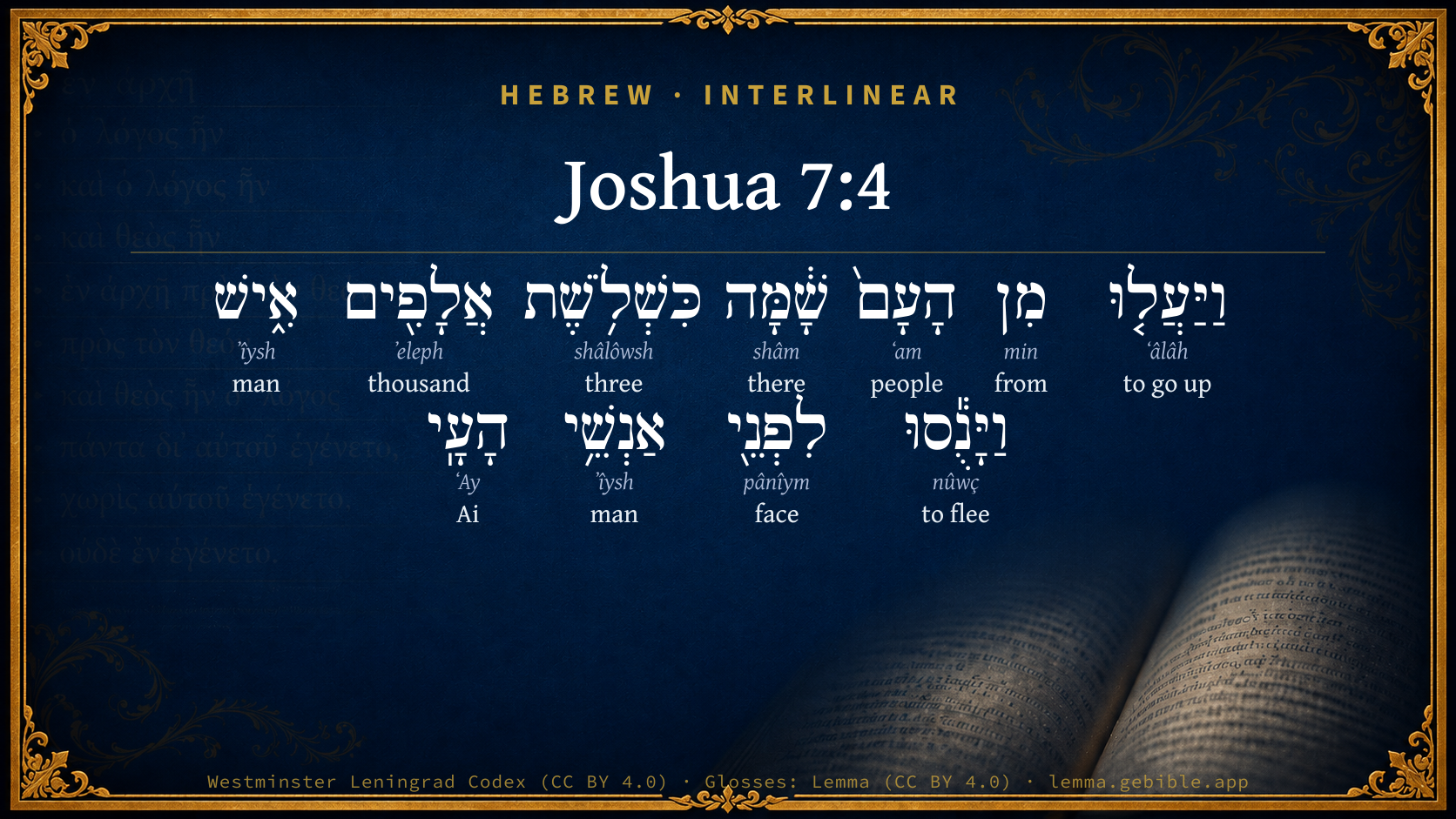
Hebrew (Westminster Leningrad Codex) Joshua 7:4 appears in the Hebrew Old Testament. The text above is from the Westminster Leningrad Codex. Each word links to its Strong’s number, a concise gloss, and parsing drawn from the Open Scriptures Hebrew Bible morphology. Click any word for its full Brown-Driver-Briggs (BDB) entry.
Download image
Cite this verse

Joshua 7:4 (World English Bible). Public Domain. Lemma interlinear Bible study tool, https://lemma.gebible.app/v/joshua/7/4.

Show BibTeX & RIS
BibTeX
RIS
English Translation
So there went up there of the people about three thousand men: and they fled before the men of Ai.
World English Bible · Public Domain
Download a study sheet

One document with this verse’s original text, its word-by-word gloss line, the meaning frame, cross-references with their text, attributed commentary, and full source and license credits — printable, and it pastes into notes with its structure intact.

This verse Autodidact and up

Study sheet (.html) Plain text (.txt)

A passage Seminary Student

Up to 50 verses in one chapter. A passage sheet keeps up to 6 commentary sources and 12 cross-references per verse, in the order this page ranks them, and says so on the sheet whenever that leaves anything out. Ask for a single verse and you get the Autodidact verse sheet above.

Everything on this page stays free to read, with no account — the sheet is a download of what is already on screen, not access to it.

Want to remove ads? Support Godless Engineer
Compare translations 3

The same verse in 3 English versions, stacked beneath the original-language interlinear above. Click any original word for its lexicon entry.

Each is an independent rendering of the whole verse — the interlinear is not word-aligned to these translations.

Highlighted words mark where these versions differ — a whole-verse word diff, not a word-by-word alignment.

  • World English Bible Public Domain
    So there went up there of the people about three thousand men: and they fled before the men of Ai.
  • King James Version Public Domain
    So there went up thither of the people about three thousand men: and they fled before the men of Ai.
  • unfoldingWord Literal Text CC BY-SA 4.0
    And about 3, 000 men from the people went up there, and they fled to the face of the men of Ai.

unfoldingWord Literal Text — © unfoldingWord, licensed CC BY-SA 4.0. Word-aligned USFM3 via Door43 (git.door43.org/unfoldingWord/en_ult).

Versions to compare (up to 4)

3 of 4 selected

Show all 18 translations

Every available English version of this verse, each an independent rendering of the whole verse.

  • World English Bible Public Domain
    So there went up there of the people about three thousand men: and they fled before the men of Ai.
  • Berean Standard Bible Public Domain
    So about three thousand men went up, but they fled before the men of Ai.
  • Majority Standard Bible Public Domain
    So about three thousand men went up, but they fled before the men of Ai.
  • King James Version Public Domain
    So there went up thither of the people about three thousand men: and they fled before the men of Ai.
  • American Standard Version (1901) Public Domain
    So there went up thither of the people about three thousand men: and they fled before the men of Ai.
  • Revised Version (1885) Public Domain
    So there went up thither of the people about three thousand men: and they fled before the men of Ai.
  • Geneva Bible (1599) Public Domain
    So there went vp thither of the people about three thousande men, and they fledde before the men of Ai.
  • Douay-Rheims (1899) Public Domain
    There went up therefore three thou- sand fighting men: who immediately turned their backs,
  • Young's Literal Translation Public Domain
    And there go up of the people thither about three thousand men, and they flee before the men of Ai,
  • Literal Standard Version CC BY-SA 4.0
    So about three thousand men of the people go up from there, and they flee before the men of Ai,
  • Unlocked Literal Bible CC BY-SA 4.0
    So only about three thousand men went up from the army, but these ran away from the men of Ai.
  • unfoldingWord Literal Text CC BY-SA 4.0
    And about 3, 000 men from the people went up there, and they fled to the face of the men of Ai.
  • Darby Bible Public Domain
    And there went up thither of the people about three thousand men, but they fled before the men of Ai.
  • World Messianic Bible Public Domain
    So about three thousand men of the people went up there, and they fled before the men of Ai.
  • Webster's Bible Public Domain
    So there went up thither of the people about three thousand men: and they fled before the men of Ai.
  • Free Bible Version CC BY-SA 4.0
    So around three thousand men went to fight, but they were beaten by the men of Ai and they ran away.
  • Bible in Basic English Public Domain
    So about three thousand of the people went up, and were sent in flight by the men of Ai.
  • JPS Tanakh (1917) Public Domain
    So there went up thither of the people about three thousand men; and they fled before the men of Ai.

Literal Standard Version (2020), Covenant Press — licensed CC BY-SA 4.0. Text via the HelloAO Bible API (eBible.org). Unlocked Literal Bible (unfoldingWord) — licensed CC BY-SA 4.0. Text via the HelloAO Bible API (eBible.org). unfoldingWord Literal Text — © unfoldingWord, licensed CC BY-SA 4.0. Word-aligned USFM3 via Door43 (git.door43.org/unfoldingWord/en_ult). Free Bible Version, Dr. Jonathan Gallagher — licensed CC BY-SA 4.0. Text via the HelloAO Bible API (eBible.org).

Word by word

More ways to search: Search by grammar → Find every occurrence → Compare this word →

Practice this passage: Drill this verse → Learn its vocabulary →

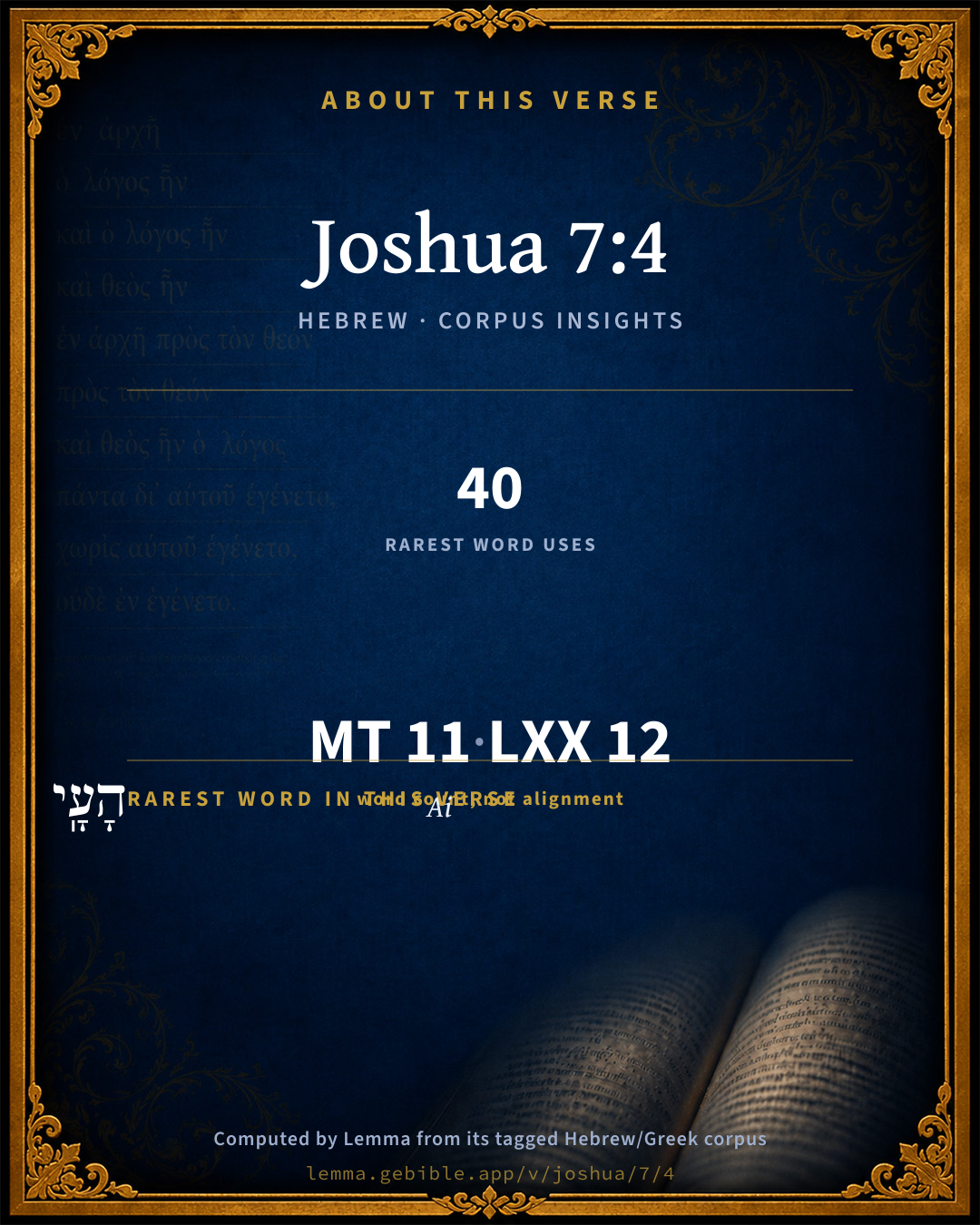
הָעָֽי
ʻAy
H5857
“the · Ai”
Particle, Definite Article + Noun, Proper
Part of Speech
Particle + Noun
Type
Proper
Full BDB Definition

Origin: for H5856

TWOT: None

Ai or Aija or Aiath or Hai = "heap of ruins" - a city lying east of Bethel and beside Bethaven near Jericho and the 2nd city taken on the invasion of Canaan - a city of the Ammonites on the east of the Jordan and apparently attached to Heshbon
  1. וַיַּעֲל֤וּ ʻâlâh H5927 “and · to go up” Conjunction + Verb, Qal, Sequential Imperfect, 3rd Person, Masculine, Plural
  2. מִן min H4480 “from” Preposition
  3. הָעָם֙ ʻam H5971 “the · people” Particle, Definite Article + Noun, Common, Masculine, Singular, Absolute
  4. שָׁ֔מָּה shâm H8033 “there · toward” Adverb + Suffix, Demonstrative
  5. כִּשְׁלֹ֥שֶׁת shâlôwsh H7969 “like/as · three” Preposition + Adjective, Cardinal number, Masculine, Singular, Construct
  6. אֲלָפִ֖ים ʼeleph H505 “thousand” Adjective, Cardinal number, Both, Plural, Absolute
  7. אִ֑ישׁ ʼîysh H376 “man” Noun, Common, Masculine, Singular, Absolute
  8. וַיָּנֻ֕סוּ nûwç H5127 “and · to flee” Conjunction + Verb, Qal, Sequential Imperfect, 3rd Person, Masculine, Plural
  9. לִפְנֵ֖י pânîym H6440 “to/for · face(s) of” Preposition + Noun, Common, Both, Plural, Construct
  10. אַנְשֵׁ֥י ʼîysh H376 “men of” Noun, Common, Masculine, Plural, Construct

About this verse

These counts appear in no published source. They are computed here, from the morphology-tagged text and Lemma’s own curated glosses. What Lemma adds →

11
words
10
distinct lemmas
Historical
section

Shared distinctive vocabulary

הָעָֽי Ai H5857 occurs in 34 verses of the Hebrew Bible. Also found in:

Grammatical profile

  • 2 verbs
  • 5 nouns
  • 2 adjectives
  • 1 preposition
  • 1 adverb

Verb forms

  • וַיַּעֲל֤וּ Qal · Sequential Imperfect
  • וַיָּנֻ֕סוּ Qal · Sequential Imperfect

Repetition

A word recurs within this verse — often emphatic in Hebrew:

  • אִ֑ישׁ man H376 ×2

Hebrew & Septuagint length

In English translation the verse runs 20 words from the Hebrew and 17 from the Septuagint (LXX English) — closely comparable.

A rough comparison of the two English renderings, which tokenize alike — not a word-level alignment.

Word counts can differ between the Hebrew and the Greek without any difference in meaning — e.g. the Hebrew direct-object marker אֵת has no separate Greek word, and Greek often adds the article ὁ.

In the original languages it is 11 Hebrew tokens and 12 Greek tokens — but the two are counted differently (Hebrew bundles its prefixes and suffixes into one token; the Greek is in lemma form), so that isn’t a like-for-like length.

Cross-references

5

Topical passages linked to Joshua 7:4 in the Treasury of Scripture Knowledge — connected by theme and wording, ordered by reader-vote popularity; previews shown in the World English Bible.

  • Deuteronomy 28:25 Yahweh will cause you to be struck before your enemies; you shall go out one way against them, and shall flee seven ways before them: and you shall be tossed back and forth among all the kingdoms of the earth.
  • Leviticus 26:17 I will set my face against you, and you will be struck before your enemies. Those who hate you will rule over you; and you will flee when no one pursues you.
  • Deuteronomy 32:30 How should one chase a thousand, Two put ten thousand to flight, Except their Rock had sold them, Yahweh had delivered them up?
  • Isaiah 30:17 One thousand [shall flee] at the threat of one; at the threat of five shall you flee: until you be left as a beacon on the top of a mountain, and as an ensign on a hill.
  • Isaiah 59:2 but your iniquities have separated between you and your God, and your sins have hidden his face from you, so that he will not hear.

Cross-references courtesy of OpenBible.info (CC BY 4.0).

Hebrew and Greek witnesses Masoretic Hebrew ↔ Greek Septuagint

The same verse in the two great witnesses to the Old Testament, shown verse-for-verse.

These are two independent witnesses, not word-aligned to each other, and the Septuagint is shown in lemma (dictionary) form.

Hebrew Joshua 7:4 Masoretic · Westminster Leningrad Codex

וַיַּעֲל֤וּ מִן הָעָם֙ שָׁ֔מָּה כִּשְׁלֹ֥שֶׁת אֲלָפִ֖ים אִ֑ישׁ וַיָּנֻ֕סוּ לִפְנֵ֖י אַנְשֵׁ֥י הָעָֽי

So there went up there of the people about three thousand men: and they fled before the men of Ai.

World English Bible · Public Domain

Greek LXX Joshua 7:4 Septuagint · lemma form

καί ἀναβαίνω ὡσεί τρισχίλιοι ἀνήρ καί φεύγω ἀπό πρόσωπον ὁ ἀνήρ γαι

And there went up about three thousand men, and they fled from before the men of Gai.

LXX2012 (modern English Septuagint) · Public Domain

Hebrew: Westminster Leningrad Codex (CC BY 4.0). Greek: Septuagint (public domain); English from LXX2012 (modern English Septuagint) (Public Domain). How the Septuagint differs from the Hebrew →

Targum (Aramaic paraphrase)

1

The Targum is the ancient Jewish Aramaic paraphrase of the Hebrew Scriptures — an interpretive translation, not the Hebrew text itself. Onkelos (literal) and Pseudo-Jonathan (expansive) render the Torah, and Jonathan the Prophets. Coverage is partial: where no permissively-licensed English translation exists for a verse, only the Aramaic is shown. This is verse-level text, not a word-by-word alignment to the Hebrew.

  1. Targum Jonathan Prophets (Joshua–Malachi)
    וּסְלִיקוּ מִן עַמָא לְתַמָן כִּתְלָתָא אַלְפִין גַבְרָא וְאַפִּיכוּ קֳדָם אֱנָשֵׁי עָי:

    (no public-domain English translation for this verse)

    Targum Jonathan — Aramaic: “Mikraot Gedolot” (public domain). English: “Sefaria Community Translation” (CC0 1.0 (public-domain dedication)); “London "Chaldee Paraphrase," 1871” (public domain). Text via Sefaria.

Commentary

Notes on Joshua 7:4 from classic Christian and Jewish commentators (each source and its license shown beneath its notes). The classic Christian expositions comment on the surrounding passage and are grouped to its opening verse, so a note may address several verses; the Jewish commentaries on the Tanakh (Rashi and others) are per-verse, so they appear only where the commentator wrote on this verse.

Lemma curates 59 commentaries, every one of them public domain or Creative Commons licensed, each selected and text-cleaned for this edition rather than reprinted as found. About our sources →

Trapp's Complete Commentary

John Trapp

Jos 7:4 So there went up thither of the people about three thousand men: and they fled before the men of Ai.

Ver. 4. And they fled before the men of Ai.] Their sins having betrayed them into the hands of divine justice, the victory was abandoned, and sent away to the enemy; as that noble General Trajan told Valens, the Arrian emperor, when he had been defeated by the Goths in the very first battle, as these Israelites also were. {a}

{a} Niceph., lib. xiii. cap. 40.

John Trapp, A Commentary or Exposition upon All the Books of the Old and New Testament (1647–1656) — public domain. Text from a community e-Sword module.

Joseph Benson's Commentary

Jos 7:4. They fled before the men of Ai — Not having courage, it seems, to strike a stroke, a plain evidence that God had forsaken them, and an instructive event, to show them what they were when God left them; that they did not gain their victories by their own valour, but that it was God that gave the Canaanites into their hands. And may we not hence conclude, however little it may be thought of, that victory or superiority in war between different nations, depends more upon the will of God than upon any other circumstance; and that a nation that goes to battle loaded with its crimes, has but little reason to hope for final victory or lasting success!

Joseph Benson's Commentary on the Old and New Testaments (1811–1818) — public domain. Text from a community e-Sword module.

Jamieson, Fausset & Brown

Robert Jamieson, A. R. Fausset & David Brown

they fled before the men of Ai--An unexpected resistance, and the loss of thirty-six of their number diffused a panic, which ended in an ignominious rout.

Jamieson, Fausset & Brown — Commentary Critical and Explanatory on the Whole Bible (1871) — public domain (CC PDM 1.0). Text via the HelloAO Bible API.

Adam Clarke's Commentary

Verse 4. About three thousand men] The spies sent to reconnoitre the place (Jos 7:3) reported that the town was meanly garrisoned, and that two or three thousand men would be sufficient to take it. These were accordingly sent up, and were repulsed by the Amorites.

Adam Clarke's Commentary on the Bible (1810–1826) — public domain. Text from a community e-Sword/MySword module.

Ellicott's Commentary for English Readers

(4) They fled before the men of Ai.—A very natural reaction from overweening confidence to utter dismay is exhibited in this incident and its effect (Jos_7:5), “the heart of the people melted and became as water.” The demoralisation of Israel was a suitable penalty for their assumption, quite apart from its supernatural cause. It was absolutely necessary that the character of the conquest of Canaan should be vindicated, at whatever cost.

A Bible Commentary for English Readers, edited by Charles John Ellicott (1878–1897) — public domain. Text from a community e-Sword module.

John Gill's Exposition

So there went up thither of the people about three thousand men,.... Joshua detached from the army the largest number proposed, that there might be strength enough to take the place; and those he sent under proper officers to Ai, who went up to the very gate of the city, as appears from Jos 7:5,

and they fled before the men of Ai; for upon their appearing at the gate of their city, they came out with all their forces against them, and as soon as they did, the children of Israel durst not face them, but without engaging with them fled at once: God having forsaken them, their courage failed, the dread of their enemies falling on them.

John Gill's Exposition of the Whole Bible (1746–1763) — public domain (CC PDM 1.0). Text via the HelloAO Bible API.

Matthew Poole's English Annotations

Not having their usual courage to strike a stroke, which was a plain evidence that God had forsaken them; and a useful instruction, to show them what weak and inconsiderable creatures they were when God left them; and that it was God, not their own valour, that gave the Canaanites and their land into their hands.

Matthew Poole's English Annotations on the Holy Bible (1683–1685) — public domain. Text from a community e-Sword/MySword module.

Whedon's Commentary on the Bible

Daniel D. Whedon

4. They fled before the men of Ai — Having made their assault in perfect confidence of success, and having met an unexpected repulse, they became panic-stricken, and fled in disorder.

Daniel D. Whedon (gen. ed.), Commentary on the Old and New Testaments (1874–1909) — public domain. Text from a community e-Sword module.

John Wesley's Explanatory Notes

They fled - Not having courage to strike a stroke, which was a plain evidence that God had forsaken then; and an useful instruction, to shew them what they were when God left them: and that it was God, not their own valour, that gave the Canaanites into their hands.

John Wesley, Explanatory Notes Upon the Whole Bible (1754–1765) — public domain. Text via the GEBible commentary corpus.

unfoldingWord translationNotes

Door43 World Missions Community

three thousand men went up from the army

These men were part of the army. AT: "three thousand men belonging to the army went up"

three thousand men ... thirty-six men

"3,000 men ... 36 men" (See: Numbers)

The hearts of the people melted and became like water

These phrases "melted" and "became like water" share similar meanings and are combined to emphasize that the people were extremely afraid. (See: Parallelism)

The hearts of the people melted

Here the people are represented by their "hearts" to emphasize their emotions. AT: "The people were very afraid" (See: Synecdoche)

The hearts of the people

The phrase "the people" refers to the Israelite soldiers.

translationWords

Ai

gate

heart

fear

unfoldingWord translationNotes — © Distant Shores Media and the Door43 World Missions Community, licensed CC BY-SA 4.0. Source: git.door43.org/Door43/en_tn.

Lesson kit

Teaching starters — assembled from the data on this page, not authored interpretation. Every prompt links to the verse data it draws on. Edit before teaching.

Joshua, in the Historical, opens this verse with 11 words (10 distinct Hebrew lemmas). Its most distinctive word is ʻAy (“Ai”). A historical commentator’s framing appears above. Read the whole chapter for the surrounding context.

Discussion questions

  1. What does “Ai” (ʻAy) contribute to the verse as a whole?
  2. How does Genesis 12:8, which shares the word «Ai», read alongside this verse?
  3. What does the repetition of “man” (2× in this one verse) do in this verse?
  4. These translations render this verse differently. What is at stake in choosing one wording over another?
  5. «וַיַּעֲל֤וּ» is a Qal Sequential Imperfect verb. How does that grammatical form shape the action described?
  6. Compare how Trapp's Complete Commentary and Joseph Benson's Commentary read this verse. Where do they agree or differ?

Things to notice

Reading settings

Reading text

Shown beneath each verse's original-language words.

Old Testament
Old Testament edition

Read the OT as the Masoretic Hebrew (MT) or the Greek Septuagint (LXX).

English shown for the Greek Septuagint (in the Hebrew ↔ Greek comparison).

Comparing translations? Open the Compare panel on any verse page to stack up to four side by side.