
Exodus 8:5

Hebrew (Westminster Leningrad Codex) Exodus 8:5 appears in the Hebrew Old Testament. The text above is from the Westminster Leningrad Codex. Each word links to its Strong’s number, a concise gloss, and parsing drawn from the Open Scriptures Hebrew Bible morphology. Click any word for its full Brown-Driver-Briggs (BDB) entry.
Download image
Cite this verse

Exodus 8:5 (World English Bible). Public Domain. Lemma interlinear Bible study tool, https://lemma.gebible.app/v/exodus/8/5.

Show BibTeX & RIS
BibTeX
RIS
English Translation
Yahweh said to Moses, "Tell Aaron, 'Stretch forth your hand with your rod over the rivers, over the streams, and over the pools, and cause frogs to come up on the land of Egypt.'"
World English Bible · Public Domain
Download a study sheet

One document with this verse’s original text, its word-by-word gloss line, the meaning frame, cross-references with their text, attributed commentary, and full source and license credits — printable, and it pastes into notes with its structure intact.

This verse Autodidact and up

Study sheet (.html) Plain text (.txt)

A passage Seminary Student

Up to 50 verses in one chapter. A passage sheet keeps up to 6 commentary sources and 12 cross-references per verse, in the order this page ranks them, and says so on the sheet whenever that leaves anything out. Ask for a single verse and you get the Autodidact verse sheet above.

Everything on this page stays free to read, with no account — the sheet is a download of what is already on screen, not access to it.

Want to remove ads? Support Godless Engineer
Compare translations 3

The same verse in 3 English versions, stacked beneath the original-language interlinear above. Click any original word for its lexicon entry.

Each is an independent rendering of the whole verse — the interlinear is not word-aligned to these translations.

Highlighted words mark where these versions differ — a whole-verse word diff, not a word-by-word alignment.

  • World English Bible Public Domain
    Yahweh said to Moses, "Tell Aaron, 'Stretch forth your hand with your rod over the rivers, over the streams, and over the pools, and cause frogs to come up on the land of Egypt.'"
  • King James Version Public Domain
    And the LORD spake unto Moses, Say unto Aaron, Stretch forth thine hand with thy rod over the streams, over the rivers, and over the ponds, and cause frogs to come up upon the land of Egypt.
  • unfoldingWord Literal Text CC BY-SA 4.0
    And Yahweh said to Moses, “Say to Aaron, ‘Reach out your hand with your staff over the canals, over the streams, and over the pools, and cause the frogs to come up on the land of Egypt.’”

unfoldingWord Literal Text — © unfoldingWord, licensed CC BY-SA 4.0. Word-aligned USFM3 via Door43 (git.door43.org/unfoldingWord/en_ult).

Versions to compare (up to 4)

3 of 4 selected

Show all 18 translations

Every available English version of this verse, each an independent rendering of the whole verse.

  • World English Bible Public Domain
    Yahweh said to Moses, "Tell Aaron, 'Stretch forth your hand with your rod over the rivers, over the streams, and over the pools, and cause frogs to come up on the land of Egypt.'"
  • Berean Standard Bible Public Domain
    And the LORD said to Moses, “Tell Aaron, ‘Stretch out your hand with your staff over the rivers and canals and ponds, and cause the frogs to come up onto the land of Egypt.’”
  • Majority Standard Bible Public Domain
    And the LORD said to Moses, “Tell Aaron, ‘Stretch out your hand with your staff over the rivers and canals and ponds, and cause the frogs to come up onto the land of Egypt.’”
  • King James Version Public Domain
    And the LORD spake unto Moses, Say unto Aaron, Stretch forth thine hand with thy rod over the streams, over the rivers, and over the ponds, and cause frogs to come up upon the land of Egypt.
  • American Standard Version (1901) Public Domain
    And Jehovah said unto Moses, Say unto Aaron, Stretch forth thy hand with thy rod over the rivers, over the streams, and over the pools, and cause frogs to come up upon the land of Egypt.
  • Revised Version (1885) Public Domain
    And the LORD said unto Moses, Say unto Aaron, Stretch forth thine hand with thy rod over the rivers, over the streams, and over the pools, and cause frogs to come up upon the land of Egypt.
  • Geneva Bible (1599) Public Domain
    Also the Lord said vnto Moses, Say thou vnto Aaron, Stretch out thine hande with thy rod vpon the streames, vpon the riuers, and vpon the ponds, and cause frogs to come vp vpon the land of Egypt.
  • Douay-Rheims (1899) Public Domain
    And the Lord said to Moses: Say to Aaron, Stretch forth thy hand upon the streams and upon the rivers and the pools, and bring forth frogs upon the land of Egypt.
  • Young's Literal Translation Public Domain
    And Jehovah saith unto Moses, `Say unto Aaron, Stretch out thy hand, with thy rod, against the streams, against the rivers, and against the ponds, and cause the frogs to come up against the land of Egypt.'
  • Literal Standard Version CC BY-SA 4.0
    And YHWH says to Moses, “Say to Aaron, Stretch out your hand, with your rod, against the streams, against the rivers, and against the ponds, and cause the frogs to come up against the land of Egypt.”
  • Unlocked Literal Bible CC BY-SA 4.0
    Yahweh said to Moses, “Say to Aaron, 'Reach out with your hand and your staff over the rivers, the streams, and the pools, and bring the frogs up over the land of Egypt.'”
  • unfoldingWord Literal Text CC BY-SA 4.0
    And Yahweh said to Moses, “Say to Aaron, ‘Reach out your hand with your staff over the canals, over the streams, and over the pools, and cause the frogs to come up on the land of Egypt.’”
  • Darby Bible Public Domain
    And Jehovah said to Moses, Say unto Aaron, Stretch out thy hand with thy staff over the streams, over the rivers, and over the ponds, and cause frogs to come up on the land of Egypt.
  • World Messianic Bible Public Domain
    The LORD said to Moses, “Tell Aaron, ‘Stretch out your hand with your rod over the rivers, over the streams, and over the pools, and cause frogs to come up on the land of Egypt.’”
  • Webster's Bible Public Domain
    And the LORD spoke to Moses, Say to Aaron, Stretch forth thy hand with thy rod over the streams, over the rivers, and over the ponds, and cause frogs to come up on the land of Egypt.
  • Free Bible Version CC BY-SA 4.0
    The Lord said to Moses, “Tell Aaron, ‘Hold out your walking stick in your hand over the rivers and canals and ponds, and make frogs spread over Egypt.’”
  • Bible in Basic English Public Domain
    And the Lord said to Moses, Say to Aaron, Let the rod in your hand be stretched out over the streams and the waterways and the pools, causing frogs to come up on the land of Egypt.
  • JPS Tanakh (1917) Public Domain
    (8-1) And the LORD said unto Moses: 'Say unto Aaron: Stretch forth thy hand with thy rod over the rivers, over the canals, and over the pools, and cause frogs to come up upon the land of Egypt.'

Literal Standard Version (2020), Covenant Press — licensed CC BY-SA 4.0. Text via the HelloAO Bible API (eBible.org). Unlocked Literal Bible (unfoldingWord) — licensed CC BY-SA 4.0. Text via the HelloAO Bible API (eBible.org). unfoldingWord Literal Text — © unfoldingWord, licensed CC BY-SA 4.0. Word-aligned USFM3 via Door43 (git.door43.org/unfoldingWord/en_ult). Free Bible Version, Dr. Jonathan Gallagher — licensed CC BY-SA 4.0. Text via the HelloAO Bible API (eBible.org).

Word by word

More ways to search: Search by grammar → Find every occurrence → Compare this word →

Practice this passage: Drill this verse → Learn its vocabulary →

הָאֲגַמִּ֑ים
ʼăgam
H98
“the · pools”
Particle, Definite Article + Noun, Common, Masculine, Plural, Absolute
Part of Speech
Particle + Noun
Type
Common
Gender
Masculine
Number
Plural
State
Absolute
Full BDB Definition

Origin: from an unused root (meaning to collect as water)

TWOT: 18a

pool, troubled pool - troubled or muddy (gloomy) pools, marshes - any pool, pond - swamp reeds, reeds, rush(es)
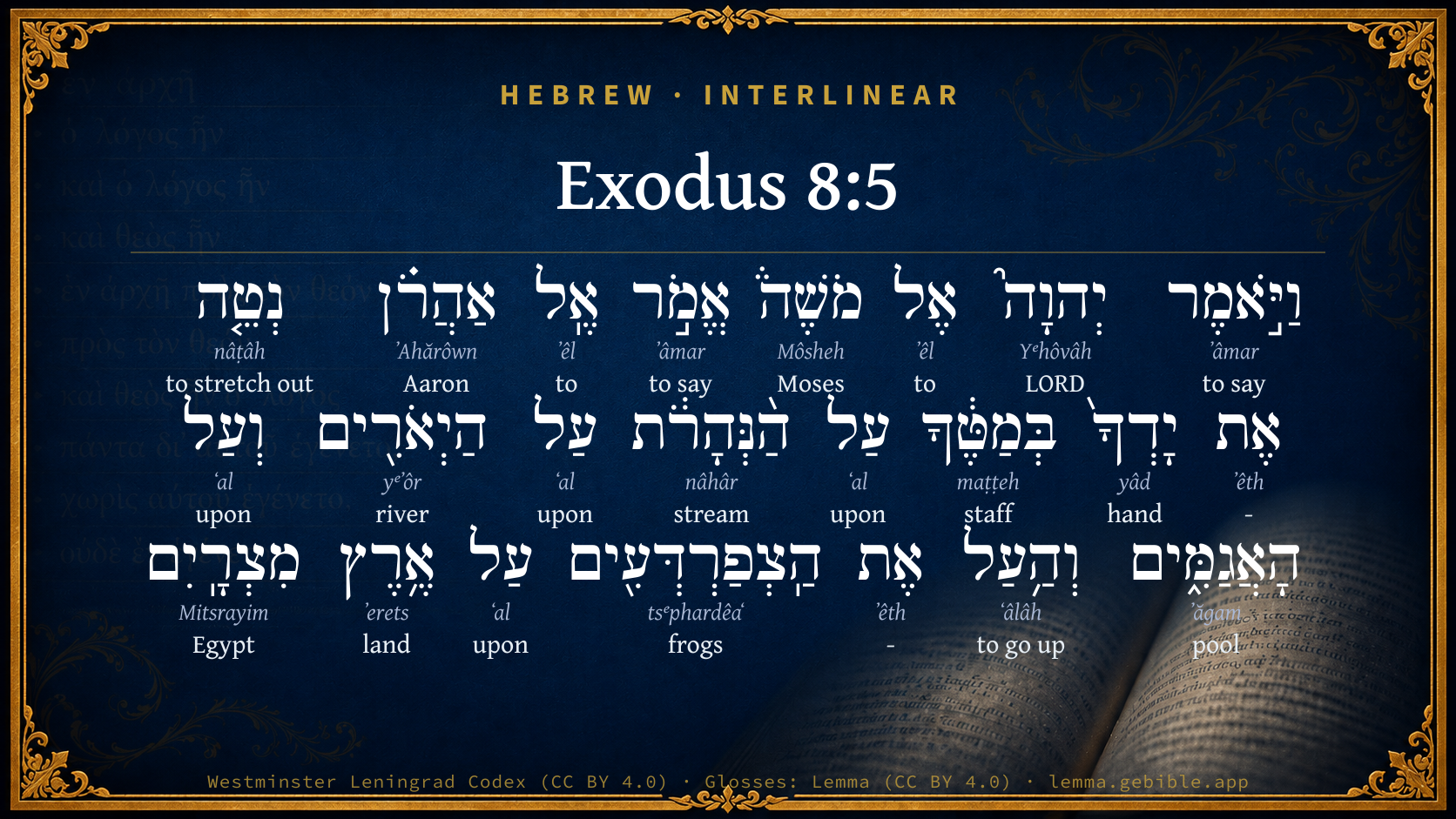
  1. וַיֹּ֣אמֶר ʼâmar H559 “and · to say” Conjunction + Verb, Qal, Sequential Imperfect, 3rd Person, Masculine, Singular
  2. יְהוָה֮ Yᵉhôvâh H3068 “LORD” Noun, Proper
  3. אֶל ʼêl H413 “to” Preposition
  4. מֹשֶׁה֒ Môsheh H4872 “Moses” Noun, Proper
  5. אֱמֹ֣ר ʼâmar H559 “say” Verb, Qal, Imperative, 2nd Person, Masculine, Singular
  6. אֶֽל ʼêl H413 “to” Preposition
  7. אַהֲרֹ֗ן ʼAhărôwn H175 “Aaron” Noun, Proper
  8. נְטֵ֤ה nâṭâh H5186 “stretch out” Verb, Qal, Imperative, 2nd Person, Masculine, Singular
  9. אֶת ʼêth H853 “-” Particle, Direct Object
  10. יָדְךָ֙ yâd H3027 “hand · your” Noun, Common, Both, Singular, Construct + Suffix, Personal, 2nd Person, Masculine, Singular
  11. בְּמַטֶּ֔ךָ maṭṭeh H4294 “in/at · staff · your” Preposition + Noun, Common, Masculine, Singular, Construct + Suffix, Personal, 2nd Person, Masculine, Singular
  12. עַל ʻal H5921 “upon” Preposition
  13. הַ֨נְּהָרֹ֔ת nâhâr H5104 “the · streams” Particle, Definite Article + Noun, Common, Masculine, Plural, Absolute
  14. עַל ʻal H5921 “upon” Preposition
  15. הַיְאֹרִ֖ים yᵉʼôr H2975 “the · rivers” Particle, Definite Article + Noun, Common, Masculine, Plural, Absolute
  16. וְעַל ʻal H5921 “and · upon” Conjunction + Preposition
  17. וְהַ֥עַל ʻâlâh H5927 “and · go up” Conjunction + Verb, Hiphil, Imperative, 2nd Person, Masculine, Singular
  18. אֶת ʼêth H853 “-” Particle, Direct Object
  19. הַֽצְפַרְדְּעִ֖ים tsᵉphardêaʻ H6854 “the · frogs” Particle, Definite Article + Noun, Common, Feminine, Plural, Absolute
  20. עַל ʻal H5921 “upon” Preposition
  21. אֶ֥רֶץ ʼerets H776 “land of” Noun, Common, Both, Singular, Construct
  22. מִצְרָֽיִם Mitsrayim H4714 “Egypt” Noun, Proper

About this verse

These counts appear in no published source. They are computed here, from the morphology-tagged text and Lemma’s own curated glosses. What Lemma adds →

23
words
17
distinct lemmas
Pentateuch
section

Notable vocabulary

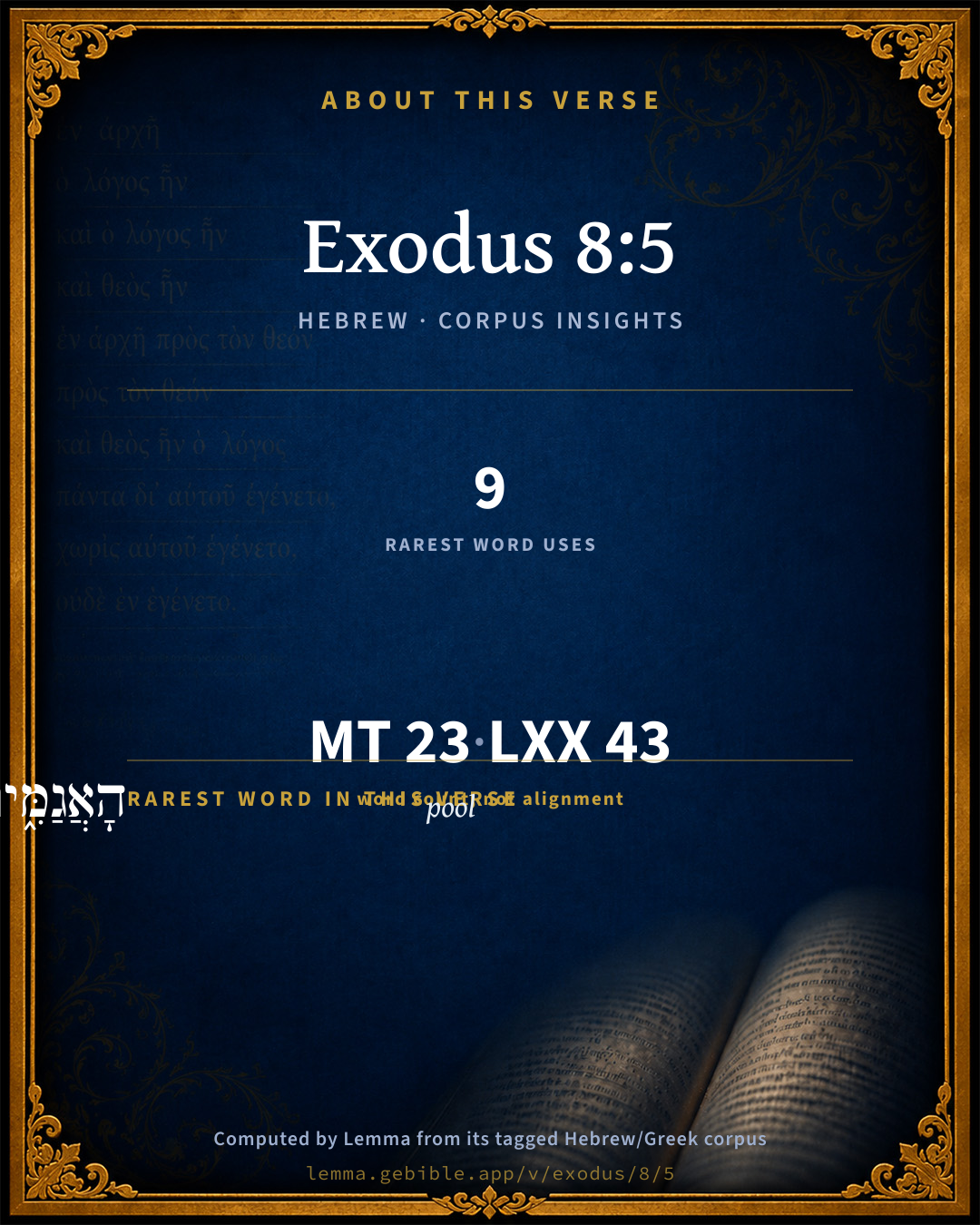
The rarest word here is הָאֲגַמִּ֑ים pool H98 — appearing just 9 times in the whole Hebrew Bible.

Shared distinctive vocabulary

הָאֲגַמִּ֑ים pool H98 occurs in 9 verses of the Hebrew Bible. Also found in:

Grammatical profile

  • 4 verbs
  • 11 nouns
  • 6 prepositions
  • 2 particles

Verb forms

  • וַיֹּ֣אמֶר Qal · Sequential Imperfect
  • אֱמֹ֣ר Qal · Imperative
  • נְטֵ֤ה Qal · Imperative
  • וְהַ֥עַל Hiphil · Imperative

Repetition

Words recur within this verse — often emphatic in Hebrew:

  • עַל upon H5921 ×4
  • וַיֹּ֣אמֶר to say H559 ×2
  • אֶל to H413 ×2

Hebrew & Septuagint length

In English translation the verse runs 34 words from the Hebrew and 34 from the Septuagint (LXX English) — the same length.

A rough comparison of the two English renderings, which tokenize alike — not a word-level alignment.

Word counts can differ between the Hebrew and the Greek without any difference in meaning — e.g. the Hebrew direct-object marker אֵת has no separate Greek word, and Greek often adds the article ὁ.

In the original languages it is 23 Hebrew tokens and 43 Greek tokens — but the two are counted differently (Hebrew bundles its prefixes and suffixes into one token; the Greek is in lemma form), so that isn’t a like-for-like length.

Cross-references

1

Topical passages linked to Exodus 8:5 in the Treasury of Scripture Knowledge — connected by theme and wording, ordered by reader-vote popularity; previews shown in the World English Bible.

  • Exodus 7:19 Yahweh said to Moses, "Tell Aaron, 'Take your rod, and stretch out your hand over the waters of Egypt, over their rivers, over their streams, and over their pools, and over all their ponds of water, that they may become blood; and there shall be blood throughout all the land of Egypt, both in vessels of wood and in vessels of stone.'"

Cross-references courtesy of OpenBible.info (CC BY 4.0).

Hebrew and Greek witnesses Masoretic Hebrew ↔ Greek Septuagint

The same verse in the two great witnesses to the Old Testament, shown verse-for-verse.

These are two independent witnesses, not word-aligned to each other, and the Septuagint is shown in lemma (dictionary) form.

Hebrew Exodus 8:5 Masoretic · Westminster Leningrad Codex

וַיֹּ֣אמֶר יְהוָה֮ אֶל מֹשֶׁה֒ אֱמֹ֣ר אֶֽל אַהֲרֹ֗ן נְטֵ֤ה אֶת יָדְךָ֙ בְּמַטֶּ֔ךָ עַל הַ֨נְּהָרֹ֔ת עַל הַיְאֹרִ֖ים וְעַל הָאֲגַמִּ֑ים וְהַ֥עַל אֶת הַֽצְפַרְדְּעִ֖ים עַל אֶ֥רֶץ מִצְרָֽיִם

Yahweh said to Moses, "Tell Aaron, 'Stretch forth your hand with your rod over the rivers, over the streams, and over the pools, and cause frogs to come up on the land of Egypt.'"

World English Bible · Public Domain

Greek LXX Exodus 8:5 Septuagint · lemma form

εἶπον δέ μωυσῆς πρός φαραώ τάσσω πρός ἐγώ πότε εὔχομαι περί σύ καί περί ὁ θεράπων σύ καί περί ὁ λαός σύ ἀπο ἀναἵζω ὁ βάτραχος ἀπό σύ καί ἀπό ὁ λαός σύ καί ἐκ ὁ οἰκία σύ πλήν ἐν ὁ ποταμός ὑπολείπω

And the Lord said to Moses, Say to Aaron your brother, Stretch forth with the hand your rod over the rivers, and over the canals, and over the pools, and bring up the frogs.

LXX2012 (modern English Septuagint) · Public Domain

Hebrew: Westminster Leningrad Codex (CC BY 4.0). Greek: Septuagint (public domain); English from LXX2012 (modern English Septuagint) (Public Domain). How the Septuagint differs from the Hebrew →

Targum (Aramaic paraphrase)

2

The Targum is the ancient Jewish Aramaic paraphrase of the Hebrew Scriptures — an interpretive translation, not the Hebrew text itself. Onkelos (literal) and Pseudo-Jonathan (expansive) render the Torah, and Jonathan the Prophets. Coverage is partial: where no permissively-licensed English translation exists for a verse, only the Aramaic is shown. This is verse-level text, not a word-by-word alignment to the Hebrew.

  1. Targum Onkelos Torah (Genesis–Deuteronomy)
    וַאֲמַר משֶׁה לְפַרְעֹה שְׁאַל לָךְ גְבוּרָא הַב לִי זְמַן לְאִמָתַי אֱצַלֵי עֲלָךְ וְעַל עַבְדָיךְ וְעַל עַמָךְ לְשֵׁיצָאָה עֻרְדְעָנַיָא מִנָךְ וּמִבָּתָּיךְ לְחוֹד בְּנַהֲרָא תִּשְׁתָּאָרָן:

    (no public-domain English translation for this verse)

    Targum Onkelos — Aramaic: “Onkelos Genesis” (public domain); “Onkelos Exodus” (public domain); “Onkelos Leviticus” (public domain); “Onkelos Numbers” (public domain); “Onkelos Deuteronomy” (public domain). English: “Sefaria Community Translation” (CC0 1.0 (public-domain dedication)); “J.W. Etheridge. The Targums of Onkelos and Jonathan Ben Uzziel on the Pentateuch. London: Longmans, Green, 1862” (public domain). Text via Sefaria.

  2. Targum Pseudo-Jonathan Torah (Genesis–Deuteronomy)
    וַאֲמַר משֶׁה לְפַרְעה שַׁבַּח בְּגִינִי לְאֵימַת דְאַנְתְּ בָּעֵי אַיְצַלֵי עֲלָךְ וְעַל עַבְדָךְ וְעַל עַמָךְ לְשֵׁיצָאָה עוּרְדְעָנַיָא מִינָךְ וּמִבָּתָּךְ לְחוֹד מָה דִבְנַהֲרָא יִשְׁתַּיְירוּן

    And Mosheh said to Pharoh, Glorify thyself on account of me. At what time dost thou request that I should pray for thee, and for thy servants, and for thy people, that the frogs may be destroyed from thee and from thy house, and be left only in the river?

    Targum Pseudo-Jonathan — Aramaic: “Targum Jonathan on Genesis” (public domain); “Targum Jonathan on Exodus” (public domain); “Targum Jonathan on Leviticus” (public domain); “Targum Jonathan on Numbers” (public domain); “Targum Jonathan on Deuteronomy” (public domain). English: “The Targum of Jonathan ben Uzziel, trans. J. W. Etheridge, London, 1862” (public domain). Text via Sefaria.

Commentary

Notes on Exodus 8:5 from classic Christian and Jewish commentators (each source and its license shown beneath its notes). The classic Christian expositions comment on the surrounding passage and are grouped to its opening verse, so a note may address several verses; the Jewish commentaries on the Tanakh (Rashi and others) are per-verse, so they appear only where the commentator wrote on this verse.

Lemma curates 59 commentaries, every one of them public domain or Creative Commons licensed, each selected and text-cleaned for this edition rather than reprinted as found. About our sources →

Trapp's Complete Commentary

John Trapp

Exo 8:5 And the LORD spake unto Moses, Say unto Aaron, Stretch forth thine hand with thy rod over the streams, over the rivers, and over the ponds, and cause frogs to come up upon the land of Egypt.

Ver. 5. And the Lord spake unto Moses.] By secret inspiration; for it was in Pharaoh’s presence.

John Trapp, A Commentary or Exposition upon All the Books of the Old and New Testament (1647–1656) — public domain. Text from a community e-Sword module.

Jamieson, Fausset & Brown

Robert Jamieson, A. R. Fausset & David Brown

Stretch forth thine hand with thy rod over the streams, &c. The miracle consisted in the reptiles leaving their marshes at the very time he commanded them.

Jamieson, Fausset & Brown — Commentary Critical and Explanatory on the Whole Bible (1871) — public domain (CC PDM 1.0). Text via the HelloAO Bible API.

Adam Clarke's Commentary

Verse 5. Stretch forth thine hand - over the streams, over the rivers] The streams and rivers here may refer to the grand divisions of the Nile in the Lower Egypt, which were at least seven, and to the canals by which these were connected; as there were no other streams, &c., but what proceeded from this great river.

Adam Clarke's Commentary on the Bible (1810–1826) — public domain. Text from a community e-Sword/MySword module.

The Cambridge Bible for Schools and Colleges

gen. ed. J. J. S. Perowne

5. Say unto Aaron] See on Exo_7:19.

with thy rod] The rod which in P Aaron habitually carries (Exo_7:9; Exo_7:19, Exo_8:16-17).

the streams] the Nile-canals, as Exo_7:19. In J the frogs are to come up only out of the Nile (v. 3); in P they come up out of the other waters in Egypt as well (cf. v. 6).

5–7. The arrival of the frogs is described in an extract from P. As elsewhere in P (p. 55), the wonder is brought about by Aaron with is rod.

The Cambridge Bible for Schools and Colleges (gen. ed. J. J. S. Perowne; Cambridge University Press, 1878–1918) — public domain. Text from a community e-Sword module.

John Gill's Exposition

And Aaron stretched out his hand over the waters of Egypt,.... That is, towards the waters of the Nile, and towards all places where any water was; for it was not possible he could stretch out his hand over all the waters that were in every place:

and the frogs came and covered the land of Egypt: they came up at once, and in such multitudes everywhere, that the whole land was full of them; this was done on the twenty fifth of Adar, or February, the same day the former plague ceased; so Artapanus (s), the Heathen historian says, that Moses by his rod produced frogs, locusts, and lice. And the story which Heraclides Lembus (t) tells seems to be hammered out of this account of Moses, that in Paeonia and Dardania such a number of frogs fell from heaven, as filled the public roads and private houses; at first the inhabitants killed them, and keeping their houses shut, bore it patiently some time; but when it signified nothing, and their household goods were covered with them, and they found them boiled and roasted with their food, and lay in such heaps that they could not tread for them, and were so distressed with the smell of the dead ones, they forsook their country.

(s) Apud Euseb. ut supra. (Praepar. Evangel. l. 9. c. 27. p. 425.) (t) Apud Athenaei Deipnosophist. l. 8. c. 2.

John Gill's Exposition of the Whole Bible (1746–1763) — public domain (CC PDM 1.0). Text via the HelloAO Bible API.

Matthew Poole's English Annotations

The Lord spake unto Moses, by inward instinct or suggestion to his mind; for He was now in the king’s presence.

Matthew Poole's English Annotations on the Holy Bible (1683–1685) — public domain. Text from a community e-Sword/MySword module.

The Pulpit Commentary

Over the streams rivers ponds. See the comment on Exo_7:19.

The Pulpit Commentary (1880–1919), ed. H.D.M. Spence-Jones & Joseph S. Exell — public domain. Text from a community e-Sword module.

unfoldingWord translationNotes

Door43 World Missions Community

translationWords

Aaron

staff

Egypt

water

magic

unfoldingWord translationNotes — © Distant Shores Media and the Door43 World Missions Community, licensed CC BY-SA 4.0. Source: git.door43.org/Door43/en_tn.

Rashi

Rabbi Shlomo Yitzchaki (Rashi)

התפאר עלי GLORY OVER ME — Similar is, (Isaiah 10:15) “Should the axe יתפאר against him that heweth therewith” i. e. should it boast, saying “I am greater than thou”; old French vanter. Therefore התפאר means pride yourself on showing your cleverness and on asking of me a difficult matter asserting that I shall be unable to do it.

למתי אעתיר FOR WHAT PERIOD SHALL I ENTREAT FOR THEE — With reference to the entreaty which I shall make to-day regarding the destruction of the frogs, by what period do you wish that they should be destroyed, and you will see whether I can carry out my promise by the time which you will set me. If the text said מתי אעתיר (without ל), it would signify “when shall I pray?” but now that it is said למתי, it signifies I will pray to-day for you that the frogs should be destroyed by the time which you will set for me. Tell me, then, by what day you wish that they shall be destroyed. The words here, אעתיר and העתירו (v. 4) and העתרתי (v. 25) are Hiphil forms, and it does not say אֶעְתַּר and עִתְרוּ and וְעָתַרְתִּי (Kal forms) because wherever the root עתר is used it denotes to pray much (more lit. Rashi’s words signify “to multiply praying”, “to make much praying”), and just as one says אַרְבֶּה and הַרְבּוּ and וְהִרְבֵּתִי which all have the meaning of “causing an action to happen” (in this case, causing a thing to be much — our Hiphil conjugation), so one says אַעְתִּיר and הַעְתִּירוּ and וְהֵעְתַּרְתִּי “I increase”, “increase ye” and “I will increase” i. e. I will increase words. The passage which serves as evidence of the meaning of all these words is (Ezekiel 35:13) “וְהֵעְתַּרְתֶּם your words against Me” — which can only mean “Ye have multiplied” (being a transitive verb; cf. Rashi on Genesis 25:21).

Rashi on the Tanakh — English translations: “The Judaica Press complete Tanach with Rashi, translated by A. J. Rosenberg” (CC BY 4.0); “Pentateuch with Rashi's commentary by M. Rosenbaum and A.M. Silbermann, 1929-1934” (public domain); “The Metsudah Tanach series, Lakewood, N.J” (CC BY 4.0); and “The Book of Joshua, Metsudah Publications, 1997” (CC BY 4.0). Text via Sefaria.

Ramban (Nachmanides)

Rabbi Moshe ben Nachman (Ramban / Nachmanides)

L’MATHAI’ (AGAINST WHAT TIME) SHALL I ENTREAT FOR THEE? Rashi commented: “If the text said mathai (when) — [not l’mathai] — shall I entreat, it would signify ‘when shall I pray?’ But now that it said l’mathai, it means ‘Today I will pray for you that the frogs be destroyed by the time which you will set for me. Say then by what day you wish that they shall be destroyed.’”In line with the plain meaning of Scripture, the removal of the plagues took place at the time of Moses’ prayer, as it is written, And Moses cried unto the Eternal, etc., and the Eternal did according to the word of Moses and it is not written “and the Eternal did so tomorrow.” The letter lamed in the word l’mathai is no proof that Moses prayed immediately, for the word l’mathai is equivalent to mathai, there being many verses where the lamed occurs [just for elegance of language], thus: ‘l’min’ (from) the day that thou didst go forth out of the land of Egypt; in the word l’min is superfluous. until ‘l’minchath’ (the offering) of the evening; in l’minchath is a superfluous style. the wing of the one cherub was five ‘l’amoth’ (cubits). in l’amoth is superfluous. There are many other such cases.

THAT THE FROGS BE DESTROYED. This is an allusion to their death, just as the expressions: that soul shall be cut off; and I will cut off from Ahab every man-child. The intent of Moses’ repeating the promise to Pharaoh, And the frogs shall depart, etc., was to state that as soon as he will have prayed, the frogs will all be removed, and that Pharaoh should not fear that when these frogs die, others will come up from the river. Rather, the plague will be completely removed even though some of them will remain in the river. All this was to inform Pharaoh that the plague came from G-d for the sake of Israel alone.

Ramban (Nachmanides) on the Tanakh — English translation: “Commentary on the Torah by Ramban (Nachmanides). Translated and annotated by Charles B. Chavel. New York, Shilo Pub. House, 1971-1976” (CC BY 4.0). Text via Sefaria.

Lesson kit

Teaching starters — assembled from the data on this page, not authored interpretation. Every prompt links to the verse data it draws on. Edit before teaching.

Exodus, in the Pentateuch, opens this verse with 23 words (17 distinct Hebrew lemmas). Its most distinctive word is ʼăgam (“pool”). A historical commentator’s framing appears above. Read the whole chapter for the surrounding context.

Discussion questions

  1. What does “pool” (ʼăgam) contribute to the verse as a whole?
  2. How does Exodus 7:19, which shares the word «pool», read alongside this verse?
  3. What does the repetition of “upon” (4× in this one verse) do in this verse?
  4. These translations render this verse differently. What is at stake in choosing one wording over another?
  5. «וַיֹּ֣אמֶר» is a Qal Sequential Imperfect verb. How does that grammatical form shape the action described?
  6. Compare how Trapp's Complete Commentary and Jamieson, Fausset & Brown read this verse. Where do they agree or differ?

Things to notice

Reading settings

Reading text

Shown beneath each verse's original-language words.

Old Testament
Old Testament edition

Read the OT as the Masoretic Hebrew (MT) or the Greek Septuagint (LXX).

English shown for the Greek Septuagint (in the Hebrew ↔ Greek comparison).

Comparing translations? Open the Compare panel on any verse page to stack up to four side by side.