
Numbers 14:40

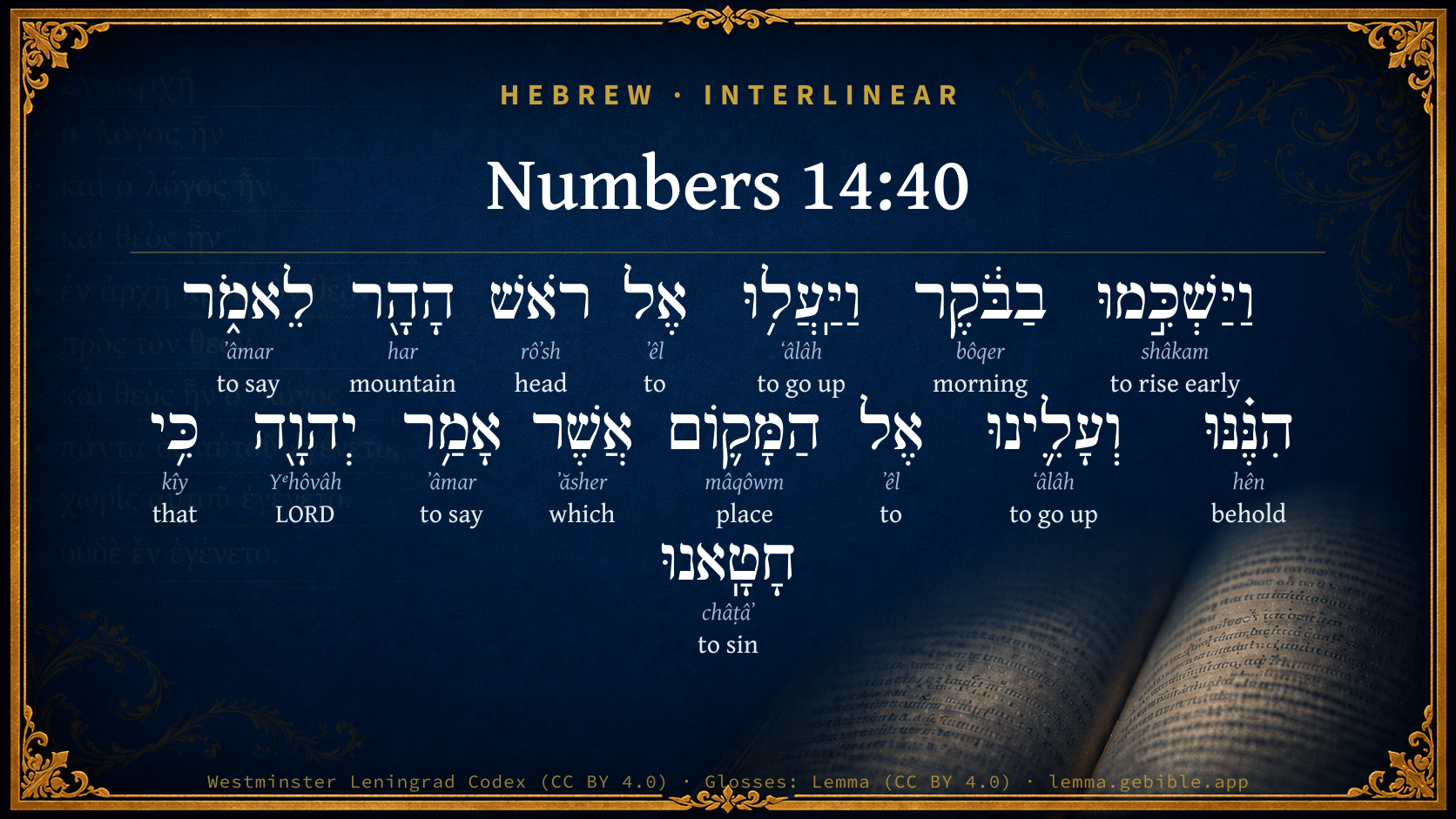
Hebrew (Westminster Leningrad Codex) Numbers 14:40 appears in the Hebrew Old Testament. The text above is from the Westminster Leningrad Codex. Each word links to its Strong’s number, a concise gloss, and parsing drawn from the Open Scriptures Hebrew Bible morphology. Click any word for its full Brown-Driver-Briggs (BDB) entry.
Download image
Cite this verse

Numbers 14:40 (World English Bible). Public Domain. Lemma interlinear Bible study tool, https://lemma.gebible.app/v/numbers/14/40.

Show BibTeX & RIS
BibTeX
RIS
English Translation
They rose up early in the morning, and got them up to the top of the mountain, saying, Behold, we are here, and will go up to the place which Yahweh has promised: for we have sinned.
World English Bible · Public Domain
Download a study sheet

One document with this verse’s original text, its word-by-word gloss line, the meaning frame, cross-references with their text, attributed commentary, and full source and license credits — printable, and it pastes into notes with its structure intact.

This verse Autodidact and up

Study sheet (.html) Plain text (.txt)

A passage Seminary Student

Up to 50 verses in one chapter. A passage sheet keeps up to 6 commentary sources and 12 cross-references per verse, in the order this page ranks them, and says so on the sheet whenever that leaves anything out. Ask for a single verse and you get the Autodidact verse sheet above.

Everything on this page stays free to read, with no account — the sheet is a download of what is already on screen, not access to it.

Want to remove ads? Support Godless Engineer
Compare translations 3

The same verse in 3 English versions, stacked beneath the original-language interlinear above. Click any original word for its lexicon entry.

Each is an independent rendering of the whole verse — the interlinear is not word-aligned to these translations.

Highlighted words mark where these versions differ — a whole-verse word diff, not a word-by-word alignment.

  • World English Bible Public Domain
    They rose up early in the morning, and got them up to the top of the mountain, saying, Behold, we are here, and will go up to the place which Yahweh has promised: for we have sinned.
  • King James Version Public Domain
    And they rose up early in the morning, and gat them up into the top of the mountain, saying, Lo, we be here, and will go up unto the place which the LORD hath promised: for we have sinned.
  • unfoldingWord Literal Text CC BY-SA 4.0
    and they rose early in the morning and went up to the head of the hill country, saying, “Behold us! And we will go up to the place that Yahweh said, for we sinned.”

unfoldingWord Literal Text — © unfoldingWord, licensed CC BY-SA 4.0. Word-aligned USFM3 via Door43 (git.door43.org/unfoldingWord/en_ult).

Versions to compare (up to 4)

3 of 4 selected

Show all 18 translations

Every available English version of this verse, each an independent rendering of the whole verse.

  • World English Bible Public Domain
    They rose up early in the morning, and got them up to the top of the mountain, saying, Behold, we are here, and will go up to the place which Yahweh has promised: for we have sinned.
  • Berean Standard Bible Public Domain
    Early the next morning they got up and went up toward the ridge of the hill country. “We have indeed sinned,” they said, “but we will go to the place the LORD has promised.”
  • Majority Standard Bible Public Domain
    Early the next morning they got up and went up toward the ridge of the hill country. “We have indeed sinned,” they said, “but we will go to the place the LORD has promised.”
  • King James Version Public Domain
    And they rose up early in the morning, and gat them up into the top of the mountain, saying, Lo, we be here, and will go up unto the place which the LORD hath promised: for we have sinned.
  • American Standard Version (1901) Public Domain
    And they rose up early in the morning, and gat them up to the top of the mountain, saying, Lo, we are here, and will go up unto the place which Jehovah hath promised: for we have sinned.
  • Revised Version (1885) Public Domain
    And they rose up early in the morning, and gat them up to the top of the mountain, saying, Lo, we be here, and will go up unto the place which the LORD hath promised: for we have sinned.
  • Geneva Bible (1599) Public Domain
    And they rose vp earely in the morning, and gate them vp into the toppe of the mountaine, saying, Loe, we be readie, to goe vp to the place which the Lord hath promised: for wee haue sinned.
  • Douay-Rheims (1899) Public Domain
    And behold rising up very early in the morning, they went up to the top of the mountain, and said: We are ready to go up to the place, of which the Lord hath spoken: for we have sinned.
  • Young's Literal Translation Public Domain
    and they rise early in the morning, and go up unto the top of the mountain, saying, `Here we `are', and we have come up unto the place which Jehovah hath spoken of, for we have sinned.'
  • Literal Standard Version CC BY-SA 4.0
    and they rise early in the morning, and go up to the top of the mountain, saying, “Here we [are], and we have come up to the place which YHWH has spoken of, for we have sinned.”
  • Unlocked Literal Bible CC BY-SA 4.0
    They rose up early in the morning and went to the top of the mountain and said, “Look, we are here, and we will go to the place that Yahweh has promised, for we have sinned.”
  • unfoldingWord Literal Text CC BY-SA 4.0
    and they rose early in the morning and went up to the head of the hill country, saying, “Behold us! And we will go up to the place that Yahweh said, for we sinned.”
  • Darby Bible Public Domain
    And they rose up early in the morning, and went up to the hill-top, saying, Here are we, and we will go up to the place of which Jehovah has spoken; for we have sinned.
  • World Messianic Bible Public Domain
    They rose up early in the morning and went up to the top of the mountain, saying, “Behold, we are here, and will go up to the place which the LORD has promised; for we have sinned.”
  • Webster's Bible Public Domain
    And they rose early in the morning, and ascended to the top of the mountain, saying, Lo, we are here, and will go up to the place which the LORD hath promised: for we have sinned.
  • Free Bible Version CC BY-SA 4.0
    They got up early the next morning planning to go into the hill country. “Yes we really did sin,” they said, “but now we're here and we'll go where the Lord told us.”
  • Bible in Basic English Public Domain
    And early in the morning they got up and went to the top of the mountain, saying, We are here and we will go up to the place which the Lord said he would give us: for we have done wrong.
  • JPS Tanakh (1917) Public Domain
    And they rose up early in the morning, and got them up to the top of the mountain, saying: 'Lo, we are here, and will go up unto the place which the LORD hath promised; for we have sinned.'

Literal Standard Version (2020), Covenant Press — licensed CC BY-SA 4.0. Text via the HelloAO Bible API (eBible.org). Unlocked Literal Bible (unfoldingWord) — licensed CC BY-SA 4.0. Text via the HelloAO Bible API (eBible.org). unfoldingWord Literal Text — © unfoldingWord, licensed CC BY-SA 4.0. Word-aligned USFM3 via Door43 (git.door43.org/unfoldingWord/en_ult). Free Bible Version, Dr. Jonathan Gallagher — licensed CC BY-SA 4.0. Text via the HelloAO Bible API (eBible.org).

Word by word

More ways to search: Search by grammar → Find every occurrence → Compare this word →

Practice this passage: Drill this verse → Learn its vocabulary →

וַיַּשְׁכִּ֣מוּ
shâkam
H7925
“and · to rise early”
Conjunction + Verb, Hiphil, Sequential Imperfect, 3rd Person, Masculine, Plural
Part of Speech
Conjunction + Verb
Stem
Hiphil
Form
Sequential Imperfect
Person
3rd Person
Gender
Masculine
Number
Plural
Full BDB Definition

Origin: a primitive root

TWOT: 2386

to rise or start early - (Hiphil) - to rise early, make an early start - early (as adverb)
  1. בַבֹּ֔קֶר bôqer H1242 “in/at the · morning” Preposition, Determined + Noun, Common, Masculine, Singular, Absolute
  2. וַיַּֽעֲל֥וּ ʻâlâh H5927 “and · to go up” Conjunction + Verb, Qal, Sequential Imperfect, 3rd Person, Masculine, Plural
  3. אֶל ʼêl H413 “to” Preposition
  4. רֹאשׁ rôʼsh H7218 “head of” Noun, Common, Masculine, Singular, Construct
  5. הָהָ֖ר har H2022 “the · mountain” Particle, Definite Article + Noun, Common, Masculine, Singular, Absolute
  6. לֵאמֹ֑ר ʼâmar H559 “to say” Preposition + Verb, Qal, Infinitive Construct
  7. הִנֶּ֗נּוּ hên H2005 “behold · us” Particle, Demonstrative + Suffix, Personal, 1st Person, Common, Plural
  8. וְעָלִ֛ינוּ ʻâlâh H5927 “and · to go up” Conjunction + Verb, Qal, Perfect, 1st Person, Common, Plural
  9. אֶל ʼêl H413 “to” Preposition
  10. הַמָּק֛וֹם mâqôwm H4725 “the · place” Particle, Definite Article + Noun, Common, Masculine, Singular, Absolute
  11. אֲשֶׁר ʼăsher H834 “which” Particle, Relative
  12. אָמַ֥ר ʼâmar H559 “to say” Verb, Qal, Perfect, 3rd Person, Masculine, Singular
  13. יְהוָ֖ה Yᵉhôvâh H3068 “LORD” Noun, Proper
  14. כִּ֥י kîy H3588 “that” Conjunction
  15. חָטָֽאנוּ châṭâʼ H2398 “to sin” Verb, Qal, Perfect, 1st Person, Common, Plural

About this verse

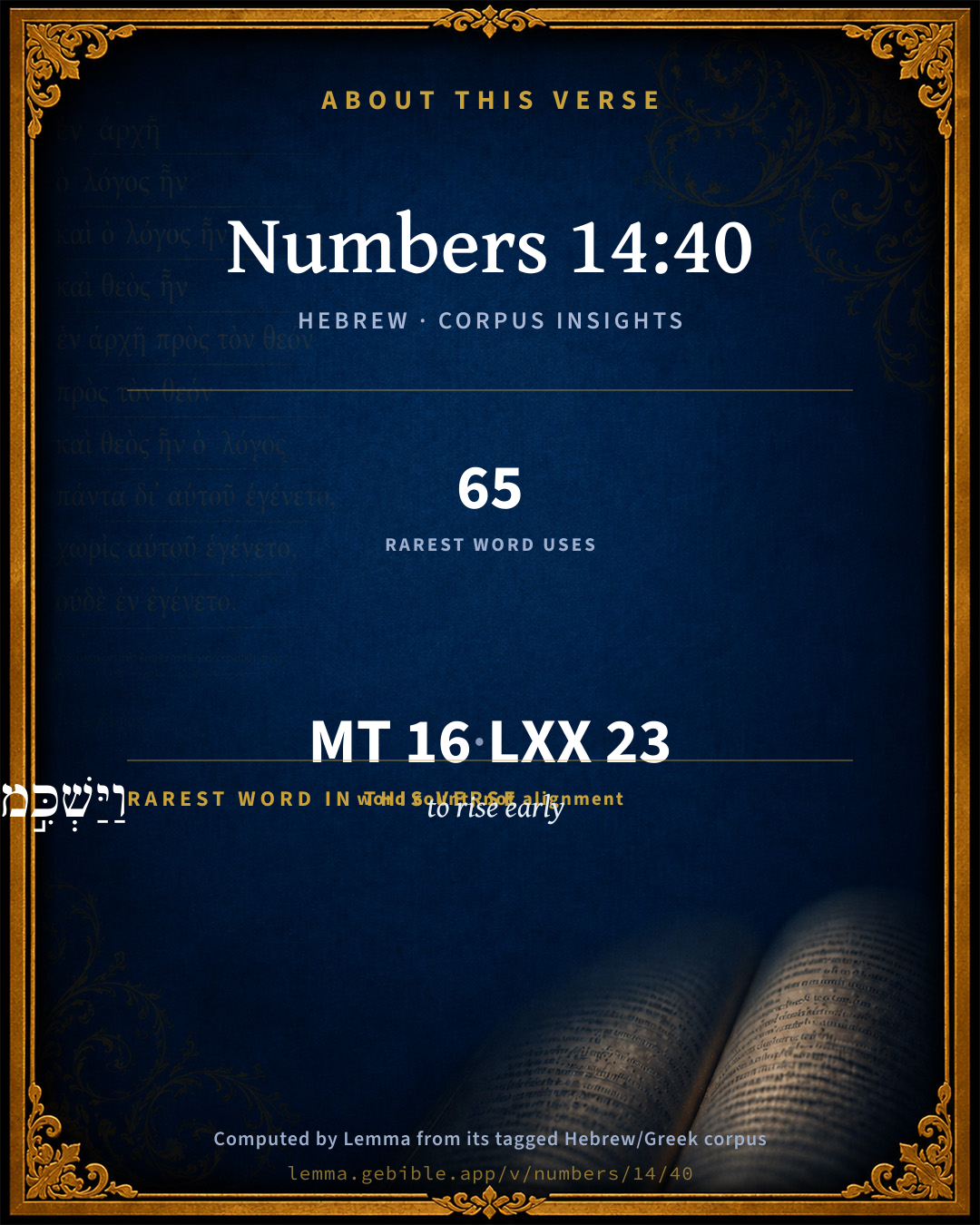
These counts appear in no published source. They are computed here, from the morphology-tagged text and Lemma’s own curated glosses. What Lemma adds →

16
words
13
distinct lemmas
Pentateuch
section

Grammatical profile

  • 6 verbs
  • 5 nouns
  • 2 prepositions
  • 1 conjunction
  • 2 particles

Verb forms

  • וַיַּשְׁכִּ֣מוּ Hiphil · Sequential Imperfect
  • וַיַּֽעֲל֥וּ Qal · Sequential Imperfect
  • לֵאמֹ֑ר Qal · Infinitive Construct
  • וְעָלִ֛ינוּ Qal · Perfect
  • אָמַ֥ר Qal · Perfect
  • חָטָֽאנוּ Qal · Perfect

Repetition

Words recur within this verse — often emphatic in Hebrew:

  • וַיַּֽעֲל֥וּ to go up H5927 ×2
  • לֵאמֹ֑ר to say H559 ×2
  • אֶל to H413 ×2

Hebrew & Septuagint length

In English translation the verse runs 37 words from the Hebrew and 38 from the Septuagint (LXX English) — closely comparable.

A rough comparison of the two English renderings, which tokenize alike — not a word-level alignment.

Word counts can differ between the Hebrew and the Greek without any difference in meaning — e.g. the Hebrew direct-object marker אֵת has no separate Greek word, and Greek often adds the article ὁ.

In the original languages it is 16 Hebrew tokens and 23 Greek tokens — but the two are counted differently (Hebrew bundles its prefixes and suffixes into one token; the Greek is in lemma form), so that isn’t a like-for-like length.

Cross-references

5

Topical passages linked to Numbers 14:40 in the Treasury of Scripture Knowledge — connected by theme and wording, ordered by reader-vote popularity; previews shown in the World English Bible.

  • Deuteronomy 1:41 Then you answered and said to me, We have sinned against Yahweh, we will go up and fight, according to all that Yahweh our God commanded us. You girded on every man his weapons of war, and were forward to go up into the hill-country.
  • Ecclesiastes 9:3 This is an evil in all that is done under the sun, that there is one event to all: yes also, the heart of the sons of men is full of evil, and madness is in their heart while they live, and after that they go to the dead.
  • Matthew 7:21–23 Not everyone who says to me, 'Lord, Lord,' will enter into the Kingdom of Heaven; but he who does the will of my Father who is in heaven.
  • Luke 13:25 When once the master of the house has risen up, and has shut the door, and you begin to stand outside, and to knock at the door, saying, 'Lord, Lord, open to us!' then he will answer and tell you, 'I don't know you or where you come from.'
  • Matthew 26:11–12 For you always have the poor with you; but you don't always have me.

Cross-references courtesy of OpenBible.info (CC BY 4.0).

Hebrew and Greek witnesses Masoretic Hebrew ↔ Greek Septuagint

The same verse in the two great witnesses to the Old Testament, shown verse-for-verse.

These are two independent witnesses, not word-aligned to each other, and the Septuagint is shown in lemma (dictionary) form.

Hebrew Numbers 14:40 Masoretic · Westminster Leningrad Codex

וַיַּשְׁכִּ֣מוּ בַבֹּ֔קֶר וַיַּֽעֲל֥וּ אֶל רֹאשׁ הָהָ֖ר לֵאמֹ֑ר הִנֶּ֗נּוּ וְעָלִ֛ינוּ אֶל הַמָּק֛וֹם אֲשֶׁר אָמַ֥ר יְהוָ֖ה כִּ֥י חָטָֽאנוּ

They rose up early in the morning, and got them up to the top of the mountain, saying, Behold, we are here, and will go up to the place which Yahweh has promised: for we have sinned.

World English Bible · Public Domain

Greek LXX Numbers 14:40 Septuagint · lemma form

καί ὀρθρίζω ὁ πρωΐ ἀναβαίνω εἰς ὁ κορυφή ὁ ὄρος λέγω ἰδού ὅδε ἐγώ ἀναβαίνω εἰς ὁ τόπος ὅς εἶπον κύριος ὅτι ἁμαρτάνω

And they rose early in the morning and went up to the top of the mountain, saying, Behold, we that are here will go up to the place of which the Lord has spoken, because we have sinned.

LXX2012 (modern English Septuagint) · Public Domain

Hebrew: Westminster Leningrad Codex (CC BY 4.0). Greek: Septuagint (public domain); English from LXX2012 (modern English Septuagint) (Public Domain). How the Septuagint differs from the Hebrew →

Targum (Aramaic paraphrase)

2

The Targum is the ancient Jewish Aramaic paraphrase of the Hebrew Scriptures — an interpretive translation, not the Hebrew text itself. Onkelos (literal) and Pseudo-Jonathan (expansive) render the Torah, and Jonathan the Prophets. Coverage is partial: where no permissively-licensed English translation exists for a verse, only the Aramaic is shown. This is verse-level text, not a word-by-word alignment to the Hebrew.

  1. Targum Onkelos Torah (Genesis–Deuteronomy)
    וְאַקְדִימוּ בְצַפְרָא וּסְלִיקוּ לְרֵישׁ טוּרָא לְמֵימָר הָא אֲנַחְנָא סָלְקִין לְאַתְרָא דִי אֲמַר יְיָ אֲרֵי חַבְנָא

    (no public-domain English translation for this verse)

    Targum Onkelos — Aramaic: “Onkelos Genesis” (public domain); “Onkelos Exodus” (public domain); “Onkelos Leviticus” (public domain); “Onkelos Numbers” (public domain); “Onkelos Deuteronomy” (public domain). English: “Sefaria Community Translation” (CC0 1.0 (public-domain dedication)); “J.W. Etheridge. The Targums of Onkelos and Jonathan Ben Uzziel on the Pentateuch. London: Longmans, Green, 1862” (public domain). Text via Sefaria.

  2. Targum Pseudo-Jonathan Torah (Genesis–Deuteronomy)
    וְאַקְדִימוּ בְּצַפְרָא וּסְלִיקוּ לְרֵישׁ טַוְורָא לְמֵימַר הָא אֲנַחְנָא סַלְקִין לְאַתְרָא דְאָמַר יְיָ אֲרוּם חַבְנָא

    And they arose in the morning and went up to the top of the mountain., saying: Behold, we will go up to the place of which the Lord hath spoken; for we have sinned.

    Targum Pseudo-Jonathan — Aramaic: “Targum Jonathan on Genesis” (public domain); “Targum Jonathan on Exodus” (public domain); “Targum Jonathan on Leviticus” (public domain); “Targum Jonathan on Numbers” (public domain); “Targum Jonathan on Deuteronomy” (public domain). English: “The Targum of Jonathan ben Uzziel, trans. J. W. Etheridge, London, 1862” (public domain). Text via Sefaria.

Commentary

Notes on Numbers 14:40 from classic Christian and Jewish commentators (each source and its license shown beneath its notes). The classic Christian expositions comment on the surrounding passage and are grouped to its opening verse, so a note may address several verses; the Jewish commentaries on the Tanakh (Rashi and others) are per-verse, so they appear only where the commentator wrote on this verse.

Lemma curates 59 commentaries, every one of them public domain or Creative Commons licensed, each selected and text-cleaned for this edition rather than reprinted as found. About our sources →

Trapp's Complete Commentary

John Trapp

Num 14:40 And they rose up early in the morning, and gat them up into the top of the mountain, saying, Lo, we [be here], and will go up unto the place which the LORD hath promised: for we have sinned.

Ver. 40. We have sinned.] Here was confession of sin, without confusion for sin. So was that of Saul. {1Sa 15:30}

John Trapp, A Commentary or Exposition upon All the Books of the Old and New Testament (1647–1656) — public domain. Text from a community e-Sword module.

The Biblical Illustrator

Joseph S. Exell

Num_14:40-45

But they presumed to go up.

A presumptuous enterprise and its disastrous termination

In these verses we have an illustration of--

1. The sad perversity of sinful human nature.

2. The confession of sin, and persistence in sin.

3. The great difficulty of walking humbly and patiently in the path which our sin has rendered necessary for us.

I. The presumptuous enterprise.

1. In opposition to the command of the Lord.

2. Despite the remonstrance of Moses.

3. Without the symbol of the Divine Presence and the presence of the Divinely-appointed leader.

II. The disastrous termination of this presumptuous enterprise.

1. Disgraceful defeat.

2. Sore slaughter.

3. Bitter sorrow.

Conclusion--From the whole let us learn the sin and the folly of entering upon any enterprises, and especially difficult ones, in our own strength. Apart from Me, said Christ, ye can do nothing. This is applicable to--

1. Spiritual life in its origin and progress. The attempt in our own strength to lead a religious, godly life, is sure to end in sad disappointment and utter failure.

2. Spiritual conflict. Unless we take to ourselves the whole armour of God, our spiritual foes will be too many and too mighty for us. We can conquer only through Christ.

3. Spiritual service. Our efforts to benefit our fellow-men will succeed only as they are made in reliance upon the blessing of God. We can bless others only as He blesses us (comp. 1Co_3:5-7). (W. Jones.)

Unauthorised enterprises

The man who forsakes Gods commandments forsakes his own happiness.

1. The importance of improving present opportunities. You have a throne of grace to go to; go there to-day, lest by delay your anxiety, though earnest, should be as unavailing as was that of Israel to go to Canaan, and you are compelled to say with the prophet (Jer_8:20).

2. The necessity of Gods blessing on all our undertakings. We do not say that man, without Gods blessing, never gets what he wants; he often does, but not what is good for him; all things work together for good only to those who have this blessing. And further, those undertakings which, with the Divine blessing, are easy, without it are impossible.

3. The connection which subsists between transgression and sorrow. Sorrow is of two kinds; first, godly sorrow, which worketh repentance unto salvation, not to be repented of--such was that of Peter; and, secondly, the sorrow of unavailing regret, when the day of recovery has passed away. It was this unavailing sorrow that Israel felt when the Lord said, Thou shalt not enter into My rest. In a spirit of rebellion they resolve, We will go up; but they went without the Lord, and they were driven back.

4. The danger that results from an unbelieving heart!

5. We see from this passage the holiness of that God with whom we have to do. While every provision is made for the returning penitent, the impenitent transgressor will certainly be destroyed. God never tolerates sin; no, not even in His own people.

6. Finally, we should learn from this subject our need of special sanctifying grace; for no outward advantages can secure personal holiness. (George Breay, B. A.)

Religious explanation of failure

Because ye are turned away from the Lord, therefore the Lord will not be with you. Even that is a word of comfort. The comfort is not far to fetch, even from the desert of this stern fact. The comfort is found in the fact that the Lord will be with those who have not turned away from Him. The law operates in two opposite ways. Law is love, when rightly seized and applied; and love is law, having all the pillars of its security and all the dignity of its righteousness to support it in all the transitions of its experience. The reason why we fail is that God has gone from us. Putting the case so, we put it wrongly. God has not gone from us; we have gone from God. The Church is nothing without its godliness; it is less than nothing: it is not only the negation of strength, it is the utter and most helpless weakness. Israel was the Church in the wilderness, and Israel was nothing without its God. The number might be six hundred thousand fighting men, and they would go down like a dry wooden fence before a raging fire, if the Lord was not in the midst. They were not men without Him. The Church lives, moves, and has its being in God--not in some high or deep metaphysical sense only, but in the plain and obvious sense of the terms: that it has no being or existence outside God. When it forgets to pray, it loses the art of war; when the Church forgets to put on the beautiful garments of holiness, though it be made up of a thousand Samsons, it cannot strike one fatal blow at the enemy. Count the Church by the volume of its prayer; register the strength of the Church by the purity and completeness of its consecration. If you number the Church in millions, and tell not what it is at the altar and at the cross, you have returned the census of a cemetery, not the statistics of a living, mighty, invincible host. Genius is nothing, learning is nothing, organisation is a sarcasm and an irony--apart from that which gives every one of them value and force--the praying heart, the trustful spirit. The Church conquers by holiness. (J. Parker, D. D.)

.

The Biblical Illustrator, edited by Joseph S. Exell (c. 1880s–1900s) — public domain. Text from a community e-Sword module.

Whedon's Commentary on the Bible

Daniel D. Whedon

THE PRESUMPTION OF THE PEOPLE PUNISHED, Num_14:40-45.

40. The top of the mountain — Some plateau on the northern border of the valley mentioned in Num_14:25. Lo,

we… will go up — That this apparent spasm of faith is not faith, but sheer presumption, is seen in its utter disregard of Jehovah’s command, “To-morrow turn you.” True faith always bears the fruit of obedience. Its highest exercise brings the human into perfect harmony with the divine will. Gal_2:20; Gal_5:24-25. The pendulum of unbelief, oscillating from the paralysis of despair to the rashness of self-confidence, is in either motion alike displeasing to God.

For we have sinned — The Hebrew כי, for, is susceptible of two renderings: (1.) Although. This sense would imply an Antinomian view of the divine promise as wholly unconditional. (2.) For, in the sense of, “we admit that we have sinned, and we regret it.” In this case their confession was not of the heart but of the lips only, involving the radical error of Universalism — that, after the final sentence of the sinner, any expression of regret is sufficient to unlock the gates of hell and open wide the portals of heaven. But there are in the divine government irreversible verdicts. Repentance may be too late.

Daniel D. Whedon (gen. ed.), Commentary on the Old and New Testaments (1874–1909) — public domain. Text from a community e-Sword module.

Geneva Bible (1599)

Geneva Bible translators

They confess they sinned by rebelling against God, but consider not they offended in going up without God’s commandment.

Geneva Bible (1599) marginal notes — public domain. Text via Bolls.life.

Jamieson, Fausset & Brown

Robert Jamieson, A. R. Fausset & David Brown

they rose up early in the morning, and gat them up into the top of the mountain--Notwithstanding the tidings that Moses communicated and which diffused a general feeling of melancholy and grief throughout the camp, the impression was of very brief continuance. They rushed from one extreme of rashness and perversity to another, and the obstinacy of their rebellious spirit was evinced by their active preparations to ascend the hill, notwithstanding the divine warning they had received not to undertake that enterprise.

for we have sinned--that is, realizing our sin, we now repent of it, and are eager to do as Caleb and Joshua exhorted us--or, as some render it, though we have sinned, we trust God will yet give us the land of promise. The entreaties of their prudent and pious leader, who represented to them that their enemies, scaling the other side of the valley, would post themselves on the top of the hill before them, were disregarded. How strangely perverse the conduct of the Israelites, who, shortly before, were afraid that, though their Almighty King was with them, they could not get possession of the land; and yet now they act still more foolishly in supposing that, though God were not with them, they could expel the inhabitants by their unaided efforts. The consequences were such as might have been anticipated. The Amalekites and Canaanites, who had been lying in ambuscade expecting their movement, rushed down upon them from the heights and became the instruments of punishing their guilty rebellion.

Jamieson, Fausset & Brown — Commentary Critical and Explanatory on the Whole Bible (1871) — public domain (CC PDM 1.0). Text via the HelloAO Bible API.

Adam Clarke's Commentary

Verse 40. We - will go up unto the place, c.] They found themselves on the very borders of the land, and they heard God say they should not enter it, but should be consumed by a forty years' wandering in the wilderness notwithstanding, they are determined to render vain this purpose of God, probably supposing that the temporary sorrow they felt for their late rebellion would be accepted as a sufficient atonement for their crimes. They accordingly went up, and were cut down by their enemies; and why? God went not with them. How vain is the counsel of man against the wisdom of God! Nature, poor, fallen human nature, is ever running into extremes. This miserable people, a short time ago, thought that though they had Omnipotence with them they could not conquer and possess the land! Now they imagine that though God himself go not with them, yet they shall be sufficient to drive out the inhabitants, and take possession of their country! Man is ever supposing he can either do all things or do nothing; he is therefore sometimes presumptuous, and at other times in despair. Who but an apostle, or one under the influence of the same Spirit, can say, I can do ALL THINGS THROUGH CHRIST who strengtheneth me?

Adam Clarke's Commentary on the Bible (1810–1826) — public domain. Text from a community e-Sword/MySword module.

Ellicott's Commentary for English Readers

(40) Into the top of the mountain.—Or, towards the top of the mountain. This appears to have been the same route as that by which the spies had gone into the south country of Judæa. (See Num_13:17.) It seems to be implied in w. 44, 45 that the people did not actually ascend the top of the adjoining mountain.

A Bible Commentary for English Readers, edited by Charles John Ellicott (1878–1897) — public domain. Text from a community e-Sword module.

The Cambridge Bible for Schools and Colleges

gen. ed. J. J. S. Perowne

40. the top of the mountain] Perhaps a particular hill in the south of the Negeb, close to Kadesh: but it may denote more generally ‘the high ground of the hill country.’

The Cambridge Bible for Schools and Colleges (gen. ed. J. J. S. Perowne; Cambridge University Press, 1878–1918) — public domain. Text from a community e-Sword module.

John Gill's Exposition

And Moses said, Wherefore now do ye transgress the commandment of the Lord?.... Which was to turn back into the wilderness, and go the way that leads to the Red sea, Num 14:25; instead of which now they were for going forward into the land of Canaan, though averse to it just before:

but it shall not prosper; their attempt to enter into it.

John Gill's Exposition of the Whole Bible (1746–1763) — public domain (CC PDM 1.0). Text via the HelloAO Bible API.

Matthew Poole's English Annotations

Gat them up, i.e. designed, or attempted, or prepared themselves to go up; for that they were not yet actually gone up, plainly appears from Num 14:42,44, and from Deu 1:41. Things designed or endeavoured in Scripture phrase are oft said to be done. See on Gen 37:21,22; Exo 8:18.

Matthew Poole's English Annotations on the Holy Bible (1683–1685) — public domain. Text from a community e-Sword/MySword module.

The Pulpit Commentary

Early in the morning. Wishing to anticipate the retrograde movement commanded by God (verse 25). Into the top of the mountain. What summit is here spoken of as the object of their enterprise is quite uncertain. Probably it was some ridge not far distant which seemed to them from below to be the height of land, but was itself commanded by loftier heights beyond. For we have sinned. The prospect of being taken at their own word, and being excluded from the land which lay so near, brought home to them a sense of their folly; but their repentance merely consisted in a frantic effort to avoid the punishment which their sin had incurred.

The Pulpit Commentary (1880–1919), ed. H.D.M. Spence-Jones & Joseph S. Exell — public domain. Text from a community e-Sword module.

John Wesley's Explanatory Notes

Gat them up - Designed or prepared themselves to go up.

John Wesley, Explanatory Notes Upon the Whole Bible (1754–1765) — public domain. Text via the GEBible commentary corpus.

Rashi

Rabbi Shlomo Yitzchaki (Rashi)

אל ראש ההר [AND THEY … WENT UP] INTO THE TOP OF THE MOUNTAIN — that is the route that leads up to the Land of Israel.

הננו ועלינו אל המקום LO, WE ARE HERE, AND WILL GO UP INTO THE PLACE, viz., to the Land of Israel,

אשר אמר ה׳ WHICH THE LORD HATH PROMISED to give us; thither will we go up, (and we will not return to Egypt).

כי חטאנו FOR WE HAVE SINNED in that we said, (v. 3) “were it not better for us to return to Egypt?”

Rashi on the Tanakh — English translations: “The Judaica Press complete Tanach with Rashi, translated by A. J. Rosenberg” (CC BY 4.0); “Pentateuch with Rashi's commentary by M. Rosenbaum and A.M. Silbermann, 1929-1934” (public domain); “The Metsudah Tanach series, Lakewood, N.J” (CC BY 4.0); and “The Book of Joshua, Metsudah Publications, 1997” (CC BY 4.0). Text via Sefaria.

Lesson kit

Teaching starters — assembled from the data on this page, not authored interpretation. Every prompt links to the verse data it draws on. Edit before teaching.

Numbers, in the Pentateuch, opens this verse with 16 words (13 distinct Hebrew lemmas). Its most distinctive word is shâkam (“to rise early”). A historical commentator’s framing appears above. Read the whole chapter for the surrounding context.

Discussion questions

  1. How does “to rise early” (shâkam) shape what this verse is saying?
  2. How does Deuteronomy 1:41, which shares this passage’s theme, read alongside this verse?
  3. What does the repetition of “to go up” (2× in this one verse) do in this verse?
  4. These translations render this verse differently; the difference is in the English rendering, not the original. What questions does that raise?
  5. «וַיַּשְׁכִּ֣מוּ» is a Hiphil Sequential Imperfect verb. How does that grammatical form shape the action described?
  6. Compare how Trapp's Complete Commentary and The Biblical Illustrator read this verse. Where do they agree or differ?

Things to notice

Reading settings

Reading text

Shown beneath each verse's original-language words.

Old Testament
Old Testament edition

Read the OT as the Masoretic Hebrew (MT) or the Greek Septuagint (LXX).

English shown for the Greek Septuagint (in the Hebrew ↔ Greek comparison).

Comparing translations? Open the Compare panel on any verse page to stack up to four side by side.