
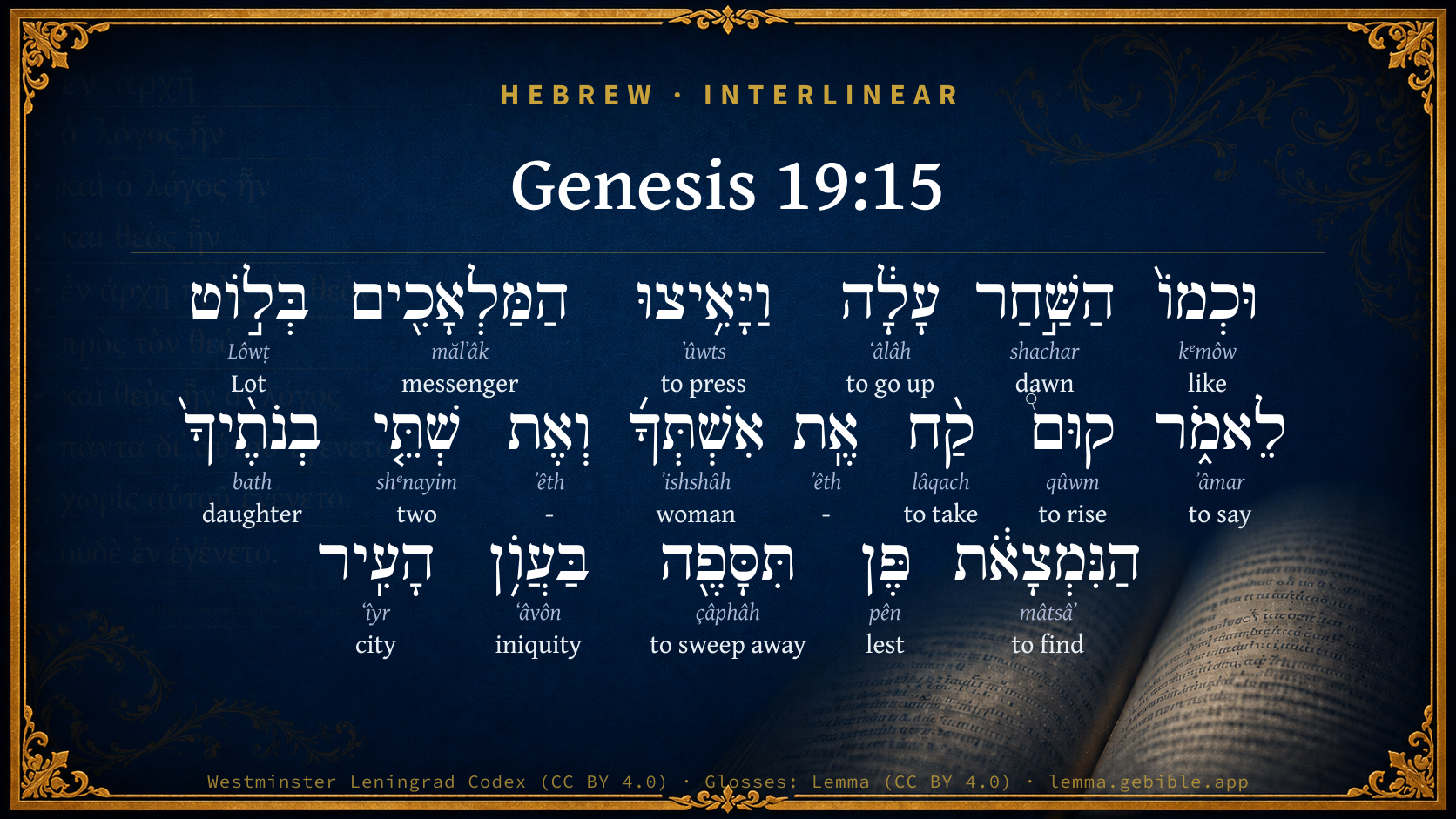
Genesis 19:15

Hebrew (Westminster Leningrad Codex) Genesis 19:15 appears in the Hebrew Old Testament. The text above is from the Westminster Leningrad Codex. Each word links to its Strong’s number, a concise gloss, and parsing drawn from the Open Scriptures Hebrew Bible morphology. Click any word for its full Brown-Driver-Briggs (BDB) entry.
Download image
Cite this verse

Genesis 19:15 (World English Bible). Public Domain. Lemma interlinear Bible study tool, https://lemma.gebible.app/v/genesis/19/15.

Show BibTeX & RIS
BibTeX
RIS
English Translation
When the morning arose, then the angels hurried Lot, saying, "Arise, take your wife, and your two daughters who are here, lest you be consumed in the iniquity of the city."
World English Bible · Public Domain
Highlights
  • 3 first appearances in the Hebrew Bible
Full analysis ↓
Download a study sheet

One document with this verse’s original text, its word-by-word gloss line, the meaning frame, cross-references with their text, attributed commentary, and full source and license credits — printable, and it pastes into notes with its structure intact.

This verse Autodidact and up

Study sheet (.html) Plain text (.txt)

A passage Seminary Student

Up to 50 verses in one chapter. A passage sheet keeps up to 6 commentary sources and 12 cross-references per verse, in the order this page ranks them, and says so on the sheet whenever that leaves anything out. Ask for a single verse and you get the Autodidact verse sheet above.

Everything on this page stays free to read, with no account — the sheet is a download of what is already on screen, not access to it.

Want to remove ads? Support Godless Engineer
Compare translations 3

The same verse in 3 English versions, stacked beneath the original-language interlinear above. Click any original word for its lexicon entry.

Each is an independent rendering of the whole verse — the interlinear is not word-aligned to these translations.

Highlighted words mark where these versions differ — a whole-verse word diff, not a word-by-word alignment.

  • World English Bible Public Domain
    When the morning arose, then the angels hurried Lot, saying, "Arise, take your wife, and your two daughters who are here, lest you be consumed in the iniquity of the city."
  • King James Version Public Domain
    And when the morning arose, then the angels hastened Lot, saying, Arise, take thy wife, and thy two daughters, which are here; lest thou be consumed in the iniquity of the city.
  • unfoldingWord Literal Text CC BY-SA 4.0
    Then when the dawn came, the angels urged Lot, saying, “Get up, take your wife and your two daughters who are here, so that you are not swept away in the punishment of the city.”

unfoldingWord Literal Text — © unfoldingWord, licensed CC BY-SA 4.0. Word-aligned USFM3 via Door43 (git.door43.org/unfoldingWord/en_ult).

Versions to compare (up to 4)

3 of 4 selected

Show all 18 translations

Every available English version of this verse, each an independent rendering of the whole verse.

  • World English Bible Public Domain
    When the morning arose, then the angels hurried Lot, saying, "Arise, take your wife, and your two daughters who are here, lest you be consumed in the iniquity of the city."
  • Berean Standard Bible Public Domain
    At daybreak the angels hurried Lot along, saying, “Get up! Take your wife and your two daughters who are here, or you will be swept away in the punishment of the city.”
  • Majority Standard Bible Public Domain
    At daybreak the angels hurried Lot along, saying, “Get up! Take your wife and your two daughters who are here, or you will be swept away in the punishment of the city.”
  • King James Version Public Domain
    And when the morning arose, then the angels hastened Lot, saying, Arise, take thy wife, and thy two daughters, which are here; lest thou be consumed in the iniquity of the city.
  • American Standard Version (1901) Public Domain
    And when the morning arose, then the angels hastened Lot, saying, Arise, take thy wife, and thy two daughters that are here, lest thou be consumed in the iniquity of the city.
  • Revised Version (1885) Public Domain
    And when the morning arose, then the angels hastened Lot, saying, Arise, take thy wife, and thy two daughters which are here; lest thou be consumed in the iniquity of the city.
  • Geneva Bible (1599) Public Domain
    And when the morning arose, the Angels hasted Lot, saying, Arise, take thy wife and thy two daughters which are here, lest thou be destroyed in the punishment of the citie.
  • Douay-Rheims (1899) Public Domain
    And when it was- morning, the angels pressed him, saying: Arise, take thy wife, and the two daughters which thou hast: lest thou also perish in the wickedness of the city.
  • Young's Literal Translation Public Domain
    And when the dawn hath ascended, then the messengers press upon Lot, saying, `Rise, take thy wife, and thy two daughters who are found present, lest thou be consumed in the iniquity of the city.'
  • Literal Standard Version CC BY-SA 4.0
    And when the dawn has ascended, then the messengers press on Lot, saying, “Rise, take your wife, and your two daughters who are found present, lest you are consumed in the iniquity of the city.”
  • Unlocked Literal Bible CC BY-SA 4.0
    When the morning dawned, the angels urged Lot, saying, “Get going, take your wife and your two daughters that are here, so you are not swept away in the punishment of the city.”
  • unfoldingWord Literal Text CC BY-SA 4.0
    Then when the dawn came, the angels urged Lot, saying, “Get up, take your wife and your two daughters who are here, so that you are not swept away in the punishment of the city.”
  • Darby Bible Public Domain
    And as the dawn arose, the angels urged Lot, saying, Up, take thy wife and thy two daughters who are present, lest thou perish in the iniquity of the city.
  • World Messianic Bible Public Domain
    When the morning came, then the angels hurried Lot, saying, “Get up! Take your wife and your two daughters who are here, lest you be consumed in the iniquity of the city.”
  • Webster's Bible Public Domain
    And when the morning arose, then the angels hastened Lot, saying, Arise, take thy wife, and thy two daughters who are here; lest thou be consumed in the iniquity of the city.
  • Free Bible Version CC BY-SA 4.0
    At dawn, the angels begged Lot to be quick, telling him, “Hurry up! Leave right now with your wife and your two daughters here, otherwise you'll be wiped out when the city is punished.”
  • Bible in Basic English Public Domain
    And when morning came, the angels did all in their power to make Lot go, saying, Get up quickly and take your wife and your two daughters who are here, and go, for fear that you come to destruction in the punishment of the town.
  • JPS Tanakh (1917) Public Domain
    And when the morning arose, then the angels hastened Lot, saying: 'Arise, take thy wife, and thy two daughters that are here; lest thou be swept away in the iniquity of the city.'

Literal Standard Version (2020), Covenant Press — licensed CC BY-SA 4.0. Text via the HelloAO Bible API (eBible.org). Unlocked Literal Bible (unfoldingWord) — licensed CC BY-SA 4.0. Text via the HelloAO Bible API (eBible.org). unfoldingWord Literal Text — © unfoldingWord, licensed CC BY-SA 4.0. Word-aligned USFM3 via Door43 (git.door43.org/unfoldingWord/en_ult). Free Bible Version, Dr. Jonathan Gallagher — licensed CC BY-SA 4.0. Text via the HelloAO Bible API (eBible.org).

Word by word

More ways to search: Search by grammar → Find every occurrence → Compare this word →

Practice this passage: Drill this verse → Learn its vocabulary →

וַיָּאִ֥יצוּ
ʼûwts
H213
“and · to press”
Conjunction + Verb, Hiphil, Sequential Imperfect, 3rd Person, Masculine, Plural
Part of Speech
Conjunction + Verb
Stem
Hiphil
Form
Sequential Imperfect
Person
3rd Person
Gender
Masculine
Number
Plural
Full BDB Definition

Origin: a primitive root

TWOT: 51

to press, be pressed, make haste, urge, be narrow - (Qal) - to press, hasten - to be pressed, confined, narrow - to hasten, make haste - be narrow - (Hiphil) - to urge, insist - to hasten
  1. וּכְמוֹ֙ kᵉmôw H3644 “and · like” Conjunction + Preposition
  2. הַשַּׁ֣חַר shachar H7837 “the · dawn” Particle, Definite Article + Noun, Common, Masculine, Singular, Absolute
  3. עָלָ֔ה ʻâlâh H5927 “to go up” Verb, Qal, Perfect, 3rd Person, Masculine, Singular
  4. הַמַּלְאָכִ֖ים mălʼâk H4397 “the · messengers” Particle, Definite Article + Noun, Common, Masculine, Plural, Absolute
  5. בְּל֣וֹט Lôwṭ H3876 “in/at · Lot” Preposition + Noun, Proper
  6. לֵאמֹ֑ר ʼâmar H559 “to say” Preposition + Verb, Qal, Infinitive Construct
  7. קוּם֩ qûwm H6965 “rise” Verb, Qal, Imperative, 2nd Person, Masculine, Singular
  8. קַ֨ח lâqach H3947 “take” Verb, Qal, Imperative, 2nd Person, Masculine, Singular
  9. אֶֽת ʼêth H853 “-” Particle, Direct Object
  10. אִשְׁתְּךָ֜ ʼishshâh H802 “woman · your” Noun, Common, Feminine, Singular, Construct + Suffix, Personal, 2nd Person, Masculine, Singular
  11. וְאֶת ʼêth H853 “and · -” Conjunction + Particle, Direct Object
  12. שְׁתֵּ֤י shᵉnayim H8147 “two” Adjective, Cardinal number, Feminine, Dual, Construct
  13. בְנֹתֶ֨יךָ֙ bath H1323 “daughters · your” Noun, Common, Feminine, Plural, Construct + Suffix, Personal, 2nd Person, Masculine, Singular
  14. הַנִּמְצָאֹ֔ת mâtsâʼ H4672 “the · finding” Particle, Definite Article + Verb, Niphal, Participle Active, Feminine, Plural, Absolute
  15. פֶּן pên H6435 “lest” Conjunction
  16. תִּסָּפֶ֖ה çâphâh H5595 “to sweep away” Verb, Niphal, Imperfect, 2nd Person, Masculine, Singular
  17. בַּעֲוֺ֥ן ʻâvôn H5771 “in/at · iniquity of” Preposition + Noun, Common, Both, Singular, Construct
  18. הָעִֽיר ʻîyr H5892 “the · city” Particle, Definite Article + Noun, Common, Feminine, Singular, Absolute

About this verse

These counts appear in no published source. They are computed here, from the morphology-tagged text and Lemma’s own curated glosses. What Lemma adds →

19
words
18
distinct lemmas
Pentateuch
section

Notable vocabulary

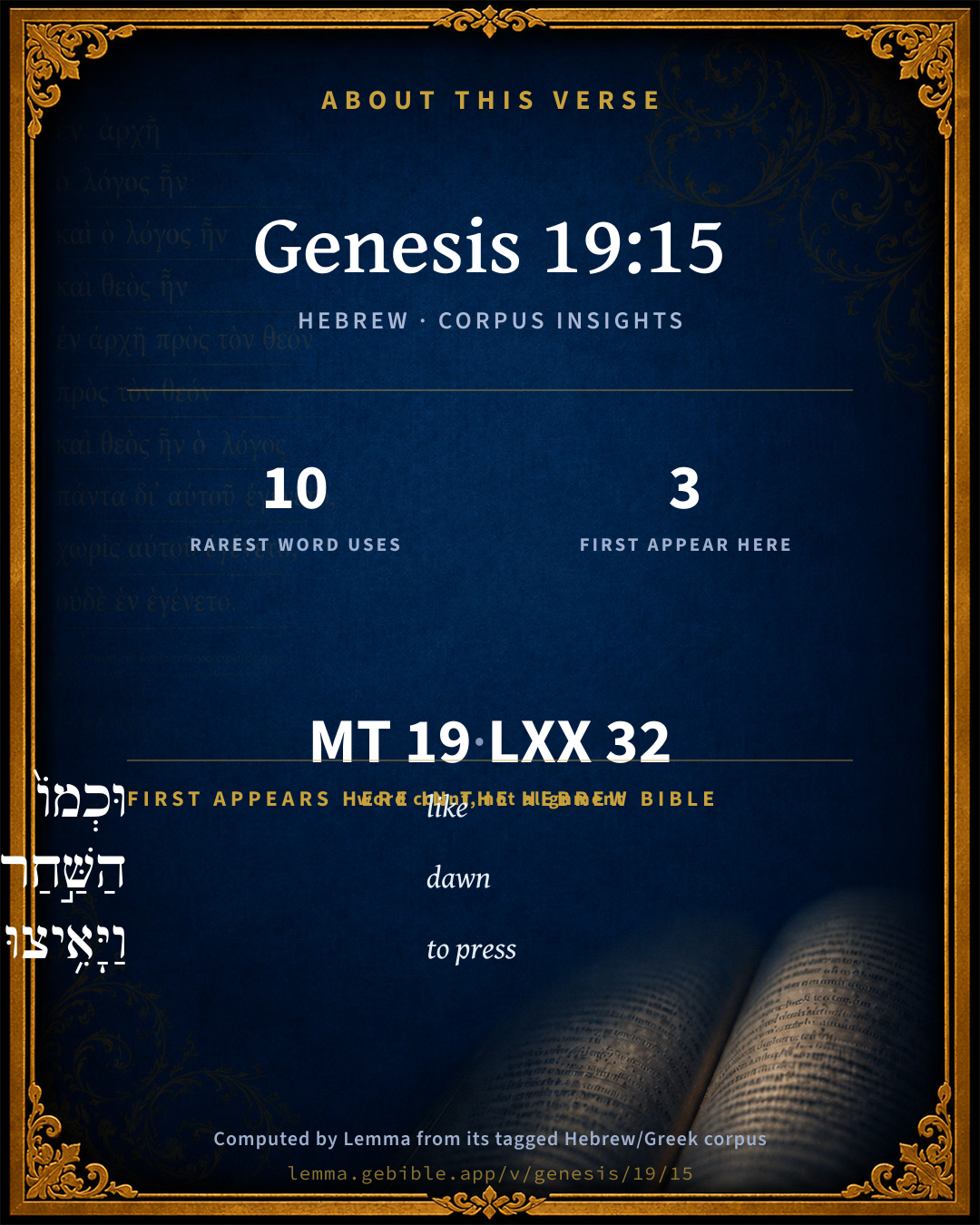
The rarest word here is וַיָּאִ֥יצוּ to press H213 — appearing just 10 times in the whole Hebrew Bible.

First appearance in Scripture

These words make their first canonical appearance in the Hebrew Bible here:

  • וּכְמוֹ֙ like H3644
  • הַשַּׁ֣חַר dawn H7837
  • וַיָּאִ֥יצוּ to press H213

Shared distinctive vocabulary

וַיָּאִ֥יצוּ to press H213 occurs in 10 verses of the Hebrew Bible. Also found in:

Grammatical profile

  • 7 verbs
  • 7 nouns
  • 1 adjective
  • 1 preposition
  • 1 conjunction
  • 2 particles

Verb forms

  • עָלָ֔ה Qal · Perfect
  • וַיָּאִ֥יצוּ Hiphil · Sequential Imperfect
  • לֵאמֹ֑ר Qal · Infinitive Construct
  • קוּם֩ Qal · Imperative
  • קַ֨ח Qal · Imperative
  • הַנִּמְצָאֹ֔ת Niphal · Participle Active
  • תִּסָּפֶ֖ה Niphal · Imperfect

Hebrew & Septuagint length

In English translation the verse runs 31 words from the Hebrew and 36 from the Septuagint (LXX English) — closely comparable.

A rough comparison of the two English renderings, which tokenize alike — not a word-level alignment.

Word counts can differ between the Hebrew and the Greek without any difference in meaning — e.g. the Hebrew direct-object marker אֵת has no separate Greek word, and Greek often adds the article ὁ.

In the original languages it is 19 Hebrew tokens and 32 Greek tokens — but the two are counted differently (Hebrew bundles its prefixes and suffixes into one token; the Greek is in lemma form), so that isn’t a like-for-like length.

Cross-references

8

Topical passages linked to Genesis 19:15 in the Treasury of Scripture Knowledge — connected by theme and wording, ordered by reader-vote popularity; previews shown in the World English Bible.

  • Numbers 16:24–27 Speak to the congregation, saying, Get away from around the tent of Korah, Dathan, and Abiram.
  • Revelation 18:4 I heard another voice from heaven, saying, "Come out of her, my people, that you have no participation in her sins, and that you don't receive of her plagues,
  • Genesis 19:22 Hurry, escape there, for I can't do anything until you get there." Therefore the name of the city was called Zoar.
  • Proverbs 6:4–5 Give no sleep to your eyes, Nor slumber to your eyelids.
  • Luke 13:24–25 "Strive to enter in by the narrow door, for many, I tell you, will seek to enter in, and will not be able.
  • 2 Corinthians 6:2 for he says, "At an acceptable time I listened to you, In a day of salvation I helped you." Behold, now is the acceptable time. Behold, now is the day of salvation.
  • Genesis 19:17 It came to pass, when they had taken them out, that he said, "Escape for your life! Don't look behind you, neither stay anywhere in the plain. Escape to the mountain, lest you be consumed!"
  • Hebrews 3:7–8 Therefore, even as the Holy Spirit says, "Today if you will hear his voice,

Cross-references courtesy of OpenBible.info (CC BY 4.0).

Hebrew and Greek witnesses Masoretic Hebrew ↔ Greek Septuagint

The same verse in the two great witnesses to the Old Testament, shown verse-for-verse.

These are two independent witnesses, not word-aligned to each other, and the Septuagint is shown in lemma (dictionary) form.

Hebrew Genesis 19:15 Masoretic · Westminster Leningrad Codex

וּכְמוֹ֙ הַשַּׁ֣חַר עָלָ֔ה וַיָּאִ֥יצוּ הַמַּלְאָכִ֖ים בְּל֣וֹט לֵאמֹ֑ר קוּם֩ קַ֨ח אֶֽת אִשְׁתְּךָ֜ וְאֶת שְׁתֵּ֤י בְנֹתֶ֨יךָ֙ הַנִּמְצָאֹ֔ת פֶּן תִּסָּפֶ֖ה בַּעֲוֺ֥ן הָעִֽיר

When the morning arose, then the angels hurried Lot, saying, "Arise, take your wife, and your two daughters who are here, lest you be consumed in the iniquity of the city."

World English Bible · Public Domain

Greek LXX Genesis 19:15 Septuagint · lemma form

ἡνίκα δέ ὄρθρος γίγνομαι ἐπισπουδάζω ὁ ἄγγελος ὁ λωτ λέγω ἀναἵστημι λαμβάνω ὁ γυνή σύ καί ὁ δύο θυγάτηρ σύ ὅς ἔχω καί ἐκἔρχομαι ἵνα μή συν ἀποὀλλύω ὁ ἀνομία ὁ πόλις

But when it was morning, the angels hastened Lot, saying, Arise and take your wife, and your two daughters whom you have, and go forth; lest you also be destroyed with the iniquities of the city.

LXX2012 (modern English Septuagint) · Public Domain

Hebrew: Westminster Leningrad Codex (CC BY 4.0). Greek: Septuagint (public domain); English from LXX2012 (modern English Septuagint) (Public Domain). How the Septuagint differs from the Hebrew →

Targum (Aramaic paraphrase)

2

The Targum is the ancient Jewish Aramaic paraphrase of the Hebrew Scriptures — an interpretive translation, not the Hebrew text itself. Onkelos (literal) and Pseudo-Jonathan (expansive) render the Torah, and Jonathan the Prophets. Coverage is partial: where no permissively-licensed English translation exists for a verse, only the Aramaic is shown. This is verse-level text, not a word-by-word alignment to the Hebrew.

  1. Targum Onkelos Torah (Genesis–Deuteronomy)
    וּכְמִסַּק צַפְרָא הֲוָה וּדְחִיקוּ מַלְאָכַיָּא בְּלוֹט לְמֵימָר קוּם דְּבַר יָת אִתְּתָךְ וְיָת תַּרְתֵּין בְּנָתָךְ דְּאִשְׁתְּכַחַן מְהֵימְנָא עִמָּךְ דִּילְמָא תִלְקֵי בְּחוֹבֵי קַרְתָּא

    (no public-domain English translation for this verse)

    Targum Onkelos — Aramaic: “Onkelos Genesis” (public domain); “Onkelos Exodus” (public domain); “Onkelos Leviticus” (public domain); “Onkelos Numbers” (public domain); “Onkelos Deuteronomy” (public domain). English: “Sefaria Community Translation” (CC0 1.0 (public-domain dedication)); “J.W. Etheridge. The Targums of Onkelos and Jonathan Ben Uzziel on the Pentateuch. London: Longmans, Green, 1862” (public domain). Text via Sefaria.

  2. Targum Pseudo-Jonathan Torah (Genesis–Deuteronomy)
    וּכְאִישׁוֹן מֵיסַק קְרִצְתָּא הֲוָה לְמֵיסוֹק וּדְחִיקוּ מַלְאָכַיָא בְּלוֹט לְמֵימַר קוּם דְבַר יַת אִנְתְּתָךְ וְיַת תַּרְתֵּין בְּנָתָךְ דְהִשְׁתַּכְּחָן גַבָּךְ דִלְמָא תִּשְׁתֵּצֵי בְּחוֹבֵי יַתְבֵי קַרְתָּא

    And at the time that the morning was about to uprise, the angels were urgent upon Lot, saying, Up, take thy wife and thy two daughters who are with you, lest you perish in the condemnation of the inhabitants of the city.

    Targum Pseudo-Jonathan — Aramaic: “Targum Jonathan on Genesis” (public domain); “Targum Jonathan on Exodus” (public domain); “Targum Jonathan on Leviticus” (public domain); “Targum Jonathan on Numbers” (public domain); “Targum Jonathan on Deuteronomy” (public domain). English: “The Targum of Jonathan ben Uzziel, trans. J. W. Etheridge, London, 1862” (public domain). Text via Sefaria.

Commentary

Notes on Genesis 19:15 from classic Christian and Jewish commentators (each source and its license shown beneath its notes). The classic Christian expositions comment on the surrounding passage and are grouped to its opening verse, so a note may address several verses; the Jewish commentaries on the Tanakh (Rashi and others) are per-verse, so they appear only where the commentator wrote on this verse.

Lemma curates 59 commentaries, every one of them public domain or Creative Commons licensed, each selected and text-cleaned for this edition rather than reprinted as found. About our sources →

Matthew Henry's Commentary

Here is, I. The rescue of Lot out of Sodom. Thought there were not ten righteous men in Sodom, for whose sakes it might be spared, yet that one righteous man that was among them delivered his own soul, Eze 14:14. Early in the morning his own guests, in kindness to him, turned him out of doors, and his family with him, Gen 19:15. His daughters that were married perished with their unbelieving husbands; but those that continued with him were preserved with him. Observe,

1. With what a gracious violence Lot was brought out of Sodom, Gen 19:16. It seems, though he did not make a jest of the warning given, as his sons-in-law did, yet he lingered, he trifled, he did not make so much haste as the case required. Thus many that are under some convictions about the misery of their spiritual state, and the necessity of a change, yet defer that needful work, and foolishly linger. Lot did so, and it might have been fatal to him it the angels had not laid hold of his hand, and brought him forth, and saved him with fear, Jde 1:23. Herein it is said, The Lord was merciful to him; otherwise he might justly have left him to perish, since he was so loth to depart. Note, (1.) The salvation of the most righteous men must be attributed to God's mercy, not to their own merit. We are saved by grace. (2.) God's power also must be acknowledged in the bringing of souls out of a sinful state. If God had not brought us forth, we had never come forth. (3.) If God had not been merciful to us, our lingering had been our ruin.

2. With what a gracious vehemence he was urged to make the best of his way, when he was brought forth, Gen 19:17. (1.) He must still apprehend himself in danger of being consumed, and be quickened by the law of self-preservation to flee for his life. Note, A holy fear and trembling are found necessary to the working out of our salvation. (2.) He must therefore mind his business with the utmost care and diligence. He must not hanker after Sodom: Look not behind thee. He must not loiter by the way: Stay not in the plain; for it would all be made one dead sea. He must not take up short of the place of refuge appointed him: Escape to the mountain. Such as these are the commands given to those who through grace are delivered out of a sinful state. [1.] Return not to sin and Satan, for that is looking back to Sodom. [2.] Rest not in self and the world, for that is staying in the plain. And, [3.] Reach towards Christ and heaven, for that is escaping to the mountain, short of which we must not take up.

II. The fixing of a place of refuge for him. The mountain was first appointed for him to flee to, but, 1. He begged for a city of refuge, one of the five that lay together, called Bela, Gen 14:2, Gen 14:18-20. It was Lot's weakness to think a city of his own choosing safer than the mountain of God's appointing. And he argued against himself when he pleaded, Thou hast magnified thy mercy in saving my life, and I cannot escape to the mountain; for could not he that plucked him out of Sodom, when he lingered, carry him safely to the mountain, though he began to tire? Could not he that saved him from greater evils save him from the less? He insists much in his petition upon the smallness of the place: It is a little one, it is not? therefore, it was to be hoped, not so bad as the rest. This gave a new name to the place; it was called Zoar, a little one. Intercessions for little ones are worthy to be remembered. 2. God granted him his request, though there was much infirmity in it, Gen 19:21, Gen 19:22. See what favour God showed to a true saint, though weak. (1.) Zoar was spared, to gratify him. Though his intercession for it was not, as Abraham's for Sodom, from a principle of generous charity, but merely from self-interest, yet God granted him his request, to show how much the fervent prayer of a righteous man avails. (2.) Sodom's ruin was suspended till he was safe: I cannot do any thing till thou shalt have come thither. Note, The very presence of good men in a place helps to keep off judgments. See what care God takes for the preservation of his people. The winds are held till God's servants are sealed, Rev 7:3; Eze 9:4.

III. It is taken notice of that the sun had risen when Lot entered into Zoar; for when a good man comes into a place he brings light along with him, or should do.

Matthew Henry's Commentary on the Whole Bible (1708–1710) — public domain (CC PDM 1.0). Text via the HelloAO Bible API.

Trapp's Complete Commentary

John Trapp

Gen 19:15 And when the morning arose, then the angels hastened Lot, saying, Arise, take thy wife, and thy two daughters, which are here; lest thou be consumed in the iniquity of the city.

Ver. 15. Lest thou be consumed.] So Rev 18:4. "Come out of her, that ye receive not of her plagues." Musculi ruinis imminentibus praemigrant, et aranei cum telis primi eadunt , saith Pliny. {a} Swine flee home before a storm. Let men hasten out of their natural estate, as Lot was bidden to do out of Sodom: there is the smell of the fire and brimstone upon them.

{a} Plin., lib. viii. cap. 28.

John Trapp, A Commentary or Exposition upon All the Books of the Old and New Testament (1647–1656) — public domain. Text from a community e-Sword module.

The Biblical Illustrator

Joseph S. Exell

Gen_19:15

When the morning arose, then the angels hastened Lot

Hastening Lot

I.

THE RIGHTEOUS NEED TO BE HASTENED.

1. In what?

(1) In matters of obedience to their Lord.

(2) In coming out from the world.

(3) In seeking the good of their families (Gen_19:12).

(4) In general quickness of movement in spiritual things (Gen_19:17; Gen_19:22).

2. Why?

(1) The flesh is weak.

(2) Perseverance is difficult.

(3) Sodom has a sluggish influence.

(4) When our worldly occupation is incessant, and takes up most of our thoughts, we are hindered from decision.

(5) Idle leisure is still worse. Men with nothing to do in the world seldom do anything in religion.

3. By what means?

(1) By reminding them of their obligations, their opportunities, and the days already wasted.

(2) By leading them to consider the flight of time and brevity of life.

(3) By warning them of the sure ruin of their impenitent friends.

(4) By setting before them the fact that delay in duty is sin, and leads to other sins.

II. THE SINNERS NEED TO BE HASTENED.

1. Sinners are very slow, and apt to linger.

(1) They have settled down in the Sodom of sin. Like the sluggard, they desire a little more folding of the arms to sleep.

(2) They are bound by many ties to the City of Destruction.

(3) They do not believe our warning (Gen_19:14).

(4) They trifle with our message when they dare not contradict it.

(5) Delay is Satans grand device for their ruin.

(6) Procrastination baffles our persuasions. Delays act like bales of wool dropped over the wall of a besieged city to deaden the blows of a battering-ram. Felix quieted his conscience by the idea of a more convenient season.

2. Our business is to hasten them.

(1) We must be in earnest ourselves, as these angels were.

(2) We must also be patient, and repeat our pleadings.

(3) We must be resolute, and lay hold on their hands.

3. We have many arguments with which to hasten them. May the Holy Spirit make them see--

(1) Their imminent danger while lingering.

(2) The sin of loitering when God commands them to escape for their lives.

(3) The fitness of the present above any possible future.

(4) The uncertainty that any available future will come.

(5) The supreme necessity of immediate decision with some; for it may be now or never with them; they will die in their sins if they do not hear the voice of God today. (C. H. Spurgeon.)

The lingerer

I. WHY IS IT, THAT IN THE ESCAPE OF THE SOUL, MEN SO LINGER?

1. The first cause is the entanglement of their affections with worldly things.

2. Another cause of Lots irresoluteness would be the refusal of his sons-in-law and of their wives, his daughters, to escape with him.

3. Other causes of lingering there may be peculiar to yourselves.

(1) Perhaps you have not fortitude enough to brave the ridicule or the persecution that you will be exposed to.

(2) Perhaps you are but half-persuaded of your peril. Acknowledging in general terms your sin, you do not realize the possible imminency of its punishment. You presume upon a longer probation. You put off Christ with a promise. Be ye, therefore, ready; for in such an hour as ye think not the Son of Man cometh.

II. Need I point out to YOU THE PERIL OF LINGERING? It is strikingly illustrated by the narrowness of Lots escape. How nigh he was to the fate that overtook his wife! How closely his reluctance, which the angels had to force, must have approached to her disobedience, which they had to punish! And how affecting this separation! She who left Sodom with him was not to enter Zoar with him. (H. Allon.)

A reason for haste

A Christian tradesmen bethought him that he had never spoken to a certain regular customer about his soul, though the man had called at his shop for years. He determined to plead earnestly with him the next time he came in his way. There was no next time; his customer died suddenly, so that he saw him no more. (C. H. Spurgeon.)

Spiritual concerns first

When a young man made an open profession of the gospel, his father, greatly offended, gave him this advice: James, you should first get yourself established in a good trade, and then think of the matter of religion. Father, said the son, Jesus Christ advises me differently; He says, Seek ye first the kingdom of God. (C. H.Spurgeon.)

Urgency needed

Brother, said a dying man, why have you not been more pressing with me about my soul? Dear James, replied the brother, I have spoken to you several times. Yes, was the answer, you are not to blame; but you were always so quiet over it; I wish you had gone on your knees to me, or had taken me by the neck and shaken me, for I have been careless, and have nearly slept myself into hell. (C. H. Spurgeon.)

No time to lose

The poor needle-woman with her inch of candle has work to finish. See how her fingers fly, for she fears lest she should be left in darkness, and her work undone. (C. H. Spurgeon.)

Inducement to hasten

Do not some professors cause sinners to loiter by their own loitering? A man taking a seat at the Tabernacle came to the minister and said, Sir, do I understand that if I became a seat-holder I shall be expected to be converted? Yes, was the reply, I hope you will, and I pray that it may be so. Do you object? The answer was, Oh, sir, I desire it above everything. Was not the man hastened by the general feeling of hopefulness which pervaded the Church? Assuredly there is much in the atmosphere which surrounds a man. Among warm-hearted Christians it is hard for the careless to remain indifferent. (C. H. Spurgeon.)

The Biblical Illustrator, edited by Joseph S. Exell (c. 1880s–1900s) — public domain. Text from a community e-Sword module.

MacLaren's Expositions of Holy Scripture

Alexander MacLaren

Genesis

THE SWIFT DESTROYER

Gen 19:15 - Gen 19:26.

The religious significance of this solemn page of revelation is but little affected by any of the interesting questions which criticism raises concerning it, so that I am free to look at the whole narrative for the purpose of deducing its perennial lessons. There are four clearly marked stages in the story: the lingering of Lot in the doomed city, and the friendly force which dragged him from it; the prayer of abject fear, and the wonderful answer; the awful catastrophe; and the fate of the wretched woman who looked back.

1. Lot’s lingering and rescue by force. Second thoughts are not always best. When great resolves have to be made, and when a clear divine command has to be obeyed, the first thought is usually the nobler; and the second, which pulls it back, and damps its ardour, is usually of the earth, earthy. So was it with Lot. Overnight, in the excitement of the terrible scene enacted before his door, Lot had been not only resolved himself to flee, but his voice had urged his sons-in-law to escape from the doom which he then felt to be imminent. But with the cold grey light of morning his mood has changed. The ties which held him in Sodom reassert their power. Perhaps daylight made his fears seem less real. There was no sign in the chill Eastern twilight that this day was to be unlike the other days. Perhaps the angels’ summons roused him from sleep, and their ‘arise’ is literally meant. It might have given wings to his flight. Urgent, and resonant, like the morning bugle, it bids him be stirring lest he be swept away ‘in the punishment of the city.’ Observe that the same word means ‘sin’ and ‘punishment,’-a testimony to the profound truth that at bottom they are one, sin being pain in the root, pain being sin in the flower. So our own word ‘evil’ covers all the ground, and means both sin and sorrow. But even that pealing note does not shatter his hesitation. He still lingers. What kept him? That which had first taken him there-material advantages. He had struck root in Sodom. The tent life which he had kept to at first has been long given up; we find him sitting in the gate of the city, the place for gossip and friendly intercourse. He has either formed, or is going to form, marriage alliances for his daughters with men of the city who are as black as the rest. Perhaps his wife, whom the story will not name, for pity or for horror, was a Sodomite. To escape meant to leave all this and his wealth behind. If he goes out, he goes out a pauper. So his heart, which is where his treasure is, makes his movements slow. What insanity his lingering must have seemed to the angels! I wonder if we, who cling so desperately to the world, and who are so slow to go where God would have us to be for our own safety, if thereby we shall lose anything of this world’s wealth, seem very much wiser to eyes made clear-sighted with the wisdom of heaven. This poor hesitating lingerer, too much at home in the city of destruction to get out of it even to save his life, has plenty of brothers to-day. Every man who lets the world hold him by the skirts when Christ is calling him to salvation, and every man who is reluctant to obey any clear call to sacrifice and separation from godless men, may see his own face in this glass, and perhaps get a glimpse of its ugliness.

What a homely picture, full of weighty truth, the story gives us, of the angels each taking two of the reluctant four by the hand, and dragging them with some degree of kindly force from destruction into safety! So, in a great fire, domestic animals and horses seem to find a strange fascination in the flames, and have to be carried out of certain death by main force. They ‘set him’-or we might read, ‘made him rest’-outside the city. It was but a little distance, for these ‘cities’ were tiny places, and the walls were soon reached. But it was far enough to change Lot’s whole feelings. He passes to feeble despair and abject fear, as we shall see. That forlorn group, homeless, friendless, stripped of everything, shivering outside the gate in the cold morning air, may teach us how wise and prudent the man is who seeks the kingdom of God second, and the other things first.

2. There was a pause outside the city. A new voice speaks now to Lot. ‘They’ brought him forth; but ‘He’ said ‘escape.’ The same ‘Lord’ to whom Abraham had prayed, has now rejoined the mysterious pair whom He had sent to Sodom. And Lot’s entreaty is addressed to Him whom he calls ‘my Lord.’ He uses singular pronouns throughout, although the narrator says that he ‘said unto them.’ There seems to be here the same idea as is embodied in the word ‘Elohim’; namely, that the divine powers are regarded as in some sense separable, and yet all inhering in a personal unity. At all events, we have here a distinct representation of an intercourse between God and man, in which thoughts are conveyed to the human spirit direct from the divine, and desires pass from the human to the divine. The manner of the intercourse we do not know, but the possibility of the fact can scarcely be denied by any believer in a God; and, however we may call this miraculous or abnormal, the essence of the event can be repeated in the experience of each of us. God still speaks to men, and men may still plead with God. Unless our religion is communion, it is nothing.

The divine voice reiterates the angels’ urgent command in still more stringent words: ‘Escape for thy life.’ There is to be no more angel-leading, but Lot’s feet are to be made as hinds’ feet by the thought of the flaming death that is pursuing. His lingering looks are sternly forbidden, since they would delay his flight and divide his heart. The direction of his flight is for the first time pointed out. The fertile plain, which had lured him down from the safe hills, is prohibited. Only on the mountain-side, probably the eastern mountains, where the morning red was beginning to blush, is there safety.

Lot’s answer shows a complete change of feeling. He is too fully alarmed now. His fright is so desperate that it has killed faith and common sense. The natural conclusion from God’s mercy, which he acknowledges, would have been trust and obedience. ‘Therefore I can escape,’ not ‘but I cannot escape,’ would have been the logic of faith. The latter is the irrationality of fear. When a man who has been cleaving to this fleeting life of earthly good wakes up to believe his danger, he is ever apt to plunge into an abyss of terror, in which God’s commands seem impossible, and His will to save becomes dim. The world first lies to us by ‘You are quite safe where you are. Don’t be in a hurry to go.’ Then it lies, ‘You never can get away now.’ Reverse Lot’s whimpering fears, and we get the truth. Are not God’s directions how to escape, promises that we shall escape? Will He begin to build, and not be able to finish? Will the judgments of His hand overrun their commission, like a bloodhound which, in its master’s absence, may rend his friend? ‘We have all of us one human heart,’ and this swift leap from unreasoning carelessness to as unreasoning dread, this failure to draw the true conclusion from God’s past mercy, and this despairing recoil from the path pointed for us, and craving for easier ways, belongs to us. ‘A strange servant of God was this,’ say we. Yes, and we are often quite as strange. How many people awakened to see their danger are so absorbed by the sight that they cannot see the cross, or think they can never reach it!

God answered the cry, whatever its fault, and that may well make us pause in our condemnation. He hears even a very imperfect petition, and can see the tiniest germ of faith buried under thick clods of doubt and fear. This stooping readiness to meet Lot’s weakness comes in wonderful contrast with the terrible revelation of judgment which follows. What a conception of God, which had room for this more than human patience with weakness, and also for the flashing, lurid glories of destructive retribution! Zoar is spared, not for the unworthy reason which Lot suggested-because its minuteness might buy impunity, as some noxious insect too small to be worth crushing-but in accordance with the principle which was illustrated in Abraham’s intercession, and even in Lot’s safety; namely, that the righteous are shields for others, as Paul had the lives of all that sailed with him given to him.

God’s ‘cannot’ answers Lot’s ‘cannot.’ His power is limited by His own solemn purpose to save His faltering servant. The latter had feared that, before he could reach the mountain, ‘the evil’ would overtake him. God shows him that his safety was a condition precedent to its outburst. Lot barred the way. God could not ‘let slip the dogs of’ judgment, but held them in the leash until Lot was in Zoar. Very awful is the command to make haste, based on this impossibility, as if God were weary of delay, and more than ready to smite. However we may find anthropomorphism in these early narratives, let us not forget that, when the world has long been groaning under some giant evil, and the bitter seed is grown up into a waving forest of poison, there is something in the passionless righteousness of God which brooks no longer delay, but seeks to make ‘a short work’ on the earth.

3. So we are brought face to face with the grim story of the destruction. There is a world of tragic meaning in the simple note of time given. ‘The sun was risen upon the earth when Lot entered into Zoar.’ The low-lying cities of the plain would lie in shadow for some time before the sun topped the eastern hills. What a dawn! At that joyous hour, just when the sunshine struck down on the smiling plain, and lake and river gleamed like silver, and all things woke to new hopes and fresh life, then the sky darkened, and the earth sank, and horrible rain of fiery bitumen fell from the black pall, salt mud poured in streams, and over all hung a column of fat, oily smoke. It is not my province to discuss the physical cause of the destruction; but I may refer to the suggestions of Sir J. W. Dawson, in his Egypt and Syria, and in The Expositor for May 1886, in which he shows that great beds of bituminous limestone extend below the Jordan valley and much of the Dead Sea, and that the escape of inflammable gag from these through the opening of a fissure along a great ‘line of fault,’ is capable of producing all the effects described. The ‘brimstone’ of the Authorised Version is probably rather some form of bituminous matter which would be carried into the air by such an escape of gas, and a thick saline mud would accompany the eruption, encrusting anything it reached. Subsidence would follow the ejection of quantities of such matter; and hence the word ‘overthrew,’ which seems inappropriate to a mere conflagration, would be explained.

But, however this may be, we have to recognise a supernatural element in the starting of the train of natural causes, as well as in the timing of the catastrophe, and a divine purpose of retribution, which turns the catastrophe, however effected, into a judgment.

So regarded, the event has a double meaning. In the first place, it is a revelation of an element in the divine character and of a feature in the divine government. To the men of that time, it might be a warning. To Abraham, and through him to his descendants, and through them to us, it preaches a truth very unwelcome to many in this day: that there is in God that which constrains Him to hate, fight against, and punish, evil. The temper of this generation turns away from such thoughts, and, in the name of the truth that ‘God is love,’ would fain obliterate the truth that He does and will punish. But if the punitive element be suppressed, and that in God which makes it necessary ignored or weakened, the result will be a God who has not force enough to love, but only weakly to indulge. If He does not hate and punish, He does not pardon. For the sake of the love of God, we must hold firm by the belief in the judgments of God. The God who destroyed Sodom is not merely the God of an earlier antiquated creed. ‘Is He the God of the Jews only? Is He not also of the Gentiles? Yea, of the Gentiles also.’

Again, this event is a prophecy. So our Lord has employed it; and much of the imagery in which the last judgment is represented is directly drawn from this narrative. So far from this story showing to us only the superstitions of a form of belief which we have long outgrown, its deepest meaning lies far ahead, and closes the history of man on the earth. We know from the lips which cannot lie, that the appalling suddenness of that destruction foreshadows the swiftness of the coming of that last ‘day of the Lord.’ We know that in literality some of the physical features shall be reproduced; for the fire which shall burn up the world and all its works is no figure, nor is it proclaimed only by such non-authoritative voices as those of Jesus and His apostles, but also by the modern possessors of infallible certitude, the men of science. We know that that day shall be a day of retribution. We know, too, that the crime of Sodom, foul and unnatural as it was, is not the darkest, but that its inhabitants {who have to face that judgment too} will find their doom more tolerable, and their sins lighter, than some who have had high places in the Church, than the Pharisees and wise men who have not taken Christ for their Saviour.

4. The fate of the loiterer. Her backward look must have been more than momentary, for the destruction of the cities did not begin till Lot was safe in Zoar. She must have lingered far behind, and been overtaken by the eruption of liquid saline mud, which, as Sir J. W. Dawson has shown, would attend or follow the outburst of bituminous matter, so that her fate was the natural consequence of her heart being still in Sodom. As to the ‘pillar of salt’ which has excited cavils on the one hand and foolish legends on the other, probably we are to think rather of a heap than of a pillar. The word does not occur in either meaning elsewhere, but its derivation implies something raised above the level of the ground; and a heap, such as would be formed by a human body encrusted with salt mud, would suit the requirements of the expression. Like a man who falls in a snowstorm, or, still more accurately, just as some of the victims at Pompeii stumbled in their flight, and were buried under the ashes, which still keep the outline of their figures, so Lot’s wife was covered with the half-liquid slimy mud. Granted the delay in her flight, the rest is perfectly simple and natural. She was buried in a horrible tomb; and, in pity to her memory, no name has been written upon it. She remains to all generations, in a far truer sense than superstition dreamed of when it pointed to an upright salt rock as her prison and her monument, a warning of the danger of the backward look, which betrays the true home of the heart, and may leave us unsheltered in the open plain when the fiery storm bursts. ‘Remember Lot’s wife.’

When the angels awoke Lot, the day was breaking. By the time that Abraham had risen ‘early in the morning,’ and reached the place by his tent from which he had yesterday looked on the smiling plain, all was over, and the heavy smoke cloud wrapped the dead with its pall-like folds. So swift and sudden is to be the coming of the Son of man,-as the lightning which rushes in one fierce blinding flash from one side of heaven to the other. Wherefore, God calls to each of us: ‘Escape for thy life; look not behind thee.’

Alexander MacLaren, Expositions of Holy Scripture (1904–1910) — public domain. Text from a community e-Sword module.

Tyndale Open Study Notes

Tyndale Open Resources

19:15-23 Lot escaped judgment by God’s grace, but his heart was still in Sodom. Israel would forever remember Lot as lingering, halting, and being dragged to safety by angels. The Lord mercifully spared Lot for Abraham’s sake (18:23; 19:29). Lot deserved judgment for his way of life, but he was a believer at heart and the Lord rescued him (2 Pet 2:7-8). • Lot is not alone in his conflicted lifestyle. Countless believers fall in with a corrupt world rather than flee a doomed society. God’s people, living in a pagan world, must remain separate (1 Jn 2:15-17). The corrupt world system awaits God’s coming judgment, which will be far greater than the destruction of Sodom and Gomorrah (Matt 11:23-24).

Tyndale Open Study Notes — © Tyndale Open Resources, licensed CC BY-SA 4.0. Text via the HelloAO Bible API.

Geneva Bible (1599)

Geneva Bible translators

Hebrew, which are found.

Geneva Bible (1599) marginal notes — public domain. Text via Bolls.life.

Jamieson, Fausset & Brown

Robert Jamieson, A. R. Fausset & David Brown

The kindly interest the angels took in the preservation of Lot is beautifully displayed. But he "lingered." Was it from sorrow at the prospect of losing all his property, the acquisition of many years? Or was it that his benevolent heart was paralyzed by thoughts of the awful crisis? This is the charitable way of accounting for a delay that would have been fatal but for the friendly urgency of the angel.

Jamieson, Fausset & Brown — Commentary Critical and Explanatory on the Whole Bible (1871) — public domain (CC PDM 1.0). Text via the HelloAO Bible API.

John Calvin's Commentaries

15. The angels hastened Lot. Having praised the faith and piety of Lot, Moses shows that something human still adhered to him; because the angels hastened him, when he was lingering. The cause of his tardiness might be, that he thought he was going into exile: thus a multiplicity of cares and fears disturb his anxious mind. For he doubts what would happen to him, as a fugitives when, having left his house and furniture, naked and in want, he should retake himself to some desert place. In the meantime, he does not consider that he must act like persons shipwrecked, who, in order that they may come safe into port, cast into the sea their cargo, and every thing they have. He does not indeed doubt, that God is speaking the truth; nor does he refuse to remove elsewhere, as he is commanded; but, as if sinking under his own infirmity, and entangled with many cares, he, who ought to have run forth hastily, and without delay, moves with slow and halting pace. In his person, however, the Spirit of God presents to us, as in a mirror, our own tardiness; in order that we, shaking off all sloth, may learn to prepare ourselves for prompt obedience, as soon as the heavenly voice sounds in our ears; otherwise, in addition to that indolence which, by nature, dwells within us, Satan will interpose many delays. The angels, in order the more effectually to urge Lot forward, infuse the fear, lest he should be destroyed in the iniquity, or the punishment of the city. For the word עוון(ayon) signifies both. Not that the Lord rashly casts the innocent on the same heap with the wicked, but because the man, who will not consult for his own safety, and who, even being warned to beware, yet exposes himself, by his sloth, to ruin, deserves to perish.

John Calvin's Commentaries (1540-1563) — public domain. Text from the Calvin Translation Society English edition (1840s-50s) via the Christian Classics Ethereal Library (ccel.org). Calvin's coverage is partial (roughly two-thirds of the Bible); uncommented books and verses are honest gaps, never fabricated. The 19th-century editor's footnotes and remarks are omitted so the notes are faithfully Calvin's own voice.

Ellicott's Commentary for English Readers

(15) When the morning arose.—Lot had thus the night for making his preparations, but part of this he spent in his visits to his sons-in-law.

Consumed.—Heb., swept away; and so in Gen_19:17. See Gen_18:23-24, where it is rendered “destroy.”

A Bible Commentary for English Readers, edited by Charles John Ellicott (1878–1897) — public domain. Text from a community e-Sword module.

The Cambridge Bible for Schools and Colleges

gen. ed. J. J. S. Perowne

15. when the morning arose] At day-break. The doom was to be inflicted before sun-rise (cf. Gen_19:23). If Lot was still in the city, he too would perish: hence the men’s haste.

consumed] See Gen_18:23.

iniquity] Better, as R.V. marg., punishment. See note, on the ambiguous meaning of the Hebrew word, in Gen_4:13; cf. 1Sa_25:24; 2Sa_14:9.

The Cambridge Bible for Schools and Colleges (gen. ed. J. J. S. Perowne; Cambridge University Press, 1878–1918) — public domain. Text from a community e-Sword module.

John Gill's Exposition

And when the morning arose,.... When it was break of day, for as yet the sun was not risen, nor did it rise until Lot got to Zoar, Gen 19:23. He was now returned from his sons-in-law, and by this time it began to be light:

then the angels hastened Lot; urged him to get out of his house as fast as he could:

saying, arise, take thy wife, and thy two daughters, which are here; from whence Aben Ezra, and others, have concluded, as has been observed, that he had other daughters elsewhere, which they suppose were married to men of Sodom; but the phrase, "which are here", or "are found", or "are present" (t), relates to his wife, as well as his daughters, and only signifies, that he should take all his relations that were present; and these may be only opposed to and distinguished from his sons-in-law that were absent, and refused to hearken to his advice and exhortations. Onkelos paraphrases the words, "who are found faithful with thee"; who believed what the angels said concerning the destruction of Sodom, as well as he, as did his wife and two daughters:

lest thou be consumed in the iniquity of the city; in the punishment inflicted on the city for their iniquity. See Rev 18:4.

(t) "quae inveniuntur", Pagninus, Montanus; "quae adsunt", Junius & Tremellius, Piscator; "quae praesentes", Fagius, Munster, Cocceius.

John Gill's Exposition of the Whole Bible (1746–1763) — public domain (CC PDM 1.0). Text via the HelloAO Bible API.

Matthew Poole's English Annotations

Which are here; Heb. which are found; i.e. which are present with thee, as this word is used, 1Ch 29:17; 2Ch 5:11; 30:21; 31:1. Whence some gather that he had two other daughters married to two Sodomitish men, who by their husbands’ persuasion and example staid and perished in those flames. But this is not necessary; for this phrase may be applied to the daughters by way of distinction from their spouses or husbands: q.d. Tarry no longer in expectation of thy sons-in-law, who are absent, and must be given up for lost, but take thy daughters which are found and present with thee, and go thy way.

Matthew Poole's English Annotations on the Holy Bible (1683–1685) — public domain. Text from a community e-Sword/MySword module.

Whedon's Commentary on the Bible

Daniel D. Whedon

15. When the morning arose — Or, as the dawn went up; as it began to turn towards day, “when the morning star rose.” — Kalisch. It was after sunrise when Lot reached Zoar, (Gen_19:23,) so that he must have left Sodom some time before.

Hastened Lot — It was hard for him to tear himself so suddenly away from his home.

Which are here — Hebrews, which are found. This implies other daughters which were not found.

In the iniquity of the city — The city and its iniquity are to be blotted out together, and those who perish with the city, perish with and in its iniquity, being identified with it.

Daniel D. Whedon (gen. ed.), Commentary on the Old and New Testaments (1874–1909) — public domain. Text from a community e-Sword module.

The Pulpit Commentary

Vers. 15, 16. And when the morning arose, literally, as soon as the dawn (from rjv; to break forth as the light) went up, i.e. on the first appearance of the morning twilightthen the angels hastened Lot, saying, Arise, take thy wife, and thy two daughters, which are here; literally, which are found; not implying the existence of other daughters (Knobel), but contrasting with the sons in law (Keil, Kalisch) lest thou be consumed in the iniquity (or punishment, as in Isa_5:18) of the city. And while he lingered, Lot"s irresolution would have been his ruin but for his attendant. His heart manifestly clung to the earthly possessions he was leaving. The angels made no mention of his attempting to save a portion of his great wealththe men laid hold upon his hand, and upon the hand of his wife, and upon the hand of his two daughters; the Lord being merciful to him: literally, in the mercy, or gentleness, of Jehovah to him; the primary idea of the verb from which the noun is derived being that of softness (cf. Isa_63:9) and they brought him forth, and set him without the city.

The Pulpit Commentary (1880–1919), ed. H.D.M. Spence-Jones & Joseph S. Exell — public domain. Text from a community e-Sword module.

Keil & Delitzsch

C. F. Keil & F. Delitzsch

As soon as it was dawn, the angels urged Lot to hasten away with his family; and when he still delayed, his heart evidently clinging to the earthly home and possessions which he was obliged to leave, they laid hold of him, with his wife and his two daughters, עליו יהוה בּחמלת, "by virtue of the sparing mercy of Jehovah (which operated) upon him," and_ led him out of the city.

Keil & Delitzsch — Biblical Commentary on the Old Testament (1861–1891) — public domain (CC PDM 1.0). Text via the HelloAO Bible API. (Old Testament only.)

Scofield Reference Notes

C. I. Scofield

angel

(See Scofield "Heb 1:4").

The Scofield Reference Bible (1917 edition), notes by C. I. Scofield — public domain. Text from a community e-Sword module.

Rashi

Rabbi Shlomo Yitzchaki (Rashi)

ויאיצו THEY URGED [LOT] — as the Targum takes it, “they pressed” — i.e. they hurried him.

הנמצאות WHO ARE HERE (literally, who can be found) — who are ready at hand in the house to be rescued. There is a Midrashic explanation also, but this is the proper way to explain the text.

תספה means [LEST] THOU BE MADE AN END OF. The words (Deuteronomy 2:14) עד תום כל הדור “until all the generation were completely ended” are translated by Onkelos: עד דסף כל דרא (the same root סף as in our text).

Rashi on the Tanakh — English translations: “The Judaica Press complete Tanach with Rashi, translated by A. J. Rosenberg” (CC BY 4.0); “Pentateuch with Rashi's commentary by M. Rosenbaum and A.M. Silbermann, 1929-1934” (public domain); “The Metsudah Tanach series, Lakewood, N.J” (CC BY 4.0); and “The Book of Joshua, Metsudah Publications, 1997” (CC BY 4.0). Text via Sefaria.

Radak

Rabbi David Kimhi (Radak)

וכמו השחר עלה, at the time when dawn broke forth.

ויאיצו, they urged המלאכים, here the angels are described as angels again, not as in verse 10 where they were described as האנשים, “the men.” The reason is that here they performed the tasks of angels, i.e. they saved Lot and they destroyed the whole region.

Radak on the Tanakh — English translations: “Sefaria Community Translation” (CC0 1.0 (public-domain dedication)); “Eliyahu Munk, HaChut Hameshulash” (CC BY 4.0); “Rabbi Mike Feuer, Jerusalem Anthology” (CC BY 4.0); and “R. David Kimhi on the first book of Psalms, Translated by R.G. Finch, London, 1919” (public domain). Text via Sefaria.

Lesson kit

Teaching starters — assembled from the data on this page, not authored interpretation. Every prompt links to the verse data it draws on. Edit before teaching.

Genesis, in the Pentateuch, opens this verse with 19 words (18 distinct Hebrew lemmas). Its most distinctive word is ʼûwts (“to press”). A historical commentator’s framing appears above. Read the whole chapter for the surrounding context.

Discussion questions

  1. How does “to press” (ʼûwts) shape what this verse is saying?
  2. 3 words here appear for the first time in Scripture. What is being introduced at this debut?
  3. Exodus 5:13 shares the word «to press» with this verse. How do the two illuminate each other?
  4. The translations on this page render this verse differently — a whole-verse word diff, not a word-by-word alignment. What might account for the different wordings?
  5. The verb «עָלָ֔ה» is Qal Perfect. How does its form color the action?
  6. Reading how Matthew Henry's Commentary and Trapp's Complete Commentary read this verse, where do the two commentators agree and where do they part?

Things to notice

Reading settings

Reading text

Shown beneath each verse's original-language words.

Old Testament
Old Testament edition

Read the OT as the Masoretic Hebrew (MT) or the Greek Septuagint (LXX).

English shown for the Greek Septuagint (in the Hebrew ↔ Greek comparison).

Comparing translations? Open the Compare panel on any verse page to stack up to four side by side.