
Numbers 19:2

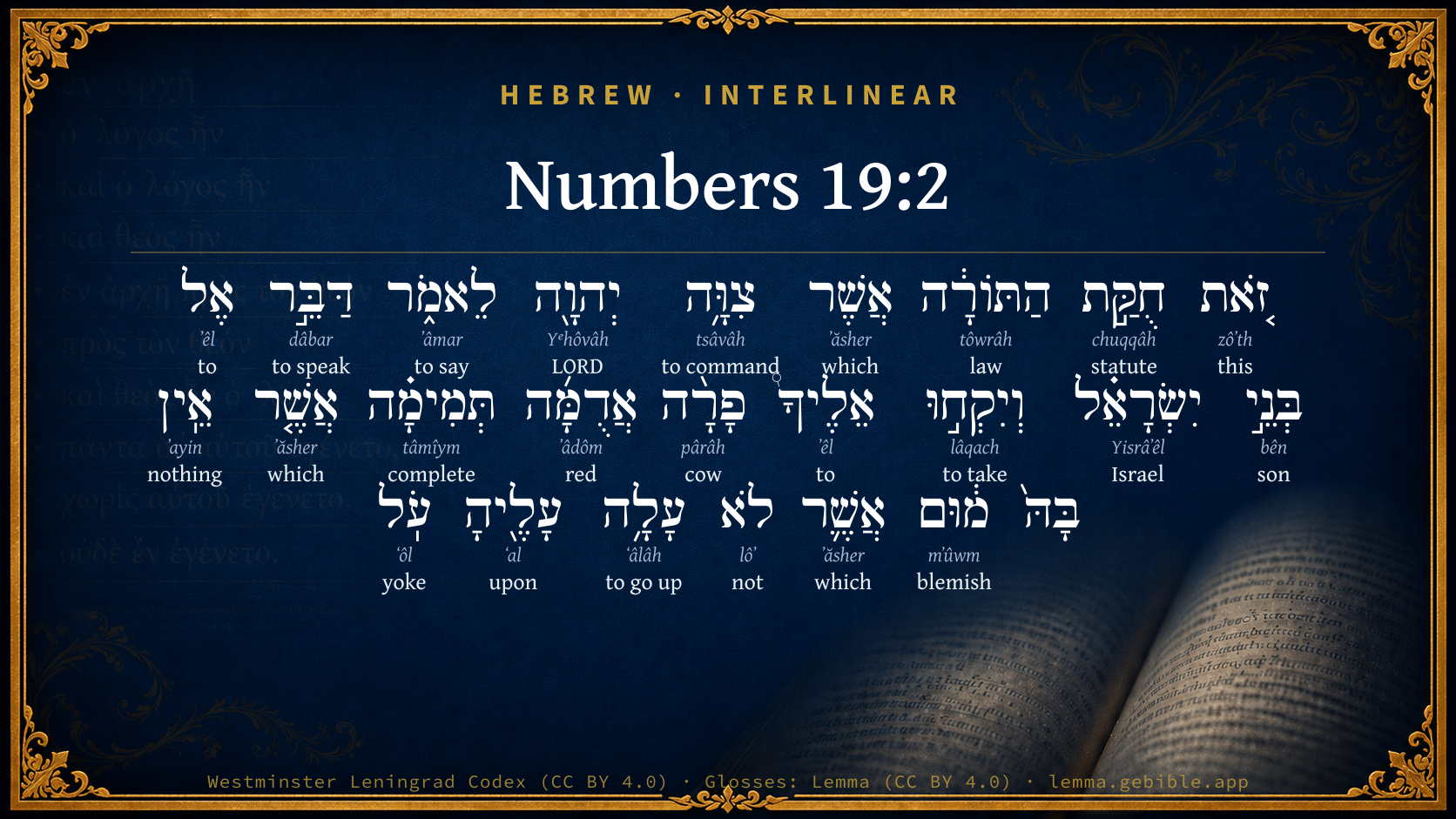
Hebrew (Westminster Leningrad Codex) Numbers 19:2 appears in the Hebrew Old Testament. The text above is from the Westminster Leningrad Codex. Each word links to its Strong’s number, a concise gloss, and parsing drawn from the Open Scriptures Hebrew Bible morphology. Click any word for its full Brown-Driver-Briggs (BDB) entry.
Download image
Cite this verse

Numbers 19:2 (World English Bible). Public Domain. Lemma interlinear Bible study tool, https://lemma.gebible.app/v/numbers/19/2.

Show BibTeX & RIS
BibTeX
RIS
English Translation
This is the statute of the law which Yahweh has commanded, saying, Speak to the children of Israel, that they bring you a red heifer without spot, in which is no blemish, [and] on which never came yoke.
World English Bible · Public Domain
Download a study sheet

One document with this verse’s original text, its word-by-word gloss line, the meaning frame, cross-references with their text, attributed commentary, and full source and license credits — printable, and it pastes into notes with its structure intact.

This verse Autodidact and up

Study sheet (.html) Plain text (.txt)

A passage Seminary Student

Up to 50 verses in one chapter. A passage sheet keeps up to 6 commentary sources and 12 cross-references per verse, in the order this page ranks them, and says so on the sheet whenever that leaves anything out. Ask for a single verse and you get the Autodidact verse sheet above.

Everything on this page stays free to read, with no account — the sheet is a download of what is already on screen, not access to it.

Want to remove ads? Support Godless Engineer
Compare translations 3

The same verse in 3 English versions, stacked beneath the original-language interlinear above. Click any original word for its lexicon entry.

Each is an independent rendering of the whole verse — the interlinear is not word-aligned to these translations.

Highlighted words mark where these versions differ — a whole-verse word diff, not a word-by-word alignment.

  • World English Bible Public Domain
    This is the statute of the law which Yahweh has commanded, saying, Speak to the children of Israel, that they bring you a red heifer without spot, in which is no blemish, [and] on which never came yoke.
  • King James Version Public Domain
    This is the ordinance of the law which the LORD hath commanded, saying, Speak unto the children of Israel, that they bring thee a red heifer without spot, wherein is no blemish, and upon which never came yoke:
  • unfoldingWord Literal Text CC BY-SA 4.0
    “This the statute of the law that Yahweh has commanded, saying, ‘Speak to the sons of Israel, and they shall bring to you a red cow, a perfect one in which there is no defect, on which a yoke has not gone up.

unfoldingWord Literal Text — © unfoldingWord, licensed CC BY-SA 4.0. Word-aligned USFM3 via Door43 (git.door43.org/unfoldingWord/en_ult).

Versions to compare (up to 4)

3 of 4 selected

Show all 18 translations

Every available English version of this verse, each an independent rendering of the whole verse.

  • World English Bible Public Domain
    This is the statute of the law which Yahweh has commanded, saying, Speak to the children of Israel, that they bring you a red heifer without spot, in which is no blemish, [and] on which never came yoke.
  • Berean Standard Bible Public Domain
    “This is the statute of the law that the LORD has commanded: Instruct the Israelites to bring you an unblemished red heifer that has no defect and has never been placed under a yoke.
  • Majority Standard Bible Public Domain
    “This is the statute of the law that the LORD has commanded: Instruct the Israelites to bring you an unblemished red heifer that has no defect and has never been placed under a yoke.
  • King James Version Public Domain
    This is the ordinance of the law which the LORD hath commanded, saying, Speak unto the children of Israel, that they bring thee a red heifer without spot, wherein is no blemish, and upon which never came yoke:
  • American Standard Version (1901) Public Domain
    This is the statute of the law which Jehovah hath commanded, saying, Speak unto the children of Israel, that they bring thee a red heifer without spot, wherein is no blemish, `and' upon which never came yoke.
  • Revised Version (1885) Public Domain
    This is the statute of the law which the LORD hath commanded, saying, Speak unto the children of Israel, that they bring thee a red heifer without spot, wherein is no blemish, and upon which never came yoke:
  • Geneva Bible (1599) Public Domain
    This is the ordinance of the lawe, which the Lord hath commanded, saying, Speake vnto the children of Israel that they bring thee a red kow without blemish, wherein is no spot, vpon the which neuer came yoke.
  • Douay-Rheims (1899) Public Domain
    This is the observance of the victim, which the Lord hath ordained. Command the children of Israel, that they bring unto thee a red cow of full age, in which there is no blemish, and which hath not carried the yoke:
  • Young's Literal Translation Public Domain
    `This `is' a statute of the law which Jehovah hath commanded, saying, Speak unto the sons of Israel, and they bring unto thee a red cow, a perfect one, in which there is no blemish, on which no yoke hath gone up;
  • Literal Standard Version CC BY-SA 4.0
    “This [is] a statute of the law which YHWH has commanded, saying, Speak to the sons of Israel, and they bring a red cow to you, a perfect one, in which there is no blemish, on which no yoke has gone up;
  • Unlocked Literal Bible CC BY-SA 4.0
    “This is a statute, a law which I am commanding you: Say to the people of Israel that they must bring to you a red heifer without flaw or blemish, and which has never carried a yoke.
  • unfoldingWord Literal Text CC BY-SA 4.0
    “This the statute of the law that Yahweh has commanded, saying, ‘Speak to the sons of Israel, and they shall bring to you a red cow, a perfect one in which there is no defect, on which a yoke has not gone up.
  • Darby Bible Public Domain
    This is the statute of the law which Jehovah hath commanded, saying, Speak unto the children of Israel, that they bring thee a red heifer without blemish, wherein is no defect, and upon which never came yoke;
  • World Messianic Bible Public Domain
    “This is the statute of the law which the LORD has commanded. Tell the children of Israel to bring you a red heifer without spot, in which is no defect, and which was never yoked.
  • Webster's Bible Public Domain
    This is the ordinance of the law which the LORD hath commanded, saying, Speak to the children of Israel, that they bring thee a red heifer without spot, in which is no blemish, and upon which never came a yoke:
  • Free Bible Version CC BY-SA 4.0
    “This is a legal regulation the Lord has ordered, saying, Tell the Israelites to bring you a red cow without defects which has never been yoked.
  • Bible in Basic English Public Domain
    This is the rule of the law which the Lord has made, saying, Give orders to the children of Israel to give you a red cow without any mark on her, and on which the yoke has never been put:
  • JPS Tanakh (1917) Public Domain
    This is the statute of the law which the LORD hath commanded, saying: Speak unto the children of Israel, that they bring thee a red heifer, faultless, wherein is no blemish, and upon which never came yoke.

Literal Standard Version (2020), Covenant Press — licensed CC BY-SA 4.0. Text via the HelloAO Bible API (eBible.org). Unlocked Literal Bible (unfoldingWord) — licensed CC BY-SA 4.0. Text via the HelloAO Bible API (eBible.org). unfoldingWord Literal Text — © unfoldingWord, licensed CC BY-SA 4.0. Word-aligned USFM3 via Door43 (git.door43.org/unfoldingWord/en_ult). Free Bible Version, Dr. Jonathan Gallagher — licensed CC BY-SA 4.0. Text via the HelloAO Bible API (eBible.org).

Word by word

More ways to search: Search by grammar → Find every occurrence → Compare this word →

Practice this passage: Drill this verse → Learn its vocabulary →

אֲדֻמָּ֜ה
ʼâdôm
H122
“red”
Adjective, Adjective, Feminine, Singular, Absolute
Part of Speech
Adjective
Type
Adjective
Gender
Feminine
Number
Singular
State
Absolute
Full BDB Definition

Origin: from H119

TWOT: 26b

red, ruddy (of man, horse, heifer, garment, water, lentils)
  1. זֹ֚את zôʼth H2063 “this” Pronoun, Demonstrative, Feminine, Singular
  2. חֻקַּ֣ת chuqqâh H2708 “statute of” Noun, Common, Both, Singular, Construct
  3. הַתּוֹרָ֔ה tôwrâh H8451 “the · law” Particle, Definite Article + Noun, Common, Feminine, Singular, Absolute
  4. אֲשֶׁר ʼăsher H834 “which” Particle, Relative
  5. צִוָּ֥ה tsâvâh H6680 “to command” Verb, Piel, Perfect, 3rd Person, Masculine, Singular
  6. יְהוָ֖ה Yᵉhôvâh H3068 “LORD” Noun, Proper
  7. לֵאמֹ֑ר ʼâmar H559 “to say” Preposition + Verb, Qal, Infinitive Construct
  8. דַּבֵּ֣ר dâbar H1696 “speak” Verb, Piel, Imperative, 2nd Person, Masculine, Singular
  9. אֶל ʼêl H413 “to” Preposition
  10. בְּנֵ֣י bên H1121 “sons of” Noun, Common, Masculine, Plural, Construct
  11. יִשְׂרָאֵ֗ל Yisrâʼêl H3478 “Israel” Noun, Proper
  12. וְיִקְח֣וּ lâqach H3947 “and · to take” Conjunction + Verb, Qal, Imperfect, 3rd Person, Masculine, Plural
  13. אֵלֶיךָ֩ ʼêl H413 “to · you” Preposition + Suffix, Personal, 2nd Person, Masculine, Singular
  14. פָרָ֨ה pârâh H6510 “cow” Noun, Common, Feminine, Singular, Absolute
  15. תְּמִימָ֗ה tâmîym H8549 “complete” Adjective, Adjective, Feminine, Singular, Absolute
  16. אֲשֶׁ֤ר ʼăsher H834 “which” Particle, Relative
  17. אֵֽין ʼayin H369 “nothing” Particle, Negative
  18. מ֔וּם mʼûwm H3971 “blemish” Noun, Common, Masculine, Singular, Absolute
  19. אֲשֶׁ֛ר ʼăsher H834 “which” Particle, Relative
  20. לֹא lôʼ H3808 “not” Particle, Negative
  21. עָלָ֥ה ʻâlâh H5927 “to go up” Verb, Qal, Perfect, 3rd Person, Masculine, Singular
  22. עָלֶ֖יהָ ʻal H5921 “upon · her” Preposition + Suffix, Personal, 3rd Person, Feminine, Singular
  23. עֹֽל ʻôl H5923 “yoke” Noun, Common, Masculine, Singular, Absolute

About this verse

These counts appear in no published source. They are computed here, from the morphology-tagged text and Lemma’s own curated glosses. What Lemma adds →

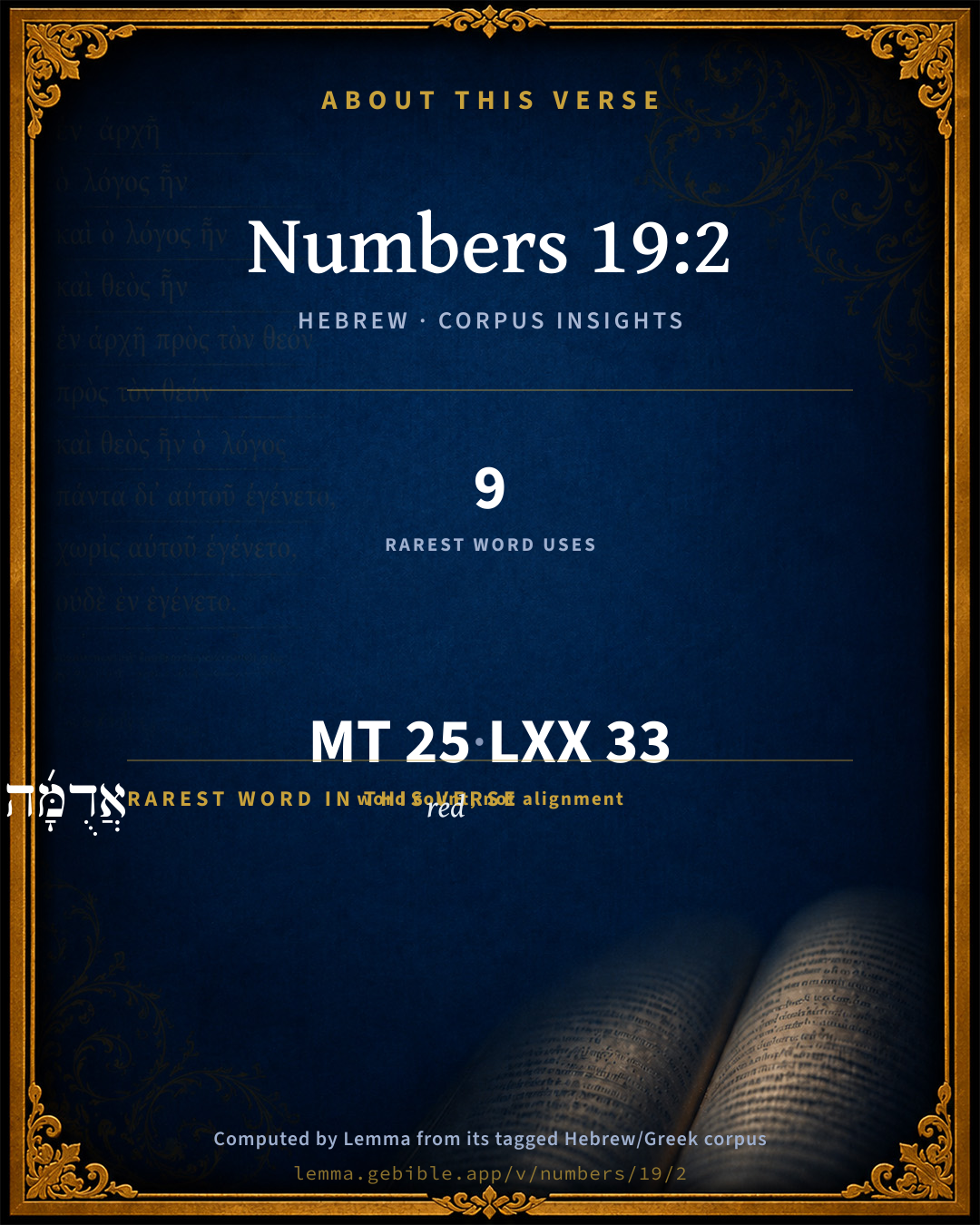
25
words
21
distinct lemmas
Pentateuch
section

Notable vocabulary

The rarest word here is אֲדֻמָּ֜ה red H122 — appearing just 9 times in the whole Hebrew Bible.

Shared distinctive vocabulary

אֲדֻמָּ֜ה red H122 occurs in 7 verses of the Hebrew Bible. Also found in:

Grammatical profile

  • 5 verbs
  • 8 nouns
  • 2 adjectives
  • 1 pronoun
  • 4 prepositions
  • 5 particles

Verb forms

  • צִוָּ֥ה Piel · Perfect
  • לֵאמֹ֑ר Qal · Infinitive Construct
  • דַּבֵּ֣ר Piel · Imperative
  • וְיִקְח֣וּ Qal · Imperfect
  • עָלָ֥ה Qal · Perfect

Repetition

Words recur within this verse — often emphatic in Hebrew:

  • אֲשֶׁר which H834 ×3
  • אֶל to H413 ×2

Hebrew & Septuagint length

In English translation the verse runs 38 words from the Hebrew and 44 from the Septuagint (LXX English) — closely comparable.

A rough comparison of the two English renderings, which tokenize alike — not a word-level alignment.

Word counts can differ between the Hebrew and the Greek without any difference in meaning — e.g. the Hebrew direct-object marker אֵת has no separate Greek word, and Greek often adds the article ὁ.

In the original languages it is 25 Hebrew tokens and 33 Greek tokens — but the two are counted differently (Hebrew bundles its prefixes and suffixes into one token; the Greek is in lemma form), so that isn’t a like-for-like length.

Cross-references

18

Topical passages linked to Numbers 19:2 in the Treasury of Scripture Knowledge — connected by theme and wording, ordered by reader-vote popularity; previews shown in the World English Bible.

  • Leviticus 22:20–25 But whatever has a blemish, that you shall not offer: for it shall not be acceptable for you.
  • Deuteronomy 21:3 and it shall be, that the city which is nearest to the slain man, even the elders of that city shall take a heifer of the herd, which hasn't been worked with, and which has not drawn in the yoke;
  • 1 Samuel 6:7 Now therefore take and prepare yourselves a new cart, and two milk cattle, on which there has come no yoke; and tie the cattle to the cart, and bring their calves home from them;
  • Philippians 2:6–8 who, existing in the form of God, didn't consider it robbery to be equal with God,
  • 1 Peter 1:19 but with precious blood, as of a lamb without spot, the blood of Christ;
  • Isaiah 1:18 "Come now, and let us reason together," says Yahweh: "Though your sins be as scarlet, they shall be as white as snow. Though they be red like crimson, they shall be as wool.
  • Lamentations 1:14 The yoke of my transgressions is bound by his hand; They are knit together, they are come up on my neck; he has made my strength to fail: The Lord has delivered me into their hands, against whom I am not able to stand.
  • Malachi 1:13–14 You say also, 'Behold, what a weariness it is!' and you have sniffed at it," says Yahweh of Hosts; "and you have brought that which was taken by violence, the lame, and the sick; thus you bring the offering. Should I accept this at your hand?" says Yahweh.
  • Luke 1:35 The angel answered her, "The Holy Spirit will come on you, and the power of the Most High will overshadow you. Therefore also the holy one who is born from you will be called the Son of God.
  • John 10:17–18 Therefore the Father loves me, because I lay down my life, that I may take it again.
  • Hebrews 7:26 For such a high priest was fitting for us: holy, guiltless, undefiled, separated from sinners, and made higher than the heavens;
  • Hebrews 9:10 being only (with meats and drinks and various washings) fleshly ordinances, imposed until a time of reformation.
  • 1 Peter 2:22 who did not sin, "neither was deceit found in his mouth."
  • Revelation 1:5 and from Jesus Christ, the faithful witness, the firstborn of the dead, and the ruler of the kings of the earth. To him who loves us, and washed us from our sins by his blood;
  • Exodus 12:5 Your lamb shall be without blemish, a male a year old. You shall take it from the sheep, or from the goats:
  • Leviticus 14:6 As for the living bird, he shall take it, and the cedar wood, and the scarlet, and the hyssop, and shall dip them and the living bird in the blood of the bird that was killed over the running water.
  • Numbers 19:6 and the priest shall take cedar-wood, and hyssop, and scarlet, and cast it into the midst of the burning of the heifer.
  • Numbers 31:21 Eleazar the priest said to the men of war who went to the battle, This is the statute of the law which Yahweh has commanded Moses:

Cross-references courtesy of OpenBible.info (CC BY 4.0).

Hebrew and Greek witnesses Masoretic Hebrew ↔ Greek Septuagint

The same verse in the two great witnesses to the Old Testament, shown verse-for-verse.

These are two independent witnesses, not word-aligned to each other, and the Septuagint is shown in lemma (dictionary) form.

Hebrew Numbers 19:2 Masoretic · Westminster Leningrad Codex

זֹ֚את חֻקַּ֣ת הַתּוֹרָ֔ה אֲשֶׁר צִוָּ֥ה יְהוָ֖ה לֵאמֹ֑ר דַּבֵּ֣ר אֶל בְּנֵ֣י יִשְׂרָאֵ֗ל וְיִקְח֣וּ אֵלֶיךָ֩ פָרָ֨ה אֲדֻמָּ֜ה תְּמִימָ֗ה אֲשֶׁ֤ר אֵֽין בָּהּ֙ מ֔וּם אֲשֶׁ֛ר לֹא עָלָ֥ה עָלֶ֖יהָ עֹֽל

This is the statute of the law which Yahweh has commanded, saying, Speak to the children of Israel, that they bring you a red heifer without spot, in which is no blemish, [and] on which never came yoke.

World English Bible · Public Domain

Greek LXX Numbers 19:2 Septuagint · lemma form

οὗτος ὁ διαστολή ὁ νόμος ὅσος συντάσσω κύριος λέγω λαλέω ὁ υἱός ἰσραήλ καί λαμβάνω πρός σύ δάμαλις πυρρός ἄμωμος ὅστις οὐ ἔχω ἐν αὐτός μῶμος καί ὅς οὐ ἐπιβάλλω ἐπί αὐτός ζυγός

This is the constitution of the law, as the Lord has commanded, saying, Speak to the sons of Israel, and let them take for you a red heifer without spot, which has no spot on her, and on which no yoke has been put.

LXX2012 (modern English Septuagint) · Public Domain

On this verse, Keil & Delitzsch discusses the Septuagint’s reading. Read the note in Commentary ↓

Hebrew: Westminster Leningrad Codex (CC BY 4.0). Greek: Septuagint (public domain); English from LXX2012 (modern English Septuagint) (Public Domain). How the Septuagint differs from the Hebrew →

Targum (Aramaic paraphrase)

2

The Targum is the ancient Jewish Aramaic paraphrase of the Hebrew Scriptures — an interpretive translation, not the Hebrew text itself. Onkelos (literal) and Pseudo-Jonathan (expansive) render the Torah, and Jonathan the Prophets. Coverage is partial: where no permissively-licensed English translation exists for a verse, only the Aramaic is shown. This is verse-level text, not a word-by-word alignment to the Hebrew.

  1. Targum Onkelos Torah (Genesis–Deuteronomy)
    דָא גְזֵירַת אוֹרַיְתָא דִי פַקִיד יְיָ לְמֵימָר מַלֵיל עִם בְּנֵי יִשְׂרָאֵל וְיִסְבוּן לָךְ תּוֹרְתָא סִמוּקְתָּא שְׁלֶמְתָּא דִי לֵית בָּהּ מוּמָא דְלָא סְלִיק עֲלַהּ נִירָא

    (no public-domain English translation for this verse)

    Targum Onkelos — Aramaic: “Onkelos Genesis” (public domain); “Onkelos Exodus” (public domain); “Onkelos Leviticus” (public domain); “Onkelos Numbers” (public domain); “Onkelos Deuteronomy” (public domain). English: “Sefaria Community Translation” (CC0 1.0 (public-domain dedication)); “J.W. Etheridge. The Targums of Onkelos and Jonathan Ben Uzziel on the Pentateuch. London: Longmans, Green, 1862” (public domain). Text via Sefaria.

  2. Targum Pseudo-Jonathan Torah (Genesis–Deuteronomy)
    דָא גְזֵירַת אַחְוָיַת אוֹרַיְיתָא דְפַקֵיד יְיָ לְמֵימָר מַלֵיל עִם בְּנֵי יִשְרָאֵל וְיִסְבוּן לָךְ מֵאַפְרָשׁוּת לִישְׁכְּתָא תוֹרָתָא סוּמְקָתָא בְּרַת תַּרְתֵּין שְׁנִין דְלֵית בָּהּ מוּמָא וְשׁוּמָא מִשֵעָר חַוְורָן דְלָא סַלִיק עֲלָהּ דְכַר וְלָא אַטְרָחָא בְּאוּבְצַן עִיבִידְתָּא וְאִפְסְרָא וּקְטַרְבָא וְלָא אִידְעָצָא בְּזִקְתָא וְסוּל וְסִירְתָּא וְכָל דְדָמֵי לְנִירָא

    This is the decree, the publication of the law which the Lord hath commanded, saying; Speak to the sons of Israel, that they bring to thee from the separation of the fold a red heifer, two years old, in which there is neither spot nor white hair, on which no male hath come, nor the burden of any work been imposed, neither hurt by the thong, nor grieved by the goad or prick, nor collar (band) or any like yoke.

    Targum Pseudo-Jonathan — Aramaic: “Targum Jonathan on Genesis” (public domain); “Targum Jonathan on Exodus” (public domain); “Targum Jonathan on Leviticus” (public domain); “Targum Jonathan on Numbers” (public domain); “Targum Jonathan on Deuteronomy” (public domain). English: “The Targum of Jonathan ben Uzziel, trans. J. W. Etheridge, London, 1862” (public domain). Text via Sefaria.

Commentary

Notes on Numbers 19:2 from classic Christian and Jewish commentators (each source and its license shown beneath its notes). The classic Christian expositions comment on the surrounding passage and are grouped to its opening verse, so a note may address several verses; the Jewish commentaries on the Tanakh (Rashi and others) are per-verse, so they appear only where the commentator wrote on this verse.

Lemma curates 59 commentaries, every one of them public domain or Creative Commons licensed, each selected and text-cleaned for this edition rather than reprinted as found. About our sources →

Trapp's Complete Commentary

John Trapp

Num 19:2 This [is] the ordinance of the law which the LORD hath commanded, saying, Speak unto the children of Israel, that they bring thee a red heifer without spot, wherein [is] no blemish, [and] upon which never came yoke:

Ver. 2. This is the ordinance of the law, which.] An ordinance, a law, a commanded law: all this to show the peremptoriness of the Lord in this point, that unless we lay hold upon the blood of Christ, prefigured by this red heifer, we cannot escape the damnation of hell.

That they bring thee.] At a common charge, because for a common good. All the congregation must get them a bloody Saviour.

A red heifer.] Typing out Christum cruentatum, Christ covered with his own blood: {see Isa 63:1-2} white and ruddy, as the Church says of him: {Son 5:10} Tam recens mihi Christus crucifixus, ac si iam fudisset sanguinem. {a} The pressure of his sufferings made him sweat great drops, or rather clods of blood, in a cold night, besides what afterwards issued from his many wounds in his head and body.

Never came yoke.] Christ never bore the yoke either of sin or servitude. He laid down his life of himself. {Joh 10:17-18} See Heb 9:13-14. He was not subject to any command of man. {Luk 2:44 Joh 2:4}

{a} Luther.

John Trapp, A Commentary or Exposition upon All the Books of the Old and New Testament (1647–1656) — public domain. Text from a community e-Sword module.

Joseph Benson's Commentary

Num 19:2. This is the law which the Lord hath commanded — Or rather, had commanded. For it is probable that the water of purification had been made before, although the manner of making it is here first described. That they bring thee a red heifer — Provided at the expense of the congregation, because they were all to have a joint interest in it; as all believers, the spiritual Israel, have in Christ, typified by it. Here a question arises, why this sacrifice (if it may be so called) must be a heifer, when in other cases bullocks are appointed, and, in general, the male is preferred to the female. According to St. Austin and Theodoret, the weaker sex was to signify that infirmity of the flesh wherewith Christ was clothed. But the reason which Dr. Spencer assigns seems to be more plausible, which is, that it was in opposition to the Egyptian superstition. For though the Egyptians offered bullocks in sacrifice, they had cows in great veneration; as Herodotus, Diodorus Siculus, Ælian, Porphyry, and others, unanimously declare. Porphyry says they would rather have eaten human flesh than that of cows. In order, therefore, to expose this folly of Egypt in the eyes of the Israelites, God directs Moses to appoint one solemn institution wherein a heifer was to be the victim. A red heifer — A fit colour to shadow forth the nature of sin, and the blood of Christ, from which this water and all other rites had their purifying virtue. The Jews say, that it was necessary the heifer should be entirely red, without the least mixture of any other colour, and that if but two hairs were black or white it was unfit for this sacrifice. Without spot — Hebrew, תמימה, temima, perfect; wherein is no blemish — Thus typifying the spotless purity and sinless perfection of the Lord Jesus. Upon which never came yoke — This was not necessary in other sacrifices; but may here be considered as signifying the perfect freedom of the Lord Jesus from every obligation to undertake our cause and die in our stead, save that which love laid him under. For when he said, Lo, I come, he was bound by no other cords than those of his great love to us.

Joseph Benson's Commentary on the Old and New Testaments (1811–1818) — public domain. Text from a community e-Sword module.

Keil & Delitzsch

C. F. Keil & F. Delitzsch

Preparation of the Purifying Water. - As water is the ordinary means by which all kinds of uncleanness are removed, it was also to be employed in the removal of the uncleanness of death. But as this uncleanness was the strongest of all religious defilements, fresh water alone was not sufficient to remove it; and consequently a certain kind of sprinkling-water was appointed, which was strengthened by the ashes of a sin-offering, and thus formed into a holy alkali. The main point in the law which follows, therefore, was the preparation of the ashes, and these had to be obtained by the sacrifice of a red heifer.

(Note: On this sacrifice, which is so rich in symbolical allusions, but the details of which are so difficult to explain, compare the rabbinical statutes in the talmudical tractate Para (Mishnah, v. Surenh. vi. pp. 269ff.); Maimonides de vacca rufa; and Lundius jd. Heiligth. pp. 680ff. Among modern treatises on this subject, are Bhr's Symbolik, ii. pp. 493ff.; Hengstenberg, Egypt and the Books of Moses, pp. 173ff.; Leyrer in Herzog's Cycl.; Kurtz in the Theol. Studien und Kritiken, 1846, pp. 629ff. (also Sacrificial Worship of the Old Testament, pp. 422ff., Eng. transl., Tr.); and my Archologie, i. p. 58.)

Num 19:2

The sons of Israel were to bring to Moses a red heifer, entirely without blemish, and to give it to Eleazar the priest, that he might have it slaughtered in his presence outside the camp. פּרה is not a cow generally, but a young cow, a heifer, הב́לבכיע (lxx), juvenca, between the calf and the full-grown cow. אדמּה, of a red colour, is not to be connected with תמימה in the sense of "quite red," as the Rabbins interpret it; but תמימה, integra, is to be taken by itself, and the words which follow, "wherein is no blemish," to be regarded as defining it still more precisely (see Lev 22:19-20). The slaying of this heifer is called חטּאת, a sin-offering, in Num 19:9 and Num 19:17. To remind the congregation that death was the wages of sin, the antidote to the defilement of death was to be taken from a sin-offering. But as the object was not to remove and wipe away sin as such, but simply to cleanse the congregation from the uncleanness which proceeded from death, the curse of sin, it was necessary that the sin-offering should be modified in a peculiar manner to accord with this special design. The sacrificial animal was not to be a bullock, as in the case of the ordinary sin-offerings of the congregation (Lev 4:14), but a female, because the female sex is the bearer of life (Gen 3:20), a פּרה, i.e., lit., the fruit-bringing; and of a red colour, not because the blood-red colour points to sin (as Hengstenberg follows the Rabbins and earlier theologians in supposing), but as the colour of the most "intensive life," which has its seat in the blood, and shows itself in the red colour of the face (the cheeks and lips); and one "upon which no yoke had ever come," i.e., whose vital energy had not yet been crippled by labour under the yoke. Lastly, like all the sacrificial animals, it was to be uninjured, and free from faults, inasmuch as the idea of representation, which lay at the foundation of all the sacrifices, but more especially of the sin-offerings, demanded natural sinlessness and original purity, quite as much as imputed sin and transferred uncleanness. Whilst the last-mentioned prerequisite showed that the victim was well fitted for bearing sin, the other attributes indicated the fulness of life and power in their highest forms, and qualified it to form a powerful antidote to death. As thus appointed to furnish a reagent against death and mortal corruption, the sacrificial animal was to possess throughout, viz., in colour, in sex, and in the character of its body, the fulness of life in its greatest freshness and vigour.

Num 19:3-4

The sacrifice itself was to be superintended by Eleazar the priest, the eldest son of the high priest, and his presumptive successor in office; because Aaron, or the high priest, whose duty it was to present the sin-offerings for the congregation (Lev 4:16), could not, according to his official position, which required him to avoid all uncleanness of death (Lev 21:11-12), perform such an act as this, which stood in the closest relation to death and the uncleanness of death, and for that very reason had to be performed outside the camp. The subject, to "bring her forth" and "slay her," is indefinite; since it was not the duty of the priest to slay the sacrificial animal, but of the offerer himself, or in the case before us, of the congregation, which would appoint one of its own number for the purpose. All that the priest had to do was to sprinkle the blood; at the same time the slaying was to take place לפניו, before him, i.e., before his eyes. Eleazar was to sprinkle some of the blood seven times "towards the opposite," i.e., toward the front of the tabernacle (seven times, as in Lev 4:17). Through this sprinkling of the blood the slaying became a sacrifice, being brought thereby into relation to Jehovah and the sanctuary; whilst the life, which was sacrificed for the sin of the congregation, was given up to the Lord, and offered up in the only way in which a sacrifice, prepared like this, outside the sanctuary, could possibly be offered.

Num 19:5-6

After this (Num 19:5, Num 19:6), they were to burn the cow, with the skin, flesh, blood, and dung, before his (Eleazar's) eyes, and he was to throw cedar-wood, hyssop, and scarlet wool into the fire. The burning of the sacrificial animal outside the camp took place in the case of every sin-offering for the whole congregation, for the reasons expounded on Lev 4:11-12. But in the case before us, the whole of the sacrificial act had to be performed outside the camp, i.e., outside the sphere of the theocracy; because the design of this sin-offering was not that the congregation might thereby be received through the expiation of its sin into the fellowship of the God and Lord who was present at the altar and in the sanctuary, but simply that an antidote to the infection of death might be provided for the congregation, which had become infected through fellowship with death; and consequently, the victim was to represent, not the living congregation as still associated with the God who was present in His earthly kingdom, but those members of the congregation who had fallen victims to temporal death as the wages of sin, and, as such, were separated from the earthly theocracy (see my Archaeology, i. p. 283). In this sacrifice, the blood, which was generally poured out at the foot of the altar, was burned along with the rest, and the ashes to be obtained were impregnated with the substance thereof. But in order still further to increase the strength of these ashes, which were already well fitted to serve as a powerful antidote to the corruption of death, as being the incorruptible residuum of the sin-offering which had not been destroyed by the fire, cedar-wood was thrown into the fire, as the symbol of the incorruptible continuance of life; and hyssop, as the symbol of purification from the corruption of death; and scarlet wool, the deep red of which shadowed forth the strongest vital energy (see at Lev 14:6), - so that the ashes might be regarded "as the quintessence of all that purified and strengthened life, refined and sublimated by the fire" (Leyrer).

Num 19:7-10

The persons who took part in this - viz., the priest, the man who attended to the burning, and the clean man who gathered the ashes together, and deposited them in a clean place for subsequent use - became unclean till the evening in consequence; not from the fact that they had officiated for unclean persons, and, in a certain sense, had participated in their uncleanness (Knobel), but through the uncleanness of sin and death, which had passed over to the sin-offering; just as the man who led into the wilderness the goat which had been rendered unclean through the imposition of sin, became himself unclean in consequence (Lev 16:26). Even the sprinkling water prepared from the ashes defiled every one who touched it (Num 19:21). But when the ashes were regarded in relation to their appointment as the means of purification, they were to be treated as clean. Not only were they to be collected together by a clean man; but they were to be kept for use in a clean place, just as the ashes of the sacrifices that were taken away from the altar were to be carried to a clean place outside the camp (Lev 6:4). These defilements, like every other which only lasted till the evening, were to be removed by washing. The ashes thus collected were to serve the congregation נדּה למי, i.e., literally as water of uncleanness; in other words, as water by which uncleanness was to be removed. "Water of uncleanness" is analogous to "water of sin" in Num 8:7.

Keil & Delitzsch — Biblical Commentary on the Old Testament (1861–1891) — public domain (CC PDM 1.0). Text via the HelloAO Bible API. (Old Testament only.)

Geneva Bible (1599)

Geneva Bible translators

According to this law and ceremony ye shall sacrifice the red cow.

Geneva Bible (1599) marginal notes — public domain. Text via Bolls.life.

Adam Clarke's Commentary

Verse 2. Speak unto the children of Israel that they bring thee, c.] The ordinance of the red heifer was a sacrifice of general application. All the people were to have an interest in it, and therefore the people at large are to provide the sacrifice. This Jewish rite certainly had a reference to things done under the Gospel, as the author of the Epistle to the Hebrews has remarked: "For if," says he, "the blood of bulls and of goats," alluding, probably, to the sin-offerings and the scape-goat, "and the ashes of a heifer, sprinkling the unclean, sanctifieth to the purifying of the flesh how much more shall the blood of Christ, who through the eternal Spirit offered himself without spot to God, purge your conscience from dead works to serve the living God!" Heb 9:13-14. As the principal stress of the allusion here is to the ordinance of the red heifer, we may certainly conclude that it was designed to typify the sacrifice of our blessed Lord.

We may remark several curious particulars in this ordinance.

1. A heifer was appointed for a sacrifice, probably, in opposition to the Egyptian superstition which held these sacred, and actually worshipped their great goddess Isis under this form; and this appears the more likely because males in general were preferred for sacrifice, yet here the female is chosen.

2. It was to be a red heifer, because red bulls were sacrificed to appease the evil demon Typhon, worshipped among the Egyptians. See Spencer.

3. The heifer was to be without spot - having no mixture of any other colour. Plutarch remarks, De Iside et de Osiride, that if there was a single hair in the animal either white or black, it marred the sacrifice. See Calmet, and See Clarke on Nu 8:7.

4. Without blemish - having no kind of imperfection in her body; the other, probably, applying to the hair or colour.

5. On which never came yoke, because any animal which had been used for any common purpose was deemed improper to be offered in sacrifice to God. The heathens, who appear to have borrowed much from the Hebrews, were very scrupulous in this particular. Neither the Greeks nor Romans, nor indeed the Egyptians, would offer an animal in sacrifice that had been employed for agricultural purposes. Of this we have the most positive evidence from Homer, Porphyry, Virgil, and Macrobius.

Just such a sacrifice as that prescribed here, does Diomede vow to offer to Pallas. - Iliad, lib. x., ver. 291.

Ὡς νυν μοι εθελουσα παριστασο, και με φυλασσε·

Σοι δ' αυ εγω ῥεξω βουν ηνιν ευρυμετωπον,

Αδμητην, ἡν ουπω ὑπο ζυγον ηγαγεν ανηρ·

Την τοι εγω ῥεξω, χρυσον κερασιν περιχευας.

"So now be present, O celestial maid;

So still continue to the race thine aid;

A yearling heifer falls beneath the stroke,

Untamed, unconscious of the galling yoke,

With ample forehead and with spreading horns,

Whose tapering tops refulgent gold adorns."

Altered from POPE.

In the very same words Nestor, Odyss., lib. iii., ver. 382, promises a similar sacrifice to Pallas.

The Romans had the same religion with the Greeks, and consequently the same kind of sacrifices; so Virgil, Georg. iv., ver. 550.

Quatuor eximios praestanti corpore tauros

Ducit, et intacta totidem cervice juveneas.

"---------From his herd he culls

For slaughter four the fairest of his bulls;

Four heifers from his female stock he took,

All fair, and all unknowing of the yoke."

- DRYDEN.

It is very likely that the Gentiles learnt their first sacrificial rites from the patriarchs; and on this account we need not wonder to find so many coincidences in the sacrificial system of the patriarchs and Jews, and all the neighbouring nations.

Adam Clarke's Commentary on the Bible (1810–1826) — public domain. Text from a community e-Sword/MySword module.

The Cambridge Bible for Schools and Colleges

gen. ed. J. J. S. Perowne

2. a red heifer] a red cow. The Heb. word is that ordinarily used for the full-grown animal (e.g. Gen_41:2-4; 1Sa_6:7). The reason for the particular colour is not known. The red animal and the scarlet thread may both, perhaps, have had reference to blood as an instrument of purification.

without spot] perfect. Any blemish, such as lameness, blindness, or the malformation of a limb, would disqualify it.

The Cambridge Bible for Schools and Colleges (gen. ed. J. J. S. Perowne; Cambridge University Press, 1878–1918) — public domain. Text from a community e-Sword module.

John Gill's Exposition

This is the ordinance of the law which the Lord hath commanded,.... By which it appears, that this law was not of the moral, but of the ceremonial kind, being called an ordinance, a statute, a decree of God, the King of kings; and which was founded not on any clear plain reason in the thing itself, but in the will of God, who intended it as a type and shadow of the blood and sacrifice of Christ, and of the efficacy of that to cleanse from sin; and it also appears by this, that it was not a new law now made, but which had been made already: "which the Lord hath commanded": as is plain from what has been observed; see Gill on Num 19:1; and the Jews (q) say, that the red heifer was slain by Eleazar the day after the tabernacle was erected, even on the second day of the first month of Israel's coming out of Egypt; and it was now repeated both on account of the priests and people, because of the priest to whom it belonged, as Aben Ezra observes, Aaron being now established in the priesthood; and because of the people, who were afraid they should die if they came near the tabernacle; now hereby they are put in mind of a provision made for the purification of them, when under any uncleanness, which made them unfit for coming to it:

saying, speak unto the children of Israel; whom this law concerned, and for whose purification it was designed; and it was at the expense not of a private person, but of the whole congregation, that the water of purifying was made; and that, as the Jews say (r), that the priests might have no personal profit from it:

that they bring thee a red heifer; or "young cow", for so the word properly signifies; one of two years old, as the Targum of Jonathan, and so says the Misnah (s); though some of the Rabbins say one of three years, or of four years, or even one of five years old, would do. This instance, with others, where females are ordered to be slain, see Lev 3:1; confutes the notion of such, who think the laws of Moses were made in conformity to the customs of the Egyptians, this being directly contrary to them; if they were the same in the times of Moses, they were in the times of Herodotus, who expressly says (t), male oxen the Egyptians sacrifice; but it is not lawful for them to sacrifice females, for they are sacred to Isis. Indeed, according to Plutarch (u) and Diodorus Siculus (w), the Egyptians in their times sacrificed red bullocks to Typhon, who they supposed was of the same colour, and to whom they had an aversion, accounting him the god of evil; and because red oxen were odious to them, they offered them to him; as red-haired men also were slain by them for the same reason, at the tomb of Osiris, who they say was murdered by the red-haired Typhon; but these were superstitions that obtained among them after the times of Moses, and could not be retorted to by him; a better reason is to be given why this heifer or cow was to be of a red colour:

without spot, wherein is no blemish; the first of these, without spot, the Jews understand of colour, that it should have no spots in it of any other colour, black or white, nor indeed so much as an hair, at least not two of another colour; and so the Targum of Jonathan, in which there is no spot or mark of a white hair; and Jarchi more particularly,"which is perfect in redness; for if there were in it (he says) two black hairs, it was unfit;''and so Ben Gersom, with which agrees the Misnah (x); if there were in it two hairs, black or white, in one part, it was rejected; if there was one in the head, and another in the tail, it was rejected; if there were two hairs in it, the root or bottom of which were black, and the head or top red, and so on the contrary; all depended on the sight: and it must be owned, the same exactness was observed in the red oxen sacrificed by the Egyptians, as Plutarch relates (y); for if the ox had but one hair black or white, they reckoned it was not fit to be sacrificed; in which perhaps they imitated the Jews: it being without blemish was what was common to all sacrifices, such as are described in Lev 22:22,

and upon which never came yoke; and so among the Heathens in later times, very probably in imitation of this, they used to offer to their deities oxen that never had bore any yoke; as appears from Homer, Horace, Virgil, Ovid, and Seneca, out of whom instances are produced by Bochart (z). Now, though this red cow was not properly a sacrifice for sin, yet it was analogous to one, and was a type of our Lord Jesus Christ, in whom all these characters meet, and are significant. It being a female may denote the infirmities of Christ's human nature, to which it was subject, though sinless ones; he was encompassed with, and took on him, our infirmities; and may have some respect to the woman, by whom the transgression came, which brought impurity on all human nature, which made a purification for sin necessary; and the red colour of it may point at the flesh and blood of Christ he partook of, and the sins of his people, which were laid upon him, and were as crimson and as scarlet, and the bloody sufferings he endured to make satisfaction for them; and its being without spot and blemish may denote the perfection of Christ in his person, obedience, and sufferings, and the purity and holiness of his nature; and having never had any yoke upon it may signify, that though he was made under the law, and had commands enjoined him by his father as man, yet was free from the yoke of human traditions, and from the servitude of sin, and most willingly engaged, and not by force and compulsion, in the business of our redemption and salvation.

(q) Seder Olam Rabba, c. 7. p. 22. (r) Misn. Shekalim, c. 7. sect. 7. & Maimon, in ib. (s) Misn. Parah, c. 1. sect. 1. (t) Euterpe, sive, l. 2. c. 41. (u) De lside. (w) Bibliothec. l. 1. p. 79. (x) Parah, c. 2. sect. 5. (y) Ut supra. (Bibliothec. l. 1. p. 79.) (z) Hierozoic. par. 1. l. 2. c. 33. vol. 322.

John Gill's Exposition of the Whole Bible (1746–1763) — public domain (CC PDM 1.0). Text via the HelloAO Bible API.

Albert Barnes' Notes on the Bible

A red heifer - Red, in order to shadow forth man’s earthly body, even as the name Adam bears allusion to the red earth of which man’s body was fashioned.

Without spot, wherein is no blemish - As with sin-offerings generally Lev 4:3.

Upon which never came yoke - So here and elsewhere (see the marginal references), in the case of female victims.

Albert Barnes' Notes on the Bible (1834–1885) — public domain. Text from a community e-Sword/MySword module.

Haydock's Catholic Bible Commentary

Observance. Hebrew, "ceremony." Septuagint, "distinction, (diastole, St. Augustine, q. 33,) or ordinance." (Calmet) --- Victim. Hebrew, "the ordinance of the law." (Du Hamel) --- A red cow, &c. This red cow, offered in sacrifice for sin, and consumed with fire without the camp, with the ashes of which, mingled with water, the unclean were to be expiated and purified; was a figure of the passion of Christ, by whose precious blood, applied to our souls in the holy sacraments, we are cleansed from our sins. (Challoner) --- Age, three years old. Some translate, "entirely red." They suppose, that these regulations are in opposition to the customs of the Egyptians, who never sacrificed the cow, esteeming it sacred to Isis, or to the moon. Spencer (Rit. ii. 15) adds, that the red colour was formerly in the highest estimation; and this victim represented the death of Christ, who expiated our defilements. The Egyptians immolated bulls of a red colour, in hatred of Typhon, and to appease that dangerous god, whom they depicted perfectly red. Plut.[Plutarch?] (Isis) observes, that they hate all animals of that colour; and the Copths precipitated a red ass down a precipice. The ancient kings of Egypt sacrificed red men on the tomb of Osiris or Dyphon; (Diodorus, Bib. 1,) and Manetho assures us, that they scattered their ashes in the wind. If this custom prevailed in the days of Moses, we need not wonder that he teaches the Hebrews to have so little dread of Typhon, as even to chose a red cow in preference, to purify themselves. --- Yoke. Such victims were generally chosen by the Romans, Greeks, and Egyptians, as more delicate and respectful. Intacta totidem cervice juvencus. (Georg. iv.; Bochart, anim. 2. 33.) St. Jerome (ep. 27,) says, that a red cow was sacrificed every year, as in reality one would be requisite for all the people, though the Rabbins pretend that only seven, or ten at most, were treated in this manner, from Moses till the destruction of the temple by Titus. (Drusius)

George Leo Haydock (1774–1849), Haydock's Catholic Family Bible and Commentary, 1859 edition — public domain. Excludes Psalms (Douay-Rheims chapter numbering differs from Protestant) and Deuterocanonical books (Catholic canon only).

Matthew Poole's English Annotations

The ordinance of the law, or, the constitution of the law, i.e. that which God hath ordained or established by law.

That they bring thee, at their common charge, because it was for the common good. Red; a fit colour to shadow forth both the bloody nature and complexion of sin, Isa 1:8, and the human nature, and especially the blood, of Christ, from which this water and all other rites had their purifying virtue.

Wherein is no blemish; a fit type of Christ, who was such, Heb 7:26; 1Pe 1:19.

Upon which never came yoke; whereby may be signified, either that Christ in himself was free from all the yoke or obligation of God’s command, till for our sakes he took up our yoke, and put himself under the law; or that Christ was not drawn or forced to undertake our burden and cross, but that lie did voluntarily choose it. See Joh 10:17,18.

Matthew Poole's English Annotations on the Holy Bible (1683–1685) — public domain. Text from a community e-Sword/MySword module.

Whedon's Commentary on the Bible

Daniel D. Whedon

2. The ordinance of the law — This use of two words, each of which signifies law or statute, occurs again only in Num_31:21, in connexion with purification. It is intended to give emphasis to the ordinance.

A red heifer — No reason is assigned for the sex and color of the victim. Hence all interpretations of this symbolry must be conjectural. The following particulars have been suggested: (1.) A heifer was taken as a rebuke to pagan Egypt, which regarded her as sacred, and worshipped her as the impersonation of the goddess Isis. Herodotus says that the Egyptians sacrifice male kine, both old and young, but it is not lawful for them to sacrifice females. (2.) It was to be red, or quite red, as the rabbins interpret it, because the Egyptians sacrificed red bulls to the evil demon Typhon. (3.)

Without spot — Because the Egyptians, in their selection of red bulls for sacrifice, regard as unfit the animal having a single white or black hair. See Lev_1:3; Lev_22:20-24, notes. (4.) The requirement that the heifer should be one upon which never came yoke harmonized with the ancient usage which deemed an animal which had been used for common purposes improper for sacrifice. The Homeric heroes vow to offer to Pallas “a yearling heifer which no man had yet brought under the yoke.” Il., 10:291; Od., 3:382.

Daniel D. Whedon (gen. ed.), Commentary on the Old and New Testaments (1874–1909) — public domain. Text from a community e-Sword module.

The Pulpit Commentary

This is the ordinance of the law. hrwOTh tQju. Law-statute: an unusual combination only found elsewhere in Num_31:21, which also concerns legal purifications. A red heifer. This offering was obviously intended, apart from its symbolic significance, to be studiedly simple and cheap. In contradiction to the many and costly and ever-repeated sacrifices of the Sinaitic legislation, this was a single individual, a female, and of the most common description: red is the most ordinary colour of cattle, and a young heifer is of less value than any other beast of its kind. The ingenuity indeed of the Jews heaped around the choice of this animal a multitude of precise requirements, and supplemented the prescribed ritual with many ceremonies, some of which are incorporated by the Targums with the sacred text; but even so they could not destroy the remarkable contrast between the simplicity of this offering and the elaborate complexity of those ordained at Sinai. Only six red heifers are said to have been needed during the whole of Jewish history, so far-reaching and so long-enduring were the uses and advantages of a single immolation. It is evident that this ordinance had for its distinguishing character oneness as opposed to multiplicity, simplicity contrasted with elaborateness. Without spot, wherein is no blemish. See on Lev_4:8. However little, comparatively speaking, the victim might cost them, it must yet be perfect of its kind. The later Jews held that three white hairs together on any part of the body made it unfit for the purpose. On the sex and color of the offering see below. Upon which never came yoke. Cf. Deu_21:3 1Sa_6:7. The imposition of the yoke, according to the common sentiment of all nations, was a species of degradation, and therefore inconsistent with the ideal of what was fit to be offered in rids ease. That the matter was wholly one of sentiment is nothing to the point: God doth not care for oxen of any kind, but he doth care that man should give him what is, whether in fact or in fancy, the best of its sort.

The Pulpit Commentary (1880–1919), ed. H.D.M. Spence-Jones & Joseph S. Exell — public domain. Text from a community e-Sword module.

John Wesley's Explanatory Notes

Red - A fit colour to shadow forth the bloody nature of sin, and the blood of Christ, from which this water and all other rites had their purifying virtue. No blemish - A fit type of Christ. Upon which never came yoke - Whereby may be signified, either that Christ in himself was free from all the yoke or obligation of God's command, till for our sakes he put himself under the law; or that Christ was not forced to undertake our burden and cross, but did voluntarily chuse it. He was bound and held with no other cords but those of his own love.

John Wesley, Explanatory Notes Upon the Whole Bible (1754–1765) — public domain. Text via the GEBible commentary corpus.

Scofield Reference Notes

C. I. Scofield

red heifer

The red heifer: Type of the sacrifice of Christ as the ground of the cleansing of the believer from the defilement contracted in his pilgrim walk through this world, and illustration of the method of his cleansing. The order is:

(1) the slaying of the sacrifice;

(2) the sevenfold sprinkling of the blood, typical public testimony before the eyes of all of the complete and never-to-be-repeated putting away of all the believer’s sin as before God. Heb 9:12-14; Heb 10:10-12.

(3) the reduction of the sacrifice to ashes which are preserved and become a memorial of the sacrifice;

(4) the cleansing from defilement (sin has two aspects--guilt and uncleanness) by sprinkling with the ashes mingled with water. Water is a type of both the Spirit and the Word. Joh 7:37-39. Eph 5:26. The operation typified is this: the Holy Spirit used the Word to convict the believer of some evil allowed in his life to the hindering of his joy, growth, and service. Thus convicted, he remembers that the guilt of his sin has been met by the sacrifice of Christ 1Jn 1:7. Instead, therefore, of despairing, the convicted believer judges and confesses the defiling thing as unworthy a saint, and is forgiven and cleansed; Joh 13:3-10; 1Jn 1:7-10.

The Scofield Reference Bible (1917 edition), notes by C. I. Scofield — public domain. Text from a community e-Sword module.

Rashi

Rabbi Shlomo Yitzchaki (Rashi)

וזאת חקת התורה THIS IS THE ORDINANCE OF THE LAW — Because Satan and the nations of the world taunt Israel, saying, “What is this command and what reason is there for it”, on this account it (Scripture) writes (uses) the term חקה about it, implying: It is an enactment from before Me; you have no right to criticize it (Yoma 67b; cf. Midrash Tanchuma, Chukat 7).

ויקחו אליך THEY SHALL TAKE UNTO THEE — It will always be called by thy name: people will speak of the cow which Moses prepared in the wilderness (Midrash Tanchuma, Chukat 8).

אדמה תמימה [A COW] RED, PERFECT — This means that it should be perfect in respect to its redness (Sifrei Bamidbar 123:1), — so that if there are two black hairs in it (or two of any color other than red) it is unfitted for the rite here described (Mishnah Parah 2:5).

Rashi on the Tanakh — English translations: “The Judaica Press complete Tanach with Rashi, translated by A. J. Rosenberg” (CC BY 4.0); “Pentateuch with Rashi's commentary by M. Rosenbaum and A.M. Silbermann, 1929-1934” (public domain); “The Metsudah Tanach series, Lakewood, N.J” (CC BY 4.0); and “The Book of Joshua, Metsudah Publications, 1997” (CC BY 4.0). Text via Sefaria.

Ramban (Nachmanides)

Rabbi Moshe ben Nachman (Ramban / Nachmanides)

This is ‘chukath’ (the statute of) the law. “Since Satan and the nations of the world ridicule Israel, saying, ‘What is [the meaning of] this commandment [of the Red Heifer]?’ therefore the Torah uses the term chukah (statute) in connection with it, [meaning]: ‘It is a decree from before Me, and you have no permission to question it.’” This is Rashi’s language, taken from the words of our Rabbis. 7; Yoma 67b. See also Vol. II, p. 208, Note 236. Now I have already written in connection with the goat that is sent away [to Azazel the reason] why the nations of the world should taunt us about this [commandment] more than [they taunt us about] the rest of the offerings which effect atonement, and some of which bring about purification — such as the offerings of a man [or woman] who suffered a flux, 15:13-15; 25-31. or of a woman after childbirth., 12:6-8. [The reason is] that since [the procedure of the Red Heifer] is performed outside [the Sanctuary], it appears to the nations that it is slaughtered to the satyrs which are in the open field., 17:5-7. But the truth is that [the Red Heifer] is brought to remove the spirit of impurity, and the burning thereof outside [the Sanctuary Court] is like the sweet savor, 1:9 etc. — In other words, as long as the observance is in accordance with the word of G-d, it does not matter if it is done within the Sanctuary Court or outside thereof, for both were equally commanded by Him. [of the offerings brought within the Sanctuary Court].The reason for the impurity conveyed by a corpse is [due to man’s sin committed through] the instigation of the serpent, for those who die by “the Divine Kiss” do not [in fact] convey impurity according to the law, this being the [sense of the] saying of the Rabbis: “The righteous do not convey impurity [when dead].” It is for this reason that Scripture states, This is ‘chukath’ of the law, meaning: [this is] that which is “hollowed out” — “to engrave, hollow out.” from the [Written] Torah, namely, the Oral Torah. Therefore it is a [female] heifer and must be red, [symbolic] of the attribute of justice. It is given to Eleazar inasmuch as it must be slaughtered before him, even [though it may actually be slaughtered] by a non-priest, because the deputy High Priest [i.e., Eleazar] supervises the performance thereof, so that it should be done in accordance with his intentions, and so that they should not entertain any improper thoughts about it, as do the nations [of the world] and Satan [as mentioned above].Now this section [of the Red Heifer] completes the laws of the priests [and as such belongs in the Book of Leviticus]. However, it is written here after [the preceding section dealing with] the gifts to the priests, in order to declare that the purification of Israel must also be effected through the priest [just as atonement for sin is effected through the offerings which are offered on the altar by the priests]. THIS IS THE STATUTE OF THE LAW WHICH THE ETERNAL COMMANDED. The reason for this expression [when it should have said “that I commanded,” since G-d is the Speaker of these words], is similar to the verse, And unto Moses He said: ‘Come up unto the Eternal’ [where it should likewise have said: “Come up unto Me”]. Or it may be that this verse must be re-arranged [in order to be interpreted properly], its sense being: “Speak unto the children of Israel: This is the statute of the law which the Eternal hath commanded, saying etc.” … With the sense of the verse being as Ramban transposes it, we can understand the use of the phrase which ‘the Eternal’ hath commanded, because this is part of the statement which Moses is to make to the people, when conveying G-d’s command. Hence it cannot say: “which I have commanded.”

Scripture states dabeir [— in the singular — dabeir (speak) unto the children of Israel] and not dabru [in the plural, although the section begins: And the Eternal spoke unto Moses and unto Aaron], because Moses was the main [person who spoke to the people, “or it may mean that G-d spoke to Moses that he should tell it to Aaron, as our Rabbis have explained” (see a similar case in Leviticus 13:1) and in this sense Moses was the main person involved in the Divine communication].

THEY SHALL TAKE UNTO THEE. The reason [why the verse says] “unto thee” [Moses] is [because G-d first commanded] that they should do this in the wilderness for that particular time, and afterwards He commanded that it shall be unto the children of Israel, and unto the stranger that sojourneth among them for a statute for ever, meaning that they should do so throughout their generations. Similarly [we find the expression unto thee in the following verses]: that they bring ‘unto thee’ pure olive oil, and afterwards it says, it shall be a statute for ever throughout their generations., Verse 21. Here too, the original command was for Moses’ lifetime [hence “unto thee”], and afterwards it was repeated to make it obligatory throughout the generations.Scripture states: And ‘ye’ shall give, and not “and ‘thou’ shalt give,” in order to include Aaron together with Moses and thereby to honor him [Aaron], for both of them were to command Eleazar to have it slaughtered before him. Or it may be that He said and ‘ye’ shall give [because it refers] to many [givers] — those now and those of subsequent generations, and the meaning is that Eleazar who [was in charge of it being] slaughtered [although it could actually be slaughtered by anybody, as explained above] was to take it from the possession of the court, and they were to give it to him so that it should be done properly and in accordance with their intention; in a similar manner to that which we have been taught [in a Mishnah]: “And who prepared them [the ashes of the Red Heifer]? The first one was prepared by Moses our teacher; the second one was prepared by Ezra, and seven were prepared after Ezra’s time. And who prepared them? Simon the Just and Jochanan the High Priest prepared two each etc.”, 3:4).

Ramban (Nachmanides) on the Tanakh — English translation: “Commentary on the Torah by Ramban (Nachmanides). Translated and annotated by Charles B. Chavel. New York, Shilo Pub. House, 1971-1976” (CC BY 4.0). Text via Sefaria.

Lesson kit

Teaching starters — assembled from the data on this page, not authored interpretation. Every prompt links to the verse data it draws on. Edit before teaching.

Numbers, in the Pentateuch, opens this verse with 25 words (21 distinct Hebrew lemmas). Its most distinctive word is ʼâdôm (“red”). A historical commentator’s framing appears above. Read the whole chapter for the surrounding context.

Discussion questions

  1. What does “red” (ʼâdôm) contribute to the verse as a whole?
  2. Genesis 25:30 shares the word «red» with this verse. How do the two illuminate each other?
  3. “which” occurs 3× in this one verse. What is the effect of the repetition?
  4. The translations on this page render this verse differently — a whole-verse word diff, not a word-by-word alignment. What might account for the different wordings?
  5. The verb «צִוָּ֥ה» is Piel Perfect. How does its form color the action?
  6. Reading how Trapp's Complete Commentary and Joseph Benson's Commentary read this verse, where do the two commentators agree and where do they part?

Things to notice

Reading settings

Reading text

Shown beneath each verse's original-language words.

Old Testament
Old Testament edition

Read the OT as the Masoretic Hebrew (MT) or the Greek Septuagint (LXX).

English shown for the Greek Septuagint (in the Hebrew ↔ Greek comparison).

Comparing translations? Open the Compare panel on any verse page to stack up to four side by side.