
Leviticus 16:10

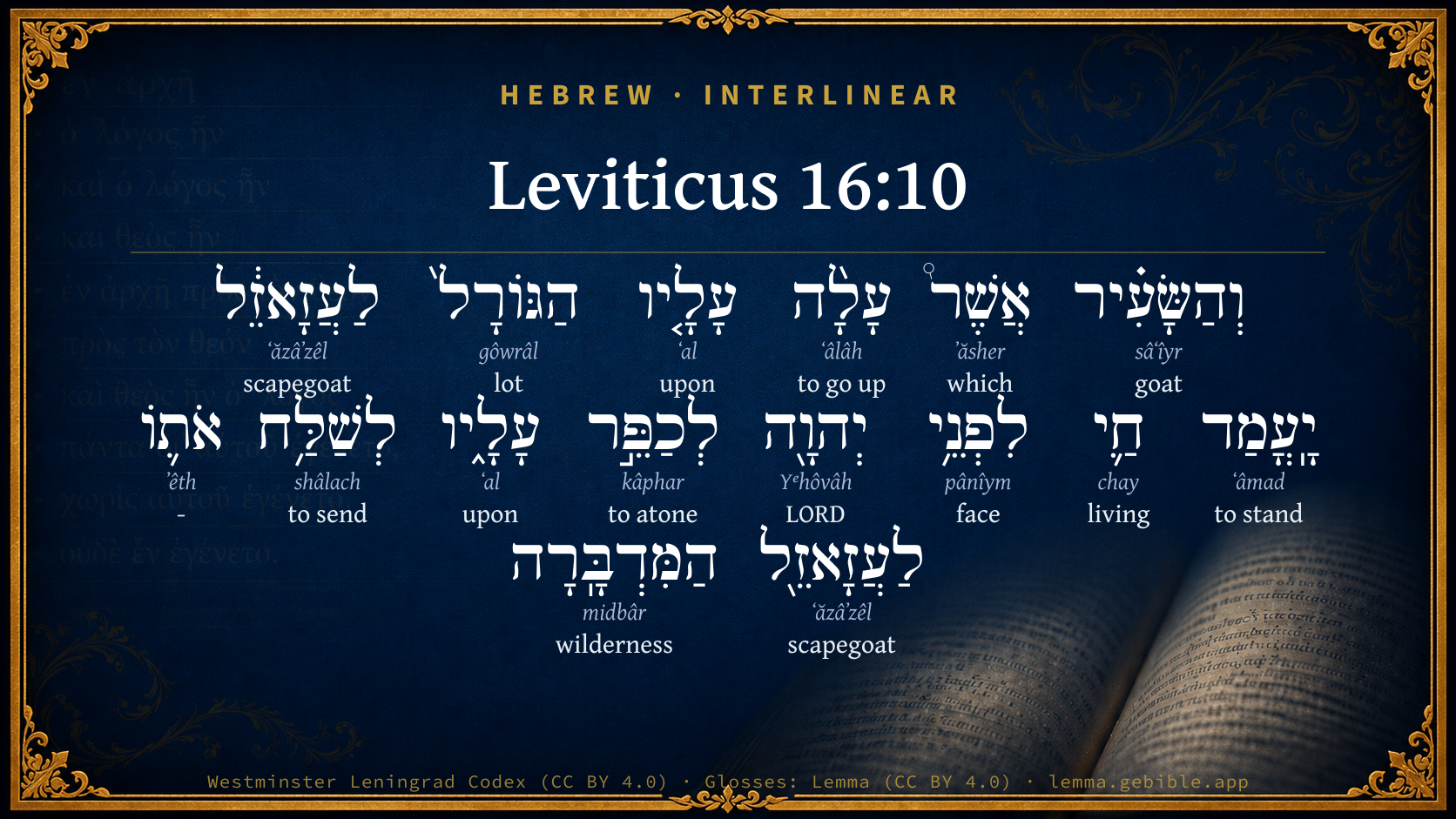
Hebrew (Westminster Leningrad Codex) Leviticus 16:10 appears in the Hebrew Old Testament. The text above is from the Westminster Leningrad Codex. Each word links to its Strong’s number, a concise gloss, and parsing drawn from the Open Scriptures Hebrew Bible morphology. Click any word for its full Brown-Driver-Briggs (BDB) entry.
Download image
Cite this verse

Leviticus 16:10 (World English Bible). Public Domain. Lemma interlinear Bible study tool, https://lemma.gebible.app/v/leviticus/16/10.

Show BibTeX & RIS
BibTeX
RIS
English Translation
But the goat, on which the lot fell for the scapegoat, shall be presented alive before Yahweh, to make atonement for him, to send him away for the scapegoat into the wilderness.
World English Bible · Public Domain
Download a study sheet

One document with this verse’s original text, its word-by-word gloss line, the meaning frame, cross-references with their text, attributed commentary, and full source and license credits — printable, and it pastes into notes with its structure intact.

This verse Autodidact and up

Study sheet (.html) Plain text (.txt)

A passage Seminary Student

Up to 50 verses in one chapter. A passage sheet keeps up to 6 commentary sources and 12 cross-references per verse, in the order this page ranks them, and says so on the sheet whenever that leaves anything out. Ask for a single verse and you get the Autodidact verse sheet above.

Everything on this page stays free to read, with no account — the sheet is a download of what is already on screen, not access to it.

Want to remove ads? Support Godless Engineer
Compare translations 3

The same verse in 3 English versions, stacked beneath the original-language interlinear above. Click any original word for its lexicon entry.

Each is an independent rendering of the whole verse — the interlinear is not word-aligned to these translations.

Highlighted words mark where these versions differ — a whole-verse word diff, not a word-by-word alignment.

  • World English Bible Public Domain
    But the goat, on which the lot fell for the scapegoat, shall be presented alive before Yahweh, to make atonement for him, to send him away for the scapegoat into the wilderness.
  • King James Version Public Domain
    But the goat, on which the lot fell to be the scapegoat, shall be presented alive before the LORD, to make an atonement with him, and to let him go for a scapegoat into the wilderness.
  • unfoldingWord Literal Text CC BY-SA 4.0
    But the goat on which the lot for the scapegoat went up shall be made to stand, living, to the face of Yahweh to make atonement on it by sending it away as the scapegoat, to the wilderness.

unfoldingWord Literal Text — © unfoldingWord, licensed CC BY-SA 4.0. Word-aligned USFM3 via Door43 (git.door43.org/unfoldingWord/en_ult).

Versions to compare (up to 4)

3 of 4 selected

Show all 18 translations

Every available English version of this verse, each an independent rendering of the whole verse.

  • World English Bible Public Domain
    But the goat, on which the lot fell for the scapegoat, shall be presented alive before Yahweh, to make atonement for him, to send him away for the scapegoat into the wilderness.
  • Berean Standard Bible Public Domain
    But the goat chosen by lot as the scapegoat shall be presented alive before the LORD to make atonement by sending it into the wilderness as the scapegoat.
  • Majority Standard Bible Public Domain
    But the goat chosen by lot as the scapegoat shall be presented alive before the LORD to make atonement by sending it into the wilderness as the scapegoat.
  • King James Version Public Domain
    But the goat, on which the lot fell to be the scapegoat, shall be presented alive before the LORD, to make an atonement with him, and to let him go for a scapegoat into the wilderness.
  • American Standard Version (1901) Public Domain
    But the goat, on which the lot fell for Azazel, shall be set alive before Jehovah, to make atonement for him, to send him away for Azazel into the wilderness.
  • Revised Version (1885) Public Domain
    But the goat, on which the lot fell for Azazel, shall be set alive before the LORD, to make atonement for him, to send him away for Azazel into the wilderness.
  • Geneva Bible (1599) Public Domain
    But the goate, on which the lot shall fall to be the Scape goate, shalbe presented aliue before the Lord, to make reconciliation by him, and to let him go (as a Scape goate) into the wildernes.
  • Douay-Rheims (1899) Public Domain
    But that whose lot was to be the emissary goat, he shall present alive before the Lord, that he may pour out prayers upon him, and let him go into the wilderness.
  • Young's Literal Translation Public Domain
    `And the goat on which the lot for a goat of departure hath gone up is caused to stand living before Jehovah to make atonement by it, to send it away for a goat of departure into the wilderness.
  • Literal Standard Version CC BY-SA 4.0
    And the goat on which the lot for a goat of departure has gone up is caused to stand living before YHWH to make atonement by it, to send it away for a goat of departure into the wilderness.
  • Unlocked Literal Bible CC BY-SA 4.0
    But the goat on which the lot fell for the scapegoat must be brought alive before Yahweh, to make atonement by sending him away as a scapegoat into the wilderness.
  • unfoldingWord Literal Text CC BY-SA 4.0
    But the goat on which the lot for the scapegoat went up shall be made to stand, living, to the face of Yahweh to make atonement on it by sending it away as the scapegoat, to the wilderness.
  • Darby Bible Public Domain
    And the goat upon which the lot fell for Azazel shall be set alive before Jehovah, to make atonement with it, to send it away as Azazel into the wilderness.
  • World Messianic Bible Public Domain
    But the goat on which the lot fell for the scapegoat shall be presented alive before the LORD, to make atonement for him, to send him away as the scapegoat into the wilderness.
  • Webster's Bible Public Domain
    But the goat on which the lot fell to be the scape-goat, shall be presented alive before the LORD, to make an atonement with him, and to let him go for a scape-goat into the wilderness.
  • Free Bible Version CC BY-SA 4.0
    The goat chosen by lot as the scapegoat is to be presented alive before the Lord to make things right by sending it away into the wilderness as the scapegoat.
  • Bible in Basic English Public Domain
    But the goat for Azazel is to be placed living before the Lord, for the taking away of sin, that it may be sent away for Azazel into the waste land.
  • JPS Tanakh (1917) Public Domain
    But the goat, on which the lot fell for Azazel, shall be set alive before the LORD, to make atonement over him, to send him away for Azazel into the wilderness.

Literal Standard Version (2020), Covenant Press — licensed CC BY-SA 4.0. Text via the HelloAO Bible API (eBible.org). Unlocked Literal Bible (unfoldingWord) — licensed CC BY-SA 4.0. Text via the HelloAO Bible API (eBible.org). unfoldingWord Literal Text — © unfoldingWord, licensed CC BY-SA 4.0. Word-aligned USFM3 via Door43 (git.door43.org/unfoldingWord/en_ult). Free Bible Version, Dr. Jonathan Gallagher — licensed CC BY-SA 4.0. Text via the HelloAO Bible API (eBible.org).

Word by word

More ways to search: Search by grammar → Find every occurrence → Compare this word →

Practice this passage: Drill this verse → Learn its vocabulary →

לַעֲזָאזֵ֔ל
ʻăzâʼzêl
H5799
“to/for · scapegoat”
Preposition + Noun, Proper
Part of Speech
Preposition + Noun
Type
Proper
Full BDB Definition

Origin: from H5795 and H235

TWOT: 1593

entire removal, scapegoat - refers to the goat used for sacrifice for the sins of the people - meaning dubious
  1. וְהַשָּׂעִ֗יר sâʻîyr H8163 “and · the · goat” Conjunction + Particle, Definite Article + Noun, Common, Masculine, Singular, Absolute
  2. אֲשֶׁר֩ ʼăsher H834 “which” Particle, Relative
  3. עָלָ֨ה ʻâlâh H5927 “to go up” Verb, Qal, Perfect, 3rd Person, Masculine, Singular
  4. עָלָ֤יו ʻal H5921 “upon · him” Preposition + Suffix, Personal, 3rd Person, Masculine, Singular
  5. הַגּוֹרָל֙ gôwrâl H1486 “the · lot” Particle, Definite Article + Noun, Common, Masculine, Singular, Absolute
  6. יָֽעֳמַד ʻâmad H5975 “to stand” Verb, Hophal, Imperfect, 3rd Person, Masculine, Singular
  7. חַ֛י chay H2416 “living” Adjective, Adjective, Masculine, Singular, Absolute
  8. לִפְנֵ֥י pânîym H6440 “to/for · face(s) of” Preposition + Noun, Common, Both, Plural, Construct
  9. יְהוָ֖ה Yᵉhôvâh H3068 “LORD” Noun, Proper
  10. לְכַפֵּ֣ר kâphar H3722 “to atone” Preposition + Verb, Piel, Infinitive Construct
  11. עָלָ֑יו ʻal H5921 “upon · him” Preposition + Suffix, Personal, 3rd Person, Masculine, Singular
  12. לְשַׁלַּ֥ח shâlach H7971 “to send” Preposition + Verb, Piel, Infinitive Construct
  13. אֹת֛וֹ ʼêth H853 “- · him” Particle, Direct Object + Suffix, Personal, 3rd Person, Masculine, Singular
  14. לַעֲזָאזֵ֖ל ʻăzâʼzêl H5799 “to/for · scapegoat” Preposition + Noun, Proper
  15. הַמִּדְבָּֽרָה midbâr H4057 “the · wilderness · toward” Particle, Definite Article + Noun, Common, Masculine, Singular, Absolute + Suffix, Demonstrative

About this verse

These counts appear in no published source. They are computed here, from the morphology-tagged text and Lemma’s own curated glosses. What Lemma adds →

16
words
14
distinct lemmas
Pentateuch
section

Notable vocabulary

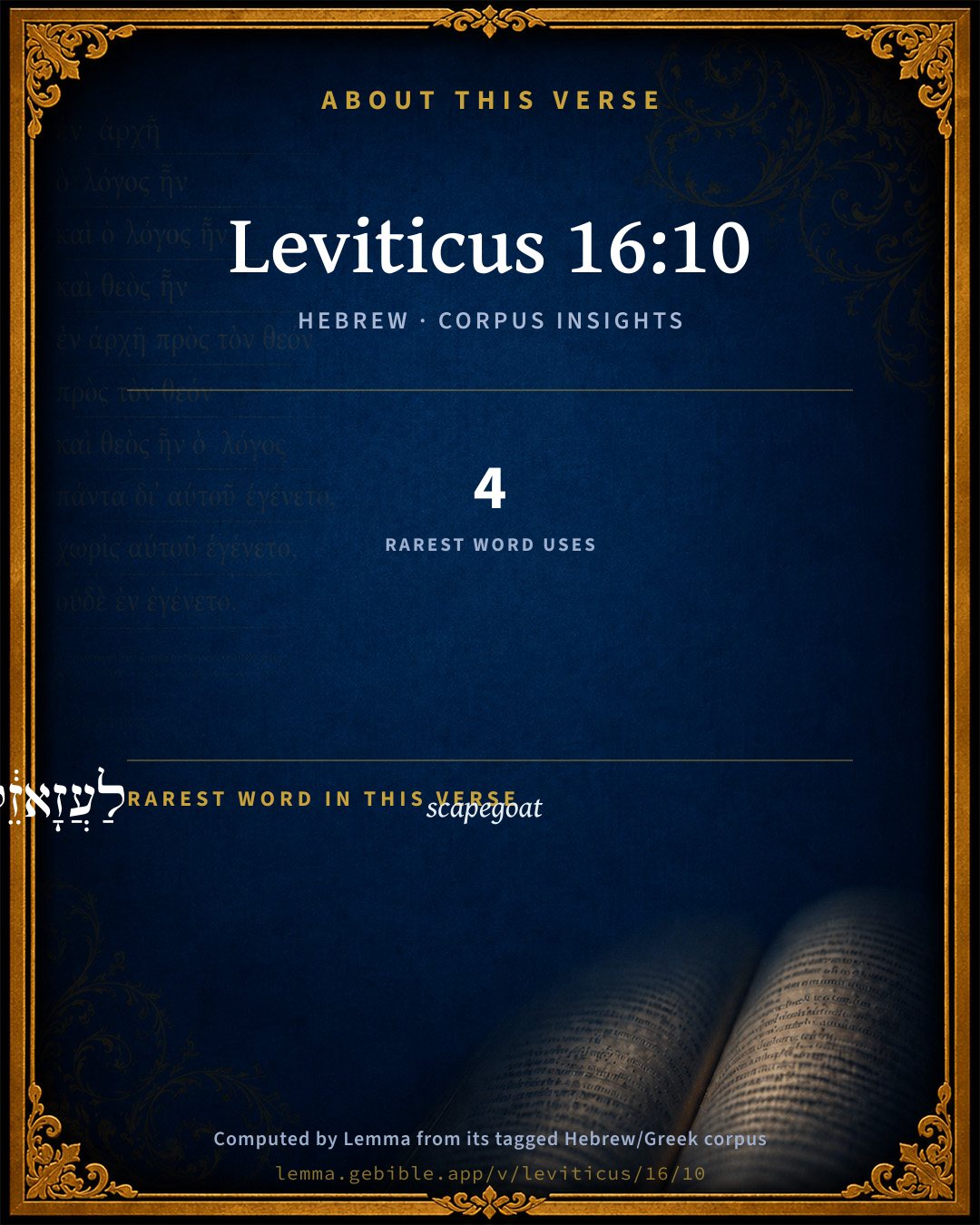
The rarest word here is לַעֲזָאזֵ֔ל scapegoat H5799 — appearing just 4 times in the whole Hebrew Bible.

Shared distinctive vocabulary

לַעֲזָאזֵ֔ל scapegoat H5799 occurs in 3 verses of the Hebrew Bible. Also found in:

Grammatical profile

  • 4 verbs
  • 7 nouns
  • 1 adjective
  • 2 prepositions
  • 2 particles

Verb forms

  • עָלָ֨ה Qal · Perfect
  • יָֽעֳמַד Hophal · Imperfect
  • לְכַפֵּ֣ר Piel · Infinitive Construct
  • לְשַׁלַּ֥ח Piel · Infinitive Construct

Repetition

Words recur within this verse — often emphatic in Hebrew:

  • עָלָ֤יו upon H5921 ×2
  • לַעֲזָאזֵ֔ל scapegoat H5799 ×2

Hebrew & Septuagint length

In English translation the verse runs 32 words from the Hebrew and 40 from the Septuagint (LXX English) — closely comparable.

A rough comparison of the two English renderings, which tokenize alike — not a word-level alignment.

Word counts can differ between the Hebrew and the Greek without any difference in meaning — e.g. the Hebrew direct-object marker אֵת has no separate Greek word, and Greek often adds the article ὁ.

Cross-references

10

Topical passages linked to Leviticus 16:10 in the Treasury of Scripture Knowledge — connected by theme and wording, ordered by reader-vote popularity; previews shown in the World English Bible.

  • 1 John 2:2 And he is the atoning sacrifice for our sins, and not for ours only, but also for the whole world.
  • Leviticus 16:21–22 Aaron shall lay both his hands on the head of the live goat, and confess over him all the iniquities of the children of Israel, and all their transgressions, even all their sins; and he shall put them on the head of the goat, and shall send him away into the wilderness by the hand of a man who is in readiness.
  • Hebrews 9:23–24 It was necessary therefore that the copies of the things in the heavens should be cleansed with these; but the heavenly things themselves with better sacrifices than these.
  • Isaiah 53:4–11 Surely he has borne our sickness, and carried our suffering; yet we considered him plagued, struck by God, and afflicted.
  • 1 John 3:16 By this we know love, because he laid down his life for us. And we ought to lay down our lives for the brothers.
  • Leviticus 14:7 He shall sprinkle on him who is to be cleansed from the leprosy seven times, and shall pronounce him clean, and shall let the living bird go into the open field.
  • Romans 3:25 whom God set forth to be an atoning sacrifice, through faith in his blood, for a demonstration of his righteousness through the passing over of prior sins, in God's forbearance;
  • Romans 4:25 who was delivered up for our trespasses, and was raised for our justification.
  • 2 Corinthians 5:21 For him who knew no sin he made to be sin on our behalf; so that in him we might become the righteousness of God.
  • Hebrews 7:26–27 For such a high priest was fitting for us: holy, guiltless, undefiled, separated from sinners, and made higher than the heavens;

Cross-references courtesy of OpenBible.info (CC BY 4.0).

Hebrew and Greek witnesses Masoretic Hebrew ↔ Greek Septuagint

The same verse in the two great witnesses to the Old Testament, shown verse-for-verse.

These are two independent witnesses, not word-aligned to each other, and the Septuagint is shown in lemma (dictionary) form.

Hebrew Leviticus 16:10 Masoretic · Westminster Leningrad Codex

וְהַשָּׂעִ֗יר אֲשֶׁר֩ עָלָ֨ה עָלָ֤יו הַגּוֹרָל֙ לַעֲזָאזֵ֔ל יָֽעֳמַד חַ֛י לִפְנֵ֥י יְהוָ֖ה לְכַפֵּ֣ר עָלָ֑יו לְשַׁלַּ֥ח אֹת֛וֹ לַעֲזָאזֵ֖ל הַמִּדְבָּֽרָה

But the goat, on which the lot fell for the scapegoat, shall be presented alive before Yahweh, to make atonement for him, to send him away for the scapegoat into the wilderness.

World English Bible · Public Domain

Greek LXX Leviticus 16:10 Septuagint · lemma form

καί ὁ χίμαρος ἐπί ὅς ἐπιἔρχομαι ἐπί αὐτός ὁ κλῆρος ὁ ἀποπομπαῖος ἵστημι αὐτός ζάω ἔναντι κύριος ὁ ἐκἱλάσκομαι ἐπί αὐτός ὥστε ἀποστέλλω αὐτός εἰς ὁ ἀποπομπή ἀποἵημι αὐτός εἰς ὁ ἔρημος

and the goat upon which the lot of the scape-goat came, he shall present alive before the Lord, to make atonement upon him, so as to send him away as a scape-goat, and he shall send him into the wilderness.

LXX2012 (modern English Septuagint) · Public Domain

Hebrew: Westminster Leningrad Codex (CC BY 4.0). Greek: Septuagint (public domain); English from LXX2012 (modern English Septuagint) (Public Domain). How the Septuagint differs from the Hebrew →

Targum (Aramaic paraphrase)

2

The Targum is the ancient Jewish Aramaic paraphrase of the Hebrew Scriptures — an interpretive translation, not the Hebrew text itself. Onkelos (literal) and Pseudo-Jonathan (expansive) render the Torah, and Jonathan the Prophets. Coverage is partial: where no permissively-licensed English translation exists for a verse, only the Aramaic is shown. This is verse-level text, not a word-by-word alignment to the Hebrew.

  1. Targum Onkelos Torah (Genesis–Deuteronomy)
    וּצְפִירָא דִי סְלִיק עֲלוֹהִי עַדְבָא לַעֲזָאזֵל יִתָּקַם כַּד חַי קֳדָם יְיָ לְכַפָּרָא עֲלוֹהִי לְשַׁלַח יָתֵהּ לַעֲזָאזֵל לְמַדְבְּרָא

    (no public-domain English translation for this verse)

    Targum Onkelos — Aramaic: “Onkelos Genesis” (public domain); “Onkelos Exodus” (public domain); “Onkelos Leviticus” (public domain); “Onkelos Numbers” (public domain); “Onkelos Deuteronomy” (public domain). English: “Sefaria Community Translation” (CC0 1.0 (public-domain dedication)); “J.W. Etheridge. The Targums of Onkelos and Jonathan Ben Uzziel on the Pentateuch. London: Longmans, Green, 1862” (public domain). Text via Sefaria.

  2. Targum Pseudo-Jonathan Torah (Genesis–Deuteronomy)
    וּצְפִירָא דְסָלֵק עֲלוֹי עַדְבָא לַעֲזָאזֵל יִתּוֹקָם בְּחַיִין קֳדָם יְיָ לְכַפָּרָא עַל סַרְחָנוּת עַמָא בֵּית יִשְרָאֵל לְשַׁדְרָא יָתֵיהּ לִמְמָת בַּאֲתַר תַּקִיף וְקַשֵׁי דִבְמַדְבְּרָא דְצוּק דְהוּא בֵּית חֲרוּרֵי

    And the goat on which came up the lot for Azazel he shall make to stand alive before the Lord, to expiate for the sins of the people of the house of Israel, by sending him to die in a place rough and hard in the rocky desert which is Beth-hadurey.

    Targum Pseudo-Jonathan — Aramaic: “Targum Jonathan on Genesis” (public domain); “Targum Jonathan on Exodus” (public domain); “Targum Jonathan on Leviticus” (public domain); “Targum Jonathan on Numbers” (public domain); “Targum Jonathan on Deuteronomy” (public domain). English: “The Targum of Jonathan ben Uzziel, trans. J. W. Etheridge, London, 1862” (public domain). Text via Sefaria.

Commentary

Notes on Leviticus 16:10 from classic Christian and Jewish commentators (each source and its license shown beneath its notes). The classic Christian expositions comment on the surrounding passage and are grouped to its opening verse, so a note may address several verses; the Jewish commentaries on the Tanakh (Rashi and others) are per-verse, so they appear only where the commentator wrote on this verse.

Lemma curates 59 commentaries, every one of them public domain or Creative Commons licensed, each selected and text-cleaned for this edition rather than reprinted as found. About our sources →

Joseph Benson's Commentary

Lev 16:10. For a scape-goat — This seems to be the most literal and obvious meaning of the original word אזאזל, Azazel, evidently derived from עז, ez, or gnez, a goat, and אזל, azel, to go away. In this sense the Seventy understand it, rendering the word αποπομπαιος, sent away; Aquila also, who translates it απολελυμενον, dismissed; and Symmachus, who renders it απερχομενον, going away. Nor does there appear to be any solid reason for thinking it was the name of a mountain, to which the goat was sent, much less that the angel of death, or the devil, was intended by the word, as some have said; for surely in that case it could be no type of Christ’s resurrection, as it is generally supposed to have been.

Joseph Benson's Commentary on the Old and New Testaments (1811–1818) — public domain. Text from a community e-Sword module.

Adam Clarke's Commentary

Verse 10. To be the scape-goat] עזאזל azazel, from עז az, a goat, and אזל azal, to dismiss; the dismissed or sent away goat, to distinguish it from the goat that was to be offered in sacrifice. Most ancient nations had vicarious sacrifices, to which they transferred by certain rites and ceremonies the guilt of the community at large, in the same manner in which the scapegoat was used by the Jews. The white bull that was sacrificed by the Egyptians to their god Apis was of this kind; they cut off the head of the victim which they had sacrificed, and after having loaded it with execrations, "that if there be any evil hanging over them or the land of Egypt, it may be poured out upon that head," they either sold it to the Greeks or threw it into the Nile. - See HEROD. Euterp., p. 104, edit. Gale.

Petronius Arbiter says that it was a custom among the ancient inhabitants of Marseilles, whenever they were afflicted by any pestilence, to take one of the poorer citizens who offered himself for the purpose, and having fed him a whole year with the purest and best food, they adorned him with vervain, and clothed him with sacred vestments: they then led him round their city, loading him with execrations; and having prayed that all the evils to which the city was exposed might fall upon him, they then precipitated him from the top of a rock.-Satiricon, in fine.

Suidas, under the word περιψημα, observes that it was a custom to devote a man annually to death for the safety of the people, with these words, Περιψἡμα ημων γενου, Be thou our purifier; and, having said so, to throw him into the sea as a sacrifice to Neptune. It was probably to this custom that Virgil alludes when speaking of the pilot Palinurus, who fell into the sea and was drowned, he says: -

Unum pro multis dabiter caput. - AEn., lib. v., ver. 815.

"One life is given for the preservation of many."

But the nearest resemblance to the scapegoat of the Hebrews is found in the Ashummeed Jugg of the Hindoos, where a horse is used instead of a goat, the description of which I shall here introduce from Mr. Halhed's Code of Gentoo Laws; Introduction, p. xix.

"That the curious," says he, "may form some idea of this Gentoo sacrifice when reduced to a symbol, as well as from the subsequent plain account given of it in a chapter of the Code, sec. ix., p. 127, an explanation of it is here inserted from Darul Sheküh's famous Persian translation of some commentaries upon the four Beids, or original Scriptures of Hindostan. The work itself is extremely scarce, and it was by mere accident that this little specimen was procured: -

"The Ashummeed Jugg does not merely consist in the performance of that ceremony which is open to the inspection of the world, namely, in bringing a horse and sacrificing him; but Ashummeed is to be taken in a mystic signification, as implying that the sacrificer must look upon himself to be typified in that horse, such as he shall be described; because the religious duty of the Ashummeed Jugg comprehends all those other religious duties to the performance of which the wise and holy direct all their actions, and by which all the sincere professors of every different faith aim at perfection. The mystic signification thereof is as follows: The head of that unblemished horse is the symbol of the morning; his eyes are the sun; his breath, the wind; his wide-opening mouth is the bish-waner, or that innate warmth which invigorates all the world; his body typifies one entire year; his back, paradise; his belly, the plains; his hoof, this earth; his sides, the four quarters of the heavens; the bones thereof, the intermediate spaces between the four quarters; the rest of his limbs represent all distinct matter; the places where those limbs meet, or his joints, imply the months, and halves of the months, which are called peche, (or fortnights;) his feet signify night and day; and night and day are of four kinds:

1. The night and day of Brihma;

2. The night and day of angels;

3. The night and day of the world of the spirits of deceased ancestors;

4. The night and day of mortals.

These four kinds are typified in his four feet. The rest of his bones are the constellations of the fixed stars, which are the twenty-eight stages of the moon's course, called the lunar year; his flesh is the clouds; his food, the sand; his tendons, the rivers; his spleen and liver, the mountains; the hair of his body, the vegetables; and his long hair, the trees; the forepart of his body typifies the first half of the day, and the hinder part, the latter half; his yawning is the flash of the lightning, and his turning himself is the thunder of the cloud; his urine represents the rain, and his mental reflection is his only speech. The golden vessels which are prepared before the horse is let loose are the light of the day, and the place where those vessels are kept is a type of the ocean of the east; the silver vessels which are prepared after the horse is let loose are the light of the night, and the place where those vessels are kept is a type of the ocean of the west. These two sorts of vessels are always before and after the horse. The Arabian horse, which on account of his swiftness is called Hy, is the performer of the journeys of angels; the Tajee, which is of the race of Persian horses, is the performer of the journeys of the Kundherps, (or good spirits;) the Wazba, which is of the race of the deformed Tazee horses, is the performer of the journeys of the Jins, (or demons;) and the Ashov, which is of the race of Turkish horses, is the performer of the journeys of mankind: this one horse which performs these several services on account of his four different sorts of riders, obtains the four different appellations. The place where this horse remains is the great ocean, which signifies the great spirit of Perm-Atma, or the universal soul, which proceeds also from that Perm-Atma, and is comprehended in the same Perm-Atma. The intent of this sacrifice is, that a man should consider himself to be in the place of that horse, and look upon all these articles as typified in himself; and conceiving the Atma (or Divine soul) to be an ocean, should let all thought of self be absorbed in that Atma."

This sacrifice is explained, in sec. ix., p. 127, of the Code of Hindoo Laws, thus: -

"An Ashummeed Jugg is when a person, having commenced a Jugg, (i. e., religious ceremony,) writes various articles upon a scroll of paper on a horse's neck, and dismisses the horse, sending along with the horse a stout and valiant person, equipped with the best necessaries and accoutrements to accompany the horse day and night whithersoever he shall choose to go; and if any creature, either man, genius, or dragon, should seize the horse, that man opposes such attempt, and having gained the victory upon a battle, again gives the horse his freedom. If any one in this world, or in heaven, or beneath the earth, would seize this horse, and the horse of himself comes to the house of the celebrator of the Jugg, upon killing that horse he must throw the flesh of him upon the fire of the Juk, and utter the prayers of his deity; such a Jugg is called a Jugg Ashummeed, and the merit of it as a religious work is infinite."

This is a most curious circumstance; and the coincidence between the religious rites of two people who probably never had any intercourse with each other, is very remarkable. I would not however say that the Hindoo ceremony could not have been borrowed from the Jews; (though it is very unlikely;) no more than I should say, as some have done, that the Jewish rite was borrowed from the Egyptian sacrifice to Apis mentioned above, which is still more unlikely. See particularly Clarke's note on "Le 1:4".

Adam Clarke's Commentary on the Bible (1810–1826) — public domain. Text from a community e-Sword/MySword module.

Ellicott's Commentary for English Readers

(10) On which the lot fell to be the scapegoat.—Better, on which the lot “for Azazel” fell. This one with its distinctive scarlet badge was placed at the spot from whence he was sent away, and thus stood alive, not presented, before the Lord.

To make an atonement with him.—Better, to make atonement for it, that is, it was placed before the Lord in order that it might receive expiation and sanctification, and thus be fitted for the sacred purposes it was destined to fulfil. (See Lev_16:16; Lev_16:18.)

And to let him go for a scapegoat into the wilderness.—Better, to send it to Azazel into the wilderness.

A Bible Commentary for English Readers, edited by Charles John Ellicott (1878–1897) — public domain. Text from a community e-Sword module.

The Cambridge Bible for Schools and Colleges

gen. ed. J. J. S. Perowne

10. to make atonement for (mg. over) him] The meaning of this phrase is obscure. It probably refers to some ceremony of atonement performed over the goat, before being sent into the wilderness. Kennedy (ad loc.) suggests that it was an early purification rite, here reintroduced, but otherwise unknown. The name ‘scapegoat’ is to be traced back to the caper emissarius of the Vulg. Neither this nor the R.V. mg.’s rendering, dismissal, can be obtained etymologically from the Heb.

In Lev_16:3-10 we find prescribed how Aaron is to come into the holy place, the garments which he must wear, the animals which he is to bring, and their destination: the following Lev_16:11-28 contain a detailed account of the whole ceremonial.

The Cambridge Bible for Schools and Colleges (gen. ed. J. J. S. Perowne; Cambridge University Press, 1878–1918) — public domain. Text from a community e-Sword module.

John Gill's Exposition

But the goat on which the lot fell to be the scapegoat,.... Or for Azazel, of which more hereafter in the latter part of the verse:

shall be presented alive before the Lord; this seems to be a second presentation; both the goats were presented before the Lord before the lots were cast, Lev 16:7; but this was afterwards, when one of the goats, according to the lot, being presented, was ordered to be killed for a sin offering, and the other according to the lot being presented alive, was ordered to remain so:

to make an atonement with him; to make an atonement for the sins of the people of Israel along with the other, for they both made one sin offering, Lev 16:6; and this, though spared alive for a while, yet at length was killed; and how, the Jewish writers relate, as will be after observed:

and to let him go for a scapegoat into the wilderness; or, unto Azazel into the wilderness; which, some understand of a mountain in the wilderness called Azazel, to which the Targum of Jonathan has respect, which paraphrases the word,"to send him to die in a place strong and hard, which is in the wilderness of Zuck;''and so Saadiah Gaon, Jarchi, Kimchi, and others; and one in Aben Ezra says, it was near Mount Sinai; but as it is rightly observed by some, was this the name of a mountain, Moses would have called it the mountain Azazel, as he does other mountains by their names: nor is there any account of any such mountain in those parts, by such who have travelled in it, and if near Sinai, it was a long way to send it from Jerusalem; and for which there seems to be no reason, since there were many deserts between those two places: Aben Ezra suggests, there is a secret or mystery in the word Azazel, and says, you may know it and the mystery of his name, for he has companions in Scripture; and I will reveal to you, says he, part of it by a hint, when you are the son of thirty three, you may know its meaning, that is, by reckoning thirty three verses from Lev 16:8; where this word is first mentioned, which will fall on Lev 17:7; "they shall no more offer unto devils"; and so R. Menachem interprets Azazel of Samael, the angel of death, the devil, the prince that hath power over desolate places: there are several Christian writers of great note, that understand this of the devil, as Origen (b), among the ancients; and of the moderns, Cocceius (c), Witsius (d), and Spencer (e), who think that by these two goats is signified the twofold respect of Christ our Mediator; one to God, as a Judge, to whom he made satisfaction by his death; the other to the devil, the enemy with whom he conflicted in life; who, according to prophecy, was to be delivered up to Satan, and have his heel bruised by him; and who was to come, and did come into the wilderness of this world, and when Jerusalem was a desert, and became a Roman province; and who was led by the Spirit into wilderness of Judea, in a literal sense, to be tempted of the devil, and had a sore conflict with him in the garden, when he sweat, as it were, drops of blood; and upon the cross, when he submitted to the death of it; during which time he had the sins of all his people on him, and made an end of them, so as to be seen no more; all which agrees with Lev 16:21; of which see more there; and it must be owned, that no other sense seems so well to agree with the type as this; since the living goat had all the sins of the people on him, and was reckoned so impure, that he that led him into the wilderness stood in need of washing and cleansing, Lev 16:21; whereas, when Christ was raised from the dead, he was clear of all sin, being justified in the Spirit; and in his resurrection there was no impurity, nor could any be reckoned or supposed to belong to him, as Witsius well observes, no, not as the surety of his people; nor in his resurrection was he a sin offering, as this goat was; nor could his ascension to heaven, with any propriety, be represented by this goat being let go into the wilderness: as for the notion of Barabbas, as Origen (f), being meant by Azazel, or the rebellious people of the Jews, carried into the wilderness, or into captivity by Nebuchadnezzar, and which is the sense of Abarbinel, and in which he is followed by many Christian writers, they need no confutation.

(b) Contr. Cels. 1. 6. p. 305. (c) Comment. in Heb. 9. sect. 25, &c. (d) De Oeconom. Faederum, l. 4. c. 6. sect. 71, 72, 73. (e) De Leg. Heb. l. 3. Dissert. 8. c. 1. sect. 2. and of the same mind was our English poet Milton, that Azazel was a demon:His mighty standard: that proud honour claim'd Azazel as his right, a cherub tall. --Milton's Paradise Lost, B. 1. l. 533, 534. (f) In Lev. Homil. 10. c. 16. fol. 82.

John Gill's Exposition of the Whole Bible (1746–1763) — public domain (CC PDM 1.0). Text via the HelloAO Bible API.

Albert Barnes' Notes on the Bible

On which the lot fell to be the scapegoat - Rather, on which the lot ‘for Azazel’ fell.

An atonement with him - The goat “for Azazel” was to be considered as taking his part along with the other goat in the great symbol of atonement.

For a scapegoat into the wilderness - Rather, “to Azazel, into the wilderness.”

Albert Barnes' Notes on the Bible (1834–1885) — public domain. Text from a community e-Sword/MySword module.

Matthew Poole's English Annotations

To make an atonement with him, in manner hereafter expressed Le 16:21,22

Matthew Poole's English Annotations on the Holy Bible (1683–1685) — public domain. Text from a community e-Sword/MySword module.

Whedon's Commentary on the Bible

Daniel D. Whedon

10. To make atonement with him — R.V. “for him.” In Lev_1:4 the same Hebrew words are translated “to make atonement for him.” Bahr says, that the means of atonement is never marked by על, upon or for, but always by ב, with, and that the former regularly marks the object of the atonement. Hengstenberg also concurs with this view, and remarks that by the live goat being said to be atoned for, “he was thereby identified with the first, and the nature of the dead was transferred to the living;” so that “the goats stand here in a relation entirely similar to that of the two birds in the purification of the leper, of which the one let go was first dipped in the blood of the slain.” Lev_14:7.

Into the wilderness — Wilderness, with the article, as here, signifies either the desert lying next to the speaker, or the well-known Arabian desert, or that about Petra.

Daniel D. Whedon (gen. ed.), Commentary on the Old and New Testaments (1874–1909) — public domain. Text from a community e-Sword module.

Rashi

Rabbi Shlomo Yitzchaki (Rashi)

חי ‎יעמד SHALL BE PRESENTED ALIVE — חי‎ יָעֳמַד is the same as חי ‏‎ ‏ יוּעֲמַד (i. e. יָעֳמַד is a regular Hophal-form) — it shall be made to stand by others (i. e. it shall be placed). The Targum also renders it by: יתקם כד חי, “it shall be made to stand in a live state". — Why is it stated that it shall be presented alive; this is already implied in the word יעמד. it shall be made to stand!? But because it continues “to send it forth unto Azazel" and I would not know whether this “sending forth” means to death or to life (in the latter case it would mean “to let it go”; cf. Leviticus 14:7 where ושלח has this meaning), therefore Scripture states “it shall be presented alive” — its presentation must be made whilst it is alive and the animal remains so up to the time when it is being sent forth; it follows therefore that it shall be sent forth to death (Sifra, Acharei Mot, Chapter 2 6).

לכפר עליו THAT HE MAY MAKE AN EXPIATION WITH IT — i. e. that he (the High-Priest) shall confess upon it (upon its head) Israel’s sins, as it is said (v. 21) “And Aaron shall confess upon it [the iniquities of the children of Israel]” (cf. Yoma 40b).

Rashi on the Tanakh — English translations: “The Judaica Press complete Tanach with Rashi, translated by A. J. Rosenberg” (CC BY 4.0); “Pentateuch with Rashi's commentary by M. Rosenbaum and A.M. Silbermann, 1929-1934” (public domain); “The Metsudah Tanach series, Lakewood, N.J” (CC BY 4.0); and “The Book of Joshua, Metsudah Publications, 1997” (CC BY 4.0). Text via Sefaria.

Lesson kit

Teaching starters — assembled from the data on this page, not authored interpretation. Every prompt links to the verse data it draws on. Edit before teaching.

Leviticus, in the Pentateuch, opens this verse with 16 words (14 distinct Hebrew lemmas). Its most distinctive word is ʻăzâʼzêl (“scapegoat”). A historical commentator’s framing appears above. Read the whole chapter for the surrounding context.

Discussion questions

  1. What does “scapegoat” (ʻăzâʼzêl) contribute to the verse as a whole?
  2. Leviticus 16:8 shares the word «scapegoat» with this verse. How do the two illuminate each other?
  3. “upon” occurs 2× in this one verse. What is the effect of the repetition?
  4. These translations render this verse differently. What is at stake in choosing one wording over another?
  5. The verb «עָלָ֨ה» is Qal Perfect. How does its form color the action?
  6. Reading how Joseph Benson's Commentary and Adam Clarke's Commentary read this verse, where do the two commentators agree and where do they part?

Things to notice

Reading settings

Reading text

Shown beneath each verse's original-language words.

Old Testament
Old Testament edition

Read the OT as the Masoretic Hebrew (MT) or the Greek Septuagint (LXX).

English shown for the Greek Septuagint (in the Hebrew ↔ Greek comparison).

Comparing translations? Open the Compare panel on any verse page to stack up to four side by side.