
Exodus 24:13

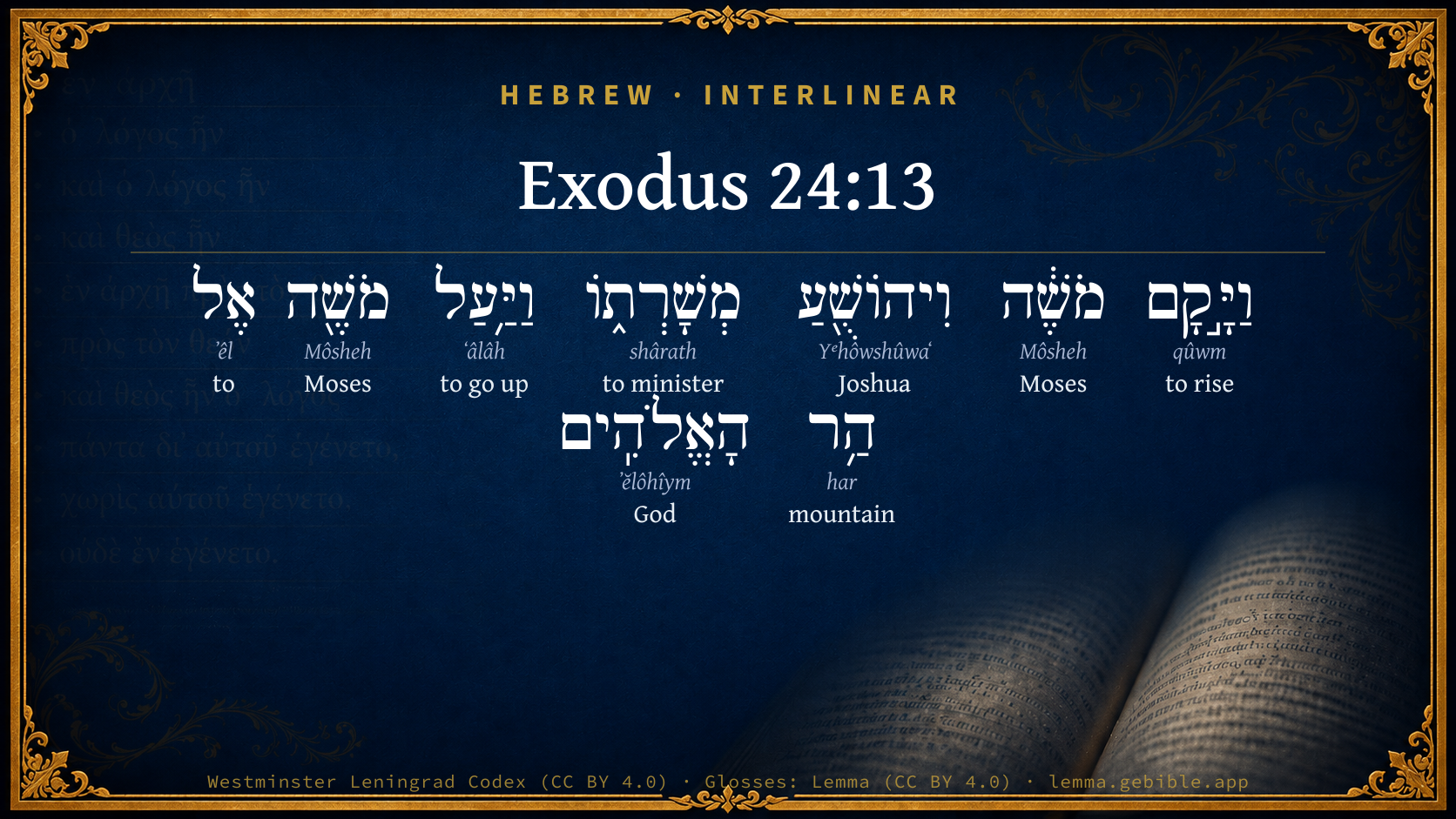
Hebrew (Westminster Leningrad Codex) Exodus 24:13 appears in the Hebrew Old Testament. The text above is from the Westminster Leningrad Codex. Each word links to its Strong’s number, a concise gloss, and parsing drawn from the Open Scriptures Hebrew Bible morphology. Click any word for its full Brown-Driver-Briggs (BDB) entry.
Download image
Cite this verse

Exodus 24:13 (World English Bible). Public Domain. Lemma interlinear Bible study tool, https://lemma.gebible.app/v/exodus/24/13.

Show BibTeX & RIS
BibTeX
RIS
English Translation
Moses rose up with Joshua, his servant, and Moses went up onto God's Mountain.
World English Bible · Public Domain
Download a study sheet

One document with this verse’s original text, its word-by-word gloss line, the meaning frame, cross-references with their text, attributed commentary, and full source and license credits — printable, and it pastes into notes with its structure intact.

This verse Autodidact and up

Study sheet (.html) Plain text (.txt)

A passage Seminary Student

Up to 50 verses in one chapter. A passage sheet keeps up to 6 commentary sources and 12 cross-references per verse, in the order this page ranks them, and says so on the sheet whenever that leaves anything out. Ask for a single verse and you get the Autodidact verse sheet above.

Everything on this page stays free to read, with no account — the sheet is a download of what is already on screen, not access to it.

Want to remove ads? Support Godless Engineer
Compare translations 3

The same verse in 3 English versions, stacked beneath the original-language interlinear above. Click any original word for its lexicon entry.

Each is an independent rendering of the whole verse — the interlinear is not word-aligned to these translations.

Highlighted words mark where these versions differ — a whole-verse word diff, not a word-by-word alignment.

  • World English Bible Public Domain
    Moses rose up with Joshua, his servant, and Moses went up onto God's Mountain.
  • King James Version Public Domain
    And Moses rose up, and his minister Joshua: and Moses went up into the mount of God.
  • unfoldingWord Literal Text CC BY-SA 4.0
    And Moses and his servant Joshua got up, and Moses went up to the mountain of God.

unfoldingWord Literal Text — © unfoldingWord, licensed CC BY-SA 4.0. Word-aligned USFM3 via Door43 (git.door43.org/unfoldingWord/en_ult).

Versions to compare (up to 4)

3 of 4 selected

Show all 18 translations

Every available English version of this verse, each an independent rendering of the whole verse.

  • World English Bible Public Domain
    Moses rose up with Joshua, his servant, and Moses went up onto God's Mountain.
  • Berean Standard Bible Public Domain
    So Moses set out with Joshua his attendant and went up on the mountain of God.
  • Majority Standard Bible Public Domain
    So Moses set out with Joshua his attendant and went up on the mountain of God.
  • King James Version Public Domain
    And Moses rose up, and his minister Joshua: and Moses went up into the mount of God.
  • American Standard Version (1901) Public Domain
    And Moses rose up, and Joshua his minister: and Moses went up into the mount of God.
  • Revised Version (1885) Public Domain
    And Moses rose up, and Joshua his minister: and Moses went up into the mount of God.
  • Geneva Bible (1599) Public Domain
    Then Moses rose vp, and his minister Ioshua, and Moses went vp into the mountaine of God,
  • Douay-Rheims (1899) Public Domain
    Moses rose up, and his minister Josue: and Moses going up into the mount of God,
  • Young's Literal Translation Public Domain
    And Moses riseth -- Joshua his minister also -- and Moses goeth up unto the mount of God;
  • Literal Standard Version CC BY-SA 4.0
    And Moses rises—his minister Joshua also—and Moses goes up to the mountain of God;
  • Unlocked Literal Bible CC BY-SA 4.0
    So Moses set out with his assistant Joshua and went up the mountain of God.
  • unfoldingWord Literal Text CC BY-SA 4.0
    And Moses and his servant Joshua got up, and Moses went up to the mountain of God.
  • Darby Bible Public Domain
    And Moses rose up, and Joshua his attendant; and Moses went up to the mountain of God.
  • World Messianic Bible Public Domain
    Moses rose up with Joshua, his servant, and Moses went up onto God’s Mountain.
  • Webster's Bible Public Domain
    And Moses rose up, and his minister Joshua: and Moses went up upon the mount of God.
  • Free Bible Version CC BY-SA 4.0
    So Moses left with Joshua his attendant and climbed up the mountain of God.
  • Bible in Basic English Public Domain
    Then Moses and Joshua his servant got up; and Moses went up into the mountain of God.
  • JPS Tanakh (1917) Public Domain
    And Moses rose up, and Joshua his minister; and Moses went up into the mount of God.

Literal Standard Version (2020), Covenant Press — licensed CC BY-SA 4.0. Text via the HelloAO Bible API (eBible.org). Unlocked Literal Bible (unfoldingWord) — licensed CC BY-SA 4.0. Text via the HelloAO Bible API (eBible.org). unfoldingWord Literal Text — © unfoldingWord, licensed CC BY-SA 4.0. Word-aligned USFM3 via Door43 (git.door43.org/unfoldingWord/en_ult). Free Bible Version, Dr. Jonathan Gallagher — licensed CC BY-SA 4.0. Text via the HelloAO Bible API (eBible.org).

Word by word

More ways to search: Search by grammar → Find every occurrence → Compare this word →

Practice this passage: Drill this verse → Learn its vocabulary →

About this verse

These counts appear in no published source. They are computed here, from the morphology-tagged text and Lemma’s own curated glosses. What Lemma adds →

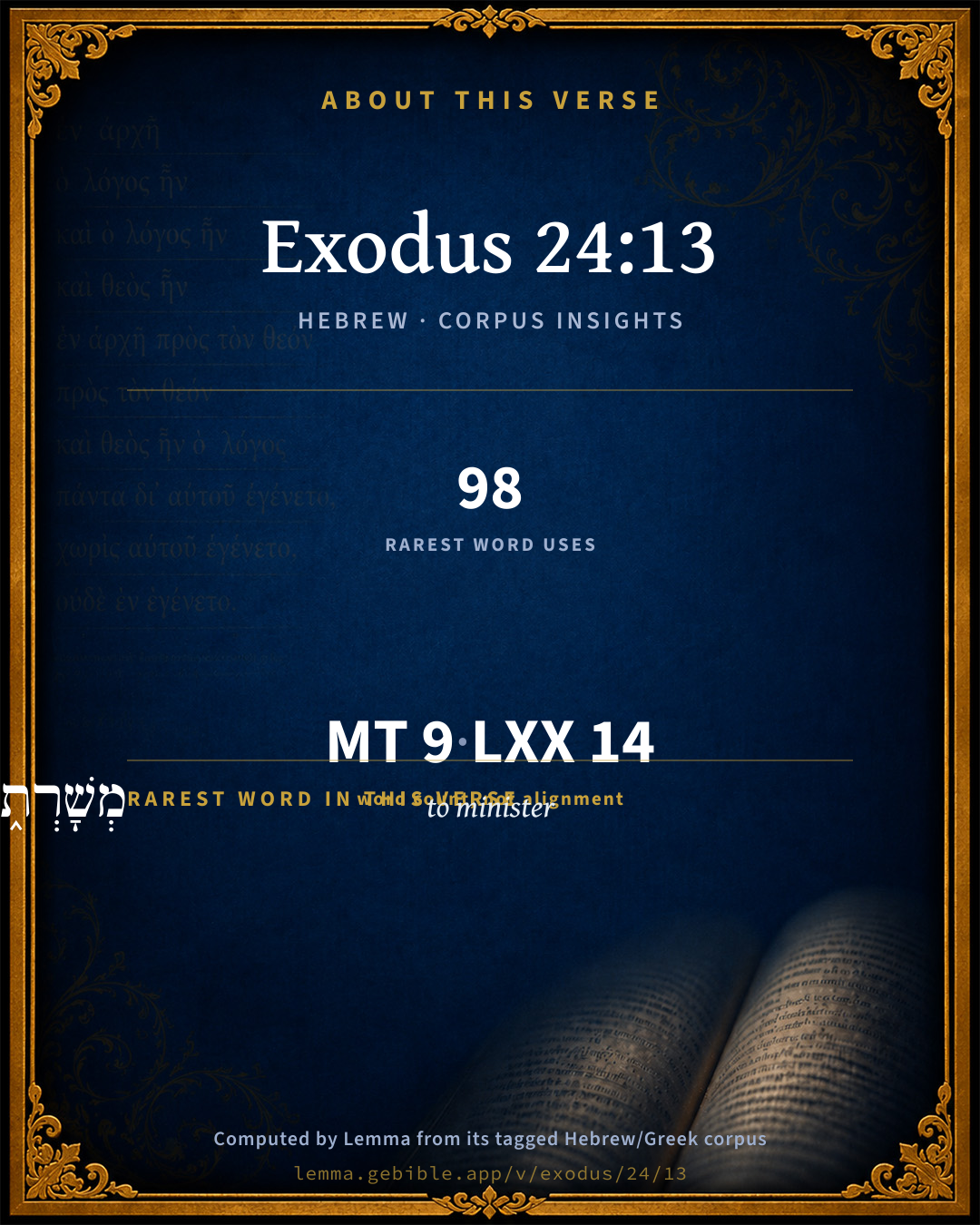
9
words
8
distinct lemmas
Pentateuch
section

Grammatical profile

  • 3 verbs
  • 5 nouns
  • 1 preposition

Verb forms

  • וַיָּ֣קָם Qal · Sequential Imperfect
  • מְשָׁרְת֑וֹ Piel · Participle Active
  • וַיַּ֥עַל Qal · Sequential Imperfect

Repetition

A word recurs within this verse — often emphatic in Hebrew:

  • מֹשֶׁ֔ה Moses H4872 ×2

Hebrew & Septuagint length

In English translation the verse runs 14 words from the Hebrew and 17 from the Septuagint (LXX English) — closely comparable.

A rough comparison of the two English renderings, which tokenize alike — not a word-level alignment.

Word counts can differ between the Hebrew and the Greek without any difference in meaning — e.g. the Hebrew direct-object marker אֵת has no separate Greek word, and Greek often adds the article ὁ.

In the original languages it is 9 Hebrew tokens and 14 Greek tokens — but the two are counted differently (Hebrew bundles its prefixes and suffixes into one token; the Greek is in lemma form), so that isn’t a like-for-like length.

Cross-references

5

Topical passages linked to Exodus 24:13 in the Treasury of Scripture Knowledge — connected by theme and wording, ordered by reader-vote popularity; previews shown in the World English Bible.

  • Exodus 33:11 Yahweh spoke to Moses face to face, as a man speaks to his friend. He turned again into the camp, but his servant Joshua, the son of Nun, a young man, didn't depart out of the Tent.
  • Numbers 11:28 Joshua the son of Nun, the minister of Moses, one of his chosen men, answered, My lord Moses, forbid them.
  • Exodus 3:1 Now Moses was keeping the flock of Jethro, his father-in-law, the priest of Midian, and he led the flock to the back of the wilderness, and came to God's mountain, to Horeb.
  • Exodus 17:9–14 Moses said to Joshua, "Choose men for us, and go out, fight with Amalek. Tomorrow I will stand on the top of the hill with God's rod in my hand."
  • Exodus 32:17 When Joshua heard the noise of the people as they shouted, he said to Moses, "There is the noise of war in the camp."

Cross-references courtesy of OpenBible.info (CC BY 4.0).

Hebrew and Greek witnesses Masoretic Hebrew ↔ Greek Septuagint

The same verse in the two great witnesses to the Old Testament, shown verse-for-verse.

These are two independent witnesses, not word-aligned to each other, and the Septuagint is shown in lemma (dictionary) form.

Hebrew Exodus 24:13 Masoretic · Westminster Leningrad Codex

וַיָּ֣קָם מֹשֶׁ֔ה וִיהוֹשֻׁ֖עַ מְשָׁרְת֑וֹ וַיַּ֥עַל מֹשֶׁ֖ה אֶל הַ֥ר הָאֱלֹהִֽים

Moses rose up with Joshua, his servant, and Moses went up onto God's Mountain.

World English Bible · Public Domain

Greek LXX Exodus 24:13 Septuagint · lemma form

καί ἀναἵστημι μωυσῆς καί ἰησοῦς ὁ παραἵστημι αὐτός ἀναβαίνω εἰς ὁ ὄρος ὁ θεός

And Moses rose up and Joshua his attendant, and they went up into the mount of God.

LXX2012 (modern English Septuagint) · Public Domain

Hebrew: Westminster Leningrad Codex (CC BY 4.0). Greek: Septuagint (public domain); English from LXX2012 (modern English Septuagint) (Public Domain). How the Septuagint differs from the Hebrew →

Targum (Aramaic paraphrase)

2

The Targum is the ancient Jewish Aramaic paraphrase of the Hebrew Scriptures — an interpretive translation, not the Hebrew text itself. Onkelos (literal) and Pseudo-Jonathan (expansive) render the Torah, and Jonathan the Prophets. Coverage is partial: where no permissively-licensed English translation exists for a verse, only the Aramaic is shown. This is verse-level text, not a word-by-word alignment to the Hebrew.

  1. Targum Onkelos Torah (Genesis–Deuteronomy)
    וְקָם משֶׁה וִיהוֹשֻׁעַ מְשֻׁמְשָׁנֵהּ וּסְלֵיק משֶׁה לְטוּרָא דְאִתְגְלִי עֲלוֹהִי יְקָרָא דַיְיָ:

    (no public-domain English translation for this verse)

    Targum Onkelos — Aramaic: “Onkelos Genesis” (public domain); “Onkelos Exodus” (public domain); “Onkelos Leviticus” (public domain); “Onkelos Numbers” (public domain); “Onkelos Deuteronomy” (public domain). English: “Sefaria Community Translation” (CC0 1.0 (public-domain dedication)); “J.W. Etheridge. The Targums of Onkelos and Jonathan Ben Uzziel on the Pentateuch. London: Longmans, Green, 1862” (public domain). Text via Sefaria.

  2. Targum Pseudo-Jonathan Torah (Genesis–Deuteronomy)
    וְקָם משֶׁה וִיהוֹשֻׁעַ מְשׁוּמְשָׁנֵיהּ וּסְלֵיק משֶׁה לְטַוְורָא דְאִיתְגְּלֵי עֲלוֹי יְקַר שְׁכִינְתָּא דַיְיָ

    And Mosheh arose and Jehoshua his minister; and Mosheh went up to the mountain on which was revealed the glory of the Shekinah of the Lord.

    Targum Pseudo-Jonathan — Aramaic: “Targum Jonathan on Genesis” (public domain); “Targum Jonathan on Exodus” (public domain); “Targum Jonathan on Leviticus” (public domain); “Targum Jonathan on Numbers” (public domain); “Targum Jonathan on Deuteronomy” (public domain). English: “The Targum of Jonathan ben Uzziel, trans. J. W. Etheridge, London, 1862” (public domain). Text via Sefaria.

Commentary

Notes on Exodus 24:13 from classic Christian and Jewish commentators (each source and its license shown beneath its notes). The classic Christian expositions comment on the surrounding passage and are grouped to its opening verse, so a note may address several verses; the Jewish commentaries on the Tanakh (Rashi and others) are per-verse, so they appear only where the commentator wrote on this verse.

Lemma curates 59 commentaries, every one of them public domain or Creative Commons licensed, each selected and text-cleaned for this edition rather than reprinted as found. About our sources →

Trapp's Complete Commentary

John Trapp

Exo 24:13 And Moses rose up, and his minister Joshua: and Moses went up into the mount of God.

Ver. 13. And Moses went up.] Joshua stayed the while in some convenient place.

John Trapp, A Commentary or Exposition upon All the Books of the Old and New Testament (1647–1656) — public domain. Text from a community e-Sword module.

Joseph Benson's Commentary

Exo 24:13. Joshua was his minister or servant, and it would be a satisfaction to him to have him as a companion during the six days that he tarried in the mount before God called to him. Joshua was to be his successor, and therefore thus he was honoured before the people, and thus he was prepared by being trained up in communion with God. Joshua was a type of Christ, and (as the learned Bishop Pearson well observes) Moses takes him with him unto the mount, because without Jesus, in whom are hid all the treasures of wisdom and knowledge, there is no looking into the secrets of heaven, nor approaching the presence of God.

Joseph Benson's Commentary on the Old and New Testaments (1811–1818) — public domain. Text from a community e-Sword module.

Jamieson, Fausset & Brown

Robert Jamieson, A. R. Fausset & David Brown

Moses went up into the mount of God--He was called to receive the divine transcript. Joshua was taken a little higher, and it would be a great comfort for the leader to have his company during the six days he was in patient waiting for the call on the seventh or sabbath day.

Jamieson, Fausset & Brown — Commentary Critical and Explanatory on the Whole Bible (1871) — public domain (CC PDM 1.0). Text via the HelloAO Bible API.

Adam Clarke's Commentary

Verse 13. Moses rose up] In Ex 24:16 it is said that the glory of the Lord abode on the mount, and the cloud covered it. The glory was probably above the cloud, and it was to the cloud that Moses and his servant Joshua ascended at this time, leaving Aaron and the elders below. After they had been in this region, viz., where the cloud encompassed the mountain, for six days, God appears to have called Moses up higher: compare verses Ex 24:16 and Ex 24:18. Moses then ascended to the glory, leaving Joshua in the cloud, with whom he had, no doubt, frequent conferences during the forty days he continued with God on the mount.

Adam Clarke's Commentary on the Bible (1810–1826) — public domain. Text from a community e-Sword/MySword module.

Ellicott's Commentary for English Readers

(13) Moses rose up, and his minister Joshua.—The close connection of Joshua with Moses is here, for the first time, indicated. His employment as a general against Amalek (Exo_17:9-13) might have simply marked his military capacity; but from this point in the history it becomes apparent that he was Moses’ most trusted friend and assistant in all matters where there was need of confidential relations between the leader and his subordinates, and thus that he was to be his successor (see Exo_32:17; Exo_33:11; Num_13:8; Num_13:16; Num_27:18-23; Deu_34:9), since no other person stood in any such close association.

Moses went up into the mount of God.—Ascended, i.e., to the highest point of the mountain, whereof mention has been previously made; not, probably, to the Jebel Musa, but to the highest summit of the Ras Sufsafeh, upon which the cloud rested.

A Bible Commentary for English Readers, edited by Charles John Ellicott (1878–1897) — public domain. Text from a community e-Sword module.

The Cambridge Bible for Schools and Colleges

gen. ed. J. J. S. Perowne

13. Joshua] first mentioned in Exo_17:9.

his minister] Joshua’s standing title: Exo_33:11, Num_11:28, Jos_1:1.

and Moses went up, &c.] leaving Joshua on the lower part of the mountain; cf. Exo_32:17, with the note.

the mount of God] See on Exo_3:1.

The Cambridge Bible for Schools and Colleges (gen. ed. J. J. S. Perowne; Cambridge University Press, 1878–1918) — public domain. Text from a community e-Sword module.

John Gill's Exposition

And Moses rose up, and his minister Joshua,.... In order to go up higher on the mount. Joshua, and he only, was to go up higher with him, though not to the top of the mount, at least not into the cloud upon it, as Moses did. Joshua was his minister or servant, and waited upon him wherever he went, and was to be his successor; and therefore for his encouragement, and to qualify him the better for it, he was indulged with a sight and knowledge of things others were not; for by his not knowing anything of the idolatry of the golden calf, Exo 32:17 it appears that he was on some part of the mount all the forty days and forty nights; and if it should be asked whether he fasted all that time, or, if he did not, how he was provided with food and drink? it may be replied, that there is no necessity to suppose that he fasted all that time; and it is easy to imagine how he was supplied, for the manna fell round about the mountain, of which he might gather and eat day by day, as Aben Ezra observes; and there was a brook which descended out of the mount, from whence he might have water, Deu 9:21.

and Moses went up into the mount of God; Mount Sinai, where he had formerly appeared to him in a bush, and now had descended on it to give the law, and was still upon it, where his glory was seen; and therefore might, with great propriety, be called the mount of God; to the top of which Moses was preparing to go, but before he went gave the following instructions.

John Gill's Exposition of the Whole Bible (1746–1763) — public domain (CC PDM 1.0). Text via the HelloAO Bible API.

Matthew Poole's English Annotations

Joshua did not go up with Moses to the top of the mount, as is sufficiently implied both here and above, Exo 24:1,2; but abode in some lower place, waiting for Moses’s return, as appears from Exo 32:17. And there Joshua abode forty days, not fasting all the while, but having, as the rest had,

manna for his meat, and for his drink, water out of the brook that descended out of the mount, as we read Deu 9:21.

Matthew Poole's English Annotations on the Holy Bible (1683–1685) — public domain. Text from a community e-Sword/MySword module.

Whedon's Commentary on the Bible

Daniel D. Whedon

13. His minister Joshua — This intimate companion of the great lawgiver, destined to be his successor, was admitted into holiest relations with him. See notes on Exo_17:9, and Jos_1:1, and comp. Exo_32:17; Exo_33:11. Whether he went with Moses “into the midst of the cloud,” (Exo_24:18,) we are not expressly told, but that is the legitimate inference.

Daniel D. Whedon (gen. ed.), Commentary on the Old and New Testaments (1874–1909) — public domain. Text from a community e-Sword module.

The Pulpit Commentary

Moses went up. Prompt to obey, Moses, though he had only just descended from the mount, immediately made ready to set forth and again ascend it. This time he was attended by his minister, Joshua, whose arm he had employed on a former occasion against the Amalekites. (Exo_17:9-13) The name, Joshua, is, however, still given him by anticipation, since he did not receive it until he was sent by Moses to explore the land of Canaan. (Num_13:8, Num_13:16)

The Pulpit Commentary (1880–1919), ed. H.D.M. Spence-Jones & Joseph S. Exell — public domain. Text from a community e-Sword module.

John Wesley's Explanatory Notes

Joshua was his minister or servant, and it would be a satisfaction to him to have him with him as a companion during the six days that he tarried in the mount before God called to him. Joshua was to be his successor, and therefore thus he was honoured before the people, and thus he was prepared by being trained up in communion with God. Joshua was a type of Christ, and (as the learned Bishop Peirson well observes Moses takes him with him into the mount, because without Jesus, in whom are hid all the treasures of wisdom and knowledge, there is no looking into the secrets of heaven, nor approaching the presence of God.

John Wesley, Explanatory Notes Upon the Whole Bible (1754–1765) — public domain. Text via the GEBible commentary corpus.

Rashi

Rabbi Shlomo Yitzchaki (Rashi)

ויקם משה ויהושע משרתו AND MOSES ROSE AND HIS MINISTER JOSHUA — I am not sure in what capacity Joshua appears here, but I think that as a disciple he was accompanying the teacher as far as the place where the bounds of the mountain were marked out, whence onward he was not permitted to proceed. From that point ויעל משה MOSES alone ASCENDED אל הר האלהים THE MOUNTAIN OF GOD, whilst Joshua pitched his tent there and stayed there during the whole forty days which Moses spent on the mountain. For thus we find that when Moses came down from the mountain it states, (Exodus 32:17) “and Joshua heard the voice of the people that they shouted” — from which we may infer that he was not with them in the camp.

Rashi on the Tanakh — English translations: “The Judaica Press complete Tanach with Rashi, translated by A. J. Rosenberg” (CC BY 4.0); “Pentateuch with Rashi's commentary by M. Rosenbaum and A.M. Silbermann, 1929-1934” (public domain); “The Metsudah Tanach series, Lakewood, N.J” (CC BY 4.0); and “The Book of Joshua, Metsudah Publications, 1997” (CC BY 4.0). Text via Sefaria.

Ramban (Nachmanides)

Rabbi Moshe ben Nachman (Ramban / Nachmanides)

AND MOSES ROSE UP, AND JOSHUA HIS MINISTER. “I do not know in what capacity Joshua was serving here. But it appears to me that the disciple was accompanying the master as far as the place where the limits of the mountain were marked out, for beyond them Joshua was not permitted to go, and from there Moses went up alone into the mountain of G-d, while Joshua pitched his tent there for the whole of the forty days. Thus we find that when Moses came down from the mountain it is written, And Joshua heard the noise of the people as they shouted, from which we learn that Joshua was not with them in the camp” [at the time of the making of the golden calf]. Thus far is Rashi’s language.In my opinion, Joshua was one of the seventy elders [who were asked to ascend the mountain], for there was nobody more worthy amongst the seventy elders of Israel to approach G-d than he, and when Moses separated from them [to ascend higher], Joshua accompanied his master up to the border [beyond which he was not permitted to go]. Now do not object to my explanation on this point from what the Rabbis have said, 16. Rashi in Verse 10 here brings part of the Midrash with reference to Nadab and Abihu. concerning the punishment of these elders at Taberah, — that is, among the most distinguished and prominent ones among them, namely the elders (see Rashi ibid., Verse 1). Now the reason why the elders were singled out for punishment at that time is stated by the Rabbis as follows: Since at the time of the Giving of the Torah they gazed more intently than they were permitted to, behaving as if they were eating and drinking (see here Verse 11), they were liable to death. But since G-d did not wish to disturb the joy caused by the Giving of the Torah, He waited with their punishment till Taberah. — Now on the basis of this Midrash you might think that Joshua, too, was like the elders and unworthy of seeing Divine visions. But, concludes Ramban, this was not the case with Joshua. for they said so concerning all of them except Joshua, for he was indeed worthy to see visions of G-d and to receive prophecy.

Ramban (Nachmanides) on the Tanakh — English translation: “Commentary on the Torah by Ramban (Nachmanides). Translated and annotated by Charles B. Chavel. New York, Shilo Pub. House, 1971-1976” (CC BY 4.0). Text via Sefaria.

Ibn Ezra

Rabbi Abraham ibn Ezra

Moshe and Yehoshua … set out. Yehoshua accompanied Moshe as far as the foot of the mountain, where he remained until Moshe returned. That explains why Yehoshua did not know about the making of the Calf. Food would not have been a problem for him because the manna fell all around the camp.

Ibn Ezra on the Tanakh — English translations: “Sefaria Community Translation” (CC0 1.0 (public-domain dedication)); “Yalkut, Sifsei Chachomim Chumash, Metsudah Publications, 2009” (CC BY 4.0); and “Commentary of Ibn Ezra on Isaiah - trans. by M. Friedlander, 1873” (public domain). Text via Sefaria.

Lesson kit

Teaching starters — assembled from the data on this page, not authored interpretation. Every prompt links to the verse data it draws on. Edit before teaching.

Exodus, in the Pentateuch, opens this verse with 9 words (8 distinct Hebrew lemmas). Its most distinctive word is shârath (“to minister”). A historical commentator’s framing appears above. Read the whole chapter for the surrounding context.

Discussion questions

  1. The word shârath carries the sense “to minister.” How does it shape the verse?
  2. Exodus 33:11 shares this passage’s theme. How do the two illuminate each other?
  3. “Moses” occurs 2× in this one verse. What is the effect of the repetition?
  4. These translations render this verse differently. What is at stake in choosing one wording over another?
  5. The verb «וַיָּ֣קָם» is Qal Sequential Imperfect. How does its form color the action?
  6. Reading how Trapp's Complete Commentary and Joseph Benson's Commentary read this verse, where do the two commentators agree and where do they part?

Things to notice

Reading settings

Reading text

Shown beneath each verse's original-language words.

Old Testament
Old Testament edition

Read the OT as the Masoretic Hebrew (MT) or the Greek Septuagint (LXX).

English shown for the Greek Septuagint (in the Hebrew ↔ Greek comparison).

Comparing translations? Open the Compare panel on any verse page to stack up to four side by side.