
2 Samuel 15:30

Hebrew (Westminster Leningrad Codex) 2 Samuel 15:30 appears in the Hebrew Old Testament. The text above is from the Westminster Leningrad Codex. Each word links to its Strong’s number, a concise gloss, and parsing drawn from the Open Scriptures Hebrew Bible morphology. Click any word for its full Brown-Driver-Briggs (BDB) entry.
Download image
Cite this verse

2 Samuel 15:30 (World English Bible). Public Domain. Lemma interlinear Bible study tool, https://lemma.gebible.app/v/2-samuel/15/30.

Show BibTeX & RIS
BibTeX
RIS
English Translation
David went up by the ascent of the [Mount of] Olives, and wept as he went up; and he had his head covered, and went barefoot: and all the people who were with him covered every man his head, and they went up, weeping as they went up.
World English Bible · Public Domain
Highlights
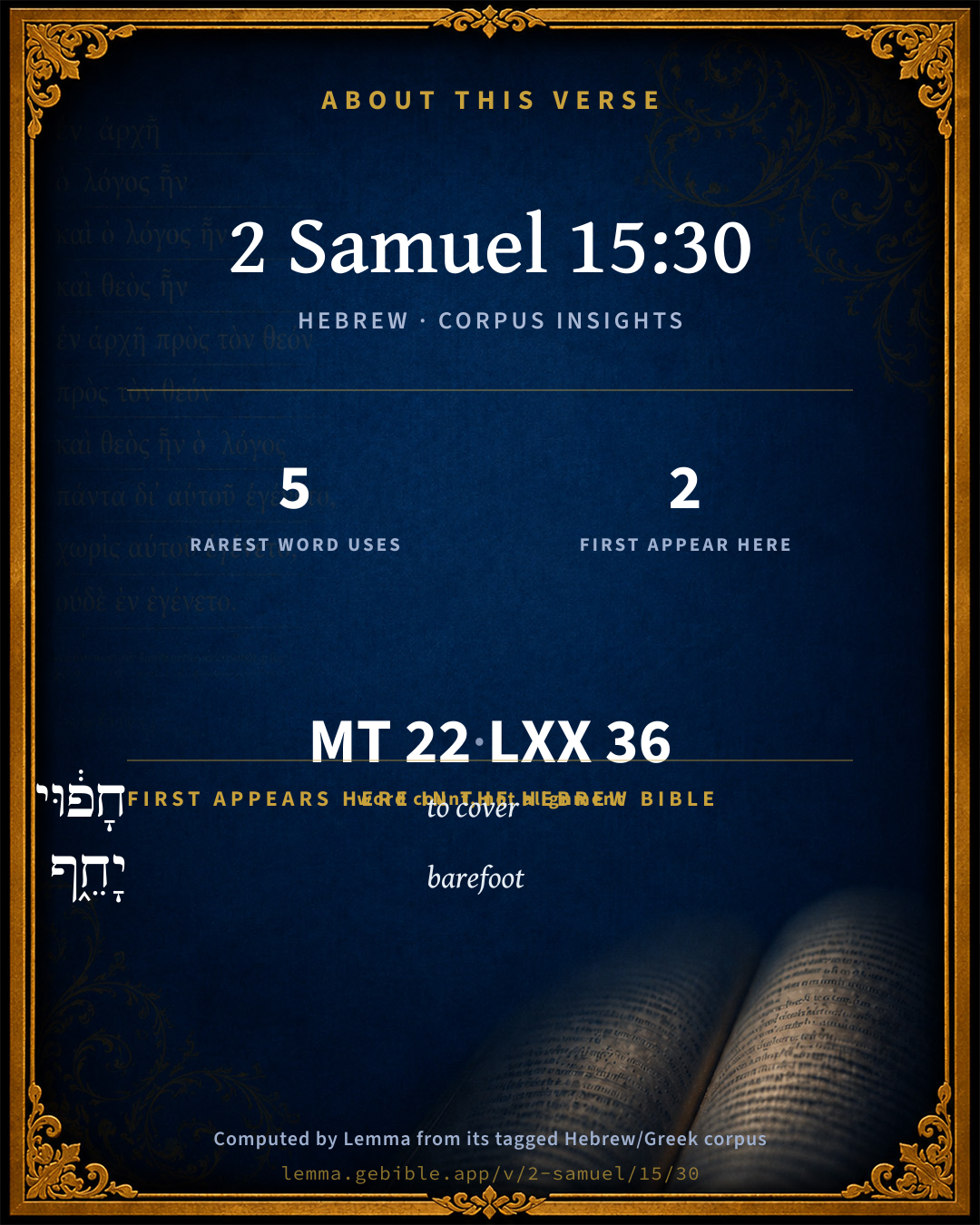
  • 2 first appearances in the Hebrew Bible
Full analysis ↓
Download a study sheet

One document with this verse’s original text, its word-by-word gloss line, the meaning frame, cross-references with their text, attributed commentary, and full source and license credits — printable, and it pastes into notes with its structure intact.

This verse Autodidact and up

Study sheet (.html) Plain text (.txt)

A passage Seminary Student

Up to 50 verses in one chapter. A passage sheet keeps up to 6 commentary sources and 12 cross-references per verse, in the order this page ranks them, and says so on the sheet whenever that leaves anything out. Ask for a single verse and you get the Autodidact verse sheet above.

Everything on this page stays free to read, with no account — the sheet is a download of what is already on screen, not access to it.

Want to remove ads? Support Godless Engineer
Compare translations 3

The same verse in 3 English versions, stacked beneath the original-language interlinear above. Click any original word for its lexicon entry.

Each is an independent rendering of the whole verse — the interlinear is not word-aligned to these translations.

Highlighted words mark where these versions differ — a whole-verse word diff, not a word-by-word alignment.

  • World English Bible Public Domain
    David went up by the ascent of the [Mount of] Olives, and wept as he went up; and he had his head covered, and went barefoot: and all the people who were with him covered every man his head, and they went up, weeping as they went up.
  • King James Version Public Domain
    And David went up by the ascent of mount Olivet, and wept as he went up, and had his head covered, and he went barefoot: and all the people that was with him covered every man his head, and they went up, weeping as they went up.
  • unfoldingWord Literal Text CC BY-SA 4.0
    And David was going up onto the Mount of Olives, going up and weeping, and his head was covered, and he was walking barefoot. And all of the people who with him covered, a man his head, and they went up, going up and weeping.

unfoldingWord Literal Text — © unfoldingWord, licensed CC BY-SA 4.0. Word-aligned USFM3 via Door43 (git.door43.org/unfoldingWord/en_ult).

Versions to compare (up to 4)

3 of 4 selected

Show all 18 translations

Every available English version of this verse, each an independent rendering of the whole verse.

  • World English Bible Public Domain
    David went up by the ascent of the [Mount of] Olives, and wept as he went up; and he had his head covered, and went barefoot: and all the people who were with him covered every man his head, and they went up, weeping as they went up.
  • Berean Standard Bible Public Domain
    But David continued up the Mount of Olives, weeping as he went up. His head was covered, and he was walking barefoot. And all the people with him covered their heads and went up, weeping as they went.
  • Majority Standard Bible Public Domain
    But David continued up the Mount of Olives, weeping as he went up. His head was covered, and he was walking barefoot. And all the people with him covered their heads and went up, weeping as they went.
  • King James Version Public Domain
    And David went up by the ascent of mount Olivet, and wept as he went up, and had his head covered, and he went barefoot: and all the people that was with him covered every man his head, and they went up, weeping as they went up.
  • American Standard Version (1901) Public Domain
    And David went up by the ascent of the `mount of' Olives, and wept as he went up; and he had his head covered, and went barefoot: and all the people that were with him covered every man his head, and they went up, weeping as they went up.
  • Revised Version (1885) Public Domain
    And David went up by the ascent of the mount of Olives, and wept as he went up; and he had his head covered, and went barefoot: and all the people that were with him covered every man his head, and they went up, weeping as they went up.
  • Geneva Bible (1599) Public Domain
    And Dauid went vp the mount of oliues and wept as he went vp, and had his head couered, and went barefooted: and al the people that was with him, had euery man his head couered, and as they went vp, they wept.
  • Douay-Rheims (1899) Public Domain
    But David went up by the ascent of mount Olivet, going up and weeping, walking barefoot, and with his head covered, and all the people that were with them, went up with their heads covered weeping.
  • Young's Literal Translation Public Domain
    And David is going up in the ascent of the olives, going up and weeping, and he hath the head covered, and he is going barefooted, and all the people who `are' with him have covered each his head, and have gone up, going up and weeping;
  • Literal Standard Version CC BY-SA 4.0
    And David is going up in the ascent of the [Mount of] Olives, going up and weeping, and he has the head covered, and he is going barefooted, and all the people who [are] with him have each covered his head, and have gone up, going up and weeping;
  • Unlocked Literal Bible CC BY-SA 4.0
    But David ascended barefoot and weeping up the Mount of Olives, and he had his head covered. Every man of the people who were with him covered his head, and they went up weeping as they walked.
  • unfoldingWord Literal Text CC BY-SA 4.0
    And David was going up onto the Mount of Olives, going up and weeping, and his head was covered, and he was walking barefoot. And all of the people who with him covered, a man his head, and they went up, going up and weeping.
  • Darby Bible Public Domain
    But David went up by the ascent of the Olives, and wept as he went up, and had his head covered, and he went barefoot; and all the people that was with him covered every man his head, and they went up, weeping as they went up.
  • World Messianic Bible Public Domain
    David went up by the ascent of the Mount of Olives, and wept as he went up; and he had his head covered and went barefoot. All the people who were with him each covered his head, and they went up, weeping as they went up.
  • Webster's Bible Public Domain
    And David went up by the ascent of mount Olivet, and wept as he went, and had his head covered, and he went barefoot: and all the people that were with him covered every man his head, and they went up, weeping as they went.
  • Free Bible Version CC BY-SA 4.0
    David went on his way up the Mount of Olives, weeping as he did so. He had his head covered, and walked barefoot. All the people with him covered their heads, weeping as they went along.
  • Bible in Basic English Public Domain
    And David went up the slopes of the Mount of Olives weeping all the way, with his head covered and no shoes on his feet: and all the people who were with him, covering their heads, went up weeping.
  • JPS Tanakh (1917) Public Domain
    And David went up by the ascent of the mount of Olives, and wept as he went up; and he had his head covered, and went barefoot; and all the people that were with him covered every man his head, and they went up, weeping as they went up.

Literal Standard Version (2020), Covenant Press — licensed CC BY-SA 4.0. Text via the HelloAO Bible API (eBible.org). Unlocked Literal Bible (unfoldingWord) — licensed CC BY-SA 4.0. Text via the HelloAO Bible API (eBible.org). unfoldingWord Literal Text — © unfoldingWord, licensed CC BY-SA 4.0. Word-aligned USFM3 via Door43 (git.door43.org/unfoldingWord/en_ult). Free Bible Version, Dr. Jonathan Gallagher — licensed CC BY-SA 4.0. Text via the HelloAO Bible API (eBible.org).

Word by word

More ways to search: Search by grammar → Find every occurrence → Compare this word →

Practice this passage: Drill this verse → Learn its vocabulary →

יָחֵ֑ף
yâchêph
H3182
“barefoot”
Adjective, Adjective, Masculine, Singular, Absolute
Part of Speech
Adjective
Type
Adjective
Gender
Masculine
Number
Singular
State
Absolute
Full BDB Definition

Origin: from an unused root meaning to take off the shoes

TWOT: 861a

barefoot - bareness, being unshod (substantive)
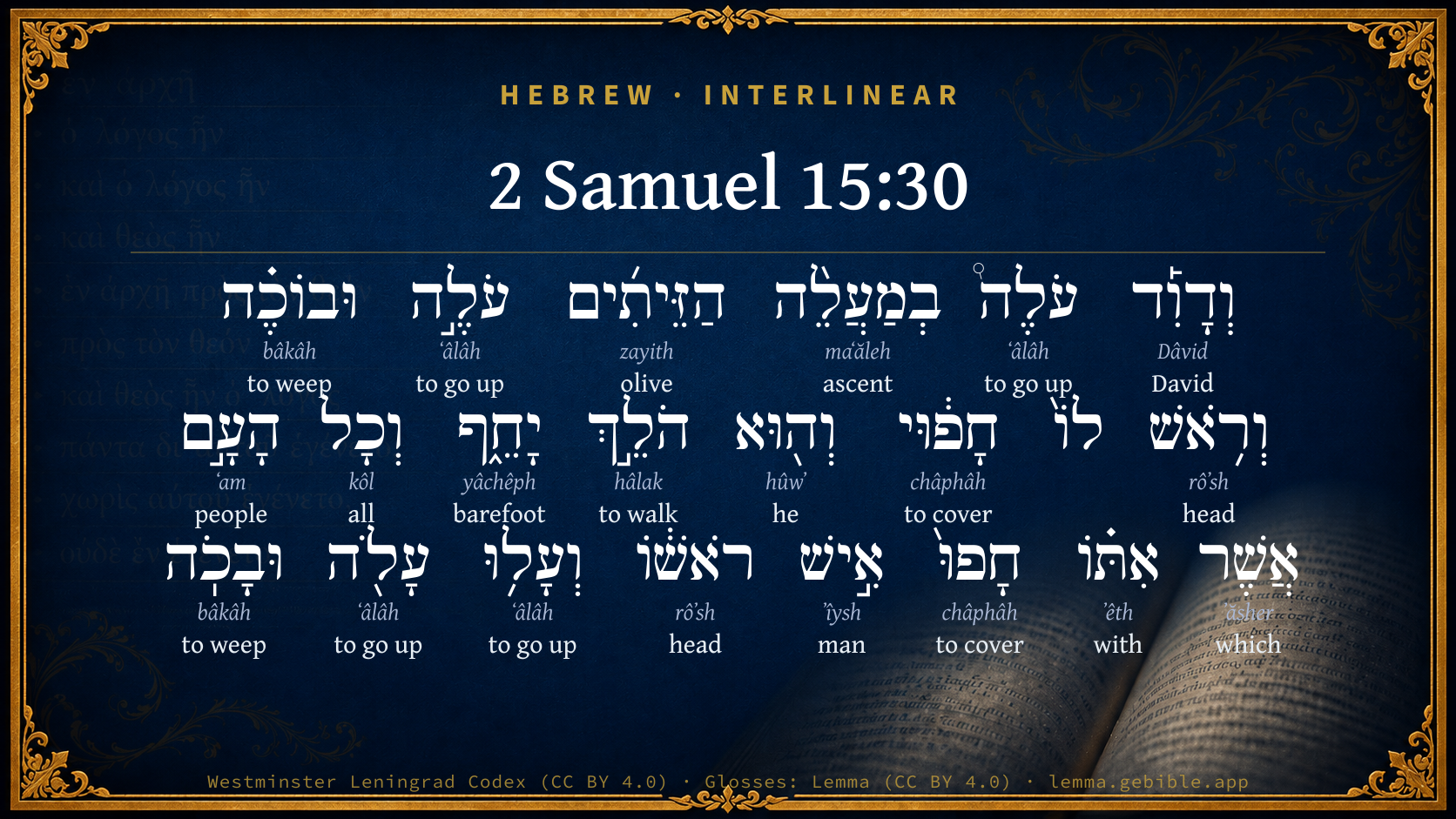
  1. וְדָוִ֡ד Dâvid H1732 “and · David” Conjunction + Noun, Proper
  2. עֹלֶה֩ ʻâlâh H5927 “going up” Verb, Qal, Participle Active, Masculine, Singular, Absolute
  3. בְמַעֲלֵ֨ה maʻăleh H4608 “in/at · ascent of” Preposition + Noun, Common, Masculine, Singular, Construct
  4. הַזֵּיתִ֜ים zayith H2132 “the · olives” Particle, Definite Article + Noun, Common, Masculine, Plural, Absolute
  5. עֹלֶ֣ה ʻâlâh H5927 “going up” Verb, Qal, Participle Active, Masculine, Singular, Absolute
  6. וּבוֹכֶ֗ה bâkâh H1058 “and · weeping” Conjunction + Verb, Qal, Participle Active, Masculine, Singular, Absolute
  7. וְרֹ֥אשׁ rôʼsh H7218 “and · head” Conjunction + Noun, Common, Masculine, Singular, Absolute
  8. חָפ֔וּי châphâh H2645 “covered” Verb, Qal, Participle Passive, Masculine, Singular, Absolute
  9. וְה֖וּא hûwʼ H1931 “and · he” Conjunction + Pronoun, Personal, 3rd Person, Masculine, Singular
  10. הֹלֵ֣ךְ hâlak H1980 “walking” Verb, Qal, Participle Active, Masculine, Singular, Absolute
  11. וְכָל kôl H3605 “and · all of” Conjunction + Noun, Common, Masculine, Singular, Construct
  12. הָעָ֣ם ʻam H5971 “the · people” Particle, Definite Article + Noun, Common, Masculine, Singular, Absolute
  13. אֲשֶׁר ʼăsher H834 “which” Particle, Relative
  14. אִתּ֗וֹ ʼêth H854 “with · him” Preposition + Suffix, Personal, 3rd Person, Masculine, Singular
  15. חָפוּ֙ châphâh H2645 “to cover” Verb, Qal, Perfect, 3rd Person, Common, Plural
  16. אִ֣ישׁ ʼîysh H376 “man” Noun, Common, Masculine, Singular, Absolute
  17. רֹאשׁ֔וֹ rôʼsh H7218 “head · his” Noun, Common, Masculine, Singular, Construct + Suffix, Personal, 3rd Person, Masculine, Singular
  18. וְעָל֥וּ ʻâlâh H5927 “and · to go up” Conjunction + Verb, Qal, Sequential Perfect, 3rd Person, Common, Plural
  19. עָלֹ֖ה ʻâlâh H5927 “to go up” Verb, Qal, Infinitive Absolute
  20. וּבָכֹֽה bâkâh H1058 “and · to weep” Conjunction + Verb, Qal, Infinitive Absolute

About this verse

These counts appear in no published source. They are computed here, from the morphology-tagged text and Lemma’s own curated glosses. What Lemma adds →

22
words
15
distinct lemmas
Historical
section

Notable vocabulary

The rarest word here is יָחֵ֑ף barefoot H3182 — appearing just 5 times in the whole Hebrew Bible.

First appearance in Scripture

These words make their first canonical appearance in the Hebrew Bible here:

  • חָפ֔וּי to cover H2645
  • יָחֵ֑ף barefoot H3182

Shared distinctive vocabulary

יָחֵ֑ף barefoot H3182 occurs in 5 verses of the Hebrew Bible. Also found in:

Grammatical profile

  • 9 verbs
  • 8 nouns
  • 1 adjective
  • 1 pronoun
  • 2 prepositions
  • 1 particle

Verb forms

  • עֹלֶה֩ Qal · Participle Active
  • עֹלֶ֣ה Qal · Participle Active
  • וּבוֹכֶ֗ה Qal · Participle Active
  • חָפ֔וּי Qal · Participle Passive
  • הֹלֵ֣ךְ Qal · Participle Active
  • חָפוּ֙ Qal · Perfect
  • וְעָל֥וּ Qal · Sequential Perfect
  • עָלֹ֖ה Qal · Infinitive Absolute
  • וּבָכֹֽה Qal · Infinitive Absolute

Repetition

Words recur within this verse — often emphatic in Hebrew:

  • עֹלֶה֩ to go up H5927 ×4
  • וּבוֹכֶ֗ה to weep H1058 ×2
  • וְרֹ֥אשׁ head H7218 ×2
  • חָפ֔וּי to cover H2645 ×2

Hebrew & Septuagint length

In English translation the verse runs 48 words from the Hebrew and 43 from the Septuagint (LXX English) — closely comparable.

A rough comparison of the two English renderings, which tokenize alike — not a word-level alignment.

Word counts can differ between the Hebrew and the Greek without any difference in meaning — e.g. the Hebrew direct-object marker אֵת has no separate Greek word, and Greek often adds the article ὁ.

In the original languages it is 22 Hebrew tokens and 36 Greek tokens — but the two are counted differently (Hebrew bundles its prefixes and suffixes into one token; the Greek is in lemma form), so that isn’t a like-for-like length.

Cross-references

19

Topical passages linked to 2 Samuel 15:30 in the Treasury of Scripture Knowledge — connected by theme and wording, ordered by reader-vote popularity; previews shown in the World English Bible.

  • Esther 6:12 Mordecai came again to the king's gate. But Haman hurried to his house, mourning and having his head covered.
  • 2 Samuel 19:4 The king covered his face, and the king cried with a loud voice, my son Absalom, Absalom, my son, my son!
  • Luke 19:41 When he drew near, he saw the city and wept over it,
  • Isaiah 20:2–4 at that time Yahweh spoke by Isaiah the son of Amoz, saying, Go, and loose the sackcloth from off your loins, and put your shoe from off your foot. He did so, walking naked and barefoot.
  • Jeremiah 14:3–4 Their nobles send their little ones to the waters: they come to the cisterns, and find no water; they return with their vessels empty; they are disappointed and confounded, and cover their heads.
  • Ezekiel 24:17 Sigh, but not aloud, make no mourning for the dead; bind your headdress on you, and put your shoes on your feet, and don't cover your lips, and don't eat men's bread.
  • Ezekiel 24:23 Your tires shall be on your heads, and your shoes on your feet: you shall not mourn nor weep; but you shall pine away in your iniquities, and moan one toward another.
  • Zechariah 14:4 His feet will stand in that day on the Mount of Olives, which is before Jerusalem on the east; and the Mount of Olives will be split in two, from east to west, making a very great valley. Half of the mountain will move toward the north, and half of it toward the south.
  • Luke 19:29 It happened, when he drew near to Bethsphage and Bethany, at the mountain that is called Olivet, he sent two of his disciples,
  • Luke 19:37 As he was now getting near, at the descent of the Mount of Olives, the whole multitude of the disciples began to rejoice and praise God with a loud voice for all the mighty works which they had seen,
  • Luke 21:37 Every day Jesus was teaching in the temple, and every night he would go out and spend the night on the mountain that is called Olivet.
  • Luke 22:39 He came out, and went, as his custom was, to the Mount of Olives. His disciples also followed him.
  • Acts 1:12 Then they returned to Jerusalem from the mountain called Olivet, which is near Jerusalem, a Sabbath day's journey away.
  • Psalms 42:3–43:2 My tears have been my food day and night, While they continually ask me, "Where is your God?"
  • Psalms 43:5 Why are you in despair, my soul? Why are you disturbed within me? Hope in God! For I shall still praise him: My Savior, my helper, and my God.
  • Psalms 126:5–6 Those who sow in tears will reap in joy.
  • Matthew 5:4 Blessed are those who mourn, For they shall be comforted.
  • Romans 12:15 Rejoice with those who rejoice. Weep with those who weep.
  • 1 Corinthians 12:26 When one member suffers, all the members suffer with it. Or when one member is honored, all the members rejoice with it.

Cross-references courtesy of OpenBible.info (CC BY 4.0).

Hebrew and Greek witnesses Masoretic Hebrew ↔ Greek Septuagint

The same verse in the two great witnesses to the Old Testament, shown verse-for-verse.

These are two independent witnesses, not word-aligned to each other, and the Septuagint is shown in lemma (dictionary) form.

Hebrew 2 Samuel 15:30 Masoretic · Westminster Leningrad Codex

וְדָוִ֡ד עֹלֶה֩ בְמַעֲלֵ֨ה הַזֵּיתִ֜ים עֹלֶ֣ה וּבוֹכֶ֗ה וְרֹ֥אשׁ לוֹ֙ חָפ֔וּי וְה֖וּא הֹלֵ֣ךְ יָחֵ֑ף וְכָל הָעָ֣ם אֲשֶׁר אִתּ֗וֹ חָפוּ֙ אִ֣ישׁ רֹאשׁ֔וֹ וְעָל֥וּ עָלֹ֖ה וּבָכֹֽה

David went up by the ascent of the [Mount of] Olives, and wept as he went up; and he had his head covered, and went barefoot: and all the people who were with him covered every man his head, and they went up, weeping as they went up.

World English Bible · Public Domain

Greek LXX 2 Samuel 15:30 Septuagint · lemma form

καί δαυίδ ἀναβαίνω ἐν ὁ ἀνάβασις ὁ ἐλαία ἀναβαίνω καί κλαίω καί ὁ κεφαλή ἐπικαλύπτω καί αὐτός πορεύομαι ἀνυπόδετος καί πᾶς ὁ λαός ὁ μετά αὐτός ἐπικαλύπτω ἀνήρ ὁ κεφαλή αὐτός καί ἀναβαίνω ἀναβαίνω καί κλαίω

And David went up by the ascent of the mount of Olives, ascending and weeping, and had his head covered, and went barefooted: and all the people that were with him covered every man his head; and they went up, ascending and weeping.

LXX2012 (modern English Septuagint) · Public Domain

Hebrew: Westminster Leningrad Codex (CC BY 4.0). Greek: Septuagint (public domain); English from LXX2012 (modern English Septuagint) (Public Domain). How the Septuagint differs from the Hebrew →

Targum (Aramaic paraphrase)

1

The Targum is the ancient Jewish Aramaic paraphrase of the Hebrew Scriptures — an interpretive translation, not the Hebrew text itself. Onkelos (literal) and Pseudo-Jonathan (expansive) render the Torah, and Jonathan the Prophets. Coverage is partial: where no permissively-licensed English translation exists for a verse, only the Aramaic is shown. This is verse-level text, not a word-by-word alignment to the Hebrew.

  1. Targum Jonathan Prophets (Joshua–Malachi)
    וְדָוִד סָלִיק בְּמַסְקָנָא דְטוּר זֵיתַיָא סָלִיק וּבָכֵי וְרֵישֵׁיהּ לֵיהּ מְכָרֵךְ וְהוּא אָזֵיל יָחֵיף וְכָל עַמָא דְעִמֵיהּ כָּרִיכוּ גְבַר רֵישֵׁיהּ וְסַלְקִין מְסַק וּבָכָן:

    (no public-domain English translation for this verse)

    Targum Jonathan — Aramaic: “Mikraot Gedolot” (public domain). English: “Sefaria Community Translation” (CC0 1.0 (public-domain dedication)); “London "Chaldee Paraphrase," 1871” (public domain). Text via Sefaria.

Commentary

Notes on 2 Samuel 15:30 from classic Christian and Jewish commentators (each source and its license shown beneath its notes). The classic Christian expositions comment on the surrounding passage and are grouped to its opening verse, so a note may address several verses; the Jewish commentaries on the Tanakh (Rashi and others) are per-verse, so they appear only where the commentator wrote on this verse.

Lemma curates 59 commentaries, every one of them public domain or Creative Commons licensed, each selected and text-cleaned for this edition rather than reprinted as found. About our sources →

Trapp's Complete Commentary

John Trapp

2Sa 15:30 And David went up by the ascent of [mount] Olivet, and wept as he went up, and had his head covered, and he went barefoot: and all the people that [was] with him covered every man his head, and they went up, weeping as they went up.

Ver. 30. And wept as he went up.] Bewailing his own sins, and the deplorable state of the commonwealth at that time.

And had his head covered.] As was and is still the guise and garb of mourners, {2Sa 19:4 Est 6:12 Jer 14:3} partly for secrecy’s sake, and partly for seriousness, that their minds might not be diverted or distracted. For which cause also our modern Jews do in their synagogues put on each man his taleth or square vestment, turning it back about their neck, that so they may be the more attentive at their prayers, without looking aside any way. {a}

And he went barefoot.] In token of sorrow and shame. {Isa 20:3-4} Whether his bare feet by the hard stones were forced to yield bloody tokens of his humiliation, as our Henry II did when he went on pilgrimage to Becket’s sepulchre, {b} we have not to say. Muleasses, king of Tunis, fleeing from his son Amida (another Absalom), was betrayed and taken by the sweet odours he had about him, and could not be without, no not in so great a danger.

And all the people.] Regis ad exemplum, &c. They sympathised.

{a} Leo Modena.

{b} Daniel.

John Trapp, A Commentary or Exposition upon All the Books of the Old and New Testament (1647–1656) — public domain. Text from a community e-Sword module.

Joseph Benson's Commentary

2Sa 15:30. David went up by the ascent of mount Olivet, and wept as he went up — To think that one who was the offspring of his own body should thus lift up the heel against him, and reflecting on his own conduct in the matter of Uriah, as the cause of this calamity. And had his head covered — Through shame and confusion. And he went up barefoot — In testimony of his deep sorrow and humiliation for the sins whereby he had procured this evil to himself; for these were the habits of mourners; and to take a holy revenge upon himself for his former delicacy and luxury. “A more memorable event, surely, was never recorded in history, nor a more moving spectacle exhibited to mortal eyes! A king, venerable for his years and victories; sacred in the characters, both of his piety and prophecy; renowned for prowess, and revered for wisdom, reduced to the condition of a fugitive! to a sudden and extreme necessity of fleeing for his life, from the presence of his own son, his darling and delight; and a whole country loudly lamenting his fate! In this condition, David went up the mount, and when he reached the summit of it, fell down prostrate before God. Josephus tells us, that when David reached the top of the mountain, he took a view of the city, and prayed to God with abundance of tears. The reader will perhaps think it worth his notice, that Josephus should tell us, that David wept and viewed the city in the same spot from which, the evangelist informs us, our blessed Saviour wept over it.” — Delaney. And is this the glorious king of Israel, the beloved of God, the wise, the victorious David, who slew his ten thousands? Strange change indeed! What has produced this sad reverse? Sin alone has wrought all this! These are its baneful effects: he forgot the commandment of the Lord his God, and from hence has flowed all this evil! You that plead an excuse for sin, because David, the man after God’s own heart, fell into it; remember, likewise, what bitter and grievous punishments he underwent for it. Are you willing to pay such a price for sin? And yet, be assured, the inviolable laws of God require you to pay it in one way or other.

Joseph Benson's Commentary on the Old and New Testaments (1811–1818) — public domain. Text from a community e-Sword module.

Keil & Delitzsch

C. F. Keil & F. Delitzsch

Ahithophel and Hushai. - Sa2 15:30, Sa2 15:31. When David was going by the height of the olive-trees, i.e., the Mount of Olives, weeping as he went, with his head covered, and barefooted, as a sign of grief and mourning (see Est 6:12; Eze 24:17), and with the people who accompanied him also mourning, he received intelligence that Ahithophel (see at Sa2 15:12) was with Absalom, and among the conspirators. הגּיד ודוד gives no sense; for David cannot be the subject, because the next clause, "and David said," etc., contains most distinctly an expression of David's on receiving some information. Thenius would therefore alter הגּיד into the Hophal הגּד, whilst Ewald (131, a) would change it into הגּיד, an unusual form of the Hophal, "David was informed," according to the construction of the Hiphil with the accusative. But although this construction of the Hiphil is placed beyond all doubt by Job 31:37; Job 26:4, and Eze 43:10, the Hiphil is construed as a rule, as the Hophal always is, with ל of the person who receives information. Consequently דּוד must be altered into לדוד, and הגּיד taken as impersonal, "they announced to David." Upon receipt of this intelligence David prayed to the Lord, that He would "turn the counsel of Ahithophel into foolishness," make it appear as folly, i.e., frustrate it, - a prayer which God answered (vid., Sa2 17:1.).

Keil & Delitzsch — Biblical Commentary on the Old Testament (1861–1891) — public domain (CC PDM 1.0). Text via the HelloAO Bible API. (Old Testament only.)

Geneva Bible (1599)

Geneva Bible translators

With ashes and dust in sign of sorrow.

Geneva Bible (1599) marginal notes — public domain. Text via Bolls.life.

Jamieson, Fausset & Brown

Robert Jamieson, A. R. Fausset & David Brown

David went up by the ascent of mount Olivet--The same pathway over that mount has been followed ever since that memorable day.

had his head covered--with a mourning wrapper. The humility and resignation of David marked strongly his sanctified spirit, induced by contrition for his transgressions. He had fallen, but it was the fall of the upright; and he rose again, submitting himself meekly in the meantime to the will of God [CHALMERS].

Jamieson, Fausset & Brown — Commentary Critical and Explanatory on the Whole Bible (1871) — public domain (CC PDM 1.0). Text via the HelloAO Bible API.

Adam Clarke's Commentary

Verse 30. Had his head covered] This was not only the attitude of a mourner, but even of a culprit; they usually had their heads covered when condemned. See the case of Haman. When the king had pronounced his condemnation, they immediately covered his face, and led him out to punishment; Es 7:8. See also Quintus Curtius, De Philota, cap. vi.: I, Lictor; caput obnubito.

Adam Clarke's Commentary on the Bible (1810–1826) — public domain. Text from a community e-Sword/MySword module.

The Cambridge Bible for Schools and Colleges

gen. ed. J. J. S. Perowne

30–37. Hushai commissioned to defeat Ahithophel

30. the ascent of mount Olivet] Lit. by the ascent of Olives: the name mount Olivet is derived from mons oliveti in the Vulgate of Act_1:12. The “mount of Olives” is the ridge which rises on the east of Jerusalem above the Kidron ravine, screening the city from the desert country beyond. With the exception of this touching scene, there is little of interest connected with the Mount of Olives in the O. T. On it, perhaps on the spot already consecrated for worship (2Sa_15:32), Solomon erected high places for the false gods of his foreign wives (1Ki_11:7-8), which were desecrated long afterwards by Josiah (2Ki_23:13-14). A passing allusion to the woods which covered it (Neh_8:15), and the details of the scenery in two prophetic visions (Eze_11:23; Zec_14:4), complete the references to it in the O. T. “Its lasting glory belongs not to the Old Dispensation but to the New.” See Stanley’s Sinai and Pal. p. 185 ff.

had his head covered, and he went barefoot] The muffled head marks the deep grief which shuts itself up from the outer world: the bare feet—still a sign of mourning in the East—betoken affliction, self-humiliation, penitence. Cp ch. 2Sa_19:4; Est_6:12; Eze_24:17.

The Cambridge Bible for Schools and Colleges (gen. ed. J. J. S. Perowne; Cambridge University Press, 1878–1918) — public domain. Text from a community e-Sword module.

John Gill's Exposition

And David went up by the ascent of Mount Olivet,.... So called from the olive trees that grew upon it, which is often mentioned in the New Testament, and where our Lord Jesus Christ, the antitype of David, often was, in his state of humiliation, Mat 26:30, and from whence he ascended to heaven after his resurrection, Act 1:12; it was about a mile from Jerusalem, to the east of it:

and wept as he went up; thinking perhaps of the wickedness and rebellion of his son, of his own hard case, to be obliged to quit his metropolis and palace, and make his flight afoot; and perhaps also of his own sins, which were the cause of his calamities:

and had his head covered; with his mantle, with which he enwraped himself as a mourner, Sa2 19:4; so the Egyptians used to cover their heads in mourning, and the Romans in later times (q); so Megara in sorrowful circumstances is represented as having her head covered with a garment (r):

and he went barefoot; in token of mourning also, and like one forlorn, and going into captivity, see Isa 20:2,

and all the people that was with him covered every man his head; as David did, and in imitation of him, and sympathizing with him; and which was sometimes done when men were ashamed and confounded, Jer 14:3,

and they went up, weeping as they went up; the mount of Olivet, grieved for their king, and the distresses and calamities that were coming upon them.

(q) Vid. Solerium de Pileo, sect. 2. p. 14, 19. (r) Senec. Hercul. furens, act. 2.

John Gill's Exposition of the Whole Bible (1746–1763) — public domain (CC PDM 1.0). Text via the HelloAO Bible API.

Albert Barnes' Notes on the Bible

His head covered - See the marginal references and Jer 14:3-4; Eze 24:17; the sign of deep mourning.

Albert Barnes' Notes on the Bible (1834–1885) — public domain. Text from a community e-Sword/MySword module.

Haydock's Catholic Bible Commentary

Weeping, &c. David on this occasion wept for his sins, which he knew were the cause of all his sufferings. (Challoner) --- Barefoot, like a criminal, or one in mourning, Isaias xx. 4., and Ezechiel xxiv. 17. (Calmet) --- Covered, that the people might not see him. (Worthington)

George Leo Haydock (1774–1849), Haydock's Catholic Family Bible and Commentary, 1859 edition — public domain. Excludes Psalms (Douay-Rheims chapter numbering differs from Protestant) and Deuterocanonical books (Catholic canon only).

Matthew Poole's English Annotations

He went barefoot, in testimony of his deep sorrow, and humiliation and shame for his sins, whereby he had procured, this evil to himself; for these were the habits of mourners, 2Sa 19:4; Est 6:12; Isa 20:3,4; Jer 14:3,4; and to take a holy revenge upon himself for his former delicacy and luxury.

Matthew Poole's English Annotations on the Holy Bible (1683–1685) — public domain. Text from a community e-Sword/MySword module.

Whedon's Commentary on the Bible

Daniel D. Whedon

30. Head covered… barefoot… weeping — Thus both the king and his people in deep self-abasement humble themselves before the penal chastisements of God.

Daniel D. Whedon (gen. ed.), Commentary on the Old and New Testaments (1874–1909) — public domain. Text from a community e-Sword module.

The Pulpit Commentary

The ascent of mount Olivet; Hebrew, the ascent of the olive trees. The hill never was called Olivet, which is a word formed from the Latin mons oliveti, the mount of the olive grove. David had his head covered. This was a sign of grief among the Persians, Egyptians, and Romans, as well as the Hebrews, (for whom see Eze_24:17) it being originally a natural movement to conceal an outburst of tears. So we in great sorrow bury our faces in our hands. In this mark of mourning all joined, but David added the going barefoot as a sign of deeper humiliation. According to the Jewish Midrash, it was upon the Mount of Olives that David composed the third psalm. More probably it was at the fords of the Jordan, after David, wearied with the fatigues of the march, had enjoyed a short refreshing slumber, and while he was waiting for his two young friends, that he comforted himself by this outpouring of his heart to God.

David"s tears or Olivet.

1. What a scene of fallen greatness and bitter grief is here depicted! Hewho yesterday reigned in Jerusalem, as the anointed (Messiah) of Jehovah, is today a homeless fugitive (ver. 20), toiling up the ascent of Olivet, in deep humiliation and undisguised sorrow, with head covered (2Sa_3:31, 32 19:4) and feet bare; accompanied by stern warriors and tender women and children, all, like himself, with covered heads "going and weeping." It is "as one long funeral procession of men wailing over the fall of all their hopes" (Plumptre).

2. What an instance of moral excellence and overcoming faith is hereafforded! "The greatness of David did not depend on his royal state; it was within his lofty soul and inseparable from his commanding character" (Milman). He is considerate, generous (ver. 19), submissive (ver. 26), prayerful (ver. 31), grateful, (2Sa_16:4) forbearing, (2Sa_16:10) and hopeful. (2Sa_16:12) His suffering manifests his sincerity, his outward shame his inward worth; and "out of the depths" of his trouble he rises to the loftiest elevation (Psa_130:1 Psa_84:6; 2Sa_23:13, 2Sa_23:14; Hos_2:15)

3. What an outline is here furnished of the ideal representation, given by psalmist and prophet, of the suffering Servant of Jehovah, (Ps 22 Isa 53) and fully realized in him who, on the same spot, a thousand years afterwards, wept over the sinning and perishing city! "And when he was come near," etc.. (Luk_19:41-44 Luk_23:27-31) Consider

I THE SORROWS OF DAVID. Why did he weep? Not so much on account of his exile, privation, etc., as on account of:

1. The grievous transgressions which he had formerly committed, (Psa_39:12 Psa_6:6) and which were now brought afresh to remembrance. "My sin is ever before me.

1. The ungrateful treatment which he received, from his son whom he tenderly loved, (2Sa_16:11) from his subjects whom he faithfully served, from his adversaries who hated him "wrongfully" and "without a cause". (Psa_69:3-5) Neither his former transgressions nor his recent defects justified rebellion against his authority as king. Indeed, his personal piety and theocratic policy made him to many an object of hatred and reproach; and in him the Divine King of Israel himself was

2. despised. (Psa_5:10 Psa_22:8 Psa_42:3 Psa_69:7, Psa_69:9, Psa_69:20) "Though David suffered for his many sins, he had yet through penitence already obtained forgiveness of sins. Thus he was the righteous sufferer, who could appeal to God for the purity of his heart and the holiness of his cause" (Erdmann).

3. The national calamity which he beheld the distress of "all the people that was with him" (ver. 23), the distracted condition of the country, the ruin which thousands would, bring upon themselves: filling him with commiseration: (1Sa_15:35 Psa_119:136)

4. The Divine displeasure which he experienced against his sin and the sins of the people; regarding this calamity as a sign thereof, enduring it in common with them, and bearing it, as far as possible, in his own person. (2Sa_24:17) "Behold, and see if there be any sorrow like unto my sorrow," etc. (Lam_1:12; Jer_9:1) "When I fall I shall arise," etc. (Mic_7:8, Mic_7:9; Psa_31:5)

II THE SORROWS OF CHRIST; arising from:

1. His relation to a sinful race, whose nature he assumed and among whom he dwelt, "yet without sin;" the suffering "which a pure and holy nature must feel from the mere contiguity of evil; and the reflected and borrowed shame and pain which noble natures feel for the sins of those with whom they are closely connected" (Caird).

2. His rejection by the world, which he came to save; being reproached, persecuted, betrayed, deserted, condemned, and crucified; and thus made the victim of human wickedness. His righteousness and love, his Divine dignity, as the Son of God, the King Messiah, (2Sa_7:16) rendered his treatment peculiarly sinful, and reveals the sin of men in its true light.

3. His compassion for human misery loss, suffering, bondage, death, in the present and the future; the necessary fruit of human sin (Joh_11:35; Luk_13:34, Luk_13:35)

4. His endurance of Divine abandonment to the power of darkness and (Psa_22:1; Luk_22:44; Mar_15:34; Heb_5:7) wherein (without the sense of personal guilt and remorse) he gathered into his experience all the griefs endured by the servants of God in all ages from and for transgressors, and all the woes of humanity arising from alienation from God; and whereby, in unfaltering trust and entire self devotion, he fulfilled the Father"s will, overcame sin, death, and hell, and "became unto all them that obey him the Author of eternal salvation." "The chastisement was laid upon him for our peace; and through his stripes we were healed" (Isa_53:5, Isa_53:10; Psa_22:8, Psa_22:16, Psa_22:18, Psa_22:24-31)

III THE SORROWS OF THE CHRISTIAN. For everyone who follows Christ must tread the path of sorrows (not only such as are natural, bat such as are spiritual and Divine), on account of:

1. The manifold sins of which he has been guilty against the Lord. (Mat_5:4)

We have not time to mourn. The worse for us. He that lacks time to mourn lacks time to mend; Eternity mourns that. ("Philip van Artevelde.")

2. The evil effects wrought thereby in himself and others.

Weep not for broad lands lost; Weep not for fair hopes crost; Weep not when limbs wax old; Weep not when friends grow cold; Weep not that death must part Thine and the best loved heart; Yet weep, weep all thou can Weep, weep, because thou art A sin-defiled man. (Trench.)

3. The sinful opposition of men to Christ, his kingdom, and his people; unbelief, enmity, and persecution; the effects of which he shares with his Lord and for his sake (Joh_16:33; 1Pe_4:13; Col_1:24) "For many walk, of whom I told you often, and now tell you even weeping," etc.. (Php_3:18)

4. The miserable condition and gloomy prospects of the impenitent. He mourns over them "with many tears" (Act_20:19, Act_20:31) "in the tender mercies of Jesus Christ", (Php_1:8) and is willing to undergo the greatest sacrifice and suffering for their salvation. (Rom_9:2, Rom_9:3) "If we suffer we shall also reign with him". D. (1Ti_5:12)

The Pulpit Commentary (1880–1919), ed. H.D.M. Spence-Jones & Joseph S. Exell — public domain. Text from a community e-Sword module.

John Wesley's Explanatory Notes

Barefoot - In testimony of his deep sorrow, and humiliation and shame for his sins.

John Wesley, Explanatory Notes Upon the Whole Bible (1754–1765) — public domain. Text via the GEBible commentary corpus.

unfoldingWord translationNotes

Door43 World Missions Community

barefoot

wearing no shoes or sandals

his head covered

This is a sign of mourning and shame. AT: "his head covered in mourning" (See: Symbolic Action)

Ahithophel

See how you translated this man's name in 2 Samuel 15:11.

conspirators

people who join together against someone else

please turn Ahithophel's advice into foolishness

David is asking Yahweh to make Ahitohphel's advice foolish and useless. AT: "please let whatever advice Ahithophel gives be foolishness and unsuccessful" (See: Assumed Knowledge and Implicit Information)

translationWords

Mount of Olives

Absalom

pray

Yahweh

turn

unfoldingWord translationNotes — © Distant Shores Media and the Door43 World Missions Community, licensed CC BY-SA 4.0. Source: git.door43.org/Door43/en_tn.

Rashi

Rabbi Shlomo Yitzchaki (Rashi)

The heights of Mount Olives. On Mount Olives.

Was covered. "Covered" in the manner of mourners.

Covered. [Yonasan translates:] "Covered."

Rashi on the Tanakh — English translations: “The Judaica Press complete Tanach with Rashi, translated by A. J. Rosenberg” (CC BY 4.0); “Pentateuch with Rashi's commentary by M. Rosenbaum and A.M. Silbermann, 1929-1934” (public domain); “The Metsudah Tanach series, Lakewood, N.J” (CC BY 4.0); and “The Book of Joshua, Metsudah Publications, 1997” (CC BY 4.0). Text via Sefaria.

Lesson kit

Teaching starters — assembled from the data on this page, not authored interpretation. Every prompt links to the verse data it draws on. Edit before teaching.

2 Samuel, in the Historical, opens this verse with 22 words (15 distinct Hebrew lemmas). Its most distinctive word is yâchêph (“barefoot”). A historical commentator’s framing appears above. Read the whole chapter for the surrounding context.

Discussion questions

  1. How does “barefoot” (yâchêph) shape what this verse is saying?
  2. 2 words here appear for the first time in Scripture. What is being introduced at this debut?
  3. Isaiah 20:2 shares the word «barefoot» with this verse. How do the two illuminate each other?
  4. “to go up” occurs 4× in this one verse. What is the effect of the repetition?
  5. The translations on this page render this verse differently — a whole-verse word diff, not a word-by-word alignment. What might account for the different wordings?
  6. The verb «עֹלֶה֩» is Qal Participle Active. How does its form color the action?
  7. Reading how Trapp's Complete Commentary and Joseph Benson's Commentary read this verse, where do the two commentators agree and where do they part?

Things to notice

Reading settings

Reading text

Shown beneath each verse's original-language words.

Old Testament
Old Testament edition

Read the OT as the Masoretic Hebrew (MT) or the Greek Septuagint (LXX).

English shown for the Greek Septuagint (in the Hebrew ↔ Greek comparison).

Comparing translations? Open the Compare panel on any verse page to stack up to four side by side.