Exodus 34:3

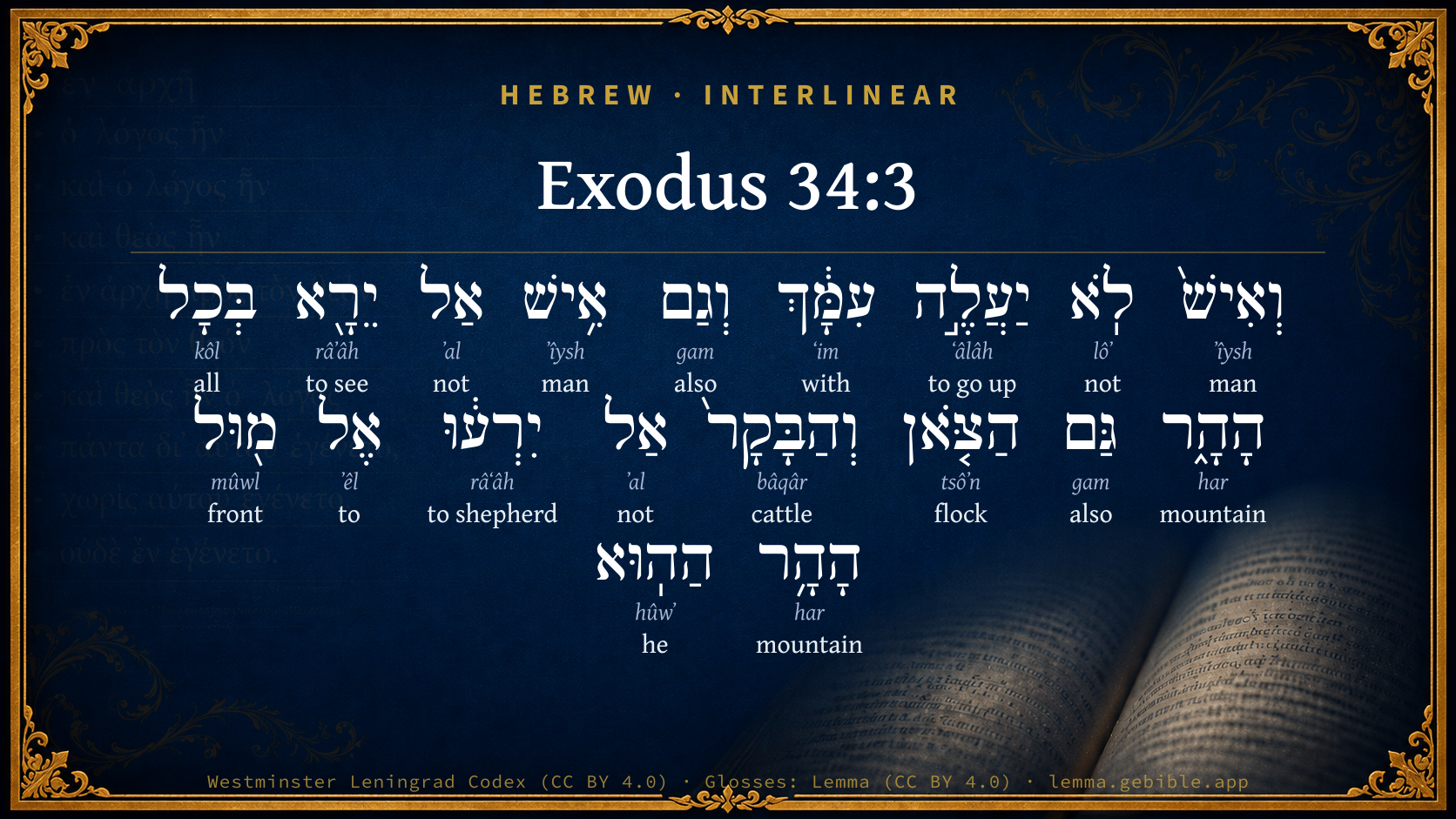
Hebrew (Westminster Leningrad Codex) Exodus 34:3 appears in the Hebrew Old Testament. The text above is from the Westminster Leningrad Codex. Each word links to its Strong’s number, a concise gloss, and parsing drawn from the Open Scriptures Hebrew Bible morphology. Click any word for its full Brown-Driver-Briggs (BDB) entry.
Download image
Cite this verse

Exodus 34:3 (World English Bible). Public Domain. Lemma interlinear Bible study tool, https://lemma.gebible.app/v/exodus/34/3.

Show BibTeX & RIS
BibTeX
RIS
English Translation
No one shall come up with you; neither let anyone be seen throughout all the mountain; neither let the flocks nor herds feed before that mountain."
World English Bible · Public Domain
Download a study sheet

One document with this verse’s original text, its word-by-word gloss line, the meaning frame, cross-references with their text, attributed commentary, and full source and license credits — printable, and it pastes into notes with its structure intact.

This verse Autodidact and up

Study sheet (.html) Plain text (.txt)

A passage Seminary Student

Up to 50 verses in one chapter. A passage sheet keeps up to 6 commentary sources and 12 cross-references per verse, in the order this page ranks them, and says so on the sheet whenever that leaves anything out. Ask for a single verse and you get the Autodidact verse sheet above.

Everything on this page stays free to read, with no account — the sheet is a download of what is already on screen, not access to it.

Want to remove ads? Support Godless Engineer
Compare translations 3

The same verse in 3 English versions, stacked beneath the original-language interlinear above. Click any original word for its lexicon entry.

Each is an independent rendering of the whole verse — the interlinear is not word-aligned to these translations.

Highlighted words mark where these versions differ — a whole-verse word diff, not a word-by-word alignment.

  • World English Bible Public Domain
    No one shall come up with you; neither let anyone be seen throughout all the mountain; neither let the flocks nor herds feed before that mountain."
  • King James Version Public Domain
    And no man shall come up with thee, neither let any man be seen throughout all the mount; neither let the flocks nor herds feed before that mount.
  • unfoldingWord Literal Text CC BY-SA 4.0
    And a man shall not come up with you and also let a man not be seen on all of the mountain. Also let not the flocks and the herds graze to the front of that mountain.”

unfoldingWord Literal Text — © unfoldingWord, licensed CC BY-SA 4.0. Word-aligned USFM3 via Door43 (git.door43.org/unfoldingWord/en_ult).

Versions to compare (up to 4)

3 of 4 selected

Show all 18 translations

Every available English version of this verse, each an independent rendering of the whole verse.

  • World English Bible Public Domain
    No one shall come up with you; neither let anyone be seen throughout all the mountain; neither let the flocks nor herds feed before that mountain."
  • Berean Standard Bible Public Domain
    No one may go up with you; in fact, no one may be seen anywhere on the mountain—not even the flocks or herds may graze in front of the mountain.”
  • Majority Standard Bible Public Domain
    No one may go up with you; in fact, no one may be seen anywhere on the mountain—not even the flocks or herds may graze in front of the mountain.”
  • King James Version Public Domain
    And no man shall come up with thee, neither let any man be seen throughout all the mount; neither let the flocks nor herds feed before that mount.
  • American Standard Version (1901) Public Domain
    And no man shall come up with thee; neither let any man be seen throughout all the mount; neither let the flocks nor herds feed before that mount.
  • Revised Version (1885) Public Domain
    And no man shall come up with thee, neither let any man be seen throughout all the mount; neither let the flocks nor herds feed before that mount.
  • Geneva Bible (1599) Public Domain
    But let no man come vp with thee, neither let any man be seene throughout all the mount, neyther let the sheepe nor cattell feede before this mount.
  • Douay-Rheims (1899) Public Domain
    Let no man go up with thee: and let not any man be seen throughout all the mount: neither let the oxen nor the sheep feed over against it.
  • Young's Literal Translation Public Domain
    and no man cometh up with thee, and also no man is seen in all the mount, also the flock and the herd do not feed over-against that mount.'
  • Literal Standard Version CC BY-SA 4.0
    and no man comes up with you, and also no man is seen in all the mountain, also the flock and the herd do not feed toward the front of that mountain.”
  • Unlocked Literal Bible CC BY-SA 4.0
    No one is to come up with you. Do not let anyone else be seen anywhere on the mountain. No flocks or herds are even to graze in front of the mountain.”
  • unfoldingWord Literal Text CC BY-SA 4.0
    And a man shall not come up with you and also let a man not be seen on all of the mountain. Also let not the flocks and the herds graze to the front of that mountain.”
  • Darby Bible Public Domain
    And let no man go up with thee, neither shall any man be seen on all the mountain; neither shall sheep and oxen feed in front of that mountain.
  • World Messianic Bible Public Domain
    No one shall come up with you or be seen anywhere on the mountain. Do not let the flocks or herds graze in front of that mountain.”
  • Webster's Bible Public Domain
    And no man shall come up with thee, neither let any man be seen throughout all the mount: neither let the flocks nor herds feed before that mount.
  • Free Bible Version CC BY-SA 4.0
    Nobody else can come up with you—I don't want to see anyone anywhere on the mountain, and no flocks or herds should graze at the foot of the mountain.”
  • Bible in Basic English Public Domain
    No one is to come up with you, and let no man be seen anywhere on the mountain; let no flocks or herds come near to get their food at its foot.
  • JPS Tanakh (1917) Public Domain
    And no man shall come up with thee, neither let any man be seen throughout all the mount; neither let the flocks nor herds feed before that mount.'

Literal Standard Version (2020), Covenant Press — licensed CC BY-SA 4.0. Text via the HelloAO Bible API (eBible.org). Unlocked Literal Bible (unfoldingWord) — licensed CC BY-SA 4.0. Text via the HelloAO Bible API (eBible.org). unfoldingWord Literal Text — © unfoldingWord, licensed CC BY-SA 4.0. Word-aligned USFM3 via Door43 (git.door43.org/unfoldingWord/en_ult). Free Bible Version, Dr. Jonathan Gallagher — licensed CC BY-SA 4.0. Text via the HelloAO Bible API (eBible.org).

Word by word

More ways to search: Search by grammar → Find every occurrence → Compare this word →

Practice this passage: Drill this verse → Learn its vocabulary →

מ֖וּל
mûwl
H4136
“front”
Preposition
Part of Speech
Preposition
Full BDB Definition

Origin: from H4135

TWOT: 1160

front (noun masculine) - front - in the opposite direction - in front of (preposition) - in front of - (with prefix) - towards the front of, to the front of, on the front of - from the front of, off the front of, close in front of, on the forefront of
  1. וְאִישׁ֙ ʼîysh H376 “and · man” Conjunction + Noun, Common, Masculine, Singular, Absolute
  2. לֹֽא lôʼ H3808 “not” Particle, Negative
  3. יַעֲלֶ֣ה ʻâlâh H5927 “to go up” Verb, Qal, Imperfect, 3rd Person, Masculine, Singular
  4. עִמָּ֔ךְ ʻim H5973 “with · you” Preposition + Suffix, Personal, 2nd Person, Feminine, Singular
  5. וְגַם gam H1571 “and · also” Conjunction + Particle, Accusative
  6. אִ֥ישׁ ʼîysh H376 “man” Noun, Common, Masculine, Singular, Absolute
  7. אַל ʼal H408 “not” Particle, Negative
  8. יֵרָ֖א râʼâh H7200 “to see” Verb, Niphal, Jussive, 3rd Person, Masculine, Singular
  9. בְּכָל kôl H3605 “in/at · all of” Preposition + Noun, Common, Masculine, Singular, Construct
  10. הָהָ֑ר har H2022 “the · mountain” Particle, Definite Article + Noun, Common, Masculine, Singular, Absolute
  11. גַּם gam H1571 “also” Particle, Accusative
  12. הַצֹּ֤אן tsôʼn H6629 “the · flock” Particle, Definite Article + Noun, Common, Both, Singular, Absolute
  13. וְהַבָּקָר֙ bâqâr H1241 “and · the · cattle” Conjunction + Particle, Definite Article + Noun, Common, Both, Singular, Absolute
  14. אַל ʼal H408 “not” Particle, Negative
  15. יִרְע֔וּ râʻâh H7462 “to shepherd” Verb, Qal, Jussive, 3rd Person, Masculine, Plural
  16. אֶל ʼêl H413 “to” Preposition
  17. הָהָ֥ר har H2022 “the · mountain” Particle, Definite Article + Noun, Common, Masculine, Singular, Absolute
  18. הַהֽוּא hûwʼ H1931 “the · he” Particle, Definite Article + Pronoun, Personal, 3rd Person, Masculine, Singular

About this verse

These counts appear in no published source. They are computed here, from the morphology-tagged text and Lemma’s own curated glosses. What Lemma adds →

19
words
15
distinct lemmas
Pentateuch
section

Shared distinctive vocabulary

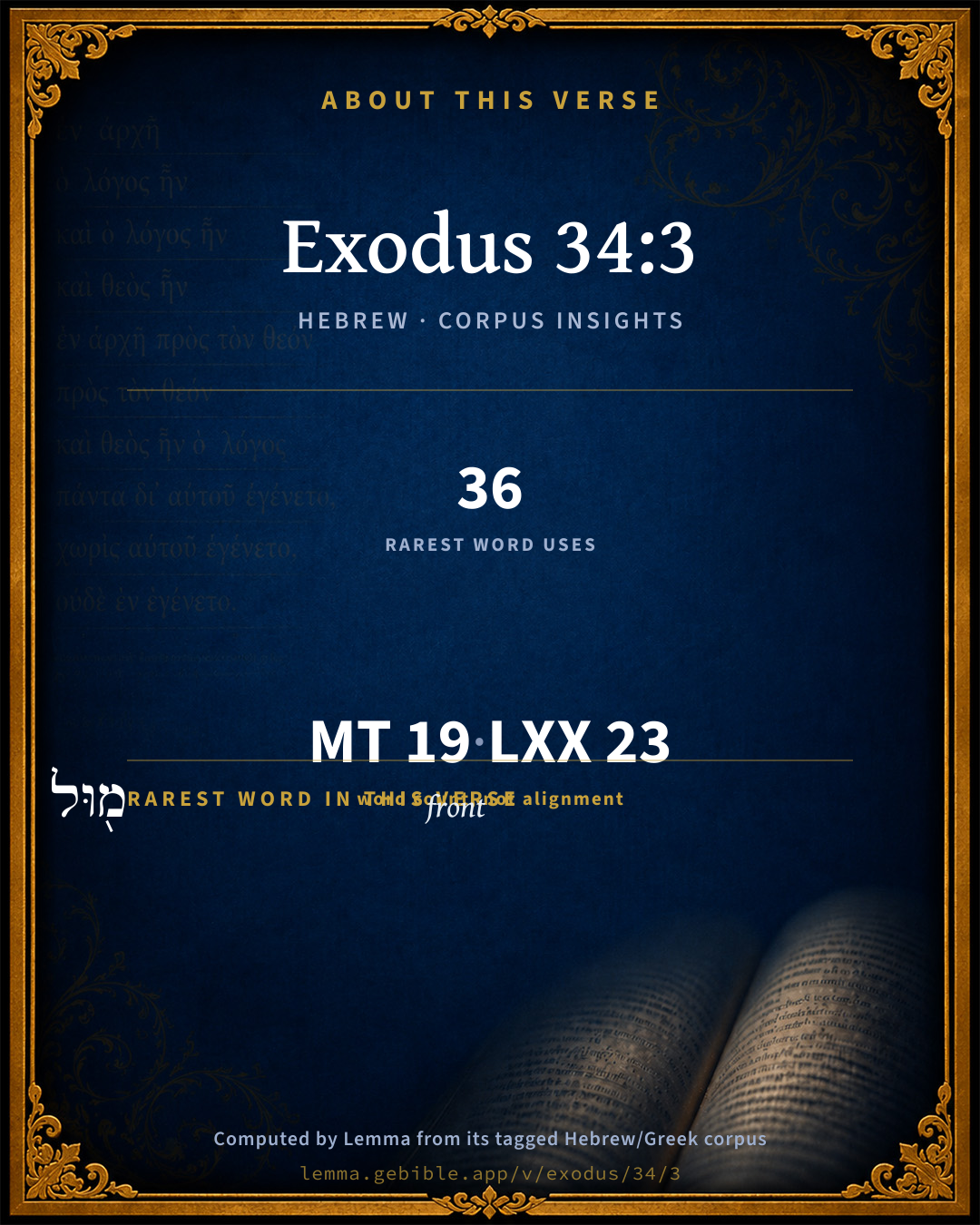
מ֖וּל front H4136 occurs in 34 verses of the Hebrew Bible. Also found in:

Grammatical profile

  • 3 verbs
  • 7 nouns
  • 1 pronoun
  • 3 prepositions
  • 5 particles

Verb forms

  • יַעֲלֶ֣ה Qal · Imperfect
  • יֵרָ֖א Niphal · Jussive
  • יִרְע֔וּ Qal · Jussive

Repetition

Words recur within this verse — often emphatic in Hebrew:

  • וְאִישׁ֙ man H376 ×2
  • וְגַם also H1571 ×2
  • הָהָ֑ר mountain H2022 ×2
  • אַל not H408 ×2

Hebrew & Septuagint length

In English translation the verse runs 26 words from the Hebrew and 26 from the Septuagint (LXX English) — the same length.

A rough comparison of the two English renderings, which tokenize alike — not a word-level alignment.

Word counts can differ between the Hebrew and the Greek without any difference in meaning — e.g. the Hebrew direct-object marker אֵת has no separate Greek word, and Greek often adds the article ὁ.

In the original languages it is 19 Hebrew tokens and 23 Greek tokens — but the two are counted differently (Hebrew bundles its prefixes and suffixes into one token; the Greek is in lemma form), so that isn’t a like-for-like length.

Cross-references

5

Topical passages linked to Exodus 34:3 in the Treasury of Scripture Knowledge — connected by theme and wording, ordered by reader-vote popularity; previews shown in the World English Bible.

  • Exodus 19:12–13 You shall set bounds to the people round about, saying, 'Be careful that you don't go up onto the mountain, or touch its border. Whoever touches the mountain shall be surely put to death.
  • Exodus 19:21 Yahweh said to Moses, "Go down, charge the people, lest they break through to Yahweh to gaze, and many of them perish.
  • Leviticus 16:17 There shall be no one in the Tent of Meeting when he enters to make atonement in the Holy Place, until he comes out, and has made atonement for himself and for his household, and for all the assembly of Israel.
  • 1 Timothy 2:5 For there is one God, and one mediator between God and men, the man Christ Jesus,
  • Hebrews 12:20 for they could not stand that which was commanded, "If even an animal touches the mountain, it shall be stoned;"

Cross-references courtesy of OpenBible.info (CC BY 4.0).

Hebrew and Greek witnesses Masoretic Hebrew ↔ Greek Septuagint

The same verse in the two great witnesses to the Old Testament, shown verse-for-verse.

These are two independent witnesses, not word-aligned to each other, and the Septuagint is shown in lemma (dictionary) form.

Hebrew Exodus 34:3 Masoretic · Westminster Leningrad Codex

וְאִישׁ֙ לֹֽא יַעֲלֶ֣ה עִמָּ֔ךְ וְגַם אִ֥ישׁ אַל יֵרָ֖א בְּכָל הָהָ֑ר גַּם הַצֹּ֤אן וְהַבָּקָר֙ אַל יִרְע֔וּ אֶל מ֖וּל הָהָ֥ר הַהֽוּא

No one shall come up with you; neither let anyone be seen throughout all the mountain; neither let the flocks nor herds feed before that mountain."

World English Bible · Public Domain

Greek LXX Exodus 34:3 Septuagint · lemma form

καί μηδείς ἀναβαίνω μετά σύ μηδέ ὁράω ἐν πᾶς ὁ ὄρος καί ὁ πρόβατον καί ὁ βοῦς μή νέμω πλησίον ὁ ὄρος ἐκεῖνος

And let no one go up with you, nor be seen in all the mountain; and let not the sheep and oxen feed near that mountain.

LXX2012 (modern English Septuagint) · Public Domain

Hebrew: Westminster Leningrad Codex (CC BY 4.0). Greek: Septuagint (public domain); English from LXX2012 (modern English Septuagint) (Public Domain). How the Septuagint differs from the Hebrew →

Targum (Aramaic paraphrase)

2

The Targum is the ancient Jewish Aramaic paraphrase of the Hebrew Scriptures — an interpretive translation, not the Hebrew text itself. Onkelos (literal) and Pseudo-Jonathan (expansive) render the Torah, and Jonathan the Prophets. Coverage is partial: where no permissively-licensed English translation exists for a verse, only the Aramaic is shown. This is verse-level text, not a word-by-word alignment to the Hebrew.

  1. Targum Onkelos Torah (Genesis–Deuteronomy)
    וֶאֱנַשׁ לָא יִסַק עִמָךְ וְאַף אֱנַשׁ לָא יִתְחֲזֵי בְּכָל טוּרָא אַף עֲנָא וְתוֹרֵי לָא יִרְעוּן לָקֳבֵל טוּרָא הַהוּא:

    (no public-domain English translation for this verse)

    Targum Onkelos — Aramaic: “Onkelos Genesis” (public domain); “Onkelos Exodus” (public domain); “Onkelos Leviticus” (public domain); “Onkelos Numbers” (public domain); “Onkelos Deuteronomy” (public domain). English: “Sefaria Community Translation” (CC0 1.0 (public-domain dedication)); “J.W. Etheridge. The Targums of Onkelos and Jonathan Ben Uzziel on the Pentateuch. London: Longmans, Green, 1862” (public domain). Text via Sefaria.

  2. Targum Pseudo-Jonathan Torah (Genesis–Deuteronomy)
    וְאֵינַשׁ לָא יִסַק עִמָּךְ וְאוּף אֵינַשׁ לָא יִתְחָמֵי בְּכָל טַוְורָא אוּף עָנָא וְתוֹרֵי לָא יַרְעוּן כָּל קְבֵיל טַוְורָא הַהוּא

    No man shall ascend with thee, nor any man be seen on all the mountain, nor sheep, nor oxen grazing on the side of the mount.

    Targum Pseudo-Jonathan — Aramaic: “Targum Jonathan on Genesis” (public domain); “Targum Jonathan on Exodus” (public domain); “Targum Jonathan on Leviticus” (public domain); “Targum Jonathan on Numbers” (public domain); “Targum Jonathan on Deuteronomy” (public domain). English: “The Targum of Jonathan ben Uzziel, trans. J. W. Etheridge, London, 1862” (public domain). Text via Sefaria.

Commentary

Notes on Exodus 34:3 from classic Christian and Jewish commentators (each source and its license shown beneath its notes). The classic Christian expositions comment on the surrounding passage and are grouped to its opening verse, so a note may address several verses; the Jewish commentaries on the Tanakh (Rashi and others) are per-verse, so they appear only where the commentator wrote on this verse.

Lemma curates 59 commentaries, every one of them public domain or Creative Commons licensed, each selected and text-cleaned for this edition rather than reprinted as found. About our sources →

Trapp's Complete Commentary

John Trapp

Exo 34:3 And no man shall come up with thee, neither let any man be seen throughout all the mount; neither let the flocks nor herds feed before that mount.

Ver. 3. Neither let any man be seen.] {See Trapp on "Exo 19:12"}

Neither let the flocks.] Moses comes alone to God, and leaves the flocks. Jacob ferrieth over all belonging to him on the other side of the river, before he wrestleth with God. Abraham leaveth the servant and asses at the foot of the hill, &c. Men must lay aside all, and prepare, before they draw nigh to God in holy duties.

John Trapp, A Commentary or Exposition upon All the Books of the Old and New Testament (1647–1656) — public domain. Text from a community e-Sword module.

Geneva Bible (1599)

Geneva Bible translators

Or, about.

Geneva Bible (1599) marginal notes — public domain. Text via Bolls.life.

Jamieson, Fausset & Brown

Robert Jamieson, A. R. Fausset & David Brown

no man shall come up with thee . . . neither . . . flocks nor herds--All these enactments were made in order that the law might be a second time renewed with the solemnity and sanctity that marked its first delivery. The whole transaction was ordered so as to impress the people with an awful sense of the holiness of God; and that it was a matter of no trifling moment to have subjected Him, so to speak, to the necessity of re-delivering the law of the ten commandments.

Jamieson, Fausset & Brown — Commentary Critical and Explanatory on the Whole Bible (1871) — public domain (CC PDM 1.0). Text via the HelloAO Bible API.

Ellicott's Commentary for English Readers

(3) No man shall come up with thee . . . —These stringent commands were new. On the previous occasion, Aaron, Hur, and the elders had ascended the mount part of the way (Exo_24:9-11); and Joshua had accompanied his master almost to the summit (Exo_24:13), and had apparently remained in some part of the mountain during the whole time of Moses’ stay (Exo_32:17). Now Moses was to be quite alone, and no one was to be seen in any part of the mount. The stringency of the new orders must be connected with the promised revelation to Moses of God’s glory (Exo_33:21-23).

A Bible Commentary for English Readers, edited by Charles John Ellicott (1878–1897) — public domain. Text from a community e-Sword module.

The Cambridge Bible for Schools and Colleges

gen. ed. J. J. S. Perowne

3. The precautions are similar to those taken in Exo_19:12 f.

before] rather, in front of, i.e. on the slopes in front of the mountain, towards its foot.

As was pointed out on p. 347, the historical retrospect in Deu_9:8-29 is based largely upon Exodus 32, and contains numerous verbal excerpts from it; and a comparison of Deu_10:1-3 with Exo_34:1; Exo_34:4 makes it practically certain that in the text of Exo_34:1; Exo_34:4 which lay before the author of Dt., there was mention of the ark as made at this time by Moses. Here is the text of Deu_10:1-3, with the words excerpted from Exo_34:1-2; Exo_34:4 printed in italics:—‘(Deu_10:1) At that time Jehovah said unto me, Hew thee two tables of stone like unto the first, and come up unto me to the mount, and make thee an ark of wood; (2) that I may write upon the tables the words that were on the first tables, which thou brakest, and thou shalt put them in the ark. (3) And I made an ark of acacia-wood; and I hewed two tables of stone like unto the first, and I went up to the mount; and the two tables were in my hand.’ Thus in Dt. Moses is instructed to make, and actually does make, the ark, before ascending the mount the second time to receive the tables of stone (Exo_34:4); whereas in Ex. the command to make the ark is both given to Bezalel and executed by him, after Moses’ return from the mountain (Exo_35:30 ff., Exo_36:2, Exo_37:1—all passages belonging to P). The two accounts are evidently discrepant: and there can be no reasonable doubt that the notices of the ark contained in the original text of Exo_34:1; Exo_34:4 were omitted by the compiler, as inconsistent with the more detailed particulars, which he preferred, contained in the narrative of P.

The Cambridge Bible for Schools and Colleges (gen. ed. J. J. S. Perowne; Cambridge University Press, 1878–1918) — public domain. Text from a community e-Sword module.

John Gill's Exposition

And no man shall come up with thee,.... Before, Aaron and his two sons, and the seventy elders of Israel, went up with Moses, though they did not go so near the Lord as he did; but now having sinned in the matter of the golden calf, though a reconciliation was made, they were not allowed to go with him, nor even Joshua his servant, though he had no concern in the sin; Moses must be alone, that the ministration of the law might be by him only, and in order to receive a peculiar favour in answer to his request:

neither let any man be seen throughout all the mount; in any part of it, as Joshua was before in some part of it, even all the while that Moses was there; but now not a single person must be seen anywhere, not only because of the giving of the law to Moses, but because of the display of the divine glory, which was to be made particularly to him:

neither let the flocks nor herds feed before that mount; or over against it, or rather "near" it (f); which was ordered, not so much on the account of the flocks themselves, who were not capable of any moral guilt; nor that they might not come to any hurt, since they were to be stoned or thrust through with a dart if they touched it, which order it is highly probable was in force as before; but on the account of their keepers, that there might be none of them on the spot, or near, to observe what passed; and chiefly this was said to command fear and reverence in the minds of the people, while this solemn affair was transacting between God and Moses, and to check all curiosity in them.

(f) , Sept. "prope montem illum", Noldius, p. 80.

John Gill's Exposition of the Whole Bible (1746–1763) — public domain (CC PDM 1.0). Text via the HelloAO Bible API.

Haydock's Catholic Bible Commentary

Let no, &c. This was to impress all with sentiments of reverence.

George Leo Haydock (1774–1849), Haydock's Catholic Family Bible and Commentary, 1859 edition — public domain. Excludes Psalms (Douay-Rheims chapter numbering differs from Protestant) and Deuterocanonical books (Catholic canon only).

Matthew Poole's English Annotations

This is said, not for the beasts, which are not capable of a law, but to restrain the presumption and curiosity of the people, by this argument, that even the beasts that come too near shall be destroyed, and much more man, whose knowledge aggravates his sin and punishment.

Matthew Poole's English Annotations on the Holy Bible (1683–1685) — public domain. Text from a community e-Sword/MySword module.

Whedon's Commentary on the Bible

Daniel D. Whedon

3. No man… with thee — As contrasted with Exo_24:9-13. Not even Joshua accompanied Moses now. He probably remained at the tent of the congregation. Exo_33:11.

Daniel D. Whedon (gen. ed.), Commentary on the Old and New Testaments (1874–1909) — public domain. Text from a community e-Sword module.

The Pulpit Commentary

No man shall come up with thee. This time, no one, not even Joshua, was to accompany Moses. The new manifestation of the glory of God was to be made to him alone. Neither let any man be seen throughout all the mount, etc. Compare the injunctions given in Exo_19:12, Exo_19:13. The present orders are even more stringent.

The Pulpit Commentary (1880–1919), ed. H.D.M. Spence-Jones & Joseph S. Exell — public domain. Text from a community e-Sword module.

unfoldingWord translationNotes

Door43 World Missions Community

General Information:

Yahweh continues speaking to Moses.

Do not let anyone else be seen anywhere on the mountain

Being seen doing something represents doing that. AT: "Do not let anyone else be anywhere on the mountain" (See: Metonymy)

No flocks or herds are even to graze in front of the mountain

"Even flocks or herds are not allowed to come near the mountain to eat."

translationWords

flocks

Moses

Sinai

Yahweh

unfoldingWord translationNotes — © Distant Shores Media and the Door43 World Missions Community, licensed CC BY-SA 4.0. Source: git.door43.org/Door43/en_tn.

Rashi

Rabbi Shlomo Yitzchaki (Rashi)

ואיש לא יעלה עמך AND NO MAN SHALL GO UP WITH THEE — Because the first tablets were given amidst great noises and alarms and a vast assembly the “evil eye” had power over them (they did not endure) — there is no finer quality than to be unostentatious! (Midrash Tanchuma 3:9:31).

Rashi on the Tanakh — English translations: “The Judaica Press complete Tanach with Rashi, translated by A. J. Rosenberg” (CC BY 4.0); “Pentateuch with Rashi's commentary by M. Rosenbaum and A.M. Silbermann, 1929-1934” (public domain); “The Metsudah Tanach series, Lakewood, N.J” (CC BY 4.0); and “The Book of Joshua, Metsudah Publications, 1997” (CC BY 4.0). Text via Sefaria.

Ramban (Nachmanides)

Rabbi Moshe ben Nachman (Ramban / Nachmanides)

AND NO MAN SHALL COME UP WITH THEE. None of the elders of Israel at all should go up with you, as they had done at the first Tablets of the Law.

NEITHER LET ANY MAN BE SEEN THROUGHOUT ALL THE MOUNT — even at the foot of the mountain, where Israel had stood at first [during the Revelation].

NEITHER LET THE FLOCKS NOR HERDS FEED BEFORE THAT MOUNT — in front of it. For at [the giving of] the first Tablets they had been warned only, no hand shall touch it [i.e., the mountain] … whether it be beast or man, 19:13. and now they were still under that admonition, for the Glory was always on the mountain until the last Tablets of the Law were given. However, at the giving of these Tablets He was now more stringent than at the first Revelation [in requiring that none of the elders accompany Moses]. The reason for all this was that at the first Tablets the Revelation was for all Israel, whereas this one was only for Moses, because of his merit and his prayer, and the Glory revealed on the mountain for [the giving of] the last Tablets would be greater than that of the first ones.

Ramban (Nachmanides) on the Tanakh — English translation: “Commentary on the Torah by Ramban (Nachmanides). Translated and annotated by Charles B. Chavel. New York, Shilo Pub. House, 1971-1976” (CC BY 4.0). Text via Sefaria.

Lesson kit

Teaching starters — assembled from the data on this page, not authored interpretation. Every prompt links to the verse data it draws on. Edit before teaching.

Exodus, in the Pentateuch, opens this verse with 19 words (15 distinct Hebrew lemmas). Its most distinctive word is mûwl (“front”). A historical commentator’s framing appears above. Read the whole chapter for the surrounding context.

Discussion questions

  1. The word mûwl carries the sense “front.” How does it shape the verse?
  2. Exodus 18:19 shares the word «front» with this verse. How do the two illuminate each other?
  3. “man” occurs 2× in this one verse. What is the effect of the repetition?
  4. These translations render this verse differently. What is at stake in choosing one wording over another?
  5. The verb «יַעֲלֶ֣ה» is Qal Imperfect. How does its form color the action?
  6. Reading how Trapp's Complete Commentary and Geneva Bible (1599) read this verse, where do the two commentators agree and where do they part?

Things to notice

Reading settings

Reading text

Shown beneath each verse's original-language words.

Old Testament
Old Testament edition

Read the OT as the Masoretic Hebrew (MT) or the Greek Septuagint (LXX).

English shown for the Greek Septuagint (in the Hebrew ↔ Greek comparison).

Comparing translations? Open the Compare panel on any verse page to stack up to four side by side.