Exodus 16:14

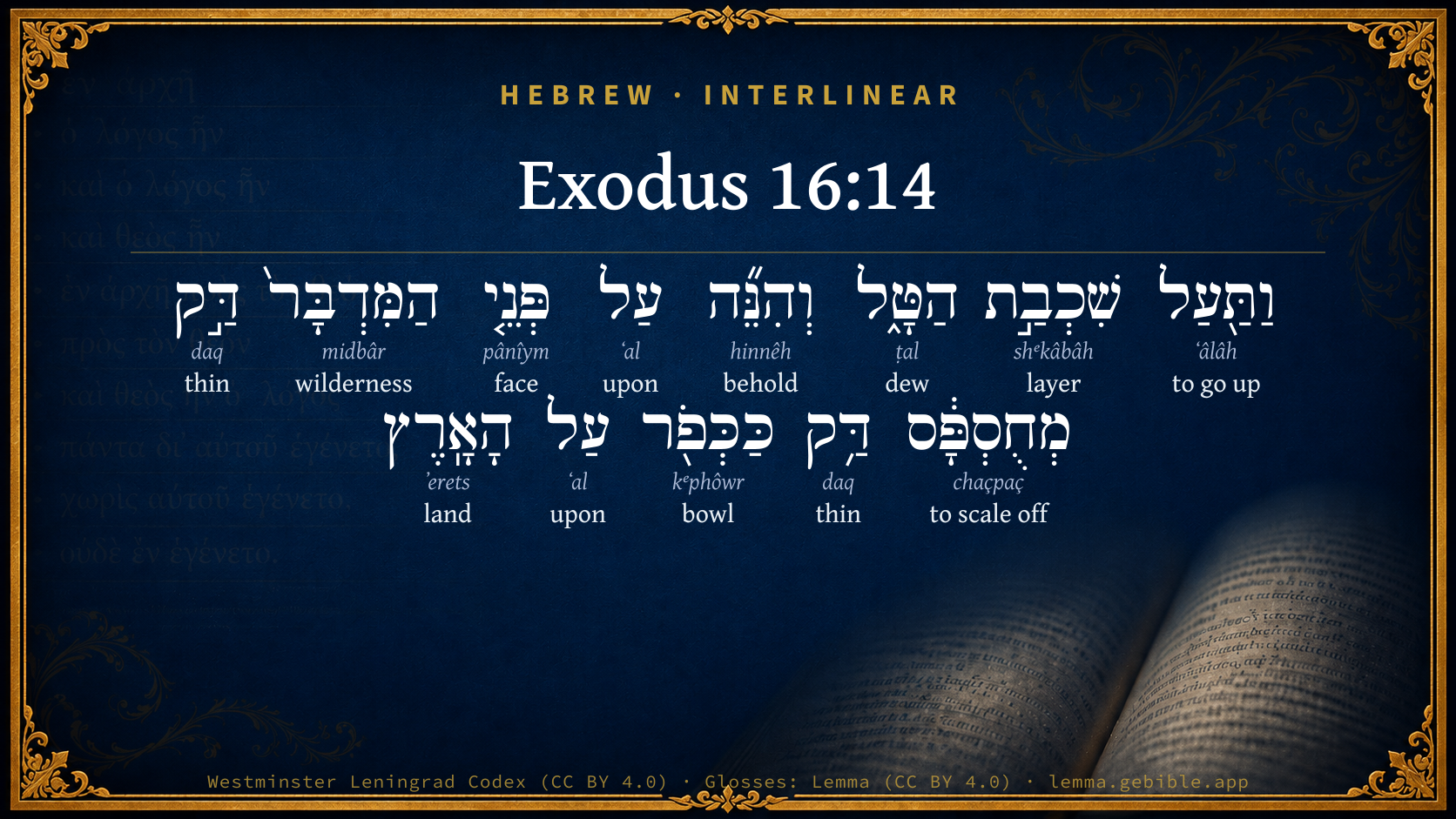
Hebrew (Westminster Leningrad Codex) Exodus 16:14 appears in the Hebrew Old Testament. The text above is from the Westminster Leningrad Codex. Each word links to its Strong’s number, a concise gloss, and parsing drawn from the Open Scriptures Hebrew Bible morphology. Click any word for its full Brown-Driver-Briggs (BDB) entry.
Download image
Cite this verse

Exodus 16:14 (World English Bible). Public Domain. Lemma interlinear Bible study tool, https://lemma.gebible.app/v/exodus/16/14.

Show BibTeX & RIS
BibTeX
RIS
English Translation
When the dew that lay had gone, behold, on the surface of the wilderness was a small round thing, small as the hoar-frost on the ground.
World English Bible · Public Domain
Highlights
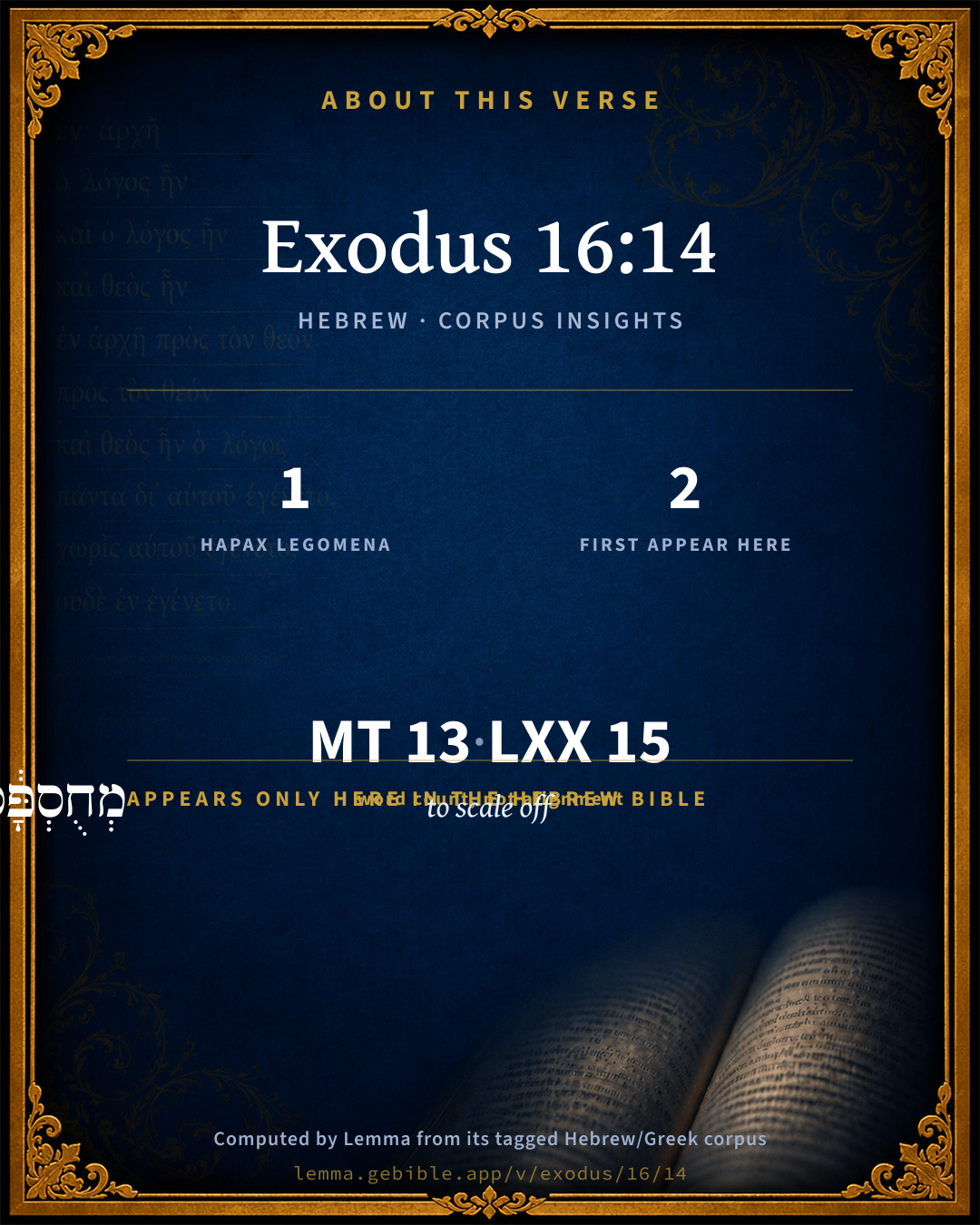
  • 1 hapax legomenon — only here in the Hebrew Bible
  • 2 first appearances in the Hebrew Bible
Full analysis ↓
Download a study sheet

One document with this verse’s original text, its word-by-word gloss line, the meaning frame, cross-references with their text, attributed commentary, and full source and license credits — printable, and it pastes into notes with its structure intact.

This verse Autodidact and up

Study sheet (.html) Plain text (.txt)

A passage Seminary Student

Up to 50 verses in one chapter. A passage sheet keeps up to 6 commentary sources and 12 cross-references per verse, in the order this page ranks them, and says so on the sheet whenever that leaves anything out. Ask for a single verse and you get the Autodidact verse sheet above.

Everything on this page stays free to read, with no account — the sheet is a download of what is already on screen, not access to it.

Want to remove ads? Support Godless Engineer
Compare translations 3

The same verse in 3 English versions, stacked beneath the original-language interlinear above. Click any original word for its lexicon entry.

Each is an independent rendering of the whole verse — the interlinear is not word-aligned to these translations.

Highlighted words mark where these versions differ — a whole-verse word diff, not a word-by-word alignment.

  • World English Bible Public Domain
    When the dew that lay had gone, behold, on the surface of the wilderness was a small round thing, small as the hoar-frost on the ground.
  • King James Version Public Domain
    And when the dew that lay was gone up, behold, upon the face of the wilderness there lay a small round thing, as small as the hoar frost on the ground.
  • unfoldingWord Literal Text CC BY-SA 4.0
    And the lying dew went up; and behold! On the face of the wilderness were thin flakes, thin like frost on the ground.

unfoldingWord Literal Text — © unfoldingWord, licensed CC BY-SA 4.0. Word-aligned USFM3 via Door43 (git.door43.org/unfoldingWord/en_ult).

Versions to compare (up to 4)

3 of 4 selected

Show all 18 translations

Every available English version of this verse, each an independent rendering of the whole verse.

  • World English Bible Public Domain
    When the dew that lay had gone, behold, on the surface of the wilderness was a small round thing, small as the hoar-frost on the ground.
  • Berean Standard Bible Public Domain
    When the layer of dew had evaporated, there were thin flakes on the desert floor, as fine as frost on the ground.
  • Majority Standard Bible Public Domain
    When the layer of dew had evaporated, there were thin flakes on the desert floor, as fine as frost on the ground.
  • King James Version Public Domain
    And when the dew that lay was gone up, behold, upon the face of the wilderness there lay a small round thing, as small as the hoar frost on the ground.
  • American Standard Version (1901) Public Domain
    And when the dew that lay was gone up, behold, upon the face of the wilderness a small round thing, small as the hoar-frost on the ground.
  • Revised Version (1885) Public Domain
    And when the dew that lay was gone up, behold, upon the face of the wilderness a small round thing, small as the hoar frost on the ground.
  • Geneva Bible (1599) Public Domain
    And when the dewe that was fallen was ascended, beholde, a small round thing was vpon the face of the wildernes, small as the hoare frost on the earth.
  • Douay-Rheims (1899) Public Domain
    And when it had covered the face of the earth, it appeared in the wilderness small, and as it were beaten with a pestle, like unto the hoar frost on the ground.
  • Young's Literal Translation Public Domain
    and the lying of the dew goeth up, and lo, on the face of the wilderness a thin, bare thing, thin as hoar-frost on the earth.
  • Literal Standard Version CC BY-SA 4.0
    and the lying of the dew goes up, and behold, on the face of the wilderness [is] a thin, bare thing, thin as hoarfrost on the earth.
  • Unlocked Literal Bible CC BY-SA 4.0
    When the dew was gone, there on the surface of the wilderness were thin flakes like frost on the ground.
  • unfoldingWord Literal Text CC BY-SA 4.0
    And the lying dew went up; and behold! On the face of the wilderness were thin flakes, thin like frost on the ground.
  • Darby Bible Public Domain
    And when the dew that lay [round it] was gone up, behold, on the face of the wilderness there was [something] fine, granular, fine as hoar-frost, on the ground.
  • World Messianic Bible Public Domain
    When the dew that lay had gone, behold, on the surface of the wilderness was a small round thing, small as the frost on the ground.
  • Webster's Bible Public Domain
    And when the dew that lay was gone up, behold, upon the face of the wilderness there lay a small round thing, as small as the hoar frost on the ground:
  • Free Bible Version CC BY-SA 4.0
    Once the dew had gone, there was something thin and flaky on the desert, looking like frost crystals on the ground.
  • Bible in Basic English Public Domain
    And when the dew was gone, on the face of the earth was a small round thing, like small drops of ice on the earth.
  • JPS Tanakh (1917) Public Domain
    And when the layer of dew was gone up, behold upon the face of the wilderness a fine, scale-like thing, fine as the hoar-frost on the ground.

Literal Standard Version (2020), Covenant Press — licensed CC BY-SA 4.0. Text via the HelloAO Bible API (eBible.org). Unlocked Literal Bible (unfoldingWord) — licensed CC BY-SA 4.0. Text via the HelloAO Bible API (eBible.org). unfoldingWord Literal Text — © unfoldingWord, licensed CC BY-SA 4.0. Word-aligned USFM3 via Door43 (git.door43.org/unfoldingWord/en_ult). Free Bible Version, Dr. Jonathan Gallagher — licensed CC BY-SA 4.0. Text via the HelloAO Bible API (eBible.org).

Word by word

More ways to search: Search by grammar → Find every occurrence → Compare this word →

Practice this passage: Drill this verse → Learn its vocabulary →

מְחֻסְפָּ֔ס
chaçpaç
H2636
“scaled off”
Verb, Pual, Participle Passive, Masculine, Singular, Absolute
Part of Speech
Verb
Stem
Pual
Form
Participle Passive
Gender
Masculine
Number
Singular
State
Absolute
Full BDB Definition

Origin: reduplicated from an unused root meaning apparently to peel

TWOT: 704

(Pual) to peel, flake off (only in the participle) - scale-like, flake-like, scaled-off
  1. וַתַּ֖עַל ʻâlâh H5927 “and · to go up” Conjunction + Verb, Qal, Sequential Imperfect, 3rd Person, Feminine, Singular
  2. שִׁכְבַ֣ת shᵉkâbâh H7902 “layer of” Noun, Common, Feminine, Singular, Construct
  3. הַטָּ֑ל ṭal H2919 “the · dew” Particle, Definite Article + Noun, Common, Masculine, Singular, Absolute
  4. וְהִנֵּ֞ה hinnêh H2009 “and · behold” Conjunction + Particle, Demonstrative
  5. עַל ʻal H5921 “upon” Preposition
  6. פְּנֵ֤י pânîym H6440 “face(s) of” Noun, Common, Both, Plural, Construct
  7. הַמִּדְבָּר֙ midbâr H4057 “the · wilderness” Particle, Definite Article + Noun, Common, Masculine, Singular, Absolute
  8. דַּ֣ק daq H1851 “thin” Adjective, Adjective, Masculine, Singular, Absolute
  9. דַּ֥ק daq H1851 “thin” Adjective, Adjective, Masculine, Singular, Absolute
  10. כַּכְּפֹ֖ר kᵉphôwr H3713 “like/as the · bowl” Preposition, Determined + Noun, Common, Masculine, Singular, Absolute
  11. עַל ʻal H5921 “upon” Preposition
  12. הָאָֽרֶץ ʼerets H776 “the · land” Particle, Definite Article + Noun, Common, Both, Singular, Absolute

About this verse

These counts appear in no published source. They are computed here, from the morphology-tagged text and Lemma’s own curated glosses. What Lemma adds →

13
words
11
distinct lemmas
Pentateuch
section

Notable vocabulary

1 hapax legomenon — a word that appears only here in the entire Hebrew Bible:

  • מְחֻסְפָּ֔ס to scale off H2636

First appearance in Scripture

These words make their first canonical appearance in the Hebrew Bible here:

  • מְחֻסְפָּ֔ס to scale off H2636
  • כַּכְּפֹ֖ר bowl H3713

Shared distinctive vocabulary

שִׁכְבַ֣ת layer H7902 occurs in 9 verses of the Hebrew Bible. Also found in:

Grammatical profile

  • 2 verbs
  • 6 nouns
  • 2 adjectives
  • 2 prepositions
  • 1 particle

Verb forms

  • וַתַּ֖עַל Qal · Sequential Imperfect
  • מְחֻסְפָּ֔ס Pual · Participle Passive

Repetition

Words recur within this verse — often emphatic in Hebrew:

Hebrew & Septuagint length

In English translation the verse runs 26 words from the Hebrew and 36 from the Septuagint (LXX English) — closely comparable.

A rough comparison of the two English renderings, which tokenize alike — not a word-level alignment.

Word counts can differ between the Hebrew and the Greek without any difference in meaning — e.g. the Hebrew direct-object marker אֵת has no separate Greek word, and Greek often adds the article ὁ.

In the original languages it is 13 Hebrew tokens and 15 Greek tokens — but the two are counted differently (Hebrew bundles its prefixes and suffixes into one token; the Greek is in lemma form), so that isn’t a like-for-like length.

Cross-references

7

Topical passages linked to Exodus 16:14 in the Treasury of Scripture Knowledge — connected by theme and wording, ordered by reader-vote popularity; previews shown in the World English Bible.

  • Numbers 11:7–9 The manna was like coriander seed, and the appearance of it as the appearance of bdellium.
  • Deuteronomy 8:3 He humbled you, and allowed you to hunger, and fed you with manna, which you didn't know, neither did your fathers know; that he might make you know that man does not live by bread only, but by everything that proceeds out of the mouth of Yahweh does man live.
  • Nehemiah 9:15 and gave them bread from the sky for their hunger, and brought forth water for them out of the rock for their thirst, and commanded those who they should go in to possess the land which you had sworn to give them.
  • Psalms 78:24 He rained down manna on them to eat, And gave them food from the sky.
  • Psalms 105:40 They asked, and he brought quails, And satisfied them with the bread of the sky.
  • Exodus 16:31 The house of Israel called the name of it Manna, and it was like coriander seed, white; and its taste was like wafers with honey.
  • Psalms 147:16 He gives snow like wool, And scatters frost like ashes.

Cross-references courtesy of OpenBible.info (CC BY 4.0).

Hebrew and Greek witnesses Masoretic Hebrew ↔ Greek Septuagint

The same verse in the two great witnesses to the Old Testament, shown verse-for-verse.

These are two independent witnesses, not word-aligned to each other, and the Septuagint is shown in lemma (dictionary) form.

Hebrew Exodus 16:14 Masoretic · Westminster Leningrad Codex

וַתַּ֖עַל שִׁכְבַ֣ת הַטָּ֑ל וְהִנֵּ֞ה עַל פְּנֵ֤י הַמִּדְבָּר֙ דַּ֣ק מְחֻסְפָּ֔ס דַּ֥ק כַּכְּפֹ֖ר עַל הָאָֽרֶץ

When the dew that lay had gone, behold, on the surface of the wilderness was a small round thing, small as the hoar-frost on the ground.

World English Bible · Public Domain

Greek LXX Exodus 16:14 Septuagint · lemma form

καί ἰδού ἐπί πρόσωπον ὁ ἔρημος λεπτός ὡσεί κόριον λευκός ὡσεί πάγος ἐπί ὁ γῆ

in the morning it came to pass as the dew ceased round about the camp, that, behold, on the face of the wilderness was a small thing like white coriander seed, as frost upon the earth.

LXX2012 (modern English Septuagint) · Public Domain

Hebrew: Westminster Leningrad Codex (CC BY 4.0). Greek: Septuagint (public domain); English from LXX2012 (modern English Septuagint) (Public Domain). How the Septuagint differs from the Hebrew →

Targum (Aramaic paraphrase)

2

The Targum is the ancient Jewish Aramaic paraphrase of the Hebrew Scriptures — an interpretive translation, not the Hebrew text itself. Onkelos (literal) and Pseudo-Jonathan (expansive) render the Torah, and Jonathan the Prophets. Coverage is partial: where no permissively-licensed English translation exists for a verse, only the Aramaic is shown. This is verse-level text, not a word-by-word alignment to the Hebrew.

  1. Targum Onkelos Torah (Genesis–Deuteronomy)
    וּסְלֵיקַת נְחָתַת טַלָא וְהָא עַל אַפֵּי מַדְבְּרָא דַעְדַק מְקַלַף דַעְדַק כְּגִיר כִּגְלִידָא עַל אַרְעָא:

    (no public-domain English translation for this verse)

    Targum Onkelos — Aramaic: “Onkelos Genesis” (public domain); “Onkelos Exodus” (public domain); “Onkelos Leviticus” (public domain); “Onkelos Numbers” (public domain); “Onkelos Deuteronomy” (public domain). English: “Sefaria Community Translation” (CC0 1.0 (public-domain dedication)); “J.W. Etheridge. The Targums of Onkelos and Jonathan Ben Uzziel on the Pentateuch. London: Longmans, Green, 1862” (public domain). Text via Sefaria.

  2. Targum Pseudo-Jonathan Torah (Genesis–Deuteronomy)
    וּסְלִיקוּ עֲנָנַיָא וְאָחִיתוּ מַנָּא עִילַוֵי אֲנָחוּת טַלָא וַהֲוַת עַל אַנְפֵּי מַדְבְּרָא דְקִיק מְסַרְגֵּל דְּקִיק כִּגְלִידָא עַל אַרְעָא

    and the clouds ascended and caused manna to descend upon the dew; and there was upon the face of the desert a minute (substance) in lines, minute as the hoar frost upon the ground.

    Targum Pseudo-Jonathan — Aramaic: “Targum Jonathan on Genesis” (public domain); “Targum Jonathan on Exodus” (public domain); “Targum Jonathan on Leviticus” (public domain); “Targum Jonathan on Numbers” (public domain); “Targum Jonathan on Deuteronomy” (public domain). English: “The Targum of Jonathan ben Uzziel, trans. J. W. Etheridge, London, 1862” (public domain). Text via Sefaria.

Commentary

Notes on Exodus 16:14 from classic Christian and Jewish commentators (each source and its license shown beneath its notes). The classic Christian expositions comment on the surrounding passage and are grouped to its opening verse, so a note may address several verses; the Jewish commentaries on the Tanakh (Rashi and others) are per-verse, so they appear only where the commentator wrote on this verse.

Lemma curates 59 commentaries, every one of them public domain or Creative Commons licensed, each selected and text-cleaned for this edition rather than reprinted as found. About our sources →

Trapp's Complete Commentary

John Trapp

Exo 16:14 And when the dew that lay was gone up, behold, upon the face of the wilderness [there lay] a small round thing, [as] small as the hoar frost on the ground.

Ver. 14. The dew that lay.] And covered the manna: whence that promise of hidden manna in Rev 2:17.

John Trapp, A Commentary or Exposition upon All the Books of the Old and New Testament (1647–1656) — public domain. Text from a community e-Sword module.

Joseph Benson's Commentary

Exo 16:14. When the dew was gone up — To wit, into the air; or was vanished, there lay a small round thing — According to Num 11:9, there was a dew which fell before the manna; for it is said, when the dew fell in the night, the manna fell upon it. But it appears here, that there was also a dew upon it, which went up when the sun rose. So that the manna lay as it were enclosed. This might be designed to keep it pure and clean.

Joseph Benson's Commentary on the Old and New Testaments (1811–1818) — public domain. Text from a community e-Sword module.

Adam Clarke's Commentary

Verse 14. Behold, upon the face of the wilderness there lay a small round thing] It appears that this small round thing fell with the dew, or rather the dew fell first, and this substance fell on it. The dew might have been intended to cool the ground, that the manna on its fall might not be dissolved; for we find from Ex 16:21, that the heat of the sun melted it. The ground therefore being sufficiently cooled by the dew, the manna lay unmelted long enough for the Israelites to collect a sufficient quantity for their dally use.

Adam Clarke's Commentary on the Bible (1810–1826) — public domain. Text from a community e-Sword/MySword module.

Ellicott's Commentary for English Readers

(14) Was gone up—i.e., was drawn up by the heat of the sun.

A small round thing, as small as the hoar frost.—What the manna was has been much disputed. There are two natural substances, quite distinct, with which it has been compared, and by some persons identified. One is a deposit from the air, which falls indifferently on trees, stones, grass, &c, and is generally thick and sticky, like honey, but under certain circumstances is “concreted into small granular masses.” This bas been described by Aristotle (Hist. An., v. 22), Pliny (H. N., xi. 12), Avicenna(p. 212), Ǽlian (Hist. An., xv. 7), Shaw, Forskal, and others. It has been called ὰερόμελι or “air-honey” (Athen. Deipn, xi., p. 500). It is collected by the Arabs, and eaten with their unleavened cakes as a condiment. It so far resembles the manna that it comes with the dew, is spread upon the ground generally, and melts when the sun’s rays attain a certain power (Œdmann: Misc. Collect., vol. iv., p. 7). But it is never found in large quantities; it does not fall for more than two months in the year; and it is wholly unfit to serve as man’s principal food, being more like honey than anything else. The other substance is a gum which exudes from certain trees at certain seasons of the year, in consequence of the punctures made in their leaves by a small insect, the Coccus manniparus. It has been described at length by C. Niebuhr in his Description de l’ Arabie (pp. 128, 129); by Rauwolf (Travels, vol. I., p. 94); Gmelin (Travels through Russia to Persia, Part III., p. 28), and others. It is comparatively a dry substance, is readily shaken from the leaves, and consists of small yellowish – white grains, which are hard, and have been compared to coriander seed by moderns (Rauwolf, 50s.100). The name “manna” attaches in the East to this latter substance, which is employed both as a condiment, like the “air-honey,” and also as a laxative. The special points in which it differs from the manna of Scripture are its confinement to certain trees or bushes, its comparative permanency, for it “accumulates on the leaves” (Niebuhr, p. 129), and its unfitness for food. It has also, like the “air-honey,” only a short season—the months of July and August.

The manna of Scripture in certain respects resembles the one, and in certain other respects the other of these substances, but in its most important characteristics resembles neither, and is altogether sui generis. For (1) it was adapted to be men’s principal nourishment, and served the Israelites as such for forty years; (2) it was supplied in quantities far exceeding anything that is recorded of the natural substances compared with it; (3) it continued through the whole of the year; (4) for forty years it fell regularly for six nights following, and ceased upon the seventh night; (5) it “bred worms” if kept to a second day, when gathered on five days out of the six, but when gathered on the sixth day continued good throughout the seventh, and bred no worms. The manna of Scripture must therefore be regarded as a miraculous substance, created ad hoc, and not as a natural product. It pleased the Creator, however, to proceed on the lines of Nature, so to speak, and to assimilate His new to certain of His old creations.

A Bible Commentary for English Readers, edited by Charles John Ellicott (1878–1897) — public domain. Text from a community e-Sword module.

The Cambridge Bible for Schools and Colleges

gen. ed. J. J. S. Perowne

14. The Hebrews conceived dew to fall from heaven (Deu_33:13; Deu_33:28, Pro_3:20 al.); and the manna falls with it (so Num_11:9): cf. v. 4, where it is said to be rained ‘from heaven.’

a thin flake (RVm.)] properly, it seems, from the Arabic, ‘a thin scab or scale-like thing’ (see Di., and Lex.). The word is a peculiar one, and occurs only here: but ‘round’ (Saad., Kimchi, EVV.) has no philological support.

The Cambridge Bible for Schools and Colleges (gen. ed. J. J. S. Perowne; Cambridge University Press, 1878–1918) — public domain. Text from a community e-Sword module.

John Gill's Exposition

And when the dew that lay was gone up,.... Exhaled by the sun upon the rising of it:

behold, upon the face of the wilderness; upon the surface of it, all around the camp of Israel:

there lay a small round thing, as small as the hoar frost on the ground; which is what is in the next verse called "manna". Before the sun rose there was nothing but a dew to be seen; when that was gone off through the force of the sun, then the manna appeared; which was but a "small thing", and very unpromising for food, and especially for such a vast number of people; and a "round" thing, for which it is after compared to a coriander seed, as is thought; though the Targums of Onkelos and Jonathan do not interpret the word of the round form, but rather refer to its smallness; and which is expressed in the Vulgate Latin version,"small, and as if beat with a pestle;''and for its white colour, as well as its smallness, it looked like hoar frost on the ground. Jarchi says there were two dews, within which it lay as something covered in a box, and he seems to be right; for it is certain from Num 11:9, that there was a dew which fell first, and then the manna fell upon it; and from hence it is plain also, that there was a dew over the manna, which went up from it when the sun rose: and the design of this seems to be to keep this heavenly bread pure and clean for the Israelites, that it might neither partake of the dust nor sand of the wilderness where it fell, and that nothing might light upon it until the time of gathering it came. The Jews, in memory of this, will sometimes put bread upon the table between two table cloths (n); and it is highly probable, that to this the allusion is of the "hidden manna" in Rev 2:17, by which is meant our Lord Jesus Christ, the antitype of this manna, as will be observed as we pass on, in all the circumstances of it; the manna came with the dew, and was covered with it, and hid in it; Christ is the gift of God's free grace to the sons of men, and is exhibited in the word of grace, where he lies hid to men in the glory of his person and the fulness of his grace, until revealed and made known. The figure of the manna being "round", which is a perfect figure, may denote the perfection of Christ in his person, natures, and office; he being perfectly God and perfectly man, having all the essential perfections both of the divine and human natures in him, as well as all fulness of grace; and being made perfect through sufferings, is become a complete Saviour, and by his blood, righteousness, and sacrifice, has perfected for ever his sanctified ones: and the manna being "small", may signify the meanness of Christ in the eyes of men in his state of humiliation, and the unpromising appearance he made of being the Saviour and King of Israel; the white colour of it may direct to the purity of Christ, to the holiness of his natures, and the beauty of his person, being white and ruddy, the chiefest among ten thousands.

(n) Vid. Fagium in loc.

John Gill's Exposition of the Whole Bible (1746–1763) — public domain (CC PDM 1.0). Text via the HelloAO Bible API.

Matthew Poole's English Annotations

When the dew was gone up, to wit, into the air; or, was vanished, as the word ascend is used Jer 48:15.

Matthew Poole's English Annotations on the Holy Bible (1683–1685) — public domain. Text from a community e-Sword/MySword module.

Whedon's Commentary on the Bible

Daniel D. Whedon

14. A small round thing, as small as the hoar frost — Rather, A thing fine, and in fine scales, fine as the hoar frost. It was in small and white grains. The tamarisk manna is white when it drops upon the clean rocks.

Daniel D. Whedon (gen. ed.), Commentary on the Old and New Testaments (1874–1909) — public domain. Text from a community e-Sword module.

The Pulpit Commentary

When the dew that lay was gone up. The moisture which lay upon the herbage soon evaporated, drawn up by the sun; and then the miracle revealed itself. There remained upon each leaf and each blade of grass a delicate small substance, compared here to hoar frost, and elsewhere (Num_11:7) to "coriander seed," which was easily detached and collected in bags or baskets. The thing was altogether a novelty to the Israelites, though analogous in some degree to natural processes still occurring in the country. These processes are of two kinds. At certain times of the year there is a deposit of a glutinous substance from the air upon leaves and even upon stones, which may be scraped off, and which resembles thick honey. There is also an exudation from various trees and shrubs, especially the tamarisk, which is moderately hard, and is found both on the growing plant and on the fallen leaves beneath it, in the shape of small, round, white or greyish grains. It is this last which is the manna of commerce. The Biblical manna cannot be identified with either of these two substances. In some points it resembled the one, in other points the other; in some, it differed from both. It came out of the air like the "airhoney," and did not exude from shrubs; but it was hard, like the manna of commerce, and could be "ground in mills" and "beaten in mortars," which the "air-honey" cannot. It was not a medicament, like the one, nor a condiment, like the other, but a substance suited to be a substitute for bread, and to become the main sustenance of the Israelitish people. It was produced in quantities far exceeding anything that is recorded of either manna proper, or air honey. It accompanied the Israelites wherever they went during the space of forty years, whereas the natural substances, which in certain points resemble it, are confined to certain districts, and to certain seasons of the year. During the whole space of forty years it fell regularly during six consecutive days, and then ceased on the seventh. It "bred worms" if kept till the morrow on all days of the week except one; on that one the Sabbath it bred no worms, but was sweet and good. Thus, it must be regarded as a peculiar substance, miraculously created for a special purpose, but similar in certain respects to certain known substances which are still produced in the Sinaitic region.

Verses Joh_6:32) We may profitably consider, in what respects the type held good.

I IT WAS THE NOURISHMENT OF THE BODY, AS CHRIST IS OF THE SOUL. The manna constituted almost the sole nourishment of the Israelites from this time forth until they entered Canaan. (Jos_5:12) So Christ is the food of the soul during its entire pilgrimage through the wilderness of this world, until it reaches the true Canaan, heaven. The Israelites were in danger of perishing for lack of food they murmured and God gave them the manna. The world was perishing for lack of spiritual nourishment it made a continual dumb complaint and God heard, and gave his own Son from heaven. Christ came into the world, not only to teach it, and redeem it, but to be its "spiritual food and sustenance." He feeds us with the bread of life. He gives us his own self for nourishment. Nothing else can truly sustain and support the soul not creeds, not sacraments, not even his own Word without him.

II IT WAS GIVEN FREELY FOR ALL THE PEOPLE OF ISRAEL, AS CHRIST IS GIVEN" TO BE THE SAVIOUR OF THE WHOLE WORLD. The manna fell all around the camp of Israel, close to them, so that they had but to stretch out the hand and take it. None could lack sufficient sustenance except by his own fault. If he refused to gather, be might starve; hut not otherwise. So Christ gave himself for all men, "not willing that any should perish, but that all should come to repentance." His was "a full, perfect, and sufficient sacrifice for the sins of the whole world." Even they who know him not may be saved by him, "if they will do the works of the law written in their hearts," or, in other words, act up to the light that has been vouchsafed them. Thus, his salvation is free, and open to all. In Christian lands it is close to all, made palpable to all, shown them openly, daily pressed upon them. He who starves here in England can scarcely starve save by his own fault because he will not stretch out his hand to gather of the bread of life, will not take it when it is offered to him, rejects it, despises it, "loathes" it.

III IT WAS WHITE, AND SWEET TO THE TASTE, AS CHRIST IS PURE AND SPOTLESS, AND SWEET TO THE SOUL. A master mind of these modern times has made his hero, a well-disposed heathen, see in Christ, even before he could bring himself to believe in him, "the WHITE Christ." "Holy, harmless, undefiled, separate from sinners," he presents himself to all who will read his life, and contemplate his character, as pure, stainless, innocent. The Lamb is his fitting emblem. Driven snow is not purer or more speckless. "Thou art all fair, my love; there is no spot in. (Son_4:7) And he is sweet also. "Thy lips, O my spouse, drop as the honeycomb; honey and milk are under thy tongue" (ib, 11). "How sweet are thy words unto my taste! yea, sweeter than honey unto my mouth!" (Psa_119:103) His words, his life, his promises, his influence, his presence, are all sweet, especially the last. Let those who know him not, once "taste and see how gracious the Lord is," and they will desire no other nourishment.

IV IT DESCENDED NOISELESSLY IN THE NIGHT. So Christ comes to us, not "with observation not in the wind, or in the fire, or in the earthquake, but in silence and in quietude, when other voices are hushed within us and about us, when we sit and watch, in patience possessing our souls. His doctrine drops as the rain, and his peace distils as the dew. It comes down "like the rain into a fleece of wool, even as the drops that water the earth." In the whirl of passion, in the giddy excitement of pleasure, in the active bustle of business, there is no room for Christ, no fit place for his presence. Christ comes to the soul when it is calm and tranquil, when it waits for him, and believing in his promise that he will come, is at rest.

V IT REQUIRED TO BE GATHERED EARLY, AND IF NOT GATHERED MELTED AWAY. "Remember thy Creator in the days of thy youth." Unless we will seek Christ early, we have no warrant to expect that he will condescend to be found of us. If we slight him, if we dally with the world, if we put off seeking him till a "more convenient season," we may find, when we wake up from our foolish negligence, that he has withdrawn himself, has (as it were) melted away. If an Israelite put off his gathering of the manna until the sun was hot, he obtained nothing the manna no longer lay ready to his hand. So with the Christian who is slothful, self-indulgent, careless when, after long neglect, he at length seeks spiritual food, he may find it too late, the opportunity may be irrevocably gone.

The Pulpit Commentary (1880–1919), ed. H.D.M. Spence-Jones & Joseph S. Exell — public domain. Text from a community e-Sword module.

Rashi

Rabbi Shlomo Yitzchaki (Rashi)

ותעל שכבת הטל וגו׳ AND WHEN THE LAYER OF DEW WENT UP etc. — When the sun rose the dew which was lying upon the Manna ascended sunward, as is the manner of dew — that it ascends sunward; even if you were to fill an egg-shell with dew and close up its opening and place it in the sun, it (the egg-shell with the dew in it) will rise of its own accord into the air, (in consequence of the tendency of the dew to rise upwards). — But our Rabbis explained that these words imply that the dew rose from the ground into the air. — When the layer of dew went up the Manna became visible, and they looked, (cf. Midrash Tanchuma, Beshalach 20; Shemot Rabbah 38:4) והנה על המדבר דק AND BEHOLD, UPON THE SURFACE OF THE DESERT there was etc.

דק, a THIN object,

מחספס uncovered — and there is no other example of this word in the Scriptures. One may also explain מחספס as having the same meaning as חפיסה in (Mishna Bava Metzia 1:8) חפיסה ודלוסקמא, “a valise and chest”, in Mishnaic Hebrew, and the meaning would be, that when it became uncovered from the layer of dew they saw that there had been a thin object enclosed in it i. e. enclosed between the two layers of dew. Onkelos translates it by מקלף peeled (flaky), taking מחספס in the sense of, and from a similar root as, (Genesis 30:37) “peeling off (מחשף) the white”.

ככפר AS HOAR FORST — כפר is old French gelide. The Targum renders דק by דעדק כגיר, the word גיר occurring in (Isaiah 27:9) “גיר-stones” — this is a kind of black colour — just as we enumerate amongst the kinds of earth which may be used for covering the blood of a wild animal or bird after it has been slaughtered “powdered chalk (גיר) and orpiment” (Chullin 88b). Onkelos renders the entire phrase by “powdered like גיר, like hoar-frost upon the ground”, meaning that it was as fine as גיר and lay congealed as frost in the ground. This is therefore the meaning of דק ככפור: “spread out fine but yet one atom hanging to another like hoar-frost”. דק is old French tenuis — meaning that it formed a thin incrustation on top. The word וכגיר which Onkelos has in his translation is an addition to the Hebrew text, there being no word corresponding to it in the verse.

Rashi on the Tanakh — English translations: “The Judaica Press complete Tanach with Rashi, translated by A. J. Rosenberg” (CC BY 4.0); “Pentateuch with Rashi's commentary by M. Rosenbaum and A.M. Silbermann, 1929-1934” (public domain); “The Metsudah Tanach series, Lakewood, N.J” (CC BY 4.0); and “The Book of Joshua, Metsudah Publications, 1997” (CC BY 4.0). Text via Sefaria.

Ramban (Nachmanides)

Rabbi Moshe ben Nachman (Ramban / Nachmanides)

DAK’ (A FINE) ‘MECHUSPAS’ (PEELED THING). In the opinion of Onkelos, [who translated the word mechuspas as meaning “peeled,” the word] is associated with the expressions: ‘machsoph’ (streaks making bare) the white; ‘chasaph hashem’ (the Eternal hath made bare) His holy arm. The letter sin [in the words machsoph and chasaph] is interchanged for the letter samach [in the word mechuspas], and the second root-letter of the verb [chasaph] of the verb.” Following the theory of Dunash ben Labrat, the great Hebrew grammarian of the tenth century, we call the three letters of the root of any verb by the names of the three letters of the Hebrew ‘po’al’ (verb) [which is spelled pei, ayin and lamed]. Thus the first letter of any verb is called the pei of the verb, the second is called the ayin, the third is called the lamed. In the verb chasaph before us, the second root-letter is the sin or its interchange, the samach, as explained in the text. In the word mechuspas, the samach appears twice. This then is the meaning of Ramban’s saying, “and the ayin (second letter) of the verb is doubled.” is doubled, [thus making it mechuspas].

DAK’ (FINE) ‘KAK’PHOR’ (AS THE HOAR-FROST). K’phor is the covering [of minute ice-particles] upon the ground in cold weather. It is similar in usage to the expression, He scattered ‘k’phor’ (hoar-frost) like ashes. Now Onkelos rendered [the Hebrew dak kak’phor al ha’aretz] into Aramaic thus: da’adak k’gir kig’lida al ar’a. On this, Rashi wrote [as an interpretation of Onkelos, that the word gir occurs in the expression], “as stones of ‘gir,’ which is a kind of black color. This is just as we say in connection with the covering of the blood [of a slaughtered wild animal or fowl, which the Torah specified must be done with earth. The Rabbis enumerate amongst the kinds of earth that can be used]: ‘gir (powdered chalk) and arsenic (or orpiment).’ [Onkelos’ Aramaic rendition da’adak k’gir kig’lida al ar’a thus means:] ‘thin [and brittle] like powdered chalk, and lying congealed as frost on the ground.’ And this is the meaning of the Hebrew dak kak’phor: spread out fine and connected like hoar-frost. Dak means that there was a thin incrustation on top. And that which Onkelos translated, k’gir (as powdered chalk), is an addition to the Hebrew text, there being no word corresponding to it in the verse.” [These are the words of Rashi.]But all this is not correct. Gir [is not a kind of black color, as Rashi wrote, but instead it] is a white earth which sticks to stone, and when crushed, it is used as plaster upon walls. It is very white and is better for the plastering of walls than lime, [which does not have the admixture of that white earth]. And so it is written, upon the ‘gira’ (plaster) of the wall of the king’s palace. This is why the manna which was white and spread out upon the earth could be associated with that crushed white earth.Onkelos then translated the Hebrew word k’phor in two ways. First, he derived it from the expression, and thou shalt pitch it within and without ‘bakopher’ (with pitch). Hence, he said k’gir (as the white earth) with which [the stones] are fastened and covered. Then he derived it also from the expression, He scattered ‘k’phor’ like ashes, which is the covering of minute ice needles which form in a cold atmosphere, just as he translated [the Hebrew] ‘v’kerach’ (and the frost) by night, 31:40. “ug’lida (and frost) came down upon me at night.” in Onkelos’ translation has no corresponding word in the Hebrew text. According to Ramban, both Aramaic words, k’gir and kig’lida (“as powdered white earth” and “as frost”), are two renditions of the one Hebrew word kak’phor. Such was Onkelos’ style, to give two translations of one Hebrew word. The word can be used in the plural [g’lidin], (ices have sorrounded me), a metaphoric expression of a person describing that the hairs of his mustache and beard have turned gray (Rashi, ibid.) while the singular is called g’lid (ice), just as we have been taught in the Mishnah in Mikvaoth: “These are the things which only serve to fill up the immersion-pool [to its prescribed measure of forty s’ah] and do not render it invalid: snow, hail, hoar-frost, v’hag’lid (and ice).” And so indeed does Onkelos translate many Scriptural texts in two ways. But in carefully-edited texts of Targum Onkelos, it is written, da’adak d’gir, as we have assumed the reading in Onkelos to be until now. The reading of k’gir had forced Ramban to interpret that Onkelos simultaneously used two different translations of the Hebrew word kak’phor, namely, “as powdered white earth” and “as frost,” as explained above. This is clearly a difficult position. But with this present reading in Onkelos — d’gir, which means a heap — the Aramaic text leads to one unified thought: the manna was piled up in heaps as ice upon the earth. kig’lida al ar’a, and the meaning thereof is that the manna was piled up in heaps as ice upon the earth. This is the truth, for if [the word k’gir in the Targum] were of the root gir (powdered white earth or plaster), as we assumed at first], the Aramaic translation should have been: k’gira d’g'lida (as the powdered flakes of the ice), [and not, as we have it, k’gira ‘kig’lida], for such is the style of the Aramaic language. (“as” ice), and not d’g'lida (“of” the ice), it shows that the antecedent word is d’gir (a heap) and not k’gir (as powdered white earth). Thus the thought conveyed by the Targum is that the manna lay powdered in heaps as ice upon the ground.

Ramban (Nachmanides) on the Tanakh — English translation: “Commentary on the Torah by Ramban (Nachmanides). Translated and annotated by Charles B. Chavel. New York, Shilo Pub. House, 1971-1976” (CC BY 4.0). Text via Sefaria.

Lesson kit

Teaching starters — assembled from the data on this page, not authored interpretation. Every prompt links to the verse data it draws on. Edit before teaching.

Exodus, in the Pentateuch, opens this verse with 13 words (11 distinct Hebrew lemmas). Its most distinctive word is chaçpaç (“to scale off”). A historical commentator’s framing appears above. Read the whole chapter for the surrounding context.

Discussion questions

  1. How does “to scale off” (chaçpaç) shape what this verse is saying?
  2. This verse holds 1 word here found nowhere else in the Hebrew Bible. What might the rare word draw attention to?
  3. 2 words here appear for the first time in Scripture. What is being introduced at this debut?
  4. Exodus 16:13 shares the word «layer» with this verse. How do the two illuminate each other?
  5. “upon” occurs 2× in this one verse. What is the effect of the repetition?
  6. These translations render this verse differently; the difference is in the English rendering, not the original. What questions does that raise?
  7. The verb «וַתַּ֖עַל» is Qal Sequential Imperfect. How does its form color the action?
  8. Reading how Trapp's Complete Commentary and Joseph Benson's Commentary read this verse, where do the two commentators agree and where do they part?

Things to notice

  • 1 word in this verse appears nowhere else in the Hebrew Bible.
  • 2 words make their first canonical appearance in Scripture here.
  • This verse counts 13 Hebrew ↔ 15 Greek words.
  • These translations choose different wording for 20 words in this verse.
  • “upon” occurs 2× in this single verse.

Reading settings

Reading text

Shown beneath each verse's original-language words.

Old Testament
Old Testament edition

Read the OT as the Masoretic Hebrew (MT) or the Greek Septuagint (LXX).

English shown for the Greek Septuagint (in the Hebrew ↔ Greek comparison).

Comparing translations? Open the Compare panel on any verse page to stack up to four side by side.