1 Kings 1:40

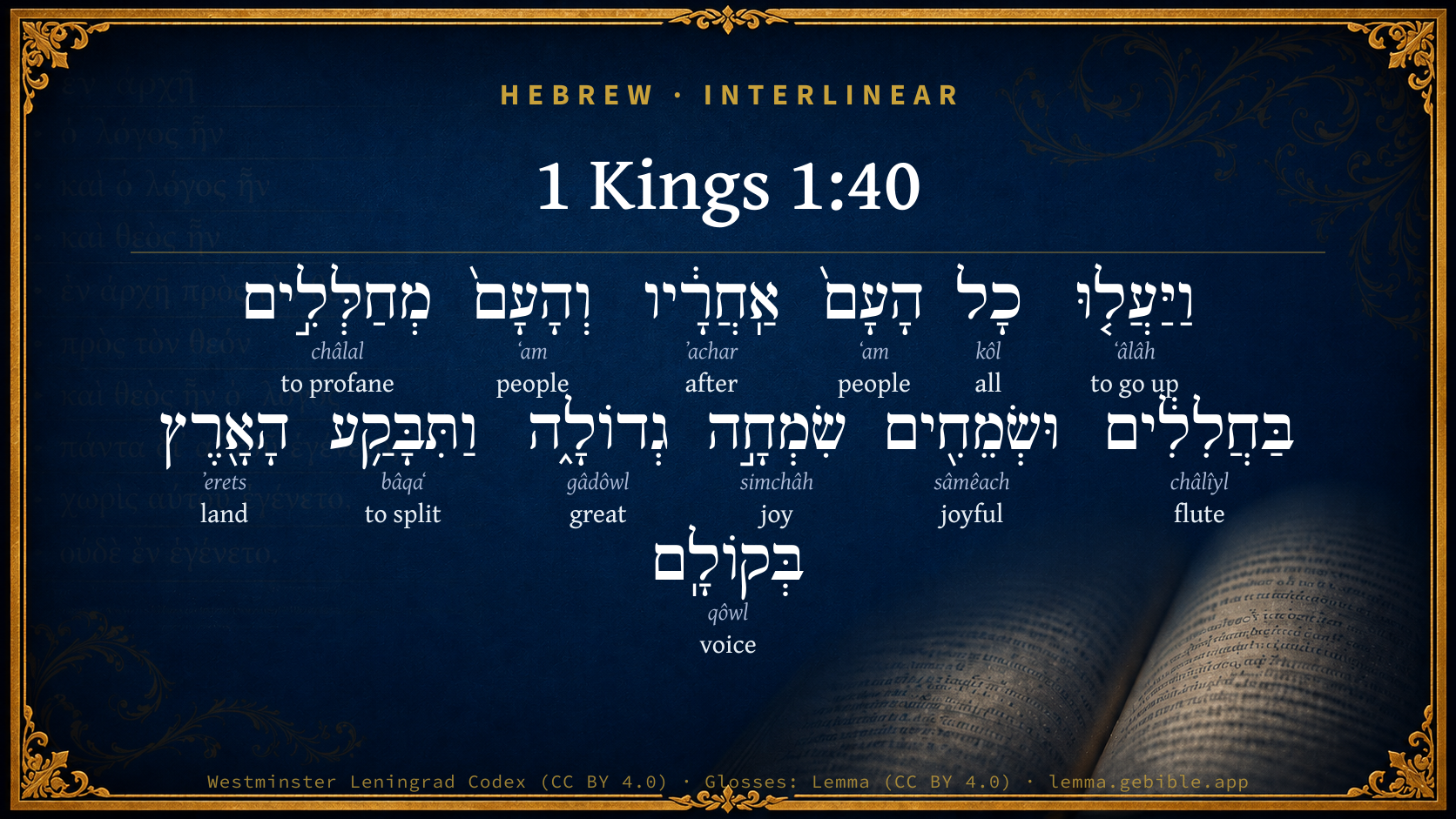
Hebrew (Westminster Leningrad Codex) 1 Kings 1:40 appears in the Hebrew Old Testament. The text above is from the Westminster Leningrad Codex. Each word links to its Strong’s number, a concise gloss, and parsing drawn from the Open Scriptures Hebrew Bible morphology. Click any word for its full Brown-Driver-Briggs (BDB) entry.
Download image
Cite this verse

1 Kings 1:40 (World English Bible). Public Domain. Lemma interlinear Bible study tool, https://lemma.gebible.app/v/1-kings/1/40.

Show BibTeX & RIS
BibTeX
RIS
English Translation
All the people came up after him, and the people piped with pipes, and rejoiced with great joy, so that the earth shook with the sound of them.
World English Bible · Public Domain
Download a study sheet

One document with this verse’s original text, its word-by-word gloss line, the meaning frame, cross-references with their text, attributed commentary, and full source and license credits — printable, and it pastes into notes with its structure intact.

This verse Autodidact and up

Study sheet (.html) Plain text (.txt)

A passage Seminary Student

Up to 50 verses in one chapter. A passage sheet keeps up to 6 commentary sources and 12 cross-references per verse, in the order this page ranks them, and says so on the sheet whenever that leaves anything out. Ask for a single verse and you get the Autodidact verse sheet above.

Everything on this page stays free to read, with no account — the sheet is a download of what is already on screen, not access to it.

Want to remove ads? Support Godless Engineer
Compare translations 3

The same verse in 3 English versions, stacked beneath the original-language interlinear above. Click any original word for its lexicon entry.

Each is an independent rendering of the whole verse — the interlinear is not word-aligned to these translations.

Highlighted words mark where these versions differ — a whole-verse word diff, not a word-by-word alignment.

  • World English Bible Public Domain
    All the people came up after him, and the people piped with pipes, and rejoiced with great joy, so that the earth shook with the sound of them.
  • King James Version Public Domain
    And all the people came up after him, and the people piped with pipes, and rejoiced with great joy, so that the earth rent with the sound of them.
  • unfoldingWord Literal Text CC BY-SA 4.0
    Then all of the people went up after him. And the people were piping with pipes and rejoicing a great rejoicing. And the earth was split by their sound.

unfoldingWord Literal Text — © unfoldingWord, licensed CC BY-SA 4.0. Word-aligned USFM3 via Door43 (git.door43.org/unfoldingWord/en_ult).

Versions to compare (up to 4)

3 of 4 selected

Show all 18 translations

Every available English version of this verse, each an independent rendering of the whole verse.

  • World English Bible Public Domain
    All the people came up after him, and the people piped with pipes, and rejoiced with great joy, so that the earth shook with the sound of them.
  • Berean Standard Bible Public Domain
    All the people followed him, playing flutes and rejoicing with such a great joy that the earth was split by the sound.
  • Majority Standard Bible Public Domain
    All the people followed him, playing flutes and rejoicing with such a great joy that the earth was split by the sound.
  • King James Version Public Domain
    And all the people came up after him, and the people piped with pipes, and rejoiced with great joy, so that the earth rent with the sound of them.
  • American Standard Version (1901) Public Domain
    And all the people came up after him, and the people piped with pipes, and rejoiced with great joy, so that the earth rent with the sound of them.
  • Revised Version (1885) Public Domain
    And all the people came up after him, and the people piped with pipes, and rejoiced with great joy, so that the earth rent with the sound of them.
  • Geneva Bible (1599) Public Domain
    And all the people came vp after him, and the people piped with pipes, and reioyced with great ioye, so that the earth rang with the sound of them.
  • Douay-Rheims (1899) Public Domain
    And all the multitude went up after him, and the people played with pipes, and rejoiced with a great joy, and the earth rang with the noise of their cry.
  • Young's Literal Translation Public Domain
    And all the people come up after him, and the people are piping with pipes, and rejoicing -- great joy, and the earth rendeth with their voice.
  • Literal Standard Version CC BY-SA 4.0
    And all the people come up after him, and the people are piping with pipes, and rejoicing [with] great joy, and the earth splits with their voice.
  • Unlocked Literal Bible CC BY-SA 4.0
    Then all the people went up after him, and the people played the flutes and rejoiced with great joy, so that the earth shook with their sound.
  • unfoldingWord Literal Text CC BY-SA 4.0
    Then all of the people went up after him. And the people were piping with pipes and rejoicing a great rejoicing. And the earth was split by their sound.
  • Darby Bible Public Domain
    And all the people came up after him, and the people piped with pipes, and rejoiced with great joy, so that the earth rent with the sound of them.
  • World Messianic Bible Public Domain
    All the people came up after him, and the people piped with pipes, and rejoiced with great joy, so that the earth shook with their sound.
  • Webster's Bible Public Domain
    And all the people came up after him, and the people piped with pipes, and rejoiced with great joy, so that the earth rent with the sound of them.
  • Free Bible Version CC BY-SA 4.0
    Everyone followed him, playing flutes and celebrating so happily that the sound shook the earth.
  • Bible in Basic English Public Domain
    And all the people came up after him, piping with pipes, and they were glad with great joy, so that the earth was shaking with the sound.
  • JPS Tanakh (1917) Public Domain
    And all the people came up after him, and the people piped with pipes, and rejoiced with great joy, so that the earth rent with the sound of them.

Literal Standard Version (2020), Covenant Press — licensed CC BY-SA 4.0. Text via the HelloAO Bible API (eBible.org). Unlocked Literal Bible (unfoldingWord) — licensed CC BY-SA 4.0. Text via the HelloAO Bible API (eBible.org). unfoldingWord Literal Text — © unfoldingWord, licensed CC BY-SA 4.0. Word-aligned USFM3 via Door43 (git.door43.org/unfoldingWord/en_ult). Free Bible Version, Dr. Jonathan Gallagher — licensed CC BY-SA 4.0. Text via the HelloAO Bible API (eBible.org).

Word by word

More ways to search: Search by grammar → Find every occurrence → Compare this word →

Practice this passage: Drill this verse → Learn its vocabulary →

בַּחֲלִלִ֔ים
châlîyl
H2485
“in/at · flutes”
Preposition + Noun, Common, Masculine, Plural, Absolute
Part of Speech
Preposition + Noun
Type
Common
Gender
Masculine
Number
Plural
State
Absolute
Full BDB Definition

Origin: from H2490

TWOT: 660d

pipe, flute
  1. וַיַּעֲל֤וּ ʻâlâh H5927 “and · to go up” Conjunction + Verb, Qal, Sequential Imperfect, 3rd Person, Masculine, Plural
  2. כָל kôl H3605 “all of” Noun, Common, Masculine, Singular, Construct
  3. הָעָם֙ ʻam H5971 “the · people” Particle, Definite Article + Noun, Common, Masculine, Singular, Absolute
  4. אַֽחֲרָ֔יו ʼachar H310 “after · him” Preposition + Suffix, Personal, 3rd Person, Masculine, Singular
  5. וְהָעָם֙ ʻam H5971 “and · the · people” Conjunction + Particle, Definite Article + Noun, Common, Masculine, Singular, Absolute
  6. מְחַלְּלִ֣ים châlal H2490 “profaning” Verb, Piel, Participle Active, Masculine, Plural, Absolute
  7. וּשְׂמֵחִ֖ים sâmêach H8056 “and · joyful” Conjunction + Verb, Qal, Participle Active, Masculine, Plural, Absolute
  8. שִׂמְחָ֣ה simchâh H8057 “joy” Noun, Common, Feminine, Singular, Absolute
  9. גְדוֹלָ֑ה gâdôwl H1419 “great” Adjective, Adjective, Feminine, Singular, Absolute
  10. וַתִּבָּקַ֥ע bâqaʻ H1234 “and · to split” Conjunction + Verb, Niphal, Sequential Imperfect, 3rd Person, Feminine, Singular
  11. הָאָ֖רֶץ ʼerets H776 “the · land” Particle, Definite Article + Noun, Common, Both, Singular, Absolute
  12. בְּקוֹלָֽם qôwl H6963 “in/at · voice · their” Preposition + Noun, Common, Masculine, Singular, Construct + Suffix, Personal, 3rd Person, Masculine, Plural

About this verse

These counts appear in no published source. They are computed here, from the morphology-tagged text and Lemma’s own curated glosses. What Lemma adds →

13
words
12
distinct lemmas
Historical
section

Notable vocabulary

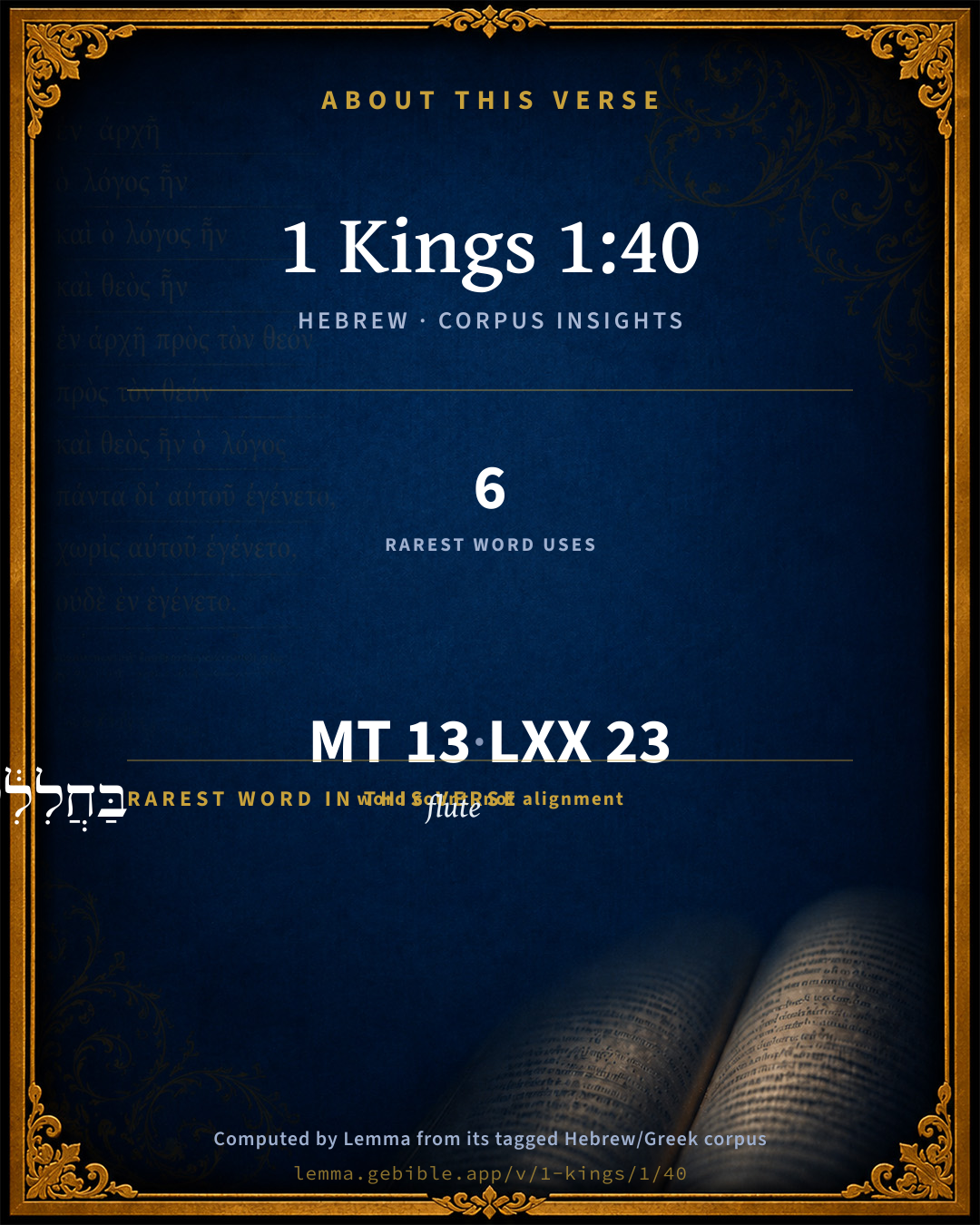
The rarest word here is בַּחֲלִלִ֔ים flute H2485 — appearing just 6 times in the whole Hebrew Bible.

Shared distinctive vocabulary

בַּחֲלִלִ֔ים flute H2485 occurs in 5 verses of the Hebrew Bible. Also found in:

Grammatical profile

  • 4 verbs
  • 7 nouns
  • 1 adjective
  • 1 preposition

Verb forms

  • וַיַּעֲל֤וּ Qal · Sequential Imperfect
  • מְחַלְּלִ֣ים Piel · Participle Active
  • וּשְׂמֵחִ֖ים Qal · Participle Active
  • וַתִּבָּקַ֥ע Niphal · Sequential Imperfect

Repetition

A word recurs within this verse — often emphatic in Hebrew:

  • הָעָם֙ people H5971 ×2

Hebrew & Septuagint length

In English translation the verse runs 28 words from the Hebrew and 25 from the Septuagint (LXX English) — closely comparable.

A rough comparison of the two English renderings, which tokenize alike — not a word-level alignment.

Word counts can differ between the Hebrew and the Greek without any difference in meaning — e.g. the Hebrew direct-object marker אֵת has no separate Greek word, and Greek often adds the article ὁ.

In the original languages it is 13 Hebrew tokens and 23 Greek tokens — but the two are counted differently (Hebrew bundles its prefixes and suffixes into one token; the Greek is in lemma form), so that isn’t a like-for-like length.

Cross-references

9

Topical passages linked to 1 Kings 1:40 in the Treasury of Scripture Knowledge — connected by theme and wording, ordered by reader-vote popularity; previews shown in the World English Bible.

  • 1 Samuel 11:15 All the people went to Gilgal; and there they made Saul king before Yahweh in Gilgal; and there they offered sacrifices of peace-offerings before Yahweh; and there Saul and all the men of Israel rejoiced greatly.
  • 2 Kings 11:14 and she looked, and, behold, the king stood by the pillar, as the manner was, and the captains and the trumpets by the king; and all the people of the land rejoiced, and blew trumpets. Then Athaliah tore her clothes, and cried, Treason! treason!
  • 2 Kings 11:20 So all the people of the land rejoiced, and the city was quiet. Athaliah they had slain with the sword at the king's house.
  • 1 Chronicles 12:38–40 All these being men of war, who could order the battle array, came with a perfect heart to Hebron, to make David king over all Israel: and all the rest also of Israel were of one heart to make David king.
  • Psalms 97:1 Yahweh reigns! Let the earth rejoice! Let the multitude of islands be glad!
  • Daniel 3:5 that whenever you hear the sound of the horn, flute, zither, lyre, harp, pipe, and all kinds of music, you fall down and worship the golden image that Nebuchadnezzar the king has set up;
  • Zechariah 9:9 Rejoice greatly, daughter of Zion! Shout, daughter of Jerusalem! Behold, your king comes to you! He is righteous, and having salvation; Lowly, and riding on a donkey, Even on a colt, the foal of a donkey.
  • Luke 19:37 As he was now getting near, at the descent of the Mount of Olives, the whole multitude of the disciples began to rejoice and praise God with a loud voice for all the mighty works which they had seen,
  • Revelation 11:15–18 The seventh angel sounded, and great voices in heaven followed, saying, "The kingdom of the world has become the Kingdom of our Lord, and of his Christ. He will reign forever and ever!"

Cross-references courtesy of OpenBible.info (CC BY 4.0).

Hebrew and Greek witnesses Masoretic Hebrew ↔ Greek Septuagint

The same verse in the two great witnesses to the Old Testament, shown verse-for-verse.

These are two independent witnesses, not word-aligned to each other, and the Septuagint is shown in lemma (dictionary) form.

Hebrew 1 Kings 1:40 Masoretic · Westminster Leningrad Codex

וַיַּעֲל֤וּ כָל הָעָם֙ אַֽחֲרָ֔יו וְהָעָם֙ מְחַלְּלִ֣ים בַּחֲלִלִ֔ים וּשְׂמֵחִ֖ים שִׂמְחָ֣ה גְדוֹלָ֑ה וַתִּבָּקַ֥ע הָאָ֖רֶץ בְּקוֹלָֽם

All the people came up after him, and the people piped with pipes, and rejoiced with great joy, so that the earth shook with the sound of them.

World English Bible · Public Domain

Greek LXX 1 Kings 1:40 Septuagint · lemma form

καί ἀναβαίνω πᾶς ὁ λαός ὀπίσω αὐτός καί χορεύω ἐν χορός καί εὐφραίνω εὐφροσύνη μέγας καί ῥήγνυμι ὁ γῆ ἐν ὁ φωνή αὐτός

And all the people went up after him, and they danced in choirs, and rejoiced with great joy, and the earth quaked with their voice.

LXX2012 (modern English Septuagint) · Public Domain

On this verse, The Cambridge Bible for Schools and Colleges discusses the Septuagint’s reading. Read the note in Commentary ↓

Hebrew: Westminster Leningrad Codex (CC BY 4.0). Greek: Septuagint (public domain); English from LXX2012 (modern English Septuagint) (Public Domain). How the Septuagint differs from the Hebrew →

Targum (Aramaic paraphrase)

1

The Targum is the ancient Jewish Aramaic paraphrase of the Hebrew Scriptures — an interpretive translation, not the Hebrew text itself. Onkelos (literal) and Pseudo-Jonathan (expansive) render the Torah, and Jonathan the Prophets. Coverage is partial: where no permissively-licensed English translation exists for a verse, only the Aramaic is shown. This is verse-level text, not a word-by-word alignment to the Hebrew.

  1. Targum Jonathan Prophets (Joshua–Malachi)
    וּסְלִיקוּ כָל עַמָא בַּתְרוֹהִי וְעַמָא מְשַׁבְּחִין בְּחִנְגַיָא וְחָדָן חֶדְוָא רַבָּא וְזָעַת אַרְעָא לְקַלְהוֹן:

    (no public-domain English translation for this verse)

    Targum Jonathan — Aramaic: “Mikraot Gedolot” (public domain). English: “Sefaria Community Translation” (CC0 1.0 (public-domain dedication)); “London "Chaldee Paraphrase," 1871” (public domain). Text via Sefaria.

Commentary

Notes on 1 Kings 1:40 from classic Christian and Jewish commentators (each source and its license shown beneath its notes). The classic Christian expositions comment on the surrounding passage and are grouped to its opening verse, so a note may address several verses; the Jewish commentaries on the Tanakh (Rashi and others) are per-verse, so they appear only where the commentator wrote on this verse.

Lemma curates 59 commentaries, every one of them public domain or Creative Commons licensed, each selected and text-cleaned for this edition rather than reprinted as found. About our sources →

Trapp's Complete Commentary

John Trapp

1Ki 1:40 And all the people came up after him, and the people piped with pipes, and rejoiced with great joy, so that the earth rent with the sound of them.

Ver. 40. Piped with pipes.] Or, Flutes; that Adonijah’s party might hear and be startled with those noises, which at once proclaimed Solomon’s triumph, and their confusion.

And rejoiced with great joy.] By the special operation of God’s Spirit, {see 1Ch 12:40} and to shadow forth the great joy which the saints should take in the kingdom of Christ. {Zec 9:9}

So that the earth rent.] After a sort, with their loud acclamations, Hyperbole sumpta a fragoris similitudine.

John Trapp, A Commentary or Exposition upon All the Books of the Old and New Testament (1647–1656) — public domain. Text from a community e-Sword module.

Tyndale Open Study Notes

Tyndale Open Resources

1:40-41 Those attending Adonijah’s banquet at En-rogel could not see the celebration, but it was so joyously noisy that they could hear it.

Tyndale Open Study Notes — © Tyndale Open Resources, licensed CC BY-SA 4.0. Text via the HelloAO Bible API.

Geneva Bible (1599)

Geneva Bible translators

Hebrew, brake.

Geneva Bible (1599) marginal notes — public domain. Text via Bolls.life.

Jamieson, Fausset & Brown

Robert Jamieson, A. R. Fausset & David Brown

all the people came up after him--that is, from the valley to the citadel of Zion.

Jamieson, Fausset & Brown — Commentary Critical and Explanatory on the Whole Bible (1871) — public domain (CC PDM 1.0). Text via the HelloAO Bible API.

Adam Clarke's Commentary

Verse 40. The people piped with pipes] They danced, sang, and played on what instruments of music they possessed.

The earth rent] We use a similar expression in precisely the same sense: They rent the air with their cries.

Adam Clarke's Commentary on the Bible (1810–1826) — public domain. Text from a community e-Sword/MySword module.

Ellicott's Commentary for English Readers

(40) Piped with pipes.—The Greek Version has “danced in dances,” by a slight variation of reading. The graphic description of the acclamation of the people indicates something more than conventional loyalty. The attempt of Adonijah relied on the support only of the great men, and perhaps the army, but had no popular following.

A Bible Commentary for English Readers, edited by Charles John Ellicott (1878–1897) — public domain. Text from a community e-Sword module.

The Cambridge Bible for Schools and Colleges

gen. ed. J. J. S. Perowne

40. piped with pipes] The LXX. adopting some slight alteration of the Hebrew, renders ‘danced in dances.’ And Josephus speaks of the people (Antiq. vii. 14, 5) as ‘dancing and playing on pipes’; thus shewing a desire to combine both readings. That the Israelites were likely to have pipes on such an occasion seems probable from 1Sa_10:5, where they are enumerated among the instruments used by the company of prophets.

rent with the sound] The Hebrew text implies ‘cleaving asunder’ and must, if correct, be taken as hyperbolic: that it is correct seems clear from the LXX. which has ‘was broken asunder’ (ἐῤῥάγη), though a slight change in the letters of the Hebrew (reading תקע for בקע) would give the meaning which the Vulgate has, ‘insonuit,’ i.e. resounded. Josephus appears thus to have understood the phrase, whatever reading he had, for he writes ‘from the multitude of the instruments all the earth and the air resounded.’

The Cambridge Bible for Schools and Colleges (gen. ed. J. J. S. Perowne; Cambridge University Press, 1878–1918) — public domain. Text from a community e-Sword module.

John Gill's Exposition

And all the people came up after him,.... Following him from the fountain to the city, with their loud acclamations:

and the people piped with pipes; which were hollow instruments, and full of holes which they blew with their mouths, and upon with their fingers; Jarchi says they were and very probably:

and rejoiced with great joy; which they expressed by such loud shouts:

so that the earth rent with the sound thereof; an hyperbolical expression, showing the great numbers gathered together on this occasion, and the sonorous acclamations they made.

John Gill's Exposition of the Whole Bible (1746–1763) — public domain (CC PDM 1.0). Text via the HelloAO Bible API.

Albert Barnes' Notes on the Bible

Piped with pipes - Some prefer “danced with dances” - a meaning which the Hebrew would give by a change in the pointing, and the alteration of one letter. But the change is unnecessary. (Flutepipes were known to the Israelites 1Sa 10:5; they were very ancient in Egypt, and were known also to the Assyrians.

The earth rent - If the present Hebrew text is correct we have here a strong instance of Oriental hyperbole. But it is suspected that there is a slight corruption, and that the verb really used meant “resounded.”

Albert Barnes' Notes on the Bible (1834–1885) — public domain. Text from a community e-Sword/MySword module.

Haydock's Catholic Bible Commentary

Rang. Hebrew, "was split." Chaldean, "shook." (Menochius)

George Leo Haydock (1774–1849), Haydock's Catholic Family Bible and Commentary, 1859 edition — public domain. Excludes Psalms (Douay-Rheims chapter numbering differs from Protestant) and Deuterocanonical books (Catholic canon only).

Matthew Poole's English Annotations

All the people came up after him; which flocked in of so thither abundance; some out of curiosity to see so solemn an action; others to do their duty; and others in expectation some advantage by their cheerful attendance upon the new king.

Rejoiced with great joy; partly because this would certainly prevent civil wars, under which they had lately and so sorely groaned, and which they had reason to fear from Adonijah’s pretence to the crown, and the assistance he might have from the great and famous lord-general Joab, and from Abiathar the high priest, and from others who were or might easily be engaged for him, if David had not ended the controversy in his lifetime; and partly because of the singular wisdom and virtue for which Solomon was even then famous. See 1Ki 2:6,9. The earth rent; an hyperbolical expression; yet even solid bodies have been oft broken and rent by great sounds.

Matthew Poole's English Annotations on the Holy Bible (1683–1685) — public domain. Text from a community e-Sword/MySword module.

Whedon's Commentary on the Bible

Daniel D. Whedon

40. Pipes — See note and cuts on 1Sa_10:5.

The earth rent with the sound — A hyperbolical expression to indicate the boundless joyfulness of the people on that occasion. From many facts recorded in the last half of the Second Book of Samuel it is not difficult to infer that the closing years of David’s reign were not popular in Israel. The growing infirmities of age prevented his appearing any more among the people; and though he held a large place in the nation’s heart, his voluntary resignation of the crown to Solomon, who had doubtless, by reason of his many amiable qualities, already become endeared to all who knew him, and the enthronization of that youthful prince, were an occasion of great rejoicings throughout the royal city. It was also a matter of rejoicing that there was no violent break in the succession. David enthrones Solomon by his own proclamation, so that, as Wordsworth beautifully says, “Solomon’s reign is to be regarded as a continuation of the reign of David his father. David’s reign did not end with David’s life, but it flowed on in the life of Solomon his son, for which it was a preparation. Thus the union of David and Solomon, as forming by their conjunction a typical representation of CHRIST, the king of the spiritual Zion, as a conqueror like David, and yet as the prince of peace like Solomon, is made more manifest.” So in the harmony of the Divine dispensations the kingdom of Israel was continued, and is perpetuated in the more glorious kingdom of the Messiah.

Daniel D. Whedon (gen. ed.), Commentary on the Old and New Testaments (1874–1909) — public domain. Text from a community e-Sword module.

The Pulpit Commentary

And all the people came up after him same expression as ver. 35. The procession, the sound of the trumpets, etc., had collected a large crowd, which followed Solomon on his return, and the people piped Hebrews were piping with pipes pipes or flutes were used on occasions of rejoicing (Isa_5:12 Isa_30:29. Cf., 1Sa_10:5) and so of mourning. (Jer_48:36; Mat_9:23) It is true that a very slight change ( pyliljom instead of will give the meaning, "dancing with dances," which Ewald prefers, on the ground that all the people" could not have produced their pipes at a moment"s notice. But the objection loses its force when it is observed (Rawlinson) that the text implies that only some of the people piped. All the people came up and the people," etc. Besides, even if it were not so, some allowance is surely to be made for Eastern hyperbole. And the received text is to be preferred on other grounds. The LXX, however, has ejcoreuon ejn coroiv, and rejoiced with great joy Hebrews "were rejoicing a great joy", and the earth rent this is certainly a strangly hyperbolical expression. For (Q"b; strictly means to cleave asunder, tear open. (see, e.g., Num_16:31; Amo_1:13; 2Ch_25:12) And Thenius suggests a slight emendation of the text, viz., qTTiw (i.e., " resounded") for qBTiw which would obviate this difficulty. He points out that while the LXX Cod. Vat. has ejrragh, some versions have hchsen, and the Vulg. insonuit. But perhaps it is safer to keep to the lectio ardua with the sound of them Heb. "with their voices".

The Pulpit Commentary (1880–1919), ed. H.D.M. Spence-Jones & Joseph S. Exell — public domain. Text from a community e-Sword module.

Keil & Delitzsch

C. F. Keil & F. Delitzsch

All the people, i.e., the crowd which was present at the anointing, went up after him, i.e., accompanied Solomon to the citadel of Zion, with flutes and loud acclamation, so that the earth nearly burst with their shouting. תּבּקע, "to burst in pieces" (as in Ch2 25:12), is a hyperbolical expression for quaking.

Keil & Delitzsch — Biblical Commentary on the Old Testament (1861–1891) — public domain (CC PDM 1.0). Text via the HelloAO Bible API. (Old Testament only.)

Rashi

Rabbi Shlomo Yitzchaki (Rashi)

The flutes. Flute in O.F.

And the earth [seemed to] split. Prophets spoke in terms of exaggeration as [is common] among people.

Rashi on the Tanakh — English translations: “The Judaica Press complete Tanach with Rashi, translated by A. J. Rosenberg” (CC BY 4.0); “Pentateuch with Rashi's commentary by M. Rosenbaum and A.M. Silbermann, 1929-1934” (public domain); “The Metsudah Tanach series, Lakewood, N.J” (CC BY 4.0); and “The Book of Joshua, Metsudah Publications, 1997” (CC BY 4.0). Text via Sefaria.

Lesson kit

Teaching starters — assembled from the data on this page, not authored interpretation. Every prompt links to the verse data it draws on. Edit before teaching.

1 Kings, in the Historical, opens this verse with 13 words (12 distinct Hebrew lemmas). Its most distinctive word is châlîyl (“flute”). A historical commentator’s framing appears above. Read the whole chapter for the surrounding context.

Discussion questions

  1. The word châlîyl carries the sense “flute.” How does it shape the verse?
  2. 1 Samuel 10:5 shares the word «flute» with this verse. How do the two illuminate each other?
  3. “people” occurs 2× in this one verse. What is the effect of the repetition?
  4. These translations render this verse differently. What is at stake in choosing one wording over another?
  5. The verb «וַיַּעֲל֤וּ» is Qal Sequential Imperfect. How does its form color the action?
  6. Reading how Trapp's Complete Commentary and Tyndale Open Study Notes read this verse, where do the two commentators agree and where do they part?

Things to notice

Reading settings

Reading text

Shown beneath each verse's original-language words.

Old Testament
Old Testament edition

Read the OT as the Masoretic Hebrew (MT) or the Greek Septuagint (LXX).

English shown for the Greek Septuagint (in the Hebrew ↔ Greek comparison).

Comparing translations? Open the Compare panel on any verse page to stack up to four side by side.