
Genesis 50:24

Hebrew (Westminster Leningrad Codex) Genesis 50:24 appears in the Hebrew Old Testament. The text above is from the Westminster Leningrad Codex. Each word links to its Strong’s number, a concise gloss, and parsing drawn from the Open Scriptures Hebrew Bible morphology. Click any word for its full Brown-Driver-Briggs (BDB) entry.
Download image
Cite this verse

Genesis 50:24 (World English Bible). Public Domain. Lemma interlinear Bible study tool, https://lemma.gebible.app/v/genesis/50/24.

Show BibTeX & RIS
BibTeX
RIS
English Translation
Joseph said to his brothers, "I am dying, but God will surely visit you, and bring you up out of this land to the land which he swore to Abraham, to Isaac, and to Jacob."
World English Bible · Public Domain
Download a study sheet

One document with this verse’s original text, its word-by-word gloss line, the meaning frame, cross-references with their text, attributed commentary, and full source and license credits — printable, and it pastes into notes with its structure intact.

This verse Autodidact and up

Study sheet (.html) Plain text (.txt)

A passage Seminary Student

Up to 50 verses in one chapter. A passage sheet keeps up to 6 commentary sources and 12 cross-references per verse, in the order this page ranks them, and says so on the sheet whenever that leaves anything out. Ask for a single verse and you get the Autodidact verse sheet above.

Everything on this page stays free to read, with no account — the sheet is a download of what is already on screen, not access to it.

Want to remove ads? Support Godless Engineer
Compare translations 3

The same verse in 3 English versions, stacked beneath the original-language interlinear above. Click any original word for its lexicon entry.

Each is an independent rendering of the whole verse — the interlinear is not word-aligned to these translations.

Highlighted words mark where these versions differ — a whole-verse word diff, not a word-by-word alignment.

  • World English Bible Public Domain
    Joseph said to his brothers, "I am dying, but God will surely visit you, and bring you up out of this land to the land which he swore to Abraham, to Isaac, and to Jacob."
  • King James Version Public Domain
    And Joseph said unto his brethren, I die: and God will surely visit you, and bring you out of this land unto the land which he sware to Abraham, to Isaac, and to Jacob.
  • unfoldingWord Literal Text CC BY-SA 4.0
    Then Joseph said to his brothers, “I am dying, and God will surely visit you and take you up from this land to the land that he swore to Abraham, to Isaac, and to Jacob.”

unfoldingWord Literal Text — © unfoldingWord, licensed CC BY-SA 4.0. Word-aligned USFM3 via Door43 (git.door43.org/unfoldingWord/en_ult).

Versions to compare (up to 4)

3 of 4 selected

Show all 18 translations

Every available English version of this verse, each an independent rendering of the whole verse.

  • World English Bible Public Domain
    Joseph said to his brothers, "I am dying, but God will surely visit you, and bring you up out of this land to the land which he swore to Abraham, to Isaac, and to Jacob."
  • Berean Standard Bible Public Domain
    Then Joseph said to his brothers, “I am about to die, but God will surely visit you and bring you up from this land to the land He promised on oath to Abraham, Isaac, and Jacob.”
  • Majority Standard Bible Public Domain
    Then Joseph said to his brothers, “I am about to die, but God will surely visit you and bring you up from this land to the land He promised on oath to Abraham, Isaac, and Jacob.”
  • King James Version Public Domain
    And Joseph said unto his brethren, I die: and God will surely visit you, and bring you out of this land unto the land which he sware to Abraham, to Isaac, and to Jacob.
  • American Standard Version (1901) Public Domain
    And Joseph said unto his brethren, I die; but God will surely visit you, and bring you up out of this land unto the land which he sware to Abraham, to Isaac, and to Jacob.
  • Revised Version (1885) Public Domain
    And Joseph said unto his brethren, I die: but God will surely visit you, and bring you up out of this land unto the land which he sware to Abraham, to Isaac, and to Jacob.
  • Geneva Bible (1599) Public Domain
    And Ioseph sayd vnto his brethren, I am ready to dye, and God will surely visite you, and bring you out of this land, vnto ye land which hee sware vnto Abraham, vnto Izhak, and vnto Iaakob.
  • Douay-Rheims (1899) Public Domain
    And he made them swear to him, saying: God will visit you, Carry my bones with you out of this place:
  • Young's Literal Translation Public Domain
    And Joseph saith unto his brethren, `I am dying, and God doth certainly inspect you, and hath caused you to go up from this land, unto the land which He hath sworn to Abraham, to Isaac, and to Jacob.'
  • Literal Standard Version CC BY-SA 4.0
    And Joseph says to his brothers, “I am dying, and God certainly inspects you, and has caused you to go up from this land, to the land which He has sworn to Abraham, to Isaac, and to Jacob.”
  • Unlocked Literal Bible CC BY-SA 4.0
    Joseph said to his brothers, “I am about to die; but God will surely come to you and lead you up out of this land to the land which he swore to give to Abraham, to Isaac, and to Jacob.”
  • unfoldingWord Literal Text CC BY-SA 4.0
    Then Joseph said to his brothers, “I am dying, and God will surely visit you and take you up from this land to the land that he swore to Abraham, to Isaac, and to Jacob.”
  • Darby Bible Public Domain
    And Joseph said to his brethren, I die; and God will certainly visit you, and bring you up out of this land, into the land that he swore unto Abraham, to Isaac, and to Jacob.
  • World Messianic Bible Public Domain
    Joseph said to his brothers, “I am dying, but God will surely visit you, and bring you up out of this land to the land which he swore to Abraham, to Isaac, and to Jacob.”
  • Webster's Bible Public Domain
    And Joseph said to his brethren, I die: and God will surely visit you, and bring you out of this land, to the land which he swore to Abraham, to Isaac, and to Jacob.
  • Free Bible Version CC BY-SA 4.0
    “I'm going to die soon,” Joseph told his brothers, “but God will be with you, and he will lead you out of this country to the land that he swore to give to Abraham, Isaac, and Jacob.”
  • Bible in Basic English Public Domain
    Then Joseph said to his brothers, The time of my death has come; but God will keep you in mind and take you out of this land into the land which he gave by his oath to Abraham and Isaac and Jacob.
  • JPS Tanakh (1917) Public Domain
    And Joseph said unto his brethren: 'I die; but God will surely remember you, and bring you up out of this land unto the land which He swore to Abraham, to Isaac, and to Jacob.'

Literal Standard Version (2020), Covenant Press — licensed CC BY-SA 4.0. Text via the HelloAO Bible API (eBible.org). Unlocked Literal Bible (unfoldingWord) — licensed CC BY-SA 4.0. Text via the HelloAO Bible API (eBible.org). unfoldingWord Literal Text — © unfoldingWord, licensed CC BY-SA 4.0. Word-aligned USFM3 via Door43 (git.door43.org/unfoldingWord/en_ult). Free Bible Version, Dr. Jonathan Gallagher — licensed CC BY-SA 4.0. Text via the HelloAO Bible API (eBible.org).

Word by word

More ways to search: Search by grammar → Find every occurrence → Compare this word →

Practice this passage: Drill this verse → Learn its vocabulary →

לְיִצְחָ֖ק
Yitschâq
H3327
“to/for · Isaac”
Preposition + Noun, Proper
Part of Speech
Preposition + Noun
Type
Proper
Full BDB Definition

Origin: from H6711

TWOT: 1905b

Isaac = "he laughs" - son of Abraham by Sarah his wife and father of Jacob and Esau
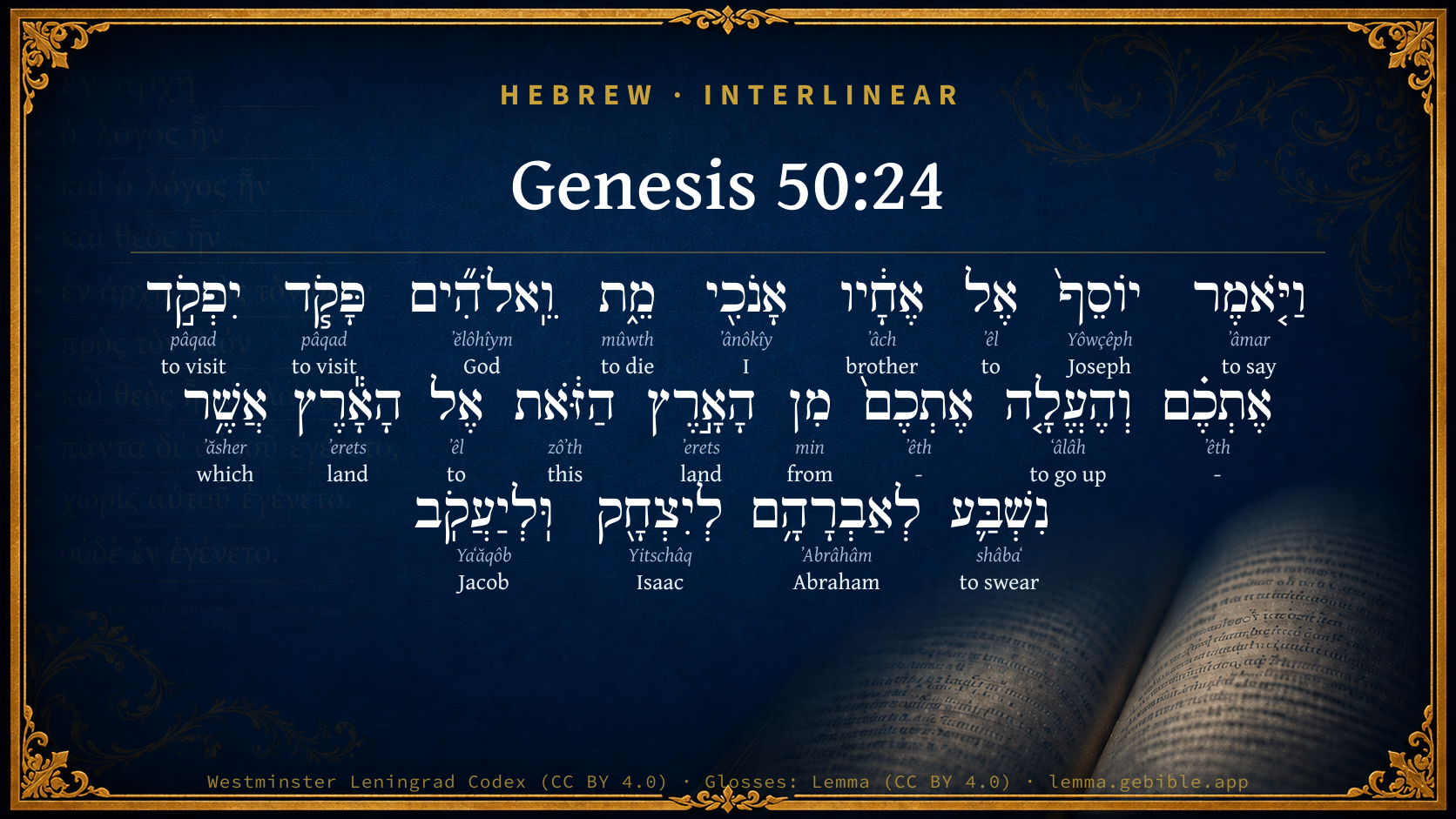
  1. וַיֹּ֤אמֶר ʼâmar H559 “and · to say” Conjunction + Verb, Qal, Sequential Imperfect, 3rd Person, Masculine, Singular
  2. יוֹסֵף֙ Yôwçêph H3130 “Joseph” Noun, Proper
  3. אֶל ʼêl H413 “to” Preposition
  4. אֶחָ֔יו ʼâch H251 “brothers · his” Noun, Common, Masculine, Plural, Construct + Suffix, Personal, 3rd Person, Masculine, Singular
  5. אָנֹכִ֖י ʼânôkîy H595 “I” Pronoun, Personal, 1st Person, Common, Singular
  6. מֵ֑ת mûwth H4191 “dying” Verb, Qal, Participle Active, Masculine, Singular, Absolute
  7. וֵֽאלֹהִ֞ים ʼĕlôhîym H430 “and · God(s)” Conjunction + Noun, Common, Masculine, Plural, Absolute
  8. פָּקֹ֧ד pâqad H6485 “to visit” Verb, Qal, Infinitive Absolute
  9. יִפְקֹ֣ד pâqad H6485 “to visit” Verb, Qal, Imperfect, 3rd Person, Masculine, Singular
  10. אֶתְכֶ֗ם ʼêth H853 “- · you” Particle, Direct Object + Suffix, Personal, 2nd Person, Masculine, Plural
  11. וְהֶעֱלָ֤ה ʻâlâh H5927 “and · to go up” Conjunction + Verb, Hiphil, Sequential Perfect, 3rd Person, Masculine, Singular
  12. אֶתְכֶם֙ ʼêth H853 “- · you” Particle, Direct Object + Suffix, Personal, 2nd Person, Masculine, Plural
  13. מִן min H4480 “from” Preposition
  14. הָאָ֣רֶץ ʼerets H776 “the · land” Particle, Definite Article + Noun, Common, Both, Singular, Absolute
  15. הַזֹּ֔את zôʼth H2063 “the · this” Particle, Definite Article + Pronoun, Demonstrative, Feminine, Singular
  16. אֶל ʼêl H413 “to” Preposition
  17. הָאָ֕רֶץ ʼerets H776 “the · land” Particle, Definite Article + Noun, Common, Both, Singular, Absolute
  18. אֲשֶׁ֥ר ʼăsher H834 “which” Particle, Relative
  19. נִשְׁבַּ֛ע shâbaʻ H7650 “to swear” Verb, Niphal, Perfect, 3rd Person, Masculine, Singular
  20. לְאַבְרָהָ֥ם ʼAbrâhâm H85 “to/for · Abraham” Preposition + Noun, Proper
  21. וּֽלְיַעֲקֹֽב Yaʻăqôb H3290 “and · to/for · Jacob” Conjunction + Preposition + Noun, Proper

About this verse

These counts appear in no published source. They are computed here, from the morphology-tagged text and Lemma’s own curated glosses. What Lemma adds →

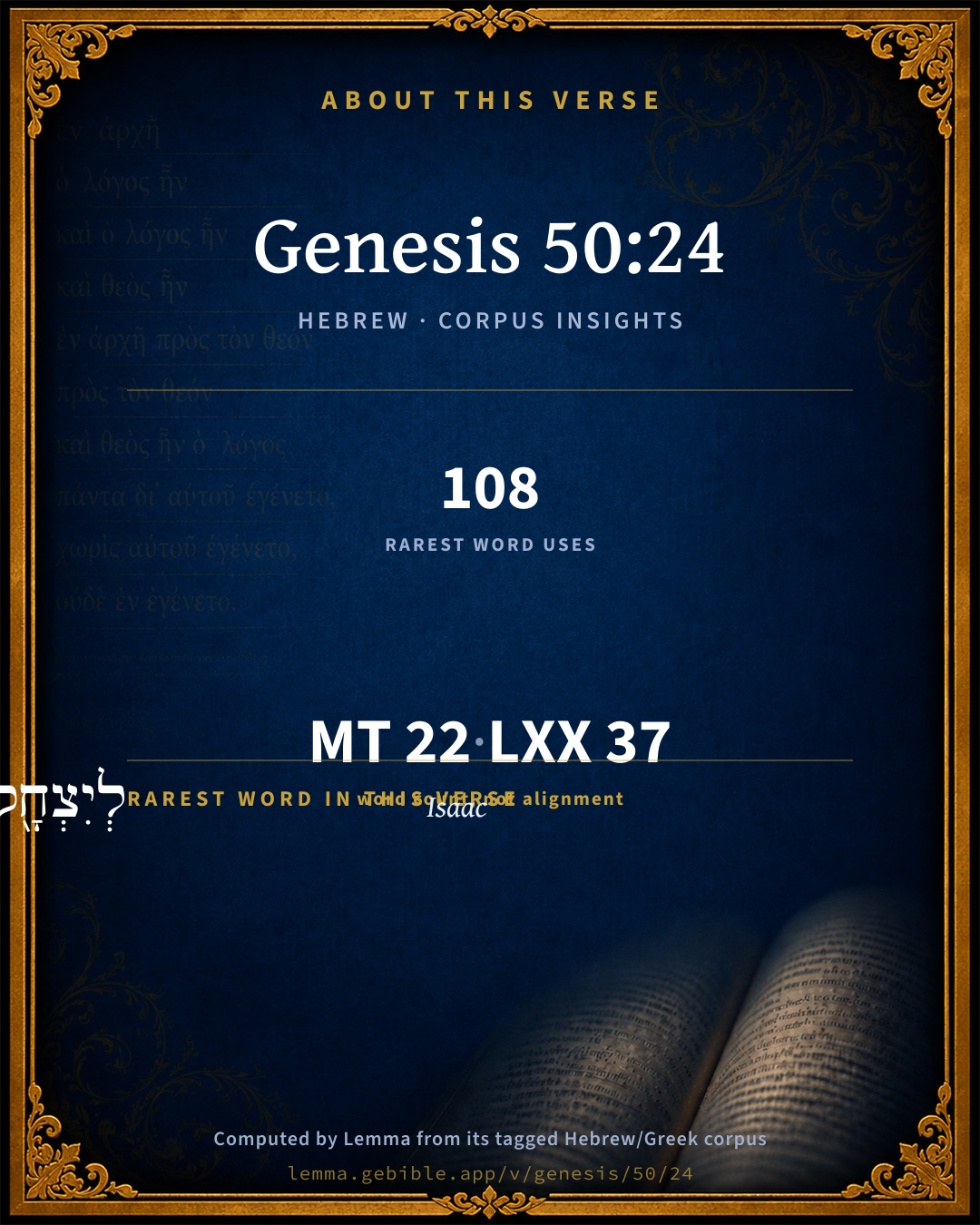
22
words
18
distinct lemmas
Pentateuch
section

Grammatical profile

  • 6 verbs
  • 8 nouns
  • 2 pronouns
  • 3 prepositions
  • 3 particles

Verb forms

  • וַיֹּ֤אמֶר Qal · Sequential Imperfect
  • מֵ֑ת Qal · Participle Active
  • פָּקֹ֧ד Qal · Infinitive Absolute
  • יִפְקֹ֣ד Qal · Imperfect
  • וְהֶעֱלָ֤ה Hiphil · Sequential Perfect
  • נִשְׁבַּ֛ע Niphal · Perfect

Repetition

Words recur within this verse — often emphatic in Hebrew:

  • פָּקֹ֧ד to visit H6485 ×2
  • הָאָ֣רֶץ land H776 ×2
  • אֶל to H413 ×2

Hebrew & Septuagint length

In English translation the verse runs 35 words from the Hebrew and 37 from the Septuagint (LXX English) — closely comparable.

A rough comparison of the two English renderings, which tokenize alike — not a word-level alignment.

Word counts can differ between the Hebrew and the Greek without any difference in meaning — e.g. the Hebrew direct-object marker אֵת has no separate Greek word, and Greek often adds the article ὁ.

In the original languages it is 22 Hebrew tokens and 37 Greek tokens — but the two are counted differently (Hebrew bundles its prefixes and suffixes into one token; the Greek is in lemma form), so that isn’t a like-for-like length.

Cross-references

27

Topical passages linked to Genesis 50:24 in the Treasury of Scripture Knowledge — connected by theme and wording, ordered by reader-vote popularity; previews shown in the World English Bible.

  • Exodus 3:16–17 Go, and gather the elders of Israel together, and tell them, 'Yahweh, the God of your fathers, the God of Abraham, of Isaac, and of Jacob, has appeared to me, saying, "I have surely visited you, and seen that which is done to you in Egypt;
  • Genesis 26:3 Sojourn in this land, and I will be with you, and will bless you. For to you, and to your seed, I will give all these lands, and I will establish the oath which I swore to Abraham your father.
  • Genesis 35:12 The land which I gave to Abraham and Isaac, I will give it to you, and to your seed after you will I give the land."
  • Genesis 28:13 Behold, Yahweh stood above it, and said, "I am Yahweh, the God of Abraham your father, and the God of Isaac. The land whereon you lie, to you will I give it, and to your seed.
  • Genesis 46:4 I will go down with you into Egypt. I will also surely bring you up again. Joseph will close your eyes."
  • Genesis 48:21 Israel said to Joseph, "Behold, I am dying, but God will be with you, and bring you again to the land of your fathers.
  • Genesis 13:17 Arise, walk through the land in the length of it and in the breadth of it; for I will give it to you."
  • Genesis 15:18 In that day Yahweh made a covenant with Abram, saying, "To your seed have I given this land, from the river of Egypt to the great river, the river Euphrates:
  • Genesis 13:15 for all the land which you see, I will give to you, and to your offspring forever.
  • Genesis 15:7 He said to him, "I am Yahweh who brought you out of Ur of the Chaldees, to give you this land to inherit it."
  • Genesis 15:14–16 I will also judge that nation, whom they will serve. Afterward they will come out with great substance.
  • Genesis 12:7 Yahweh appeared to Abram, and said, "I will give this land to your seed." He built an altar there to Yahweh, who appeared to him.
  • Hebrews 11:22 By faith, Joseph, when his end was near, made mention of the departure of the children of Israel; and gave instructions concerning his bones.
  • Genesis 3:19 By the sweat of your face will you eat bread until you return to the ground, for out of it you were taken. For you are dust, and to dust you shall return."
  • Genesis 17:8 I will give to you, and to your seed after you, the land where you are traveling, all the land of Canaan, for an everlasting possession. I will be their God."
  • Genesis 21:1 Yahweh visited Sarah as he had said, and Yahweh did to Sarah as he had spoken.
  • Genesis 50:5 'My father made me swear, saying, "Behold, I am dying. Bury me in my grave which I have dug for myself in the land of Canaan." Now therefore, please let me go up and bury my father, and I will come again.'"
  • Exodus 4:31 The people believed, and when they heard that Yahweh had visited the children of Israel, and that he had seen their affliction, then they bowed their heads and worshiped.
  • Exodus 33:1 Yahweh spoke to Moses, "Depart, go up from here, you and the people that you have brought up out of the land of Egypt, to the land of which I swore to Abraham, to Isaac, and to Jacob, saying, 'I will give it to your seed.'
  • Numbers 32:11 Surely none of the men who came up out of Egypt, from twenty years old and upward, shall see the land which I swore to Abraham, to Isaac, and to Jacob; because they have not wholly followed me:
  • Deuteronomy 1:8 Behold, I have set the land before you: go in and possess the land which Yahweh swore to your fathers, to Abraham, to Isaac, and to Jacob, to give to them and to their seed after them.
  • Deuteronomy 6:10 It shall be, when Yahweh your God shall bring you into the land which he swore to your fathers, to Abraham, to Isaac, and to Jacob, to give you, great and goodly cities, which you didn't build,
  • Job 30:23 For I know that you will bring me to death, To the house appointed for all living.
  • Ecclesiastes 12:5 Yes, they shall be afraid of heights, And terrors will be in the way; And the almond tree shall blossom, And the grasshopper shall be a burden, And desire shall fail; Because man goes to his everlasting home, And the mourners go about the streets:
  • Ecclesiastes 12:7 And the dust returns to the earth as it was, And the spirit returns to God who gave it.
  • Romans 5:12 Therefore, as sin entered into the world through one man, and death through sin; and so death passed to all men, because all sinned.
  • Hebrews 9:27 Inasmuch as it is appointed for men to die once, and after this, judgment,

Cross-references courtesy of OpenBible.info (CC BY 4.0).

Hebrew and Greek witnesses Masoretic Hebrew ↔ Greek Septuagint

The same verse in the two great witnesses to the Old Testament, shown verse-for-verse.

These are two independent witnesses, not word-aligned to each other, and the Septuagint is shown in lemma (dictionary) form.

Hebrew Genesis 50:24 Masoretic · Westminster Leningrad Codex

וַיֹּ֤אמֶר יוֹסֵף֙ אֶל אֶחָ֔יו אָנֹכִ֖י מֵ֑ת וֵֽאלֹהִ֞ים פָּקֹ֧ד יִפְקֹ֣ד אֶתְכֶ֗ם וְהֶעֱלָ֤ה אֶתְכֶם֙ מִן הָאָ֣רֶץ הַזֹּ֔את אֶל הָאָ֕רֶץ אֲשֶׁ֥ר נִשְׁבַּ֛ע לְאַבְרָהָ֥ם לְיִצְחָ֖ק וּֽלְיַעֲקֹֽב

Joseph said to his brothers, "I am dying, but God will surely visit you, and bring you up out of this land to the land which he swore to Abraham, to Isaac, and to Jacob."

World English Bible · Public Domain

Greek LXX Genesis 50:24 Septuagint · lemma form

καί εἶπον ιωσηφ ὁ ἀδελφός αὐτός λέγω ἐγώ ἀποθνήσκω ἐπισκοπή δέ ἐπισκέπτομαι σύ ὁ θεός καί ἀναἄγω σύ ἐκ ὁ γῆ οὗτος εἰς ὁ γῆ ὅς ὄμνυμι ὁ θεός ὁ πατήρ ἐγώ αβρααμ καί ισαακ καί ἰακώβ

And Joseph spoke to his brethren, saying, I die, and God will surely visit you, and will bring you out of this land to the land concerning which God swore to our fathers, Abraam, Isaac, and Jacob.

LXX2012 (modern English Septuagint) · Public Domain

Hebrew: Westminster Leningrad Codex (CC BY 4.0). Greek: Septuagint (public domain); English from LXX2012 (modern English Septuagint) (Public Domain). How the Septuagint differs from the Hebrew →

Targum (Aramaic paraphrase)

2

The Targum is the ancient Jewish Aramaic paraphrase of the Hebrew Scriptures — an interpretive translation, not the Hebrew text itself. Onkelos (literal) and Pseudo-Jonathan (expansive) render the Torah, and Jonathan the Prophets. Coverage is partial: where no permissively-licensed English translation exists for a verse, only the Aramaic is shown. This is verse-level text, not a word-by-word alignment to the Hebrew.

  1. Targum Onkelos Torah (Genesis–Deuteronomy)
    וַאֲמַר יוֹסֵף לַאֲחוֹהִי אֲנָא מָאִית וַיְיָ מִדְכַּר דְּכִיר יָתְכוֹן וְיִסַק יָתְכוֹן מִן אַרְעָא הָדָא לְאַרְעָא דִי קַיִים לְאַבְרָהָם לְיִצְחָק וּלְיַעֲקֹב

    (no public-domain English translation for this verse)

    Targum Onkelos — Aramaic: “Onkelos Genesis” (public domain); “Onkelos Exodus” (public domain); “Onkelos Leviticus” (public domain); “Onkelos Numbers” (public domain); “Onkelos Deuteronomy” (public domain). English: “Sefaria Community Translation” (CC0 1.0 (public-domain dedication)); “J.W. Etheridge. The Targums of Onkelos and Jonathan Ben Uzziel on the Pentateuch. London: Longmans, Green, 1862” (public domain). Text via Sefaria.

  2. Targum Pseudo-Jonathan Torah (Genesis–Deuteronomy)
    וַאֲמַר יוֹסֵף לְאָחוֹי הָא אֲנָא מָיִת וַיְיָ מִידְכַּר יִדְכַּר יַתְכוֹן וְיִסַק יַתְכוֹן מִן אַרְעָא הָדָא לְאַרְעָא דְקַיֵים לְאַבְרָהָם לְיִצְחָק וּלְיַעֲקב

    And Joseph said to his Brethren Behold, I die; but the Lord remembering will remember you and will bring you up from this land, into the land which He sware to Abraham, to Izhak, and to Jakob.

    Targum Pseudo-Jonathan — Aramaic: “Targum Jonathan on Genesis” (public domain); “Targum Jonathan on Exodus” (public domain); “Targum Jonathan on Leviticus” (public domain); “Targum Jonathan on Numbers” (public domain); “Targum Jonathan on Deuteronomy” (public domain). English: “The Targum of Jonathan ben Uzziel, trans. J. W. Etheridge, London, 1862” (public domain). Text via Sefaria.

Commentary

Notes on Genesis 50:24 from classic Christian and Jewish commentators (each source and its license shown beneath its notes). The classic Christian expositions comment on the surrounding passage and are grouped to its opening verse, so a note may address several verses; the Jewish commentaries on the Tanakh (Rashi and others) are per-verse, so they appear only where the commentator wrote on this verse.

Lemma curates 59 commentaries, every one of them public domain or Creative Commons licensed, each selected and text-cleaned for this edition rather than reprinted as found. About our sources →

Trapp's Complete Commentary

John Trapp

Gen 50:24 And Joseph said unto his brethren, I die: and God will surely visit you, and bring you out of this land unto the land which he sware to Abraham, to Isaac, and to Jacob.

Ver. 24. And Joseph said unto his brethren, I die.] A sad saying to them, poor souls. For now began their misery and slavery in Egypt. When Epaminondas died, his whole country died with him; the Thebans were never after known by their victories, but by their overthrows. When Augustus died, the sun seemed to the Romans to fall from heaven: such an alteration presently followed in that state. When Louis XII departed this world, saith Budaeus, {a} he that erewhile seemed to touch heaven with his finger, lay grovelling, as if he had been thunderstruck. All Israel’s prosperity died with Josiah; and so did their liberty and worldly felicity with Joseph. His nephews, the Ephraimites, attempted, before the time, their own deliverance, not long after Joseph’s death, even while their father Ephraim was yet alive, but with ill success, to his great grief and regret. {1Ch 7:22 Psa 78:9} Hasty work seldom ends well: how this of mine will do, I know not, made up, as it might be, in little more than four month’s space, amidst manifold fears and distractions, at spare hours; and bearing date from mine enlargement, July the llth, Anno Dom. 1643, that happy day that saw me both a prisoner and a free man, by the good hand of my God upon me; to whom be glory and praise for ever. As for this my book, made {b} purposely to testify my thankfulness to God, mine Almighty Deliverer, and to those whom he was pleased to use as instruments of my much endeared liberty; such as it is, Eχετε, κρινατε; as he said of his rhetoric: and, if I shall cast in my verdict,

“ Cum relego, scripsisse pudet, quia plurima cerno,

Me quoque, qui [scripsi] iudice, digna lini. ”{ c}

{a} Qui prius digito coelum attingere videbantur, nunc humi de

repente serpere sideratos esse diceres. - Bud.

{b} See mine Epist. Dedicat. set before my Com. on the Four

Evangel.

{c} Ovid., De Pont., eleg. i. 6.

John Trapp, A Commentary or Exposition upon All the Books of the Old and New Testament (1647–1656) — public domain. Text from a community e-Sword module.

Joseph Benson's Commentary

Gen 50:24. I die; and God will surely visit you — To this purpose Jacob had spoken to him, Gen 48:21. Thus must we comfort others with the same comforts wherewith we ourselves have been comforted of God, and encourage them to rest on those promises which have been our support. Joseph was, under God, both the protector and benefactor of his brethren, and what would become of them now he was dying? Why, let this be their comfort, God will surely visit you. God’s gracious visits will serve to make up the loss of our best friends: and bring you out of this land — And therefore they must not hope to settle there, nor look upon it as their rest for ever; they must set their hearts upon the land of promise, and call that their home.

Joseph Benson's Commentary on the Old and New Testaments (1811–1818) — public domain. Text from a community e-Sword module.

Tyndale Open Study Notes

Tyndale Open Resources

50:24-25 God will surely come to help you (literally visit you): These words of Joseph, given twice, summarize the hope expressed throughout both the Old Testament and the New Testament. God’s visitation in the person of the Messiah, the offspring of Abraham, would bring the curse to an end and establish the long-awaited blessing of God in a new creation. The company of the faithful would wait in expectation for that to happen. • Like his father before him, Joseph made his brothers promise that his bones would be taken out of Egypt when God would come to take them (to help you and lead you back) to Canaan (see Exod 13:19; Josh 24:32; Heb 11:22).

Tyndale Open Study Notes — © Tyndale Open Resources, licensed CC BY-SA 4.0. Text via the HelloAO Bible API.

unfoldingWord translationNotes

Door43 World Missions Community

surely come to you

In Genesis 50:24/26 the word "you" refers to Joseph's brothers, but it also stands for their descendants. (See: Metonymy)

lead you up out of this land to the land

It was common to use the word "up" when speaking of traveling from Egypt to Canaan. AT: "bring you out of this land and take you to the land" (See: Order of Events)

110 years

"one hundred and ten years" (See: Numbers)

They embalmed him

To "embalm" is a special way of preserving a dead body before it is buried. See how you translated "embalmed" in Genesis 50:1.

he was placed

This can be stated in active form. AT: "they placed him" (See: Active or Passive)

in a coffin

"in a chest" or "in a case." This is a box a dead person is placed in.

translationWords

oath

Abraham

Isaac

Jacob

people group

Israel

year

unfoldingWord translationNotes — © Distant Shores Media and the Door43 World Missions Community, licensed CC BY-SA 4.0. Source: git.door43.org/Door43/en_tn.

Jamieson, Fausset & Brown

Robert Jamieson, A. R. Fausset & David Brown

Joseph said unto his brethren, I die--The national feelings of the Egyptians would have been opposed to his burial in Canaan; but he gave the strongest proof of the strength of his faith and full assurance of the promises, by "the commandment concerning his bones" [Heb 11:22].

Jamieson, Fausset & Brown — Commentary Critical and Explanatory on the Whole Bible (1871) — public domain (CC PDM 1.0). Text via the HelloAO Bible API.

Adam Clarke's Commentary

Verse 24. Joseph said - I die] That is, I am dying; and God will surely visit you - he will yet again give you, in the time when it shall be essentially necessary, the most signal proof of his unbounded love towards the seed of Jacob.

And bring you out of this land] Though ye have here every thing that can render life comfortable, yet this is not the typical land, the land given by covenant, the land which represents the rest that remains for the people of God.

Adam Clarke's Commentary on the Bible (1810–1826) — public domain. Text from a community e-Sword/MySword module.

John Calvin's Commentaries

24. And Joseph said unto his brethren. It is uncertain whether Joseph died the first or the last of the brethren, or whether a part of them survived him. Here indeed Moses includes, under the name of brethren, not only those who were really so, but other relations. I think, however, that certain of the chiefs of each family were called at his command, from whom the whole of the people might receive information: and although it is probable that the other patriarchs also gave the same command respecting themselves, since the bones of them all were, in like manner, conveyed into the land of Canaan; yet special mention is made of Joseph alone, for two reasons. First, since the eyes of them all were fixed upon him, on account of his high authority, it was his duty to lead their way, and cautiously to beware lest the splendor of his dignity should cast a stumbling block before any of them. Secondly, it was of great consequence, as an example, that it should be known to all the people, that he who held the second place in the kingdom of Egypt, regardless of so great an honor, was contented with his own coalition, which was only that of the heir of a bare promise.

I die. This expression has the force of a command to his brethren to be of good courage after his death, because the truth of God is immortal; for he does not wish them to depend upon his life or that of another man, so as to cause them to prescribe a limit to the power of God; but he would have them patiently to rest till the suitable time should arrive. But whence had he this great certainty, that he should be a witness and a surety of future redemption, except from his having been so taught by his father? For we do not read that God had appeared unto him, or that an oracle had been brought to him by an angel from heaven; but because he was certainly persuaded that Jacob was a divinely appointed teacher and prophet, who should transmit to his sons the covenant of salvation deposited with him; Joseph relies upon his testimony not less securely than if some vision had been presented to him, or he had seen angels descending to him from heaven: for unless the hearing of the word is sufficient for our faith, we deserve not that God, whom we then defraud of his honor, should condescend to deal with us: not that faith relies on human authority, but because it hears God speaking through the mouth of men, and by their external voice is drawn upwards; for what God pronounces through men, he seals on our hearts by his Spirit. Thus faith is built on no other foundation than God himself; and yet the preaching of men is not wanting in its claim of authority and reverence. This restraint is put upon the rash curiosity of those men, who, eagerly desiring visions, despise the ordinary ministry of the Church; as if it were absurd that God, who formerly showed himself to the fathers out of heaven, should send forth his voice out of the earth. But if they would reflect how gloriously he once descended to us in the person of his only-begotten Son, they would not so importunately desire that heaven should daily be opened unto them. But, not to insist upon these things; when the brethren saw that Joseph, — who in this respect was inferior to his fathers, as having been partaker of no oracle, — had been imbued by them with the doctrine of piety, so that he contended with a faith similar to theirs; they would at once be most ungrateful and malignant, if they rejected the participation of his grace.

John Calvin's Commentaries (1540-1563) — public domain. Text from the Calvin Translation Society English edition (1840s-50s) via the Christian Classics Ethereal Library (ccel.org). Calvin's coverage is partial (roughly two-thirds of the Bible); uncommented books and verses are honest gaps, never fabricated. The 19th-century editor's footnotes and remarks are omitted so the notes are faithfully Calvin's own voice.

Ellicott's Commentary for English Readers

(24) God will . . . bring you out of this land.—This is, first, a proof of Joseph’s faith, commended in Heb_11:22; and, secondly, it is a preparation for the next book (Exodus). Joseph’s faith thus unites the two books together.

A Bible Commentary for English Readers, edited by Charles John Ellicott (1878–1897) — public domain. Text from a community e-Sword module.

The Cambridge Bible for Schools and Colleges

gen. ed. J. J. S. Perowne

24. will surely visit you] The visitation of God in a gracious and merciful sense, as in Exo_3:16; Exo_4:31; cf. Luk_1:68, “He hath visited and redeemed his people.” “Bring you up,” cf. Gen_15:16, Gen_28:15, Gen_46:4.

which he sware, &c.] Cf. Gen_22:16, Gen_26:3, Gen_28:13.

Observe how the patriarchal narrative is closing with the promise of redemption, and with the renewal of the oath to Abraham, Isaac, and Jacob.

The Cambridge Bible for Schools and Colleges (gen. ed. J. J. S. Perowne; Cambridge University Press, 1878–1918) — public domain. Text from a community e-Sword module.

John Gill's Exposition

And Joseph took an oath of the children of Israel,.... Not of his brethren only, but of their posterity, as many of them as were now grown up, that so it might be communicated from one to another, and become well known to that generation which should depart out of Egypt:

saying, God will surely visit you; which he repeats for the certainty of it, and that it might be observed:

and ye shall carry up my bones from hence; when they should go from thence to Canaan's land; he did not desire them to carry him thither when he should die, which he knew would give umbrage to the Egyptians, and they would not be so able to obtain leave to do it as he had for his father. This was accordingly done; when Israel went out of Egypt, Moses took the bones of Joseph with him, and they were buried in Shechem; see Exo 13:19.

John Gill's Exposition of the Whole Bible (1746–1763) — public domain (CC PDM 1.0). Text via the HelloAO Bible API.

Haydock's Catholic Bible Commentary

Visit you with various persecutions; or will fulfil his promises. --- Carry my bones. He would have them to keep his bones till the time of their departure, as an earnest that they should certainly obtain the land of Chanaan; and thus his bones were visited, and after death, they prophesied, Ecclesiasticus xlix. 18. Perhaps the Egyptians would have been offended, (Worthington) if the corpse of Joseph had been removed out of the country immediately, as that of Jacob was; and they might have taken occasion hence to envy and persecute his brethren. (Haydock)

George Leo Haydock (1774–1849), Haydock's Catholic Family Bible and Commentary, 1859 edition — public domain. Excludes Psalms (Douay-Rheims chapter numbering differs from Protestant) and Deuterocanonical books (Catholic canon only).

Matthew Poole's English Annotations

God will surely visit you, i.e. deliver you out of this place, where I foresee you will be hardly used after my decease; or, fulfil his promised kindness to you, as that word is used, Gen 21:1; Exo 4:31. There is a double visitation oft mentioned in Scripture; the one of grace and mercy, which is here meant; the other of justice and anger, as elsewhere.

Matthew Poole's English Annotations on the Holy Bible (1683–1685) — public domain. Text from a community e-Sword/MySword module.

The Pulpit Commentary

Vers. 24, 25. And Joseph said unto his brethren, I die: and God (Elohim) will surely visit you, literally, visiting will visit you, according to his promise (Gen_46:4) and bring you out of this land unto the land which he swore to Abraham, to Isaac, and to Jacob. And Joseph took an oath of the children of Israel, as his father had done of him, (Gen_47:31) saying, God will surely visit you, and ye shall carry up my bones from hence. The writer to the Hebrews (Gen_11:22) refers to this as a signal instance of faith on the part of Joseph.

The Pulpit Commentary (1880–1919), ed. H.D.M. Spence-Jones & Joseph S. Exell — public domain. Text from a community e-Sword module.

John Wesley's Explanatory Notes

I die, but God will surely visit you - To this purpose Jacob had spoken to him, chap. xlviii, 21. Thus must we comfort others with the same comforts wherewith we ourselves have been comforted of God, and encourage them to rest on those promises which have been our support. Joseph was, under God, both the protector and benefactor of his brethren, and what would become of them now he was dying? Why let this be their comfort, God will surely visit you. God's gracious visits will serve to make up the loss of our best friends, and bring you out of this land - And therefore, they must not hope to settle there, nor look upon it as their rest forever; they must set their hearts upon the land of promise, and call that their home.

John Wesley, Explanatory Notes Upon the Whole Bible (1754–1765) — public domain. Text via the GEBible commentary corpus.

Keil & Delitzsch

C. F. Keil & F. Delitzsch

When Joseph saw his death approaching, he expressed to his brethren his firm belief in the fulfilment of the divine promise (Gen 46:4-5, cf. Gen 15:16, Gen 15:18.), and made them take an oath, that if God should bring them into the promised land, they would carry his bones with them from Egypt. This last desire of his was carried out. When he died, they embalmed him, and laid him (ויּישׂם from ישׂם, like Gen 24:33 in the chethib) "in the coffin," i.e., the ordinary coffin, constructed of sycamore-wood (see Hengstenberg, pp. 71, 72), which was then deposited in a room, according to Egyptian custom (Herod. 2, 86), and remained in Egypt for 360 years, until they carried it away with them at the time of the exodus, when it was eventually buried in Shechem, in the piece of land which had been bought by Jacob there (Gen 33:19; Jos 24:32).

Thus the account of the pilgrim-life of the patriarchs terminates with an act of faith on the part of the dying Joseph; and after his death, in consequence of his instructions, the coffin with his bones became a standing exhortation to Israel, to turn its eyes away from Egypt to Canaan, the land promised to its fathers, and to wait in the patience of faith for the fulfilment of the promise.

Chronological Survey of the Leading Eventsof the Patriarchal History

Arranged according to the Hebrew Text, as a continuation of the Chronological Tables at p. 77, with an additional calculation of the year before Christ.

The Events Year of Migration to Egypt Year of Entrance into Canaan Year from the Creation Year Before Christ Abram's entrance into Canaan 1 2021 2137 Birth of Ishmael 11 2032 2126 Institution of Circumcision 24 2045 2113 Birth of Isaac 25 2046 2112 Death of Sarah 62 2083 2075 Marriage of Isaac 65 2086 2072 Birth of Esau and Jacob 85 2106 2052 Death of Abraham 100 2121 2037 Marriage of Esau 125 2146 2012 Death of Ishmael 148 2169 1989 Flight of Jacob to Padan Aram 162 2183 1975 Jacob's Marriage 169 2190 1968 Birth of Joseph 176 2197 1961 Jacob's return from Padan Aram 182 2203 1951 Jacob's arrival at Shechem in Canaan ? 187 ? 2208 ? 1950 Jacob's return home to Hebron 192 2213 1945 Sale of Joseph 193 2214 1944 Death of Isaac 205 2226 1932 Promotion of Joseph in Egypt 206 2227 1931 Removal of Israel to Egypt 1 215 2236 1922 Death of Jacob 17 232 2253 1905 Death of Joseph 71 286 2307 1851 Birth of Moses 350 565 2586 1572 Exodus of Israel from Egypt 430 645 2666 1492

The calculation of the years b.c. is based upon the fact, that the termination of the 70 years' captivity coincided with the first year of the sole government of Cyrus, and fell in the year 536 b.c.; consequently the captivity commenced in the year 606 B. C.

Keil & Delitzsch — Biblical Commentary on the Old Testament (1861–1891) — public domain (CC PDM 1.0). Text via the HelloAO Bible API. (Old Testament only.)

Lesson kit

Teaching starters — assembled from the data on this page, not authored interpretation. Every prompt links to the verse data it draws on. Edit before teaching.

Genesis, in the Pentateuch, opens this verse with 22 words (18 distinct Hebrew lemmas). Its most distinctive word is Yitschâq (“Isaac”). A historical commentator’s framing appears above. Read the whole chapter for the surrounding context.

Discussion questions

  1. The word Yitschâq carries the sense “Isaac.” How does it shape the verse?
  2. How does Exodus 3:16–17, which shares this passage’s theme, read alongside this verse?
  3. What does the repetition of “to visit” (2× in this one verse) do in this verse?
  4. These translations render this verse differently; the difference is in the English rendering, not the original. What questions does that raise?
  5. «וַיֹּ֤אמֶר» is a Qal Sequential Imperfect verb. How does that grammatical form shape the action described?
  6. Compare how Trapp's Complete Commentary and Joseph Benson's Commentary read this verse. Where do they agree or differ?

Things to notice

Reading settings

Reading text

Shown beneath each verse's original-language words.

Old Testament
Old Testament edition

Read the OT as the Masoretic Hebrew (MT) or the Greek Septuagint (LXX).

English shown for the Greek Septuagint (in the Hebrew ↔ Greek comparison).

Comparing translations? Open the Compare panel on any verse page to stack up to four side by side.