Deuteronomy 1:43

Hebrew (Westminster Leningrad Codex) Deuteronomy 1:43 appears in the Hebrew Old Testament. The text above is from the Westminster Leningrad Codex. Each word links to its Strong’s number, a concise gloss, and parsing drawn from the Open Scriptures Hebrew Bible morphology. Click any word for its full Brown-Driver-Briggs (BDB) entry.
Download image
Cite this verse

Deuteronomy 1:43 (World English Bible). Public Domain. Lemma interlinear Bible study tool, https://lemma.gebible.app/v/deuteronomy/1/43.

Show BibTeX & RIS
BibTeX
RIS
English Translation
So I spoke to you, and you didn't listen; but you rebelled against the commandment of Yahweh, and were presumptuous, and went up into the hill-country.
World English Bible · Public Domain
Download a study sheet

One document with this verse’s original text, its word-by-word gloss line, the meaning frame, cross-references with their text, attributed commentary, and full source and license credits — printable, and it pastes into notes with its structure intact.

This verse Autodidact and up

Study sheet (.html) Plain text (.txt)

A passage Seminary Student

Up to 50 verses in one chapter. A passage sheet keeps up to 6 commentary sources and 12 cross-references per verse, in the order this page ranks them, and says so on the sheet whenever that leaves anything out. Ask for a single verse and you get the Autodidact verse sheet above.

Everything on this page stays free to read, with no account — the sheet is a download of what is already on screen, not access to it.

Want to remove ads? Support Godless Engineer
Compare translations 3

The same verse in 3 English versions, stacked beneath the original-language interlinear above. Click any original word for its lexicon entry.

Each is an independent rendering of the whole verse — the interlinear is not word-aligned to these translations.

Highlighted words mark where these versions differ — a whole-verse word diff, not a word-by-word alignment.

  • World English Bible Public Domain
    So I spoke to you, and you didn't listen; but you rebelled against the commandment of Yahweh, and were presumptuous, and went up into the hill-country.
  • King James Version Public Domain
    So I spake unto you; and ye would not hear, but rebelled against the commandment of the LORD, and went presumptuously up into the hill.
  • unfoldingWord Literal Text CC BY-SA 4.0
    And I spoke to you, but you did not listen. And you rebelled against the mouth of Yahweh, and you were arrogant and went up to the hill.

unfoldingWord Literal Text — © unfoldingWord, licensed CC BY-SA 4.0. Word-aligned USFM3 via Door43 (git.door43.org/unfoldingWord/en_ult).

Versions to compare (up to 4)

3 of 4 selected

Show all 17 translations

Every available English version of this verse, each an independent rendering of the whole verse.

  • World English Bible Public Domain
    So I spoke to you, and you didn't listen; but you rebelled against the commandment of Yahweh, and were presumptuous, and went up into the hill-country.
  • Berean Standard Bible Public Domain
    So I spoke to you, but you would not listen. You rebelled against the command of the LORD and presumptuously went up into the hill country.
  • Majority Standard Bible Public Domain
    So I spoke to you, but you would not listen. You rebelled against the command of the LORD and presumptuously went up into the hill country.
  • King James Version Public Domain
    So I spake unto you; and ye would not hear, but rebelled against the commandment of the LORD, and went presumptuously up into the hill.
  • American Standard Version (1901) Public Domain
    So I spake unto you, and ye hearkened not; but ye rebelled against the commandment of Jehovah, and were presumptuous, and went up into the hill-country.
  • Revised Version (1885) Public Domain
    So I spake unto you, and ye hearkened not; but ye rebelled against the commandment of the LORD, and were presumptuous, and went up into the mountain.
  • Geneva Bible (1599) Public Domain
    And when I told you, ye would not heare, but rebelled against the commandement of the Lord, and were presumptuous, and went vp into the mountaine.
  • Young's Literal Translation Public Domain
    `And I speak unto you, and ye have not hearkened, and provoke the mouth of Jehovah, and act proudly, and go up into the hill-country;
  • Literal Standard Version CC BY-SA 4.0
    And I speak to you, and you have not listened, and provoke the mouth of YHWH, and act proudly, and go up into the hill-country;
  • Unlocked Literal Bible CC BY-SA 4.0
    I spoke to you in this way, but you did not listen. You rebelled against the commandment of Yahweh; you were arrogant and attacked the hill country.
  • unfoldingWord Literal Text CC BY-SA 4.0
    And I spoke to you, but you did not listen. And you rebelled against the mouth of Yahweh, and you were arrogant and went up to the hill.
  • Darby Bible Public Domain
    And I spoke unto you, but ye would not hear, and ye rebelled against the word of Jehovah, and acted presumptuously, and went up the hill.
  • World Messianic Bible Public Domain
    So I spoke to you, and you didn’t listen; but you rebelled against the commandment of the LORD, and were presumptuous, and went up into the hill country.
  • Webster's Bible Public Domain
    So I spoke to you; and ye would not hear, but rebelled against the commandment of the LORD, and presumptuously ascended the hill.
  • Free Bible Version CC BY-SA 4.0
    I told you this, but you refused to listen. You defied the instructions of the Lord and arrogantly went to fight in the hill country.
  • Bible in Basic English Public Domain
    This I said to you, but you gave no attention and went against the orders of the Lord, and in your pride went up into the hill-country.
  • JPS Tanakh (1917) Public Domain
    So I spoke unto you, and ye hearkened not; but ye rebelled against the commandment of the LORD, and were presumptuous, and went up into the hill-country.

Literal Standard Version (2020), Covenant Press — licensed CC BY-SA 4.0. Text via the HelloAO Bible API (eBible.org). Unlocked Literal Bible (unfoldingWord) — licensed CC BY-SA 4.0. Text via the HelloAO Bible API (eBible.org). unfoldingWord Literal Text — © unfoldingWord, licensed CC BY-SA 4.0. Word-aligned USFM3 via Door43 (git.door43.org/unfoldingWord/en_ult). Free Bible Version, Dr. Jonathan Gallagher — licensed CC BY-SA 4.0. Text via the HelloAO Bible API (eBible.org).

Word by word

More ways to search: Search by grammar → Find every occurrence → Compare this word →

Practice this passage: Drill this verse → Learn its vocabulary →

וַתָּזִ֖דוּ
zûwd
H2102
“and · to act presumptuously”
Conjunction + Verb, Hiphil, Sequential Imperfect, 2nd Person, Masculine, Plural
Part of Speech
Conjunction + Verb
Stem
Hiphil
Form
Sequential Imperfect
Person
2nd Person
Gender
Masculine
Number
Plural
Full BDB Definition

Origin: a primitive root

TWOT: 547

to boil, boil up, seethe, act proudly, act presumptuously, act rebelliously, be presumptuous, be arrogant, be rebelliously proud - (Qal) - to act presumptuously - to deal arrogantly (with 'al') - to defy proudly (with 'el') - (Hiphil) - to boil, seethe, act proudly - to act presumptuously, act insolently
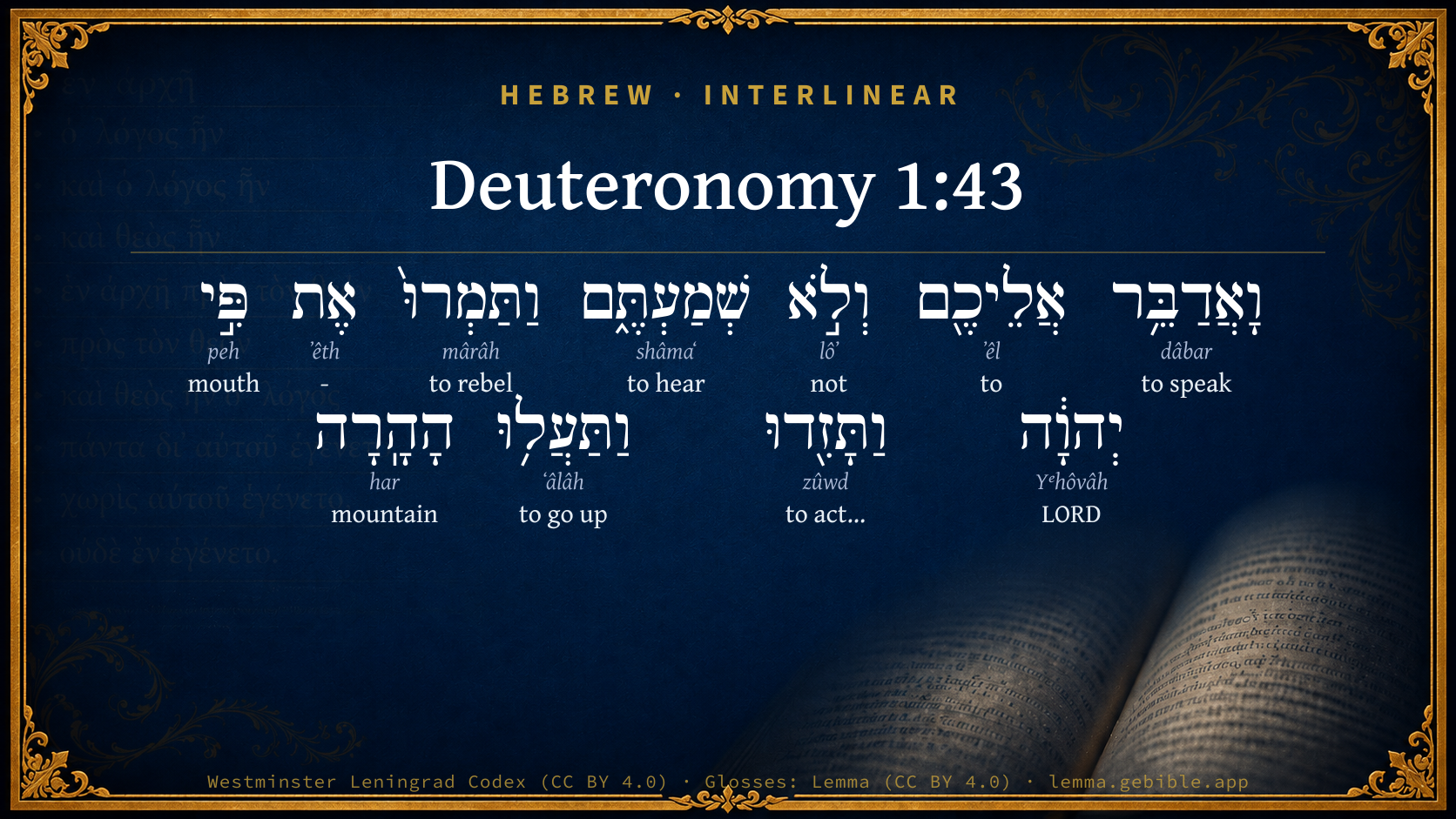
  1. וָאֲדַבֵּ֥ר dâbar H1696 “and · to speak” Conjunction + Verb, Piel, Sequential Imperfect, 1st Person, Common, Singular
  2. אֲלֵיכֶ֖ם ʼêl H413 “to · you” Preposition + Suffix, Personal, 2nd Person, Masculine, Plural
  3. וְלֹ֣א lôʼ H3808 “and · not” Conjunction + Particle, Negative
  4. שְׁמַעְתֶּ֑ם shâmaʻ H8085 “to hear” Verb, Qal, Perfect, 2nd Person, Masculine, Plural
  5. וַתַּמְרוּ֙ mârâh H4784 “and · to rebel” Conjunction + Verb, Hiphil, Sequential Imperfect, 2nd Person, Masculine, Plural
  6. אֶת ʼêth H853 “-” Particle, Direct Object
  7. פִּ֣י peh H6310 “mouth of” Noun, Common, Masculine, Singular, Construct
  8. יְהוָ֔ה Yᵉhôvâh H3068 “LORD” Noun, Proper
  9. וַתַּעֲל֥וּ ʻâlâh H5927 “and · to go up” Conjunction + Verb, Qal, Sequential Imperfect, 2nd Person, Masculine, Plural
  10. הָהָֽרָה har H2022 “the · mountain · toward” Particle, Definite Article + Noun, Common, Masculine, Singular, Absolute + Suffix, Demonstrative

About this verse

These counts appear in no published source. They are computed here, from the morphology-tagged text and Lemma’s own curated glosses. What Lemma adds →

11
words
11
distinct lemmas
Pentateuch
section

Notable vocabulary

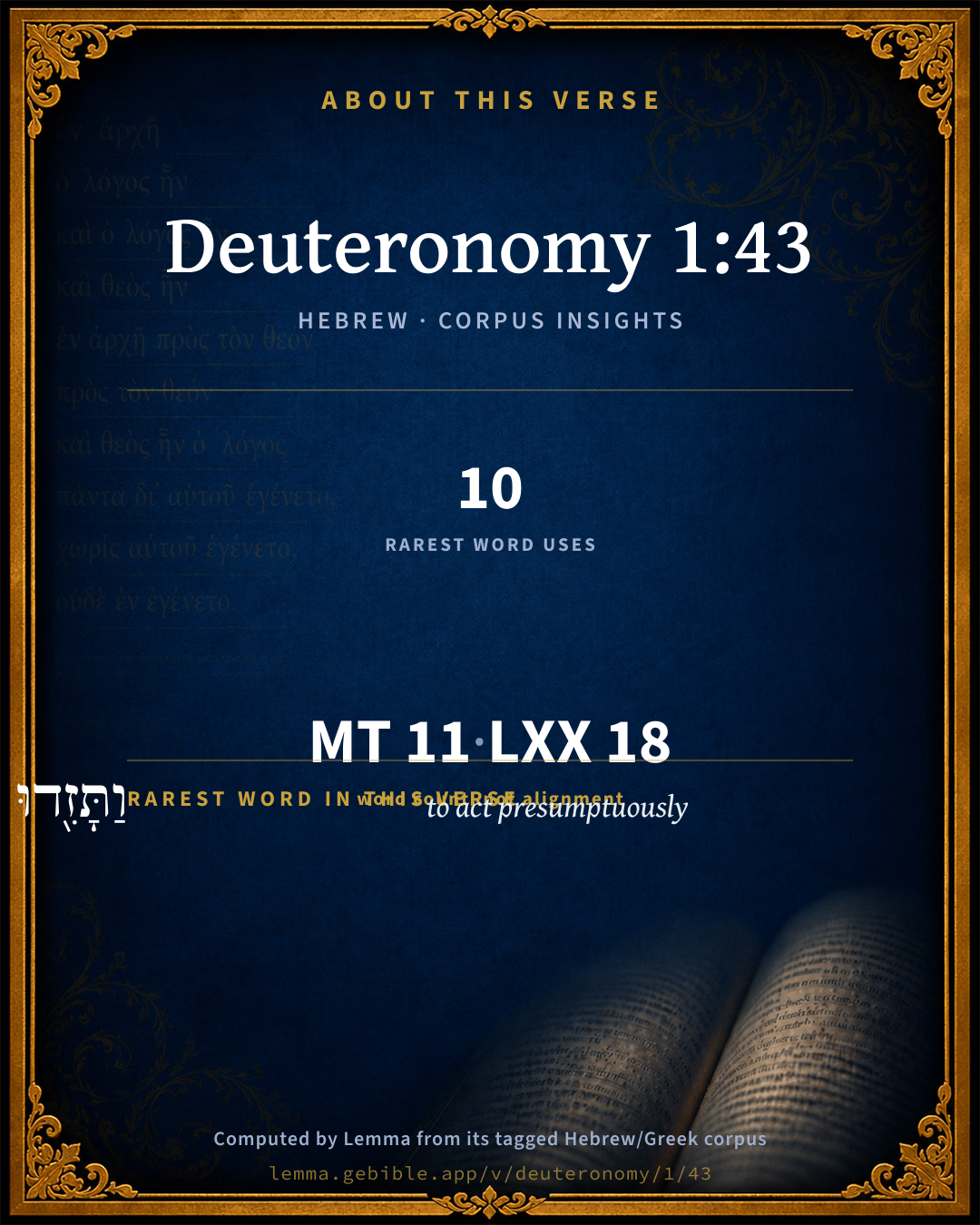
The rarest word here is וַתָּזִ֖דוּ to act presumptuously H2102 — appearing just 10 times in the whole Hebrew Bible.

Shared distinctive vocabulary

וַתָּזִ֖דוּ to act presumptuously H2102 occurs in 10 verses of the Hebrew Bible. Also found in:

Grammatical profile

  • 5 verbs
  • 3 nouns
  • 1 preposition
  • 2 particles

Verb forms

  • וָאֲדַבֵּ֥ר Piel · Sequential Imperfect
  • שְׁמַעְתֶּ֑ם Qal · Perfect
  • וַתַּמְרוּ֙ Hiphil · Sequential Imperfect
  • וַתָּזִ֖דוּ Hiphil · Sequential Imperfect
  • וַתַּעֲל֥וּ Qal · Sequential Imperfect

Hebrew & Septuagint length

In English translation the verse runs 26 words from the Hebrew and 31 from the Septuagint (LXX English) — closely comparable.

A rough comparison of the two English renderings, which tokenize alike — not a word-level alignment.

Word counts can differ between the Hebrew and the Greek without any difference in meaning — e.g. the Hebrew direct-object marker אֵת has no separate Greek word, and Greek often adds the article ὁ.

In the original languages it is 11 Hebrew tokens and 18 Greek tokens — but the two are counted differently (Hebrew bundles its prefixes and suffixes into one token; the Greek is in lemma form), so that isn’t a like-for-like length.

Cross-references

4

Topical passages linked to Deuteronomy 1:43 in the Treasury of Scripture Knowledge — connected by theme and wording, ordered by reader-vote popularity; previews shown in the World English Bible.

  • Numbers 14:44 But they presumed to go up to the top of the mountain: nevertheless the ark of the covenant of Yahweh, and Moses, didn't depart out of the camp.
  • Isaiah 63:10 But they rebelled, and grieved his holy Spirit: therefore he was turned to be their enemy, [and] himself fought against them.
  • Acts 7:51 "You stiff-necked and uncircumcised in heart and ears, you always resist the Holy Spirit! As your fathers did, so you do.
  • Romans 8:7–8 because the mind of the flesh is hostile towards God; for it is not subject to God's law, neither indeed can it be.

Cross-references courtesy of OpenBible.info (CC BY 4.0).

Hebrew and Greek witnesses Masoretic Hebrew ↔ Greek Septuagint

The same verse in the two great witnesses to the Old Testament, shown verse-for-verse.

These are two independent witnesses, not word-aligned to each other, and the Septuagint is shown in lemma (dictionary) form.

Hebrew Deuteronomy 1:43 Masoretic · Westminster Leningrad Codex

וָאֲדַבֵּ֥ר אֲלֵיכֶ֖ם וְלֹ֣א שְׁמַעְתֶּ֑ם וַתַּמְרוּ֙ אֶת פִּ֣י יְהוָ֔ה וַתָּזִ֖דוּ וַתַּעֲל֥וּ הָהָֽרָה

So I spoke to you, and you didn't listen; but you rebelled against the commandment of Yahweh, and were presumptuous, and went up into the hill-country.

World English Bible · Public Domain

Greek LXX Deuteronomy 1:43 Septuagint · lemma form

καί λαλέω σύ καί οὐ εἰςἀκούω ἐγώ καί παραβαίνω ὁ ῥῆμα κύριος καί παραβιάζομαι ἀναβαίνω εἰς ὁ ὄρος

And I spoke to you, and you⌃ did not listen to me; and you⌃ transgressed the commandment of the Lord; and you⌃ forced your way and went up into the mountain.

LXX2012 (modern English Septuagint) · Public Domain

Hebrew: Westminster Leningrad Codex (CC BY 4.0). Greek: Septuagint (public domain); English from LXX2012 (modern English Septuagint) (Public Domain). How the Septuagint differs from the Hebrew →

Targum (Aramaic paraphrase)

2

The Targum is the ancient Jewish Aramaic paraphrase of the Hebrew Scriptures — an interpretive translation, not the Hebrew text itself. Onkelos (literal) and Pseudo-Jonathan (expansive) render the Torah, and Jonathan the Prophets. Coverage is partial: where no permissively-licensed English translation exists for a verse, only the Aramaic is shown. This is verse-level text, not a word-by-word alignment to the Hebrew.

  1. Targum Onkelos Torah (Genesis–Deuteronomy)
    וּמַלֵלִית עִמְכוֹן וְלָא קַבֶּלְתּוּן וְסָרֶבְתּוּן עַל גְזֵרַת מֵימְרָא דַיְיָ וְאַרְשַׁעְתּוּן וּסְלֶקְתּוּן לְטוּרָא

    (no public-domain English translation for this verse)

    Targum Onkelos — Aramaic: “Onkelos Genesis” (public domain); “Onkelos Exodus” (public domain); “Onkelos Leviticus” (public domain); “Onkelos Numbers” (public domain); “Onkelos Deuteronomy” (public domain). English: “Sefaria Community Translation” (CC0 1.0 (public-domain dedication)); “J.W. Etheridge. The Targums of Onkelos and Jonathan Ben Uzziel on the Pentateuch. London: Longmans, Green, 1862” (public domain). Text via Sefaria.

  2. Targum Pseudo-Jonathan Torah (Genesis–Deuteronomy)
    וּמַלֵלִית לְכוֹן וְלָא קַבֵּילְתּוּן וְסָרֵיבְתּוּן עַל מֵימְרָא דַיְיָ וְאַרְשַׁעְתּוּן וּסְלִיקְתּוּן לְטַוְורָא

    And I spake with you, but you would not obey but were rebellious against the Word of the Lord, and did wickedly, and went up to the mountain.

    Targum Pseudo-Jonathan — Aramaic: “Targum Jonathan on Genesis” (public domain); “Targum Jonathan on Exodus” (public domain); “Targum Jonathan on Leviticus” (public domain); “Targum Jonathan on Numbers” (public domain); “Targum Jonathan on Deuteronomy” (public domain). English: “The Targum of Jonathan ben Uzziel, trans. J. W. Etheridge, London, 1862” (public domain). Text via Sefaria.

Commentary

Notes on Deuteronomy 1:43 from classic Christian and Jewish commentators (each source and its license shown beneath its notes). The classic Christian expositions comment on the surrounding passage and are grouped to its opening verse, so a note may address several verses; the Jewish commentaries on the Tanakh (Rashi and others) are per-verse, so they appear only where the commentator wrote on this verse.

Lemma curates 59 commentaries, every one of them public domain or Creative Commons licensed, each selected and text-cleaned for this edition rather than reprinted as found. About our sources →

Ellicott's Commentary for English Readers

(43) The last clause comes from Num_14:44.

A Bible Commentary for English Readers, edited by Charles John Ellicott (1878–1897) — public domain. Text from a community e-Sword module.

The Cambridge Bible for Schools and Colleges

gen. ed. J. J. S. Perowne

43. rebelled] See on Deu_1:26.

and were presumptuous] Heb. boiled over, acted impulsively and with passion or rebelliously, Deu_17:2, Deu_18:20.

The Cambridge Bible for Schools and Colleges (gen. ed. J. J. S. Perowne; Cambridge University Press, 1878–1918) — public domain. Text from a community e-Sword module.

John Gill's Exposition

So I spake unto you,.... The words, the orders he had received from the Lord to deliver to them:

and ye would not hear; so as to obey them, and act according to them:

but rebelled against the commandment of the Lord: as before, by not going up when he would have had them gone, and now by attempting it when he forbid them:

and went presumptuously up into the hill; that is, of themselves, in their own strength, disregarding the commandment of God, and what they were threatened with; this they endeavoured to do, for they were not able to effect it; the Amorites, perceiving them to make up the hill, came pouring down upon them in great numbers, and stopped them, and obliged them to retreat; see Num 14:45.

John Gill's Exposition of the Whole Bible (1746–1763) — public domain (CC PDM 1.0). Text via the HelloAO Bible API.

Whedon's Commentary on the Bible

Daniel D. Whedon

43. Went presumptuously up — You acted rashly and went up, and met with signal defeat.

Daniel D. Whedon (gen. ed.), Commentary on the Old and New Testaments (1874–1909) — public domain. Text from a community e-Sword module.

The Pulpit Commentary

In vain were they thus warned. Moses spoke to them as God commanded, but they would not be persuaded. Went presumptuously; rather, acted insolently and went up; margin, Authorized Version, "Ye were presumptuous, and went up" The verb here (dyzije, from dWz, to boil) signifies tropically, to act proudly, haughtily, insolently. (comp. Neh_11:29, Authorized Version, "dealt proudly

The Pulpit Commentary (1880–1919), ed. H.D.M. Spence-Jones & Joseph S. Exell — public domain. Text from a community e-Sword module.

unfoldingWord translationNotes

Door43 World Missions Community

General Information:

Moses continues to speak to the people of Israel.

attacked the hill country

The metonym "hill country" stands for the people who live there. AT: "attacked the people who live in the hill country" (See: Metonymy)

chased you like bees

A "bee" is a small, flying insect that flies in large groups and stings people who threaten them. This means that so many Amorites attacked the Israelite soldiers that they had to leave the battle. (See: Simile and Translate Unknowns)

Seir

This is the name of a piece of land. (See: How to Translate Names)

Hormah

This is the name of a city. (See: How to Translate Names)

struck you down

"killed many of your soldiers"

translationWords

rebel

command

Yahweh

arrogant

Amorite

unfoldingWord translationNotes — © Distant Shores Media and the Door43 World Missions Community, licensed CC BY-SA 4.0. Source: git.door43.org/Door43/en_tn.

Lesson kit

Teaching starters — assembled from the data on this page, not authored interpretation. Every prompt links to the verse data it draws on. Edit before teaching.

Deuteronomy, in the Pentateuch, opens this verse with 11 words (11 distinct Hebrew lemmas). Its most distinctive word is zûwd (“to act presumptuously”). A historical commentator’s framing appears above. Read the whole chapter for the surrounding context.

Discussion questions

  1. What does “to act presumptuously” (zûwd) contribute to the verse as a whole?
  2. How does Genesis 25:29, which shares the word «to act presumptuously», read alongside this verse?
  3. These translations render this verse differently. What is at stake in choosing one wording over another?
  4. «וָאֲדַבֵּ֥ר» is a Piel Sequential Imperfect verb. How does that grammatical form shape the action described?
  5. Compare how Ellicott's Commentary for English Readers and The Cambridge Bible for Schools and Colleges read this verse. Where do they agree or differ?

Things to notice

Reading settings

Reading text

Shown beneath each verse's original-language words.

Old Testament
Old Testament edition

Read the OT as the Masoretic Hebrew (MT) or the Greek Septuagint (LXX).

English shown for the Greek Septuagint (in the Hebrew ↔ Greek comparison).

Comparing translations? Open the Compare panel on any verse page to stack up to four side by side.