
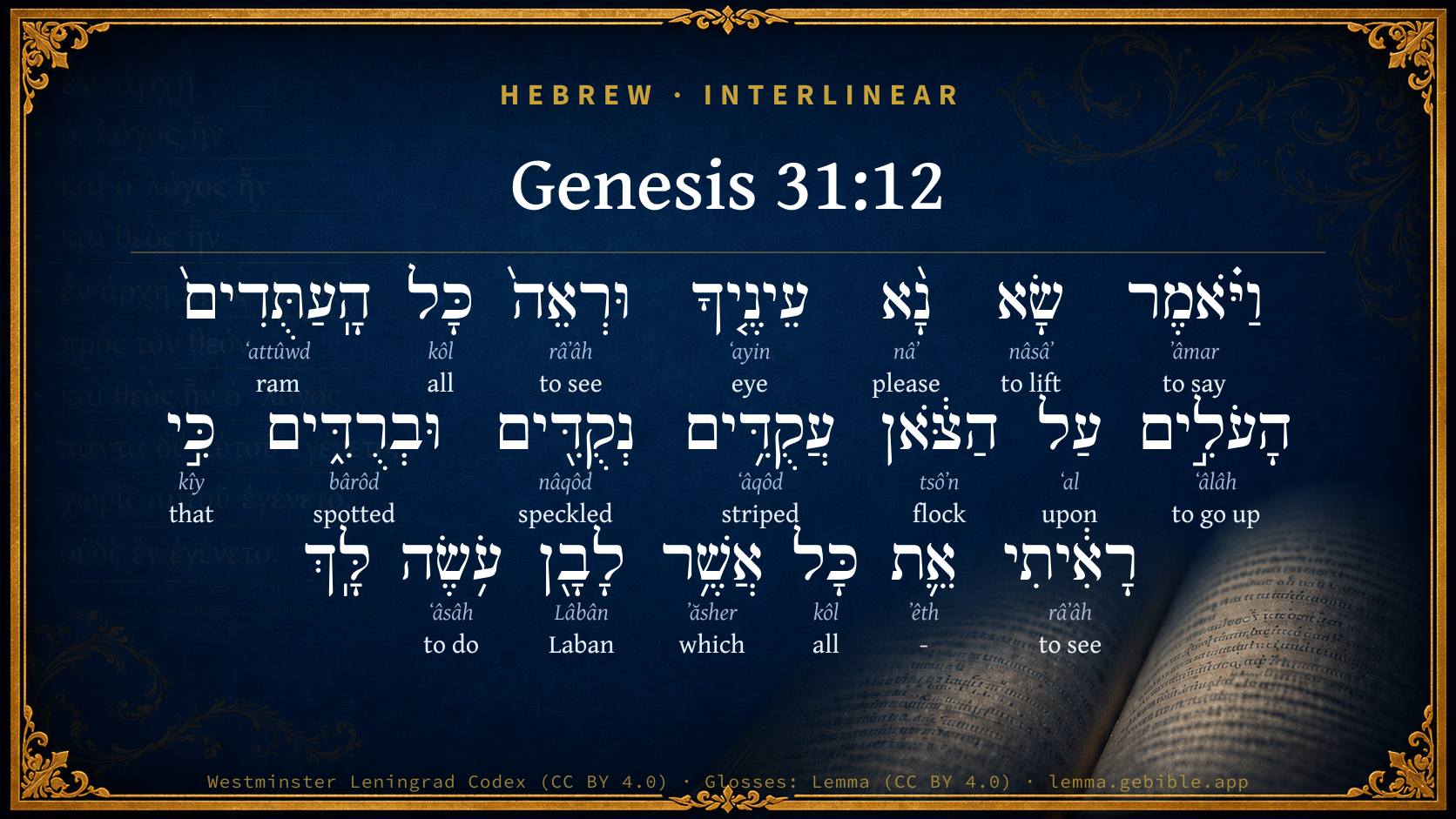
Genesis 31:12

Hebrew (Westminster Leningrad Codex) Genesis 31:12 appears in the Hebrew Old Testament. The text above is from the Westminster Leningrad Codex. Each word links to its Strong’s number, a concise gloss, and parsing drawn from the Open Scriptures Hebrew Bible morphology. Click any word for its full Brown-Driver-Briggs (BDB) entry.
Download image
Cite this verse

Genesis 31:12 (World English Bible). Public Domain. Lemma interlinear Bible study tool, https://lemma.gebible.app/v/genesis/31/12.

Show BibTeX & RIS
BibTeX
RIS
English Translation
He said, 'Now lift up your eyes, and behold, all the male goats which leap on the flock are streaked, speckled, and grizzled, for I have seen all that Laban does to you.
World English Bible · Public Domain
Download a study sheet

One document with this verse’s original text, its word-by-word gloss line, the meaning frame, cross-references with their text, attributed commentary, and full source and license credits — printable, and it pastes into notes with its structure intact.

This verse Autodidact and up

Study sheet (.html) Plain text (.txt)

A passage Seminary Student

Up to 50 verses in one chapter. A passage sheet keeps up to 6 commentary sources and 12 cross-references per verse, in the order this page ranks them, and says so on the sheet whenever that leaves anything out. Ask for a single verse and you get the Autodidact verse sheet above.

Everything on this page stays free to read, with no account — the sheet is a download of what is already on screen, not access to it.

Want to remove ads? Support Godless Engineer
Compare translations 3

The same verse in 3 English versions, stacked beneath the original-language interlinear above. Click any original word for its lexicon entry.

Each is an independent rendering of the whole verse — the interlinear is not word-aligned to these translations.

Highlighted words mark where these versions differ — a whole-verse word diff, not a word-by-word alignment.

  • World English Bible Public Domain
    He said, 'Now lift up your eyes, and behold, all the male goats which leap on the flock are streaked, speckled, and grizzled, for I have seen all that Laban does to you.
  • King James Version Public Domain
    And he said, Lift up now thine eyes, and see, all the rams which leap upon the cattle are ring-streaked, speckled, and grizzled: for I have seen all that Laban doeth unto thee.
  • unfoldingWord Literal Text CC BY-SA 4.0
    Then he said, ‘Please lift up your eyes and see all the he-goats that are mounting the flock streaked, speckled, and spotted, because I have seen all that Laban is doing to you.

unfoldingWord Literal Text — © unfoldingWord, licensed CC BY-SA 4.0. Word-aligned USFM3 via Door43 (git.door43.org/unfoldingWord/en_ult).

Versions to compare (up to 4)

3 of 4 selected

Show all 18 translations

Every available English version of this verse, each an independent rendering of the whole verse.

  • World English Bible Public Domain
    He said, 'Now lift up your eyes, and behold, all the male goats which leap on the flock are streaked, speckled, and grizzled, for I have seen all that Laban does to you.
  • Berean Standard Bible Public Domain
    ‘Look up,’ he said, ‘and see that all the males that are mating with the flock are streaked, spotted, or speckled; for I have seen all that Laban has done to you.
  • Majority Standard Bible Public Domain
    ‘Look up,’ he said, ‘and see that all the males that are mating with the flock are streaked, spotted, or speckled; for I have seen all that Laban has done to you.
  • King James Version Public Domain
    And he said, Lift up now thine eyes, and see, all the rams which leap upon the cattle are ring-streaked, speckled, and grizzled: for I have seen all that Laban doeth unto thee.
  • American Standard Version (1901) Public Domain
    And he said, Lift up now thine eyes, and see, all the he-goats which leap upon the flock are ringstreaked, speckled, and grizzled: for I have seen all that Laban doeth unto thee.
  • Revised Version (1885) Public Domain
    And he said, Lift up now thine eyes, and see, all the he-goats which leap upon the flock are ringstraked, speckled, and grisled: for I have seen all that Laban doeth unto thee.
  • Geneva Bible (1599) Public Domain
    And he sayde, Lift vp nowe thine eyes, and see all the hee goates leaping vpon ye shee goates that are partie coloured, spotted with litle and great spots: for I haue seene all that Laban doeth vnto thee.
  • Douay-Rheims (1899) Public Domain
    And he said: Lift up thy eyes, and see that all the males leaping upon the females, are of divers colors, spotted, and speckled. For I have seen all that Laban hath done to thee.
  • Young's Literal Translation Public Domain
    `And He saith, Lift up, I pray thee, thine eyes, and see -- all the he-goats which are going up on the flock `are' ring-straked, speckled, and grisled, for I have seen all that Laban is doing to thee;
  • Literal Standard Version CC BY-SA 4.0
    And He says, Now lift up your eyes and see [that] all the male goats which are going up on the flock [are] striped, speckled, and spotted, for I have seen all that Laban is doing to you;
  • Unlocked Literal Bible CC BY-SA 4.0
    He said, 'Lift up your eyes and see all the male goats that are breeding with the flock. They are striped, speckled, and spotted, for I have seen everything that Laban is doing to you.
  • unfoldingWord Literal Text CC BY-SA 4.0
    Then he said, ‘Please lift up your eyes and see all the he-goats that are mounting the flock streaked, speckled, and spotted, because I have seen all that Laban is doing to you.
  • Darby Bible Public Domain
    And he said, Lift up now thine eyes, and see: all the rams that leap upon the flock are ringstraked, speckled, and spotted; for I have seen all that Laban does to thee.
  • World Messianic Bible Public Domain
    He said, ‘Now lift up your eyes, and behold, all the male goats which leap on the flock are streaked, speckled, and grizzled, for I have seen all that Laban does to you.
  • Webster's Bible Public Domain
    And he said, Lift up now thy eyes and see, all the rams which leap upon the cattle are ring-streaked, speckled, and grizzled: for I have seen all that Laban doeth to thee.
  • Free Bible Version CC BY-SA 4.0
    He told me, ‘Take a look and you'll see that all the male goats mating with the flock are streaked, speckled or spotted, for I've been watching everything that Laban has been doing to you.
  • Bible in Basic English Public Domain
    And he said, See how all the he-goats are banded and marked and coloured: for I have seen what Laban has done to you.
  • JPS Tanakh (1917) Public Domain
    And he said: Lift up now thine eyes, and see, all the he-goats which leap upon the flock are streaked, speckled, and grizzled; for I have seen all that Laban doeth unto thee.

Literal Standard Version (2020), Covenant Press — licensed CC BY-SA 4.0. Text via the HelloAO Bible API (eBible.org). Unlocked Literal Bible (unfoldingWord) — licensed CC BY-SA 4.0. Text via the HelloAO Bible API (eBible.org). unfoldingWord Literal Text — © unfoldingWord, licensed CC BY-SA 4.0. Word-aligned USFM3 via Door43 (git.door43.org/unfoldingWord/en_ult). Free Bible Version, Dr. Jonathan Gallagher — licensed CC BY-SA 4.0. Text via the HelloAO Bible API (eBible.org).

Word by word

More ways to search: Search by grammar → Find every occurrence → Compare this word →

Practice this passage: Drill this verse → Learn its vocabulary →

וּבְרֻדִּ֑ים
bârôd
H1261
“and · spotted”
Conjunction + Adjective, Adjective, Masculine, Plural, Absolute
Part of Speech
Conjunction + Adjective
Type
Adjective
Gender
Masculine
Number
Plural
State
Absolute
Full BDB Definition

Origin: from H1258

TWOT: 280b

spotted, marked
  1. וַיֹּ֗אמֶר ʼâmar H559 “and · to say” Conjunction + Verb, Qal, Sequential Imperfect, 3rd Person, Masculine, Singular
  2. שָׂא nâsâʼ H5375 “lift” Verb, Qal, Imperative, 2nd Person, Masculine, Singular
  3. נָ֨א nâʼ H4994 “please” Particle, Exhortation
  4. עֵינֶ֤יךָ ʻayin H5869 “eyes · your” Noun, Common, Both, Dual, Construct + Suffix, Personal, 2nd Person, Masculine, Singular
  5. וּרְאֵה֙ râʼâh H7200 “and · see” Conjunction + Verb, Qal, Imperative, 2nd Person, Masculine, Singular
  6. כָּל kôl H3605 “all of” Noun, Common, Masculine, Singular, Construct
  7. הָֽעַתֻּדִים֙ ʻattûwd H6260 “the · rams” Particle, Definite Article + Noun, Common, Masculine, Plural, Absolute
  8. הָעֹלִ֣ים ʻâlâh H5927 “the · going up” Particle, Definite Article + Verb, Qal, Participle Active, Masculine, Plural, Absolute
  9. עַל ʻal H5921 “upon” Preposition
  10. הַצֹּ֔אן tsôʼn H6629 “the · flock” Particle, Definite Article + Noun, Common, Both, Singular, Absolute
  11. עֲקֻדִּ֥ים ʻâqôd H6124 “striped” Adjective, Adjective, Masculine, Plural, Absolute
  12. נְקֻדִּ֖ים nâqôd H5348 “speckled” Adjective, Adjective, Masculine, Plural, Absolute
  13. כִּ֣י kîy H3588 “that” Conjunction
  14. רָאִ֔יתִי râʼâh H7200 “to see” Verb, Qal, Perfect, 1st Person, Common, Singular
  15. אֵ֛ת ʼêth H853 “-” Particle, Direct Object
  16. כָּל kôl H3605 “all of” Noun, Common, Masculine, Singular, Construct
  17. אֲשֶׁ֥ר ʼăsher H834 “which” Particle, Relative
  18. לָבָ֖ן Lâbân H3837 “Laban” Noun, Proper
  19. עֹ֥שֶׂה ʻâsâh H6213 “doing” Verb, Qal, Participle Active, Masculine, Singular, Absolute

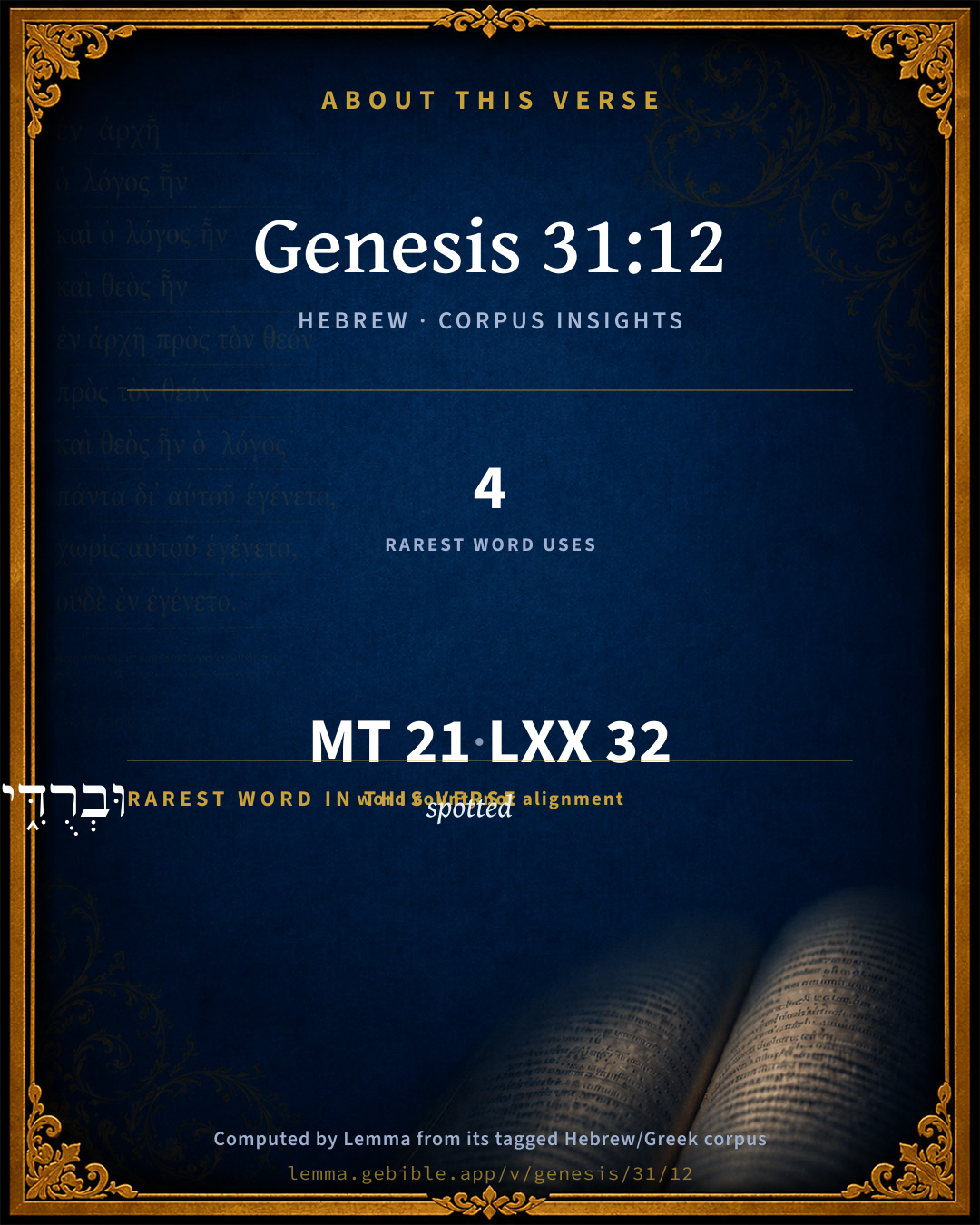
About this verse

These counts appear in no published source. They are computed here, from the morphology-tagged text and Lemma’s own curated glosses. What Lemma adds →

21
words
18
distinct lemmas
Pentateuch
section

Notable vocabulary

The rarest word here is וּבְרֻדִּ֑ים spotted H1261 — appearing just 4 times in the whole Hebrew Bible.

Shared distinctive vocabulary

וּבְרֻדִּ֑ים spotted H1261 occurs in 4 verses of the Hebrew Bible. Also found in:

Grammatical profile

  • 6 verbs
  • 6 nouns
  • 3 adjectives
  • 2 prepositions
  • 1 conjunction
  • 3 particles

Verb forms

  • וַיֹּ֗אמֶר Qal · Sequential Imperfect
  • שָׂא Qal · Imperative
  • וּרְאֵה֙ Qal · Imperative
  • הָעֹלִ֣ים Qal · Participle Active
  • רָאִ֔יתִי Qal · Perfect
  • עֹ֥שֶׂה Qal · Participle Active

Repetition

Words recur within this verse — often emphatic in Hebrew:

  • וּרְאֵה֙ to see H7200 ×2
  • כָּל all H3605 ×2

Hebrew & Septuagint length

In English translation the verse runs 33 words from the Hebrew and 41 from the Septuagint (LXX English) — closely comparable.

A rough comparison of the two English renderings, which tokenize alike — not a word-level alignment.

Word counts can differ between the Hebrew and the Greek without any difference in meaning — e.g. the Hebrew direct-object marker אֵת has no separate Greek word, and Greek often adds the article ὁ.

In the original languages it is 21 Hebrew tokens and 32 Greek tokens — but the two are counted differently (Hebrew bundles its prefixes and suffixes into one token; the Greek is in lemma form), so that isn’t a like-for-like length.

Cross-references

11

Topical passages linked to Genesis 31:12 in the Treasury of Scripture Knowledge — connected by theme and wording, ordered by reader-vote popularity; previews shown in the World English Bible.

  • Exodus 3:7 Yahweh said, "I have surely seen the affliction of my people who are in Egypt, and have heard their cry because of their taskmasters, for I know their sorrows.
  • Genesis 31:42 Unless the God of my father, the God of Abraham, and the fear of Isaac, had been with me, surely now you would have sent me away empty. God has seen my affliction and the labor of my hands, and rebuked you last night."
  • Deuteronomy 24:15 in his day you shall give him his hire, neither shall the sun go down on it; for he is poor, and sets his heart on it: lest he cry against you to Yahweh, and it be sin to you.
  • Genesis 30:37–43 Jacob took to himself rods of fresh poplar, almond, plane tree, peeled white streaks in them, and made the white appear which was in the rods.
  • Exodus 3:9 Now, behold, the cry of the children of Israel has come to me. Moreover I have seen the oppression with which the Egyptians oppress them.
  • Leviticus 19:13 "'You shall not oppress your neighbor, nor rob him. The wages of a hired servant shall not remain with you all night until the morning.
  • Psalms 12:5 "Because of the oppression of the weak and because of the groaning of the needy, I will now arise," says Yahweh; "I will set him in safety from those who malign him."
  • Psalms 139:3 You search out my path and my lying down, And are acquainted with all my ways.
  • Ecclesiastes 5:8 If you see the oppression of the poor, and the violent taking away of justice and righteousness in a district, don't marvel at the matter: for one official is eyed by a higher one; and there are officials over them.
  • Acts 7:34 I have surely seen the affliction of my people that is in Egypt, and have heard their groaning. I have come down to deliver them. Now come, I will send you into Egypt.'
  • Ephesians 6:9 You masters, do the same things to them, and give up threatening, knowing that he who is both their Master and yours is in heaven, and there is no partiality with him.

Cross-references courtesy of OpenBible.info (CC BY 4.0).

Hebrew and Greek witnesses Masoretic Hebrew ↔ Greek Septuagint

The same verse in the two great witnesses to the Old Testament, shown verse-for-verse.

These are two independent witnesses, not word-aligned to each other, and the Septuagint is shown in lemma (dictionary) form.

Hebrew Genesis 31:12 Masoretic · Westminster Leningrad Codex

וַיֹּ֗אמֶר שָׂא נָ֨א עֵינֶ֤יךָ וּרְאֵה֙ כָּל הָֽעַתֻּדִים֙ הָעֹלִ֣ים עַל הַצֹּ֔אן עֲקֻדִּ֥ים נְקֻדִּ֖ים וּבְרֻדִּ֑ים כִּ֣י רָאִ֔יתִי אֵ֛ת כָּל אֲשֶׁ֥ר לָבָ֖ן עֹ֥שֶׂה לָּֽךְ

He said, 'Now lift up your eyes, and behold, all the male goats which leap on the flock are streaked, speckled, and grizzled, for I have seen all that Laban does to you.

World English Bible · Public Domain

Greek LXX Genesis 31:12 Septuagint · lemma form

καί εἶπον ἀναβλέπω ὁ ὀφθαλμός σύ καί ὁράω ὁ τράγος καί ὁ κριός ἀναβαίνω ἐπί ὁ πρόβατον καί ὁ αἴξ διάλευκος καί ποικίλος καί σποδοειδής ῥαντός ὁράω γάρ ὅσος σύ λαβαν ποιέω

And he said, Look up with your eyes, and behold the he-goats and the rams leaping on the sheep and the she-goats, speckled and variegated and spotted with ash-colored spots; for I have seen all things that Laban does to you.

LXX2012 (modern English Septuagint) · Public Domain

Hebrew: Westminster Leningrad Codex (CC BY 4.0). Greek: Septuagint (public domain); English from LXX2012 (modern English Septuagint) (Public Domain). How the Septuagint differs from the Hebrew →

Targum (Aramaic paraphrase)

2

The Targum is the ancient Jewish Aramaic paraphrase of the Hebrew Scriptures — an interpretive translation, not the Hebrew text itself. Onkelos (literal) and Pseudo-Jonathan (expansive) render the Torah, and Jonathan the Prophets. Coverage is partial: where no permissively-licensed English translation exists for a verse, only the Aramaic is shown. This is verse-level text, not a word-by-word alignment to the Hebrew.

  1. Targum Onkelos Torah (Genesis–Deuteronomy)
    וַאֲמַר זְקוֹף כְּעַן עַינָיךְ וַחֲזֵי כָּל תְּיָשַׁיָּא דְּסָלְקִין עַל עָנָא רְגוֹלִין נְמוֹרִין וּפַצִיחִין אֲרֵי גְלֵי קֳדָמַי יָת כָּל דִּי לָבָן עָבֵד לָךְ

    (no public-domain English translation for this verse)

    Targum Onkelos — Aramaic: “Onkelos Genesis” (public domain); “Onkelos Exodus” (public domain); “Onkelos Leviticus” (public domain); “Onkelos Numbers” (public domain); “Onkelos Deuteronomy” (public domain). English: “Sefaria Community Translation” (CC0 1.0 (public-domain dedication)); “J.W. Etheridge. The Targums of Onkelos and Jonathan Ben Uzziel on the Pentateuch. London: Longmans, Green, 1862” (public domain). Text via Sefaria.

  2. Targum Pseudo-Jonathan Torah (Genesis–Deuteronomy)
    וַאֲמַר זְקוֹף כְּדוֹן עֵינָךְ וְחָמֵי כָּל בָּרְחַיָא דְסַלְקִין עַל עָנָא שׁוּמָא בְּרִגְלֵיהוֹן וּקְרוּחִין וְגַבֵּיהוֹן חִוְורִין אֲרוּם גְלֵי קֳדָמַי יַת כָּל אוּנְסָא דְלָבָן עָבִיד לָךְ

    And He said, Lift up now thine eyes and see: all the goats that rise upon the flock are spotted in their feet, or streaked or white in their backs: because all the injury that Laban hath done thee is manifest before me.

    Targum Pseudo-Jonathan — Aramaic: “Targum Jonathan on Genesis” (public domain); “Targum Jonathan on Exodus” (public domain); “Targum Jonathan on Leviticus” (public domain); “Targum Jonathan on Numbers” (public domain); “Targum Jonathan on Deuteronomy” (public domain). English: “The Targum of Jonathan ben Uzziel, trans. J. W. Etheridge, London, 1862” (public domain). Text via Sefaria.

Commentary

Notes on Genesis 31:12 from classic Christian and Jewish commentators (each source and its license shown beneath its notes). The classic Christian expositions comment on the surrounding passage and are grouped to its opening verse, so a note may address several verses; the Jewish commentaries on the Tanakh (Rashi and others) are per-verse, so they appear only where the commentator wrote on this verse.

Lemma curates 59 commentaries, every one of them public domain or Creative Commons licensed, each selected and text-cleaned for this edition rather than reprinted as found. About our sources →

Trapp's Complete Commentary

John Trapp

Gen 31:12 And he said, Lift up now thine eyes, and see, all the rams which leap upon the cattle [are] ringstraked, speckled, and grisled: for I have seen all that Laban doeth unto thee.

Ver. 12. I have seen all that Laban doeth.] And am resolved to fleece him for thy hire. Gain ill got will burn men’s fingers, and burn through their purses. Yea, the greater wealth, the greater spoil awaits such misers; as a tree with thick and large boughs, every man desires to lop it. {See Trapp on "Gen 31:10"}

John Trapp, A Commentary or Exposition upon All the Books of the Old and New Testament (1647–1656) — public domain. Text from a community e-Sword module.

Joseph Benson's Commentary

Gen 31:12. I have seen all that Laban doeth to thee — If we attend to this vision we cannot but see reason to conclude that it was really communicated to Jacob at this time to make use of the speckled rods; for here is a plain declaration that God would effect the thing, and the reason why; because he had seen Laban’s ungenerous and unfair dealing toward Jacob, and therefore was resolved to punish him for it, and at the same time reward Jacob for his fidelity and contentedness under these injuries.

Joseph Benson's Commentary on the Old and New Testaments (1811–1818) — public domain. Text from a community e-Sword module.

Adam Clarke's Commentary

Verse 12. Grisled] ברדים beruddim; ברד barad signifies hail, and the meaning must be, they had white spots on them similar to hail. Our word grisled comes from the old French, gresl, hail, now written gràle; hence greslé, grisled, spotted with white upon a dark ground.

Adam Clarke's Commentary on the Bible (1810–1826) — public domain. Text from a community e-Sword/MySword module.

Ellicott's Commentary for English Readers

(12) Grisled.—That is, covered with spots like hailstones, the word “grisled” being derived from the French grêle, hail. Others derive the word from gris, grisaille, grey.

A Bible Commentary for English Readers, edited by Charles John Ellicott (1878–1897) — public domain. Text from a community e-Sword module.

John Gill's Exposition

I am the God of Bethel,.... The same Angel that appeared to Jacob in a dream, at the beginning of his six years' servitude, now appeared to him at the close of it, declaring himself to be the God of Bethel; or that God that manifested himself to him at Bethel, as Onkelos and Jonathan paraphrase the words; for this is a distinct vision from that in the preceding verses, concerning the rams of different colours, and are both put together for the sake of brevity, and because they belong to the same affair:

where thou anointedst the pillar, and where thou vowedst a vow unto me: See Gill on Gen 28:19, Gen 28:20; hereby signifying the divine approbation of the name Jacob gave to that place, and of what he did in it, and to put him in mind of his promise there made:

now arise, get thee out from this land: of Mesopotamia, or Syria, and out of Haran, a city there, where Jacob now was, and Laban lived:

and return unto the land of thy kindred: to the land of Canaan, the place of his nativity, and where his relations dwelt: this shows, that this appearance of God to him, as the God of Bethel, was at the close of his six years' service.

John Gill's Exposition of the Whole Bible (1746–1763) — public domain (CC PDM 1.0). Text via the HelloAO Bible API.

Haydock's Catholic Bible Commentary

Are of divers colours. Their fancy was strongly impressed with thee various colours, in consequence of the pilled rods, which they beheld: and which Jacob was directed by the angel to place in the troughs. --- I have seen with displeasure, the injustice of Laban; (Haydock) and therefore, I, the Lord of all things, authorize thee to act in this manner. By this vision, the justice of Jacob would appear; and the authority for removing, given in a second vision, would suffice to induce the two principal wives of Jacob to give their consent to leave their father’s house, and to begin a long journey. During the last six years, Providence had given no increase of family, that the little children might be no impediment to the removal. (Haydock)

George Leo Haydock (1774–1849), Haydock's Catholic Family Bible and Commentary, 1859 edition — public domain. Excludes Psalms (Douay-Rheims chapter numbering differs from Protestant) and Deuterocanonical books (Catholic canon only).

Whedon's Commentary on the Bible

Daniel D. Whedon

12. All that Laban doeth — Or, rather, all that he is doing. God’s interposition had been to punish Laban for his unnatural and narrow policy towards his own children, not to show favour to Jacob’s deception. In their natural lives and works both Laban and Jacob were bad enough, but in this case Laban was the aggressor in taking undue advantage, and Jacob’s action was a policy of self-defence.

Daniel D. Whedon (gen. ed.), Commentary on the Old and New Testaments (1874–1909) — public domain. Text from a community e-Sword module.

The Pulpit Commentary

And he said, Lift up now thine eyes, and see, all the rams which leap upon the cattle are ringstraked, speckled, and grisled. Since all the parti-colored animals had already been removed, (Gen_30:35) this vision must have been intended to assure him that the flocks would produce speckled and spotted progeny all the same as if the ringstraked and grisled rams and he-goats had not been removed from their midst (cf. Kurtz, To insist upon a contradiction between this account of the increase of Jacob"s flocks and that mentioned in Gen_30:37 is to forget that both may be true. Equally arbitrary does it seem to be to accuse Jacob of fraud in adopting the artifice of the pilled rods (Kalisch) Without resorting to the supposition that he acted under God s guidance (Wordsworth), we may believe that the dream suggested the expedient referred to, in which some see Jacob"s unbelief and impatience (Kurtz, Gosman in Lange), and others a praiseworthy instance of self-help (Keil). For I have seen all that Laban doeth unto thee. If the preceding clause appears to imply that the vision was sent to Jacob at the beginning of the six years" service, the present clause scents to point to the end of that period as the date of its occurrence; in which case it would require to be understood as a Divine intimation to Jacob that his immense wealth was not to be ascribed to the success of his own stratagem, but to the blessing of God (Delitzsch). The difficulty of harmonizing the two views has led to the suggestion that Jacob here mixes the accounts of two different visions accorded to him, at the commencement and at the close of the period of servitude (Nachmanides, Rosenm Kurtz, Commentary," Murphy, Candlish).

The Pulpit Commentary (1880–1919), ed. H.D.M. Spence-Jones & Joseph S. Exell — public domain. Text from a community e-Sword module.

unfoldingWord translationNotes

Door43 World Missions Community

General Information:

The angel of the Lord continues to talk to Jacob. (See: Genesis 31:10)

Lift up your eyes

This is a way of saying "Look up." (See: Idiom)

that are breeding with the flock

Here "flock" stands for only the female goats. AT: "that are breeding with the female goats of the flock" (See: Synecdoche)

are striped, speckled, and spotted

"have stripes and spots"

where you anointed a pillar

Jacob poured oil on the pillar to dedicate it to God. (See: Symbolic Action)

the land of your birth

"the land where you were born"

translationWords

goat

Laban

God

Bethel

anoint

column

vow

unfoldingWord translationNotes — © Distant Shores Media and the Door43 World Missions Community, licensed CC BY-SA 4.0. Source: git.door43.org/Door43/en_tn.

Lesson kit

Teaching starters — assembled from the data on this page, not authored interpretation. Every prompt links to the verse data it draws on. Edit before teaching.

Genesis, in the Pentateuch, opens this verse with 21 words (18 distinct Hebrew lemmas). Its most distinctive word is bârôd (“spotted”). A historical commentator’s framing appears above. Read the whole chapter for the surrounding context.

Discussion questions

  1. How does “spotted” (bârôd) shape what this verse is saying?
  2. How does Genesis 31:10, which shares the word «spotted», read alongside this verse?
  3. What does the repetition of “to see” (2× in this one verse) do in this verse?
  4. The translations on this page render this verse differently — a whole-verse word diff, not a word-by-word alignment. What might account for the different wordings?
  5. «וַיֹּ֗אמֶר» is a Qal Sequential Imperfect verb. How does that grammatical form shape the action described?
  6. Compare how Trapp's Complete Commentary and Joseph Benson's Commentary read this verse. Where do they agree or differ?

Things to notice

Reading settings

Reading text

Shown beneath each verse's original-language words.

Old Testament
Old Testament edition

Read the OT as the Masoretic Hebrew (MT) or the Greek Septuagint (LXX).

English shown for the Greek Septuagint (in the Hebrew ↔ Greek comparison).

Comparing translations? Open the Compare panel on any verse page to stack up to four side by side.