
2 Chronicles 36:17

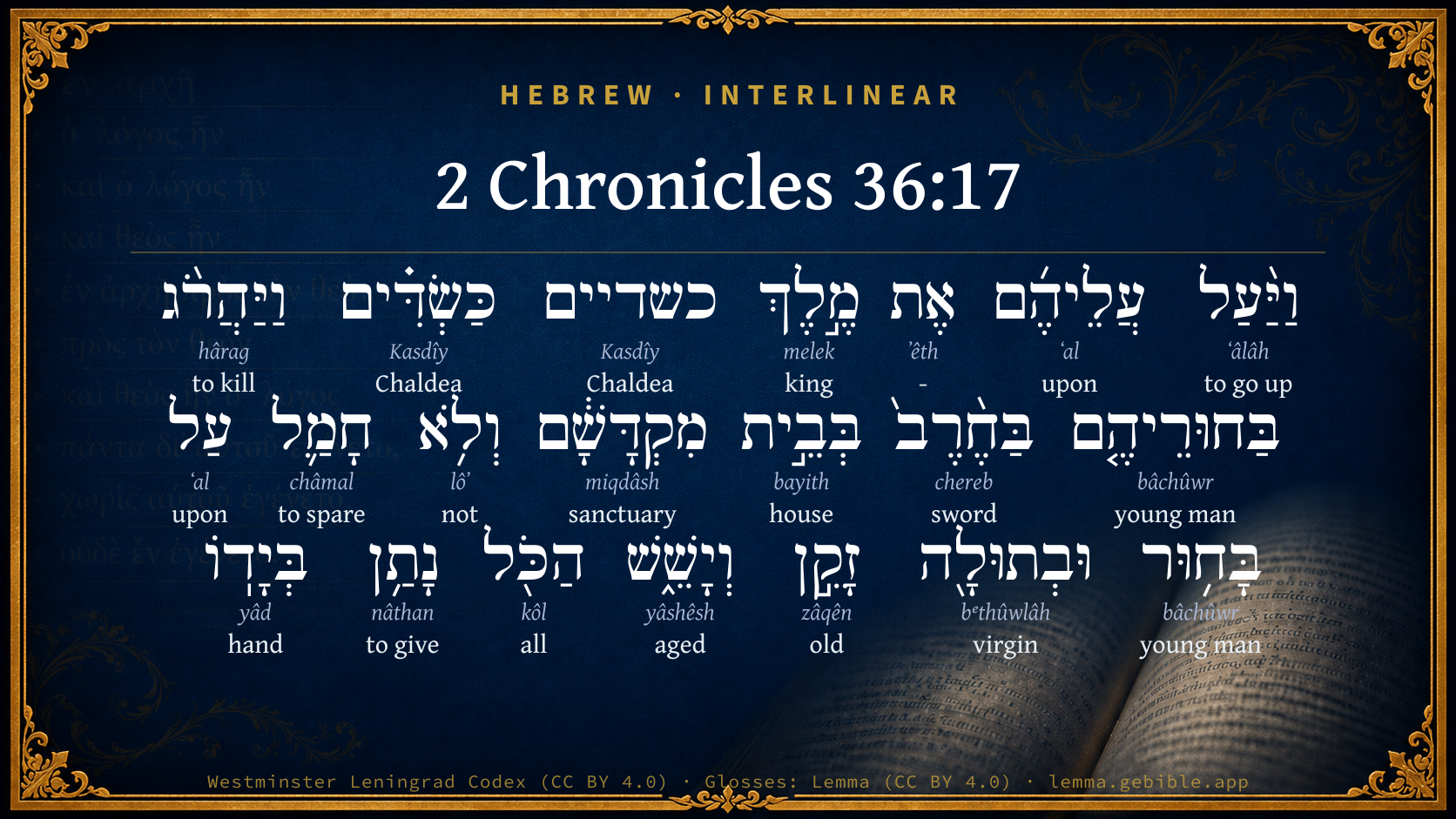
Hebrew (Westminster Leningrad Codex) 2 Chronicles 36:17 appears in the Hebrew Old Testament. The text above is from the Westminster Leningrad Codex. Each word links to its Strong’s number, a concise gloss, and parsing drawn from the Open Scriptures Hebrew Bible morphology. Click any word for its full Brown-Driver-Briggs (BDB) entry.
Download image
Cite this verse

2 Chronicles 36:17 (World English Bible). Public Domain. Lemma interlinear Bible study tool, https://lemma.gebible.app/v/2-chronicles/36/17.

Show BibTeX & RIS
BibTeX
RIS
English Translation
Therefore he brought on them the king of the Chaldeans, who killed their young men with the sword in the house of their sanctuary, and had no compassion on young man or virgin, old man or gray-headed: he gave them all into his hand.
World English Bible · Public Domain
Highlights
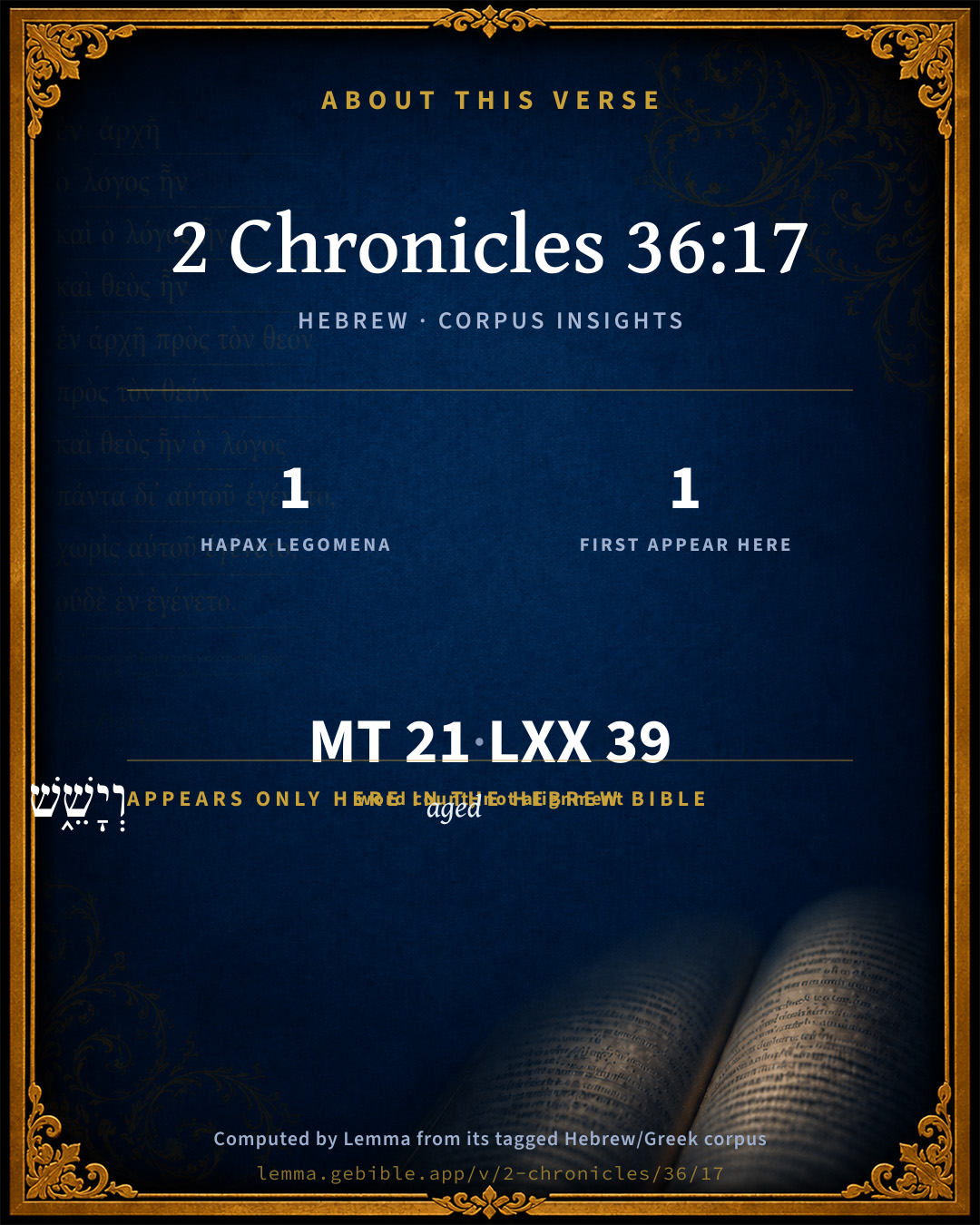
  • 1 hapax legomenon — only here in the Hebrew Bible
  • 1 first appearance in the Hebrew Bible
Full analysis ↓
Download a study sheet

One document with this verse’s original text, its word-by-word gloss line, the meaning frame, cross-references with their text, attributed commentary, and full source and license credits — printable, and it pastes into notes with its structure intact.

This verse Autodidact and up

Study sheet (.html) Plain text (.txt)

A passage Seminary Student

Up to 50 verses in one chapter. A passage sheet keeps up to 6 commentary sources and 12 cross-references per verse, in the order this page ranks them, and says so on the sheet whenever that leaves anything out. Ask for a single verse and you get the Autodidact verse sheet above.

Everything on this page stays free to read, with no account — the sheet is a download of what is already on screen, not access to it.

Want to remove ads? Support Godless Engineer
Compare translations 3

The same verse in 3 English versions, stacked beneath the original-language interlinear above. Click any original word for its lexicon entry.

Each is an independent rendering of the whole verse — the interlinear is not word-aligned to these translations.

Highlighted words mark where these versions differ — a whole-verse word diff, not a word-by-word alignment.

  • World English Bible Public Domain
    Therefore he brought on them the king of the Chaldeans, who killed their young men with the sword in the house of their sanctuary, and had no compassion on young man or virgin, old man or gray-headed: he gave them all into his hand.
  • King James Version Public Domain
    Therefore he brought upon them the king of the Chaldees, who slew their young men with the sword in the house of their sanctuary, and had no compassion upon young man or maiden, old man, or him that stooped for age: he gave them all into his hand.
  • unfoldingWord Literal Text CC BY-SA 4.0
    And he brought up against them the king of the Chaldeans, and he killed their young men with the sword in the house of their holy place, and he did not spare a young man or a virgin, old or aged. All he gave into his hand.

unfoldingWord Literal Text — © unfoldingWord, licensed CC BY-SA 4.0. Word-aligned USFM3 via Door43 (git.door43.org/unfoldingWord/en_ult).

Versions to compare (up to 4)

3 of 4 selected

Show all 18 translations

Every available English version of this verse, each an independent rendering of the whole verse.

  • World English Bible Public Domain
    Therefore he brought on them the king of the Chaldeans, who killed their young men with the sword in the house of their sanctuary, and had no compassion on young man or virgin, old man or gray-headed: he gave them all into his hand.
  • Berean Standard Bible Public Domain
    So He brought up against them the king of the Chaldeans, who put their young men to the sword in the sanctuary, sparing neither young men nor young women, neither elderly nor infirm. God gave them all into the hand of Nebuchadnezzar,
  • Majority Standard Bible Public Domain
    So He brought up against them the king of the Chaldeans, who put their young men to the sword in the sanctuary, sparing neither young men nor young women, neither elderly nor infirm. God gave them all into the hand of Nebuchadnezzar,
  • King James Version Public Domain
    Therefore he brought upon them the king of the Chaldees, who slew their young men with the sword in the house of their sanctuary, and had no compassion upon young man or maiden, old man, or him that stooped for age: he gave them all into his hand.
  • American Standard Version (1901) Public Domain
    Therefore he brought upon them the king of the Chaldeans, who slew their young men with the sword in the house of their sanctuary, and had no compassion upon young man or virgin, old man or hoary-headed: he gave them all into his hand.
  • Revised Version (1885) Public Domain
    Therefore he brought upon them the king of the Chaldeans, who slew their young men with the sword in the house of their sanctuary, and had no compassion upon young man or maiden, old man or ancient: he gave them all into his hand.
  • Geneva Bible (1599) Public Domain
    For he brought vpon them the King of the Caldeans, who slewe their yong men with the sworde in the house of their Sanctuarie, and spared neither yong man, nor virgin, ancient, nor aged. God gaue all into his hande,
  • Douay-Rheims (1899) Public Domain
    For he brought upon them the king of the Chaldeans, and he slew their young men with the sword in the house of his sanctuary, he had no compassion on young man, or maiden, old man or even him that stooped for age, but he delivered them all into his hands.
  • Young's Literal Translation Public Domain
    And He causeth to go up against them the king of the Chaldeans, and he slayeth their chosen ones by the sword in the house of their sanctuary, and hath had no pity on young man and virgin, old man and very aged -- the whole He hath given into his hand.
  • Literal Standard Version CC BY-SA 4.0
    And He causes the king of the Chaldeans to go up against them, and he slays their chosen ones by the sword in the house of their sanctuary, and has had no pity on young man and virgin, old man and very aged—He has given the whole into his hand.
  • Unlocked Literal Bible CC BY-SA 4.0
    So God brought on them the king of the Chaldeans, who killed their young men with the sword in the sanctuary, and had no compassion on young men or virgins, old men or the gray-haired. God gave them all into his hand.
  • unfoldingWord Literal Text CC BY-SA 4.0
    And he brought up against them the king of the Chaldeans, and he killed their young men with the sword in the house of their holy place, and he did not spare a young man or a virgin, old or aged. All he gave into his hand.
  • Darby Bible Public Domain
    And he brought up [against] them the king of the Chaldees, and slew their young men with the sword in the house of their sanctuary, and spared not young man nor maiden, old man nor him of hoary head: he gave [them] all into his hand.
  • World Messianic Bible Public Domain
    Therefore he brought on them the king of the Kasdim, who killed their young men with the sword in the house of their sanctuary, and had no compassion on young man or virgin, old man or infirm. He gave them all into his hand.
  • Webster's Bible Public Domain
    Therefore he brought upon them the king of the Chaldees, who slew their young men with the sword in the house of their sanctuary, and had no compassion upon young man or maiden, old man, or him that stooped for age: he gave them all into his hand.
  • Free Bible Version CC BY-SA 4.0
    So the Lord brought the king of Babylon to attack them. His army killed by the sword their best young men even in the sanctuary. The Babylonians did not spare young men or young women, the sick or the elderly. God handed them all over to Nebuchadnezzar.
  • Bible in Basic English Public Domain
    So he sent against them the king of the Chaldaeans, who put their young men to death with the sword in the house of their holy place, and had no pity for any, young man or virgin, old man or white-haired: God gave them all into his hands.
  • JPS Tanakh (1917) Public Domain
    Therefore He brought upon them the king of the Chaldeans, who slew their young men with the sword in the house of their sanctuary, and had no compassion upon young man or maiden, old man or hoary-headed; He gave them all into his hand.

Literal Standard Version (2020), Covenant Press — licensed CC BY-SA 4.0. Text via the HelloAO Bible API (eBible.org). Unlocked Literal Bible (unfoldingWord) — licensed CC BY-SA 4.0. Text via the HelloAO Bible API (eBible.org). unfoldingWord Literal Text — © unfoldingWord, licensed CC BY-SA 4.0. Word-aligned USFM3 via Door43 (git.door43.org/unfoldingWord/en_ult). Free Bible Version, Dr. Jonathan Gallagher — licensed CC BY-SA 4.0. Text via the HelloAO Bible API (eBible.org).

Word by word

More ways to search: Search by grammar → Find every occurrence → Compare this word →

Practice this passage: Drill this verse → Learn its vocabulary →

וְיָשֵׁ֑שׁ
yâshêsh
H3486
“and · aged”
Conjunction + Adjective, Adjective, Masculine, Singular, Absolute
Part of Speech
Conjunction + Adjective
Type
Adjective
Gender
Masculine
Number
Singular
State
Absolute
Full BDB Definition

Origin: from an unused root meaning to blanch

TWOT: 931a

aged, decrepit, feeble
  1. וַיַּ֨עַל ʻâlâh H5927 “and · to go up” Conjunction + Verb, Hiphil, Sequential Imperfect, 3rd Person, Masculine, Singular
  2. עֲלֵיהֶ֜ם ʻal H5921 “upon · them” Preposition + Suffix, Personal, 3rd Person, Masculine, Plural
  3. אֶת ʼêth H853 “-” Particle, Direct Object
  4. מֶ֣לֶךְ melek H4428 “king of” Noun, Common, Masculine, Singular, Construct
  5. כשדיים Kasdîy H3778 “Chaldeans” Noun, Gentilic, Masculine, Plural, Absolute
  6. כַּשְׂדִּ֗ים Kasdîy H3778 “Chaldeans” Noun, Gentilic, Masculine, Plural, Absolute
  7. וַיַּהֲרֹ֨ג hârag H2026 “and · to kill” Conjunction + Verb, Qal, Sequential Imperfect, 3rd Person, Masculine, Singular
  8. בַּחוּרֵיהֶ֤ם bâchûwr H970 “young men · their” Noun, Common, Masculine, Plural, Construct + Suffix, Personal, 3rd Person, Masculine, Plural
  9. בַּחֶ֨רֶב֙ chereb H2719 “in/at the · sword” Preposition, Determined + Noun, Common, Feminine, Singular, Absolute
  10. בְּבֵ֣ית bayith H1004 “in/at · house of” Preposition + Noun, Common, Masculine, Singular, Construct
  11. מִקְדָּשָׁ֔ם miqdâsh H4720 “sanctuary · their” Noun, Common, Masculine, Singular, Construct + Suffix, Personal, 3rd Person, Masculine, Plural
  12. וְלֹ֥א lôʼ H3808 “and · not” Conjunction + Particle, Negative
  13. חָמַ֛ל châmal H2550 “to spare” Verb, Qal, Perfect, 3rd Person, Masculine, Singular
  14. עַל ʻal H5921 “upon” Preposition
  15. בָּח֥וּר bâchûwr H970 “young man” Noun, Common, Masculine, Singular, Absolute
  16. וּבְתוּלָ֖ה bᵉthûwlâh H1330 “and · virgin” Conjunction + Noun, Common, Feminine, Singular, Absolute
  17. זָקֵ֣ן zâqên H2205 “old” Adjective, Adjective, Masculine, Singular, Absolute
  18. הַכֹּ֖ל kôl H3605 “the · all” Particle, Definite Article + Noun, Common, Masculine, Singular, Absolute
  19. נָתַ֥ן nâthan H5414 “to give” Verb, Qal, Perfect, 3rd Person, Masculine, Singular
  20. בְּיָדֽוֹ yâd H3027 “in/at · hand · his” Preposition + Noun, Common, Both, Singular, Construct + Suffix, Personal, 3rd Person, Masculine, Singular

About this verse

These counts appear in no published source. They are computed here, from the morphology-tagged text and Lemma’s own curated glosses. What Lemma adds →

21
words
18
distinct lemmas
Historical
section

Notable vocabulary

1 hapax legomenon — a word that appears only here in the entire Hebrew Bible:

  • וְיָשֵׁ֑שׁ aged H3486

First appearance in Scripture

This word makes its first canonical appearance in the Hebrew Bible here:

  • וְיָשֵׁ֑שׁ aged H3486

Shared distinctive vocabulary

חָמַ֛ל to spare H2550 occurs in 40 verses of the Hebrew Bible. Also found in:

Grammatical profile

  • 4 verbs
  • 11 nouns
  • 2 adjectives
  • 2 prepositions
  • 2 particles

Verb forms

  • וַיַּ֨עַל Hiphil · Sequential Imperfect
  • וַיַּהֲרֹ֨ג Qal · Sequential Imperfect
  • חָמַ֛ל Qal · Perfect
  • נָתַ֥ן Qal · Perfect

Repetition

Words recur within this verse — often emphatic in Hebrew:

  • עֲלֵיהֶ֜ם upon H5921 ×2
  • כשדיים Chaldea H3778 ×2
  • בַּחוּרֵיהֶ֤ם young man H970 ×2

Hebrew & Septuagint length

In English translation the verse runs 44 words from the Hebrew and 50 from the Septuagint (LXX English) — closely comparable.

A rough comparison of the two English renderings, which tokenize alike — not a word-level alignment.

Word counts can differ between the Hebrew and the Greek without any difference in meaning — e.g. the Hebrew direct-object marker אֵת has no separate Greek word, and Greek often adds the article ὁ.

In the original languages it is 21 Hebrew tokens and 39 Greek tokens — but the two are counted differently (Hebrew bundles its prefixes and suffixes into one token; the Greek is in lemma form), so that isn’t a like-for-like length.

Cross-references

23

Topical passages linked to 2 Chronicles 36:17 in the Treasury of Scripture Knowledge — connected by theme and wording, ordered by reader-vote popularity; previews shown in the World English Bible.

  • Ezra 9:7 Since the days of our fathers we have been exceeding guilty to this day; and for our iniquities have we, our kings, and our priests, been delivered into the hand of the kings of the lands, to the sword, to captivity, and to plunder, and to confusion of face, as it is this day.
  • Psalms 74:20 Honor your covenant, For haunts of violence fill the dark places of the earth.
  • Jeremiah 40:3 and Yahweh has brought it, and done according as he spoke: because you have sinned against Yahweh, and have not obeyed his voice, therefore this thing is come on you.
  • Ezekiel 9:5–7 To the others he said in my hearing, Go you through the city after him, and strike: don't let your eye spare, neither have you pity;
  • Leviticus 26:14–46 "'But if you will not listen to me, and will not do all these commandments;
  • Deuteronomy 28:15–68 But it shall come to pass, if you will not listen to the voice of Yahweh your God, to observe to do all his commandments and his statutes which I command you this day, that all these curses shall come on you, and overtake you.
  • Deuteronomy 29:18–28 lest there should be among you man, or woman, or family, or tribe, whose heart turns away this day from Yahweh our God, to go to serve the gods of those nations; lest there should be among you a root that bears gall and wormwood;
  • Deuteronomy 30:18 I denounce to you this day, that you shall surely perish; you shall not prolong your days in the land, where you pass over the Jordan to go in to possess it.
  • Deuteronomy 31:16–18 Yahweh said to Moses, Behold, you shall sleep with your fathers; and this people will rise up, and play the prostitute after the strange gods of the land, where they go to be among them, and will forsake me, and break my covenant which I have made with them.
  • Deuteronomy 32:15–28 But Jeshurun grew fat, and kicked: You have grown fat, you are grown thick, you are become sleek; Then he forsook God who made him, Lightly esteemed the Rock of his salvation.
  • 2 Kings 24:2–3 Yahweh sent against him bands of the Chaldeans, and bands of the Syrians, and bands of the Moabites, and bands of the children of Ammon, and sent them against Judah to destroy it, according to the word of Yahweh, which he spoke by his servants the prophets.
  • 2 Kings 25:1–30 It happened in the ninth year of his reign, in the tenth month, in the tenth day of the month, that Nebuchadnezzar king of Babylon came, he and all his army, against Jerusalem, and encamped against it; and they built forts against it round about.
  • 2 Chronicles 24:21 They conspired against him, and stoned him with stones at the commandment of the king in the court of the house of Yahweh.
  • 2 Chronicles 33:11 Therefore Yahweh brought on them the captains of the host of the king of Assyria, who took Manasseh in chains, and bound him with fetters, and carried him to Babylon.
  • Psalms 79:2–3 They have given the dead bodies of your servants to be food for the birds of the sky, The flesh of your saints to the animals of the earth.
  • Jeremiah 15:8–9 Their widows are increased to me above the sand of the seas; I have brought on them against the mother of the young men a destroyer at noonday: I have caused anguish and terrors to fall on her suddenly.
  • Jeremiah 18:21 Therefore deliver up their children to the famine, and give them over to the power of the sword; and let their wives become childless, and widows; and let their men be slain of death, [and] their young men struck of the sword in battle.
  • Jeremiah 32:42 For thus says Yahweh: Like as I have brought all this great evil on this people, so will I bring on them all the good that I have promised them.
  • Jeremiah 39:1–18 It happened when Jerusalem was taken, (in the ninth year of Zedekiah king of Judah, in the tenth month, came Nebuchadrezzar king of Babylon and all his army against Jerusalem, and besieged it;
  • Jeremiah 52:1–34 Zedekiah was twenty-one years old when he began to reign; and he reigned eleven years in Jerusalem: and his mother's name was Hamutal the daughter of Jeremiah of Libnah.
  • Lamentations 2:20–22 Look, Yahweh, and see to whom you have done thus! Shall the women eat their fruit, the children that are dandled in the hands? Shall the priest and the prophet be killed in the sanctuary of the Lord?
  • Daniel 9:14 Therefore has Yahweh watched over the evil, and brought it on us; for Yahweh our God is righteous in all his works which he does, and we have not obeyed his voice.
  • Luke 13:1–2 Now there were some present at the same time who told him about the Galileans, whose blood Pilate had mixed with their sacrifices.

Cross-references courtesy of OpenBible.info (CC BY 4.0).

Hebrew and Greek witnesses Masoretic Hebrew ↔ Greek Septuagint

The same verse in the two great witnesses to the Old Testament, shown verse-for-verse.

These are two independent witnesses, not word-aligned to each other, and the Septuagint is shown in lemma (dictionary) form.

Hebrew 2 Chronicles 36:17 Masoretic · Westminster Leningrad Codex

וַיַּ֨עַל עֲלֵיהֶ֜ם אֶת מֶ֣לֶךְ כשדיים כַּשְׂדִּ֗ים וַיַּהֲרֹ֨ג בַּחוּרֵיהֶ֤ם בַּחֶ֨רֶב֙ בְּבֵ֣ית מִקְדָּשָׁ֔ם וְלֹ֥א חָמַ֛ל עַל בָּח֥וּר וּבְתוּלָ֖ה זָקֵ֣ן וְיָשֵׁ֑שׁ הַכֹּ֖ל נָתַ֥ן בְּיָדֽוֹ

Therefore he brought on them the king of the Chaldeans, who killed their young men with the sword in the house of their sanctuary, and had no compassion on young man or virgin, old man or gray-headed: he gave them all into his hand.

World English Bible · Public Domain

Greek LXX 2 Chronicles 36:17 Septuagint · lemma form

καί ἄγω ἐπί αὐτός βασιλεύς χαλδαῖος καί ἀποκτείνω ὁ νεανίσκος αὐτός ἐν ῥομφαία ἐν οἶκος ἁγίασμα αὐτός καί οὐ φείδομαι ὁ σεδεκιας καί ὁ παρθένος αὐτός οὐ ἐλεέω καί ὁ πρεσβύτερος αὐτός ἀποἄγω ὁ πᾶς παραδίδωμι ἐν χείρ αὐτός

And he brought against them the king of the Chaldeans, and killed their young men with the sword in the house of his sanctuary, and did not spare Sedekias, and had no mercy upon their virgins, and they led away their old men: he delivered all things into their hands.

LXX2012 (modern English Septuagint) · Public Domain

Hebrew: Westminster Leningrad Codex (CC BY 4.0). Greek: Septuagint (public domain); English from LXX2012 (modern English Septuagint) (Public Domain). How the Septuagint differs from the Hebrew →

Commentary

Notes on 2 Chronicles 36:17 from classic Christian and Jewish commentators (each source and its license shown beneath its notes). The classic Christian expositions comment on the surrounding passage and are grouped to its opening verse, so a note may address several verses; the Jewish commentaries on the Tanakh (Rashi and others) are per-verse, so they appear only where the commentator wrote on this verse.

Lemma curates 59 commentaries, every one of them public domain or Creative Commons licensed, each selected and text-cleaned for this edition rather than reprinted as found. About our sources →

Trapp's Complete Commentary

John Trapp

2Ch 36:17 Therefore he brought upon them the king of the Chaldees, who slew their young men with the sword in the house of their sanctuary, and had no compassion upon young man or maiden, old man, or him that stooped for age: he gave [them] all into his hand.

Ver. 17. Who slew their young men … in the house of their sanctuary.] This was barbarous inhumanity. Alaricus the Goth, when, after two years’ siege, he had taken the city of Rome, spared such as had fled into the churches, and there taken sanctuary.

John Trapp, A Commentary or Exposition upon All the Books of the Old and New Testament (1647–1656) — public domain. Text from a community e-Sword module.

Joseph Benson's Commentary

2Ch 36:17. Therefore he brought upon them the king of the Chaldees —

The king of the Chaldeans marched against them out of some political view; but we are taught in the Holy Scriptures to ascribe all these events to the agency of the Divine Providence, and therefore it is said here, not that the king of the Chaldeans went against them, but that the Lord brought upon them the king of the Chaldeans. Who slew their young men in the house of their sanctuary — Either in Jerusalem, which was the dwelling- place of God’s sanctuary, or in the house which was their sanctuary. It is probable they killed some of them in the very courts and house of God, to which they had fled for refuge, such places being esteemed sacred and inviolable by the heathen themselves. He gave them all into his hand — To be carried captive into Chaldea. Abraham was called out of Ur of the Chaldees, when God took him into covenant with himself. And now his degenerate seed are carried into that country again, to signify that they had forfeited all that kindness wherewith they had been loved for their father’s sake, and the benefit of the covenant into which he was called.

Joseph Benson's Commentary on the Old and New Testaments (1811–1818) — public domain. Text from a community e-Sword module.

Keil & Delitzsch

C. F. Keil & F. Delitzsch

When the moral corruption had reached this height, judgment broke upon the incorrigible race. As in Ch2 36:12-16 the transgressions of the king and people are not described according to their historical progression, but are portrayed in rhetorical gradation; so, too, in Ch2 36:17-21 the judgment upon the sinful people and kingdom is not represented in its historical details, but only rhetorically in its great general outlines. "Then brought He upon them the king of the Chaldeans, who slew their young men with the sword in their sanctuary, and spared not the youth and the maiden, the old man and the grey-headed; he gave everything into his hand." Prophetic utterances form the basis of this description of the fearful judgment, e.g., Jer 15:1-9; Jer 32:3., Eze 9:6; and these, again, rest upon Deu 32:25. The subject in the first and last clause of the verse is Jahve. Bertheau therefore assumes that He is also the subject of the intermediate sentence: "and God slew their young men in the sanctuary;" but this can hardly be correct. As in the expansion of the last clause, "he gave everything into his hand," which follows in Ch2 36:18, not Jahve but the king of Babylon is the subject; so also in the expansion of the first clause, which וגו ויּהרג introduces, the king of the Chaldeans is the subject, as most commentators have rightly recognised. By מקדּשׁם בּבית the judgment is brought into definite relationship to the crime: because they had profaned the sanctuary by idolatry (Ch2 36:14), they themselves were slain in the sanctuary. On נתן ב הכּל, cf. Jer 27:6; Jer 32:3-4. הכּל includes things and persons, and is specialized in Ch2 36:18-20.

Keil & Delitzsch — Biblical Commentary on the Old Testament (1861–1891) — public domain (CC PDM 1.0). Text via the HelloAO Bible API. (Old Testament only.)

Geneva Bible (1599)

Geneva Bible translators

Whither they fled, thinking to have been saved for the holiness thereof.

Which is not because God approveth him, which yet is the minister of his justice, but because God would by his just judgment punish this people: for this king was led with ambition and vain glory, whereunto were joined fury and cruelty: therefore his work was condemnable, notwithstanding it was just and holy on God’s part, who used this wicked instrument to declare his justice.

Geneva Bible (1599) marginal notes — public domain. Text via Bolls.life.

Ellicott's Commentary for English Readers

(17) Therefore he brought up.—And He caused to come up; alluding to “the wrath . . . went up.”

In the house of their sanctuary.—Which they had polluted (2Ch_36:14). The scene of their sin witnessed their destruction.

Him that stooped for age.—Rather, greyheaded, hoary (yâshçsh). (Comp. Ezekiel 9, where the horrors of the capture of Jerusalem are ascribed expressly to the Divine working; see also Jer_15:1-9; Deu_32:25.)

He gave them all into his hand.—Comp. Jer_37:6; Jer_32:3-4.

Them all.—Literally, the whole, everything, τά πάντα. “Them all” would be hullâm, whereas the text is hakkôl. (So 2Ch_36:18, “all these.”) Jerusalem was taken 588 B.C.

A Bible Commentary for English Readers, edited by Charles John Ellicott (1878–1897) — public domain. Text from a community e-Sword module.

The Cambridge Bible for Schools and Colleges

gen. ed. J. J. S. Perowne

17. Chaldees] R.V. Chaldeans. Their name in Hebrew is Casdim and in Assyrio-Babylonian Caldu (the change of “s” for “l” before a dental is not uncommon in the latter language). They were a people originally living south of Babylon on the sea, but Nabopolassar, father of Nebuchadnezzar, conquered Babylon and established a Chaldæo-Babylonian empire.

in the house of their sanctuary] Cp. Ezekiel’s vision of the slaughter; Eze_9:1-11.

him that stooped for age] R.V. ancient; cp. Isa_9:15.

The Cambridge Bible for Schools and Colleges (gen. ed. J. J. S. Perowne; Cambridge University Press, 1878–1918) — public domain. Text from a community e-Sword module.

John Gill's Exposition

And all the vessels of the house of God, great and small,.... All that were left; for some had been carried away in both the reigns preceding:

and the treasures of the house of the Lord, and the treasures of the king and of his princes; which became the spoil and booty of the soldiers:

all these he brought to Babylon; the vessels were laid up there, and restored when Cyrus took it; but the treasures were no doubt in part taken for his own use, and the rest divided in the army.

John Gill's Exposition of the Whole Bible (1746–1763) — public domain (CC PDM 1.0). Text via the HelloAO Bible API.

Albert Barnes' Notes on the Bible

The fearful slaughter took place at the capture of the city, in the courts of the temple itself (Eze 9:6-7; compare Lam 2:7, Lam 2:20).

Albert Barnes' Notes on the Bible (1834–1885) — public domain. Text from a community e-Sword/MySword module.

Matthew Poole's English Annotations

In the house of their sanctuary; either in Jerusalem, which was the dwelling-place of God’s sanctuary; or, in the house which was their sanctuary; as the river of Euphrates, Gen 15:18, is the river which is Euphrates. It is probable they killed them in the very courts and house of God, to which some of them fled for refuge, such places being esteemed sacred and inviolable by the heathens themselves.

Matthew Poole's English Annotations on the Holy Bible (1683–1685) — public domain. Text from a community e-Sword/MySword module.

The Pulpit Commentary

Powerful illustrations of this verse may be read in Lam. 2. and Ezekiel 9. throughout the length of the chapters.

Stooping.

compassion on him that stooped for age." There are many kinds of" stooping," some of which are to be commiserated, one of which is to be honoured and even envied and emulated. There is the stooping which is

I A MISFORTUNE. That of bodily deformity; such as was suffered by the poor woman of whom we read that "she had a spirit of infirmity eighteen years, and was bound together, and could in no wise lift up herself". (Luk_13:11) We do not wonder that the Lord of love had compassion on her, and "loosed her from her infirmity." Perhaps few men and women are more to be pitied than the deformed. They see all ethers round them standing, walking, running, erect in the full stature and freedom of manhood, and they themselves are subjects of uncomeliness and inability. How cruelly unchristian to treat these with contempt, or even with disregard! How are we bound, as the followers of our Lord, to extend to these stooping ones our sympathy, our brotherliness, our honour! "Trust me no more, but trust me no less," our great popular novelist makes such an afflicted one say continually; and here, as often, the secular writer is more Christian than he may know.

II A MARK OF TIME. This is the case of those named in the text; they "stoop for age." The burdens of life have rested on their shoulders and have made them stoop. They have carried much, and they bend with the weight of the years they have spent. It is an honorable mark, like that of the "hoary head." Shall we pity them that stoop for age? Yes, if they have lived a life that has not been worthy, and move toward a future in which no star of hope is shining. No, if they are bent down with estimable and fruitful labour, with work that will leave many traces behind it especially if the weight beneath which they stoop is the burden of others which they have generously and (perhaps) nobly borne; (Gal_6:2) no, if this mark of the passage of time only indicates that he who thus stoops is nearing the end of his earthly service, that he may lay it down and take up the better work in the brighter light and the broader sphere, where toil knows no fatigue, and, instead of wearing out the worker, continually multiplies his power. But let those who "stoop for age" remember that their work below is nearly finished; that what else they would do here for the Master and for their kind they must do quickly; "so much the more (therefore) as they see the day approaching.

III A SERIOUS DISCREDIT. There is:

1. The stoop of servility. This is discreditable. No one need be and no one should be servile. It is a mistake as well as a fault and a dishonour. Civility every one appreciates; respect, all who are worthy of it look for and like to receive; but cringing or servility is as unacceptable to him to whom it is shown as it is dishonourable and injurious to him by whom it is offered.

2. The stoop of immorality; the lowering of the standard of morals in order to accommodate ourselves to circumstances, in order to be free to gain or to enjoy that which, in our truer and worthier moods, we could not touch. This stooping of the soul is pitiable indeed; it is also condemnable indeed. If we have yielded to it, let us be ashamed of it; let us rise to our true height, let us stand erect again in the full stature of honourable and estimable Christian manhood. Only then can we respect ourselves and enjoy the esteem of the pure and good.

IV THE HIGHEST SPIRITUAL ATTAINMENT. We know who it is that has stooped the furthest; it is that Son of God who became the Son of man. It is he who, "though he was rich, for our sake became poor, that we through his poverty might be rich". (2Co_8:9; and see Php_2:3-8) We never rise so high in the estimation of our Divine Lord as when we stoop thus. When we are thus reduced we are enlarged indeed. When we renounce our right, whether it be

(1) of enjoyment, or

(2) of adornment, or

(3) of enrichment,

in order to reach and rescue others, then do we rise toward the nobility of our great Exemplar, and then are we in the way of reaping a large reward. C.

The Pulpit Commentary (1880–1919), ed. H.D.M. Spence-Jones & Joseph S. Exell — public domain. Text from a community e-Sword module.

John Wesley's Explanatory Notes

Chaldees - Abraham was called out of Ur of the Chaldees, when God took him into covenant with himself. And now his degenerate seed are carried into that country again, to signify that they had forfeited all that kindness wherewith they had been loved for their father's sake, and the benefit of the covenant into which he was called.

John Wesley, Explanatory Notes Upon the Whole Bible (1754–1765) — public domain. Text via the GEBible commentary corpus.

unfoldingWord translationNotes

Door43 World Missions Community

God brought on them the king of the Chaldeans, who

The idiom "brought on them" means to cause to attack with his army. AT: "God caused the king of the Chaldeans to attack them, and he" (See: Idiom)

who killed their young men with the sword

The king probably did not personally kill their young men. Rather, his army killed them. AT: "whose army killed their young men with swords" (See: Metonymy)

God gave them all into his hand

Here "hand" is a metonym for the power to defeat them. AT: "God allowed the Chaldean army to defeat them" (See: Metonymy)

translationWords

Chaldea

sword

sanctuary

virgin

unfoldingWord translationNotes — © Distant Shores Media and the Door43 World Missions Community, licensed CC BY-SA 4.0. Source: git.door43.org/Door43/en_tn.

Rashi

Rabbi Shlomo Yitzchaki (Rashi)

And He brought upon them the king of the Chaldeans who were a lowly nation, as it is said (Isa. 23:13): “Behold the land of the Chaldees, this people has never been,” and here was fulfilled (Deut. 32:21): “They provoked Me with a non-god, etc....I will provoke them to anger with a vile nation.”

and he slew their young men by the sword in their Temple and their recompense was requited them, as is written above (verse 14): “and they defiled the House of the Lord,” and that which He said was fulfilled, (Ezek. 9:5ff.): “’and smite, let not your eye spare, etc....and go out,’ and they went out and smote in the city.”

and he had pity neither on youth nor virgin, elder nor ancient one unlike the custom of soldiers, who, when they are victorious in war, slay the combatants, but pity the elders, the youths, and the virgins, and are filled with compassion for them, and Moses’ prophecy was fulfilled (Deut. 32:25): “The sword will bereave from outside and terror from within, youth, etc.”

Rashi on the Tanakh — English translations: “The Judaica Press complete Tanach with Rashi, translated by A. J. Rosenberg” (CC BY 4.0); “Pentateuch with Rashi's commentary by M. Rosenbaum and A.M. Silbermann, 1929-1934” (public domain); “The Metsudah Tanach series, Lakewood, N.J” (CC BY 4.0); and “The Book of Joshua, Metsudah Publications, 1997” (CC BY 4.0). Text via Sefaria.

Lesson kit

Teaching starters — assembled from the data on this page, not authored interpretation. Every prompt links to the verse data it draws on. Edit before teaching.

2 Chronicles, in the Historical, opens this verse with 21 words (18 distinct Hebrew lemmas). Its most distinctive word is yâshêsh (“aged”). A historical commentator’s framing appears above. Read the whole chapter for the surrounding context.

Discussion questions

  1. What does “aged” (yâshêsh) contribute to the verse as a whole?
  2. 1 word here appears nowhere else in the Hebrew Bible. Why might the author reach for such rare wording?
  3. This is the first place “aged” appears in Scripture (first appears here). What does its debut here establish?
  4. How does Exodus 2:6, which shares the word «to spare», read alongside this verse?
  5. What does the repetition of “upon” (2× in this one verse) do in this verse?
  6. These translations render this verse differently; the difference is in the English rendering, not the original. What questions does that raise?
  7. «וַיַּ֨עַל» is a Hiphil Sequential Imperfect verb. How does that grammatical form shape the action described?
  8. Compare how Trapp's Complete Commentary and Joseph Benson's Commentary read this verse. Where do they agree or differ?

Things to notice

  • 1 word in this verse appears nowhere else in the Hebrew Bible.
  • 1 word makes its first canonical appearance in Scripture here.
  • This verse counts 21 Hebrew ↔ 39 Greek words.
  • These translations choose different wording for 23 words in this verse.
  • “upon” occurs 2× in this single verse.

Reading settings

Reading text

Shown beneath each verse's original-language words.

Old Testament
Old Testament edition

Read the OT as the Masoretic Hebrew (MT) or the Greek Septuagint (LXX).

English shown for the Greek Septuagint (in the Hebrew ↔ Greek comparison).

Comparing translations? Open the Compare panel on any verse page to stack up to four side by side.