
Deuteronomy 17:8

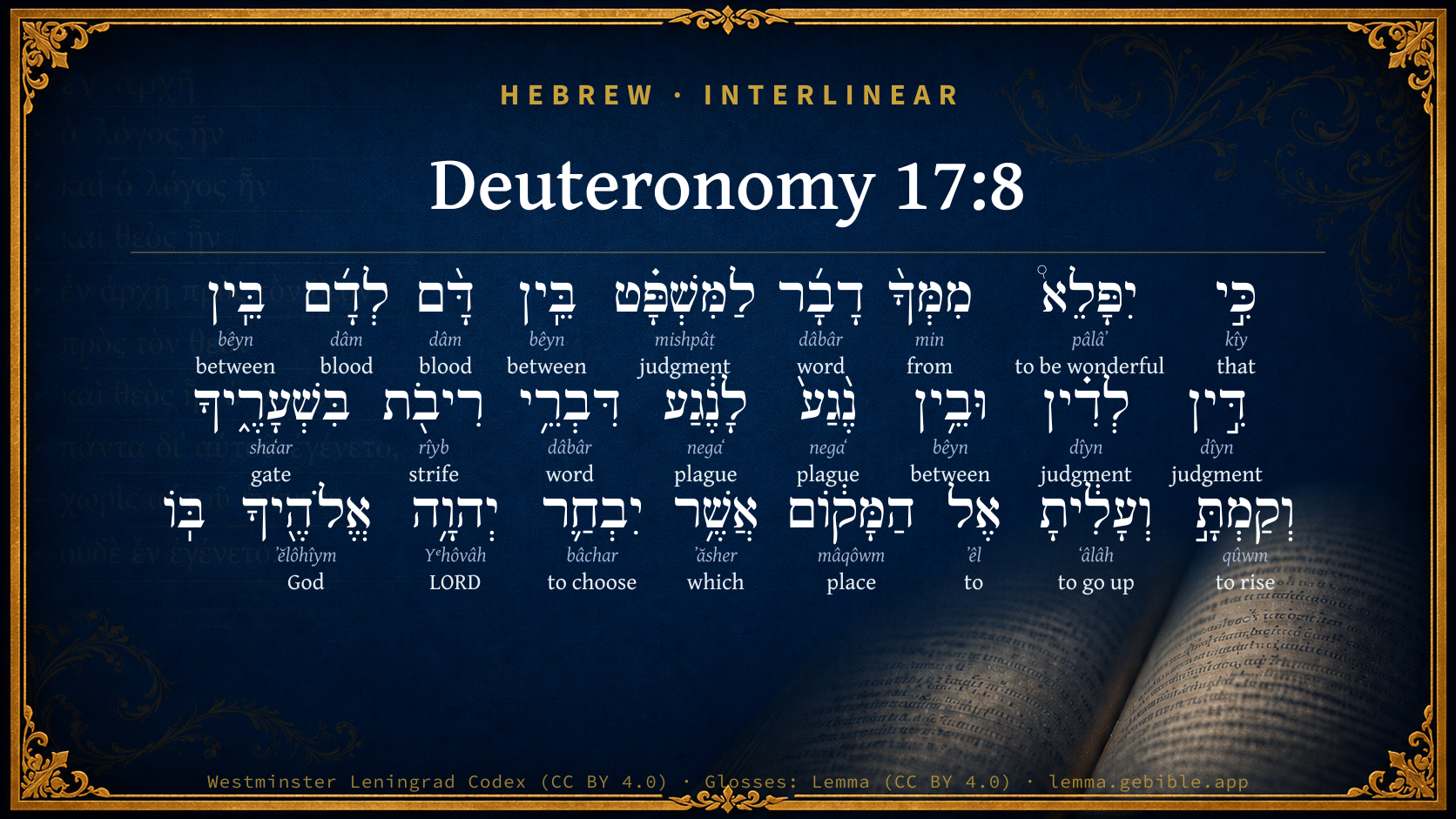
Hebrew (Westminster Leningrad Codex) Deuteronomy 17:8 appears in the Hebrew Old Testament. The text above is from the Westminster Leningrad Codex. Each word links to its Strong’s number, a concise gloss, and parsing drawn from the Open Scriptures Hebrew Bible morphology. Click any word for its full Brown-Driver-Briggs (BDB) entry.
Download image
Cite this verse

Deuteronomy 17:8 (World English Bible). Public Domain. Lemma interlinear Bible study tool, https://lemma.gebible.app/v/deuteronomy/17/8.

Show BibTeX & RIS
BibTeX
RIS
English Translation
If there arise a matter too hard for you in judgment, between blood and blood, between plea and plea, and between stroke and stroke, being matters of controversy within your gates; then shall you arise, and go up to the place which Yahweh your God shall choose;
World English Bible · Public Domain
Highlights
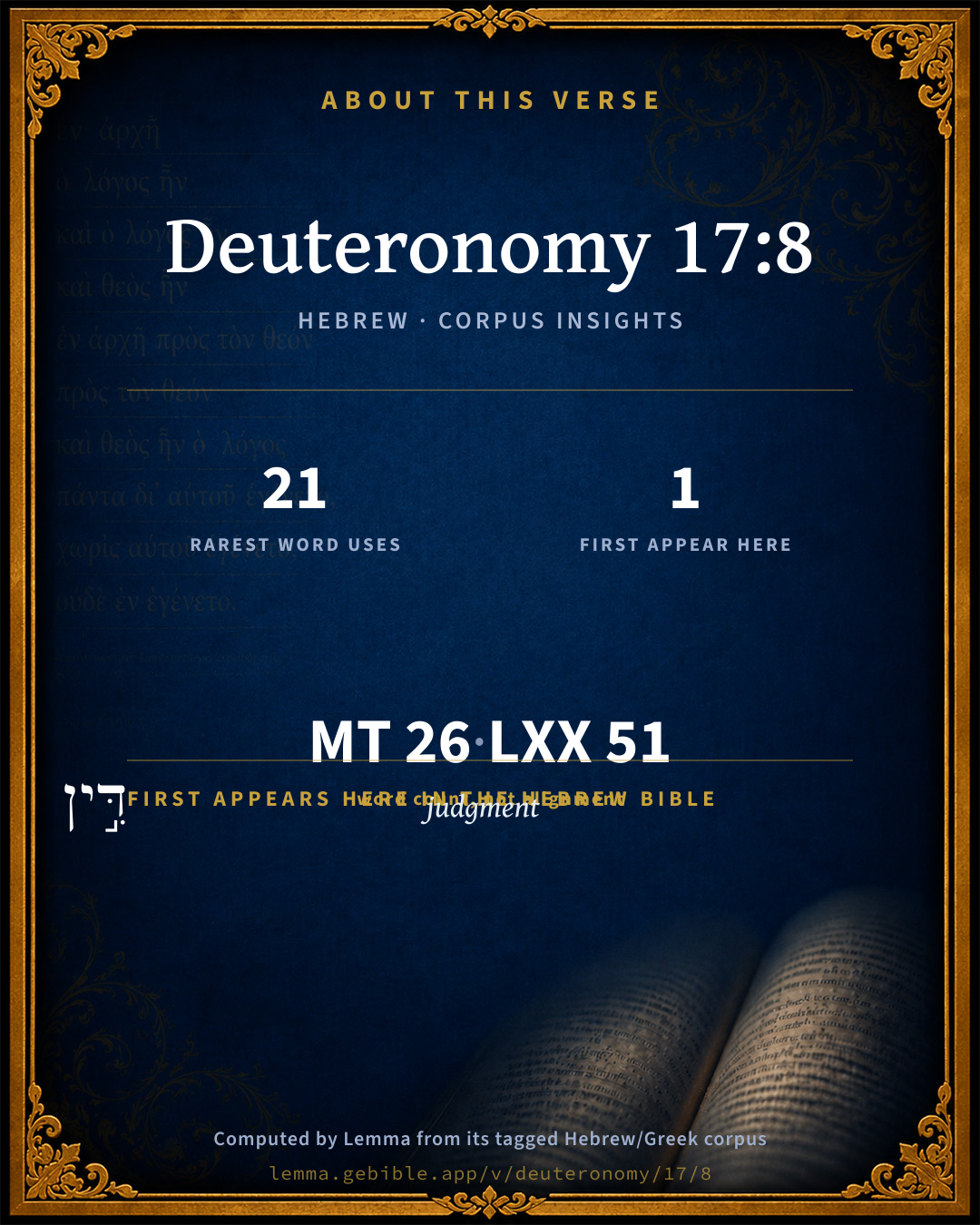
  • 1 first appearance in the Hebrew Bible
Full analysis ↓
Download a study sheet

One document with this verse’s original text, its word-by-word gloss line, the meaning frame, cross-references with their text, attributed commentary, and full source and license credits — printable, and it pastes into notes with its structure intact.

This verse Autodidact and up

Study sheet (.html) Plain text (.txt)

A passage Seminary Student

Up to 50 verses in one chapter. A passage sheet keeps up to 6 commentary sources and 12 cross-references per verse, in the order this page ranks them, and says so on the sheet whenever that leaves anything out. Ask for a single verse and you get the Autodidact verse sheet above.

Everything on this page stays free to read, with no account — the sheet is a download of what is already on screen, not access to it.

Want to remove ads? Support Godless Engineer
Compare translations 3

The same verse in 3 English versions, stacked beneath the original-language interlinear above. Click any original word for its lexicon entry.

Each is an independent rendering of the whole verse — the interlinear is not word-aligned to these translations.

Highlighted words mark where these versions differ — a whole-verse word diff, not a word-by-word alignment.

  • World English Bible Public Domain
    If there arise a matter too hard for you in judgment, between blood and blood, between plea and plea, and between stroke and stroke, being matters of controversy within your gates; then shall you arise, and go up to the place which Yahweh your God shall choose;
  • King James Version Public Domain
    If there arise a matter too hard for thee in judgment, between blood and blood, between plea and plea, and between stroke and stroke, being matters of controversy within thy gates: then shalt thou arise, and get thee up into the place which the LORD thy God shall choose;
  • unfoldingWord Literal Text CC BY-SA 4.0
    If a case is too difficult for you to judge, between blood and blood, between a lawsuit and a lawsuit, and between an assault and an assault, cases of dispute in your gates, then you shall arise and go up to the place which Yahweh your God will choose it.

unfoldingWord Literal Text — © unfoldingWord, licensed CC BY-SA 4.0. Word-aligned USFM3 via Door43 (git.door43.org/unfoldingWord/en_ult).

Versions to compare (up to 4)

3 of 4 selected

Show all 18 translations

Every available English version of this verse, each an independent rendering of the whole verse.

  • World English Bible Public Domain
    If there arise a matter too hard for you in judgment, between blood and blood, between plea and plea, and between stroke and stroke, being matters of controversy within your gates; then shall you arise, and go up to the place which Yahweh your God shall choose;
  • Berean Standard Bible Public Domain
    If a case is too difficult for you to judge, whether the controversy within your gates is regarding bloodshed, lawsuits, or assaults, you must go up to the place the LORD your God will choose.
  • Majority Standard Bible Public Domain
    If a case is too difficult for you to judge, whether the controversy within your gates is regarding bloodshed, lawsuits, or assaults, you must go up to the place the LORD your God will choose.
  • King James Version Public Domain
    If there arise a matter too hard for thee in judgment, between blood and blood, between plea and plea, and between stroke and stroke, being matters of controversy within thy gates: then shalt thou arise, and get thee up into the place which the LORD thy God shall choose;
  • American Standard Version (1901) Public Domain
    If there arise a matter too hard for thee in judgment, between blood and blood, between plea and plea, and between stroke and stroke, being matters of controversy within thy gates; then shalt thou arise, and get thee up unto the place which Jehovah thy God shall choose;
  • Revised Version (1885) Public Domain
    If there arise a matter too hard for thee in judgment, between blood and blood, between plea and plea, and between stroke and stroke, being matters of controversy within thy gates: then shalt thou arise, and get thee up unto the place which the LORD thy God shall choose;
  • Geneva Bible (1599) Public Domain
    If there rise a matter too harde for thee in iudgement betweene blood and blood, betweene plea and plea, betweene plague and plague, in the matters of controuersie within thy gates, then shalt thou arise, and goe vp vnto the place which the Lord thy God shall chuse,
  • Douay-Rheims (1899) Public Domain
    If thou perceive that there be among you a hard and doubtful matter in judgment between blood and blood, cause and cause, leprosy and leprosy: and thou see that the words of the judges within thy gates do vary: arise, and go up to the place, which the Lord thy God shall choose.
  • Young's Literal Translation Public Domain
    `When anything is too hard for thee for judgment, between blood and blood, between plea and plea, and between stroke and stroke -- matters of strife within thy gates -- then thou hast risen, and gone up unto the place on which Jehovah thy God doth fix,
  • Literal Standard Version CC BY-SA 4.0
    When anything is too hard for you for judgment, between blood and blood, between plea and plea, and between stroke and stroke—matters of strife within your gates—then you have risen and gone up to the place on which your God YHWH fixes,
  • Unlocked Literal Bible CC BY-SA 4.0
    If a matter arises that is too hard for you to judge—perhaps a question of murder or accidental death, of one person's right and another person's right, or a question of one kind of harm done, or another kind of matter, matters of controversy within your city gates—then you must go up to the place that Yahweh your God will choose as his sanctuary.
  • unfoldingWord Literal Text CC BY-SA 4.0
    If a case is too difficult for you to judge, between blood and blood, between a lawsuit and a lawsuit, and between an assault and an assault, cases of dispute in your gates, then you shall arise and go up to the place which Yahweh your God will choose it.
  • Darby Bible Public Domain
    If there arise a matter too hard for thee in judgment, between blood and blood, between cause and cause, and between stroke and stroke, matters of controversy within thy gates, then shalt thou arise, and go up to the place which Jehovah thy God will choose.
  • World Messianic Bible Public Domain
    If there arises a matter too hard for you in judgment, between blood and blood, between plea and plea, and between stroke and stroke, being matters of controversy within your gates, then you shall arise, and go up to the place which the LORD your God chooses.
  • Webster's Bible Public Domain
    If there shall arise a matter too hard for thee in judgment, between blood and blood, between plea and plea, and between stroke and stroke, being matters of controversy within thy gates: then shalt thou arise, and go up to the place which the LORD thy God shall choose;
  • Free Bible Version CC BY-SA 4.0
    If there's a case before your town court that is too problematic for you to settle, whether the argument is over murder or manslaughter, one legal decision against another, or different degrees of assault, you must take the issue to the place the Lord your God will choose.
  • Bible in Basic English Public Domain
    If you are not able to give a decision as to who is responsible for a death, or who is right in a cause, or who gave the first blow in a fight, and there is a division of opinion about it in your town: then go to the place marked out by the Lord your God;
  • JPS Tanakh (1917) Public Domain
    If there arise a matter too hard for thee in judgment, between blood and blood, between plea and plea, and between stroke and stroke, even matters of controversy within thy gates; then shalt thou arise, and get thee up unto the place which the LORD thy God shall choose.

Literal Standard Version (2020), Covenant Press — licensed CC BY-SA 4.0. Text via the HelloAO Bible API (eBible.org). Unlocked Literal Bible (unfoldingWord) — licensed CC BY-SA 4.0. Text via the HelloAO Bible API (eBible.org). unfoldingWord Literal Text — © unfoldingWord, licensed CC BY-SA 4.0. Word-aligned USFM3 via Door43 (git.door43.org/unfoldingWord/en_ult). Free Bible Version, Dr. Jonathan Gallagher — licensed CC BY-SA 4.0. Text via the HelloAO Bible API (eBible.org).

Word by word

More ways to search: Search by grammar → Find every occurrence → Compare this word →

Practice this passage: Drill this verse → Learn its vocabulary →

דִּ֣ין
dîyn
H1779
“judgment”
Noun, Common, Masculine, Singular, Absolute
Part of Speech
Noun
Type
Common
Gender
Masculine
Number
Singular
State
Absolute
Full BDB Definition

Origin: from H1777

TWOT: 426a

judgment - judgment - cause, plea - condemnation, judgment - dispute, legal suit, strife - government
  1. כִּ֣י kîy H3588 “that” Conjunction
  2. יִפָּלֵא֩ pâlâʼ H6381 “to be wonderful” Verb, Niphal, Imperfect, 3rd Person, Masculine, Singular
  3. מִמְּךָ֨ min H4480 “from · you” Preposition + Suffix, Personal, 2nd Person, Masculine, Singular
  4. דָבָ֜ר dâbâr H1697 “word” Noun, Common, Masculine, Singular, Absolute
  5. לַמִּשְׁפָּ֗ט mishpâṭ H4941 “to/for the · judgment” Preposition, Determined + Noun, Common, Masculine, Singular, Absolute
  6. בֵּֽין bêyn H996 “between” Preposition
  7. דָּ֨ם dâm H1818 “blood” Noun, Common, Masculine, Singular, Absolute
  8. לְדָ֜ם dâm H1818 “to/for · blood” Preposition + Noun, Common, Masculine, Singular, Absolute
  9. בֵּֽין bêyn H996 “between” Preposition
  10. לְדִ֗ין dîyn H1779 “to/for · judgment” Preposition + Noun, Common, Masculine, Singular, Absolute
  11. וּבֵ֥ין bêyn H996 “and · between” Conjunction + Preposition
  12. נֶ֨גַע֙ negaʻ H5061 “plague” Noun, Common, Masculine, Singular, Absolute
  13. לָנֶ֔גַע negaʻ H5061 “to/for · plague” Preposition + Noun, Common, Masculine, Singular, Absolute
  14. דִּבְרֵ֥י dâbâr H1697 “words of” Noun, Common, Masculine, Plural, Construct
  15. רִיבֹ֖ת rîyb H7379 “disputes” Noun, Common, Both, Plural, Absolute
  16. בִּשְׁעָרֶ֑יךָ shaʻar H8179 “in/at · gates · your” Preposition + Noun, Common, Masculine, Plural, Construct + Suffix, Personal, 2nd Person, Masculine, Singular
  17. וְקַמְתָּ֣ qûwm H6965 “and · to rise” Conjunction + Verb, Qal, Sequential Perfect, 2nd Person, Masculine, Singular
  18. וְעָלִ֔יתָ ʻâlâh H5927 “and · to go up” Conjunction + Verb, Qal, Sequential Perfect, 2nd Person, Masculine, Singular
  19. אֶל ʼêl H413 “to” Preposition
  20. הַמָּק֔וֹם mâqôwm H4725 “the · place” Particle, Definite Article + Noun, Common, Masculine, Singular, Absolute
  21. אֲשֶׁ֥ר ʼăsher H834 “which” Particle, Relative
  22. יִבְחַ֛ר bâchar H977 “to choose” Verb, Qal, Imperfect, 3rd Person, Masculine, Singular
  23. יְהוָ֥ה Yᵉhôvâh H3068 “LORD” Noun, Proper
  24. אֱלֹהֶ֖יךָ ʼĕlôhîym H430 “God(s) · your” Noun, Common, Masculine, Plural, Construct + Suffix, Personal, 2nd Person, Masculine, Singular

About this verse

These counts appear in no published source. They are computed here, from the morphology-tagged text and Lemma’s own curated glosses. What Lemma adds →

26
words
19
distinct lemmas
Pentateuch
section

Notable vocabulary

The rarest word here is דִּ֣ין judgment H1779 — appearing just 21 times in the whole Hebrew Bible.

First appearance in Scripture

This word makes its first canonical appearance in the Hebrew Bible here:

  • דִּ֣ין judgment H1779

Shared distinctive vocabulary

דִּ֣ין judgment H1779 occurs in 17 verses of the Hebrew Bible. Also found in:

Grammatical profile

  • 4 verbs
  • 14 nouns
  • 6 prepositions
  • 1 conjunction
  • 1 particle

Verb forms

  • יִפָּלֵא֩ Niphal · Imperfect
  • וְקַמְתָּ֣ Qal · Sequential Perfect
  • וְעָלִ֔יתָ Qal · Sequential Perfect
  • יִבְחַ֛ר Qal · Imperfect

Repetition

Words recur within this verse — often emphatic in Hebrew:

  • בֵּֽין between H996 ×3
  • דָבָ֜ר word H1697 ×2
  • דָּ֨ם blood H1818 ×2
  • דִּ֣ין judgment H1779 ×2
  • נֶ֨גַע֙ plague H5061 ×2

Hebrew & Septuagint length

In English translation the verse runs 47 words from the Hebrew and 37 from the Septuagint (LXX English) — closely comparable.

A rough comparison of the two English renderings, which tokenize alike — not a word-level alignment.

Word counts can differ between the Hebrew and the Greek without any difference in meaning — e.g. the Hebrew direct-object marker אֵת has no separate Greek word, and Greek often adds the article ὁ.

In the original languages it is 26 Hebrew tokens and 51 Greek tokens — but the two are counted differently (Hebrew bundles its prefixes and suffixes into one token; the Greek is in lemma form), so that isn’t a like-for-like length.

Cross-references

19

Topical passages linked to Deuteronomy 17:8 in the Treasury of Scripture Knowledge — connected by theme and wording, ordered by reader-vote popularity; previews shown in the World English Bible.

  • Deuteronomy 12:5 But to the place which Yahweh your God shall choose out of all your tribes, to put his name there, even to his habitation shall you seek, and there you shall come;
  • Haggai 2:11 "Thus says Yahweh of Hosts: Ask now the priests concerning the law, saying,
  • Deuteronomy 1:17 You shall not show partiality in judgment; you shall hear the small and the great alike; you shall not be afraid of the face of man; for the judgment is God's: and the cause that is too hard for you, you shall bring to me, and I will hear it.
  • Exodus 18:26 They judged the people at all times. They brought the hard causes to Moses, but every small matter they judged themselves.
  • Exodus 21:12–14 "One who strikes a man so that he dies shall surely be put to death,
  • Exodus 21:20 "If a man strikes his servant or his maid with a rod, and he dies under his hand, he shall surely be punished.
  • Exodus 21:22 "If men fight and hurt a pregnant woman so that she gives birth prematurely, and yet no harm follows, he shall be surely fined as much as the woman's husband demands and the judges allow.
  • Exodus 21:28 "If a bull gores a man or a woman to death, the bull shall surely be stoned, and its flesh shall not be eaten; but the owner of the bull shall not be held responsible.
  • Exodus 22:2 If the thief is found breaking in, and is struck so that he dies, there shall be no guilt of bloodshed for him.
  • Numbers 35:11 then you shall appoint you cities to be cities of refuge for you, that the manslayer who kills any person unwittingly may flee there.
  • Numbers 35:16 But if he struck him with an instrument of iron, so that he died, he is a murderer: the murderer shall surely be put to death.
  • Numbers 35:19–34 The avenger of blood shall himself put the murderer to death: when he meets him, he shall put him to death.
  • Deuteronomy 19:4 This is the case of the manslayer, that shall flee there and live: whoever kills his neighbor unawares, and didn't hate him in time past;
  • Deuteronomy 19:17 then both the men, between whom the controversy is, shall stand before Yahweh, before the priests and the judges who shall be in those days;
  • 1 Kings 3:16–28 Then there came two women who were prostitutes, to the king, and stood before him.
  • 2 Chronicles 19:8–10 Moreover in Jerusalem did Jehoshaphat set of the Levites and the priests, and of the heads of the fathers' [houses] of Israel, for the judgment of Yahweh, and for controversies. They returned to Jerusalem.
  • Psalms 122:4–5 Where the tribes go up, even Yah's tribes, According to an ordinance for Israel, To give thanks to the name of Yahweh.
  • Malachi 2:7 For the priest's lips should keep knowledge, and they should seek the law at his mouth; for he is the messenger of Yahweh of Hosts.
  • Deuteronomy 19:10–11 that innocent blood not be shed in the midst of your land, which Yahweh your God gives you for an inheritance, and so blood be on you.

Cross-references courtesy of OpenBible.info (CC BY 4.0).

Hebrew and Greek witnesses Masoretic Hebrew ↔ Greek Septuagint

The same verse in the two great witnesses to the Old Testament, shown verse-for-verse.

These are two independent witnesses, not word-aligned to each other, and the Septuagint is shown in lemma (dictionary) form.

Hebrew Deuteronomy 17:8 Masoretic · Westminster Leningrad Codex

כִּ֣י יִפָּלֵא֩ מִמְּךָ֨ דָבָ֜ר לַמִּשְׁפָּ֗ט בֵּֽין דָּ֨ם לְדָ֜ם בֵּֽין דִּ֣ין לְדִ֗ין וּבֵ֥ין נֶ֨גַע֙ לָנֶ֔גַע דִּבְרֵ֥י רִיבֹ֖ת בִּשְׁעָרֶ֑יךָ וְקַמְתָּ֣ וְעָלִ֔יתָ אֶל הַמָּק֔וֹם אֲשֶׁ֥ר יִבְחַ֛ר יְהוָ֥ה אֱלֹהֶ֖יךָ בּֽוֹ

If there arise a matter too hard for you in judgment, between blood and blood, between plea and plea, and between stroke and stroke, being matters of controversy within your gates; then shall you arise, and go up to the place which Yahweh your God shall choose;

World English Bible · Public Domain

Greek LXX Deuteronomy 17:8 Septuagint · lemma form

ἐάν δέ ἀδυνατέω ἀπό σύ ῥῆμα ἐν κρίσις ἀνά μέσος αἷμα αἷμα καί ἀνά μέσος κρίσις κρίσις καί ἀνά μέσος ἁφή ἁφή καί ἀνά μέσος ἀντιλογία ἀντιλογία ῥῆμα κρίσις ἐν ὁ πόλις σύ καί ἀναἵστημι ἀναβαίνω εἰς ὁ τόπος ὅς ἄν ἐκλέγω κύριος ὁ θεός σύ ἐπικαλέω ὁ ὄνομα αὐτός ἐκεῖ

And if a matter shall be too hard for you in judgment, between blood and blood, and between cause and cause, and between stroke and stroke, and between contradiction and contradiction, matters of judgment in your cities;

LXX2012 (modern English Septuagint) · Public Domain

Hebrew: Westminster Leningrad Codex (CC BY 4.0). Greek: Septuagint (public domain); English from LXX2012 (modern English Septuagint) (Public Domain). How the Septuagint differs from the Hebrew →

Targum (Aramaic paraphrase)

2

The Targum is the ancient Jewish Aramaic paraphrase of the Hebrew Scriptures — an interpretive translation, not the Hebrew text itself. Onkelos (literal) and Pseudo-Jonathan (expansive) render the Torah, and Jonathan the Prophets. Coverage is partial: where no permissively-licensed English translation exists for a verse, only the Aramaic is shown. This is verse-level text, not a word-by-word alignment to the Hebrew.

  1. Targum Onkelos Torah (Genesis–Deuteronomy)
    אֲרֵי יִתְכַסֵי מִנָךְ פִּתְגָמָא לְדִינָא בֵּין דְמָא לִדְמָא בֵּין דִינָא לְדִינָא וּבֵין מַכְתַּשׁ סְגִירוּ לְמַכְתַּשׁ סְגִירוּ פִּתְגָמֵי פְלֻגְתָּא דִינָא בְּקִרְוָיךְ וּתְקוּם וְתִסַק לְאַתְרָא דִי יִתִּרְעֵי יְיָ אֱלָהָךְ בֵּהּ

    (no public-domain English translation for this verse)

    Targum Onkelos — Aramaic: “Onkelos Genesis” (public domain); “Onkelos Exodus” (public domain); “Onkelos Leviticus” (public domain); “Onkelos Numbers” (public domain); “Onkelos Deuteronomy” (public domain). English: “Sefaria Community Translation” (CC0 1.0 (public-domain dedication)); “J.W. Etheridge. The Targums of Onkelos and Jonathan Ben Uzziel on the Pentateuch. London: Longmans, Green, 1862” (public domain). Text via Sefaria.

  2. Targum Pseudo-Jonathan Torah (Genesis–Deuteronomy)
    אֲרוּם יִתְפְּרֵשׁ מִנְכוֹן פִּתְגָמָא לְדִינָא בֵּינֵי אֲדַם סְאוֹב לַאֲדַם דְּכֵי וּבֵינֵי דִינָא נַפְשָׁתָא לְדִינָא מָמוֹנָא וּבֵינֵי מַכְתַּשׁ צוֹרְעָא לְמַכְתַּשׁ נִתְקָא מִלֵי פְּלוּגְתָּא בְּבֵית דִּינֵיכוֹן וּתְקוּמוּן וְתִסְקוּן לְאַתְרָא דְיִתְרְעֵי יְיָ אֱלָהָכוֹן בֵּיהּ

    If there be with you an extraordinary matter for judgment between unclean and clean blood, cases of life or of money, or between a plague of leprosy or of the scall, with words of controversy in your beth din, then you shall arise and go up to the place which the Lord your God will choose;

    Targum Pseudo-Jonathan — Aramaic: “Targum Jonathan on Genesis” (public domain); “Targum Jonathan on Exodus” (public domain); “Targum Jonathan on Leviticus” (public domain); “Targum Jonathan on Numbers” (public domain); “Targum Jonathan on Deuteronomy” (public domain). English: “The Targum of Jonathan ben Uzziel, trans. J. W. Etheridge, London, 1862” (public domain). Text via Sefaria.

Commentary

Notes on Deuteronomy 17:8 from classic Christian and Jewish commentators (each source and its license shown beneath its notes). The classic Christian expositions comment on the surrounding passage and are grouped to its opening verse, so a note may address several verses; the Jewish commentaries on the Tanakh (Rashi and others) are per-verse, so they appear only where the commentator wrote on this verse.

Lemma curates 59 commentaries, every one of them public domain or Creative Commons licensed, each selected and text-cleaned for this edition rather than reprinted as found. About our sources →

Matthew Henry's Commentary

Courts of judgment were ordered to be erected in every city (Deu 16:18), and they were empowered to hear and determine causes according to law, both those which we call pleas of the crown and those between party and party; and we may suppose that ordinarily they ended the matters that were brought before them, and their sentence was definitive; but, 1. It is here taken for granted that sometimes a case might come into their court too difficult for those inferior judges to determine, who could not be thought to be so learned in the laws as those that presided in the higher courts; so that (to speak in the language of our law) they must find a special verdict, and take time to advise before the giving of judgment (Deu 17:8): If there arise a matter too hard for thee in judgment, which it would be no dishonour to the judges to own the difficulty of, - suppose it between blood and blood, the blood of a person which cried and the blood of him that was charged with the murder which was demanded, when it was doubtful upon the evidence whether it was wilful or casual, - or between plea and plea, the plea (that is, the bill or declaration) of the plaintiff and the plea of the defendant, - or between stroke and stroke, in actions of assault and battery; in these and similar cases, thought the evidence were plain, yet doubts might arise about the sense and meaning of the law and the application of it to the particular case. 2. These difficult cases, which hitherto had been brought to Moses, according to Jethro's advice, were, after his death, to be brought to the supreme power, wherever it was lodged, whether in a judge (when there was such an extraordinary person raised up and qualified for that great service, as Othniel, Deborah, Gideon, etc.) or in the high-priest (when he was by the eminency of his gifts called of God to preside in public affairs, as Eli), or, if no single person were marked by heaven for this honour, then in the priests and Levites (or in the priests, who were Levites of course), who not only attended the sanctuary, but met in council to receive appeals from the inferior courts, who might reasonably be supposed, not only to be best qualified by their learning and experience, but to have the best assistance of the divine Spirit for the deciding of doubts, Deu 17:9, Deu 17:11, Deu 17:12. They are not appointed to consult the urim and thummim, for it is supposed that these were to be consulted only in cases relating to the public, either the body of the people or the prince; but in ordinary cases the wisdom and integrity of those that sat at the stern must be relied on, their judgment had not the divine authority of an oracle, yet besides the moral certainty it had, as the judgment of knowing, prudent, and experienced men, it had the advantage of a divine promise, implied in those words (Deu 17:9), They shall show thee the sentence of judgment; it had also the support of a divine institution, by which they were made the supreme judicature of the nation. 3. The definitive sentence given by the judge, priest, or great council, must be obeyed by the parties concerned, upon pain of death: Thou shalt do according to their sentence (Deu 17:10); thou shalt observe to do it, thou shalt not decline from it (Deu 17:11), to the right hand nor to the left. Note, It is for the honour of God and the welfare of a people that the authority of the higher power be supported and the due order of government observed, that those be obeyed who are appointed to rule, and that every soul be subject to them in all those things that fall within their commission. Though the party thought himself injured by the sentence (as every man is apt to be partial in is own cause), yet he must needs be subject, must stand to the award, how unpleasing soever, and bear, or lose, or pay, according to it, not only for wrath, but also for conscience' sake. But if an inferior judge contradict the sentence of the higher court and will not execute the orders of it, or a private person refuse to conform to their sentence, the contumacy must be punished with death, though the matter were ever so small in which the opposition was made: That man shall die, and all the people shall hear and fear, Deu 17:12, Deu 17:13. See here, (1.) The evil of disobedience. Rebellion and stubbornness, from a spirit of contradiction and opposition of God, or those in authority under him, from a principle of contempt and self-willedness, are as witchcraft and idolatry. To differ in opinion from weakness and infirmity may be excused and must be borne with; but to do so presumptuously, in pride and wickedness (as the ancient translations explain it), this is to take up arms against the government, and is an affront to him by whom the powers that be are ordained. (2.) The design of punishment: that others may hear and fear, and not do the like. Some would be so considerate as to infer the heinousness of the offence from the grievousness of the penalty, and therefore would detest it; and others would so far consult their own safety as to cross their humours by conforming to the sentence rather than to sin against their own heads, and forfeit their lives by going contrary to it. From this law the apostle infers the greatness of the punishment of which those will be thought worthy that trample on the authority of the Son of God, Heb 10:28, Heb 10:29.

Matthew Henry's Commentary on the Whole Bible (1708–1710) — public domain (CC PDM 1.0). Text via the HelloAO Bible API.

Jamieson, Fausset & Brown

Robert Jamieson, A. R. Fausset & David Brown

THE PRIESTS AND JUDGES TO DETERMINE CONTROVERSIES. (Deu 17:8-13)

If there arise a matter too hard for thee in judgment--In all civil or criminal cases, where there was any doubt or difficulty in giving a decision, the local magistrates were to submit them by reference to the tribunal of the Sanhedrim--the supreme council, which was composed partly of civil and partly of ecclesiastical persons. "The priests and Levites," should rather be "the priests--the Levites"; that is, the Levitical priests, including the high priest, who were members of the legislative assembly; and who, as forming one body, are called "the judge." Their sittings were held in the neighborhood of the sanctuary because in great emergencies the high priest had to consult God by Urim (Num 27:21). From their judgment there was no appeal; and if a person were so perverse and refractory as to refuse obedience to their sentences, his conduct, as inconsistent with the maintenance of order and good government, was then to be regarded and punished as a capital crime.

Jamieson, Fausset & Brown — Commentary Critical and Explanatory on the Whole Bible (1871) — public domain (CC PDM 1.0). Text via the HelloAO Bible API.

Ellicott's Commentary for English Readers

Deu_17:8-20. THE SUPREMACY IN ISRAEL OF THE WRITTEN LAW OF GOD.

(8) If there arise a matter too hard for thee.—Literally, too wonderful.

Between blood and blood, between plea and plea, and between stroke and stroke.—The “blood” and the “plea” seem to indicate criminal and civil cases. The word “stroke” is the common word for “plague” in the Pentateuch and elsewhere. It may possibly refer to cases of ceremonial purity or impurity, especially in reference to disease. There is an evident allusion to this law in the history of King Jehoshaphat (2Ch_19:8-10). There the words are “between blood and blood, between law and commandment, statutes and judgments.” The questions are (1) between two contending parties; (2) between the law as a general rule and its application to particular duties, institutions and requirements. Other passages in the same chapter recall Deu_16:18-20.

Matters of controversy within thy gates—i.e., in the local courts of their several cities. The “gate” was the place of judgment. In 2Ch_19:10, the phrase is more clearly expressed, thus, “what cause soever shall come unto you of your brethren that dwell in their cities.”

Into the place which the Lord thy God shall choose.—This implies what was afterwards ordered before Moses’ death, that the standard copy of the Law would be kept beside the Ark of the Covenant, in the sacred place (Deu_31:26).

(9) Thou shalt come unto the priests the Levites—i.e., “the priests that come of the tribe of Levi” (Rashi). Some modern critics say the writer of Deuteronomy knew no distinction between priests and Levites; but see above on Deu_11:6, and also the notes on Deu_31:9; Deu_31:25.

The priests, the Levites, and . . . the judge.—The order agrees exactly with the constitution which Moses left behind him at his death. This has been already indicated in Num_27:15-21. Joshua was to “stand before Eleazar.” Eleazar was to ask counsel from Jehovah, and at his word Joshua and all the people were to go in and out. The order, when the two are mentioned together in the Book of Joshua, is invariably “Eleazar the priest and Joshua the son of Nun,” not vice versâ. The priests are the custodians of the Law; the judge or chief magistrate is the executor of it. (Comp. Mal_2:7-8.) The principle is not altered by the substitution of a king for the judge, or by the addition of a prophet.

That shall be in those days.—Rashi and the New Testament are curiously agreed in the application of this part of the commandment. Our Lord, in Mat_23:2-3, says of the Scribes and Pharisees (the judges of His day) that they “sit in Moses’ seat: All therefore whatsoever they bid you observe, that observe and do.” Rashi says here, “Although he is not like the rest of the judges that were before him, thou must hearken to him. There is no judge for thee except the judge that is in thy days.”

(9-11) And they shall shew thee the sentence of judgment . . . According to the sentence of the law . . . thou shalt do.—This passage should be carefully noted. The function of the priest and judge was to show, inform, teach, and tell the applicant the sentence of the law, i.e., of the written law. The four English verbs have only three equivalents in Hebrew, viz., tell, teach and say. It is not sufficiently observed that this defines the relation between the Church and the Bible from the time the Law (which was the germ of the Bible) was delivered to the Church, and that the relation between the Church and the Bible is the same to this day. The only authority wherewith the Church (of Israel, or of Christ) can “bind” or “loose,” is the written Law of God. The binding (or forbidding) and loosing (or permitting) of the Rabbis—the authority which our Lord committed to His Church—was only the application of His written word. The Rabbis acknowledge this from one end of the Talmud to the other by the appeal to Scripture which is made in every page, sometimes in almost every line. The application is often strained or fanciful; but that does not alter the principle. The written word is the chain that binds. Nor does the varying relation between the executive and legislative authority alter the principle. Where the law of Jehovah is the law of the land, death may be the penalty of disobedience. Where it is only the law of the Christian community, exclusion may be the extreme penalty that is possible. But still the relation between the written word and the ministers of the Church is the same. The Church is the “witness and keeper of Holy Writ,” and can only shew from thence the sentence of judgment. The sentence is an application of the law, not a mere invention of the authorities themselves; and it would be easy to show from history how every misapplication of the Divine code brought with it surely, sooner or later, its own refutation, and the overthrow of the unfaithful government. The prophets not seldom took the place of tribunes of the people in cases of oppression. No one lifted up a more distinct protest from the law itself against the misapplication of the law than the Prophet like unto Moses, who formally acknowledged the authority of them that sat in Moses’ seat.[3]

[3] Manifestly, when copies of the Law were scarce, and when a good deal of it, like this Book of Deuteronomy, was general, and even prophetic, a board of authorised interpreters, or appliers, of the law to matters of detail was an absolute necessity. (See Introduction to Deuteronomy for more on this head.)

(12) And the man that will do presumptuously . . . shall die.—This word “presumptuously” occurs for the first time in this place. (See also Deu_18:22.) It is connected with “pride,” and denotes a proud self-assertion against the law. The penalty of death arises necessarily out of the theocracy. If God is the king of the nation, rebellion against His law is treason, and if it be proud and wilful rebellion, the penalty of death is only what we should expect to see inflicted. As soon as the law of Jehovah is in any way separated from the law of the land, this state of things may be altered. It is remarkable that in Ezra’s commission from Artaxerxes we find permission to identify the law of Jehovah with the law of the Persian empire to the full extent of this precept, “Whosoever will not do the law of thy God, and the law of the king, let judgment be executed speedily upon him, whether it be unto death, banishment, confiscation of goods, or imprisonment” (Ezr_7:25-26.) But such penalties, except in a theocratic government, are obviously out of place in matters connected with religion.

A Bible Commentary for English Readers, edited by Charles John Ellicott (1878–1897) — public domain. Text from a community e-Sword module.

The Cambridge Bible for Schools and Colleges

gen. ed. J. J. S. Perowne

8. If there arise a matter too hard for thee] Heb. if a matter be too wonderful (or extraordinary) for thee; cp. Deu_22:11. In Deu_1:17, and Exo_18:22; Exo_18:26 (E), hard translates other Heb. words.

between blood and blood] i.e. between accidental manslaughter and wilful murder, Deu_4:42, Deu_19:4 f., Deu_19:11 f.; E, Exo_21:12-14.

between plea and plea] Probably questions of property, as in Exo_22:1 ff., etc.

between stroke and stroke] Questions of compensation for bodily injuries, such as are defined in E, Exo_21:18 ff.

matters of controversy within thy gates] Summary of the previous clauses—all local cases. See on Deu_12:12, Deu_16:18.

get thee up] Of resort to the Sanctuary, 1Sa_1:3, etc., Psa_122:4.

the place, etc.] See on Deu_12:5.

8–13. Of the Judges of Final Appeal

Local cases too hard for the local courts (see Deu_16:18-20, on which this passage immediately follows) are to be taken before the Priests, the Levites at the Sanctuary, and the Judge of the time (Deu_17:8 f.), whose decisions must be strictly obeyed (Deu_17:10 f.); the man who presumptuously refuses to obey shall die (Deu_17:12 f.).—Sg. address. The association of a lay judge with the priests is remarkable. Because of this and because he regards Deu_17:8 b and Deu_17:9 a as doublets and Deu_17:10 and Deu_17:11 as another pair of doublets, Steuern. analyses the passage into two originally distinct laws (with editorial additions), one constituting the Priests of the Altar a court of appeal, the other recognising the Judge (i.e. the King) as the final authority. But Deu_17:8 b and Deu_17:9 a are not doublets, and although Deu_17:10 and Deu_17:11 are redundant it is impossible to discriminate in them two distinct sources. More probably the passage is intended to sanction the double practice prevailing in Israel from the earliest times, and during the monarchy, of the discharge of justice by both the priestly and the civil heads of the people. How the authority was divided is nowhere stated except in 2Ch_19:8-11, which attributes to King Jehoshaphat (873–849) the institution of a double court consisting of Levites, priests, and heads of families. Over this the chief priest was set in all the matters of Jehovah, and a prince was set over it in all the King’s matters. But it is uncertain whether the passage merely reflects the procedure of justice in the Chronicler’s own day or is a genuine memory of that which prevailed under the monarchy. See the present writer’s Jerusalem, i. 379 n., 387 f.

The Cambridge Bible for Schools and Colleges (gen. ed. J. J. S. Perowne; Cambridge University Press, 1878–1918) — public domain. Text from a community e-Sword module.

Trapp's Complete Commentary

John Trapp

Deu 17:8 If there arise a matter too hard for thee in judgment, between blood and blood, between plea and plea, and between stroke and stroke, [being] matters of controversy within thy gates: then shalt thou arise, and get thee up into the place which the LORD thy God shall choose;

Ver. 10. According to all that they inform thee,] viz., Agreeable to the sentence of the law. {Deu 17:11} The Jews from this text foolishly seek footing for their traditions, which they so much magnify. {Mat 15:1-2}

John Trapp, A Commentary or Exposition upon All the Books of the Old and New Testament (1647–1656) — public domain. Text from a community e-Sword module.

Albert Barnes' Notes on the Bible

The cases in question are such as the inferior judges did not feel able to decide satisfactorily, and which accordingly they remitted to their superiors (compare Exo 18:23-27).

The Supreme court Deu 17:9 is referred to in very general terms as sitting at the sanctuary Deu 17:8. “The judge” would no doubt usually be a layman, and thus the court would contain both an ecclesiastical and a civil element. Jehoshaphat 2Ch 19:4-11 organized his judicial system very closely upon the lines here laid down.

Albert Barnes' Notes on the Bible (1834–1885) — public domain. Text from a community e-Sword/MySword module.

Joseph Benson's Commentary

Deu 17:8. If there arise a matter too hard for thee — These words are to be considered as addressed to the ordinary judges, or inferior magistrates, who were appointed in every city. Between blood and blood — That is, in capital causes, whether a man hath committed wilful or casual murder. Between plea and plea — In civil causes, about words or estates, when the question is, whose cause or plea is the better? Between stroke and stroke — In criminal causes; in the case of wounds or blows inflicted by one man upon another, of which see Exo 21:20. Being matters of controversy — That is, such things being doubtful, and the magistrates being divided in their opinions about them. Thou shalt get thee unto the place which the Lord shall choose — Namely, to set up his tabernacle or temple there; because there was the abode, both of their sanhedrim, which was constituted of priests and civil magistrates, and of the high-priests, who were to consult God, by Urim, in matters which could not be decided otherwise.

Joseph Benson's Commentary on the Old and New Testaments (1811–1818) — public domain. Text from a community e-Sword module.

Keil & Delitzsch

C. F. Keil & F. Delitzsch

The Higher Judicial Court at the Place of the Sanctuary. - Just as the judges appointed at Sinai were to bring to Moses whatever cases were too difficult for them to decide, that he might judge them according to the decision of God (Exo 18:26 and Exo 18:19); so in the future the judges of the different towns were to bring all difficult cases, which they were unable to decide, before the Levitical priests and judges at the place of the sanctuary, that a final decision might be given there.

Deu 17:8-9

"If there is to thee a matter too marvellous for judgment (נפלא with מן, too wonderful, incomprehensible, or beyond carrying out, Gen 18:14, i.e., too difficult to give a judicial decision upon), between blood and blood, plea and plea, stroke and stroke (i.e., too hard for you to decide according to what legal provisions a fatal blow, or dispute on some civil matter, or a bodily injury, is to be settled), disputes in thy gates (a loosely arranged apposition in this sense, dispute of different kinds, such as shall arise in thy towns); arise, and get thee to the place which Jehovah thy God shall choose; and go to the Levitical priest and the judge that shall be in those days, and inquire." Israel is addressed here as a nation, but the words are not to be supposed to be directed "first of all to the local courts (Deu 16:18), and lastly to the contending parties" (Knobel), nor "directly to the parties to the suit" (Schultz), but simply to the persons whose duty it was to administer justice in the nation, i.e., to the regular judges in the different towns and districts of the land. This is evident from the general fact, that the Mosaic law never recognises any appeal to higher courts by the different parties to a lawsuit, and that in this case also it is not assumed, since all that is enjoined is, that if the matter should be too difficult for the local judges to decide, they themselves were to carry it to the superior court. As Oehler has quite correctly observed in Herzog's Cyclopaedia, "this superior court was not a court of appeal; for it did not adjudicate after the local court had already given a verdict, but in cases in which the latter would not trust itself to give a verdict at all." And this is more especially evident from what is stated in Deu 17:10, with regard to the decisions of the superior court, namely, that they were to do whatever the superior judges taught, without deviating to the right hand or to the left. This is unquestionably far more applicable to the judges of the different towns, who were to carry out exactly the sentence of the higher tribunal, than to the parties to the suit, inasmuch as the latter, at all events those who were condemned for blood (i.e., for murder), could not possibly be in a position to alter the decision of the court at pleasure, since it did not rest with them, but with the authorities of their town, to carry out the sentence.

Moses did not directly institute a superior tribunal at the place of the sanctuary on this occasion, but rather assumed its existence; not however its existence at that time (as Riehm and other modern critics suppose), but its establishment and existence in the future. Just as he gives no minute directions concerning the organization of the different local courts, but leaves this to the natural development of the judicial institutions already in existence, so he also restricts himself, so far as the higher court is concerned, to general allusions, which might serve as a guide to the national rulers of a future day, to organize it according to the existing models. He had no disorganized mob before him, but a well-ordered nation, already in possession of civil institutions, with fruitful germs for further expansion and organization. In addition to its civil classification into tribes, families, fathers' houses, and family groups, which possessed at once their rulers in their own heads, the nation had received in the priesthood, with the high priest at the head, and the Levites as their assistants, a spiritual class, which mediated between the congregation and the Lord, and not only kept up the knowledge of right in the people as the guardian of the law, but by virtue of the high priest's office was able to lay the rights of the people before God, and in difficult cases could ask for His decision. Moreover, a leader had already been appointed for the nation, for the time immediately succeeding Moses' death; and in this nomination of Joshua, a pledge had been given that the Lord would never leave it without a supreme ruler of its civil affairs, but, along with the high priest, would also appoint a judge at the place of the central sanctuary, who would administer justice in the highest court in association with the priests. On the ground of these facts, sit was enough for the future to mention the Levitical priests and the judge who would be at the place of the sanctuary, as constituting the court by which the difficult questions were to be decided.

(Note: The simple fact, that the judicial court at the place of the national sanctuary is described in such general terms, furnishes a convincing proof that we have here the words of Moses, and not those of some later prophetic writer who had copied the superior court at Jerusalem of the times of the kings, as Riehm and the critics assume.)

For instance, the words themselves show distinctly enough, that by "the judge" we are not to understand the high priest, but the temporal judge or president of the superior court; and it is evident from the singular, "the priest that standeth to minister there before the Lord" (Deu 17:12), that the high priest is included among the priests. The expression "the priests the Levites" (Levitical priests), which also occurs in Deu 17:18; Deu 18:1; Deu 21:5; Deu 24:8; Deu 27:9; Deu 31:9, instead of "sons of Aaron," which we find in the middle books, is quite in harmony with the time and character of the book before us. As long as Aaron was living with his sons, the priesthood consisted only of himself and his sons, that is to say, of one family. Hence all the instructions in the middle books are addressed to them, and for the most part to Aaron personally (vid., Ex 28 and 29; Lev 8-10; Num 18:1, etc.). This as all changed when Aaron died; henceforth the priesthood consisted simply of the descendants of Aaron and his sons, who were no longer one family, but formed a distinct class in the nation, the legitimacy of which arose from its connection with the tribe of Levi, to which Aaron himself had belonged. It was evidently more appropriate, therefore, to describe them as sons of Levi than as sons of Aaron, which had been the title formerly given to the priests, with the exception of the high priest, viz., Aaron himself. - In connection with the superior court, however, the priests are introduced rather as knowing and teaching the law (Lev 10:11), than as actual judges. For this reason appeal was to be made not only to them, but also to the judge, whose duty it was in any case to make the judicial inquiry and pronounce the sentence. - The object of the verb "inquire" (Deu 17:9) follows after "they shall show thee," viz., "the word of right," the judicial sentence which is sought (Ch2 19:6).

Deu 17:10-11

They shall do "according to the sound of the word which they utter" (follow their decision exactly), and that "according to the sound of the law which they teach," and "according to the right which they shall speak." The sentence was to be founded upon the Thorah, upon the law which the priests had to teach.

Deu 17:12-13

No one was to resist in pride, to refuse to listen to the priest or to the judge. Resistance to the priest took place when any one was dissatisfied with his interpretation of the law; to the judge, when any one was discontented with the sentence that was passed on the basis of the law. Such refractory conduct was to be punished with death, as rebellion against God, in whose name the right had been spoken (Deu 1:17). (On Deu 17:13, see Deu 13:12.)

Keil & Delitzsch — Biblical Commentary on the Old Testament (1861–1891) — public domain (CC PDM 1.0). Text via the HelloAO Bible API. (Old Testament only.)

Tyndale Open Study Notes

Tyndale Open Resources

17:8 whether someone is guilty of murder or only of manslaughter: In Old Testament law, as in modern jurisprudence, murder was intentional, manslaughter was accidental (cp. 19:1-13).

Tyndale Open Study Notes — © Tyndale Open Resources, licensed CC BY-SA 4.0. Text via the HelloAO Bible API.

Adam Clarke's Commentary

Verse 8. If there arise a matter too hard for thee] These directions are given to the common magistrates, who might not be able to judge of or apply the law in all cases that might be brought before them. The priests and Levites, who were lawyers by birth and continual practice, were reasonably considered as the best qualified to decide on difficult points.

Adam Clarke's Commentary on the Bible (1810–1826) — public domain. Text from a community e-Sword/MySword module.

John Gill's Exposition

If there arise a matter too hard for thee in judgment,.... This is spoken to inferior judges in cities in the country, who sometimes might have cases too wonderful and mysterious, as the word signifies, or secret and hidden, such as were out of their reach and beyond their capacity, and so be very difficult for them to determine what should be done:

between blood and blood; that is, whether a man is guilty of shedding innocent blood or not; when such a case is depending between a person charged with it and the relatives of the deceased, or between a man slayer and the avenger of blood, and the question is, whether he may have the benefit of a city of refuge or not, and there are some circumstances attending it which make it difficult how to determine:

between plea and plea; of the plaintiff on one side and of the defendant on the other, and both have so much to say in their own cause, that it is hard to decide which is in the right and which is in the wrong, whether in capital or pecuniary cases; it chiefly if not solely respects civil things in controversy:

and between stroke and stroke; blow or wound which one man received from another, and for which he commences a suit of law upon it, Exo 21:18 or for assault and battery; and so Aben Ezra interprets it of blows and bruises; but the Jewish writers generally interpret it of the plague, or stroke of leprosy; so the Targums of Jonathan and Jerusalem; but the examination of such a case did not belong to the civil magistrate, but to a priest; nor was such a person had up to Jerusalem to be searched, but was shut up in a house until further evidence could be got; and, besides, the signs of the leprosy are so distinctly given, that at waiting a proper time, there was seldom or ever any difficulty about determining it:

being matter of controversy within thy gates; or what are matters of controversy about anything else; for the phrase is general, as Aben Ezra observes, and takes in everything in which anything difficult might occur; so Jarchi interprets it of things which the wise men of a city are divided about; one pronounces a person or thing unclean, another clean, one condemning and another justifying, and so far rightly; for this respects not controversies between men, that may be brought into courts of judicature, but controversies or divisions arising in these courts upon them, between the judges themselves, they not agreeing in their opinions:

then shalt thou arise and get thee up into the place which the Lord thy God shall choose; to Jerusalem, to the great sanhedrim or court of judicature, to which the inferior judges were to apply themselves, in matters of moment and difficulty, for instruction, information, and direction; it being supposed that in such a court such like cases may have been brought before them, and they were expert and understanding in them.

John Gill's Exposition of the Whole Bible (1746–1763) — public domain (CC PDM 1.0). Text via the HelloAO Bible API.

Haydock's Catholic Bible Commentary

If thou perceive, &c. Here we see what authority God was pleased to give to the church-guides of the Old Testament, in deciding, without appeal, all controversies relating to the law; promising that they should not err therein; and punishing with death such as proudly refused to obey their decisions: and surely he has not done less for the church-guides of the New Testament. (Challoner) --- Hard. Hebrew also means, "doubtful, hidden, divided;" so that the opinions of the judges do not agree. In matters of fact, the thing is more easily investigated on the spot. But in these cases, where the law is ambiguous, as even the divine ordinances frequently are, being delivered in human language, (Grotius) a living judge is necessary. God remits the Jews in the council of the priests, at the head of whom was the sovereign pontiff, who was the natural and supreme judge of such difficulties, ver. 9, 12. (Haydock) --- And blood, to decide when murder must be punished with death, and when the right of an asylum may be claimed. (Calmet) --- The Vulgate renders the same words, 2 Paralipomenon xix. 10. --- Between kindred and kindred, as the different degrees cause many embarrassments, with regard to marriages, &c. (Tirinus) --- The Rabbins understand that the judge had to declare when a woman was rendered unclean, Leviticus xii. 4. (Lyranus) --- And cause, or law-suit; some thinking that a greater sum for reparation of an injury should be required, others judging that one of the contending parties should be set at liberty, while the other judges are of a contrary sentiment. Hebrew, "between judgment and judgment," when a doubt arises whether laymen or the Levites may be the proper judges. The Rabbins only remit three cases to the tribunal of the latter, respecting, 1. The red heifer; 2. the woman accused of adultery by her jealous husband; 3. the heifer to be offered in sacrifice, for a murder committed by a person unknown, chap. xxi. 5. --- And leprosy. Various difficulties might arise concerning this matter, of which the priests had to pass sentence, Leviticus xiii. Some render the Hebrew negah, "wound." The law of retaliation required a scrupulous nicety. Blood, cause, and leprosy, may denote lawsuits of a criminal, less important, and ceremonial nature. (Jansenius) --- Vary. Hebrew, "which are matters of contention within thy gates."

George Leo Haydock (1774–1849), Haydock's Catholic Family Bible and Commentary, 1859 edition — public domain. Excludes Psalms (Douay-Rheims chapter numbering differs from Protestant) and Deuterocanonical books (Catholic canon only).

Matthew Poole's English Annotations

Too hard for thee; he speaks to the inferior magistrates, who were erected in several cities, as appears by the opposition of these to them at Jerusalem. If, saith he, thou hast not skill or confidence to determine so weighty and difficult a cause.

Between blood and blood, i.e. in capital causes in matter of bloodshed, whether it be wilful or casual murder, whether punishable or pardonable by those laws, Exo 21:13,20,22,28; 22:2; Num 35:11,16,19; Deu 19:4,10.

Between plea and plea; in civil causes or suits between plaintiffs and defendants about words or estates.

Between stroke and stroke, i.e. either first in ceremonial causes,

between plague and plague, between the true leprosy, which is ofttimes called the plague, and the seeming and counterfeit leprosy, which was oft-times hard to determine. And under this, as the most eminent of the kind, may seem to be contained all ceremonial uncleannesses. But this seems not probable,

1. Because the final determination of the matter of leprosy is manifestly left to any particular priest, Le 13 14.

2. Because the person suspected of leprosy was not to be brought to Jerusalem, to be tried there, but was to be shut up in his own city and house, Lev 13:4,5; and the judges at Jerusalem neither could nor would determine his case without once seeing the person.

3. Because the case of leprosy was not hard or difficult, as those causes are said to be, but plain and evident, and so particularly and punctually described, that the priest needed only eyes to decide it. Or rather,

2. In criminal causes, concerning blows or wounds inflicted by one man upon another, and to be requited to him by the sentence of the magistrate according to that law, Exo 21:23-25, wherein there might be many cases of great difficulty and doubt, about which see the annotations there.

Matters of controversy, i.e. such things or matters of blood and pleas and strokes being doubtful, and the magistrates divided in their opinions about it; for if it was a clear case, this was not to be done. Some make this an additional clause to comprehend these and all other things, thus as if he had said, and in general,

any words or matters of strifes or contentions.

1. Which the Lord shall choose, to wit, to set up his worship and tabernacle or temple there; because there was the abode, both of their sanhedrim, or chief council, which was constituted of priests and civil magistrates, who were most able to determine all controversies, and of the high priests, who were to consult God by Urim, Num 27:21, in great matters, which could not be decided otherwise.

Matthew Poole's English Annotations on the Holy Bible (1683–1685) — public domain. Text from a community e-Sword/MySword module.

Whedon's Commentary on the Bible

Daniel D. Whedon

8. If there arise a matter too hard for thee — The meaning evidently is this: In cases where it is difficult to decide, as to a fatal blow or in disputes about civil matters, or in cases of bodily injury, the subject must be referred for adjudication to this high judicial court. The judges appointed at Sinai were to bring to Moses such cases as they found it impossible to decide.

So after the people became settled in the land there was to be a place for the final adjudication of difficult cases. This was not an appeal from the parties involved, but a referring of the matter by the local judges.

Daniel D. Whedon (gen. ed.), Commentary on the Old and New Testaments (1874–1909) — public domain. Text from a community e-Sword module.

The Pulpit Commentary

Vers. 8-13. So long as Moses was with the people, they had in him one to whom, in the last resort, eases might be brought for decision which were found too difficult for the ordinary judges. (Exo_18:19-26) But, as he was not to be always with them, it was needful to provide a supreme court, to which such cases might be carried when they could no longer be decided by him; and such a court is here appointed to be held at the sanctuary.

A matter too hard for thee; literally, too marvelous; something extraordinary, and which could not be decided by the ordinary rules of the judicature. Between blood and blood, between plea and plea, and between stroke and stroke; i.e. in cases where blood had been shed and death had ensued, either accidentally or from murderous intent (Exo_21:13, etc.; Num_35:9, etc.) in cases of disputed rights and claims; (cf. 2Ch_19:10) and in cases where corporeal injury had been suffered, whether in strife or from assault; (Exo_21:18, etc.) and, in general, wherever matters of controversy disputes as to what was lawful and right, might arise in their towns and villages. In all such cases recourse was to be had to the court at the sanctuary the priests the Levites," i.e. the priests who were of the tribe of Levi, and to the judge presiding there the lay judge associated with the high priest as president (see Oehler, in Herzog"s "Encyclop.," vol. 5. p. 58). It is not intended by this that an appeal was to lie from the lower court to the higher, or that the parties in a suit might carry it at once to the supreme judge; the meaning rather is that, when the ordinary judges found an ease too difficult for them to deal with, they were themselves to transmit it to the supreme court for decision.

Vers. 8-13. Religion the guard of justice.

In the preceding chapter, vers. 18-20, judges and officers are specified as appointed by Goel to be the guardians of justice and right. The Hebrew is very emphatic in ver. 20, "Justice, justice, shalt thou follow," etc. Manifold complications, however, would be sure to arise as the nation advanced, and as the primitive simplicity of their first settlement passed into more fixed arrangements as to property, etc. In such difficult cases, it might not be easy, and perhaps it would not always be possible, for the judges and shoterim to determine what was just. The legislator is here bidden, therefore, to make provision in case such perplexities should arise. When the people should come to the land which the Lord their God gave them, there would be one place which the Lord would choose to put his Name there. There should "thrones of judgment" sit. The priests, who would have to offer sacrifices and to intercede for the people before God, would also be expected to be so versed in the Law of God, that they could appropriately he regarded as the highest court of appeal, by whose decision the highest sanctions of religion would be brought to declare and enforce "justice, justice." Their decision was held to be given them by light from on high. And when such decision was in accordance with the Divine will, the people were bound by it. To resist it was "a presumptuous sin;" and, withal, it was one of so deep a dye, that it was not safe for Israel that any man should continue among them, who spurned the highest decisions which could possibly be given. At the same time, there were sundry checks and counter-checks against the abuse of this law. The authority of this highest court was relative or conditional, not absolute. If priests became unfaithful, and their judgments unjust, then the sin of presumption was chargeable upon them (cf. Deu_18:20; see also Jeremiah"s, Ezekiel"s, and Malachi"s charges against such unfaithful expounders) Note, further, that as early as the time of the Judges, when the priests profaned their office, God set them aside, and wrought and taught by means of the prophet Samuel. So that the supreme court bound the people only so far as it was what it was designed to be, even God"s appointment for securing justice, by investing it with the sublime sanctions of religion.

But when it was that, and so far as it answered its end, its utterances were to the people as the voice of God.

Now, we all know that, as a formal institution, this court of appeal has long since passed away. But we greatly mistake if there are not couched here sundry momentous principles, of which no age, country, or race can afford to lose sight. These principles are

I THAT RELIGION IS THE TRUE GUARANTEE OF JUSTICE BETWEEN MAN AND MAN. That in the course of time the essence of religion may have so evaporated, and its place be so taken up by forms and ceremonies, that the connection between religion and justice may seem to be lost, must be admitted to be a possibility, but it does not alter the principle here enunciated. The guarantee of justice between man and man is found in a power of appeal on both sides to a law of immutable right mutually acknowledged. To such a law conscience, the regulative faculty, points with steady finger. Such law obeyed, she approves the obedience, and when disobeyed, she condemns the disobedience. Both the approval and the condemnation of the voice within are witnesses to the existence and government of a Great Judge of all, who, seated on the throne of universal empire, issues his mandates to the world! And in the appeal from human acts to the judgment of the Great Supreme, lies the safeguard of justice between man and man. In a word, religion is the sole adequate guarantee of morality. Both are comprehended under the one word, "righteousness." Religion is righteousness towards God; morality is righteousness towards man. If man ever comes to regard himself as the supreme existence, empowered to make right right, and wrong wrong, instead of regarding himself as subject to the everlasting laws of right, the best and dearest privileges of the human family will be in imminent peril, and at best can endure but for a while!

II RELIGIOUS SANCTIONS FIND THEIR EXPRESSION IN THE LAW OF GOD. See Ps 19, in which the Psalmist extols the pure and holy Law of Jehovah, as being the written expression of perfect right. In the Ten Commandments the various phases of the right in act or thought are set forth. And according to the ordinance alluded to in this paragraph, when a case arose which was too difficult to be solved by the lower authorities, it might be taken up to a higher court, that the will of the Lord might thereby be discovered by the most trustworthy exposition of the bearings of God"s Law on each particular case.

III GOD"S HOUSE IS TO BE THE SEAT AND CENTER WHERE RIGHTEOUSNESS IS ENTHRONED, EXPOUNDED, AND ENFORCED. If in Israel a poor man could not get justice elsewhere, he was to be sure of it in God"s house. It was a pious Hebrew"s delight to inquire in God"s temple. And we do not think adequately of the temple service if we merely regard it as consisting of sacrifice and mediation; the holy house was also a place where men could learn the mind and will of God in their bearing on the life of man both in general and in specific cases. And one of the delights of the Psalmist"s heart was this: "there are set thrones of judgment." And so now, in God"s house, not only are we bidden to "behold the Lamb of God," but "to live soberly, righteously, and godly in this present world.

IV GOD"S MINISTERS ARE TO BE THE EXPOUNDERS OF RIGHTEOUSNESS. There are no priests now, as of yore. But the Church of God has a ministry, and by this ministry the truth of God is to be "opened up" and "commended to every man"s conscience as in the sight of God.

V WHEN GOD"S HOLY AND RIGHTEOUS LAW IS EXPOUNDED TO THE PEOPLE, THEY ARE LOYALLY TO ACCEPT IT, SUBMIT TO IT, AND OBEY IT. And this, not because of him whose voice speaks, but because of him in whose behalf the preacher speaks. Men are to receive the truth, not as the word of man, but as the Word of God. (cf. 2Co_10:5)

VI REFUSAL TO OBEY THE WILL OF GOD, WHEN CLEARLY EXPOUNDED, IS A PRESUMPTUOUS SIN. (See passages where same Hebrew word is used which is here rendered "presumptuous," specially. (Psa_19:13) The epithet indicates the greatness of the sin. It is one which Jehovah specially hates, severely rebukes, and utterly condemns. He "resisteth the proud." He hides things from the wise and prudent. He scorneth the scorners. He taketh the wise in their own craftiness. First pride, then shame. "What shall the end be of them that obey not the gospel of God?

Vers. 8-13. The priest and the judge.

The priests, in association with a judge or judges, (Deu_19:17) constituted a supreme tribunal to which difficult causes were carried, and whose judgment was to be final. The priest had naturally a place in this supreme court:

1. As representing God in the theocracy.

2. As a member of the distinctively learned class of the nation.

1. As one whose special office it was to teach and interpret the Law of. (Lev_10:11; Deu_33:10; Eze_44:24; Mal_2:7) The differentiation of functions in society has long since taken learning in the law out of the hands of the clergy, but we may remark

2. THAT SPIRITUAL AND CIVIL FUNCTIONARIES MAY RENDER EACH OTHER IMPORTANT ASSISTANCE. The spheres of civil and spiritual jurisdiction are indeed distinct. Yet as the lawyer and judge, with their legal expertness, their knowledge of forms, and their experience in sifting evidence, are often of the greatest service in processes purely ecclesiastical, so, on the other hand, the best of them stand in need of that higher direction and enlightenment of the conscience from God"s Word, which it is the business of a body of spiritual teachers to supply. The ministers of religion have a function:

1. In upholding the Law of God as the supreme standard of right.

2. In furnishing general enlightenment to the conscience.

3. In reminding judges, the highest of them, of their duties and responsibilities before God as set "for the punishment of evildoers, and for the praise of them that do well". (1Pe_2:14)

II THAT LAWS BASED ON GOD"S WORD HAVE ATTACHING TO THEM A DIVINE AS WELL AS A HUMAN AUTHORITY. The duty of the priest was not to invent laws, but to interpret the existing Law of God. To it all cases of right had ultimately to be appealed. God"s Law, as exhibiting the unalterable principles of right, underlies human law and gives to it authority. Whatever may happen in courts on earth, no decision will stand in the court of heaven which that Law is found to condemn. Laws e.g. which invade rights of conscience, which (as in slave-holdingcountries) place the life of one man at the mercy of another, which are favorable to illicit relations of the sexes, which make light of divorce, which bear unequally on different classes of the community, which prop up abuses, etc., may be submitted to, but cannot be justified. Where, on the contrary, the law of a land is in essential harmony with the principles of righteousness, obedience to it becomes a duty of religion. He who sets it at naught strives with God not less than with man, is "as they which strive with the priest," and does "presumptuously". J.O. (cf. Hos_4:4)

Vers. 8-13. The ruling -power of the priests in the Jewish Church.

The government among the Israelites was first by an eldership elected on the representative principle. Thus in Gen_1:7 we find at the funeral of Jacob "all the elders of the land of Egypt." Again, when Moses came from Midian to emancipate his brethren, he was directed to consult "the elders of Israel," who were to go in with him before Pharaoh. (Exo_3:16, Exo_3:18) After the Exodus, the priests were appointed as the ministers of religion; and with these were associated the elders selected to the number of seventy from those already in office, and to whom God gave his Spirit. (Num_11:16, etc.) When the people settled in Canaan, they were directed to elect judges for judgment. This was the distribution and development of the eldership. And in case of any special difficulty, the aggrieved parties were to repair to the place of the central altar, and there lay the matter before the priests and the judge. It follows that the priests had co-ordinate ruling power with the elders or judges, that they were rulers and officiating ministers besides. And here we have to notice

I THESE CHURCH OFFICERS EXERCISED THEIR AUTHORITY UNDER GOD AS KING. The Church was a theocracy, and God was regarded as ever present with his officers and people. The same is true in the Church still. It is a theocracy; an ever-present Jesus still presides even where two or three are met together for the purposes of Church government. (Mat_18:20)

II THE PRIESTS AND THE JUDGE ARE TO SHOW THE PARTIES THE DIVINE LAW ON THE SUBJECT. The decision is to be expository of existing law, not a decision on the ground of expediency. Now this necessarily follows from the Kingship of God. His will must be paramount. His officers simply try to find out his will. A national parliament may manufacture laws; but Church officers take their laws from the inspired Statute-book. It is exposition of Divine Law that the ruler in God"s Church is really concerned with.

III THE CHURCH OFFICERS REQUIRED IMPLICIT OBEDIENCE FROM THE PEOPLE TO THEIR INTERPRETATION OF GOD"S WILL. In a rude age this was needful, implicit obedience such as we require from children. But when we reach the corresponding part of the New Testament economy, the exhortation is, Prove all things, hold fast that which is good". (1Th_5:21) The right of private judgment is admitted, and regulates the obedience. Just as when children grow to manhood, the implicit obedience demanded gives place to persuasion and the appeal to conscience.

IV PRESUMPTUOUS DISREGARD OF GOD"S WILL EXPRESSED BY THE PRIEST AND JUDGE WAS PUNISHED WITH DEATH. This was disobedience in its generic form, and came under the penalty of death, just as in Eden. The aggrieved parties had appealed for light to God"s officer; he was to be their Arbitrator, and they contracted to abide by his decision. Disobedience under such circumstances would overthrow the order both of Church and State. Hence the death penalty.

Presumptuous disregard of Divine commandments is not now less heinous than it was then, though it may escape for the time being such a terrible penalty. The judgment of God is only postponed. Should the presumption continue, the penalty will come at last with compound interest.

V THE PATIENT STUDY OF GOD"S WORD IS SURELY A DUTY WHEN PRESUMPTUOUS DISREGARD OF GOD"S WILL IS SO HEINOUS A SIN. It should be our supreme desire to know what God would have us to do. This can only be known through systematic and patient study of the holy oracles. The priest with the Urim and Thummim is not now available. We must content ourselves with a quieter way. The Book is given instead of the oracle, and we are directed to consult it for ourselves. Approaching it in a patient, obedient spirit, we shall find it unlocking many a mystery to us, and affording us the light we need. R.M.E.

Vers. 8-13. High court of appeal.

We can imagine a condition of human society in which wrong-doing would at once declare itself by some visible pain or sign. We can imagine a condition of society in which God would himself step forth and punish every offence against truth or virtue. But then, men would lose the benefits of moral training which the present system ensures. This necessity for men to take part in the administration of justice brings large advantage.

I HUMAN INTERESTS OFTEN BECOME VERY COMPLICATED. The interests men have in property, liberty, reputation, often become very involved. This arises largely from the operation of selfishness. Every item which will add to a man"s self-importance he will sue for by every process of law. This comes from the neglect of the comprehensive precept, "Thou shalt love thy neighbor as thyself." Another great difficulty in the administration of justice arises from men"s untruthfulness. The day will dawn when a stigma of shame will brand the man who withholds or violates the truth. If now, in every judicial inquiry, the whole truth, pure and simple, were forthcoming, decision and verdict would be a simple result.

II THE MOST HOLY WILL BE, CAETERIS PARIBUS, THE MOST SAGACIOUS. The man who lives nearest to God will obtain the most of God"s wisdom. He will be free from base and selfish motive. He will be the most trusted by his fellows. He will have fullest access to God when intricate questions have to be solved. If any man lack wisdom, let him ask of God." "Unto the upright there ariseth light in the darkness." But pretended piety will serve no practical good.

III EVERY JUDGE AMONG MEN ACTS SPECIALLY IN THE STEAD OF GOD. To be the administrator of justice, to adjudicate between right and wrong, is the highest office which men can fill. No position is more responsible; none more honorable. For all practical purposes, his decision must be regarded as the decision of God. Otherwise, there will be no termination to litigation and strife. From the verdict of the highest human judge, there is but one court of appeal, viz. the court of heaven. Without doubt, many judicial decisions on earth will be reversed by the Great Judge of all. This is sweet solace to the injured now. Yet it is nobler to suffer wrong at the hands of men than to resist by violence. For the present, we are to accept the sentence of the judge as absolute and obligatory. Our feet must diverge neither to the right hand nor to the left.

IV CONTUMACY IS CRIME, PUNISHABLE BY DEATH. To despise the verdict of the judge is to weaken the authority of the State is to sow the seeds of anarchy and ruin. Defective administration of law is better than none. Rebellion is as the sin of witchcraft, and stubbornness is as idolatry." Yet, if contempt of human authority be accounted a capital crime, how much more criminal must be contumacy against God!

V CAPITAL PUNISHMENT HAS FOR ITS END THE GOOD OF THE COMMUNITY. It is an advantage to remove from the circle of human society a pest a firebrand. The authority of law, the sacredness of justice, are set on high in flaming characters, and on all classes of the community the impression is salutary. Reverence for constituted authority is strengthened, and unbiased minds learn the heinous wickedness of disobedience. The effect is virtue, order, peace. D.

The Pulpit Commentary (1880–1919), ed. H.D.M. Spence-Jones & Joseph S. Exell — public domain. Text from a community e-Sword module.

John Wesley's Explanatory Notes

For thee - He speaks to the inferior magistrates, who were erected in several cities. If thou hast not skill to determine, between blood and blood - That is, in capital causes. Between plea and plea - In civil causes, about words or estates. Between stroke and stroke - In criminal causes, concerning blows, or wounds inflicted by one man upon another. Matters of controversy - That is, such things being doubtful, and the magistrates divided in their opinions about it. Chuse - Namely to set up his tabernacle, or temple there; because there was the abode, both of their sanhedrim, which was constituted of priests and civil magistrates, and of the high-priests, who were to consult God by Urim, in matters which could not be decided otherwise.

John Wesley, Explanatory Notes Upon the Whole Bible (1754–1765) — public domain. Text via the GEBible commentary corpus.

Kretzmann's Popular Commentary

Paul E. Kretzmann

Difficult Questions to be Decided by the Priest

v. 8. If there arise a matter too hard for thee in judgment, one beyond the ability of the ordinary judge or officer to decide, between blood and blood, between plea and plea, and between stroke and stroke, where the legal enactments concerning a bodily injury, Exo 21:12 ff. concerning civil cases, and concerning quarrels are not clear enough for the officers before whom the matter is brought, being matters of controversy within thy gates, then shalt thou arise, namely, the men in authority in the individual cities or towns, and get thee up into the place which the Lord, thy God, shall choose, for there would always be priests on duty at the central Sanctuary;

v. 9. and thou shalt come unto the priests, the Levites, the children of Levi, and unto the judge that shall be in those days, a sort of chief justice by the side of the high priest, and enquire; and they shall show thee the sentence of judgment, interpret the law which would find its application in that case, if necessary, after consulting the Lord directly, 1Sa 28:6;

v. 10. and thou shalt do according to the sentence which they of that place which the Lord shall choose shall show thee; and thou shalt observe to do according to all that they inform thee, the priests here corning into consideration as teachers of the Law;

v. 11. according to the sentence of the Law which they shall teach thee, and according to the judgment which they shall tell thee, thou shalt do, conform exactly to the decision of the supreme court; thou shalt not decline from the sentence which they shall show thee, to the right hand nor to the left, since the decision would rest upon the Law of Jehovah, with which the priests were to have a perfect acquaintance.

v. 12. And the man that will do presumptuously, act with haughty insolence, and will not hearken unto the priest that standeth to minister there before the Lord, thy God, acting as mediator between Jehovah and His worshipers whenever a sacrifice was made, or unto the judge, even that man shall die, for the rebellious behavior was in reality an offense against God, in whose name judgment had been given; and thou shalt put away the evil from Israel.

v. 13. And all the people shall hear, and fear, and do no more presumptuously, be deterred from choosing a similar insolent course. Christian pastors should remember that it is their duty to teach their congregation the Word of God, to make Holy Writ both the norm of doctrine and the rule of life.

Paul E. Kretzmann, Popular Commentary of the Bible (1921–1924) — public domain. Text from a community e-Sword module.

unfoldingWord translationNotes

Door43 World Missions Community

General Information:

Moses continues speaking to the people of Israel.

If a matter arises

"If there is a matter" or "If there is a situation"

one person's right and another person's right

A "right" is a person's legal authority to do something or to possess something.

within your city gates

Here "city gates" represents cities or towns. AT: "within your towns" (See: Synecdoche)

you will seek their advice

The abstract noun "advice" can be stated as a verb. AT: "you will ask them to advise you" (See: Abstract Nouns)

they will give you the verdict

The abstract noun "verdict" can be stated as a verb. AT: "they will decide on the matter" (See: Abstract Nouns)

translationWords

judge

gate

sanctuary

priest

Levi

judge, judges

servant

unfoldingWord translationNotes — © Distant Shores Media and the Door43 World Missions Community, licensed CC BY-SA 4.0. Source: git.door43.org/Door43/en_tn.

Rashi

Rabbi Shlomo Yitzchaki (Rashi)

כי יפלא IF THERE BE [A THING] TOO HARD [FOR THEE IN JUDGMENT] — The term פלא always denotes separation and being at a distance; it means here that the matter is apart and is hidden from thee.

בין דם לדם [IF THERE IS ANYTHING TOO HARD FOR THEE IN JUDGMENT] BETWEEN BLOOD AND BLOOD — i.e. between the blood of the menstruous woman that may be unclean blood, and blood that may be clean (Niddah 19a; cf. Sifrei Devarim 152:5),

בין דין לדין BETWEEN PLEA AND PLEA — i.e. between a verdict of acquittal and a verdict of “guilty”.

בין נגע לנגע BETWEEN PLAGUE AND PLAGUE — i.e. between a plague that may be unclean and a plague that may be clean.

דברי ריבה BEING THINGS OF STRIFE [WITHIN THY GATES] — i.e. that the scholars of the city (the judges) be of different opinions in that particular matter (cf. Onkelos), the one declaring it unclean, the other clean, the one sentencing, the other acquitting,

וקמת ועלית THEN SHALT THOU RISE AND GO UP [UNTO THE PLACE WHICH THE LORD THY GOD SHALL CHOOSE] — This (the phrase “go up”) teaches that the Temple (in the vicinity of which the Sanhedrin sat) was situated higher than all other places in Palestine (Sifrei Devarim 152:15; Sanhedrin 87a). (cf. however, Ibn Ezra on Numbers 16:12.)

Rashi on the Tanakh — English translations: “The Judaica Press complete Tanach with Rashi, translated by A. J. Rosenberg” (CC BY 4.0); “Pentateuch with Rashi's commentary by M. Rosenbaum and A.M. Silbermann, 1929-1934” (public domain); “The Metsudah Tanach series, Lakewood, N.J” (CC BY 4.0); and “The Book of Joshua, Metsudah Publications, 1997” (CC BY 4.0). Text via Sefaria.

Ramban (Nachmanides)

Rabbi Moshe ben Nachman (Ramban / Nachmanides)

IF THERE ARISE A MATTER TOO HARD FOR THEE IN JUDGMENT, BETWEEN BLOOD AND BLOOD, BETWEEN PLEA AND PLEA, AND BETWEEN PLAGUE AND PLAGUE, MATTERS OF CONTROVERSY WITHIN THY GATES. “Matters of controversy — if the Sages of the city disagree over the matter, this one declaring it unclean and that one declaring it clean, this one convicting and that one acquitting.” This is Rashi’s language. It is also the opinion of Onkelos [who translated: matters of controversy — “disagreement among the judges”]. But it is not correct. refers back to between blood and blood etc. Ramban will explain matters of controversy as an independent expression, as explained further on. Rather, according to the Midrash thereof 152. Sanhedrin 87a. it means as follows: “Between blood and blood, [the Sages disagree whether the blood in question is clean or unclean, the blood being any of the following]: the blood of a menstruous woman, the blood of a woman in childbirth, or the blood of a woman suffering a flux. Between plea and plea, [they disagree concerning the verdict in] civil cases, capital cases, and laws of scourging. And between plague and plague, [concerning] plagues of man, plagues of houses, and plagues of garments. Matters of controversy, giving the water to a suspected adulteress, the breaking of the heifer’s neck, and the purifying of the leper.” Thus the meaning of the word between [‘between’ blood and blood] is “and between,” [the verse stating: If there arise a matter too hard for thee in judgment, “and” between blood and blood, since the phrase between blood and blood is a new category, and not in apposition to the first part of the verse]. The letter lamed [in the words l’dam which literally means “in regard to blood” and l’din — “in regard to a plea”] has the usage here of a beth [meaning “among”], “between blood ‘among’ blood, plea ‘among’ pleas,” meaning, should a case arise concerning one [form of blood] among the various forms of blood, or concerning one [plea] among the various pleas, [a case that will be too difficult for you to decide]. A similar usage [of a lamed serving as beth is found in these verses:] but the name of the city was Luz ‘larishonah’ [literally: “‘to’ the beginning”] means barishonah — “in the beginning;” the Eternal smote him in his bowels ‘lacholi l’ein marpei’ [literally: “to an incurable disease”] means bacholi b’ein marpei — “with an incurable disease;” and he covered it with fine gold ‘l’chikarim’ [literally: “to talents”] six hundred, 3:8. means b’chikarim — “with talents.” There are many similar cases. Or it may be that the meaning of the word between [‘between’ blood and blood etc.] is “between [a certain flow of] blood in regard to all other bloods, between [a certain kind of] plea in regard to all pleas.” Similarly, and whensoever any controversy shall come to you from your brethren, between blood and blood, between law and commandment, statutes and ordinances, ye shall warn them, that they not be guilty towards the Eternal., 19:10.And in line with the plain meaning of Scripture the verse means: between blood and blood, matters of bloodshed; [between plea and plea] in civil cases; [and between plague and plague]cases of wounds and bruises [i.e., bodily injury] — all matters of controversy that shall be in your cities. Scripture thus speaks of common occurrences, for in the matters of ordinances [cases between man and his neighbor], more disagreements will arise than in other decisions. The law of the elder [who rebels against the decision of the highest court] is, however, alike in all cases. Therefore He said, And thou shalt do according to the Torah (law) which they shall teach thee, and according to the judgment which they shall tell thee, is from Verse 10. for the word “Torah” alludes to the rest of the decisions.

Ramban (Nachmanides) on the Tanakh — English translation: “Commentary on the Torah by Ramban (Nachmanides). Translated and annotated by Charles B. Chavel. New York, Shilo Pub. House, 1971-1976” (CC BY 4.0). Text via Sefaria.

Lesson kit

Teaching starters — assembled from the data on this page, not authored interpretation. Every prompt links to the verse data it draws on. Edit before teaching.

Deuteronomy, in the Pentateuch, opens this verse with 26 words (19 distinct Hebrew lemmas). Its most distinctive word is dîyn (“judgment”). A historical commentator’s framing appears above. Read the whole chapter for the surrounding context.

Discussion questions

  1. The word dîyn carries the sense “judgment.” How does it shape the verse?
  2. This is the first place “judgment” appears in Scripture (first appears here). What does its debut here establish?
  3. How does Esther 1:13, which shares the word «judgment», read alongside this verse?
  4. What does the repetition of “between” (3× in this one verse) do in this verse?
  5. The translations on this page render this verse differently — a whole-verse word diff, not a word-by-word alignment. What might account for the different wordings?
  6. «יִפָּלֵא֩» is a Niphal Imperfect verb. How does that grammatical form shape the action described?
  7. Compare how Matthew Henry's Commentary and Jamieson, Fausset & Brown read this verse. Where do they agree or differ?

Things to notice

Reading settings

Reading text

Shown beneath each verse's original-language words.

Old Testament
Old Testament edition

Read the OT as the Masoretic Hebrew (MT) or the Greek Septuagint (LXX).

English shown for the Greek Septuagint (in the Hebrew ↔ Greek comparison).

Comparing translations? Open the Compare panel on any verse page to stack up to four side by side.