
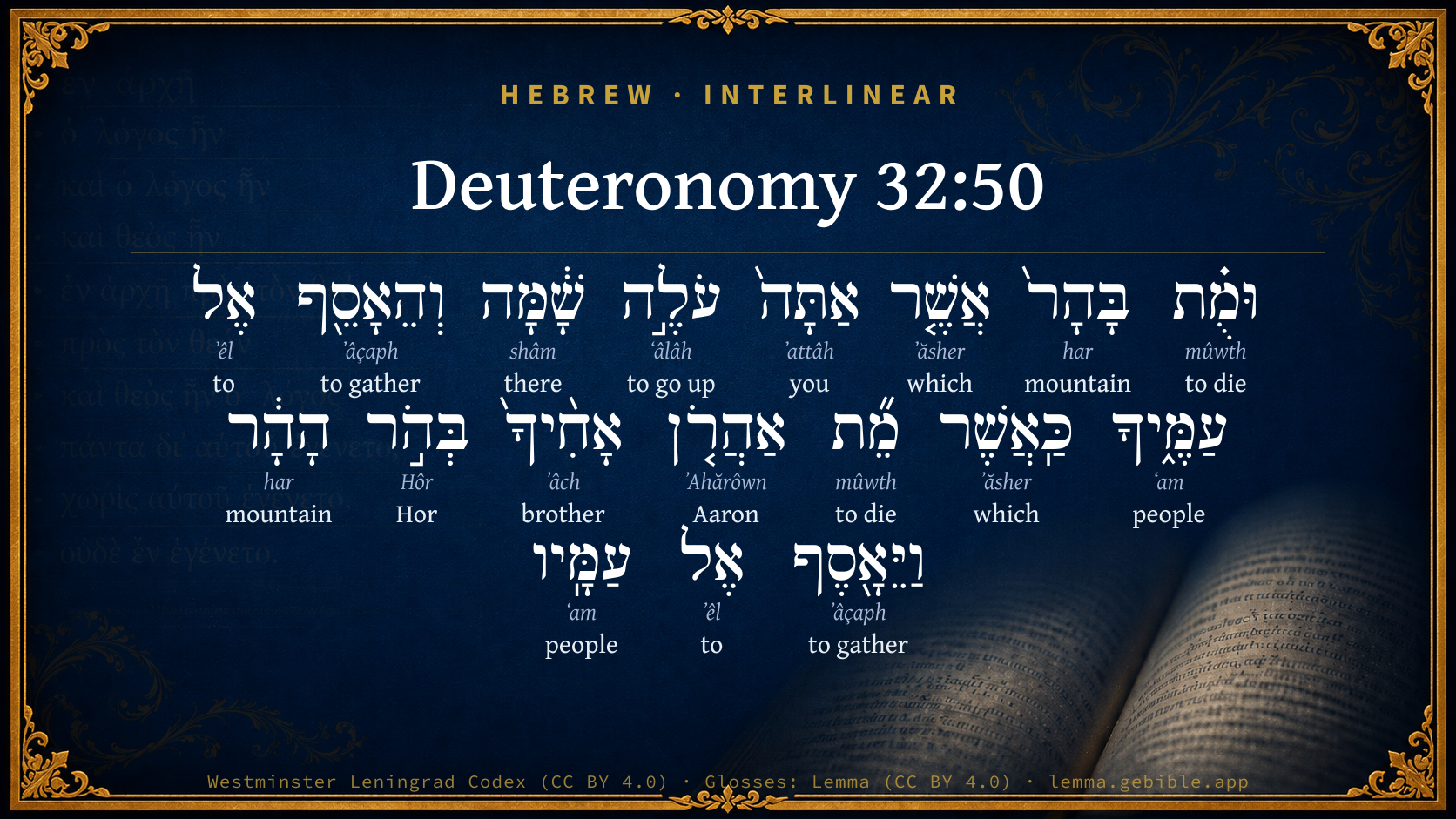
Deuteronomy 32:50

Hebrew (Westminster Leningrad Codex) Deuteronomy 32:50 appears in the Hebrew Old Testament. The text above is from the Westminster Leningrad Codex. Each word links to its Strong’s number, a concise gloss, and parsing drawn from the Open Scriptures Hebrew Bible morphology. Click any word for its full Brown-Driver-Briggs (BDB) entry.
Download image
Cite this verse

Deuteronomy 32:50 (World English Bible). Public Domain. Lemma interlinear Bible study tool, https://lemma.gebible.app/v/deuteronomy/32/50.

Show BibTeX & RIS
BibTeX
RIS
English Translation
and die on the mountain where you go up, and be gathered to your people, as Aaron your brother died on Mount Hor, and was gathered to his people:
World English Bible · Public Domain
Download a study sheet

One document with this verse’s original text, its word-by-word gloss line, the meaning frame, cross-references with their text, attributed commentary, and full source and license credits — printable, and it pastes into notes with its structure intact.

This verse Autodidact and up

Study sheet (.html) Plain text (.txt)

A passage Seminary Student

Up to 50 verses in one chapter. A passage sheet keeps up to 6 commentary sources and 12 cross-references per verse, in the order this page ranks them, and says so on the sheet whenever that leaves anything out. Ask for a single verse and you get the Autodidact verse sheet above.

Everything on this page stays free to read, with no account — the sheet is a download of what is already on screen, not access to it.

Want to remove ads? Support Godless Engineer
Compare translations 3

The same verse in 3 English versions, stacked beneath the original-language interlinear above. Click any original word for its lexicon entry.

Each is an independent rendering of the whole verse — the interlinear is not word-aligned to these translations.

Highlighted words mark where these versions differ — a whole-verse word diff, not a word-by-word alignment.

  • World English Bible Public Domain
    and die on the mountain where you go up, and be gathered to your people, as Aaron your brother died on Mount Hor, and was gathered to his people:
  • King James Version Public Domain
    And die in the mount whither thou goest up, and be gathered unto thy people; as Aaron thy brother died in mount Hor, and was gathered unto his people:
  • unfoldingWord Literal Text CC BY-SA 4.0
    And you will die on the mountain which you are going up to, and you will be gathered to your people, as Aaron your brother died on Mount Hor and was gathered to his people,

unfoldingWord Literal Text — © unfoldingWord, licensed CC BY-SA 4.0. Word-aligned USFM3 via Door43 (git.door43.org/unfoldingWord/en_ult).

Versions to compare (up to 4)

3 of 4 selected

Show all 18 translations

Every available English version of this verse, each an independent rendering of the whole verse.

  • World English Bible Public Domain
    and die on the mountain where you go up, and be gathered to your people, as Aaron your brother died on Mount Hor, and was gathered to his people:
  • Berean Standard Bible Public Domain
    And there on the mountain that you climb, you will die and be gathered to your people, just as your brother Aaron died on Mount Hor and was gathered to his people.
  • Majority Standard Bible Public Domain
    And there on the mountain that you climb, you will die and be gathered to your people, just as your brother Aaron died on Mount Hor and was gathered to his people.
  • King James Version Public Domain
    And die in the mount whither thou goest up, and be gathered unto thy people; as Aaron thy brother died in mount Hor, and was gathered unto his people:
  • American Standard Version (1901) Public Domain
    and die in the mount whither thou goest up, and be gathered unto thy people, as Aaron thy brother died in mount Hor, and was gathered unto his people:
  • Revised Version (1885) Public Domain
    and die in the mount whither thou goest up, and be gathered unto thy people; as Aaron thy brother died in mount Hor, and was gathered unto his people:
  • Geneva Bible (1599) Public Domain
    And die in the mount which thou goest vp vnto, and thou shalt be gathered vnto thy people, as Aaron thy brother died in mount Hor, and was gathered vnto his people,
  • Douay-Rheims (1899) Public Domain
    When thou art gone up into it thou shalt be gathered to thy people, as Aaron thy brother died in mount Her, and was gathered to his people:
  • Young's Literal Translation Public Domain
    and die in the mount whither thou art going up, and be gathered unto thy people, as Aaron thy brother hath died in the mount Hor, and is gathered unto his people:
  • Literal Standard Version CC BY-SA 4.0
    and die on the mountain to where you are going up, and be gathered to your people, as your brother Aaron has died on Mount Hor and is gathered to his people;
  • Unlocked Literal Bible CC BY-SA 4.0
    You will die on the mountain that you go up, and you will be gathered to your people, as Aaron your fellow Israelite died on Mount Hor and was gathered to his people.
  • unfoldingWord Literal Text CC BY-SA 4.0
    And you will die on the mountain which you are going up to, and you will be gathered to your people, as Aaron your brother died on Mount Hor and was gathered to his people,
  • Darby Bible Public Domain
    and die on the mountain whither thou goest up, and be gathered unto thy peoples, as Aaron thy brother died on mount Hor, and was gathered unto his peoples;
  • World Messianic Bible Public Domain
    Die on the mountain where you go up, and be gathered to your people, as Aaron your brother died on Mount Hor, and was gathered to his people;
  • Webster's Bible Public Domain
    And die in the mount whither thou goest, and be gathered to thy people; as Aaron thy brother died in mount Hor, and was gathered to his people:
  • Free Bible Version CC BY-SA 4.0
    There on the mountain you've climbed, you will die and join your people in death, in the same way your brother Aaron died on Mount Hor and joined his people.
  • Bible in Basic English Public Domain
    And let death come to you on the mountain where you are going, and be put to rest with your people; as death came to Aaron, your brother, on Mount Hor, where he was put to rest with his people:
  • JPS Tanakh (1917) Public Domain
    and die in the mount whither thou goest up, and be gathered unto thy people; as Aaron thy brother died in mount Hor, and was gathered unto his people.

Literal Standard Version (2020), Covenant Press — licensed CC BY-SA 4.0. Text via the HelloAO Bible API (eBible.org). Unlocked Literal Bible (unfoldingWord) — licensed CC BY-SA 4.0. Text via the HelloAO Bible API (eBible.org). unfoldingWord Literal Text — © unfoldingWord, licensed CC BY-SA 4.0. Word-aligned USFM3 via Door43 (git.door43.org/unfoldingWord/en_ult). Free Bible Version, Dr. Jonathan Gallagher — licensed CC BY-SA 4.0. Text via the HelloAO Bible API (eBible.org).

Word by word

More ways to search: Search by grammar → Find every occurrence → Compare this word →

Practice this passage: Drill this verse → Learn its vocabulary →

בְּהֹ֣ר
Hôr
H2023
“in/at · Hor”
Preposition + Noun, Proper
Part of Speech
Preposition + Noun
Type
Proper
Full BDB Definition

Origin: another form of H2022

TWOT: None

Hor = "mountain" - the mountain on which Aaron died; situated on the eastern side of the valley of Arabah, the highest of the whole range of sandstone mountains in Edom; on the eastern side is the ancient city of Petra - the mountain named as one of the marks of the northern boundary of the land which the children of Israel were about to conquer; located in Lebanon
  1. וּמֻ֗ת mûwth H4191 “and · die” Conjunction + Verb, Qal, Imperative, 2nd Person, Masculine, Singular
  2. בָּהָר֙ har H2022 “in/at the · mountain” Preposition, Determined + Noun, Common, Masculine, Singular, Absolute
  3. אֲשֶׁ֤ר ʼăsher H834 “which” Particle, Relative
  4. אַתָּה֙ ʼattâh H859 “you” Pronoun, Personal, 2nd Person, Masculine, Singular
  5. עֹלֶ֣ה ʻâlâh H5927 “going up” Verb, Qal, Participle Active, Masculine, Singular, Absolute
  6. שָׁ֔מָּה shâm H8033 “there · toward” Adverb + Suffix, Demonstrative
  7. וְהֵאָסֵ֖ף ʼâçaph H622 “and · gather” Conjunction + Verb, Niphal, Imperative, 2nd Person, Masculine, Singular
  8. אֶל ʼêl H413 “to” Preposition
  9. עַמֶּ֑יךָ ʻam H5971 “peoples · your” Noun, Common, Masculine, Plural, Construct + Suffix, Personal, 2nd Person, Masculine, Singular
  10. כַּֽאֲשֶׁר ʼăsher H834 “like/as · which” Preposition + Particle, Relative
  11. מֵ֞ת mûwth H4191 “to die” Verb, Qal, Perfect, 3rd Person, Masculine, Singular
  12. אַהֲרֹ֤ן ʼAhărôwn H175 “Aaron” Noun, Proper
  13. אָחִ֨יךָ֙ ʼâch H251 “brother · your” Noun, Common, Masculine, Singular, Construct + Suffix, Personal, 2nd Person, Masculine, Singular
  14. הָהָ֔ר har H2022 “the · mountain” Particle, Definite Article + Noun, Common, Masculine, Singular, Absolute
  15. וַיֵּאָ֖סֶף ʼâçaph H622 “and · to gather” Conjunction + Verb, Niphal, Sequential Imperfect, 3rd Person, Masculine, Singular
  16. אֶל ʼêl H413 “to” Preposition
  17. עַמָּֽיו ʻam H5971 “peoples · his” Noun, Common, Masculine, Plural, Construct + Suffix, Personal, 3rd Person, Masculine, Singular

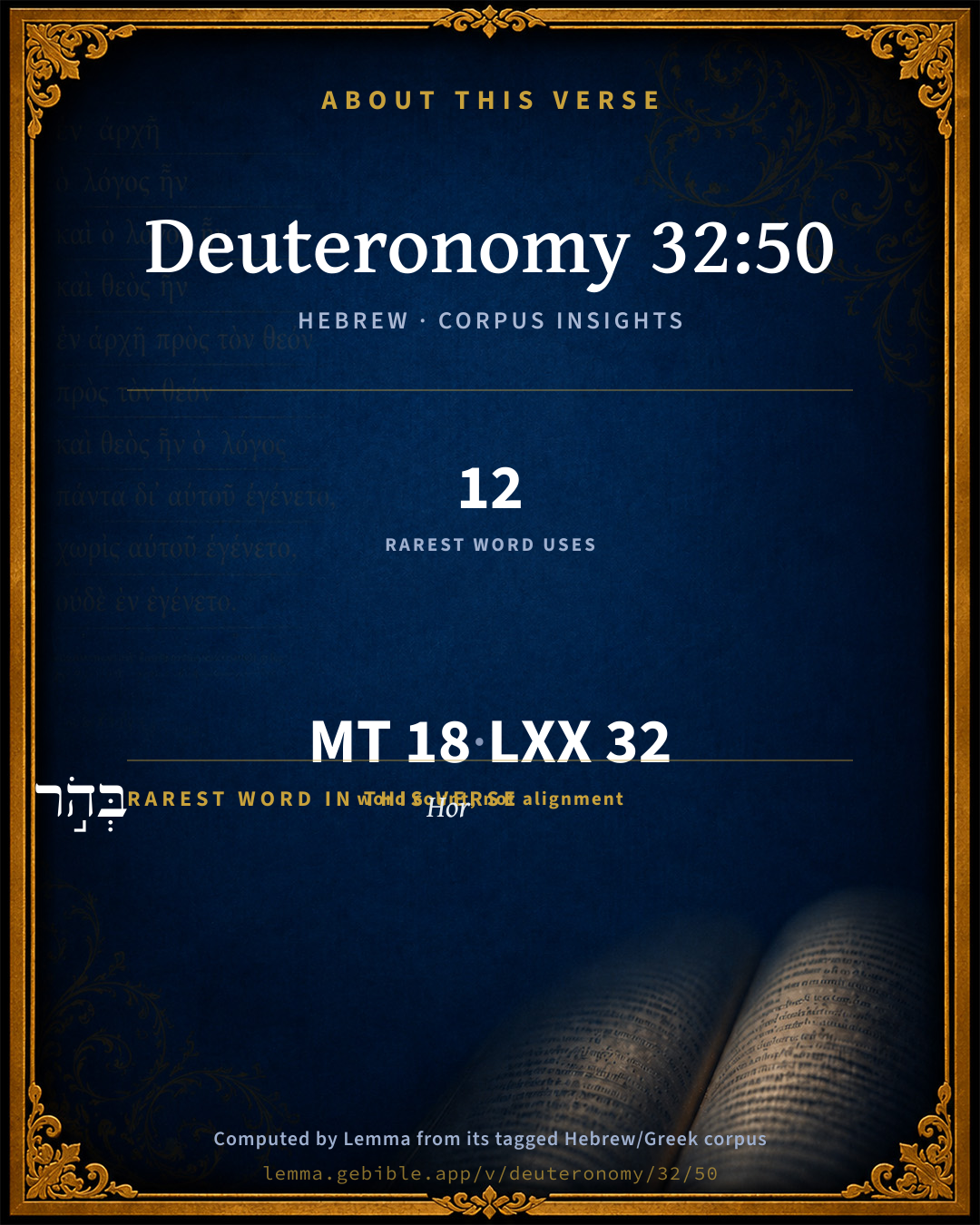
About this verse

These counts appear in no published source. They are computed here, from the morphology-tagged text and Lemma’s own curated glosses. What Lemma adds →

18
words
12
distinct lemmas
Pentateuch
section

Notable vocabulary

The rarest word here is בְּהֹ֣ר Hor H2023 — appearing just 12 times in the whole Hebrew Bible.

Shared distinctive vocabulary

בְּהֹ֣ר Hor H2023 occurs in 12 verses of the Hebrew Bible. Also found in:

Grammatical profile

  • 5 verbs
  • 7 nouns
  • 1 pronoun
  • 2 prepositions
  • 1 adverb
  • 2 particles

Verb forms

  • וּמֻ֗ת Qal · Imperative
  • עֹלֶ֣ה Qal · Participle Active
  • וְהֵאָסֵ֖ף Niphal · Imperative
  • מֵ֞ת Qal · Perfect
  • וַיֵּאָ֖סֶף Niphal · Sequential Imperfect

Repetition

Words recur within this verse — often emphatic in Hebrew:

  • וּמֻ֗ת to die H4191 ×2
  • בָּהָר֙ mountain H2022 ×2
  • וְהֵאָסֵ֖ף to gather H622 ×2
  • עַמֶּ֑יךָ people H5971 ×2
  • אֲשֶׁ֤ר which H834 ×2
  • אֶל to H413 ×2

Hebrew & Septuagint length

In English translation the verse runs 29 words from the Hebrew and 29 from the Septuagint (LXX English) — the same length.

A rough comparison of the two English renderings, which tokenize alike — not a word-level alignment.

Word counts can differ between the Hebrew and the Greek without any difference in meaning — e.g. the Hebrew direct-object marker אֵת has no separate Greek word, and Greek often adds the article ὁ.

In the original languages it is 18 Hebrew tokens and 32 Greek tokens — but the two are counted differently (Hebrew bundles its prefixes and suffixes into one token; the Greek is in lemma form), so that isn’t a like-for-like length.

Cross-references

7

Topical passages linked to Deuteronomy 32:50 in the Treasury of Scripture Knowledge — connected by theme and wording, ordered by reader-vote popularity; previews shown in the World English Bible.

  • Genesis 25:8 Abraham gave up the spirit, and died in a good old age, an old man, and full of years, and was gathered to his people.
  • Numbers 33:38 Aaron the priest went up into Mount Hor at the commandment of Yahweh, and died there, in the fortieth year after the children of Israel were come out of the land of Egypt, in the fifth month, on the first day of the month.
  • Genesis 15:15 But you will go to your fathers in peace. You will be buried in a good old age.
  • Genesis 25:17 These are the years of the life of Ishmael: one hundred thirty-seven years. He gave up the spirit and died, and was gathered to his people.
  • Genesis 49:33 When Jacob made an end of charging his sons, he gathered up his feet into the bed, and yielded up the spirit, and was gathered to his people.
  • Numbers 20:24–29 Aaron shall be gathered to his people; for he shall not enter into the land which I have given to the children of Israel, because you rebelled against my word at the waters of Meribah.
  • Daniel 12:13 But go you your way until the end be; for you shall rest, and shall stand in your lot, at the end of the days.

Cross-references courtesy of OpenBible.info (CC BY 4.0).

Hebrew and Greek witnesses Masoretic Hebrew ↔ Greek Septuagint

The same verse in the two great witnesses to the Old Testament, shown verse-for-verse.

These are two independent witnesses, not word-aligned to each other, and the Septuagint is shown in lemma (dictionary) form.

Hebrew Deuteronomy 32:50 Masoretic · Westminster Leningrad Codex

וּמֻ֗ת בָּהָר֙ אֲשֶׁ֤ר אַתָּה֙ עֹלֶ֣ה שָׁ֔מָּה וְהֵאָסֵ֖ף אֶל עַמֶּ֑יךָ כַּֽאֲשֶׁר מֵ֞ת אַהֲרֹ֤ן אָחִ֨יךָ֙ בְּהֹ֣ר הָהָ֔ר וַיֵּאָ֖סֶף אֶל עַמָּֽיו

and die on the mountain where you go up, and be gathered to your people, as Aaron your brother died on Mount Hor, and was gathered to his people:

World English Bible · Public Domain

Greek LXX Deuteronomy 32:50 Septuagint · lemma form

καί τελευτάω ἐν ὁ ὄρος εἰς ὅς ἀναβαίνω ἐκεῖ καί προςτίθημι πρός ὁ λαός σύ ὅς τρόπος ἀποθνήσκω ἀαρών ὁ ἀδελφός σύ ἐν ωρ ὁ ὄρος καί προςτίθημι πρός ὁ λαός αὐτός

and die in the mount whither you go up, and be added to your people; as Aaron your brother died in mount Or, and was added to his people.

LXX2012 (modern English Septuagint) · Public Domain

Hebrew: Westminster Leningrad Codex (CC BY 4.0). Greek: Septuagint (public domain); English from LXX2012 (modern English Septuagint) (Public Domain). How the Septuagint differs from the Hebrew →

Targum (Aramaic paraphrase)

2

The Targum is the ancient Jewish Aramaic paraphrase of the Hebrew Scriptures — an interpretive translation, not the Hebrew text itself. Onkelos (literal) and Pseudo-Jonathan (expansive) render the Torah, and Jonathan the Prophets. Coverage is partial: where no permissively-licensed English translation exists for a verse, only the Aramaic is shown. This is verse-level text, not a word-by-word alignment to the Hebrew.

  1. Targum Onkelos Torah (Genesis–Deuteronomy)
    וּמוּת בְּטוּרָא דִי אַתְּ סָלֵק לְתַמָן וְתִתְכְּנֵשׁ לְעַמָךְ כְּמָא דְמִית אַהֲרֹן אֲחוּךְ בְּהוֹר טוּרָא וְאִתְכְּנִישׁ לְעַמֵהּ

    (no public-domain English translation for this verse)

    Targum Onkelos — Aramaic: “Onkelos Genesis” (public domain); “Onkelos Exodus” (public domain); “Onkelos Leviticus” (public domain); “Onkelos Numbers” (public domain); “Onkelos Deuteronomy” (public domain). English: “Sefaria Community Translation” (CC0 1.0 (public-domain dedication)); “J.W. Etheridge. The Targums of Onkelos and Jonathan Ben Uzziel on the Pentateuch. London: Longmans, Green, 1862” (public domain). Text via Sefaria.

  2. Targum Pseudo-Jonathan Torah (Genesis–Deuteronomy)
    וּשְׁכוֹב בְּטַוְורָא דְאַנְתְּ סָלֵיק לְתַמָן וְאִתְכְּנֵשׁ לְעַמָךְ אוּף אַנְתְּ הֵיכְמָא דְשָׁכַב אַהֲרן אָחוּךְ בְּטַוְורוֹס אוּמָנוֹס וְאִתְכְּנַשׁ לְעַמֵיהּ מִן יַד פָּתַח משֶׁה פּוּמֵיהּ בִּצְלוֹתָא וְכֵן אָמַר רִבּוֹנֵיהּ דְעַלְמָא בְּבָעוּ מִנָךְ לָא אֱהִי מְתִיל כְּבַר נַשׁ דַהֲוָה לֵיהּ בִּיר יְחִידָאֵי וְאִשְׁתְּבֵי אָזַל פַּרְקֵיהּ בְּמָמוֹן סַגִי אַלְפֵיהּ חָכְמָתָא וְאוּמָנוּתָא קַדִישׁ לֵיהּ אִיתָא נְצִיב אַבְוַורְנְקִי דְמַלְכַיָא בְּנָא לֵיהּ בֵּית חֲתָנוּתָא אַתְקִין לֵיהּ פּוּרְיָינָא וְקָטַר לֵיהּ גְנָנָא בְּגַוֵיהּ זַמִין לֵיהּ שׁוּשְׁבִינֵי אַפָא פִּתֵּיהּ נְכַס נִיכְסֵיהּ מְזַג חַמְרֵיהּ כֵּיוַון דְמָטָא לְמֶחֱדֵי בְּרֵיהּ עִם אִנְתְּתֵיהּ וּבָעוּ שׁוּשְׁבִינֵי לְמִכְרַךְ רִפְתָּא אִתְּבַע הַהוּא בַּר נַשׁ לְבֵי דִינָא קַמֵי מַלְכָּא וְאִתְקְנֵס דִין קְטוֹל וְלָא דָלוּ מִנֵיהּ עַד דְחָמֵי בְּחֶדְוָות בְּרֵיהּ הֵיכְדֵין אֲנָא טְרָחִית בְּעַמָא הָדֵין אַפִּיקִית יַתְהוֹן בְּמֵימְרָךְ מִמִצְרַיִם אַלִיפִית יַתְהוֹן אוֹרַיְיתָךְ בָּנִיתִי לְהוֹן מַשְׁכְּנָא לִשְׁמָךְ וְכַד מָטָא זִמְנָא לְמֵיעֲבַר יַת יוֹרְדְנָא לְמֵירוֹת יַת אַרְעָא אֲנָא מִתְקְנַס לִמְמַת אִי נִיחָא לְקַמָךְ דַלֵי מִנִי וְאֶעֱבוֹר יַת יוֹרְדְנָא וְאֶחֱמֵי בְּטוּבָתָא דְיִשְרָאֵל וּמִבָּתַר כְּדֵין אֵימוּת

    And thou shalt sleep in the mountain to which thou goest up, and be gathered to thy people, even thou, as Aharon thy brother hath slept in the mountain of Omanos, and hath been gathered unto his people. Mosheh at once opened his mouth in prayer, and said, Lord of all the world, I entreat that I may not be as a man who had one only son, who being in captivity, he went and redeemed him with great price; he taught him wisdom and art, espoused him to a wife, planted for him a royal bower, builded him a marriage house, prepared for him the bed, invited his companions, baked his bread, slew his victims, and mixed his wine; yet, when the time came for his son to make glad with his wife, and the guests were about to consecrate the feast; then was that man required to go to the house of judgment, before the king and be punished with the judgment of death; neither would the delay to execute his sentence that he might see the happiness of his son. So have I laboured for this people; I have led them by Thy Word out of Mizraim, and builded for this people; I have taught them Thy law builded for them the tabernacle to Thy Name; but now that the time hath come to pass the Jordan, I am punished with death! Let it please Thee to withhold from me this sentence until I have passed the Jordan, to see the good of Israel before I die.

    Targum Pseudo-Jonathan — Aramaic: “Targum Jonathan on Genesis” (public domain); “Targum Jonathan on Exodus” (public domain); “Targum Jonathan on Leviticus” (public domain); “Targum Jonathan on Numbers” (public domain); “Targum Jonathan on Deuteronomy” (public domain). English: “The Targum of Jonathan ben Uzziel, trans. J. W. Etheridge, London, 1862” (public domain). Text via Sefaria.

Commentary

Notes on Deuteronomy 32:50 from classic Christian and Jewish commentators (each source and its license shown beneath its notes). The classic Christian expositions comment on the surrounding passage and are grouped to its opening verse, so a note may address several verses; the Jewish commentaries on the Tanakh (Rashi and others) are per-verse, so they appear only where the commentator wrote on this verse.

Lemma curates 59 commentaries, every one of them public domain or Creative Commons licensed, each selected and text-cleaned for this edition rather than reprinted as found. About our sources →

Joseph Benson's Commentary

Deu 32:50. And died in the mount — Not immediately, but after he had blessed the people, as in the next chapter. Be gathered unto thy people — We seem to be compelled to understand this of the soul of Moses, to be associated in paradise with the souls of the just, here termed his people; in which sense it is taken by some of the Jewish writers. For if it were to be interpreted of his body only, or chiefly, it could hardly be said to be sense, since the people of Moses were not buried in mount Abarim. See on Gen 25:8.

Joseph Benson's Commentary on the Old and New Testaments (1811–1818) — public domain. Text from a community e-Sword module.

Tyndale Open Study Notes

Tyndale Open Resources

32:50 The location of Mount Hor is uncertain, but the traditional location (Jebel Haroun) is within sight of the Nabatean city of Petra (see Num 20:22-29). • The phrase joined his ancestors is a euphemism for burial.

Tyndale Open Study Notes — © Tyndale Open Resources, licensed CC BY-SA 4.0. Text via the HelloAO Bible API.

Adam Clarke's Commentary

Verse 50. And die in the mount - as Aaron] Some have supposed that Moses was translated; but if so, then Aaron was translated, for what is said of the death of the one is said of the death of the other.

Adam Clarke's Commentary on the Bible (1810–1826) — public domain. Text from a community e-Sword/MySword module.

Ellicott's Commentary for English Readers

(50, 51) And die in the mount . . . as Aaron thy brother died in mount Hor . . . because ye trespassed against me.—It may be asked why Moses and Aaron should both have been made to ascend a mountain to die. I believe a clue to the reason may be found in the words and act which constituted their transgression. They were bidden to speak to the rock in Kadesh, and they struck it. The words which Moses used on that occasion were, “Hear now, ye rebels; must we fetch you water out of this cliff (Selagh)?” The last words of the sentence are emphatic; and the rock is described as a cliff, not by the name given to the Rock in Horeb (Tzûr). The emphasis laid upon these words has been much discussed by Jewish commentators, though it escapes English readers. I suspect that the mistake Moses and Aaron made, in thinking it needful to strike the cliff, also led them to think it necessary to ascend it, instead of gathering the congregation together beneath it, and speaking to it from below. This view harmonises with the spiritual significance of the act. The smitten Rock in Horeb was Christ; the Cliff not to be smitten in Kadesh pointed also to Christ, ascended now, needing only the prayer of faith to call down all that He will give. And so Moses himself taught, in some of his latest words. “It is not in heaven that thou shouldest say, Who shall go up for us to heaven, and bring it unto us? . . . But the word is nigh thee, in thy mouth.”

The impatient words of Moses, after toiling up the cliff with his brother Aaron, had to be recompensed by their ascending mount Hor and mount Nebo to die. Moses, as the more responsible of the two, had to ascend on each occasion, for his brother’s death and for his own. The remembrance of his brother’s death in the Lord may well have comforted Moses in the prospect of his own.

A Bible Commentary for English Readers, edited by Charles John Ellicott (1878–1897) — public domain. Text from a community e-Sword module.

The Cambridge Bible for Schools and Colleges

gen. ed. J. J. S. Perowne

50. unto thy people] Better thy father’s folk, as always in this phrase. The word, ‘am, originally meant this, but in Heb. is usually widened to people, while in Ar. it = ‘father’s brother’ and ‘father’s brother’s children’ (Driver). The whole phrase is frequent in P, Gen_25:8; Gen_35:29, Num_20:24; Num_20:26, etc., and is found nowhere else.

on Hor, the mountain] Always so in P; cp. Num_20:22-29; Num_21:4; Num_33:37-41. Contr. above Deu_10:6 (E).

The Cambridge Bible for Schools and Colleges (gen. ed. J. J. S. Perowne; Cambridge University Press, 1878–1918) — public domain. Text from a community e-Sword module.

John Gill's Exposition

Yet thou shalt see the land before thee,.... Which Jarchi interprets, afar off; and so does Noldius (c); he saw it at a distance, as the Old Testament saints saw the things promised afar off, and were persuaded of them, though they did not enjoy them, Heb 11:13,

but thou shalt not go thither unto the land which I give the children of Israel; the land of Canaan was a gift of God to Israel, into which they were not to be introduced by Moses, but by Joshua; signifying that eternal life, or the heavenly Canaan, is the gift of God through Christ, the antitype of Joshua, and not to obtained by the works of the law.

(c) Ebr. part. Concord. p. 626. so Ainsworth.

Next: Deuteronomy Chapter 33

John Gill's Exposition of the Whole Bible (1746–1763) — public domain (CC PDM 1.0). Text via the HelloAO Bible API.

The Pulpit Commentary

And be thou gathered unto thy people. "To Abraham, Isaac, and Jacob. This signifies," saith R. Isaac, "that he should be associated and joined to the souls of the just who are called his people. For the people of Moses were not buried in Mount Abarim, and therefore he doth not speak of gathering his body to their bodies, but of his soul to their souls ("Chissute Emuna," L 11)" (Patrick).

The Pulpit Commentary (1880–1919), ed. H.D.M. Spence-Jones & Joseph S. Exell — public domain. Text from a community e-Sword module.

unfoldingWord translationNotes

Door43 World Missions Community

General Information:

Yahweh finishes speaking to Moses.

be gathered to your people

This is a polite way of saying Moses' spirit would join the spirits of his relatives in the world of the dead. AT: "join your ancestors who died before you" (See: Euphemism)

Mount Hor

This is the name of a mountain on the border of Edom. (See: How to Translate Names)

Meribah

This is the name of the place in the desert where Moses disobeyed God. (See: How to Translate Names)

wilderness of Zin

This is the name of a wilderness on the southern border of Judah. (See: How to Translate Names)

translationWords

die

people group

Aaron

Israel

faithful

water

Kadesh

desert

honor

unfoldingWord translationNotes — © Distant Shores Media and the Door43 World Missions Community, licensed CC BY-SA 4.0. Source: git.door43.org/Door43/en_tn.

Rashi

Rabbi Shlomo Yitzchaki (Rashi)

כאשר מת אהרן אחיך [AND DIE] … AS AARON THY BROTHER DIED — i.e., and die by that death which you witnessed and for which you longed. For Moses stripped Aaron (before the latter’s death) of his first (i.e., the upper) garment, similarly the second, and similarly the third, and attired Elazar with them, and thus he (Aaron) beheld his son in his new dignity. Moses then said to him, “Aaron, my brother, ascend the bier”, and he ascended; — “Stretch out your hand”, and he stretched it out; — “Stretch out your leg”, and he stretched it out; “Close your eyes”, and he closed them; — “Close your mouth”, and he closed it, and thus did he pass away! Thereupon Moses said, “Happy is he who will die a death like this!” (Sifrei Devarim 339:3; cf. Rashi on Numbers 20:26).

Rashi on the Tanakh — English translations: “The Judaica Press complete Tanach with Rashi, translated by A. J. Rosenberg” (CC BY 4.0); “Pentateuch with Rashi's commentary by M. Rosenbaum and A.M. Silbermann, 1929-1934” (public domain); “The Metsudah Tanach series, Lakewood, N.J” (CC BY 4.0); and “The Book of Joshua, Metsudah Publications, 1997” (CC BY 4.0). Text via Sefaria.

Lesson kit

Teaching starters — assembled from the data on this page, not authored interpretation. Every prompt links to the verse data it draws on. Edit before teaching.

Deuteronomy, in the Pentateuch, opens this verse with 18 words (12 distinct Hebrew lemmas). Its most distinctive word is Hôr (“Hor”). A historical commentator’s framing appears above. Read the whole chapter for the surrounding context.

Discussion questions

  1. The word Hôr carries the sense “Hor.” How does it shape the verse?
  2. How does Numbers 20:22, which shares the word «Hor», read alongside this verse?
  3. What does the repetition of “to die” (2× in this one verse) do in this verse?
  4. These translations render this verse differently. What is at stake in choosing one wording over another?
  5. «וּמֻ֗ת» is a Qal Imperative verb. How does that grammatical form shape the action described?
  6. Compare how Joseph Benson's Commentary and Tyndale Open Study Notes read this verse. Where do they agree or differ?

Things to notice

Reading settings

Reading text

Shown beneath each verse's original-language words.

Old Testament
Old Testament edition

Read the OT as the Masoretic Hebrew (MT) or the Greek Septuagint (LXX).

English shown for the Greek Septuagint (in the Hebrew ↔ Greek comparison).

Comparing translations? Open the Compare panel on any verse page to stack up to four side by side.