1 Chronicles 11:6

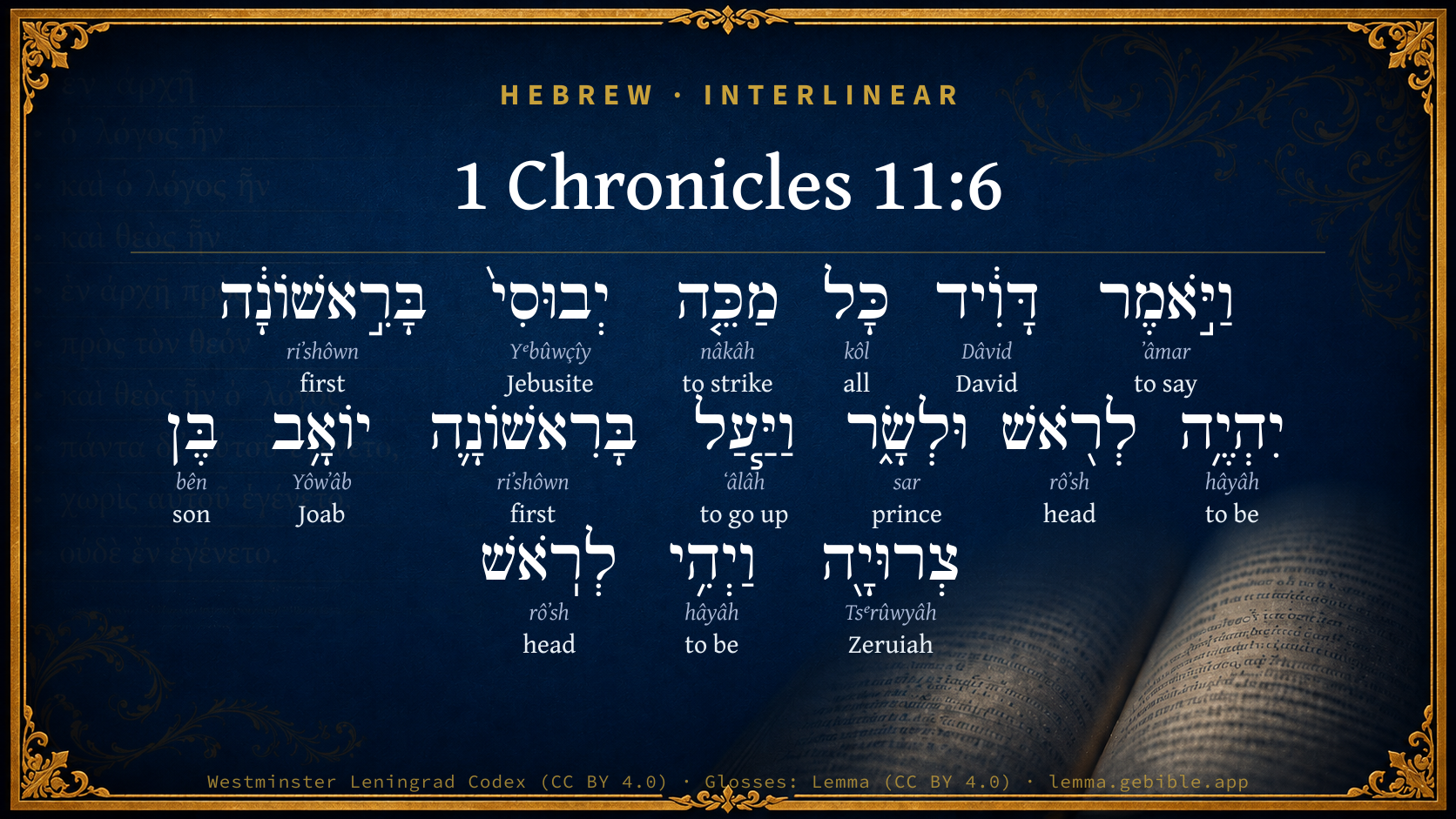
Hebrew (Westminster Leningrad Codex) 1 Chronicles 11:6 appears in the Hebrew Old Testament. The text above is from the Westminster Leningrad Codex. Each word links to its Strong’s number, a concise gloss, and parsing drawn from the Open Scriptures Hebrew Bible morphology. Click any word for its full Brown-Driver-Briggs (BDB) entry.
Download image
Cite this verse

1 Chronicles 11:6 (World English Bible). Public Domain. Lemma interlinear Bible study tool, https://lemma.gebible.app/v/1-chronicles/11/6.

Show BibTeX & RIS
BibTeX
RIS
English Translation
David said, Whoever strikes the Jebusites first shall be chief and captain. Joab the son of Zeruiah went up first, and was made chief.
World English Bible · Public Domain
Download a study sheet

One document with this verse’s original text, its word-by-word gloss line, the meaning frame, cross-references with their text, attributed commentary, and full source and license credits — printable, and it pastes into notes with its structure intact.

This verse Autodidact and up

Study sheet (.html) Plain text (.txt)

A passage Seminary Student

Up to 50 verses in one chapter. A passage sheet keeps up to 6 commentary sources and 12 cross-references per verse, in the order this page ranks them, and says so on the sheet whenever that leaves anything out. Ask for a single verse and you get the Autodidact verse sheet above.

Everything on this page stays free to read, with no account — the sheet is a download of what is already on screen, not access to it.

Want to remove ads? Support Godless Engineer
Compare translations 3

The same verse in 3 English versions, stacked beneath the original-language interlinear above. Click any original word for its lexicon entry.

Each is an independent rendering of the whole verse — the interlinear is not word-aligned to these translations.

Highlighted words mark where these versions differ — a whole-verse word diff, not a word-by-word alignment.

  • World English Bible Public Domain
    David said, Whoever strikes the Jebusites first shall be chief and captain. Joab the son of Zeruiah went up first, and was made chief.
  • King James Version Public Domain
    And David said, Whosoever smiteth the Jebusites first shall be chief and captain. So Joab the son of Zeruiah went first up, and was chief.
  • unfoldingWord Literal Text CC BY-SA 4.0
    And David said, “Anyone striking the Jebusite first will become the head and the chief. And Joab, the son of Zeruiah, went up first, and he became the head.

unfoldingWord Literal Text — © unfoldingWord, licensed CC BY-SA 4.0. Word-aligned USFM3 via Door43 (git.door43.org/unfoldingWord/en_ult).

Versions to compare (up to 4)

3 of 4 selected

Show all 18 translations

Every available English version of this verse, each an independent rendering of the whole verse.

  • World English Bible Public Domain
    David said, Whoever strikes the Jebusites first shall be chief and captain. Joab the son of Zeruiah went up first, and was made chief.
  • Berean Standard Bible Public Domain
    Now David had said, “Whoever is the first to strike down a Jebusite will become chief commander.” And Joab son of Zeruiah went up first, and he became the chief.
  • Majority Standard Bible Public Domain
    Now David had said, “Whoever is the first to strike down a Jebusite will become chief commander.” And Joab son of Zeruiah went up first, and he became the chief.
  • King James Version Public Domain
    And David said, Whosoever smiteth the Jebusites first shall be chief and captain. So Joab the son of Zeruiah went first up, and was chief.
  • American Standard Version (1901) Public Domain
    And David said, Whosoever smiteth the Jebusites first shall be chief and captain. And Joab the son of Zeruiah went up first, and was made chief.
  • Revised Version (1885) Public Domain
    And David said, Whosoever smiteth the Jebusites first shall be chief and captain. And Joab the son of Zeruiah went up first, and was made chief.
  • Geneva Bible (1599) Public Domain
    And Dauid sayd, Whosoeuer smiteth the Iebusites first, shalbe the chiefe and captaine. So Ioab the sonne of Zeruiah went first vp, and was captaine.
  • Douay-Rheims (1899) Public Domain
    And he said: Whosoever shall first strike the Jebusites, shall be the head and chief captain. And Joab the son of Sarvia went up first, and was made the general.
  • Young's Literal Translation Public Domain
    And David saith, `Whoever smiteth the Jebusite first doth become head and prince;' and go up first doth Joab son of Zeruiah and becometh head.
  • Literal Standard Version CC BY-SA 4.0
    And David says, “Whoever strikes the Jebusite first becomes head and prince”; and Joab son of Zeruiah goes up first and becomes head.
  • Unlocked Literal Bible CC BY-SA 4.0
    David had said, “Whoever attacks the Jebusites first will become chief and commander.” So Joab son of Zeruiah attacked first, so he was made the chief.
  • unfoldingWord Literal Text CC BY-SA 4.0
    And David said, “Anyone striking the Jebusite first will become the head and the chief. And Joab, the son of Zeruiah, went up first, and he became the head.
  • Darby Bible Public Domain
    And David said, Whoever smites the Jebusites first shall be chief and captain. And Joab the son of Zeruiah went first up, and was chief.
  • World Messianic Bible Public Domain
    David had said, “Whoever strikes the Jebusites first shall be chief and captain.” Joab the son of Zeruiah went up first, and was made chief.
  • Webster's Bible Public Domain
    And David said, Whoever smiteth the Jebusites first shall be chief and captain. So Joab the son of Zeruiah went up first, and was chief.
  • Free Bible Version CC BY-SA 4.0
    David had said, “Whoever is first to attack the Jebusites will be my commander-in-chief.” Since Joab, son of Zeruiah, was the first, he became commander-in-chief.
  • Bible in Basic English Public Domain
    And David said, The first to overcome the Jebusites will be chief and captain. And Joab, the son of Zeruiah, went up first, and became chief.
  • JPS Tanakh (1917) Public Domain
    And David said: 'Whosoever smiteth the Jebusites first shall be chief and captain.' And Joab the son of Zeruiah went up first, and was made chief.

Literal Standard Version (2020), Covenant Press — licensed CC BY-SA 4.0. Text via the HelloAO Bible API (eBible.org). Unlocked Literal Bible (unfoldingWord) — licensed CC BY-SA 4.0. Text via the HelloAO Bible API (eBible.org). unfoldingWord Literal Text — © unfoldingWord, licensed CC BY-SA 4.0. Word-aligned USFM3 via Door43 (git.door43.org/unfoldingWord/en_ult). Free Bible Version, Dr. Jonathan Gallagher — licensed CC BY-SA 4.0. Text via the HelloAO Bible API (eBible.org).

Word by word

More ways to search: Search by grammar → Find every occurrence → Compare this word →

Practice this passage: Drill this verse → Learn its vocabulary →

צְרוּיָ֖ה
Tsᵉrûwyâh
H6870
“Zeruiah”
Noun, Proper
Part of Speech
Noun
Type
Proper
Full BDB Definition

Origin: pass part from the same as H6875

TWOT: None

Zeruiah = "balsam" - sister of David and mother of the 3 leading heroes of David's army - Abishai, Joab, and Asahel
  1. וַיֹּ֣אמֶר ʼâmar H559 “and · to say” Conjunction + Verb, Qal, Sequential Imperfect, 3rd Person, Masculine, Singular
  2. דָּוִ֔יד Dâvid H1732 “David” Noun, Proper
  3. כָּל kôl H3605 “all of” Noun, Common, Masculine, Singular, Construct
  4. מַכֵּ֤ה nâkâh H5221 “striking” Verb, Hiphil, Participle Active, Masculine, Singular, Construct
  5. יְבוּסִי֙ Yᵉbûwçîy H2983 “Jebusite” Noun, Gentilic, Masculine, Singular, Absolute
  6. בָּרִ֣אשׁוֹנָ֔ה riʼshôwn H7223 “in/at the · first” Preposition, Determined + Adjective, Adjective, Feminine, Singular, Absolute
  7. יִהְיֶ֥ה hâyâh H1961 “to be” Verb, Qal, Imperfect, 3rd Person, Masculine, Singular
  8. לְרֹ֖אשׁ rôʼsh H7218 “to/for · head” Preposition + Noun, Common, Masculine, Singular, Absolute
  9. וּלְשָׂ֑ר sar H8269 “and · to/for · prince” Conjunction + Preposition + Noun, Common, Masculine, Singular, Absolute
  10. וַיַּ֧עַל ʻâlâh H5927 “and · to go up” Conjunction + Verb, Qal, Sequential Imperfect, 3rd Person, Masculine, Singular
  11. בָּרִאשׁוֹנָ֛ה riʼshôwn H7223 “in/at the · first” Preposition, Determined + Adjective, Adjective, Feminine, Singular, Absolute
  12. יוֹאָ֥ב Yôwʼâb H3097 “Joab” Noun, Proper
  13. בֶּן bên H1121 “son of” Noun, Common, Masculine, Singular, Construct
  14. וַיְהִ֥י hâyâh H1961 “and · to be” Conjunction + Verb, Qal, Sequential Imperfect, 3rd Person, Masculine, Singular
  15. לְרֹֽאשׁ rôʼsh H7218 “to/for · head” Preposition + Noun, Common, Masculine, Singular, Absolute

About this verse

These counts appear in no published source. They are computed here, from the morphology-tagged text and Lemma’s own curated glosses. What Lemma adds →

16
words
13
distinct lemmas
Historical
section

Shared distinctive vocabulary

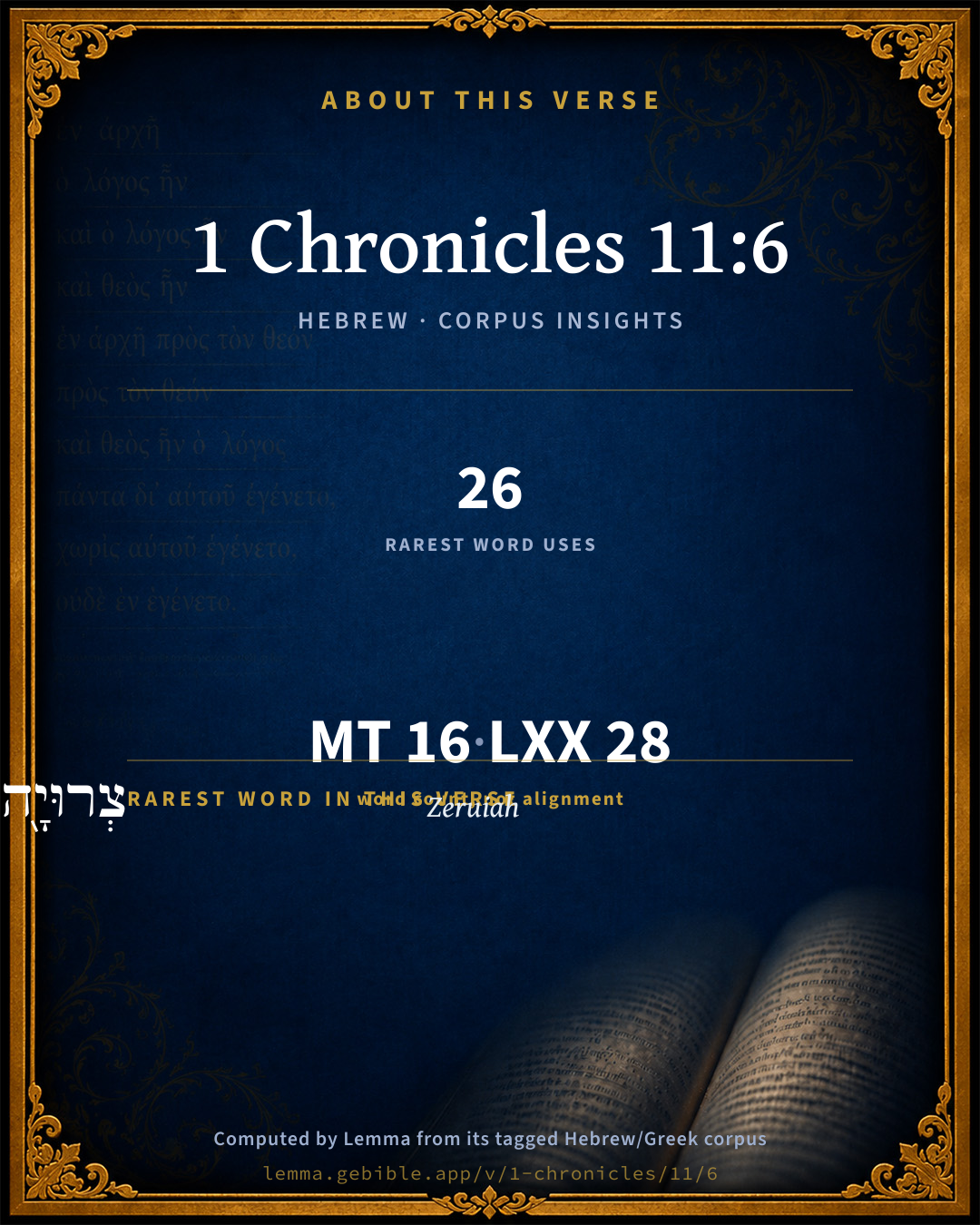
צְרוּיָ֖ה Zeruiah H6870 occurs in 25 verses of the Hebrew Bible. Also found in:

Grammatical profile

  • 5 verbs
  • 9 nouns
  • 2 adjectives

Verb forms

  • וַיֹּ֣אמֶר Qal · Sequential Imperfect
  • מַכֵּ֤ה Hiphil · Participle Active
  • יִהְיֶ֥ה Qal · Imperfect
  • וַיַּ֧עַל Qal · Sequential Imperfect
  • וַיְהִ֥י Qal · Sequential Imperfect

Repetition

Words recur within this verse — often emphatic in Hebrew:

  • בָּרִ֣אשׁוֹנָ֔ה first H7223 ×2
  • יִהְיֶ֥ה to be H1961 ×2
  • לְרֹ֖אשׁ head H7218 ×2

Hebrew & Septuagint length

In English translation the verse runs 24 words from the Hebrew and 27 from the Septuagint (LXX English) — closely comparable.

A rough comparison of the two English renderings, which tokenize alike — not a word-level alignment.

Word counts can differ between the Hebrew and the Greek without any difference in meaning — e.g. the Hebrew direct-object marker אֵת has no separate Greek word, and Greek often adds the article ὁ.

In the original languages it is 16 Hebrew tokens and 28 Greek tokens — but the two are counted differently (Hebrew bundles its prefixes and suffixes into one token; the Greek is in lemma form), so that isn’t a like-for-like length.

Cross-references

6

Topical passages linked to 1 Chronicles 11:6 in the Treasury of Scripture Knowledge — connected by theme and wording, ordered by reader-vote popularity; previews shown in the World English Bible.

  • 2 Samuel 8:16 Joab the son of Zeruiah was over the host; and Jehoshaphat the son of Ahilud was recorder;
  • Joshua 15:16–17 Caleb said, He who strikes Kiriath Sepher, and takes it, to him will I give Achsah my daughter as wife.
  • 1 Samuel 17:25 The men of Israel said, Have you seen this man who is come up? surely to defy Israel is he come up: and it shall be, that the man who kills him, the king will enrich him with great riches, and will give him his daughter, and make his father's house free in Israel.
  • 2 Samuel 2:18 The three sons of Zeruiah were there, Joab, and Abishai, and Asahel: and Asahel was as light of foot as a wild gazelle.
  • 2 Samuel 3:27 When Abner was returned to Hebron, Joab took him aside into the midst of the gate to speak with him quietly, and struck him there in the body, so that he died, for the blood of Asahel his brother.
  • 2 Samuel 20:23 Now Joab was over all the host of Israel; and Benaiah the son of Jehoiada was over the Cherethites and over the Pelethites;

Cross-references courtesy of OpenBible.info (CC BY 4.0).

Hebrew and Greek witnesses Masoretic Hebrew ↔ Greek Septuagint

The same verse in the two great witnesses to the Old Testament, shown verse-for-verse.

These are two independent witnesses, not word-aligned to each other, and the Septuagint is shown in lemma (dictionary) form.

Hebrew 1 Chronicles 11:6 Masoretic · Westminster Leningrad Codex

וַיֹּ֣אמֶר דָּוִ֔יד כָּל מַכֵּ֤ה יְבוּסִי֙ בָּרִ֣אשׁוֹנָ֔ה יִהְיֶ֥ה לְרֹ֖אשׁ וּלְשָׂ֑ר וַיַּ֧עַל בָּרִאשׁוֹנָ֛ה יוֹאָ֥ב בֶּן צְרוּיָ֖ה וַיְהִ֥י לְרֹֽאשׁ

David said, Whoever strikes the Jebusites first shall be chief and captain. Joab the son of Zeruiah went up first, and was made chief.

World English Bible · Public Domain

Greek LXX 1 Chronicles 11:6 Septuagint · lemma form

καί εἶπον δαυίδ πᾶς τύπτω ιεβουσαῖος ἐν πρῶτος καί εἰμί εἰς ἄρχων καί εἰς στρατηγός καί ἀναβαίνω ἐπί αὐτός ἐν πρῶτος ιωαβ υἱός σαρουια καί γίγνομαι εἰς ἄρχων

And David said, Whoever first smites the Jebusite, even he shall be chief and captain. And Joab the son of Saruia went up first, and became chief.

LXX2012 (modern English Septuagint) · Public Domain

Hebrew: Westminster Leningrad Codex (CC BY 4.0). Greek: Septuagint (public domain); English from LXX2012 (modern English Septuagint) (Public Domain). How the Septuagint differs from the Hebrew →

Commentary

Notes on 1 Chronicles 11:6 from classic Christian and Jewish commentators (each source and its license shown beneath its notes). The classic Christian expositions comment on the surrounding passage and are grouped to its opening verse, so a note may address several verses; the Jewish commentaries on the Tanakh (Rashi and others) are per-verse, so they appear only where the commentator wrote on this verse.

Lemma curates 59 commentaries, every one of them public domain or Creative Commons licensed, each selected and text-cleaned for this edition rather than reprinted as found. About our sources →

Joseph Benson's Commentary

1Ch 11:6. And was chief — Before this he was one of David’s chief captains; but now he is made captain-general of all the forces of Israel and Judah.

Joseph Benson's Commentary on the Old and New Testaments (1811–1818) — public domain. Text from a community e-Sword module.

Ellicott's Commentary for English Readers

(6) Whosoever smiteth the Jebusites first.—The account diverges more and more from the parallel passage. 2Sa_5:8, reads, “And David said in that day, Whosoever smiteth the Jebusite, let him hurl down the waterfall (Psa_42:7), both the lame and the blind, the hated of David’s soul! Therefore they say, Blind and lame must not enter the house” (i.e., the Temple). Such is the simplest rendering of an obscure, but evidently original record. The chronicler appears to have followed another and clearer account, which made Joab play at the storm of Jebus the part of Othniel at that of Kirjath-sepher (Jdg_1:12-13).

Chief and captain.—Literally, shall become a head and a captain.

Joab the son of Zeruiah is not mentioned at all in the parallel passage. Joab already appears as David’s general, while Ishbosheth is yet reigning at Mahanaim (2Sa_2:13; 2Sa_3:23). Perhaps the phrase here used means head and governor of Jerusalem. (Comp. 1Ch_11:8.)

Went up.—Scaled the rampart, “and became a head.”

A Bible Commentary for English Readers, edited by Charles John Ellicott (1878–1897) — public domain. Text from a community e-Sword module.

The Cambridge Bible for Schools and Colleges

gen. ed. J. J. S. Perowne

6. Whosoever smiteth the Jebusites first shall be chief and captain] The Chronicler has simplified the very difficult phrase which occurs in the parallel passage (2Sa_5:8).

Joab the son of Zeruiah] Zeruiah was David’s sister (1Ch_2:16). It is not said in Samuel that Joab first became commander-in-chief on this occasion; on the contrary he appears in command (2Sa_2:13) during the civil war against the house of Saul. Perhaps he was first formally acknowledged as commander at the capture of Jebus.

The Cambridge Bible for Schools and Colleges (gen. ed. J. J. S. Perowne; Cambridge University Press, 1878–1918) — public domain. Text from a community e-Sword module.

Albert Barnes' Notes on the Bible

The narrative here given fills out a manifest defect in 2Sa 5:8 where something has evidently dropped out of the text.

The prowess of Joab on this occasion, and the part which he took in the building of the city of David 1Ch 11:8, are known to us only from this passage of Chronicles.

Albert Barnes' Notes on the Bible (1834–1885) — public domain. Text from a community e-Sword/MySword module.

Matthew Poole's English Annotations

Before this he was one of David’s chief captains, 2Sa 3:22,23, and general of the forces of Judah; but now he is made captain-general of all the forces of Israel and Judah.

Matthew Poole's English Annotations on the Holy Bible (1683–1685) — public domain. Text from a community e-Sword/MySword module.

The Pulpit Commentary

The name and fresh glory of Joab, as given here, are not given 2Sa_5:3-10; and we could suppose that they were purposely withheld there. It is true that Joab already held high office, probably the first place as captain of David"s men, but Bertheau"s objection to the statements of this verse on such grounds easily yields to the considerations first, that there can be no doubt Joab had fallen into disfavour withDavid and others, upon his slaying of Abner; (2Sa_3:26-29, 2Sa_3:36, 2Sa_3:37) and further, that this was a great occasion, exceedingly favourable for evoking any very special ability of younger or unknown men, at present lost under the shadow of larger growths. The advantage which Joab gained now was one that confirmed his position and increased largely his influence; and an indication that he was not slow to avail himself of it is probably to be traced in the eighth verse, where it is said while "David built even from Millo round about, Joab repaired the rest of the city.

Joab, the military statesman.

Though this man, Josh, is introduced to us before, (2Sa_2:13, 2Sa_2:26, etc.) yet, in order of time, this passage is his first appearance, and only here have we the account of his prowess in taking Jebus, and his part in the building of the city of David. He probably had been chief captain of David"s band of outlaws, but on this occasion he gained the position of general of the national army, and he became subsequently the great military statesman of the kingdom, and the chief king"s counsellor. Probably he may be regarded as the man who exercised most influence over the king, and the careful review of their relations produces a deep impression that the influence was seldom a good one. He became David"s master, and under his bondage David vainly writhed and struggled in his later years.

I JOAB HIMSELF. The incidents by which he is made known to us are mainly the following:

1. Abner"s killing of Asahel, Joab"s brother, (2Sa_2:12-32) filled Joab with purposes of revenge.

2. Joab treacherously slew Abner, (2Sa_3:6-39) and David felt himself too weak to do more than denounce the murder; he dare not punish the murderer.

3. Joab took a leading part in the wars of the reign, especiallydistinguishing himself against the Ammonites. (2Sa_10:6-14)

4. Joab connived at David"s sin in the matter of Bathsheba, and so gained the power over him which he so humiliatingly used afterwards.

5. Joab was faithful in the time of Absalom"s rebellion.

6. He directly and insultingly disobeyed his king and lord in slayingAbsalom.

7. He showed his mastery and his control of the army by killing Amass,who had been appointed chief general in his stead.

8. He properly remonstrated with David against his self-willed scheme oftaking a census.

9. But after David"s death he took the part of Adonijah, and was condemned by Solomon. He was strictly a man of the world, brave, daring, manly, generous, and persevering, but masterful, impatient of what he thought David"s hesitancy and weakness; a man who saw clearly an end to be aimed at, and was in no way particular about the choice of means by which to reach it. He was unscrupulous, having no quick sensitiveness of conscience to that which is wrong. He ordered his life by the rule of the expedient, not the rule of the right, and was heedless of the claims of others if they stood in his way. A man who was a type of a class still to be found in business and social spheres, who are all for self, and do not mind who they trample down as they go up. "His character was ambitious, daring, unscrupulous, yet with an occasional show of piety". (2Sa_10:12) Wordsworth says, "Joab is the personification of worldly policy and secular expediency, and temporal ambition eager for its own personal aggrandizement, and especially for the maintenance of its own political ascendancy, and practising on the weaknesses of princes for its own self-interests; but at last the victim of its own Machiavellian shrewdness.

II JOAB"S INFLUENCE ON DAVID. Sometimes it was good. He skilfully aided in the restoration of the banished Absalom; and he properly roused the king from the excessive grief he felt at the death of his favourite son. Again and again, with statesmanlike genius, he enabled David promptly to seize the occasions that promised success; and he had religion enough, or insight enough, to see where David was wrong in the matter of the census. But, as a whole, Joab"s influence was bad. His unscrupulousness led David into crimes, and his masterfulness prevented David from properly punishing crimes. When conflict came between state necessity and religious duty, Joab gained the victory for mere policy, and so made David act in ways that were unworthy of one who was only Jehovah"s vicegerent. It is never good for us to come into the power of any fellow-man. We should be ever in Gods lead, but refuse any fellow-man"s bonds. And no undue influence exerted by a fellow-man can ever relieve our responsibility before God. Craft, guile, policy, are no forces of blessing in any human spheres. R.T.

The Pulpit Commentary (1880–1919), ed. H.D.M. Spence-Jones & Joseph S. Exell — public domain. Text from a community e-Sword module.

John Wesley's Explanatory Notes

Chief - Before this he was one of David's chief captains: but now he is made captain-general of all the forces of Israel and Judah.

John Wesley, Explanatory Notes Upon the Whole Bible (1754–1765) — public domain. Text via the GEBible commentary corpus.

Lesson kit

Teaching starters — assembled from the data on this page, not authored interpretation. Every prompt links to the verse data it draws on. Edit before teaching.

1 Chronicles, in the Historical, opens this verse with 16 words (13 distinct Hebrew lemmas). Its most distinctive word is Tsᵉrûwyâh (“Zeruiah”). A historical commentator’s framing appears above. Read the whole chapter for the surrounding context.

Discussion questions

  1. How does “Zeruiah” (Tsᵉrûwyâh) shape what this verse is saying?
  2. How does 1 Samuel 26:6, which shares the word «Zeruiah», read alongside this verse?
  3. What does the repetition of “first” (2× in this one verse) do in this verse?
  4. The translations on this page render this verse differently — a whole-verse word diff, not a word-by-word alignment. What might account for the different wordings?
  5. «וַיֹּ֣אמֶר» is a Qal Sequential Imperfect verb. How does that grammatical form shape the action described?
  6. Compare how Joseph Benson's Commentary and Ellicott's Commentary for English Readers read this verse. Where do they agree or differ?

Things to notice

Reading settings

Reading text

Shown beneath each verse's original-language words.

Old Testament
Old Testament edition

Read the OT as the Masoretic Hebrew (MT) or the Greek Septuagint (LXX).

English shown for the Greek Septuagint (in the Hebrew ↔ Greek comparison).

Comparing translations? Open the Compare panel on any verse page to stack up to four side by side.