
Exodus 19:13

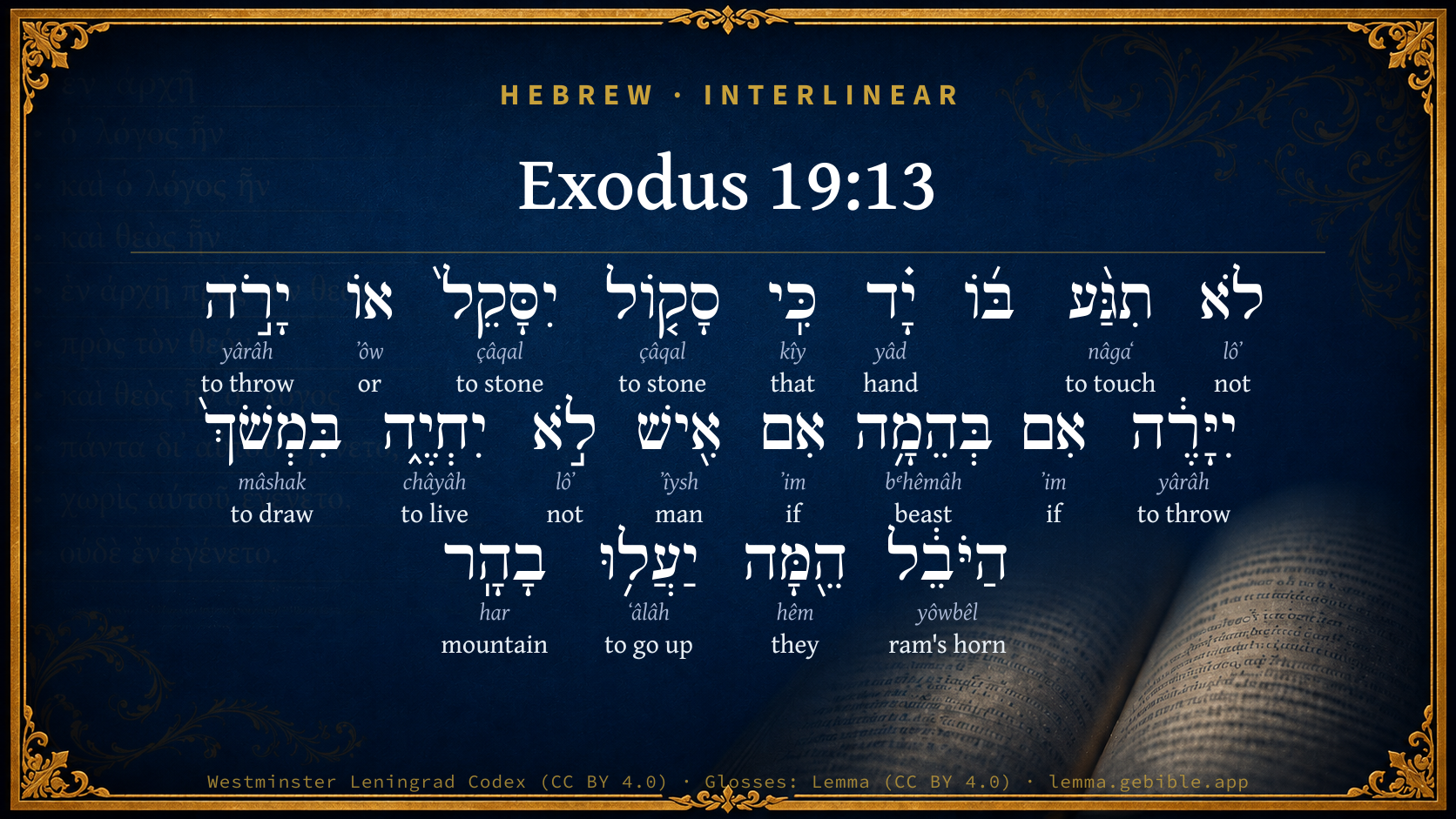
Hebrew (Westminster Leningrad Codex) Exodus 19:13 appears in the Hebrew Old Testament. The text above is from the Westminster Leningrad Codex. Each word links to its Strong’s number, a concise gloss, and parsing drawn from the Open Scriptures Hebrew Bible morphology. Click any word for its full Brown-Driver-Briggs (BDB) entry.
Download image
Cite this verse

Exodus 19:13 (World English Bible). Public Domain. Lemma interlinear Bible study tool, https://lemma.gebible.app/v/exodus/19/13.

Show BibTeX & RIS
BibTeX
RIS
English Translation
No hand shall touch him, but he shall surely be stoned or shot through; whether it is animal or man, he shall not live.' When the trumpet sounds long, they shall come up to the mountain."
World English Bible · Public Domain
Highlights
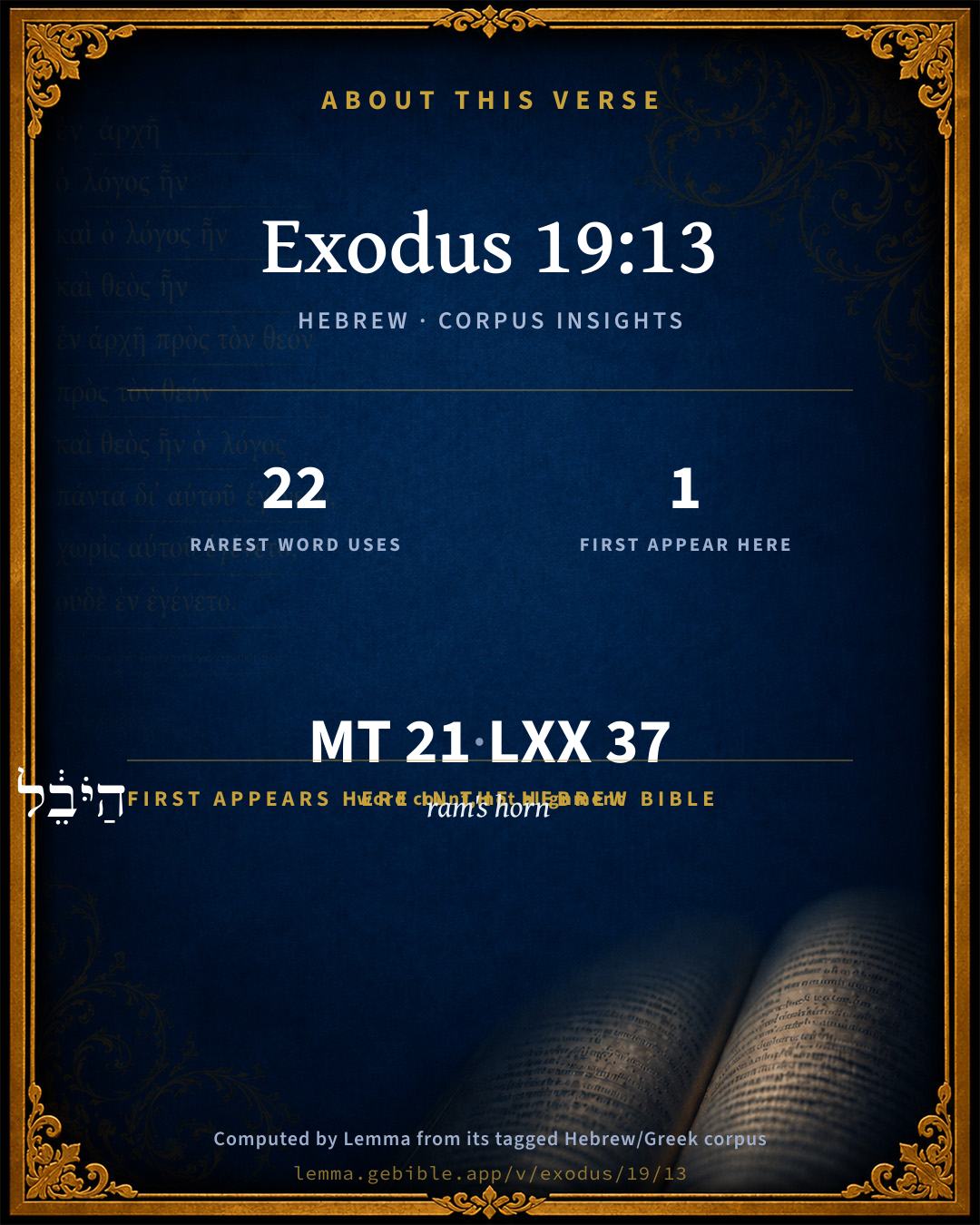
  • 1 first appearance in the Hebrew Bible
Full analysis ↓
Download a study sheet

One document with this verse’s original text, its word-by-word gloss line, the meaning frame, cross-references with their text, attributed commentary, and full source and license credits — printable, and it pastes into notes with its structure intact.

This verse Autodidact and up

Study sheet (.html) Plain text (.txt)

A passage Seminary Student

Up to 50 verses in one chapter. A passage sheet keeps up to 6 commentary sources and 12 cross-references per verse, in the order this page ranks them, and says so on the sheet whenever that leaves anything out. Ask for a single verse and you get the Autodidact verse sheet above.

Everything on this page stays free to read, with no account — the sheet is a download of what is already on screen, not access to it.

Want to remove ads? Support Godless Engineer
Compare translations 3

The same verse in 3 English versions, stacked beneath the original-language interlinear above. Click any original word for its lexicon entry.

Each is an independent rendering of the whole verse — the interlinear is not word-aligned to these translations.

Highlighted words mark where these versions differ — a whole-verse word diff, not a word-by-word alignment.

  • World English Bible Public Domain
    No hand shall touch him, but he shall surely be stoned or shot through; whether it is animal or man, he shall not live.' When the trumpet sounds long, they shall come up to the mountain."
  • King James Version Public Domain
    There shall not an hand touch it, but he shall surely be stoned, or shot through; whether it be beast or man, it shall not live: when the trumpet soundeth long, they shall come up to the mount.
  • unfoldingWord Literal Text CC BY-SA 4.0
    No hand shall touch that one. Instead, he shall be stoned or he shall be shot. Whether animal or human, he shall not live.’ At the prolonged sound of the horn, they shall ascend on the mountain.”

unfoldingWord Literal Text — © unfoldingWord, licensed CC BY-SA 4.0. Word-aligned USFM3 via Door43 (git.door43.org/unfoldingWord/en_ult).

Versions to compare (up to 4)

3 of 4 selected

Show all 18 translations

Every available English version of this verse, each an independent rendering of the whole verse.

  • World English Bible Public Domain
    No hand shall touch him, but he shall surely be stoned or shot through; whether it is animal or man, he shall not live.' When the trumpet sounds long, they shall come up to the mountain."
  • Berean Standard Bible Public Domain
    No hand shall touch him, but he shall surely be stoned or shot with arrows—whether man or beast, he must not live.’ Only when the ram’s horn sounds a long blast may they approach the mountain.”
  • Majority Standard Bible Public Domain
    No hand shall touch him, but he shall surely be stoned or shot with arrows—whether man or beast, he must not live.’ Only when the ram’s horn sounds a long blast may they approach the mountain.”
  • King James Version Public Domain
    There shall not an hand touch it, but he shall surely be stoned, or shot through; whether it be beast or man, it shall not live: when the trumpet soundeth long, they shall come up to the mount.
  • American Standard Version (1901) Public Domain
    no hand shall touch him, but he shall surely be stoned, or shot through; whether it be beast or man, he shall not live: when the trumpet soundeth long, they shall come up to the mount.
  • Revised Version (1885) Public Domain
    no hand shall touch him, but he shall surely be stoned, or shot through; whether it be beast or man, it shall not live: when the trumpet soundeth long, they shall come up to the mount.
  • Geneva Bible (1599) Public Domain
    No hand shall touche it, but he shalbe stoned to death, or striken through with darts: whether it be beast or man, he shall not liue: when the horne bloweth long, they shall come vp into the mountaine.
  • Douay-Rheims (1899) Public Domain
    No hands shall touch him, but he shall be stoned to death, or shall be shot through with arrows: whether it be beast, or man, he shall not live. When the trumpet shall begin to sound, then let them go up into the mount.
  • Young's Literal Translation Public Domain
    a hand cometh not against him, for he is certainly stoned or shot through, whether beast or man it liveth not; in the drawing out of the jubilee cornet they go up into the mount.'
  • Literal Standard Version CC BY-SA 4.0
    a hand does not come against him, for he is certainly stoned or shot through, whether beast or man—it does not live; in the prolonging of the ram’s horn they go up into the mountain.”
  • Unlocked Literal Bible CC BY-SA 4.0
    No one's hand must touch such a person. Instead, he must certainly be stoned or shot. Whether it is a person or an animal, he must be put to death. When the trumpet sounds a long blast, they may come up to the foot of the mountain.”
  • unfoldingWord Literal Text CC BY-SA 4.0
    No hand shall touch that one. Instead, he shall be stoned or he shall be shot. Whether animal or human, he shall not live.’ At the prolonged sound of the horn, they shall ascend on the mountain.”
  • Darby Bible Public Domain
    not a hand shall touch it, but it shall certainly be stoned, or shot through; whether it be a beast or a man, it shall not live. When the long drawn note of the trumpet soundeth, they shall come up to the mountain.
  • World Messianic Bible Public Domain
    No hand shall touch him, but he shall surely be stoned or shot through; whether it is animal or man, he shall not live.’ When the shofar sounds long, they shall come up to the mountain.”
  • Webster's Bible Public Domain
    There shall not a hand touch it, but he shall surely be stoned or shot through: whether it be beast or man, it shall not live: when the trumpet soundeth long, they shall come up to the mount.
  • Free Bible Version CC BY-SA 4.0
    Make sure they are stoned or shot with arrows—they must not be allowed to live.’ Only when there is a long blast on the ram's horn can the people come up the mountain.”
  • Bible in Basic English Public Domain
    He is not to be touched by a hand, but is to be stoned or have an arrow put through him; man or beast, he is to be put to death: at the long sounding of a horn they may come up to the mountain.
  • JPS Tanakh (1917) Public Domain
    no hand shall touch him, but he shall surely be stoned, or shot through; whether it be beast or man, it shall not live; when the ram's horn soundeth long, they shall come up to the mount.'

Literal Standard Version (2020), Covenant Press — licensed CC BY-SA 4.0. Text via the HelloAO Bible API (eBible.org). Unlocked Literal Bible (unfoldingWord) — licensed CC BY-SA 4.0. Text via the HelloAO Bible API (eBible.org). unfoldingWord Literal Text — © unfoldingWord, licensed CC BY-SA 4.0. Word-aligned USFM3 via Door43 (git.door43.org/unfoldingWord/en_ult). Free Bible Version, Dr. Jonathan Gallagher — licensed CC BY-SA 4.0. Text via the HelloAO Bible API (eBible.org).

Word by word

More ways to search: Search by grammar → Find every occurrence → Compare this word →

Practice this passage: Drill this verse → Learn its vocabulary →

סָק֤וֹל
çâqal
H5619
“to stone”
Verb, Qal, Infinitive Absolute
Part of Speech
Verb
Stem
Qal
Form
Infinitive Absolute
Full BDB Definition

Origin: a primitive root

TWOT: 1541

to stone (to death), put to death by stoning - (Qal) to pelt with stones, stone to death - (Niphal) to be stoned to death - (Piel) - to stone, pelt with stones - to free from stones (of vineyard, highway) - (Pual) to be stoned to death
  1. לֹא lôʼ H3808 “not” Particle, Negative
  2. תִגַּ֨ע nâgaʻ H5060 “to touch” Verb, Qal, Imperfect, 3rd Person, Feminine, Singular
  3. יָ֗ד yâd H3027 “hand” Noun, Common, Both, Singular, Absolute
  4. כִּֽי kîy H3588 “that” Conjunction
  5. יִסָּקֵל֙ çâqal H5619 “to stone” Verb, Niphal, Imperfect, 3rd Person, Masculine, Singular
  6. אוֹ ʼôw H176 “or” Conjunction
  7. יָרֹ֣ה yârâh H3384 “to throw” Verb, Qal, Infinitive Absolute
  8. יִיָּרֶ֔ה yârâh H3384 “to throw” Verb, Niphal, Imperfect, 3rd Person, Masculine, Singular
  9. אִם ʼim H518 “if” Conjunction
  10. בְּהֵמָ֥ה bᵉhêmâh H929 “beast” Noun, Common, Feminine, Singular, Absolute
  11. אִם ʼim H518 “if” Conjunction
  12. אִ֖ישׁ ʼîysh H376 “man” Noun, Common, Masculine, Singular, Absolute
  13. לֹ֣א lôʼ H3808 “not” Particle, Negative
  14. יִחְיֶ֑ה châyâh H2421 “to live” Verb, Qal, Imperfect, 3rd Person, Masculine, Singular
  15. בִּמְשֹׁךְ֙ mâshak H4900 “in/at · to draw” Preposition + Verb, Qal, Infinitive Construct
  16. הַיֹּבֵ֔ל yôwbêl H3104 “the · ram's horn” Particle, Definite Article + Noun, Common, Masculine, Singular, Absolute
  17. הֵ֖מָּה hêm H1992 “they” Pronoun, Personal, 3rd Person, Masculine, Plural
  18. יַעֲל֥וּ ʻâlâh H5927 “to go up” Verb, Qal, Imperfect, 3rd Person, Masculine, Plural
  19. בָהָֽר har H2022 “in/at the · mountain” Preposition, Determined + Noun, Common, Masculine, Singular, Absolute

About this verse

These counts appear in no published source. They are computed here, from the morphology-tagged text and Lemma’s own curated glosses. What Lemma adds →

21
words
16
distinct lemmas
Pentateuch
section

Notable vocabulary

The rarest word here is סָק֤וֹל to stone H5619 — appearing just 22 times in the whole Hebrew Bible.

First appearance in Scripture

This word makes its first canonical appearance in the Hebrew Bible here:

  • הַיֹּבֵ֔ל ram's horn H3104

Shared distinctive vocabulary

סָק֤וֹל to stone H5619 occurs in 20 verses of the Hebrew Bible. Also found in:

Grammatical profile

  • 8 verbs
  • 5 nouns
  • 1 pronoun
  • 1 preposition
  • 4 conjunctions
  • 2 particles

Verb forms

  • תִגַּ֨ע Qal · Imperfect
  • סָק֤וֹל Qal · Infinitive Absolute
  • יִסָּקֵל֙ Niphal · Imperfect
  • יָרֹ֣ה Qal · Infinitive Absolute
  • יִיָּרֶ֔ה Niphal · Imperfect
  • יִחְיֶ֑ה Qal · Imperfect
  • בִּמְשֹׁךְ֙ Qal · Infinitive Construct
  • יַעֲל֥וּ Qal · Imperfect

Repetition

Words recur within this verse — often emphatic in Hebrew:

  • סָק֤וֹל to stone H5619 ×2
  • יָרֹ֣ה to throw H3384 ×2
  • לֹא not H3808 ×2
  • אִם if H518 ×2

Hebrew & Septuagint length

In English translation the verse runs 36 words from the Hebrew and 50 from the Septuagint (LXX English) — closely comparable.

A rough comparison of the two English renderings, which tokenize alike — not a word-level alignment.

Word counts can differ between the Hebrew and the Greek without any difference in meaning — e.g. the Hebrew direct-object marker אֵת has no separate Greek word, and Greek often adds the article ὁ.

In the original languages it is 21 Hebrew tokens and 37 Greek tokens — but the two are counted differently (Hebrew bundles its prefixes and suffixes into one token; the Greek is in lemma form), so that isn’t a like-for-like length.

Cross-references

7

Topical passages linked to Exodus 19:13 in the Treasury of Scripture Knowledge — connected by theme and wording, ordered by reader-vote popularity; previews shown in the World English Bible.

  • Exodus 19:16 It happened on the third day, when it was morning, that there were thunders and lightnings, and a thick cloud on the mountain, and the sound of an exceedingly loud trumpet; and all the people who were in the camp trembled.
  • 1 Thessalonians 4:16 For the Lord himself will descend from heaven with a shout, with the voice of the archangel, and with God's trumpet. The dead in Christ will rise first,
  • Hebrews 12:20 for they could not stand that which was commanded, "If even an animal touches the mountain, it shall be stoned;"
  • Exodus 19:19 When the sound of the trumpet grew louder and louder, Moses spoke, and God answered him by a voice.
  • Exodus 21:28–29 "If a bull gores a man or a woman to death, the bull shall surely be stoned, and its flesh shall not be eaten; but the owner of the bull shall not be held responsible.
  • Leviticus 20:15–16 "'If a man lies with an animal, he shall surely be put to death; and you shall kill the animal.
  • 1 Corinthians 15:52 in a moment, in the twinkling of an eye, at the last trumpet. For the trumpet will sound, and the dead will be raised incorruptible, and we will be changed.

Cross-references courtesy of OpenBible.info (CC BY 4.0).

Hebrew and Greek witnesses Masoretic Hebrew ↔ Greek Septuagint

The same verse in the two great witnesses to the Old Testament, shown verse-for-verse.

These are two independent witnesses, not word-aligned to each other, and the Septuagint is shown in lemma (dictionary) form.

Hebrew Exodus 19:13 Masoretic · Westminster Leningrad Codex

לֹא תִגַּ֨ע בּ֜וֹ יָ֗ד כִּֽי סָק֤וֹל יִסָּקֵל֙ אוֹ יָרֹ֣ה יִיָּרֶ֔ה אִם בְּהֵמָ֥ה אִם אִ֖ישׁ לֹ֣א יִחְיֶ֑ה בִּמְשֹׁךְ֙ הַיֹּבֵ֔ל הֵ֖מָּה יַעֲל֥וּ בָהָֽר

No hand shall touch him, but he shall surely be stoned or shot through; whether it is animal or man, he shall not live.' When the trumpet sounds long, they shall come up to the mountain."

World English Bible · Public Domain

Greek LXX Exodus 19:13 Septuagint · lemma form

οὐ ἅπτομαι αὐτός χείρ ἐν γάρ λίθος λιθοβολέω ἤ βολίς κατατοξεύω ἐάν τε κτῆνος ἐάν τε ἄνθρωπος οὐ ζάω ὅταν ὁ φωνή καί ὁ σάλπιγξ καί ὁ νεφέλη ἀποἔρχομαι ἀπό ὁ ὄρος ἐκεῖνος ἀναβαίνω ἐπί ὁ ὄρος

A hand shall not touch it, for every one that touches shall be stoned with stones or shot through with a dart, whether beast or whether man, it shall not live: when the voices and trumpets and cloud depart from off the mountain, they shall come up on the mountain.

LXX2012 (modern English Septuagint) · Public Domain

On this verse, John Gill's Exposition discusses the Septuagint’s reading. Read the note in Commentary ↓

Hebrew: Westminster Leningrad Codex (CC BY 4.0). Greek: Septuagint (public domain); English from LXX2012 (modern English Septuagint) (Public Domain). How the Septuagint differs from the Hebrew →

Targum (Aramaic paraphrase)

2

The Targum is the ancient Jewish Aramaic paraphrase of the Hebrew Scriptures — an interpretive translation, not the Hebrew text itself. Onkelos (literal) and Pseudo-Jonathan (expansive) render the Torah, and Jonathan the Prophets. Coverage is partial: where no permissively-licensed English translation exists for a verse, only the Aramaic is shown. This is verse-level text, not a word-by-word alignment to the Hebrew.

  1. Targum Onkelos Torah (Genesis–Deuteronomy)
    לָא תִקְרַב בֵּהּ יְדָא אֲרֵי אִתְרְגָמָא יִתְרְגֵם אוֹ אִשְׁתְּדָאָה יִשְׁתְּדִי אִם בְּעִירָא אִם אֱנָשָׁא לָא יִתְקַיָם בְּמֵיגַד שׁוֹפָרָא אִנוּן מְרָשָׁן לְמִסַק בְּטוּרָא:

    (no public-domain English translation for this verse)

    Targum Onkelos — Aramaic: “Onkelos Genesis” (public domain); “Onkelos Exodus” (public domain); “Onkelos Leviticus” (public domain); “Onkelos Numbers” (public domain); “Onkelos Deuteronomy” (public domain). English: “Sefaria Community Translation” (CC0 1.0 (public-domain dedication)); “J.W. Etheridge. The Targums of Onkelos and Jonathan Ben Uzziel on the Pentateuch. London: Longmans, Green, 1862” (public domain). Text via Sefaria.

  2. Targum Pseudo-Jonathan Torah (Genesis–Deuteronomy)
    לָא תִקְרַב בֵּיהּ יְדָא אֲרוּם יִתְרְגָמָא יִתְרְגֵם בְּאַבְנָא בַרְדָא אוֹ גִירִין דְּאֵשָׁא יִדְרְקוּן בֵּיהּ אִין בְּעִירָא אִין אֵינָשָׁא לָא יִתְקַיֵּים בְּרַם בְּמֵיגַד קַל שׁוֹפְרָא הִינוּן מַרְשַׁן לְמֵיסַק בְּטַוְורָא

    Touch it not with the hand; for he will be stoned with hailstone, or be pierced with arrows of fire; whether beast or man, he will not live. But when the voice of the trumpet is heard, they may go up (forwards) towards the mount.

    Targum Pseudo-Jonathan — Aramaic: “Targum Jonathan on Genesis” (public domain); “Targum Jonathan on Exodus” (public domain); “Targum Jonathan on Leviticus” (public domain); “Targum Jonathan on Numbers” (public domain); “Targum Jonathan on Deuteronomy” (public domain). English: “The Targum of Jonathan ben Uzziel, trans. J. W. Etheridge, London, 1862” (public domain). Text via Sefaria.

Commentary

Notes on Exodus 19:13 from classic Christian and Jewish commentators (each source and its license shown beneath its notes). The classic Christian expositions comment on the surrounding passage and are grouped to its opening verse, so a note may address several verses; the Jewish commentaries on the Tanakh (Rashi and others) are per-verse, so they appear only where the commentator wrote on this verse.

Lemma curates 59 commentaries, every one of them public domain or Creative Commons licensed, each selected and text-cleaned for this edition rather than reprinted as found. About our sources →

Ellicott's Commentary for English Readers

(13) There shall not an hand touch it.—This translation gives an entirely wrong sense. The meaning is, beyond all doubt, “There shall not a hand touch him,” i.e., the transgressor. To stop him and seize him, another person must have transgressed the bounds, and so have repeated the act which was forbidden. This course was to be avoided, and punishment was to be inflicted on the transgressor by stoning him, or transfixing him with arrows, from within the barrier.

Whether it be beast or man.—Though beasts are innocent of wrong-doing, and are thus no proper objects of punishment, yet the law of God requires their slaughter in certain eases—e.g. (1) when they are dangerous (Exo_21:28); (2) when they have become polluted (Lev_20:15); (3) When their owner’s sin is appropriately punished through their loss (Exo_13:13). In the present case, it could only be through the culpable carelessness of an owner that a beast could get inside the barrier.

When the trumpet soundeth long.—Comp. Exo_19:19.

They shall come up to the mount.—Rather, into the mount. The expression used is identical with that of the preceding verse, and there rendered “go up into the mount.” Thus the act forbidden in Exo_19:12 is allowed in Exo_19:13; it is not, however, allowed to the same persons. The word “they” (hêmah) in this present place is emphatic, and refers to certain privileged persons, as Moses and Aaron (Exo_19:24), not to the people generally.

A Bible Commentary for English Readers, edited by Charles John Ellicott (1878–1897) — public domain. Text from a community e-Sword module.

Trapp's Complete Commentary

John Trapp

Exo 19:13 There shall not an hand touch it, but he shall surely be stoned, or shot through; whether [it be] beast or man, it shall not live: when the trumpet soundeth long, they shall come up to the mount.

Ver. 13. They shall come up to the mount,] i.e., To the bottom of the mount, to the foot thereof. {Exo 19:17} {See Trapp on "Heb 12:20"} "The way of life is above to the wise," saith Solomon. {Pro 15:24} As Moses was with God in the mount, when the people were below in the valley.

John Trapp, A Commentary or Exposition upon All the Books of the Old and New Testament (1647–1656) — public domain. Text from a community e-Sword module.

Joseph Benson's Commentary

Exo 19:13. When the trumpet soundeth long — Then let them take their places at the foot of the mount. Never was so great a congregation called together and preached to at once as this was here. No one man’s voice could have reached so many, but the voice of God did.

Joseph Benson's Commentary on the Old and New Testaments (1811–1818) — public domain. Text from a community e-Sword module.

Geneva Bible (1599)

Geneva Bible translators

Or, trumpet.

Or, toward.

Geneva Bible (1599) marginal notes — public domain. Text via Bolls.life.

Adam Clarke's Commentary

Verse 13. There shall not a hand touch it] בו bo, HIM, not the mountain, but the man who had presumed to touch the mountain. He should be considered altogether as an unclean and accursed thing, not to be touched for fear of conveying defilement; but should be immediately stoned or pierced through with a dart, Heb 12:20.

Adam Clarke's Commentary on the Bible (1810–1826) — public domain. Text from a community e-Sword/MySword module.

The Cambridge Bible for Schools and Colleges

gen. ed. J. J. S. Perowne

13. no hand, &c.] i.e. he is not to be followed, and seized on the mount, but to be stoned or shot from a distance. Possibly the underlying idea may be (Bä.) that the trespasser, having touched sacred ground without proper authority, becomes thereby taboo—i.e. dangerous to touch, on account of the supernatural penalties that would be thereby incurred (see DB. ii. 395b n., iv. 826 ff.)—and forfeits his life to the deity, and anyone touching him afterwards is liable to become taboo likewise (cf. on Exo_29:37). RVm. it means the mountain; but this is not probable.

13b. the ram(’s horn)] Heb. yôbçl, as Jos_6:5 (קרן היובל, also with ‘soundeth long’); 4, 6, 8, 13 (שופרות (ה)יובלים). Not the word rendered ‘trumpet’ in vv. 16, 19, Exo_20:18.

they (emph.) may come up into (Heb., as v. 12) the mount, &c.] It may be doubted whether this clause is in its original position. Where it stands, it apparently refers to what may be done when the signal is given by the ‘ram’s horn’ at the end of the solemnity. Bacon would transfer vv. 11b–13 to v. 24, to follow priests (as in the note): ‘they shall come’ would then refer to the priests, and, vv. 23, 24 (to down) being rejected as a gloss, vv. 20–22, 24a, 11b–13, 24b would read consecutively (cf. McNeile, pp. xxvi. 113).

The Cambridge Bible for Schools and Colleges (gen. ed. J. J. S. Perowne; Cambridge University Press, 1878–1918) — public domain. Text from a community e-Sword module.

John Gill's Exposition

There shall not a hand touch it,.... The mountain or the border of it, which is repeated that it might be taken notice of; and to show that it would be resented if they were to stretch out their hand and only lightly touch it, much more should they set their feet upon it and attempt to ascend it: or rather, "shall not touch him" (o); that is, the man that shall touch the mountain; he shall be so detestable and abominable, whoever touches it or breaks through the bounds of it, and attempts to ascend it, that no man shall follow him to lay hold on him, in order to bring him back to justice, but shall dispatch him at once in one or other of the ways directed to:

but he shall surely be stoned, or shot through; if near at hand, all about him shall rise upon him, and take up stones and stone him; but if he is got at a distance, then they were to shoot arrows at him; and in this way Aben Ezra interprets it; the words, says he, refer to the man that toucheth the mount, who is not to be followed and apprehended, but those that see him, and are near, abiding in the place where they are, are to stone him immediately, and if afar off they are to throw darts at him: though the Targum of Jonathan seems to understand it, as if punishment would be immediately inflicted upon such a person, not by the hands of men, but by the hand of God; for it says, such an one shall be stoned with hailstones, and fiery darts shall be spread upon him; or, as the Jerusalem Targum, shall be shot at him:

whether it be beast, or man, it shall not live; that touches the mountain, and so it is explained, Heb 12:20, the word beast comprehends all kinds of beasts, wild and tame, and all sorts of cattle, of the herd or flock; as the word "man" takes in women as well as men, as Ben Gersom observes; Aben Ezra thinks fowls are not mentioned, because they cannot be taken, but fly away immediately; but then they might be shot:

when the trumpet soundeth long, they shall come up to the mount; this, according to Jarchi, was a trumpet of a ram's horn; the word used in the Arabic language signifying a ram; but it is a mere fancy and fable of his, that this was of the ram of Isaac which was sacrificed in his stead; it is much more likely that there was indeed no real trumpet, only a sound was formed like the sound of one; and, it is highly probable, was formed by the ministering angels; Aben Ezra observes, that the sound of a trumpet was never heard until the day of the decalogue, until the day that was given; and that there was not a greater wonder on Mount Sinai than this: the design and use of it was to gather, this vast body of people together, to come and hear what God had to say unto them; and when its sound was protracted to a great length, or was in one continued tone, and somewhat lower, as is usual when a trumpet is about to cease blowing, then the people were to take it as a token that they should approach the mountain; not to ascend it, but come to the lower and nether part of it, where bounds were set to direct them how far they might go, and no further: so the Septuagint version is,"when the voices (or thunders) and the trumpets and the cloud departed from the mountain, they went up to the mountain:''a certain Jewish writer (p) interprets this, not of the people in general, but of Aaron and his sons, and of the seventy elders, see Exo 19:24.

(o) "non tanget eum", Vatablus, Drusius, "non feriet eum", Tigurine version. (p) R. Samuel Ben Hophni, apud Aben Ezram, in loc.

John Gill's Exposition of the Whole Bible (1746–1763) — public domain (CC PDM 1.0). Text via the HelloAO Bible API.

Albert Barnes' Notes on the Bible

Touch it - Rather “touch him.” The person who had touched the mount was not to be touched, since the contact would be pollution.

Albert Barnes' Notes on the Bible (1834–1885) — public domain. Text from a community e-Sword/MySword module.

Haydock's Catholic Bible Commentary

Him. In detestation of his impiety, which has made him unclean. (Haydock) --- Go up into the precincts of the mountain, to which Moses conducted them; (ver. 17. 21,) or they might ascend after the trumpet ceased, and the law was given. For some understand shall begin, in a contrary sense with the Roman Septuagint, "when the voices of thunder, and the trumpets, and the cloud shall be no more;" (apelthe) so also the Chaldean, Syriac. (Vatable) The sound which was heard, resembled that of a horn. (Jobel.) See Leviticus xxv. 10. (Calmet)

George Leo Haydock (1774–1849), Haydock's Catholic Family Bible and Commentary, 1859 edition — public domain. Excludes Psalms (Douay-Rheims chapter numbering differs from Protestant) and Deuterocanonical books (Catholic canon only).

Matthew Poole's English Annotations

There shall not an hand touch it, i.e. the mountain. But,

1. This seems to be a gross tautology, for it was twice forbidden in the words next foregoing.

2. So the word hand would seem to be ascribed both to man and beast. Others therefore render it

touch him, i.e. they shall look upon such an impudent transgressor of my express command as an abominable person, whom they cannot touch without defilement, and therefore he shall be put to death in such a manner as may be performed without touching him.

Whether it be beast; for though the beasts are not capable of a law, yet they might be threatened for man’s caution, and punished for the fault of their owners in not keeping them at a distance from the mount.

When the trumpet soundeth long, i.e. with one continued, equal, and gentle sound, as is usual in the end of the music song, which is opposed to a rough, and loud, and unequal sound. There was no real trumpet here, but an angel made a sound like that of a trumpet.

They shall come up to the mount.

Object. This was forbidden to them, Exo 19:12.

Answ. 1. They were forbidden to come up to the mount whilst God was delivering his laws, but allowed it afterwards when that action ceased, which was signified by the long sound of the trumpet.

2. They might not come into the mount or towards the top of it, but they might come to the bottom or lower parts of it, where the bounds were set, or at least towards or near it, as the Hebrew preposition beth is sometimes used. So the mount may be understood, more strictly, Exo 19:12, for an eminent part or top of it, where the thick cloud appeared, and where Moses was, and here more largely for the whole mountain.

Matthew Poole's English Annotations on the Holy Bible (1683–1685) — public domain. Text from a community e-Sword/MySword module.

Whedon's Commentary on the Bible

Daniel D. Whedon

13. Not a hand touch it — So sacred and so awful was that mount to be esteemed that no one unsanctified and unbidden might touch it, on the peril of life. Not even a beast would be permitted to touch it, and live. This rigorous requirement was adapted to inculcate reverence for the law.

When the trumpet soundeth long — Hebrews, in the drawing out of the yobel. The word יובל, here translated trumpet, appears to have been some kind of a wind instrument. In Jos_6:4-5; Jos_6:8, we find the word employed to qualify קרן, horn, or cornet, and in Lev_25:10, it denotes the fiftieth year — year of liberty and joy — commonly known as “the year of jubilee.” The Targum and the rabbins understand a wind instrument made of a ram’s horn. The exact meaning is doubtful. Gesenius regards it as an onomatopoetic word, signifying a joyful shout, and, perhaps, is best understood here as the sound of some instrument, rather than the instrument itself. The drawing out of the yobel would thus mean the prolonged tones of a signal call, without specifying the particular instrument employed. See further on Exo_19:16, where the trumpet is mentioned.

They shall come up to the mount — Who? Certainly not the people generally, who were forbidden to touch it, (comp. Exo_19:23-24,) but chosen representatives and elders of the people, (see Exo_24:1-2,) whom the writer does not here stop to specify. We see from Exo_19:20 that only Moses went up at first; subsequently Aaron was permitted to accompany him, (Exo_19:24,) but the priests and the people were forbidden.

Daniel D. Whedon (gen. ed.), Commentary on the Old and New Testaments (1874–1909) — public domain. Text from a community e-Sword module.

The Pulpit Commentary

There shall not a hand touch it. Rather, "there shall not a hand touch him." The transgressor shall not be seized and apprehended, for that would involve the repetition of the offence by his arrester, who must overpass the "bounds" set by Moses, in order to make the arrest. Instead of seizing him, they were to kill him with stones or arrows from within the "bounds," and the same was to be done, if any stray beast approached the mountain. When the trumpet soundeth long, they shall come up to the mount. By translating the same Hebrew phrase differently here and in verse 12, the A.V. avoids the difficulty which most commentators see in this passage. According to the apparent construction, the people are first told that they may, on no account, ascend the mountain (ver., 12), and then that they may do so, so soon as the trumpet sounds long (ver. 13). But they do not ascend at that time (ver. 19), nor are they allowed to do so on the contrary, Moses is charged anew to prevent it (ver. 21-25); nor indeed do the people ever ascend, but only Moses, Aaron, Nadab, Abihu, and the seventy eiders. (Exo_24:1, Exo_24:2) What, then, is the permission here given? When we scrutinise the passage closely, we observe that the pronoun "they" is in the Hebrew, emphatic, and, therefore, unlikely to refer to "the people" of ver. 12. To whom then does it refer? Not, certainly, to "the Elders" of ver. 7, which would be too remote an antecedent, but to those chosen persons who are in the writer"s mind, whom God was about to allow to ascend. Even these were not allowed to go up until summoned by the prolonged blast of the trumpet.

The Pulpit Commentary (1880–1919), ed. H.D.M. Spence-Jones & Joseph S. Exell — public domain. Text from a community e-Sword module.

John Wesley's Explanatory Notes

When the trumpet soundeth long - Then let them take their places at the foot of the mount. Never was so great a congregation called together and preached to at once as this was here. No one man's voice could have reached so many, but the voice of God did.

John Wesley, Explanatory Notes Upon the Whole Bible (1754–1765) — public domain. Text via the GEBible commentary corpus.

Rashi

Rabbi Shlomo Yitzchaki (Rashi)

ירה יירה HE SHALL SURELY BE CAST DOWN — From this we derive the law regarding those who are sentenced to be stoned that they have to be thrown down from the place of stoning, which was a spot of the height of twice a man’s stature (Sanhedrin 45a).

יירה means HE SHALL BE THROWN BELOW to the ground, the word being similar to, (Exodus 15:4) “He hath cast down (ירה) into the sea”.

במשך היבל WHEN THE RAM’S HORN SOUNDETH LONG — when the ram’s horn draws out a long sound that is a sign of the departure of the Shechina and that the Divine voice is about to cease, and as soon as “I” shall depart they shall be permitted to ascend [i. e. המה יעלו בהר is not obligatory, signifying, “they shall go up”, but it is permissive] (Mekhilta).

היבל — This denotes a ram’s horn, for so do they term, a ram in Arabia — יובלא (corresponding to the Hebrew יובל) (Rosh Hashanah 26a). The horn used here was that of Isaac’s ram (Pirkei DeRabbi Eliezer 31).

Rashi on the Tanakh — English translations: “The Judaica Press complete Tanach with Rashi, translated by A. J. Rosenberg” (CC BY 4.0); “Pentateuch with Rashi's commentary by M. Rosenbaum and A.M. Silbermann, 1929-1934” (public domain); “The Metsudah Tanach series, Lakewood, N.J” (CC BY 4.0); and “The Book of Joshua, Metsudah Publications, 1997” (CC BY 4.0). Text via Sefaria.

Ramban (Nachmanides)

Rabbi Moshe ben Nachman (Ramban / Nachmanides)

WHEN ‘HAYOVEIL’ (THE RAM’S HORN) SOUNDETH LONG, THEY SHALL COME UP TO THE MOUNT. “The Hebrew word hayoveil denotes a ram’s horn, and the horn used here was that of Isaac’s ram.” Thus Rashi’s language. But I have not understood this, for Isaac’s ram was burnt as a whole-offering, and horns and hoofs were completely burnt in whole-offerings. Perhaps the Holy One, blessed be He, shaped the ashes of the horn [of Isaac’s ram] and restored it to what it was originally. But in my opinion, this Agadah (homily) contains a secret. Thus they, is unknown to me. have said that this Voice [heard on Mount Sinai, as stated in Verse 16], was that of Pachad Yitzchak (the Fear of Isaac). (Vol. I pp. 388-389). And in Bachya’s commentary here (Vol. II, p. 172 of my edition): “This is the Pachad Yitzchak which they perceived at Mount Sinai.” It is for this reason that Scripture says, and all the people that were in the camp trembled. ” (Bachya, ibid.) At this manifestation of G’vurah. they did not grasp the commandment itself but only a voice.

Ramban (Nachmanides) on the Tanakh — English translation: “Commentary on the Torah by Ramban (Nachmanides). Translated and annotated by Charles B. Chavel. New York, Shilo Pub. House, 1971-1976” (CC BY 4.0). Text via Sefaria.

Lesson kit

Teaching starters — assembled from the data on this page, not authored interpretation. Every prompt links to the verse data it draws on. Edit before teaching.

Exodus, in the Pentateuch, opens this verse with 21 words (16 distinct Hebrew lemmas). Its most distinctive word is çâqal (“to stone”). A historical commentator’s framing appears above. Read the whole chapter for the surrounding context.

Discussion questions

  1. How does “to stone” (çâqal) shape what this verse is saying?
  2. The word “ram's horn” first appears here in Scripture. What is being introduced at this debut?
  3. Exodus 8:26 shares the word «to stone» with this verse. How do the two illuminate each other?
  4. “to stone” occurs 2× in this one verse. What is the effect of the repetition?
  5. These translations render this verse differently; the difference is in the English rendering, not the original. What questions does that raise?
  6. The verb «תִגַּ֨ע» is Qal Imperfect. How does its form color the action?
  7. Reading how Ellicott's Commentary for English Readers and Trapp's Complete Commentary read this verse, where do the two commentators agree and where do they part?

Things to notice

Reading settings

Reading text

Shown beneath each verse's original-language words.

Old Testament
Old Testament edition

Read the OT as the Masoretic Hebrew (MT) or the Greek Septuagint (LXX).

English shown for the Greek Septuagint (in the Hebrew ↔ Greek comparison).

Comparing translations? Open the Compare panel on any verse page to stack up to four side by side.