Genesis 49:9

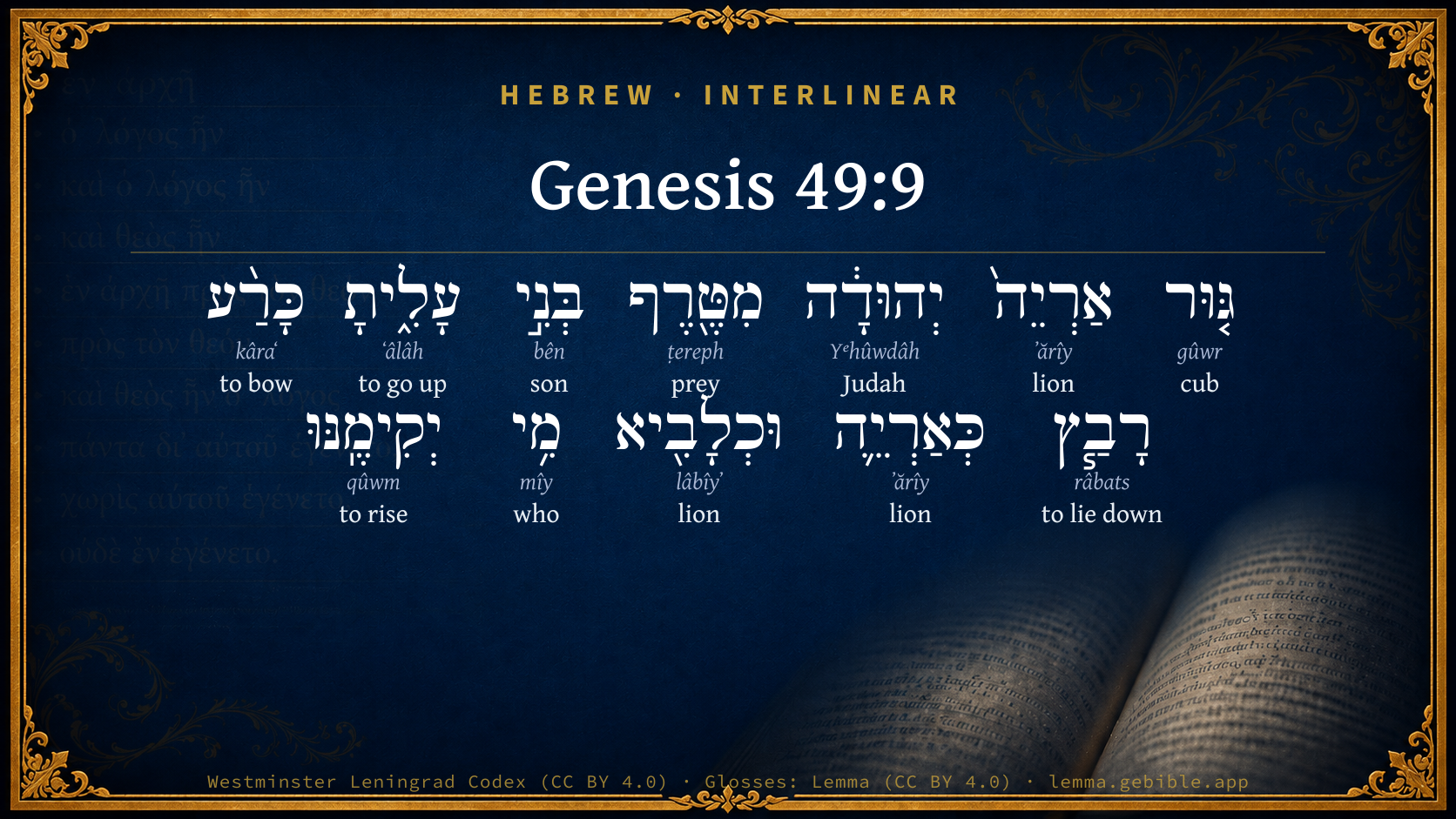
Hebrew (Westminster Leningrad Codex) Genesis 49:9 appears in the Hebrew Old Testament. The text above is from the Westminster Leningrad Codex. Each word links to its Strong’s number, a concise gloss, and parsing drawn from the Open Scriptures Hebrew Bible morphology. Click any word for its full Brown-Driver-Briggs (BDB) entry.
Download image
Cite this verse

Genesis 49:9 (World English Bible). Public Domain. Lemma interlinear Bible study tool, https://lemma.gebible.app/v/genesis/49/9.

Show BibTeX & RIS
BibTeX
RIS
English Translation
Judah is a lion's cub. From the prey, my son, you have gone up. He stooped down, he crouched as a lion, As a lioness. Who will rouse him up?
World English Bible · Public Domain
Highlights
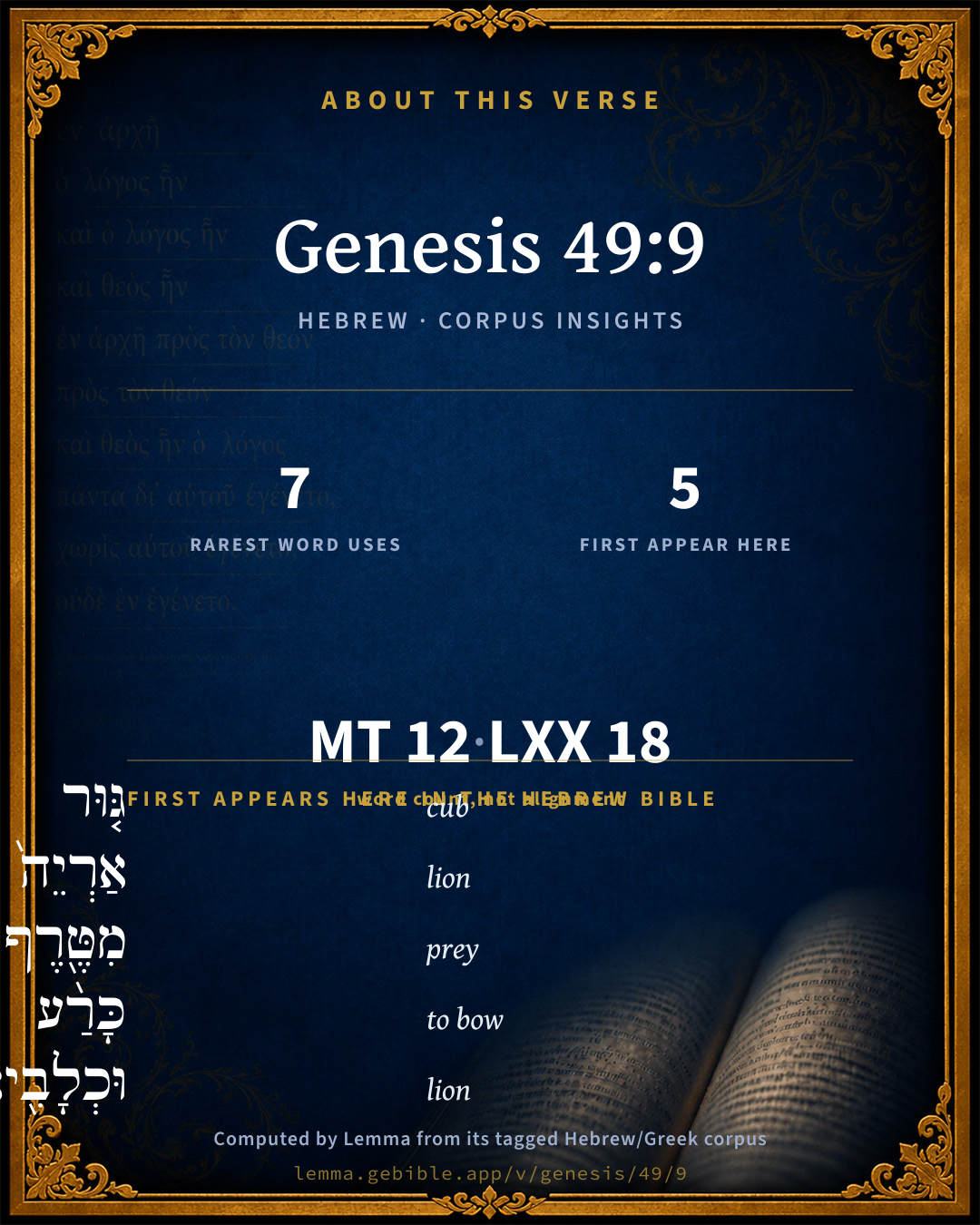
  • 5 first appearances in the Hebrew Bible
Full analysis ↓
Download a study sheet

One document with this verse’s original text, its word-by-word gloss line, the meaning frame, cross-references with their text, attributed commentary, and full source and license credits — printable, and it pastes into notes with its structure intact.

This verse Autodidact and up

Study sheet (.html) Plain text (.txt)

A passage Seminary Student

Up to 50 verses in one chapter. A passage sheet keeps up to 6 commentary sources and 12 cross-references per verse, in the order this page ranks them, and says so on the sheet whenever that leaves anything out. Ask for a single verse and you get the Autodidact verse sheet above.

Everything on this page stays free to read, with no account — the sheet is a download of what is already on screen, not access to it.

Want to remove ads? Support Godless Engineer
Compare translations 3

The same verse in 3 English versions, stacked beneath the original-language interlinear above. Click any original word for its lexicon entry.

Each is an independent rendering of the whole verse — the interlinear is not word-aligned to these translations.

Highlighted words mark where these versions differ — a whole-verse word diff, not a word-by-word alignment.

  • World English Bible Public Domain
    Judah is a lion's cub. From the prey, my son, you have gone up. He stooped down, he crouched as a lion, As a lioness. Who will rouse him up?
  • King James Version Public Domain
    Judah is a lion's whelp: from the prey, my son, thou art gone up: he stooped down, he couched as a lion, and as an old lion; who shall rouse him up?
  • unfoldingWord Literal Text CC BY-SA 4.0
    Judah the cub of a lion. From the prey, my son, you have gone up. He crouches lies down like a lion. And like a lioness, who will rouse him?

unfoldingWord Literal Text — © unfoldingWord, licensed CC BY-SA 4.0. Word-aligned USFM3 via Door43 (git.door43.org/unfoldingWord/en_ult).

Versions to compare (up to 4)

3 of 4 selected

Show all 18 translations

Every available English version of this verse, each an independent rendering of the whole verse.

  • World English Bible Public Domain
    Judah is a lion's cub. From the prey, my son, you have gone up. He stooped down, he crouched as a lion, As a lioness. Who will rouse him up?
  • Berean Standard Bible Public Domain
    Judah is a young lion—my son, you return from the prey. Like a lion he crouches and lies down; like a lioness, who dares to rouse him?
  • Majority Standard Bible Public Domain
    Judah is a young lion—my son, you return from the prey. Like a lion he crouches and lies down; like a lioness, who dares to rouse him?
  • King James Version Public Domain
    Judah is a lion's whelp: from the prey, my son, thou art gone up: he stooped down, he couched as a lion, and as an old lion; who shall rouse him up?
  • American Standard Version (1901) Public Domain
    Judah is a lion's whelp; From the prey, my son, thou art gone up: He stooped down, he couched as a lion, And as a lioness; who shall rouse him up?
  • Revised Version (1885) Public Domain
    Judah is a lion’s whelp; From the prey, my son, thou art gone up: He stooped down, he couched as a lion, And as a lioness; who shall rouse him up?
  • Geneva Bible (1599) Public Domain
    Iudah, as a Lions whelpe shalt thou come vp from the spoyle, my sonne. He shall lye downe and couche as a Lion, and as a Lionesse: Who shall stirre him vp?
  • Douay-Rheims (1899) Public Domain
    Juda is a lion's whelp: to the prey, my son, thou art gone up: resting thou hast couched as a lion, and as a lioness, who shall rouse him?
  • Young's Literal Translation Public Domain
    A lion's whelp `is' Judah, For prey, my son, thou hast gone up; He hath bent, he hath crouched as a lion, And as a lioness; who causeth him to arise?
  • Literal Standard Version CC BY-SA 4.0
    A lion’s whelp [is] Judah, || For prey, my son, you have gone up; He has bent, he has crouched as a lion, || And as a lioness; who causes him to arise?
  • Unlocked Literal Bible CC BY-SA 4.0
    Judah is a lion's cub. My son, you have gone up from your victims. He stooped down, he crouched like a lion, like a lioness. Who would dare to awaken him?
  • unfoldingWord Literal Text CC BY-SA 4.0
    Judah the cub of a lion. From the prey, my son, you have gone up. He crouches lies down like a lion. And like a lioness, who will rouse him?
  • Darby Bible Public Domain
    Judah is a young lion; From the prey, my son, thou art gone up. He stoopeth, he layeth himself down as a lion, And as a lioness: who will rouse him up?
  • World Messianic Bible Public Domain
    Judah is a lion’s cub. From the prey, my son, you have gone up. He stooped down, he crouched as a lion, as a lioness. Who will rouse him up?
  • Webster's Bible Public Domain
    Judah is a lion's whelp; from the prey, my son, thou hast gone up: he stooped down, he couched as a lion, and as an old lion: who shall rouse him up?
  • Free Bible Version CC BY-SA 4.0
    My son Judah is a young lion coming back from eating its prey. He crouches and lies down like a lion. Like a lion, who would dare to disturb him?
  • Bible in Basic English Public Domain
    Judah is a young lion; like a lion full of meat you have become great, my son; now he takes his rest like a lion stretched out and like an old lion; by whom will his sleep be broken?
  • JPS Tanakh (1917) Public Domain
    Judah is a lion's whelp; from the prey, my son, thou art gone up. He stooped down, he couched as a lion, and as a lioness; who shall rouse him up?

Literal Standard Version (2020), Covenant Press — licensed CC BY-SA 4.0. Text via the HelloAO Bible API (eBible.org). Unlocked Literal Bible (unfoldingWord) — licensed CC BY-SA 4.0. Text via the HelloAO Bible API (eBible.org). unfoldingWord Literal Text — © unfoldingWord, licensed CC BY-SA 4.0. Word-aligned USFM3 via Door43 (git.door43.org/unfoldingWord/en_ult). Free Bible Version, Dr. Jonathan Gallagher — licensed CC BY-SA 4.0. Text via the HelloAO Bible API (eBible.org).

Word by word

More ways to search: Search by grammar → Find every occurrence → Compare this word →

Practice this passage: Drill this verse → Learn its vocabulary →

גּ֤וּר
gûwr
H1482
“cub of”
Noun, Common, Masculine, Singular, Construct
Part of Speech
Noun
Type
Common
Gender
Masculine
Number
Singular
State
Construct
Full BDB Definition

Origin: perhaps from H1481

TWOT: 331b

cub, whelp, young
  1. אַרְיֵה֙ ʼărîy H738 “lion” Noun, Common, Masculine, Singular, Absolute
  2. יְהוּדָ֔ה Yᵉhûwdâh H3063 “Judah” Noun, Proper
  3. מִטֶּ֖רֶף ṭereph H2964 “from · prey” Preposition + Noun, Common, Masculine, Singular, Absolute
  4. בְּנִ֣י bên H1121 “son · my” Noun, Common, Masculine, Singular, Construct + Suffix, Personal, 1st Person, Common, Singular
  5. עָלִ֑יתָ ʻâlâh H5927 “to go up” Verb, Qal, Perfect, 2nd Person, Masculine, Singular
  6. כָּרַ֨ע kâraʻ H3766 “to bow” Verb, Qal, Perfect, 3rd Person, Masculine, Singular
  7. רָבַ֧ץ râbats H7257 “to lie down” Verb, Qal, Perfect, 3rd Person, Masculine, Singular
  8. כְּאַרְיֵ֛ה ʼărîy H738 “like/as · lion” Preposition + Noun, Common, Masculine, Singular, Absolute
  9. וּכְלָבִ֖יא lâbîyʼ H3833 “and · like/as · lion” Conjunction + Preposition + Noun, Common, Both, Singular, Absolute
  10. מִ֥י mîy H4310 “who” Particle, Interrogative
  11. יְקִימֶֽנּוּ qûwm H6965 “to rise · him” Verb, Hiphil, Imperfect, 3rd Person, Masculine, Singular + Suffix, Personal, 3rd Person, Masculine, Singular

About this verse

These counts appear in no published source. They are computed here, from the morphology-tagged text and Lemma’s own curated glosses. What Lemma adds →

12
words
11
distinct lemmas
Pentateuch
section

Notable vocabulary

The rarest word here is גּ֤וּר cub H1482 — appearing just 7 times in the whole Hebrew Bible.

First appearance in Scripture

These words make their first canonical appearance in the Hebrew Bible here:

  • גּ֤וּר cub H1482
  • אַרְיֵה֙ lion H738
  • מִטֶּ֖רֶף prey H2964
  • כָּרַ֨ע to bow H3766
  • וּכְלָבִ֖יא lion H3833

Shared distinctive vocabulary

גּ֤וּר cub H1482 occurs in 7 verses of the Hebrew Bible. Also found in:

Grammatical profile

  • 4 verbs
  • 7 nouns
  • 1 particle

Verb forms

  • עָלִ֑יתָ Qal · Perfect
  • כָּרַ֨ע Qal · Perfect
  • רָבַ֧ץ Qal · Perfect
  • יְקִימֶֽנּוּ Hiphil · Imperfect

Repetition

A word recurs within this verse — often emphatic in Hebrew:

  • אַרְיֵה֙ lion H738 ×2

Hebrew & Septuagint length

In English translation the verse runs 30 words from the Hebrew and 31 from the Septuagint (LXX English) — closely comparable.

A rough comparison of the two English renderings, which tokenize alike — not a word-level alignment.

Word counts can differ between the Hebrew and the Greek without any difference in meaning — e.g. the Hebrew direct-object marker אֵת has no separate Greek word, and Greek often adds the article ὁ.

In the original languages it is 12 Hebrew tokens and 18 Greek tokens — but the two are counted differently (Hebrew bundles its prefixes and suffixes into one token; the Greek is in lemma form), so that isn’t a like-for-like length.

Cross-references

8

Topical passages linked to Genesis 49:9 in the Treasury of Scripture Knowledge — connected by theme and wording, ordered by reader-vote popularity; previews shown in the World English Bible.

  • Numbers 24:9 He couched, he lay down as a lion, As a lioness; who shall rouse him up? Blessed be everyone who blesses you, Cursed be everyone who curses you.
  • Numbers 23:24 Behold, the people rises up as a lioness, As a lion does he lift himself up: He shall not lie down until he eat of the prey, Drink the blood of the slain.
  • Revelation 5:5 One of the elders said to me, "Don't weep. Behold, the Lion who is of the tribe of Judah, the Root of David, has overcome; he who opens the book and its seven seals."
  • Micah 5:8 The remnant of Jacob will be among the nations, In the midst of many peoples, Like a lion among the animals of the forest, Like a young lion among the flocks of sheep; Who, if he goes through, treads down and tears in pieces, And there is no one to deliver.
  • Hosea 5:14 For I will be to Ephraim like a lion, And like a young lion to the house of Judah. I myself will tear in pieces and go away. I will carry off, and there will be no one to deliver.
  • Ezekiel 19:5 Now when she saw that she had waited, and her hope was lost, then she took another of her cubs, and made him a young lion.
  • Hosea 5:4 Their deeds won't allow them to turn to their God; For the spirit of prostitution is within them, And they don't know Yahweh.
  • 1 Corinthians 15:24 Then the end comes, when he will deliver up the Kingdom to God, even the Father; when he will have abolished all rule and all authority and power.

Cross-references courtesy of OpenBible.info (CC BY 4.0).

Hebrew and Greek witnesses Masoretic Hebrew ↔ Greek Septuagint

The same verse in the two great witnesses to the Old Testament, shown verse-for-verse.

These are two independent witnesses, not word-aligned to each other, and the Septuagint is shown in lemma (dictionary) form.

Hebrew Genesis 49:9 Masoretic · Westminster Leningrad Codex

גּ֤וּר אַרְיֵה֙ יְהוּדָ֔ה מִטֶּ֖רֶף בְּנִ֣י עָלִ֑יתָ כָּרַ֨ע רָבַ֧ץ כְּאַרְיֵ֛ה וּכְלָבִ֖יא מִ֥י יְקִימֶֽנּוּ

Judah is a lion's cub. From the prey, my son, you have gone up. He stooped down, he crouched as a lion, As a lioness. Who will rouse him up?

World English Bible · Public Domain

Greek LXX Genesis 49:9 Septuagint · lemma form

σκύμνος λέων ιουδα ἐκ βλαστός υἱός ἐγώ ἀναβαίνω ἀναπίπτω κοιμάω ὡς λέων καί ὡς σκύμνος τίς ἐγείρω αὐτός

Juda is a lion's whelp: from the tender plant, my son, you are gone up, having couched you lie as a lion, and as a whelp; who shall stir him up?

LXX2012 (modern English Septuagint) · Public Domain

Hebrew: Westminster Leningrad Codex (CC BY 4.0). Greek: Septuagint (public domain); English from LXX2012 (modern English Septuagint) (Public Domain). How the Septuagint differs from the Hebrew →

Targum (Aramaic paraphrase)

2

The Targum is the ancient Jewish Aramaic paraphrase of the Hebrew Scriptures — an interpretive translation, not the Hebrew text itself. Onkelos (literal) and Pseudo-Jonathan (expansive) render the Torah, and Jonathan the Prophets. Coverage is partial: where no permissively-licensed English translation exists for a verse, only the Aramaic is shown. This is verse-level text, not a word-by-word alignment to the Hebrew.

  1. Targum Onkelos Torah (Genesis–Deuteronomy)
    שִׁלְטוֹן יְהֵי בְשֵׁרוּיָא וּבְסוֹפָא יִתְרַבָּא מַלְכָּא מִדְבֵית יְהוּדָה אֲרֵי מִדִין קַטְלָא בְּרִי נַפְשָׁךְ סְלֶקְתָּא יְנוּחַ יִשְׁרֵי בִתְקוֹף כְּאַרְיָא וּכְלֵיתָא וְלֵית מַלְכוּ דִתְזַעְזְעִנֵהּ

    (no public-domain English translation for this verse)

    Targum Onkelos — Aramaic: “Onkelos Genesis” (public domain); “Onkelos Exodus” (public domain); “Onkelos Leviticus” (public domain); “Onkelos Numbers” (public domain); “Onkelos Deuteronomy” (public domain). English: “Sefaria Community Translation” (CC0 1.0 (public-domain dedication)); “J.W. Etheridge. The Targums of Onkelos and Jonathan Ben Uzziel on the Pentateuch. London: Longmans, Green, 1862” (public domain). Text via Sefaria.

  2. Targum Pseudo-Jonathan Torah (Genesis–Deuteronomy)
    מְדַמֵי אֲנָא לָךְ יְהוּדָה בְּרִי לְגוּר בַּר אַרְיְוָן דְמִין קְטוּלֵיהּ דְיוֹסֵף בְּרִי סְלִיקְתָּא נַפְשָׁךְ וּמִדִינָא דְתָּמָר תְּהֵי מְשֵׁזִיב נְיָיח וְשָׁרִי בִּתְקוֹף הֵי כְּאַרְיָא וְהֵי כְלֵיתָא דְכַד נַח מִן יְקִימִינֵיהּ

    I will liken thee, my son Jehuda, to a whelp, the young of a lion; for from the killing of Joseph my son thou didst uplift thy soul, and from the judgment of Tamar thou wast free. He dwelleth quietly and in strength, as a lion; and as an old lion when he reposeth, who may stir him up?

    Targum Pseudo-Jonathan — Aramaic: “Targum Jonathan on Genesis” (public domain); “Targum Jonathan on Exodus” (public domain); “Targum Jonathan on Leviticus” (public domain); “Targum Jonathan on Numbers” (public domain); “Targum Jonathan on Deuteronomy” (public domain). English: “The Targum of Jonathan ben Uzziel, trans. J. W. Etheridge, London, 1862” (public domain). Text via Sefaria.

Commentary

Notes on Genesis 49:9 from classic Christian and Jewish commentators (each source and its license shown beneath its notes). The classic Christian expositions comment on the surrounding passage and are grouped to its opening verse, so a note may address several verses; the Jewish commentaries on the Tanakh (Rashi and others) are per-verse, so they appear only where the commentator wrote on this verse.

Lemma curates 59 commentaries, every one of them public domain or Creative Commons licensed, each selected and text-cleaned for this edition rather than reprinted as found. About our sources →

Trapp's Complete Commentary

John Trapp

Gen 49:9 Judah [is] a lion’s whelp: from the prey, my son, thou art gone up: he stooped down, he couched as a lion, and as an old lion; who shall rouse him up?

Ver. 9. Judah is a lion’s whelp.] Many lionlike Lysimachusses came of this tribe, that, as Samson and David, first fought with lions, and then with their enemies; all which were types of that "Lion of the tribe of Judah," Rev 5:5. The devil is a roaring lion, Leo ωρυομενος, lies in wait {a} for the Church: but Christ, her invincible champion, is ever at hand for her help, {b} who is also Leo ο ρυομενος, as St Paul hath it, the Lion of the tribe of Judah, "that delivereth us from the wrath to come." {1Th 1:10} And when this lion roareth, all creatures tremble. {Amo 3:8} St Ambrose tells us that when the lion puts forth his voice, many creatures that could outrun him are so astonished at the terror of his roars, that they are not able to stir from the place. And Isidore writeth, that the lion’s whelp, for the first three days after it comes into the world, lieth as it were asleep, and is afterwards roused and raised by the old lions’ roaring, which makes the very den to shake. Christ, at the last day, shall come with the voice of the archangel, and trump of God, &c. And then shall they "that sleep in the dust of death awake, some to everlasting life, and some to everlasting horror and amazement." {Dan 12:2}

{a} In insidiis.

{b} In subsidiis.

John Trapp, A Commentary or Exposition upon All the Books of the Old and New Testament (1647–1656) — public domain. Text from a community e-Sword module.

Joseph Benson's Commentary

Gen 49:9. Judah is a lion’s whelp, &c. — The lion is the king of beasts, the terror of the forest when he roars; when he seizeth his prey, none can resist him; when he goes up from the prey, none dares pursue him to revenge it. By this it was foretold that the tribe of Judah should become very formidable, and should not only obtain great victories, but should peaceably enjoy what was gotten by those victories. Judah is compared, not to a lion rampant, always raging, but to a lion couching, enjoying the satisfaction of his success, without creating vexation to others.

Joseph Benson's Commentary on the Old and New Testaments (1811–1818) — public domain. Text from a community e-Sword module.

Geneva Bible (1599)

Geneva Bible translators

His enemies shall so fear him.

Geneva Bible (1599) marginal notes — public domain. Text via Bolls.life.

John Calvin's Commentaries

9. Judah is a lion’s whelp. This similitude confirms the preceding sentence, that Judah would be formidable to his enemies. Yet Jacob seems to allude to that diminution which took place, when the greater part of the people revolted to Jeroboam. For then the king of Judah began to be like a sleeping lion, for he did not shake his mane to diffuse his terror far and wide, but, as it were, laid him down in his den. Yet a certain secret power of God lay hidden under that torpor, and they who most desired his destruction, and who were most able to do him injury, did not dare to disturb him. Therefore, after Jacob has transferred the supreme authority over his brethren to Judah alone; he now adds, by way of correction, that, though his power should happen to be diminished, he would nevertheless remain terrible to his enemies, like a lion who lies down in his lair.

John Calvin's Commentaries (1540-1563) — public domain. Text from the Calvin Translation Society English edition (1840s-50s) via the Christian Classics Ethereal Library (ccel.org). Calvin's coverage is partial (roughly two-thirds of the Bible); uncommented books and verses are honest gaps, never fabricated. The 19th-century editor's footnotes and remarks are omitted so the notes are faithfully Calvin's own voice.

Ellicott's Commentary for English Readers

(9) Judah is a lion’s whelp.—We have seen that the sons of Jacob had each his signet, and that Judah’s was so large as to be worn by him attached to a cord fastened round his neck (Gen_38:18). Probably his emblem was a lion; that of Zebulun a ship; that of Issachar an ass; that of Dan an adder, and so on. Using then his self-chosen emblem, Jacob compares him, first, to a “lion’s whelp,” full of activity and enterprise, and which, after feasting upon its prey, goes up to its mountain lair, calm and fearless in the consciousness of its strength. But as Judah is a young lion in his activity and fearlessness, so is he “a lion” full-grown and majestic in his repose, which Jacob’s words literally describe. For the “stooping down” is the bending of the limbs together before the lion couches, that is, lies down in his den.

As an old lion.—Heb., as a lioness, the female being said to be more fierce than the male, and to resent more angrily any disturbance of its rest.

A Bible Commentary for English Readers, edited by Charles John Ellicott (1878–1897) — public domain. Text from a community e-Sword module.

The Cambridge Bible for Schools and Colleges

gen. ed. J. J. S. Perowne

9. a lion’s whelp] For the comparison of Judah with a lion, which through this verse became its historic symbol, cf. 2Es_12:31-32; Rev_5:5. The metaphor of a lion is applied to Gad (Deu_33:20) and to Dan (Deu_33:22). For its use in poetical description, cf. Num_23:24; Num_24:9; Mic_5:8; 1Ma_3:4.

gone up] The lion, having seized and devoured its prey, returns to its fastness in the hills, secure and inaccessible.

stooped down … couched] A description of the movements of a lion (cf. Num_24:9) stalking its prey, running swiftly and secretly, and gathering itself for a final spring. The verb describes the habitual swiftness and force in the movements of the tribe.

The Cambridge Bible for Schools and Colleges (gen. ed. J. J. S. Perowne; Cambridge University Press, 1878–1918) — public domain. Text from a community e-Sword module.

John Gill's Exposition

Judah is a lion's whelp,.... Or as one; the note of similitude being wanting, as Aben Ezra and Ben Melech observe; he was comparable to a young lion for his strength, courage, and generosity; and it may refer to the infant state of this tribe in the times of the judges, who first went up against the Canaanites and overcame them, Jdg 1:1.

from the prey, my son, thou art gone up; alluding to the lion going up to the mountains, where it chiefly resides, after it has found its prey and satiated itself with it:

he stooped down, he couched as a lion, and as an old lion; one that is grown up, and has arrived to its full strength, such an one is a proper emblem of David king of Israel, of his royalty, courage, valour and conquests; and who having subdued the nations round about him, couched like a lion, and had rest from all his enemies; and especially this was verified in the times of Solomon his son, when he had peace on all sides, and Judah and Israel dwelt safely under their vines and fig trees, Kg1 4:24.

who shall rouse him up? a lion grown up and in its full strength, or a lioness, as some choose to interpret it, and which is the fiercest, and therefore the most dangerous to rouse up when laid down, either in its den, or with its prey in its paws: so dangerous it was to provoke the tribe of Judah, as its enemies after found, especially in the times of David: all this may be applied to Christ, the lion of the tribe of Judah; the lion being the king of beasts, and the strongest among them, may denote the kingly power and authority of Christ, his great strength as the mighty God and mighty Saviour, his courage in engaging with all the powers of darkness, and valour in vanquishing all enemies; his generosity and lenity to those that stoop to him, and his fierceness to his adversaries, who took the prey from the mighty, and then ascended on high, leading captivity captive; where he sat down at the right hand of God at rest and ease, and who will dare to rouse him up, or be able to stand before him when once he is angry? This verse in some ancient (o) writings of the Jews is interpreted of Messiah the son of David.

(o) Raya Mehimna in Zohar in Exod. fol. 49. 3. 4.

John Gill's Exposition of the Whole Bible (1746–1763) — public domain (CC PDM 1.0). Text via the HelloAO Bible API.

Haydock's Catholic Bible Commentary

A lion’s whelp, &c. This blessing of Juda foretelleth the strength of his tribe, the fertility of his inheritance, and principally that the sceptre, and legislative power, should not be utterly taken away from his race till about the time of the coming of Christ: as in effect it never was: which is a demonstration against the modern Jews, that the Messias is long since come; for the sceptre has long since been utterly taken away from Juda. (Challoner) --- This none can deny. Juda is compared to a lion, which was the emblem of his royal dignity, and was borne in the standards of that tribe. --- To the prey. Hebrew, "from the prey." He proceeds from victory to victory. He couches, ready to fall upon his prey; and, retiring to the mountains, is still eager to renew the attack. (Calmet) --- Read the history of David and of Solomon, who, both in peace and war, were a terror to the surrounding nations.

George Leo Haydock (1774–1849), Haydock's Catholic Family Bible and Commentary, 1859 edition — public domain. Excludes Psalms (Douay-Rheims chapter numbering differs from Protestant) and Deuterocanonical books (Catholic canon only).

Matthew Poole's English Annotations

Judah is as

a lion’s whelp, or as a young lion, for courage, and strength, and terror to his enemies. The particle as is here wanting, as also Gen 49:14,17,21,22, and in many other places, as Psa 11:1; 12:6; 22:6, &c. And he is rightly compared first to a lion’s whelp, then to an old lion, to signify the growth of that tribe in strength and interest; and that from small beginnings, and a precedency of order only, Jdg 1:1,2, it should ascend to the height of honour, and power, and happiness in David, and especially in the Messiah, who should conquer all nations.

From the prey... thou art gone up. Having taken the prey, i.e. conquered thine enemies, thou art

gone up in triumph; or gone up, i.e. grown greater and higher after thy victories, as the manner is. Or he alludes to the lions, which usually dwell in mountains, as divers writers observe, and come down to prey in the valleys, and when they have got their prey, they go up to their habitations, and so shall Judah do.

He stooped; a change of the person very frequent in prophetical writings, as we shall oft have occasion to note hereafter.

He couched. When he hath taken the prey, he doth not convey it away to his den with haste and speed for fear the enemy should return and overtake him, but like a lion he stoops down to feed upon his prey, and coucheth or lieth down securely to rest himself after he hath eaten it, without the least fear of any enemy, as it is observed of him, Isa 31:4. Judah’s conquests shall not be interrupted or followed with ill successes and defeats or overthrows afterward, as it frequently happens in the course of war, but he quietly possess his spoils, and after the bloody wars, to which he will be forced, shall enjoy a sweet peace and tranquillity, which his posterity did, 1Ki 4:25.

As an old lion, or rather a grown lion, not a decrepit and impotent lion, but one come to his full strength; who shall presume or dare to disturb or provoke him? All shall fear him, and seek peace with him.

Matthew Poole's English Annotations on the Holy Bible (1683–1685) — public domain. Text from a community e-Sword/MySword module.

Whedon's Commentary on the Bible

Daniel D. Whedon

9. Whelp of a lion — Three different Hebrew words are here employed for lion, represented in our translation by whelp, lion, and lioness. The patriarch first calls Judah a lion’s whelp, and then directly addresses him, as if, like a lion, he had seized his prey, and having eaten what he would, had gone up to his lair in the mountains. He then resumes the third person, and pictures the victorious lion as having bowed and crouched down, either for repose or in readiness to pounce upon any victim which might approach him. In this crouching attitude he is further described as a lioness, fiercest of all the lion family, and most dangerous to rouse up in the lair. Hence the apocalyptic expression, “lion of the tribe of Judah,” (Rev_5:5.) “The form of this vision came from remembered sights and sounds in the far-away Syrian mountains, but its substance came from an energy, courage, and might that were to burst upon the world in still increasing splendour through successive generations, yet incomprehensible to the wisest prophet in advance of their historic development. It came from Jerusalem, the Ariel, ‘or lion of God’ — from David, who, in one of his loftiest lyrics, cried, ‘Thou hast given me the necks of mine enemies,’ (Psa_18:40,) — from the ‘Lion of the tribe of Judah,’ whose eyes are one day to be turned upon men ‘like a flame of fire,’ and his voice to fill the world ‘like the sound of many waters.’” — Newhall.

Daniel D. Whedon (gen. ed.), Commentary on the Old and New Testaments (1874–1909) — public domain. Text from a community e-Sword module.

John Wesley's Explanatory Notes

Judah is a lion's whelp - The lion is the king of beasts, the terror of the forest when he roars; when he seizeth his prey, none can resist him; when he goes up from the prey, none dares pursue him to revenge it. By this it is foretold that the tribe of Judah should become very formidable, and should not only obtain great victories but should peaceably enjoy what was got by those victories. Judah is compared not to a lion rampant, always raging but to a lion couching, enjoying the satisfaction of his success, without creating vexation to others.

John Wesley, Explanatory Notes Upon the Whole Bible (1754–1765) — public domain. Text via the GEBible commentary corpus.

unfoldingWord translationNotes

Door43 World Missions Community

Judah is a lion's cub

Jacob speaks about Judah as if he were a lion's cub. Jacob is emphasizing Judah's strength. AT: "Judah is like a young lion" (See: Metaphor)

My son, you have gone up from your victims

"You, my son, have come back from eating your prey"

like a lioness

Jacob also compares Judah to a female lion. The lioness is the primary hunter and protector of her cubs. (See: Simile)

Who would dare to awaken him?

Jacob uses a question to emphasize how terrifying Judah is to other people. AT: "No one wants to wake him up." (See: Rhetorical Question)

translationWords

lions

unfoldingWord translationNotes — © Distant Shores Media and the Door43 World Missions Community, licensed CC BY-SA 4.0. Source: git.door43.org/Door43/en_tn.

Rashi

Rabbi Shlomo Yitzchaki (Rashi)

גור אריה A YOUNG LION — He prophesied this with reference to David who, when he began his military career, was but as a whelp — as it states, (2 Samuel 5:2) “when Saul was king over us it was thou that didst lead out and bring in Israel” — but who later on became as a lion when they made him king over themselves. That is what Onkelos means by translating it “A ruler he shall he בשרויא” — at the beginning

מטרף FROM THE PREY (literally, tearing) — From the deed of which I suspected you when I said (Genesis 37:33) “Joseph is torn in pieces, an evil beast hath devoured him” — and by that Judah was meant who was likened to a lion —

בני עלית THOU WENTEST UP, O MY SON — from that murderous deed you withdrew saying, (Genesis. 5:26) “what profit is it if we slay our brother”, and similarly did he act when Tamar was condemned to death, for he said “She is righteous: mine is the blame” (cf. Rashi on Genesis 38:26), therefore as a reward כרע רבץ HE STOOPED DOWN, HE CROUCHED etc. — as we are told of the days of Solomon (1 Kings 5:5) “[Israel dwelt safely] every man under his vine etc.” (Genesis Rabbah 99:8).

Rashi on the Tanakh — English translations: “The Judaica Press complete Tanach with Rashi, translated by A. J. Rosenberg” (CC BY 4.0); “Pentateuch with Rashi's commentary by M. Rosenbaum and A.M. Silbermann, 1929-1934” (public domain); “The Metsudah Tanach series, Lakewood, N.J” (CC BY 4.0); and “The Book of Joshua, Metsudah Publications, 1997” (CC BY 4.0). Text via Sefaria.

Radak

Rabbi David Kimhi (Radak)

גור אריה יהודה; at the beginning of his career he would be only a גור, a cub, one that has not attained maturity. Even so, such a lion is stronger than all the other beasts. Yehudah was also the first of the tribal princes to offer his inaugural sacrifice (Numbers 7,12). When it came to the war against the Canaanites in Judges 1,2 this tribe was the one leading all the others. Again, at Geva in Binyamin (Judges 20,18) the tribe of Yehudah was in the lead in the tragic civil war against the tribe of Binyamin. [at any rate a heavenly voice or the High Priest after consulting the Ephod had announced that Yehudah should be in the lead. Ed.] The first of the Judges who were heads of the nation after the death of Joshua who had failed to appoint a successor, was Othniel son of Knaz from the tribe of Yehudah. (Judges 3,9). Eventually, when David was appointed King of all the Israelites, this גור, “young lion,” became a fully grown mature lion, i.e. אריה,

מטרף בני עלית, due to the surfeit of loot you rose to a position of distinction and glory as we know from Samuel II 8,13 “David gained fame when he returned from defeating Edom in the valley of Salt.”

כרע רבץ כאריה, my father of blessed memory explained this verse as follows: during the period of David, Yehudah crouched as does a lion who at the time when he is afraid of other ferocious beasts does not lie down and relax, but only crouches. This he does in order to be able to rouse himself at a moment’s notice when attacked. However, at a time when he does not face imminent danger he lies down relaxed. Similarly, David. Seeing that he was involved in wars practically during the entire period of his reign and had to be ready to rise at a moment’s notice to face his enemies and to kill them, he was like a lion concerned about staying alive. However, his son Solomon, could afford to lie down in repose seeing that all the nations were afraid of him and none dared attack him. There was no one around who would rouse him from his slumber.

Radak on the Tanakh — English translations: “Sefaria Community Translation” (CC0 1.0 (public-domain dedication)); “Eliyahu Munk, HaChut Hameshulash” (CC BY 4.0); “Rabbi Mike Feuer, Jerusalem Anthology” (CC BY 4.0); and “R. David Kimhi on the first book of Psalms, Translated by R.G. Finch, London, 1919” (public domain). Text via Sefaria.

Lesson kit

Teaching starters — assembled from the data on this page, not authored interpretation. Every prompt links to the verse data it draws on. Edit before teaching.

Genesis, in the Pentateuch, opens this verse with 12 words (11 distinct Hebrew lemmas). Its most distinctive word is gûwr (“cub”). A historical commentator’s framing appears above. Read the whole chapter for the surrounding context.

Discussion questions

  1. How does “cub” (gûwr) shape what this verse is saying?
  2. 5 words here appear for the first time in Scripture. What is being introduced at this debut?
  3. Deuteronomy 33:22 shares the word «cub» with this verse. How do the two illuminate each other?
  4. “lion” occurs 2× in this one verse. What is the effect of the repetition?
  5. These translations render this verse differently; the difference is in the English rendering, not the original. What questions does that raise?
  6. The verb «עָלִ֑יתָ» is Qal Perfect. How does its form color the action?
  7. Reading how Trapp's Complete Commentary and Joseph Benson's Commentary read this verse, where do the two commentators agree and where do they part?

Things to notice

Reading settings

Reading text

Shown beneath each verse's original-language words.

Old Testament
Old Testament edition

Read the OT as the Masoretic Hebrew (MT) or the Greek Septuagint (LXX).

English shown for the Greek Septuagint (in the Hebrew ↔ Greek comparison).

Comparing translations? Open the Compare panel on any verse page to stack up to four side by side.