
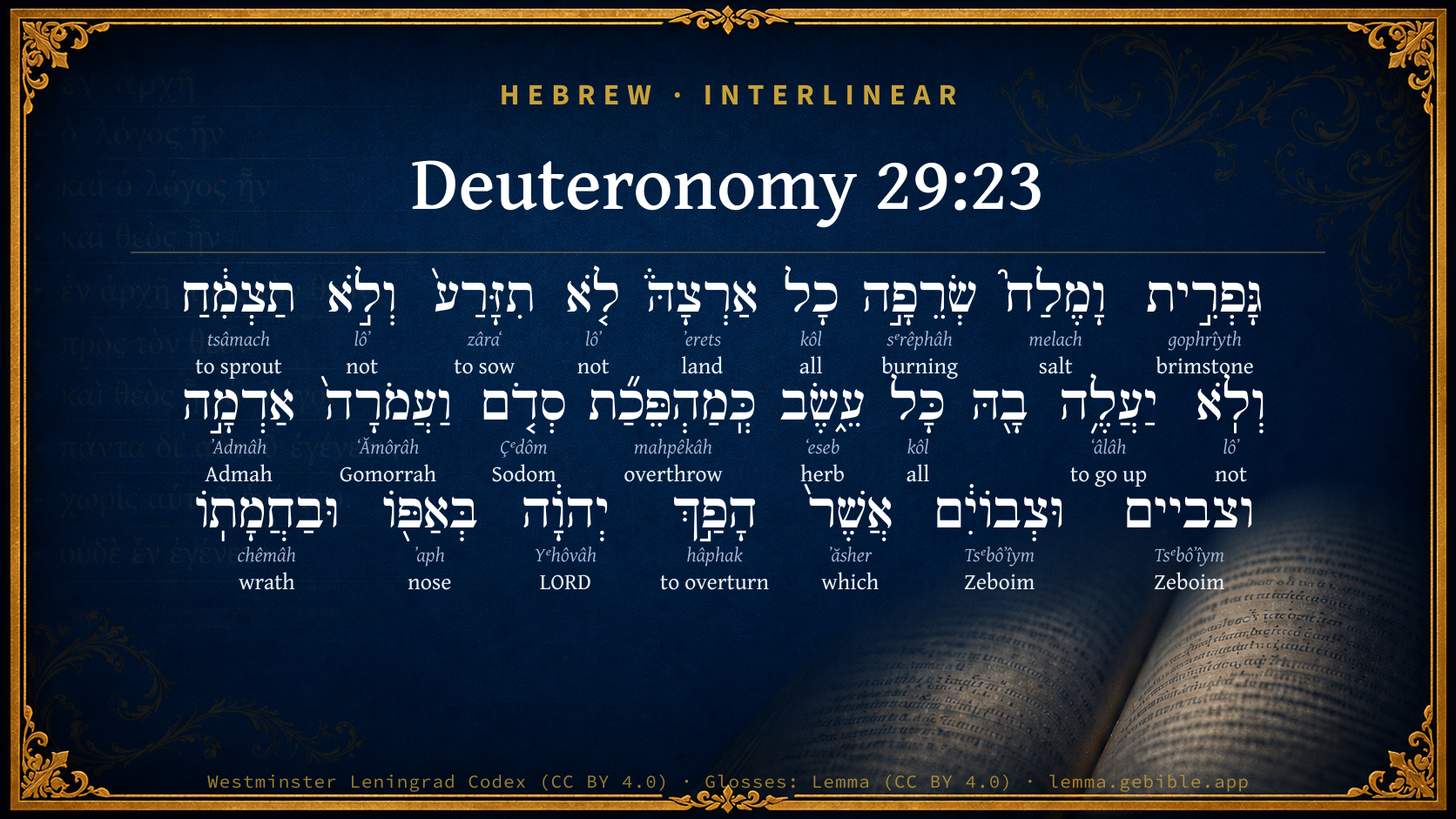
Deuteronomy 29:23

Hebrew (Westminster Leningrad Codex) Deuteronomy 29:23 appears in the Hebrew Old Testament. The text above is from the Westminster Leningrad Codex. Each word links to its Strong’s number, a concise gloss, and parsing drawn from the Open Scriptures Hebrew Bible morphology. Click any word for its full Brown-Driver-Briggs (BDB) entry.
Download image
Cite this verse

Deuteronomy 29:23 (World English Bible). Public Domain. Lemma interlinear Bible study tool, https://lemma.gebible.app/v/deuteronomy/29/23.

Show BibTeX & RIS
BibTeX
RIS
English Translation
[and that] the whole land of it is sulfur, and salt, [and] a burning, [that] it is not sown, nor bears, nor any grass grows therein, like the overthrow of Sodom and Gomorrah, Admah and Zeboiim, which Yahweh overthrew in his anger, and in his wrath:
World English Bible · Public Domain
Highlights
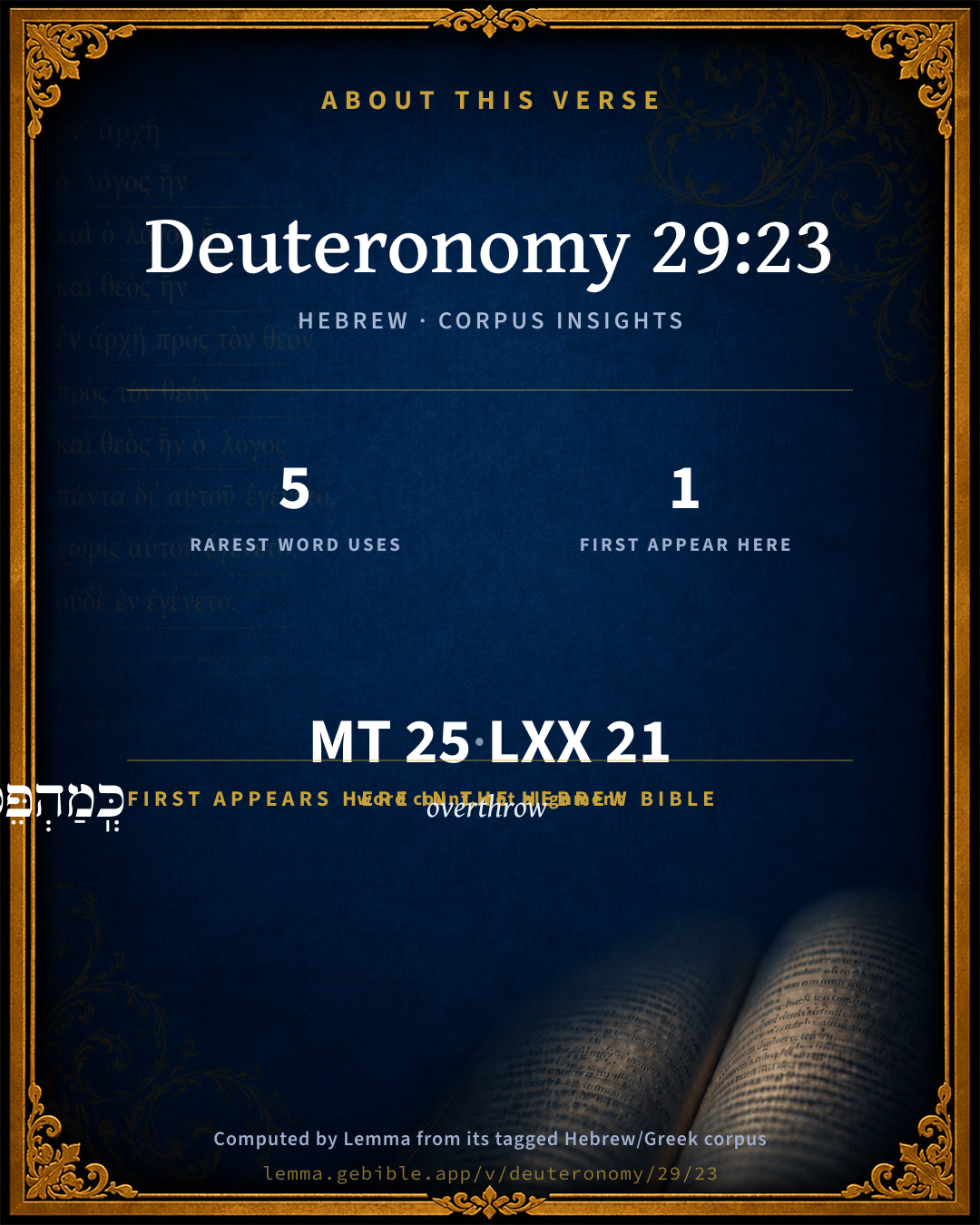
  • 1 first appearance in the Hebrew Bible
Full analysis ↓
Download a study sheet

One document with this verse’s original text, its word-by-word gloss line, the meaning frame, cross-references with their text, attributed commentary, and full source and license credits — printable, and it pastes into notes with its structure intact.

This verse Autodidact and up

Study sheet (.html) Plain text (.txt)

A passage Seminary Student

Up to 50 verses in one chapter. A passage sheet keeps up to 6 commentary sources and 12 cross-references per verse, in the order this page ranks them, and says so on the sheet whenever that leaves anything out. Ask for a single verse and you get the Autodidact verse sheet above.

Everything on this page stays free to read, with no account — the sheet is a download of what is already on screen, not access to it.

Want to remove ads? Support Godless Engineer
Compare translations 3

The same verse in 3 English versions, stacked beneath the original-language interlinear above. Click any original word for its lexicon entry.

Each is an independent rendering of the whole verse — the interlinear is not word-aligned to these translations.

Highlighted words mark where these versions differ — a whole-verse word diff, not a word-by-word alignment.

  • World English Bible Public Domain
    [and that] the whole land of it is sulfur, and salt, [and] a burning, [that] it is not sown, nor bears, nor any grass grows therein, like the overthrow of Sodom and Gomorrah, Admah and Zeboiim, which Yahweh overthrew in his anger, and in his wrath:
  • King James Version Public Domain
    And that the whole land thereof is brimstone, and salt, and burning, that it is not sown, nor beareth, nor any grass groweth therein, like the overthrow of Sodom, and Gomorrah, Admah, and Zeboim, which the LORD overthrew in his anger, and in his wrath:
  • unfoldingWord Literal Text CC BY-SA 4.0
    ‘All its land sulfur and burning salt; no one sows and nothing sprouts and not any grass grows in it, like the overthrow of Sodom and Gomorrah, Admah and Zeboiim, which Yahweh destroyed in his nose and in his wrath,’

unfoldingWord Literal Text — © unfoldingWord, licensed CC BY-SA 4.0. Word-aligned USFM3 via Door43 (git.door43.org/unfoldingWord/en_ult).

Versions to compare (up to 4)

3 of 4 selected

Show all 18 translations

Every available English version of this verse, each an independent rendering of the whole verse.

  • World English Bible Public Domain
    [and that] the whole land of it is sulfur, and salt, [and] a burning, [that] it is not sown, nor bears, nor any grass grows therein, like the overthrow of Sodom and Gomorrah, Admah and Zeboiim, which Yahweh overthrew in his anger, and in his wrath:
  • Berean Standard Bible Public Domain
    All its soil will be a burning waste of sulfur and salt, unsown and unproductive, with no plant growing on it, just like the destruction of Sodom and Gomorrah, Admah and Zeboiim, which the LORD overthrew in His fierce anger.
  • Majority Standard Bible Public Domain
    All its soil will be a burning waste of sulfur and salt, unsown and unproductive, with no plant growing on it, just like the destruction of Sodom and Gomorrah, Admah and Zeboiim, which the LORD overthrew in His fierce anger.
  • King James Version Public Domain
    And that the whole land thereof is brimstone, and salt, and burning, that it is not sown, nor beareth, nor any grass groweth therein, like the overthrow of Sodom, and Gomorrah, Admah, and Zeboim, which the LORD overthrew in his anger, and in his wrath:
  • American Standard Version (1901) Public Domain
    `and that' the whole land thereof is brimstone, and salt, `and' a burning, `that' it is not sown, nor beareth, nor any grass groweth therein, like the overthrow of Sodom and Gomorrah, Admah and Zeboiim, which Jehovah overthrew in his anger, and in his wrath:
  • Revised Version (1885) Public Domain
    and that the whole land thereof is brimstone, and salt, and a burning, that it is not sown, nor beareth, nor any grass groweth therein, like the overthrow of Sodom and Gomorrah, Admah and Zeboiim, which the LORD overthrew in his anger, and in his wrath:
  • Geneva Bible (1599) Public Domain
    (For all that land shall burne with brimstone and salt: it shall not be sowen, nor bring forth, nor any grasse shall growe therein, like as in the ouerthrowing of Sodom, and Gomorah, Admah, and Zeboim, which the Lord ouerthrewe in his wrath and in his anger)
  • Douay-Rheims (1899) Public Domain
    Burning it with brimstone, and the heat of salt, so that it cannot be sown any more, nor any green thing grow therein, after the example of the destruction of Sodom and Gomorrha, Adama and Seboim, which the Lord destroyed in his wrath and indignation:
  • Young's Literal Translation Public Domain
    (`with' brimstone and salt is the whole land burnt, it is not sown, nor doth it shoot up, nor doth there go up on it any herb, like the overthrow of Sodom and Gomorrah, Admah and Zeboim, which Jehovah overturned in His anger, and in His fury,) --
  • Literal Standard Version CC BY-SA 4.0
    The whole land is burned [with] brimstone and salt, it is not sown, nor does it shoot up, nor does any herb go up on it there, like the overthrow of Sodom and Gomorrah, Admah and Zeboim, which YHWH overturned in His anger and in His fury.
  • Unlocked Literal Bible CC BY-SA 4.0
    and when they see that the whole land has become sulfur and burning salt, where nothing is sown or bears fruit, where no vegetation grows, like the overthrow of Sodom and Gomorrah, Admah and Zeboyim, that Yahweh destroyed in his anger and wrath—
  • unfoldingWord Literal Text CC BY-SA 4.0
    ‘All its land sulfur and burning salt; no one sows and nothing sprouts and not any grass grows in it, like the overthrow of Sodom and Gomorrah, Admah and Zeboiim, which Yahweh destroyed in his nose and in his wrath,’
  • Darby Bible Public Domain
    [that] the whole ground thereof is brimstone and salt, [and] burning, that it is not sown, nor beareth, and no grass groweth in it, like the overthrow of Sodom and Gomorrah, Admah and Zeboim, which Jehovah overthrew in his anger and in his fury:
  • World Messianic Bible Public Domain
    that all of its land is sulfur, salt, and burning, that it is not sown, doesn’t produce, nor does any grass grow in it, like the overthrow of Sodom, Gomorrah, Admah, and Zeboiim, which the LORD overthrew in his anger, and in his wrath.
  • Webster's Bible Public Domain
    And that the whole land of it is brimstone, and salt, and burning, that it is not sown, nor doth it bear, nor doth any grass grow in it, like the overthrow of Sodom, and Gomorrah, Admah, and Zeboim, which the LORD overthrew in his anger and in his wrath:
  • Free Bible Version CC BY-SA 4.0
    The whole country will be a burning wasteland of sulfur and salt. Nothing is sown; it's totally unproductive; no plant grows there—just like the destruction of Sodom and Gomorrah, Admah and Zeboiim, which the Lord destroyed in his furious anger.
  • Bible in Basic English Public Domain
    And that all the land is a salt and smoking waste, not planted or giving fruit or clothed with grass, but wasted like Sodom and Gomorrah, Admah and Zeboiim, on which the Lord sent destruction in the heat of his wrath:
  • JPS Tanakh (1917) Public Domain
    (29-22) and that the whole land thereof is brimstone, and salt, and a burning, that it is not sown, nor beareth, nor any grass groweth therein, like the overthrow of Sodom and Gomorrah, Admah and Zeboiim, which the LORD overthrew in His anger, and in His wrath;

Literal Standard Version (2020), Covenant Press — licensed CC BY-SA 4.0. Text via the HelloAO Bible API (eBible.org). Unlocked Literal Bible (unfoldingWord) — licensed CC BY-SA 4.0. Text via the HelloAO Bible API (eBible.org). unfoldingWord Literal Text — © unfoldingWord, licensed CC BY-SA 4.0. Word-aligned USFM3 via Door43 (git.door43.org/unfoldingWord/en_ult). Free Bible Version, Dr. Jonathan Gallagher — licensed CC BY-SA 4.0. Text via the HelloAO Bible API (eBible.org).

Word by word

More ways to search: Search by grammar → Find every occurrence → Compare this word →

Practice this passage: Drill this verse → Learn its vocabulary →

אַדְמָ֣ה
ʼAdmâh
H126
“Admah”
Noun, Proper
Part of Speech
Noun
Type
Proper
Full BDB Definition

Origin: contracted for H127

TWOT: None

Admah = "red earth" - city in the Siddim valley
  1. גָּפְרִ֣ית gophrîyth H1614 “brimstone” Noun, Common, Feminine, Singular, Absolute
  2. וָמֶלַח֮ melach H4417 “and · salt” Conjunction + Noun, Common, Masculine, Singular, Absolute
  3. שְׂרֵפָ֣ה sᵉrêphâh H8316 “burning” Noun, Common, Feminine, Singular, Absolute
  4. כָל kôl H3605 “all of” Noun, Common, Masculine, Singular, Construct
  5. אַרְצָהּ֒ ʼerets H776 “land · her” Noun, Common, Both, Singular, Construct + Suffix, Personal, 3rd Person, Feminine, Singular
  6. לֹ֤א lôʼ H3808 “not” Particle, Negative
  7. תִזָּרַע֙ zâraʻ H2232 “to sow” Verb, Niphal, Imperfect, 3rd Person, Feminine, Singular
  8. וְלֹ֣א lôʼ H3808 “and · not” Conjunction + Particle, Negative
  9. תַצְמִ֔חַ tsâmach H6779 “to sprout” Verb, Hiphil, Imperfect, 3rd Person, Feminine, Singular
  10. וְלֹֽא lôʼ H3808 “and · not” Conjunction + Particle, Negative
  11. יַעֲלֶ֥ה ʻâlâh H5927 “to go up” Verb, Qal, Imperfect, 3rd Person, Masculine, Singular
  12. כָּל kôl H3605 “all of” Noun, Common, Masculine, Singular, Construct
  13. עֵ֑שֶׂב ʻeseb H6212 “herb” Noun, Common, Masculine, Singular, Absolute
  14. כְּֽמַהְפֵּכַ֞ת mahpêkâh H4114 “like/as · overthrow of” Preposition + Noun, Common, Feminine, Singular, Construct
  15. סְדֹ֤ם Çᵉdôm H5467 “Sodom” Noun, Proper
  16. וַעֲמֹרָה֙ ʻĂmôrâh H6017 “and · Gomorrah” Conjunction + Noun, Proper
  17. וצביים Tsᵉbôʼîym H6636 “and · Zeboim” Conjunction + Noun, Proper
  18. וּצְבוֹיִ֔ם Tsᵉbôʼîym H6636 “and · Zeboim” Conjunction + Noun, Proper
  19. אֲשֶׁר֙ ʼăsher H834 “which” Particle, Relative
  20. הָפַ֣ךְ hâphak H2015 “to overturn” Verb, Qal, Perfect, 3rd Person, Masculine, Singular
  21. יְהוָ֔ה Yᵉhôvâh H3068 “LORD” Noun, Proper
  22. בְּאַפּ֖וֹ ʼaph H639 “in/at · nose · his” Preposition + Noun, Common, Masculine, Singular, Construct + Suffix, Personal, 3rd Person, Masculine, Singular
  23. וּבַחֲמָתֽוֹ chêmâh H2534 “and · in/at · wrath · his” Conjunction + Preposition + Noun, Common, Feminine, Singular, Construct + Suffix, Personal, 3rd Person, Masculine, Singular

About this verse

These counts appear in no published source. They are computed here, from the morphology-tagged text and Lemma’s own curated glosses. What Lemma adds →

25
words
20
distinct lemmas
Pentateuch
section

Notable vocabulary

The rarest word here is אַדְמָ֣ה Admah H126 — appearing just 5 times in the whole Hebrew Bible.

First appearance in Scripture

This word makes its first canonical appearance in the Hebrew Bible here:

  • כְּֽמַהְפֵּכַ֞ת overthrow H4114

Shared distinctive vocabulary

אַדְמָ֣ה Admah H126 occurs in 5 verses of the Hebrew Bible. Also found in:

Grammatical profile

  • 4 verbs
  • 16 nouns
  • 1 preposition
  • 4 particles

Verb forms

  • תִזָּרַע֙ Niphal · Imperfect
  • תַצְמִ֔חַ Hiphil · Imperfect
  • יַעֲלֶ֥ה Qal · Imperfect
  • הָפַ֣ךְ Qal · Perfect

Repetition

Words recur within this verse — often emphatic in Hebrew:

  • כָל all H3605 ×2
  • וצביים Zeboim H6636 ×2
  • לֹ֤א not H3808 ×3

Hebrew & Septuagint length

In English translation the verse runs 46 words from the Hebrew and 39 from the Septuagint (LXX English) — closely comparable.

A rough comparison of the two English renderings, which tokenize alike — not a word-level alignment.

Word counts can differ between the Hebrew and the Greek without any difference in meaning — e.g. the Hebrew direct-object marker אֵת has no separate Greek word, and Greek often adds the article ὁ.

In the original languages it is 25 Hebrew tokens and 21 Greek tokens — but the two are counted differently (Hebrew bundles its prefixes and suffixes into one token; the Greek is in lemma form), so that isn’t a like-for-like length.

Cross-references

15

Topical passages linked to Deuteronomy 29:23 in the Treasury of Scripture Knowledge — connected by theme and wording, ordered by reader-vote popularity; previews shown in the World English Bible.

  • Jeremiah 17:6 For he shall be like the heath in the desert, and shall not see when good comes, but shall inhabit the parched places in the wilderness, a salt land and not inhabited.
  • Zephaniah 2:9 Therefore as I live, says Yahweh of Hosts, the God of Israel, surely Moab will be as Sodom, and the children of Ammon as Gomorrah, a possession of nettles, and salt pits, and a perpetual desolation. The remnant of my people will plunder them, and the survivors of my nation will inherit them.
  • Genesis 14:2 that they made war with Bera, king of Sodom, and with Birsha, king of Gomorrah, Shinab, king of Admah, and Shemeber, king of Zeboiim, and the king of Bela (the same is Zoar).
  • Genesis 19:24–25 Then Yahweh rained on Sodom and on Gomorrah sulfur and fire from Yahweh out of the sky.
  • Isaiah 34:9 The streams of [Edom] shall be turned into pitch, and the dust of it into sulfur, and the land of it shall become burning pitch.
  • Judges 9:45 Abimelech fought against the city all that day; and he took the city, and killed the people who were therein: and he beat down the city, and sowed it with salt.
  • Jeremiah 20:16 Let that man be as the cities which Yahweh overthrew, and didn't repent: and let him hear a cry in the morning, and shouting at noontime;
  • Ezekiel 47:11 But the miry places of it, and the marshes of it, shall not be healed; they shall be given up to salt.
  • Hosea 11:8–9 "How can I give you up, Ephraim? How can I hand you over, Israel? How can I make you like Admah? How can I make you like Zeboiim? My heart is turned within me, My compassion is aroused.
  • Amos 4:11 "I have overthrown some of you, As when God overthrew Sodom and Gomorrah, And you were like a burning stick plucked out of the fire; Yet you haven't returned to me," says Yahweh.
  • Luke 17:29 but in the day that Lot went out from Sodom, it rained fire and sulfur from the sky, and destroyed them all.
  • Job 18:15 There shall dwell in his tent that which is none of his. Sulfur shall be scattered on his habitation.
  • Psalms 107:34 And a fruitful land into a salt waste, For the wickedness of those who dwell in it.
  • Luke 14:34–35 Salt is good, but if the salt becomes flat and tasteless, with what do you season it?
  • Revelation 19:20 The beast was taken, and with him the false prophet who worked the signs in his sight, with which he deceived those who had received the mark of the beast and those who worshiped his image. These two were thrown alive into the lake of fire that burns with sulfur.

Cross-references courtesy of OpenBible.info (CC BY 4.0).

Hebrew and Greek witnesses Masoretic Hebrew ↔ Greek Septuagint

The same verse in the two great witnesses to the Old Testament, shown verse-for-verse.

These are two independent witnesses, not word-aligned to each other, and the Septuagint is shown in lemma (dictionary) form.

Hebrew Deuteronomy 29:23 Masoretic · Westminster Leningrad Codex

גָּפְרִ֣ית וָמֶלַח֮ שְׂרֵפָ֣ה כָל אַרְצָהּ֒ לֹ֤א תִזָּרַע֙ וְלֹ֣א תַצְמִ֔חַ וְלֹֽא יַעֲלֶ֥ה בָ֖הּ כָּל עֵ֑שֶׂב כְּֽמַהְפֵּכַ֞ת סְדֹ֤ם וַעֲמֹרָה֙ אַדְמָ֣ה וצביים וּצְבוֹיִ֔ם אֲשֶׁר֙ הָפַ֣ךְ יְהוָ֔ה בְּאַפּ֖וֹ וּבַחֲמָתֽוֹ

[and that] the whole land of it is sulfur, and salt, [and] a burning, [that] it is not sown, nor bears, nor any grass grows therein, like the overthrow of Sodom and Gomorrah, Admah and Zeboiim, which Yahweh overthrew in his anger, and in his wrath:

World English Bible · Public Domain

Greek LXX Deuteronomy 29:23 Septuagint · lemma form

καί εἶπον πᾶς ὁ ἔθνος διά τίς ποιέω κύριος οὕτως ὁ γῆ οὗτος τίς ὁ θυμός ὁ ὀργή ὁ μέγας οὗτος

brimstone and burning salt, (the whole land shall not be sown, neither shall any green thing spring, nor rise upon it, as Sodom and Gomorrha were overthrown, Adama and Seboim, which the Lord overthrew in his wrath and anger:)—

LXX2012 (modern English Septuagint) · Public Domain

Hebrew: Westminster Leningrad Codex (CC BY 4.0). Greek: Septuagint (public domain); English from LXX2012 (modern English Septuagint) (Public Domain). How the Septuagint differs from the Hebrew →

Targum (Aramaic paraphrase)

2

The Targum is the ancient Jewish Aramaic paraphrase of the Hebrew Scriptures — an interpretive translation, not the Hebrew text itself. Onkelos (literal) and Pseudo-Jonathan (expansive) render the Torah, and Jonathan the Prophets. Coverage is partial: where no permissively-licensed English translation exists for a verse, only the Aramaic is shown. This is verse-level text, not a word-by-word alignment to the Hebrew.

  1. Targum Onkelos Torah (Genesis–Deuteronomy)
    וְיֵימְרוּן כָּל עַמְמַיָא עַל מֶה עֲבַד יְיָ כְּדֵין לְאַרְעָא הָדָא מָא תְקוֹף רָגְזָא רַבָּא הָדֵין

    (no public-domain English translation for this verse)

    Targum Onkelos — Aramaic: “Onkelos Genesis” (public domain); “Onkelos Exodus” (public domain); “Onkelos Leviticus” (public domain); “Onkelos Numbers” (public domain); “Onkelos Deuteronomy” (public domain). English: “Sefaria Community Translation” (CC0 1.0 (public-domain dedication)); “J.W. Etheridge. The Targums of Onkelos and Jonathan Ben Uzziel on the Pentateuch. London: Longmans, Green, 1862” (public domain). Text via Sefaria.

  2. Targum Pseudo-Jonathan Torah (Genesis–Deuteronomy)
    וְיֵימְרוּן כָּל עַמְמַיָא מְטוּל מַה עָבַד יְיָ הֵיכְנָא לְאַרְעָא הָדָא מַה הֲוָה תְּקוֹף רוּגְזָא רַבָּא הָדֵין

    then all people will say, Why hath the Lord done so unto this land? What meaneth the strength of this great anger?

    Targum Pseudo-Jonathan — Aramaic: “Targum Jonathan on Genesis” (public domain); “Targum Jonathan on Exodus” (public domain); “Targum Jonathan on Leviticus” (public domain); “Targum Jonathan on Numbers” (public domain); “Targum Jonathan on Deuteronomy” (public domain). English: “The Targum of Jonathan ben Uzziel, trans. J. W. Etheridge, London, 1862” (public domain). Text via Sefaria.

Commentary

Notes on Deuteronomy 29:23 from classic Christian and Jewish commentators (each source and its license shown beneath its notes). The classic Christian expositions comment on the surrounding passage and are grouped to its opening verse, so a note may address several verses; the Jewish commentaries on the Tanakh (Rashi and others) are per-verse, so they appear only where the commentator wrote on this verse.

Lemma curates 59 commentaries, every one of them public domain or Creative Commons licensed, each selected and text-cleaned for this edition rather than reprinted as found. About our sources →

Trapp's Complete Commentary

John Trapp

Deu 29:23 [And that] the whole land thereof [is] brimstone, and salt, [and] burning, [that] it is not sown, nor beareth, nor any grass groweth therein, like the overthrow of Sodom, and Gomorrah, Admah, and Zeboim, which the LORD overthrew in his anger, and in his wrath:

Ver. 23. And beareth not any grass.] As they say no ground doth where the great Turk hath once set his foot; such waste he makes, and such desolation he leaves behind him.

Like the overthrow of Sodom and Gomorrah.] {See Trapp on "Gen 19:24"} {See Trapp on "Gen 19:25"}

Admah and Zeboim.] Which two cities, bordering on Sodom and Gomorrah, were the worse, and fared the worse, for their neighbourhood, as Hamath did for Damascus. {Zec 9:2} God overthrew them, and repented not. {Jer 20:16}

And that the whole land thereof is brimstone and salt.] In the fire that consumed Sodom there was, it seemeth, admixed salt, to make the land barren, and to pickle up the people; brimstone also to keep down with its weight the fire, which of itself was light, and tended upwards.

John Trapp, A Commentary or Exposition upon All the Books of the Old and New Testament (1647–1656) — public domain. Text from a community e-Sword module.

Tyndale Open Study Notes

Tyndale Open Resources

29:23 like . . . Sodom and Gomorrah, Admah and Zeboiim: In the days of Abraham and Lot, these cities were destroyed because of their gross immorality; their destruction was associated with sulfur and salt (Gen 19:23-28).

Tyndale Open Study Notes — © Tyndale Open Resources, licensed CC BY-SA 4.0. Text via the HelloAO Bible API.

Ellicott's Commentary for English Readers

(23) And that the whole land thereof is brimstone, and salt, and burning, that it is not sown, nor beareth, nor any grass groweth therein.—Can this be a description of the same country of which it was written in Deu_8:7-9, “A good land, a land of brooks of water, of fountains and depths that spring out of valleys and hills; a land of wheat, and barley, and vines, and fig trees, and pomegranates; a land of oil olive, and honey; a land wherein thou shalt eat bread without scarceness;” and (Deu_11:12) “a land which the Lord thy God careth for”? Yet every one knows which of these two descriptions has been nearer to the actual fact for many centuries.

A Bible Commentary for English Readers, edited by Charles John Ellicott (1878–1897) — public domain. Text from a community e-Sword module.

The Cambridge Bible for Schools and Colleges

gen. ed. J. J. S. Perowne

23. brimstone, etc.] The prediction is in terms of the surroundings of the Dead Sea. Beareth, lit. causeth to sprout; grass better herbage.

Sodom … Zeboiim] Amo_4:11, Hos_11:8; Gen_14:2; Gen_19:24 f.

The Cambridge Bible for Schools and Colleges (gen. ed. J. J. S. Perowne; Cambridge University Press, 1878–1918) — public domain. Text from a community e-Sword module.

John Gill's Exposition

Even all nations shall say,.... For the destruction of this land, and the people of it, would be, as it has been, so very great and awful, and so very remarkable and surprising, that the fame of it would be heard among all the nations of the world, as it has been; who, upon hearing the sad report of it, would ask the following questions:

wherefore hath the Lord done thus unto this land? so distinguished from all others for the fruitfulness and pleasantness of it; the people, the inhabitants of which, he chose, above all others, to be a special and peculiar people; and where he had a temple built for him, and where he had his residence, and worship used to be given unto him:

what meaneth the heat of this great anger? what is the reason of his stirring up his fierce wrath, and causing it to burn in so furious a manner? surely it must be something very horrible and provoking indeed!

John Gill's Exposition of the Whole Bible (1746–1763) — public domain (CC PDM 1.0). Text via the HelloAO Bible API.

Albert Barnes' Notes on the Bible

The description is borrowed from the local features of the Dead Sea and its vicinity. The towns of the vale of Siddim were fertile and well watered (compare Gen 13:10) until devastated by the wrath of God Gen 19:24-25. The ruin of Israel and its land should be of the like sort (compare Lev 26:31-32; Psa 107:34; Zep 2:9). The desolate state of Palestine at present, and the traces of former fertility and prosperity, are attested by every traveler.

Albert Barnes' Notes on the Bible (1834–1885) — public domain. Text from a community e-Sword/MySword module.

Haydock's Catholic Bible Commentary

Of salt. This salt was of a bituminous or sulphureous nature, which would burn like oil, and was sometimes used in lamps. (Herodotus, ii. 62; Pliny, [Natural History?] ii. 104.) It dried up the moisture of the earth, and rendered it barren. For which reason, it was scattered upon such places as were no longer to be cultivated, or inhabited. Abimelech sowed some on the ruins of Sichem, Judges ix. 45. It seems that Palestine now feels the effects of this curse; as, for the most part, it is uncultivated, and a desert, though once so flourishing. (Calmet)

George Leo Haydock (1774–1849), Haydock's Catholic Family Bible and Commentary, 1859 edition — public domain. Excludes Psalms (Douay-Rheims chapter numbering differs from Protestant) and Deuterocanonical books (Catholic canon only).

Matthew Poole's English Annotations

Is brimstone, and salt, and burning, i.e. is burnt up and made barren, as with brimstone and salt. See Jdg 9:45; Psa 107:34; Jer 17:6; Eze 47:11.

Matthew Poole's English Annotations on the Holy Bible (1683–1685) — public domain. Text from a community e-Sword/MySword module.

Whedon's Commentary on the Bible

Daniel D. Whedon

23. The whole land thereof is brimstone, etc. — The description is taken from the Dead Sea and the destruction of the Cities of the Plain.

Daniel D. Whedon (gen. ed.), Commentary on the Old and New Testaments (1874–1909) — public domain. Text from a community e-Sword module.

The Pulpit Commentary

And that the whole land thereof is brimstone, and salt, and burning, etc.; rather, sulfur and salt, a burning the whole land thereof, it shall not be sown, etc. The words "sulfur," etc., are in apposition to the "plagues and sicknesses" of ver. 22, and thus so far depend on the "see." The description here is taken from the country around the Dead Sea, to which there is an express allusion in the close of the verse. (cf. Gen_19:23, etc.) As this country, which before had been as the garden of the Lord, became, when the wrath of God was poured upon it, utterly desolate and waste; so should it be with the land of Israel when the plagues and sicknesses threatened were laid on it by the Lord.

The Pulpit Commentary (1880–1919), ed. H.D.M. Spence-Jones & Joseph S. Exell — public domain. Text from a community e-Sword module.

John Wesley's Explanatory Notes

Salt and burning - Is burnt up and made barren, as with brimstone and salt.

John Wesley, Explanatory Notes Upon the Whole Bible (1754–1765) — public domain. Text via the GEBible commentary corpus.

Lesson kit

Teaching starters — assembled from the data on this page, not authored interpretation. Every prompt links to the verse data it draws on. Edit before teaching.

Deuteronomy, in the Pentateuch, opens this verse with 25 words (20 distinct Hebrew lemmas). Its most distinctive word is ʼAdmâh (“Admah”). A historical commentator’s framing appears above. Read the whole chapter for the surrounding context.

Discussion questions

  1. The word ʼAdmâh carries the sense “Admah.” How does it shape the verse?
  2. This is the first place “overthrow” appears in Scripture (first appears here). What does its debut here establish?
  3. How does Genesis 10:19, which shares the word «Admah», read alongside this verse?
  4. What does the repetition of “all” (2× in this one verse) do in this verse?
  5. These translations render this verse differently; the difference is in the English rendering, not the original. What questions does that raise?
  6. «תִזָּרַע֙» is a Niphal Imperfect verb. How does that grammatical form shape the action described?
  7. Compare how Trapp's Complete Commentary and Tyndale Open Study Notes read this verse. Where do they agree or differ?

Things to notice

Reading settings

Reading text

Shown beneath each verse's original-language words.

Old Testament
Old Testament edition

Read the OT as the Masoretic Hebrew (MT) or the Greek Septuagint (LXX).

English shown for the Greek Septuagint (in the Hebrew ↔ Greek comparison).

Comparing translations? Open the Compare panel on any verse page to stack up to four side by side.