Leviticus 17:8

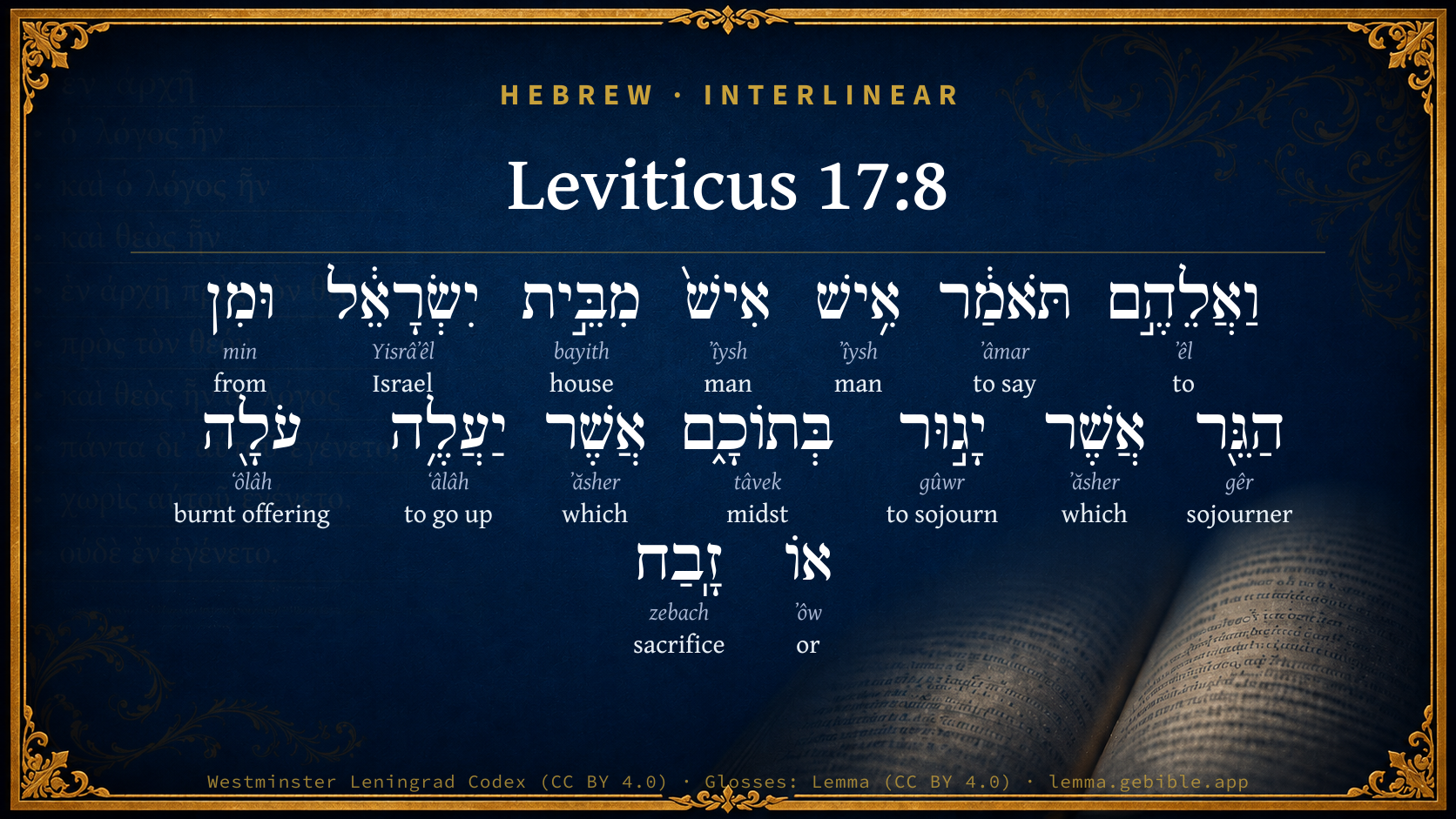
Hebrew (Westminster Leningrad Codex) Leviticus 17:8 appears in the Hebrew Old Testament. The text above is from the Westminster Leningrad Codex. Each word links to its Strong’s number, a concise gloss, and parsing drawn from the Open Scriptures Hebrew Bible morphology. Click any word for its full Brown-Driver-Briggs (BDB) entry.
Download image
Cite this verse

Leviticus 17:8 (World English Bible). Public Domain. Lemma interlinear Bible study tool, https://lemma.gebible.app/v/leviticus/17/8.

Show BibTeX & RIS
BibTeX
RIS
English Translation
"You shall say to them, 'Any man there is of the house of Israel, or of the strangers who live as foreigners among them, who offers a burnt offering or sacrifice,
World English Bible · Public Domain
Download a study sheet

One document with this verse’s original text, its word-by-word gloss line, the meaning frame, cross-references with their text, attributed commentary, and full source and license credits — printable, and it pastes into notes with its structure intact.

This verse Autodidact and up

Study sheet (.html) Plain text (.txt)

A passage Seminary Student

Up to 50 verses in one chapter. A passage sheet keeps up to 6 commentary sources and 12 cross-references per verse, in the order this page ranks them, and says so on the sheet whenever that leaves anything out. Ask for a single verse and you get the Autodidact verse sheet above.

Everything on this page stays free to read, with no account — the sheet is a download of what is already on screen, not access to it.

Want to remove ads? Support Godless Engineer
Compare translations 3

The same verse in 3 English versions, stacked beneath the original-language interlinear above. Click any original word for its lexicon entry.

Each is an independent rendering of the whole verse — the interlinear is not word-aligned to these translations.

Highlighted words mark where these versions differ — a whole-verse word diff, not a word-by-word alignment.

  • World English Bible Public Domain
    "You shall say to them, 'Any man there is of the house of Israel, or of the strangers who live as foreigners among them, who offers a burnt offering or sacrifice,
  • King James Version Public Domain
    And thou shalt say unto them, Whatsoever man there be of the house of Israel, or of the strangers which sojourn among you, that offereth a burnt offering or sacrifice,
  • unfoldingWord Literal Text CC BY-SA 4.0
    And you shall say to them, ‘A man, a man from the house of Israel or from the sojourner who sojourns in their midst, who makes a burnt offering or a sacrifice go up,

unfoldingWord Literal Text — © unfoldingWord, licensed CC BY-SA 4.0. Word-aligned USFM3 via Door43 (git.door43.org/unfoldingWord/en_ult).

Versions to compare (up to 4)

3 of 4 selected

Show all 18 translations

Every available English version of this verse, each an independent rendering of the whole verse.

  • World English Bible Public Domain
    "You shall say to them, 'Any man there is of the house of Israel, or of the strangers who live as foreigners among them, who offers a burnt offering or sacrifice,
  • Berean Standard Bible Public Domain
    Tell them that if anyone from the house of Israel or any foreigner living among them offers a burnt offering or a sacrifice
  • Majority Standard Bible Public Domain
    Tell them that if anyone from the house of Israel or any foreigner living among them offers a burnt offering or a sacrifice
  • King James Version Public Domain
    And thou shalt say unto them, Whatsoever man there be of the house of Israel, or of the strangers which sojourn among you, that offereth a burnt offering or sacrifice,
  • American Standard Version (1901) Public Domain
    And thou shalt say unto them, Whatsoever man there be of the house of Israel, or of the strangers that sojourn among them, that offereth a burnt-offering or sacrifice,
  • Revised Version (1885) Public Domain
    And thou shalt say unto them, Whatsoever man there be of the house of Israel, or of the strangers that sojourn among them, that offereth a burnt offering or sacrifice,
  • Geneva Bible (1599) Public Domain
    Also thou shalt say vnto them, whosoeuer he be of the house of Israel, or of the strangers which soiourne among them, that offreth a burnt offring or sacrifice,
  • Douay-Rheims (1899) Public Domain
    And thou shalt say to them: The man of the house of Israel, and of the strangers who sojourn among you, that offereth a holocaust or a victim,
  • Young's Literal Translation Public Domain
    `And unto them thou sayest: Any man of the house of Israel, or of the sojourners, who sojourneth in your midst, who causeth burnt-offering or sacrifice to ascend,
  • Literal Standard Version CC BY-SA 4.0
    And you say to them: Any man of the house of Israel, or of the sojourners who sojourns in your midst, who causes burnt-offering or sacrifice to ascend,
  • Unlocked Literal Bible CC BY-SA 4.0
    You must say to them, 'Any man of Israel, or any foreigner who lives among them, who offers a burnt offering or sacrifice
  • unfoldingWord Literal Text CC BY-SA 4.0
    And you shall say to them, ‘A man, a man from the house of Israel or from the sojourner who sojourns in their midst, who makes a burnt offering or a sacrifice go up,
  • Darby Bible Public Domain
    And thou shalt say unto them, Every one of the house of Israel, and of the strangers who sojourn among them, that offereth up a burnt-offering or sacrifice,
  • World Messianic Bible Public Domain
    “You shall say to them, ‘Any man there is of the house of Israel, or of the strangers who live as foreigners among them, who offers a burnt offering or sacrifice,
  • Webster's Bible Public Domain
    And thou shalt say to them, Whatever man there may be of the house of Israel, or of the strangers which sojourn among you, that offereth a burnt-offering or sacrifice,
  • Free Bible Version CC BY-SA 4.0
    Warn them that any Israelite or any foreigner living among them who offers a burnt offering or a sacrifice
  • Bible in Basic English Public Domain
    And say to them, If any man of Israel, or any other living among them, makes a burned offering or other offering,
  • JPS Tanakh (1917) Public Domain
    And thou shalt say unto them: Whatsoever man there be of the house of Israel, or of the strangers that sojourn among them, that offereth a burnt-offering or sacrifice,

Literal Standard Version (2020), Covenant Press — licensed CC BY-SA 4.0. Text via the HelloAO Bible API (eBible.org). Unlocked Literal Bible (unfoldingWord) — licensed CC BY-SA 4.0. Text via the HelloAO Bible API (eBible.org). unfoldingWord Literal Text — © unfoldingWord, licensed CC BY-SA 4.0. Word-aligned USFM3 via Door43 (git.door43.org/unfoldingWord/en_ult). Free Bible Version, Dr. Jonathan Gallagher — licensed CC BY-SA 4.0. Text via the HelloAO Bible API (eBible.org).

Word by word

More ways to search: Search by grammar → Find every occurrence → Compare this word →

Practice this passage: Drill this verse → Learn its vocabulary →

הַגֵּ֖ר
gêr
H1616
“the · sojourner”
Particle, Definite Article + Noun, Common, Masculine, Singular, Absolute
Part of Speech
Particle + Noun
Type
Common
Gender
Masculine
Number
Singular
State
Absolute
Full BDB Definition

Origin: from H1481

TWOT: 330a

sojourner - a temporary inhabitant, a newcomer lacking inherited rights - of foreigners in Israel, though conceded rights
  1. וַאֲלֵהֶ֣ם ʼêl H413 “and · to · them” Conjunction + Preposition + Suffix, Personal, 3rd Person, Masculine, Plural
  2. תֹּאמַ֔ר ʼâmar H559 “to say” Verb, Qal, Imperfect, 2nd Person, Masculine, Singular
  3. אִ֥ישׁ ʼîysh H376 “man” Noun, Common, Masculine, Singular, Absolute
  4. אִישׁ֙ ʼîysh H376 “man” Noun, Common, Masculine, Singular, Absolute
  5. מִבֵּ֣ית bayith H1004 “from · house of” Preposition + Noun, Common, Masculine, Singular, Construct
  6. יִשְׂרָאֵ֔ל Yisrâʼêl H3478 “Israel” Noun, Proper
  7. וּמִן min H4480 “and · from” Conjunction + Preposition
  8. אֲשֶׁר ʼăsher H834 “which” Particle, Relative
  9. יָג֣וּר gûwr H1481 “to sojourn” Verb, Qal, Imperfect, 3rd Person, Masculine, Singular
  10. בְּתוֹכָ֑ם tâvek H8432 “in/at · midst · their” Preposition + Noun, Common, Masculine, Singular, Construct + Suffix, Personal, 3rd Person, Masculine, Plural
  11. אֲשֶׁר ʼăsher H834 “which” Particle, Relative
  12. יַעֲלֶ֥ה ʻâlâh H5927 “to go up” Verb, Hiphil, Imperfect, 3rd Person, Masculine, Singular
  13. עֹלָ֖ה ʻôlâh H5930 “burnt offering” Noun, Common, Feminine, Singular, Absolute
  14. אוֹ ʼôw H176 “or” Conjunction
  15. זָֽבַח zebach H2077 “sacrifice” Noun, Common, Masculine, Singular, Absolute

About this verse

These counts appear in no published source. They are computed here, from the morphology-tagged text and Lemma’s own curated glosses. What Lemma adds →

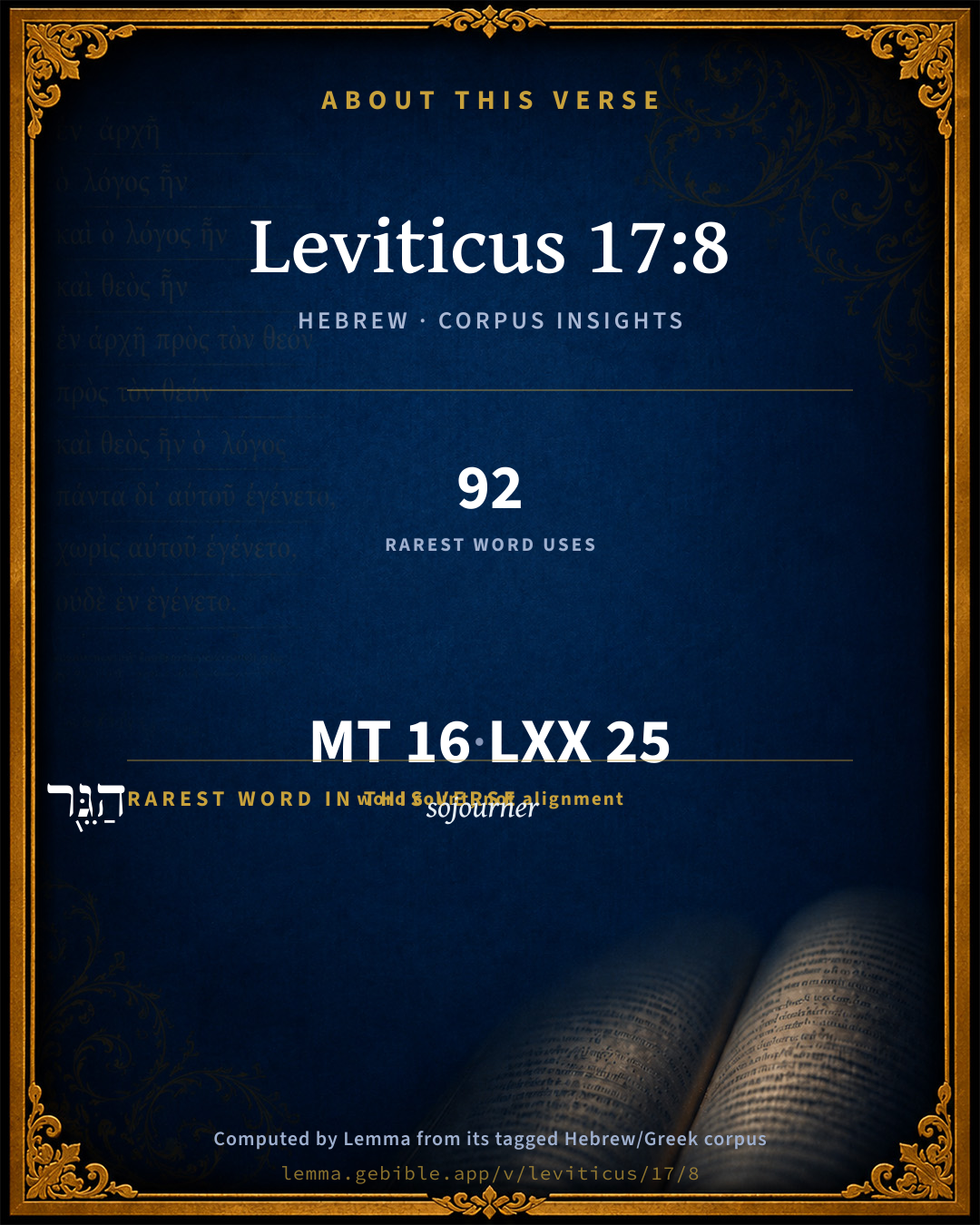
16
words
14
distinct lemmas
Pentateuch
section

Grammatical profile

  • 3 verbs
  • 8 nouns
  • 2 prepositions
  • 1 conjunction
  • 2 particles

Verb forms

  • תֹּאמַ֔ר Qal · Imperfect
  • יָג֣וּר Qal · Imperfect
  • יַעֲלֶ֥ה Hiphil · Imperfect

Repetition

Words recur within this verse — often emphatic in Hebrew:

  • אִ֥ישׁ man H376 ×2
  • אֲשֶׁר which H834 ×2

Hebrew & Septuagint length

In English translation the verse runs 31 words from the Hebrew and 32 from the Septuagint (LXX English) — closely comparable.

A rough comparison of the two English renderings, which tokenize alike — not a word-level alignment.

Word counts can differ between the Hebrew and the Greek without any difference in meaning — e.g. the Hebrew direct-object marker אֵת has no separate Greek word, and Greek often adds the article ὁ.

In the original languages it is 16 Hebrew tokens and 25 Greek tokens — but the two are counted differently (Hebrew bundles its prefixes and suffixes into one token; the Greek is in lemma form), so that isn’t a like-for-like length.

Cross-references

10

Topical passages linked to Leviticus 17:8 in the Treasury of Scripture Knowledge — connected by theme and wording, ordered by reader-vote popularity; previews shown in the World English Bible.

  • Leviticus 1:2–3 "Speak to the children of Israel, and tell them, 'When anyone of you offers an offering to Yahweh, you shall offer your offering of the cattle, from the herd and from the flock.
  • Leviticus 17:4 and hasn't brought it to the door of the Tent of Meeting, to offer it as an offering to Yahweh before the tabernacle of Yahweh: blood shall be imputed to that man. He has shed blood; and that man shall be cut off from among his people.
  • Leviticus 17:10 "'Any man of the house of Israel, or of the strangers who live as foreigners among them, who eats any kind of blood, I will set my face against that soul who eats blood, and will cut him off from among his people.
  • Judges 6:26 and build an altar to Yahweh your God on the top of this stronghold, in the orderly manner, and take the second bull, and offer a burnt offering with the wood of the Asherah which you shall cut down.
  • 1 Samuel 7:9 Samuel took a sucking lamb, and offered it for a whole burnt-offering to Yahweh: and Samuel cried to Yahweh for Israel; and Yahweh answered him.
  • 1 Samuel 10:8 You shall go down before me to Gilgal; and, behold, I will come down to you, to offer burnt offerings, and to sacrifice sacrifices of peace-offerings: seven days shall you wait, until I come to you, and show you what you shall do.
  • 1 Samuel 16:2 Samuel said, How can I go? if Saul hear it, he will kill me. Yahweh said, Take a heifer with you, and say, I am come to sacrifice to Yahweh.
  • 2 Samuel 24:25 David built there an altar to Yahweh, and offered burnt offerings and peace-offerings. So Yahweh was entreated for the land, and the plague was stayed from Israel.
  • 1 Kings 18:30–38 Elijah said to all the people, Come near to me; and all the people came near to him. He repaired the altar of Yahweh that was thrown down.
  • Malachi 1:11 For from the rising of the sun even to the going down of the same, my name is great among the nations, and in every place incense will be offered to my name, and a pure offering: for my name is great among the nations," says Yahweh of Hosts.

Cross-references courtesy of OpenBible.info (CC BY 4.0).

Hebrew and Greek witnesses Masoretic Hebrew ↔ Greek Septuagint

The same verse in the two great witnesses to the Old Testament, shown verse-for-verse.

These are two independent witnesses, not word-aligned to each other, and the Septuagint is shown in lemma (dictionary) form.

Hebrew Leviticus 17:8 Masoretic · Westminster Leningrad Codex

וַאֲלֵהֶ֣ם תֹּאמַ֔ר אִ֥ישׁ אִישׁ֙ מִבֵּ֣ית יִשְׂרָאֵ֔ל וּמִן הַגֵּ֖ר אֲשֶׁר יָג֣וּר בְּתוֹכָ֑ם אֲשֶׁר יַעֲלֶ֥ה עֹלָ֖ה אוֹ זָֽבַח

"You shall say to them, 'Any man there is of the house of Israel, or of the strangers who live as foreigners among them, who offers a burnt offering or sacrifice,

World English Bible · Public Domain

Greek LXX Leviticus 17:8 Septuagint · lemma form

καί εἶπον πρός αὐτός ἄνθρωπος ἄνθρωπος ὁ υἱός ἰσραήλ καί ἀπό ὁ υἱός ὁ προσήλυτος ὁ προςκεῖμαι ἐν σύ ὅς ἄν ποιέω ὁλοκαύτωμα ἤ θυσία

And you shall say to them, Whatever man of the children of Israel, or of the sons of the proselytes dwelling among you, shall offer a whole burnt offering or a sacrifice,

LXX2012 (modern English Septuagint) · Public Domain

Hebrew: Westminster Leningrad Codex (CC BY 4.0). Greek: Septuagint (public domain); English from LXX2012 (modern English Septuagint) (Public Domain). How the Septuagint differs from the Hebrew →

Targum (Aramaic paraphrase)

2

The Targum is the ancient Jewish Aramaic paraphrase of the Hebrew Scriptures — an interpretive translation, not the Hebrew text itself. Onkelos (literal) and Pseudo-Jonathan (expansive) render the Torah, and Jonathan the Prophets. Coverage is partial: where no permissively-licensed English translation exists for a verse, only the Aramaic is shown. This is verse-level text, not a word-by-word alignment to the Hebrew.

  1. Targum Onkelos Torah (Genesis–Deuteronomy)
    וּלְהוֹן תֵּימַר גְבַר גְבַר מִבֵּית יִשְׂרָאֵל וּמִן גִיוֹרָא דְיִתְגַיְרוּן בֵּינֵיכוֹן דִי יַסֵק עֲלָתָא אוֹ נִכְסַת קוּדְשַׁיָא

    (no public-domain English translation for this verse)

    Targum Onkelos — Aramaic: “Onkelos Genesis” (public domain); “Onkelos Exodus” (public domain); “Onkelos Leviticus” (public domain); “Onkelos Numbers” (public domain); “Onkelos Deuteronomy” (public domain). English: “Sefaria Community Translation” (CC0 1.0 (public-domain dedication)); “J.W. Etheridge. The Targums of Onkelos and Jonathan Ben Uzziel on the Pentateuch. London: Longmans, Green, 1862” (public domain). Text via Sefaria.

  2. Targum Pseudo-Jonathan Torah (Genesis–Deuteronomy)
    וּלְהוֹן תֵּימַר גְבַר טְלֵי וּגְבַר סִיב מִבֵּית גְנִיסַת יִשְרָאֵל וּמִן גִיוֹרָא דְיִתְגַיְירוּן לְמֵיתָב בֵּינֵיהוֹן דִי יַסִיק עֲלָתָא אוֹ נִכְסַת קוּדְשַׁיָא

    And thou shalt tell them: A man, whether young or old, of the house of Israel, or of the strangers who sojourn among you, who shall sacrifice a burnt offering, or consecrated oblation,

    Targum Pseudo-Jonathan — Aramaic: “Targum Jonathan on Genesis” (public domain); “Targum Jonathan on Exodus” (public domain); “Targum Jonathan on Leviticus” (public domain); “Targum Jonathan on Numbers” (public domain); “Targum Jonathan on Deuteronomy” (public domain). English: “The Targum of Jonathan ben Uzziel, trans. J. W. Etheridge, London, 1862” (public domain). Text via Sefaria.

Commentary

Notes on Leviticus 17:8 from classic Christian and Jewish commentators (each source and its license shown beneath its notes). The classic Christian expositions comment on the surrounding passage and are grouped to its opening verse, so a note may address several verses; the Jewish commentaries on the Tanakh (Rashi and others) are per-verse, so they appear only where the commentator wrote on this verse.

Lemma curates 59 commentaries, every one of them public domain or Creative Commons licensed, each selected and text-cleaned for this edition rather than reprinted as found. About our sources →

Ellicott's Commentary for English Readers

(8, 9) Whatsoever man there be.—Better, what man soever there be, as it is in the Authorised Version in Lev_17:3. Here again we have an instance of the same legislative phrase used four times in one short section (Lev_17:3; Lev_17:8; Lev_17:10; Lev_17:13), being translated differently in the Authorised Version. The law enacted in these two verses requires that all legitimate sacrifices should henceforth be presented in the appointed sanctuary, which was the centre of national unity, thus abolishing the liberty which, in accordance with patriarchal practice, had hitherto existed, that every head of a family could be his own priest, and offer up sacrifices wherever and whenever he liked. The commonwealth of Israel were now to acknowledge one altar, one high priest, and one sanctuary. This law was binding not only upon the Israelite by race, but upon strangers who took up their abode in and joined the Jewish community. For wilfully violating this law the offender incurred the penalty of excision.

A Bible Commentary for English Readers, edited by Charles John Ellicott (1878–1897) — public domain. Text from a community e-Sword module.

Trapp's Complete Commentary

John Trapp

Lev 17:8 And thou shalt say unto them, Whatsoever man [there be] of the house of Israel, or of the strangers which sojourn among you, that offereth a burnt offering or sacrifice,

Ver. 8. That offereth a burnt offering.] They were strictly tied to one place, that they might be kept all in one uniform way of God’s worship appointed by himself.

John Trapp, A Commentary or Exposition upon All the Books of the Old and New Testament (1647–1656) — public domain. Text from a community e-Sword module.

Keil & Delitzsch

C. F. Keil & F. Delitzsch

To this there are appended three laws, which are kindred in their nature, and which were binding not only upon the Israelites, but also upon the foreigners who dwelt in the midst of them.

Lev 17:8-12

Lev 17:8, Lev 17:9 contain the command, that whoever offered a burnt-offering of slain-offering, and did not bring it to the tabernacle to prepare it for Jehovah there, was to be exterminated; a command which involved the prohibition of sacrifice in any other place whatever, and was given, as the further extension of this law in Deut 12 clearly proves, for the purpose of suppressing the disposition to offer sacrifice to other gods, as well as in other places. In Lev 17:10-14 the prohibition of the eating of blood is repeated, and ordered to be observed on pain of extermination; it is also extended to the strangers in Israel; and after a more precise explanation of the reason for the law, is supplemented by instructions for the disposal of the blood of edible game. God threatens that He will inflict the punishment Himself, because the eating of blood was a transgression of the law which might easily escape the notice of the authorities. "To set one's face against:" i.e., to judge. The reason for the command in Lev 17:11, "For the soul of the flesh (the soul which gives life to the flesh) is in the blood, and I have given it to you upon the altar, to make an atonement for your souls," is not a double one, viz., (1) because the blood contained the soul of the animal, and (2) because God had set apart the blood, as the medium of expiation for the human soul, for the altar, i.e., to be sprinkled upon the altar. The first reason simply forms the foundation for the second: God appointed the blood for the altar, as containing the soul of the animal, to be the medium of expiation for the souls of men, and therefore prohibited its being used as food. "For the blood it expiates by virtue of the soul," not "the soul" itself. בּ with כּפּר has only a local or instrumental signification (Lev 6:23; Lev 16:17, Lev 16:27; also Lev 7:7; Exo 29:33; Num 5:8). Accordingly, it was not the blood as such, but the blood as the vehicle of the soul, which possessed expiatory virtue; because the animal soul was offered to God upon the altar as a substitute for the human soul. Hence every bleeding sacrifice had an expiatory force, though without being an expiatory sacrifice in the strict sense of the word.

Lev 17:13

The blood also of such hunted game as was edible, whether bird or beast, was not to be eaten either by the Israelite or stranger, but to be poured out and covered with earth. In Deu 12:16 and Deu 12:24, where the command to slay all the domestic animals at the tabernacle as slain-offerings is repealed, this is extended to such domestic animals as were slaughtered for food; their blood also was not to be eaten, but to be poured upon the earth "like water," i.e., not quasi rem profanam et nullo ritu sacro (Rosenmller, etc.), but like water which is poured upon the earth, sucked in by it, and thus given back to the womb of the earth, from which God had caused the animals to come forth at their creation (Gen 1:24). Hence pouring it out upon the earth like water was substantially the same as pouring it out and covering it with earth (cf. Eze 24:7-8); and the purpose of the command was to prevent the desecration of the vehicle of the soulish life, which was sanctified as the medium of expiation.

Lev 17:14-16

"For as for the soul of all flesh...its blood makes out its soul:" i.e., "this is the case with the soul of all flesh, that it is its blood which makes out its soul." בּנפשׁו is to be taken as a predicate in its meaning, introduced with beth essentiale. It is only as so understood, that the clause supplies a reason at all in harmony with the context. Because the distinguishing characteristic of the blood as, that it was the soul of the being when living in the flesh; therefore it was not to be eaten in the case of any animal: and even in the case of animals that were not proper for sacrifice, it was to be allowed to run out upon the ground, and then covered with earth, or, so to speak, buried.

(Note: On the truth which lay at the foundation of this idea of the unity of the soul and blood, which others of the ancients shared with the Hebrews, particularly the early Greek philosophers, see Delitzsch's bibl. Psychol. pp. 242ff. "It seems at first sight to be founded upon no other reason, than that a sudden diminution of the quantity of the blood is sure to cause death. But this phenomenon rests upon the still deeper ground, that all the activity of the body, especially that of the nervous and muscular systems, is dependent upon the circulation of the blood; for if the flow of blood is stopped from any part of the body, all its activity ceases immediately; a sensitive part loses all sensation in a very few minutes, and muscular action is entirely suspended... The blood is really the basis of the physical life; and so far the soul, as the vital principle of the body, is pre-eminently in the blood" (p. 245).)

- Lastly (Lev 17:15, Lev 17:16), the prohibition against eating "that which died" (Lev 11:39-40), or "that which was torn" (Exo 22:30), is renewed and supplemented by the law, that whoever, either of the natives or of foreigners, should eat the flesh of that which had fallen (died a natural death), or had been torn in pieces by wild beasts (sc., thoughtlessly or in ignorance; cf. Lev 5:2), and neglected the legal purification afterwards, was to bear his iniquity (Lev 5:1). Of course the flesh intended is that of animals which were clean, and therefore allowable as food, when properly slaughtered, and which became unclean simply from the fact, that when they had died a natural death, or had been torn to pieces by wild beasts, the blood remained in the flesh, or did not flow out in a proper manner. According to Exo 22:30, the נבלה (that which had fallen) was to be thrown to the dogs; but in Deu 14:21 permission is given either to sell it or give it to a stranger or alien, to prevent the plea that it was a pity that such a thing should be entirely wasted, and so the more effectually to secure the observance of the command, that it was not to be eaten by an Israelite.

Keil & Delitzsch — Biblical Commentary on the Old Testament (1861–1891) — public domain (CC PDM 1.0). Text via the HelloAO Bible API. (Old Testament only.)

Jamieson, Fausset & Brown

Robert Jamieson, A. R. Fausset & David Brown

Whatsoever man . . . offereth . . . And bringeth it not unto the door of the tabernacle--Before the promulgation of the law, men worshipped wherever they pleased or pitched their tents. But after that event the rites of religion could be acceptably performed only at the appointed place of worship. This restriction with respect to place was necessary as a preventive of idolatry; for it prohibited the Israelites, when at a distance, from repairing to the altars of the heathen, which were commonly in groves or fields.

Jamieson, Fausset & Brown — Commentary Critical and Explanatory on the Whole Bible (1871) — public domain (CC PDM 1.0). Text via the HelloAO Bible API.

The Cambridge Bible for Schools and Colleges

gen. ed. J. J. S. Perowne

8. of the strangers …] See p. 99.

The Cambridge Bible for Schools and Colleges (gen. ed. J. J. S. Perowne; Cambridge University Press, 1878–1918) — public domain. Text from a community e-Sword module.

John Gill's Exposition

And thou shalt say unto them,.... To Aaron and his sons, and to the children of Israel, as in Lev 17:2,

whatsoever man there be of the house of Israel: belonging to that nation, and to any of its tribes and families, of whatever age; as a young man or an old man, as the Targum of Jonathan; or of whatsoever rank, class, and condition in life:

or of the strangers which sojourn among you; that is, of the proselytes among them; not the proselytes of the gate, who were not admitted to offer sacrifice on the altar of the Lord; and if they were, they could not for non-compliance with this law be cut off from the Jewish church and commonwealth, of which they were no part, only suffered to dwell among them, but partook of none of their privileges; but this is to be understood of proselytes of righteousness, such as embraced the Jewish religion, and submitted to all the rituals of it, and had communion with the body of the people, and shared in all the immunities of their civil and church state, and so liable in case of any real practice to be cut off from them:

that offereth a burnt offering or sacrifice; any other sacrifice besides a burnt offering, as a sin offering, or a trespass offering, or a peace offering.

John Gill's Exposition of the Whole Bible (1746–1763) — public domain (CC PDM 1.0). Text via the HelloAO Bible API.

Albert Barnes' Notes on the Bible

The strangers which sojourn - The foreigners who dwell. See Lev 16:29 note.

Or sacrifice - i. e., a slaughtered offering of any kind, generally a peace-offering.

Albert Barnes' Notes on the Bible (1834–1885) — public domain. Text from a community e-Sword/MySword module.

Whedon's Commentary on the Bible

Daniel D. Whedon

8. Strangers… sacrifice — For the religious privileges and obligations of strangers, see Lev_1:2; Lev_23:22, notes. The Israelites were expressly forbidden to offer burnt offerings in every place, but only “in the place which the Lord shall choose,” in order to preserve the unity of the ritual and of the nation, and to exclude idolatry. To build a rival altar was to erect a rival throne. See Jos_22:10-12. It was reasonable that resident strangers should be subjected to a law which concerned the life of the state. No sacrifice can be offered except at the door of the tabernacle, and this can be erected only in the place selected by Jehovah; (Deu_12:5-14;) it follows that, since Mount Moriah was the last place chosen for the “house of sacrifice,” (2Ch_7:12,) the Jews, ever since their exclusion from this sacred spot, have been destitute of all lawful burnt offerings, sin offerings, and days of atonement. This wretched disability has induced a few of them to bow to Jesus Christ. To the sin-burdened Jew this is the weakest point in his religion.

Daniel D. Whedon (gen. ed.), Commentary on the Old and New Testaments (1874–1909) — public domain. Text from a community e-Sword module.

The Pulpit Commentary

Vers. 8, 9. So essential is the regulation to the maintenance of the Israelitish polity, that it is extended to the strangers which sojourn among them, not confined to those who were of the house of Israel; and the penalty of excommunication is appointed for both classes alike in case of disobedience. It may be noticed that this verse assumes that burnt offerings and peace offerings are offered by the strangers that sojourn among them, as well as by the Israelites by race.

The Pulpit Commentary (1880–1919), ed. H.D.M. Spence-Jones & Joseph S. Exell — public domain. Text from a community e-Sword module.

unfoldingWord translationNotes

Door43 World Missions Community

that man must be cut off from his people

A person being excluded from his community is spoken of as if he had been cut off from his people, as one would cut a piece of cloth or cut a branch from a tree. This can be translated in active form. See how you translated this in Leviticus 7:20. AT: "that person may no longer live among his people" or "you must separate that person from his people" (See: Metaphor and Active or Passive)

translationWords

alien

burnt offering

unfoldingWord translationNotes — © Distant Shores Media and the Door43 World Missions Community, licensed CC BY-SA 4.0. Source: git.door43.org/Door43/en_tn.

Rashi

Rabbi Shlomo Yitzchaki (Rashi)

אשר יעלה עלה [WHOSOEVER MAN THERE BE ….] THAT OFFERETH (lit., bringeth up) A BURNT OFFERING — This is intended to declare one who burns the limbs of sacrifices outside the fore-court to be liable to the penalty of excision just the same as him who slaughtered a sacrifice outside the fore-court; so that if one person slaughtered a sacrifice outside the fore-court and another brought it up on the altar to burn it both are liable to excision (cf. Sifra, Acharei Mot, Chapter 10 6; Zevachim 106a).

Rashi on the Tanakh — English translations: “The Judaica Press complete Tanach with Rashi, translated by A. J. Rosenberg” (CC BY 4.0); “Pentateuch with Rashi's commentary by M. Rosenbaum and A.M. Silbermann, 1929-1934” (public domain); “The Metsudah Tanach series, Lakewood, N.J” (CC BY 4.0); and “The Book of Joshua, Metsudah Publications, 1997” (CC BY 4.0). Text via Sefaria.

Lesson kit

Teaching starters — assembled from the data on this page, not authored interpretation. Every prompt links to the verse data it draws on. Edit before teaching.

Leviticus, in the Pentateuch, opens this verse with 16 words (14 distinct Hebrew lemmas). Its most distinctive word is gêr (“sojourner”). A historical commentator’s framing appears above. Read the whole chapter for the surrounding context.

Discussion questions

  1. How does “sojourner” (gêr) shape what this verse is saying?
  2. Leviticus 1:2–3 shares this passage’s theme. How do the two illuminate each other?
  3. “man” occurs 2× in this one verse. What is the effect of the repetition?
  4. These translations render this verse differently; the difference is in the English rendering, not the original. What questions does that raise?
  5. The verb «תֹּאמַ֔ר» is Qal Imperfect. How does its form color the action?
  6. Reading how Ellicott's Commentary for English Readers and Trapp's Complete Commentary read this verse, where do the two commentators agree and where do they part?

Things to notice

Reading settings

Reading text

Shown beneath each verse's original-language words.

Old Testament
Old Testament edition

Read the OT as the Masoretic Hebrew (MT) or the Greek Septuagint (LXX).

English shown for the Greek Septuagint (in the Hebrew ↔ Greek comparison).

Comparing translations? Open the Compare panel on any verse page to stack up to four side by side.