
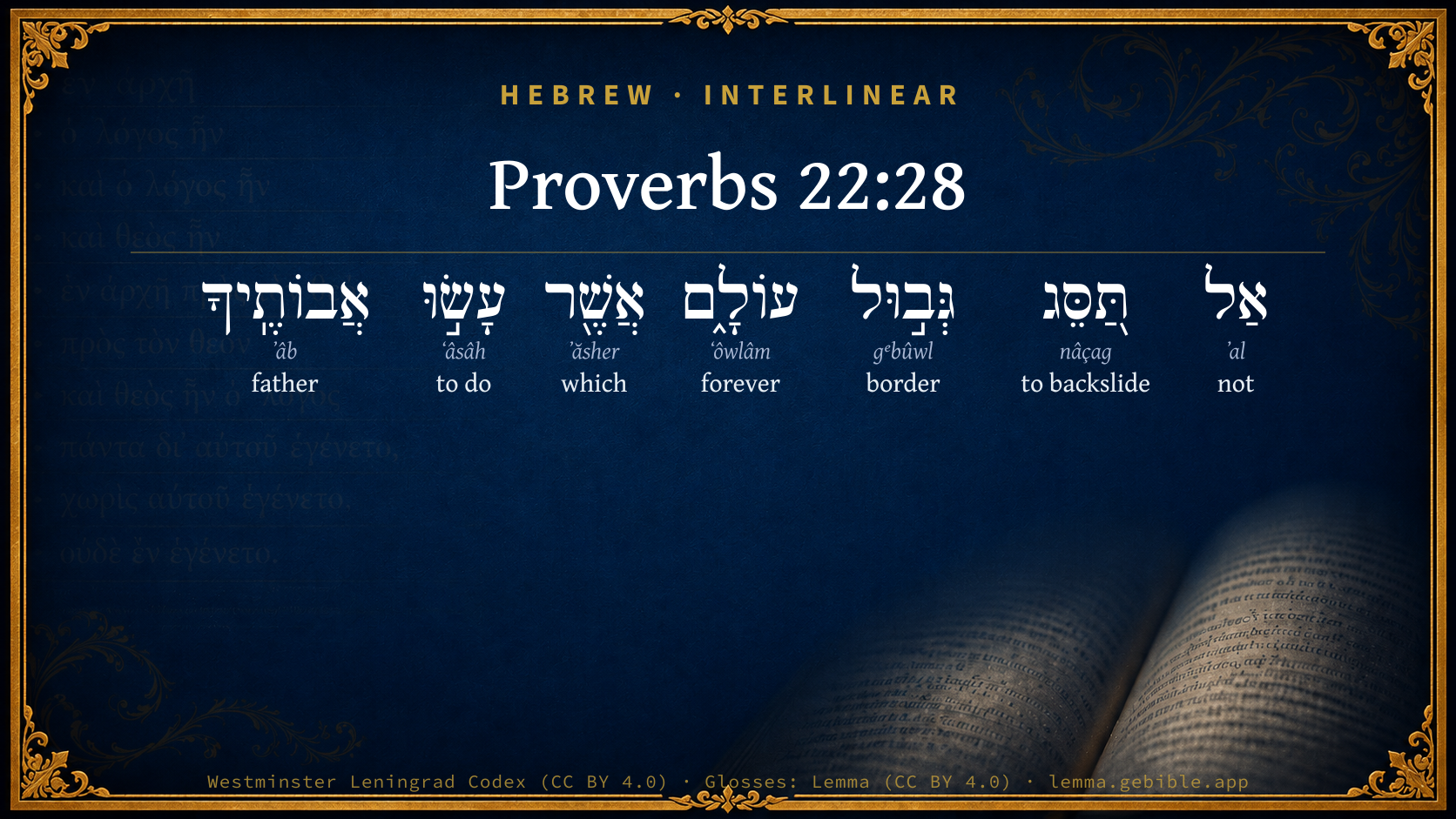
Proverbs 22:28

Hebrew (Westminster Leningrad Codex) Proverbs 22:28 appears in the Hebrew Old Testament. The text above is from the Westminster Leningrad Codex. Each word links to its Strong’s number, a concise gloss, and parsing drawn from the Open Scriptures Hebrew Bible morphology. Click any word for its full Brown-Driver-Briggs (BDB) entry.
Download image
Cite this verse

Proverbs 22:28 (World English Bible). Public Domain. Lemma interlinear Bible study tool, https://lemma.gebible.app/v/proverbs/22/28.

Show BibTeX & RIS
BibTeX
RIS
English Translation
Don't move the ancient boundary stone, Which your fathers have set up.
World English Bible · Public Domain
Download a study sheet

One document with this verse’s original text, its word-by-word gloss line, the meaning frame, cross-references with their text, attributed commentary, and full source and license credits — printable, and it pastes into notes with its structure intact.

This verse Autodidact and up

Study sheet (.html) Plain text (.txt)

A passage Seminary Student

Up to 50 verses in one chapter. A passage sheet keeps up to 6 commentary sources and 12 cross-references per verse, in the order this page ranks them, and says so on the sheet whenever that leaves anything out. Ask for a single verse and you get the Autodidact verse sheet above.

Everything on this page stays free to read, with no account — the sheet is a download of what is already on screen, not access to it.

Want to remove ads? Support Godless Engineer
Compare translations 3

The same verse in 3 English versions, stacked beneath the original-language interlinear above. Click any original word for its lexicon entry.

Each is an independent rendering of the whole verse — the interlinear is not word-aligned to these translations.

Highlighted words mark where these versions differ — a whole-verse word diff, not a word-by-word alignment.

  • World English Bible Public Domain
    Don't move the ancient boundary stone, Which your fathers have set up.
  • King James Version Public Domain
    Remove not the ancient landmark, which thy fathers have set.
  • unfoldingWord Literal Text CC BY-SA 4.0
    Do not move the ancient boundary that your fathers made.

unfoldingWord Literal Text — © unfoldingWord, licensed CC BY-SA 4.0. Word-aligned USFM3 via Door43 (git.door43.org/unfoldingWord/en_ult).

Versions to compare (up to 4)

3 of 4 selected

Show all 18 translations

Every available English version of this verse, each an independent rendering of the whole verse.

  • World English Bible Public Domain
    Don't move the ancient boundary stone, Which your fathers have set up.
  • Berean Standard Bible Public Domain
    Do not move an ancient boundary stone which your fathers have placed.
  • Majority Standard Bible Public Domain
    Do not move an ancient boundary stone which your fathers have placed.
  • King James Version Public Domain
    Remove not the ancient landmark, which thy fathers have set.
  • American Standard Version (1901) Public Domain
    Remove not the ancient landmark, Which thy fathers have set.
  • Revised Version (1885) Public Domain
    Remove not the ancient landmark, which thy fathers have set.
  • Geneva Bible (1599) Public Domain
    Thou shalt not remooue the ancient bounds which thy fathers haue made.
  • Douay-Rheims (1899) Public Domain
    Pass not beyond the ancient bounds which thy fathers have set.
  • Young's Literal Translation Public Domain
    Remove not a border of olden times, That thy fathers have made.
  • Literal Standard Version CC BY-SA 4.0
    Do not remove a border of ancient times, || That your fathers have made.
  • Unlocked Literal Bible CC BY-SA 4.0
    Do not remove the ancient boundary stone that your fathers have set.
  • unfoldingWord Literal Text CC BY-SA 4.0
    Do not move the ancient boundary that your fathers made.
  • Darby Bible Public Domain
    Remove not the ancient landmark which thy fathers have set.
  • World Messianic Bible Public Domain
    Don’t move the ancient boundary stone which your fathers have set up.
  • Webster's Bible Public Domain
    Remove not the ancient landmark, which thy fathers have set.
  • Free Bible Version CC BY-SA 4.0
    Don't move ancient boundary markers that your forefathers put in place.
  • Bible in Basic English Public Domain
    Let not the old landmark be moved which your fathers have put in place.
  • JPS Tanakh (1917) Public Domain
    Remove not the ancient landmark, which thy fathers have set.

Literal Standard Version (2020), Covenant Press — licensed CC BY-SA 4.0. Text via the HelloAO Bible API (eBible.org). Unlocked Literal Bible (unfoldingWord) — licensed CC BY-SA 4.0. Text via the HelloAO Bible API (eBible.org). unfoldingWord Literal Text — © unfoldingWord, licensed CC BY-SA 4.0. Word-aligned USFM3 via Door43 (git.door43.org/unfoldingWord/en_ult). Free Bible Version, Dr. Jonathan Gallagher — licensed CC BY-SA 4.0. Text via the HelloAO Bible API (eBible.org).

Word by word

More ways to search: Search by grammar → Find every occurrence → Compare this word →

Practice this passage: Drill this verse → Learn its vocabulary →

About this verse

These counts appear in no published source. They are computed here, from the morphology-tagged text and Lemma’s own curated glosses. What Lemma adds →

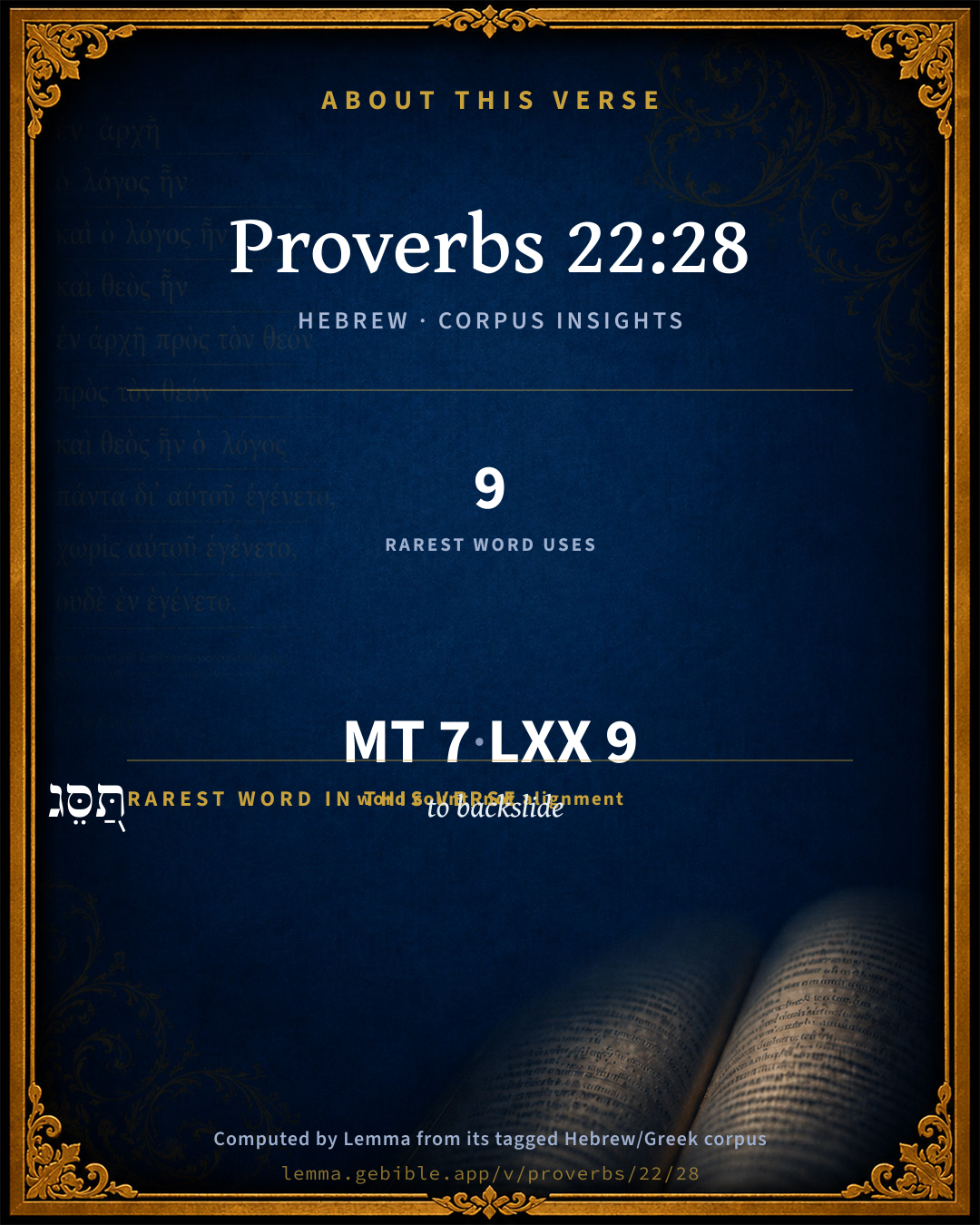
7
words
7
distinct lemmas
Wisdom
section

Notable vocabulary

The rarest word here is תַּ֭סֵּג to backslide H5253 — appearing just 9 times in the whole Hebrew Bible.

Shared distinctive vocabulary

תַּ֭סֵּג to backslide H5253 occurs in 9 verses of the Hebrew Bible. Also found in:

Grammatical profile

  • 2 verbs
  • 3 nouns
  • 2 particles

Verb forms

  • תַּ֭סֵּג Hiphil · Jussive
  • עָשׂ֣וּ Qal · Perfect

Hebrew & Septuagint length

In English translation the verse runs 12 words from the Hebrew and 9 from the Septuagint (LXX English) — closely comparable.

A rough comparison of the two English renderings, which tokenize alike — not a word-level alignment.

Word counts can differ between the Hebrew and the Greek without any difference in meaning — e.g. the Hebrew direct-object marker אֵת has no separate Greek word, and Greek often adds the article ὁ.

In the original languages it is 7 Hebrew tokens and 9 Greek tokens — but the two are counted differently (Hebrew bundles its prefixes and suffixes into one token; the Greek is in lemma form), so that isn’t a like-for-like length.

Cross-references

4

Topical passages linked to Proverbs 22:28 in the Treasury of Scripture Knowledge — connected by theme and wording, ordered by reader-vote popularity; previews shown in the World English Bible.

  • Deuteronomy 19:14 You shall not remove your neighbor's landmark, which they of old time have set, in your inheritance which you shall inherit, in the land that Yahweh your God gives you to possess it.
  • Deuteronomy 27:17 Cursed be he who removes his neighbor's landmark. All the people shall say, Amen.
  • Proverbs 23:10 Don't move the ancient boundary stone. Don't encroach on the fields of the fatherless:
  • Job 24:2 There are people who remove the landmarks. They violently take away flocks, and feed them.

Cross-references courtesy of OpenBible.info (CC BY 4.0).

Hebrew and Greek witnesses Masoretic Hebrew ↔ Greek Septuagint

The same verse in the two great witnesses to the Old Testament, shown verse-for-verse.

These are two independent witnesses, not word-aligned to each other, and the Septuagint is shown in lemma (dictionary) form.

Hebrew Proverbs 22:28 Masoretic · Westminster Leningrad Codex

אַל תַּ֭סֵּג גְּב֣וּל עוֹלָ֑ם אֲשֶׁ֖ר עָשׂ֣וּ אֲבוֹתֶֽיךָ

Don't move the ancient boundary stone, Which your fathers have set up.

World English Bible · Public Domain

Greek LXX Proverbs 22:28 Septuagint · lemma form

μή μετααἴρω ὅριον αἰώνιος ὅς τίθημι ὁ πατήρ σύ

Remove not the old landmarks, which your fathers placed.

LXX2012 (modern English Septuagint) · Public Domain

On this verse, The Pulpit Commentary discusses the Septuagint’s reading. Read the note in Commentary ↓

Hebrew: Westminster Leningrad Codex (CC BY 4.0). Greek: Septuagint (public domain); English from LXX2012 (modern English Septuagint) (Public Domain). How the Septuagint differs from the Hebrew →

Commentary

Notes on Proverbs 22:28 from classic Christian and Jewish commentators (each source and its license shown beneath its notes). The classic Christian expositions comment on the surrounding passage and are grouped to its opening verse, so a note may address several verses; the Jewish commentaries on the Tanakh (Rashi and others) are per-verse, so they appear only where the commentator wrote on this verse.

Lemma curates 59 commentaries, every one of them public domain or Creative Commons licensed, each selected and text-cleaned for this edition rather than reprinted as found. About our sources →

Trapp's Complete Commentary

John Trapp

Pro 22:28 Remove not the ancient landmark, which thy fathers have set.

Ver. 28. Remove not the ancient landmark.] Unless ye covet a curse. {Deu 27:17} Let levellers look to it, and know that property is God’s ordinance; {Act 5:4 Psa 17:14} that magistracy is the hedge of a nation; {a} and that "he that breaks a hedge, a serpent shall bite him"; {Ecc 10:8} that the ministry is Christ’s own institution; {Eph 4:11} and that lay preachers may look to speed as Nadab and Abihu, as Uzzah and Uzziah, or as other usurpers: {See Trapp on "Deu 19:14"}

{a} ερμα πολεως.

John Trapp, A Commentary or Exposition upon All the Books of the Old and New Testament (1647–1656) — public domain. Text from a community e-Sword module.

The Biblical Illustrator

Joseph S. Exell

Pro_22:28

Remove not the ancient landmarks.

The old landmarks

The wisdom of the Mosaic code is nowhere more manifest than in its provisions touching the tenure of land. Every man in Israel was a landowner, and he must remain so. It was customary to mark the boundaries of estates by corner-stones. To remove these landmarks, if an envious neighbour were so disposed, was an easy matter. But it was prohibited under a severe penalty. We deal with the spiritual inheritance handed down by our fathers as a rich bequest of truth and virtue. An attempt to remove the landmarks of this inheritance is noted as one of the dangerous tendencies of modern thought.

1. One landmark is belief in the supernatural. The hand reached forth to remove this boundary is Agnosticism.

2. Another is Revelation. By which is meant the Holy Scriptures. The enemy of Scripture to-day is Rationalism. To the present controversy as to the trustworthiness of Scripture is due loss of reverence and loss of faith.

3. Another is belief in Christ. The enemies are the various forms of humanitarianism.

4. Another is tradition. There is danger in clamouring against a thing because it bears the seal of antiquity. Progress in theological circles has come to mean a reckless abandonment of everything that age has sanctified. Dogma is objected to because it has been handed down. In fact, a dogma is nothing more nor less than a formulated truth bearing the marks of age, and of long trial, and the warrant of venerable authority. (D. J. Burrell, D.D.)

Old landmarks

I. Some of the landmarks threatened.

1. Those of doctrine. The deity of Christ. Salvation by atonement. The necessity for regeneration.

2. Those of Christian life. Laxity in doctrine results in laxity of life.

II. Reasons why these landmarks should be left. Loyalty to God as King forbids us from tampering with them, and affection to Him as a Father says, Respect them. They are the ramparts of the Church. They are the foundations of all true happiness, and the men who have most faithfully stood by them, and most humbly paid homage to them, have been the men who have been the glory of the Church. (Archibald G. Brown.)

Eastern land-divisions

Eastern fields were not divided by hedge, or wall, or ditch, so there was much danger of confusing the separate properties of individuals. In the East advantage was taken, wherever possible, of natural divisions, such as river-beds, tributary stream-lines, and edges of valleys. But in the open ground the separate properties were only marked by a deeper furrow, or large stones almost buried in the soil. The injunction not to remove a neighbours landmarks was, therefore, of the utmost importance, as stealthy encroachments might easily be made by shifting these stones. (Biblical Things not Generally Known.)

The Biblical Illustrator, edited by Joseph S. Exell (c. 1880s–1900s) — public domain. Text from a community e-Sword module.

Joseph Benson's Commentary

Pro 22:28. Remove not the ancient landmark — Whereby the lands of several possessors were distinguished and divided. Do not enrich thyself with the injury of other men: do not invade the rights of others.

Joseph Benson's Commentary on the Old and New Testaments (1811–1818) — public domain. Text from a community e-Sword module.

Tyndale Open Study Notes

Tyndale Open Resources

22:28 Saying 4: Property was marked by stones set up as boundary markers; it was a great offense to move these ancient markers of real estate (see also 23:10; Deut 19:14).

Tyndale Open Study Notes — © Tyndale Open Resources, licensed CC BY-SA 4.0. Text via the HelloAO Bible API.

Matthew Henry's Commentary

1. We are here taught not to invade another man's right, though we can find ways of doing it ever so secretly and plausibly, clandestinely and by fraud, without any open force. Let not property in general be entrenched upon, by robbing men of their liberties and privileges, or of any just ways of maintaining them. Let not the property of particular persons be encroached upon. The land-marks, or meer-stones, are standing witnesses to every man's right; let not those be removed quite away, for thence come wars, and fightings, and endless disputes; let them not be removed so as to take from thy neighbour's lot to thy own, for that is downright robbing him and entailing the fraud upon posterity. 2. We may infer hence that a deference is to be paid, in all civil matters, to usages that have prevailed time out of mind and the settled constitutions of government, in which it becomes us to acquiesce, lest an attempt to change it, under pretence of changing it for the better, prove of dangerous consequence.

Matthew Henry's Commentary on the Whole Bible (1708–1710) — public domain (CC PDM 1.0). Text via the HelloAO Bible API.

Jamieson, Fausset & Brown

Robert Jamieson, A. R. Fausset & David Brown

(Compare Pro 23:10). Do not entrench on others (Deu 19:14; Deu 27:17).

Jamieson, Fausset & Brown — Commentary Critical and Explanatory on the Whole Bible (1871) — public domain (CC PDM 1.0). Text via the HelloAO Bible API.

Adam Clarke's Commentary

Verse 28. Remove not the ancient landmark] Do not take the advantage, in ploughing or breaking up a field contiguous to that of thy neighbour, to set the dividing stones farther into his field that thou mayest enlarge thy own. Take not what is not thy own in any case. Let all ancient divisions, and the usages connected with them, be held sacred. Bring in no new dogmas, nor rites, nor ceremonies, into religion, or the worship of God, that are not clearly laid down in the sacred writings. "Stand in the way; and see, and ask for the old paths, which is the good way, and walk therein; and ye shall find rest for your souls;" Jer 6:16. But if any Church have lost sight of the genuine doctrines of the Gospel, calling them back to these is not removing the ancient landmarks, as some have falsely asserted. God gave a law against removing the ancient landmarks, by which the inheritances of tribes and families were distinguished. See De 19:14, from which these words of Solomon appear to be taken.

Even among the heathens the landmark was sacred; so sacred that they made a deity of it. Terminus signifies the stone or post that served as a landmark. And Terminus was reputed a god, and had offerings made to him. Hence OVID: -

Tu quoque sacrorum, Termine, finis eras.

FAST. lib. i., ver. 50.

Nox ubi transierit, solito celebratur honore,

Separat indicio qui Deus arva suo.

Termine, sive lapis, sive es defossus in agro

Stipes, ab antiquis sic quoque Numen habes.

Te duo diversa domini pro parte coronant;

Binaque serta tibi, binaque liba ferunt.----

Conveniunt, celebrantque dapes vicinia simplex;

Et cantant laudes, Termine sancte, tuas.

Tu populos, urbesque, et regna ingentia finis:

Omnis erit, sine te, litigiosus ager.

FAST. lib. ii., ver. 639.

Here we find the owners of both fields bringing each his garland and libation to the honour of this god. They sung its praises, put on its top a chaplet of flowers, poured out the libation before it; and the inhabitants of the country held a festival in its honour. It was, in short, celebrated as the preserver of the bounds and territorial rights of tribes, cities, and whole kingdoms; and without its testimony and evidence, every field would have been a subject of litigation.

Adam Clarke's Commentary on the Bible (1810–1826) — public domain. Text from a community e-Sword/MySword module.

Ellicott's Commentary for English Readers

(28) Remove not the ancient landmark.—The stones marking the boundaries of the fields: evidently a not uncommon crime, from the earnestness with which it is forbidden. (Comp. Pro_23:10; Deu_19:14; Deu_27:17.)

A Bible Commentary for English Readers, edited by Charles John Ellicott (1878–1897) — public domain. Text from a community e-Sword module.

The Cambridge Bible for Schools and Colleges

gen. ed. J. J. S. Perowne

28. Comp. Pro_23:10; Deu_19:14.

The Cambridge Bible for Schools and Colleges (gen. ed. J. J. S. Perowne; Cambridge University Press, 1878–1918) — public domain. Text from a community e-Sword module.

John Gill's Exposition

Remove not the ancient landmark which thy fathers have set. Or, "the ancient border" or "boundary" (n); by which lands, estates, and inheritances, were marked, bounded, and distinguished; set by ancestors in agreement with their neighbours; which to remove was contrary to a law, and a curse is denounced upon those that did it, Deu 19:14; and was always reckoned a very heinous crime in early times; See Gill on Job 24:2. This was so sacred a thing among the Romans, that they had a deity which presided over those bounds, and had its name from them. Some apply this, in a political sense, to laws of long standing, and customs of long prescription; and others interpret it, in a theological sense, of doctrines and practices settled by the fathers of the church; which, if understood of Christ and his apostles only, will be allowed; but if of the ancient fathers of the church that followed them, it should not be received; since they were but fallible men, and guilty of many errors and mistakes, both in doctrine and practice.

(n) "terminum antiquum", Pagninus, Junius & Tremellius, Piscator, Michaelis, Schultens.

John Gill's Exposition of the Whole Bible (1746–1763) — public domain (CC PDM 1.0). Text via the HelloAO Bible API.

Albert Barnes' Notes on the Bible

A protest against the grasping covetousness Isa 5:8 which is regardless of the rights of the poor upon whose inheritance men encroach (compare the margin reference). The not uncommon reference of the words to the “landmarks” of thought or custom, however, natural and legitimate, is foreign to the mind of the writer.

Albert Barnes' Notes on the Bible (1834–1885) — public domain. Text from a community e-Sword/MySword module.

Haydock's Catholic Bible Commentary

Set. The pagans made a god of Terminus, to prevent disputes. (Ovid, Fast. ii.) --- If it be unlawful to disturb land-marks, how much more so is it to give way to novelty in religion? (Deuteronomy xix. 14.) (Calmet) --- Solomon is addressing those who follow the true faith. Else the conduct of infidel ancestors should not deter any from embracing the truth. (Haydock)

George Leo Haydock (1774–1849), Haydock's Catholic Family Bible and Commentary, 1859 edition — public domain. Excludes Psalms (Douay-Rheims chapter numbering differs from Protestant) and Deuterocanonical books (Catholic canon only).

Matthew Poole's English Annotations

Landmark, whereby the lands of several possessors were distinguished and divided. Do not enrich thyself with the injury of other men; do not invade the rights of others.

Matthew Poole's English Annotations on the Holy Bible (1683–1685) — public domain. Text from a community e-Sword/MySword module.

Whedon's Commentary on the Bible

Daniel D. Whedon

28. Remove not the ancient landmark — The marks, frequently stones, by which lands were divided, whether private estates or the territories of tribes, were held very sacred, not merely among the Hebrews, but among other ancient nations. To change them, secretly or by force, was a high offence and injustice, and brought on litigations and wars. Estates passed down from generation to generation, and hence these “marks” are described as “the ancient landmarks which thy fathers have set.” (See Deu_19:14; Deu_27:17.) It is probable that a tropical sense may be intended here. Some think it is the principal one. The sense of the passage then would be, applying the general principle: Change not the ancient and approved usages of the fathers, whether political, social, or religious; be not restless innovators. Duly qualified, this is an excellent maxim. Doubtless improvements are frequently effected by changes; but to innovate is not to necessarily improve. See note on Job_24:2. Comp. Hos_5:10; Pro_23:10-11.

Daniel D. Whedon (gen. ed.), Commentary on the Old and New Testaments (1874–1909) — public domain. Text from a community e-Sword module.

The Pulpit Commentary

The first line is repeated at Pro_23:10. (On the sanctity of landmarks, see note on Pro_15:25) Some of the stones, exhibiting a bilingual inscription, which marked the boundaries of the Levitical city of Gezer, were discovered by Gauneau in 1874 ("Quart. Statement Pal. Explor. Fund," 1874). The Septuagint calls the landmarks oria aiwnia .

Ancient landmarks.

I ANCIENT LANDMARKS OF PROPERTY. The stone that divided one man"s vineyard from his neighbour"s was regarded as a sacred thing, on no account to be touched. This arrangement helped to perpetuate family holdings. It prevented the accumulation of large estates by the wealthy, and the alienation of the land from the poor. It guarded the weak from the oppression of the strong. It was a protection against deceit, error, and confusion. Ahab transgressed the Law in seeking to acquire Naboth"s vineyard. It would be well if we could appreciate the spirit of the old Hebrew sanctity of the landmark. It would be well, too, if there were more people who had a personal interest in the soil of the country. The "sacred rights of property" cannot confer on the owner any power to oppress the tiller of the soil; but, on the other hand, they should protect the owner from the violence of social revolution.

II ANCIENT LANDMARKS OF HISTORY. The fieldstones of Palestine were historic. Their very presence served as a record of the lives and doings of a past ancestry. As such they gathered a certain sanctity of association. It is no small thing that we in England belong to a historic nation. The forward movement that is so characteristic of our day should not blind us to the lessons of the past. Noble lives and great events are landmarks on the vast field of history. They help us to map out the past, and they also assist us to gain wisdom for the present. We cannot dispense with the landmarks of Scripture history. Christianity, without the facts of the life of Christ, would be boneless and shapeless. It is strong as a historical religion. Directly it is treated merely as an idea, a sentiment, or a "spirit," it will languish by the loss of the old landmarks of concrete facts in the Birch, Life, Passion, Death, and Resurrection of Christ.

III ANCIENT LANDMARKS OF DOCTRINE. We live in an age when many of these have been uprooted and flung on one side. No doubt some of them had been converted into obstructions standing up in the middle of the road of truth. We need to ascertain whether we are really dealing with the truly ancient landmarks, and are not deceived by fraudulent inventions of later ages. The primary landmarks of Christianity are in the teachings of Christ and his apostles. We may have to clear away a great deal of the rubbish of the ages in order to get back to these original truths of Christianity. It is not right to accuse those who are loyal to Christ with removing the ancient landmarks, when they are only taking away these later accretions. But we cannot dispense with the truly ancient landmarks. If we forsake the New Testament, we forsake Christianity.

IV ANCIENT LANDMARKS OF MORALS. Many practices of antiquity may be abandoned. Some may be superseded by better ways, others left behind as unsuited to the circumstances of the new times. But behind and beneath all these changing fashions there are the solid rocks of truth and righteousness. What, ever else may be shaken, we cannot afford to shift these landmarks. We may improve upon old customs; but we cannot cast away the ten commandments.

The ancient landmark.

The text clearly refers to the ancient division of property by which the land was carefully marked out, and each family had its own proper share. The man who removed these boundaries in his own material interest was simply appropriating what did not belong to him. Perhaps "the removal of the ancient landmark" became a proverbial phrase to signify any serious departure from rectitude. It will be worth while to consider

I WHAT IS NOT FORBIDDEN IN" THIS PRECEPT.

1. A change in social customs. It is found by experience that we are all the better for leaving certain usages behind us. We outgrow them, and they become hindrances rather than aids to us.

2. The remodelling of old institutions. The time comes when the old order changes, giving place to new, by common consent and to the general advantage. With new methods, new organizations, there may come new life and renewed power.

3. The change of religious vocabulary. There is nothing wrong in putting the old doctrine in new forms; indeed, it becomes more living and more telling when uttered in the language of the time. Ancient phraseology is to be respected, but it is not sacred; it may and must give place to new.

4. The modification of Christian doctrine; not, indeed, a change of "the faith once delivered to the saints a departure from "the truth as it is in Jesus," but such a varying account and statement of it as comes with increased light from the study of nature or of man, and with further reverent research of the Word of God. But what is

II THE WRONG WHICH IS HERE FORBIDDEN. It is all criminal selfishness, more especially such as that referred to the appropriation of land by immoral means, or the securing of any kind of property by tampering with a deed or other document. It may include the act of obtaining any advantage in any direction whatever by means that are dishonourable and unworthy. In all such cases we need the ear to hear a Divine, "Thou shalt not." To act thus is a sin and a mistake. It is:

1. To disobey the voice of the Lord, who emphatically denounces it. Especially does God rebuke and threaten the wronging of the poor and feeble because they are such; to do this is to add meanness and cowardice to selfishness and crime (see vers. 16, 22).

2. To injure ourselves far more seriously and irremediably than we hurt our neighbour. It is to lose the favour of God, the approval of our own conscience, and the esteem of the fast. C.

The Pulpit Commentary (1880–1919), ed. H.D.M. Spence-Jones & Joseph S. Exell — public domain. Text from a community e-Sword module.

Keil & Delitzsch

C. F. Keil & F. Delitzsch

A fourth proverb - a distich - beginning with the warning אל:

28 Remove not the perpetual landmark

Which thy ancestors have set up.

28a = Pro 23:10. Regarding the inviolability of boundaries established by the law, vid., at Pro 15:25. גּבוּל עולם denotes "the boundary mark set up from ancient times, the removal of which were a double transgression, because it is rendered sacred by its antiquity" (Orelli, p. 76). נסג = סוּג signifies to remove back, Hiph. to shove back, to move away. אשׁר has the meaning of (ὅριον) ὅ, τι, quippe quod. Instead of עולם, the Mishna reads, Pea v. 6, עולים, which in the Jerusalem Gemara one Rabbi understands of those brought up out of Egypt, another of the poor; for "to rise" (in the world) is a euphemism (לשׁון כבוד) for "to come down" (be reduced in circumstances).

(Note: As an analogical example, סגּי נהור, seeing clearly = blind.)

Keil & Delitzsch — Biblical Commentary on the Old Testament (1861–1891) — public domain (CC PDM 1.0). Text via the HelloAO Bible API. (Old Testament only.)

Bridges on Proverbs

Charles Bridges

Every one has an undoubted right to his own. He must therefore have the means of knowing and securing his right. Even the heathen admitted the sacredness of the landmark. The stone or the staple was honored as the god, without whose kindly influence every field would be the subject of contention.†1 The landmark was protected by the wise laws of Israel. God himself set the bounds to the respective parts of his own world, restricting each part within its proper limits.†2 Thus also he distributed the different nations,†3 and appointed the same security for the several allotments of his own people.†4 The ancient landmark stood as the witness and memorial of each man’s rights, which his fathers had set. Its removal therefore was forbidden, as a selfish and unjust invasion of property,†5 included in the curses of Ebal,†6 and noted, in subsequent ages, as the forefront of national provocation.†7

All sound expositors†8 warn us, from this Proverb, to reverence long-tried and well-established principles, and not rashly to innovate upon them. Some scorn the ancient landmarks as relics of bye-gone days of darkness. Impatient of restraint, they want a wider range of wandering, to indulge either their own prurient appetite for novelties, or the morbid cravings of others for this unwholesome excitement. (2Ti 3:7 ; 2Ti 4:3-4 .) Endless divisions and dissensions have been the fruit of this deadly evil. The right of individual judgment oversteps its legitimate bounds; and in its licentious exercise "every man" feels justified to "do" and think "that which is right in his own eyes." (Jdg 21:25 .)

Rome, on the other hand, charges us with removing the ancient landmark of unwritten Tradition, which our fathers have set. We ask — What right had they to set it up? We do reverence to no unwritten traditions upon the footing of "the law and the testimony." (Isa 8:20 .) We rebut the charge of Antichrist, and contend, upon the broad ground of historic testimony, that she has removed the ancient landmarks, and substituted her own in their place; that Protestantism (in principle, though not in name) is the old religion, and Popery a comparative novelty.†9 ’We have not removed the ancient landmarks by bringing men back to the true doctrine, because this, being delivered by God, is the ancient doctrine, and the landmarks have been subsequently removed by the subtlety of the devil, and idolatry put in the place of the true worship.’†10

Turning to our beloved and venerated Church; the last age witnessed a rude, but by divine mercy an unsuccessful, effort, to root up her landmarks.†11 We have seen a subtle and invidious attempt to remove them from the place, where our well-instructed fathers have set them, and fix them nearer Rome; leaving but a narrow boundary of division between Christ and Antichrist. This is indeed the rooting up of the foundations of the grace of God, which ought, if need be, to "be resisted unto blood." (Heb 12:4 .) The LORD make us "valiant for the truth," and consistent witnesses of its power!

Footnotes:

†1 See Ovid, Trist. ii. 639-648.

†2 Gen 1:6-10. Job 38:10-11 .

†3 Deu 32:8.

†4 Num 34:1-29.

†5 Deu 19:14. Compare Pro 23:10 . Job 24:2 .

†6 Deu 27:17.

†7 Hos 5:10.

†8 Bp. Patrick, Scott, Geier, &c. Romish expositors naturally apply it to their own traditions. Estè quotes the Venerable Bede. See also Corn. à Lapide.

†9 The historical dates of the distinctive principles of Popery accredited as articles of faith, are many centuries subsequent to the primitive era. See a valuable tract by Rev. Thomas Lathbury - ’Protestantism the Old Religion, Popery the New.’ Also ’Our Protestant Forefathers.’ By the Rev. Dr. Gilly - As regards our own church - Mr. Soames’s interesting and elaborate work on the Anglo-Saxon Church.

†10 Melancthon. Comment. 12mo. 1550.

†11 The Heathen Association, at Feathers Tavern, supported by men of influence and dignity, with the avowed object of sweeping away the Creeds, Articles, and Subscriptions.

Charles Bridges, An Exposition of the Book of Proverbs (1846) — public domain. Text from a community e-Sword module.

Kretzmann's Popular Commentary

Paul E. Kretzmann

v. 28. Remove not the ancient landmark, set to mark the boundaries, which thy fathers have set. Cf Pro 15:25.

Paul E. Kretzmann, Popular Commentary of the Bible (1921–1924) — public domain. Text from a community e-Sword module.

unfoldingWord translationNotes

Door43 World Missions Community

General Information:

These verses continue the "thirty sayings" (Proverbs 22:20).

ancient

very old

boundary stone

a large stone that shows where one person's land ends and another person's land begins

fathers

ancestors

Do you see a man skilled at his work?

This rhetorical question is actually a command. AT: "Think of someone you know who is skilled at his work" (See: Rhetorical Question)

stand before

This represents becoming a servant of the important person. Kings and other important people will think so highly of him that they will use his services. (See: Metonymy)

translationWords

ancestor

works

king

unfoldingWord translationNotes — © Distant Shores Media and the Door43 World Missions Community, licensed CC BY-SA 4.0. Source: git.door43.org/Door43/en_tn.

Rashi

Rabbi Shlomo Yitzchaki (Rashi)

Do not remove an ancient boundary Do not turn away from the custom of your forefathers. Our Sages of blessed memory said: If one places a basket under a vine at the time of vintage so that the fallen grapes should fall into it, concerning this was stated: “Do not remove an ancient boundary, etc.” remove Heb. תסג, as in (Ps. 129:5) “and shall draw backwards (ויסגו).”

Rashi on the Tanakh — English translations: “The Judaica Press complete Tanach with Rashi, translated by A. J. Rosenberg” (CC BY 4.0); “Pentateuch with Rashi's commentary by M. Rosenbaum and A.M. Silbermann, 1929-1934” (public domain); “The Metsudah Tanach series, Lakewood, N.J” (CC BY 4.0); and “The Book of Joshua, Metsudah Publications, 1997” (CC BY 4.0). Text via Sefaria.

Lesson kit

Teaching starters — assembled from the data on this page, not authored interpretation. Every prompt links to the verse data it draws on. Edit before teaching.

Proverbs, in the Wisdom, opens this verse with 7 words (7 distinct Hebrew lemmas). Its most distinctive word is nâçag (“to backslide”). A historical commentator’s framing appears above. Read the whole chapter for the surrounding context.

Discussion questions

  1. How does “to backslide” (nâçag) shape what this verse is saying?
  2. How does Deuteronomy 19:14, which shares the word «to backslide», read alongside this verse?
  3. These translations render this verse differently; the difference is in the English rendering, not the original. What questions does that raise?
  4. «תַּ֭סֵּג» is a Hiphil Jussive verb. How does that grammatical form shape the action described?
  5. Compare how Trapp's Complete Commentary and The Biblical Illustrator read this verse. Where do they agree or differ?

Things to notice

Reading settings

Reading text

Shown beneath each verse's original-language words.

Old Testament
Old Testament edition

Read the OT as the Masoretic Hebrew (MT) or the Greek Septuagint (LXX).

English shown for the Greek Septuagint (in the Hebrew ↔ Greek comparison).

Comparing translations? Open the Compare panel on any verse page to stack up to four side by side.