
Genesis 41:19

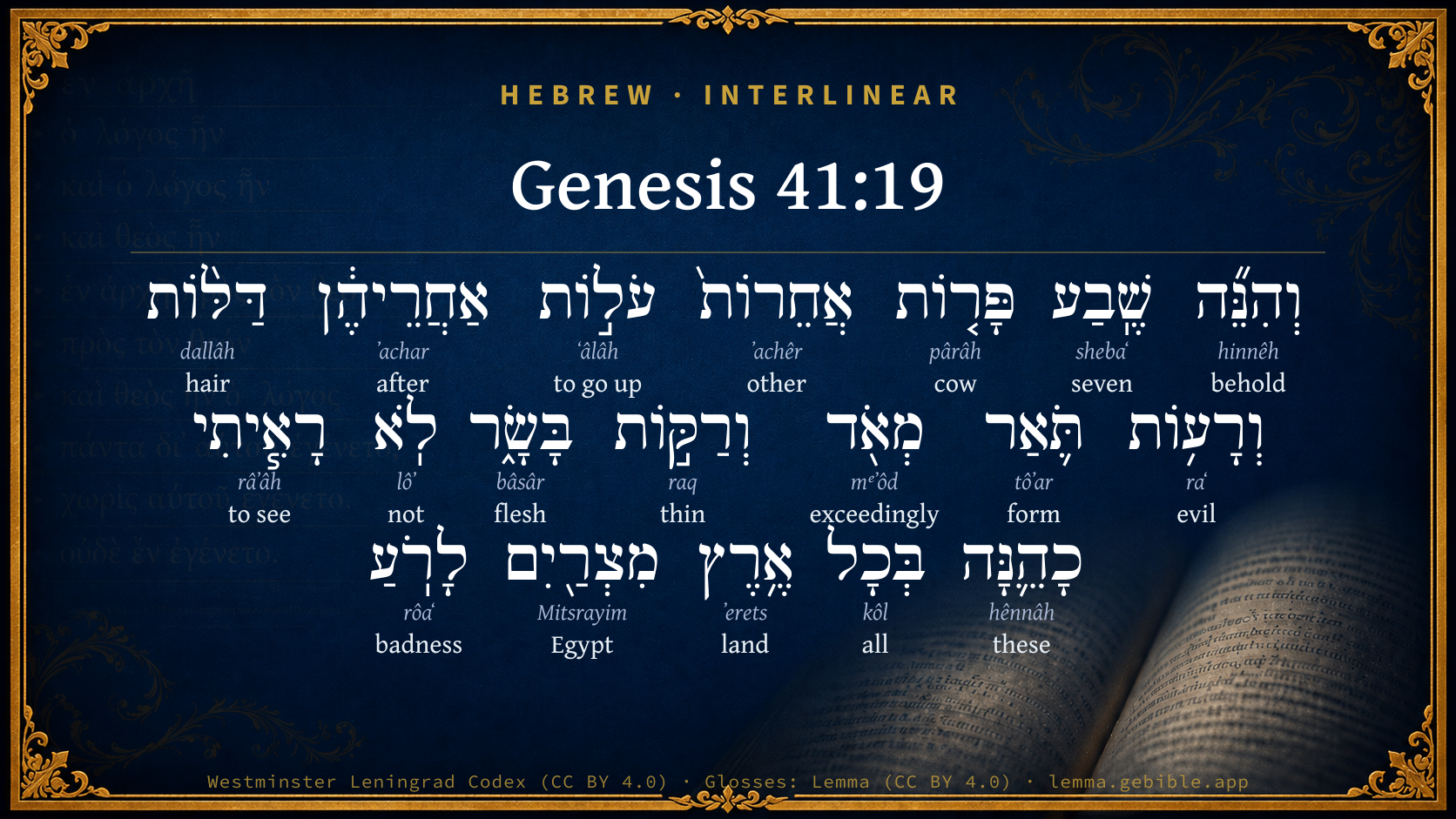
Hebrew (Westminster Leningrad Codex) Genesis 41:19 appears in the Hebrew Old Testament. The text above is from the Westminster Leningrad Codex. Each word links to its Strong’s number, a concise gloss, and parsing drawn from the Open Scriptures Hebrew Bible morphology. Click any word for its full Brown-Driver-Briggs (BDB) entry.
Download image
Cite this verse

Genesis 41:19 (World English Bible). Public Domain. Lemma interlinear Bible study tool, https://lemma.gebible.app/v/genesis/41/19.

Show BibTeX & RIS
BibTeX
RIS
English Translation
and, behold, seven other cattle came up after them, poor and very ill-favored and lean-fleshed, such as I never saw in all the land of Egypt for ugliness.
World English Bible · Public Domain
Highlights
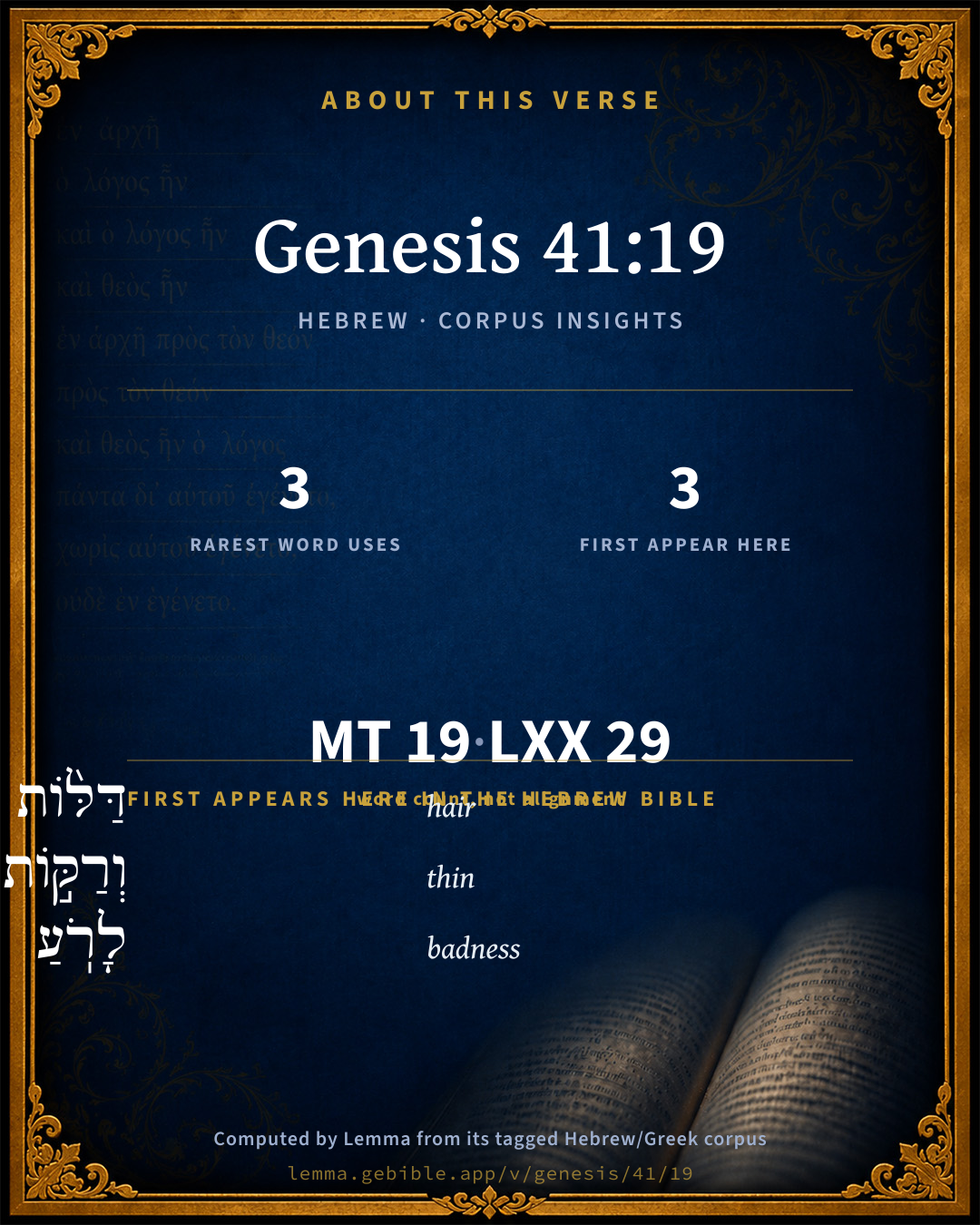
  • 3 first appearances in the Hebrew Bible
Full analysis ↓
Download a study sheet

One document with this verse’s original text, its word-by-word gloss line, the meaning frame, cross-references with their text, attributed commentary, and full source and license credits — printable, and it pastes into notes with its structure intact.

This verse Autodidact and up

Study sheet (.html) Plain text (.txt)

A passage Seminary Student

Up to 50 verses in one chapter. A passage sheet keeps up to 6 commentary sources and 12 cross-references per verse, in the order this page ranks them, and says so on the sheet whenever that leaves anything out. Ask for a single verse and you get the Autodidact verse sheet above.

Everything on this page stays free to read, with no account — the sheet is a download of what is already on screen, not access to it.

Want to remove ads? Support Godless Engineer
Compare translations 3

The same verse in 3 English versions, stacked beneath the original-language interlinear above. Click any original word for its lexicon entry.

Each is an independent rendering of the whole verse — the interlinear is not word-aligned to these translations.

Highlighted words mark where these versions differ — a whole-verse word diff, not a word-by-word alignment.

  • World English Bible Public Domain
    and, behold, seven other cattle came up after them, poor and very ill-favored and lean-fleshed, such as I never saw in all the land of Egypt for ugliness.
  • King James Version Public Domain
    And, behold, seven other kine came up after them, poor and very ill favored and leanfleshed, such as I never saw in all the land of Egypt for badness:
  • unfoldingWord Literal Text CC BY-SA 4.0
    Then behold, seven other cows came up after them, poor and very ugly of form and thin-fleshed. I have not seen as ugly as those in all the land of Egypt!

unfoldingWord Literal Text — © unfoldingWord, licensed CC BY-SA 4.0. Word-aligned USFM3 via Door43 (git.door43.org/unfoldingWord/en_ult).

Versions to compare (up to 4)

3 of 4 selected

Show all 18 translations

Every available English version of this verse, each an independent rendering of the whole verse.

  • World English Bible Public Domain
    and, behold, seven other cattle came up after them, poor and very ill-favored and lean-fleshed, such as I never saw in all the land of Egypt for ugliness.
  • Berean Standard Bible Public Domain
    After them, seven other cows—sickly, ugly, and thin—came up. I have never seen such ugly cows in all the land of Egypt!
  • Majority Standard Bible Public Domain
    After them, seven other cows—sickly, ugly, and thin—came up. I have never seen such ugly cows in all the land of Egypt!
  • King James Version Public Domain
    And, behold, seven other kine came up after them, poor and very ill favored and leanfleshed, such as I never saw in all the land of Egypt for badness:
  • American Standard Version (1901) Public Domain
    and, behold, seven other kine came up after them, poor and very ill-favored and lean-fleshed, such as I never saw in all the land of Egypt for badness:
  • Revised Version (1885) Public Domain
    and, behold, seven other kine came up after them, poor and very ill favoured and leanfleshed, such as I never saw in all the land of Egypt for badness:
  • Geneva Bible (1599) Public Domain
    Also loe, seuen other kine came vp after them, poore and very euilfauoured, and leanefleshed: I neuer sawe the like in all the lande of Egypt, for euilfauoured.
  • Douay-Rheims (1899) Public Domain
    So Pharao told what he had dreamed: Methought I stood upon the bank of the river,
  • Young's Literal Translation Public Domain
    and lo, seven other kine are coming up after them, thin, and of very bad form, and lean `in' flesh; I have not seen like these in all the land of Egypt for badness.
  • Literal Standard Version CC BY-SA 4.0
    and behold, seven other cows are coming up after them, thin, and of very bad form, and lean [in] flesh; I have not seen like these in all the land of Egypt for badness.
  • Unlocked Literal Bible CC BY-SA 4.0
    Behold, seven other cows came up after them, weak, very undesirable, and thin. I never saw in all the land of Egypt such undesirableness like them.
  • unfoldingWord Literal Text CC BY-SA 4.0
    Then behold, seven other cows came up after them, poor and very ugly of form and thin-fleshed. I have not seen as ugly as those in all the land of Egypt!
  • Darby Bible Public Domain
    And behold, seven other kine came up after them, poor, and very ill-formed, and lean-fleshed -- such as I never saw in all the land of Egypt for badness.
  • World Messianic Bible Public Domain
    and behold, seven other cattle came up after them, poor and very ugly and thin, such as I never saw in all the land of Egypt for ugliness.
  • Webster's Bible Public Domain
    And behold, seven other cows came out after them, poor, and very ill-favored, and lean-fleshed, such as I never saw in all the land of Egypt for badness:
  • Free Bible Version CC BY-SA 4.0
    Then I saw another seven cows that came up behind them. They looked sickly and ugly and skinny—I've never seen such ugly cows in the whole of Egypt!
  • Bible in Basic English Public Domain
    Then after them came seven other cows, very thin and poor-looking, worse than any I ever saw in the land of Egypt;
  • JPS Tanakh (1917) Public Domain
    And, behold, seven other kine came up after them, poor and very ill-favoured and lean-fleshed, such as I never saw in all the land of Egypt for badness.

Literal Standard Version (2020), Covenant Press — licensed CC BY-SA 4.0. Text via the HelloAO Bible API (eBible.org). Unlocked Literal Bible (unfoldingWord) — licensed CC BY-SA 4.0. Text via the HelloAO Bible API (eBible.org). unfoldingWord Literal Text — © unfoldingWord, licensed CC BY-SA 4.0. Word-aligned USFM3 via Door43 (git.door43.org/unfoldingWord/en_ult). Free Bible Version, Dr. Jonathan Gallagher — licensed CC BY-SA 4.0. Text via the HelloAO Bible API (eBible.org).

Word by word

More ways to search: Search by grammar → Find every occurrence → Compare this word →

Practice this passage: Drill this verse → Learn its vocabulary →

וְרַקּ֣וֹת
raq
H7534
“and · thin of”
Conjunction + Adjective, Adjective, Feminine, Plural, Construct
Part of Speech
Conjunction + Adjective
Type
Adjective
Gender
Feminine
Number
Plural
State
Construct
Full BDB Definition

Origin: from H7556 in its original sense

TWOT: 2218a

thin, lean
  1. וְהִנֵּ֞ה hinnêh H2009 “and · behold” Conjunction + Particle, Demonstrative
  2. שֶֽׁבַע shebaʻ H7651 “seven” Adjective, Cardinal number, Feminine, Singular, Absolute
  3. פָּר֤וֹת pârâh H6510 “cows” Noun, Common, Feminine, Plural, Absolute
  4. אֲחֵרוֹת֙ ʼachêr H312 “other” Adjective, Adjective, Feminine, Plural, Absolute
  5. עֹל֣וֹת ʻâlâh H5927 “going up” Verb, Qal, Participle Active, Feminine, Plural, Absolute
  6. אַחֲרֵיהֶ֔ן ʼachar H310 “after · them” Preposition + Suffix, Personal, 3rd Person, Feminine, Plural
  7. דַּלּ֨וֹת dallâh H1803 “hair” Adjective, Adjective, Feminine, Plural, Absolute
  8. וְרָע֥וֹת raʻ H7451 “and · evil of” Conjunction + Adjective, Adjective, Feminine, Plural, Construct
  9. תֹּ֛אַר tôʼar H8389 “form” Noun, Common, Masculine, Singular, Absolute
  10. מְאֹ֖ד mᵉʼôd H3966 “exceedingly” Adverb
  11. בָּשָׂ֑ר bâsâr H1320 “flesh” Noun, Common, Masculine, Singular, Absolute
  12. לֹֽא lôʼ H3808 “not” Particle, Negative
  13. רָאִ֧יתִי râʼâh H7200 “to see” Verb, Qal, Perfect, 1st Person, Common, Singular
  14. כָהֵ֛נָּה hênnâh H2007 “like/as · these” Preposition + Pronoun, Personal, 3rd Person, Feminine, Plural
  15. בְּכָל kôl H3605 “in/at · all of” Preposition + Noun, Common, Masculine, Singular, Construct
  16. אֶ֥רֶץ ʼerets H776 “land of” Noun, Common, Both, Singular, Construct
  17. מִצְרַ֖יִם Mitsrayim H4714 “Egypt” Noun, Proper
  18. לָרֹֽעַ rôaʻ H7455 “to/for the · badness” Preposition, Determined + Noun, Common, Masculine, Singular, Absolute

About this verse

These counts appear in no published source. They are computed here, from the morphology-tagged text and Lemma’s own curated glosses. What Lemma adds →

19
words
19
distinct lemmas
Pentateuch
section

Notable vocabulary

The rarest word here is וְרַקּ֣וֹת thin H7534 — appearing just 3 times in the whole Hebrew Bible.

First appearance in Scripture

These words make their first canonical appearance in the Hebrew Bible here:

  • דַּלּ֨וֹת hair H1803
  • וְרַקּ֣וֹת thin H7534
  • לָרֹֽעַ badness H7455

Shared distinctive vocabulary

וְרַקּ֣וֹת thin H7534 occurs in 3 verses of the Hebrew Bible. Also found in:

Grammatical profile

  • 2 verbs
  • 7 nouns
  • 5 adjectives
  • 1 pronoun
  • 1 preposition
  • 1 adverb
  • 2 particles

Verb forms

  • עֹל֣וֹת Qal · Participle Active
  • רָאִ֧יתִי Qal · Perfect

Hebrew & Septuagint length

In English translation the verse runs 28 words from the Hebrew and 30 from the Septuagint (LXX English) — closely comparable.

A rough comparison of the two English renderings, which tokenize alike — not a word-level alignment.

Word counts can differ between the Hebrew and the Greek without any difference in meaning — e.g. the Hebrew direct-object marker אֵת has no separate Greek word, and Greek often adds the article ὁ.

In the original languages it is 19 Hebrew tokens and 29 Greek tokens — but the two are counted differently (Hebrew bundles its prefixes and suffixes into one token; the Greek is in lemma form), so that isn’t a like-for-like length.

Hebrew and Greek witnesses Masoretic Hebrew ↔ Greek Septuagint

The same verse in the two great witnesses to the Old Testament, shown verse-for-verse.

These are two independent witnesses, not word-aligned to each other, and the Septuagint is shown in lemma (dictionary) form.

Hebrew Genesis 41:19 Masoretic · Westminster Leningrad Codex

וְהִנֵּ֞ה שֶֽׁבַע פָּר֤וֹת אֲחֵרוֹת֙ עֹל֣וֹת אַחֲרֵיהֶ֔ן דַּלּ֨וֹת וְרָע֥וֹת תֹּ֛אַר מְאֹ֖ד וְרַקּ֣וֹת בָּשָׂ֑ר לֹֽא רָאִ֧יתִי כָהֵ֛נָּה בְּכָל אֶ֥רֶץ מִצְרַ֖יִם לָרֹֽעַ

and, behold, seven other cattle came up after them, poor and very ill-favored and lean-fleshed, such as I never saw in all the land of Egypt for ugliness.

World English Bible · Public Domain

Greek LXX Genesis 41:19 Septuagint · lemma form

καί ἰδού ἑπτά βοῦς ἕτερος ἀναβαίνω ὀπίσω αὐτός ἐκ ὁ ποταμός πονηρός καί αἰσχρός ὁ εἶδος καί λεπτός ὁ σάρξ οἷος οὐ ὁράω τοιοῦτος ἐν ὅλος γῆ αἴγυπτος αἰσχρός

And behold seven other cows came up after them out of the river, evil and ill-favoured and lean-fleshed, such that I never saw worse in all the land of Egypt.

LXX2012 (modern English Septuagint) · Public Domain

Hebrew: Westminster Leningrad Codex (CC BY 4.0). Greek: Septuagint (public domain); English from LXX2012 (modern English Septuagint) (Public Domain). How the Septuagint differs from the Hebrew →

Targum (Aramaic paraphrase)

2

The Targum is the ancient Jewish Aramaic paraphrase of the Hebrew Scriptures — an interpretive translation, not the Hebrew text itself. Onkelos (literal) and Pseudo-Jonathan (expansive) render the Torah, and Jonathan the Prophets. Coverage is partial: where no permissively-licensed English translation exists for a verse, only the Aramaic is shown. This is verse-level text, not a word-by-word alignment to the Hebrew.

  1. Targum Onkelos Torah (Genesis–Deuteronomy)
    וְהָא שְׁבַע תּוֹרָן אָחֳרָנְיָן סָלְקָן בַּתְרֵיהוֹן חֲסִיכָן וּבִישָׁן לְמֶחֱזֵי לַחֲדָא וַחֲסִירָן בְּשָׂר לָא חֲזֵתִי כְוָתְהֵן בְּכָל אַרְעָא דְמִצְרַיִם לְבִישׁוּ

    (no public-domain English translation for this verse)

    Targum Onkelos — Aramaic: “Onkelos Genesis” (public domain); “Onkelos Exodus” (public domain); “Onkelos Leviticus” (public domain); “Onkelos Numbers” (public domain); “Onkelos Deuteronomy” (public domain). English: “Sefaria Community Translation” (CC0 1.0 (public-domain dedication)); “J.W. Etheridge. The Targums of Onkelos and Jonathan Ben Uzziel on the Pentateuch. London: Longmans, Green, 1862” (public domain). Text via Sefaria.

  2. Targum Pseudo-Jonathan Torah (Genesis–Deuteronomy)
    וְהָא שְׁבַע תּוֹרָתֵי חוֹרָנִין סָלְקָן בַּתְרֵיהֶן חֲשִיכָן וּבִישָׁן לְמֶחֱמֵי לַחֲדָא וְחַסְיַין בְּבִישְרֵהוֹן לָא חָמִית דִכְוַותְהוֹן בְּכָל אַרְעָא דְמִצְרַיִם לְבִישׁוּ

    And behold seven other oxen came up after them, wasted, and very eviljlooking, and lean in their flesh. I have not seen the like of them in all the land of Mizraim for badness.

    Targum Pseudo-Jonathan — Aramaic: “Targum Jonathan on Genesis” (public domain); “Targum Jonathan on Exodus” (public domain); “Targum Jonathan on Leviticus” (public domain); “Targum Jonathan on Numbers” (public domain); “Targum Jonathan on Deuteronomy” (public domain). English: “The Targum of Jonathan ben Uzziel, trans. J. W. Etheridge, London, 1862” (public domain). Text via Sefaria.

Commentary

Notes on Genesis 41:19 from classic Christian and Jewish commentators (each source and its license shown beneath its notes). The classic Christian expositions comment on the surrounding passage and are grouped to its opening verse, so a note may address several verses; the Jewish commentaries on the Tanakh (Rashi and others) are per-verse, so they appear only where the commentator wrote on this verse.

Lemma curates 59 commentaries, every one of them public domain or Creative Commons licensed, each selected and text-cleaned for this edition rather than reprinted as found. About our sources →

Trapp's Complete Commentary

John Trapp

Gen 41:19 And, behold, seven other kine came up after them, poor and very ill favoured and leanfleshed, such as I never saw in all the land of Egypt for badness:

Ver. 19. {See Trapp on "Gen 41:2"} {See Trapp on "Gen 41:3"} {See Trapp on "Gen 41:4"}

John Trapp, A Commentary or Exposition upon All the Books of the Old and New Testament (1647–1656) — public domain. Text from a community e-Sword module.

Geneva Bible (1599)

Geneva Bible translators

Hebrew, naught.

Geneva Bible (1599) marginal notes — public domain. Text via Bolls.life.

Jamieson, Fausset & Brown

Robert Jamieson, A. R. Fausset & David Brown

behold, seven other kine . . . poor and ill-favoured--The cow being the emblem of fruitfulness, the different years of plenty and of famine were aptly represented by the different condition of those kine--the plenty, by the cattle feeding on the richest fodder; and the dearth, by the lean and famishing kine, which the pangs of hunger drove to act contrary to their nature.

Jamieson, Fausset & Brown — Commentary Critical and Explanatory on the Whole Bible (1871) — public domain (CC PDM 1.0). Text via the HelloAO Bible API.

Ellicott's Commentary for English Readers

(19) Poor and very ill-favoured and leanfleshed.—Pharaoh, in his recital, describes his dreams at greater length than is the case in the narrative (Gen_41:2-7), and also mentions the impressions made upon his imagination by what he had seen, as, for instance, that he had never beheld such lean cattle, and that they were as wretched in look after eating up the fat kine as before. There is also a slight difference in his description of the kine. In Gen_41:3 they are called “evil in appearance, and lean of flesh;” but the words here are “lean, and evil in shape, and thin of flesh.”

A Bible Commentary for English Readers, edited by Charles John Ellicott (1878–1897) — public domain. Text from a community e-Sword module.

John Gill's Exposition

And the lean and the ill favoured kine,.... The same as previously described; See Gill on Gen 41:4.

.

Genesis 41:21

gen 41:21

gen 41:21

gen 41:21And when they had eaten them up,.... Or "were come into their bowels" (k), into their inward parts, their bellies, being swallowed and devoured by them:

it could not be known that they had eaten them: or were in their bellies, they seemed never the fuller nor the fatter for them:

but they were still ill favoured as at the beginning; looked as thin and as meagre as they did when they first came out of the river, or were first seen by Pharaoh:

so I awoke; surprised at what he had seen; this was his first dream.

(k) "et venerunt ad interiora earum", Pagninus, Montanus; "in ventrem istarum", Junius & Tremellius, Piscator, Drusius, Tigurine version.

John Gill's Exposition of the Whole Bible (1746–1763) — public domain (CC PDM 1.0). Text via the HelloAO Bible API.

unfoldingWord translationNotes

Door43 World Missions Community

Behold, seven other cows

Pharaoh uses the word "Behold" to make Joseph pay attention to surprising information.

undesirable, and thin

"weak, and skinny." See how you translated this phrase in Genesis 41:3.

such undesirableness

The abstract noun "undesirableness" can be translated with an adjective. AT: "such ugly cows" or "such worthless looking cows" (See: Abstract Nouns)

fat cows

"well-fed cows." See how you translated this phrase in Genesis 41:2.

it could not be known that they had eaten them

This can be stated in active form. AT: "no one would have been able to tell that the thin cows had eaten the fat cows" (See: Active or Passive)

translationWords

cow

Egypt

unfoldingWord translationNotes — © Distant Shores Media and the Door43 World Missions Community, licensed CC BY-SA 4.0. Source: git.door43.org/Door43/en_tn.

Rashi

Rabbi Shlomo Yitzchaki (Rashi)

דלות means LEAN, as (2 Samuel 13:4) “Why art thou thus becoming (דל) lean?” which occurs in the narrative of Amnon.

ורקות בשר AND LEAN-FLESHED — wherever רקות is found in Scripture it means spare (literally, deficient) of flesh; old French flouet.

Rashi on the Tanakh — English translations: “The Judaica Press complete Tanach with Rashi, translated by A. J. Rosenberg” (CC BY 4.0); “Pentateuch with Rashi's commentary by M. Rosenbaum and A.M. Silbermann, 1929-1934” (public domain); “The Metsudah Tanach series, Lakewood, N.J” (CC BY 4.0); and “The Book of Joshua, Metsudah Publications, 1997” (CC BY 4.0). Text via Sefaria.

Radak

Rabbi David Kimhi (Radak)

ורקות בשר, with the letter ר instead of the letter ד the meaning is derived from רקק, as in רקיקי מצות, in Exodus 29,2 where it means “unleavened wafers.” [the author refers to the thinness of wafers describing the thinness of the flesh on these cows. Ed.]

Radak on the Tanakh — English translations: “Sefaria Community Translation” (CC0 1.0 (public-domain dedication)); “Eliyahu Munk, HaChut Hameshulash” (CC BY 4.0); “Rabbi Mike Feuer, Jerusalem Anthology” (CC BY 4.0); and “R. David Kimhi on the first book of Psalms, Translated by R.G. Finch, London, 1919” (public domain). Text via Sefaria.

Lesson kit

Teaching starters — assembled from the data on this page, not authored interpretation. Every prompt links to the verse data it draws on. Edit before teaching.

Genesis, in the Pentateuch, opens this verse with 19 words (19 distinct Hebrew lemmas). Its most distinctive word is raq (“thin”). A historical commentator’s framing appears above. Read the whole chapter for the surrounding context.

Discussion questions

  1. What does “thin” (raq) contribute to the verse as a whole?
  2. 3 words make their first appearance in Scripture here. What does this debut establish?
  3. How does Genesis 41:20, which shares the word «thin», read alongside this verse?
  4. These translations render this verse differently. What is at stake in choosing one wording over another?
  5. «עֹל֣וֹת» is a Qal Participle Active verb. How does that grammatical form shape the action described?
  6. Compare how Trapp's Complete Commentary and Geneva Bible (1599) read this verse. Where do they agree or differ?

Things to notice

Reading settings

Reading text

Shown beneath each verse's original-language words.

Old Testament
Old Testament edition

Read the OT as the Masoretic Hebrew (MT) or the Greek Septuagint (LXX).

English shown for the Greek Septuagint (in the Hebrew ↔ Greek comparison).

Comparing translations? Open the Compare panel on any verse page to stack up to four side by side.