
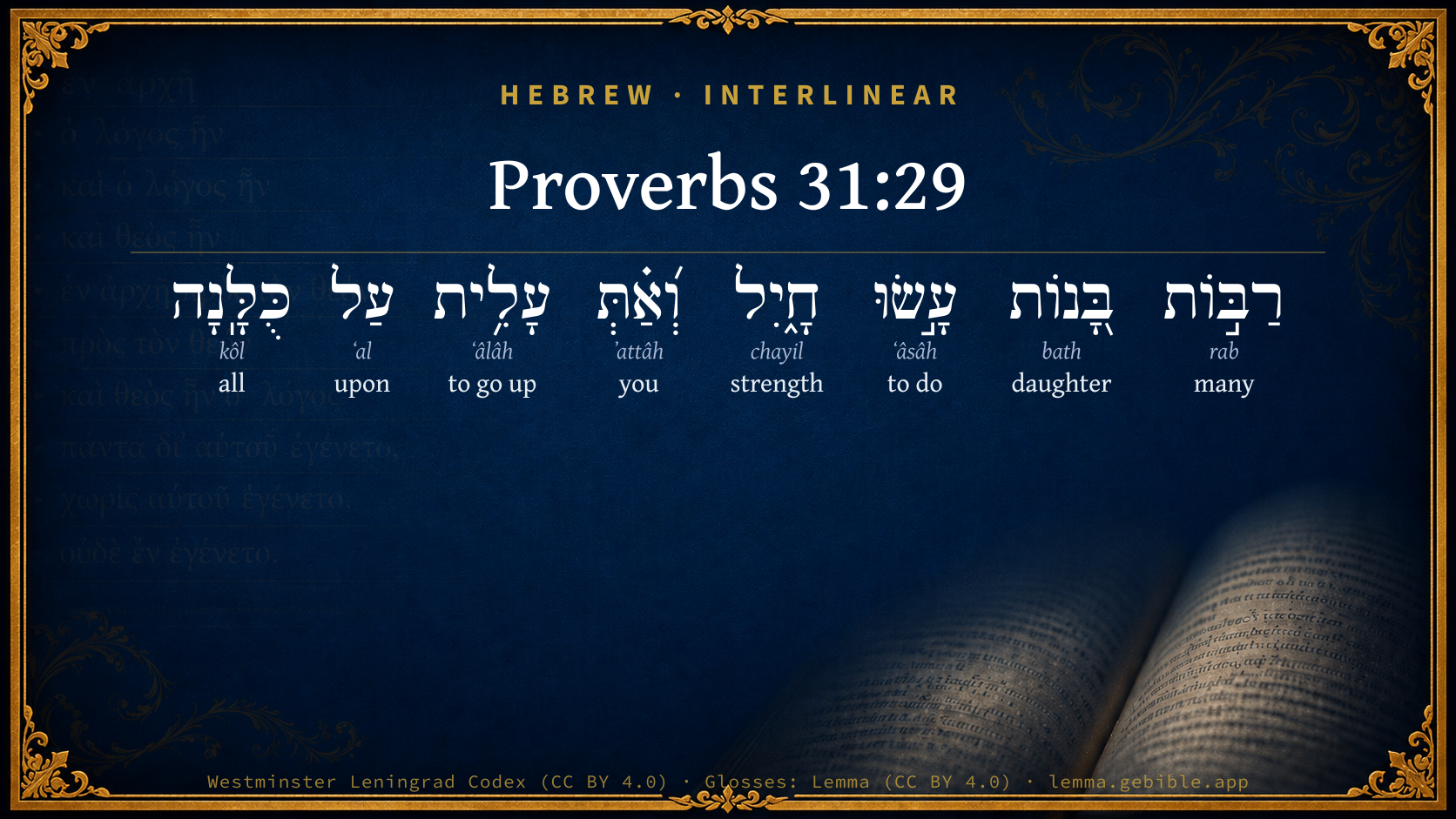
Proverbs 31:29

Hebrew (Westminster Leningrad Codex) Proverbs 31:29 appears in the Hebrew Old Testament. The text above is from the Westminster Leningrad Codex. Each word links to its Strong’s number, a concise gloss, and parsing drawn from the Open Scriptures Hebrew Bible morphology. Click any word for its full Brown-Driver-Briggs (BDB) entry.
Download image
Cite this verse

Proverbs 31:29 (World English Bible). Public Domain. Lemma interlinear Bible study tool, https://lemma.gebible.app/v/proverbs/31/29.

Show BibTeX & RIS
BibTeX
RIS
English Translation
"Many women do noble things, But you excel them all."
World English Bible · Public Domain
Download a study sheet

One document with this verse’s original text, its word-by-word gloss line, the meaning frame, cross-references with their text, attributed commentary, and full source and license credits — printable, and it pastes into notes with its structure intact.

This verse Autodidact and up

Study sheet (.html) Plain text (.txt)

A passage Seminary Student

Up to 50 verses in one chapter. A passage sheet keeps up to 6 commentary sources and 12 cross-references per verse, in the order this page ranks them, and says so on the sheet whenever that leaves anything out. Ask for a single verse and you get the Autodidact verse sheet above.

Everything on this page stays free to read, with no account — the sheet is a download of what is already on screen, not access to it.

Want to remove ads? Support Godless Engineer
Compare translations 3

The same verse in 3 English versions, stacked beneath the original-language interlinear above. Click any original word for its lexicon entry.

Each is an independent rendering of the whole verse — the interlinear is not word-aligned to these translations.

Highlighted words mark where these versions differ — a whole-verse word diff, not a word-by-word alignment.

  • World English Bible Public Domain
    "Many women do noble things, But you excel them all."
  • King James Version Public Domain
    Many daughters have done virtuously, but thou excellest them all.
  • unfoldingWord Literal Text CC BY-SA 4.0
    “Many daughters have acted worth, but you yourself have ascended over all of them.”

unfoldingWord Literal Text — © unfoldingWord, licensed CC BY-SA 4.0. Word-aligned USFM3 via Door43 (git.door43.org/unfoldingWord/en_ult).

Versions to compare (up to 4)

3 of 4 selected

Show all 18 translations

Every available English version of this verse, each an independent rendering of the whole verse.

  • World English Bible Public Domain
    "Many women do noble things, But you excel them all."
  • Berean Standard Bible Public Domain
    “Many daughters have done noble things, but you surpass them all!”
  • Majority Standard Bible Public Domain
    “Many daughters have done noble things, but you surpass them all!”
  • King James Version Public Domain
    Many daughters have done virtuously, but thou excellest them all.
  • American Standard Version (1901) Public Domain
    Many daughters have done worthily, But thou excellest them all.
  • Revised Version (1885) Public Domain
    Many daughters have done virtuously, but thou excellest them all.
  • Geneva Bible (1599) Public Domain
    Many daughters haue done vertuously: but thou surmountest them all.
  • Douay-Rheims (1899) Public Domain
    Many daughters have gathered together riches: thou hast surpassed them all.
  • Young's Literal Translation Public Domain
    `Many `are' the daughters who have done worthily, Thou hast gone up above them all.'
  • Literal Standard Version CC BY-SA 4.0
    “The daughters who have done worthily [are] many, || You have gone up above them all.”
  • Unlocked Literal Bible CC BY-SA 4.0
    “Many women have done well, but you surpassed them all.”
  • unfoldingWord Literal Text CC BY-SA 4.0
    “Many daughters have acted worth, but you yourself have ascended over all of them.”
  • Darby Bible Public Domain
    Many daughters have done worthily, but thou excellest them all.
  • World Messianic Bible Public Domain
    “Many women do noble things, but you excel them all.”
  • Webster's Bible Public Domain
    Many daughters have done virtuously, but thou excellest them all.
  • Free Bible Version CC BY-SA 4.0
    “Many women do great things, but you are better than all of them!”
  • Bible in Basic English Public Domain
    Unnumbered women have done well, but you are better than all of them.
  • JPS Tanakh (1917) Public Domain
    'Many daughters have done valiantly, but thou excellest them all.'

Literal Standard Version (2020), Covenant Press — licensed CC BY-SA 4.0. Text via the HelloAO Bible API (eBible.org). Unlocked Literal Bible (unfoldingWord) — licensed CC BY-SA 4.0. Text via the HelloAO Bible API (eBible.org). unfoldingWord Literal Text — © unfoldingWord, licensed CC BY-SA 4.0. Word-aligned USFM3 via Door43 (git.door43.org/unfoldingWord/en_ult). Free Bible Version, Dr. Jonathan Gallagher — licensed CC BY-SA 4.0. Text via the HelloAO Bible API (eBible.org).

Word by word

More ways to search: Search by grammar → Find every occurrence → Compare this word →

Practice this passage: Drill this verse → Learn its vocabulary →

About this verse

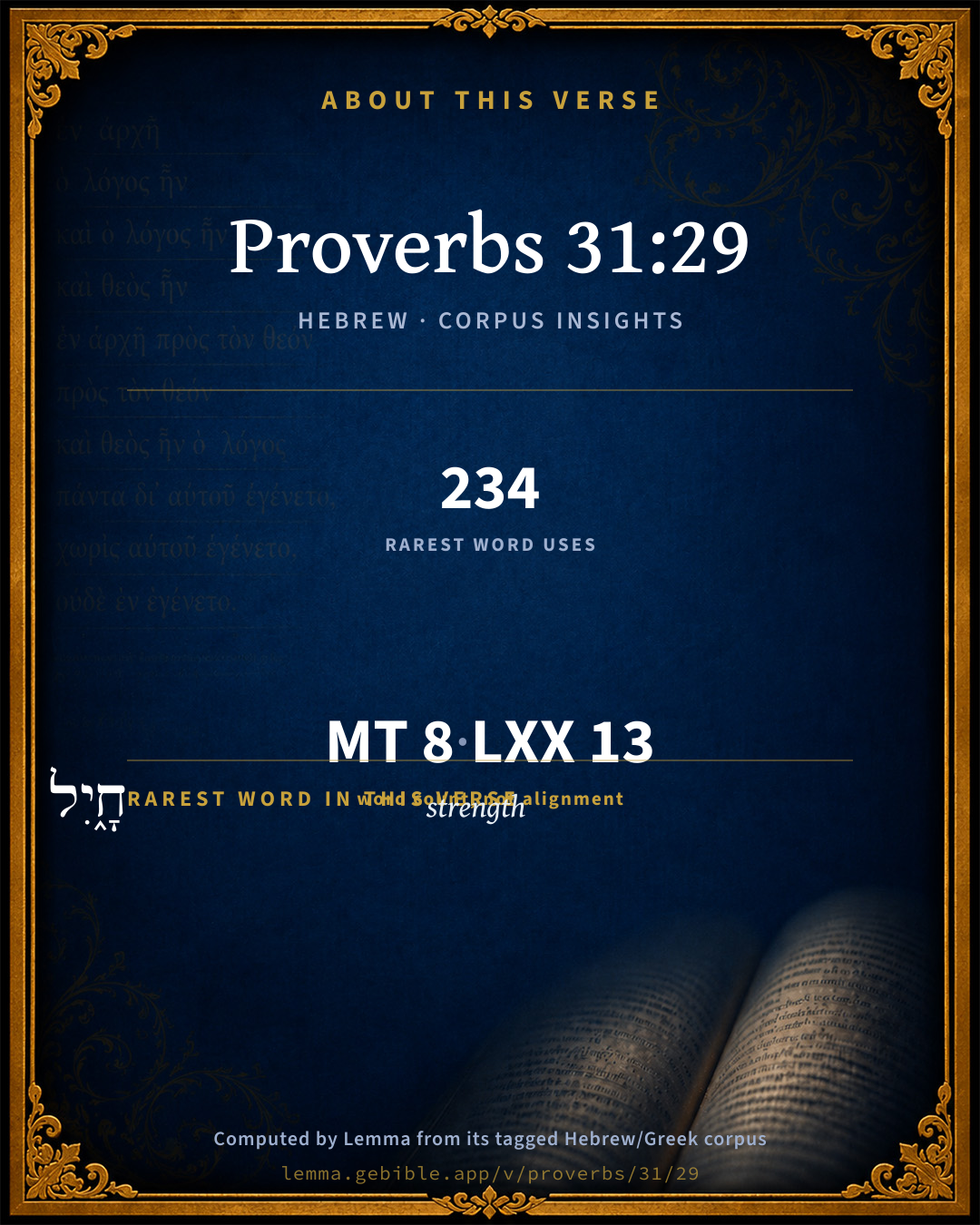
These counts appear in no published source. They are computed here, from the morphology-tagged text and Lemma’s own curated glosses. What Lemma adds →

8
words
8
distinct lemmas
Wisdom
section

Grammatical profile

  • 2 verbs
  • 3 nouns
  • 1 adjective
  • 1 pronoun
  • 1 preposition

Verb forms

  • עָ֣שׂוּ Qal · Perfect
  • עָלִ֥ית Qal · Perfect

Hebrew & Septuagint length

In English translation the verse runs 10 words from the Hebrew and 17 from the Septuagint (LXX English) — the Septuagint runs noticeably longer here. See the side-by-side →

A rough comparison of the two English renderings, which tokenize alike — not a word-level alignment.

Word counts can differ between the Hebrew and the Greek without any difference in meaning — e.g. the Hebrew direct-object marker אֵת has no separate Greek word, and Greek often adds the article ὁ.

In the original languages it is 8 Hebrew tokens and 13 Greek tokens — but the two are counted differently (Hebrew bundles its prefixes and suffixes into one token; the Greek is in lemma form), so that isn’t a like-for-like length.

Cross-references

2

Topical passages linked to Proverbs 31:29 in the Treasury of Scripture Knowledge — connected by theme and wording, ordered by reader-vote popularity; previews shown in the World English Bible.

  • Song of Solomon 6:8–9 There are sixty queens, eighty concubines, And virgins without number.
  • Ephesians 5:27 that he might present the assembly to himself gloriously, not having spot or wrinkle or any such thing; but that it should be holy and without blemish.

Cross-references courtesy of OpenBible.info (CC BY 4.0).

Hebrew and Greek witnesses Masoretic Hebrew ↔ Greek Septuagint

The same verse in the two great witnesses to the Old Testament, shown verse-for-verse.

Here the Septuagint runs noticeably longer than the Hebrew — LXX2012 (modern English Septuagint) 17 words vs World English Bible 10. A rough length comparison of the two English translations, not a word-level alignment — read both below.

These are two independent witnesses, not word-aligned to each other, and the Septuagint is shown in lemma (dictionary) form.

Hebrew Proverbs 31:29 Masoretic · Westminster Leningrad Codex

רַבּ֣וֹת בָּ֭נוֹת עָ֣שׂוּ חָ֑יִל וְ֝אַ֗תְּ עָלִ֥ית עַל כֻּלָּֽנָה

"Many women do noble things, But you excel them all."

World English Bible · Public Domain

Greek LXX Proverbs 31:29 Septuagint · lemma form

πολύς θυγάτηρ κτάομαι πλοῦτος πολύς ποιέω δυνατός σύ δέ ὑπερκεῖμαι καί ὑπεραἴρω πᾶς

Many daughters have obtained wealth, many have wrought valiantly; but you have exceeded, you have surpassed all.

LXX2012 (modern English Septuagint) · Public Domain

On this verse, The Cambridge Bible for Schools and Colleges discusses the Septuagint’s reading. Read the note in Commentary ↓

Hebrew: Westminster Leningrad Codex (CC BY 4.0). Greek: Septuagint (public domain); English from LXX2012 (modern English Septuagint) (Public Domain). How the Septuagint differs from the Hebrew →

Commentary

Notes on Proverbs 31:29 from classic Christian and Jewish commentators (each source and its license shown beneath its notes). The classic Christian expositions comment on the surrounding passage and are grouped to its opening verse, so a note may address several verses; the Jewish commentaries on the Tanakh (Rashi and others) are per-verse, so they appear only where the commentator wrote on this verse.

Lemma curates 59 commentaries, every one of them public domain or Creative Commons licensed, each selected and text-cleaned for this edition rather than reprinted as found. About our sources →

Trapp's Complete Commentary

John Trapp

Pro 31:29 Many daughters have done virtuously, but thou excellest them all.

Ver. 29. Many daughters have done virtuously.] By the benefit of a better nature, or civil education, or for praise of men, or for a quiet life, sure it is that all unsanctified women, though never so well qualified, have failed, both quoad fontem, et quoad finem, for want of faith for the principle, and God’s glory the aim of their virtuous actions. And therefore, though they be suo genere, praise worthy, yet they are far short of this gracious matron. The civil life without faith is but a beautiful abomination, a smoother way to hell. Melius est pallens aurum quam fulgens aurichalcum, {a} Better is pale gold than glittering copper. Say the world what it will, a drachm of holiness is worth a pound of good nature. Prefer that before this (in the choice of a wife especially), as ye would do a piece of gold for weight rather than for workmanship, for value than for elegance, like that French coin in the historian, in qua plus formae quam ponderis, wherein there was more neatness than weightiness. Of carnal women, though never so witty, well-spoken, and well-deeded too, we may say, as the civil law doth of those mixed beasts, elephants and camels, operam praestant, natura fera est, they do the work of tame creatures, but they have the nature of wild ones.

But thou excellest them all.] As the only paragon of the world, the female glory, the wonder of womenkind.

{a} Bernard.

John Trapp, A Commentary or Exposition upon All the Books of the Old and New Testament (1647–1656) — public domain. Text from a community e-Sword module.

The Biblical Illustrator

Joseph S. Exell

Pro_31:29

Many daughters have done virtuously, but thou excellest them all.

To daughters

The world has dealt severely with woman. It has always been too fashionable to distort her character, and with cruel cowardice cast on her the entire blame for all the ills humanity endures. Long ago it was declared that if the world were only free from women, men would not be without the converse of the gods. Even Chrysostom pronounced woman to be a necessary evil, a national temptation, a desirable calamity, a domestic peril, a deadly fascination, and a painted ill. There is still an Italian proverb to the effect, If a woman were as little as she is good, a peas pod would make her a gown and a hood. Similarly the Germans say, There are only two good women in the world--one of them is dead, and the other is not found. So Englishmen sometimes say, If there is any mischief you may rest sure that a woman has to do with it. It cannot be denied that the devil employed woman to accomplish the ruin of the race; that by her he disturbed Abrahams home and heart, cast innocent Joseph into prison, robbed Samson of his strength, brought life-long trouble upon David, seduced Solomon into idolatry, caused John the Baptist to be beheaded, and drove Paul and Barnabas from Antioch. But let us go over to the other side, and deal fairly with woman. Whilst we hear the harsh voices of men shamefully reviling our Saviour we cannot discover an instance of a woman insulting or injuring the God man. Whilst men--even the favoured disciples--forsook Christ and fled, women responded readily to the loving appeals of Jesus, clung constantly to His person, ministered self-denyingly to His needs, and watched patiently and persistently at His cross. Remember that many daughters have done virtuously. It is not a few who stand before us for our admiration and gratitude. It is a glorious galaxy of pure-minded, consecrated women to whom the Church and the world are, and ever will be, indebted. And, further, recollect that they became what they were, and accomplished what they did, by personal effort. They strove to excel. They reasoned thus: The thing is right, reasonable, desirable; circumstances demand that it should be done; therefore, with all my heart I will do it or fail in the effort. Hence the words of the wise man. Many daughters have done virtuously, but thou excellest them all. The words seem to picture before us a racecourse with women runners--the goal, perfect virtue; the course, three-score years and ten; the umpire, God; the spectators, men and angels. We see the maiden entering the lists before she reaches her teens. Young, innocent, inexperienced, and trustful, she begins the race; we watch her pressing on through youth, adolescence, and old age. Now surpassing some who started with her, then being surpassed by some who began long after her; now level, abreast of scores of equals, then outdistancing her compeers. To-day passing one barrier of temptation, and to-morrow scoring another victory. Not stopping for some fading allurements as Atalanta did, but adding one excellency to another until it is said of her: Many daughters have run well, but thou hast outrun them all; many daughters have done virtuously, but thou..excellest them all. Young women, I ask you each to enter on this holy competition. Let me say, then, that you should cultivate affection for, and obedience to, your parents. We have known cases in which daughters have been callously absorbed in thoughts of themselves whilst all sympathy for the anxious and ageing mother has been wanting--where the young woman has deemed it beneath her to help a hard-toiling parent. I beseech you to remember that next to God you cannot love too deeply and lastingly those who have so sympathetically watched over and waited upon you. Never suffer either parents or friends to have cause for pronouncing you idle or indifferent to home claims. Be as careful what books you read as you are with what persons you associate. Above all, acquaint yourself with the Scriptures. And do not be ashamed to have it known that you pray. It is a lofty honour to commune with the Infinite Father. (J. H. Hitchens, D.D.)

The Biblical Illustrator, edited by Joseph S. Exell (c. 1880s–1900s) — public domain. Text from a community e-Sword module.

Joseph Benson's Commentary

Pro 31:29-30. Many daughters have done virtuously — Daughters of men, that is, women, so called, Gen 34:1; Eze 30:18; but thou excellest them all — Her husband esteems it but just, that his praises should bear proportion to her real and manifold excellences. Favour — Comeliness, which commonly gives women favour with those who behold them. Deceitful — It gives a false representation of the person, being often a cover to a deformed soul; it does not give a man that satisfaction which at first he promised to himself from it; and it is soon lost, not only by death, but by many diseases and contingences. But a woman that feareth the Lord — Which character is here mentioned, either as the crown of all her perfections, or as a key to understand the foregoing description of her character, as being intended of that wisdom, fidelity, and diligence, which proceed from, or are accompanied with, the fear of God.

Joseph Benson's Commentary on the Old and New Testaments (1811–1818) — public domain. Text from a community e-Sword module.

Jamieson, Fausset & Brown

Robert Jamieson, A. R. Fausset & David Brown

The words are those of her husband, praising her.

virtuously--(Compare Pro 31:10).

Jamieson, Fausset & Brown — Commentary Critical and Explanatory on the Whole Bible (1871) — public domain (CC PDM 1.0). Text via the HelloAO Bible API.

Adam Clarke's Commentary

Verse 29. Many daughters have done virtuously] This is undoubtedly the speech of the husband, giving testimony to the excellence of his wife: "Her husband also, and he praiseth her, saying, 'many daughters,' women, 'have done virtuously,' with due propriety as wives, mistresses, and mothers; 'but THOU,' my incomparable wife, 'excellent them all;' ואת עלית על כלנה veath alith al cullanah, but THOU hast ascended above the whole of them-thou hast carried every duty, every virtue, and every qualification and excellency, to a higher perfection, than any of whom we have ever read or heard." And let the reader seriously consider the above particulars, as specified under the different heads and subdivisions; and he will be probably of the same mind. But high as the character of this Jewish matron stands in the preceding description, I can say that I have met at least her equal, in a daughter of the Rev. Dr. Samuel Annesly, the wife of Samuel Wesley, sen., rector of Epworth in Lincolnshire, and mother of the late extraordinary brothers, John and Charles Wesley. I am constrained to add this testimony, after having traced her from her birth to her death, through all the relations that a woman can bear upon earth. Her Christianity gave to her virtues and excellences a heightening, which the Jewish matron could not possess. Besides, she was a woman of great learning and information, and of a depth of mind, and reach of thought, seldom to be found among the daughters of Eve, and not often among the sons of Adam.

Adam Clarke's Commentary on the Bible (1810–1826) — public domain. Text from a community e-Sword/MySword module.

Ellicott's Commentary for English Readers

(29) Many daughters—i.e., women (Gen_30:13; Son_6:9); a term of affection.

A Bible Commentary for English Readers, edited by Charles John Ellicott (1878–1897) — public domain. Text from a community e-Sword module.

The Cambridge Bible for Schools and Colleges

gen. ed. J. J. S. Perowne

29. done virtuously] This rendering, which recalls the same word in Pro_31:10 (“a woman of virtue,” “have done virtue”), is much to be preferred to the rendering of LXX. and Vulg. and A.V. marg., gotten riches.

excellest them all] Regarded as the commendation of her husband and children, this is true to nature, and it accords better with their partial, or at any rate limited view, than with the wider range of the author himself. “With him every virtuous woman would merit such meed of praise.

29–31. This concluding paragraph may be regarded either as the comment of the author himself upon the picture he has just drawn, or as being the actual words of the “praise” bestowed by her husband and her children upon the “virtuous woman.” The latter view is taken by R.V., which introduces the paragraph by the word saying, at the end of the preceding verse.

The Cambridge Bible for Schools and Colleges (gen. ed. J. J. S. Perowne; Cambridge University Press, 1878–1918) — public domain. Text from a community e-Sword module.

John Gill's Exposition

Many daughters have done virtuously,.... This, according to Aben Ezra and Gersom, is what was said by her husband and children, and which seems to be right; especially they may be thought to be the words of her husband. By these "daughters" may be meant false churches, such as the church of Rome and her daughters, who is the mother of harlots, Rev 17:17. These are "many", when the true church of Christ is but one, to whom she is opposed, Sol 6:8. These may do many virtuous things externally; may make a great show of religion and devotion; may have a form of godliness, without the power of it; and a name to live, and be dead. The Vulgate Latin version renders it, "many daughters have gathered riches"; or "have possessed riches", as the Septuagint, Syriac, and Arabic versions, and so the Targum; and in this sense the phrase is sometimes used for getting riches and wealth; see Deu 8:17; and may well be applied to the false churches, the church of Rome and her daughters, who possess great riches and large emoluments, which yet in a short time will come to nothing, Rev 18:17;

but thou excellest them all; in real beauty, in true riches, in purity of doctrine, in simplicity of worship, in holiness of life and conversation, in undefiled religion, in doing good works, properly so called. Christ's church is "the fairest among women", Sol 1:8. So Ambrose interprets the daughters of heresies and heretics.

John Gill's Exposition of the Whole Bible (1746–1763) — public domain (CC PDM 1.0). Text via the HelloAO Bible API.

Albert Barnes' Notes on the Bible

The words of praise which the husband Pro 31:28 is supposed to have addressed to the ideal wife.

Virtuously - The Hebrew word has primarily (like “virtus”) the idea of “strength,” but is used with various shades of meaning. Here (as in Pro 12:4; Rth 3:11) the strength is that of character stedfast in goodness. In other passages (e. g., Gen 34:29; Psa 49:10) it has the sense of “riches,” and is so taken here by the Septuagint and Vulgate, see also the marginal rendering.

Albert Barnes' Notes on the Bible (1834–1885) — public domain. Text from a community e-Sword/MySword module.

Matthew Poole's English Annotations

Daughters; daughters of men, i.e. women, so called also Gen 34:1; Eze 30:18.

Thou excellest them all: he esteems it but just that his praises should bear proportion to her real and manifold perfections.

Matthew Poole's English Annotations on the Holy Bible (1683–1685) — public domain. Text from a community e-Sword/MySword module.

Whedon's Commentary on the Bible

Daniel D. Whedon

29. Many daughters — That is, according to a well-known Hebrew idiom — many women. This is generally regarded as the eulogium of the husband.

Have done virtuously — Have done bravely, or worthily. It is the same word, hhayil, which we met in Pro_31:10. There the supposed writer wished for a wife of energy and capability: here he acknowledges that he has found one that displays these qualities in the highest degree.

Excellest them all — Literally, hast ascended above them all — ascended, that is, in the scale of the virtues and excellences of true, noble womanhood. עשׂו חיל, (‘hasu hhayil,) rendered “hast done virtuously,” is sometimes translated, acquired wealth, gotten riches, but it is like our expression, “Has done well, or bravely,” which may be, and often is, applied to the acquisition of wealth, but not necessarily confined to this sense. Doubtless, this was included in the woman’s well-doing. But this was only a part.

Daniel D. Whedon (gen. ed.), Commentary on the Old and New Testaments (1874–1909) — public domain. Text from a community e-Sword module.

The Pulpit Commentary

RESH. Many daughters have done virtuously, but thou excellest them all. The versions and some commentators take the encomium in the mean and restricted sense of praise for the acquisition of riches. Thus the Vulgate, Multae filiae congregaverunt divitias; Septuagint, "Many daughters have obtained wealth." But it adds another rendering, "Many have wrought power (epoihsandunamin )," which is nearer the meaning in this place. Chayil (as we have seen, ver. 10) means "force," virtus, "strength of character" shown in various ways. (comp. Num_24:18 Psa_60:12) "Daughters," equivalent to "women," as Gen_30:13 Son_6:9. Roman Catholic commentators have, with much ingenuity, applied the whole description of the virtuous woman, and especially the present verse, to the Virgin Mary. We may regard it as a representation of the truly Christian matron, who loves husband and children, guides the house, is discreet, chaste, good, a teacher of good things. (1Ti_5:14 Tit_2:3, etc.)

The Pulpit Commentary (1880–1919), ed. H.D.M. Spence-Jones & Joseph S. Exell — public domain. Text from a community e-Sword module.

Keil & Delitzsch

C. F. Keil & F. Delitzsch

29 ר "Many are the daughters who have done bravely,

But thou hast surpassed them all together."

We have already often remarked, last time under Pro 29:6, that רב, not indeed in its sing., but in its plur. רבּים and רבּות, can precede, after the manner of a numeral, as attribute; but this syntactical licence, Pro 28:12, by no means appears, and needs to be assumed as little here as at Pro 8:26, although there is no reason that can be adduced against it. עשׂה חיל signifies here not the gaining of riches (the lxx, Syr., Targ., Jerome, Luther, Gesenius, Bttcher, and others), which here, where the encomium comes to its height, would give to it a mercenary mammon-worship note - it indeed has this signification only when connected with ל of the person: Sibi opes acquirere, Deu 6:17; Eze 28:4 - but: bravery, energy, and, as the reference to אשׁת חיל demands, moral activity, capacity for activity, in accordance with one's calling, ποιεῖν ἀρετήν, by which the Venet. translates it. בּנות is, as in the primary passages, Gen 30:13; Sol 6:9, a more delicate, finer name of women than נשׁים: many daughters there have always been who have unfolded ability, but thou my spouse hast raised thyself above them all, i.e., thou art excellent and incomparable. Instead of עלית, there is to be written, after Chajug, Aben Ezra (Zachoth 7a), and Jekuthiel under Gen 16:11, עלית; the Spanish Nakdanim thus distinguish the forms מצאת, thou hast found, and מצאת, she has found. כּלּנה, for כּלּן, Gen 42:36.

Keil & Delitzsch — Biblical Commentary on the Old Testament (1861–1891) — public domain (CC PDM 1.0). Text via the HelloAO Bible API. (Old Testament only.)

Rashi

Rabbi Shlomo Yitzchaki (Rashi)

“Many women, etc.” In this way, her husband and children call her fortunate.

Rashi on the Tanakh — English translations: “The Judaica Press complete Tanach with Rashi, translated by A. J. Rosenberg” (CC BY 4.0); “Pentateuch with Rashi's commentary by M. Rosenbaum and A.M. Silbermann, 1929-1934” (public domain); “The Metsudah Tanach series, Lakewood, N.J” (CC BY 4.0); and “The Book of Joshua, Metsudah Publications, 1997” (CC BY 4.0). Text via Sefaria.

Lesson kit

Teaching starters — assembled from the data on this page, not authored interpretation. Every prompt links to the verse data it draws on. Edit before teaching.

Proverbs, in the Wisdom, opens this verse with 8 words (8 distinct Hebrew lemmas). Its most distinctive word is chayil (“strength”). The Greek Septuagint runs longer here. A historical commentator’s framing appears above. Read the whole chapter for the surrounding context.

Discussion questions

  1. What does “strength” (chayil) contribute to the verse as a whole?
  2. Song of Solomon 6:8–9 shares this passage’s theme. How do the two illuminate each other?
  3. Compared with the Hebrew, the Septuagint runs longer here. What questions does that raise?
  4. These translations render this verse differently. What is at stake in choosing one wording over another?
  5. The verb «עָ֣שׂוּ» is Qal Perfect. How does its form color the action?
  6. Reading how Trapp's Complete Commentary and The Biblical Illustrator read this verse, where do the two commentators agree and where do they part?

Things to notice

Reading settings

Reading text

Shown beneath each verse's original-language words.

Old Testament
Old Testament edition

Read the OT as the Masoretic Hebrew (MT) or the Greek Septuagint (LXX).

English shown for the Greek Septuagint (in the Hebrew ↔ Greek comparison).

Comparing translations? Open the Compare panel on any verse page to stack up to four side by side.