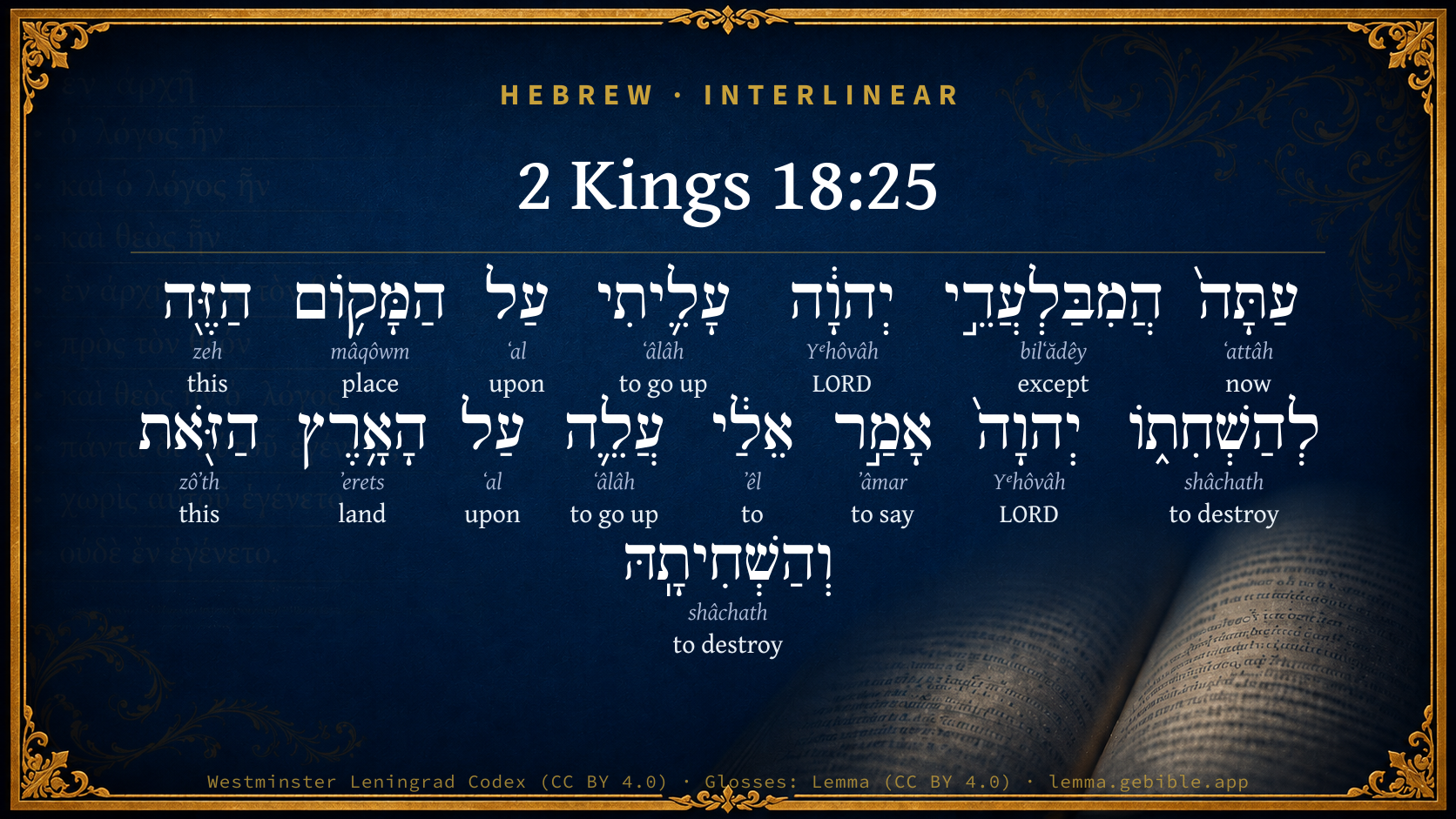
2 Kings 18:25

Hebrew (Westminster Leningrad Codex) 2 Kings 18:25 appears in the Hebrew Old Testament. The text above is from the Westminster Leningrad Codex. Each word links to its Strong’s number, a concise gloss, and parsing drawn from the Open Scriptures Hebrew Bible morphology. Click any word for its full Brown-Driver-Briggs (BDB) entry.
Download image
Cite this verse

2 Kings 18:25 (World English Bible). Public Domain. Lemma interlinear Bible study tool, https://lemma.gebible.app/v/2-kings/18/25.

Show BibTeX & RIS
BibTeX
RIS
English Translation
Am I now come up without Yahweh against this place to destroy it? Yahweh said to me, Go up against this land, and destroy it.
World English Bible · Public Domain
Download a study sheet

One document with this verse’s original text, its word-by-word gloss line, the meaning frame, cross-references with their text, attributed commentary, and full source and license credits — printable, and it pastes into notes with its structure intact.

This verse Autodidact and up

Study sheet (.html) Plain text (.txt)

A passage Seminary Student

Up to 50 verses in one chapter. A passage sheet keeps up to 6 commentary sources and 12 cross-references per verse, in the order this page ranks them, and says so on the sheet whenever that leaves anything out. Ask for a single verse and you get the Autodidact verse sheet above.

Everything on this page stays free to read, with no account — the sheet is a download of what is already on screen, not access to it.

Want to remove ads? Support Godless Engineer
Compare translations 3

The same verse in 3 English versions, stacked beneath the original-language interlinear above. Click any original word for its lexicon entry.

Each is an independent rendering of the whole verse — the interlinear is not word-aligned to these translations.

Highlighted words mark where these versions differ — a whole-verse word diff, not a word-by-word alignment.

  • World English Bible Public Domain
    Am I now come up without Yahweh against this place to destroy it? Yahweh said to me, Go up against this land, and destroy it.
  • King James Version Public Domain
    Am I now come up without the LORD against this place to destroy it? The LORD said to me, Go up against this land, and destroy it.
  • unfoldingWord Literal Text CC BY-SA 4.0
    ‘“Now have I come up against this place to destroy it without Yahweh? Yahweh said to me, ‘Go up against this land and destroy it.’”’”

unfoldingWord Literal Text — © unfoldingWord, licensed CC BY-SA 4.0. Word-aligned USFM3 via Door43 (git.door43.org/unfoldingWord/en_ult).

Versions to compare (up to 4)

3 of 4 selected

Show all 18 translations

Every available English version of this verse, each an independent rendering of the whole verse.

  • World English Bible Public Domain
    Am I now come up without Yahweh against this place to destroy it? Yahweh said to me, Go up against this land, and destroy it.
  • Berean Standard Bible Public Domain
    So now, was it apart from the LORD that I have come up against this place to destroy it? The LORD Himself said to me, ‘Go up against this land and destroy it.’”
  • Majority Standard Bible Public Domain
    So now, was it apart from the LORD that I have come up against this place to destroy it? The LORD Himself said to me, ‘Go up against this land and destroy it.’”
  • King James Version Public Domain
    Am I now come up without the LORD against this place to destroy it? The LORD said to me, Go up against this land, and destroy it.
  • American Standard Version (1901) Public Domain
    Am I now come up without Jehovah against this place to destroy it? Jehovah said unto me, Go up against this land, and destroy it.
  • Revised Version (1885) Public Domain
    Am I now come up without the LORD against this place to destroy it? The LORD said unto me, Go up against this land, and destroy it.
  • Geneva Bible (1599) Public Domain
    Am I now come vp without the Lord to this place, to destroy it? the Lord sayd to me, Goe vp against this land, and destroy it.
  • Douay-Rheims (1899) Public Domain
    Is it without the will of the Lord that I am come up to this place to destroy it? The Lord said to me: Go up to this land and destroy it.
  • Young's Literal Translation Public Domain
    Now, without Jehovah have I come up against this place to destroy it? Jehovah said unto me, Go up against this land, and thou hast destroyed it.'
  • Literal Standard Version CC BY-SA 4.0
    Have I now come up without YHWH against this place to destroy it? YHWH said to me, Go up against this land, and you have destroyed it.”
  • Unlocked Literal Bible CC BY-SA 4.0
    Have I traveled up here without Yahweh to fight against this place and destroy it? Yahweh said to me, 'Attack this land and destroy it.'”
  • unfoldingWord Literal Text CC BY-SA 4.0
    ‘“Now have I come up against this place to destroy it without Yahweh? Yahweh said to me, ‘Go up against this land and destroy it.’”’”
  • Darby Bible Public Domain
    Am I now come up without Jehovah against this place to destroy it? Jehovah said to me, Go up against this land and destroy it.
  • World Messianic Bible Public Domain
    Have I now come up without the LORD against this place to destroy it? The LORD said to me, ‘Go up against this land, and destroy it.’”’”
  • Webster's Bible Public Domain
    Have I now come up without the LORD against this place to destroy it? The LORD said to me, Go up against this land, and destroy it.
  • Free Bible Version CC BY-SA 4.0
    More than that—would I have come to attack this place without the Lord's encouragement? It was the Lord himself who told me, ‘Go and attack this land and destroy it.’”
  • Bible in Basic English Public Domain
    And have I now come up to send destruction on this place without the Lord's authority? It was the Lord himself who said to me, Go up against this land and make it waste.
  • JPS Tanakh (1917) Public Domain
    Am I now come up without the LORD against this place to destroy it? The LORD said unto me: Go up against this land, destroy it.'

Literal Standard Version (2020), Covenant Press — licensed CC BY-SA 4.0. Text via the HelloAO Bible API (eBible.org). Unlocked Literal Bible (unfoldingWord) — licensed CC BY-SA 4.0. Text via the HelloAO Bible API (eBible.org). unfoldingWord Literal Text — © unfoldingWord, licensed CC BY-SA 4.0. Word-aligned USFM3 via Door43 (git.door43.org/unfoldingWord/en_ult). Free Bible Version, Dr. Jonathan Gallagher — licensed CC BY-SA 4.0. Text via the HelloAO Bible API (eBible.org).

Word by word

More ways to search: Search by grammar → Find every occurrence → Compare this word →

Practice this passage: Drill this verse → Learn its vocabulary →

הֲמִבַּלְעֲדֵ֣י
bilʻădêy
H1107
“from · except”
Particle, Interrogative + Preposition + Preposition
Part of Speech
Particle + Preposition + Preposition
Full BDB Definition

Origin: constructive pl. from H1077 and H5703

TWOT: 246h

apart from, except, without, besides
  1. עַתָּה֙ ʻattâh H6258 “now” Adverb
  2. יְהוָ֔ה Yᵉhôvâh H3068 “LORD” Noun, Proper
  3. עָלִ֛יתִי ʻâlâh H5927 “to go up” Verb, Qal, Perfect, 1st Person, Common, Singular
  4. עַל ʻal H5921 “upon” Preposition
  5. הַמָּק֥וֹם mâqôwm H4725 “the · place” Particle, Definite Article + Noun, Common, Masculine, Singular, Absolute
  6. הַזֶּ֖ה zeh H2088 “the · this” Particle, Definite Article + Pronoun, Demonstrative, Masculine, Singular
  7. לְהַשְׁחִת֑וֹ shâchath H7843 “to destroy · him” Preposition + Verb, Hiphil, Infinitive Construct + Suffix, Personal, 3rd Person, Masculine, Singular
  8. יְהוָה֙ Yᵉhôvâh H3068 “LORD” Noun, Proper
  9. אָמַ֣ר ʼâmar H559 “to say” Verb, Qal, Perfect, 3rd Person, Masculine, Singular
  10. אֵלַ֔י ʼêl H413 “to · me” Preposition + Suffix, Personal, 1st Person, Common, Singular
  11. עֲלֵ֛ה ʻâlâh H5927 “go up” Verb, Qal, Imperative, 2nd Person, Masculine, Singular
  12. עַל ʻal H5921 “upon” Preposition
  13. הָאָ֥רֶץ ʼerets H776 “the · land” Particle, Definite Article + Noun, Common, Both, Singular, Absolute
  14. הַזֹּ֖את zôʼth H2063 “the · this” Particle, Definite Article + Pronoun, Demonstrative, Feminine, Singular
  15. וְהַשְׁחִיתָֽהּ shâchath H7843 “and · destroy · her” Conjunction + Verb, Hiphil, Imperative, 2nd Person, Masculine, Singular + Suffix, Personal, 3rd Person, Feminine, Singular

About this verse

These counts appear in no published source. They are computed here, from the morphology-tagged text and Lemma’s own curated glosses. What Lemma adds →

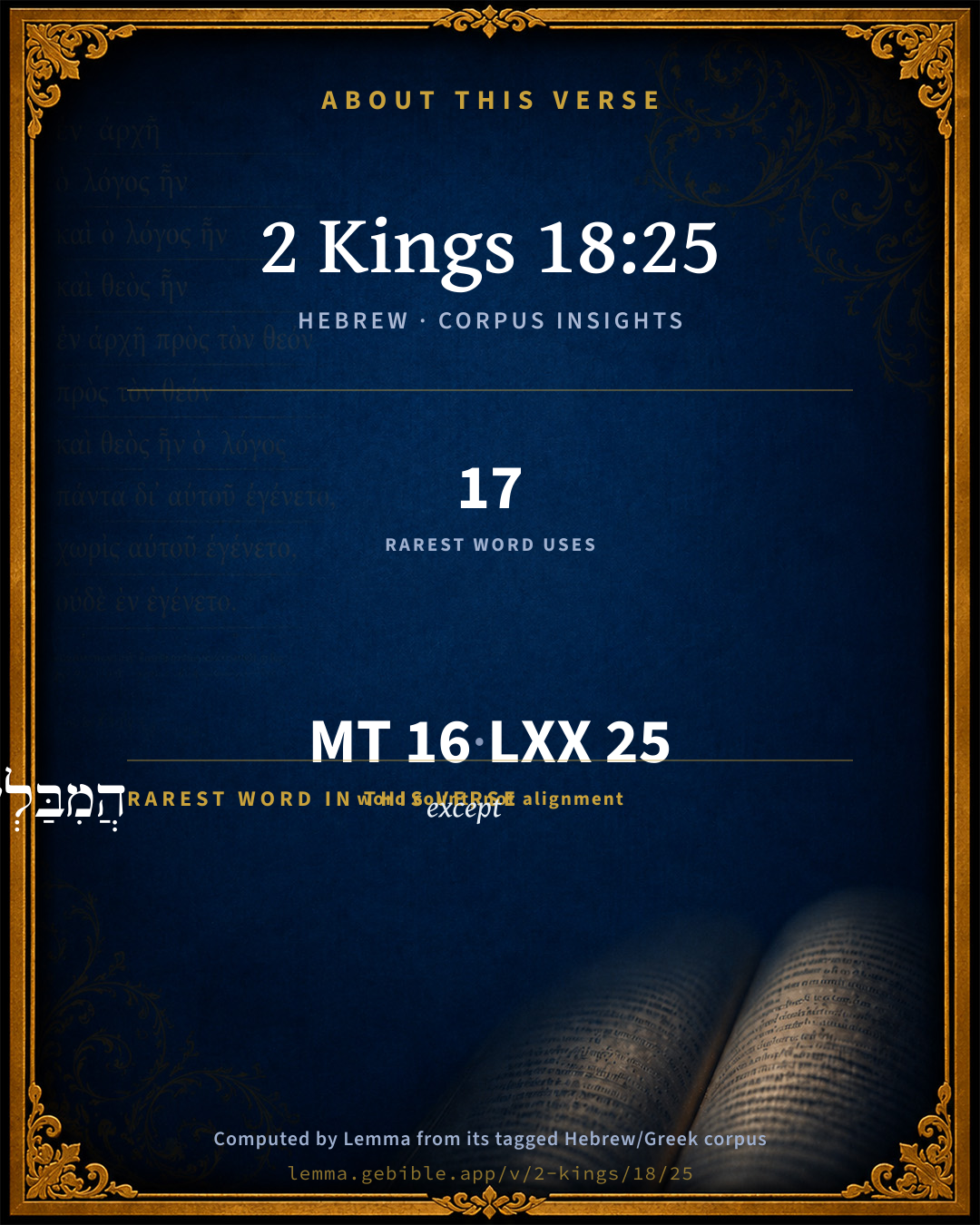
16
words
12
distinct lemmas
Historical
section

Notable vocabulary

The rarest word here is הֲמִבַּלְעֲדֵ֣י except H1107 — appearing just 17 times in the whole Hebrew Bible.

Shared distinctive vocabulary

הֲמִבַּלְעֲדֵ֣י except H1107 occurs in 16 verses of the Hebrew Bible. Also found in:

Grammatical profile

  • 5 verbs
  • 4 nouns
  • 2 pronouns
  • 4 prepositions
  • 1 adverb

Verb forms

  • עָלִ֛יתִי Qal · Perfect
  • לְהַשְׁחִת֑וֹ Hiphil · Infinitive Construct
  • אָמַ֣ר Qal · Perfect
  • עֲלֵ֛ה Qal · Imperative
  • וְהַשְׁחִיתָֽהּ Hiphil · Imperative

Repetition

Words recur within this verse — often emphatic in Hebrew:

  • יְהוָ֔ה LORD H3068 ×2
  • עָלִ֛יתִי to go up H5927 ×2
  • עַל upon H5921 ×2
  • לְהַשְׁחִת֑וֹ to destroy H7843 ×2

Hebrew & Septuagint length

In English translation the verse runs 25 words from the Hebrew and 28 from the Septuagint (LXX English) — closely comparable.

A rough comparison of the two English renderings, which tokenize alike — not a word-level alignment.

Word counts can differ between the Hebrew and the Greek without any difference in meaning — e.g. the Hebrew direct-object marker אֵת has no separate Greek word, and Greek often adds the article ὁ.

In the original languages it is 16 Hebrew tokens and 25 Greek tokens — but the two are counted differently (Hebrew bundles its prefixes and suffixes into one token; the Greek is in lemma form), so that isn’t a like-for-like length.

Cross-references

7

Topical passages linked to 2 Kings 18:25 in the Treasury of Scripture Knowledge — connected by theme and wording, ordered by reader-vote popularity; previews shown in the World English Bible.

  • 2 Kings 19:6 Isaiah said to them, Thus shall you tell your master, Thus says Yahweh, Don't be afraid of the words that you have heard, with which the servants of the king of Assyria have blasphemed me.
  • 1 Kings 13:18 He said to him, I also am a prophet as you are; and an angel spoke to me by the word of Yahweh, saying, Bring him back with you into your house, that he may eat bread and drink water. [But] he lied to him.
  • 2 Kings 19:22–37 Whom have you defied and blasphemed? and against whom have you exalted your voice and lifted up your eyes on high? [even] against the Holy One of Israel.
  • 2 Chronicles 35:21 But he sent ambassadors to him, saying, What have I to do with you, you king of Judah? [I come] not against you this day, but against the house with which I have war; and God has commanded me to make haste: forbear you from [meddling with] God, who is with me, that he not destroy you.
  • Isaiah 10:5–6 Ho Assyrian, the rod of my anger, the staff in whose hand is my indignation!
  • Amos 3:6 Does the trumpet alarm sound in a city, Without the people being afraid? Does evil happen to a city, And Yahweh hasn't done it?
  • John 19:10–11 Pilate therefore said to him, "Aren't you speaking to me? Don't you know that I have power to release you, and have power to crucify you?"

Cross-references courtesy of OpenBible.info (CC BY 4.0).

Hebrew and Greek witnesses Masoretic Hebrew ↔ Greek Septuagint

The same verse in the two great witnesses to the Old Testament, shown verse-for-verse.

These are two independent witnesses, not word-aligned to each other, and the Septuagint is shown in lemma (dictionary) form.

Hebrew 2 Kings 18:25 Masoretic · Westminster Leningrad Codex

עַתָּה֙ הֲמִבַּלְעֲדֵ֣י יְהוָ֔ה עָלִ֛יתִי עַל הַמָּק֥וֹם הַזֶּ֖ה לְהַשְׁחִת֑וֹ יְהוָה֙ אָמַ֣ר אֵלַ֔י עֲלֵ֛ה עַל הָאָ֥רֶץ הַזֹּ֖את וְהַשְׁחִיתָֽהּ

Am I now come up without Yahweh against this place to destroy it? Yahweh said to me, Go up against this land, and destroy it.

World English Bible · Public Domain

Greek LXX 2 Kings 18:25 Septuagint · lemma form

καί νῦν μή ἄνευ κύριος ἀναβαίνω ἐπί ὁ τόπος οὗτος ὁ διαφθείρω αὐτός κύριος εἶπον πρός ἐγώ ἀναβαίνω ἐπί ὁ γῆ οὗτος καί διαφθείρω αὐτός

And now have we come up without the Lord against this place to destroy it? The Lord said to me, Go up against this land, and destroy it.

LXX2012 (modern English Septuagint) · Public Domain

Hebrew: Westminster Leningrad Codex (CC BY 4.0). Greek: Septuagint (public domain); English from LXX2012 (modern English Septuagint) (Public Domain). How the Septuagint differs from the Hebrew →

Targum (Aramaic paraphrase)

1

The Targum is the ancient Jewish Aramaic paraphrase of the Hebrew Scriptures — an interpretive translation, not the Hebrew text itself. Onkelos (literal) and Pseudo-Jonathan (expansive) render the Torah, and Jonathan the Prophets. Coverage is partial: where no permissively-licensed English translation exists for a verse, only the Aramaic is shown. This is verse-level text, not a word-by-word alignment to the Hebrew.

  1. Targum Jonathan Prophets (Joshua–Malachi)
    כְּעַן הֲבַר מִמֵימְרָא דַייָ סְלֵיקִית עַל אַתְרָא הָדֵין לְחַבָּלוּתָהּ יְיָ אֲמַר לִי סַק לְאַתְרָא הָדֵין וְחַבְּלִינָהּ:

    (no public-domain English translation for this verse)

    Targum Jonathan — Aramaic: “Mikraot Gedolot” (public domain). English: “Sefaria Community Translation” (CC0 1.0 (public-domain dedication)); “London "Chaldee Paraphrase," 1871” (public domain). Text via Sefaria.

Commentary

Notes on 2 Kings 18:25 from classic Christian and Jewish commentators (each source and its license shown beneath its notes). The classic Christian expositions comment on the surrounding passage and are grouped to its opening verse, so a note may address several verses; the Jewish commentaries on the Tanakh (Rashi and others) are per-verse, so they appear only where the commentator wrote on this verse.

Lemma curates 59 commentaries, every one of them public domain or Creative Commons licensed, each selected and text-cleaned for this edition rather than reprinted as found. About our sources →

Trapp's Complete Commentary

John Trapp

2Ki 18:25 Am I now come up without the LORD against this place to destroy it? The LORD said to me, Go up against this land, and destroy it.

Ver. 25. Am I now come up without the Lord?] Without his secret impulse, as 2Sa 16:10. The villainous gunpowder plotters pretended that God set them to work to punish this sinful nation. So the Jesuits tell the people that the devil stirred up Luther: and that God sent forth them to oppose him.

John Trapp, A Commentary or Exposition upon All the Books of the Old and New Testament (1647–1656) — public domain. Text from a community e-Sword module.

Joseph Benson's Commentary

2Ki 18:25. Am I now come up without the Lord? — Without his consent and commission? The Lord hath said unto me, Go up against this land — They were vain, boasting words, without any foundation for them. He neither owned God’s word, nor regarded his providence; but he forged this to strike a terror into Hezekiah and the people.

Joseph Benson's Commentary on the Old and New Testaments (1811–1818) — public domain. Text from a community e-Sword module.

Tyndale Open Study Notes

Tyndale Open Resources

18:25 The chief of staff concluded his argument by claiming that Jerusalem’s situation was hopeless because the Assyrians had come at the Lord’s direction to destroy Judah. To oppose the great king was to oppose God himself!

Tyndale Open Study Notes — © Tyndale Open Resources, licensed CC BY-SA 4.0. Text via the HelloAO Bible API.

Geneva Bible (1599)

Geneva Bible translators

The wicked always in their prosperity flatter themselves, that God doth favor them. Thus he speaketh to fear Hezekiah that by resisting him he should resist God.

Geneva Bible (1599) marginal notes — public domain. Text via Bolls.life.

Adam Clarke's Commentary

Verse 25. Am I now come up without the Lord] As Rab-shakeh saw that the Jews placed the utmost confidence in God, he wished to persuade them that by Hezekiah's conduct Jehovah had departed from them, and was become ally to the king of Assyria, and therefore they could not expect any help from that quarter.

Adam Clarke's Commentary on the Bible (1810–1826) — public domain. Text from a community e-Sword/MySword module.

Ellicott's Commentary for English Readers

(25) The Lord said to me.—Michaelis supposed that Sennacherib had consulted some of the captive priests of the Northern kingdom. Others think some report of the menaces of the Hebrew prophets may have reached Assyrian ears. Thenius makes Rab-shakeh’s words a mere inference from the success which had hitherto attended the expedition; but the language is too definite for this. In the annals of Nabuna’id, the last king of Babylon, a remarkable parallel occurs. The Persian Cyrus there represents himself as enjoying the special favour of Merodach the chief god of Babylon; Merodach foretells his march upon the city, and accompanies him thither. Cyrus even declares that he has daily offered prayers to Bel and Nebo, that they might intercede with Merodach on his behalf. From all this it would appear to have been customary with invaders to seek to win the gods of hostile countries to the furtherance of their schemes of conquest. (Comp. the account of the taking of Veii in Livy, v. 21, especially the sentence beginning “Veientes ignari se jam ab suis vatibus, jam ab externis oraculis proditos;” and Macrob. Sat. iii. 9.) It is not impossible that there was some renegade prophet of Jehovah in the Assyrian camp. At all events, the form of the oracle, “Go up against this land, and destroy it,” is thoroughly authentic. Comp. the oracle of Chemosh to Mesha: “And Chemosh said unto me, Go thou, seize Nebo against Israel” (Moabite Stone, 1. 14). Meanwhile, Isa_10:5 seq. shows how true was the boast of the arrogant invader, in a sense which lay far above his heathenish apprehension.

A Bible Commentary for English Readers, edited by Charles John Ellicott (1878–1897) — public domain. Text from a community e-Sword module.

The Cambridge Bible for Schools and Colleges

gen. ed. J. J. S. Perowne

25. Am I now come up without the Lord] Rab-shakeh goes one step further, and with a bold assertion claims Jehovah’s support. Perhaps he thought his lie would receive some credence because he had already been able to reduce the towns all round Jerusalem. And if it did, one great stay of the king’s courage would be broken down. ‘How fearful a word was this. The rest were but vain cracks: this was a thunderbolt to strike dead the heart of Hezekiah. If Rab-shakeh could have been believed, Jerusalem could not but have flown open’ (Bp Hall). Rab-shakeh would know and use the name of the God of Israel, without regarding Him otherwise than as a local deity, just as Asshur was of Assyria.

The Cambridge Bible for Schools and Colleges (gen. ed. J. J. S. Perowne; Cambridge University Press, 1878–1918) — public domain. Text from a community e-Sword module.

Albert Barnes' Notes on the Bible

The Rab-shakeh probably tries the effect of a bold assertion, which had no basis of fact to rest upon.

Albert Barnes' Notes on the Bible (1834–1885) — public domain. Text from a community e-Sword/MySword module.

Haydock's Catholic Bible Commentary

Destroy. Prosperity renders a man insolent, and the passions blind him. Rabsaces interprets success to be a sure proof of the divine approbation, and thus attempts to justify all the excesses of his master. (Calmet) --- God only used Sennacherib as a rod to chastise his people. (Menochius) --- The most wicked often represent themselves as the executioners of God’s will, and attribute their ambition to his decrees. (Haydock) --- God did not order the Assyrians to destroy the land: he rather threatened to destroy them, Isaias xxxvii., and 2 Paralipomenon xxxii. (Worthington)

George Leo Haydock (1774–1849), Haydock's Catholic Family Bible and Commentary, 1859 edition — public domain. Excludes Psalms (Douay-Rheims chapter numbering differs from Protestant) and Deuterocanonical books (Catholic canon only).

Matthew Poole's English Annotations

Without the Lord; without his consent and commission.

The Lord said unto me, to wit, by secret inspiration, or by his providence. But indeed he neither owned God’s word, nor regarded his providence; but he forged this, to strike a terror into Hezekiah and the people.

Matthew Poole's English Annotations on the Holy Bible (1683–1685) — public domain. Text from a community e-Sword/MySword module.

Whedon's Commentary on the Bible

Daniel D. Whedon

25. The Lord said to me — The thought in this verse is thus well paraphrased by Bahr: “So far from thy being justified in relying upon Jehovah, he is, on the contrary, on our side, and it is by his command that we are come hither to destroy Jerusalem.” It is by no means impossible, but rather probable, that Rab-shakeh had heard of, and here alludes to, such prophecies of Jehovah’s chastising Judah by the rod of Assyrian power as the one in Isa_10:5-11. It was perfectly consistent with Assyrian polytheism to believe in the truth and power of Jehovah as well as of other gods. See note on 2Ki_17:29; 2Ki_17:33.

Daniel D. Whedon (gen. ed.), Commentary on the Old and New Testaments (1874–1909) — public domain. Text from a community e-Sword module.

The Pulpit Commentary

Am I now come up without the Lord against this place to destroy it? The Lord said to me, Go up against this land, and destroy it. The Assyrian monarchs constantly state that Asshur, their "great god," directs them to make war against this or that nation ("Records of the Past," vol. 1. pp. 48, 60, 70, 71, 82, etc.), but not that the god of the country to be attacked does so. It is difficult to account for Sennacherib"s very exceptional boast, "Jehovah said to me. Go up against this laud." Perhaps he identifies "Jehovah" with "Asshur." Perhaps he has heard of prophecies, uttered in the name of Jehovah, by Jewish prophets, which threatened the land with desolation at the hand of the Assyrians. ( e.g. Isa_7:17-24 Isa_10:5-12; Joe_2:1-11, etc.) Or he may have made the statement in mere bravado, as one that might frighten some, and at any rate could not be contradicted.

The Pulpit Commentary (1880–1919), ed. H.D.M. Spence-Jones & Joseph S. Exell — public domain. Text from a community e-Sword module.

John Wesley's Explanatory Notes

Am I, &c. - He neither owned God's word, nor regarded his providence; but he forged this, to strike a terror into Hezekiah and the people.

John Wesley, Explanatory Notes Upon the Whole Bible (1754–1765) — public domain. Text via the GEBible commentary corpus.

Rashi

Rabbi Shlomo Yitzchaki (Rashi)

Is it with other than Adonoy. Did I come without permission? Yeshayohu already prophesied in the days of Achaz your father, ”Adonoy shall bring upon you and upon your people, etc., the king of Ashur.”

And to destroy it. This he added of his own accord.

Rashi on the Tanakh — English translations: “The Judaica Press complete Tanach with Rashi, translated by A. J. Rosenberg” (CC BY 4.0); “Pentateuch with Rashi's commentary by M. Rosenbaum and A.M. Silbermann, 1929-1934” (public domain); “The Metsudah Tanach series, Lakewood, N.J” (CC BY 4.0); and “The Book of Joshua, Metsudah Publications, 1997” (CC BY 4.0). Text via Sefaria.

Lesson kit

Teaching starters — assembled from the data on this page, not authored interpretation. Every prompt links to the verse data it draws on. Edit before teaching.

2 Kings, in the Historical, opens this verse with 16 words (12 distinct Hebrew lemmas). Its most distinctive word is bilʻădêy (“except”). A historical commentator’s framing appears above. Read the whole chapter for the surrounding context.

Discussion questions

  1. What does “except” (bilʻădêy) contribute to the verse as a whole?
  2. Genesis 14:24 shares the word «except» with this verse. How do the two illuminate each other?
  3. “LORD” occurs 2× in this one verse. What is the effect of the repetition?
  4. These translations render this verse differently; the difference is in the English rendering, not the original. What questions does that raise?
  5. The verb «עָלִ֛יתִי» is Qal Perfect. How does its form color the action?
  6. Reading how Trapp's Complete Commentary and Joseph Benson's Commentary read this verse, where do the two commentators agree and where do they part?

Things to notice

Reading settings

Reading text

Shown beneath each verse's original-language words.

Old Testament
Old Testament edition

Read the OT as the Masoretic Hebrew (MT) or the Greek Septuagint (LXX).

English shown for the Greek Septuagint (in the Hebrew ↔ Greek comparison).

Comparing translations? Open the Compare panel on any verse page to stack up to four side by side.