
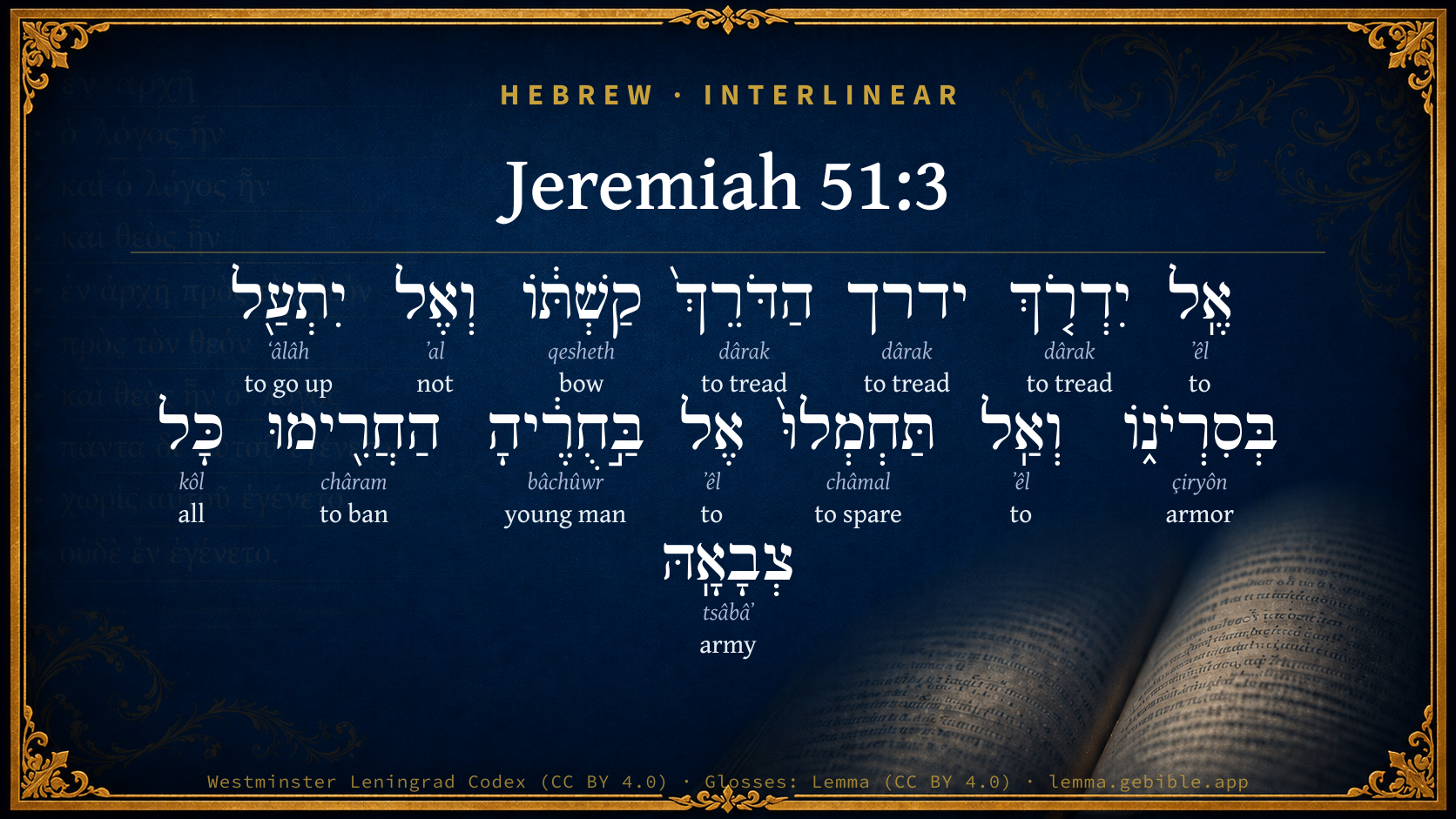
Jeremiah 51:3

Hebrew (Westminster Leningrad Codex) Jeremiah 51:3 appears in the Hebrew Old Testament. The text above is from the Westminster Leningrad Codex. Each word links to its Strong’s number, a concise gloss, and parsing drawn from the Open Scriptures Hebrew Bible morphology. Click any word for its full Brown-Driver-Briggs (BDB) entry.
Download image
Cite this verse

Jeremiah 51:3 (World English Bible). Public Domain. Lemma interlinear Bible study tool, https://lemma.gebible.app/v/jeremiah/51/3.

Show BibTeX & RIS
BibTeX
RIS
English Translation
Against [him who] bends let the archer bend his bow, and against [him who] lifts himself up in his coat of mail: and don't you spare her young men; destroy you utterly all her host.
World English Bible · Public Domain
Download a study sheet

One document with this verse’s original text, its word-by-word gloss line, the meaning frame, cross-references with their text, attributed commentary, and full source and license credits — printable, and it pastes into notes with its structure intact.

This verse Autodidact and up

Study sheet (.html) Plain text (.txt)

A passage Seminary Student

Up to 50 verses in one chapter. A passage sheet keeps up to 6 commentary sources and 12 cross-references per verse, in the order this page ranks them, and says so on the sheet whenever that leaves anything out. Ask for a single verse and you get the Autodidact verse sheet above.

Everything on this page stays free to read, with no account — the sheet is a download of what is already on screen, not access to it.

Want to remove ads? Support Godless Engineer
Compare translations 3

The same verse in 3 English versions, stacked beneath the original-language interlinear above. Click any original word for its lexicon entry.

Each is an independent rendering of the whole verse — the interlinear is not word-aligned to these translations.

Highlighted words mark where these versions differ — a whole-verse word diff, not a word-by-word alignment.

  • World English Bible Public Domain
    Against [him who] bends let the archer bend his bow, and against [him who] lifts himself up in his coat of mail: and don't you spare her young men; destroy you utterly all her host.
  • King James Version Public Domain
    Against him that bendeth let the archer bend his bow, and against him that lifteth himself up in his brigandine: and spare ye not her young men; destroy ye utterly all her host.
  • unfoldingWord Literal Text CC BY-SA 4.0
    Do not let the archers bend their bows; do not let them put on armor. Do not spare her young men; set her whole army apart for destruction.

unfoldingWord Literal Text — © unfoldingWord, licensed CC BY-SA 4.0. Word-aligned USFM3 via Door43 (git.door43.org/unfoldingWord/en_ult).

Versions to compare (up to 4)

3 of 4 selected

Show all 18 translations

Every available English version of this verse, each an independent rendering of the whole verse.

  • World English Bible Public Domain
    Against [him who] bends let the archer bend his bow, and against [him who] lifts himself up in his coat of mail: and don't you spare her young men; destroy you utterly all her host.
  • Berean Standard Bible Public Domain
    Do not let the archer bend his bow or put on his armor. Do not spare her young men; devote all her army to destruction!
  • Majority Standard Bible Public Domain
    Do not let the archer bend his bow or put on his armor. Do not spare her young men; devote all her army to destruction!
  • King James Version Public Domain
    Against him that bendeth let the archer bend his bow, and against him that lifteth himself up in his brigandine: and spare ye not her young men; destroy ye utterly all her host.
  • American Standard Version (1901) Public Domain
    Against `him that' bendeth let the archer bend his bow, and against `him that' lifteth himself up in his coat of mail: and spare ye not her young men; destroy ye utterly all her host.
  • Revised Version (1885) Public Domain
    Let not the archer bend his bow, and let him not lift himself up in his coat of mail: and spare ye not her young men; destroy ye utterly all her host.
  • Geneva Bible (1599) Public Domain
    Also to the bender that bendeth his bowe, and to him that lifteth himselfe vp in his brigandine, will I say, Spare not her yong men, but destroy all her hoste.
  • Douay-Rheims (1899) Public Domain
    Let not him that bendeth, bend his bow, and let not, him go up that is armed with a coat of mail: spare not her young men, destroy all her army.
  • Young's Literal Translation Public Domain
    Let not the treader tread his bow, Nor lift himself up in his coat of mail, Nor have ye pity on her young men, Devote ye to destruction all her host.
  • Literal Standard Version CC BY-SA 4.0
    Do not let the treader tread his bow, || Nor lift himself up in his coat of mail, || Nor have pity on her young men, || Devote all her host to destruction.
  • Unlocked Literal Bible CC BY-SA 4.0
    Do not let the archers bend their bows; do not let them put on armor. Do not spare her young men; set her whole army apart for destruction.
  • unfoldingWord Literal Text CC BY-SA 4.0
    Do not let the archers bend their bows; do not let them put on armor. Do not spare her young men; set her whole army apart for destruction.
  • Darby Bible Public Domain
    Against him that bendeth let the archer bend his bow, and against him that lifteth himself up in his coat of mail; and spare not her young men: destroy utterly all her host.
  • World Messianic Bible Public Domain
    Against him who bends, let the archer bend his bow, also against him who lifts himself up in his coat of mail. Don’t spare her young men! Utterly destroy all her army!
  • Webster's Bible Public Domain
    Against him that bendeth let the archer bend his bow, and against him that lifteth himself up in his coat of mail: and spare ye not her young men; destroy ye utterly all her host.
  • Free Bible Version CC BY-SA 4.0
    The archer doesn't need to use his bow; the infantryman doesn't need to put on his armor. Don't spare her young soldiers; set apart her whole army for destruction!
  • Bible in Basic English Public Domain
    Against her the bow of the archer is bent, and he puts on his coat of metal: have no mercy on her young men, give all her army up to the curse.
  • JPS Tanakh (1917) Public Domain
    Let the archer bend his bow against her, and let him lift himself up against her in his coat of mail; and spare ye not her young men, destroy ye utterly all her host.

Literal Standard Version (2020), Covenant Press — licensed CC BY-SA 4.0. Text via the HelloAO Bible API (eBible.org). Unlocked Literal Bible (unfoldingWord) — licensed CC BY-SA 4.0. Text via the HelloAO Bible API (eBible.org). unfoldingWord Literal Text — © unfoldingWord, licensed CC BY-SA 4.0. Word-aligned USFM3 via Door43 (git.door43.org/unfoldingWord/en_ult). Free Bible Version, Dr. Jonathan Gallagher — licensed CC BY-SA 4.0. Text via the HelloAO Bible API (eBible.org).

Word by word

More ways to search: Search by grammar → Find every occurrence → Compare this word →

Practice this passage: Drill this verse → Learn its vocabulary →

בְּסִרְיֹנ֑וֹ
çiryôn
H5630
“in/at · armor · his”
Preposition + Noun, Common, Masculine, Singular, Construct + Suffix, Personal, 3rd Person, Masculine, Singular
Part of Speech
Preposition + Noun
Type
Common
Gender
Masculine
Number
Singular
State
Construct
Full BDB Definition

Origin: for H8302

TWOT: 1544

armour
  1. אֶֽל ʼêl H413 “to” Preposition
  2. יִדְרֹ֤ךְ dârak H1869 “to tread” Verb, Qal, Imperfect, 3rd Person, Masculine, Singular
  3. ידרך dârak H1869 “to tread” Verb, Qal, Imperfect, 3rd Person, Masculine, Singular
  4. הַדֹּרֵךְ֙ dârak H1869 “the · treading” Particle, Definite Article + Verb, Qal, Participle Active, Masculine, Singular, Absolute
  5. קַשְׁתּ֔וֹ qesheth H7198 “bow · his” Noun, Common, Feminine, Singular, Construct + Suffix, Personal, 3rd Person, Masculine, Singular
  6. וְאֶל ʼal H408 “and · not” Conjunction + Preposition
  7. יִתְעַ֖ל ʻâlâh H5927 “to go up” Verb, Hithpael, Jussive, 3rd Person, Masculine, Singular
  8. וְאַֽל ʼêl H413 “and · to” Conjunction + Particle, Negative
  9. תַּחְמְלוּ֙ châmal H2550 “to spare” Verb, Qal, Imperfect, 2nd Person, Masculine, Plural
  10. אֶל ʼêl H413 “to” Preposition
  11. בַּ֣חֻרֶ֔יהָ bâchûwr H970 “young men · her” Noun, Common, Masculine, Plural, Construct + Suffix, Personal, 3rd Person, Feminine, Singular
  12. הַחֲרִ֖ימוּ châram H2763 “ban” Verb, Hiphil, Imperative, 2nd Person, Masculine, Plural
  13. כָּל kôl H3605 “all of” Noun, Common, Masculine, Singular, Construct
  14. צְבָאָֽהּ tsâbâʼ H6635 “army · her” Noun, Common, Both, Singular, Construct + Suffix, Personal, 3rd Person, Feminine, Singular

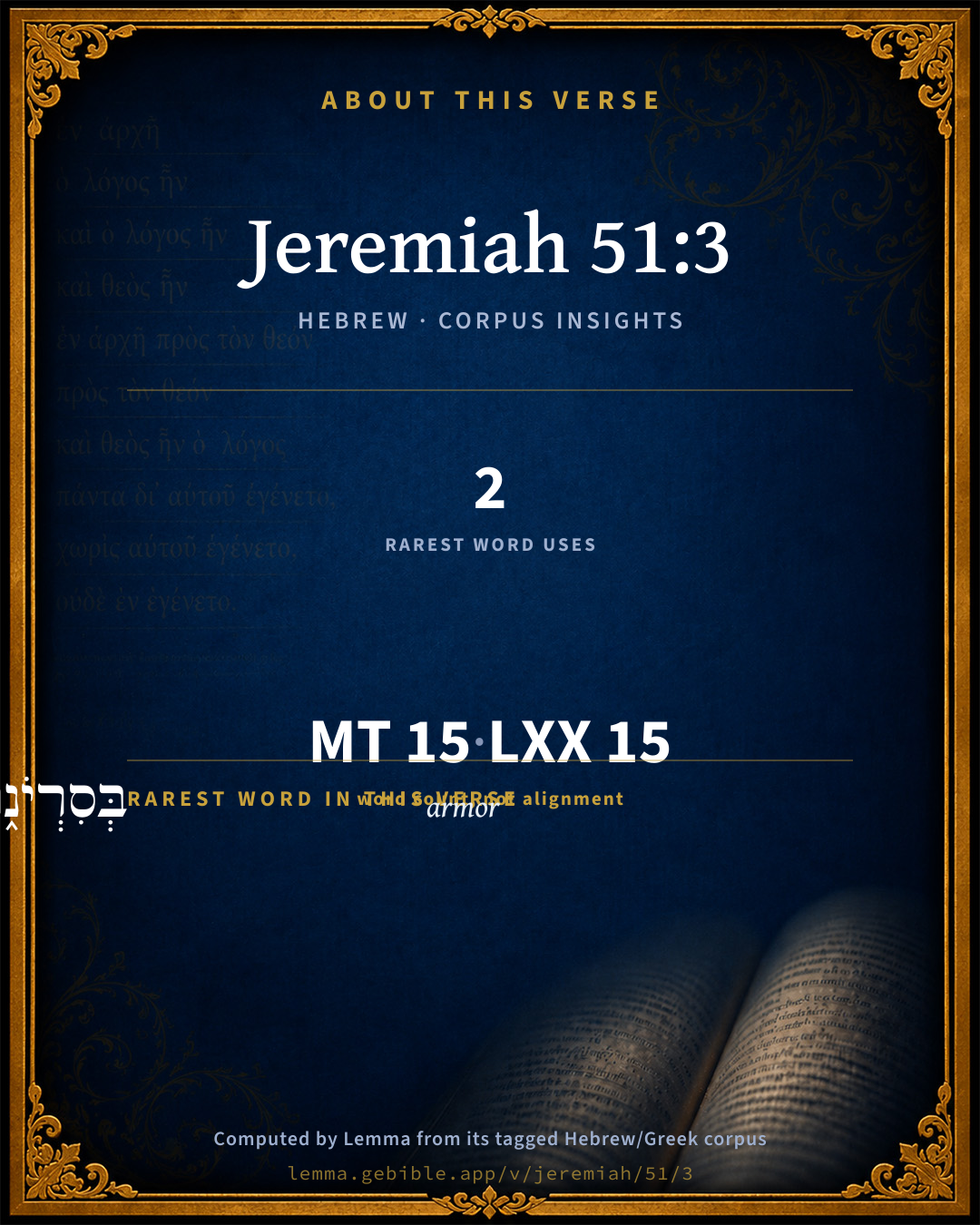
About this verse

These counts appear in no published source. They are computed here, from the morphology-tagged text and Lemma’s own curated glosses. What Lemma adds →

15
words
11
distinct lemmas
Prophets
section

Notable vocabulary

The rarest word here is בְּסִרְיֹנ֑וֹ armor H5630 — appearing just 2 times in the whole Hebrew Bible.

Shared distinctive vocabulary

בְּסִרְיֹנ֑וֹ armor H5630 occurs in 2 verses of the Hebrew Bible. Also found in:

Grammatical profile

  • 6 verbs
  • 5 nouns
  • 3 prepositions
  • 1 particle

Verb forms

  • יִדְרֹ֤ךְ Qal · Imperfect
  • ידרך Qal · Imperfect
  • הַדֹּרֵךְ֙ Qal · Participle Active
  • יִתְעַ֖ל Hithpael · Jussive
  • תַּחְמְלוּ֙ Qal · Imperfect
  • הַחֲרִ֖ימוּ Hiphil · Imperative

Repetition

Words recur within this verse — often emphatic in Hebrew:

  • יִדְרֹ֤ךְ to tread H1869 ×3
  • אֶֽל to H413 ×3

Hebrew & Septuagint length

In the original languages it is 15 Hebrew tokens and 15 Greek tokens — but the two are counted differently (Hebrew bundles its prefixes and suffixes into one token; the Greek is in lemma form), so that isn’t a like-for-like length.

Cross-references

11

Topical passages linked to Jeremiah 51:3 in the Treasury of Scripture Knowledge — connected by theme and wording, ordered by reader-vote popularity; previews shown in the World English Bible.

  • Jeremiah 50:14 Set yourselves in array against Babylon round about, all you who bend the bow; shoot at her, spare no arrows: for she has sinned against Yahweh.
  • Jeremiah 46:4 Harness the horses, and get up, you horsemen, and stand forth with your helmets; furbish the spears, put on the coats of mail.
  • Jeremiah 50:21 Go up against the land of Merathaim, even against it, and against the inhabitants of Pekod: kill and utterly destroy after them, says Yahweh, and do according to all that I have commanded you.
  • Deuteronomy 32:25 Outside shall the sword bereave, In the chambers terror; [It shall destroy] both young man and virgin, The suckling with the man of gray hairs.
  • Isaiah 13:10–18 For the stars of the sky and the constellations of it shall not give their light; the sun shall be darkened in its going forth, and the moon shall not cause its light to shine.
  • Jeremiah 9:21 For death is come up into our windows, it is entered into our palaces; to cut off the children from outside, [and] the young men from the streets.
  • Jeremiah 50:27 Kill all her bulls; let them go down to the slaughter: woe to them! for their day is come, the time of their visitation.
  • Jeremiah 50:29–30 Call together the archers against Babylon, all those who bend the bow; encamp against her round about; let none of it escape: recompense her according to her work; according to all that she has done, do to her; for she has been proud against Yahweh, against the Holy One of Israel.
  • Jeremiah 50:41–42 Behold, a people comes from the north; and a great nation and many kings shall be stirred up from the uttermost parts of the earth.
  • James 2:13 For judgment is without mercy to him who has shown no mercy. Mercy triumphs over judgment.
  • Psalms 137:9 Happy shall he be, Who takes and dashes your little ones against the rock.

Cross-references courtesy of OpenBible.info (CC BY 4.0).

Hebrew and Greek witnesses Masoretic Hebrew ↔ Greek Septuagint

The same verse in the two great witnesses to the Old Testament, shown verse-for-verse.

These are two independent witnesses, not word-aligned to each other, and the Septuagint is shown in lemma (dictionary) form.

Hebrew Jeremiah 51:3 Masoretic · Westminster Leningrad Codex

אֶֽל יִדְרֹ֤ךְ ידרך הַדֹּרֵךְ֙ קַשְׁתּ֔וֹ וְאֶל יִתְעַ֖ל בְּסִרְיֹנ֑וֹ וְאַֽל תַּחְמְלוּ֙ אֶל בַּ֣חֻרֶ֔יהָ הַחֲרִ֖ימוּ כָּל צְבָאָֽהּ

Against [him who] bends let the archer bend his bow, and against [him who] lifts himself up in his coat of mail: and don't you spare her young men; destroy you utterly all her host.

World English Bible · Public Domain

Greek LXX Structure differs

In the Septuagint, Jeremiah is about an eighth shorter than the Hebrew and arranges its material differently — the Oracles Against the Nations (Hebrew chapters 46–51) appear in the middle of the Greek book, after 25:13. Because the chapter and verse boundaries do not line up, a verse-for-verse comparison with the Hebrew is not shown.

A verse-for-verse comparison isn’t shown here because the chapters and verses don’t line up. Switch to the LXX edition with the MT / LXX toggle above to read the Greek directly.

On this verse, Haydock's Catholic Bible Commentary discusses the Septuagint’s reading. Read the note in Commentary ↓

Hebrew: Westminster Leningrad Codex (CC BY 4.0). Greek: Septuagint (public domain); English from a public-domain English Septuagint. How the Septuagint differs from the Hebrew →

Targum (Aramaic paraphrase)

1

The Targum is the ancient Jewish Aramaic paraphrase of the Hebrew Scriptures — an interpretive translation, not the Hebrew text itself. Onkelos (literal) and Pseudo-Jonathan (expansive) render the Torah, and Jonathan the Prophets. Coverage is partial: where no permissively-licensed English translation exists for a verse, only the Aramaic is shown. This is verse-level text, not a word-by-word alignment to the Hebrew.

  1. Targum Jonathan Prophets (Joshua–Malachi)
    לָא יִמְתַּח דִמְתַּח קַשְׁתֵּיהּ וְלָא יִסַק בְּסִרְיָנַיָהּ וְלָא תְחוּסוּן עַל עוּלֵימָהָא גַמִירוּ כָּל נִכְסָהָא:

    (no public-domain English translation for this verse)

    Targum Jonathan — Aramaic: “Mikraot Gedolot” (public domain). English: “Sefaria Community Translation” (CC0 1.0 (public-domain dedication)); “London "Chaldee Paraphrase," 1871” (public domain). Text via Sefaria.

Commentary

Notes on Jeremiah 51:3 from classic Christian and Jewish commentators (each source and its license shown beneath its notes). The classic Christian expositions comment on the surrounding passage and are grouped to its opening verse, so a note may address several verses; the Jewish commentaries on the Tanakh (Rashi and others) are per-verse, so they appear only where the commentator wrote on this verse.

Lemma curates 59 commentaries, every one of them public domain or Creative Commons licensed, each selected and text-cleaned for this edition rather than reprinted as found. About our sources →

Trapp's Complete Commentary

John Trapp

Jer 51:3 Against [him that] bendeth let the archer bend his bow, and against [him that] lifteth himself up in his brigandine: and spare ye not her young men; destroy ye utterly all her host.

Ver. 3. Against him that bendeth.] Periphrasis Babylonii, omnibus gentibus infesti.

John Trapp, A Commentary or Exposition upon All the Books of the Old and New Testament (1647–1656) — public domain. Text from a community e-Sword module.

Joseph Benson's Commentary

Jer 51:3-5. Against him that bendeth let the archer bend — See Jer 50:14; and against him, that lifteth up himself in his brigandine — Or, coat of mail: suffer not them who are skilful in using the bow, or armed in coats of mail, to avail themselves any thing of their skill or their armour, but oppose them with superior skill and force. Thus the slain shall fall in the land of the Chaldeans — There seems to be a transposition of words in this sentence, the sense certainly being, Thus the Chaldeans shall fall down slain to the earth. For Israel hath not been (or rather, shall not be) forsaken, nor Judah of his God — “Though God was justly displeased with his people, yet he would not cast them off utterly, or deprive them of his protection, though he would do so to those that were the rod in his hand, to chastise and scourge his people.”

Joseph Benson's Commentary on the Old and New Testaments (1811–1818) — public domain. Text from a community e-Sword module.

Tyndale Open Study Notes

Tyndale Open Resources

51:3-4 God took the role of commander and ordered the destroyer to wipe out the Babylonians. • completely destroyed: See Lev 27:28-29; 1 Sam 15:3.

Tyndale Open Study Notes — © Tyndale Open Resources, licensed CC BY-SA 4.0. Text via the HelloAO Bible API.

Jamieson, Fausset & Brown

Robert Jamieson, A. R. Fausset & David Brown

Against him that bendeth--namely, the bow; that is, the Babylonian archer.

let the archer bend--that is, the Persian archer (Jer 50:4). The Chaldean version and JEROME, by changing the vowel points, read, "Let not him (the Babylonian) who bendeth his bow bend it." But the close of the verse is addressed to the Median invaders; therefore it is more likely that the first part of the verse is addressed to them, as in English Version, not to the Babylonians, to warn them against resistance as vain, as in the Chaldean version. The word "bend" is thrice repeated: "Against him that bendeth let him that bendeth bend," to imply the utmost straining of the bow.

Jamieson, Fausset & Brown — Commentary Critical and Explanatory on the Whole Bible (1871) — public domain (CC PDM 1.0). Text via the HelloAO Bible API.

John Calvin's Commentaries

Interpreters give various expositions of this verse. Some understand a soldier of light armor by him who bends the bow; and by him who elevates himself in his coat of mail, they understand a heavy-armed, soldier, There is also another difference; some take אל, al, for לא, la, when it is said ואל יתעל, veal itol, because a copulative follows; and the words seem not to be well connected, if we read thus, “As to him who raises himself up in his coat of mail, and spare ye not,” etc.; and hence they take negatively the particle אל, al, instead of לא la, “and he may not raise up himself in his coat of mail.” But it is probable that the copulative in the second place is redundant The simple meaning would therefore be, As to him who bends the bow, and who raises himself up in his coat of mall

I do not, indeed, give such a refined interpretation as some do, respecting the light and heavy armed soldiers. I doubt not, then, but that he points out the archers, and those clad in mail. If, however, any one prefers the other explanation, let him enjoy his own opinion. As to the main point, it is evident that the Prophet exhorts the Persians and the Medes not to spare the young men among the Chaldeans, but to destroy their whole army, so that no part of it should be left remaining.

John Calvin's Commentaries (1540-1563) — public domain. Text from the Calvin Translation Society English edition (1840s-50s) via the Christian Classics Ethereal Library (ccel.org). Calvin's coverage is partial (roughly two-thirds of the Bible); uncommented books and verses are honest gaps, never fabricated. The 19th-century editor's footnotes and remarks are omitted so the notes are faithfully Calvin's own voice.

Ellicott's Commentary for English Readers

(3) Let the archer bend his bow.—The words represent the sense of the original, but the Hebrew word for “archer” is literally bender, and so the iteration of the verb gains its full rhetorical force. On “brigandine,” as meaning the “coat of mail” of heavy-armed troops, see Note on Jer_46:4. The two classes of soldiers describe collectively the garrison that defended Babylon.

A Bible Commentary for English Readers, edited by Charles John Ellicott (1878–1897) — public domain. Text from a community e-Sword module.

The Cambridge Bible for Schools and Colleges

gen. ed. J. J. S. Perowne

3. Let not the archer bend his bow, and let him not lift himself up, etc.] As the mg., when compared with the text, suggests, the Heb. is difficult. It is in fact ungrammatical and probably corrupt. It seems best to omit the negatives, and make the whole v. (as the latter part must be in any case) an address to the assailants of Babylon. If we retain the negatives, the sense will be that it will be useless for Babylon’s warriors to attempt her defence.

destroy ye utterly all] For mg. devote ye all, etc., See on Jer_25:9 and cp. Jer_50:21.

The Cambridge Bible for Schools and Colleges (gen. ed. J. J. S. Perowne; Cambridge University Press, 1878–1918) — public domain. Text from a community e-Sword module.

John Gill's Exposition

Against him that bendeth let the archer bend his bow,.... These are either the words of the Lord to the Medes and Persians, to the archers among them, to bend their bows and level their arrows against the Chaldeans, who had bent their bows and shot their arrows against others; or of the Medes and Persians stirring up one another to draw their bows, and fight manfully against the enemy:

and against him that lifteth up himself in his brigandine; or coat of mail; that swaggers about in it, proud of it, and putting his confidence in it, as if out of all danger. The sense is, that they should direct their arrows both against those that were more lightly or more heavily armed; since by them they might do execution among the one and the other:

and spare ye not her young men; because of their youth, beauty, and strength:

destroy ye utterly all her host; her whole army, whether officers or common soldiers; or let them be accoutred in what manner they will. The Targum is,

"consume all her substance.''

John Gill's Exposition of the Whole Bible (1746–1763) — public domain (CC PDM 1.0). Text via the HelloAO Bible API.

Albert Barnes' Notes on the Bible

The man who bends the bow, and the heavy-armed soldier who vaunts himself in his coat of mail (Jer 46:4 note), represent the Babylonians who defend the city.

Albert Barnes' Notes on the Bible (1834–1885) — public domain. Text from a community e-Sword/MySword module.

Haydock's Catholic Bible Commentary

Mail. There will be little or no resistance made, chap. l. 3. (Haydock) --- The Persians denounce destruction to all taken in arms; or, according to Septuagint and Syriac they exhort each other to fight. (Calmet) --- "Let him," &c. (Haydock) --- Hebrew of the Masorets, "you who bend....spare not." (Calmet) --- Protestants, "against him that bendeth let the archer bend his bow," &c. (Haydock) --- Hebrew is printed ne tendat tendat tendans. The second word is properly omitted in some manuscripts. Thus (1 Chronicles xxiv. 6.) we read taken taken, achuz having been put erroneously for achad, one. (Kennicott)

George Leo Haydock (1774–1849), Haydock's Catholic Family Bible and Commentary, 1859 edition — public domain. Excludes Psalms (Douay-Rheims chapter numbering differs from Protestant) and Deuterocanonical books (Catholic canon only).

Matthew Poole's English Annotations

Whatever arms the Babylonians shall be armed with, they shall meet with their matches; those that are archers shall meet with archers to bend the bow against them, and those who are otherwise armed shall meet with persons prepared to encounter them at their own weapons. Their whole host shall be destroyed, both young and old men.

Matthew Poole's English Annotations on the Holy Bible (1683–1685) — public domain. Text from a community e-Sword/MySword module.

Whedon's Commentary on the Bible

Daniel D. Whedon

3. Archer — Literally, bender. The Masoretes have stumbled over the text of this verse, and there has been some variety of opinion among the critical expositors of recent times. But there is no serious difficulty in the text as it now stands, and it is by all means to be accepted.

Daniel D. Whedon (gen. ed.), Commentary on the Old and New Testaments (1874–1909) — public domain. Text from a community e-Sword module.

The Pulpit Commentary

Against him that bendeth, etc. There are two readings in the Hebrew Bible one that given by the Authorized Version; the other, "Against him that bendeth (let) him that bendeth his bow (come)." The difficulty, however, is in the first two words of the clause, which are the same in either reading. It would be much simpler to alter a single point, and render, "Let not the archer bend his bow; and let him not lift himself up in his coat of mail"; (for the old word "brigandine," see on Jer_46:4) which might be explained of the Babylonians, on the analogy of Jer_46:6, "Let him not bend his bow, for it will be useless;" but then the second half of the verse hardly suits the first the prohibitions seem clearly intended to run on in a connected order. On the other hand, the descriptions, "him that bendeth," and "him that lifteth himself up in his brigandine," seem hardly a natural way of putting "the Chaldean army."

The Pulpit Commentary (1880–1919), ed. H.D.M. Spence-Jones & Joseph S. Exell — public domain. Text from a community e-Sword module.

unfoldingWord translationNotes

Door43 World Missions Community

Do not let ... do not let

Yahweh wants the attack to be so sudden that the archers have no time to prepare for battle.

those who are killed

This can be translated in active form. AT: "those whom the attackers kill" (See: Active or Passive)

translationWords

archer

bow and arrow

armor

Chaldea

unfoldingWord translationNotes — © Distant Shores Media and the Door43 World Missions Community, licensed CC BY-SA 4.0. Source: git.door43.org/Door43/en_tn.

Rashi

Rabbi Shlomo Yitzchaki (Rashi)

To...the archer shall bend This is an elliptical verse. [The meaning is:] To wherever I say, there the archer shall bend his bow.

and he shall not be healed with his coat of mail Heb. וְאַל יִתְעַל.

Rashi on the Tanakh — English translations: “The Judaica Press complete Tanach with Rashi, translated by A. J. Rosenberg” (CC BY 4.0); “Pentateuch with Rashi's commentary by M. Rosenbaum and A.M. Silbermann, 1929-1934” (public domain); “The Metsudah Tanach series, Lakewood, N.J” (CC BY 4.0); and “The Book of Joshua, Metsudah Publications, 1997” (CC BY 4.0). Text via Sefaria.

Lesson kit

Teaching starters — assembled from the data on this page, not authored interpretation. Every prompt links to the verse data it draws on. Edit before teaching.

Jeremiah, in the Prophets, opens this verse with 15 words (11 distinct Hebrew lemmas). Its most distinctive word is çiryôn (“armor”). A historical commentator’s framing appears above. Read the whole chapter for the surrounding context.

Discussion questions

  1. How does “armor” (çiryôn) shape what this verse is saying?
  2. Jeremiah 46:4 shares the word «armor» with this verse. How do the two illuminate each other?
  3. “to tread” occurs 3× in this one verse. What is the effect of the repetition?
  4. These translations render this verse differently. What is at stake in choosing one wording over another?
  5. The verb «יִדְרֹ֤ךְ» is Qal Imperfect. How does its form color the action?
  6. Reading how Trapp's Complete Commentary and Joseph Benson's Commentary read this verse, where do the two commentators agree and where do they part?

Things to notice

Reading settings

Reading text

Shown beneath each verse's original-language words.

Old Testament
Old Testament edition

Read the OT as the Masoretic Hebrew (MT) or the Greek Septuagint (LXX).

English shown for the Greek Septuagint (in the Hebrew ↔ Greek comparison).

Comparing translations? Open the Compare panel on any verse page to stack up to four side by side.