
1 Samuel 25:13

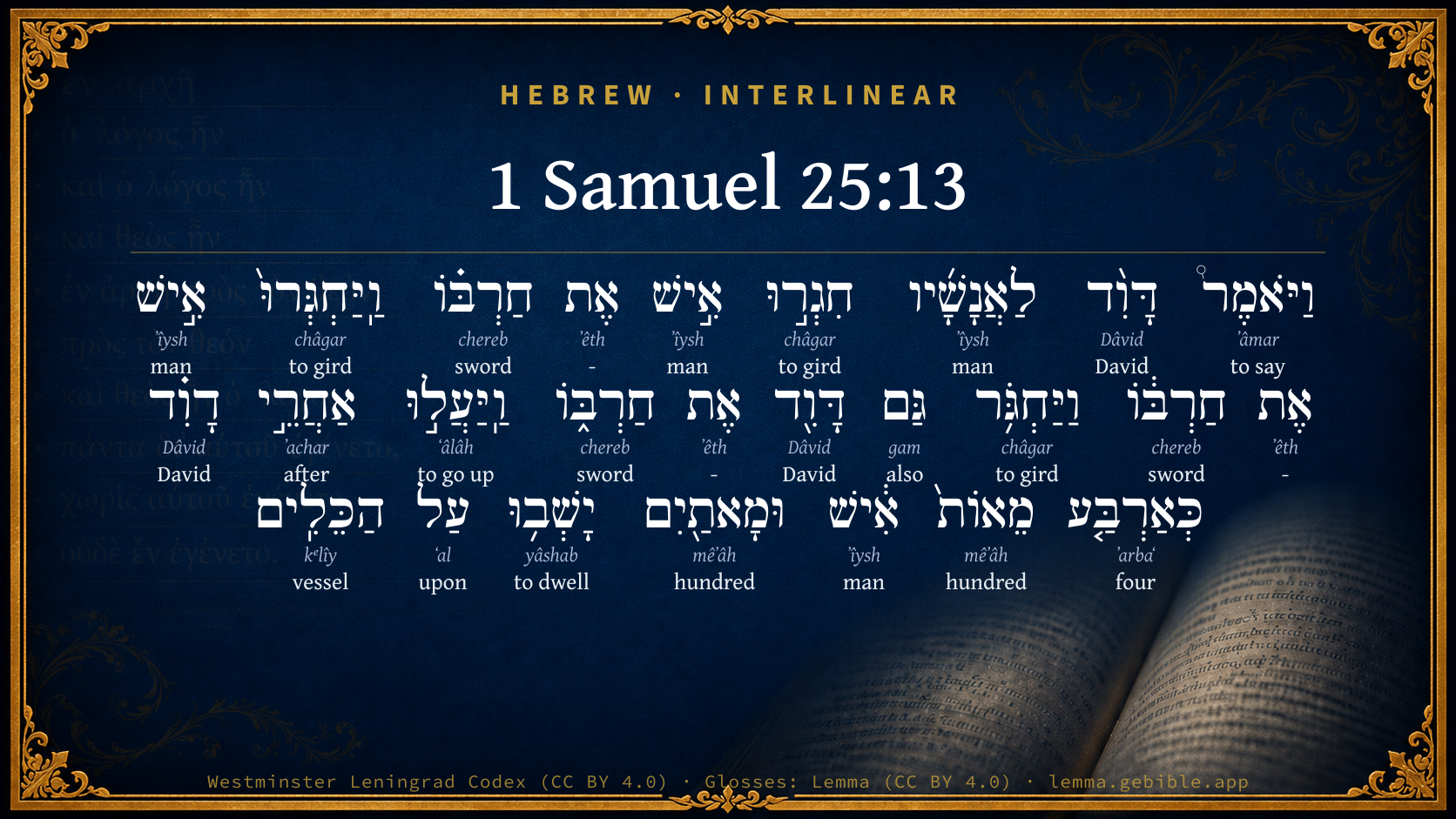
Hebrew (Westminster Leningrad Codex) 1 Samuel 25:13 appears in the Hebrew Old Testament. The text above is from the Westminster Leningrad Codex. Each word links to its Strong’s number, a concise gloss, and parsing drawn from the Open Scriptures Hebrew Bible morphology. Click any word for its full Brown-Driver-Briggs (BDB) entry.
Download image
Cite this verse

1 Samuel 25:13 (World English Bible). Public Domain. Lemma interlinear Bible study tool, https://lemma.gebible.app/v/1-samuel/25/13.

Show BibTeX & RIS
BibTeX
RIS
English Translation
David said to his men, Gird you on every man his sword. They girded on every man his sword; and David also girded on his sword: and there went up after David about four hundred men; and two hundred abode by the baggage.
World English Bible · Public Domain
Download a study sheet

One document with this verse’s original text, its word-by-word gloss line, the meaning frame, cross-references with their text, attributed commentary, and full source and license credits — printable, and it pastes into notes with its structure intact.

This verse Autodidact and up

Study sheet (.html) Plain text (.txt)

A passage Seminary Student

Up to 50 verses in one chapter. A passage sheet keeps up to 6 commentary sources and 12 cross-references per verse, in the order this page ranks them, and says so on the sheet whenever that leaves anything out. Ask for a single verse and you get the Autodidact verse sheet above.

Everything on this page stays free to read, with no account — the sheet is a download of what is already on screen, not access to it.

Want to remove ads? Support Godless Engineer
Compare translations 3

The same verse in 3 English versions, stacked beneath the original-language interlinear above. Click any original word for its lexicon entry.

Each is an independent rendering of the whole verse — the interlinear is not word-aligned to these translations.

Highlighted words mark where these versions differ — a whole-verse word diff, not a word-by-word alignment.

  • World English Bible Public Domain
    David said to his men, Gird you on every man his sword. They girded on every man his sword; and David also girded on his sword: and there went up after David about four hundred men; and two hundred abode by the baggage.
  • King James Version Public Domain
    And David said unto his men, Gird ye on every man his sword. And they girded on every man his sword; and David also girded on his sword: and there went up after David about four hundred men; and two hundred abode by the stuff.
  • unfoldingWord Literal Text CC BY-SA 4.0
    And David said to his men, “Strap on, a man his sword.” And they strapped on, a man his sword. And David also strapped on his sword. And about 400 men went up behind David, and 200 stayed with the equipment.

unfoldingWord Literal Text — © unfoldingWord, licensed CC BY-SA 4.0. Word-aligned USFM3 via Door43 (git.door43.org/unfoldingWord/en_ult).

Versions to compare (up to 4)

3 of 4 selected

Show all 18 translations

Every available English version of this verse, each an independent rendering of the whole verse.

  • World English Bible Public Domain
    David said to his men, Gird you on every man his sword. They girded on every man his sword; and David also girded on his sword: and there went up after David about four hundred men; and two hundred abode by the baggage.
  • Berean Standard Bible Public Domain
    And David said to his men, “Strap on your swords!” So David and all his men put on their swords, and about four hundred men followed David, while two hundred stayed with the supplies.
  • Majority Standard Bible Public Domain
    And David said to his men, “Strap on your swords!” So David and all his men strapped on their swords, and about four hundred men followed David, while two hundred stayed with the supplies.
  • King James Version Public Domain
    And David said unto his men, Gird ye on every man his sword. And they girded on every man his sword; and David also girded on his sword: and there went up after David about four hundred men; and two hundred abode by the stuff.
  • American Standard Version (1901) Public Domain
    And David said unto his men, Gird ye on every man his sword. And they girded on every man his sword; and David also girded on his sword: and there went up after David about four hundred men; and two hundred abode by the baggage.
  • Revised Version (1885) Public Domain
    And David said unto his men, Gird ye on every man his sword. And they girded on every man his sword; and David also girded on his sword: and there went up after David about four hundred men; and two hundred abode by the stuff.
  • Geneva Bible (1599) Public Domain
    And Dauid said vnto his men, Girde euery man his sword about him. And they girded euery man his sworde: Dauid also girded his sworde. And about foure hundreth men went vp after Dauid, and two hundreth abode by the cariage.
  • Douay-Rheims (1899) Public Domain
    Then David said to his young men: Let every man gird on his sword. And they girded on every man his sword. And David also girded on his sword: and there followed David about four hundred men: and two hundred remained with the baggage.
  • Young's Literal Translation Public Domain
    And David saith to his men, `Gird ye on each his sword;' and they gird on each his sword, and David also girdeth on his sword, and there go up after David about four hundred men, and two hundred have remained by the vessels.
  • Literal Standard Version CC BY-SA 4.0
    And David says to his men, “Each gird on his sword”; and they each gird on his sword, and David also girds on his sword, and about four hundred men go up after David, and two hundred have remained by the vessels.
  • Unlocked Literal Bible CC BY-SA 4.0
    David said to his men, “Every man strap on his sword.” So every man strapped on his sword. David also strapped on his sword. About four hundred men followed after David, and two hundred stayed by the baggage.
  • unfoldingWord Literal Text CC BY-SA 4.0
    And David said to his men, “Strap on, a man his sword.” And they strapped on, a man his sword. And David also strapped on his sword. And about 400 men went up behind David, and 200 stayed with the equipment.
  • Darby Bible Public Domain
    And David said to his men, Gird ye on every man his sword. And they girded on every man his sword; and David also girded on his sword; and there went up after David about four hundred men; and two hundred abode by the baggage.
  • World Messianic Bible Public Domain
    David said to his men, “Every man put on his sword!” Every man put on his sword. David also put on his sword. About four hundred men followed David, and two hundred stayed by the baggage.
  • Webster's Bible Public Domain
    And David said to his men, Gird ye on every man his sword. And they girded on every man his sword; and David also girded on his sword: and there went up after David about four hundred men; and two hundred abode by the goods.
  • Free Bible Version CC BY-SA 4.0
    “Everyone, put on your swords!” David ordered. They all put on their swords, and David did too. About four hundred followed David, while two hundred remained behind to guard their gear.
  • Bible in Basic English Public Domain
    And David said to his men, Put on your swords, every one of you. And every man put on his sword; and David did the same; and about four hundred men went up with David, and two hundred kept watch over their goods.
  • JPS Tanakh (1917) Public Domain
    And David said unto his men: 'Gird ye on every man his sword.' And they girded on every man his sword; and David also girded on his sword; and there went up after David about four hundred men; and two hundred abode by the baggage.

Literal Standard Version (2020), Covenant Press — licensed CC BY-SA 4.0. Text via the HelloAO Bible API (eBible.org). Unlocked Literal Bible (unfoldingWord) — licensed CC BY-SA 4.0. Text via the HelloAO Bible API (eBible.org). unfoldingWord Literal Text — © unfoldingWord, licensed CC BY-SA 4.0. Word-aligned USFM3 via Door43 (git.door43.org/unfoldingWord/en_ult). Free Bible Version, Dr. Jonathan Gallagher — licensed CC BY-SA 4.0. Text via the HelloAO Bible API (eBible.org).

Word by word

More ways to search: Search by grammar → Find every occurrence → Compare this word →

Practice this passage: Drill this verse → Learn its vocabulary →

חִגְר֣וּ
châgar
H2296
“gird”
Verb, Qal, Imperative, 2nd Person, Masculine, Plural
Part of Speech
Verb
Stem
Qal
Form
Imperative
Person
2nd Person
Gender
Masculine
Number
Plural
Full BDB Definition

Origin: a primitive root

TWOT: 604

to gird, gird on, gird oneself, put on a belt - (Qal) - to gird - to gird on, bind on - to gird oneself
  1. וַיֹּאמֶר֩ ʼâmar H559 “and · to say” Conjunction + Verb, Qal, Sequential Imperfect, 3rd Person, Masculine, Singular
  2. דָּוִ֨ד Dâvid H1732 “David” Noun, Proper
  3. לַאֲנָשָׁ֜יו ʼîysh H376 “to/for · men · his” Preposition + Noun, Common, Masculine, Plural, Construct + Suffix, Personal, 3rd Person, Masculine, Singular
  4. אִ֣ישׁ ʼîysh H376 “man” Noun, Common, Masculine, Singular, Absolute
  5. אֶת ʼêth H853 “-” Particle, Direct Object
  6. חַרְבּ֗וֹ chereb H2719 “sword · his” Noun, Common, Feminine, Singular, Construct + Suffix, Personal, 3rd Person, Masculine, Singular
  7. וַֽיַּחְגְּרוּ֙ châgar H2296 “and · to gird” Conjunction + Verb, Qal, Sequential Imperfect, 3rd Person, Masculine, Plural
  8. אִ֣ישׁ ʼîysh H376 “man” Noun, Common, Masculine, Singular, Absolute
  9. אֶת ʼêth H853 “-” Particle, Direct Object
  10. חַרְבּ֔וֹ chereb H2719 “sword · his” Noun, Common, Feminine, Singular, Construct + Suffix, Personal, 3rd Person, Masculine, Singular
  11. וַיַּחְגֹּ֥ר châgar H2296 “and · to gird” Conjunction + Verb, Qal, Sequential Imperfect, 3rd Person, Masculine, Singular
  12. גַּם gam H1571 “also” Particle, Accusative
  13. דָּוִ֖ד Dâvid H1732 “David” Noun, Proper
  14. אֶת ʼêth H853 “-” Particle, Direct Object
  15. חַרְבּ֑וֹ chereb H2719 “sword · his” Noun, Common, Feminine, Singular, Construct + Suffix, Personal, 3rd Person, Masculine, Singular
  16. וַֽיַּעֲל֣וּ ʻâlâh H5927 “and · to go up” Conjunction + Verb, Qal, Sequential Imperfect, 3rd Person, Masculine, Plural
  17. אַחֲרֵ֣י ʼachar H310 “after” Preposition
  18. דָוִ֗ד Dâvid H1732 “David” Noun, Proper
  19. כְּאַרְבַּ֤ע ʼarbaʻ H702 “like/as · four” Preposition + Adjective, Cardinal number, Feminine, Singular, Absolute
  20. מֵאוֹת֙ mêʼâh H3967 “hundred” Adjective, Cardinal number, Both, Plural, Absolute
  21. אִ֔ישׁ ʼîysh H376 “man” Noun, Common, Masculine, Singular, Absolute
  22. וּמָאתַ֖יִם mêʼâh H3967 “and · hundred” Conjunction + Adjective, Cardinal number, Both, Dual, Absolute
  23. יָשְׁב֥וּ yâshab H3427 “to dwell” Verb, Qal, Perfect, 3rd Person, Common, Plural
  24. עַל ʻal H5921 “upon” Preposition
  25. הַכֵּלִֽים kᵉlîy H3627 “the · vessels” Particle, Definite Article + Noun, Common, Masculine, Plural, Absolute

About this verse

These counts appear in no published source. They are computed here, from the morphology-tagged text and Lemma’s own curated glosses. What Lemma adds →

26
words
14
distinct lemmas
Historical
section

Shared distinctive vocabulary

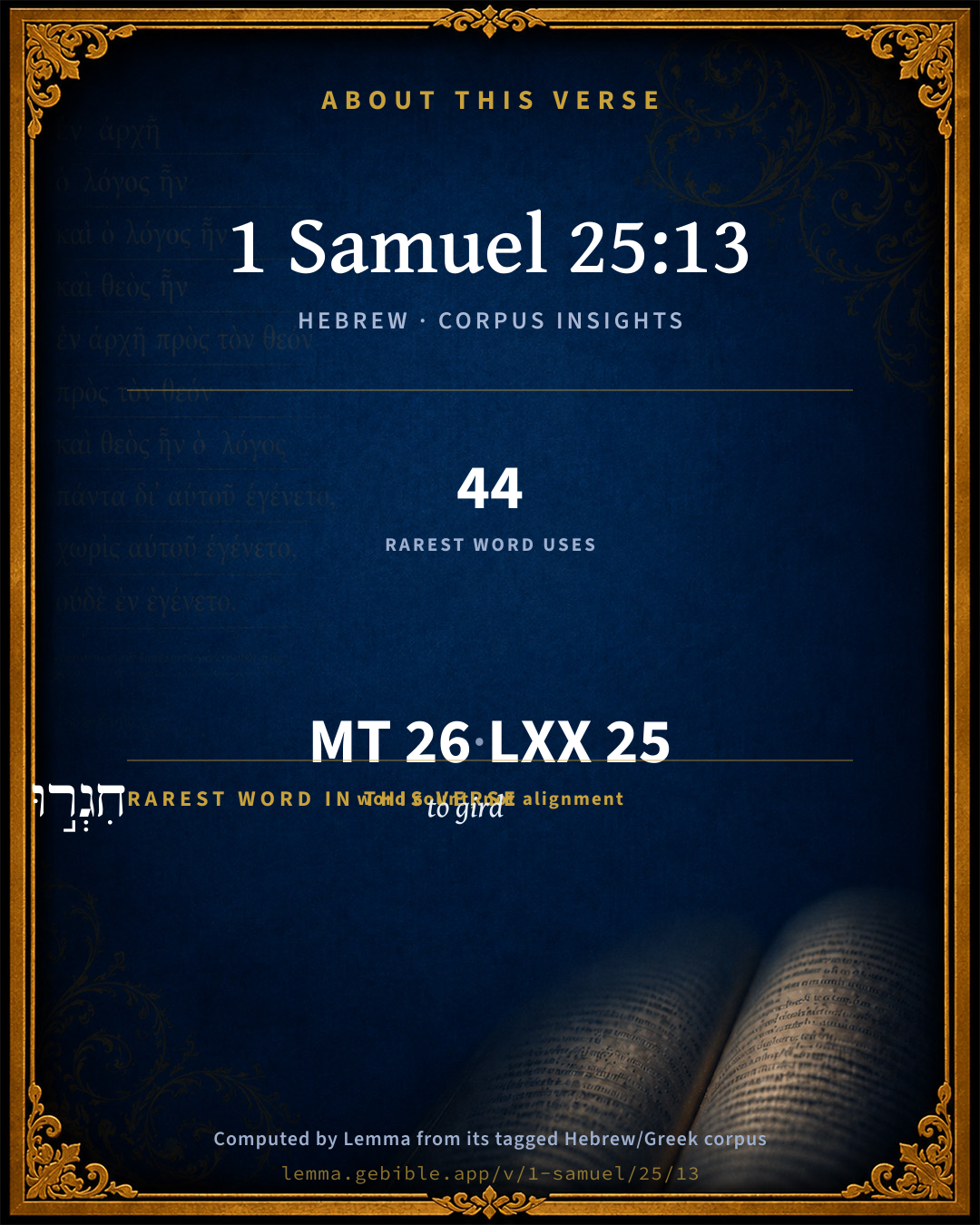
חִגְר֣וּ to gird H2296 occurs in 41 verses of the Hebrew Bible. Also found in:

Grammatical profile

  • 6 verbs
  • 11 nouns
  • 3 adjectives
  • 2 prepositions
  • 4 particles

Verb forms

  • וַיֹּאמֶר֩ Qal · Sequential Imperfect
  • חִגְר֣וּ Qal · Imperative
  • וַֽיַּחְגְּרוּ֙ Qal · Sequential Imperfect
  • וַיַּחְגֹּ֥ר Qal · Sequential Imperfect
  • וַֽיַּעֲל֣וּ Qal · Sequential Imperfect
  • יָשְׁב֥וּ Qal · Perfect

Repetition

Words recur within this verse — often emphatic in Hebrew:

  • לַאֲנָשָׁ֜יו man H376 ×4
  • דָּוִ֨ד David H1732 ×3
  • חִגְר֣וּ to gird H2296 ×3
  • חַרְבּ֗וֹ sword H2719 ×3
  • מֵאוֹת֙ hundred H3967 ×2

Hebrew & Septuagint length

In English translation the verse runs 43 words from the Hebrew and 29 from the Septuagint (LXX English) — the Septuagint runs noticeably shorter here. See the side-by-side →

A rough comparison of the two English renderings, which tokenize alike — not a word-level alignment.

Word counts can differ between the Hebrew and the Greek without any difference in meaning — e.g. the Hebrew direct-object marker אֵת has no separate Greek word, and Greek often adds the article ὁ.

In the original languages it is 26 Hebrew tokens and 25 Greek tokens — but the two are counted differently (Hebrew bundles its prefixes and suffixes into one token; the Greek is in lemma form), so that isn’t a like-for-like length.

Cross-references

12

Topical passages linked to 1 Samuel 25:13 in the Treasury of Scripture Knowledge — connected by theme and wording, ordered by reader-vote popularity; previews shown in the World English Bible.

  • 1 Samuel 23:13 Then David and his men, who were about six hundred, arose and departed out of Keilah, and went wherever they could go. It was told Saul that David was escaped from Keilah; and he gave up going there.
  • Joshua 9:14 The men took of their provision, and didn't ask counsel at the mouth of Yahweh.
  • 1 Samuel 24:5–6 It happened afterward, that David's heart struck him, because he had cut off Saul's skirt.
  • 1 Samuel 30:9–10 So David went, he and the six hundred men who were with him, and came to the brook Besor, where those who were left behind stayed.
  • 1 Samuel 30:21–24 David came to the two hundred men, who were so faint that they could not follow David, whom also they had made to abide at the brook Besor; and they went forth to meet David, and to meet the people who were with him: and when David came near to the people, he greeted them.
  • Proverbs 14:29 He who is slow to anger has great understanding, But he who has a quick temper displays folly.
  • Proverbs 19:2 It isn't good to have zeal without knowledge; Nor being hasty with one's feet and missing the way.
  • Proverbs 19:11 The discretion of a man makes him slow to anger. It is his glory to overlook an offense.
  • Proverbs 25:8 Don't be hasty in bringing charges to court. What will you do in the end when your neighbor shames you?
  • Romans 12:19–21 Don't seek revenge yourselves, beloved, but give place to God's wrath. For it is written, "Vengeance belongs to me; I will repay, says the Lord."
  • James 1:19–20 So, then, my beloved brothers, let every man be swift to hear, slow to speak, and slow to anger;
  • Proverbs 16:32 One who is slow to anger is better than the mighty; One who rules his spirit, than he who takes a city.

Cross-references courtesy of OpenBible.info (CC BY 4.0).

Hebrew and Greek witnesses Masoretic Hebrew ↔ Greek Septuagint

The same verse in the two great witnesses to the Old Testament, shown verse-for-verse.

Here the Septuagint runs noticeably shorter than the Hebrew — LXX2012 (modern English Septuagint) 29 words vs World English Bible 43. A rough length comparison of the two English translations, not a word-level alignment — read both below.

These are two independent witnesses, not word-aligned to each other, and the Septuagint is shown in lemma (dictionary) form.

Hebrew 1 Samuel 25:13 Masoretic · Westminster Leningrad Codex

וַיֹּאמֶר֩ דָּוִ֨ד לַאֲנָשָׁ֜יו חִגְר֣וּ אִ֣ישׁ אֶת חַרְבּ֗וֹ וַֽיַּחְגְּרוּ֙ אִ֣ישׁ אֶת חַרְבּ֔וֹ וַיַּחְגֹּ֥ר גַּם דָּוִ֖ד אֶת חַרְבּ֑וֹ וַֽיַּעֲל֣וּ אַחֲרֵ֣י דָוִ֗ד כְּאַרְבַּ֤ע מֵאוֹת֙ אִ֔ישׁ וּמָאתַ֖יִם יָשְׁב֥וּ עַל הַכֵּלִֽים

David said to his men, Gird you on every man his sword. They girded on every man his sword; and David also girded on his sword: and there went up after David about four hundred men; and two hundred abode by the baggage.

World English Bible · Public Domain

Greek LXX 1 Samuel 25:13 Septuagint · lemma form

καί εἶπον δαυίδ ὁ ἀνήρ αὐτός ζώννυμι ἕκαστος ὁ ῥομφαία αὐτός καί ἀναβαίνω ὀπίσω δαυίδ ὡς τετρακόσιοι ἀνήρ καί ὁ διακόσιοι καταἵζω μετά ὁ σκεῦος

And David said to his men, Gird on every man his sword. And they went up after David, about four hundred men: and two hundred abode with the stuff.

LXX2012 (modern English Septuagint) · Public Domain

Hebrew: Westminster Leningrad Codex (CC BY 4.0). Greek: Septuagint (public domain); English from LXX2012 (modern English Septuagint) (Public Domain). How the Septuagint differs from the Hebrew →

Targum (Aramaic paraphrase)

1

The Targum is the ancient Jewish Aramaic paraphrase of the Hebrew Scriptures — an interpretive translation, not the Hebrew text itself. Onkelos (literal) and Pseudo-Jonathan (expansive) render the Torah, and Jonathan the Prophets. Coverage is partial: where no permissively-licensed English translation exists for a verse, only the Aramaic is shown. This is verse-level text, not a word-by-word alignment to the Hebrew.

  1. Targum Jonathan Prophets (Joshua–Malachi)
    וַאֲמַר דָוִד לְגַבְרוֹהִי זְרִיזוּ גְבַר יַת חַרְבֵּיהּ וְזָרִיזוּ גְבַר יַת חַרְבֵּיהּ וְזָרֵיז אַף דָוִד יַת חַרְבֵּיהּ וּסְלִיקוּ בָּתַר דָוִד כְּאַרְבַּע מְאָה גַבְרָא וּמָאתָן אִשְׁתָּאֲרוּ לְמִטַר מָנַיָא:

    (no public-domain English translation for this verse)

    Targum Jonathan — Aramaic: “Mikraot Gedolot” (public domain). English: “Sefaria Community Translation” (CC0 1.0 (public-domain dedication)); “London "Chaldee Paraphrase," 1871” (public domain). Text via Sefaria.

Commentary

Notes on 1 Samuel 25:13 from classic Christian and Jewish commentators (each source and its license shown beneath its notes). The classic Christian expositions comment on the surrounding passage and are grouped to its opening verse, so a note may address several verses; the Jewish commentaries on the Tanakh (Rashi and others) are per-verse, so they appear only where the commentator wrote on this verse.

Lemma curates 59 commentaries, every one of them public domain or Creative Commons licensed, each selected and text-cleaned for this edition rather than reprinted as found. About our sources →

Trapp's Complete Commentary

John Trapp

1Sa 25:13 And David said unto his men, Gird ye on every man his sword. And they girded on every man his sword; and David also girded on his sword: and there went up after David about four hundred men; and two hundred abode by the stuff.

Ver. 13. Gird ye on every man his sword.] So subject are God’s best saints to weak passions; they are men as others are; and man’s nature is most impatient of contempt and contumely.

John Trapp, A Commentary or Exposition upon All the Books of the Old and New Testament (1647–1656) — public domain. Text from a community e-Sword module.

Geneva Bible (1599)

Geneva Bible translators

Hebrew, vessel.

Geneva Bible (1599) marginal notes — public domain. Text via Bolls.life.

Jamieson, Fausset & Brown

Robert Jamieson, A. R. Fausset & David Brown

two hundred abode by the stuff--This addition to his followers was made after his return into Judah (see Sa1 22:2).

Jamieson, Fausset & Brown — Commentary Critical and Explanatory on the Whole Bible (1871) — public domain (CC PDM 1.0). Text via the HelloAO Bible API.

Ellicott's Commentary for English Readers

(13) Gird ye on every man his sword.—The formal preparation and the largeness of the force told off for the work showed how terribly David was in earnest, and how bent he was on wiping out the insult of Nabal in blood. From the view we have taken of the transaction above, David’s anger is quite to be accounted for, though not to be excused.

A Bible Commentary for English Readers, edited by Charles John Ellicott (1878–1897) — public domain. Text from a community e-Sword module.

The Cambridge Bible for Schools and Colleges

gen. ed. J. J. S. Perowne

13. abode by the stuff] Remained to guard their property. On “stuff” see 1Sa_10:22 : cp. 1Sa_30:24.

The Cambridge Bible for Schools and Colleges (gen. ed. J. J. S. Perowne; Cambridge University Press, 1878–1918) — public domain. Text from a community e-Sword module.

John Gill's Exposition

And David said unto his men,.... Provoked to the last degree to have such a rude churlish answer returned to such a civil and humble message as he had sent:

gird you on every man his sword; and prepare to march and chastise Nabal for his insolence:

and they girded on every man his sword; in obedience to David, and in vindication of his honour and their own:

and David also girded on his sword; in order to march at the head of them, fired with indignation at the affront given him:

and there went up after David about four hundred men; out of the six hundred he had with him, Sa1 23:13,

and two hundred abode by the stuff; the baggage in their camp; the Targum is, they"were left to watch the vessels;''the things necessary for their use, for the dressing of their food, their bedding, &c.

John Gill's Exposition of the Whole Bible (1746–1763) — public domain (CC PDM 1.0). Text via the HelloAO Bible API.

Matthew Poole's English Annotations

Gird ye on every man his sword; having resolved and sworn to revenge himself of Nabal, as is expressed, 1Sa 25:21,22. By the stuff. See 1Sa 17:22; 30:24.

Matthew Poole's English Annotations on the Holy Bible (1683–1685) — public domain. Text from a community e-Sword/MySword module.

The Pulpit Commentary

Vers. 13-17.

Creed and practice.

The facts are

1. David, stung by the insult, prepares to take summary vengeance onNabal.

2. A servant, overhearing his intention, reports it to Abigail.

3. He also relates to her the circumstances of David"s kindness to Nabal"s men, and appeals to her for intervention, as he has no faith in Nabal"s wisdom or generosity. The course taken by David would ordinarily be termed natural for an Eastern chieftain; that of the servant was more considerate than usually is found among men of his class when placed in personal peril. Regarding the two causes separately, we may express the teaching thus:

I THERE IS AT TIMES A SAD DISPROPORTION BETWEEN THE BELIEFS AND THE PRACTICE OF EVEN THE BEST OF MEN. David was undoubtedly the most spiritually enlightened, patient, and devout man then living. The psalms of the period indicate a wonderful faith in the care and goodness of God, and his recent conduct had illustrated his patience, generosity, and forbearance. The elevated tone of his language to Saul, (1Sa_24:11-15) in which he commits his personal wrongs to God, is worthy of New Testament times. The common faith of his life could not but have been strengthened by the solemnities of the funeral from which he had lately returned. Nevertheless David could not bear an insult and ingratitude, but must in unholy zeal cease to trust his cause to God, and avenge evil with his own hand. Sons of Zebedee live in every age, who cannot wait the calm purpose of God to vindicate his saints, while at the same time professing to he of a spirit born of heaven, and akin to that of him "who when he was reviled, reviled not again." This falling below our ideal is a too common calamity in individual and Church life. The question may rise whether we really believe what we say we do when conduct does not harmonise therewith, for is not real faith influential? The great verities of our Christian Scriptures, respecting Christ"s love, our destiny, the world"s spiritual need, and the unspeakable importance of eternal things, are enough to enchain every soul to holy consecration that knows no reserve. It is well that we estimate the disparity between creed and conduct; the dishonour it brings, the harm to religion it entails, and the effect of it on our prayers. (Jam_5:16)

II OUR STANDARD OF CONDUCT IS TO BE TAKEN NOT FROM GOOD MEN, but from the EXPLICIT TEACHING OF SCRIPTURE AND THE EXAMPLE OF CHRIST. As we read the books of men with reserve, and accept only that which accords with a standard of truth apart from them, so our reading of the conduct of saints is to be discriminating. They are often illustrious examples of good, but not our models. Our conduct under analogous circumstances is not to be regulated by that of David, but by the teaching which tells us not to "avenge" ourselves, but to return good for evil, and even love our enemies. If men ask what this non-personal retaliation means, the answer is, the life of Christ. That it is alien to human tendencies and often regarded as unmanly does not make it less Christian. Very few persons "enter into the kingdom of God" in the sense of behaving in the world as Christ did. Even Christian men sometimes speak as though it were madness to display just the spirit of meekness, love, and compassion which marked his career under provocation. Who dare say in the truest sense, "We have the mind of Christ "?

III DISCRIMINATION AND PROMPTITUDE ARE VALUABLE QUALITIES IN AVERTING EVILS INCIDENT TO HUMAN WRONG DOING. The evil consequences of one great sin on the part of a good man may be very serious, and, as in this case, calling for exceeding care if they are to be averted. The conduct of the servant (vers. 14-17) is worthy of imitation in many departments of life. He did not selfishly flee to secure himself, but, reading well the purpose of David, thought of the safety of all, formed a just estimate of Abigail"s tact and courage, and of Nabal"s stupidity, and without delay laid before his mistress the provocation offered to David. A wise and prompt servant is a blessing in a home. These qualities go far to render men successful in life; and if more attention were paid in early years to the development of them, many a one would be saved from disaster, and the whole machinery of saints would move more smoothly. May we not also see an analogy here to the case of a man who, foreseeing spiritual calamity to others, promptly devises means of delivering them from it?

Practical lessons:

1. We should be on the watch against sudden provocations of our unholytendencies, and we shall find a habitually prayerful spirit one of the best aids to the immediate suppression of passion.

2. It is worth considering how much the Church and world have lost byfailure on the part of Christians to live out the spirit and precepts of Christ.

3. It is a question whether sufficient attention is paid to the suppression ofthe love of fighting and taking of revenge in children, and how far literature and customs foster these evils.

4. In cases of moral conduct prompt action is always best.

The Pulpit Commentary (1880–1919), ed. H.D.M. Spence-Jones & Joseph S. Exell — public domain. Text from a community e-Sword module.

Rashi

Rabbi Shlomo Yitzchaki (Rashi)

And Dovid too, girded his sword. From here [we learn] that we commence, in cases involving capital punishment, from the less significant first.

With the equipment. To guard their tents and equipment.

Rashi on the Tanakh — English translations: “The Judaica Press complete Tanach with Rashi, translated by A. J. Rosenberg” (CC BY 4.0); “Pentateuch with Rashi's commentary by M. Rosenbaum and A.M. Silbermann, 1929-1934” (public domain); “The Metsudah Tanach series, Lakewood, N.J” (CC BY 4.0); and “The Book of Joshua, Metsudah Publications, 1997” (CC BY 4.0). Text via Sefaria.

Lesson kit

Teaching starters — assembled from the data on this page, not authored interpretation. Every prompt links to the verse data it draws on. Edit before teaching.

1 Samuel, in the Historical, opens this verse with 26 words (14 distinct Hebrew lemmas). Its most distinctive word is châgar (“to gird”). The Greek Septuagint runs shorter here. A historical commentator’s framing appears above. Read the whole chapter for the surrounding context.

Discussion questions

  1. What does “to gird” (châgar) contribute to the verse as a whole?
  2. How does Exodus 12:11, which shares the word «to gird», read alongside this verse?
  3. What does the repetition of “man” (4× in this one verse) do in this verse?
  4. The Septuagint runs shorter here than the Hebrew. What might account for the difference?
  5. These translations render this verse differently. What is at stake in choosing one wording over another?
  6. «וַיֹּאמֶר֩» is a Qal Sequential Imperfect verb. How does that grammatical form shape the action described?
  7. Compare how Trapp's Complete Commentary and Geneva Bible (1599) read this verse. Where do they agree or differ?

Things to notice

Reading settings

Reading text

Shown beneath each verse's original-language words.

Old Testament
Old Testament edition

Read the OT as the Masoretic Hebrew (MT) or the Greek Septuagint (LXX).

English shown for the Greek Septuagint (in the Hebrew ↔ Greek comparison).

Comparing translations? Open the Compare panel on any verse page to stack up to four side by side.