1 Samuel 28:13

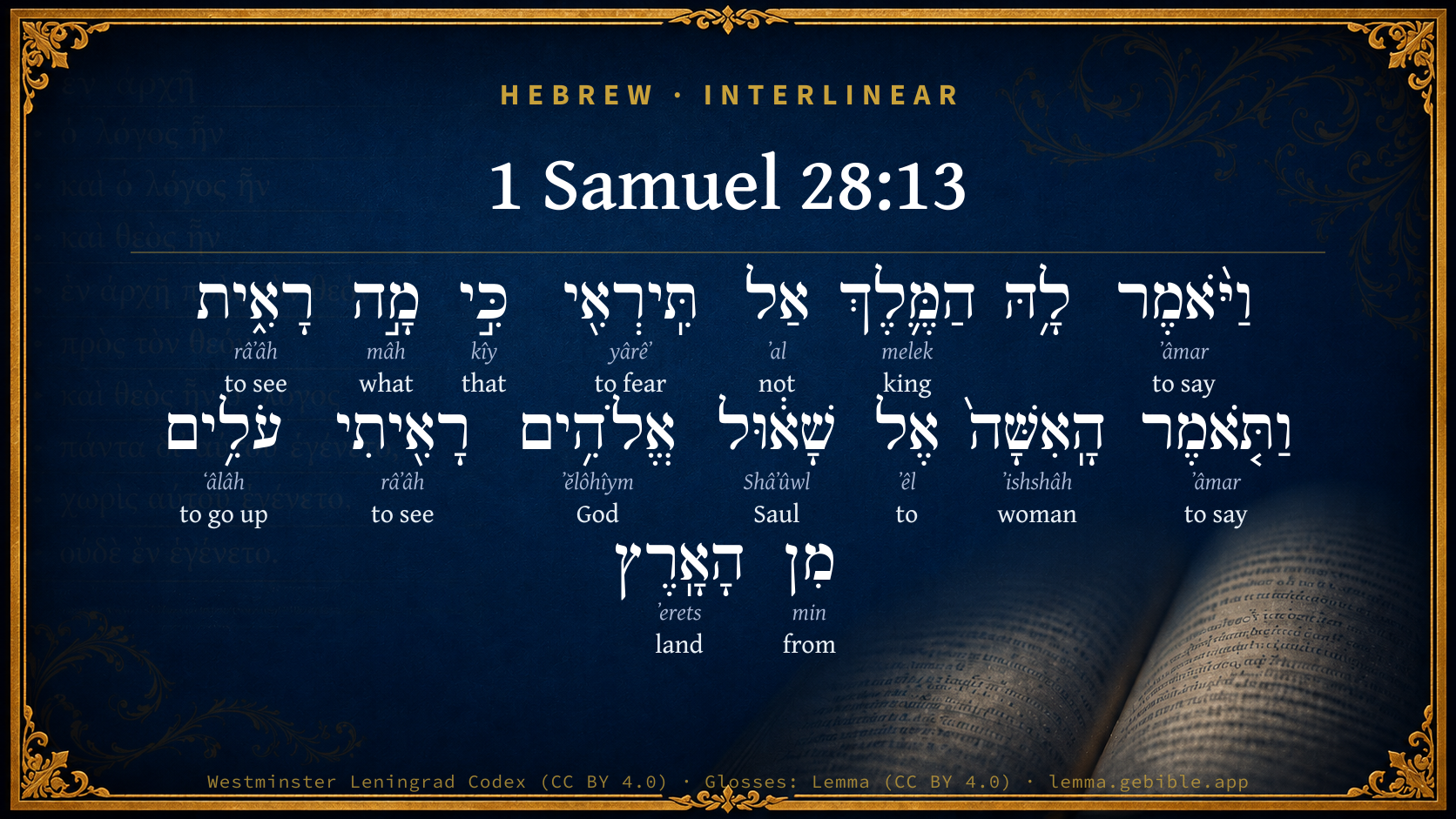
Hebrew (Westminster Leningrad Codex) 1 Samuel 28:13 appears in the Hebrew Old Testament. The text above is from the Westminster Leningrad Codex. Each word links to its Strong’s number, a concise gloss, and parsing drawn from the Open Scriptures Hebrew Bible morphology. Click any word for its full Brown-Driver-Briggs (BDB) entry.
Download image
Cite this verse

1 Samuel 28:13 (World English Bible). Public Domain. Lemma interlinear Bible study tool, https://lemma.gebible.app/v/1-samuel/28/13.

Show BibTeX & RIS
BibTeX
RIS
English Translation
The king said to her, Don't be afraid: for what do you see? The woman said to Saul, I see a god coming up out of the earth.
World English Bible · Public Domain
Download a study sheet

One document with this verse’s original text, its word-by-word gloss line, the meaning frame, cross-references with their text, attributed commentary, and full source and license credits — printable, and it pastes into notes with its structure intact.

This verse Autodidact and up

Study sheet (.html) Plain text (.txt)

A passage Seminary Student

Up to 50 verses in one chapter. A passage sheet keeps up to 6 commentary sources and 12 cross-references per verse, in the order this page ranks them, and says so on the sheet whenever that leaves anything out. Ask for a single verse and you get the Autodidact verse sheet above.

Everything on this page stays free to read, with no account — the sheet is a download of what is already on screen, not access to it.

Want to remove ads? Support Godless Engineer
Compare translations 3

The same verse in 3 English versions, stacked beneath the original-language interlinear above. Click any original word for its lexicon entry.

Each is an independent rendering of the whole verse — the interlinear is not word-aligned to these translations.

Highlighted words mark where these versions differ — a whole-verse word diff, not a word-by-word alignment.

  • World English Bible Public Domain
    The king said to her, Don't be afraid: for what do you see? The woman said to Saul, I see a god coming up out of the earth.
  • King James Version Public Domain
    And the king said unto her, Be not afraid: for what sawest thou? And the woman said unto Saul, I saw gods ascending out of the earth.
  • unfoldingWord Literal Text CC BY-SA 4.0
    And the king said to her, “Do not fear. But what have you seen?” And the woman said to Saul, “I have seen a god coming up from the earth.”

unfoldingWord Literal Text — © unfoldingWord, licensed CC BY-SA 4.0. Word-aligned USFM3 via Door43 (git.door43.org/unfoldingWord/en_ult).

Versions to compare (up to 4)

3 of 4 selected

Show all 18 translations

Every available English version of this verse, each an independent rendering of the whole verse.

  • World English Bible Public Domain
    The king said to her, Don't be afraid: for what do you see? The woman said to Saul, I see a god coming up out of the earth.
  • Berean Standard Bible Public Domain
    “Do not be afraid,” the king replied. “What do you see?” “I see a god coming up out of the earth,” the woman answered.
  • Majority Standard Bible Public Domain
    “Do not be afraid,” the king replied. “What do you see?” “I see a god coming up out of the earth,” the woman answered.
  • King James Version Public Domain
    And the king said unto her, Be not afraid: for what sawest thou? And the woman said unto Saul, I saw gods ascending out of the earth.
  • American Standard Version (1901) Public Domain
    And the king said unto her, Be not afraid: for what seest thou? And the woman said unto Saul, I see a god coming up out of the earth.
  • Revised Version (1885) Public Domain
    And the king said unto her, Be not afraid: for what seest thou? And the woman said unto Saul, I see a god coming up out of the earth.
  • Geneva Bible (1599) Public Domain
    And the King said vnto her, Be not afraid: for what sawest thou? And the woman said vnto Saul, I saw gods ascending vp out of the earth.
  • Douay-Rheims (1899) Public Domain
    And the king said to her: Fear not: what hast thou seen? And the woman said to Saul: I saw gods ascending out of the earth.
  • Young's Literal Translation Public Domain
    And the king saith to her, `Do not fear; for what hast thou seen?' and the woman saith unto Saul, `Gods I have seen coming up out of the earth.'
  • Literal Standard Version CC BY-SA 4.0
    And the king says to her, “Do not fear; for what have you seen?” And the woman says to Saul, “I have seen gods coming up out of the earth.”
  • Unlocked Literal Bible CC BY-SA 4.0
    The king said to her, “Do not be afraid. What do you see?” The woman said to Saul, “I see a god coming up out of the earth.”
  • unfoldingWord Literal Text CC BY-SA 4.0
    And the king said to her, “Do not fear. But what have you seen?” And the woman said to Saul, “I have seen a god coming up from the earth.”
  • Darby Bible Public Domain
    And the king said to her, Be not afraid; but what didst thou see? And the woman said to Saul, I saw a god ascending out of the earth.
  • World Messianic Bible Public Domain
    The king said to her, “Don’t be afraid! What do you see?” The woman said to Saul, “I see a god coming up out of the earth.”
  • Webster's Bible Public Domain
    And the king said to her be not afraid: for what sawest thou? And the woman said to Saul, I saw gods ascending out of the earth.
  • Free Bible Version CC BY-SA 4.0
    “Don't be scared,” the king told her. “What can you see?” “I see a god coming up out of the ground,” the woman replied.
  • Bible in Basic English Public Domain
    And the king said to her, Have no fear: what do you see? And the woman said to Saul, I see a god coming up out of the earth.
  • JPS Tanakh (1917) Public Domain
    And the king said unto her: 'Be not afraid; for what seest thou?' And the woman said unto Saul: 'I see a godlike being coming up out of the earth.'

Literal Standard Version (2020), Covenant Press — licensed CC BY-SA 4.0. Text via the HelloAO Bible API (eBible.org). Unlocked Literal Bible (unfoldingWord) — licensed CC BY-SA 4.0. Text via the HelloAO Bible API (eBible.org). unfoldingWord Literal Text — © unfoldingWord, licensed CC BY-SA 4.0. Word-aligned USFM3 via Door43 (git.door43.org/unfoldingWord/en_ult). Free Bible Version, Dr. Jonathan Gallagher — licensed CC BY-SA 4.0. Text via the HelloAO Bible API (eBible.org).

Word by word

More ways to search: Search by grammar → Find every occurrence → Compare this word →

Practice this passage: Drill this verse → Learn its vocabulary →

תִּֽירְאִ֖י
yârêʼ
H3372
“to fear”
Verb, Qal, Jussive, 2nd Person, Feminine, Singular
Part of Speech
Verb
Stem
Qal
Form
Jussive
Person
2nd Person
Gender
Feminine
Number
Singular
Full BDB Definition

Origin: a primitive root

TWOT: 907 , 908

to fear, revere, be afraid - (Qal) - to fear, be afraid - to stand in awe of, be awed - to fear, reverence, honour, respect - (Niphal) - to be fearful, be dreadful, be feared - to cause astonishment and awe, be held in awe - to inspire reverence or godly fear or awe - (Piel) to make afraid, terrify - (TWOT) to shoot, pour
  1. וַיֹּ֨אמֶר ʼâmar H559 “and · to say” Conjunction + Verb, Qal, Sequential Imperfect, 3rd Person, Masculine, Singular
  2. הַמֶּ֛לֶךְ melek H4428 “the · king” Particle, Definite Article + Noun, Common, Masculine, Singular, Absolute
  3. אַל ʼal H408 “not” Particle, Negative
  4. כִּ֣י kîy H3588 “that” Conjunction
  5. מָ֣ה mâh H4100 “what” Particle, Interrogative
  6. רָאִ֑ית râʼâh H7200 “to see” Verb, Qal, Perfect, 2nd Person, Feminine, Singular
  7. וַתֹּ֤אמֶר ʼâmar H559 “and · to say” Conjunction + Verb, Qal, Sequential Imperfect, 3rd Person, Feminine, Singular
  8. הָֽאִשָּׁה֙ ʼishshâh H802 “the · woman” Particle, Definite Article + Noun, Common, Feminine, Singular, Absolute
  9. אֶל ʼêl H413 “to” Preposition
  10. שָׁא֔וּל Shâʼûwl H7586 “Saul” Noun, Proper
  11. אֱלֹהִ֥ים ʼĕlôhîym H430 “God(s)” Noun, Common, Masculine, Plural, Absolute
  12. רָאִ֖יתִי râʼâh H7200 “to see” Verb, Qal, Perfect, 1st Person, Common, Singular
  13. עֹלִ֥ים ʻâlâh H5927 “going up” Verb, Qal, Participle Active, Masculine, Plural, Absolute
  14. מִן min H4480 “from” Preposition
  15. הָאָֽרֶץ ʼerets H776 “the · land” Particle, Definite Article + Noun, Common, Both, Singular, Absolute

About this verse

These counts appear in no published source. They are computed here, from the morphology-tagged text and Lemma’s own curated glosses. What Lemma adds →

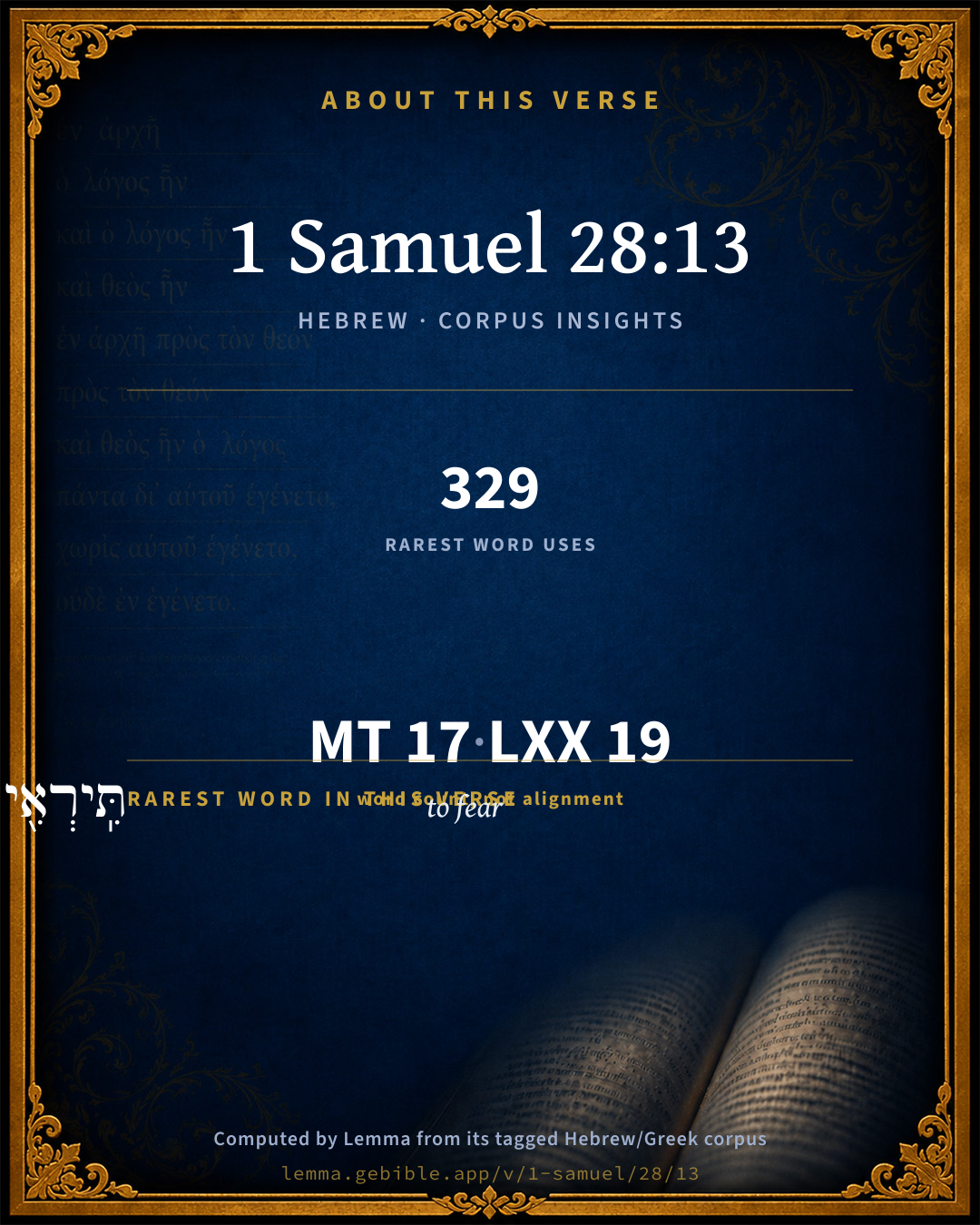
17
words
14
distinct lemmas
Historical
section

Grammatical profile

  • 6 verbs
  • 5 nouns
  • 3 prepositions
  • 1 conjunction
  • 2 particles

Verb forms

  • וַיֹּ֨אמֶר Qal · Sequential Imperfect
  • תִּֽירְאִ֖י Qal · Jussive
  • רָאִ֑ית Qal · Perfect
  • וַתֹּ֤אמֶר Qal · Sequential Imperfect
  • רָאִ֖יתִי Qal · Perfect
  • עֹלִ֥ים Qal · Participle Active

Repetition

Words recur within this verse — often emphatic in Hebrew:

  • וַיֹּ֨אמֶר to say H559 ×2
  • רָאִ֑ית to see H7200 ×2

Hebrew & Septuagint length

In English translation the verse runs 28 words from the Hebrew and 28 from the Septuagint (LXX English) — the same length.

A rough comparison of the two English renderings, which tokenize alike — not a word-level alignment.

Word counts can differ between the Hebrew and the Greek without any difference in meaning — e.g. the Hebrew direct-object marker אֵת has no separate Greek word, and Greek often adds the article ὁ.

In the original languages it is 17 Hebrew tokens and 19 Greek tokens — but the two are counted differently (Hebrew bundles its prefixes and suffixes into one token; the Greek is in lemma form), so that isn’t a like-for-like length.

Cross-references

4

Topical passages linked to 1 Samuel 28:13 in the Treasury of Scripture Knowledge — connected by theme and wording, ordered by reader-vote popularity; previews shown in the World English Bible.

  • Exodus 4:16 He will be your spokesman to the people; and it will happen, that he will be to you a mouth, and you will be to him as God.
  • Exodus 22:28 "You shall not blaspheme God, nor curse a ruler of your people.
  • Psalms 82:6–7 I said, "You are gods, All of you are sons of the Most High.
  • John 10:34–35 Jesus answered them, "Isn't it written in your law, 'I said, you are gods?'

Cross-references courtesy of OpenBible.info (CC BY 4.0).

Hebrew and Greek witnesses Masoretic Hebrew ↔ Greek Septuagint

The same verse in the two great witnesses to the Old Testament, shown verse-for-verse.

These are two independent witnesses, not word-aligned to each other, and the Septuagint is shown in lemma (dictionary) form.

Hebrew 1 Samuel 28:13 Masoretic · Westminster Leningrad Codex

וַיֹּ֨אמֶר לָ֥הּ הַמֶּ֛לֶךְ אַל תִּֽירְאִ֖י כִּ֣י מָ֣ה רָאִ֑ית וַתֹּ֤אמֶר הָֽאִשָּׁה֙ אֶל שָׁא֔וּל אֱלֹהִ֥ים רָאִ֖יתִי עֹלִ֥ים מִן הָאָֽרֶץ

The king said to her, Don't be afraid: for what do you see? The woman said to Saul, I see a god coming up out of the earth.

World English Bible · Public Domain

Greek LXX 1 Samuel 28:13 Septuagint · lemma form

καί εἶπον αὐτός ὁ βασιλεύς μή φοβέω εἶπον τίς ὁράω καί εἶπον αὐτός θεός ὁράω ἀναβαίνω ἐκ ὁ γῆ

And the king said to her, Fear not; tell me whom you have seen. And the woman said to him, I saw gods ascending out of the earth.

LXX2012 (modern English Septuagint) · Public Domain

Hebrew: Westminster Leningrad Codex (CC BY 4.0). Greek: Septuagint (public domain); English from LXX2012 (modern English Septuagint) (Public Domain). How the Septuagint differs from the Hebrew →

Targum (Aramaic paraphrase)

1

The Targum is the ancient Jewish Aramaic paraphrase of the Hebrew Scriptures — an interpretive translation, not the Hebrew text itself. Onkelos (literal) and Pseudo-Jonathan (expansive) render the Torah, and Jonathan the Prophets. Coverage is partial: where no permissively-licensed English translation exists for a verse, only the Aramaic is shown. This is verse-level text, not a word-by-word alignment to the Hebrew.

  1. Targum Jonathan Prophets (Joshua–Malachi)
    וַאֲמַר לָהּ מַלְכָּא לָא תִדְחֲלִין אֲרֵי מֶה חָזִית וַאֲמַרַת אִתְּתָא לְשָׁאוּל מַלְאָכָא דַייָ חֲזֵיתִי דְסָלִיק מִן אַרְעָא:

    (no public-domain English translation for this verse)

    Targum Jonathan — Aramaic: “Mikraot Gedolot” (public domain). English: “Sefaria Community Translation” (CC0 1.0 (public-domain dedication)); “London "Chaldee Paraphrase," 1871” (public domain). Text via Sefaria.

Commentary

Notes on 1 Samuel 28:13 from classic Christian and Jewish commentators (each source and its license shown beneath its notes). The classic Christian expositions comment on the surrounding passage and are grouped to its opening verse, so a note may address several verses; the Jewish commentaries on the Tanakh (Rashi and others) are per-verse, so they appear only where the commentator wrote on this verse.

Lemma curates 59 commentaries, every one of them public domain or Creative Commons licensed, each selected and text-cleaned for this edition rather than reprinted as found. About our sources →

Trapp's Complete Commentary

John Trapp

1Sa 28:13 And the king said unto her, Be not afraid: for what sawest thou? And the woman said unto Saul, I saw gods ascending out of the earth.

Ver. 13. For what sawest thou?] He then was not an eye-witness at first, the witch being in secretario, saith the Gloss, in a secret place by herself, working her feats.

saw gods ascending out of the earth,] i.e., Some goodly apparitions sent by Satan, as his apparitors and forerunners. Or, I saw a judge, or an excellent person, ascending, &c. {a}

{a} Jun.

John Trapp, A Commentary or Exposition upon All the Books of the Old and New Testament (1647–1656) — public domain. Text from a community e-Sword module.

Joseph Benson's Commentary

1Sa 28:13. The woman said, I saw gods ascending — The original word here used is elohim; and is with equal propriety rendered God, a god, or gods; when spoken of Jehovah it is translated God in the Scriptures; but when meant of the false gods of the heathen, of angels or of magistrates, which it sometimes is, it is generally rendered in the plural number. As it is plain the woman saw and spoke only of one person, it should evidently be translated a god here, that is, a divine or glorious person, full of majesty and splendour, exceeding not only mortal men, but common ghosts. Dr. Waterland renders it, a venerable person, and Mr. Locke says, it here signifies an angel or a judge, and that in the singular number. The same word certainly means magistrates, Psa 82:1-6.

Joseph Benson's Commentary on the Old and New Testaments (1811–1818) — public domain. Text from a community e-Sword module.

Tyndale Open Study Notes

Tyndale Open Resources

28:13 Saul asked the medium to describe what she saw that caused her to scream. She described a divine being, a god (Hebrew ’elohim) coming up. Perhaps she observed a human figure with a godlike or angelic appearance, or her use of the term god might reflect a pagan belief that a person becomes a god—a spirit possessing supernatural abilities—after death.

Tyndale Open Study Notes — © Tyndale Open Resources, licensed CC BY-SA 4.0. Text via the HelloAO Bible API.

Geneva Bible (1599)

Geneva Bible translators

Or, an excellent person.

Geneva Bible (1599) marginal notes — public domain. Text via Bolls.life.

Adam Clarke's Commentary

Verse 13. I saw gods ascending out of the earth.] The word אלהום elohim, which we translate gods, is the word which is used for the Supreme Being throughout the Bible; but all the versions, the Chaldee excepted, translate it in the plural number, as we do. The Chaldee has, I see מלאכא דיי malacha dayeya, an angel of the Lord, ascending from the earth. This sight alarmed the woman; it was what she did not expect; in this she could not recognise her familiar, and she was terrified at the appearance.

Adam Clarke's Commentary on the Bible (1810–1826) — public domain. Text from a community e-Sword/MySword module.

Ellicott's Commentary for English Readers

(13) I saw gods ascending out of the earth.—The king at once calms the witch’s fears for her life, and impatiently, as it would seem, asks what she saw which called forth the cry of fear and terror. “Gods”—this is the rendering of the Hebrew word Elohim. The English Version, however, follows the majority of the Versions here. The Chaldee translates the word by “angels.” Corn, à Lapide and the best modern scholars, however, reasoning from Saul’s words which immediately follow—“What is his form?”—suppose the Elohim to signify, not a plurality of appearances, but one God-like form: something majestic and august. The feeling, however, of antiquity seems to have been in favour of more than one supernatural form entering into the En-dor dwelling on that awful night. Besides the testimony of the Versions above referred to, the passage in the Babylonian Talmud treatise Chaggigah, quoted below, speaks of two positively spirit forms-Samuel and another.

A Bible Commentary for English Readers, edited by Charles John Ellicott (1878–1897) — public domain. Text from a community e-Sword module.

The Cambridge Bible for Schools and Colleges

gen. ed. J. J. S. Perowne

13. gods] The Heb. word Elôhîm is plural, and when not applied to God Himself is generally to be so rendered. But it is evident from 1Sa_28:14 that only a single figure appeared. Elôhîm here denotes a supernatural, non-earthly being; or as Josephus paraphrases it, “one of god-like form.”

The Cambridge Bible for Schools and Colleges (gen. ed. J. J. S. Perowne; Cambridge University Press, 1878–1918) — public domain. Text from a community e-Sword module.

John Gill's Exposition

And the king said unto her, be not afraid,.... Meaning not of the apparition, but of him; since he had sworn no punishment should come upon her, and he should inviolably observe his oath: for what sawest thou? for as yet Saul himself saw not anything, the woman being between him and the apparition; or she might be in another room with her familiar spirit performing the operations when Samuel appeared:

and the woman said unto Saul, I saw gods ascending out of the earth; a great personage, one of a majestic form, like the gods, or judges and civil magistrates, sometimes so called, as Kimchi and R. Isaiah rightly interpret it; and so the Targum,"I saw an angel of the Lord;''a person that looked like one; for not many came up with him, and particularly Moses, as say some Jewish writers (d).

(d) T. Bab. Chagigah, fol. 4. 8. Pirke Eliezer, c. 33.

John Gill's Exposition of the Whole Bible (1746–1763) — public domain (CC PDM 1.0). Text via the HelloAO Bible API.

Albert Barnes' Notes on the Bible

Gods - אלהים 'ĕlohı̂ym is here used in a general sense of a supernatural appearance, either angel or spirit. Hell, or the place of the departed (compare 1Sa 28:19; 2Sa 12:23) is represented as under the earth Isa 14:9-10; Eze 32:18.

Albert Barnes' Notes on the Bible (1834–1885) — public domain. Text from a community e-Sword/MySword module.

Haydock's Catholic Bible Commentary

Gods, or one venerable and divine personage. (Worthington) --- Elohim, is applied to Samuel for greater honour. It is a title given to the true God, to idols, and people in dignity. (Calmet)

George Leo Haydock (1774–1849), Haydock's Catholic Family Bible and Commentary, 1859 edition — public domain. Excludes Psalms (Douay-Rheims chapter numbering differs from Protestant) and Deuterocanonical books (Catholic canon only).

Matthew Poole's English Annotations

i.e. A god, a divine person, glorious, and full of majesty and splendour, exceeding not only mortal men, but common ghosts. She useth the plural number,

gods, either after the manner of the Hebrew language, which commonly useth that word of one person; or after the language and custom of the heathens. But the whole coherence shows that it was but one. For Saul desired but one, 1Sa 28:11, and he inquires and the woman answers only of one, 1Sa 28:14. Ascending out of the earth, as if it came from the place of the dead.

Matthew Poole's English Annotations on the Holy Bible (1683–1685) — public domain. Text from a community e-Sword/MySword module.

Whedon's Commentary on the Bible

Daniel D. Whedon

13. Be not afraid: for what sawest thou — She probably, at first, after returning from her clairvoyant state, refused, in her fear, to hold any more intercourse with the king; but after he had allayed her fears, perhaps by further oaths, (compare 1Sa_28:10,) she answered:

I saw gods ascending out of the earth — Neither the sacred historian nor his interpreter is responsible for the truth or falsehood of these words of the witch. But whatsoever of truth they may contain, we regard them as a part of those devices by which she sought to awe, and impose upon, both Saul and his servants. She probably alluded to the ghostly pictures which she saw passing, like so many shadows, over his excited imagination. What she saw in that one vision of Saul’s soul was a sufficient basis for her to devise and utter the responses that follow.

Daniel D. Whedon (gen. ed.), Commentary on the Old and New Testaments (1874–1909) — public domain. Text from a community e-Sword module.

The Pulpit Commentary

What sawest thou? Thus far Saul had seen nothing; and as the words literally are What seest thou? it is plain that she had not gone into another room, as some have supposed. The vision was entirely unsubstantial, and Saul, hearing her cry, and observing her excitement, and her steady gaze upon some object, asked what that object was. Probably she was at some distance from him, as was no doubt her custom when performing her incantations, in order that what she did might not be too closely observed; probably, too, she burnt odours, and surrounded herself with the smoke of incense. In answer to Saul she says, "I see Elohim ascending out of the earth." As the participle is plural, she does not mean God; nor, as it was a single appearance, is the rendering gods correct. What she means is that she saw some grand supernatural appearance rising out of the ground, which she calls a god in a general way, without attaching any very exact meaning to the term.

The Pulpit Commentary (1880–1919), ed. H.D.M. Spence-Jones & Joseph S. Exell — public domain. Text from a community e-Sword module.

John Wesley's Explanatory Notes

Gods - That is, a God, and divine person, glorious, and full of majesty and splendour, exceeding not only mortal men, but common ghosts. She used the plural number, gods, either after the manner of the Hebrew language, which commonly uses that word of one person: or, after the language and custom of the heathens.

John Wesley, Explanatory Notes Upon the Whole Bible (1754–1765) — public domain. Text via the GEBible commentary corpus.

unfoldingWord translationNotes

Door43 World Missions Community

a god

Other possible meanings are 1) "one like God" or 2) "a judge" (See: 1 Samuel 7:15).

translationWords

king

fear

Saul (OT)

false god

earth

clothe

robe

Samuel

bow

unfoldingWord translationNotes — © Distant Shores Media and the Door43 World Missions Community, licensed CC BY-SA 4.0. Source: git.door43.org/Door43/en_tn.

Rashi

Rabbi Shlomo Yitzchaki (Rashi)

I saw a godly man rising from the earth. Two angels, Moshe and Shmuel, for Shmuel feared, 'Perhaps I am being summoned for judgement,' and he therefore brought Moshe up with him, as it is stated in [Maseches] Chagiga and Ta'anis.

Rashi on the Tanakh — English translations: “The Judaica Press complete Tanach with Rashi, translated by A. J. Rosenberg” (CC BY 4.0); “Pentateuch with Rashi's commentary by M. Rosenbaum and A.M. Silbermann, 1929-1934” (public domain); “The Metsudah Tanach series, Lakewood, N.J” (CC BY 4.0); and “The Book of Joshua, Metsudah Publications, 1997” (CC BY 4.0). Text via Sefaria.

Lesson kit

Teaching starters — assembled from the data on this page, not authored interpretation. Every prompt links to the verse data it draws on. Edit before teaching.

1 Samuel, in the Historical, opens this verse with 17 words (14 distinct Hebrew lemmas). Its most distinctive word is yârêʼ (“to fear”). A historical commentator’s framing appears above. Read the whole chapter for the surrounding context.

Discussion questions

  1. What does “to fear” (yârêʼ) contribute to the verse as a whole?
  2. Exodus 4:16 shares this passage’s theme. How do the two illuminate each other?
  3. “to say” occurs 2× in this one verse. What is the effect of the repetition?
  4. These translations render this verse differently. What is at stake in choosing one wording over another?
  5. The verb «וַיֹּ֨אמֶר» is Qal Sequential Imperfect. How does its form color the action?
  6. Reading how Trapp's Complete Commentary and Joseph Benson's Commentary read this verse, where do the two commentators agree and where do they part?

Things to notice

Reading settings

Reading text

Shown beneath each verse's original-language words.

Old Testament
Old Testament edition

Read the OT as the Masoretic Hebrew (MT) or the Greek Septuagint (LXX).

English shown for the Greek Septuagint (in the Hebrew ↔ Greek comparison).

Comparing translations? Open the Compare panel on any verse page to stack up to four side by side.