
Numbers 16:27

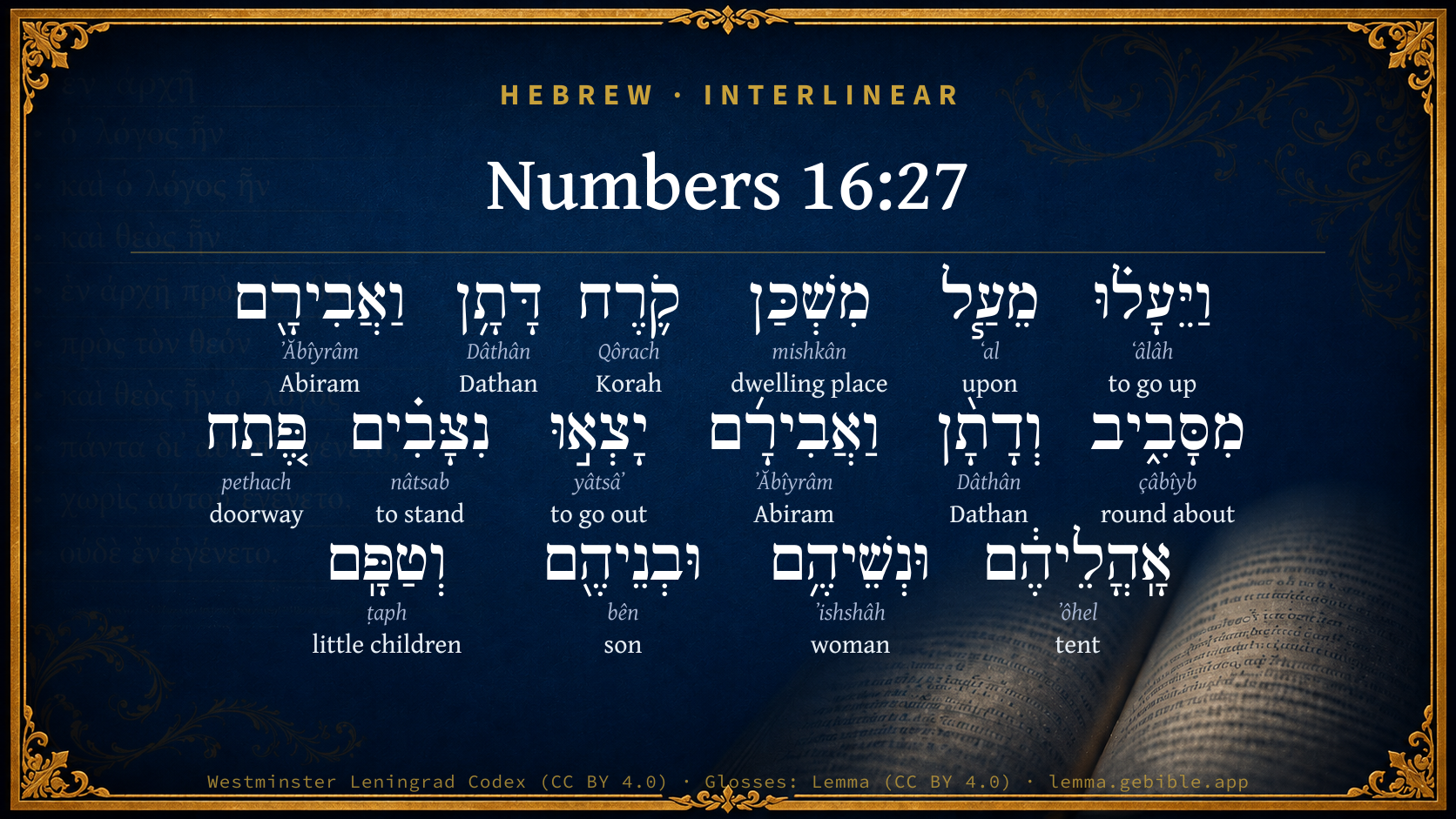
Hebrew (Westminster Leningrad Codex) Numbers 16:27 appears in the Hebrew Old Testament. The text above is from the Westminster Leningrad Codex. Each word links to its Strong’s number, a concise gloss, and parsing drawn from the Open Scriptures Hebrew Bible morphology. Click any word for its full Brown-Driver-Briggs (BDB) entry.
Download image
Cite this verse

Numbers 16:27 (World English Bible). Public Domain. Lemma interlinear Bible study tool, https://lemma.gebible.app/v/numbers/16/27.

Show BibTeX & RIS
BibTeX
RIS
English Translation
So they got them up from the tent of Korah, Dathan, and Abiram, on every side: and Dathan and Abiram came out, and stood at the door of their tents, and their wives, and their sons, and their little ones.
World English Bible · Public Domain
Download a study sheet

One document with this verse’s original text, its word-by-word gloss line, the meaning frame, cross-references with their text, attributed commentary, and full source and license credits — printable, and it pastes into notes with its structure intact.

This verse Autodidact and up

Study sheet (.html) Plain text (.txt)

A passage Seminary Student

Up to 50 verses in one chapter. A passage sheet keeps up to 6 commentary sources and 12 cross-references per verse, in the order this page ranks them, and says so on the sheet whenever that leaves anything out. Ask for a single verse and you get the Autodidact verse sheet above.

Everything on this page stays free to read, with no account — the sheet is a download of what is already on screen, not access to it.

Want to remove ads? Support Godless Engineer
Compare translations 3

The same verse in 3 English versions, stacked beneath the original-language interlinear above. Click any original word for its lexicon entry.

Each is an independent rendering of the whole verse — the interlinear is not word-aligned to these translations.

Highlighted words mark where these versions differ — a whole-verse word diff, not a word-by-word alignment.

  • World English Bible Public Domain
    So they got them up from the tent of Korah, Dathan, and Abiram, on every side: and Dathan and Abiram came out, and stood at the door of their tents, and their wives, and their sons, and their little ones.
  • King James Version Public Domain
    So they gat up from the tabernacle of Korah, Dathan, and Abiram, on every side: and Dathan and Abiram came out, and stood in the door of their tents, and their wives, and their sons, and their little children.
  • unfoldingWord Literal Text CC BY-SA 4.0
    And they were taken up from upon the dwelling of Korah, Dathan, and Abiram, from around, and Dathan and Abiram went out, standing the opening of their tents, and their wives and their sons and their children.

unfoldingWord Literal Text — © unfoldingWord, licensed CC BY-SA 4.0. Word-aligned USFM3 via Door43 (git.door43.org/unfoldingWord/en_ult).

Versions to compare (up to 4)

3 of 4 selected

Show all 18 translations

Every available English version of this verse, each an independent rendering of the whole verse.

  • World English Bible Public Domain
    So they got them up from the tent of Korah, Dathan, and Abiram, on every side: and Dathan and Abiram came out, and stood at the door of their tents, and their wives, and their sons, and their little ones.
  • Berean Standard Bible Public Domain
    So they moved away from the dwellings of Korah, Dathan, and Abiram. Meanwhile, Dathan and Abiram had come out and stood at the entrances to their tents with their wives and children and infants.
  • Majority Standard Bible Public Domain
    So they moved away from the dwellings of Korah, Dathan, and Abiram. Meanwhile, Dathan and Abiram had come out and stood at the entrances to their tents with their wives and children and infants.
  • King James Version Public Domain
    So they gat up from the tabernacle of Korah, Dathan, and Abiram, on every side: and Dathan and Abiram came out, and stood in the door of their tents, and their wives, and their sons, and their little children.
  • American Standard Version (1901) Public Domain
    So they gat them up from the tabernacle of Korah, Dathan, and Abiram, on every side: and Dathan and Abiram came out, and stood at the door of their tents, and their wives, and their sons, and their little ones.
  • Revised Version (1885) Public Domain
    So they gat them up from the tabernacle of Korah, Dathan, and Abiram, on every side: and Dathan and Abiram came out, and stood at the door of their tents, and their wives, and their sons, and their little ones.
  • Geneva Bible (1599) Public Domain
    So they gate them away from the Tabernacle of Korah, Dathan and Abiram on euerie side: and Dathan, and Abiram came out and stood in the doore of their tentes with their wiues, and their sonnes, and their little children.
  • Douay-Rheims (1899) Public Domain
    And when they were departed from their tents round about, Dathan and Abiron coming out stood in the entry of their pavilions with their wives and children, and all the people.
  • Young's Literal Translation Public Domain
    And they go up from the tabernacle of Korah, Dathan and Abiram, from round about, and Dathan, and Abiram have come out, standing at the opening of their tents, and their wives, and their sons, and their infants.
  • Literal Standard Version CC BY-SA 4.0
    And they go up from the dwelling place of Korah, Dathan, and Abiram, from all around, and Dathan and Abiram have come out, standing at the opening of their tents, with their wives, and their sons, and their infants.
  • Unlocked Literal Bible CC BY-SA 4.0
    So the community on every side of the tents of Korah, Dathan, and Abiram left them. Dathan and Abiram came out and stood at the entrance to their tents, with their wives, sons, and their little ones.
  • unfoldingWord Literal Text CC BY-SA 4.0
    And they were taken up from upon the dwelling of Korah, Dathan, and Abiram, from around, and Dathan and Abiram went out, standing the opening of their tents, and their wives and their sons and their children.
  • Darby Bible Public Domain
    And they got up from the habitation of Koran, Dathan, and Abiram, on every side. And Dathan and Abiram came out, and stood in the entrance of their tents, and their wives, and their sons, and their little ones.
  • World Messianic Bible Public Domain
    So they went away from the tent of Korah, Dathan, and Abiram, on every side. Dathan and Abiram came out, and stood at the door of their tents with their wives, their sons, and their little ones.
  • Webster's Bible Public Domain
    So they withdrew from the tabernacle of Korah, Dathan, and Abiram, on every side: and Dathan and Abiram came out, and stood in the door of their tents, and their wives, and their sons, and their little children.
  • Free Bible Version CC BY-SA 4.0
    The people moved away from the homes of Korah, Dathan, and Abiram. Dathan and Abiram came out and stood at the entrances to their tents along with their wives, children and little ones.
  • Bible in Basic English Public Domain
    So on every side they went away from the tent of Korah Dathan, and Abiram: and Dathan and Abiram came out to the door of their tents, with their wives and their sons and their little ones.
  • JPS Tanakh (1917) Public Domain
    So they got them up from the dwelling of Korah, Dathan, and Abiram, on every side; and Dathan and Abiram came out, and stood at the door of their tents, with their wives, and their sons, and their little ones.

Literal Standard Version (2020), Covenant Press — licensed CC BY-SA 4.0. Text via the HelloAO Bible API (eBible.org). Unlocked Literal Bible (unfoldingWord) — licensed CC BY-SA 4.0. Text via the HelloAO Bible API (eBible.org). unfoldingWord Literal Text — © unfoldingWord, licensed CC BY-SA 4.0. Word-aligned USFM3 via Door43 (git.door43.org/unfoldingWord/en_ult). Free Bible Version, Dr. Jonathan Gallagher — licensed CC BY-SA 4.0. Text via the HelloAO Bible API (eBible.org).

Word by word

More ways to search: Search by grammar → Find every occurrence → Compare this word →

Practice this passage: Drill this verse → Learn its vocabulary →

דָּתָ֥ן
Dâthân
H1885
“Dathan”
Noun, Proper
Part of Speech
Noun
Type
Proper
Full BDB Definition

Origin: of uncertain derivation

TWOT: None

Dathan = "belonging to a fountain" - a Reubenite chief, son of Eliab, who, with his brother, Abiram, joined Korah's conspiracy against Moses' authority
  1. וַיֵּעָל֗וּ ʻâlâh H5927 “and · to go up” Conjunction + Verb, Niphal, Sequential Imperfect, 3rd Person, Masculine, Plural
  2. מֵעַ֧ל ʻal H5921 “from · upon” Preposition + Preposition
  3. מִשְׁכַּן mishkân H4908 “dwelling place of” Noun, Common, Masculine, Singular, Construct
  4. קֹ֛רֶח Qôrach H7141 “Korah” Noun, Proper
  5. וַאֲבִירָ֖ם ʼĂbîyrâm H48 “and · Abiram” Conjunction + Noun, Proper
  6. מִסָּבִ֑יב çâbîyb H5439 “from · round about” Preposition + Noun, Common, Both, Singular, Absolute
  7. וְדָתָ֨ן Dâthân H1885 “and · Dathan” Conjunction + Noun, Proper
  8. וַאֲבִירָ֜ם ʼĂbîyrâm H48 “and · Abiram” Conjunction + Noun, Proper
  9. יָצְא֣וּ yâtsâʼ H3318 “to go out” Verb, Qal, Perfect, 3rd Person, Common, Plural
  10. נִצָּבִ֗ים nâtsab H5324 “standing” Verb, Niphal, Participle Active, Masculine, Plural, Absolute
  11. פֶּ֚תַח pethach H6607 “doorway of” Noun, Common, Masculine, Singular, Construct
  12. אָֽהֳלֵיהֶ֔ם ʼôhel H168 “tents · their” Noun, Common, Masculine, Plural, Construct + Suffix, Personal, 3rd Person, Masculine, Plural
  13. וּנְשֵׁיהֶ֥ם ʼishshâh H802 “and · women · their” Conjunction + Noun, Common, Feminine, Plural, Construct + Suffix, Personal, 3rd Person, Masculine, Plural
  14. וּבְנֵיהֶ֖ם bên H1121 “and · sons · their” Conjunction + Noun, Common, Masculine, Plural, Construct + Suffix, Personal, 3rd Person, Masculine, Plural
  15. וְטַפָּֽם ṭaph H2945 “and · little children · their” Conjunction + Noun, Common, Masculine, Singular, Construct + Suffix, Personal, 3rd Person, Masculine, Plural

About this verse

These counts appear in no published source. They are computed here, from the morphology-tagged text and Lemma’s own curated glosses. What Lemma adds →

16
words
14
distinct lemmas
Pentateuch
section

Notable vocabulary

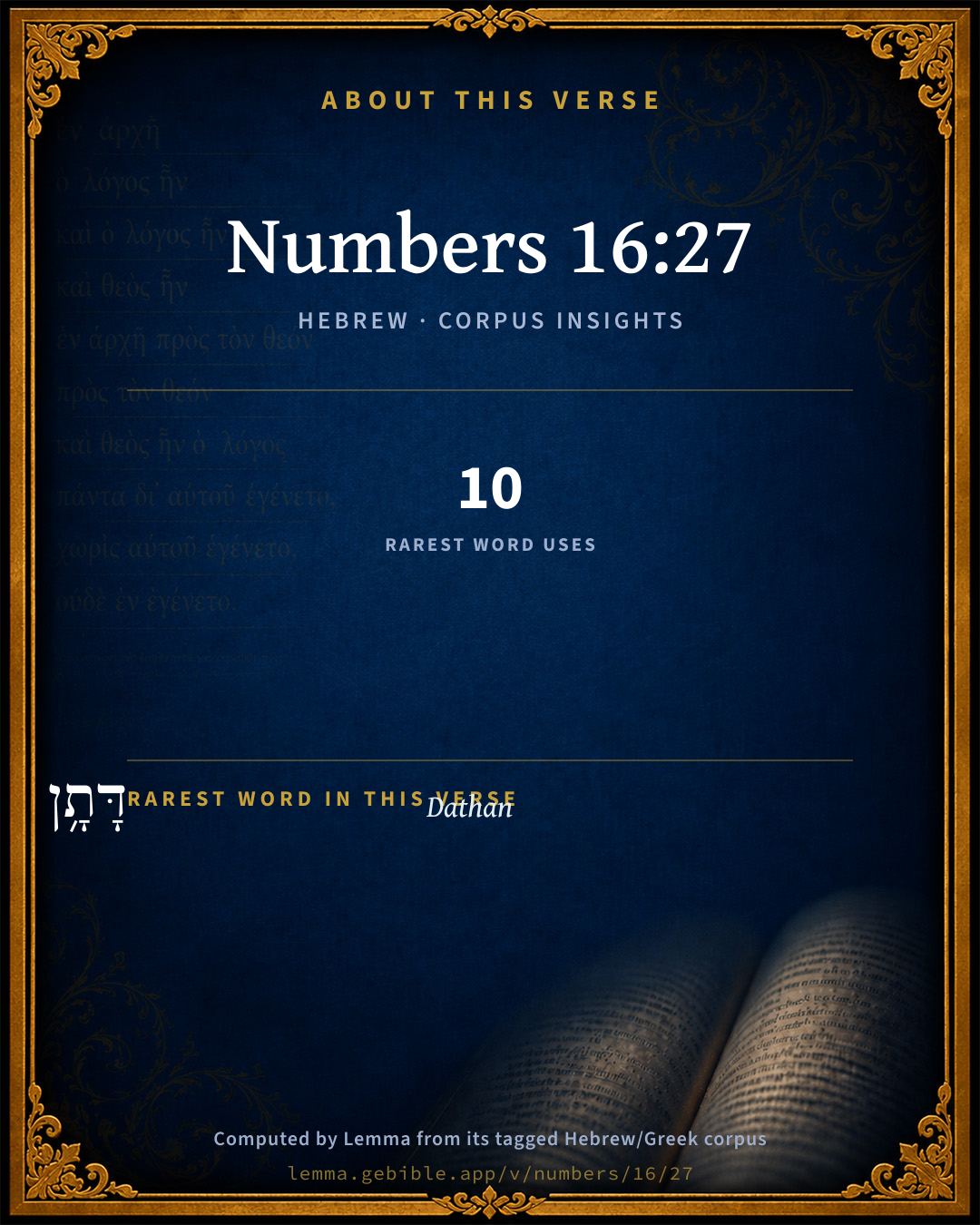
The rarest word here is דָּתָ֥ן Dathan H1885 — appearing just 10 times in the whole Hebrew Bible.

Shared distinctive vocabulary

דָּתָ֥ן Dathan H1885 occurs in 8 verses of the Hebrew Bible. Also found in:

Grammatical profile

  • 3 verbs
  • 12 nouns
  • 1 preposition

Verb forms

  • וַיֵּעָל֗וּ Niphal · Sequential Imperfect
  • יָצְא֣וּ Qal · Perfect
  • נִצָּבִ֗ים Niphal · Participle Active

Repetition

Words recur within this verse — often emphatic in Hebrew:

  • דָּתָ֥ן Dathan H1885 ×2
  • וַאֲבִירָ֖ם Abiram H48 ×2

Hebrew & Septuagint length

In English translation the verse runs 40 words from the Hebrew and 34 from the Septuagint (LXX English) — closely comparable.

A rough comparison of the two English renderings, which tokenize alike — not a word-level alignment.

Word counts can differ between the Hebrew and the Greek without any difference in meaning — e.g. the Hebrew direct-object marker אֵת has no separate Greek word, and Greek often adds the article ὁ.

Cross-references

6

Topical passages linked to Numbers 16:27 in the Treasury of Scripture Knowledge — connected by theme and wording, ordered by reader-vote popularity; previews shown in the World English Bible.

  • 2 Kings 9:30–31 When Jehu was come to Jezreel, Jezebel heard of it; and she painted her eyes, and attired her head, and looked out at the window.
  • Job 9:4 God who is wise in heart, and mighty in strength: Who has hardened himself against him, and prospered?
  • Job 40:10–11 "Now deck yourself with excellency and dignity. Array yourself with honor and majesty.
  • Proverbs 16:18 Pride goes before destruction, And a haughty spirit before a fall.
  • Proverbs 18:12 Before destruction the heart of man is proud, But before honor is humility.
  • Isaiah 28:14 Why hear the word of Yahweh, you scoffers, that rule this people that is in Jerusalem:

Cross-references courtesy of OpenBible.info (CC BY 4.0).

Hebrew and Greek witnesses Masoretic Hebrew ↔ Greek Septuagint

The same verse in the two great witnesses to the Old Testament, shown verse-for-verse.

These are two independent witnesses, not word-aligned to each other, and the Septuagint is shown in lemma (dictionary) form.

Hebrew Numbers 16:27 Masoretic · Westminster Leningrad Codex

וַיֵּעָל֗וּ מֵעַ֧ל מִשְׁכַּן קֹ֛רֶח דָּתָ֥ן וַאֲבִירָ֖ם מִסָּבִ֑יב וְדָתָ֨ן וַאֲבִירָ֜ם יָצְא֣וּ נִצָּבִ֗ים פֶּ֚תַח אָֽהֳלֵיהֶ֔ם וּנְשֵׁיהֶ֥ם וּבְנֵיהֶ֖ם וְטַפָּֽם

So they got them up from the tent of Korah, Dathan, and Abiram, on every side: and Dathan and Abiram came out, and stood at the door of their tents, and their wives, and their sons, and their little ones.

World English Bible · Public Domain

Greek LXX Numbers 16:27 Septuagint · lemma form

καί ἀποἵστημι ἀπό ὁ σκηνή κορε κύκλος καί δαθαν καί αβιρων ἐκἔρχομαι καί ἵστημι παρά ὁ θύρα ὁ σκηνή αὐτός καί ὁ γυνή αὐτός καί ὁ τέκνον αὐτός καί ὁ ἀποσκευή αὐτός

And they stood aloof from the tent of Core round about; and Dathan and Abiron went forth and stood by the doors of their tents, and their wives and their children and their store.

LXX2012 (modern English Septuagint) · Public Domain

On this verse, Haydock's Catholic Bible Commentary discusses the Septuagint’s reading. Read the note in Commentary ↓

Hebrew: Westminster Leningrad Codex (CC BY 4.0). Greek: Septuagint (public domain); English from LXX2012 (modern English Septuagint) (Public Domain). How the Septuagint differs from the Hebrew →

Targum (Aramaic paraphrase)

2

The Targum is the ancient Jewish Aramaic paraphrase of the Hebrew Scriptures — an interpretive translation, not the Hebrew text itself. Onkelos (literal) and Pseudo-Jonathan (expansive) render the Torah, and Jonathan the Prophets. Coverage is partial: where no permissively-licensed English translation exists for a verse, only the Aramaic is shown. This is verse-level text, not a word-by-word alignment to the Hebrew.

  1. Targum Onkelos Torah (Genesis–Deuteronomy)
    וְאִסְתַּלָקוּ מֵעִלַוֵי מַשְׁכְּנָא דְקֹרַח דָתָן וַאֲבִירָם מִסְחוֹר סְחוֹר וְדָתָן וַאֲבִירָם נְפָקוּ קַיְימִין בִּתְרַע מַשְׁכְּנֵיהוֹן וּנְשֵׁיהוֹן וּבְנֵיהוֹן וְטַפְלְהוֹן

    (no public-domain English translation for this verse)

    Targum Onkelos — Aramaic: “Onkelos Genesis” (public domain); “Onkelos Exodus” (public domain); “Onkelos Leviticus” (public domain); “Onkelos Numbers” (public domain); “Onkelos Deuteronomy” (public domain). English: “Sefaria Community Translation” (CC0 1.0 (public-domain dedication)); “J.W. Etheridge. The Targums of Onkelos and Jonathan Ben Uzziel on the Pentateuch. London: Longmans, Green, 1862” (public domain). Text via Sefaria.

  2. Targum Pseudo-Jonathan Torah (Genesis–Deuteronomy)
    וְאִסְתְּלָקוּ מֵעִלַוֵי מַשְׁכְּנָא דְקרַח דָתָן וַאֲבִירָם מִן חֲזוֹר חֲזוֹר וְדָתָן וַאֲבִירָם נְפָקוּ בְּמִילֵי חֵירוּפוּן וְקָמוּ וְאַרְגִיזוּ לְמשֶׁה תְּרַע מַשְׁכְּנֵיהוֹן וּנְשֵׁיהוֹן וּבְנֵיהוֹן וְטַפְלֵיהוֹן

    And they went apart from the tents of Korach, Dathan, and Abiram round about. But Dathan and Abiram came out, with reviling words, and arose and provoked Mosheh at the door of their tents, with their wives, their sons, and their little ones.

    Targum Pseudo-Jonathan — Aramaic: “Targum Jonathan on Genesis” (public domain); “Targum Jonathan on Exodus” (public domain); “Targum Jonathan on Leviticus” (public domain); “Targum Jonathan on Numbers” (public domain); “Targum Jonathan on Deuteronomy” (public domain). English: “The Targum of Jonathan ben Uzziel, trans. J. W. Etheridge, London, 1862” (public domain). Text via Sefaria.

Commentary

Notes on Numbers 16:27 from classic Christian and Jewish commentators (each source and its license shown beneath its notes). The classic Christian expositions comment on the surrounding passage and are grouped to its opening verse, so a note may address several verses; the Jewish commentaries on the Tanakh (Rashi and others) are per-verse, so they appear only where the commentator wrote on this verse.

Lemma curates 59 commentaries, every one of them public domain or Creative Commons licensed, each selected and text-cleaned for this edition rather than reprinted as found. About our sources →

Trapp's Complete Commentary

John Trapp

Num 16:27 So they gat up from the tabernacle of Korah, Dathan, and Abiram, on every side: and Dathan and Abiram came out, and stood in the door of their tents, and their wives, and their sons, and their little children.

Ver. 27. Came out and stood.] As out facing Moses, and scorning the judgment threatened. Deus quem destruit dementat. Hardened sinners make no more of God’s dreadful threatenings, than behemoth doth of iron weapons, which he esteemeth as straws.

John Trapp, A Commentary or Exposition upon All the Books of the Old and New Testament (1647–1656) — public domain. Text from a community e-Sword module.

Joseph Benson's Commentary

Num 16:27. Stood in the door — An argument of their foolish confidence, obstinacy, and impenitence, whereby they declared that they neither feared God nor reverenced man.

Joseph Benson's Commentary on the Old and New Testaments (1811–1818) — public domain. Text from a community e-Sword module.

Jamieson, Fausset & Brown

Robert Jamieson, A. R. Fausset & David Brown

the tabernacle of Korah, Dathan, and Abiram--Korah being a Kohathite, his tent could not have been in the Reubenite camp, and it does not appear that he himself was on the spot where Dathan and Abiram stood with their families. Their attitude of defiance indicated their daring and impenitent character, equally regardless of God and man.

Jamieson, Fausset & Brown — Commentary Critical and Explanatory on the Whole Bible (1871) — public domain (CC PDM 1.0). Text via the HelloAO Bible API.

Ellicott's Commentary for English Readers

(27) And Dathan and Abiram came out . . . —No mention is made of the position of Korah at this time, neither is any mention made of his sons, who, as we learn from Num_26:11, “died not” when the company of Korah died. His descendants are mentioned in 1Ch_6:22-38, and mention is made of “the sons of Korah” in the titles of eleven of the Psalms. Samuel the prophet and Heman the singer were of this family (1Ch_6:22; 1Ch_6:33).

A Bible Commentary for English Readers, edited by Charles John Ellicott (1878–1897) — public domain. Text from a community e-Sword module.

The Cambridge Bible for Schools and Colleges

gen. ed. J. J. S. Perowne

27. the tabernacle of Korah &c.] Read the tabernacle of Jehovah. See on Num_16:24.

The Cambridge Bible for Schools and Colleges (gen. ed. J. J. S. Perowne; Cambridge University Press, 1878–1918) — public domain. Text from a community e-Sword module.

John Gill's Exposition

So they gat up from the tabernacle of Korah, Dathan, and Abiram, on every side,.... The place where they met together and made their general rendezvous; this it seems was encompassed on all sides by people out of the several tribes, who either wished them well in their undertaking, or were curious to know how it would issue:

and Dathan and Abiram came out; out of the tabernacle of Korah, and went to their own tents; and came out of them:

and stood in the door of their tents, and their wives, and their sons,

and their little children; in an audacious manner, as not fearing God nor man; they carried their heads high, and were not in the least daunted at what they were threatened with; and by their looks and gestures bid defiance to Moses and the elders with him.

John Gill's Exposition of the Whole Bible (1746–1763) — public domain (CC PDM 1.0). Text via the HelloAO Bible API.

Albert Barnes' Notes on the Bible

Stood in the door of their tents - Apparently in contumacious defiance.

Albert Barnes' Notes on the Bible (1834–1885) — public domain. Text from a community e-Sword/MySword module.

Haydock's Catholic Bible Commentary

People, (frequentia). The Septuagint generally translate tappam by aposkene, "family and effects," of every denomination. (Calmet) --- Here was a full assembly waiting for the event, between fear and hope. As these rebels would not come, when Moses sent for them, he condescended to go to them, and denounced the impending ruin, ver. 14, 25. He commits his whole cause to God, and is willing to be rejected as a vile impostor, if God do not shew, by a miraculous and exemplary punishment of his opponents, that what he had hitherto done, as the head of the people, and particularly in the consecration of Aaron, was by his direction. (Haydock) --- He had before proved his mission by miracles, Exodus iv. (Worthington)

George Leo Haydock (1774–1849), Haydock's Catholic Family Bible and Commentary, 1859 edition — public domain. Excludes Psalms (Douay-Rheims chapter numbering differs from Protestant) and Deuterocanonical books (Catholic canon only).

Matthew Poole's English Annotations

Their tents were not far asunder, being both on the south side of the tabernacle, as appears from Num 2:10; 3:29.

Stood in the door of their tents; an argument of their foolish confidence, pride, and impudence, obstinacy, and impenitency, whereby they declared that they neither feared God nor reverenced man, and made themselves ripe for the approaching judgment.

Matthew Poole's English Annotations on the Holy Bible (1683–1685) — public domain. Text from a community e-Sword/MySword module.

Whedon's Commentary on the Bible

Daniel D. Whedon

27. Stood in the door of their tents — Their attitude was not that of penitence, but of curiosity or defiance. Earnest prayer might have saved them even then, but men abandoned by the grieved Spirit of God cannot pray.

Their little children — To these this sudden and awful death was not a punishment but a calamity. See Jos_7:24, note. Little children are still perishing through the folly, brutality, and neglect of their parents. There is no mention here of the children of Korah, some of whom, if not all, escaped, (Num_26:11,) probably because they did not consent to their father’s crime.

Daniel D. Whedon (gen. ed.), Commentary on the Old and New Testaments (1874–1909) — public domain. Text from a community e-Sword module.

The Pulpit Commentary

And Dathan and Abiram... stood in the door of their tents. To see what Moses would do. Nothing is said of Korah.

The Pulpit Commentary (1880–1919), ed. H.D.M. Spence-Jones & Joseph S. Exell — public domain. Text from a community e-Sword module.

John Wesley's Explanatory Notes

Stood in the door - An argument of their foolish confidence, obstinacy and impenitency, whereby they declared that they neither feared God, nor reverenced man.

John Wesley, Explanatory Notes Upon the Whole Bible (1754–1765) — public domain. Text via the GEBible commentary corpus.

Keil & Delitzsch

C. F. Keil & F. Delitzsch

The congregation obeyed; but Dathan and Abiram came and placed themselves in front of the tents, along with their wives and children, to see what Moses would do. Moses then announced the sentence: "By this shall he know that Jehovah hath sent me to do all these works, that not out of my own heart (i.e., that I do not act of my own accord). If these men die like all men (i.e., if these wicked men die a natural death like other men), and the oversight of all men take place over them (i.e., if the same providence watches over them as over all other men, and preserves them from sudden death), Jehovah hath not sent me. But if Jehovah create a creation (בריאה בּרא, i.e., work an extraordinary miracle), and the earth open its mouth and swallow them up, with all that belongs to them, so that they go down alive into hell, ye shall perceive that these men have despised Jehovah."

Keil & Delitzsch — Biblical Commentary on the Old Testament (1861–1891) — public domain (CC PDM 1.0). Text via the HelloAO Bible API. (Old Testament only.)

Rashi

Rabbi Shlomo Yitzchaki (Rashi)

יצאו נצבים [AND DATHAN AND ABIRAM] CAME OUT, STATIONING THEMSELVES [AT THE ENTRANCE OF THEIR TENT] — The word נצבים suggests that they stood with erect stature in a challenging attitude, ready to revile and to curse. The phrase is similar in meaning to (I Samuel 17:16) “And he stationed himself (ויתיצב) there for forty days”, which occurs in the story of Goliath (Midrash Tanchuma, Korach 3).

ונשיהם ובניהם וטפם AND THEIR WIVES, AND THEIR SONS, AND THEIR LITTLE ONES — Come and see how grievous a sin dissension is: for an earthly tribunal (more lit., a tribunal of here below) does not punish a person before he shows signs of puberty, the heavenly tribunal (more lit., the tribunal of above) not even before he is twenty years old, while here even the sucklings perished (Midrash Tanchuma, Korach 3).

Rashi on the Tanakh — English translations: “The Judaica Press complete Tanach with Rashi, translated by A. J. Rosenberg” (CC BY 4.0); “Pentateuch with Rashi's commentary by M. Rosenbaum and A.M. Silbermann, 1929-1934” (public domain); “The Metsudah Tanach series, Lakewood, N.J” (CC BY 4.0); and “The Book of Joshua, Metsudah Publications, 1997” (CC BY 4.0). Text via Sefaria.

Lesson kit

Teaching starters — assembled from the data on this page, not authored interpretation. Every prompt links to the verse data it draws on. Edit before teaching.

Numbers, in the Pentateuch, opens this verse with 16 words (14 distinct Hebrew lemmas). Its most distinctive word is Dâthân (“Dathan”). A historical commentator’s framing appears above. Read the whole chapter for the surrounding context.

Discussion questions

  1. What does “Dathan” (Dâthân) contribute to the verse as a whole?
  2. Numbers 16:1 shares the word «Dathan» with this verse. How do the two illuminate each other?
  3. “Dathan” occurs 2× in this one verse. What is the effect of the repetition?
  4. These translations render this verse differently. What is at stake in choosing one wording over another?
  5. The verb «וַיֵּעָל֗וּ» is Niphal Sequential Imperfect. How does its form color the action?
  6. Reading how Trapp's Complete Commentary and Joseph Benson's Commentary read this verse, where do the two commentators agree and where do they part?

Things to notice

Reading settings

Reading text

Shown beneath each verse's original-language words.

Old Testament
Old Testament edition

Read the OT as the Masoretic Hebrew (MT) or the Greek Septuagint (LXX).

English shown for the Greek Septuagint (in the Hebrew ↔ Greek comparison).

Comparing translations? Open the Compare panel on any verse page to stack up to four side by side.