
Exodus 32:23

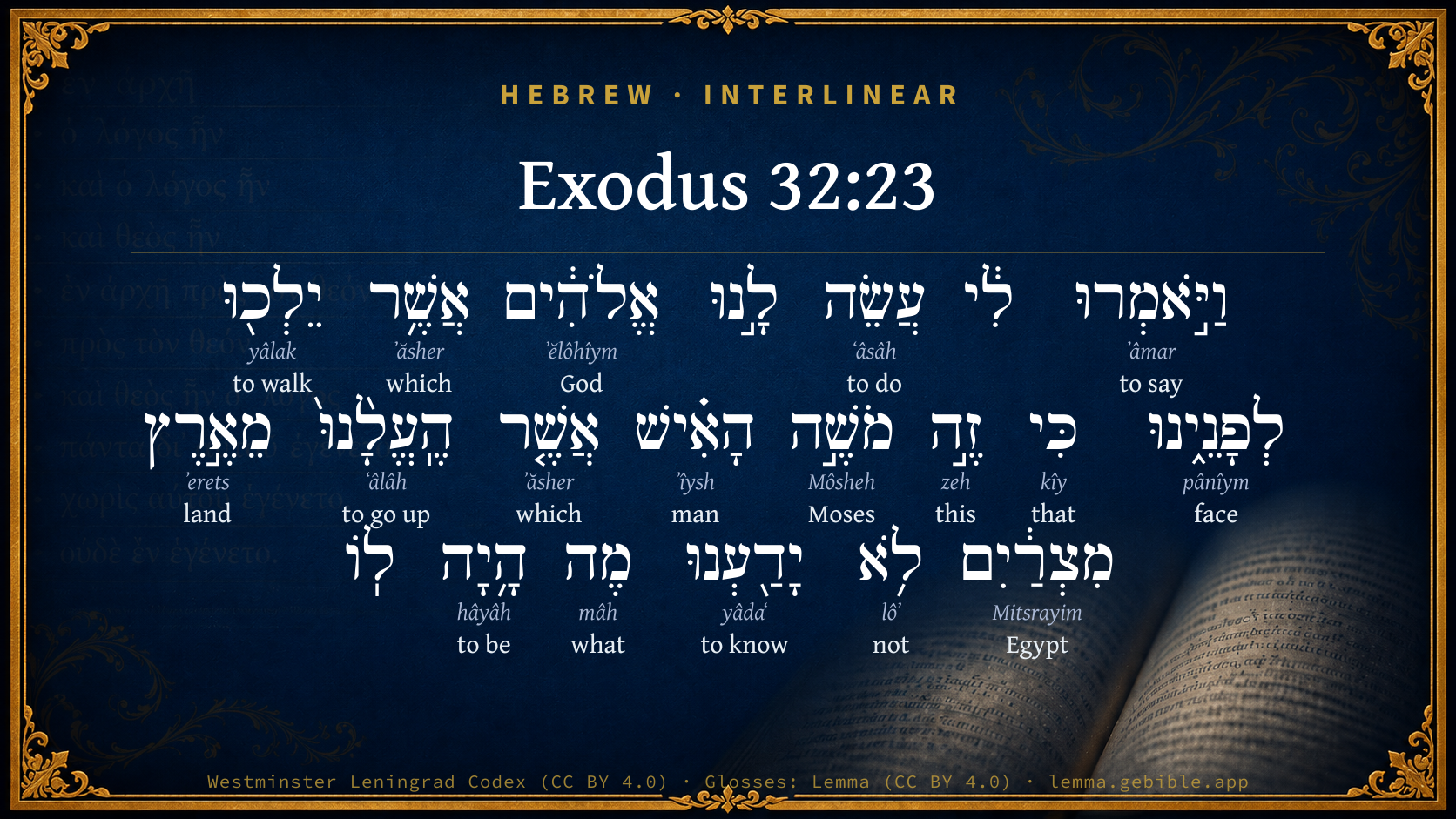
Hebrew (Westminster Leningrad Codex) Exodus 32:23 appears in the Hebrew Old Testament. The text above is from the Westminster Leningrad Codex. Each word links to its Strong’s number, a concise gloss, and parsing drawn from the Open Scriptures Hebrew Bible morphology. Click any word for its full Brown-Driver-Briggs (BDB) entry.
Download image
Cite this verse

Exodus 32:23 (World English Bible). Public Domain. Lemma interlinear Bible study tool, https://lemma.gebible.app/v/exodus/32/23.

Show BibTeX & RIS
BibTeX
RIS
English Translation
For they said to me, 'Make us gods, which shall go before us; for as for this Moses, the man who brought us up out of the land of Egypt, we don't know what has become of him.'
World English Bible · Public Domain
Download a study sheet

One document with this verse’s original text, its word-by-word gloss line, the meaning frame, cross-references with their text, attributed commentary, and full source and license credits — printable, and it pastes into notes with its structure intact.

This verse Autodidact and up

Study sheet (.html) Plain text (.txt)

A passage Seminary Student

Up to 50 verses in one chapter. A passage sheet keeps up to 6 commentary sources and 12 cross-references per verse, in the order this page ranks them, and says so on the sheet whenever that leaves anything out. Ask for a single verse and you get the Autodidact verse sheet above.

Everything on this page stays free to read, with no account — the sheet is a download of what is already on screen, not access to it.

Want to remove ads? Support Godless Engineer
Compare translations 3

The same verse in 3 English versions, stacked beneath the original-language interlinear above. Click any original word for its lexicon entry.

Each is an independent rendering of the whole verse — the interlinear is not word-aligned to these translations.

Highlighted words mark where these versions differ — a whole-verse word diff, not a word-by-word alignment.

  • World English Bible Public Domain
    For they said to me, 'Make us gods, which shall go before us; for as for this Moses, the man who brought us up out of the land of Egypt, we don't know what has become of him.'
  • King James Version Public Domain
    For they said unto me, Make us gods, which shall go before us: for as for this Moses, the man that brought us up out of the land of Egypt, we wot not what is become of him.
  • unfoldingWord Literal Text CC BY-SA 4.0
    And they said to me, ‘Make for us a god that will go before our faces. As for this Moses, the man that brought us up from the land of Egypt, we do not know what has happened to him.’

unfoldingWord Literal Text — © unfoldingWord, licensed CC BY-SA 4.0. Word-aligned USFM3 via Door43 (git.door43.org/unfoldingWord/en_ult).

Versions to compare (up to 4)

3 of 4 selected

Show all 18 translations

Every available English version of this verse, each an independent rendering of the whole verse.

  • World English Bible Public Domain
    For they said to me, 'Make us gods, which shall go before us; for as for this Moses, the man who brought us up out of the land of Egypt, we don't know what has become of him.'
  • Berean Standard Bible Public Domain
    They told me, ‘Make us gods who will go before us. As for this Moses who brought us up out of the land of Egypt, we do not know what has happened to him!’
  • Majority Standard Bible Public Domain
    They told me, ‘Make us gods who will go before us. As for this Moses who brought us up out of the land of Egypt, we do not know what has happened to him!’
  • King James Version Public Domain
    For they said unto me, Make us gods, which shall go before us: for as for this Moses, the man that brought us up out of the land of Egypt, we wot not what is become of him.
  • American Standard Version (1901) Public Domain
    For they said unto me, Make us gods, which shall go before us; for as for this Moses, the man that brought us up out of the land of Egypt, we know not what is become of him.
  • Revised Version (1885) Public Domain
    For they said unto me, Make us gods, which shall go before us: for as for this Moses, the man that brought us up out of the land of Egypt, we know not what is become of him.
  • Geneva Bible (1599) Public Domain
    And they sayde vnto me, Make vs gods to go before vs: for we knowe not what is become of this Moses (the man that brought vs out of the land of Egypt.)
  • Douay-Rheims (1899) Public Domain
    They said to me: Make us gods, that may go before us: for as to this Moses, who brought us forth out of the land of Egypt, we know not what is befallen him.
  • Young's Literal Translation Public Domain
    and they say to me, Make for us gods, who go before us, for this Moses -- the man who brought us up out of the land of Egypt -- we have not known what hath happened to him;
  • Literal Standard Version CC BY-SA 4.0
    and they say to me, Make gods for us, who go before us, for this Moses—the man who brought us up out of the land of Egypt—we have not known what has happened to him;
  • Unlocked Literal Bible CC BY-SA 4.0
    They said to me, 'Make us a god who will go before us. As for this Moses, the man who brought us up out of the land of Egypt, we do not know what has happened to him.'
  • unfoldingWord Literal Text CC BY-SA 4.0
    And they said to me, ‘Make for us a god that will go before our faces. As for this Moses, the man that brought us up from the land of Egypt, we do not know what has happened to him.’
  • Darby Bible Public Domain
    And they said to me, Make us a god, who will go before us; for this Moses, the man that has brought us up out of the land of Egypt, we do not know what is become of him!
  • World Messianic Bible Public Domain
    For they said to me, ‘Make us gods, which shall go before us. As for this Moses, the man who brought us up out of the land of Egypt, we don’t know what has become of him.’
  • Webster's Bible Public Domain
    For they said to me, Make us gods which shall go before us: for as for this Moses, the man that brought us out of the land of Egypt, we know not what is become of him.
  • Free Bible Version CC BY-SA 4.0
    They told me, ‘Make some gods for us who can lead us because this man Moses who brought us out of the land of Egypt—we don't know what's happened to him!’
  • Bible in Basic English Public Domain
    For they said to me, Make us a god to go before us: as for this Moses, who took us up out of the land of Egypt, we have no idea what has come to him.
  • JPS Tanakh (1917) Public Domain
    So they said unto me: Make us a god, which shall go before us; for as for this Moses, the man that brought us up out of the land of Egypt, we know not what is become of him.

Literal Standard Version (2020), Covenant Press — licensed CC BY-SA 4.0. Text via the HelloAO Bible API (eBible.org). Unlocked Literal Bible (unfoldingWord) — licensed CC BY-SA 4.0. Text via the HelloAO Bible API (eBible.org). unfoldingWord Literal Text — © unfoldingWord, licensed CC BY-SA 4.0. Word-aligned USFM3 via Door43 (git.door43.org/unfoldingWord/en_ult). Free Bible Version, Dr. Jonathan Gallagher — licensed CC BY-SA 4.0. Text via the HelloAO Bible API (eBible.org).

Word by word

More ways to search: Search by grammar → Find every occurrence → Compare this word →

Practice this passage: Drill this verse → Learn its vocabulary →

מִצְרַ֔יִם
Mitsrayim
H4714
“Egypt”
Noun, Proper
Part of Speech
Noun
Type
Proper
Full BDB Definition

Origin: dual of H4693

TWOT: 1235

Egyptians = "double straits" - a country at the northeastern section of Africa, adjacent to Palestine, and through which the Nile flows (noun proper locative) - the inhabitants or natives of Egypt (adjective)
  1. וַיֹּ֣אמְרוּ ʼâmar H559 “and · to say” Conjunction + Verb, Qal, Sequential Imperfect, 3rd Person, Masculine, Plural
  2. עֲשֵׂה ʻâsâh H6213 “do” Verb, Qal, Imperative, 2nd Person, Masculine, Singular
  3. אֱלֹהִ֔ים ʼĕlôhîym H430 “God(s)” Noun, Common, Masculine, Plural, Absolute
  4. אֲשֶׁ֥ר ʼăsher H834 “which” Particle, Relative
  5. יֵלְכ֖וּ yâlak H3212 “to walk” Verb, Qal, Imperfect, 3rd Person, Masculine, Plural
  6. לְפָנֵ֑ינוּ pânîym H6440 “to/for · face(s) · our” Preposition + Noun, Common, Both, Plural, Construct + Suffix, Personal, 1st Person, Common, Plural
  7. כִּי kîy H3588 “that” Conjunction
  8. זֶ֣ה zeh H2088 “this” Pronoun, Demonstrative, Masculine, Singular
  9. מֹשֶׁ֣ה Môsheh H4872 “Moses” Noun, Proper
  10. הָאִ֗ישׁ ʼîysh H376 “the · man” Particle, Definite Article + Noun, Common, Masculine, Singular, Absolute
  11. אֲשֶׁ֤ר ʼăsher H834 “which” Particle, Relative
  12. הֶֽעֱלָ֨נוּ֙ ʻâlâh H5927 “to go up · us” Verb, Hiphil, Perfect, 3rd Person, Masculine, Singular + Suffix, Personal, 1st Person, Common, Plural
  13. מֵאֶ֣רֶץ ʼerets H776 “from · land of” Preposition + Noun, Common, Both, Singular, Construct
  14. לֹ֥א lôʼ H3808 “not” Particle, Negative
  15. יָדַ֖עְנוּ yâdaʻ H3045 “to know” Verb, Qal, Perfect, 1st Person, Common, Plural
  16. מֶה mâh H4100 “what” Particle, Interrogative
  17. הָ֥יָה hâyâh H1961 “to be” Verb, Qal, Perfect, 3rd Person, Masculine, Singular

About this verse

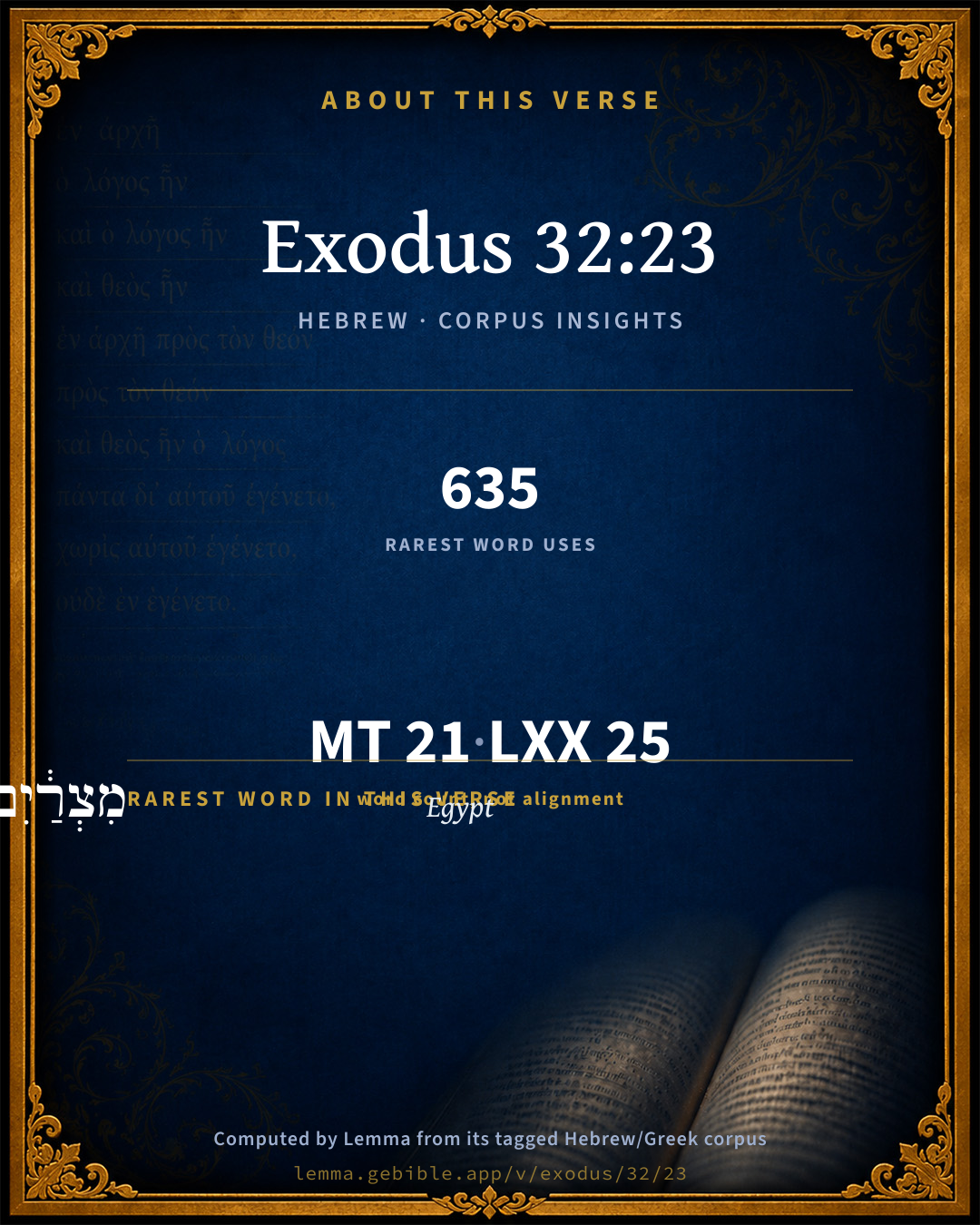
These counts appear in no published source. They are computed here, from the morphology-tagged text and Lemma’s own curated glosses. What Lemma adds →

21
words
17
distinct lemmas
Pentateuch
section

Grammatical profile

  • 6 verbs
  • 6 nouns
  • 1 pronoun
  • 3 prepositions
  • 1 conjunction
  • 4 particles

Verb forms

  • וַיֹּ֣אמְרוּ Qal · Sequential Imperfect
  • עֲשֵׂה Qal · Imperative
  • יֵלְכ֖וּ Qal · Imperfect
  • הֶֽעֱלָ֨נוּ֙ Hiphil · Perfect
  • יָדַ֖עְנוּ Qal · Perfect
  • הָ֥יָה Qal · Perfect

Repetition

A word recurs within this verse — often emphatic in Hebrew:

  • אֲשֶׁ֥ר which H834 ×2

Hebrew & Septuagint length

In English translation the verse runs 38 words from the Hebrew and 34 from the Septuagint (LXX English) — closely comparable.

A rough comparison of the two English renderings, which tokenize alike — not a word-level alignment.

Word counts can differ between the Hebrew and the Greek without any difference in meaning — e.g. the Hebrew direct-object marker אֵת has no separate Greek word, and Greek often adds the article ὁ.

In the original languages it is 21 Hebrew tokens and 25 Greek tokens — but the two are counted differently (Hebrew bundles its prefixes and suffixes into one token; the Greek is in lemma form), so that isn’t a like-for-like length.

Cross-references

2

Topical passages linked to Exodus 32:23 in the Treasury of Scripture Knowledge — connected by theme and wording, ordered by reader-vote popularity; previews shown in the World English Bible.

  • Exodus 32:1–4 When the people saw that Moses delayed to come down from the mountain, the people gathered themselves together to Aaron, and said to him, "Come, make us gods, which shall go before us; for as for this Moses, the man who brought us up out of the land of Egypt, we don't know what has become of him."
  • Exodus 32:8 They have turned aside quickly out of the way which I commanded them. They have made themselves a molten calf, and have worshiped it, and have sacrificed to it, and said, 'These are your gods, Israel, which brought you up out of the land of Egypt.'"

Cross-references courtesy of OpenBible.info (CC BY 4.0).

Hebrew and Greek witnesses Masoretic Hebrew ↔ Greek Septuagint

The same verse in the two great witnesses to the Old Testament, shown verse-for-verse.

These are two independent witnesses, not word-aligned to each other, and the Septuagint is shown in lemma (dictionary) form.

Hebrew Exodus 32:23 Masoretic · Westminster Leningrad Codex

וַיֹּ֣אמְרוּ לִ֔י עֲשֵׂה לָ֣נוּ אֱלֹהִ֔ים אֲשֶׁ֥ר יֵלְכ֖וּ לְפָנֵ֑ינוּ כִּי זֶ֣ה מֹשֶׁ֣ה הָאִ֗ישׁ אֲשֶׁ֤ר הֶֽעֱלָ֨נוּ֙ מֵאֶ֣רֶץ מִצְרַ֔יִם לֹ֥א יָדַ֖עְנוּ מֶה הָ֥יָה לֽוֹ

For they said to me, 'Make us gods, which shall go before us; for as for this Moses, the man who brought us up out of the land of Egypt, we don't know what has become of him.'

World English Bible · Public Domain

Greek LXX Exodus 32:23 Septuagint · lemma form

λέγω γάρ ἐγώ ποιέω ἐγώ θεός ὅς προπορεύομαι ἐγώ ὁ γάρ μωυσῆς οὗτος ὁ ἄνθρωπος ὅς ἐκἄγω ἐγώ ἐκ αἴγυπτος οὐ οἶδα τίς γίγνομαι αὐτός

For they say to me, Make us gods, which shall go before us; for as for this man Moses, who brought us out of Egypt, we do not know what is become of him.

LXX2012 (modern English Septuagint) · Public Domain

Hebrew: Westminster Leningrad Codex (CC BY 4.0). Greek: Septuagint (public domain); English from LXX2012 (modern English Septuagint) (Public Domain). How the Septuagint differs from the Hebrew →

Targum (Aramaic paraphrase)

2

The Targum is the ancient Jewish Aramaic paraphrase of the Hebrew Scriptures — an interpretive translation, not the Hebrew text itself. Onkelos (literal) and Pseudo-Jonathan (expansive) render the Torah, and Jonathan the Prophets. Coverage is partial: where no permissively-licensed English translation exists for a verse, only the Aramaic is shown. This is verse-level text, not a word-by-word alignment to the Hebrew.

  1. Targum Onkelos Torah (Genesis–Deuteronomy)
    וַאֲמָרוּ לִי עִבֵיד לָנָא דַחֲלָן דִי יְהָכָן קֳדָמָנָא אֲרֵי דֵין משֶׁה גַבְרָא דִי אַסְקָנָא מֵאַרְעָא דְמִצְרַיִם לָא יְדַעְנָא מָא הֲוָה לֵהּ:

    (no public-domain English translation for this verse)

    Targum Onkelos — Aramaic: “Onkelos Genesis” (public domain); “Onkelos Exodus” (public domain); “Onkelos Leviticus” (public domain); “Onkelos Numbers” (public domain); “Onkelos Deuteronomy” (public domain). English: “Sefaria Community Translation” (CC0 1.0 (public-domain dedication)); “J.W. Etheridge. The Targums of Onkelos and Jonathan Ben Uzziel on the Pentateuch. London: Longmans, Green, 1862” (public domain). Text via Sefaria.

  2. Targum Pseudo-Jonathan Torah (Genesis–Deuteronomy)
    וַאֲמָרוּ לִי עִיבַד לָנָא דַחֲלָן דִּיטַיְילוּן קֳדָמָנָא אֲרוּם דֵּין משֶׁה גַבְרָא דְאַסְקָנָא מֵאַרְעָא דְמִצְרַיִם אִישְׁתַּלְהַב בְּטַוְורָא בְּאֵישָׁא מְצַלְהֲבָא מִן קֳדָם יְיָ וְלָא אִשְׁתְּמוֹדַעֲנָא מַה הֲוָה לֵיהּ בְּסֵיפֵיהּ

    and they said to me, Make us gods that may go before us; for this Mosheh, the man who brought us up from the land of Mizraim, is consumed in the mountain, by the flaming fire from before the Lord, and we know not what hath been done to him in his end.

    Targum Pseudo-Jonathan — Aramaic: “Targum Jonathan on Genesis” (public domain); “Targum Jonathan on Exodus” (public domain); “Targum Jonathan on Leviticus” (public domain); “Targum Jonathan on Numbers” (public domain); “Targum Jonathan on Deuteronomy” (public domain). English: “The Targum of Jonathan ben Uzziel, trans. J. W. Etheridge, London, 1862” (public domain). Text via Sefaria.

Commentary

Notes on Exodus 32:23 from classic Christian and Jewish commentators (each source and its license shown beneath its notes). The classic Christian expositions comment on the surrounding passage and are grouped to its opening verse, so a note may address several verses; the Jewish commentaries on the Tanakh (Rashi and others) are per-verse, so they appear only where the commentator wrote on this verse.

Lemma curates 59 commentaries, every one of them public domain or Creative Commons licensed, each selected and text-cleaned for this edition rather than reprinted as found. About our sources →

Trapp's Complete Commentary

John Trapp

Exo 32:23 For they said unto me, Make us gods, which shall go before us: for [as for] this Moses, the man that brought us up out of the land of Egypt, we wot not what is become of him.

Ver. 23. We wot not what, &c.] See the danger of nonresidency.

John Trapp, A Commentary or Exposition upon All the Books of the Old and New Testament (1647–1656) — public domain. Text from a community e-Sword module.

Joseph Benson's Commentary

Exo 32:23. They said, Make us gods — It is natural to us to endeavour thus to transfer our guilt. He likewise extenuates his own share in the sin, as if he had only bid them break off their gold, intending but to make a hasty essay for the present, and childishly insinuates that when he cast the gold into the fire, it came out either by accident, or by the magic art of some of the mixed multitude, (as the Jewish writers dream,) in this shape. This was all Aaron had to say for himself, and he had better have said nothing, for his defence did but aggravate his offence; and yet, as sin did abound, grace did much more abound.

Joseph Benson's Commentary on the Old and New Testaments (1811–1818) — public domain. Text from a community e-Sword module.

John Gill's Exposition

And I said unto them, whosoever hath any gold, let them break it off,.... That is, any ear rings of gold, let them loose or take them off their ears:

so they gave it me; of their own accord, as if unasked by him, though he had bid them bring it to him, Exo 32:2,

then I cast it into the fire; to melt it, but says nothing of the mould the melted gold was poured into:

and there came out this calf; he speaks of it as if the gold became in the form of a calf without any design, or without using any methods to put it in this form; but that it was a matter of chance, or rather something preternatural and miraculous; he speaks of it as if it was alive, and came out of itself: and indeed the Jews represent it as done by magic art, and by the operation of Satan, and speak of it as coming out alive, bellowing and dancing; and the Targum of Jonathan is,"and I cast it into the fire, and Satan entered into the midst of it, and out of it came the likeness of this calf.''Aaron says not a word of his fashioning it with a graving tool, after he had made it a molten calf; but Moses learned this elsewhere, and has recorded it. What Moses thought of this apology is not said; it could not be satisfactory to him: and it is certain the conduct of Aaron in this affair was displeasing to God; and it seemed as if he would have destroyed him, had not Moses prayed for him, Deu 9:20.

John Gill's Exposition of the Whole Bible (1746–1763) — public domain (CC PDM 1.0). Text via the HelloAO Bible API.

The Pulpit Commentary

Make us gods. Rather "Make us a god."

The Pulpit Commentary (1880–1919), ed. H.D.M. Spence-Jones & Joseph S. Exell — public domain. Text from a community e-Sword module.

John Wesley's Explanatory Notes

They said, make us Gods - It is natural to us to endeavour thus to transfer our guilt. He likewise extenuates his own share in the sin, as if he had only bid them break off their gold, intending but to make a hasty essay for the present, and childishly insinuates that when he cast the gold into the fire, it came out either by accident, or by the magic art of some of the mixt multitude (as the Jewish writers dream) in this shape. This was all Aaron had to say for himself, and he had better have said nothing, for his defense did but aggravate his offense; and yet as sin did abound, grace did much more abound.

John Wesley, Explanatory Notes Upon the Whole Bible (1754–1765) — public domain. Text via the GEBible commentary corpus.

Lesson kit

Teaching starters — assembled from the data on this page, not authored interpretation. Every prompt links to the verse data it draws on. Edit before teaching.

Exodus, in the Pentateuch, opens this verse with 21 words (17 distinct Hebrew lemmas). Its most distinctive word is Mitsrayim (“Egypt”). A historical commentator’s framing appears above. Read the whole chapter for the surrounding context.

Discussion questions

  1. What does “Egypt” (Mitsrayim) contribute to the verse as a whole?
  2. Exodus 32:1–4 shares this passage’s theme. How do the two illuminate each other?
  3. “which” occurs 2× in this one verse. What is the effect of the repetition?
  4. The translations on this page render this verse differently — a whole-verse word diff, not a word-by-word alignment. What might account for the different wordings?
  5. The verb «וַיֹּ֣אמְרוּ» is Qal Sequential Imperfect. How does its form color the action?
  6. Reading how Trapp's Complete Commentary and Joseph Benson's Commentary read this verse, where do the two commentators agree and where do they part?

Things to notice

Reading settings

Reading text

Shown beneath each verse's original-language words.

Old Testament
Old Testament edition

Read the OT as the Masoretic Hebrew (MT) or the Greek Septuagint (LXX).

English shown for the Greek Septuagint (in the Hebrew ↔ Greek comparison).

Comparing translations? Open the Compare panel on any verse page to stack up to four side by side.