Numbers 22:41

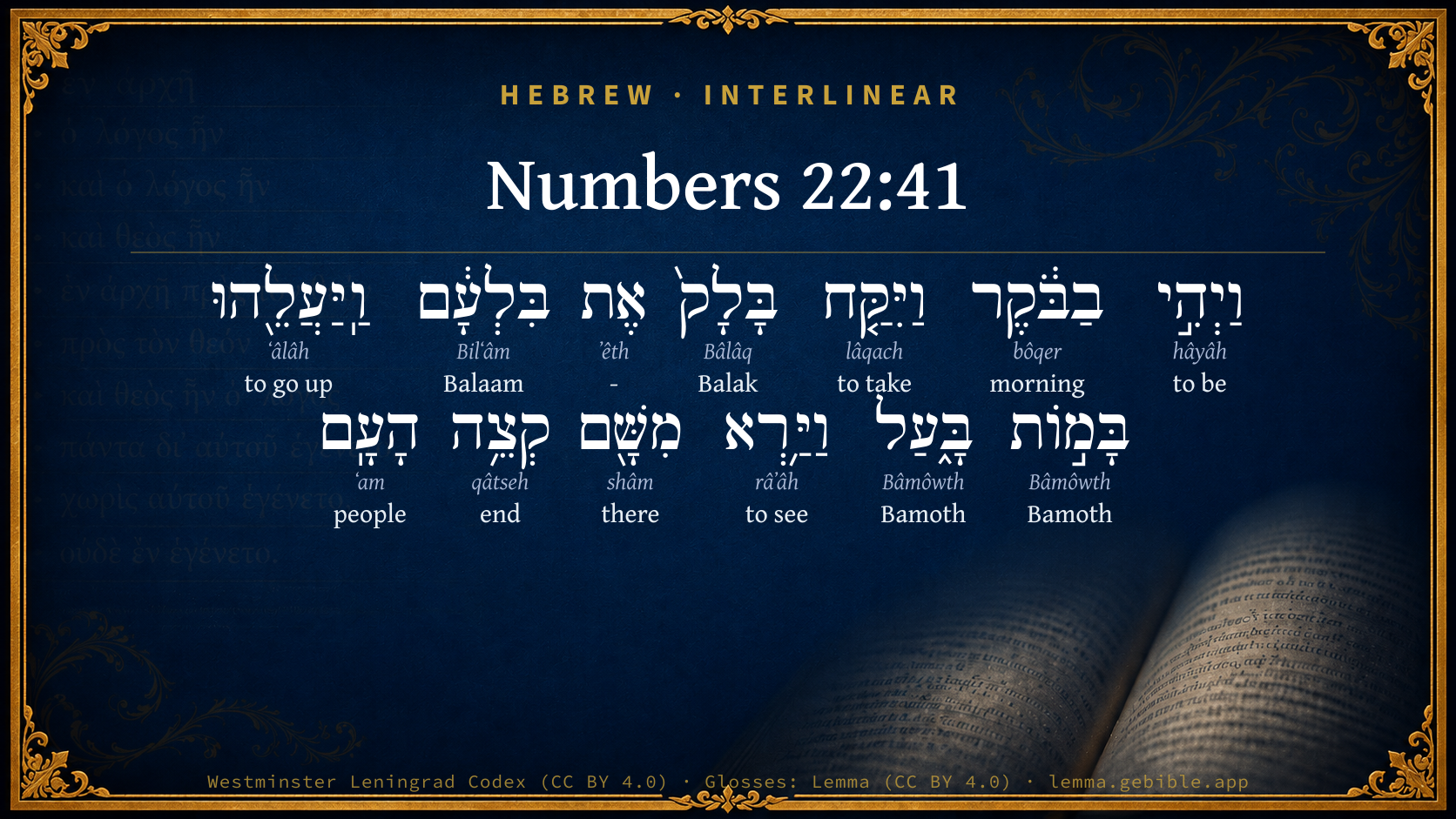
Hebrew (Westminster Leningrad Codex) Numbers 22:41 appears in the Hebrew Old Testament. The text above is from the Westminster Leningrad Codex. Each word links to its Strong’s number, a concise gloss, and parsing drawn from the Open Scriptures Hebrew Bible morphology. Click any word for its full Brown-Driver-Briggs (BDB) entry.
Download image
Cite this verse

Numbers 22:41 (World English Bible). Public Domain. Lemma interlinear Bible study tool, https://lemma.gebible.app/v/numbers/22/41.

Show BibTeX & RIS
BibTeX
RIS
English Translation
It happened in the morning, that Balak took Balaam, and brought him up into the high places of Baal; and he saw from there the utmost part of the people.
World English Bible · Public Domain
Download a study sheet

One document with this verse’s original text, its word-by-word gloss line, the meaning frame, cross-references with their text, attributed commentary, and full source and license credits — printable, and it pastes into notes with its structure intact.

This verse Autodidact and up

Study sheet (.html) Plain text (.txt)

A passage Seminary Student

Up to 50 verses in one chapter. A passage sheet keeps up to 6 commentary sources and 12 cross-references per verse, in the order this page ranks them, and says so on the sheet whenever that leaves anything out. Ask for a single verse and you get the Autodidact verse sheet above.

Everything on this page stays free to read, with no account — the sheet is a download of what is already on screen, not access to it.

Want to remove ads? Support Godless Engineer
Compare translations 3

The same verse in 3 English versions, stacked beneath the original-language interlinear above. Click any original word for its lexicon entry.

Each is an independent rendering of the whole verse — the interlinear is not word-aligned to these translations.

Highlighted words mark where these versions differ — a whole-verse word diff, not a word-by-word alignment.

  • World English Bible Public Domain
    It happened in the morning, that Balak took Balaam, and brought him up into the high places of Baal; and he saw from there the utmost part of the people.
  • King James Version Public Domain
    And it came to pass on the morrow, that Balak took Balaam, and brought him up into the high places of Baal, that thence he might see the utmost part of the people.
  • unfoldingWord Literal Text CC BY-SA 4.0
    And it happened in the morning that Balak took Balaam and brought him up Bamoth Baal, and he saw from there the edge of the people.

unfoldingWord Literal Text — © unfoldingWord, licensed CC BY-SA 4.0. Word-aligned USFM3 via Door43 (git.door43.org/unfoldingWord/en_ult).

Versions to compare (up to 4)

3 of 4 selected

Show all 18 translations

Every available English version of this verse, each an independent rendering of the whole verse.

  • World English Bible Public Domain
    It happened in the morning, that Balak took Balaam, and brought him up into the high places of Baal; and he saw from there the utmost part of the people.
  • Berean Standard Bible Public Domain
    The next morning, Balak took Balaam and brought him up to Bamoth-baal. From there he could see the outskirts of the camp of the people.
  • Majority Standard Bible Public Domain
    The next morning, Balak took Balaam and brought him up to Bamoth-baal. From there he could see the outskirts of the camp of the people.
  • King James Version Public Domain
    And it came to pass on the morrow, that Balak took Balaam, and brought him up into the high places of Baal, that thence he might see the utmost part of the people.
  • American Standard Version (1901) Public Domain
    And it came to pass in the morning, that Balak took Balaam, and brought him up into the high places of Baal; and he saw from thence the utmost part of the people.
  • Revised Version (1885) Public Domain
    And it came to pass in the morning, that Balak took Balaam, and brought him up into the high places of Baal, and he saw from thence the utmost part of the people.
  • Geneva Bible (1599) Public Domain
    And on the morowe Balak tooke Balaam, and brought him vp into the hie places of Baal, that thence hee might see the vtmost part of the people.
  • Douay-Rheims (1899) Public Domain
    And when morning was come, he brought him to the high places of Baal, and he beheld the uttermost part of the people.
  • Young's Literal Translation Public Domain
    and it cometh to pass in the morning, that Balak taketh Balaam, and causeth him to go up the high places of Baal, and he seeth from thence the extremity of the people.
  • Literal Standard Version CC BY-SA 4.0
    and it comes to pass in the morning, that Balak takes Balaam and causes him to go up [to] the high places of Ba‘al, and he sees the extremity of the people from there.
  • Unlocked Literal Bible CC BY-SA 4.0
    In the morning, Balak took Balaam up to the high place of Baal. From there Balaam could see only a part of the Israelites in their camp.
  • unfoldingWord Literal Text CC BY-SA 4.0
    And it happened in the morning that Balak took Balaam and brought him up Bamoth Baal, and he saw from there the edge of the people.
  • Darby Bible Public Domain
    And it came to pass on the morrow, that Balak took Balaam, and brought him up to the high places of Baal, and he saw from thence the extremity of the people.
  • World Messianic Bible Public Domain
    In the morning, Balak took Balaam, and brought him up into the high places of Baal; and he saw from there part of the people.
  • Webster's Bible Public Domain
    And it came to pass on the morrow, that Balak took Balaam, and conducted him to the high places of Baal, that thence he might see the utmost part of the people.
  • Free Bible Version CC BY-SA 4.0
    The next morning Balak took Balaam up to Bamoth-baal. From there he could see the extent of the Israelite camp.
  • Bible in Basic English Public Domain
    And in the morning Balak took Balaam up to the high places of Baal, and from there he was able to see the outer limits of the people.
  • JPS Tanakh (1917) Public Domain
    And it came to pass in the morning that Balak took Balaam, and brought him up into Bamoth-baal, and he saw from thence the utmost part of the people.

Literal Standard Version (2020), Covenant Press — licensed CC BY-SA 4.0. Text via the HelloAO Bible API (eBible.org). Unlocked Literal Bible (unfoldingWord) — licensed CC BY-SA 4.0. Text via the HelloAO Bible API (eBible.org). unfoldingWord Literal Text — © unfoldingWord, licensed CC BY-SA 4.0. Word-aligned USFM3 via Door43 (git.door43.org/unfoldingWord/en_ult). Free Bible Version, Dr. Jonathan Gallagher — licensed CC BY-SA 4.0. Text via the HelloAO Bible API (eBible.org).

Word by word

More ways to search: Search by grammar → Find every occurrence → Compare this word →

Practice this passage: Drill this verse → Learn its vocabulary →

בָּמ֣וֹת
Bâmôwth
H1120
“Bamoth”
Noun, Proper
Part of Speech
Noun
Type
Proper
Full BDB Definition

Origin: plural of H1116

TWOT: None

Bamoth = "high places" or " great high place" - a town on the river Arnon in Moab
  1. וַיְהִ֣י hâyâh H1961 “and · to be” Conjunction + Verb, Qal, Sequential Imperfect, 3rd Person, Masculine, Singular
  2. בַבֹּ֔קֶר bôqer H1242 “in/at the · morning” Preposition, Determined + Noun, Common, Masculine, Singular, Absolute
  3. וַיִּקַּ֤ח lâqach H3947 “and · to take” Conjunction + Verb, Qal, Sequential Imperfect, 3rd Person, Masculine, Singular
  4. בָּלָק֙ Bâlâq H1111 “Balak” Noun, Proper
  5. אֶת ʼêth H853 “-” Particle, Direct Object
  6. בִּלְעָ֔ם Bilʻâm H1109 “Balaam” Noun, Proper
  7. וַֽיַּעֲלֵ֖הוּ ʻâlâh H5927 “and · to go up · him” Conjunction + Verb, Hiphil, Sequential Imperfect, 3rd Person, Masculine, Singular + Suffix, Personal, 3rd Person, Masculine, Singular
  8. בָּ֑עַל Bâmôwth H1120 “Bamoth” Noun, Proper
  9. וַיַּ֥רְא râʼâh H7200 “and · to see” Conjunction + Verb, Qal, Sequential Imperfect, 3rd Person, Masculine, Singular
  10. מִשָּׁ֖ם shâm H8033 “from · there” Preposition + Adverb
  11. קְצֵ֥ה qâtseh H7097 “end of” Noun, Common, Both, Singular, Construct
  12. הָעָֽם ʻam H5971 “the · people” Particle, Definite Article + Noun, Common, Masculine, Singular, Absolute

About this verse

These counts appear in no published source. They are computed here, from the morphology-tagged text and Lemma’s own curated glosses. What Lemma adds →

13
words
12
distinct lemmas
Pentateuch
section

Notable vocabulary

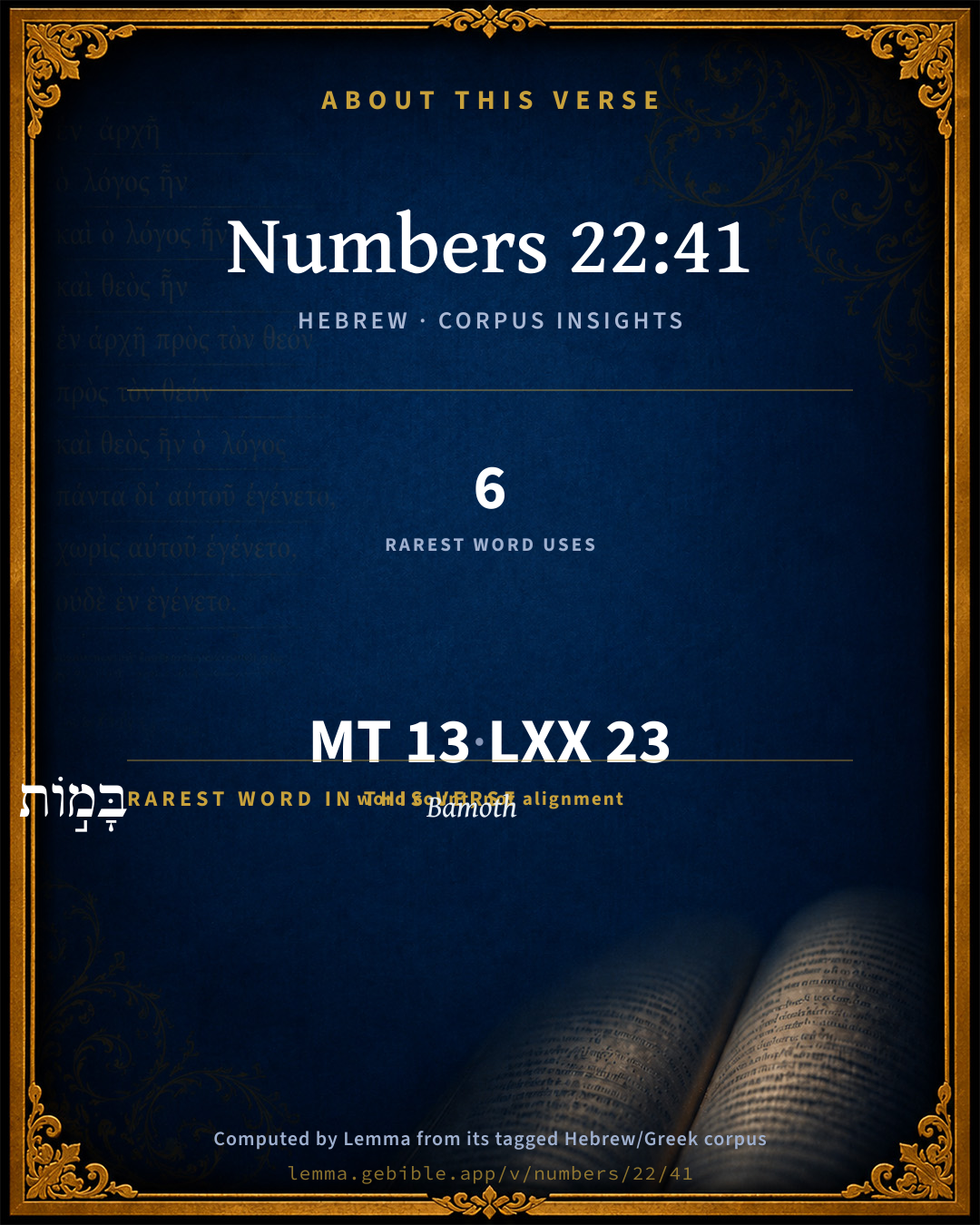
The rarest word here is בָּמ֣וֹת Bamoth H1120 — appearing just 6 times in the whole Hebrew Bible.

Shared distinctive vocabulary

בָּמ֣וֹת Bamoth H1120 occurs in 4 verses of the Hebrew Bible. Also found in:

Grammatical profile

  • 4 verbs
  • 7 nouns
  • 1 adverb
  • 1 particle

Verb forms

  • וַיְהִ֣י Qal · Sequential Imperfect
  • וַיִּקַּ֤ח Qal · Sequential Imperfect
  • וַֽיַּעֲלֵ֖הוּ Hiphil · Sequential Imperfect
  • וַיַּ֥רְא Qal · Sequential Imperfect

Repetition

A word recurs within this verse — often emphatic in Hebrew:

  • בָּמ֣וֹת Bamoth H1120 ×2

Hebrew & Septuagint length

In English translation the verse runs 30 words from the Hebrew and 26 from the Septuagint (LXX English) — closely comparable.

A rough comparison of the two English renderings, which tokenize alike — not a word-level alignment.

Word counts can differ between the Hebrew and the Greek without any difference in meaning — e.g. the Hebrew direct-object marker אֵת has no separate Greek word, and Greek often adds the article ὁ.

In the original languages it is 13 Hebrew tokens and 23 Greek tokens — but the two are counted differently (Hebrew bundles its prefixes and suffixes into one token; the Greek is in lemma form), so that isn’t a like-for-like length.

Cross-references

6

Topical passages linked to Numbers 22:41 in the Treasury of Scripture Knowledge — connected by theme and wording, ordered by reader-vote popularity; previews shown in the World English Bible.

  • Numbers 23:13 Balak said to him, Please come with me to another place, from whence you may see them; you shall see but the utmost part of them, and shall not see them all: and curse me them from there.
  • Numbers 21:28 For a fire is gone out of Heshbon, A flame from the city of Sihon: It has devoured Ar of Moab, The lords of the high places of the Arnon.
  • Numbers 25:2–3 for they called the people to the sacrifices of their gods; and the people ate, and bowed down to their gods.
  • Deuteronomy 12:2 You shall surely destroy all the places in which the nations that you shall dispossess served their gods, on the high mountains, and on the hills, and under every green tree:
  • 2 Chronicles 11:15 and he appointed him priests for the high places, and for the male goats, and for the calves which he had made.
  • Jeremiah 48:35 Moreover I will cause to cease in Moab, says Yahweh, him who offers in the high place, and him who burns incense to his gods.

Cross-references courtesy of OpenBible.info (CC BY 4.0).

Hebrew and Greek witnesses Masoretic Hebrew ↔ Greek Septuagint

The same verse in the two great witnesses to the Old Testament, shown verse-for-verse.

These are two independent witnesses, not word-aligned to each other, and the Septuagint is shown in lemma (dictionary) form.

Hebrew Numbers 22:41 Masoretic · Westminster Leningrad Codex

וַיְהִ֣י בַבֹּ֔קֶר וַיִּקַּ֤ח בָּלָק֙ אֶת בִּלְעָ֔ם וַֽיַּעֲלֵ֖הוּ בָּמ֣וֹת בָּ֑עַל וַיַּ֥רְא מִשָּׁ֖ם קְצֵ֥ה הָעָֽם

It happened in the morning, that Balak took Balaam, and brought him up into the high places of Baal; and he saw from there the utmost part of the people.

World English Bible · Public Domain

Greek LXX Numbers 22:41 Septuagint · lemma form

καί γίγνομαι πρωΐ καί παραλαμβάνω βαλακ ὁ βαλααμ ἀναβιβάζω αὐτός ἐπί ὁ στήλη ὁ βααλ καί δεικνύω αὐτός ἐκεῖθεν μέρος τις ὁ λαός

And it was morning; and Balac took Balaam, and brought him up to the pillar of Baal, and showed him thence a part of the people.

LXX2012 (modern English Septuagint) · Public Domain

On this verse, Haydock's Catholic Bible Commentary discusses the Septuagint’s reading. Read the note in Commentary ↓

Hebrew: Westminster Leningrad Codex (CC BY 4.0). Greek: Septuagint (public domain); English from LXX2012 (modern English Septuagint) (Public Domain). How the Septuagint differs from the Hebrew →

Targum (Aramaic paraphrase)

2

The Targum is the ancient Jewish Aramaic paraphrase of the Hebrew Scriptures — an interpretive translation, not the Hebrew text itself. Onkelos (literal) and Pseudo-Jonathan (expansive) render the Torah, and Jonathan the Prophets. Coverage is partial: where no permissively-licensed English translation exists for a verse, only the Aramaic is shown. This is verse-level text, not a word-by-word alignment to the Hebrew.

  1. Targum Onkelos Torah (Genesis–Deuteronomy)
    וַהֲוָה בְּצַפְרָא וּדְבַר בָּלָק יַת בִּלְעָם וְאַסְקֵיהּ לְרָמַת דַחַלְתֵּיהּ וַחֲזָא מִתַּמָן קְצַת מִן עַמָא

    (no public-domain English translation for this verse)

    Targum Onkelos — Aramaic: “Onkelos Genesis” (public domain); “Onkelos Exodus” (public domain); “Onkelos Leviticus” (public domain); “Onkelos Numbers” (public domain); “Onkelos Deuteronomy” (public domain). English: “Sefaria Community Translation” (CC0 1.0 (public-domain dedication)); “J.W. Etheridge. The Targums of Onkelos and Jonathan Ben Uzziel on the Pentateuch. London: Longmans, Green, 1862” (public domain). Text via Sefaria.

  2. Targum Pseudo-Jonathan Torah (Genesis–Deuteronomy)
    וַהֲוָה עִידוֹנֵי צַפְרָא וּדְבַר בָּלָק יַת בִּלְעָם וְאַסְקֵיהּ לְרָמַת דַחַלְתָּא דִפְעוֹר וַחֲמָא מִתַּמָן מַשִׁירְיַית דָן דִמְהַלְכִין בִּקְצַת עַמָא דְאִתְפָּרְסִימוּ מִתְּחוֹת עֲנָנֵי יְקָרָא

    And at the time of the morning Balak took Bileam, and brought him up to the high place of the idol Peor; saw from thence the camp of Dan, which went at the rear of the people; and they were discovered under the Cloud of Glory.

    Targum Pseudo-Jonathan — Aramaic: “Targum Jonathan on Genesis” (public domain); “Targum Jonathan on Exodus” (public domain); “Targum Jonathan on Leviticus” (public domain); “Targum Jonathan on Numbers” (public domain); “Targum Jonathan on Deuteronomy” (public domain). English: “The Targum of Jonathan ben Uzziel, trans. J. W. Etheridge, London, 1862” (public domain). Text via Sefaria.

Commentary

Notes on Numbers 22:41 from classic Christian and Jewish commentators (each source and its license shown beneath its notes). The classic Christian expositions comment on the surrounding passage and are grouped to its opening verse, so a note may address several verses; the Jewish commentaries on the Tanakh (Rashi and others) are per-verse, so they appear only where the commentator wrote on this verse.

Lemma curates 59 commentaries, every one of them public domain or Creative Commons licensed, each selected and text-cleaned for this edition rather than reprinted as found. About our sources →

Joseph Benson's Commentary

Num 22:41. The high places of Baal — Consecrated to the worship of Baal, that is, of Baal-peor, who was their Baal, or lord, as the word signifies, a name given to several gods, both male and female. Their god, like those of other nations, it appears, was worshipped on high places, which were generally planted with groves, whose solemn gloom served to inspire the worshippers with serious thoughts. To several of these high places Balak brought Balaam, that he might see where he could take the fullest view of the Israelites; for in those solemn imprecations it was judged necessary to have the persons devoted present to the view of him who pronounced the malediction.

Joseph Benson's Commentary on the Old and New Testaments (1811–1818) — public domain. Text from a community e-Sword module.

The Pulpit Commentary

BALAAM"S PROPHECIES. (Num 22:41-24)

The high places of Baal, or "Bamoth-Baal." Perhaps the Bamoth mentioned in Num_21:19, Num_21:20. This is, however, by no means certain, because high places were no doubt numerous, and that Bamoth would seem to have been too far from the present camp of Israel. In any case they crossed the Arnon, and ran some risk by adventuring themselves on hostile territory. That thence he might see the utmost part of the people. According to the quasi-sacramental character attributed to the cursing of a seer, it was held necessary that the subject of the curse should be in view. Balak desired to attain this object with as little risk as possible, and therefore he took Balaam first of all to these heights, whence a distant and partial view of Israel might be had.

Ver. 41-chapter 24. Balaam and his prophecies.

The prophecies of Balaam were the utterances of a bad man deeply penetrated by religious ideas, and inspired for certain purposes by the Spirit of God; hence it is evident that many deep moral and spiritual lessons may be learnt from them, apart from their evidential value as prophecies. Consider, therefore, with respect to the moral character and conduct of Balaam

I THAT BALAK AND BALAAM THOUGHT TO MOVE THE GOD OF ISRAEL BY IMPORTUNITY, OR PERHAPS TO GET THE BETTER OF HIM BY CONTRIVANCE; hence Balak repeatedly shifted his ground and brought Balaam to another point of view. Even so do ungodly men imagine that the immutable decrees of right and wrong may somehow be changed in their favour if they use sufficient perseverance and address. By putting moral questions in many different lights, by getting their outward or inward adviser to look at them from diverse points of view, they think to make right wrong, and wrong right. With what insensate perseverance, e.g., do religious people strive, by perpetually shifting" their ground, to force the Almighty to sanction in their case that covetousness which he has so unmistakably condemned.

II THAT BALAAM CLEARLY HINTED TO THE ALMIGHTY THAT, AS HE HAD PROCURED MUCH HONOUR FOR HIM FROM BALAK, HE WAS EXPECTED TO DO WHAT WAS POSSIBLE IN THE MATTER FOR HIM. Even so do men who are in truth irreligious, although often seeming very much the reverse, give the Almighty to understand (indirectly and unavowedly, but unmistakably) that they have done much, laid out much, given up much for his honour and glory, and that they naturally look for some equivalent. To serve God for nought (Job_1:9) does not enter into the thoughts of selfish people; to them godliness is a source of gain, (1Ti_6:5) if not here, then hereafter.

III THAT BALAAM WAS MOVED TO WISH HE MIGHT DIE THE DEATH OF THE RIGHTEOUS, BUT WAS NOT DISPOSED TO LIVE THE LIFE OF THE RIGHTEOUS; hence his wish was as futile as the mirage of the desert, and was signally reversed by the actual character of his end. Even so do evil men continually desire the rewards of goodness, which they cannot but admire, but they will not submit to the discipline of goodness. A sentimental appreciation of virtue and piety is worse than useless by itself.

IV THAT BALAAM RECEIVED NO REWARD FROM BALAK BECAUSE HE HAD NOT CURSED ISRAEL, AND NONE FROM GOD BECAUSE HE HAD WISHED TO CURSE HIM. Even so it is with men whose religious feelings restrain, but do not direct, their lives. They miss the rewards of this world because they are outwardly conscientious, and the rewards of the next world because they are inwardly covetous.

V THAT BALAAM RETURNED TO HIS PLACE, i.e., he went back. as it seemed, to his old home and his old life on the banks of Euphrates; in truth "he went to his own place", (Act_1:25) for he rushed blindly on destruction, and received the recompense of death.

Consider again, with respect to the sayings of Balaam

I THAT IT IS NOT POSSIBLE TO CURSE WHOM GOD HATH NOT CURSED. There is in fact but one curse which there is any reason to dread, and that is "Depart from me." Any malediction of men, unless it be merely the echo of this upon earth, spoken with authority, does but fall harmless, or else recoil upon him that utters it.

II THAT THE SINGULAR GLORY OF ISRAEL WAS HIS SEPARATENESS a separateness which was outwardly marked by a sharp line of distinction from other peoples, but was founded upon an inward and distinctive holiness of life and worship. Even so is the glory of the Church of Christ and of each faithful soul to be "separate from sinners," as was Christ. And this separation must needs be outwardly marked in many ways and in many cases; (1Co_5:11 2Co_6:17) but its essence is an inward divergence of motive, of character, and of condition before God. To be "even as others" is to be the "children of wrath"; (Eph_2:3) to be Christians is to be "a peculiar people". (Tit_2:14) If men cannot bear to be peculiar, they need not look to be blessed; if they must adopt the fashions of this world, they must be content to share its end. (Gal_1:4 2Ti_4:10 1Jn_2:15-17)

III THAT THE DEATH OF THE RIGHTEOUS IS BLESSED AND AN OBJECT OF DESIRE in a far higher sense than Balaam was able to comprehend. It may appear to the foolish that the life of the righteous is full of sadness, but none can fail to see that his death is full of immortality, that he is in peace by reason of a good conscience, and in hope of glory by reason of the sure mercies of God.

IV THAT THE LATTER END OF THE RIGHTEOUS IS MORE BLESSED AND DESIRABLE THAN HIS DEATH; for this is to live again, and to live for ever, and to inherit eternity of bliss in exchange for a few short years of strife and patience.

V THAT IT IS NOT POSSIBLE FOR MAN TO REVERSE THE BENEDICTIONS WHICH GOD HAS PRONOUNCED UPON HIS PEOPLE. This has been tried by Balaam, and by very many since, but to no effect. The blessings which we are called to inherit, as set forth in the New Testament, will certainly hold good in every age and under all circumstances. No matter what the world may say, or we be tempted to think, the "poor" and the "meek" and the "merciful" and the "persecuted for righteousness" sake" will always be "blessed," in spite of all appearances to the contrary.

VI THAT GOD DOTH NOT BEHOLD INIQUITY IN HIS PEOPLE. Not that it doth not exist (as it existed then in Israel), but because it is not imputed to them that repent and believe in Christ Jesus. God doth not behold sin in the faithful soul, because he regards it not in its own nakedness, but as clothed with the righteousness of Christ, which admits not any spot or stain. (Gal_3:27 Php_3:9 Rev_3:18) And this non-imputation of sin is not arbitrary now (as it was to a great degree in the case of Israel), because it is founded upon a real and living union with Christ as the source of holiness. There is a spiritual unity of life with him, (Joh_3:5 Joh_6:57 Joh_15:4 Gal_2:20 Eph_5:30) and there is a consequent moral unity of life with him, (Col_3:3 1Jn_2:6 1Jn_3:3 1Jn_4:17, &c.); which is only slowly and partially attained in this life; but it hath pleased God for the sake of the spiritual unity to regard the moral unity as though it were already achieved, and therefore he imputeth not sin to them that "walk in the light". (1Jn_1:7)

VII THAT IF THE LORD OUR GOD BE WITH US, THEN THE SHOUT OF A KING IS AMONG us, i.e., the joyful acclamation of them that welcome the King who never fails to lead them to victory. And this is one note of the faithful, that they rejoice in their King, (Psa_149:2, Psa_149:5, 6 Mat_21:9 Php_4:4) and that gladness is ever found in their hearts (Rom_14:17) and praise in their mouths. (Act_16:25 Heb_13:15 1Pe_2:9; and cf. Eph_5:18-20)

VIII THAT NO MAGICAL INFLUENCE CAN BE BROUGHT TO BEAR AGAINST THE RIGHTEOUS. If they fear God they need not fear any one else. (Luk_12:4, 5 Rom_8:38, Rom_8:39) Superstitious fears are unworthy of a Christian. But note that, according to the other rendering of Num_23:23, the spiritual meaning is that the faithful have no need of, and no resort to, any such uncertain and unauthorized pryings into the unseen and unrevealed as superstition and irreligion do ever favour. Here is a warning against all the arts of so-called "spiritualism," which (if it be not wholly an imposture) is rank heathenism and abominable to God. If the gospel be true, then we have all the light we need for our present path, and we have the assurance of all the light we could desire in our future home. (Joh_8:12 1Co_13:12 1Jn_3:2)

IX THAT THE CAMP OF ISRAEL WAS LOVELY IN THE EYES OF THE PROPHET NOT SO MUCH BY REASON OF ITS SIZE, AS BECAUSE OF THE ORDER AND METHOD WITH WHICH IT WAS LAID OUT like the cultivated gardens of the East. Even so is the order Divinely imparted to the Church its chiefest beauty. It is not its mere size, in which indeed it is inferior to some false religions, but its unity in the midst of variety, its coherence side by side with manifold distinctions, which stamps it as a thing of heavenly origin and growth. The highest art of the gardener is to allow to each tree the fullest liberty of individual growth, while arranging them for mutual protection and for beauty of effect; even so is the art of the Divine Husbandman (Joh_15:1) with the treeswhich he hath planted in his garden.

X THAT THE FUTURE PROSPERITY OF ISRAEL WAS SPOKEN OF BY BALAAM UNDER TWO FIGURES OF OVERFLOWING BUCKETS USED IN IRRIGATION, AND OF SEED SOWN BY MANY WATERS. Even so the prosperity of the Church has a twofold character: it stands partly in the diligent and ample watering of that which is already sprung up, which is her pastoral work; partly in the widespread sowing by many waters, far and near, which is her missionary work.

XI THAT THE CHURCH OF GOD IS NOT AFFECTED BY THE BLESSING OR CURSING, THE GOOD OR EVIL WILL OF MEN, BUT, ON THE CONTRARY, IS THE SOURCE OF BLESSING OR CURSING TO THEM; according as they treat her, so must they fare themselves. For since Christ hath loved her and given himself for her, (Eph_5:25) his interests and hers are all one, and howsoever we act towards the Church, he taketh it unto himself. (cf. Mat_25:40, Mat_25:45)

Consider again, with respect to the enterprise of Balaam

I THAT BALAAM WAS HIRED TO CURSE ISRAEL, BUT WAS CONSTRAINED TO BLESS HIM ALTOGETHER. (cf. Deu_23:5 Jos_24:10 Mic_6:5) Even so all the efforts of the world to cast infamy and odium upon the Church are turned backward, unless indeed she is untrue to herself. No weapon is forged against her more terrible than the interested enmity of gifted and intellectual men, which often promises to succeed where brute force is powerless; but even this cannot prosper. It is often the policy of the world to assail religion by religious influences, but God overrules this also. Gifts which are truly of his giving cannot be really turned against him or his.

II THAT GOD"S PURPOSES AND PRONOUNCEMENTS CONCERNING HIS CHURCH ARE ETERNAL AND IMMUTABLE, SINCE HE CANNOT DENY HIMSELF, NOR GO BACK FROM HIS WORD. The future of his Church is perfectly safe and absolutely unassailable, because it depends not on any human counsel or constancy, but upon the eternal predestination and changeless will of God.

Consider again, with respect to that which Balaam spake by the Spirit of God

I THAT BALAAM HAD A VISION OF CHRIST HIMSELF, i.e. of a mysterious Being, a King of Israel, exalted and extolled, and very high, whom the Jews believed, and we know, to be the Christ. Even so all true prophecy looks on, more or less consciously, to him in whom all the promises of God are Amen, (2Co_1:20) and in whom all the gifts of God to men are concentrated. The spirit of prophecy is the testimony of Jesus, (Rev_19:10) because there was nothing else really worth prophesying.

II THAT BALAAM SAW HIM UNDER THE EMBLEMS OF A STAR AND OF A SCEPTER. Even so the Lord is both a luminary (Luk_2:32 2Pe_1:19 Rev_22:16) and a ruler (Luk_1:33 Heb_1:8 Rev_12:5) forever.

III THAT BALAAM SAW HIM AS A DESTROYER, CRUSHING THE ENEMIES OF GOD AND OF HIS PEOPLE. And this is at first sight strange, because he came not to destroy men"s lives, but to save them. But as it is quite naturally explained from a moral point of view when we take into account the moral ideas of Balaam"s age, so it is found perfectly true in a spiritual sense when we consider what the work of Christ really is. For that work is indeed a work of destruction: he came to destroy the works of the devil; (1Jn_3:8) he came to destroy not men, but all that is sinful in men; not the enemies of God (for God has no enemies among men), but all in men which is inimical to him and to his truth. Hence he is ever represented as a destroyer in the Apocalypse, which reverts to the imagery of the Old Testament. (Rev_6:2 Rev_19:11, Rev_19:13, Rev_19:15, &c.); And this aspect of his work, which is true and necessary, and is jealously guarded as his in Holy Scripture, ought not to be set aside or obscured by the gentler and pleasanter aspects of his reign. That he must put all enemies under his feet is the first law of his kingdom, and must somehow or other be brought to pass in us, as in others.

IV THAT BALAAM SAW (ACCORDING TO HIS DAY) THE ENEMIES OF THE CHURCH OF GOD UNDER THE SEMBLANCE OF MOABITES, EDOMITES, AMALEKITES, KENITES, AND ASSYRIANS. And these may be interpreted in a spiritual sense as typifying the different forms in which a common hostility to the truth of Christ displays itself. In Moab we may see the hostility of cunning, which fears an open contest, but enlists the intellect and craft of others on its side; in Edom the hostility of insolent opposition, which loses no opportunity of inflicting annoyance and injury; in Amalek we may see vainglorious anger, which resents pretensions greater than its own, and rushes upon a hopeless conflict; in the Kenites we may see confidence in earthly strength, and in a lodgment so naturally strong as to defy all assaults; in Asshur we have the embodiment of brute force brutally used. If, however, the Kenites were the friends, not the foes, of Israel, then we may see in them how vain is the self-confidence even of religious people in any advantages of position or circumstance. The Kenites are not known to have provoked God, as Israel did, and their abode was peculiarly inaccessible and defensible; nevertheless, they too fell victims to Assyria, at the very time perhaps when Hezekiah and Jerusalem escaped.

V THAT BALAAM WAS STRUCK WITH FEAR WHEN HE FORESAW THESE DESTRUCTIONS EXTENDING EVEN TO HIS OWN PEOPLE. Who shall live? In the crash of these great contending world-powers who could hope to escape? How much more may evil men fear "when God doeth this" which he hath so clearly foretold I And not evil men only, but all who are not in the truest sense of the Israel of God. (1Pe_1:17 1Pe_4:17, 18 2Pe_3:11)

The Pulpit Commentary (1880–1919), ed. H.D.M. Spence-Jones & Joseph S. Exell — public domain. Text from a community e-Sword module.

Lange's Commentary on the Holy Scriptures

E.—THE FIRST BLESSING OF BALLAM

Num_22:41 to Num_23:10

Num_22:41 And it came to pass on the morrow, that Balak took Balaam, and brought him up into the high places of Baal, that thence he might see the utmost part of the people.

Num_23:1 And Balaam said unto Balak, Build me here seven altars, and prepare me here seven oxen and seven rams. 2And Balak did as Balaam had spoken; and Balak and Balaam offered on every altar a bullock and a ram. 3And Balaam said unto Balak, Stand by thy burnt offering, and I will go: peradventure the Lord will come to meet me; and whatsoever he sheweth me I will tell thee. And he went to an high place1 4And God met Balaam: and he said unto him, I have prepared seven altars, and I have offered upon every altar a bullock and a ram. 5And the Lord put a word in Balaam’s mouth, and said, Return unto Balak, and thus thou shalt speak. 6And he returned unto him, and, lo, he stood by his burnt sacrifice, he, and all the princes of Moab. 7And he took up his parable, and said,

Balak the king of Moab hath brought me from Aram,

Out of the mountains of the East, saying,

Come curse me, Jacob,

And come, defy Israel.

8     How shall I curse, whom God hath not cursed?

Or how shall I defy, whom the Lord hath not defied?

9     For from the top of the rocks I see him,

And from the hills I behold him:

Lo, the people shall dwell alone,

And shall not be reckoned among the nations.

10     Who can count the dust of Jacob,

And the number of the fourth part of Israel?

Let me2 die the death of the righteous,

And let my last end be like his!

TEXTUAL AND GRAMMATICAL

[Num_22:41. Heb. Bamoth-Baal—a definite locality.—A. G.]

[Num_23:3. שֵׁפִּי—a bare, bleak height—from שָׁפָּה, to scrape, to make bare, Job_33:21.—A. G.]

[Num_23:7. מָשַׁל—“a simile, then a proverb, because the proverb consists of comparisons and figures.” Keil. Hirsch, however, says that “the word always denotes a sentence or saying in which there is a progress from the individual and concrete to the universal or general,” and that it is so used here.—A. G.]

[Num_23:7. Defy. Better: be angry against, threaten.—A. G.]

[Num_23:10. Or: who can number the fourth part=or perhaps the progeny. Bible Commentary, Hirsch.—A. G.]

EXEGETICAL AND CRITICAL

1. Balak is politic and cunning. He leads Balaam to a mountain summit, from whence he could see only the ends of the Israelitish camp. A small part of the camp the must see, so that from his mountain height as from heaven he might hurl down the lightnings of his curse upon the people; but only a small part, lest he should be too deeply impressed, and thus his readiness to curse might be restrained.

[A comparison, however, of Num_22:41 with Num_23:13 seem to show that in the former case the words the ends, or the utmost of the people, refer not to a small part of the camp, but to its extreme limits. He overlooked the whole people, even to its ends or utmost bounds. Balak had strong confidence that his wish would be secured. It was essential in his view that the people should be seen by the prophet, if the curse was to take effect. He led him therefore to a position so that the whole camp lay stretched out before him. But when the prophet blesses instead of curses Israel, then apparently thinking that his mind had been overawed by the prospect; that he could not so readily curse, a people so numerous and powerful, he leads him away to a point from which he says “thou shalt see only the utmost part of them, and shalt not see them all.” Thus the two passages are perfectly consistent, and the order of steps as the scene unfolds is natural.—A. G.]

2. Balaam also on his part is a prudent schemer. Balak must build him seven altars, and offer upon them a grand sacrifice: seven bullocks and seven rams, the largest and most costly sacrifice, in the doubled seven. In connection with this pompous pretence of piety the sacrifice bears a most equivocal character. It is offered upon the high places of Baal, and still, as it appears, to Jehovah, from whom he inquires. But for which of the two were the bullocks intended, and for which the rams? Build me here seven altars—says Balaam—Stand by thy burnt-offering.—There is, in fact, a vile union between heathenism and monotheism—between yea and nay. Then Balaam goes up alone to a bare place, or a bald mountain peak, that he may see as much as possible of Israel, and that he may observe a sign, and thereby secure a vision. He appeals to Elohim, calling to witness his sacrifice. But it is Jehovah who puts the word in his mouth; it proceeds from God as the God of Israel. [Balaam went up to meet auguries (Num_24:1): I will go—peradventure Jehovah will meet me. “He hoped to receive or discover in the phenomena of nature a revelation from Jehovah.” Keil. Hence he went as the heathen augurs were wont to do, to the mountain summit, where his view above and around him would be unobstructed. God met Balaam, not “through the agencies employed to seek Him, dealing in this case in an exceptional manner,” Bible Com., not through any appearance or sign which Balaam was to clothe in words, but put a word in his mouth: thus thou shalt speak. He had a distinct message from which he could not vary.—A. G.]

3. Balaam’s first saying is richer in its form than in its contents. He speaks at first of the great expectations with which his coming is awaited. A king has sent for him, has brought him here in honor. From a remote land, from the far distant mountains of Mesopotamia, he has come to the mountain of Moab. And for this purpose, that he should curse a people whom he knew not only as Jacob, but as Israel (his words are fitly chosen: Curse, doom to wrath). He might well have said: How shall I curse him whom Jehovah blesseth? but he says somewhat less: whom God hath not cursed, whom God hath not threatened. He intimates that he sees not only a part of Israel, as Balak wished, but sees it in its whole significance and nature, as if he looked down upon it from every rocky peak and summit. The positive blessing includes three things: the isolation of Israel from the heathen, its countless number, and his own recognition of the righteous in it, with whom he wished to die. But in all the three respects the spirit of the typical word expresses much more than was present to the consciousness of Balaam, to wit, the election of God’s people, its blessed and immeasurable extension, and the salvation in life and in death prepared for the righteous. [Shall dwell alone—not isolation, freedom from tumults, and thus security—but the inward separation in character and in their relation to God, upon which the outward isolation depended, and of which it was the symbol. They dwelt alone only while they clave to God—counted not themselves among the nations. The whole Israelitish history is a striking comment upon the text. As the description applies to the N. T. Israel, so the rule likewise.

Who can count the dust?—A reference to the promise, Gen_13:15, which was already so largely fulfilled, that even the fourth part, alluding, as Keil thinks, to the fourfold arrangement of the camp, could not be numbered.—יְשָׁרִים, a term applied to Israel as the called of God who is just and right, and as expressive of the end of their calling—or destination. It is not so much descriptive of their actual character as of the idea of the people, which was partly realized in the natural Israel, but is to be actually and fully realized in the spiritual. It is always the product of the gracious dealings of God with His people.

Let my last end be like his.—Balaam could not curse the righteous people. His better impulses find expression in the wish that he might share with them at least in their death. The Hebrew word refers not so much to the dying as to that which follows death, the futurity, the last estate. (See Psa_37:37-38.) While it is true that their ideas of a future state were as yet vague and indefinite, it is not true, as Keil says, “that the Israelites did not then possess a certain hope of a blessed life beyond the grave.” It is difficult to fix just the amount of light they enjoyed, but it is well nigh impossible to read the utterances of the word in regard to their death without feeling that the light shone for them and upon them. And he who walked with God, and died in the consciousness of the divine grace and love, could never have supposed that the light would go out in darkness, or that there was no blessed life beyond the grave.—A. G.]

For the location of Bamoth-Baal see Num_21:19-20. It appears here as the most remote point from which the camp of Israel could be seen. For the ancient custom of inaugurating religious questions, undertakings, execrations or blessings with sacrifices, see Knobel, p. 137; Keil, Clark’s Translation, pp. 176, 177. The sign for which Balaam went out alone was the view of Israel which should form a sign and a vision for him.

Footnotes:

[1]Marg. on he went solitary.

[2]Marg. my soul or my life.

Lange's Commentary on the Holy Scriptures (Critical, Doctrinal, and Homiletical), ed. John Peter Lange, English translation edited by Philip Schaff (1864–1880) — public domain. Text from a community e-Sword module.

Tyndale Open Study Notes

Tyndale Open Resources

22:41 Bamoth-baal (“high places of Baal”) was along the ridge of hills that overlooks the plains of Moab northeast of the Dead Sea (cp. “Bamoth” in 21:19; Josh 13:17). It was the first of three locations to which the Moabite king took Balaam so that he could see the sprawling Israelite camp (also Num 22:41; 23:14, 28). From such a high point he could see the Israelites (22:11) and perform the ceremonies that Balak hoped would lead to a powerful imprecation (curse) against them.

Tyndale Open Study Notes — © Tyndale Open Resources, licensed CC BY-SA 4.0. Text via the HelloAO Bible API.

Geneva Bible (1599)

Geneva Bible translators

Where the idol Baal was worshipped.

Geneva Bible (1599) marginal notes — public domain. Text via Bolls.life.

Jamieson, Fausset & Brown

Robert Jamieson, A. R. Fausset & David Brown

high places of Baal--eminences consecrated to the worship of Baal-peor (see on Num 25:3) or Chemosh.

Next: Numbers Chapter 23

Jamieson, Fausset & Brown — Commentary Critical and Explanatory on the Whole Bible (1871) — public domain (CC PDM 1.0). Text via the HelloAO Bible API.

Adam Clarke's Commentary

Verse 41. That - he might see the utmost part of the people.] As he thought Balaam must have them all in his eye when he pronounced his curse, lest it might not extend to those who were not in sight. On this account he took him up into the high places of Baal.

Adam Clarke's Commentary on the Bible (1810–1826) — public domain. Text from a community e-Sword/MySword module.

Ellicott's Commentary for English Readers

(41) Into the high places of Baal.—Or, to Bamoth-Baal. Bamoth-Baal was probably the first height on the way to the steppes of Moab from which the Israelitish camp could be seen. Hengstenberg observes that “Balak started with the supposition that Balaam must necessarily have the Israelites in view if his curse was to take effect.”

That thence he might see the utmost part of the people.—Better, And he saw from thence, &c. If the Authorised Version of Num_23:13 is correct, it seems necessary to understand these words as denoting that Balaam had a view from Bamoth-Baal of the whole army of Israel, even to the very extremity. or utmost part of the camp. This verse, however, is more commonly interpreted as denoting that Balaam saw only the extremity of the camp. So the Targum of Palestine: “He saw from thence the camp of Dan, which went at the rear of the people.” (See Note on Num_23:13.)

A Bible Commentary for English Readers, edited by Charles John Ellicott (1878–1897) — public domain. Text from a community e-Sword module.

The Cambridge Bible for Schools and Colleges

gen. ed. J. J. S. Perowne

41. and brought him up to Bamoth-Baal] See on Num_21:19. The name indicates that it was a sanctuary.

the end of the people] Not the whole body of Israelites to their furthest extremity but only the nearest end or fringe in the valley immediately below him, the bulk of them being hidden by the hills.

It seems clear that Bamoth-Baal was north and not south of the Arnon, otherwise the Israelites would be many miles away. But the country north of the Arnon was then in possession not of the Moabites but of the Amorites. If we knew more of the facts the difficulty might be explained; but it is not impossible that the narrative is to be considered in the light of a popular tradition which was poetical, and that the details must not be rigidly pressed.

The Cambridge Bible for Schools and Colleges (gen. ed. J. J. S. Perowne; Cambridge University Press, 1878–1918) — public domain. Text from a community e-Sword module.

Albert Barnes' Notes on the Bible

That thence he might see - Rather, and thence he saw.

Albert Barnes' Notes on the Bible (1834–1885) — public domain. Text from a community e-Sword/MySword module.

Haydock's Catholic Bible Commentary

People. From the heights or temple of Baal, or the god of Chamos, where a statue or pillar (Septuagint) was erected in his honour, (Calmet) on Mount Arabim, (Menochius) the soothsayer was enabled to take a distinct view of all the camp of Israel, (chap. xxiii. 13,) and not of a part only, as the Septuagint and Arabic versions would insinuate. It was deemed necessary to have those present upon whom people intended to vent their imprecations. (Calmet)

George Leo Haydock (1774–1849), Haydock's Catholic Family Bible and Commentary, 1859 edition — public domain. Excludes Psalms (Douay-Rheims chapter numbering differs from Protestant) and Deuterocanonical books (Catholic canon only).

Matthew Poole's English Annotations

The high places of Baal, i.e. consecrated to the worship of Baal, i.e. of Baal-peor, who was their Baal or god, Num 25:2,3 or of Chemosh.

The utmost part of the people, i.e. all that people, even to the utmost and remotest of them, as appears by comparing this with Num 23:13. He hoped that the sight of such a numerous host ready to break in upon his country would stir up his passion and further his charms.

Matthew Poole's English Annotations on the Holy Bible (1683–1685) — public domain. Text from a community e-Sword/MySword module.

Whedon's Commentary on the Bible

Daniel D. Whedon

41. High places of Baal — Bamoth Baal, heights of Baal. See Num_21:19, note. This is the first mention in the Bible of Baal, the chief male deity of the Phenicians and Canaanites. See Jdg_2:11, note. His worship was the predominant religion over nearly all of Western Asia. He had large numbers of trained priests who were accustomed to offer bloody sacrifices upon his altars, dancing and leaping upon the altar, cutting themselves with knives in fanatical frenzy, to the astonishment and awe of the spectators. According to Jer_19:5, human sacrifices were offered to Baal. Modern research has cast much new light on this pagan cult by the discovery and interpretation of ancient inscriptions, and by tracing its spread from country to country with slightly varying names of the God, as Bel, Isa_46:1; Baal-berith, Jdg_8:33; Baal-peor, Num_25:3; Baal-zebub, 2Ki_1:6, and the golden calves of Bethel and of Dan, Hos_2:8. It is essentially the same as the Phallic worship, described by Herodotus as widely prevalent in the Orient, and is to-day polluting India with its unspeakable defilement. It conceives the divine principle as both male and female, productive and receptive — Baal and Astarte — and fills its temples with gigantic images of the male organ of generation. See “Phallus” in McClintock & Strong’s Cyclopaedia. There were two reasons for choosing a high place for cursing Israel. (1.) It was thought the curse would be more effectual with the people in full view. (2.) Mountains were considered by the ancients as sacred, since they are nearer to heaven, the source of all holiness.

The utmost part of the people — The whole encampment to the farthest extremity. See Num_23:13. This was done in order that the curse might be more powerful and fatal.

Daniel D. Whedon (gen. ed.), Commentary on the Old and New Testaments (1874–1909) — public domain. Text from a community e-Sword module.

John Wesley's Explanatory Notes

The high places of Baal - Consecrated to the worship of Baal, that is, of Baal Peor, who was their Baal or God. The utmost part - That is, all that people, even to the utmost and remotest of them, as appears by comparing this with, chap. xxiii, 13. He hoped that the sight of such a numerous host ready to break in upon his country would stir up his passion.

John Wesley, Explanatory Notes Upon the Whole Bible (1754–1765) — public domain. Text via the GEBible commentary corpus.

Keil & Delitzsch

C. F. Keil & F. Delitzsch

But Balak conducted the soothsayer to Bamoth-baal, not because it was consecrated to Baal, but because it was the first height on the way to the steppes of Moab, from which they could see the camp of Israel, or at all events, "the end of the people," i.e., the outermost portion of the camp. For "Balak started with the supposition, that Balaam must necessarily have the Israelites in view if his curse was to take effect" (Hengstenberg).

Keil & Delitzsch — Biblical Commentary on the Old Testament (1861–1891) — public domain (CC PDM 1.0). Text via the HelloAO Bible API. (Old Testament only.)

Scofield Reference Notes

C. I. Scofield

utmost

"Utmost part," etc., means the end of the encampment, the "fourth part of Israel" Num 23:10. Balak’s thought, as Grant (following Keil) points out, was not at all to permit Balaam to see the whole of the Hebrew host. In bringing Balaam to Pisgah Num 22:13; Num 22:14. Balak corrects what, evidently, he thought a blunder. Num 23:13; Num 23:14. But when the hireling sees the whole camp he must utter a grander word than before, "He hath not beheld iniquity in Jacob," and that with the nation in full view! What an illustration of the truth of Rom 4:5-8.

The Scofield Reference Bible (1917 edition), notes by C. I. Scofield — public domain. Text from a community e-Sword module.

unfoldingWord translationNotes

Door43 World Missions Community

the high place of Baal

Possible meanings are 1) this refers to the same place as Bamoth in Numbers 21:19. The word Bamoth means "the high place," or 2) this is another high place where people sacrificed to Baal.

translationWords

Baal

Israel

unfoldingWord translationNotes — © Distant Shores Media and the Door43 World Missions Community, licensed CC BY-SA 4.0. Source: git.door43.org/Door43/en_tn.

Rashi

Rabbi Shlomo Yitzchaki (Rashi)

במות בעל BAMOTH-BAAL — Understand this as the Targum does: to the heights of his god (more lit., of that which he reverenced); Baal is the name of a god.

Rashi on the Tanakh — English translations: “The Judaica Press complete Tanach with Rashi, translated by A. J. Rosenberg” (CC BY 4.0); “Pentateuch with Rashi's commentary by M. Rosenbaum and A.M. Silbermann, 1929-1934” (public domain); “The Metsudah Tanach series, Lakewood, N.J” (CC BY 4.0); and “The Book of Joshua, Metsudah Publications, 1997” (CC BY 4.0). Text via Sefaria.

Ramban (Nachmanides)

Rabbi Moshe ben Nachman (Ramban / Nachmanides)

[AND IT CAME TO PASS IN THE MORNING AND BALAK TOOK BALAAM] AND BROUGHT HIM UP INTO BAMOTH-BAAL, AND HE SAW FROM THENCE THE UTMOST PART OF THE PEOPLE. Balak took him up to a [high] place from which he could see them [the people of Israel], in order that he could concentrate his curse upon them, and his mind would not separate itself from them, for it is one of the attributes of the soul’s powers that it attaches itself at the time of seeing a certain object as is known from that which the Sages tell [of Rabbi Yochanan, that he said to his disciples]: “‘Lift up my eye-lids for me, because I want to see [this scholar].’ They [accordingly] lifted up his eye-lids. He set his eyes upon him, and [as a result] that person died.”Now Scripture relates that Balaam did not see the whole camp [of Israel] because they were encamped in four standards [positioned in all] four directions of the heaven. On the second occasion Balak said to him, thou shalt see but the utmost part of them, and shalt not see them all, meaning: “this time also you will not [be able to] see them all, if that is what prevents you from cursing them, but [nonetheless] curse me them from thence if you can, for I do not have any place from where I can show you all of them.” Balak thought that perhaps there was a standard in one of the sections [of the camp of the Israelites] consisting of righteous and good people whom it pleased not the Eternal to crush, [and therefore Balak took Balaam to other places from which Balaam could see other parts of the camp, in order to curse them effectively].It is also possible to explain that on the first occasion [referred to in this verse] Balaam did see the whole camp, for Bamoth-baal is a high place, and from there both of them [Balak and Balaam] saw part of the people, and built the altars there; then Balaam ascended to the peak of the hill on that mountain, and saw the whole people, this being the meaning of [the expression] and he [Balaam] went ‘shephi,’, Verse 3. which means he went to “the height” thereof, as Rabbi Abraham ibn Ezra has explained.

Ramban (Nachmanides) on the Tanakh — English translation: “Commentary on the Torah by Ramban (Nachmanides). Translated and annotated by Charles B. Chavel. New York, Shilo Pub. House, 1971-1976” (CC BY 4.0). Text via Sefaria.

Lesson kit

Teaching starters — assembled from the data on this page, not authored interpretation. Every prompt links to the verse data it draws on. Edit before teaching.

Numbers, in the Pentateuch, opens this verse with 13 words (12 distinct Hebrew lemmas). Its most distinctive word is Bâmôwth (“Bamoth”). A historical commentator’s framing appears above. Read the whole chapter for the surrounding context.

Discussion questions

  1. How does “Bamoth” (Bâmôwth) shape what this verse is saying?
  2. How does Numbers 21:19, which shares the word «Bamoth», read alongside this verse?
  3. What does the repetition of “Bamoth” (2× in this one verse) do in this verse?
  4. These translations render this verse differently. What is at stake in choosing one wording over another?
  5. «וַיְהִ֣י» is a Qal Sequential Imperfect verb. How does that grammatical form shape the action described?
  6. Compare how Joseph Benson's Commentary and The Pulpit Commentary read this verse. Where do they agree or differ?

Things to notice

Reading settings

Reading text

Shown beneath each verse's original-language words.

Old Testament
Old Testament edition

Read the OT as the Masoretic Hebrew (MT) or the Greek Septuagint (LXX).

English shown for the Greek Septuagint (in the Hebrew ↔ Greek comparison).

Comparing translations? Open the Compare panel on any verse page to stack up to four side by side.