
Exodus 19:12

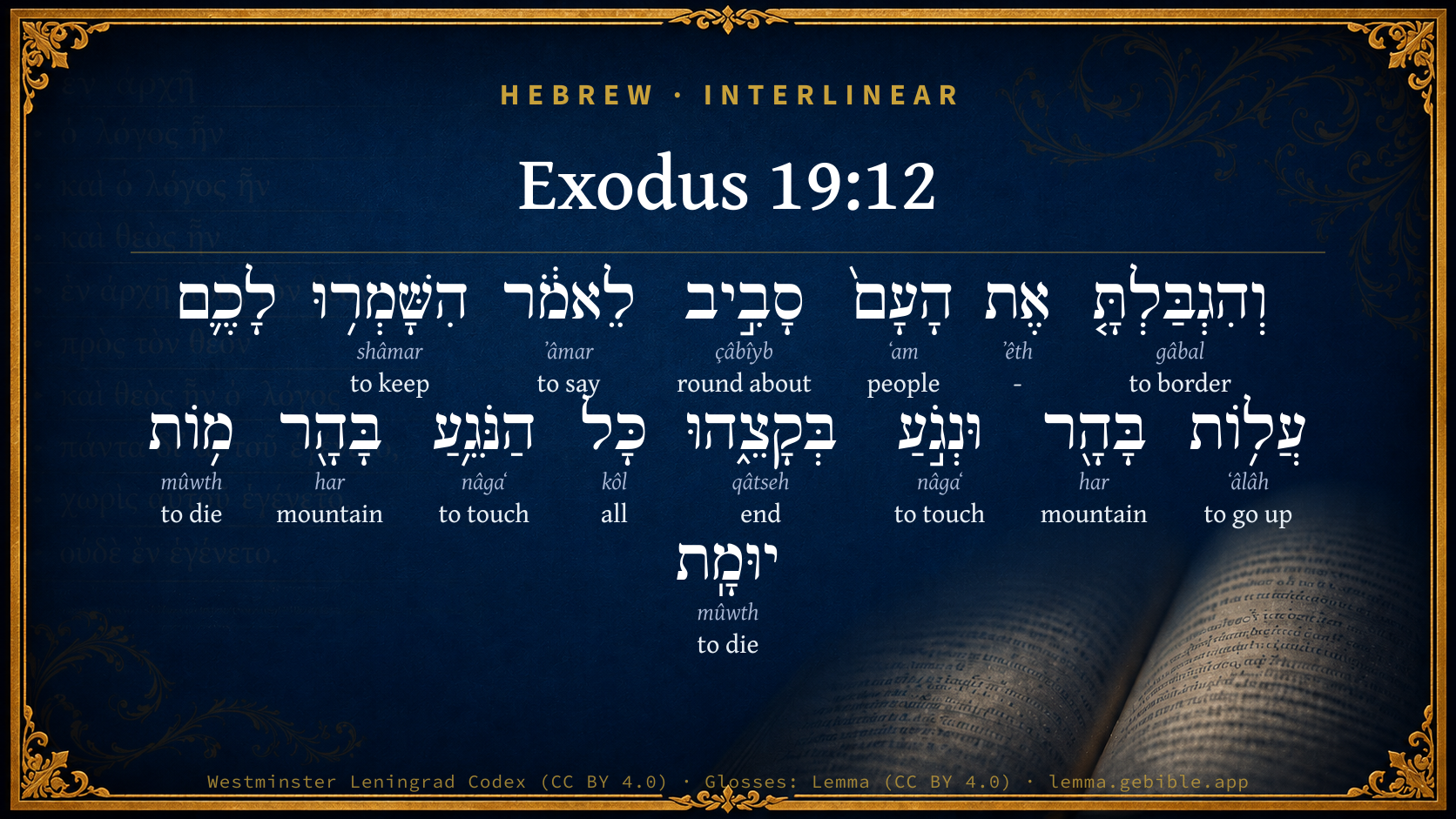
Hebrew (Westminster Leningrad Codex) Exodus 19:12 appears in the Hebrew Old Testament. The text above is from the Westminster Leningrad Codex. Each word links to its Strong’s number, a concise gloss, and parsing drawn from the Open Scriptures Hebrew Bible morphology. Click any word for its full Brown-Driver-Briggs (BDB) entry.
Download image
Cite this verse

Exodus 19:12 (World English Bible). Public Domain. Lemma interlinear Bible study tool, https://lemma.gebible.app/v/exodus/19/12.

Show BibTeX & RIS
BibTeX
RIS
English Translation
You shall set bounds to the people round about, saying, 'Be careful that you don't go up onto the mountain, or touch its border. Whoever touches the mountain shall be surely put to death.
World English Bible · Public Domain
Highlights
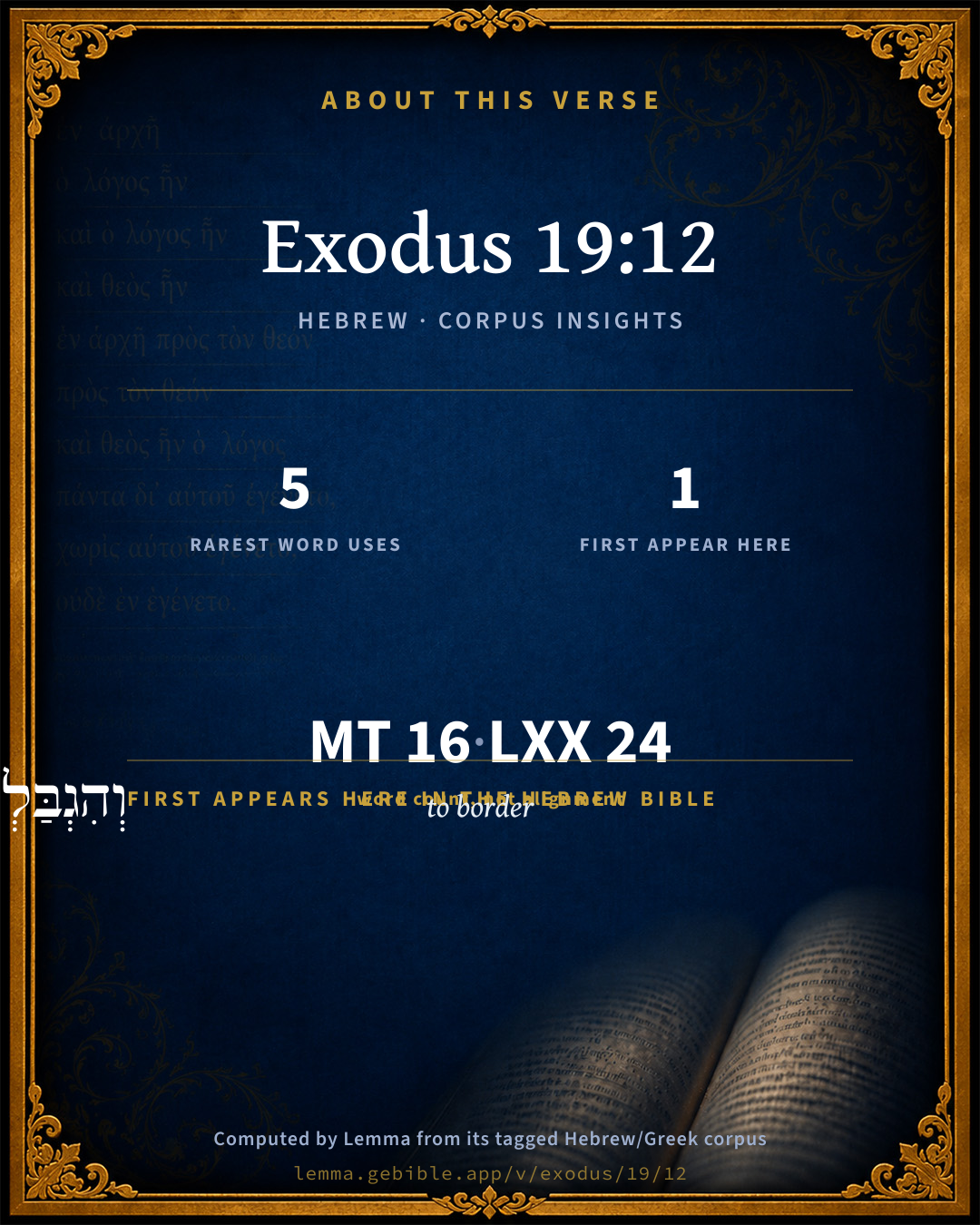
  • 1 first appearance in the Hebrew Bible
Full analysis ↓
Download a study sheet

One document with this verse’s original text, its word-by-word gloss line, the meaning frame, cross-references with their text, attributed commentary, and full source and license credits — printable, and it pastes into notes with its structure intact.

This verse Autodidact and up

Study sheet (.html) Plain text (.txt)

A passage Seminary Student

Up to 50 verses in one chapter. A passage sheet keeps up to 6 commentary sources and 12 cross-references per verse, in the order this page ranks them, and says so on the sheet whenever that leaves anything out. Ask for a single verse and you get the Autodidact verse sheet above.

Everything on this page stays free to read, with no account — the sheet is a download of what is already on screen, not access to it.

Want to remove ads? Support Godless Engineer
Compare translations 3

The same verse in 3 English versions, stacked beneath the original-language interlinear above. Click any original word for its lexicon entry.

Each is an independent rendering of the whole verse — the interlinear is not word-aligned to these translations.

Highlighted words mark where these versions differ — a whole-verse word diff, not a word-by-word alignment.

  • World English Bible Public Domain
    You shall set bounds to the people round about, saying, 'Be careful that you don't go up onto the mountain, or touch its border. Whoever touches the mountain shall be surely put to death.
  • King James Version Public Domain
    And thou shalt set bounds unto the people round about, saying, Take heed to yourselves, that ye go not up into the mount, or touch the border of it: whosoever toucheth the mount shall be surely put to death:
  • unfoldingWord Literal Text CC BY-SA 4.0
    And you shall set boundaries for the people all around, saying, ‘Watch yourselves climbing on the mountain or touching on its edge. Every mountain toucher shall certainly be killed.

unfoldingWord Literal Text — © unfoldingWord, licensed CC BY-SA 4.0. Word-aligned USFM3 via Door43 (git.door43.org/unfoldingWord/en_ult).

Versions to compare (up to 4)

3 of 4 selected

Show all 18 translations

Every available English version of this verse, each an independent rendering of the whole verse.

  • World English Bible Public Domain
    You shall set bounds to the people round about, saying, 'Be careful that you don't go up onto the mountain, or touch its border. Whoever touches the mountain shall be surely put to death.
  • Berean Standard Bible Public Domain
    And you are to set up a boundary for the people around the mountain and tell them, ‘Be careful not to go up on the mountain or touch its base. Whoever touches the mountain shall surely be put to death.
  • Majority Standard Bible Public Domain
    And you are to set up a boundary for the people around the mountain and tell them, ‘Be careful not to go up on the mountain or touch its base. Whoever touches the mountain shall surely be put to death.
  • King James Version Public Domain
    And thou shalt set bounds unto the people round about, saying, Take heed to yourselves, that ye go not up into the mount, or touch the border of it: whosoever toucheth the mount shall be surely put to death:
  • American Standard Version (1901) Public Domain
    And thou shalt set bounds unto the people round about, saying, Take heed to yourselves, that ye go not up into the mount, or touch the border of it: whosoever toucheth the mount shall be surely put to death:
  • Revised Version (1885) Public Domain
    And thou shalt set bounds unto the people round about, saying, Take heed to yourselves, that ye go not up into the mount, or touch the border of it: whosoever toucheth the mount shall be surely put to death:
  • Geneva Bible (1599) Public Domain
    And thou shalt set markes vnto the people rounde about, saying, Take heede to your selues that ye goe not vp the mount, nor touche the border of it: whosoeuer toucheth the mount, shall surely die.
  • Douay-Rheims (1899) Public Domain
    And thou shalt appoint certain limits to the people round about, and thou shalt say to them: Take heed you go not up into the mount, and that ye touch not the borders thereof: every one that toucheth the mount dying he shall die.
  • Young's Literal Translation Public Domain
    `And thou hast made a border `for' the people round about, saying, Take heed to yourselves, going up into the mount, or coming against its extremity; whoever is coming against the mount is certainly put to death;
  • Literal Standard Version CC BY-SA 4.0
    And you have made a border [for] the people all around, saying, Take heed to yourselves, going up into the mountain or coming against its extremity; whoever is coming against the mountain is certainly put to death;
  • Unlocked Literal Bible CC BY-SA 4.0
    You must set boundaries all around the mountain for the people. Say to them, 'Be careful that you do not go up the mountain or touch its border. Whoever touches the mountain will surely be put to death.'
  • unfoldingWord Literal Text CC BY-SA 4.0
    And you shall set boundaries for the people all around, saying, ‘Watch yourselves climbing on the mountain or touching on its edge. Every mountain toucher shall certainly be killed.
  • Darby Bible Public Domain
    And set bounds round about the people, saying, Take heed to yourselves, [not] to go up unto the mountain nor touch the border of it: whatever toucheth the mountain shall certainly be put to death:
  • World Messianic Bible Public Domain
    You shall set bounds to the people all around, saying, ‘Be careful that you don’t go up onto the mountain, or touch its border. Whoever touches the mountain shall be surely put to death.
  • Webster's Bible Public Domain
    And thou shalt set bounds to the people round about, saying, Take heed to yourselves, that ye go not up upon the mount, or touch the border of it: whoever toucheth the mount shall be surely put to death:
  • Free Bible Version CC BY-SA 4.0
    Set up a boundary for the people all around and warn them, ‘Watch out! Don't try to go up the mountain—don't even touch it! For anyone who touches the mountain will most certainly be killed. Don't touch any person or any animal that has touched the mountain.
  • Bible in Basic English Public Domain
    And let limits be marked out for the people round the mountain, and say to them, Take care not to go up the mountain or near the sides of it: whoever puts his foot on the mountain will certainly come to his death:
  • JPS Tanakh (1917) Public Domain
    And thou shalt set bounds unto the people round about, saying: Take heed to yourselves, that ye go not up into the mount, or touch the border of it; whosoever toucheth the mount shall be surely put to death;

Literal Standard Version (2020), Covenant Press — licensed CC BY-SA 4.0. Text via the HelloAO Bible API (eBible.org). Unlocked Literal Bible (unfoldingWord) — licensed CC BY-SA 4.0. Text via the HelloAO Bible API (eBible.org). unfoldingWord Literal Text — © unfoldingWord, licensed CC BY-SA 4.0. Word-aligned USFM3 via Door43 (git.door43.org/unfoldingWord/en_ult). Free Bible Version, Dr. Jonathan Gallagher — licensed CC BY-SA 4.0. Text via the HelloAO Bible API (eBible.org).

Word by word

More ways to search: Search by grammar → Find every occurrence → Compare this word →

Practice this passage: Drill this verse → Learn its vocabulary →

וְהִגְבַּלְתָּ֤
gâbal
H1379
“and · to border”
Conjunction + Verb, Hiphil, Sequential Perfect, 2nd Person, Masculine, Singular
Part of Speech
Conjunction + Verb
Stem
Hiphil
Form
Sequential Perfect
Person
2nd Person
Gender
Masculine
Number
Singular
Full BDB Definition

Origin: a primitive root

TWOT: 307

to bound, border - (Qal) to bound, border - (Hiphil) to set bounds, set bounds for
  1. אֶת ʼêth H853 “-” Particle, Direct Object
  2. הָעָם֙ ʻam H5971 “the · people” Particle, Definite Article + Noun, Common, Masculine, Singular, Absolute
  3. סָבִ֣יב çâbîyb H5439 “round about” Noun, Common, Both, Singular, Absolute
  4. לֵאמֹ֔ר ʼâmar H559 “to say” Preposition + Verb, Qal, Infinitive Construct
  5. הִשָּׁמְר֥וּ shâmar H8104 “keep” Verb, Niphal, Imperative, 2nd Person, Masculine, Plural
  6. עֲל֥וֹת ʻâlâh H5927 “to go up” Verb, Qal, Infinitive Construct
  7. בָּהָ֖ר har H2022 “in/at the · mountain” Preposition, Determined + Noun, Common, Masculine, Singular, Absolute
  8. וּנְגֹ֣עַ nâgaʻ H5060 “and · to touch” Conjunction + Verb, Qal, Infinitive Construct
  9. בְּקָצֵ֑הוּ qâtseh H7097 “in/at · end · his” Preposition + Noun, Common, Both, Singular, Construct + Suffix, Personal, 3rd Person, Masculine, Singular
  10. כָּל kôl H3605 “all of” Noun, Common, Masculine, Singular, Construct
  11. הַנֹּגֵ֥עַ nâgaʻ H5060 “the · touching” Particle, Definite Article + Verb, Qal, Participle Active, Masculine, Singular, Absolute
  12. בָּהָ֖ר har H2022 “in/at the · mountain” Preposition, Determined + Noun, Common, Masculine, Singular, Absolute
  13. מ֥וֹת mûwth H4191 “to die” Verb, Qal, Infinitive Absolute
  14. יוּמָֽת mûwth H4191 “to die” Verb, Hophal, Imperfect, 3rd Person, Masculine, Singular

About this verse

These counts appear in no published source. They are computed here, from the morphology-tagged text and Lemma’s own curated glosses. What Lemma adds →

16
words
12
distinct lemmas
Pentateuch
section

Notable vocabulary

The rarest word here is וְהִגְבַּלְתָּ֤ to border H1379 — appearing just 5 times in the whole Hebrew Bible.

First appearance in Scripture

This word makes its first canonical appearance in the Hebrew Bible here:

  • וְהִגְבַּלְתָּ֤ to border H1379

Shared distinctive vocabulary

וְהִגְבַּלְתָּ֤ to border H1379 occurs in 5 verses of the Hebrew Bible. Also found in:

Grammatical profile

  • 8 verbs
  • 6 nouns
  • 1 preposition
  • 1 particle

Verb forms

  • וְהִגְבַּלְתָּ֤ Hiphil · Sequential Perfect
  • לֵאמֹ֔ר Qal · Infinitive Construct
  • הִשָּׁמְר֥וּ Niphal · Imperative
  • עֲל֥וֹת Qal · Infinitive Construct
  • וּנְגֹ֣עַ Qal · Infinitive Construct
  • הַנֹּגֵ֥עַ Qal · Participle Active
  • מ֥וֹת Qal · Infinitive Absolute
  • יוּמָֽת Hophal · Imperfect

Repetition

Words recur within this verse — often emphatic in Hebrew:

  • בָּהָ֖ר mountain H2022 ×2
  • וּנְגֹ֣עַ to touch H5060 ×2
  • מ֥וֹת to die H4191 ×2

Hebrew & Septuagint length

In English translation the verse runs 34 words from the Hebrew and 36 from the Septuagint (LXX English) — closely comparable.

A rough comparison of the two English renderings, which tokenize alike — not a word-level alignment.

Word counts can differ between the Hebrew and the Greek without any difference in meaning — e.g. the Hebrew direct-object marker אֵת has no separate Greek word, and Greek often adds the article ὁ.

In the original languages it is 16 Hebrew tokens and 24 Greek tokens — but the two are counted differently (Hebrew bundles its prefixes and suffixes into one token; the Greek is in lemma form), so that isn’t a like-for-like length.

Cross-references

8

Topical passages linked to Exodus 19:12 in the Treasury of Scripture Knowledge — connected by theme and wording, ordered by reader-vote popularity; previews shown in the World English Bible.

  • Hebrews 12:20–21 for they could not stand that which was commanded, "If even an animal touches the mountain, it shall be stoned;"
  • Joshua 3:4 Yet there shall be a space between you and it, about two thousand cubits by measure: don't come near to it, that you may know the way by which you must go; for you have not passed this way heretofore.
  • Exodus 10:28 Pharaoh said to him, "Get away from me! Be careful to see my face no more; for in the day you see my face you shall die!"
  • Exodus 19:21 Yahweh said to Moses, "Go down, charge the people, lest they break through to Yahweh to gaze, and many of them perish.
  • Exodus 19:23 Moses said to Yahweh, "The people can't come up to Mount Sinai, for you charged us, saying, 'Set bounds around the mountain, and sanctify it.'"
  • Exodus 34:12 Be careful, lest you make a covenant with the inhabitants of the land where you are going, lest it be for a snare in the midst of you:
  • Deuteronomy 2:4 Command you the people, saying, You are to pass through the border of your brothers the children of Esau, who dwell in Seir; and they will be afraid of you: take good heed to yourselves therefore;
  • Deuteronomy 4:9 Only take heed to yourself, and keep your soul diligently, lest you forget the things which your eyes saw, and lest they depart from your heart all the days of your life; but make them known to your children and your children's children;

Cross-references courtesy of OpenBible.info (CC BY 4.0).

Hebrew and Greek witnesses Masoretic Hebrew ↔ Greek Septuagint

The same verse in the two great witnesses to the Old Testament, shown verse-for-verse.

These are two independent witnesses, not word-aligned to each other, and the Septuagint is shown in lemma (dictionary) form.

Hebrew Exodus 19:12 Masoretic · Westminster Leningrad Codex

וְהִגְבַּלְתָּ֤ אֶת הָעָם֙ סָבִ֣יב לֵאמֹ֔ר הִשָּׁמְר֥וּ לָכֶ֛ם עֲל֥וֹת בָּהָ֖ר וּנְגֹ֣עַ בְּקָצֵ֑הוּ כָּל הַנֹּגֵ֥עַ בָּהָ֖ר מ֥וֹת יוּמָֽת

You shall set bounds to the people round about, saying, 'Be careful that you don't go up onto the mountain, or touch its border. Whoever touches the mountain shall be surely put to death.

World English Bible · Public Domain

Greek LXX Exodus 19:12 Septuagint · lemma form

καί ἀποὁρίζω ὁ λαός κύκλος λέγω προςἔχω ἑαυτοῦ ὁ ἀναβαίνω εἰς ὁ ὄρος καί θιγγάνω τις αὐτός πᾶς ὁ ἅπτομαι ὁ ὄρος θάνατος τελευτάω

And you shall separate the people round about, saying, Take heed to yourselves that you⌃ go not up into the mountain, nor touch any part of it: every one that touches the mountain shall surely die.

LXX2012 (modern English Septuagint) · Public Domain

Hebrew: Westminster Leningrad Codex (CC BY 4.0). Greek: Septuagint (public domain); English from LXX2012 (modern English Septuagint) (Public Domain). How the Septuagint differs from the Hebrew →

Targum (Aramaic paraphrase)

2

The Targum is the ancient Jewish Aramaic paraphrase of the Hebrew Scriptures — an interpretive translation, not the Hebrew text itself. Onkelos (literal) and Pseudo-Jonathan (expansive) render the Torah, and Jonathan the Prophets. Coverage is partial: where no permissively-licensed English translation exists for a verse, only the Aramaic is shown. This is verse-level text, not a word-by-word alignment to the Hebrew.

  1. Targum Onkelos Torah (Genesis–Deuteronomy)
    וּתְתַחֵם יָת עַמָא סְחוֹר סְחוֹר לְמֵימַר אִסְתַּמָרוּ לְכוֹן מִלְמִסַק בְּטוּרָא וּלְמִקְרַב בְּסוֹפֵהּ כָּל דְיִקְרַב בְּטוּרָא אִתְקְטָלָא יִתְקְטֵל:

    (no public-domain English translation for this verse)

    Targum Onkelos — Aramaic: “Onkelos Genesis” (public domain); “Onkelos Exodus” (public domain); “Onkelos Leviticus” (public domain); “Onkelos Numbers” (public domain); “Onkelos Deuteronomy” (public domain). English: “Sefaria Community Translation” (CC0 1.0 (public-domain dedication)); “J.W. Etheridge. The Targums of Onkelos and Jonathan Ben Uzziel on the Pentateuch. London: Longmans, Green, 1862” (public domain). Text via Sefaria.

  2. Targum Pseudo-Jonathan Torah (Genesis–Deuteronomy)
    וְתַתְחֵם יַת עַמָּא וִיקוּמוּן חֲזוֹר חֲזוֹר לְטוּרָא לְמֵימָר הֲווֹ זְהִירִין מִלְמֵיסַק בְּהַר וּלְמִקְרַב בְּסַיְיפֵיהּ כָּל דְּיִקְרַב בְּטַוְורָא אִתְקְטָלָא יִתְקְטֵיל

    And thou shalt set limits for the people that they may stand round about the mountain, and shalt say, Beware that you ascend not the mount, nor come near its confines; whoever cometh nigh the mount will be surely put to death.

    Targum Pseudo-Jonathan — Aramaic: “Targum Jonathan on Genesis” (public domain); “Targum Jonathan on Exodus” (public domain); “Targum Jonathan on Leviticus” (public domain); “Targum Jonathan on Numbers” (public domain); “Targum Jonathan on Deuteronomy” (public domain). English: “The Targum of Jonathan ben Uzziel, trans. J. W. Etheridge, London, 1862” (public domain). Text via Sefaria.

Commentary

Notes on Exodus 19:12 from classic Christian and Jewish commentators (each source and its license shown beneath its notes). The classic Christian expositions comment on the surrounding passage and are grouped to its opening verse, so a note may address several verses; the Jewish commentaries on the Tanakh (Rashi and others) are per-verse, so they appear only where the commentator wrote on this verse.

Lemma curates 59 commentaries, every one of them public domain or Creative Commons licensed, each selected and text-cleaned for this edition rather than reprinted as found. About our sources →

Trapp's Complete Commentary

John Trapp

Exo 19:12 And thou shalt set bounds unto the people round about, saying, Take heed to yourselves, [that ye] go [not] up into the mount, or touch the border of it: whosoever toucheth the mount shall be surely put to death:

Ver. 12. That ye go not up into the mount.] God loves at once familiarity and fear, saith a learned divine; {a} familiarity with him in our conversation, and fear of him in his commands. He loves to be acquainted with men in the walks of their obedience, yet he takes state upon him in his ordinances, and will be trembled at in his word and judgments.

{a} Dr Hall.

John Trapp, A Commentary or Exposition upon All the Books of the Old and New Testament (1647–1656) — public domain. Text from a community e-Sword module.

Joseph Benson's Commentary

Exo 19:12. Set bounds — Probably he drew a ditch round the foot of the hill, which none were to pass upon pain of death. This was to intimate, 1st, That lawful reverence which ought to possess the minds of all that worship God. 2d, The distance at which worshippers were kept under that dispensation, which we ought to take notice of, that we may the more value our privilege under the gospel, having “boldness to enter into the holiest by the blood of Jesus,” Heb 10:19.

Joseph Benson's Commentary on the Old and New Testaments (1811–1818) — public domain. Text from a community e-Sword module.

Adam Clarke's Commentary

Verse 12. Thou shalt set bounds] Whether this was a line marked out on the ground, beyond which they were not to go, or whether a fence was actually made to keep them off, we cannot tell; or whether this fence was made all round the mountain, or only at that part to which one wing of the camp extended, is not evident.

This verse strictly forbids the people from coming near and touching Mount Sinai, which was burning with FIRE. The words therefore in Ex 19:15, אל תגשו אל אשה al tiggeshu el ishshah, come not at your wives, seem rather to mean, come not near unto the FIRE; especially as the other phrase is not at all probable: but the fire is, on this occasion, spoken of so emphatically (see De 5:4-5; De 5:22-25) that we are naturally led to consider אשה ishshah here as האש ha-esh transposed, or to say, with Simon in his Lexicon, אשה faem, idem quod masc. אש ignis. So among other instances, we have אבר and אברה a wing; אור and אורה light; אמץ and אמצה strength; and אמר and אמרה a speech. - Burt. See KENNICOTT'S Remarks.

Whosoever toucheth the mount shall be surely put to death] The place was awfully sacred, because the dreadful majesty of God was displayed on it. And this taught them that God is a consuming fire, and that it is a fearful thing to fall into the hands of the living God.

Adam Clarke's Commentary on the Bible (1810–1826) — public domain. Text from a community e-Sword/MySword module.

Ellicott's Commentary for English Readers

(12) Thou shalt set bounds.—Here was another formal and mechanical direction, having for its object to deepen and intensify the lesson of God’s unapproachable majesty and holiness. Moses was required to “set bounds to the people,” i.e., to make a substantial fence between the camp and the base of Sinai, which should prevent both animals and men from coming in contact with the mountain. Modern travellers generally observe how abruptly the rocky precipice of Ras Sufsafeh rises from the plain in front of it, so that in many places it is quite possible to stand on the plain and yet touch the mountain. The idea that a line of natural mounds now to be seen near the base of Sinai represents the “bounds” of Moses (Stanley, Sinai and Palestine, p. 43) is unsatisfactory, since the “bounds” of Moses were most certainly artificial ones. It is, however, possible that his “bounds” may have followed the line of the natural barrier.

That ye go not up into the mount.—Unless it had been forbidden, there might have seemed to be no reason why pious Israelites might not have ascended the height, to draw near to God in prayer. It is a praiseworthy feeling which breathes in the words, “Nearer, my God, to thee;” but the nation was not fit for close approach.

A Bible Commentary for English Readers, edited by Charles John Ellicott (1878–1897) — public domain. Text from a community e-Sword module.

The Cambridge Bible for Schools and Colleges

gen. ed. J. J. S. Perowne

12. border] Heb. extremity, or edge (Exo_13:20).

shall be surely put to death] Gen_26:11, Jdg_21:15; and often in the laws, as ch. Exo_21:12; Exo_21:14-16, &c.

The Cambridge Bible for Schools and Colleges (gen. ed. J. J. S. Perowne; Cambridge University Press, 1878–1918) — public domain. Text from a community e-Sword module.

John Gill's Exposition

And thou shall set bounds to the people round about,.... That is, round about the mountain, by drawing a line, throwing up a foss or ditch, or else by laying up heaps of stones or sand, which might be come at easily, or bushes and branches of trees, which grew thick on the mount, from whence it had its name; but be it what will that were used, these were to signify, that so far the people might go, but no further, which their curiosity might prompt them to:

saying, take heed unto yourselves that ye go not up into the mount; so far were they from being allowed to go up to the top of it, that they were not allowed to ascend it at all, or to go any further than where the ascent or rise began; it was at their peril to ascend, and this was what they were to take heed unto, lest they incurred danger:

or touch the border of it; it being the mountain of God, and relatively holy through his presence on it:

whosoever toucheth the mount shall be surely put to death; which severe law was made to deter them from any attempt to go up the mountain, since it was death even to touch it, see Heb 12:18.

John Gill's Exposition of the Whole Bible (1746–1763) — public domain (CC PDM 1.0). Text via the HelloAO Bible API.

Albert Barnes' Notes on the Bible

Set bounds unto the people - The low line of alluvial mounds at the foot of the cliff of Ras Safsafeh exactly answers to the bounds which were to keep the people off from touching the mount: but the bounds here spoken of were to be set up by Moses.

Albert Barnes' Notes on the Bible (1834–1885) — public domain. Text from a community e-Sword/MySword module.

Matthew Poole's English Annotations

By this symbolical injunction God designed,

1. To restrain men’s curious and bold inquiries into the things of God.

2. To possess the Israelites then present, and all succeeding generations, with the dread and reverence of the Divine Majesty, and of his holy law.

3. To prepare and inure the people to the obedience of God’s commands, even when they discern not the reasons of them.

4. To make them sensible of their own impurity and infirmity, and of their absolute need of a mediator, through whom they might have access to God. See Gal 3:19.

Matthew Poole's English Annotations on the Holy Bible (1683–1685) — public domain. Text from a community e-Sword/MySword module.

Whedon's Commentary on the Bible

Daniel D. Whedon

12. Set bounds — The allusions made here to the mount, and the possible approaches to it, and touching the border of it, afford means for identifying the true Sinai. There must have been a great plain at the base of the mount capable of accommodating an immense assembly, a sublime head or top (Exo_19:20) overlooking this plain, and such an immediate contact of plain and mountain that people might approach from below and touch the mount. All these conditions are strikingly fulfilled in the plain er-Rahah and the peak known as Ras Sasafeh, or Ras es-Sufsafeh. See note at beginning of this chapter. Stanley says: “No one who has approached the Ras Sasafeh through that noble plain, or who has looked down upon the plain from that majestic height, will willingly part with the belief that these are the two essential features of the view of the Israelitish camp. That such a plain should exist at all in front of such a cliff is so remarkable a coincidence with the sacred narrative as to furnish a strong internal argument, not merely of its identity with the scene, but of the scene itself having been described by an eye-witness. The awful and lengthened approach, as to some natural sanctuary, would have been the fittest preparation for the coming scene. The low line of alluvial mounds at the foot of the cliff exactly answers to the bounds which were to keep the people off from touching the mount. The plain itself is not broken and uneven and narrowly shut in, like almost all others in the range, but presents a long, retiring sweep against which the people could ‘remove and stand afar off.’ The cliff, rising like a huge altar in front of the whole congregation, and visible against the sky in lonely grandeur from end to end of the whole plain, is the very image of ‘the mount that might be touched,’ and from which the voice of God might be heard far and wide over the stillness of the plain below, widened at that point to its utmost extent by the confluence of all the contiguous valleys. Here, beyond all other parts of the peninsula, is the adytum, withdrawn, as if in the ‘end of the world,’ from all the stir and confusion of earthly things.” — Sinai and Palestine, pp. 42, 43.

Daniel D. Whedon (gen. ed.), Commentary on the Old and New Testaments (1874–1909) — public domain. Text from a community e-Sword module.

The Pulpit Commentary

Thou shalt set bounds. The erection of a fence or barrier, between the camp and the mountain not necessarily all round the mountain seems to be meant. This barrier may have run along the line of low alluvial mounds at the foot of the cliff of Ras Sufsafeh, mentioned by Dean Stanley (Sinai and Palestine, p. 43), but cannot have been identical with them, since it was an artificial fence. That ye go not up into the mount. Curiosity might have tempted some to ascend the mount, if it had not been positively forbidden under the penalty of death; carelessness might have brought many into contact with it, since the cliff rises abruptly from the plain. Unless the fence had been made, cattle would, naturally, have grazed along its base. To impress the Israelites with a due sense of the awful majesty of God, and the sacredness of everything material that it brought into close relations with him, the mount itself was declared holy none but Moses and Aaron might go up into it; none might touch it; even the stray beast that approached it must suffer death for its unwitting offence (ver. 13). Whosoever toucheth the mount. The mountain may be "touched" from the plain it rises so abruptly. Shall be surely put to death. A terrible punishment, and one which, to modern ideas, seems excessive. But it was only by terrible threats, and in some cases by terrible punishments, (2Sa_6:7) that the Israelites could be taught reverence. A profound reverence lies at the root of all true religious feeling; and for the education of the world, it was requisite, in the early ages, to inculcate the necessity of this frame of mind in some very marked and striking way.

The Pulpit Commentary (1880–1919), ed. H.D.M. Spence-Jones & Joseph S. Exell — public domain. Text from a community e-Sword module.

John Wesley's Explanatory Notes

Set bounds - Probably he drew a ditch round at the foot of the hill, which none were to pass upon pain of death. This was to intimate, 1st, That awful reverence which ought to possess the minds of all that worship God. 2ndly, The distance which worshippers were kept at under that dispensation, which we ought to take notice of, that we may the more value our privilege under the gospel, having boldness to enter into the holiest by the blood of Jesus, Heb. x, 19.

John Wesley, Explanatory Notes Upon the Whole Bible (1754–1765) — public domain. Text via the GEBible commentary corpus.

unfoldingWord translationNotes

Door43 World Missions Community

General Information:

Yahweh continues speaking to Moses.

set boundaries

"make a boundary." This was either a mark or some kind of barrier.

Whoever touches the mountain will surely be put to death

This can be stated with an active form. AT: "You must surely put to death any person who touches the mountain" or "You must surely kill anyone who touches the mountain" (See: Active or Passive)

Whoever touches

"Any person who touches" or "Anyone who touches"

such a person

"a person who does that" or "a person who touches the mountain"

he must certainly be stoned or shot

This can be stated in active form. AT: "you must certainly stone or shoot him" (See: Active or Passive)

shot

This refers to being killed by someone who shoots arrows from a bow or stones from a slingshot.

a long blast

"a long, loud sound"

translationWords

die

stone

trumpet

unfoldingWord translationNotes — © Distant Shores Media and the Door43 World Missions Community, licensed CC BY-SA 4.0. Source: git.door43.org/Door43/en_tn.

Rashi

Rabbi Shlomo Yitzchaki (Rashi)

והגבלת AND THOU SHALT SET BOUNDS — set boundary marks for them as a sign that they should not approach the mountain from the boundary and beyond.

לאמר SAYING — The boundary says to them, “Take care not to ascend from here and further on” and you, too, admonish them regarding this.

ונגע בקצהו OR TOUCH THE EXTREMITY THEREOF — i. e. even the extremity thereof.

Rashi on the Tanakh — English translations: “The Judaica Press complete Tanach with Rashi, translated by A. J. Rosenberg” (CC BY 4.0); “Pentateuch with Rashi's commentary by M. Rosenbaum and A.M. Silbermann, 1929-1934” (public domain); “The Metsudah Tanach series, Lakewood, N.J” (CC BY 4.0); and “The Book of Joshua, Metsudah Publications, 1997” (CC BY 4.0). Text via Sefaria.

Lesson kit

Teaching starters — assembled from the data on this page, not authored interpretation. Every prompt links to the verse data it draws on. Edit before teaching.

Exodus, in the Pentateuch, opens this verse with 16 words (12 distinct Hebrew lemmas). Its most distinctive word is gâbal (“to border”). A historical commentator’s framing appears above. Read the whole chapter for the surrounding context.

Discussion questions

  1. The word gâbal carries the sense “to border.” How does it shape the verse?
  2. This is the first place “to border” appears in Scripture (first appears here). What does its debut here establish?
  3. How does Exodus 19:23, which shares the word «to border», read alongside this verse?
  4. What does the repetition of “mountain” (2× in this one verse) do in this verse?
  5. The translations on this page render this verse differently — a whole-verse word diff, not a word-by-word alignment. What might account for the different wordings?
  6. «וְהִגְבַּלְתָּ֤» is a Hiphil Sequential Perfect verb. How does that grammatical form shape the action described?
  7. Compare how Trapp's Complete Commentary and Joseph Benson's Commentary read this verse. Where do they agree or differ?

Things to notice

Reading settings

Reading text

Shown beneath each verse's original-language words.

Old Testament
Old Testament edition

Read the OT as the Masoretic Hebrew (MT) or the Greek Septuagint (LXX).

English shown for the Greek Septuagint (in the Hebrew ↔ Greek comparison).

Comparing translations? Open the Compare panel on any verse page to stack up to four side by side.