Genesis 12:15

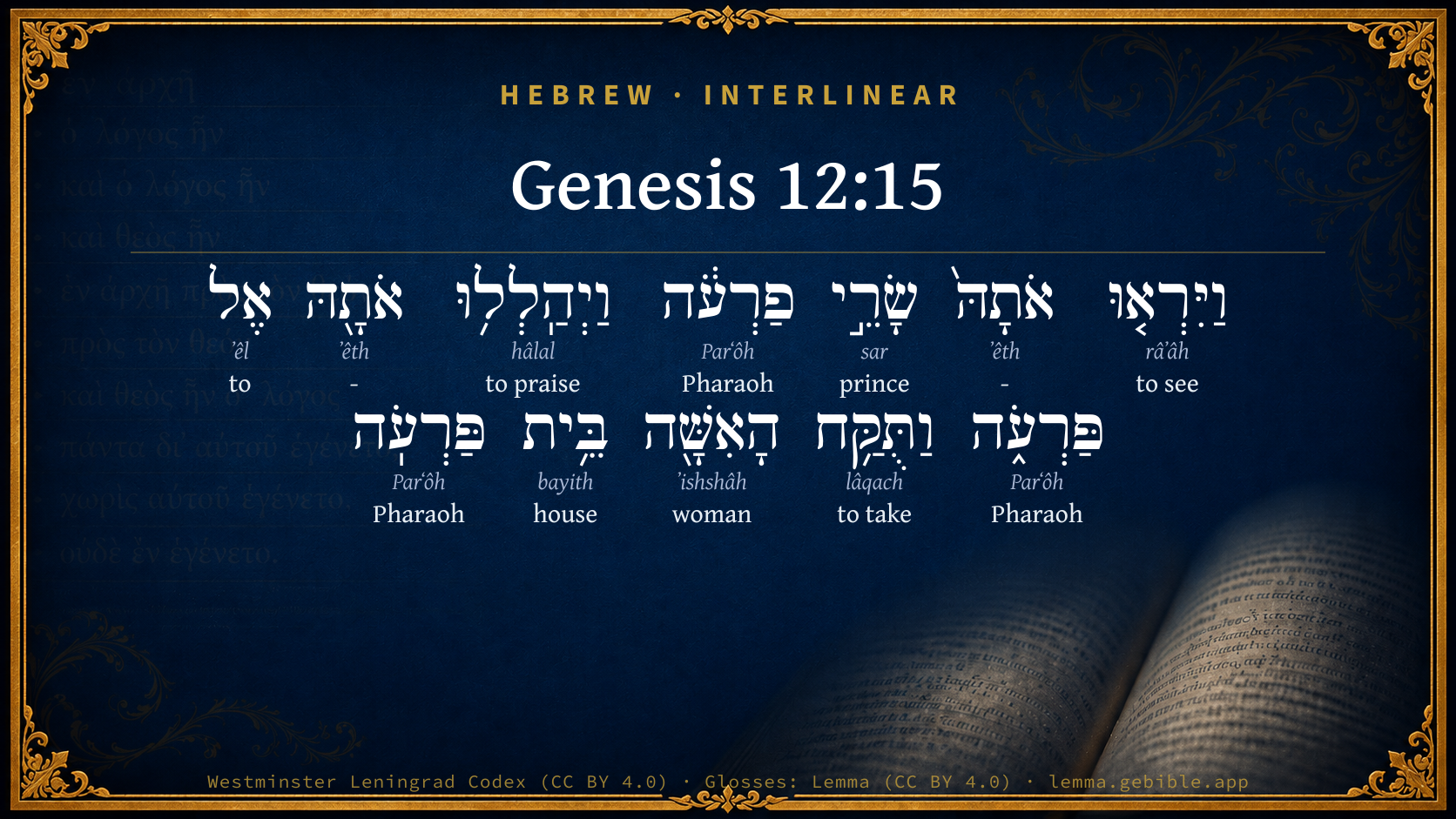
Hebrew (Westminster Leningrad Codex) Genesis 12:15 appears in the Hebrew Old Testament. The text above is from the Westminster Leningrad Codex. Each word links to its Strong’s number, a concise gloss, and parsing drawn from the Open Scriptures Hebrew Bible morphology. Click any word for its full Brown-Driver-Briggs (BDB) entry.
Download image
Cite this verse

Genesis 12:15 (World English Bible). Public Domain. Lemma interlinear Bible study tool, https://lemma.gebible.app/v/genesis/12/15.

Show BibTeX & RIS
BibTeX
RIS
English Translation
The princes of Pharaoh saw her, and praised her to Pharaoh; and the woman was taken into Pharaoh's house.
World English Bible · Public Domain
Highlights
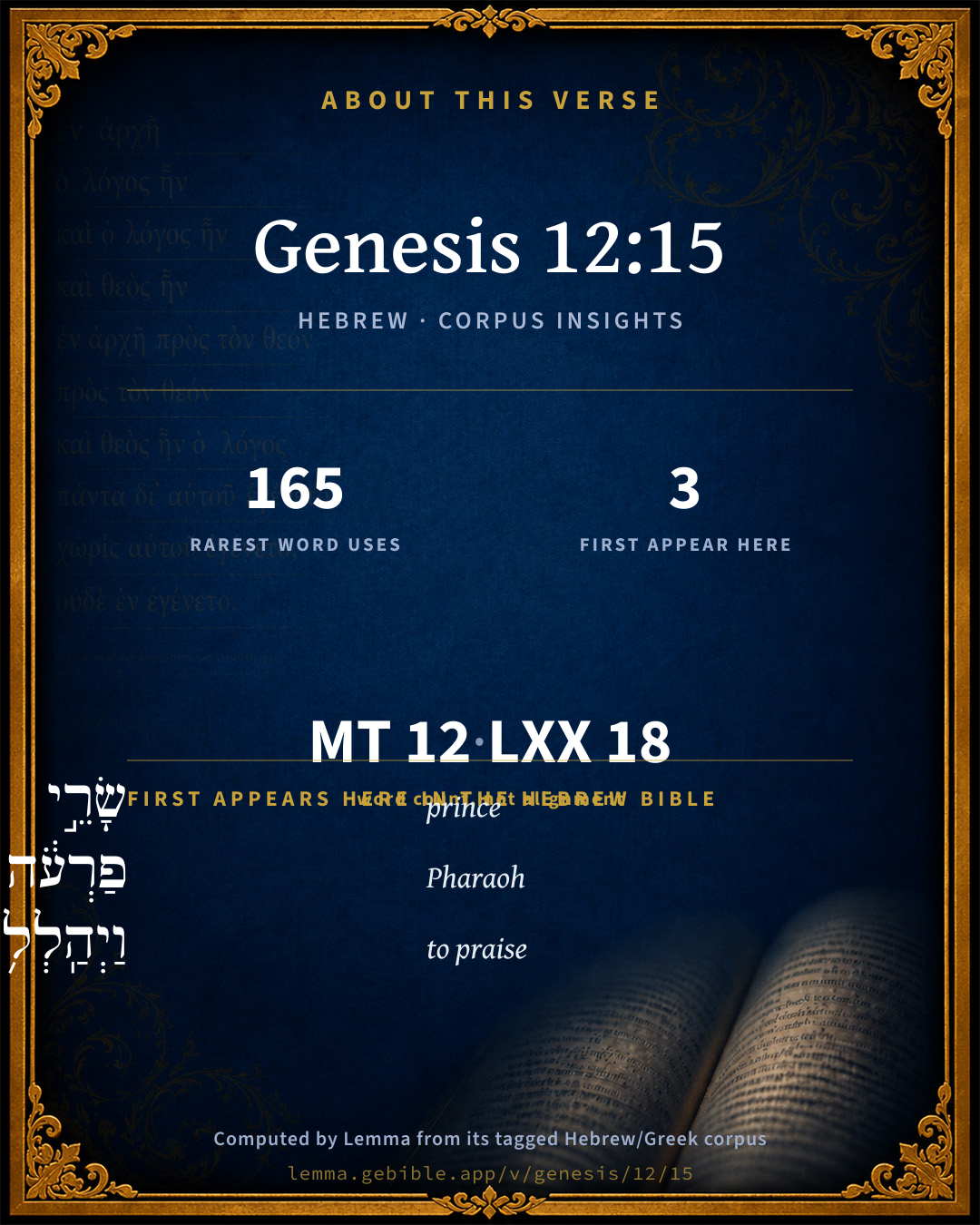
  • 3 first appearances in the Hebrew Bible
Full analysis ↓
Download a study sheet

One document with this verse’s original text, its word-by-word gloss line, the meaning frame, cross-references with their text, attributed commentary, and full source and license credits — printable, and it pastes into notes with its structure intact.

This verse Autodidact and up

Study sheet (.html) Plain text (.txt)

A passage Seminary Student

Up to 50 verses in one chapter. A passage sheet keeps up to 6 commentary sources and 12 cross-references per verse, in the order this page ranks them, and says so on the sheet whenever that leaves anything out. Ask for a single verse and you get the Autodidact verse sheet above.

Everything on this page stays free to read, with no account — the sheet is a download of what is already on screen, not access to it.

Want to remove ads? Support Godless Engineer
Compare translations 3

The same verse in 3 English versions, stacked beneath the original-language interlinear above. Click any original word for its lexicon entry.

Each is an independent rendering of the whole verse — the interlinear is not word-aligned to these translations.

Highlighted words mark where these versions differ — a whole-verse word diff, not a word-by-word alignment.

  • World English Bible Public Domain
    The princes of Pharaoh saw her, and praised her to Pharaoh; and the woman was taken into Pharaoh's house.
  • King James Version Public Domain
    The princes also of Pharaoh saw her, and commended her before Pharaoh: and the woman was taken into Pharaoh's house.
  • unfoldingWord Literal Text CC BY-SA 4.0
    And the officials of Pharaoh saw her, so they praised her to Pharaoh, and the woman was taken into Pharaoh’s house.

unfoldingWord Literal Text — © unfoldingWord, licensed CC BY-SA 4.0. Word-aligned USFM3 via Door43 (git.door43.org/unfoldingWord/en_ult).

Versions to compare (up to 4)

3 of 4 selected

Show all 18 translations

Every available English version of this verse, each an independent rendering of the whole verse.

  • World English Bible Public Domain
    The princes of Pharaoh saw her, and praised her to Pharaoh; and the woman was taken into Pharaoh's house.
  • Berean Standard Bible Public Domain
    When Pharaoh’s officials saw Sarai, they commended her to him, and she was taken into the palace of Pharaoh.
  • Majority Standard Bible Public Domain
    When Pharaoh’s officials saw Sarai, they commended her to him, and she was taken into the palace of Pharaoh.
  • King James Version Public Domain
    The princes also of Pharaoh saw her, and commended her before Pharaoh: and the woman was taken into Pharaoh's house.
  • American Standard Version (1901) Public Domain
    And the princes of Pharaoh saw her, and praised her to Pharaoh: and the woman was taken into Pharaoh's house.
  • Revised Version (1885) Public Domain
    And the princes of Pharaoh saw her, and praised her to Pharaoh: and the woman was taken into Pharaoh’s house.
  • Geneva Bible (1599) Public Domain
    And the Princes of Pharaoh sawe her, and commended her vnto Pharaoh: so the woman was taken into Pharaohs house:
  • Douay-Rheims (1899) Public Domain
    And the princes told Pharao, and praised her before him: and the woman was taken into the house of Pharao.
  • Young's Literal Translation Public Domain
    and princes of Pharaoh see her, and praise her unto Pharaoh, and the woman is taken `to' Pharaoh's house;
  • Literal Standard Version CC BY-SA 4.0
    and princes of Pharaoh see her, and praise her to Pharaoh, and the woman is taken [to] Pharaoh’s house;
  • Unlocked Literal Bible CC BY-SA 4.0
    The princes of Pharaoh saw her, and praised her to Pharaoh, and the woman was taken into Pharaoh's household.
  • unfoldingWord Literal Text CC BY-SA 4.0
    And the officials of Pharaoh saw her, so they praised her to Pharaoh, and the woman was taken into Pharaoh’s house.
  • Darby Bible Public Domain
    And the princes of Pharaoh saw her, and praised her to Pharaoh; and the woman was taken into Pharaoh's house.
  • World Messianic Bible Public Domain
    The princes of Pharaoh saw her, and praised her to Pharaoh; and the woman was taken into Pharaoh’s house.
  • Webster's Bible Public Domain
    The princes also of Pharaoh saw her, and commended her before Pharaoh: and the woman was taken into Pharaoh's house.
  • Free Bible Version CC BY-SA 4.0
    Pharaoh's officials also noticed and spoke positively about her to Pharaoh. So Sarai was taken to his palace to become one of his wives.
  • Bible in Basic English Public Domain
    And Pharaoh's great men, having seen her, said words in praise of her to Pharaoh, and she was taken into Pharaoh's house.
  • JPS Tanakh (1917) Public Domain
    And the princes of Pharaoh saw her, and praised her to Pharaoh; and the woman was taken into Pharaoh's house.

Literal Standard Version (2020), Covenant Press — licensed CC BY-SA 4.0. Text via the HelloAO Bible API (eBible.org). Unlocked Literal Bible (unfoldingWord) — licensed CC BY-SA 4.0. Text via the HelloAO Bible API (eBible.org). unfoldingWord Literal Text — © unfoldingWord, licensed CC BY-SA 4.0. Word-aligned USFM3 via Door43 (git.door43.org/unfoldingWord/en_ult). Free Bible Version, Dr. Jonathan Gallagher — licensed CC BY-SA 4.0. Text via the HelloAO Bible API (eBible.org).

Word by word

More ways to search: Search by grammar → Find every occurrence → Compare this word →

Practice this passage: Drill this verse → Learn its vocabulary →

וַיְהַֽלְל֥וּ
hâlal
H1984
“and · to praise”
Conjunction + Verb, Piel, Sequential Imperfect, 3rd Person, Masculine, Plural
Part of Speech
Conjunction + Verb
Stem
Piel
Form
Sequential Imperfect
Person
3rd Person
Gender
Masculine
Number
Plural
Full BDB Definition

Origin: a primitive root

TWOT: 499 , 500

to shine - (Qal) to shine (figuratively of God's favour) - (Hiphil) to flash forth light - to praise, boast, be boastful - (Qal) - to be boastful - boastful ones, boasters (participle) - (Piel) - to praise - to boast, make a boast - (Pual) - to be praised, be made praiseworthy, be commended, be worthy of praise - (Hithpael) to boast, glory, make one's boast - (Poel) to make a fool of, make into a fool - (Hithpoel) to act madly, act like a madman
  1. וַיִּרְא֤וּ râʼâh H7200 “and · to see” Conjunction + Verb, Qal, Sequential Imperfect, 3rd Person, Masculine, Plural
  2. אֹתָהּ֙ ʼêth H853 “- · her” Particle, Direct Object + Suffix, Personal, 3rd Person, Feminine, Singular
  3. שָׂרֵ֣י sar H8269 “princes of” Noun, Common, Masculine, Plural, Construct
  4. פַרְעֹ֔ה Parʻôh H6547 “Pharaoh” Noun, Proper
  5. אֹתָ֖הּ ʼêth H853 “- · her” Particle, Direct Object + Suffix, Personal, 3rd Person, Feminine, Singular
  6. אֶל ʼêl H413 “to” Preposition
  7. פַּרְעֹ֑ה Parʻôh H6547 “Pharaoh” Noun, Proper
  8. וַתֻּקַּ֥ח lâqach H3947 “and · to take” Conjunction + Verb, Qal Passive, Sequential Imperfect, 3rd Person, Feminine, Singular
  9. הָאִשָּׁ֖ה ʼishshâh H802 “the · woman” Particle, Definite Article + Noun, Common, Feminine, Singular, Absolute
  10. בֵּ֥ית bayith H1004 “house of” Noun, Common, Masculine, Singular, Construct
  11. פַּרְעֹֽה Parʻôh H6547 “Pharaoh” Noun, Proper

About this verse

These counts appear in no published source. They are computed here, from the morphology-tagged text and Lemma’s own curated glosses. What Lemma adds →

12
words
9
distinct lemmas
Pentateuch
section

First appearance in Scripture

These words make their first canonical appearance in the Hebrew Bible here:

  • שָׂרֵ֣י prince H8269
  • פַרְעֹ֔ה Pharaoh H6547
  • וַיְהַֽלְל֥וּ to praise H1984

Grammatical profile

  • 3 verbs
  • 6 nouns
  • 1 preposition
  • 2 particles

Verb forms

  • וַיִּרְא֤וּ Qal · Sequential Imperfect
  • וַיְהַֽלְל֥וּ Piel · Sequential Imperfect
  • וַתֻּקַּ֥ח Qal Passive · Sequential Imperfect

Repetition

A word recurs within this verse — often emphatic in Hebrew:

  • פַרְעֹ֔ה Pharaoh H6547 ×3

Hebrew & Septuagint length

In English translation the verse runs 19 words from the Hebrew and 20 from the Septuagint (LXX English) — closely comparable.

A rough comparison of the two English renderings, which tokenize alike — not a word-level alignment.

Word counts can differ between the Hebrew and the Greek without any difference in meaning — e.g. the Hebrew direct-object marker אֵת has no separate Greek word, and Greek often adds the article ὁ.

In the original languages it is 12 Hebrew tokens and 18 Greek tokens — but the two are counted differently (Hebrew bundles its prefixes and suffixes into one token; the Greek is in lemma form), so that isn’t a like-for-like length.

Cross-references

16

Topical passages linked to Genesis 12:15 in the Treasury of Scripture Knowledge — connected by theme and wording, ordered by reader-vote popularity; previews shown in the World English Bible.

  • Genesis 20:2 Abraham said about Sarah his wife, "She is my sister." Abimelech king of Gerar sent, and took Sarah.
  • Genesis 40:2 Pharaoh was angry with his two officers, the chief cupbearer and the chief baker.
  • Genesis 41:1 It happened at the end of two full years, that Pharaoh dreamed: and, behold, he stood by the river.
  • Exodus 2:5 Pharaoh's daughter came down to bathe at the river. Her maidens walked along by the riverside. She saw the basket among the reeds, and sent her handmaid to get it.
  • Exodus 2:15 Now when Pharaoh heard this thing, he sought to kill Moses. But Moses fled from the face of Pharaoh, and lived in the land of Midian, and he sat down by a well.
  • 1 Kings 3:1 Solomon made affinity with Pharaoh king of Egypt, and took Pharaoh's daughter, and brought her into the city of David, until he had made an end of building his own house, and the house of Yahweh, and the wall of Jerusalem round about.
  • 2 Kings 18:21 Now, behold, you trust on the staff of this bruised reed, even on Egypt; whereon if a man lean, it will go into his hand, and pierce it: so is Pharaoh king of Egypt to all who trust on him.
  • Esther 2:2–16 Then said the king's servants who ministered to him, Let there be beautiful young virgins sought for the king:
  • Psalms 105:4 Seek Yahweh and his strength. Seek his face forever more.
  • Proverbs 6:29 So is he who goes in to his neighbor's wife. Whoever touches her will not be unpunished.
  • Proverbs 29:12 If a ruler listens to lies, All of his officials are wicked.
  • Jeremiah 46:17 They cried there, Pharaoh king of Egypt is but a noise; he has let the appointed time pass by.
  • Hosea 7:4–5 They are all adulterers. They are burning like an oven that the baker stops stirring, From the kneading of the dough, until it is leavened.
  • Hebrews 13:4 Let marriage be held in honor among all, and let the bed be undefiled: but God will judge the sexually immoral and adulterers.
  • Jeremiah 25:19 Pharaoh king of Egypt, and his servants, and his princes, and all his people;
  • Ezekiel 32:2 Son of man, take up a lamentation over Pharaoh king of Egypt, and tell him, You were likened to a young lion of the nations: yet are you as a monster in the seas; and you did break forth with your rivers, and troubled the waters with your feet, and fouled their rivers.

Cross-references courtesy of OpenBible.info (CC BY 4.0).

Hebrew and Greek witnesses Masoretic Hebrew ↔ Greek Septuagint

The same verse in the two great witnesses to the Old Testament, shown verse-for-verse.

These are two independent witnesses, not word-aligned to each other, and the Septuagint is shown in lemma (dictionary) form.

Hebrew Genesis 12:15 Masoretic · Westminster Leningrad Codex

וַיִּרְא֤וּ אֹתָהּ֙ שָׂרֵ֣י פַרְעֹ֔ה וַיְהַֽלְל֥וּ אֹתָ֖הּ אֶל פַּרְעֹ֑ה וַתֻּקַּ֥ח הָאִשָּׁ֖ה בֵּ֥ית פַּרְעֹֽה

The princes of Pharaoh saw her, and praised her to Pharaoh; and the woman was taken into Pharaoh's house.

World English Bible · Public Domain

Greek LXX Genesis 12:15 Septuagint · lemma form

καί ὁράω αὐτός ὁ ἄρχων φαραώ καί ἐπιαἰνέω αὐτός πρός φαραώ καί εἰςἄγω αὐτός εἰς ὁ οἶκος φαραώ

that the princes of Pharao saw her, and praised her to Pharao and brought her into the house of Pharao.

LXX2012 (modern English Septuagint) · Public Domain

Hebrew: Westminster Leningrad Codex (CC BY 4.0). Greek: Septuagint (public domain); English from LXX2012 (modern English Septuagint) (Public Domain). How the Septuagint differs from the Hebrew →

Targum (Aramaic paraphrase)

2

The Targum is the ancient Jewish Aramaic paraphrase of the Hebrew Scriptures — an interpretive translation, not the Hebrew text itself. Onkelos (literal) and Pseudo-Jonathan (expansive) render the Torah, and Jonathan the Prophets. Coverage is partial: where no permissively-licensed English translation exists for a verse, only the Aramaic is shown. This is verse-level text, not a word-by-word alignment to the Hebrew.

  1. Targum Onkelos Torah (Genesis–Deuteronomy)
    וַחֲזוֹ יָתַהּ רַבְרְבֵי פַרְעֹה וְשַׁבָּחוּ יָתַהּ לְפַרְעֹה וְאִדַּבָּרַת אִתְּתָא לְבֵית פַּרְעֹה

    and the princes of Pharaoh saw her, and extolled her to Pharaoh; and the woman was taken to the house of Pharaoh.

    Targum Onkelos — Aramaic: “Onkelos Genesis” (public domain); “Onkelos Exodus” (public domain); “Onkelos Leviticus” (public domain); “Onkelos Numbers” (public domain); “Onkelos Deuteronomy” (public domain). English: “Sefaria Community Translation” (CC0 1.0 (public-domain dedication)); “J.W. Etheridge. The Targums of Onkelos and Jonathan Ben Uzziel on the Pentateuch. London: Longmans, Green, 1862” (public domain). Text via Sefaria.

  2. Targum Pseudo-Jonathan Torah (Genesis–Deuteronomy)
    וְחָמוּן יָתָהּ רַבְרְבֵי פַּרְעה וְשַׁבָּחוּ יָתֵהּ לְפַרְעה וְאִידְבָּרַת אִנְתְּתָא לְבֵית מַלְכוּתָא דְפַרְעה

    and the princes of Pharoh beheld her, and praised her to Pharoh; and the woman was conducted to the royal house of Pharoh.

    Targum Pseudo-Jonathan — Aramaic: “Targum Jonathan on Genesis” (public domain); “Targum Jonathan on Exodus” (public domain); “Targum Jonathan on Leviticus” (public domain); “Targum Jonathan on Numbers” (public domain); “Targum Jonathan on Deuteronomy” (public domain). English: “The Targum of Jonathan ben Uzziel, trans. J. W. Etheridge, London, 1862” (public domain). Text via Sefaria.

Commentary

Notes on Genesis 12:15 from classic Christian and Jewish commentators (each source and its license shown beneath its notes). The classic Christian expositions comment on the surrounding passage and are grouped to its opening verse, so a note may address several verses; the Jewish commentaries on the Tanakh (Rashi and others) are per-verse, so they appear only where the commentator wrote on this verse.

Lemma curates 59 commentaries, every one of them public domain or Creative Commons licensed, each selected and text-cleaned for this edition rather than reprinted as found. About our sources →

Trapp's Complete Commentary

John Trapp

Gen 12:15 The princes also of Pharaoh saw her, and commended her before Pharaoh: and the woman was taken into Pharaoh’s house.

Ver. 15. The princes also of Pharaoh, &c.] Flattering courtiers please princes’ humours, and serve their delights, though to the procuring of their plagues, as here, and in young King Joash. "If a ruler hearken to lies," saith Solomon, "all his servants are wicked". {Pro 29:12} Aulici sunt instar speculi , saith one. And Mirifica est sympathia , said another, inter magnates and parasitos . Herodotus writeth that, when Cambyses demanded of his courtiers and counsellors whether it were not lawful for him to marry his own sister, whom he greatly desired, they answered, that they found no law to license such a match: but another law they found, that the King of Persia might do what he wanted to. {a}

And the woman was taken into Pharaoh’s house.] Not for any worse purpose than to get her goodwill to become his wife.

{a} Aλλον μεντοι εξευρηκεναι νομον τω βασιλευοντι περσεων εξειναι πωιειν α αν βουλητα - Herod., lib. iii.

John Trapp, A Commentary or Exposition upon All the Books of the Old and New Testament (1647–1656) — public domain. Text from a community e-Sword module.

Tyndale Open Study Notes

Tyndale Open Resources

12:15 Pharaoh was a title, not a personal name (37:36; Exod 1:15).

Tyndale Open Study Notes — © Tyndale Open Resources, licensed CC BY-SA 4.0. Text via the HelloAO Bible API.

Geneva Bible (1599)

Geneva Bible translators

To be his wife.

Geneva Bible (1599) marginal notes — public domain. Text via Bolls.life.

Jamieson, Fausset & Brown

Robert Jamieson, A. R. Fausset & David Brown

the woman was taken into Pharaoh's house--Eastern kings have for ages claimed the privilege of taking to their harem an unmarried woman whom they like. The father or brother may deplore the removal as a calamity, but the royal right is never resisted nor questioned.

Jamieson, Fausset & Brown — Commentary Critical and Explanatory on the Whole Bible (1871) — public domain (CC PDM 1.0). Text via the HelloAO Bible API.

Adam Clarke's Commentary

Verse 15. The woman was taken into Pharaoh's house.] Pharaoh appears to have been the common appellative of the Cuthite shepherd kings of Egypt, who had conquered this land, as is conjectured, about seventy-two years before this time. The word is supposed to signify king in the ancient Egyptian language. If the meaning be sought in the Hebrew, the root פרע para signifies to be free or disengaged, a name which such freebooters as the Cuthite shepherds might naturally assume. All the kings of Egypt bore this name till the commencement of the Grecian monarchy, after which they were called Ptolemies.

When a woman was brought into the seragilo or harem of the eastern princes, she underwent for a considerable time certain purifications before she was brought into the king's presence. It was in this interim that God plagued Pharaoh and his house with plagues, so that Sarai was restored before she could have been taken to the bed of the Egyptian king.

Adam Clarke's Commentary on the Bible (1810–1826) — public domain. Text from a community e-Sword/MySword module.

John Calvin's Commentaries

15. And commended her before Pharaoh Although Abram had sinned by fearing too much and too soon, yet the event teaches, that he had not feared without cause: for his wife was taken from him and brought to the king. At first Moses speaks generally of the Egyptians, afterwards he mentions the courtiers; by which course he intimates, that the rumor of Sara’s beauty was everywhere spread abroad; but that it was more eagerly received by the courtiers who indulge themselves in greater license. Whereas he adds, that they told the king; we hence infer, how ancient is that corruption which now prevails immeasurably in the courts of kings. For as all things there are full of blandishments and flatteries, so the nobles principally apply their minds to introduce, from time to time, what may be gratifying to royalty. Therefore we see, that whosoever among them desires to rise high in favor, is addicted not only to servile batteries, but also to pandering for their master’s lusts.

And the woman was taken into Pharaoh’s house. Since she was carried off, and dwelt for some time in the palace, many suppose that she was corrupted by the king. For it is not credible, that a lustful man, when he had her in his power, should have spared her modesty. This, truly, Abram had richly deserved, who had neither relied upon the grace of God, nor had committed the chastity of his wife to His faithfulness and care; but the plague which immediately followed, sufficiently proves that the Lord was mindful of her; and hence we may conclude, that she remained uninjured. And although, in this place, Moses says nothing expressly on the subject, yet, from a comparison with a similar subsequent history, we conjecture, that the guardianship of God was not wanting to Abram at this time also. When he was in similar danger, (Genesis 20:1,) God did not suffer her to be violated by the king of Gerar; shall we then suppose that she was now exposed to Pharaoh’s lust? Would God have thought more about subjecting her, who had been once dishonored, to a second disgrace, than about preserving her, who had hitherto lived uprightly and chastely? Further, if God showed himself so propitious to Abram, as to rescue his wife whom he exposed a second time to infamy; how is it possible that He should have failed to obviate the previous danger? Perhaps, also, greater integrity still flourished in that age; so that the lusts of kings were not so unrestrained as they afterwards became. Moreover, when Moses adds, that Abram was kindly treated for Sarai’s sake; we hence conclude, that she was honorably entertained by Pharaoh, and was not dealt with as a harlot. When, therefore, Moses says, that she was brought into the king’s palace; I do not understand this to have been for any other purpose, than that the kings by a solemn rite, might take her as his wife.

John Calvin's Commentaries (1540-1563) — public domain. Text from the Calvin Translation Society English edition (1840s-50s) via the Christian Classics Ethereal Library (ccel.org). Calvin's coverage is partial (roughly two-thirds of the Bible); uncommented books and verses are honest gaps, never fabricated. The 19th-century editor's footnotes and remarks are omitted so the notes are faithfully Calvin's own voice.

Ellicott's Commentary for English Readers

(15) The princes . . . commended her before Pharaoh.—In the days of Abram Canaan was the highway to Egypt, and so large an immigration of men of the Semitic stock found their way thither that they overspread the whole Delta, and finally, under the name of the Hyksôs, made themselves masters of the throne of the Pharaohs, and retained their supremacy for several centuries. To keep out these hordes, Amenemhai had built a chain of fortresses, with a connecting wall; and though probably, as M. Chabas concludes (Rev. Arch., XVe Année, Livr. ii. 7), the Hyksôs had already in Abram’s time attained to empire, nevertheless, on arriving at this wall, so powerful a sheik, with so large a following, would be interrogated by the Egyptian scribes, and a report sent to the Pharaoh. The word sar. translated here prince, is common to the Babylonian, Egyptian, and Hebrew languages; but while in Babylonia it was the title of the sovereign, in Egypt it was applied to subordinate officers, such as those in command at these fortresses. By one of these Abram would, no doubt, be conducted into Pharaoh’s presence; and on one of the sepulchres at Benihassan we find an exactly parallel occurrence in the presentation of a nomad prince, evidently of Semitic origin, who, with his family and dependents, is seeking the Pharaoh’s protection, and is received by him with honour. As women did not at that time go veiled in Egypt, this custom not having been introduced there till the Persian conquest, the officers at the frontier would have full opportunity of seeing Sarai. and would, no doubt, mention the extraordinary lightness of her complexion.

The most probable derivation of the word Pharaoh is that which identifies it with a symbol constantly used in inscriptions to indicate the king, and which may be read per-ao or phar-ao. It signifies, literally, the double house, or palace. This would be a title of respect. veiling the person of the monarch under the name of his dwelling, in much the same manner as we include the sovereign and his attendants under the name of the Court. For the arguments in favour of this derivation, see Canon Cook’s Excursus on the Egyptian words in the Pentateuch, at the end of Vol. I. of the Speaker’s Commentary. He also gives there the reasons for his opinion, in opposition to that of M. Chabas, that the Pharaoh in whose days Abram visited Egypt was an early king of the twelfth dynasty, some time anterior to the usurpation of the Hyksôs.

A Bible Commentary for English Readers, edited by Charles John Ellicott (1878–1897) — public domain. Text from a community e-Sword module.

The Cambridge Bible for Schools and Colleges

gen. ed. J. J. S. Perowne

15. the princes of Pharaoh] i.e. the chief officers at the court of the king of Egypt. Pharaoh is not a proper name, but the title of the Egyptian king. It is the Hebrew way of transliterating the Egyptian royal title Per’o, “the Great House,” which was transferred from the dwelling to the dynasty of the sovereign. It is often compared with “the Sublime Porte.” As the king’s title, it is no more distinctive than “King,” or “Tsar,” or “Sultan.” There is nothing in this passage to shew which Egyptian king is intended, or at what place he held his court. If Abram was a contemporary of Hammurabi (see note on 14), the Pharaoh of this chapter may have belonged to the 12th or 13th dynasty of Egypt.

All kings of Egypt mentioned in the O.T. (except Shishak, 1Ki_14:25, and So, 2Ki_17:4) are designated Pharaoh.

into Pharaoh’s house] i.e. into the harem, or women’s quarter of the king’s palace. The verse illustrates the manner in which the courtiers of an Eastern monarch sought to win royal favour by recommending to his notice beautiful women who might be added to his harem. Cf. the story of the Book of Esther.

The story is much abbreviated: but it is implied that Sarai consented to sacrifice her honour for her husband’s life. We must remember that in the ethics of the O.T. woman is regarded in a less honourable light than man. The idea of a man sacrificing himself to save a woman’s honour belongs almost entirely to the Christian age.

The Cambridge Bible for Schools and Colleges (gen. ed. J. J. S. Perowne; Cambridge University Press, 1878–1918) — public domain. Text from a community e-Sword module.

John Gill's Exposition

The princes also of Pharaoh saw her, and commended her before Pharaoh,.... The king of Egypt; so it seems by this, that Abram and Sarai were at the place where the court was kept, which the Arabic writers (t) say was Mesr (or Memphis), the capital of the kingdom. And these princes were the king's courtiers, who taking notice of Sarai, and admiring her beauty, praised her for it to the king, and recommended her to be taken into the number of his wives or concubines, they understanding that she was a single woman and the sister of Abram: and this they did to gratify their king, and gain his favour:

and the woman was taken into Pharaoh's house; or palace, as the Jerusalem Targum; his royal palace, as the Targum of Jonathan; very probably into that part of his palace where his women were kept, or to some apartment where she might be purified and prepared for him; and this requiring time, was the means of preserving her from the danger she was exposed unto, see Est 2:8. The kingdom of Egypt, according to the Jewish and Arabic writers (u), was set up in the times of Reu, about three hundred years before Abram was here; its first king was Mizraim, a son of Ham, the same with the Menes of Herodotus; by whom also mention is made of a king of Egypt, whose name was Pheron (w), which seems to bear some likeness to the name of this king, who by Artapanus (x) is called Pharethone, and whom, he says, Abram taught astrology. It is generally thought that Pharaoh was a common name to the kings of Egypt, and continued to be so to the times of Ezekiel, as Ptolemy was some time after, and as Caesar with the Romans: whether this king was the first of the name is not certain, but probable; according to some (y), he was one of the Hycsi, or shepherd kings. Mr. Bedford (z) calls him Janias, their fifth king, and this was about A. M. 2084, and before Christ 1920. A Jewish chronologer (a) asserts, he was the first Pharaoh, who was in the times of Abram, and that his name was Totis, or Tutis, as the Arabic writers (b), one of which (c) says, that in the times of Serug lived Apiphanus king of Egypt (the same with Apophis; who according to Bishop Usher (d) was this Pharaoh); after him was Pharaoh, the son of Sancs, from whom they (the kings of Egypt) were called Pharaohs. The name of Pharaoh is derived by some (e) from which signifies both to be free, and to revenge; and so kings were called, because free from laws themselves, and were revengers of them that do evil: but it rather seems to come from the Arabic word (f), which signifies to be above others, and rule over them; and so may be thought to be not the proper name of a man, but an appellative, or the name of an office; or in other words, a king, see Gen 41:44 and so it may be always rendered, where it is used, as here, the king's courtiers saw her, and commended her to the king, and she was taken into the king's house; though to this may be objected, that Pharaoh is sometimes called Pharaoh king of Egypt, and then there would be a tautology; wherefore it may be better perhaps to take it in the former sense.

(t) In the Universal History, vol. 2. p. 115. (u) Shalshalet Hakabala, fol. 76. 1. Elmacinus, p. 29. apud Hottinger. Smegma, p. 274. (w) Euterpe sive, l. 2. c. 111. (x) Apud Euseb. ut supra. (Praepar. Evangel. l. 9. c. 16. p. 417.) (y) Vid. Rollin's Ancient History, vol. 1. p. 68. (z) Scripture Chronology, p. 314. (a) Juchasin, fol. 135. 1. (b) In the Universal History, vol. 2. p. 115. (c) Abulpharag. Hist. Dynast. p. 19. (d) Annal Vet. Test. p. 7. (e) Malvenda, Ainsworth, &c. (f) "in summo fuit, summumque cepit vel tenuit", Golius, col. 1787. Castel. col. 3077.

John Gill's Exposition of the Whole Bible (1746–1763) — public domain (CC PDM 1.0). Text via the HelloAO Bible API.

Haydock's Catholic Bible Commentary

Pharao: The usual title of the kings of Egypt, in Ezechiel’s time, Ezechiel xxxii. 2. Couriers are often too ready to flatter the passions of the prince: these are punished along with Pharao (ver. 17); whence we may conclude, that they concurred with him, to take Sarai against her will.

George Leo Haydock (1774–1849), Haydock's Catholic Family Bible and Commentary, 1859 edition — public domain. Excludes Psalms (Douay-Rheims chapter numbering differs from Protestant) and Deuterocanonical books (Catholic canon only).

Matthew Poole's English Annotations

The princes also of Pharaoh, i.e. the officers and courtiers; whose great design was to gain their prince's favour by gratifying his lusts.

Pharaoh was a name common to all the kings of Egypt now, and for many ages after.

The woman was taken into Pharaoh's house, i.e. taken and brought, one word for two. So the word take is used Gen 15:9-10; Exo 18:2; 27:20, &c. Not to his bed, but the house of his women, where they were purified and prepared for the king's presence and society, as Est 2:8-9, that in due time she might be his concubine or wife. Thus even the ceremonies of courts serve the providence of God, and give opportunity for working her deliverance.

Matthew Poole's English Annotations on the Holy Bible (1683–1685) — public domain. Text from a community e-Sword/MySword module.

Whedon's Commentary on the Bible

Daniel D. Whedon

15. Commended her before Pharaoh — The result is as Abram anticipated. He sins to help Providence, and Providence abandons him. This was also the sin of Jacob in stealing Esau’s blessing, and is no uncommon sin in God’s Church to-day.

Pharaoh — This is the same as the PI-Ra and PHRAH of the hieroglyphics, meaning “The Sun,” and applied as a title to the Egyptian kings. P-RE is written as a hieroglyphic symbol over the titles of the Egyptian kings. In the monuments the sun is treated as the visible representation of the generative principle of nature, and sun worship may have been a primitive idolatry brought into Egypt from the East. The colossal Theban statues, representing kings as brothers of the gods, show how they assumed divine dignities, and furnish a comment on the name Pharaoh.

Taken into Pharaoh’s house — An Egyptian harem. Herodotus mentions that the Egyptians had but one wife; but Diodorus says that this restriction was confined to the priests, while other men took as many wives as they pleased. Polygamy seems to have been allowed, while monogamy was deemed more reputable. Wilkinson states that the monuments show evidence that the kings had many foreign wives or concubines, captives taken in war.

Daniel D. Whedon (gen. ed.), Commentary on the Old and New Testaments (1874–1909) — public domain. Text from a community e-Sword module.

Keil & Delitzsch

C. F. Keil & F. Delitzsch

The princes of Pharaoh finding her very beautiful, extolled her beauty to the king, and she was taken to Pharaoh's house. As Sarah was then 65 years old (cf. Gen 17:17 and Gen 12:4), her beauty at such an age has been made a difficulty by some. But as she lived to the age of 127 (Gen 23:1), she was then middle-aged; and as her vigour and bloom had not been tried by bearing children, she might easily appear very beautiful in the eyes of the Egyptians, whose wives, according to both ancient and modern testimony, were generally ugly, and faded early. Pharaoh (the Egyptian ouro, king, with the article Pi) is the Hebrew name for all the Egyptian kings in the Old Testament; their proper names being only occasionally mentioned, as, for example, Necho in Kg2 23:29, or Hophra in Jer 44:30. For Sarai's sake Pharaoh treated Abram well, presenting him with cattle and slaves, possessions which constitute the wealth of nomads. These presents Abram could not refuse, though by accepting them he increased his sin. God then interfered (Gen 12:17), and smote Pharaoh and his house with great plagues. What the nature of these plagues was, cannot be determined; they were certainly of such a kind, however, that whilst Sarah was preserved by them from dishonour, Pharaoh saw at once that they were sent as punishment by the Deity on account of his relation to Sarai; he may also have learned, on inquiry from Sarai herself, that she was Abram's wife. He gave her back to him, therefore, with a reproof for his untruthfulness, and told him to depart, appointing men to conduct him out of the land together with his wife and all his possessions. שׁלּה, to dismiss, to give an escort (Gen 18:16; Gen 31:27), does not necessarily denote an involuntary dismissal here. For as Pharaoh had discovered in the plague the wrath of the God of Abraham, he did not venture to treat him harshly, but rather sought to mitigate the anger of his God, by the safe-conduct which he granted him on his departure. But Abram was not justified by this result, as was very apparent from the fact, that he was mute under Pharaoh's reproofs, and did not venture to utter a single word in vindication of his conduct, as he did in the similar circumstances described in Gen 10:11-12. The saving mercy of God had so humbled him, that he silently acknowledged his guilt in concealing his relation to Sarah from the Egyptian king.

Keil & Delitzsch — Biblical Commentary on the Old Testament (1861–1891) — public domain (CC PDM 1.0). Text via the HelloAO Bible API. (Old Testament only.)

Rashi

Rabbi Shlomo Yitzchaki (Rashi)

ויהללו אותה אל פרעה AND THEY PRAISED HER TO PHARAOH — They praised her among themselves saying, “This woman is worthy of the king (i. e. they praised her as being suitable אל פרעה for Pharaoh).

Rashi on the Tanakh — English translations: “The Judaica Press complete Tanach with Rashi, translated by A. J. Rosenberg” (CC BY 4.0); “Pentateuch with Rashi's commentary by M. Rosenbaum and A.M. Silbermann, 1929-1934” (public domain); “The Metsudah Tanach series, Lakewood, N.J” (CC BY 4.0); and “The Book of Joshua, Metsudah Publications, 1997” (CC BY 4.0). Text via Sefaria.

Ramban (Nachmanides)

Rabbi Moshe ben Nachman (Ramban / Nachmanides)

AND THE PRINCES OF PHARAOH SAW HER. The purport. Why does it say here again, And the princes of Pharaoh saw her? thereof is that when the Egyptians saw her they said, “This one is worthy of the great princes,” and so they brought her before them. But they were also afraid of touching her for due to her great beauty, they knew that the king would desire her exceedingly. “And they praised her among themselves saying, ‘This one is worthy of the king.’” Thus the language of Rashi.This is in accordance with the opinion of Onkelos who says, “And they praised her for Pharaoh.” Pharaoh. Or it may be that they praised her to the king himself, and he sent for her and took her.

Ramban (Nachmanides) on the Tanakh — English translation: “Commentary on the Torah by Ramban (Nachmanides). Translated and annotated by Charles B. Chavel. New York, Shilo Pub. House, 1971-1976” (CC BY 4.0). Text via Sefaria.

Radak

Rabbi David Kimhi (Radak)

ויראו...ותקח, our sages, in comparing the abduction of Esther, and that of Sarai, point out that whereas with Esther the word used is ותלקח, here the word used by the Torah is ותקח, a pual (strong passive) mode, as opposed to a nifal-passive mode. (compare Torah Shleymah item 157 on this) In Sarai’s case, the formulation reflects the fact that she was a married woman, so that her abduction was a violation of her and her husband’s rights, whereas in Esther’s case it was “merely” a violation of her rights. According to our author Esther had been agreeable to participating in the contest. [The passive form would only reflect that none of the girls were active, but were selected by the king’s servants who had to decide if they had a chance to appeal to the king. Ed.]

Radak on the Tanakh — English translations: “Sefaria Community Translation” (CC0 1.0 (public-domain dedication)); “Eliyahu Munk, HaChut Hameshulash” (CC BY 4.0); “Rabbi Mike Feuer, Jerusalem Anthology” (CC BY 4.0); and “R. David Kimhi on the first book of Psalms, Translated by R.G. Finch, London, 1919” (public domain). Text via Sefaria.

Lesson kit

Teaching starters — assembled from the data on this page, not authored interpretation. Every prompt links to the verse data it draws on. Edit before teaching.

Genesis, in the Pentateuch, opens this verse with 12 words (9 distinct Hebrew lemmas). Its most distinctive word is hâlal (“to praise”). A historical commentator’s framing appears above. Read the whole chapter for the surrounding context.

Discussion questions

  1. The word hâlal carries the sense “to praise.” How does it shape the verse?
  2. 3 words make their first appearance in Scripture here. What does this debut establish?
  3. How does Genesis 20:2, which shares this passage’s theme, read alongside this verse?
  4. What does the repetition of “Pharaoh” (3× in this one verse) do in this verse?
  5. These translations render this verse differently; the difference is in the English rendering, not the original. What questions does that raise?
  6. «וַיִּרְא֤וּ» is a Qal Sequential Imperfect verb. How does that grammatical form shape the action described?
  7. Compare how Trapp's Complete Commentary and Tyndale Open Study Notes read this verse. Where do they agree or differ?

Things to notice

Reading settings

Reading text

Shown beneath each verse's original-language words.

Old Testament
Old Testament edition

Read the OT as the Masoretic Hebrew (MT) or the Greek Septuagint (LXX).

English shown for the Greek Septuagint (in the Hebrew ↔ Greek comparison).

Comparing translations? Open the Compare panel on any verse page to stack up to four side by side.