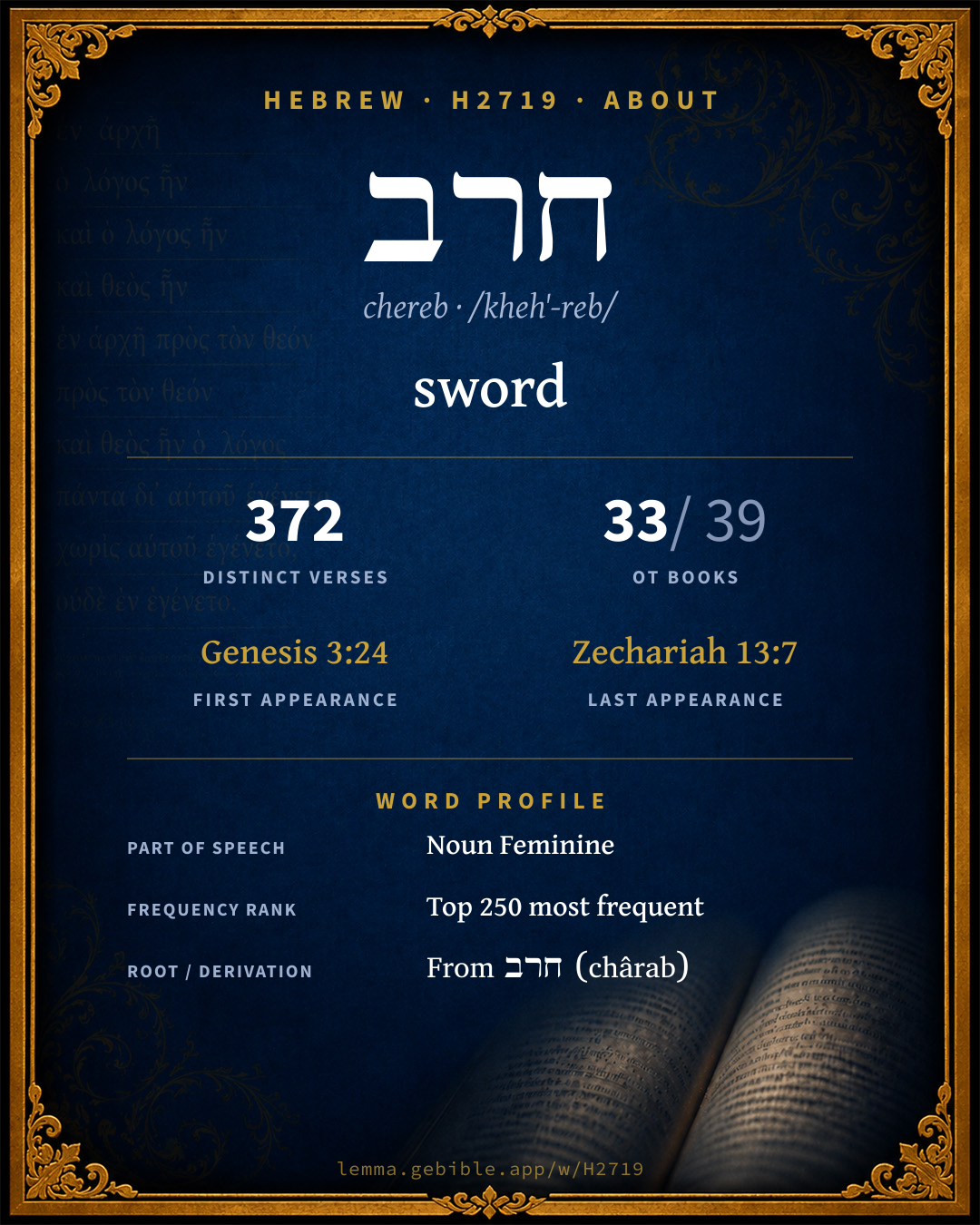
חֶ֫רֶב
sword
‘sword’ is one of 4 main senses fuller range ↓
Full lexicon entry — Brown-Driver-Briggs (BDB)
From Brown-Driver-Briggs (BDB)
Where this word appears
See every Absolute-state word in the Hebrew Bible →
Grammar key — what these labels mean
Part of speech
- Noun
- A naming word — a person, place, thing, or idea.
Noun type
- Common
- A common noun — a general class of person, place, or thing (“king,” “city,” “water”), not a specific name.
State
- Absolute
- The independent form of a noun, not bound to a following word.
- Construct
- A noun bound to a following noun in a possessive / “of” relationship (the construct chain).
Gender
- Feminine
- Grammatically feminine.
Number
- Singular
- One.
- Plural
- More than one (in Hebrew, generally three or more).
Grammatical forms
- Noun, Common, Feminine, Singular, Absolute 314 times (76%)
- Noun, Common, Feminine, Singular, Construct 80 times (19%)
- Noun, Common, Feminine, Plural, Construct 13 times (3%)
- Noun, Common, Feminine, Plural, Absolute 6 times (1%)
Parsed forms decoded from the imported morphology (morphhb / Westminster Leningrad Codex — WLC text public domain, morphhb tagging CC BY 4.0), counted across 413 parsed occurrences — not distinct verses.
Page 1 of 2 — showing verses 1–200 of 372 distinct verses where H2719 appears, across 33 books. Click any verse to open its interlinear word-by-word view. Verse text shown in the World English Bible for context — . Each verse’s Hebrew form is shown with its reference; the English is not keyword-highlighted, since the data carries no word-level English alignment. Use “Compare translations” on any verse to read it across multiple English versions. This concordance covers the Hebrew Bible; Septuagint (Greek Old Testament) occurrences are not indexed here.
Genesis 6 verses
- Genesis 3:24 הַ/חֶ֨רֶב֙ ptcl def.art + n c fs So he drove out the man; and he placed Cherubs at the east of the garden of Eden, and the flame of a sword which turned every way, to guard the way to the tree of life.
- Genesis 27:40 חַרְבְּ/ךָ֣ n c fs cs + sfx pers 2ms By your sword will you live, and you will serve your brother. It will happen, when you will break loose, That you shall shake his yoke from off your neck."
- Genesis 31:26 חָֽרֶב n c fs Laban said to Jacob, "What have you done, that you have deceived me, and carried away my daughters like captives of the sword?
- Genesis 34:25 חַרְבּ֔/וֹ n c fs cs + sfx pers 3ms It happened on the third day, when they were sore, that two of Jacob's sons, Simeon and Levi, Dinah's brothers, each took his sword, came upon the unsuspecting city, and killed all the males.
- Genesis 34:26 חָ֑רֶב n c fs They killed Hamor and Shechem, his son, with the edge of the sword, and took Dinah out of Shechem's house, and went away.
- Genesis 48:22 בְּ/חַרְבִּ֖/י prep + n c fs cs + sfx pers 1cs Moreover I have given to you one portion above your brothers, which I took out of the hand of the Amorite with my sword and with my bow."
Exodus 8 verses
- Exodus 5:3 בֶ/חָֽרֶב prep det + n c fs They said, "The God of the Hebrews has met with us. Please let us go three days' journey into the wilderness, and sacrifice to Yahweh, our God, lest he fall on us with pestilence, or with the sword."
- Exodus 5:21 חֶ֥רֶב n c fs and they said to them, "May Yahweh look at you, and judge, because you have made us a stench to be abhorred in the eyes of Pharaoh, and in the eyes of his servants, to put a sword in their hand to kill us."
- Exodus 15:9 חַרְבִּ֔/י n c fs cs + sfx pers 1cs The enemy said, 'I will pursue, I will overtake, I will divide the spoil. My desire shall be satisfied on them. I will draw my sword, my hand shall destroy them.'
- Exodus 17:13 חָֽרֶב n c fs Joshua defeated Amalek and his people with the edge of the sword.
- Exodus 18:4 מֵ/חֶ֥רֶב prep + n c fs cs The name of the other was Eliezer, for he said, "My father's God was my help and delivered me from Pharaoh's sword."
- Exodus 20:25 חַרְבְּ/ךָ֛ n c fs cs + sfx pers 2ms If you make me an altar of stone, you shall not build it of hewn stones; for if you lift up your tool on it, you have polluted it.
- Exodus 22:24 בֶּ/חָ֑רֶב prep det + n c fs and my wrath will grow hot, and I will kill you with the sword; and your wives shall be widows, and your children fatherless.
- Exodus 32:27 חַרְבּ֖/וֹ n c fs cs + sfx pers 3ms He said to them, "Thus says Yahweh, the God of Israel, 'Every man put his sword on his thigh, and go back and forth from gate to gate throughout the camp, and every man kill his brother, and every man his companion, and every man his neighbor."
Leviticus 7 verses
- Leviticus 26:6 וְ/חֶ֖רֶב conj + n c fs "'I will give peace in the land, and you shall lie down, and no one will make you afraid; and I will remove evil animals out of the land, neither shall the sword go through your land.
- Leviticus 26:7 לֶ/חָֽרֶב prep det + n c fs You shall chase your enemies, and they shall fall before you by the sword.
- Leviticus 26:8 לֶ/חָֽרֶב prep det + n c fs Five of you shall chase a hundred, and a hundred of you shall chase ten thousand; and your enemies shall fall before you by the sword.
- Leviticus 26:25 חֶ֗רֶב n c fs I will bring a sword upon you, that will execute the vengeance of the covenant; and you will be gathered together within your cities: and I will send the pestilence among you; and you will be delivered into the hand of the enemy.
- Leviticus 26:33 חָ֑רֶב n c fs I will scatter you among the nations, and I will draw out the sword after you: and your land will be a desolation, and your cities shall be a waste.
- Leviticus 26:36 חֶ֛רֶב n c fs "'As for those of you who are left, I will send a faintness into their hearts in the lands of their enemies: and the sound of a driven leaf will put them to flight; and they shall flee, as one flees from the sword; and they will fall when no one pursues.
- Leviticus 26:37 חֶ֖רֶב n c fs They will stumble over one another, as it were before the sword, when no one pursues: and you will have no power to stand before your enemies.
Numbers 9 verses
- Numbers 14:3 בַּ/חֶ֔רֶב prep det + n c fs Why does Yahweh bring us to this land, to fall by the sword? Our wives and our little ones will be a prey: wouldn't it be better for us to return into Egypt?
- Numbers 14:43 בֶּ/חָ֑רֶב prep det + n c fs For there the Amalekite and the Canaanite are before you, and you shall fall by the sword: because you are turned back from following Yahweh, therefore Yahweh will not be with you.
- Numbers 19:16 חֶ֨רֶב֙ n c fs Whoever in the open field touches one who is slain with a sword, or a dead body, or a bone of a man, or a grave, shall be unclean seven days.
- Numbers 20:18 בַּ/חֶ֖רֶב prep det + n c fs Edom said to him, You shall not pass through me, lest I come out with the sword against you.
- Numbers 21:24 חָ֑רֶב n c fs Israel struck him with the edge of the sword, and possessed his land from the Arnon to the Jabbok, even to the children of Ammon; for the border of the children of Ammon was strong.
- Numbers 22:23 וְ/חַרְבּ֤/וֹ conj + n c fs cs + sfx pers 3ms The donkey saw the angel of Yahweh standing in the way, with his sword drawn in his hand; and the donkey turned aside out of the way, and went into the field: and Balaam struck the donkey, to turn her into the way.
- Numbers 22:29 חֶ֨רֶב֙ n c fs Balaam said to the donkey, Because you have mocked me, I would there were a sword in my hand, for now I had killed you.
- Numbers 22:31 וְ/חַרְבּ֥/וֹ conj + n c fs cs + sfx pers 3ms Then Yahweh opened the eyes of Balaam, and he saw the angel of Yahweh standing in the way, with his sword drawn in his hand; and he bowed his head, and fell on his face.
- Numbers 31:8 בֶּ/חָֽרֶב prep det + n c fs They killed the kings of Midian with the rest of their slain: Evi, and Rekem, and Zur, and Hur, and Reba, the five kings of Midian: Balaam also the son of Beor they killed with the sword.
Deuteronomy 7 verses
- Deuteronomy 13:15 חָ֑רֶב חָֽרֶב n c fs n c fs you shall surely strike the inhabitants of that city with the edge of the sword, destroying it utterly, and all that is therein and the cattle of it, with the edge of the sword.
- Deuteronomy 20:13 חָֽרֶב n c fs and when Yahweh your God delivers it into your hand, you shall strike every male of it with the edge of the sword:
- Deuteronomy 28:22 וּ/בַ/חֶ֔רֶב conj + prep det + n c fs Yahweh will strike you with consumption, and with fever, and with inflammation, and with fiery heat, and with the sword, and with blasting, and with mildew; and they shall pursue you until you perish.
- Deuteronomy 32:25 חֶ֔רֶב n c fs Outside shall the sword bereave, In the chambers terror; [It shall destroy] both young man and virgin, The suckling with the man of gray hairs.
- Deuteronomy 32:41 חַרְבִּ֔/י n c fs cs + sfx pers 1cs If I whet my glittering sword, My hand take hold on judgment; I will render vengeance to my adversaries, Will recompense those who hate me.
- Deuteronomy 32:42 וְ/חַרְבִּ֖/י conj + n c fs cs + sfx pers 1cs I will make my arrows drunk with blood, My sword shall devour flesh; With the blood of the slain and the captives, From the head of the leaders of the enemy.
- Deuteronomy 33:29 חֶ֖רֶב n c fs cs Happy are you, Israel: Who is like you, a people saved by Yahweh, The shield of your help, The sword of your excellency! Your enemies shall submit themselves to you; You shall tread on their high places.
Joshua 19 verses
- Joshua 5:2 חַֽרְב֣וֹת n c fp cs At that time Yahweh said to Joshua, Make you flint knives, and circumcise again the children of Israel the second time.
- Joshua 5:3 חַֽרְב֣וֹת n c fp cs Joshua made himself flint knives, and circumcised the children of Israel at the hill of the foreskins.
- Joshua 5:13 וְ/חַרְבּ֥/וֹ conj + n c fs cs + sfx pers 3ms It happened, when Joshua was by Jericho, that he lifted up his eyes and looked, and, behold, there stood a man over against him with his sword drawn in his hand: and Joshua went to him, and said to him, Are you for us, or for our adversaries?
- Joshua 6:21 חָֽרֶב n c fs They utterly destroyed all that was in the city, both man and woman, both young and old, and ox, and sheep, and donkey, with the edge of the sword.
- Joshua 8:24 חֶ֖רֶב חָֽרֶב n c fs n c fs It happened, when Israel had made an end of killing all the inhabitants of Ai in the field, in the wilderness in which they pursued them, and they were all fallen by the edge of the sword, until they were consumed, that all Israel returned to Ai, and struck it with the edge of the sword.
- Joshua 10:11 בֶּ/חָֽרֶב prep det + n c fs It happened, as they fled from before Israel, while they were at the descent of Beth Horon, that Yahweh cast down great stones from the sky on them to Azekah, and they died: they were more who died with the hailstones than they whom the children of Israel killed with the sword.
- Joshua 10:28 חֶרֶב֮ n c fs Joshua took Makkedah on that day, and struck it with the edge of the sword, and the king of it: he utterly destroyed them and all the souls who were therein; he left none remaining; and he did to the king of Makkedah as he had done to the king of Jericho.
- Joshua 10:30 חֶ֗רֶב n c fs and Yahweh delivered it also, and the king of it, into the hand of Israel; and he struck it with the edge of the sword, and all the souls who were therein; he left none remaining in it; and he did to the king of it as he had done to the king of Jericho.
- Joshua 10:32 חֶ֔רֶב n c fs and Yahweh delivered Lachish into the hand of Israel; and he took it on the second day, and struck it with the edge of the sword, and all the souls who were therein, according to all that he had done to Libnah.
- Joshua 10:35 חֶ֔רֶב n c fs and they took it on that day, and struck it with the edge of the sword; and all the souls who were therein he utterly destroyed that day, according to all that he had done to Lachish.
- Joshua 10:37 חֶ֠רֶב n c fs and they took it, and struck it with the edge of the sword, and the king of it, and all the cities of it, and all the souls who were therein; he left none remaining, according to all that he had done to Eglon; but he utterly destroyed it, and all the souls who were therein.
- Joshua 10:39 חֶ֔רֶב n c fs and he took it, and the king of it, and all the cities of it; and they struck them with the edge of the sword, and utterly destroyed all the souls who were therein; he left none remaining: as he had done to Hebron, so he did to Debir, and to the king of it; as he had done also to Libnah, and to the king of it.
- Joshua 11:10 בֶ/חָ֑רֶב prep det + n c fs Joshua turned back at that time, and took Hazor, and struck the king of it with the sword: for Hazor before was the head of all those kingdoms.
- Joshua 11:11 חֶ֨רֶב֙ n c fs They struck all the souls who were therein with the edge of the sword, utterly destroying them; there was none left who breathed: and he burnt Hazor with fire.
- Joshua 11:12 חֶ֖רֶב n c fs All the cities of those kings, and all the kings of them, did Joshua take, and he struck them with the edge of the sword, and utterly destroyed them; as Moses the servant of Yahweh commanded.
- Joshua 11:14 חֶ֗רֶב n c fs All the spoil of these cities, and the cattle, the children of Israel took for a prey to themselves; but every man they struck with the edge of the sword, until they had destroyed them, neither left they any who breathed.
- Joshua 13:22 בַּ/חֶ֖רֶב prep det + n c fs Balaam also the son of Beor, the soothsayer, did the children of Israel kill with the sword among the rest of their slain.
- Joshua 19:47 חֶ֗רֶב n c fs The border of the children of Dan went out beyond them; for the children of Dan went up and fought against Leshem, and took it, and struck it with the edge of the sword, and possessed it, and lived therein, and called Leshem, Dan, after the name of Dan their father.
- Joshua 24:12 בְ/חַרְבְּ/ךָ֖ prep + n c fs cs + sfx pers 2ms I sent the hornet before you, which drove them out from before you, even the two kings of the Amorites; not with your sword, nor with your bow.
Judges 23 verses
- Judges 1:8 חָ֑רֶב n c fs The children of Judah fought against Jerusalem, and took it, and struck it with the edge of the sword, and set the city on fire.
- Judges 1:25 חָ֑רֶב n c fs He shown them the entrance into the city; and they struck the city with the edge of the sword; but they let the man go and all his family.
- Judges 3:16 חֶ֗רֶב n c fs Ehud made him a sword which had two edges, a cubit in length; and he girded it under his clothing on his right thigh.
- Judges 3:21 הַ/חֶ֔רֶב ptcl def.art + n c fs Ehud put forth his left hand, and took the sword from his right thigh, and thrust it into his body:
- Judges 3:22 הַ/חֶ֖רֶב ptcl def.art + n c fs and the haft also went in after the blade; and the fat closed on the blade, for he didn't draw the sword out of his body; and it came out behind.
- Judges 4:15 חֶ֖רֶב n c fs Yahweh confused Sisera, and all his chariots, and all his host, with the edge of the sword before Barak; and Sisera alighted from his chariot, and fled away on his feet.
- Judges 4:16 חֶ֔רֶב n c fs But Barak pursued after the chariots, and after the host, to Harosheth of the Gentiles: and all the host of Sisera fell by the edge of the sword; there was not a man left.
- Judges 7:14 חֶ֛רֶב n c fs cs His fellow answered, This is nothing else save the sword of Gideon the son of Joash, a man of Israel: into his hand God has delivered Midian, and all the host.
- Judges 7:20 חֶ֥רֶב n c fs The three companies blew the trumpets, and broke the pitchers, and held the torches in their left hands, and the trumpets in their right hands with which to blow; and they cried, The sword of Yahweh and of Gideon.
- Judges 7:22 חֶ֥רֶב n c fs cs They blew the three hundred trumpets, and Yahweh set every man's sword against his fellow, and against all the host; and the host fled as far as Beth-shittah toward Zererah, as far as the border of Abel Meholah, by Tabbath.
- Judges 8:10 חָֽרֶב n c fs Now Zebah and Zalmunna were in Karkor, and their hosts with them, about fifteen thousand men, all who were left of all the host of the children of the east; for there fell one hundred twenty thousand men who drew sword.
- Judges 8:20 חַרְבּ/וֹ֙ n c fs cs + sfx pers 3ms He said to Jether his firstborn, Up, and kill them. But the youth didn't draw his sword; for he feared, because he was yet a youth.
- Judges 9:54 חַרְבְּ/ךָ֙ n c fs cs + sfx pers 2ms Then he called hastily to the young man his armor bearer, and said to him, Draw your sword, and kill me, that men not say of me, A woman killed him. His young man thrust him through, and he died.
- Judges 18:27 חָ֑רֶב n c fs They took that which Micah had made, and the priest whom he had, and came to Laish, to a people quiet and secure, and struck them with the edge of the sword; and they burnt the city with fire.
- Judges 20:2 חָֽרֶב n c fs The chiefs of all the people, even of all the tribes of Israel, presented themselves in the assembly of the people of God, four hundred thousand footmen who drew sword.
- Judges 20:15 חָ֑רֶב n c fs The children of Benjamin were numbered on that day out of the cities twenty-six thousand men who drew the sword, besides the inhabitants of Gibeah, who were numbered seven hundred chosen men.
- Judges 20:17 חָ֑רֶב n c fs The men of Israel, besides Benjamin, were numbered four hundred thousand men who drew sword: all these were men of war.
- Judges 20:25 חָֽרֶב n c fs Benjamin went forth against them out of Gibeah the second day, and destroyed down to the ground of the children of Israel again eighteen thousand men; all these drew the sword.
- Judges 20:35 חָֽרֶב n c fs Yahweh struck Benjamin before Israel; and the children of Israel destroyed of Benjamin that day twenty-five thousand one hundred men: all these drew the sword.
- Judges 20:37 חָֽרֶב n c fs The liers-in-wait hurried, and rushed on Gibeah; and the liers-in-wait drew themselves along, and struck all the city with the edge of the sword.
- Judges 20:46 חֶ֖רֶב n c fs So that all who fell that day of Benjamin were twenty-five thousand men who drew the sword; all these [were] men of valor.
- Judges 20:48 חֶ֔רֶב n c fs The men of Israel turned again on the children of Benjamin, and struck them with the edge of the sword, both the entire city, and the cattle, and all that they found: moreover all the cities which they found they set on fire.
- Judges 21:10 חֶ֔רֶב n c fs The congregation sent there twelve thousand men of the most valiant, and commanded them, saying, Go and strike the inhabitants of Jabesh Gilead with the edge of the sword, with the women and the little ones.
1 Samuel 19 verses
- 1 Samuel 13:19 חֶ֖רֶב n c fs Now there was no smith found throughout all the land of Israel; for the Philistines said, Lest the Hebrews make them swords or spears:
- 1 Samuel 13:22 חֶ֤רֶב n c fs So it came to pass in the day of battle, that there was neither sword nor spear found in the hand of any of the people who were with Saul and Jonathan: but with Saul and with Jonathan his son was there found.
- 1 Samuel 14:20 חֶ֤רֶב n c fs cs Saul and all the people who were with him were gathered together, and came to the battle: and, behold, every man's sword was against his fellow, [and there was] a very great confusion.
- 1 Samuel 15:8 חָֽרֶב n c fs He took Agag the king of the Amalekites alive, and utterly destroyed all the people with the edge of the sword.
- 1 Samuel 15:33 חַרְבֶּ֔/ךָ n c fs cs + sfx pers 2ms Samuel said, As your sword has made women childless, so shall your mother be childless among women. Samuel hewed Agag in pieces before Yahweh in Gilgal.
- 1 Samuel 17:39 חַ֠רְבּ/וֹ n c fs cs + sfx pers 3ms David girded his sword on his clothing, and he tried to go; for he had not proved it. David said to Saul, I can't go with these; for I have not proved them. David put them off him.
- 1 Samuel 17:45 בְּ/חֶ֖רֶב prep + n c fs Then said David to the Philistine, You come to me with a sword, and with a spear, and with a javelin: but I come to you in the name of Yahweh of hosts, the God of the armies of Israel, whom you have defied.
- 1 Samuel 17:47 בְּ/חֶ֥רֶב prep + n c fs and that all this assembly may know that Yahweh doesn't save with sword and spear: for the battle is Yahweh's, and he will give you into our hand.
- 1 Samuel 17:50 וְ/חֶ֖רֶב conj + n c fs So David prevailed over the Philistine with a sling and with a stone, and struck the Philistine, and killed him; but there was no sword in the hand of David.
- 1 Samuel 17:51 חַ֠רְבּ/וֹ n c fs cs + sfx pers 3ms Then David ran, and stood over the Philistine, and took his sword, and drew it out of the sheath of it, and killed him, and cut off his head therewith. When the Philistines saw that their champion was dead, they fled.
- 1 Samuel 18:4 חַרְבּ֥/וֹ n c fs cs + sfx pers 3ms Jonathan stripped himself of the robe that was on him, and gave it to David, and his clothing, even to his sword, and to his bow, and to his sash.
- 1 Samuel 21:8 חָ֑רֶב חַרְבִּ֤/י n c fs n c fs cs + sfx pers 1cs David said to Ahimelech, Isn't there here under your hand spear or sword? for I have neither brought my sword nor my weapons with me, because the king's business required haste.
- 1 Samuel 21:9 חֶרֶב֩ n c fs cs The priest said, The sword of Goliath the Philistine, whom you killed in the valley of Elah, behold, it is here wrapped in a cloth behind the ephod: if you will take that, take it; for there is no other except that here. David said, There is none like that; give it me.
- 1 Samuel 22:10 חֶ֛רֶב n c fs cs He inquired of Yahweh for him, and gave him food, and gave him the sword of Goliath the Philistine.
- 1 Samuel 22:13 וְ/חֶ֗רֶב conj + n c fs Saul said to him, Why have you conspired against me, you and the son of Jesse, in that you have given him bread, and a sword, and have inquired of God for him, that he should rise against me, to lie in wait, as at this day?
- 1 Samuel 22:19 חֶ֔רֶב חָֽרֶב n c fs n c fs Nob, the city of the priests, struck he with the edge of the sword, both men and women, children and nursing babies, and oxen and donkeys and sheep, with the edge of the sword.
- 1 Samuel 25:13 חַרְבּ֗/וֹ חַרְבּ֔/וֹ חַרְבּ֑/וֹ n c fs cs + sfx pers 3ms n c fs cs + sfx pers 3ms n c fs cs + sfx pers 3ms David said to his men, Gird you on every man his sword. They girded on every man his sword; and David also girded on his sword: and there went up after David about four hundred men; and two hundred abode by the baggage.
- 1 Samuel 31:4 חַרְבְּ/ךָ֣ הַ/חֶ֔רֶב n c fs cs + sfx pers 2ms ptcl def.art + n c fs Then said Saul to his armor bearer, Draw your sword, and thrust me through therewith, lest these uncircumcised come and thrust me through, and abuse me. But his armor bearer would not; for he was sore afraid. Therefore Saul took his sword, and fell on it.
- 1 Samuel 31:5 חַרְבּ֖/וֹ n c fs cs + sfx pers 3ms When his armor bearer saw that Saul was dead, he likewise fell on his sword, and died with him.
2 Samuel 14 verses
- 2 Samuel 1:12 בֶּ/חָֽרֶב prep det + n c fs and they mourned, and wept, and fasted until even, for Saul, and for Jonathan his son, and for the people of Yahweh, and for the house of Israel; because they were fallen by the sword.
- 2 Samuel 1:22 וְ/חֶ֣רֶב conj + n c fs cs From the blood of the slain, from the fat of the mighty, The bow of Jonathan didn't turn back, The sword of Saul didn't return empty.
- 2 Samuel 2:16 וְ/חַרְבּ/וֹ֙ conj + n c fs cs + sfx pers 3ms They caught everyone his fellow by the head, and [thrust] his sword in his fellow's side; so they fell down together: therefore that place was called Helkath Hazzurim, which is in Gibeon.
- 2 Samuel 2:26 חֶ֔רֶב n c fs Then Abner called to Joab, and said, "Shall the sword devour forever? Don't you know that it will be bitterness in the latter end? How long shall it be then, before you bid the people return from following their brothers?"
- 2 Samuel 3:29 בַּ/חֶ֖רֶב prep det + n c fs let it fall on the head of Joab, and on all his father's house; and let there not fail from the house of Joab one who has an issue, or who is a leper, or who leans on a staff, or who falls by the sword, or who lacks bread.
- 2 Samuel 11:25 הֶ/חָ֑רֶב ptcl def.art + n c fs Then David said to the messenger, Thus shall you tell Joab, Don't let this thing displease you, for the sword devours one as well as another; make your battle more strong against the city, and overthrow it: and encourage you him.
- 2 Samuel 12:9 בַ/חֶ֔רֶב בְּ/חֶ֖רֶב prep det + n c fs prep + n c fs cs Why have you despised the word of Yahweh, to do that which is evil in his sight? You have struck Uriah the Hittite with the sword, and have taken his wife to be your wife, and have slain him with the sword of the children of Ammon.
- 2 Samuel 12:10 חֶ֛רֶב n c fs Now therefore the sword will never depart from your house, because you have despised me, and have taken the wife of Uriah the Hittite to be your wife.'
- 2 Samuel 15:14 חָֽרֶב n c fs David said to all his servants who were with him at Jerusalem, Arise, and let us flee; for else none of us shall escape from Absalom: make speed to depart, lest he overtake us quickly, and bring down evil on us, and strike the city with the edge of the sword.
- 2 Samuel 18:8 הַ/חֶ֖רֶב ptcl def.art + n c fs For the battle was there spread over the surface of all the country; and the forest devoured more people that day than the sword devoured.
- 2 Samuel 20:8 חֶ֨רֶב֙ n c fs When they were at the great stone which is in Gibeon, Amasa came to meet them. Joab was girded with his apparel of war that he had put on, and thereon was a sash with a sword fastened on his loins in the sheath of it; and as he went forth it fell out.
- 2 Samuel 20:10 בַּ/חֶ֣רֶב prep det + n c fs But Amasa took no heed to the sword that was in Joab's hand: so he struck him therewith in the body, and shed out his bowels to the ground, and didn't strike him again; and he died. Joab and Abishai his brother pursued after Sheba the son of Bichri.
- 2 Samuel 23:10 הַ/חֶ֔רֶב ptcl def.art + n c fs He arose, and struck the Philistines until his hand was weary, and his hand froze to the sword; and Yahweh worked a great victory that day; and the people returned after him only to take spoil.
- 2 Samuel 24:9 חֶ֔רֶב n c fs Joab gave up the sum of the numbering of the people to the king: and there were in Israel eight hundred thousand valiant men who drew the sword; and the men of Judah were five hundred thousand men.
1 Kings 9 verses
- 1 Kings 1:51 בֶּ/חָֽרֶב prep det + n c fs It was told Solomon, saying, Behold, Adonijah fears king Solomon; for, behold, he has laid hold on the horns of the altar, saying, Let king Solomon swear to me first that he will not kill his servant with the sword.
- 1 Kings 2:8 בֶּ/חָֽרֶב prep det + n c fs Behold, there is with you Shimei the son of Gera, the Benjamite, of Bahurim, who cursed me with a grievous curse in the day when I went to Mahanaim; but he came down to meet me at the Jordan, and I swore to him by Yahweh, saying, I will not put you to death with the sword.
- 1 Kings 2:32 בַּ/חֶ֔רֶב prep det + n c fs Yahweh will return his blood on his own head, because he fell on two men more righteous and better than he, and killed them with the sword, and my father David didn't know it, [to wit], Abner the son of Ner, captain of the host of Israel, and Amasa the son of Jether, captain of the host of Judah.
- 1 Kings 3:24 חָ֑רֶב הַ/חֶ֖רֶב n c fs ptcl def.art + n c fs The king said, Get me a sword. They brought a sword before the king.
- 1 Kings 18:28 בַּ/חֲרָב֖וֹת prep det + n c fp They cried aloud, and cut themselves after their manner with knives and lances, until the blood gushed out on them.
- 1 Kings 19:1 בֶּ/חָֽרֶב prep det + n c fs Ahab told Jezebel all that Elijah had done, and withal how he had slain all the prophets with the sword.
- 1 Kings 19:10 בֶ/חָ֑רֶב prep det + n c fs He said, I have been very jealous for Yahweh, the God of hosts; for the children of Israel have forsaken your covenant, thrown down your altars, and slain your prophets with the sword: and I, even I only, am left; and they seek my life, to take it away.
- 1 Kings 19:14 בֶ/חָ֑רֶב prep det + n c fs He said, I have been very jealous for Yahweh, the God of hosts; for the children of Israel have forsaken your covenant, thrown down your altars, and slain your prophets with the sword; and I, even I only, am left; and they seek my life, to take it away.
- 1 Kings 19:17 מֵ/חֶ֥רֶב מֵ/חֶ֥רֶב prep + n c fs cs prep + n c fs cs It shall happen, that he who escapes from the sword of Hazael shall Jehu kill; and he who escapes from the sword of Jehu shall Elisha kill.
2 Kings 8 verses
- 2 Kings 3:26 חֶ֗רֶב n c fs When the king of Moab saw that the battle was too severe for him, he took with him seven hundred men who drew sword, to break through to the king of Edom; but they could not.
- 2 Kings 6:22 בְּ/חַרְבְּ/ךָ֥ prep + n c fs cs + sfx pers 2ms He answered, You shall not strike them: would you strike those whom you have taken captive with your sword and with your bow? set bread and water before them, that they may eat and drink, and go to their master.
- 2 Kings 8:12 בַּ/חֶ֣רֶב prep det + n c fs Hazael said, Why weeps my lord? He answered, Because I know the evil that you will do to the children of Israel: their strongholds will you set on fire, and their young men will you kill with the sword, and will dash in pieces their little ones, and rip up their women with child.
- 2 Kings 10:25 חָ֑רֶב n c fs It happened, as soon as he had made an end of offering the burnt offering, that Jehu said to the guard and to the captains, Go in, and kill them; let none come forth. They struck them with the edge of the sword; and the guard and the captains cast them out, and went to the city of the house of Baal.
- 2 Kings 11:15 בֶּ/חָ֑רֶב prep det + n c fs Jehoiada the priest commanded the captains of hundreds who were set over the host, and said to them, Have her forth between the ranks; and him who follows her kill with the sword. For the priest said, Don't let her be slain in the house of Yahweh.
- 2 Kings 11:20 בַ/חֶ֖רֶב prep det + n c fs So all the people of the land rejoiced, and the city was quiet. Athaliah they had slain with the sword at the king's house.
- 2 Kings 19:7 בַּ/חֶ֖רֶב prep det + n c fs Behold, I will put a spirit in him, and he shall hear news, and shall return to his own land; and I will cause him to fall by the sword in his own land.
- 2 Kings 19:37 בַ/חֶ֔רֶב prep det + n c fs It happened, as he was worshipping in the house of Nisroch his god, that Adrammelech and Sharezer struck him with the sword: and they escaped into the land of Ararat. Esar Haddon his son reigned in his place.
1 Chronicles 8 verses
- 1 Chronicles 5:18 וְ/חֶ֨רֶב֙ conj + n c fs The sons of Reuben, and the Gadites, and the half-tribe of Manasseh, of valiant men, men able to bear buckler and sword, and to shoot with bow, and skillful in war, were forty-four thousand seven hundred and sixty, that were able to go forth to war.
- 1 Chronicles 10:4 חַרְבְּ/ךָ֣ הַ/חֶ֔רֶב n c fs cs + sfx pers 2ms ptcl def.art + n c fs Then said Saul to his armor-bearer, Draw your sword, and thrust me through therewith, lest these uncircumcised come and abuse me. But his armor-bearer would not; for he was sore afraid. Therefore Saul took his sword, and fell on it.
- 1 Chronicles 10:5 הַ/חֶ֖רֶב ptcl def.art + n c fs When his armor-bearer saw that Saul was dead, he likewise fell on his sword, and died.
- 1 Chronicles 21:5 חֶ֔רֶב חָֽרֶב n c fs n c fs Joab gave up the sum of the numbering of the people to David. All those of Israel were one million one hundred thousand men who drew sword: and in Judah were four hundred seventy thousand men who drew sword.
- 1 Chronicles 21:12 וְ/חֶ֣רֶב חֶ֣רֶב conj + n c fs cs n c fs cs either three years of famine; or three months to be consumed before your foes, while the sword of your enemies overtakes you; or else three days the sword of Yahweh, even pestilence in the land, and the angel of Yahweh destroying throughout all the borders of Israel. Now therefore consider what answer I shall return to him who sent me.
- 1 Chronicles 21:16 וְ/חַרְבּ֤/וֹ conj + n c fs cs + sfx pers 3ms David lifted up his eyes, and saw the angel of Yahweh standing between earth and the sky, having a drawn sword in his hand stretched out over Jerusalem. Then David and the elders, clothed in sackcloth, fell on their faces.
- 1 Chronicles 21:27 חַרְבּ֖/וֹ n c fs cs + sfx pers 3ms Yahweh commanded the angel; and he put up his sword again into the sheath of it.
- 1 Chronicles 21:30 חֶ֖רֶב n c fs cs But David couldn't go before it to inquire of God; for he was afraid because of the sword of the angel of Yahweh.
2 Chronicles 9 verses
- 2 Chronicles 20:9 חֶרֶב֮ n c fs If evil come on us, the sword, judgment, or pestilence, or famine, we will stand before this house, and before you, (for your name is in this house), and cry to you in our affliction, and you will hear and save.
- 2 Chronicles 21:4 בֶּ/חָ֑רֶב prep det + n c fs Now when Jehoram was risen up over the kingdom of his father, and had strengthened himself, he killed all his brothers with the sword, and various also of the princes of Israel.
- 2 Chronicles 23:14 בֶּ/חָ֑רֶב prep det + n c fs Jehoiada the priest brought out the captains of hundreds who were set over the host, and said to them, Have her forth between the ranks; and whoever follows her, let him be slain with the sword: for the priest said, Don't kill her in the house of Yahweh.
- 2 Chronicles 23:21 בֶ/חָֽרֶב prep det + n c fs So all the people of the land rejoiced, and the city was quiet. Athaliah they had slain with the sword.
- 2 Chronicles 29:9 בֶּ/חָ֑רֶב prep det + n c fs For, behold, our fathers have fallen by the sword, and our sons and our daughters and our wives are in captivity for this.
- 2 Chronicles 32:21 בֶ/חָֽרֶב prep det + n c fs Yahweh sent an angel, who cut off all the mighty men of valor, and the leaders and captains, in the camp of the king of Assyria. So he returned with shame of face to his own land. When he was come into the house of his god, those who came forth from his own bowels killed him there with the sword.
- 2 Chronicles 34:6 בְּ/חַרְבֹתֵי/הֶ֖ם prep + n c fp cs + sfx pers 3mp [So did he] in the cities of Manasseh and Ephraim and Simeon, even to Naphtali, in their ruins round about.
- 2 Chronicles 36:17 בַּ/חֶ֨רֶב֙ prep det + n c fs Therefore he brought on them the king of the Chaldeans, who killed their young men with the sword in the house of their sanctuary, and had no compassion on young man or virgin, old man or gray-headed: he gave them all into his hand.
- 2 Chronicles 36:20 הַ/חֶ֖רֶב ptcl def.art + n c fs Those who had escaped from the sword carried he away to Babylon; and they were servants to him and his sons until the reign of the kingdom of Persia:
Ezra 1 verse
Nehemiah 2 verses
- Nehemiah 4:13 חַרְבֹתֵי/הֶ֛ם n c fp cs + sfx pers 3mp Therefore set I in the lowest parts of the space behind the wall, in the open places, I set [there] the people after their families with their swords, their spears, and their bows.
- Nehemiah 4:18 חַרְבּ֛/וֹ n c fs cs + sfx pers 3ms and the builders, everyone had his sword girded by his side, and so built. He who sounded the trumpet was by me.
Esther 1 verse
Job 10 verses
- Job 1:15 חָ֑רֶב n c fs and the Sabeans attacked, and took them away. Yes, they have killed the servants with the edge of the sword, and I alone have escaped to tell you."
- Job 1:17 חָ֑רֶב n c fs While he was still speaking, there came also another, and said, "The Chaldeans made three bands, and swept down on the camels, and have taken them away, yes, and killed the servants with the edge of the sword; and I alone have escaped to tell you."
- Job 5:15 מֵ֭/חֶרֶב prep + n c fs But he saves from the sword of their mouth, Even the needy from the hand of the mighty.
- Job 5:20 חָֽרֶב n c fs In famine he will redeem you from death; In war, from the power of the sword.
- Job 15:22 חָֽרֶב n c fs He doesn't believe that he shall return out of darkness, He is waited for by the sword.
- Job 19:29 חֶ֗רֶב חָ֑רֶב n c fs n c fs Be afraid of the sword, For wrath brings the punishments of the sword, That you may know there is a judgment."
- Job 27:14 חָ֑רֶב n c fs If his children are multiplied, it is for the sword. His offspring shall not be satisfied with bread.
- Job 39:22 חָֽרֶב n c fs He mocks at fear, and is not dismayed; Neither does he turn back from the sword.
- Job 40:19 חַרְבּֽ/וֹ n c fs cs + sfx pers 3ms He is the chief of the ways of God. He who made him gives him his sword.
- Job 41:26 חֶ֭רֶב n c fs If one lay at him with the sword, it can't avail; Nor the spear, the dart, nor the pointed shaft.
Psalms 18 verses
- Psalms 7:12 חַרְבּ֣/וֹ n c fs cs + sfx pers 3ms If a man doesn't relent, he will sharpen his sword; He has bent and strung his bow.
- Psalms 17:13 חַרְבֶּֽ/ךָ n c fs cs + sfx pers 2ms Arise, Yahweh, Confront him, cast him down. Deliver my soul from the wicked by your sword;
- Psalms 22:20 מֵ/חֶ֣רֶב prep + n c fs Deliver my soul from the sword, My precious life from the power of the dog.
- Psalms 37:14 חֶ֤רֶב n c fs The wicked have drawn out the sword, and have bent their bow, To cast down the poor and needy, To kill those who are upright in the way.
- Psalms 37:15 חַ֭רְבָּ/ם n c fs cs + sfx pers 3mp Their sword shall enter into their own heart. Their bows shall be broken.
- Psalms 44:3 בְ/חַרְבָּ֡/ם prep + n c fs cs + sfx pers 3mp For they didn't get the land in possession by their own sword, Neither did their own arm save them; But your right hand, and your arm, and the light of your face, Because you were favorable to them.
- Psalms 44:6 וְ֝/חַרְבִּ֗/י conj + n c fs cs + sfx pers 1cs For I will not trust in my bow, Neither shall my sword save me.
- Psalms 45:3 חַרְבְּ/ךָ֣ n c fs cs + sfx pers 2ms Gird your sword on your thigh, mighty one: Your splendor and your majesty.
- Psalms 57:4 חֶ֣רֶב n c fs My soul is among lions. I lie among those who are set on fire, Even the sons of men, whose teeth are spears and arrows, And their tongue a sharp sword.
- Psalms 59:7 חֲ֭רָבוֹת n c fp Behold, they spew with their mouth. Swords are in their lips, "For," they say, "who hears us?"
- Psalms 63:10 חָ֑רֶב n c fs They shall be given over to the power of the sword. They shall be jackal food.
- Psalms 64:3 כַ/חֶ֣רֶב prep det + n c fs Who sharpen their tongue like a sword, And aim their arrows, deadly words,
- Psalms 76:3 וְ/חֶ֖רֶב conj + n c fs There he broke the flaming arrows of the bow, The shield, and the sword, and the weapons of war. Selah.
- Psalms 78:62 לַ/חֶ֣רֶב prep det + n c fs He also gave his people over to the sword, And was angry with his inheritance.
- Psalms 78:64 בַּ/חֶ֣רֶב prep det + n c fs Their priests fell by the sword, And their widows couldn't weep.
- Psalms 89:43 חַרְבּ֑/וֹ n c fs cs + sfx pers 3ms Yes, you turn back the edge of his sword, And haven't supported him in battle.
- Psalms 144:10 מֵ/חֶ֥רֶב prep + n c fs You are he who gives salvation to kings, Who rescues David, his servant, from the deadly sword.
- Psalms 149:6 וְ/חֶ֖רֶב conj + n c fs cs May the high praises of God be in their mouths, And a two-edged sword in their hand;
Proverbs 4 verses
- Proverbs 5:4 כְּ/חֶ֣רֶב prep + n c fs cs But in the end she is as bitter as wormwood, And as sharp as a two-edged sword.
- Proverbs 12:18 חָ֑רֶב n c fs There is one who speaks rashly like the piercing of a sword, But the tongue of the wise heals.
- Proverbs 25:18 וְ֭/חֶרֶב conj + n c fs A man who gives false testimony against his neighbor Is like a club, a sword, or a sharp arrow.
- Proverbs 30:14 חֲרָב֣וֹת n c fp There is a generation whose teeth are like swords, And their jaws like knives, To devour the poor from the earth, and the needy from among men.
Song of Solomon 1 verse
Isaiah 18 verses
- Isaiah 1:20 חֶ֣רֶב n c fs But if you refuse and rebel, you shall be devoured with the sword; For the mouth of Yahweh has spoken it."
- Isaiah 2:4 חַרְבוֹתָ֜/ם חֶ֔רֶב n c fp cs + sfx pers 3mp n c fs He will judge between the nations, And will decide concerning many peoples; And they shall beat their swords into plowshares, And their spears into pruning-hooks. Nation shall not lift up sword against nation, Neither shall they learn war any more.
- Isaiah 3:25 בַּ/חֶ֣רֶב prep det + n c fs Your men shall fall by the sword, And your mighty in the war.
- Isaiah 13:15 בֶּ/חָֽרֶב prep det + n c fs Everyone who is found shall be thrust through; and everyone who is taken shall fall by the sword.
- Isaiah 14:19 חָ֑רֶב n c fs But you are cast forth away from your tomb like an abominable branch, clothed with the slain, who are thrust through with the sword, who go down to the stones of the pit; as a dead body trodden under foot.
- Isaiah 21:15 חֲרָב֖וֹת חֶ֣רֶב n c fp n c fs For they fled away from the swords, from the drawn sword, and from the bent bow, and from the heat of battle.
- Isaiah 22:2 חֶ֔רֶב n c fs You that are full of shouting, a tumultuous city, a joyous town; your slain are not slain with the sword, neither are they dead in battle.
- Isaiah 27:1 בְּ/חַרְב֨/וֹ prep + n c fs cs + sfx pers 3ms In that day Yahweh with his hard and great and strong sword will punish leviathan the swift serpent, and leviathan the crooked serpent; and he will kill the monster that is in the sea.
- Isaiah 31:8 בְּ/חֶ֣רֶב וְ/חֶ֥רֶב חֶ֔רֶב prep + n c fs conj + n c fs n c fs The Assyrian shall fall by the sword, not of man; and the sword, not of men, shall devour him; and he shall flee from the sword, and his young men shall become subject to forced labor.
- Isaiah 34:5 חַרְבִּ֑/י n c fs cs + sfx pers 1cs For my sword has drunk its fill in the sky: behold, it shall come down on Edom, and on the people of my curse, to judgment.
- Isaiah 34:6 חֶ֣רֶב n c fs The sword of Yahweh is filled with blood, it is made fat with fatness, with the blood of lambs and goats, with the fat of the kidneys of rams; for Yahweh has a sacrifice in Bozrah, and a great slaughter in the land of Edom.
- Isaiah 37:7 בַּ/חֶ֖רֶב prep det + n c fs Behold, I will put a spirit in him, and he shall hear news, and shall return to his own land; and I will cause him to fall by the sword in his own land.
- Isaiah 37:38 בַ/חֶ֔רֶב prep det + n c fs It happened, as he was worshipping in the house of Nisroch his god, that Adrammelech and Sharezer his sons struck him with the sword; and they escaped into the land of Ararat. Esar Haddon his son reigned in his place.
- Isaiah 41:2 חַרְבּ֔/וֹ n c fs cs + sfx pers 3ms Who has raised up one from the east, whom he calls in righteousness to his foot? he gives nations before him, and makes him rule over kings; he gives them as the dust to his sword, as the driven stubble to his bow.
- Isaiah 49:2 כְּ/חֶ֣רֶב prep + n c fs and he has made my mouth like a sharp sword; in the shadow of his hand has he hid me: and he has made me a polished shaft; in his quiver has he kept me close:
- Isaiah 51:19 וְ/הַ/חֶ֖רֶב conj + ptcl def.art + n c fs These two things have happened to you. Who will bemoan you? Desolation and destruction, and the famine and the sword; how shall I comfort you?
- Isaiah 65:12 לַ/חֶ֗רֶב prep det + n c fs I will destine you to the sword, and you shall all bow down to the slaughter; because when I called, you did not answer; when I spoke, you did not hear; but you did that which was evil in my eyes, and chose that in which I didn't delight.
About this entry
At a glance — auto-summarized from this page’s data, not written by a person. Every figure links to its source below. This summary describes the numbers; it doesn’t interpret them.
At its core, חרב (chereb) means “sword.” Not a single-sense word: explore its full sense range. With 372 verses in 33 books, it is a common word in the Hebrew Bible. Scripture first uses it in Genesis 3:24. Sharing its root, it stands alongside חרב, חרב and חרב. Dig into 372-verse concordance and the renderings breakdown below.
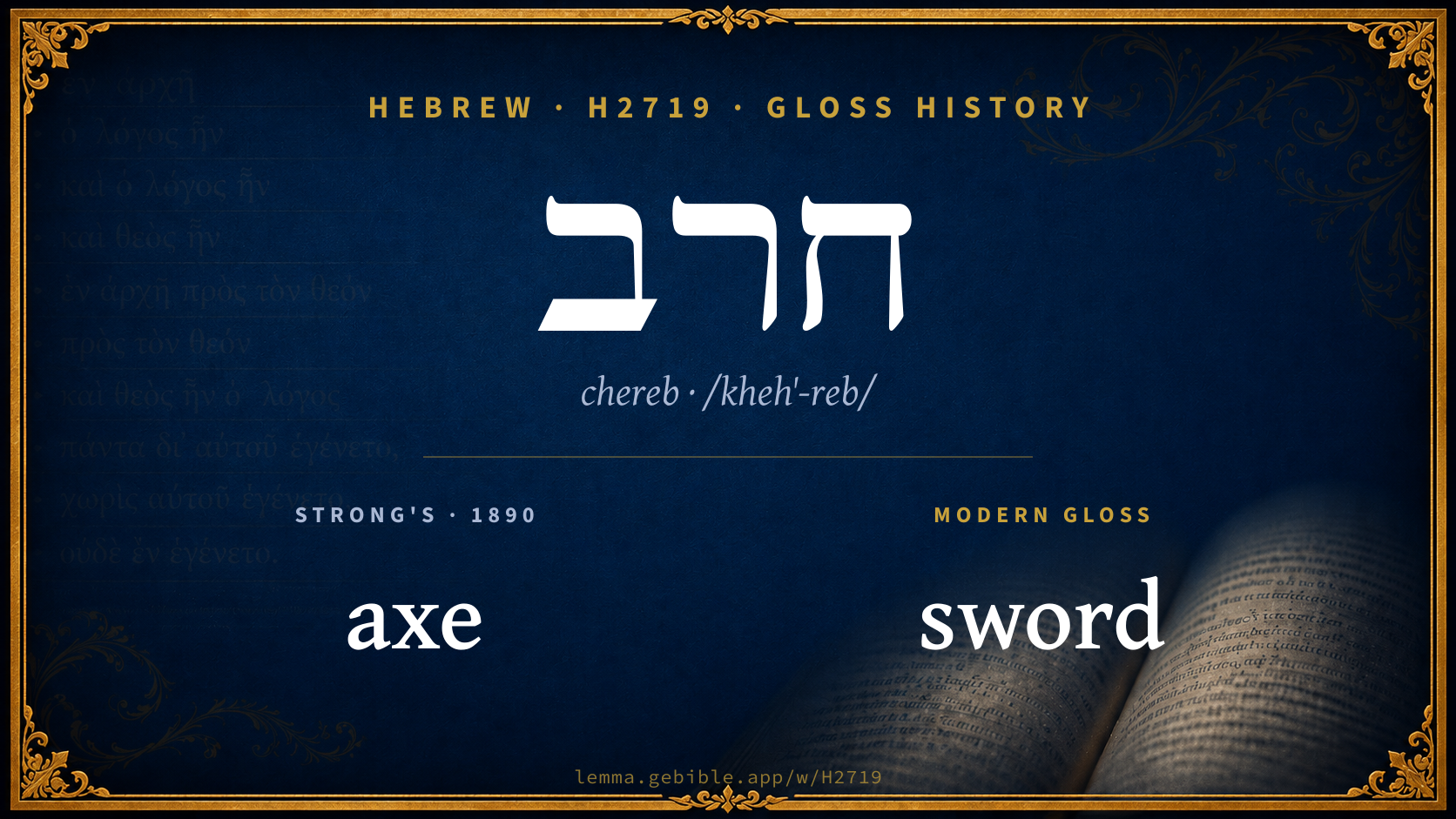
Gloss history
Strong's 1890 vs modern scholarship
About this word
Strong's H2719 catalogs a Hebrew word from the Hebrew Old Testament.
These counts are not copied from any lexicon or concordance. They are computed here, from the morphology-tagged Hebrew Old Testament. What Lemma adds →
- 372
- distinct verses
- The word appears in 372 distinct verses.
- 33 / 39
- OT books
- The word appears in 33 of 39 Old Testament books.
- #120
- by frequency
- Top 250 most frequent Hebrew words (rank 120 of 8,640 Hebrew words by occurrence).
View all 372 occurrences in the concordance →
By section of the Old Testament
By traditional corpus
Conventional, traditional groupings — biblical authorship is debated, so this is a traditional corpus grouping, not an authorship claim. Each share is this word’s portion of its verses in that division of the Hebrew canon. Each figure is a share of the word’s 372 distinct verses.
- Prophets (Nevi'im) 276 verses · 74%
- Writings (Ketuvim) 59 verses · 16%
- Torah (Pentateuch) 37 verses · 10%
How translations render this word
Counts come from each version’s own published word-to-Strong’s tagging or interlinear alignment — an approximate guide to how each version renders this word, not a word-level alignment the data otherwise carries. Because each total is that version’s own tagged count, the per-version totals vary from one another and need not match the appearance or distinct-verse counts above. These counts may also differ from a printed concordance because Lemma counts each distinctly tagged rendering and does not collapse phrase taggings into a single head-word total. This is a fixed set of word-tagged versions (KJV, ASV, BSB, ULT) and does not change with the reading translation you choose elsewhere. Each version’s license is shown beside its name below (and on Sources).
- King James Version: Sword 340×, Swords 16×, Dagger 3×
- American Standard Version: Sword 316×, Swords 14×, Shall the sword 3×
- Berean Standard Bible: Sword 339×, Swords 26×, Own sword 7×
- unfoldingWord Literal Text: Sword 319×, Sword of 20×, Swords 15×
King James Version Public Domain
Renders H2719 across 412 tagged occurrences — most commonly:
Plus 36 renderings that appear only once — usually multi-word phrases or single function words the recovered tagging swept in, not distinct renderings. Not rendered by a distinct English word in 1 further occurrence.
American Standard Version Public Domain
Renders H2719 across 411 tagged occurrences — most commonly:
Plus 65 renderings that appear only once — usually multi-word phrases or single function words the recovered tagging swept in, not distinct renderings.
Berean Standard Bible Public Domain
Renders H2719 across 405 tagged occurrences — most commonly:
Plus 23 renderings that appear only once — usually multi-word phrases or single function words the recovered tagging swept in, not distinct renderings. Not rendered by a distinct English word in 7 further occurrences.
unfoldingWord Literal Text CC BY-SA 4.0
Renders H2719 across 394 tagged occurrences — most commonly:
Plus 28 renderings that appear only once — usually multi-word phrases or single function words the recovered tagging swept in, not distinct renderings.
12 senses and sub-senses in the full BDB
What do BDB’s symbols mean?
BDB uses these scholarly abbreviations:
| Symbol | Meaning |
|---|---|
| 𝔊 | the Septuagint (the ancient Greek translation, LXX) |
| 𝔙 | the Vulgate (the Latin translation) |
| 𝔖 | the Syriac version (the Peshitta) |
| 𝔗 | the Targum (the Aramaic translation) |
| ψ | the Psalms |
| √ | root (the underlying root or stem) |
| ‖ | parallel passage (a synonymous or contrasted parallel) |
| † | the dagger: every passage where the word occurs is cited |
The 12 senses and sub-senses the full Brown-Driver-Briggs lexicon distinguishes for this word, in lexicon order (not ranked by frequency), with BDB’s own verbatim wording and sub-sense lettering. Shown in Hebrew script with BDB’s own scholarly abbreviations. The condensed entry is in the Lexicon Entry tab. See also the Forms in the corpus table below.
- 1.
- a. sword, as weapon of war Gn 48:22 (E), Ju 7:14, 20 1 S 21:9, and so in all periods; two-edged (short) sword ח׳ וְלָהּ שְׁנֵי פֵיוֹ֖ת גֹּמֶד אָרְכָּהּ Ju 3:16, cf. ח׳ פִּיּוֹת Pr 5:4 (in sim.), ח׳ פִּיפִיּוֹת ψ 149:6; v. also צוּר ח׳ edge of sword ψ 89:44. e.g. Genesis 48:22
- b. gird on sword = חָגַר הח׳ 1 S 17:39; 25:13(×3) ψ 45:4 (ח׳ הח׳ עַל יָרֵך), שִׂים על ירך Ex 32:27, cf. especially 2 S 20:8. e.g. 1 Samuel 17:39
- c. draw the sword הֵרִיק הח׳ Ex 15:9 Lv 26:33 Ez 5:2, 12; 12:14; 28:7, הוציא הח׳ Ez 21:8, 10, פתח הח׳ ψ 37:14 Ez 21:33, נטשׁ Is 21:15 (Gr Che לטשׁ v. infr.); usually שׁלף הח׳ Nu 22:23, 31 Jos 5:13 Ju 3:22; 8:10, 20; 9:54 1 S 17:51; 31:4 = 1 Ch 10:4; 21:16, and as characteristic of warriors שֹׁלֵף ח׳ Ju 20:2, 15, 17, 25, 35, 46 2 S 24:9 2 K 3:26, 1 Ch 21:5(×2); וַתִּדְבַּק יָדוֹ אֶל־הַח׳ 2 S 23:10, ins. also in ‖ 1 Ch 11:13 (Dr). e.g. Exodus 15:9
- d. whet, sharpen the sword לטשׁ הח׳ ψ 7:13 (cf. Is 21:15 supr.), but also שׁנן Dt 32:41 cf. ψ 64:4, הוּחַדָּה Ez 21:14, 16. e.g. Psalms 7:13
- e. put up the sword into the sheath הֵשִׁיב הח׳ אֶל־נְדָנָהּ 1 Ch 21:27 (sheath of sword is elsewhere תַּעַר 1 S 17:51 2 S 20:8 Je 47:6 Ez 21:8). e.g. 1 Chronicles 21:27
- f. slay with sword הרג בח׳ Jos 10:11; 13:22 +; in ימותו אנשׁים 1 S 2:33, insert בְּחֶרֶב before אנשׁים 𝔊 We Dr; rarely הכה בח׳ Jos 11:10 2 K 19:37 = Is 37:38; very often הִכָּה לְפִי־ח׳ smite according to the mouth of the sword i.e. as the sword can devour (2 S 2:26; 11:25) = without quarter Nu 21:24 (E) Dt 13:16a; 20:13 Jos 11:11, 12, 14 (all D) Ju 18:27; 21:10 1 K 10:25 Jb 1:15, 17; also c. העיר as sole obj. Jos 8:24; 10:28, 30, 32, 35, 37, cf. v 39; 19:47 Ju 1:8, 25; 20:37 1 S 22:19(×2) 2 S 15:14; הרג לפי־ח׳ †Gn 34:26 (J); החרים לפי־ח׳ Dt 13:16b (incl. הָעִיר in obj.), Jos 6:21 1 S 15:8, חלשׁ לפי־ח׳ †Ex 17:13 (E); נפל לפי־ח׳ Jos 8:24 Ju 4:16; וַיָּהָם י׳ … לפי־ח׳ Ju 4:15;—(לפי־ח׳ is chiefly in Jos and Ju (21 times), in Hexat. only JED; but Jb post-ex.). e.g. Joshua 10:11
- g. אכלה הח׳ etc., of the sword as devouring:—תֹּאכֵל חַרְבִּי בָשָׂר Dt 32:42 (poet.), 2 S 2:26; 11:25; 18:8 Is 1:20 Je 2:30 Je 46:10, 14 Na 2:14. e.g. Deuteronomy 32:42
- h. slain by sword is חֲלַל־ח׳ Nu 19:16 (P) and frequently Ez, חַלְלֵי־ח׳ 31:17, 18; 32:21, 25, 28, 29, 30, 32; 35:8 מְחֻלְלֵי ח׳ v 26 חללי־ח׳ (on text of 32:20, 22, 31 v. Co). e.g. Numbers 19:16
- i. שְׁבֻיוֹת ח׳ Gn 31:26 are captive of (taken by) sword. e.g. Genesis 31:26
- j. sword frequently agent of י׳ Ju 7:20 Is 34:6 Je 12:12; 47:6 etc.,—so Dt 28:22, but read חֹרֶב v. sub I. חרב (cf. on other hand 1 S 17:47); note especially Gn 3:24 לַהַט הח׳ הַמִּתְהַפֶּכֶת; poet. לַהַב ח׳ Na 3:3, בְּרַק ח׳ Dt 32:41. k. ח׳ fig. of tongue ψ 57:5 cf. 59:8; fig. of violence, war, etc., Gn 27:40; in sim. Pr 5:4 (of grievous end of dealings with strange women). e.g. Judges 7:20
- 2. knife ח׳ צֻרִים flint knives for use in circumcision Jos 5:2, 3 (v. WeSkizzen iii, 166); Ez 5:1, 2 ח׳ חַדָּה תַּעַר הַגַּלָּבִים (according to Co use of sword as razor is significant). e.g. Joshua 5:2
- 3. of tools used in hewing stone חַרְבְּךָ הֵנַפְתָּ עליה Ex 20:25; יִתֹּץ בח׳ Ez 26:9, according to most = tools, axes, ‘steel’ (Co ‘Eisen’), but poss. swords as implement read to hand; 2 Ch 34:6 Qr בְּחַרְבֹתֵיהֶם with their tools; read perhaps בְּחָרְבֹתֵיהֶם in their ruins, Be, who comp. ψ 109:10; v. חָרְבָּה sub II. חרב (𝔊 𝔙 om. חרב). e.g. Exodus 20:22
Senses from the full Brown-Driver-Briggs lexicon (Brown, Driver, Briggs; Oxford 1906 — public domain), digitized via Sefaria, supplemented by the OpenScriptures HebrewLexicon (CC BY 4.0). Full attribution on Sources.
Word origin
n.f. Is 21:15 sword (as weapon; Aramaic חַרְבָּא, ܚܰܪܒܳܐ, Zinj. חרב; Arabic حَرْبَةٌ dart, javelin) —abs. חֶ֫רֶב Gn 3:24 +; חָ֑רֶב Ex 17:13 +; cstr. חֶ֫רֶב Dt 33:29 +; sf. חַרְבִּי Ex 15:9 + 13 times; חַרְבְּךָ Gn 27:40 + 7 times; חַרְבֶּ֑ךָ 1 S 17:33 ψ 17:13; חַרְבּוֹ Nu 22:23 + 24 times; חַרְבְּכֶם Je 2:30 Ez 33:26; חַרְבָּם ψ 37:15; 44:4; pl. חֲרָבוֹת Is 21:15 + 5 times; cstr. חַרְבוֹת Jos 5:2 + 2 times; sf. חַרְבוֹתָיו Ez 26:9; חַרְבוֹתָם Is 2:4 + 5 times; חַרְבֹתֵיהֶם Mi 4:3 + 2 times;—
— Brown-Driver-Briggs (Oxford 1906, public domain), digitized via Sefaria, supplemented by the OpenScriptures HebrewLexicon (CC BY 4.0). See Sources.
Derived from חרב (chârab) (H2717) — to lay waste.
Jastrow Dictionary
A second Hebrew/Aramaic lexicon for comparison, covering Aramaic and post-biblical (Talmudic, Targumic, Midrashic) usage that the biblical-Hebrew BDB does not. Matched by lemma rather than by Strong’s number, so a lemma may carry more than one Jastrow headword (shown separately below), and the entries cover usage well beyond the Bible.
חָרִב I
- (b. h.) to be burned, dried up, ruined, waste. Snh. 22ᵃ כאלו ח׳ בה"מ וכ׳ as if the Temple had been destroyed in his days. Tosef. Men. XIII, 22 מפני מה חָרְבָה וכ׳ why was Shiloh destroyed?; Yoma 9ᵃ. Kil. IV, 1 (expl. קרחת הכרם) כרם שח׳ באמצעו a vineyard the central part of which is laid waste. Ib. V, 1; a. fr. [Num. R. s. 7, end בבל ח׳ מקדש, read: החריב. Taan. 29ᵃ כשח׳ טורנוס, read: כשחרש, v. Rabb. D. S. a. l.]
- to be destroyed. Erub. 18ᵇ. Yoma 39ᵇ שסופך עתיד לֵיחָרֵב that it is thy final destiny to be destroyed; a. fr.
- same. Pesik. R. s. 31 שיִתְחָרֵב. [Pirké d’R. El. ch. XXXIII, v. חָרַךְ.]
- to destroy, lay waste. Tosef. M. Kat. I, 5 מַחֲרִיבִין חורי וכ׳ you may destroy ant-stores (during the festive week). Num. R. s. 7, end שהֶחֱרִיבוּ בה"מ for they (the Romans) destroyed the Temple; a. fr.
- to be destroyed. Pes. 42ᵇ (ref. to Ez. XXVI, 2) אי מלאה זו הָחְרְבָה זו Ms. M. (ed. חרבה, v. Rabb. D. S. a. l. note 9) when the one (Jerusalem) is populated, the other (Caesarea) is laid waste; Yalk. Gen. 110 חֲרֵיבָה. e.g. Ezekiel 26:2
חֲרֵב
- Targ. Ez. XXVI, 2. Targ. Hos. XIII, 15. Targ. Is. XIX, 5; a. fr.—Naz. 32ᵇ דח׳ בה"מ that the Temple has been destroyed. Ib. דיִחְרוֹב that it will be destroyed. Gitt. 56ᵃ דלא לִיחֲרוֹב וכ׳ that Jerusalem may not be destroyed. Y. Ber. II, 5ᵃ top דברגליה חריב with whose arrival it was destroyed; a. fr.
- to destroy, lay waste. Targ. Is. XLII, 15. Targ. Jud. XVI, 24; a. fr.—Yoma 69ᵇ דאַחְרְבֵיה וכ׳ who destroyed the Temple. Taan. 29ᵃ top לאַחְרוּבֵי Ms. M. a. Rashi (ed. לַחְרוּבֵי); Gitt. 56ᵃ לַחְרוּבֵי; a. fr.
- to be destroyed. Y. Ber. l. c.
חָרֵב II
- preced. wds.)
- 1. ruined. Y. Ber. IV, 8ᵃ. Yalk. Gen. 110, p. חָרֵב I; a. fr.—Pl. חֲרֵבִים, חֲרֵי׳; f. חֲרֵבוֹת, חֲרֵי׳. Ex. R. s. 31 (ref. to Num. XXIV, 5) ומַשְׁכנותיך כשהם ח׳ thy pledges, when they are in ruins, v. מַשְׁכּוֹן; a. fr. e.g. Numbers 24:5
- 2. dry. Y. Sot. III, beg. 18ᶜ ח׳ של חטין the dry (oil-less) offering of wheat, opp. בלול. Kidd. 62ᵃ top; a. e.
חָרֵב
- ch., v. חָרוֹב
חֶרֶב
- 1. sword. Ḥull. 3ᵃ, v. חָלָל I. B. Bath. 8ᵇ ח׳ קשה וכ׳ death in war is a greater affliction than natural death. Snh. 116ᵃ מהם הרגו בח׳ some of them they put to death by the sword. Tanḥ. Balak 8; Num. R. s. 20 אא"כ שלף חַרְבּוֹ without drawing his sword. Ib. בח׳ חייהם live on their sword. Taan. III, 5 על הח׳ on the sword, i.e. when armies are passing the country. Ib. 22ᵃ ח׳ של שלום a friendly army passing; a. fr.
- 2. the sword-shaped handle of a plough. Kel. XXI, 2. Tosef. Kel. B. Bath. I, 7.—Pl. חֲרָבוֹת. Pesik. R. s. 21 ח׳ מכאן וכ׳ (soldiers with) swords here &c.; a. e.
חָרֶב
- same. Targ. Gen. XXXIV, 26. Ib. III, 24; a. fr.—Sabb. 123ᵇ, v. אוּשְׁכָּפָא; (Ar. scraping knife).
חָרֶב ²
- (חרב) dry eruption. Targ. Y. Deut. XXVIII, 27 Ar. ed. Koh. חרב (oth. ed. חרבא, חרבונא; Targ. ed. גרבא; h. text גרב).
A Dictionary of the Targumim, the Talmud Babli and Yerushalmi, and the Midrashic Literature (Marcus Jastrow; London, Luzac, 1903) — Public Domain. Digitized via Sefaria. Digitized via Sefaria. Full attribution on Sources.
Forms in the corpus
The 130 distinct written forms H2719 takes in the Hebrew Bible, most frequent first — each parse links to that state’s occurrences in the concordance. Hebrew forms include their vowel points and cantillation, so a single lemma takes many written forms.
The 60 most common forms are shown; 70 rarer forms follow in the full concordance.
Same root — word family
Other BDB entries built from the same root as H2719, grouped by Strong’s listed origin. These share a root / origin per the lexicon — not necessarily a shared meaning. Each links to that word’s own entry.
Derives from
Shares the same root
Derived from this word
Proper names from this root
People and places named from this root — a name, not an additional meaning of the word.
Compare all same-root words → Showing 4 of 7 — not the complete family. 1 of the same-root words is a proper name (a person or place). They share a root, not necessarily a meaning.
Septuagint verse parallels
This word appears in 338 verses that also exist in the Greek Old Testament (Septuagint), out of the 372 Hebrew verses it occurs in. You can read those verses in Greek by switching the Old Testament edition to the Septuagint.
Read these verses in the Septuagint
- Genesis 3:24
- Exodus 5:3
- Leviticus 26:6
- Numbers 14:3
- Deuteronomy 13:15
- Joshua 5:2
- Judges 1:8
- 1 Samuel 13:19
- 2 Samuel 1:12
- 1 Kings 1:51
- 2 Kings 3:26
- 1 Chronicles 5:18
This is a verse-level parallel only — the same verses exist in both the Hebrew and Greek Old Testaments. No word-level Hebrew↔Greek correspondence is claimed: the data carries no such alignment, so no Greek word is shown as this Hebrew word’s translation. Coverage is not total — the Septuagint omits the deuterocanon and renumbers the Psalms, so some Hebrew verses have no direct Greek parallel.