
Amos 9:4

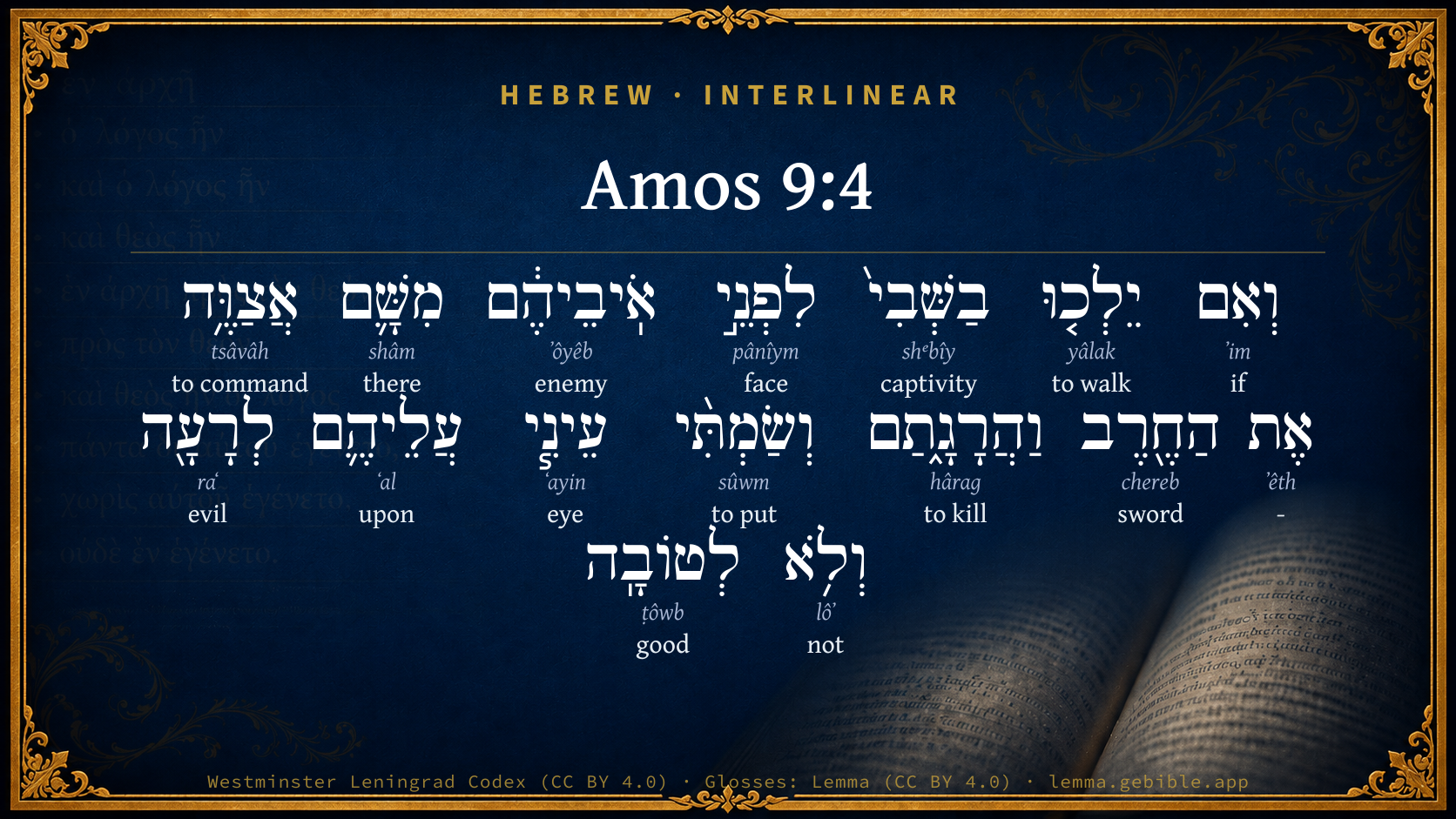
Hebrew (Westminster Leningrad Codex) Amos 9:4 appears in the Hebrew Old Testament. The text above is from the Westminster Leningrad Codex. Each word links to its Strong’s number, a concise gloss, and parsing drawn from the Open Scriptures Hebrew Bible morphology. Click any word for its full Brown-Driver-Briggs (BDB) entry.
Download image
Cite this verse

Amos 9:4 (World English Bible). Public Domain. Lemma interlinear Bible study tool, https://lemma.gebible.app/v/amos/9/4.

Show BibTeX & RIS
BibTeX
RIS
English Translation
Though they go into captivity before their enemies, there I will command the sword, and it will kill them. I will set my eyes on them for evil, and not for good.
World English Bible · Public Domain
Download a study sheet

One document with this verse’s original text, its word-by-word gloss line, the meaning frame, cross-references with their text, attributed commentary, and full source and license credits — printable, and it pastes into notes with its structure intact.

This verse Autodidact and up

Study sheet (.html) Plain text (.txt)

A passage Seminary Student

Up to 50 verses in one chapter. A passage sheet keeps up to 6 commentary sources and 12 cross-references per verse, in the order this page ranks them, and says so on the sheet whenever that leaves anything out. Ask for a single verse and you get the Autodidact verse sheet above.

Everything on this page stays free to read, with no account — the sheet is a download of what is already on screen, not access to it.

Want to remove ads? Support Godless Engineer
Compare translations 3

The same verse in 3 English versions, stacked beneath the original-language interlinear above. Click any original word for its lexicon entry.

Each is an independent rendering of the whole verse — the interlinear is not word-aligned to these translations.

Highlighted words mark where these versions differ — a whole-verse word diff, not a word-by-word alignment.

  • World English Bible Public Domain
    Though they go into captivity before their enemies, there I will command the sword, and it will kill them. I will set my eyes on them for evil, and not for good.
  • King James Version Public Domain
    And though they go into captivity before their enemies, thence will I command the sword, and it shall slay them: and I will set mine eyes upon them for evil, and not for good.
  • unfoldingWord Literal Text CC BY-SA 4.0
    Though they go into captivity, driven by their enemies before them, there will I give orders to the sword, and it will kill them. I will keep my eyes on them for harm and not for good.”

unfoldingWord Literal Text — © unfoldingWord, licensed CC BY-SA 4.0. Word-aligned USFM3 via Door43 (git.door43.org/unfoldingWord/en_ult).

Versions to compare (up to 4)

3 of 4 selected

Show all 18 translations

Every available English version of this verse, each an independent rendering of the whole verse.

  • World English Bible Public Domain
    Though they go into captivity before their enemies, there I will command the sword, and it will kill them. I will set my eyes on them for evil, and not for good.
  • Berean Standard Bible Public Domain
    Though they are driven by their enemies into captivity, there I will command the sword to slay them. I will fix My eyes upon them for harm and not for good.”
  • Majority Standard Bible Public Domain
    Though they are driven by their enemies into captivity, there I will command the sword to slay them. I will fix My eyes upon them for harm and not for good.”
  • King James Version Public Domain
    And though they go into captivity before their enemies, thence will I command the sword, and it shall slay them: and I will set mine eyes upon them for evil, and not for good.
  • American Standard Version (1901) Public Domain
    And though they go into captivity before their enemies, thence will I command the sword, and it shall slay them: and I will set mine eyes upon them for evil, and not for good.
  • Revised Version (1885) Public Domain
    And though they go into captivity before their enemies, thence will I command the sword, and it shall slay them: and I will set mine eyes upon them for evil, and not for good.
  • Geneva Bible (1599) Public Domain
    And though they goe into captiuitie before their enemies, thence wil I commande the sword, and it shall slay them: and I will set mine eyes vpon them for euill, and not for good.
  • Douay-Rheims (1899) Public Domain
    And if they go into captivity before their enemies, there will I command the sword, and it shall kill them. And I will set my eyes upon them for evil, and not for good.
  • Young's Literal Translation Public Domain
    And if they go into captivity before their enemies, From thence I command the sword, And it hath slain them, And I have set Mine eye on them for evil, And not for good.
  • Literal Standard Version CC BY-SA 4.0
    And if they go into captivity before their enemies, || From there I command the sword, || And it has slain them, || And I have set My eye on them for evil, || And not for good.”
  • Unlocked Literal Bible CC BY-SA 4.0
    Though they go into captivity, driven by their enemies before them, there will I give orders to the sword, and it will kill them. I will keep my eyes on them for harm and not for good.”
  • unfoldingWord Literal Text CC BY-SA 4.0
    Though they go into captivity, driven by their enemies before them, there will I give orders to the sword, and it will kill them. I will keep my eyes on them for harm and not for good.”
  • Darby Bible Public Domain
    and though they go into captivity before their enemies, there will I command the sword, and it shall slay them: and I will set mine eyes upon them for evil, and not for good.
  • World Messianic Bible Public Domain
    Though they go into captivity before their enemies, there I will command the sword, and it will kill them. I will set my eyes on them for evil, and not for good.
  • Webster's Bible Public Domain
    And though they go into captivity before their enemies, thence will I command the sword, and it shall slay them: and I will set my eyes upon them for evil, and not for good.
  • Free Bible Version CC BY-SA 4.0
    Even if they are driven into exile by their enemies, I will order them put to death by the sword. I will watch them carefully—and for evil, not for good.
  • Bible in Basic English Public Domain
    And though they are taken away as prisoners by their attackers, even there will I give orders to the sword to put them to death: my eyes will be fixed on them for evil and not for good.
  • JPS Tanakh (1917) Public Domain
    And though they go into captivity before their enemies, thence will I command the sword, and it shall slay them; and I will set Mine eyes upon them for evil, and not for good.

Literal Standard Version (2020), Covenant Press — licensed CC BY-SA 4.0. Text via the HelloAO Bible API (eBible.org). Unlocked Literal Bible (unfoldingWord) — licensed CC BY-SA 4.0. Text via the HelloAO Bible API (eBible.org). unfoldingWord Literal Text — © unfoldingWord, licensed CC BY-SA 4.0. Word-aligned USFM3 via Door43 (git.door43.org/unfoldingWord/en_ult). Free Bible Version, Dr. Jonathan Gallagher — licensed CC BY-SA 4.0. Text via the HelloAO Bible API (eBible.org).

Word by word

More ways to search: Search by grammar → Find every occurrence → Compare this word →

Practice this passage: Drill this verse → Learn its vocabulary →

בַשְּׁבִי֙
shᵉbîy
H7628
“in/at the · captivity”
Preposition, Determined + Noun, Common, Both, Singular, Absolute
Part of Speech
Preposition + Noun
Type
Common
Gender
Both
Number
Singular
State
Absolute
Full BDB Definition

Origin: from H7618

TWOT: 2311a

captivity, captives (noun masculine) - (state of) captivity - (act of) capture - captives - captive (noun feminine)
  1. וְאִם ʼim H518 “and · if” Conjunction + Conjunction
  2. יֵלְכ֤וּ yâlak H3212 “to walk” Verb, Qal, Imperfect, 3rd Person, Masculine, Plural
  3. לִפְנֵ֣י pânîym H6440 “to/for · face(s) of” Preposition + Noun, Common, Both, Plural, Construct
  4. אֹֽיבֵיהֶ֔ם ʼôyêb H341 “enemy · them” Verb, Qal, Participle Active, Masculine, Plural, Construct + Suffix, Personal, 3rd Person, Masculine, Plural
  5. מִשָּׁ֛ם shâm H8033 “from · there” Preposition + Adverb
  6. אֲצַוֶּ֥ה tsâvâh H6680 “to command” Verb, Piel, Imperfect, 1st Person, Common, Singular
  7. אֶת ʼêth H853 “-” Particle, Direct Object
  8. הַחֶ֖רֶב chereb H2719 “the · sword” Particle, Definite Article + Noun, Common, Feminine, Singular, Absolute
  9. וַהֲרָגָ֑תַם hârag H2026 “and · to kill · them” Conjunction + Verb, Qal, Perfect, 3rd Person, Feminine, Singular + Suffix, Personal, 3rd Person, Masculine, Plural
  10. וְשַׂמְתִּ֨י sûwm H7760 “and · to put” Conjunction + Verb, Qal, Perfect, 1st Person, Common, Singular
  11. עֵינִ֧י ʻayin H5869 “eye · my” Noun, Common, Both, Singular, Construct + Suffix, Personal, 1st Person, Common, Singular
  12. עֲלֵיהֶ֛ם ʻal H5921 “upon · them” Preposition + Suffix, Personal, 3rd Person, Masculine, Plural
  13. לְרָעָ֖ה raʻ H7451 “to/for · evil” Preposition + Noun, Common, Feminine, Singular, Absolute
  14. וְלֹ֥א lôʼ H3808 “and · not” Conjunction + Particle, Negative
  15. לְטוֹבָֽה ṭôwb H2896 “to/for · good” Preposition + Adjective, Adjective, Feminine, Singular, Absolute

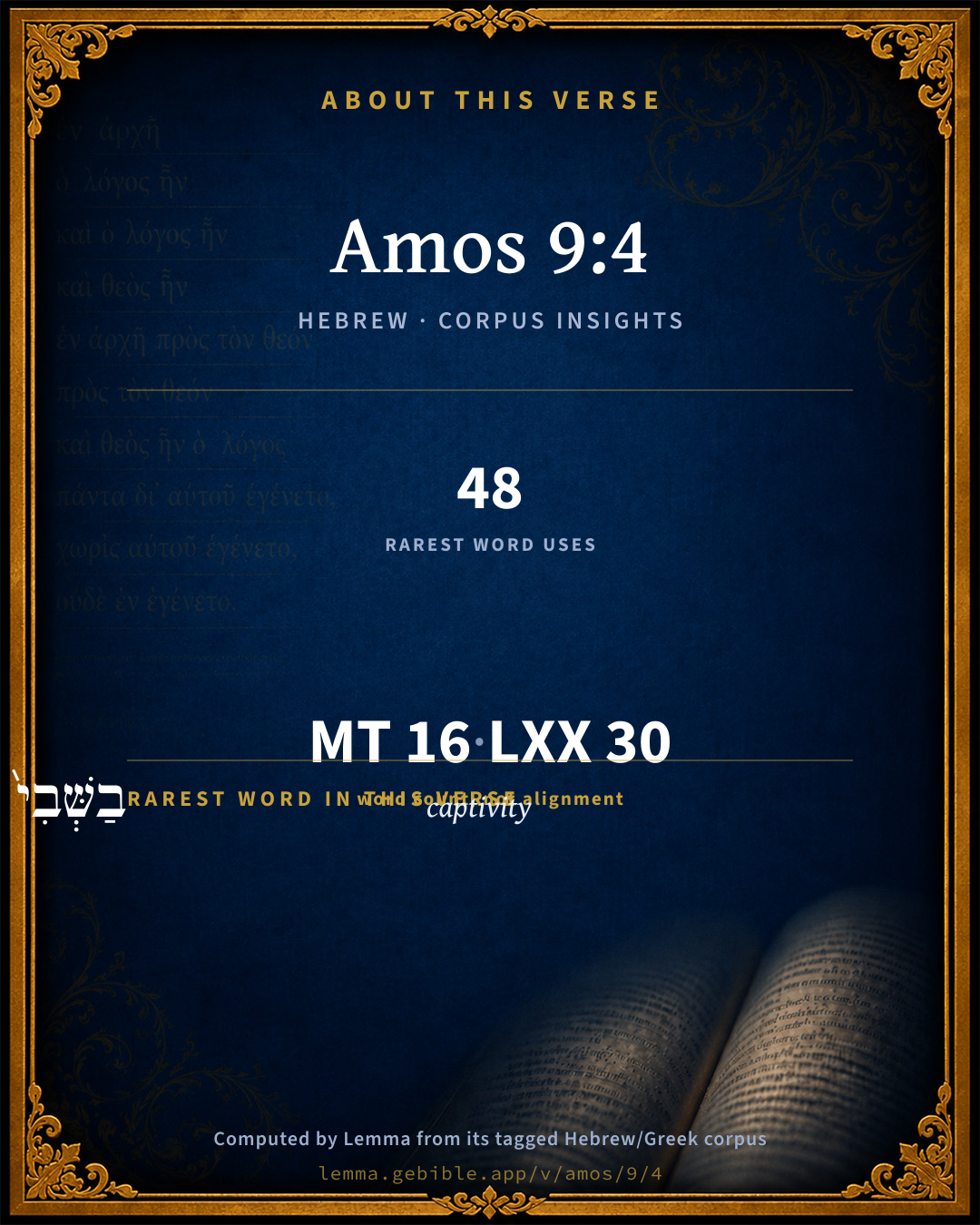
About this verse

These counts appear in no published source. They are computed here, from the morphology-tagged text and Lemma’s own curated glosses. What Lemma adds →

16
words
16
distinct lemmas
Prophets
section

Shared distinctive vocabulary

בַשְּׁבִי֙ captivity H7628 occurs in 46 verses of the Hebrew Bible. Also found in:

Grammatical profile

  • 5 verbs
  • 5 nouns
  • 1 adjective
  • 1 preposition
  • 1 conjunction
  • 1 adverb
  • 2 particles

Verb forms

  • יֵלְכ֤וּ Qal · Imperfect
  • אֹֽיבֵיהֶ֔ם Qal · Participle Active
  • אֲצַוֶּ֥ה Piel · Imperfect
  • וַהֲרָגָ֑תַם Qal · Perfect
  • וְשַׂמְתִּ֨י Qal · Perfect

Hebrew & Septuagint length

In English translation the verse runs 32 words from the Hebrew and 38 from the Septuagint (LXX English) — closely comparable.

A rough comparison of the two English renderings, which tokenize alike — not a word-level alignment.

Word counts can differ between the Hebrew and the Greek without any difference in meaning — e.g. the Hebrew direct-object marker אֵת has no separate Greek word, and Greek often adds the article ὁ.

In the original languages it is 16 Hebrew tokens and 30 Greek tokens — but the two are counted differently (Hebrew bundles its prefixes and suffixes into one token; the Greek is in lemma form), so that isn’t a like-for-like length.

Cross-references

13

Topical passages linked to Amos 9:4 in the Treasury of Scripture Knowledge — connected by theme and wording, ordered by reader-vote popularity; previews shown in the World English Bible.

  • Leviticus 26:33 I will scatter you among the nations, and I will draw out the sword after you: and your land will be a desolation, and your cities shall be a waste.
  • Jeremiah 21:10 For I have set my face on this city for evil, and not for good, says Yahweh: it shall be given into the hand of the king of Babylon, and he shall burn it with fire.
  • Jeremiah 44:11 Therefore thus says Yahweh of Hosts, the God of Israel: Behold, I will set my face against you for evil, even to cut off all Judah.
  • Leviticus 17:10 "'Any man of the house of Israel, or of the strangers who live as foreigners among them, who eats any kind of blood, I will set my face against that soul who eats blood, and will cut him off from among his people.
  • Deuteronomy 28:63–65 It shall happen that as Yahweh rejoiced over you to do you good, and to multiply you, so Yahweh will rejoice over you to cause you to perish, and to destroy you; and you shall be plucked from off the land where you go in to possess it.
  • Jeremiah 39:16 Go, and speak to Ebedmelech the Ethiopian, saying, Thus says Yahweh of Hosts, the God of Israel: Behold, I will bring my words on this city for evil, and not for good; and they shall be accomplished before you in that day.
  • Ezekiel 5:12 A third part of you shall die with the pestilence, and with famine shall they be consumed in the midst of you; and a third part shall fall by the sword round about you; and a third part I will scatter to all the winds, and will draw out a sword after them.
  • Leviticus 26:36–39 "'As for those of you who are left, I will send a faintness into their hearts in the lands of their enemies: and the sound of a driven leaf will put them to flight; and they shall flee, as one flees from the sword; and they will fall when no one pursues.
  • 2 Chronicles 16:9 For the eyes of Yahweh run back and forth throughout the whole earth, to show himself strong in the behalf of them whose heart is perfect toward him. Herein you have done foolishly; for from henceforth you shall have wars.
  • Psalms 34:15–16 Yahweh's eyes are toward the righteous. His ears listen to their cry.
  • Jeremiah 24:6 For I will set my eyes on them for good, and I will bring them again to this land: and I will build them, and not pull them down; and I will plant them, and not pluck them up.
  • Ezekiel 5:2 A third part shall you burn in the fire in the midst of the city, when the days of the siege are fulfilled; and you shall take a third part, and strike with the sword round about it; and a third part you shall scatter to the wind, and I will draw out a sword after them.
  • Zechariah 13:8–9 It shall happen that in all the land," says Yahweh, Two parts in it will be cut off and die; But the third will be left in it.

Cross-references courtesy of OpenBible.info (CC BY 4.0).

Hebrew and Greek witnesses Masoretic Hebrew ↔ Greek Septuagint

The same verse in the two great witnesses to the Old Testament, shown verse-for-verse.

These are two independent witnesses, not word-aligned to each other, and the Septuagint is shown in lemma (dictionary) form.

Hebrew Amos 9:4 Masoretic · Westminster Leningrad Codex

וְאִם יֵלְכ֤וּ בַשְּׁבִי֙ לִפְנֵ֣י אֹֽיבֵיהֶ֔ם מִשָּׁ֛ם אֲצַוֶּ֥ה אֶת הַחֶ֖רֶב וַהֲרָגָ֑תַם וְשַׂמְתִּ֨י עֵינִ֧י עֲלֵיהֶ֛ם לְרָעָ֖ה וְלֹ֥א לְטוֹבָֽה

Though they go into captivity before their enemies, there I will command the sword, and it will kill them. I will set my eyes on them for evil, and not for good.

World English Bible · Public Domain

Greek LXX Amos 9:4 Septuagint · lemma form

καί ἐάν πορεύομαι ἐν αἰχμαλωσία πρό πρόσωπον ὁ ἐχθρός αὐτός ἐκεῖ ἐντελέω ὁ ῥομφαία καί ἀποκτείνω αὐτός καί στηρίζω ὁ ὀφθαλμός ἐγώ ἐπί αὐτός εἰς κακός καί οὐ εἰς ἀγαθός

And if they should go into captivity before the face of their enemies, there will I command the sword, and it shall kill them: and I will set my eyes against them for evil, and not for good.

LXX2012 (modern English Septuagint) · Public Domain

Hebrew: Westminster Leningrad Codex (CC BY 4.0). Greek: Septuagint (public domain); English from LXX2012 (modern English Septuagint) (Public Domain). How the Septuagint differs from the Hebrew →

Targum (Aramaic paraphrase)

1

The Targum is the ancient Jewish Aramaic paraphrase of the Hebrew Scriptures — an interpretive translation, not the Hebrew text itself. Onkelos (literal) and Pseudo-Jonathan (expansive) render the Torah, and Jonathan the Prophets. Coverage is partial: where no permissively-licensed English translation exists for a verse, only the Aramaic is shown. This is verse-level text, not a word-by-word alignment to the Hebrew.

  1. Targum Jonathan Prophets (Joshua–Malachi)
    וְאִם יַהֲכוּן בְּשִׁבְיָא קֳדָם בַּעֲלֵי דְבָבֵיהוֹן מִתַּמָן אַפְקִיד יַת דְקַטְלִין בְּחַרְבָּא וְיִקְטְלוּנוּן וַאֲשַׁוֵי מֵימְרִי עֲלֵיהוֹן לְבִישָׁא וְלָא לְטָבָא:

    (no public-domain English translation for this verse)

    Targum Jonathan — Aramaic: “Mikraot Gedolot” (public domain). English: “Sefaria Community Translation” (CC0 1.0 (public-domain dedication)); “London "Chaldee Paraphrase," 1871” (public domain). Text via Sefaria.

Commentary

Notes on Amos 9:4 from classic Christian and Jewish commentators (each source and its license shown beneath its notes). The classic Christian expositions comment on the surrounding passage and are grouped to its opening verse, so a note may address several verses; the Jewish commentaries on the Tanakh (Rashi and others) are per-verse, so they appear only where the commentator wrote on this verse.

Lemma curates 59 commentaries, every one of them public domain or Creative Commons licensed, each selected and text-cleaned for this edition rather than reprinted as found. About our sources →

Trapp's Complete Commentary

John Trapp

Amo 9:4 And though they go into captivity before their enemies, thence will I command the sword, and it shall slay them: and I will set mine eyes upon them for evil, and not for good.

Ver. 4. And though they go into captivity, &c.] And so may hope the worst is over ("Surely the bitterness of death is past," 1Sa 15:32) yet it shall prove otherwise: the hypocrite’s hope is as the giving up the ghost, saith Job and that is but cold comfort; or, as the spider’s web, spun out of her own bowels; and, when the besom comes, swept to the muckhill.

Before their enemies] Whose custom was to drive their captives before them, Lam 1:5 young and o1d, naked and barefoot, even with their buttocks uncovered, Isa 20:4. Or, "before their enemies," that is, before they are taken captive by the enemies, by voluntary yielding, in hope of quarter for their lives. The Jews indeed had a promise from the prophet Jeremiah, Jer 21:9, that if they went out and fell to the Chaldeans that besieged them they should have their lives for a prey but the ten tribes had no such promise made them; they were strangers from the covenants Eph 2:12, and therefore could look for no mercy. Loammi, and therefore Loruhamah Hos 1:8, the ark and the mercy seat were never sundered.

Thence will I command the sword] See Isa 13:15-16 Jer 9:10; Jer 43:11 Eze 14:17.

And I will set mine eyes upon them] Heb. eye (Emphaticoteron est quam si dixisset Oculo pluraliter. Mercer), viz. the eye of my providence, that oculus irretortus, whereby I will look them to death, and take course that nothing shall go well with them; see a little below, Amo 9:8 Jer 21:10 Psa 34:10. In Tamerlane’s eyes sat such a majesty as man could hardly endure to behold; and man in talking with him became dumb. He held the East in such awe, as that he was commonly called, The wrath of God and terror of the world. Augustus Caesar frowned to death Cornelius Gallus; and so did Queen Elizabeth Sir Christopher Hatton, lord chancellor God’s enemies are sure to perish at the rebuke of his countenance, Psa 80:16, and if he but set his eyes upon them for evil, and not for good, all occurrences shall certainly work together for the worst unto them.

John Trapp, A Commentary or Exposition upon All the Books of the Old and New Testament (1647–1656) — public domain. Text from a community e-Sword module.

Jamieson, Fausset & Brown

Robert Jamieson, A. R. Fausset & David Brown

though they go into captivity--hoping to save their lives by voluntarily surrendering to the foe.

Jamieson, Fausset & Brown — Commentary Critical and Explanatory on the Whole Bible (1871) — public domain (CC PDM 1.0). Text via the HelloAO Bible API.

Adam Clarke's Commentary

Verse 4. I will set mine eyes upon them for evil] I will use that very providence against them which before worked for their good. Should they look upward, they shall see nothing but the terrible lightning-like eye of a sin-avenging God.

Adam Clarke's Commentary on the Bible (1810–1826) — public domain. Text from a community e-Sword/MySword module.

John Calvin's Commentaries

Now when he says, If they go into captivity among their enemies, I will there command the sword to slay them, some interpreters confine this part to that foolish flight, when a certain number of the people sought to provide for their safety by going down into Egypt. Johanan followed them, and a few escaped, (Jeremiah 43:2) but according to what Jeremiah had foretold, when he said, ‘Bend your necks to the king of Babylon, and the Lord will bless you; whosoever will flee to Egypt shall perish;’ so it happened: they found this to be really true, though they had ever refused to believe the prediction. Jeremiah was drawn there contrary to the wish of his own mind: he had, however, pronounced a curse on all who thought that it would be an asylum to them. But the Lord permitted him to be drawn there, that he might to his last breath pronounce the Woe, which they had before heard from his mouth. But I hardly dare thus to restrict these expressions of the Prophet: I therefore explain them generally, as meaning, that exile, which is commonly said to be a civil death, would not be the end of evils to the Israelites and to the Jews; for even when they surrendered themselves to their enemies, and suffered themselves to be led and drawn away wherever their enemies pleased, they could not yet even in this way preserve their life, because the Lord would command the sword to pursue them even when exiles. This, in my view, is the real meaning of the Prophet.

He at last subjoins, I will set my eyes on them for evil, and not for good. There is a contrast to be understood in this clause: for the Lord had promised to be a guardian to his people, according to what is said in Psalm 121:4,

‘Behold, he who guards Israel neither sleeps nor slumbers.’

As hypocrites ever lay hold on the promises of God without repentance and faith, without any religious feeling, and afterwards turn them to support their vain boasting, the Prophet therefore says here, that the eye of God would be upon them, not indeed in his wonted manner to protect them, as he had done from the beginning, but, on the contrary, to accumulate punishment on punishment: it was the same thing as though he said, “As I have hitherto watched over the safety of this people, whom I have chosen for myself, so I will hereafter most sedulously watch, that I may omit no kind of punishment, until they be utterly destroyed.”

And this sentence deserves to be specially noticed; for we are reminded, that though the Lord does not indeed spare unbelievers, he yet more closely observes us, and that he will punish us more severely, if he sees us to be obstinate and incurable to the last. Why so? Because we have come nearer to him, and he looks on us as his family, placed under his eyes; not that anything is hid or concealed from him, but the Scripture speaks after the manner of men. While God then favors his people with a gracious look, he yet cannot endure hypocrites; for he minutely observes their vices, that he may the more severely punish them. This then is the substance of the whole. It follows —

John Calvin's Commentaries (1540-1563) — public domain. Text from the Calvin Translation Society English edition (1840s-50s) via the Christian Classics Ethereal Library (ccel.org). Calvin's coverage is partial (roughly two-thirds of the Bible); uncommented books and verses are honest gaps, never fabricated. The 19th-century editor's footnotes and remarks are omitted so the notes are faithfully Calvin's own voice.

The Cambridge Bible for Schools and Colleges

gen. ed. J. J. S. Perowne

4. Even in captivity they would not be safe; they might escape the destruction of the foe, but the Divine sword should yet overtake them.

before their enemies] Driven before them, like a flock of sheep: cf. Lam_1:5.

I will set mine eyes upon them for evil, and not for good] To set the eye upon is elsewhere found always in a good sense = to keep watch over, take under one’s care (see Jer_24:6; Jer_39:11). For evil and not for good, as Jer_21:10 (with “to set the face against”), Jer_39:16; and (with “watch over”) Jer_44:27. God’s watchful care and love is transformed, through His people’s sin, into hostility (cf. on Amo_6:8).

The Cambridge Bible for Schools and Colleges (gen. ed. J. J. S. Perowne; Cambridge University Press, 1878–1918) — public domain. Text from a community e-Sword module.

John Gill's Exposition

And though they go into captivity before their enemies,.... Alluding to the manner in which captives are led, being put before their enemies, and so carried in triumph; see Lam 1:5; though some think this refers to their going voluntarily into a foreign country, in order to escape danger, as Johanan the son of Kareah with the Jews went into Egypt, Jer 43:5; in whom Kimchi instances:

thence will I command the sword, and it shall slay them; or them that kill with the sword, as the Targum; so that though they thought by going into another country, or into an enemy's country of their own accord, to escape the sword of the enemy, or to curry favour with them, yet should not escape:

and I will set mine eyes upon them for evil, and not for good: this is the true reason, why, let them be where they will, they cannot be safe, because the eyes of the omniscient God, which are everywhere, in heaven, earth, hell, and the sea, are set upon them, for their ruin and destruction; and there is no fleeing from his presence, or getting out of his sight, or escaping his hand. The Targum is,

"my Word shall be against them.''

John Gill's Exposition of the Whole Bible (1746–1763) — public domain (CC PDM 1.0). Text via the HelloAO Bible API.

Albert Barnes' Notes on the Bible

Captivity - , at least, seemed safe. The horrors of war are over. Men enslave, but do not commonly destroy those whom they have once been at the pains to carry captive. Amos describes them in their misery, as “going” willingly, gladly, “into captivity before their enemies,” like a flock of sheep. Yet “thence” too, out of “the captivity,” God would command the sword, and it should slay them. So God had forewarned them by Moses, that captivity should be an occasion, not an end, of slaughter. “I will scatter you among the pagan, and will draw out a sword after you” Lev 26:33. “And among these nations shalt thou find no ease - and thy life shall hang in doubt before thee, and thou shalt fear day and night, and shalt have none assurance of thy life” Deu 28:65-66. The book of Esther shows how cheaply the life of a whole nation was held by Eastern conquerors; and the book of Tobit records, how habitually Jews were slain and cast out unburied (Tobit 1:17; 2:3). The account also that Sennacherib (Tobit 1:18) avenged the loss of his army, and “in his wrath killed many,” is altogether in the character of Assyrian conquerors. Unwittingly he fulfilled the command of God, “I will command the sword and it shall slay them.”

I will set mine eyes upon them for evil - So David says, “The eyes of the Lord are over the righteous, and His ears are open to their prayers. The face of the Lord is against them that do evil, to root out the remembrance of them from off the earth” Psa 34:15-16. The Eye of God rests on each creature which He hath made, as entirely as if He had created it alone. Every moment is passed in His unvarying sight. But, as man “sets his eye” on man, watching him and with purpose of evil, so God’s Eye is felt to be on man in displeasure, when sorrow and calamity track him and overtake him, coming he knows not how in unlooked-for ways and strange events. The Eye of God upon us is our whole hope and stay and life. It is on the Confessor in prison, the Martyr on the rack, the poor in their sufferings, the mourner in the chamber of death, for good. What when everywhere that Eye, the Source of all good, rests on His creature only for evil! “and not for good,” he adds; “not,” as is the wont and the Nature of God; “not,” as He had promised, if they were faithful; “not,” as perhaps they thought, “for good.” He utterly shuts out all hope of good. It shall be all evil, and no good, such as is hell.

Albert Barnes' Notes on the Bible (1834–1885) — public domain. Text from a community e-Sword/MySword module.

Matthew Poole's English Annotations

Though they go into captivity; those excluded from safety every where else may perhaps hope that yet the enemy may spare. Captives are the slaves, the possession of their conquering enemies; these make profit of them by selling them to others, or employing them in labour and service.

Before their enemies: this seems to intimate some voluntariness in these people going before the conqueror, whom they hope hereby to mollify and sweeten, that he may use them well; yet this hope shall fail them too.

Thence will I command the sword, and it shall slay them: the enemy should, either out of cruel humour and hatred against them, or on any slight occasion and disgust, slay them as if they had commission from me so to do: neither propriety in them, nor service by them, nor profit in the sale of these poor and miserable captives, should be safety to them, they should be accounted as sheep for the slaughter.

I will set mine eyes upon them; I will perpetually watch over them, and then be sure no opportunity will be let slip.

For evil, to afflict and punish them,

and not for good, for their benefit. Thus was the course of God’s providence against them from the days Amos aimeth at unto this very day, and God hitherto hath, and still doth, make good his threat against this idolatrous, cruel, oppressing people.

Matthew Poole's English Annotations on the Holy Bible (1683–1685) — public domain. Text from a community e-Sword/MySword module.

The Pulpit Commentary

Captivity itself, in which state men generally, at any rate, are secure of their lives, shall not save them from the sword. (Deu_28:65, etc. comp. RAPC Tob 1:17, 18 2:3, where we see that the murder of captives was not unusual) The prophet looks forward to the Assyrian deportation. For evil. The people are indeed subject to God"s special attention, but only in order to punish them (Psa_34:15, Psa_34:16; Jer_44:11)

The lidless eye.

God is not an absentee. He sits at the helm of things. He administers the affairs of the world which he has made. All creatures he takes cognizance of, determines their destiny, controls their actions. His kingdom ruleth over all. And this rule is moral. Under it condition takes the colour of character. God is pure to the pure, froward to the froward. (Psa_18:26) This transgressors know to their bitter cost.

I GOD"S EYE FOLLOWS THE WICKED. In one sense his "eyes are upon the righteous". (Psa_34:15) On the wicked they rest in a very different sense.

1. In heedfulness. Divine omniscience is an uncomfortable fact which the wicked try not to realize. "They seek deep to hide their counsel from the Lord." Their whole aim is to get away from him; to be able to think thoughts he shall not know, and cherish desires he shall not sift, and do works he shall not observe. (Joh_3:20; Isaiah cf. 27) But the project is futile (Jer_23:24; Psa_33:13; Pro_15:3) God is everywhere, sees everything, fills heaven and earth. No dispensation of inadvertency is possible. God will not ignore. He cannot be inattentive. Events of whatever kind, and everywhere, are infallibly submitted to his cognizance as the movements of the clouds above are faithfully mirrored in the glassy lake. He fills all things, and all that happens happens in his presence.

2. In perfect insight. "I the Lord do search the heart." Noticing things, God sees them through and through, discerns their character, and appraises their moral value. The mind and heart of man are no mystery to him. No slightest motion of either eludes his perfect knowledge. The purpose before it comes forth in action, the thought before it has matured into a purpose, the fancy before it has taken shape in evil desire, all these are open to his eye. Even to the heathen he was totus oculus, a Being "all eye." He knows all things eternally, immeasurably, immutably, and by a single act; and men and their works and words and wishes are continually in his sight.

3. In uncompromising displeasure. God is passible. He can be affected by the actions of his creatures. His possession of genuine character ensures his genuine feeling. The moral perfection of that character ensures his feeling appropriately. "There must be so much or such kind of passibility in him that he will feel toward everything as it is, and will be diversely affected by diverse things according to their quality" (Bushnell). Therefore "he is angry with the wicked every day." Sin is to him as smoke to the eyes and vinegar to the teeth. It pains him inevitably, and leads to that infinitely pure recoil of his nature from evil, and antagonism to it, in which his wrath consists.

II GOD"S INFLUENCES FOLLOW HIS EYE. "I set mine eye upon them for evil," etc. God"s look brings evil consequences where it falls on evil things.

1. To feel is faith God to act. Much human feeling comes to nothing. No action is taken on it. Its very existence may remain unspoken. Not so with God. It is a result of his perfection that his mental or moral attitude toward any object is his active attitude toward it also. Disposition associates itself inevitably with suitable action. Feeling against sin, he must also act against it. His very feeling is equivalent to action, for his volition is power, and to will a thing is to bring it to pass.

2. Gods action exactly answers to his feeling. If he regard sin as evil, he will not treat it as good. His attitude towards it must be one all round, and therefore rigorous all round. And so it is. Whatever mystery may be about certain cases, there is no mystery about the connection between all suffering and sin. In sickness, in sorrow, in anxiety, in doubt, in all forms and degrees of pain, God"s eye and hand are on sinners for evil. Until sin becomes congenial to his nature, it cannot become satisfactory to the sinner.

III GOD"S MERCY WARNS THE SINNER OF BOTH. He makes no secret of his attitude and way in reference to sin. Both are made known to those whom they most concern.

1. This course is merciful. It gives the sinner an advantage. He sees the moral quality of sin as hateful in God"s sight, and its inevitable result as provoking his hostile action. He can neither sin ignorantly nor incur the penalty unawares. Forewarned, it is his fault if he is not forearmed.

2. It is moral. It tends to deter from sin, and so to save from its penal consequences. The thought that it is under God"s eye ought to make sin impossible, and does make it more difficult. The knowledge that it ends inevitably in ruin does much to stay the transgressor"s hand.

3. It is judicial. Sin done consciously under God"s eye, and deliberately in defiance of his wrath, is specially guilty. The warning which being heeded might have deterred from sinning will greatly aggravate the guilt of it if disregarded. The truth will be, as we treat it, a buoy lifting us out of the sinful sea, or a millstone sinking us deeper in its devouring waters.

The Pulpit Commentary (1880–1919), ed. H.D.M. Spence-Jones & Joseph S. Exell — public domain. Text from a community e-Sword module.

John Wesley's Explanatory Notes

Set my eyes - I will perpetually watch over them.

John Wesley, Explanatory Notes Upon the Whole Bible (1754–1765) — public domain. Text via the GEBible commentary corpus.

Lesson kit

Teaching starters — assembled from the data on this page, not authored interpretation. Every prompt links to the verse data it draws on. Edit before teaching.

Amos, in the Prophets, opens this verse with 16 words (16 distinct Hebrew lemmas). Its most distinctive word is shᵉbîy (“captivity”). A historical commentator’s framing appears above. Read the whole chapter for the surrounding context.

Discussion questions

  1. How does “captivity” (shᵉbîy) shape what this verse is saying?
  2. How does Exodus 12:29, which shares the word «captivity», read alongside this verse?
  3. These translations render this verse differently; the difference is in the English rendering, not the original. What questions does that raise?
  4. «יֵלְכ֤וּ» is a Qal Imperfect verb. How does that grammatical form shape the action described?
  5. Compare how Trapp's Complete Commentary and Jamieson, Fausset & Brown read this verse. Where do they agree or differ?

Things to notice

Reading settings

Reading text

Shown beneath each verse's original-language words.

Old Testament
Old Testament edition

Read the OT as the Masoretic Hebrew (MT) or the Greek Septuagint (LXX).

English shown for the Greek Septuagint (in the Hebrew ↔ Greek comparison).

Comparing translations? Open the Compare panel on any verse page to stack up to four side by side.