
Exodus 5:3

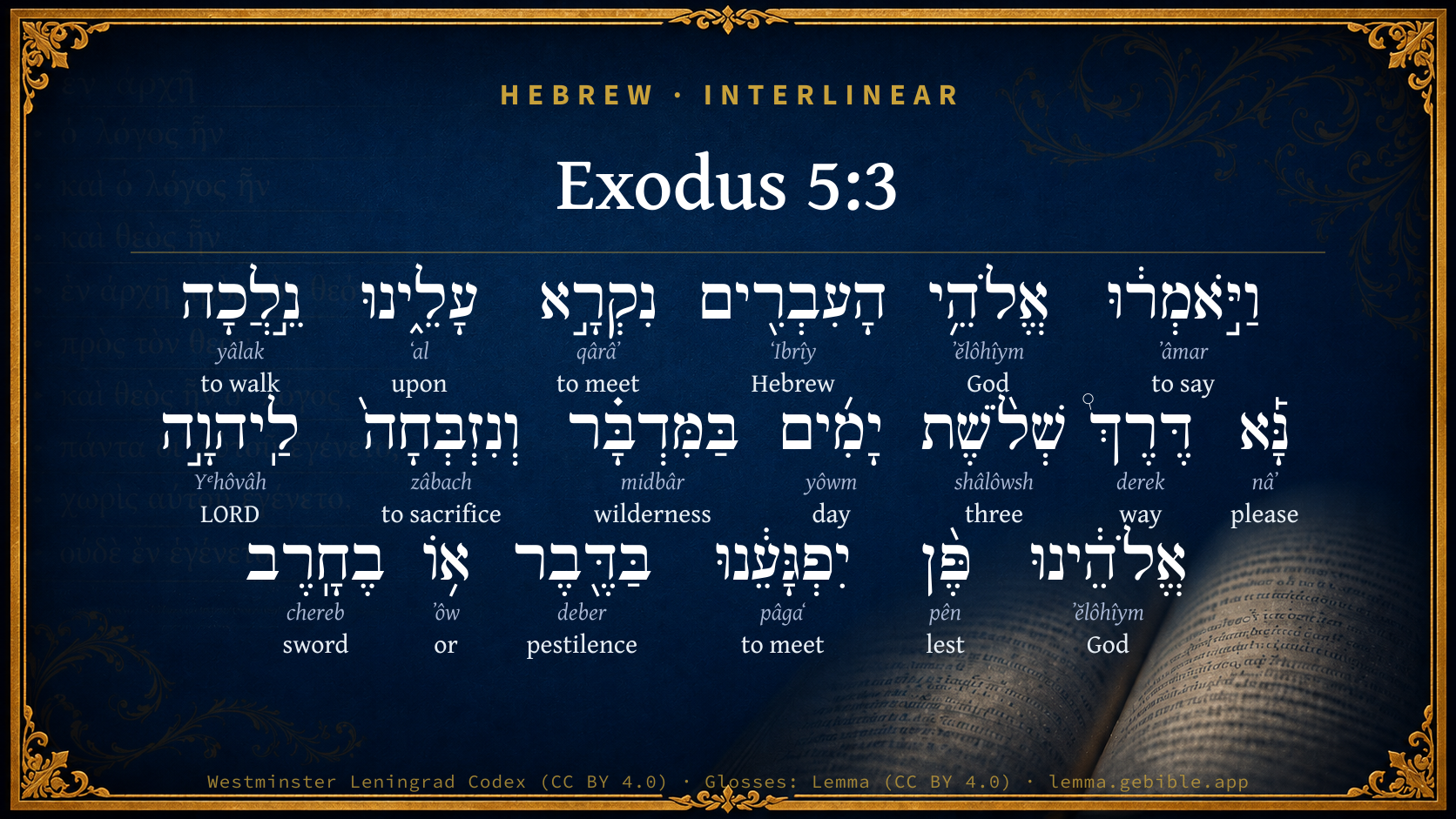
Hebrew (Westminster Leningrad Codex) Exodus 5:3 appears in the Hebrew Old Testament. The text above is from the Westminster Leningrad Codex. Each word links to its Strong’s number, a concise gloss, and parsing drawn from the Open Scriptures Hebrew Bible morphology. Click any word for its full Brown-Driver-Briggs (BDB) entry.
Download image
Cite this verse

Exodus 5:3 (World English Bible). Public Domain. Lemma interlinear Bible study tool, https://lemma.gebible.app/v/exodus/5/3.

Show BibTeX & RIS
BibTeX
RIS
English Translation
They said, "The God of the Hebrews has met with us. Please let us go three days' journey into the wilderness, and sacrifice to Yahweh, our God, lest he fall on us with pestilence, or with the sword."
World English Bible · Public Domain
Highlights
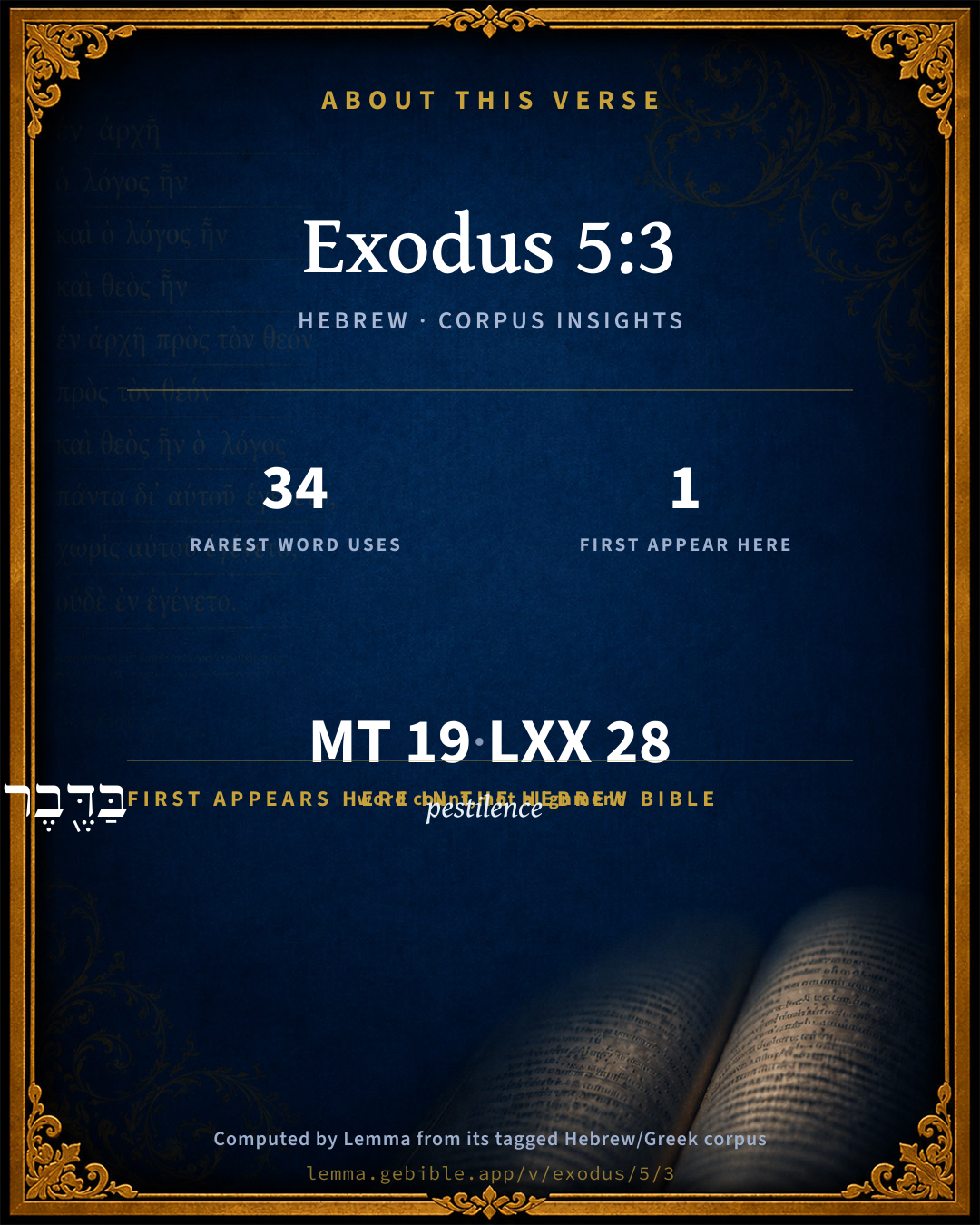
  • 1 first appearance in the Hebrew Bible
Full analysis ↓
Download a study sheet

One document with this verse’s original text, its word-by-word gloss line, the meaning frame, cross-references with their text, attributed commentary, and full source and license credits — printable, and it pastes into notes with its structure intact.

This verse Autodidact and up

Study sheet (.html) Plain text (.txt)

A passage Seminary Student

Up to 50 verses in one chapter. A passage sheet keeps up to 6 commentary sources and 12 cross-references per verse, in the order this page ranks them, and says so on the sheet whenever that leaves anything out. Ask for a single verse and you get the Autodidact verse sheet above.

Everything on this page stays free to read, with no account — the sheet is a download of what is already on screen, not access to it.

Want to remove ads? Support Godless Engineer
Compare translations 3

The same verse in 3 English versions, stacked beneath the original-language interlinear above. Click any original word for its lexicon entry.

Each is an independent rendering of the whole verse — the interlinear is not word-aligned to these translations.

Highlighted words mark where these versions differ — a whole-verse word diff, not a word-by-word alignment.

  • World English Bible Public Domain
    They said, "The God of the Hebrews has met with us. Please let us go three days' journey into the wilderness, and sacrifice to Yahweh, our God, lest he fall on us with pestilence, or with the sword."
  • King James Version Public Domain
    And they said, The God of the Hebrews hath met with us: let us go, we pray thee, three days' journey into the desert, and sacrifice unto the LORD our God; lest he fall upon us with pestilence, or with the sword.
  • unfoldingWord Literal Text CC BY-SA 4.0
    And they said, “The God of the Hebrews has met with us. Please, let us go a journey of three days into the wilderness, and let us sacrifice to Yahweh our God, lest he come upon us with the plague or with the sword.”

unfoldingWord Literal Text — © unfoldingWord, licensed CC BY-SA 4.0. Word-aligned USFM3 via Door43 (git.door43.org/unfoldingWord/en_ult).

Versions to compare (up to 4)

3 of 4 selected

Show all 18 translations

Every available English version of this verse, each an independent rendering of the whole verse.

  • World English Bible Public Domain
    They said, "The God of the Hebrews has met with us. Please let us go three days' journey into the wilderness, and sacrifice to Yahweh, our God, lest he fall on us with pestilence, or with the sword."
  • Berean Standard Bible Public Domain
    “The God of the Hebrews has met with us,” they answered. “Please let us go on a three-day journey into the wilderness to sacrifice to the LORD our God, or He may strike us with plagues or with the sword.”
  • Majority Standard Bible Public Domain
    “The God of the Hebrews has met with us,” they answered. “Please let us go on a three-day journey into the wilderness to sacrifice to the LORD our God, or He may strike us with plagues or with the sword.”
  • King James Version Public Domain
    And they said, The God of the Hebrews hath met with us: let us go, we pray thee, three days' journey into the desert, and sacrifice unto the LORD our God; lest he fall upon us with pestilence, or with the sword.
  • American Standard Version (1901) Public Domain
    And they said, The God of the Hebrews hath met with us: let us go, we pray thee, three days' journey into the wilderness, and sacrifice unto Jehovah our God, lest he fall upon us with pestilence, or with the sword.
  • Revised Version (1885) Public Domain
    And they said, The God of the Hebrews hath met with us: let us go, we pray thee, three days’ journey into the wilderness, and sacrifice unto the LORD our God; lest he fall upon us with pestilence, or with the sword.
  • Geneva Bible (1599) Public Domain
    And they saide, We worship the God of the Ebrewes: we pray thee, let vs goe three daies iourney in the desert, and sacrifice vnto the Lord our God, least he bring vpon vs the pestilence or sword.
  • Douay-Rheims (1899) Public Domain
    And they said: The God of the Hebrews hath called us, to go three days' journey into the wilderness and to sacrifice to the Lord our God: lest a pestilence or the sword fall upon us.
  • Young's Literal Translation Public Domain
    And they say, `The God of the Hebrews hath met with us, let us go, we pray thee, a journey of three days into the wilderness, and we sacrifice to Jehovah our God, lest He meet us with pestilence or with sword.'
  • Literal Standard Version CC BY-SA 4.0
    And they say, “The God of the Hebrews has met with us; please let us go a journey of three days into the wilderness, and we sacrifice to our God YHWH, lest He meet us with pestilence or with sword.”
  • Unlocked Literal Bible CC BY-SA 4.0
    They said, “The God of the Hebrews has met with us. Let us go on a three-day journey into the wilderness and sacrifice to Yahweh our God so that he does not attack us with plague or with the sword.”
  • unfoldingWord Literal Text CC BY-SA 4.0
    And they said, “The God of the Hebrews has met with us. Please, let us go a journey of three days into the wilderness, and let us sacrifice to Yahweh our God, lest he come upon us with the plague or with the sword.”
  • Darby Bible Public Domain
    And they said, The God of the Hebrews has met with us: let us go, we pray thee, three days' journey into the wilderness, and sacrifice to Jehovah our God; lest he fall upon us with pestilence or with sword.
  • World Messianic Bible Public Domain
    They said, “The God of the Hebrews has met with us. Please let us go three days’ journey into the wilderness, and sacrifice to the LORD, our God, lest he fall on us with pestilence, or with the sword.”
  • Webster's Bible Public Domain
    And they said, The God of the Hebrews hath met with us: let us go, we pray thee, three days' journey into the desert, and sacrifice to the LORD our God; lest he fall upon us with pestilence, or with the sword.
  • Free Bible Version CC BY-SA 4.0
    “The God of the Hebrews came to us,” they added. “Please allow us to go a three-day journey into the desert and offer sacrifices to the Lord our God. Otherwise he'll kill us by disease or by the sword.”
  • Bible in Basic English Public Domain
    And they said, The God of the Hebrews has come to us: let us then go three days' journey into the waste land to make an offering to the Lord our God, so that he may not send death on us by disease or the sword.
  • JPS Tanakh (1917) Public Domain
    And they said: 'The God of the Hebrews hath met with us. Let us go, we pray thee, three days' journey into the wilderness, and sacrifice unto the LORD our God; lest He fall upon us with pestilence, or with the sword.'

Literal Standard Version (2020), Covenant Press — licensed CC BY-SA 4.0. Text via the HelloAO Bible API (eBible.org). Unlocked Literal Bible (unfoldingWord) — licensed CC BY-SA 4.0. Text via the HelloAO Bible API (eBible.org). unfoldingWord Literal Text — © unfoldingWord, licensed CC BY-SA 4.0. Word-aligned USFM3 via Door43 (git.door43.org/unfoldingWord/en_ult). Free Bible Version, Dr. Jonathan Gallagher — licensed CC BY-SA 4.0. Text via the HelloAO Bible API (eBible.org).

Word by word

More ways to search: Search by grammar → Find every occurrence → Compare this word →

Practice this passage: Drill this verse → Learn its vocabulary →

הָעִבְרִ֖ים
ʻIbrîy
H5680
“the · Hebrews”
Particle, Definite Article + Noun, Gentilic, Masculine, Plural, Absolute
Part of Speech
Particle + Noun
Type
Gentilic
Gender
Masculine
Number
Plural
State
Absolute
Full BDB Definition

Origin: patronymic from H5677

TWOT: None

Hebrew = "one from beyond" - a designation of the patriarchs and the Israelites (noun proper) - a designation of the patriarchs and the Israelites (adjective)
  1. וַיֹּ֣אמְר֔וּ ʼâmar H559 “and · to say” Conjunction + Verb, Qal, Sequential Imperfect, 3rd Person, Masculine, Plural
  2. אֱלֹהֵ֥י ʼĕlôhîym H430 “God(s) of” Noun, Common, Masculine, Plural, Construct
  3. נִקְרָ֣א qârâʼ H7122 “to meet” Verb, Niphal, Perfect, 3rd Person, Masculine, Singular
  4. עָלֵ֑ינוּ ʻal H5921 “upon · us” Preposition + Suffix, Personal, 1st Person, Common, Plural
  5. נֵ֣לֲכָה yâlak H3212 “to walk” Verb, Qal, Cohortative, 1st Person, Common, Plural
  6. נָּ֡א nâʼ H4994 “please” Particle, Interjection
  7. דֶּרֶךְ֩ derek H1870 “way of” Noun, Common, Both, Singular, Construct
  8. שְׁלֹ֨שֶׁת shâlôwsh H7969 “three” Adjective, Cardinal number, Masculine, Singular, Construct
  9. יָמִ֜ים yôwm H3117 “days” Noun, Common, Masculine, Plural, Absolute
  10. בַּמִּדְבָּ֗ר midbâr H4057 “in/at the · wilderness” Preposition, Determined + Noun, Common, Masculine, Singular, Absolute
  11. וְנִזְבְּחָה֙ zâbach H2076 “and · to sacrifice” Conjunction + Verb, Qal, Cohortative, 1st Person, Common, Plural
  12. לַֽיהוָ֣ה Yᵉhôvâh H3068 “to/for · LORD” Preposition + Noun, Proper
  13. אֱלֹהֵ֔ינוּ ʼĕlôhîym H430 “God(s) · our” Noun, Common, Masculine, Plural, Construct + Suffix, Personal, 1st Person, Common, Plural
  14. פֶּ֨ן pên H6435 “lest” Conjunction
  15. יִפְגָּעֵ֔נוּ pâgaʻ H6293 “to meet · us” Verb, Qal, Imperfect, 3rd Person, Masculine, Singular + Suffix, Personal, 1st Person, Common, Plural
  16. בַּדֶּ֖בֶר deber H1698 “in/at the · pestilence” Preposition, Determined + Noun, Common, Masculine, Singular, Absolute
  17. א֥וֹ ʼôw H176 “or” Conjunction
  18. בֶחָֽרֶב chereb H2719 “in/at the · sword” Preposition, Determined + Noun, Common, Feminine, Singular, Absolute

About this verse

These counts appear in no published source. They are computed here, from the morphology-tagged text and Lemma’s own curated glosses. What Lemma adds →

19
words
18
distinct lemmas
Pentateuch
section

First appearance in Scripture

This word makes its first canonical appearance in the Hebrew Bible here:

  • בַּדֶּ֖בֶר pestilence H1698

Shared distinctive vocabulary

הָעִבְרִ֖ים Hebrew H5680 occurs in 32 verses of the Hebrew Bible. Also found in:

Grammatical profile

  • 5 verbs
  • 9 nouns
  • 1 adjective
  • 1 preposition
  • 2 conjunctions
  • 1 particle

Verb forms

  • וַיֹּ֣אמְר֔וּ Qal · Sequential Imperfect
  • נִקְרָ֣א Niphal · Perfect
  • נֵ֣לֲכָה Qal · Cohortative
  • וְנִזְבְּחָה֙ Qal · Cohortative
  • יִפְגָּעֵ֔נוּ Qal · Imperfect

Repetition

A word recurs within this verse — often emphatic in Hebrew:

  • אֱלֹהֵ֥י God H430 ×2

Hebrew & Septuagint length

In English translation the verse runs 38 words from the Hebrew and 45 from the Septuagint (LXX English) — closely comparable.

A rough comparison of the two English renderings, which tokenize alike — not a word-level alignment.

Word counts can differ between the Hebrew and the Greek without any difference in meaning — e.g. the Hebrew direct-object marker אֵת has no separate Greek word, and Greek often adds the article ὁ.

In the original languages it is 19 Hebrew tokens and 28 Greek tokens — but the two are counted differently (Hebrew bundles its prefixes and suffixes into one token; the Greek is in lemma form), so that isn’t a like-for-like length.

Cross-references

7

Topical passages linked to Exodus 5:3 in the Treasury of Scripture Knowledge — connected by theme and wording, ordered by reader-vote popularity; previews shown in the World English Bible.

  • Exodus 3:18 They will listen to your voice, and you shall come, you and the elders of Israel, to the king of Egypt, and you shall tell him, 'Yahweh, the God of the Hebrews, has met with us. Now please let us go three days' journey into the wilderness, that we may sacrifice to Yahweh, our God.'
  • Deuteronomy 28:21 Yahweh will make the pestilence cleave to you, until he have consumed you from off the land, where you go in to possess it.
  • 2 Kings 17:25 So it was, at the beginning of their dwelling there, that they didn't fear Yahweh: therefore Yahweh sent lions among them, which killed some of them.
  • 2 Chronicles 30:8 Now don't you be stiff-necked, as your fathers were; but yield yourselves to Yahweh, and enter into his sanctuary, which he has sanctified forever, and serve Yahweh your God, that his fierce anger may turn away from you.
  • Ezra 7:23 Whatever is commanded by the God of heaven, let it be done exactly for the house of the God of heaven; for why should there be wrath against the realm of the king and his sons?
  • Ezekiel 6:11 Thus says the Lord Yahweh: Smite with your hand, and stamp with your foot, and say, Alas! because of all the evil abominations of the house of Israel; for they shall fall by the sword, by the famine, and by the pestilence.
  • Zechariah 14:16–19 It will happen that everyone who is left of all the nations that came against Jerusalem will go up from year to year to worship the King, Yahweh of Hosts, and to keep the feast of tents.

Cross-references courtesy of OpenBible.info (CC BY 4.0).

Hebrew and Greek witnesses Masoretic Hebrew ↔ Greek Septuagint

The same verse in the two great witnesses to the Old Testament, shown verse-for-verse.

These are two independent witnesses, not word-aligned to each other, and the Septuagint is shown in lemma (dictionary) form.

Hebrew Exodus 5:3 Masoretic · Westminster Leningrad Codex

וַיֹּ֣אמְר֔וּ אֱלֹהֵ֥י הָעִבְרִ֖ים נִקְרָ֣א עָלֵ֑ינוּ נֵ֣לֲכָה נָּ֡א דֶּרֶךְ֩ שְׁלֹ֨שֶׁת יָמִ֜ים בַּמִּדְבָּ֗ר וְנִזְבְּחָה֙ לַֽיהוָ֣ה אֱלֹהֵ֔ינוּ פֶּ֨ן יִפְגָּעֵ֔נוּ בַּדֶּ֖בֶר א֥וֹ בֶחָֽרֶב

They said, "The God of the Hebrews has met with us. Please let us go three days' journey into the wilderness, and sacrifice to Yahweh, our God, lest he fall on us with pestilence, or with the sword."

World English Bible · Public Domain

Greek LXX Exodus 5:3 Septuagint · lemma form

καί λέγω αὐτός ὁ θεός ὁ εβραῖος προςκαλέω ἐγώ πορεύομαι οὖν ὁδός τρεῖς ἡμέρα εἰς ὁ ἔρημος ὅπως θύω ὁ θεός ἐγώ μήποτε συνἀντάω ἐγώ θάνατος ἤ φόνος

And they say to him, The God of the Hebrews has called us to him: we will go therefore a three days' journey into the wilderness, that we may sacrifice to the Lord our God, lest at any time death or slaughter happen to us.

LXX2012 (modern English Septuagint) · Public Domain

Hebrew: Westminster Leningrad Codex (CC BY 4.0). Greek: Septuagint (public domain); English from LXX2012 (modern English Septuagint) (Public Domain). How the Septuagint differs from the Hebrew →

Targum (Aramaic paraphrase)

2

The Targum is the ancient Jewish Aramaic paraphrase of the Hebrew Scriptures — an interpretive translation, not the Hebrew text itself. Onkelos (literal) and Pseudo-Jonathan (expansive) render the Torah, and Jonathan the Prophets. Coverage is partial: where no permissively-licensed English translation exists for a verse, only the Aramaic is shown. This is verse-level text, not a word-by-word alignment to the Hebrew.

  1. Targum Onkelos Torah (Genesis–Deuteronomy)
    וַאֲמָרוּ אֱלָהָא דִיהוּדָאֵי אִתְגְלִי עֲלָנָא נֵיזֵיל כְּעַן מַהֲלַךְ תְּלָתָא יוֹמִין בְּמַדְבְּרָא וּנְדַבַּח קֳדָם יְיָ אֱלָהָנָא דִלְמָא יְעַרְעִנָנָא בְּמוֹתָא אוֹ בִקְטוֹל:

    (no public-domain English translation for this verse)

    Targum Onkelos — Aramaic: “Onkelos Genesis” (public domain); “Onkelos Exodus” (public domain); “Onkelos Leviticus” (public domain); “Onkelos Numbers” (public domain); “Onkelos Deuteronomy” (public domain). English: “Sefaria Community Translation” (CC0 1.0 (public-domain dedication)); “J.W. Etheridge. The Targums of Onkelos and Jonathan Ben Uzziel on the Pentateuch. London: Longmans, Green, 1862” (public domain). Text via Sefaria.

  2. Targum Pseudo-Jonathan Torah (Genesis–Deuteronomy)
    וַאֲמָרוּ אֱלָהָא דִיהוּדָאֵי אִיתְקְרִי שְׁמֵיהּ עֲלָנָא נְטַיֵיל כְּדוֹן מַהֲלָךְ תְּלָתָא יוֹמִין בְּמַדְבְּרָא וּנְדַבַּח נִיכְסַת חַגָא קֳדָם יְיָ אֱלָהִין דִלְמָא יֶאֱרַע יָתָן בְּמוֹתָא אוֹ בְּקַטְלָא

    And they said, The Name of the God of the Jehudaee is invoked by (or upon) us. We will go, then, to proceed three days into the desert, and offer the sacrifices of a festival before the Lord God, that death and slaughter befall us not.

    Targum Pseudo-Jonathan — Aramaic: “Targum Jonathan on Genesis” (public domain); “Targum Jonathan on Exodus” (public domain); “Targum Jonathan on Leviticus” (public domain); “Targum Jonathan on Numbers” (public domain); “Targum Jonathan on Deuteronomy” (public domain). English: “The Targum of Jonathan ben Uzziel, trans. J. W. Etheridge, London, 1862” (public domain). Text via Sefaria.

Commentary

Notes on Exodus 5:3 from classic Christian and Jewish commentators (each source and its license shown beneath its notes). The classic Christian expositions comment on the surrounding passage and are grouped to its opening verse, so a note may address several verses; the Jewish commentaries on the Tanakh (Rashi and others) are per-verse, so they appear only where the commentator wrote on this verse.

Lemma curates 59 commentaries, every one of them public domain or Creative Commons licensed, each selected and text-cleaned for this edition rather than reprinted as found. About our sources →

Matthew Henry's Commentary

Finding that Pharaoh had no veneration at all for God, Moses and Aaron next try whether he had any compassion for Israel, and become humble suitors to him for leave to go and sacrifice, but in vain.

I. Their request is very humble and modest, Exo 5:3. They make no complaint of the rigour they were ruled with. They plead that the journey they designed was not a project formed among themselves, but that their God had met with them, and called them to it. They beg with all submission: We pray thee. The poor useth entreaties; though God may summon princes that oppress, it becomes us to beseech and make supplication to them. What they ask is very reasonable, only for a short vacation, while they went three days' journey into the desert, and that on a good errand, and unexceptionable: "We will sacrifice unto the Lord our God, as other people do to theirs;" and, lastly, they give a very good reason, "Lest, if we quite cast off his worship, he fall upon us with one judgment or other, and then Pharaoh will lose his vassals."

II. Pharaoh's denial of their request is very barbarous and unreasonable, Exo 5:4-9.

1. His suggestions were very unreasonable. (1.) That the people were idle, and that therefore they talked of going to sacrifice. The cities they built for Pharaoh, and the other fruit of their labours, were witnesses for them that they were not idle; yet he thus basely misrepresents them, that he might have a pretence to increase their burdens. (2.) That Moses and Aaron made them idle with vain words, Exo 5:9. God's words are here called vain words; and those that called them to the best and most needful business are accused of making them idle. Note, The malice of Satan has often represented the service and worship of God as fit employment for those only that have nothing else to do, and the business only of the idle; whereas indeed it is the indispensable duty of those that are most busy in the world.

2. His resolutions hereupon were most barbarous. (1.) Moses and Aaron themselves must get to their burdens (Exo 5:4); they are Israelites, and, however God had distinguished them from the rest, Pharaoh makes no difference: they must share in the common slavery of their nation. Persecutors have always taken a particular pleasure in putting contempt and hardship upon the ministers of the churches. (2.) The usual tale of bricks must be exacted, without the usual allowance of straw to mix with the clay, or to burn the bricks with, that thus more work might be laid upon the men, which if they performed, they would be broken with labour; and, if not, they would be exposed to punishment.

Matthew Henry's Commentary on the Whole Bible (1708–1710) — public domain (CC PDM 1.0). Text via the HelloAO Bible API.

Trapp's Complete Commentary

John Trapp

Exo 5:3 And they said, The God of the Hebrews hath met with us: let us go, we pray thee, three days’ journey into the desert, and sacrifice unto the LORD our God; lest he fall upon us with pestilence, or with the sword.

Ver. 3. Three days’ journey,] viz., to mount Horeb. They made it three months’ journey ere they came there. {Exo 13:17-18} God leads his people oft not the nearest, but the safest way to their journey’s end.

John Trapp, A Commentary or Exposition upon All the Books of the Old and New Testament (1647–1656) — public domain. Text from a community e-Sword module.

The Biblical Illustrator

Joseph S. Exell

Exo_5:3

Let us go, we pray thee, three days Journey.

Lessons

1. Gods ambassadors must not forsake His message, upon mans denial.

2. Further arguments must press Gods message, when the proposal is not enough.

3. The God of the Hebrews must be owned by them, though despised by Pharaoh.

4. Relation unto God, and call from Him necessitates souls to follow His commands.

5. Although God command powers, yet it beseemeth His people to entreat them.

6. To go at Gods call, and serve Him only after His will must be insisted on by His.

7. Small desires of the Church for God, leave powers on earth inexusable in denying.

8. To sacrifice to God and to feast with Him are synonymous.

9. Entreaties from powers to serve God for averting His judgments is reasonable.

10. Pestilence and sword are Gods judgments exacting the neglect of His service.

11. These plagues are incident on all that neglect God, but much more on them that forbid others to serve Him.

12. The fear of these judgments should awe souls from slighting His message to them. (G. Hughes, B. D.)

It is right to recognize the danger of disobedience to God

Let us go . . . lest He fall upon us with pestilence, or with the sword. It is right to have in mind the fact that God will punish us if we refuse to do as He tells us to. It may answer for other people to talk about needing no other motive to well doing than love; but you and I are not always influenced by love alone. If we knew to-day that we could do wrong with entire impunity--do a little wrong, I mean, a pet wrong, a wrong that no one would know anything about, and that wouldnt seem to harm anybody very much any way--could do it without any suffering or any punishment; do you think we should be just as strong for the right as now, while we know that the disclosure and the punishment of sin is sure? Well, even if you and I think so, God doesnt take that view of it. God threatens as well as entreats. He holds up the danger of punishment for sin, as welt as the rewards of loving and serving Him trustfully; and God doesnt make any mistake in so doing. (S. S. Times.)

The Biblical Illustrator, edited by Joseph S. Exell (c. 1880s–1900s) — public domain. Text from a community e-Sword module.

Joseph Benson's Commentary

Exo 5:3. Three days’ journey into the desert — And that on a good errand, and unexceptionable: we will sacrifice to the Lord our God — As other people do to theirs; lest if we quite cast off his worship, he fall upon us — With one judgment or other, and then Pharaoh will lose his vassals.

Though it was the intention of the Israelites quite to leave Egypt; yet the request was made only to go three days’ journey into the desert to sacrifice, probably to set the tyranny of the king in a stronger light, who would not indulge them in this small liberty even for the performance of religious rites. And as this demand was made by the express order of God, who knew that Pharaoh would not grant it, all appearance of there being any artful design in it to deceive Pharaoh is taken away.

Joseph Benson's Commentary on the Old and New Testaments (1811–1818) — public domain. Text from a community e-Sword module.

Tyndale Open Study Notes

Tyndale Open Resources

5:3 he will kill us: God had not said this. Perhaps Moses and Aaron were trying to strengthen their case by saying that they had to obey God or die.

Tyndale Open Study Notes — © Tyndale Open Resources, licensed CC BY-SA 4.0. Text via the HelloAO Bible API.

Geneva Bible (1599)

Geneva Bible translators

Hebrew, Lest he meet us with pestilence.

Or, God hath met us.

Geneva Bible (1599) marginal notes — public domain. Text via Bolls.life.

Jamieson, Fausset & Brown

Robert Jamieson, A. R. Fausset & David Brown

The God of the Hebrews hath met with us--Instead of being provoked into reproaches or threats, they mildly assured him that it was not a proposal originating among themselves, but a duty enjoined on them by their God. They had for a long series of years been debarred from the privilege of religious worship, and as there was reason to fear that a continued neglect of divine ordinances would draw down upon them the judgments of offended heaven, they begged permission to go three days' journey into the desert--a place of seclusion--where their sacrificial observances would neither suffer interruption nor give umbrage to the Egyptians. In saying this, they concealed their ultimate design of abandoning the kingdom, and by making this partial request at first, they probably wished to try the king's temper before they disclosed their intentions any farther. But they said only what God had put in their mouths (Exo 3:12, Exo 3:18), and this "legalizes the specific act, while it gives no sanction to the general habit of dissimulation" [CHALMERS].

Jamieson, Fausset & Brown — Commentary Critical and Explanatory on the Whole Bible (1871) — public domain (CC PDM 1.0). Text via the HelloAO Bible API.

Adam Clarke's Commentary

Verse 3. Three days' journey] The distance from Goshen to Sinai; see Ex 3:18.

And sacrifice unto the Lord] Great stress is laid on this circumstance. God required sacrifice; no religious acts which they performed could be acceptable to him without this. He had now showed them that it was their indispensable duty thus to worship him, and that if they did not they might expect him to send the pestilence - some plague or death proceeding immediately from himself, or the sword - extermination by the hands of an enemy. The original word דבר deber, from בדר dabar, to drive off, draw under, c., which we translate pestilence from the Latin pestis, the plague, signifies any kind of disease by which an extraordinary mortality is occasioned, and which appears from the circumstances of the case to come immediately from God. The Israelites could not sacrifice in the land of Egypt, because the animals they were to offer to God were held sacred by the Egyptians and they could not omit this duty, because it was essential to religion even before the giving of the law. Thus we find that Divine justice required the life of the animal for the life of the transgressor, and the people were conscious, if this were not done, that God would consume them with the pestilence or the sword. From the foundation of the world the true religion required sacrifice. Before, under, and after the law, this was deemed essential to salvation. Under the Christian dispensation Jesus is the lamb of God that taketh away the sin of the world; and being still the Lamb newly slain before the throne, no man cometh unto the Father but by him.

"In this first application to Pharaoh, we observe," says Dr. Dodd, "that proper respectful submission which is due from subjects to their sovereign. They represent to him the danger they should be in by disobeying their God, but do not so much as hint at any punishment that would follow to Pharaoh."

Adam Clarke's Commentary on the Bible (1810–1826) — public domain. Text from a community e-Sword/MySword module.

Ellicott's Commentary for English Readers

(3) The God of the Hebrews.—Moses accepts Pharaoh’s view, and does not insist on the authority of Jehovah over Egyptians, but makes an appeal ad misericordiam. He has, at any rate, authority over Hebrews; and, having made a requirement, He will be angered if they neglect it. Will not Pharaoh allow them to escape His anger?

With the sword.—Egypt was very open to invasion on its eastern frontier; and the brunt of an invasion in this quarter would fall upon the Hebrews. In the time of the nineteenth dynasty, Hittite incursions were especially feared.

A Bible Commentary for English Readers, edited by Charles John Ellicott (1878–1897) — public domain. Text from a community e-Sword module.

The Cambridge Bible for Schools and Colleges

gen. ed. J. J. S. Perowne

3. The request itself, as far as ‘our God,’ is repeated almost verbatim from Exo_3:18 (J). ‘God of the Hebrews’ is J’s standing expression (see the note ibid.); contrast ‘God of Israel,’ v. 1.

lest he fall upon us, &c.] for neglecting the duty laid upon us.

The Cambridge Bible for Schools and Colleges (gen. ed. J. J. S. Perowne; Cambridge University Press, 1878–1918) — public domain. Text from a community e-Sword module.

John Gill's Exposition

And they said, the God of the Hebrews hath met with us,.... Perceiving that the name Jehovah was unknown to him, and treated by him in a scornful manner, they leave it out, and only say, "the God of the Hebrews": a people that dwelt in his country, he well knew by this name, and could not be ignorant that their God was different from his; and it was he that had met Moses and Aaron; they did not seek to him to be sent on this errand, but he appeared to them as he did to Moses at Horeb, and to Aaron in Egypt. Some render it, "the God of the Hebrews is called upon us" (f); his name was called upon them, or they were called by his name; they were his servants and worshippers, and therefore under obligation to attend to what he enjoined them:

let us go, we pray thee, three days' journey into the desert: a request which was made in a very humble and modest manner, and not at all extravagant, nor anything dangerous and disadvantageous to him; for now they speak as of themselves, and therefore humbly entreat him; they do not ask to be wholly and for ever set free, only to go for three days; they do not propose to meet and have their rendezvous in any part of his country, much less in his metropolis, where he night fear they would rise in a body, and seize upon his person and treasure, only to go into the wilderness, to Mount Sinai there. And hence it appears, that the distance between Egypt and Mount Sinai was three days' journey, to go the straightest way, as Aben Ezra observes:

and sacrifice unto the Lord our God: which is what was meant by keeping a feast; some sacrifices the people, as well as the priests, feasted on; this was not a civil, but a religious concern:

lest he fall upon us with pestilence, or with the sword: this they urge as a reason to have their request granted, taken from the danger they should be exposed unto, should they not be allowed to go and offer sacrifice to God; though by this they might suggest both loss and danger to Pharaoh, in order to stir him up the more to listen to their request; for should they be smitten with pestilence, or the sword, he would lose the benefit of their bond service, which would be a considerable decline in his revenues; and besides, if God would be so displeased with the Israelites for not going, and not sacrificing, when they were detained, how much more displeased would he be with Pharaoh and the Egyptians for hindering them?

(f) "est invocatus super nos", Montanus. So some in Vatablus, Drusius.

John Gill's Exposition of the Whole Bible (1746–1763) — public domain (CC PDM 1.0). Text via the HelloAO Bible API.

Albert Barnes' Notes on the Bible

Three days’ journey - See the Exo 3:18 note.

With pestilence, or with the sword - This shows that the plague was well known to the ancient Egyptians. The reference to the sword is equally natural, since the Israelites occupied the eastern district, which was frequently disturbed by the neighboring Shasous.

Albert Barnes' Notes on the Bible (1834–1885) — public domain. Text from a community e-Sword/MySword module.

Haydock's Catholic Bible Commentary

Upon us. They include themselves in the common danger, in case of disobedience; and they admonish the king respectfully, that there is no resisting the God of the Hebrews with impunity.

George Leo Haydock (1774–1849), Haydock's Catholic Family Bible and Commentary, 1859 edition — public domain. Excludes Psalms (Douay-Rheims chapter numbering differs from Protestant) and Deuterocanonical books (Catholic canon only).

Matthew Poole's English Annotations

Hath met with us, i.e. hath appeared to us lately, and laid this command upon us. Others, is called upon us, i.e. his name is called upon us, or we are called by his name. But why should Moses so solemnly tell that to Pharaoh which all the people knew, to wit, that the Hebrews did worship the God of the Hebrews? And our translation is confirmed by comparing this with Exo 3:18, where this very message is prescribed.

Lest he fall upon us; lest he punish, either us, if we disobey his command, or thee, if thou hinderest us from obeying it: but this latter they only imply, as being easily gathered from the former.

Matthew Poole's English Annotations on the Holy Bible (1683–1685) — public domain. Text from a community e-Sword/MySword module.

Whedon's Commentary on the Bible

Daniel D. Whedon

3. The God of the Hebrews — The Israelites generally called themselves Hebrews when conferring with strangers, and were so called by other nations. Thus their reply is explanatory. Jehovah, whom they styled God of Israel, Pharaoh would style God of the Hebrews.

Daniel D. Whedon (gen. ed.), Commentary on the Old and New Testaments (1874–1909) — public domain. Text from a community e-Sword module.

The Pulpit Commentary

And they said. Moses and Aaron are not abashed by a single refusal. They expostulate, and urge fresh reasons why Pharaoh should accede to their request. But first they explain that Jehovah is the God of the Hebrews, by which name the Israelites seem to have been generally known to the Egyptians. (see Exo_1:15, Exo_1:16, 19 2:6, 7) Their God, they say, has met with them made, that is. a special revelation of himself to them an idea quite familiar to the king, and which he could not pretend to misunderstand and he has laid on them an express command. They are to go a three days" journey into the desert to be quite clear of interruption from the Egyptians. Will not Pharaoh allow them to obey the order? If they do not obey it, their God will be angry, and will punish them, either by sending a pestilence among them, or causing an invader to fall upon them with the sword. The eastern frontier of Egypt was at this time very open to invasion, and was actually threatened by a vast army some ten or fifteen years later (Brugsch, "History of Egypt," vol. 2., pp. 147-9).

The Pulpit Commentary (1880–1919), ed. H.D.M. Spence-Jones & Joseph S. Exell — public domain. Text from a community e-Sword module.

John Wesley's Explanatory Notes

We pray thee, let us go three days journey into the desert - And that on a good errand, and unexceptionable: we will sacrifice to the Lord our God - As other people do to theirs; lest if we quite cast off his worship, he fall upon us - With one judgment or other, and then Pharaoh will lose his vassals.

John Wesley, Explanatory Notes Upon the Whole Bible (1754–1765) — public domain. Text via the GEBible commentary corpus.

Keil & Delitzsch

C. F. Keil & F. Delitzsch

The messengers founded their request upon the fact that the God of the Hebrews had met them (נקרא, vid., Exo 3:18), and referred to the punishment which the neglect of the sacrificial festival demanded by God might bring upon the nation. פּן־יפגּענוּ: "lest He strike us (attack us) with pestilence or sword." פּגע: to strike, hit against any one, either by accident or with a hostile intent; ordinarily construed with בּ, also with an accusative, Sa1 10:5, and chosen here probably with reference to נקרא = נקרה. "Pestilence or sword:" these are mentioned as expressive of a violent death, and as the means employed by the deities, according to the ordinary belief of the nations, to punish the neglect of their worship. The expression "God of the Hebrews," for "God of Israel" (Exo 5:1), is not chosen as being "more intelligible to the king, because the Israelites were called Hebrews by foreigners, more especially by the Egyptians (Exo 1:16; Exo 2:6)," as Knobel supposes, but to convince Pharaoh of the necessity for their going into the desert to keep the festival demanded by their God. In Egypt they might sacrifice to the gods of Egypt, but not to the God of the Hebrews.

Keil & Delitzsch — Biblical Commentary on the Old Testament (1861–1891) — public domain (CC PDM 1.0). Text via the HelloAO Bible API. (Old Testament only.)

Scofield Reference Notes

C. I. Scofield

three days Cf. Mat 12:38-40. By death and resurrection will God have his people separated from Egypt -- the world.; Rom 6:1-11; Gal 6:14-15; Heb 13:12; Heb 13:13.

The Scofield Reference Bible (1917 edition), notes by C. I. Scofield — public domain. Text from a community e-Sword module.

unfoldingWord translationNotes

Door43 World Missions Community

God of the Hebrews

This is a term also used for the Israelites' God or Yahweh.

or with the sword

Here "sword" represents war or an attack by enemies. AT: "or cause our enemies to attack us" (See: Metonymy)

why are you taking the people from their work?

Pharaoh uses this question to express his anger towards Moses and Aaron for taking the Israelites away from their work. AT: "stop distracting the people from doing their work!" (See: Rhetorical Question)

translationWords

Hebrew

sacrifice

plague

sword

king

Egypt

unfoldingWord translationNotes — © Distant Shores Media and the Door43 World Missions Community, licensed CC BY-SA 4.0. Source: git.door43.org/Door43/en_tn.

Rashi

Rabbi Shlomo Yitzchaki (Rashi)

פן יפגענו LEST HE LIGHT ON US — They should have said, “Lest He light on thee (Pharaoh) [with pestilence] etc.” — but they showed respect to royalty (the king) by thus expressing themselves. This term פגיעה “lighting on”, “meeting” denotes meeting with death (Exodus Rabbah 5:15).

Rashi on the Tanakh — English translations: “The Judaica Press complete Tanach with Rashi, translated by A. J. Rosenberg” (CC BY 4.0); “Pentateuch with Rashi's commentary by M. Rosenbaum and A.M. Silbermann, 1929-1934” (public domain); “The Metsudah Tanach series, Lakewood, N.J” (CC BY 4.0); and “The Book of Joshua, Metsudah Publications, 1997” (CC BY 4.0). Text via Sefaria.

Ramban (Nachmanides)

Rabbi Moshe ben Nachman (Ramban / Nachmanides)

LEST HE FALL UPON US WITH PESTILENCE. “Moses and Aaron wanted to say [to Pharaoh], ‘Lest He fall upon thee,’ but they showed respect to royalty.” Thus the language of Rashi. Rabbi Abraham ibn Ezra explained: “‘Lest He fall upon us; that is, including us Israelites, also you Pharaoh and all Egypt.’ Therefore when the Egyptians saw the slaying of the firstborn, they said, ‘We are all dead men,’ for the words of Moses now became clear to them when he said, Lest he fall upon us with pestilence, and therefore they drove them to go to sacrifice [to G-d].”This explanation of Ibn Ezra is not correct, for Moses and Aaron were not commanded to say that Israel too would share in the punishment of pestilence or sword if they would not sacrifice [to G-d], and Moses and Aaron would by no means change anything in the mission of G-d.By way of the Truth, [the mystic lore of the Cabala], this is the secret of the offerings, as they constitute a redemption from punishment, for before Him goeth the pestilence.. Ramban then proceeds to explain the end of the verse: or with the sword.Or with the sword, this means the harsh [attribute of justice]. Moses said this because the Holy One, blessed be He, had commanded them, saying, And you shall say unto him: ‘The Eternal, the G-d of the Hebrews hath met with us. And now let us go … that we may sacrifice to the Eternal our G-d.’ and they said to Pharaoh, Thus saith the Eternal, the G-d of Israel: ‘Let My people go.’ Now Pharaoh was indeed a very wise man. He knew [of the existence of] G-d and acknowledged Him, as he — or his predecessor (above, 1:8). One Rabbi said that he was really a new king; the other said that it was the same king but he decreed new edicts, and comported himself as though he did not know him. — said to Joseph: Forasmuch as G-d had shown thee all this; a man in whom the spirit of G-d is., Verse 38. But Pharaoh did not know the Proper Name of G-d, [i.e., the Tetragrammaton], and accordingly, he answered, I know not the Eternal. Therefore they replied and said to him, as they were commanded, The G-d of the Hebrews hath met with us, mentioning to him only the G-d of the Hebrews, which is equivalent to E-il Sha-dai. They said, He hath met with us, relating to Pharaoh the exact language of the message they were commanded to bring him, and they explained to him that in this meeting which they would have [with G-d], it would be necessary for them to sacrifice before Him, lest the meeting be with pestilence, or with the sword. In a similar vein did Scripture set forth in connection with Balaam, as it is said, And G-d met Balaam, and he said unto Him: I have prepared the seven altars, and I have offered up a bullock and a ram on every altar.

Ramban (Nachmanides) on the Tanakh — English translation: “Commentary on the Torah by Ramban (Nachmanides). Translated and annotated by Charles B. Chavel. New York, Shilo Pub. House, 1971-1976” (CC BY 4.0). Text via Sefaria.

Lesson kit

Teaching starters — assembled from the data on this page, not authored interpretation. Every prompt links to the verse data it draws on. Edit before teaching.

Exodus, in the Pentateuch, opens this verse with 19 words (18 distinct Hebrew lemmas). Its most distinctive word is ʻIbrîy (“Hebrew”). A historical commentator’s framing appears above. Read the whole chapter for the surrounding context.

Discussion questions

  1. What does “Hebrew” (ʻIbrîy) contribute to the verse as a whole?
  2. The word “pestilence” first appears here in Scripture. What is being introduced at this debut?
  3. Genesis 14:13 shares the word «Hebrew» with this verse. How do the two illuminate each other?
  4. “God” occurs 2× in this one verse. What is the effect of the repetition?
  5. These translations render this verse differently. What is at stake in choosing one wording over another?
  6. The verb «וַיֹּ֣אמְר֔וּ» is Qal Sequential Imperfect. How does its form color the action?
  7. Reading how Matthew Henry's Commentary and Trapp's Complete Commentary read this verse, where do the two commentators agree and where do they part?

Things to notice

Reading settings

Reading text

Shown beneath each verse's original-language words.

Old Testament
Old Testament edition

Read the OT as the Masoretic Hebrew (MT) or the Greek Septuagint (LXX).

English shown for the Greek Septuagint (in the Hebrew ↔ Greek comparison).

Comparing translations? Open the Compare panel on any verse page to stack up to four side by side.