
Joshua 10:11

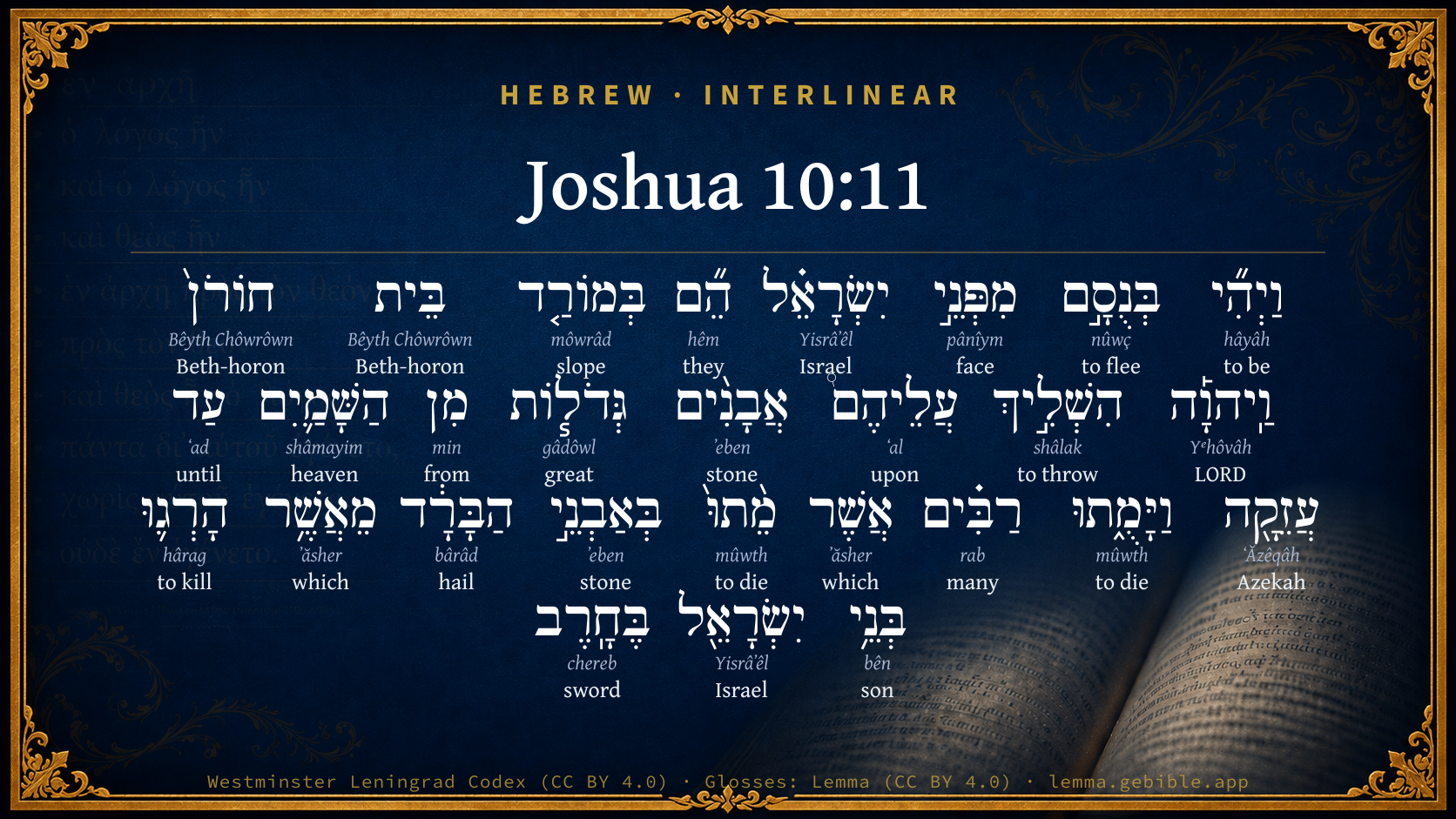
Hebrew (Westminster Leningrad Codex) Joshua 10:11 appears in the Hebrew Old Testament. The text above is from the Westminster Leningrad Codex. Each word links to its Strong’s number, a concise gloss, and parsing drawn from the Open Scriptures Hebrew Bible morphology. Click any word for its full Brown-Driver-Briggs (BDB) entry.
Download image
Cite this verse

Joshua 10:11 (World English Bible). Public Domain. Lemma interlinear Bible study tool, https://lemma.gebible.app/v/joshua/10/11.

Show BibTeX & RIS
BibTeX
RIS
English Translation
It happened, as they fled from before Israel, while they were at the descent of Beth Horon, that Yahweh cast down great stones from the sky on them to Azekah, and they died: they were more who died with the hailstones than they whom the children of Israel killed with the sword.
World English Bible · Public Domain
Download a study sheet

One document with this verse’s original text, its word-by-word gloss line, the meaning frame, cross-references with their text, attributed commentary, and full source and license credits — printable, and it pastes into notes with its structure intact.

This verse Autodidact and up

Study sheet (.html) Plain text (.txt)

A passage Seminary Student

Up to 50 verses in one chapter. A passage sheet keeps up to 6 commentary sources and 12 cross-references per verse, in the order this page ranks them, and says so on the sheet whenever that leaves anything out. Ask for a single verse and you get the Autodidact verse sheet above.

Everything on this page stays free to read, with no account — the sheet is a download of what is already on screen, not access to it.

Want to remove ads? Support Godless Engineer
Compare translations 3

The same verse in 3 English versions, stacked beneath the original-language interlinear above. Click any original word for its lexicon entry.

Each is an independent rendering of the whole verse — the interlinear is not word-aligned to these translations.

Highlighted words mark where these versions differ — a whole-verse word diff, not a word-by-word alignment.

  • World English Bible Public Domain
    It happened, as they fled from before Israel, while they were at the descent of Beth Horon, that Yahweh cast down great stones from the sky on them to Azekah, and they died: they were more who died with the hailstones than they whom the children of Israel killed with the sword.
  • King James Version Public Domain
    And it came to pass, as they fled from before Israel, and were in the going down to Bethhoron, that the LORD cast down great stones from heaven upon them unto Azekah, and they died: they were more which died with hailstones than they whom the children of Israel slew with the sword.
  • unfoldingWord Literal Text CC BY-SA 4.0
    And it happened, in their fleeing from the face of Israel, they on the descent of Beth Horon, that Yahweh threw on them great stones from the heavens unto Azekah, and they died. more who died by the stones of the hail than those whom the sons of Israel killed with the sword.

unfoldingWord Literal Text — © unfoldingWord, licensed CC BY-SA 4.0. Word-aligned USFM3 via Door43 (git.door43.org/unfoldingWord/en_ult).

Versions to compare (up to 4)

3 of 4 selected

Show all 18 translations

Every available English version of this verse, each an independent rendering of the whole verse.

  • World English Bible Public Domain
    It happened, as they fled from before Israel, while they were at the descent of Beth Horon, that Yahweh cast down great stones from the sky on them to Azekah, and they died: they were more who died with the hailstones than they whom the children of Israel killed with the sword.
  • Berean Standard Bible Public Domain
    As they fled before Israel along the descent from Beth-horon to Azekah, the LORD cast down on them large hailstones from the sky, and more of them were killed by the hailstones than by the swords of the Israelites.
  • Majority Standard Bible Public Domain
    As they fled before Israel along the descent from Beth-horon to Azekah, the LORD cast down on them large hailstones from the sky, and more of them were killed by the hailstones than by the swords of the Israelites.
  • King James Version Public Domain
    And it came to pass, as they fled from before Israel, and were in the going down to Bethhoron, that the LORD cast down great stones from heaven upon them unto Azekah, and they died: they were more which died with hailstones than they whom the children of Israel slew with the sword.
  • American Standard Version (1901) Public Domain
    And it came to pass, as they fled from before Israel, while they were at the descent of Beth-horon, that Jehovah cast down great stones from heaven upon them unto Azekah, and they died: they were more who died with the hailstones than they whom the children of Israel slew with the sword.
  • Revised Version (1885) Public Domain
    And it came to pass, as they fled from before Israel, while they were in the going down of Beth-horon, that the LORD cast down great stones from heaven upon them unto Azekah, and they died: they were more which died with the hailstones than they whom the children of Israel slew with the sword.
  • Geneva Bible (1599) Public Domain
    And as they fled from before Israel, and were in the going downe to Beth-horon, the Lord cast downe great stones from heauen vpon them, vntill Azekah, and they dyed: they were more that dyed with the hailestones, then they whom the children of Israel slewe with the sword.
  • Douay-Rheims (1899) Public Domain
    And when they were fleeing from the children of Israel, and were in the descent of Beth-horon, the Lord cast down upon them great stones from heaven as far as Azeca: and many more were killed with the hailstones than were slain by the swords of the children of Israel.
  • Young's Literal Translation Public Domain
    And it cometh to pass, in their fleeing from the face of Israel -- they `are' in the descent of Beth-Horon -- and Jehovah hath cast upon them great stones out of the heavens, unto Azekah, and they die; more are they who have died by the hailstones than they whom the sons of Israel have slain by the sword.
  • Literal Standard Version CC BY-SA 4.0
    And it comes to pass, in their fleeing from the face of Israel—they [are] in the descent of Beth-Horon—and YHWH has cast great stones on them out of the heavens, to Azekah, and they die; more are they who have died by the hailstones than they whom the sons of Israel have slain by the sword.
  • Unlocked Literal Bible CC BY-SA 4.0
    As they ran away from Israel, down the hill from Beth Horon, Yahweh threw large stones down from heaven upon them all the way to Azekah, and they died. There were more who died because of the hailstones than who were killed with the sword by the men of Israel.
  • unfoldingWord Literal Text CC BY-SA 4.0
    And it happened, in their fleeing from the face of Israel, they on the descent of Beth Horon, that Yahweh threw on them great stones from the heavens unto Azekah, and they died. more who died by the stones of the hail than those whom the sons of Israel killed with the sword.
  • Darby Bible Public Domain
    And it came to pass, as they fled from before Israel, -- they were at the descent of Beth-horon, -- that Jehovah cast down great stones from heaven upon them up to Azekah, and they died. They were more who died with the hailstones than they whom the children of Israel had slain with the sword.
  • World Messianic Bible Public Domain
    As they fled from before Israel, while they were at the descent of Beth Horon, the LORD hurled down great stones from the sky on them to Azekah, and they died. There were more who died from the hailstones than those whom the children of Israel killed with the sword.
  • Webster's Bible Public Domain
    And it came to pass as they fled from before Israel, and were in the descent to Beth-horon, that the LORD cast down great stones from heaven upon them to Azekah, and they died: they were more who died with hailstones than they whom the children of Israel slew with the sword.
  • Free Bible Version CC BY-SA 4.0
    As they ran away from the Israelites down the slope from Beth-horon, the Lord hurled large hailstones down on them from the skies all the way to Azekah. More were killed by the hailstones than were killed by the swords of the Israelites.
  • Bible in Basic English Public Domain
    And in their flight before Israel, on the way down from Beth-horon, the Lord sent down great stones from heaven on them all the way to Azekah, causing their death: those whose death was caused by the stones were more than those whom the children of Israel put to death with the sword.
  • JPS Tanakh (1917) Public Domain
    And it came to pass, as they fled from before Israel, while they were at the descent of Beth-horon, that the LORD cast down great stones from heaven upon them unto Azekah, and they died; they were more who died with the hailstones than they whom the children of Israel slew with the sword.

Literal Standard Version (2020), Covenant Press — licensed CC BY-SA 4.0. Text via the HelloAO Bible API (eBible.org). Unlocked Literal Bible (unfoldingWord) — licensed CC BY-SA 4.0. Text via the HelloAO Bible API (eBible.org). unfoldingWord Literal Text — © unfoldingWord, licensed CC BY-SA 4.0. Word-aligned USFM3 via Door43 (git.door43.org/unfoldingWord/en_ult). Free Bible Version, Dr. Jonathan Gallagher — licensed CC BY-SA 4.0. Text via the HelloAO Bible API (eBible.org).

Word by word

More ways to search: Search by grammar → Find every occurrence → Compare this word →

Practice this passage: Drill this verse → Learn its vocabulary →

בְּמוֹרַ֤ד
môwrâd
H4174
“in/at · slope of”
Preposition + Noun, Common, Masculine, Singular, Construct
Part of Speech
Preposition + Noun
Type
Common
Gender
Masculine
Number
Singular
State
Construct
Full BDB Definition

Origin: from H3381

TWOT: 909a

descent, slope, steep place, hanging work, bevelled work - descent - hanging work
  1. וַיְהִ֞י hâyâh H1961 “and · to be” Conjunction + Verb, Qal, Sequential Imperfect, 3rd Person, Masculine, Singular
  2. בְּנֻסָ֣ם nûwç H5127 “in/at · to flee · them” Preposition + Verb, Qal, Infinitive Construct + Suffix, Personal, 3rd Person, Masculine, Plural
  3. מִפְּנֵ֣י pânîym H6440 “from · face(s) of” Preposition + Noun, Common, Both, Plural, Construct
  4. יִשְׂרָאֵ֗ל Yisrâʼêl H3478 “Israel” Noun, Proper
  5. הֵ֞ם hêm H1992 “they” Pronoun, Personal, 3rd Person, Masculine, Plural
  6. בֵּית Bêyth Chôwrôwn H1032 “Beth-horon” Noun, Proper
  7. חוֹרֹן֙ Bêyth Chôwrôwn H1032 “Beth-horon” Noun, Proper
  8. וַֽיהוָ֡ה Yᵉhôvâh H3068 “and · LORD” Conjunction + Noun, Proper
  9. הִשְׁלִ֣יךְ shâlak H7993 “to throw” Verb, Hiphil, Perfect, 3rd Person, Masculine, Singular
  10. עֲלֵיהֶם֩ ʻal H5921 “upon · them” Preposition + Suffix, Personal, 3rd Person, Masculine, Plural
  11. אֲבָנִ֨ים ʼeben H68 “stones” Noun, Common, Feminine, Plural, Absolute
  12. גְּדֹל֧וֹת gâdôwl H1419 “great” Adjective, Adjective, Feminine, Plural, Absolute
  13. מִן min H4480 “from” Preposition
  14. הַשָּׁמַ֛יִם shâmayim H8064 “the · heaven(s)” Particle, Definite Article + Noun, Common, Masculine, Plural, Absolute
  15. עַד ʻad H5704 “until” Preposition
  16. עֲזֵקָ֖ה ʻĂzêqâh H5825 “Azekah” Noun, Proper
  17. וַיָּמֻ֑תוּ mûwth H4191 “and · to die” Conjunction + Verb, Qal, Sequential Imperfect, 3rd Person, Masculine, Plural
  18. רַבִּ֗ים rab H7227 “many” Adjective, Adjective, Masculine, Plural, Absolute
  19. אֲשֶׁר ʼăsher H834 “which” Particle, Relative
  20. מֵ֨תוּ֙ mûwth H4191 “to die” Verb, Qal, Perfect, 3rd Person, Common, Plural
  21. בְּאַבְנֵ֣י ʼeben H68 “in/at · stones of” Preposition + Noun, Common, Feminine, Plural, Construct
  22. הַבָּרָ֔ד bârâd H1259 “the · hail” Particle, Definite Article + Noun, Common, Masculine, Singular, Absolute
  23. מֵאֲשֶׁ֥ר ʼăsher H834 “from · which” Preposition + Particle, Relative
  24. הָרְג֛וּ hârag H2026 “to kill” Verb, Qal, Perfect, 3rd Person, Common, Plural
  25. בְּנֵ֥י bên H1121 “sons of” Noun, Common, Masculine, Plural, Construct
  26. יִשְׂרָאֵ֖ל Yisrâʼêl H3478 “Israel” Noun, Proper
  27. בֶּחָֽרֶב chereb H2719 “in/at the · sword” Preposition, Determined + Noun, Common, Feminine, Singular, Absolute

About this verse

These counts appear in no published source. They are computed here, from the morphology-tagged text and Lemma’s own curated glosses. What Lemma adds →

28
words
23
distinct lemmas
Historical
section

Notable vocabulary

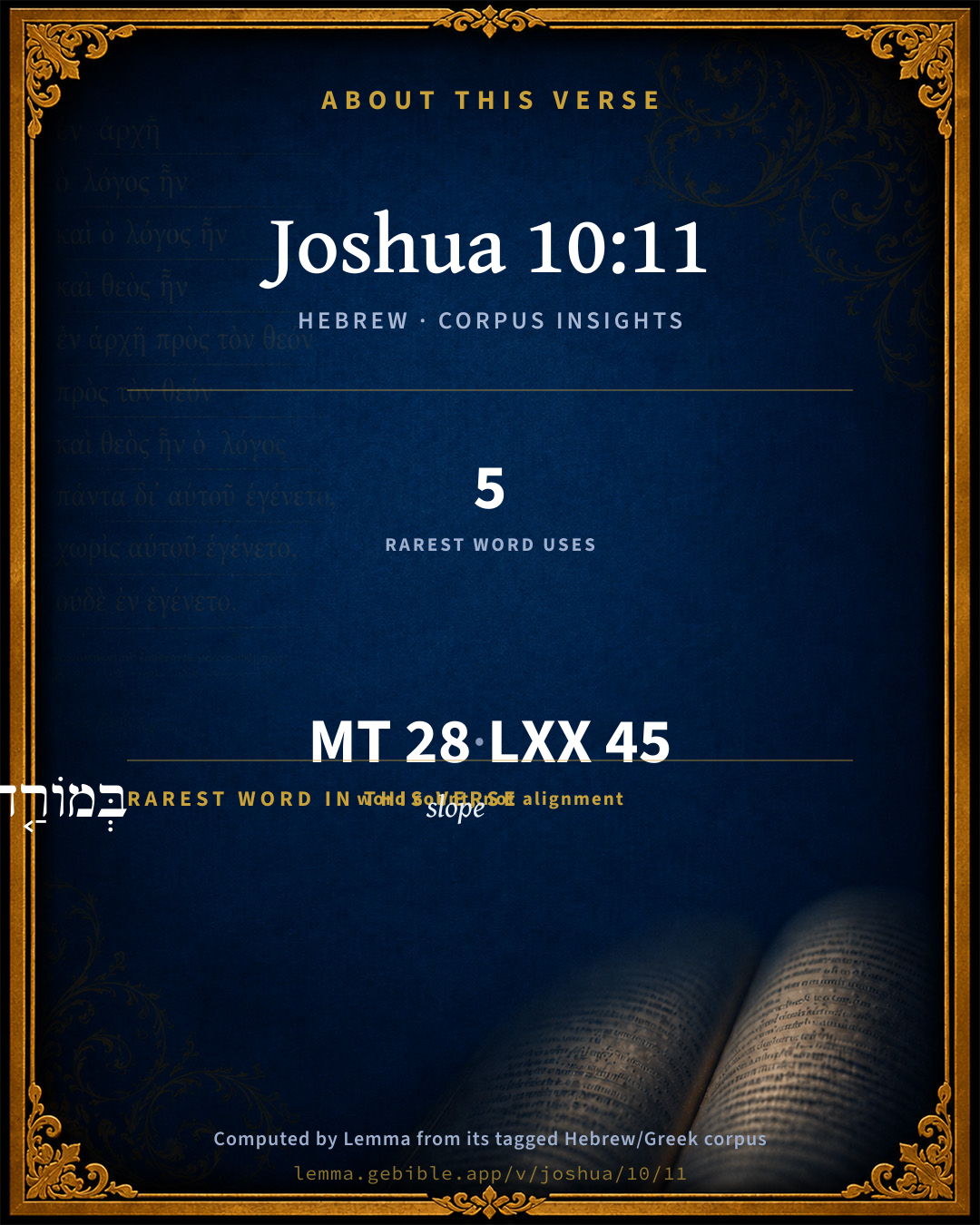
The rarest word here is בְּמוֹרַ֤ד slope H4174 — appearing just 5 times in the whole Hebrew Bible.

Shared distinctive vocabulary

בְּמוֹרַ֤ד slope H4174 occurs in 5 verses of the Hebrew Bible. Also found in:

Grammatical profile

  • 6 verbs
  • 14 nouns
  • 2 adjectives
  • 1 pronoun
  • 3 prepositions
  • 2 particles

Verb forms

  • וַיְהִ֞י Qal · Sequential Imperfect
  • בְּנֻסָ֣ם Qal · Infinitive Construct
  • הִשְׁלִ֣יךְ Hiphil · Perfect
  • וַיָּמֻ֑תוּ Qal · Sequential Imperfect
  • מֵ֨תוּ֙ Qal · Perfect
  • הָרְג֛וּ Qal · Perfect

Repetition

Words recur within this verse — often emphatic in Hebrew:

  • יִשְׂרָאֵ֗ל Israel H3478 ×2
  • בֵּית Beth-horon H1032 ×2
  • אֲבָנִ֨ים stone H68 ×2
  • וַיָּמֻ֑תוּ to die H4191 ×2
  • אֲשֶׁר which H834 ×2

Hebrew & Septuagint length

In English translation the verse runs 52 words from the Hebrew and 51 from the Septuagint (LXX English) — closely comparable.

A rough comparison of the two English renderings, which tokenize alike — not a word-level alignment.

Word counts can differ between the Hebrew and the Greek without any difference in meaning — e.g. the Hebrew direct-object marker אֵת has no separate Greek word, and Greek often adds the article ὁ.

In the original languages it is 28 Hebrew tokens and 45 Greek tokens — but the two are counted differently (Hebrew bundles its prefixes and suffixes into one token; the Greek is in lemma form), so that isn’t a like-for-like length.

Cross-references

11

Topical passages linked to Joshua 10:11 in the Treasury of Scripture Knowledge — connected by theme and wording, ordered by reader-vote popularity; previews shown in the World English Bible.

  • Isaiah 28:2 Behold, the Lord has a mighty and strong one; as a tempest of hail, a destroying storm, as a tempest of mighty waters overflowing, will he cast down to the earth with the hand.
  • Exodus 9:22–26 Yahweh said to Moses, "Stretch forth your hand toward the sky, that there may be hail in all the land of Egypt, on man, and on animal, and on every herb of the field, throughout the land of Egypt."
  • Judges 5:20 From the sky the stars fought, From their courses they fought against Sisera.
  • Psalms 18:12–14 At the brightness before him his thick clouds passed, Hailstones and coals of fire.
  • Genesis 19:24 Then Yahweh rained on Sodom and on Gomorrah sulfur and fire from Yahweh out of the sky.
  • Psalms 11:6 On the wicked he will rain blazing coals; Fire, sulfur, and scorching wind shall be the portion of their cup.
  • Psalms 77:17–18 The clouds poured out water. The skies resounded with thunder. Your arrows also flashed around.
  • Isaiah 30:30 Yahweh will cause his glorious voice to be heard, and will show the lighting down of his arm, with the indignation of [his] anger, and the flame of a devouring fire, with a blast, and tempest, and hailstones.
  • Ezekiel 13:11 tell those who daub it with whitewash, that it shall fall: there shall be an overflowing shower; and you, great hailstones, shall fall; and a stormy wind shall tear it.
  • Revelation 11:19 God's temple that is in heaven was opened, and the ark of the Lord's covenant was seen in his temple. Lightnings, sounds, thunders, an earthquake, and great hail followed.
  • Revelation 16:21 Great hailstones, about the weight of a talent, came down out of the sky on people. People blasphemed God because of the plague of the hail, for this plague is exceedingly severe.

Cross-references courtesy of OpenBible.info (CC BY 4.0).

Hebrew and Greek witnesses Masoretic Hebrew ↔ Greek Septuagint

The same verse in the two great witnesses to the Old Testament, shown verse-for-verse.

These are two independent witnesses, not word-aligned to each other, and the Septuagint is shown in lemma (dictionary) form.

Hebrew Joshua 10:11 Masoretic · Westminster Leningrad Codex

וַיְהִ֞י בְּנֻסָ֣ם מִפְּנֵ֣י יִשְׂרָאֵ֗ל הֵ֞ם בְּמוֹרַ֤ד בֵּית חוֹרֹן֙ וַֽיהוָ֡ה הִשְׁלִ֣יךְ עֲלֵיהֶם֩ אֲבָנִ֨ים גְּדֹל֧וֹת מִן הַשָּׁמַ֛יִם עַד עֲזֵקָ֖ה וַיָּמֻ֑תוּ רַבִּ֗ים אֲשֶׁר מֵ֨תוּ֙ בְּאַבְנֵ֣י הַבָּרָ֔ד מֵאֲשֶׁ֥ר הָרְג֛וּ בְּנֵ֥י יִשְׂרָאֵ֖ל בֶּחָֽרֶב

It happened, as they fled from before Israel, while they were at the descent of Beth Horon, that Yahweh cast down great stones from the sky on them to Azekah, and they died: they were more who died with the hailstones than they whom the children of Israel killed with the sword.

World English Bible · Public Domain

Greek LXX Joshua 10:11 Septuagint · lemma form

ἐν ὁ δέ φεύγω αὐτός ἀπό πρόσωπον ὁ υἱός ἰσραήλ ἐπί ὁ κατάβασις ωρωνιν καί κύριος ἐπιῥίπτω αὐτός λίθος χάλαζα ἐκ ὁ οὐρανός ἕως αζηκα καί γίγνομαι πολύς ὁ ἀποθνήσκω διά ὁ λίθος ὁ χάλαζα ἤ ὅς ἀποκτείνω ὁ υἱός ἰσραήλ μάχαιρα ἐν ὁ πόλεμος

And when they fled from the face of the children of Israel at the descent of Oronin, then the Lord cast upon them hailstones from heaven to Azeca; and they were more that died by the hailstones, than those whom the children of Israel killed with the sword in the battle.

LXX2012 (modern English Septuagint) · Public Domain

On this verse, John Gill's Exposition discusses the Septuagint’s reading. Read the note in Commentary ↓

Hebrew: Westminster Leningrad Codex (CC BY 4.0). Greek: Septuagint (public domain); English from LXX2012 (modern English Septuagint) (Public Domain). How the Septuagint differs from the Hebrew →

Targum (Aramaic paraphrase)

1

The Targum is the ancient Jewish Aramaic paraphrase of the Hebrew Scriptures — an interpretive translation, not the Hebrew text itself. Onkelos (literal) and Pseudo-Jonathan (expansive) render the Torah, and Jonathan the Prophets. Coverage is partial: where no permissively-licensed English translation exists for a verse, only the Aramaic is shown. This is verse-level text, not a word-by-word alignment to the Hebrew.

  1. Targum Jonathan Prophets (Joshua–Malachi)
    וַהֲוָה בְּמִפְּכֵיהוֹן מִן קֳדָם יִשְׂרָאֵל אִינוּן בְּמַחְתָנָא דְבֵית חוֹרוֹן וּמִן קֳדָם יְיָ אִתְרְמִיאָה עֲלֵיהוֹן אַבְנִין רַבְרְבָן מִן שְׁמַיָא עַד דַאֲתוֹ לַעֲזֵקָה וּמִיתוּ סַגִיאִין דְמִיתוּ בְּאַבְנֵי בַרְדָא מִדְקַטוּלוּ בְּנֵי יִשְׂרָאֵל בְּחַרְבָּא:

    (no public-domain English translation for this verse)

    Targum Jonathan — Aramaic: “Mikraot Gedolot” (public domain). English: “Sefaria Community Translation” (CC0 1.0 (public-domain dedication)); “London "Chaldee Paraphrase," 1871” (public domain). Text via Sefaria.

Commentary

Notes on Joshua 10:11 from classic Christian and Jewish commentators (each source and its license shown beneath its notes). The classic Christian expositions comment on the surrounding passage and are grouped to its opening verse, so a note may address several verses; the Jewish commentaries on the Tanakh (Rashi and others) are per-verse, so they appear only where the commentator wrote on this verse.

Lemma curates 59 commentaries, every one of them public domain or Creative Commons licensed, each selected and text-cleaned for this edition rather than reprinted as found. About our sources →

Trapp's Complete Commentary

John Trapp

Jos 10:11 And it came to pass, as they fled from before Israel, [and] were in the going down to Bethhoron, that the LORD cast down great stones from heaven upon them unto Azekah, and they died: [they were] more which died with hailstones than [they] whom the children of Israel slew with the sword.

Ver. 11. The Lord cast down great stones from heaven.] Huge hailstones that brained the Canaanites, but hurt not the Israelites, that were at the heels of them. See the like in mystery, {Rev 16:21} and perhaps it shall be fulfilled upon the antichristian rabble according to the letter.

John Trapp, A Commentary or Exposition upon All the Books of the Old and New Testament (1647–1656) — public domain. Text from a community e-Sword module.

Joseph Benson's Commentary

Jos 10:11. The Lord cast down great stones — That is, hail-stones of an extraordinary greatness, cast down with that certainty as to hit the Canaanites, and not their pursuers the Israelites. Josephus affirms that thunder and lightning were mixed with the hail, which may seem probable from Hab 3:11. They had robbed the true God of his honour, by worshipping the host of heaven, and now the host of heaven fights against them, and triumphs in their ruin. Beth-horon lay north of Gibeon, Azekah and Makkedah south, so that they fled each way. But which way soever they fled, the hailstones pursued them. There is no fleeing out of the hands of God!

Joseph Benson's Commentary on the Old and New Testaments (1811–1818) — public domain. Text from a community e-Sword module.

Geneva Bible (1599)

Geneva Bible translators

So we see that all things serve to execute God’s vengeance against the wicked.

Geneva Bible (1599) marginal notes — public domain. Text via Bolls.life.

Adam Clarke's Commentary

Verse 11. The Lord cast down great stones from heaven upon them] Some have contended that stones, in the common acceptation of the word, are intended here; and that the term hail-stones is only used to point out the celerity of their fall, and their quantity. That stones have fallen from the clouds, if not from a greater height, is a most incontestable fact. That these have fallen in different parts of the world is also true; the East Indies, America, France, Germany, England, Ireland, c., have all witnessed this phenomenon: of such stones I possess and have seen several fragments some considerable pieces may be seen in the British Museum. That God might have cast down such stones as these on the Canaanites, there can be no doubt, because his power is unlimited; and the whole account proves that here there was a miraculous interference. But it is more likely that hail-stones, in the proper sense of the word, are meant as well as expressed in the text. That God on other occasions has made use of hail-stones to destroy both men and cattle, we have ample proof in the plague of hail that fell on the Egyptians. See Clarke on Ex 9:18. There is now before me a square of glass, taken out of a south window in the house of Mr. Ball of Crockerton, in the parish of Longbridge Deverell, county of Wilts., through which a hail-stone passed in a shower that fell there June 1, 1780, at two o'clock, P.M. The hole is an obtuse ellipsis or oval, and is cut as true as if it had been done with a diamond: it is three inches and a half in diameter; a proof that the stone that pierced it, which was about eleven inches in circumference, came with inconceivable velocity, else the glass must have been shivered to pieces. I have known a cannon ball go through a square of glass in the cabin window of a ship, and make precisely the same kind of hole, without either shattering or even starring the glass. It is needless to add that this hail-shower did great damage, breaking even trees in pieces, and destroying the vegetation through the whole of its extent. But allowing that extraordinary showers of hail have fallen in England or France, is it likely that such showers ever fell in the promised land or its vicinity? They certainly have. Albertus Aquensis, one of the writers in the collection Gesta Dei per Francos, in describing the expedition of Baldwin I. in the Holy Land, observes that, when he and his army were in the Arabian mountains, in the vicinity of the Dead Sea, they suffered incredibly from horrible hail, terrible frost, and indescribable rain and snow, so that thirty of his men perished by them. His words are: "Sexta vero die montanis permensis, in extremo illorum cacumine maxima pertulerunt pericula, in GRANDINE horribili, in GLACIE terribili, in PLUVIA et NIVE inaudita, quorum immanitate, et horrore ingruente ad triginta homines pedites prae frigore mortui sunt." - Hist. Hieros., p. 307. I conclude, therefore, that a shower of hail-stones may be meant; and that this shower, though natural in itself, was supernaturally employed on this occasion, and miraculously directed to fall where it did, and do the execution described.

But I am ready to grant, notwithstanding, that as a most stupendous miracle was in this instance wrought, in causing the sun and moon to stand still; there can be no doubt that the shower of stones, which was also miraculous, might have been of real stones as well as hail-stones. Of late, this subject of the fall of real stones from the clouds has been very closely investigated, and not only the possibility of the fall of such stones from the clouds, or from much higher regions, but the certainty of the case has been fully demonstrated. These substances are now, in philosophical language denominated aeroliths or air-stones; and the following table constructed by M. Izarn, a foreign chemist, exhibits a variety of facts of this kind, and shows the places and times in which these substances fell, and the testimony by which these facts are supported. As it is as possible that God might have projected a shower of stones on these idolaters, even from the moon, as to arrest that planet in her course, I give the table, and leave the reader to decide, in the present case, for aeroliths or hail-stones, as may seem to him most congruous to the fact here related.

Historical Record of Large Hail Stones

SUBSTANCES

PLACES WHERE THEY FELL

1

Shower of stones

At Rome.

2

Shower of stones

At Rome.

3

A very large stone

Near the river Negos, Thrace.

4

Three large stones

In Thrace.

5

Stone of 72 lbs

Near Larissa, Macedonia.

6

About 1,200 stones; one 120 lbs

Near Padua in Italy.

7

Another of 60 lbs

8

Another of 59 lbs

On Mount Vasier, Provence.

9

Two large stones weighing 20 lbs

Liponas, in Bresse.

10

A stony mass

Niort, Normandy.

11

A stone of 7 ½ lbs

At Lure, in Le Maine.

12

A stone

At Aire, in Artois.

13

A stone

In Le Cotentin.

14

Extensive shower of stones

Environs of Agen.

15

About 12 stones

Sienna Tuscany.

16

A large stone of 56 lbs

Wold Cottage, Yorkshire.

17

A stone of 10 lbs

In Portugal.

18

A stone of about 120 lbs

Sale department of the Rhone

19

Shower of stones

Benares, East Indies.

20

Shower of stones

At Plann, near Tabor, Bohemia

21

Mass of iron, 70 cubic feet

America.

22

Mass of ditto, 14 quintals

Abakauk, Siberia.

23

Shower of stones

Barboutan, near Roquefort

24

Large stone, 260 lbs

Ensisheim, Upper Rhine.

25

Two stones, 200 and 300 lbs

Near Verona.

26

A stone of 20 lbs

Sales, near Ville Franche.

27

Several ditto from 10 to 17 lbs

Near L'Aigle, Normandy.

PERIOD OF THEIR FALL

TESTIMONY

1

Under Tullus Hostilius

Livy.

2

Consuls, C. Martius and M. Torquatus

J. Obsequens.

3

Second year of the 78th Olympiad

Pliny.

4

Year before J.C., 452

Ch. of Count Marcellin.

5

January, 1706

Paul Lucas.

6,7

In 1510

Carden, Varcit.

8

November 27, 1627

Gassendi.

9

September, 1753

De La Lande.

10

In 1750

De La Lande.

11

September 13, 1768

Bachelay.

12

In 1768

Gurson de Boyaval.

13

In 1768

Morand.

14

July 24, 1790

St. Amand, Baudin, c.

15

July, 1794

Earl of Bristol.

16

December 13, 1795

Captain Topham.

17

February 19, 1796

Southey.

18

March 17, 1798

Le Lievre and De Dree.

19

December 19, 1798

J. Lloyd Williams, Esq.

20

July 3, 1753

B. de Born.

21

April 5, 1800

Philosophical Magazine.

22

Very old

Pallas, Chladni, c.

23

July, 1789

Darcet, jun., Lomet, &c

24

November 7, 1492

Butenschoen.

25

In 1762

Acad. de Bourd.

26

March 12, 1798

De Dree.

27

April 26, 1803

Fourcroy.

These stones generally appear luminous in their descent, moving in oblique directions with very great velocities, and commonly with a hissing noise. They are frequently heard to explode or burst, and seem to fly in pieces, the larger parts falling first. They often strike the earth with such force as to sink several inches below the surface. They are always different from the surrounding bodies, but in every case are similar to one another, being semi-metallic, coated with a thin black incrustation. They bear strong marks of recent fusion. Chemists have found on examining these stones that they very nearly agree in their nature and composition, and in the proportions of their component parts. The stone which fell at Ensisheim in Alsace, in 1492, and those which fell at L'Aigle in France, in 1803, yielded, by the Analysis of Fourcroy and Vanquelin, as in this table: -

Ensisheim stone fell

A.D. 1492

L'Aigle stone fell

A.D. 1803

56 0

54

of silica

30 0

36

-oxyd of iron

12 0

9

-magnesia

2 4

3

-oxyd of nickel

3 5

2

-sulphur

1 4

1

-lime

105 3

105

Their specific gravities are generally about three of four times that of water, being heavier than common stones. From the above account it is reasonable to conclude that they have all the same origin. To account for this phenomenon, various hypotheses have appeared we shall mention three:

1. That they are little planets, which, circulating in space, fall into the atmosphere, which, by its friction, diminishes the velocity, so that they fall by their weight.

2. That they are concretions formed in the atmosphere.

3. That they are projected from lunar volcanoes. These are the most probable conjectures we can meet with, and of these the two former possess a very small degree of probability, but there are very strong reasons in favour of the last. Among the reasons we may notice the following:

1. Volcanoes in the moon have been observed by means of the telescope.

2. The lunar volcanoes are very high, and the surface of that globe suffers frequent changes, as appears by the late observations of Schroeter.

3. If a body be projected from the moon to a distance greater than that of the point of equilibrium between the attraction of the earth and moon, it will, on the known principle of gravitation, fall to the earth.

4. That a body may be projected from the lunar volcanoes beyond the moon's influence, is not only possible but very probable for on calculation it is found that four times the force usually given to a twelve pounder, will be quite sufficient for this purpose; it is to be observed that the point of equilibrium is much nearer the moon, and that a projectile from the moon will not be so much retarded as one from the earth, both on account of the moon's rarer atmosphere, and its less attractive force. On this subject, see Mr. Haward's valuable paper in the Philosophical Transactions for 1802, and Dr. Hutton's dissertation in the new abridgment, part xxi. It is highly probable that the ancile, or sacred shield, that fell from heaven in the reign of Numa Pompilius, was a stone of this sort. The description of its fall, as given by Ovid, Fast. lib. iii., bears a striking resemblance to recent accounts of stones falling from the atmosphere, particularly in the luminous appearance and hissing noise with which it was accompanied.

Dum loquitur, totum jam sol emerserat orbem,

Et gravis aethereo venit ab axe fragor.

Ter tonuit sine nube Deus, tria fulgura misit:

Credite dicenti; mira, sed acta, loquor.

A media coelum regione dehiscere coepit:

Summisere oculos cum duce turba suos.

Ecce levi scutum versatum leniter aura

Decidit, a pupulo clamor ad astra venit.

Tolit humo munus ________________________

Idque ancile vocat, quod ab omni parte recisum est.

It is very possible that the Palladium of Troy, and the Image of the Ephesian Diana, were stones which really fell from the atmosphere, bearing some rude resemblance to the human form. See the IMPERIAL ENCYCLOPAEDIA, article Aerolith.

I believe it is generally agreed among philosophers,

1. That all these aerial stones, chemically analyzed, show the same properties;

2. That no stone found on our earth possesses exactly the same properties, nor in the same proportions. This is an extraordinary circumstance, and deserves particular notice.

Adam Clarke's Commentary on the Bible (1810–1826) — public domain. Text from a community e-Sword/MySword module.

The Cambridge Bible for Schools and Colleges

gen. ed. J. J. S. Perowne

11. were in the going down to Beth-horon] This was the second stage in the flight. The Amorite host had gained the height before their pursuers, and were hurrying down the pass of nether Beth-horon, “a rough, rocky road, sometimes over the upturned edges of the limestone strata, sometimes over sheets of smooth rock, sometimes over loose rectangular stones, sometimes over steps cut in the rock” (Stanley’s Lectures, 1:242), when

the Lord cast down great stones from heaven upon them] As afterwards in the great fight of Barak against Sisera (Jdg_5:20), one of the fearful tempests, which from time to time sweep over the hills of Palestine, burst upon the disordered army, and hailstones of enormous size fell upon their shattered ranks.

they were moe which died with hailstones] Some have explained these as meteoric stones, but it was rather a fearful storm, “thunder, lightning, and a deluge of hail,” Jos. Ant. 5:1. 17. “By a very similar mischance the Austrians were overtaken in 1859 at the battle of Solferino.” Even ordinary hailstones in Syria are often of enormous size. “I have seen some that measured two inches in diameter; but sometimes irregularly shaped pieces are found among them weighing alone twenty drams.” Russell’s Natural History of Aleppo, 1:76. “During a storm at Constantinople in 1831, many of the hailstones, or rather masses of ice, weighed from half a pound to above a pound. Under this tremendous fall, the roofs of houses were beaten in, trees were stripped of their leaves and branches, many persons who could not soon enough find shelter were killed, animals were slain, and limbs were broken. In fact, none who know the tremendous power which the hailstones of the East sometimes exhibit, will question, as some have questioned, the possibility that any hail could produce the effect described.” Kitto’s Bible Illustrations, II. p. 293.

they were moe] “and ben deed man ye mo with stonus of haiul, than whom with swerd had smyten the sons of Yrael,” Wyclif. In the edition of 1611, “moe” is the comparative of “many,” and is altered to “more” in the later editions. Compare

“For elles hadde I dweld with Theseus

I-fetered in his prisoun for ever moo.”

Chaucer, Knight’s Tale, 1231.

Bru. “Is he alone?

Lu. No, sir, there are moe with him.”

Shakespeare, Jul. Cœs. 2:1. 71.

The Cambridge Bible for Schools and Colleges (gen. ed. J. J. S. Perowne; Cambridge University Press, 1878–1918) — public domain. Text from a community e-Sword module.

John Gill's Exposition

And it came to pass, as they fled before Israel, and were in the going down to Bethhoron,.... The descent of it on that side towards Azekah, and which was also a very narrow passage, of which Josephus (s) makes mention. The Jews say (t), that the going down of Bethhoron was the place where the army of Sennacherib fell:

that the Lord cast down great stones from heaven upon them unto Azekah, and they died; the Septuagint version calls them hailstones; and so they are called in the next clause; and that such sometimes have fallen as to kill men and cattle, is certain from the plague of hail in Egypt, Exo 9:19; and some in very late times (u) have been known to fall, which were from eight, nine, and twelve inches about, some bigger than the eggs of turkeys, and some half a pound weight; see Gill on Rev 16:21; but these seem to be proper stones, such as did not melt away as hailstones do; though so called, because they fell from heaven, as they do, but remained, and still remain, according to the notion the Jews have of them; for they say (w) whoever sees these great stones, in the going down to Bethhoron, is bound to bless; and frequent mention is made by historians of showers of stones being rained. Livy (x) speaks of such a shower when King Tullus conquered the Sabines; and of another (y), when Scipio succeeded at Carthage; and Pomponius Mela (z) relates, that when Hercules fought with the sons of Neptune, and darts failed him, he obtained of Jupiter to rains shower of stones, which lay spread in great abundance; and some (a) think it refers to this fact in Joshua's time, who is supposed to be the same with the Tyrian Hercules (b), from hence also called Saxanus (c); and in memory of this there are stony camps in various places, called by his name (d):

they were more which died with hailstones than they whom the children of Israel slew with the sword; but what was the number of each of them is not said; it was doubtless very great, since there was an utter destruction and consumption of them, Jos 10:20.

(s) De Bello Jud. l. 2. c. 19. sect. 7, 8. (t) Gloss. in T. Bab. Beracot, fol. 54. 2. (u) Vid. Louthorp. Abridg. Philosoph. vol. 2. p. 144, 146. (w) T. Bab. Betacot, fol. 54. 1. (x) L. 1. p. 17. (y) L. 30. c. 30. (z) De Orbis Situ, l. 2. c. 5. (a) Vossius de Origin. Idol. c. 1. sect. 16. (b) See Gale's Court of the Gentiles, l. 2. c. 5. (c) Dickins. Delph. Phoenic. c. 4. p. 42. (d) Sanford de Descens. Christi, l. 1. sect. 20. p. 35.

John Gill's Exposition of the Whole Bible (1746–1763) — public domain (CC PDM 1.0). Text via the HelloAO Bible API.

Albert Barnes' Notes on the Bible

Compare Ecclesiasticus 46:6. Frightful storms occasionally sweep over the hills of Judaea; but this was evidently a miraculous occurrence, like the hail which smote Egypt Exo 9:24 and the tempest which fell on the Philistines at Ebenezer 1Sa 7:10.

Albert Barnes' Notes on the Bible (1834–1885) — public domain. Text from a community e-Sword/MySword module.

Haydock's Catholic Bible Commentary

Azeca, for the space of twelve miles. --- Hailstones, of an uncommon size, accompanied with thunder and lightning, Habacuc iii. 11. (Josephus, [Antiquities?] v. 1.) (Calmet) (Ecclesiasticus xlvi. 6.) --- Of the same nature was the seventh plague of Egypt, Exodus ix. 23. (Menochius) --- Real stones may very probably have been hurled against the enemy, by means of some hurricane or vulcano, which God directed against the Chanaanites. Several instances of showers of stones are recorded in history. (Calmet, Dissert.) --- Even quantities of stone and earth, sufficient to form new islands, have been thus thrown up. (Montfaucon.) --- The isle of Santorin, in the Archipelago, appeared in 1707.

George Leo Haydock (1774–1849), Haydock's Catholic Family Bible and Commentary, 1859 edition — public domain. Excludes Psalms (Douay-Rheims chapter numbering differs from Protestant) and Deuterocanonical books (Catholic canon only).

Matthew Poole's English Annotations

Great stones, i.e. hailstones of extraordinary greatness and hardness, cast down with that certainty as to hit the Canaanites, and not their pursuers the Israelites, and with that force as to kill them. Josephus affirms that thunder and lightning were mixed with the hail, which may seem probable from Hab 3:11.

Matthew Poole's English Annotations on the Holy Bible (1683–1685) — public domain. Text from a community e-Sword/MySword module.

Whedon's Commentary on the Bible

Daniel D. Whedon

11. The Lord cast down great stones. — Some have supposed that this was a shower of meteoric stones, but before the statement is concluded hailstones are mentioned. Neither of these, considered by itself, is a miraculous event; but either of them occurring at that particular crisis in the flight, and falling only on the foes of Israel, must be regarded as supernatural. Both meteoric stones and hail may have fallen. I have before me the account of a shower of stones in Normandy, in France, in 1803. The stones fell with a hissing noise from a small rectangular cloud, which did not seem to move, and they were scattered over a tract of country eight miles long by three broad. Above two thousand were collected, the largest weighing seventeen and a half pounds. In the Yale College cabinet may be seen a similar stone, weighing sixteen hundred and thirty-five pounds, which fell in Arkansas. Others are found in South America, one whose estimated weight is fifteen tons. The most reasonable hypothesis is, that these stones are fragments of small invisible planets moving through space, drawn within the sphere of the earth’s attraction. That a shower of such projectiles may have been directed by the Ruler of the universe to fall on the descent to Lower Beth-horon while his foes were fleeing from Joshua is not an incredible supposition to one who believes in a personal God. There are many instances of hail storms so violent as to be destructive of life, aside from that recorded in Exodus, (Exo_9:23-26,) a plague so destructive to all who were unsheltered. In our own country, in Jackson, La., 1834, within ten minutes, a little after midnight, a great number of cattle were killed by the hailstones, and much damage was done to the houses and woods. Sir Robert Wilson describes a terrible thunder and hail-storm at Marmorice Bay, Asia Minor, while the British fleet were at anchor there in February, 1801. It continued, at intervals, two days and nights to pour hailstones as large as walnuts, deluging the camps with a torrent of them till the earth was covered two feet deep. In August, 1831, there was a hail-storm so violent that two boatmen in a village on the Bosphorus were killed, and many others were severely wounded, by balls of ice of a pound weight. Sudden showers of hail are not unusual in Palestine. The destructiveness of this shower of hail to the Amorites only, and its occurrence at this time, mark it as a miraculous event. The Lord cast down great stones from heaven, by intensifying and controlling natural agencies.

Daniel D. Whedon (gen. ed.), Commentary on the Old and New Testaments (1874–1909) — public domain. Text from a community e-Sword module.

The Pulpit Commentary

Great stones from heaven. Calmet has taken great trouble to collect evidence for showers of actual stones from heaven upon the enemies of Israel. But the next sentence of the verse states that they were hailstones, drb yneba. And even if there were not sufficient evidence of the fall of hailstones large enough to do great destruction to man and beast, we might fall back upon the theory that this was a miraculous hailstorm, since the whole history teems with miraculous intervention. But in point of fact this is unnecessary. We need not go further back than the famous storm of August 2nd, 1879, for an account of hailstones of enormous size falling within fifty miles of London. And in tropical climates still more destructive storms are of no infrequent occurrence. Every treatise on physical geography teems with instances. Masius refers to the well known story of the relief afforded by a sudden shower to Marcus Aurelius and his army, which he follows Eusebius in thinking attributable to Christian prayers, but which the emperor, in a medal struck on the occasion, attributed to Jupiter Pluvius (see Neander, "Hist. of Christian Church," vol. 1.). He also fcites the verses of Claudian on a similar victory of Theodosius: "O nimium dilecte Deo, tibi militat aether Et conjurati veniunt ad praelia venti.

They were more which died with hailstones. A conclusive proof, both to the Israelites and their antagonists, that the victory was owing rather to the favour of God than to the power of man, and suggesting the exclamation of the Psalmist, "Not unto us, O Lord, not unto us, but to Thy Name give glory". (Psa_115:1) See also Deu_9:4, Deu_9:5. It is, perhaps, worth while to remark that the printers have modernized this passage. For more the original edition has moe; cf. Shakspeare"s "Lover"s Complaint," line 47 yet mo letters sadly penned in blood." "Faith and troth they would no mo (Greene, "Shepherd"s Ode").

The Pulpit Commentary (1880–1919), ed. H.D.M. Spence-Jones & Joseph S. Exell — public domain. Text from a community e-Sword module.

John Wesley's Explanatory Notes

Great stones - That is, hailstones of extraordinary greatness, cast down with that certainty, as to hit the Canaanites and not their pursuers the Israelites. Josephus affirms, that thunder and lightning were mixed with the hail, which may seem probable from Hab. iii, 11. They had robbed the true God of his honour, by worshipping the host of heaven, and now the hosts of heaven fights against them, and triumphs in their ruin. Beth-horon lay north of Gibeon, Azekah and Makkedah, south, so that they fled each way. But which way soever they fled, the hailstones pursued them. There is no fleeing out of the hands of God!

John Wesley, Explanatory Notes Upon the Whole Bible (1754–1765) — public domain. Text via the GEBible commentary corpus.

unfoldingWord translationNotes

Door43 World Missions Community

Beth Horon ... Azekah

These are the names of places. (See: How to Translate Names)

threw large stones down from heaven

"threw large hailstones from the sky"

translationWords

Israel

Yahweh

stone

heaven

sword

unfoldingWord translationNotes — © Distant Shores Media and the Door43 World Missions Community, licensed CC BY-SA 4.0. Source: git.door43.org/Door43/en_tn.

Lesson kit

Teaching starters — assembled from the data on this page, not authored interpretation. Every prompt links to the verse data it draws on. Edit before teaching.

Joshua, in the Historical, opens this verse with 28 words (23 distinct Hebrew lemmas). Its most distinctive word is môwrâd (“slope”). A historical commentator’s framing appears above. Read the whole chapter for the surrounding context.

Discussion questions

  1. What does “slope” (môwrâd) contribute to the verse as a whole?
  2. How does Joshua 7:5, which shares the word «slope», read alongside this verse?
  3. What does the repetition of “Israel” (2× in this one verse) do in this verse?
  4. These translations render this verse differently. What is at stake in choosing one wording over another?
  5. «וַיְהִ֞י» is a Qal Sequential Imperfect verb. How does that grammatical form shape the action described?
  6. Compare how Trapp's Complete Commentary and Joseph Benson's Commentary read this verse. Where do they agree or differ?

Things to notice

Reading settings

Reading text

Shown beneath each verse's original-language words.

Old Testament
Old Testament edition

Read the OT as the Masoretic Hebrew (MT) or the Greek Septuagint (LXX).

English shown for the Greek Septuagint (in the Hebrew ↔ Greek comparison).

Comparing translations? Open the Compare panel on any verse page to stack up to four side by side.