Exodus 18:4

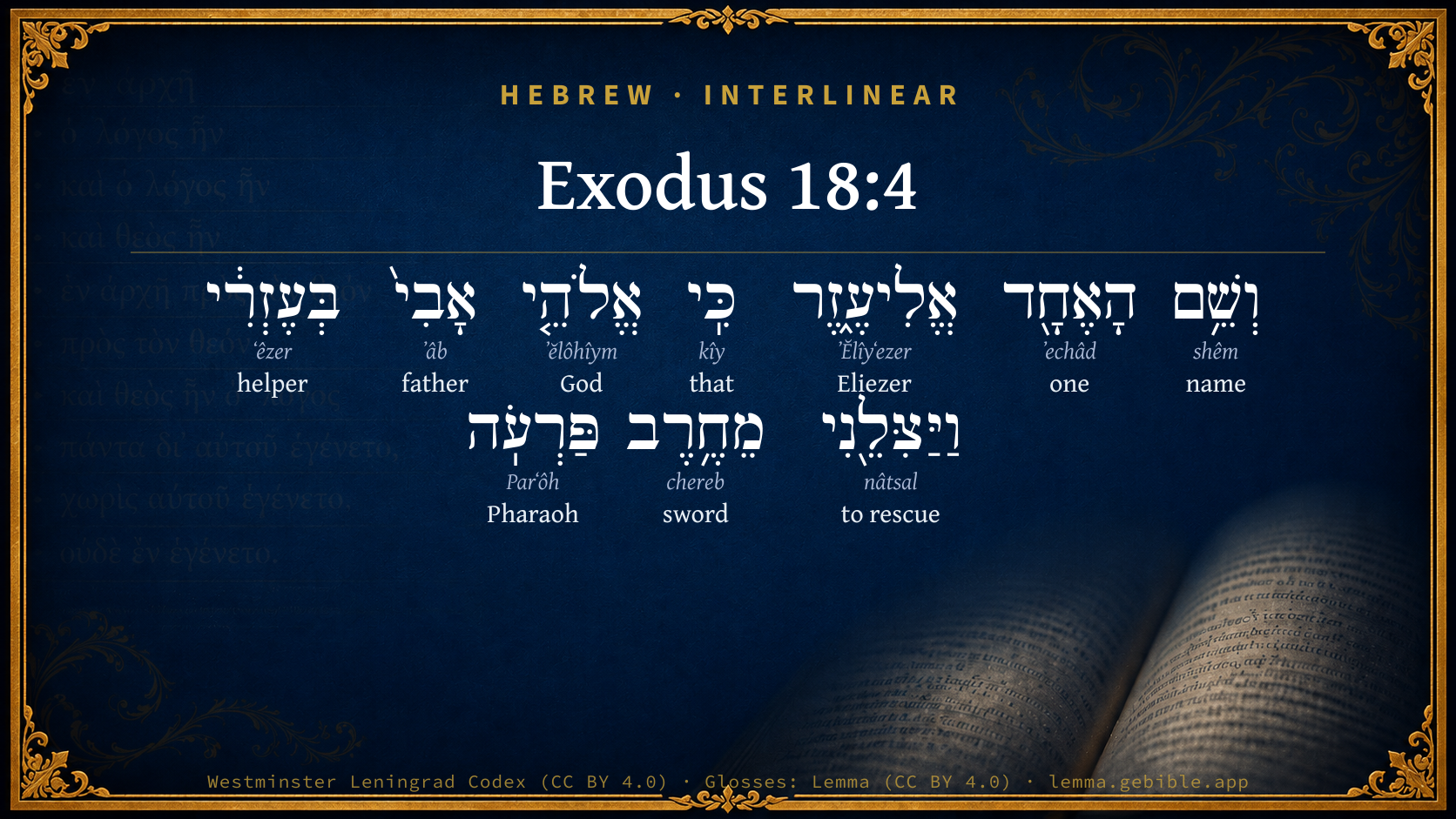
Hebrew (Westminster Leningrad Codex) Exodus 18:4 appears in the Hebrew Old Testament. The text above is from the Westminster Leningrad Codex. Each word links to its Strong’s number, a concise gloss, and parsing drawn from the Open Scriptures Hebrew Bible morphology. Click any word for its full Brown-Driver-Briggs (BDB) entry.
Download image
Cite this verse

Exodus 18:4 (World English Bible). Public Domain. Lemma interlinear Bible study tool, https://lemma.gebible.app/v/exodus/18/4.

Show BibTeX & RIS
BibTeX
RIS
English Translation
The name of the other was Eliezer, for he said, "My father's God was my help and delivered me from Pharaoh's sword."
World English Bible · Public Domain
Download a study sheet

One document with this verse’s original text, its word-by-word gloss line, the meaning frame, cross-references with their text, attributed commentary, and full source and license credits — printable, and it pastes into notes with its structure intact.

This verse Autodidact and up

Study sheet (.html) Plain text (.txt)

A passage Seminary Student

Up to 50 verses in one chapter. A passage sheet keeps up to 6 commentary sources and 12 cross-references per verse, in the order this page ranks them, and says so on the sheet whenever that leaves anything out. Ask for a single verse and you get the Autodidact verse sheet above.

Everything on this page stays free to read, with no account — the sheet is a download of what is already on screen, not access to it.

Want to remove ads? Support Godless Engineer
Compare translations 3

The same verse in 3 English versions, stacked beneath the original-language interlinear above. Click any original word for its lexicon entry.

Each is an independent rendering of the whole verse — the interlinear is not word-aligned to these translations.

Highlighted words mark where these versions differ — a whole-verse word diff, not a word-by-word alignment.

  • World English Bible Public Domain
    The name of the other was Eliezer, for he said, "My father's God was my help and delivered me from Pharaoh's sword."
  • King James Version Public Domain
    And the name of the other was Eliezer; for the God of my father, said he, was mine help, and delivered me from the sword of Pharaoh:
  • unfoldingWord Literal Text CC BY-SA 4.0
    And the name of the other was Eliezer, for “The God of my father was my helper. And he rescued me from the sword of Pharaoh.”

unfoldingWord Literal Text — © unfoldingWord, licensed CC BY-SA 4.0. Word-aligned USFM3 via Door43 (git.door43.org/unfoldingWord/en_ult).

Versions to compare (up to 4)

3 of 4 selected

Show all 18 translations

Every available English version of this verse, each an independent rendering of the whole verse.

  • World English Bible Public Domain
    The name of the other was Eliezer, for he said, "My father's God was my help and delivered me from Pharaoh's sword."
  • Berean Standard Bible Public Domain
    The other son was named Eliezer, for Moses had said, “The God of my father was my helper and delivered me from the sword of Pharaoh.”
  • Majority Standard Bible Public Domain
    The other son was named Eliezer, for Moses had said, “The God of my father was my helper and delivered me from the sword of Pharaoh.”
  • King James Version Public Domain
    And the name of the other was Eliezer; for the God of my father, said he, was mine help, and delivered me from the sword of Pharaoh:
  • American Standard Version (1901) Public Domain
    and the name of the other was Eliezer; for `he said', The God of my father was my help, and delivered me from the sword of Pharaoh.
  • Revised Version (1885) Public Domain
    and the name of the other was Eliezer; for he said, The God of my father was my help, and delivered me from the sword of Pharaoh:
  • Geneva Bible (1599) Public Domain
    And the name of the other was Eliezer: for the God of my father, said he, was mine helpe, and deliuered me from the sword of Pharaoh)
  • Douay-Rheims (1899) Public Domain
    And the other Eliezer: For the God of my father, said he, is my helper, and hath delivered me from the sword of Pharao.
  • Young's Literal Translation Public Domain
    and the name of the other `is' Eliezer, for, `the God of my father `is' for my help, and doth deliver me from the sword of Pharaoh.'
  • Literal Standard Version CC BY-SA 4.0
    and the name of the other [is] Eliezer, for, “The God of my father [is] for my help, and He delivers me from the sword of Pharaoh.”
  • Unlocked Literal Bible CC BY-SA 4.0
    The name of the other was Eliezer, for Moses had said, “My ancestor's God was my help. He rescued me from Pharaoh's sword.”
  • unfoldingWord Literal Text CC BY-SA 4.0
    And the name of the other was Eliezer, for “The God of my father was my helper. And he rescued me from the sword of Pharaoh.”
  • Darby Bible Public Domain
    -- and the name of the other, Eliezer -- For the God of my father has been my help, and has delivered me from the sword of Pharaoh.
  • World Messianic Bible Public Domain
    The name of the other was Eliezer, for he said, “My father’s God was my help and delivered me from Pharaoh’s sword.”
  • Webster's Bible Public Domain
    And the name of the other was Eliezer; (for the God of my father, said he, was my help, and delivered me from the sword of Pharaoh:)
  • Free Bible Version CC BY-SA 4.0
    The other son was named Eliezer, because Moses had said, “The God of my father was my helper, and saved me from death at Pharaoh's hand.”
  • Bible in Basic English Public Domain
    And the name of the other was Eliezer, for he said, The God of my father was my help, and kept me safe from the sword of Pharaoh:
  • JPS Tanakh (1917) Public Domain
    and the name of the other was Eliezer: 'for the God of my father was my help, and delivered me from the sword of Pharaoh.'

Literal Standard Version (2020), Covenant Press — licensed CC BY-SA 4.0. Text via the HelloAO Bible API (eBible.org). Unlocked Literal Bible (unfoldingWord) — licensed CC BY-SA 4.0. Text via the HelloAO Bible API (eBible.org). unfoldingWord Literal Text — © unfoldingWord, licensed CC BY-SA 4.0. Word-aligned USFM3 via Door43 (git.door43.org/unfoldingWord/en_ult). Free Bible Version, Dr. Jonathan Gallagher — licensed CC BY-SA 4.0. Text via the HelloAO Bible API (eBible.org).

Word by word

More ways to search: Search by grammar → Find every occurrence → Compare this word →

Practice this passage: Drill this verse → Learn its vocabulary →

אֱלִיעֶ֑זֶר
ʼĔlîyʻezer
H461
“Eliezer”
Noun, Proper
Part of Speech
Noun
Type
Proper
Full BDB Definition

Origin: from H410 and H5828

TWOT: None

Eliezer = "God is help" - Abraham's Damascene servant - a son of Moses - a Benjamite - a priest who helped move the ark - a Reubenite - a prophet who spoke to Jehoshaphat - a Levite chief - son of Harim - priest with foreign wife
  1. וְשֵׁ֥ם shêm H8034 “and · name of” Conjunction + Noun, Common, Masculine, Singular, Construct
  2. הָאֶחָ֖ד ʼechâd H259 “the · one” Particle, Definite Article + Adjective, Cardinal number, Masculine, Singular, Absolute
  3. כִּֽי kîy H3588 “that” Conjunction
  4. אֱלֹהֵ֤י ʼĕlôhîym H430 “God(s) of” Noun, Common, Masculine, Plural, Construct
  5. אָבִי֙ ʼâb H1 “father · my” Noun, Common, Masculine, Singular, Construct + Suffix, Personal, 1st Person, Common, Singular
  6. בְּעֶזְרִ֔י ʻêzer H5828 “in/at · helper · my” Preposition + Noun, Common, Masculine, Singular, Construct + Suffix, Personal, 1st Person, Common, Singular
  7. וַיַּצִּלֵ֖נִי nâtsal H5337 “and · to rescue · me” Conjunction + Verb, Hiphil, Sequential Imperfect, 3rd Person, Masculine, Singular + Suffix, Personal, 1st Person, Common, Singular
  8. מֵחֶ֥רֶב chereb H2719 “from · sword of” Preposition + Noun, Common, Feminine, Singular, Construct
  9. פַּרְעֹֽה Parʻôh H6547 “Pharaoh” Noun, Proper

About this verse

These counts appear in no published source. They are computed here, from the morphology-tagged text and Lemma’s own curated glosses. What Lemma adds →

10
words
10
distinct lemmas
Pentateuch
section

Notable vocabulary

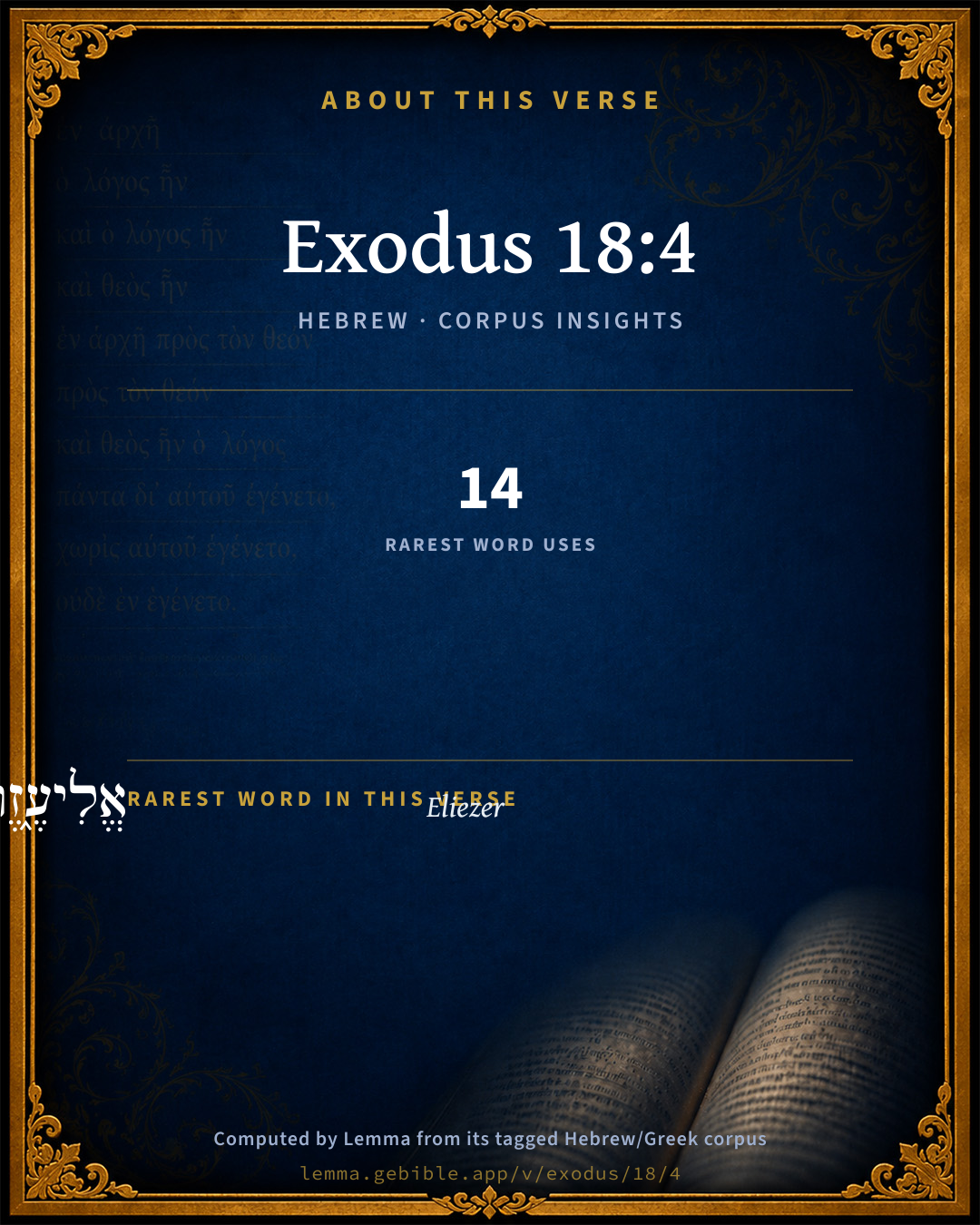
The rarest word here is אֱלִיעֶ֑זֶר Eliezer H461 — appearing just 14 times in the whole Hebrew Bible.

Shared distinctive vocabulary

אֱלִיעֶ֑זֶר Eliezer H461 occurs in 13 verses of the Hebrew Bible. Also found in:

Grammatical profile

  • 1 verb
  • 7 nouns
  • 1 adjective
  • 1 conjunction

Verb forms

  • וַיַּצִּלֵ֖נִי Hiphil · Sequential Imperfect

Hebrew & Septuagint length

In English translation the verse runs 22 words from the Hebrew and 28 from the Septuagint (LXX English) — closely comparable.

A rough comparison of the two English renderings, which tokenize alike — not a word-level alignment.

Word counts can differ between the Hebrew and the Greek without any difference in meaning — e.g. the Hebrew direct-object marker אֵת has no separate Greek word, and Greek often adds the article ὁ.

Cross-references

12

Topical passages linked to Exodus 18:4 in the Treasury of Scripture Knowledge — connected by theme and wording, ordered by reader-vote popularity; previews shown in the World English Bible.

  • Acts 12:11 When Peter had come to himself, he said, "Now I truly know that the Lord has sent out his angel and delivered me out of the hand of Herod, and from everything the Jewish people were expecting."
  • 2 Corinthians 1:8–10 For we don't desire to have you uninformed, brothers, concerning our affliction which happened to us in Asia, that we were weighed down exceedingly, beyond our power, so much that we despaired even of life.
  • 2 Timothy 4:17 But the Lord stood by me, and strengthened me, that through me the message might be fully proclaimed, and that all the Gentiles might hear; and I was delivered out of the mouth of the lion.
  • Hebrews 13:6 So that with good courage we say, "The Lord is my helper. I will not fear. What can man do to me?"
  • Exodus 2:15 Now when Pharaoh heard this thing, he sought to kill Moses. But Moses fled from the face of Pharaoh, and lived in the land of Midian, and he sat down by a well.
  • 1 Chronicles 23:15 The sons of Moses: Gershom and Eliezer.
  • Psalms 18:1 I love you, Yahweh, my strength.
  • Psalms 34:4 I sought Yahweh, and he answered me, And delivered me from all my fears.
  • Psalms 46:1 God is our refuge and strength, A very present help in trouble.
  • Isaiah 50:7–9 For the Lord Yahweh will help me; therefore I have not been confounded: therefore have I set my face like a flint, and I know that I shall not be disappointed.
  • Daniel 6:22 My God has sent his angel, and has shut the lions' mouths, and they have not hurt me; because as before him innocence was found in me; and also before you, O king, have I done no hurt.
  • Psalms 18:48 He rescues me from my enemies. Yes, you lift me up above those who rise up against me. You deliver me from the violent man.

Cross-references courtesy of OpenBible.info (CC BY 4.0).

Hebrew and Greek witnesses Masoretic Hebrew ↔ Greek Septuagint

The same verse in the two great witnesses to the Old Testament, shown verse-for-verse.

These are two independent witnesses, not word-aligned to each other, and the Septuagint is shown in lemma (dictionary) form.

Hebrew Exodus 18:4 Masoretic · Westminster Leningrad Codex

וְשֵׁ֥ם הָאֶחָ֖ד אֱלִיעֶ֑זֶר כִּֽי אֱלֹהֵ֤י אָבִי֙ בְּעֶזְרִ֔י וַיַּצִּלֵ֖נִי מֵחֶ֥רֶב פַּרְעֹֽה

The name of the other was Eliezer, for he said, "My father's God was my help and delivered me from Pharaoh's sword."

World English Bible · Public Domain

Greek LXX Exodus 18:4 Septuagint · lemma form

καί ὁ ὄνομα ὁ δεύτερος ελιεζερ λέγω ὁ γάρ θεός ὁ πατήρ ἐγώ βοηθός ἐγώ καί ἐκαἱρέω ἐγώ ἐκ χείρ φαραώ

and the name of the second Eliezer, saying, For the God of my father is my helper, and he has rescued me out of the hand of Pharao.

LXX2012 (modern English Septuagint) · Public Domain

Hebrew: Westminster Leningrad Codex (CC BY 4.0). Greek: Septuagint (public domain); English from LXX2012 (modern English Septuagint) (Public Domain). How the Septuagint differs from the Hebrew →

Targum (Aramaic paraphrase)

2

The Targum is the ancient Jewish Aramaic paraphrase of the Hebrew Scriptures — an interpretive translation, not the Hebrew text itself. Onkelos (literal) and Pseudo-Jonathan (expansive) render the Torah, and Jonathan the Prophets. Coverage is partial: where no permissively-licensed English translation exists for a verse, only the Aramaic is shown. This is verse-level text, not a word-by-word alignment to the Hebrew.

  1. Targum Onkelos Torah (Genesis–Deuteronomy)
    וְשׁוּם חַד אֱלִיעֶזֶר אֲרֵי אֱלָהָא דְאַבָּא הֲוָה בְסַעְדִי וְשֵׁזְבַנִי מֵחַרְבָּא דְפַרְעֹה:

    (no public-domain English translation for this verse)

    Targum Onkelos — Aramaic: “Onkelos Genesis” (public domain); “Onkelos Exodus” (public domain); “Onkelos Leviticus” (public domain); “Onkelos Numbers” (public domain); “Onkelos Deuteronomy” (public domain). English: “Sefaria Community Translation” (CC0 1.0 (public-domain dedication)); “J.W. Etheridge. The Targums of Onkelos and Jonathan Ben Uzziel on the Pentateuch. London: Longmans, Green, 1862” (public domain). Text via Sefaria.

  2. Targum Pseudo-Jonathan Torah (Genesis–Deuteronomy)
    וְשׁוּם חָד אֱלִיעֶזֶר אֲרוּם אֱלָהָא דְאַבָּא הֲוָה בְּסַעֲדֵי וְשֵׁיזְבַנִי מֵחַרְבָּא דְפַרְעה

    and the name of the other Eliezer, For (he had said) the God of my fathers was my helper, and saved me from the sword of Pharoh.

    Targum Pseudo-Jonathan — Aramaic: “Targum Jonathan on Genesis” (public domain); “Targum Jonathan on Exodus” (public domain); “Targum Jonathan on Leviticus” (public domain); “Targum Jonathan on Numbers” (public domain); “Targum Jonathan on Deuteronomy” (public domain). English: “The Targum of Jonathan ben Uzziel, trans. J. W. Etheridge, London, 1862” (public domain). Text via Sefaria.

Commentary

Notes on Exodus 18:4 from classic Christian and Jewish commentators (each source and its license shown beneath its notes). The classic Christian expositions comment on the surrounding passage and are grouped to its opening verse, so a note may address several verses; the Jewish commentaries on the Tanakh (Rashi and others) are per-verse, so they appear only where the commentator wrote on this verse.

Lemma curates 59 commentaries, every one of them public domain or Creative Commons licensed, each selected and text-cleaned for this edition rather than reprinted as found. About our sources →

Trapp's Complete Commentary

John Trapp

Exo 18:4 And the name of the other [was] Eliezer; for the God of my father, [said he, was] mine help, and delivered me from the sword of Pharaoh:

Ver. 4. Eliezer.] Or, Lazarus. We should write God’s mercies upon the names of our children, or some other ways perpetuate the memory of them.

John Trapp, A Commentary or Exposition upon All the Books of the Old and New Testament (1647–1656) — public domain. Text from a community e-Sword module.

Joseph Benson's Commentary

Exo 18:4. The name of the other was Eliezer — My God a help: it looks back to his deliverance from Pharaoh, when he made his escape after the slaying of the Egyptian; but if this were the son that was circumcised in the inn, it would be better to translate it, The Lord is my help, and will deliver me from the sword of Pharaoh, which he had reason to expect would be drawn against him, when he was going to fetch Israel out of bondage.

Joseph Benson's Commentary on the Old and New Testaments (1811–1818) — public domain. Text from a community e-Sword module.

Ellicott's Commentary for English Readers

(4) Eliezer.—Eliezer is supposed to have been the boy whom Zipporah circumcised in the wilderness (Exo_4:25). He grew to manhood, and had a son, Rehabiah (1Ch_23:17), whose descendants were in the time of David very numerous (1Ch_23:17; and comp. 1Ch_26:25-26). It is uncertain whether Moses gave him his name before parting from him, in allusion to his escape from the Pharaoh who “sought to slay him” (Exo_2:15), or first named him on occasion of receiving him back, in allusion to his recent escape from the host which had been destroyed in the Red Sea.

A Bible Commentary for English Readers, edited by Charles John Ellicott (1878–1897) — public domain. Text from a community e-Sword module.

The Cambridge Bible for Schools and Colleges

gen. ed. J. J. S. Perowne

4. the God of my father] Exo_3:6 (E), Exo_15:2 (the Song).

from the sword of Pharaoh] cf. Exo_2:15.

The Cambridge Bible for Schools and Colleges (gen. ed. J. J. S. Perowne; Cambridge University Press, 1878–1918) — public domain. Text from a community e-Sword module.

John Gill's Exposition

And the name of the other was Eliezer,.... Who seems to be his second son, and was that which was circumcised by Zipporah at the inn, and about which there was such a stir, Exo 4:24, and signifies "my God is help", or, his helper:

for the God of my father, said he, was mine help, and delivered me from the sword of Pharaoh; who, on hearing that Moses had killed an Egyptian, was wroth with him, and sought to slay him; and perhaps drew his sword for that purpose, but was prevented: however, this, in all human probability, would have been the case, that he would have fallen by his sword either in a private or public manner, had it not been for the interposition of divine Providence, and therefore he gave this name to his child, to be a standing memorial of it.

John Gill's Exposition of the Whole Bible (1746–1763) — public domain (CC PDM 1.0). Text via the HelloAO Bible API.

Whedon's Commentary on the Bible

Daniel D. Whedon

4. Eliezer — Here for the first time mentioned by name, but both sons are referred to in Exo_4:20, and it is supposed that this younger son was the one circumcised by the way, (Exo_4:25.) The name means, my God is a help, and was given either in remembrance of Moses’s past deliverance from the sword of Pharaoh, or as expressing his hope for the future. The fear of execution as one guilty of blood, and the purpose of Pharaoh to slay him, were the cause of his flight from Egypt, (Exo_2:15.) The same old fear may have arisen at the thought of his returning, and if Eliezer were born about that time there would have been a special appropriateness in the name. We should then render: and he will deliver me, etc.

Daniel D. Whedon (gen. ed.), Commentary on the Old and New Testaments (1874–1909) — public domain. Text from a community e-Sword module.

The Pulpit Commentary

Eliezer. Eliezer had not been previously mentioned by name; but he was probably the son circumcised by Zipporah, as related in Exo_4:25. We learn from 1Ch_23:15-17, that he grew to manhood, andhad an only son, Rehabiah, whose descendants were in the time of Solomon very numerous. For the God of my father, said he, was my help. Eliezer means literally, "My God (is my) help." It would seem that Zipporah, when she circumcised her infant son, omitted to name him; but Moses, before dismissing her, supplied the omission, calling him Eliezer, because God had been his help against the Pharaoh who had sought his life, (Exo_2:15) and of whose death he had recently had intelligence. (Exo_4:19) Thus the names of the two sons expressed respectively, the despondency natural to an exile, and the exultant gratitude of one who had just learned that by God"s goodness, the term of his banishment was over.

The Pulpit Commentary (1880–1919), ed. H.D.M. Spence-Jones & Joseph S. Exell — public domain. Text from a community e-Sword module.

John Wesley's Explanatory Notes

The name of the other was Eliezer - My God a help: it looks back to his deliverance from Pharaoh, when he made his escape after the slaying of the Egyptian; but if this were the son that was circumcised in the inn, I would rather translate it, The Lord is mine help, and will deliver me from the sword of Pharaoh, which he had reason to expect would be drawn against him, when he was going to fetch Israel out of bondage.

John Wesley, Explanatory Notes Upon the Whole Bible (1754–1765) — public domain. Text via the GEBible commentary corpus.

Scofield Reference Notes

C. I. Scofield

Eliezer

i.e. God is help.

The Scofield Reference Bible (1917 edition), notes by C. I. Scofield — public domain. Text from a community e-Sword module.

Rashi

Rabbi Shlomo Yitzchaki (Rashi)

ויצלני מחרב פרעה AND HE DELIVERED ME FROM THE SWORD OF PHARAOH — When Dathan and Abiram made the disclosure regarding the matter of the Egyptian whom Moses had killed and Pharaoh wished to slay Moses, his neck became as a column of marble so that the sword was powerless against him (Shemot Rabbah 1:31; cf. Rashi on Exodus 2:15).

Rashi on the Tanakh — English translations: “The Judaica Press complete Tanach with Rashi, translated by A. J. Rosenberg” (CC BY 4.0); “Pentateuch with Rashi's commentary by M. Rosenbaum and A.M. Silbermann, 1929-1934” (public domain); “The Metsudah Tanach series, Lakewood, N.J” (CC BY 4.0); and “The Book of Joshua, Metsudah Publications, 1997” (CC BY 4.0). Text via Sefaria.

Lesson kit

Teaching starters — assembled from the data on this page, not authored interpretation. Every prompt links to the verse data it draws on. Edit before teaching.

Exodus, in the Pentateuch, opens this verse with 10 words (10 distinct Hebrew lemmas). Its most distinctive word is ʼĔlîyʻezer (“Eliezer”). A historical commentator’s framing appears above. Read the whole chapter for the surrounding context.

Discussion questions

  1. The word ʼĔlîyʻezer carries the sense “Eliezer.” How does it shape the verse?
  2. How does Genesis 15:2, which shares the word «Eliezer», read alongside this verse?
  3. These translations render this verse differently; the difference is in the English rendering, not the original. What questions does that raise?
  4. «וַיַּצִּלֵ֖נִי» is a Hiphil Sequential Imperfect verb. How does that grammatical form shape the action described?
  5. Compare how Trapp's Complete Commentary and Joseph Benson's Commentary read this verse. Where do they agree or differ?

Things to notice

Reading settings

Reading text

Shown beneath each verse's original-language words.

Old Testament
Old Testament edition

Read the OT as the Masoretic Hebrew (MT) or the Greek Septuagint (LXX).

English shown for the Greek Septuagint (in the Hebrew ↔ Greek comparison).

Comparing translations? Open the Compare panel on any verse page to stack up to four side by side.