
Ezekiel 14:21

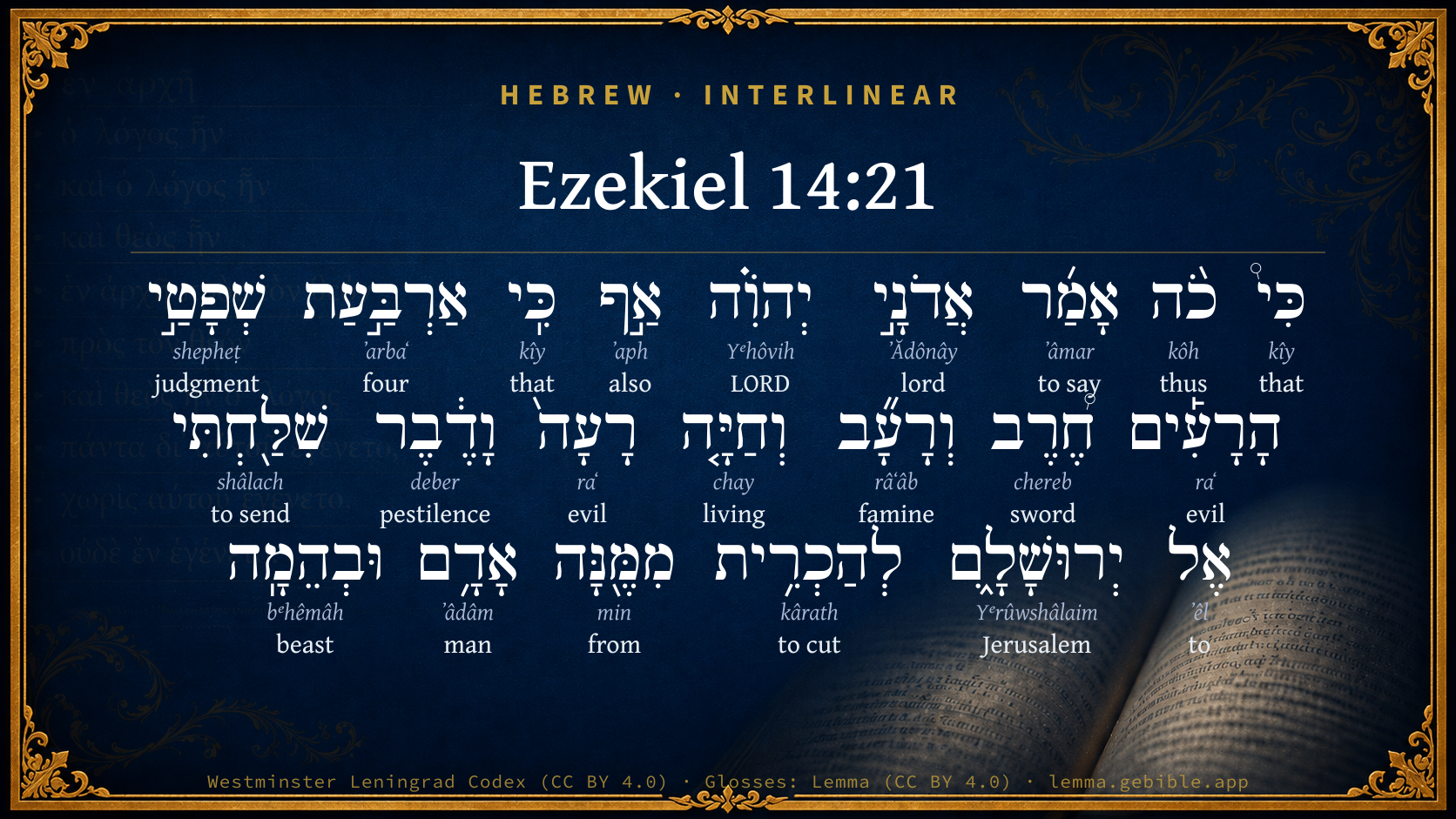
Hebrew (Westminster Leningrad Codex) Ezekiel 14:21 appears in the Hebrew Old Testament. The text above is from the Westminster Leningrad Codex. Each word links to its Strong’s number, a concise gloss, and parsing drawn from the Open Scriptures Hebrew Bible morphology. Click any word for its full Brown-Driver-Briggs (BDB) entry.
Download image
Cite this verse

Ezekiel 14:21 (World English Bible). Public Domain. Lemma interlinear Bible study tool, https://lemma.gebible.app/v/ezekiel/14/21.

Show BibTeX & RIS
BibTeX
RIS
English Translation
For thus says the Lord Yahweh: How much more when I send my four sore judgments on Jerusalem, the sword, and the famine, and the evil animals, and the pestilence, to cut off from it man and animal!
World English Bible · Public Domain
Download a study sheet

One document with this verse’s original text, its word-by-word gloss line, the meaning frame, cross-references with their text, attributed commentary, and full source and license credits — printable, and it pastes into notes with its structure intact.

This verse Autodidact and up

Study sheet (.html) Plain text (.txt)

A passage Seminary Student

Up to 50 verses in one chapter. A passage sheet keeps up to 6 commentary sources and 12 cross-references per verse, in the order this page ranks them, and says so on the sheet whenever that leaves anything out. Ask for a single verse and you get the Autodidact verse sheet above.

Everything on this page stays free to read, with no account — the sheet is a download of what is already on screen, not access to it.

Want to remove ads? Support Godless Engineer
Compare translations 3

The same verse in 3 English versions, stacked beneath the original-language interlinear above. Click any original word for its lexicon entry.

Each is an independent rendering of the whole verse — the interlinear is not word-aligned to these translations.

Highlighted words mark where these versions differ — a whole-verse word diff, not a word-by-word alignment.

  • World English Bible Public Domain
    For thus says the Lord Yahweh: How much more when I send my four sore judgments on Jerusalem, the sword, and the famine, and the evil animals, and the pestilence, to cut off from it man and animal!
  • King James Version Public Domain
    For thus saith the Lord GOD; How much more when I send my four sore judgments upon Jerusalem, the sword, and the famine, and the noisome beast, and the pestilence, to cut off from it man and beast?
  • unfoldingWord Literal Text CC BY-SA 4.0
    For the Lord Yahweh says this: I will certainly make things worse by sending my four punishments—famine, sword, wild animals, and plague—against Jerusalem to cut off both man and beast from her.

unfoldingWord Literal Text — © unfoldingWord, licensed CC BY-SA 4.0. Word-aligned USFM3 via Door43 (git.door43.org/unfoldingWord/en_ult).

Versions to compare (up to 4)

3 of 4 selected

Show all 18 translations

Every available English version of this verse, each an independent rendering of the whole verse.

  • World English Bible Public Domain
    For thus says the Lord Yahweh: How much more when I send my four sore judgments on Jerusalem, the sword, and the famine, and the evil animals, and the pestilence, to cut off from it man and animal!
  • Berean Standard Bible Public Domain
    For this is what the Lord GOD says: ‘How much worse will it be when I send against Jerusalem My four dire judgments—sword, famine, wild beasts, and plague—in order to cut off from it both man and beast?
  • Majority Standard Bible Public Domain
    For this is what the Lord GOD says: ‘How much worse will it be when I send against Jerusalem My four dire judgments—sword, famine, wild beasts, and plague—in order to cut off from it both man and beast?
  • King James Version Public Domain
    For thus saith the Lord GOD; How much more when I send my four sore judgments upon Jerusalem, the sword, and the famine, and the noisome beast, and the pestilence, to cut off from it man and beast?
  • American Standard Version (1901) Public Domain
    For thus saith the Lord Jehovah: How much more when I send my four sore judgments upon Jerusalem, the sword, and the famine, and the evil beasts, and the pestilence, to cut off from it man and beast!
  • Revised Version (1885) Public Domain
    For thus saith the Lord GOD: How much more when I send my four sore judgments upon Jerusalem, the sword, and the famine, and the noisome beasts, and the pestilence, to cut off from it man and beast?
  • Geneva Bible (1599) Public Domain
    For thus saith the Lord God, Howe much more when I sende my foure sore iudgements vpon Ierusalem, euen the sworde, and famine, and the noysome beast and pestilence, to destroy man and beast out of it?
  • Douay-Rheims (1899) Public Domain
    For thus saith the Lord: Although I shall send in upon Jerusalem my four grievous judgments, the sword, and the famine, and the mischievous beasts, and the pestilence, to destroy out of it man and beast,
  • Young's Literal Translation Public Domain
    `For thus said the Lord Jehovah: Although My four sore judgments -- sword, and famine, and wild beast, and pestilence -- I have sent unto Jerusalem, to cut off from it man and beast,
  • Literal Standard Version CC BY-SA 4.0
    For thus said Lord YHWH: “Although My four severe judgments—sword, and famine, and wild beast, and pestilence—I have sent to Jerusalem, to cut off man and beast from it,
  • Unlocked Literal Bible CC BY-SA 4.0
    For the Lord Yahweh says this: I will certainly make things worse by sending my four punishments—famine, sword, wild animals, and plague—against Jerusalem to cut off both man and beast from her.
  • unfoldingWord Literal Text CC BY-SA 4.0
    For the Lord Yahweh says this: I will certainly make things worse by sending my four punishments—famine, sword, wild animals, and plague—against Jerusalem to cut off both man and beast from her.
  • Darby Bible Public Domain
    For thus saith the Lord Jehovah: How much more when I send my four sore judgments upon Jerusalem, the sword, and the famine, and the evil beast, and the pestilence, to cut off from it man and beast!
  • World Messianic Bible Public Domain
    For the Lord GOD says: “How much more when I send my four severe judgments on Jerusalem—the sword, the famine, the evil animals, and the pestilence—to cut off from it man and animal!
  • Webster's Bible Public Domain
    For thus saith the Lord GOD; How much more when I send my four severe judgments upon Jerusalem, the sword, and the famine, and the noisome beast, and the pestilence, to cut off from it man and beast?
  • Free Bible Version CC BY-SA 4.0
    This is what the Lord God says: It will be so much worse when I send my four severe judgments against Jerusalem—war, famine, wild animals, and disease, so that both people and animals are killed!
  • Bible in Basic English Public Domain
    For this is what the Lord has said: How much more when I send my four bitter punishments on Jerusalem, the sword and need of food and evil beasts and disease, cutting off from it man and beast?
  • JPS Tanakh (1917) Public Domain
    For thus saith the Lord GOD: How much more when I send My four sore judgments against Jerusalem, the sword, and the famine, and the evil beasts, and the pestilence, to cut off from it man and beast.

Literal Standard Version (2020), Covenant Press — licensed CC BY-SA 4.0. Text via the HelloAO Bible API (eBible.org). Unlocked Literal Bible (unfoldingWord) — licensed CC BY-SA 4.0. Text via the HelloAO Bible API (eBible.org). unfoldingWord Literal Text — © unfoldingWord, licensed CC BY-SA 4.0. Word-aligned USFM3 via Door43 (git.door43.org/unfoldingWord/en_ult). Free Bible Version, Dr. Jonathan Gallagher — licensed CC BY-SA 4.0. Text via the HelloAO Bible API (eBible.org).

Word by word

More ways to search: Search by grammar → Find every occurrence → Compare this word →

Practice this passage: Drill this verse → Learn its vocabulary →

שְׁפָטַ֣י
shepheṭ
H8201
“judgments · my”
Noun, Common, Masculine, Plural, Construct + Suffix, Personal, 1st Person, Common, Singular
Part of Speech
Noun
Type
Common
Gender
Masculine
Number
Plural
State
Construct
Full BDB Definition

Origin: from H8199

TWOT: 2443a

judgment, act of judgment
  1. כִּי֩ kîy H3588 “that” Conjunction
  2. כֹ֨ה kôh H3541 “thus” Adverb
  3. אָמַ֜ר ʼâmar H559 “to say” Verb, Qal, Perfect, 3rd Person, Masculine, Singular
  4. אֲדֹנָ֣י ʼĂdônây H136 “Lord · my” Noun, Common, Masculine, Plural, Construct + Suffix, Personal, 1st Person, Common, Singular
  5. יְהֹוִ֗ה Yᵉhôvih H3069 “LORD” Noun, Proper
  6. אַ֣ף ʼaph H637 “also” Particle, Accusative
  7. כִּֽי kîy H3588 “that” Conjunction
  8. אַרְבַּ֣עַת ʼarbaʻ H702 “four” Adjective, Cardinal number, Masculine, Singular, Construct
  9. הָרָעִ֡ים raʻ H7451 “the · evil” Particle, Definite Article + Adjective, Adjective, Masculine, Plural, Absolute
  10. חֶ֠רֶב chereb H2719 “sword” Noun, Common, Feminine, Singular, Absolute
  11. וְרָעָ֞ב râʻâb H7458 “and · famine” Conjunction + Noun, Common, Masculine, Singular, Absolute
  12. וְחַיָּ֤ה chay H2416 “and · living” Conjunction + Noun, Common, Feminine, Singular, Absolute
  13. רָעָה֙ raʻ H7451 “evil” Adjective, Adjective, Feminine, Singular, Absolute
  14. וָדֶ֔בֶר deber H1698 “and · pestilence” Conjunction + Noun, Common, Masculine, Singular, Absolute
  15. שִׁלַּ֖חְתִּי shâlach H7971 “to send” Verb, Piel, Perfect, 1st Person, Common, Singular
  16. אֶל ʼêl H413 “to” Preposition
  17. יְרוּשָׁלִָ֑ם Yᵉrûwshâlaim H3389 “Jerusalem” Noun, Proper
  18. לְהַכְרִ֥ית kârath H3772 “to cut” Preposition + Verb, Hiphil, Infinitive Construct
  19. מִמֶּ֖נָּה min H4480 “from · her” Preposition + Suffix, Personal, 3rd Person, Feminine, Singular
  20. אָדָ֥ם ʼâdâm H120 “man” Noun, Common, Masculine, Singular, Absolute
  21. וּבְהֵמָֽה bᵉhêmâh H929 “and · beast” Conjunction + Noun, Common, Feminine, Singular, Absolute

About this verse

These counts appear in no published source. They are computed here, from the morphology-tagged text and Lemma’s own curated glosses. What Lemma adds →

22
words
20
distinct lemmas
Prophets
section

Notable vocabulary

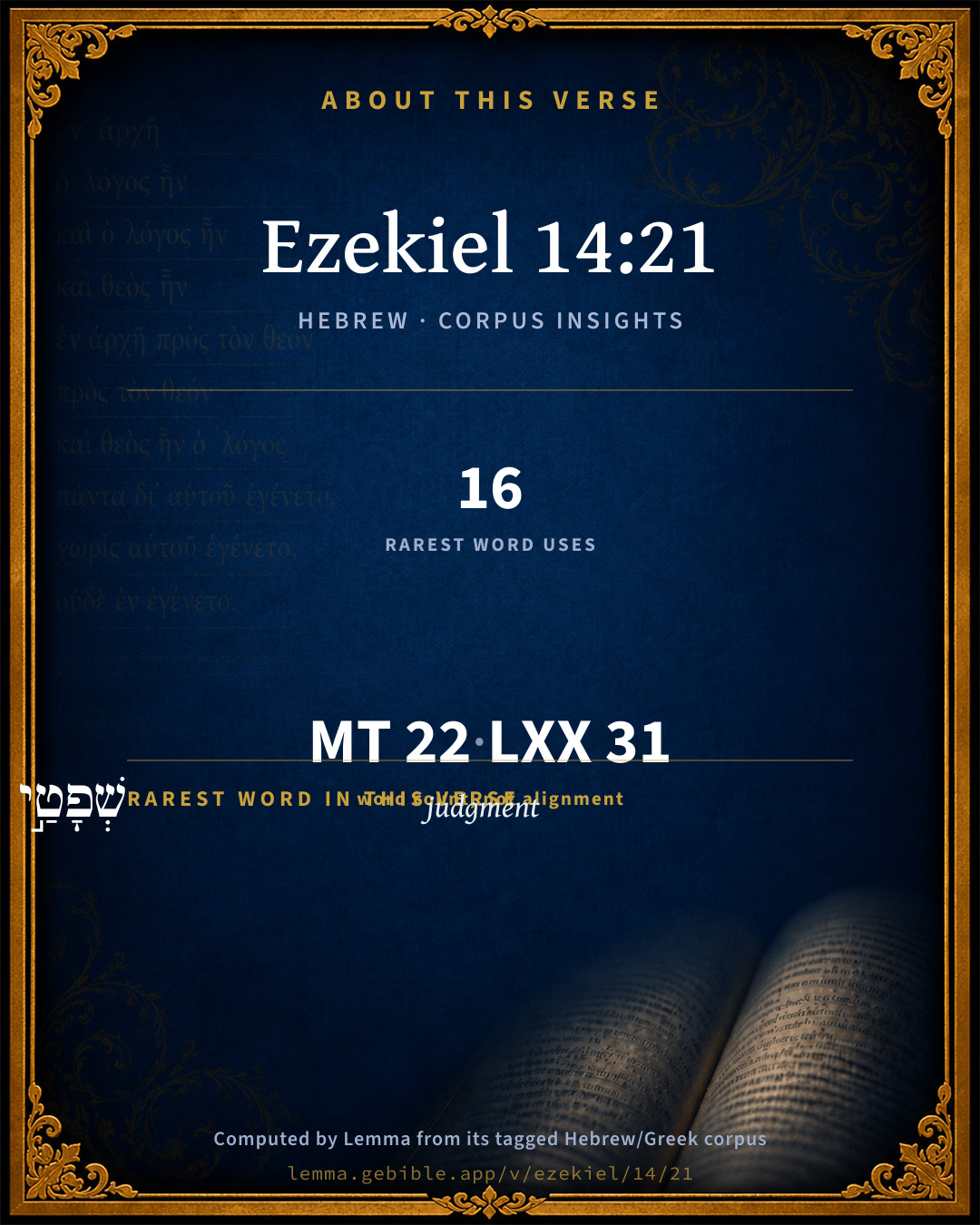
The rarest word here is שְׁפָטַ֣י judgment H8201 — appearing just 16 times in the whole Hebrew Bible.

Shared distinctive vocabulary

שְׁפָטַ֣י judgment H8201 occurs in 16 verses of the Hebrew Bible. Also found in:

Grammatical profile

  • 3 verbs
  • 10 nouns
  • 3 adjectives
  • 2 prepositions
  • 2 conjunctions
  • 1 adverb
  • 1 particle

Verb forms

  • אָמַ֜ר Qal · Perfect
  • שִׁלַּ֖חְתִּי Piel · Perfect
  • לְהַכְרִ֥ית Hiphil · Infinitive Construct

Repetition

Words recur within this verse — often emphatic in Hebrew:

  • הָרָעִ֡ים evil H7451 ×2
  • כִּי֩ that H3588 ×2

Hebrew & Septuagint length

In English translation the verse runs 38 words from the Hebrew and 32 from the Septuagint (LXX English) — closely comparable.

A rough comparison of the two English renderings, which tokenize alike — not a word-level alignment.

Word counts can differ between the Hebrew and the Greek without any difference in meaning — e.g. the Hebrew direct-object marker אֵת has no separate Greek word, and Greek often adds the article ὁ.

In the original languages it is 22 Hebrew tokens and 31 Greek tokens — but the two are counted differently (Hebrew bundles its prefixes and suffixes into one token; the Greek is in lemma form), so that isn’t a like-for-like length.

Cross-references

11

Topical passages linked to Ezekiel 14:21 in the Treasury of Scripture Knowledge — connected by theme and wording, ordered by reader-vote popularity; previews shown in the World English Bible.

  • Ezekiel 5:17 and I will send on you famine and evil animals, and they shall bereave you; and pestilence and blood shall pass through you; and I will bring the sword on you: I, Yahweh, have spoken it.
  • Ezekiel 33:27 Thus shall you tell them, Thus says the Lord Yahweh: As I live, surely those who are in the waste places shall fall by the sword; and him who is in the open field will I give to the animals to be devoured; and those who are in the strongholds and in the caves shall die of the pestilence.
  • Ezekiel 14:13 Son of man, when a land sins against me by committing a trespass, and I stretch out my hand on it, and break the staff of the bread of it, and send famine on it, and cut off from it man and animal;
  • Ezekiel 14:15 If I cause evil animals to pass through the land, and they ravage it, and it be made desolate, so that no man may pass through because of the animals;
  • Ezekiel 14:17 Or if I bring a sword on that land, and say, Sword, go through the land; so that I cut off from it man and animal;
  • Ezekiel 14:19 Or if I send a pestilence into that land, and pour out my wrath on it in blood, to cut off from it man and animal;
  • Ezekiel 5:12 A third part of you shall die with the pestilence, and with famine shall they be consumed in the midst of you; and a third part shall fall by the sword round about you; and a third part I will scatter to all the winds, and will draw out a sword after them.
  • Ezekiel 6:11–12 Thus says the Lord Yahweh: Smite with your hand, and stamp with your foot, and say, Alas! because of all the evil abominations of the house of Israel; for they shall fall by the sword, by the famine, and by the pestilence.
  • Amos 4:6–12 "I also have given you cleanness of teeth in all your cities, And lack of bread in every town; Yet you haven't returned to me," says Yahweh.
  • Jeremiah 15:2–3 It shall happen, when they tell you, Where shall we go forth? then you shall tell them, Thus says Yahweh: Such as are for death, to death; and such as are for the sword, to the sword; and such as are for the famine, to the famine; and such as are for captivity, to captivity.
  • Revelation 6:4–8 Another came forth, a red horse. To him who sat on it was given power to take peace from the earth, and that they should kill one another. There was given to him a great sword.

Cross-references courtesy of OpenBible.info (CC BY 4.0).

Hebrew and Greek witnesses Masoretic Hebrew ↔ Greek Septuagint

The same verse in the two great witnesses to the Old Testament, shown verse-for-verse.

These are two independent witnesses, not word-aligned to each other, and the Septuagint is shown in lemma (dictionary) form.

Hebrew Ezekiel 14:21 Masoretic · Westminster Leningrad Codex

כִּי֩ כֹ֨ה אָמַ֜ר אֲדֹנָ֣י יְהֹוִ֗ה אַ֣ף כִּֽי אַרְבַּ֣עַת שְׁפָטַ֣י הָרָעִ֡ים חֶ֠רֶב וְרָעָ֞ב וְחַיָּ֤ה רָעָה֙ וָדֶ֔בֶר שִׁלַּ֖חְתִּי אֶל יְרוּשָׁלִָ֑ם לְהַכְרִ֥ית מִמֶּ֖נָּה אָדָ֥ם וּבְהֵמָֽה

For thus says the Lord Yahweh: How much more when I send my four sore judgments on Jerusalem, the sword, and the famine, and the evil animals, and the pestilence, to cut off from it man and animal!

World English Bible · Public Domain

Greek LXX Ezekiel 14:21 Septuagint · lemma form

ὅδε λέγω κύριος ἐάν δέ καί ὁ τέσσαρες ἐκδίκησις ἐγώ ὁ πονηρός ῥομφαία καί λιμός καί θηρίον πονηρός καί θάνατος ἐκ ἀποστέλλω ἐπί ἰερουσαλήμ ὁ ἐκὀλεθρεύω ἐκ αὐτός ἄνθρωπος καί κτῆνος

Thus says the Lord, And if I even send upon Jerusalem my four sore judgments, sword, and famine, and evil beasts, and pestilence, to destroy from out of it man and beast;

LXX2012 (modern English Septuagint) · Public Domain

Hebrew: Westminster Leningrad Codex (CC BY 4.0). Greek: Septuagint (public domain); English from LXX2012 (modern English Septuagint) (Public Domain). How the Septuagint differs from the Hebrew →

Targum (Aramaic paraphrase)

1

The Targum is the ancient Jewish Aramaic paraphrase of the Hebrew Scriptures — an interpretive translation, not the Hebrew text itself. Onkelos (literal) and Pseudo-Jonathan (expansive) render the Torah, and Jonathan the Prophets. Coverage is partial: where no permissively-licensed English translation exists for a verse, only the Aramaic is shown. This is verse-level text, not a word-by-word alignment to the Hebrew.

  1. Targum Jonathan Prophets (Joshua–Malachi)
    אֲרֵי כִּדְנַן אֲמַר יְיָ אֱלֹהִים אַף אֲרֵי אַרְבַּע פּוּרְעָנִין בִּישָׁן חַרְבָּא וְכַפְנָא וְחַיְתָא בִּישְׁתָא וּמוֹתָא שְׁלָחֵית עַל יְרוּשְׁלֵם לְשֵׁיצָאָה מִנָה אֱנָשָׁא וּבְעִירָא:

    (no public-domain English translation for this verse)

    Targum Jonathan — Aramaic: “Mikraot Gedolot” (public domain). English: “Sefaria Community Translation” (CC0 1.0 (public-domain dedication)); “London "Chaldee Paraphrase," 1871” (public domain). Text via Sefaria.

Commentary

Notes on Ezekiel 14:21 from classic Christian and Jewish commentators (each source and its license shown beneath its notes). The classic Christian expositions comment on the surrounding passage and are grouped to its opening verse, so a note may address several verses; the Jewish commentaries on the Tanakh (Rashi and others) are per-verse, so they appear only where the commentator wrote on this verse.

Lemma curates 59 commentaries, every one of them public domain or Creative Commons licensed, each selected and text-cleaned for this edition rather than reprinted as found. About our sources →

Trapp's Complete Commentary

John Trapp

Eze 14:21 For thus saith the Lord GOD; How much more when I send my four sore judgments upon Jerusalem, the sword, and the famine, and the noisome beast, and the pestilence, to cut off from it man and beast?

Ver. 21. My four sore judgments.] Every one of the four (Cardan reckons three more of like nature, viz., earthquakes, inundations, and great winds) are sore judgments indeed. Each of them is pessimum, most wicked, i.e., perniciosum. Cavete. Dangerous. Beware.

John Trapp, A Commentary or Exposition upon All the Books of the Old and New Testament (1647–1656) — public domain. Text from a community e-Sword module.

Tyndale Open Study Notes

Tyndale Open Resources

14:21 Jerusalem was worse off than the hypothetical country of 14:12-20 in two respects. First, Jerusalem did not have Noah, Daniel, and Job; instead, the city was filled with unrighteous people. Second, it would not be hit with one single judgment plague but with all four of these dreadful punishments at once. It is therefore not surprising that all her people and animals would be destroyed.

Tyndale Open Study Notes — © Tyndale Open Resources, licensed CC BY-SA 4.0. Text via the HelloAO Bible API.

Jamieson, Fausset & Brown

Robert Jamieson, A. R. Fausset & David Brown

How much more--literally, "Surely shall it be so now, when I send," &c. If none could avert the one only judgment incurred, surely now, when all four are incurred by sin, much more impossible it will be to deliver the land.

Jamieson, Fausset & Brown — Commentary Critical and Explanatory on the Whole Bible (1871) — public domain (CC PDM 1.0). Text via the HelloAO Bible API.

Adam Clarke's Commentary

Verse 21. My four sore judgments] SWORD, war. FAMINE, occasioned by drought. PESTILENCE, epidemic diseases which sweep off a great part of the inhabitants of a land. The NOISOME BEAST, the multiplication of wild beasts in consequence of the general destruction of the inhabitants.

Adam Clarke's Commentary on the Bible (1810–1826) — public domain. Text from a community e-Sword/MySword module.

John Calvin's Commentaries

He now reasons, as we said in the beginning, from the less to the greater. Hitherto he has said, If I shall have sent forth only one weapon to take vengeance upon men, no one will oppose my following out my decree: then he enumerated four weapons, one after another. Now he adds, What then, when I shall have heaped together all punishments, and not only shall have sent pestilence or sword or famine, but as it were when I have four armies prepared and drawn up, and shall command them to attack and destroy mankind, how shall even one person escape? If Job, Daniel, and Noah, cannot snatch away even their sons and daughters from a single scourge, how shall they snatch them from four at once! We see, then, that God here cuts away the false and specious hopes by which the false prophets deluded the miserable exiles when they promised them a return to their country, and daily proclaimed how impossible it was that the sacred city, the earthly dwelling-place of God, could be taken by the enemy, and the religion which God had promised should be eternal could perish. Since, therefore, the false prophets so deceived these miserable exiles, here God shows how greatly they erred while they cherished any hope in their minds; because he had not only held one kind of scourge over Jerusalem, but approached it with a whole heap of them to destroy and cut off both man and beast. This then is the full meaning.

Now he says, If I shall have sent my four evil judgments. Here God calls his judgments evils, in the sense in which he says in Isaiah, that he creates good and evil, (Isaiah 45:7,) since immediately afterwards he expresses his meaning by saying life and death. Hence what is against us is here called evil, and so this epithet ought to be referred to our perceptions. For our natural common sense dictates that whatever is desirable and useful to us is good: food and life and peace are good, and whatever is conducive to life, and what we naturally wish for, we call good. So also, on the other hand, death and famine are evils: so are nakedness, want, and shame: why so? since we dread whatever is not useful to us; and because we fly from evils as soon as reason dawns. In fine, evil here is not opposed to justice and right, but, as I have said, to men’s opinion and our natural senses. He now confirms what we before said, namely, that these are God’s judgments when enemies rage against us, pestilence attacks us: poverty assails us, and wild beasts break in upon us. When therefore we suffer under these afflictions, let us learn immediately to descend into ourselves and to discover the cause why God is so angry with us. For if we turn our attention towards the sword, and pestilence, and famine, we are like dogs which gnaw and bite what is thrown at them, and do not regard the hand which threw it, but only vent their rage upon the stone. For such is our stupidity when we complain of famine being injurious to us, wild beasts troublesome, and war horrible. Hence this passage should always be borne in mind that, these are God’s evil judgments, that is, scourges by which he chastises our sins, and thus shows himself hostile and opposed to us.

John Calvin's Commentaries (1540-1563) — public domain. Text from the Calvin Translation Society English edition (1840s-50s) via the Christian Classics Ethereal Library (ccel.org). Calvin's coverage is partial (roughly two-thirds of the Bible); uncommented books and verses are honest gaps, never fabricated. The 19th-century editor's footnotes and remarks are omitted so the notes are faithfully Calvin's own voice.

Ellicott's Commentary for English Readers

(21) My four sore judgments.—The teaching of the preceding eight verses is here gathered up into its climax. In the case of any one of the four punishments mentioned in succession, the presence of the holiest of men should be of no avail to avert it; how much more then, when all these are combined in the judgment upon Jerusalem, will it be impossible to stay its doom.

A Bible Commentary for English Readers, edited by Charles John Ellicott (1878–1897) — public domain. Text from a community e-Sword module.

The Cambridge Bible for Schools and Colleges

gen. ed. J. J. S. Perowne

21. How much more] If when a single judgment is sent upon a land the wicked shall not be spared for the sake of the righteous, how much more shall this not happen when the wickedness of the land is so great that God’s four sore judgments together fall upon it, as they shall fall upon Jerusalem? Ch. Eze_5:17, Eze_33:27; Eze_33:22. Yet the history of Jerusalem may seem an exception. It is an exception for a wider purpose.

The Cambridge Bible for Schools and Colleges (gen. ed. J. J. S. Perowne; Cambridge University Press, 1878–1918) — public domain. Text from a community e-Sword module.

John Gill's Exposition

Yet, behold, therein shall be left a remnant,.... That is, in Jerusalem, on which God's four sore judgments should be sent: though in a sinful land, as before described, where only one judgment was sent, there was no escape, not so much as a son or a daughter were delivered; yet here, where four sore judgments came together, there is a remnant that are saved; and which being wonderful, and beyond all expectation, is introduced with a "behold", not only as a note of attention, but of admiration:

that shall be brought forth, both sons and daughters; that is, which should be brought forth out of Jerusalem when taken, and should not be destroyed either by famine, or by noisome beasts, or by the sword, or by the pestilence; and these, many of them, both sons and daughters; some of each sex, that should be the means of propagating a posterity, that should return again, and repeople the land, and continue for many ages, as they have done: this is said with respect to Eze 14:16;

behold, they shall come forth unto you; come out of Jerusalem, and their own land, into Babylon, to the captives already there; with whom Ezekiel now was, and to whom he is speaking:

and ye shall see their way and their doings; their wicked course of life and evil actions; which now being convinced of, and humbled for, they shall ingenuously acknowledge and confess to their brethren in captivity: though some think this is to be understood of wicked and reprobate men, that should be not at all reformed by the judgments of God, but continue in their wicked course; which the godly captives seeing, would conclude from thence their manner of life before, and so the righteous judgment of God upon them; and their being a remnant preserved is thought not to be in a way of mercy, but judgment; who though they escaped each of the four sore judgments, yet had a worse inflicted on them, even captivity:

and ye shall be comforted concerning the evil that I have brought upon Jerusalem, even concerning all that I have brought upon it; that is, they should be satisfied with the justice of God, and be reconciled to the providence of God, in bringing destruction upon Jerusalem; which perhaps before they murmured at, or had hard thoughts of God concerning it; but now hearing the confessions of those that were brought from thence to them, or seeing their wicked lives and conversations, they would now be fully satisfied that God was righteous in all that he had done; and that, instead of being rigorous and severe, he had been kind and merciful.

John Gill's Exposition of the Whole Bible (1746–1763) — public domain (CC PDM 1.0). Text via the HelloAO Bible API.

Matthew Poole's English Annotations

Those three men, with their best interest, should not be able to keep off one of the four, much less able to keep off all four when I commission them all to go at once, as I will, nay, have done, against Jerusalem, to cut off the obstinate, incorrigible ones amidst it.

Matthew Poole's English Annotations on the Holy Bible (1683–1685) — public domain. Text from a community e-Sword/MySword module.

Whedon's Commentary on the Bible

Daniel D. Whedon

21. How much more — If a transgression which has brought upon itself one of these penalties cannot be forgiven, even upon the petition of these great saints, how much more is this impossible when the wickedness has been so outbreaking that God has sent all four of his severest judgments upon the land (Eze_5:17; Eze_33:27). Remembering that Ezekiel wrote in Babylon it is a curious fact that wild beasts, famine, and pestilence were united as a trinity of death in Chaldean legend. For example, in the story of Dibbara (Hebrews, Debar, “Plague”), Kutha, the Babylonian necropolis, was the seat of the worship of Laz, the goddess of famine, while Nergal, the god of war, was also the god of death. (See Babylonian and Oriental Record, Eze_1:1-16, and Jastrow, Religion of the Babylonians, p. 505.)

Daniel D. Whedon (gen. ed.), Commentary on the Old and New Testaments (1874–1909) — public domain. Text from a community e-Sword module.

John Wesley's Explanatory Notes

How much more - If they could not be able to keep off one of the four, how much less would they be able to keep off all four, when I commission them all to go at once.

John Wesley, Explanatory Notes Upon the Whole Bible (1754–1765) — public domain. Text via the GEBible commentary corpus.

unfoldingWord translationNotes

Door43 World Missions Community

to cut off both man and beast from her

Yahweh speaks of killing people and animals as if it were cutting them off, like a person would cut a branch from a tree. The word "her" refers to Jerusalem. AT: "to kill both man and beast in Jerusalem" (See: Metaphor)

translationWords

Lord Yahweh

send

punish

famine

sword

plague

Jerusalem

cut off

unfoldingWord translationNotes — © Distant Shores Media and the Door43 World Missions Community, licensed CC BY-SA 4.0. Source: git.door43.org/Door43/en_tn.

Rashi

Rabbi Shlomo Yitzchaki (Rashi)

How much more Heb. אֲף כִּי, an expression of an a fortiori and ‘how much more so.’ It is the same throughout Scripture, like (I Sam. 23:3): “Behold we are afraid here in Judah; how much more so (אֲף כִּי) if we go to Keilah...?” Likewise, in this chapter (15:5): “Behold when it was whole, it could not be used for work; how much less (אֲף כִּי) when fire has consumed it, etc.?”

My judgments Mes justises in Old French, my punishments.

Rashi on the Tanakh — English translations: “The Judaica Press complete Tanach with Rashi, translated by A. J. Rosenberg” (CC BY 4.0); “Pentateuch with Rashi's commentary by M. Rosenbaum and A.M. Silbermann, 1929-1934” (public domain); “The Metsudah Tanach series, Lakewood, N.J” (CC BY 4.0); and “The Book of Joshua, Metsudah Publications, 1997” (CC BY 4.0). Text via Sefaria.

Lesson kit

Teaching starters — assembled from the data on this page, not authored interpretation. Every prompt links to the verse data it draws on. Edit before teaching.

Ezekiel, in the Prophets, opens this verse with 22 words (20 distinct Hebrew lemmas). Its most distinctive word is shepheṭ (“judgment”). A historical commentator’s framing appears above. Read the whole chapter for the surrounding context.

Discussion questions

  1. How does “judgment” (shepheṭ) shape what this verse is saying?
  2. How does Exodus 6:6, which shares the word «judgment», read alongside this verse?
  3. What does the repetition of “evil” (2× in this one verse) do in this verse?
  4. These translations render this verse differently; the difference is in the English rendering, not the original. What questions does that raise?
  5. «אָמַ֜ר» is a Qal Perfect verb. How does that grammatical form shape the action described?
  6. Compare how Trapp's Complete Commentary and Tyndale Open Study Notes read this verse. Where do they agree or differ?

Things to notice

Reading settings

Reading text

Shown beneath each verse's original-language words.

Old Testament
Old Testament edition

Read the OT as the Masoretic Hebrew (MT) or the Greek Septuagint (LXX).

English shown for the Greek Septuagint (in the Hebrew ↔ Greek comparison).

Comparing translations? Open the Compare panel on any verse page to stack up to four side by side.