
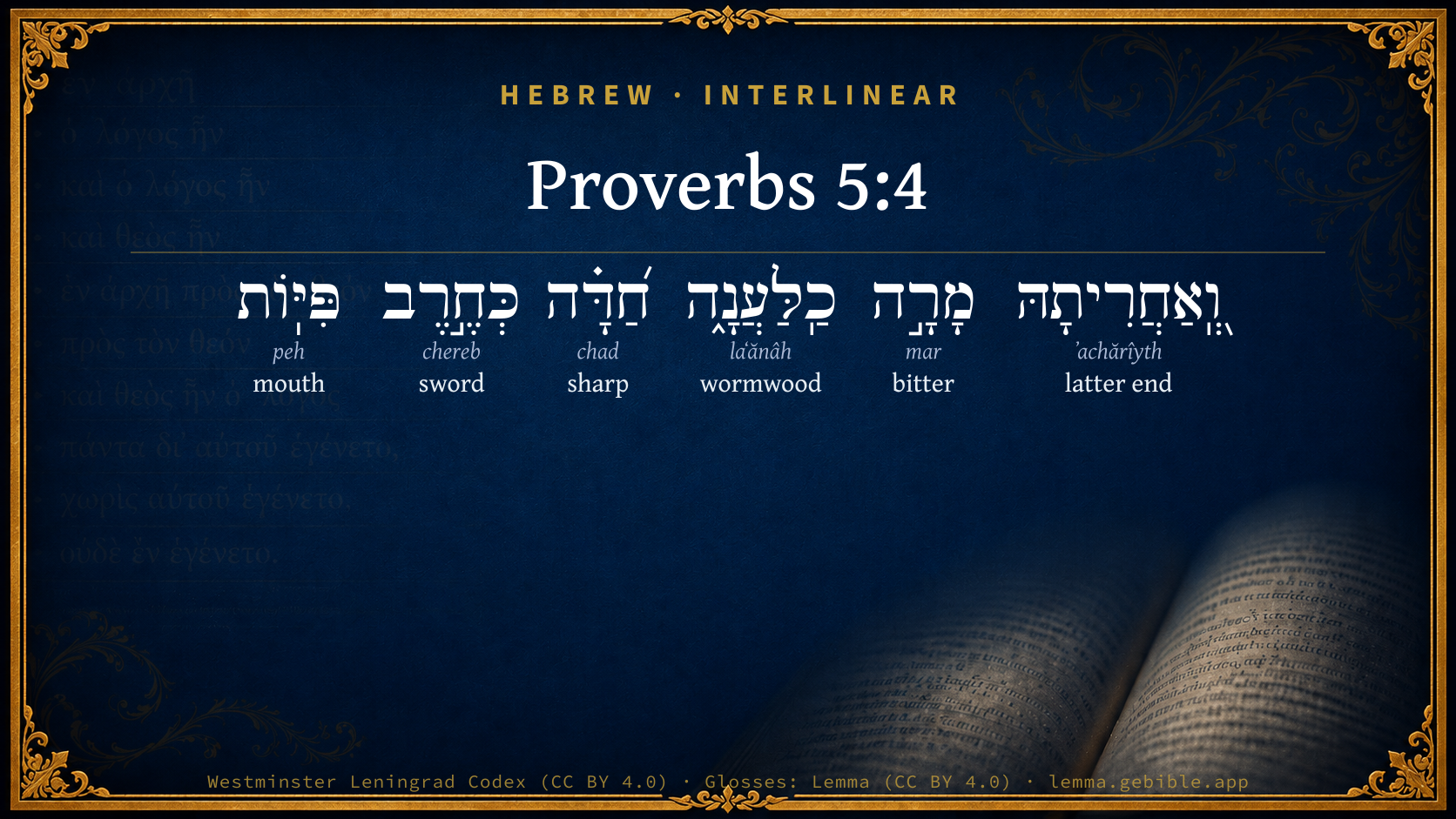
Proverbs 5:4

Hebrew (Westminster Leningrad Codex) Proverbs 5:4 appears in the Hebrew Old Testament. The text above is from the Westminster Leningrad Codex. Each word links to its Strong’s number, a concise gloss, and parsing drawn from the Open Scriptures Hebrew Bible morphology. Click any word for its full Brown-Driver-Briggs (BDB) entry.
Download image
Cite this verse

Proverbs 5:4 (World English Bible). Public Domain. Lemma interlinear Bible study tool, https://lemma.gebible.app/v/proverbs/5/4.

Show BibTeX & RIS
BibTeX
RIS
English Translation
But in the end she is as bitter as wormwood, And as sharp as a two-edged sword.
World English Bible · Public Domain
Download a study sheet

One document with this verse’s original text, its word-by-word gloss line, the meaning frame, cross-references with their text, attributed commentary, and full source and license credits — printable, and it pastes into notes with its structure intact.

This verse Autodidact and up

Study sheet (.html) Plain text (.txt)

A passage Seminary Student

Up to 50 verses in one chapter. A passage sheet keeps up to 6 commentary sources and 12 cross-references per verse, in the order this page ranks them, and says so on the sheet whenever that leaves anything out. Ask for a single verse and you get the Autodidact verse sheet above.

Everything on this page stays free to read, with no account — the sheet is a download of what is already on screen, not access to it.

Want to remove ads? Support Godless Engineer
Compare translations 3

The same verse in 3 English versions, stacked beneath the original-language interlinear above. Click any original word for its lexicon entry.

Each is an independent rendering of the whole verse — the interlinear is not word-aligned to these translations.

Highlighted words mark where these versions differ — a whole-verse word diff, not a word-by-word alignment.

  • World English Bible Public Domain
    But in the end she is as bitter as wormwood, And as sharp as a two-edged sword.
  • King James Version Public Domain
    But her end is bitter as wormwood, sharp as a two-edged sword.
  • unfoldingWord Literal Text CC BY-SA 4.0
    but her aftermath bitter as wormwood, sharp as a sword of mouths.

unfoldingWord Literal Text — © unfoldingWord, licensed CC BY-SA 4.0. Word-aligned USFM3 via Door43 (git.door43.org/unfoldingWord/en_ult).

Versions to compare (up to 4)

3 of 4 selected

Show all 18 translations

Every available English version of this verse, each an independent rendering of the whole verse.

  • World English Bible Public Domain
    But in the end she is as bitter as wormwood, And as sharp as a two-edged sword.
  • Berean Standard Bible Public Domain
    in the end she is bitter as wormwood, sharp as a double-edged sword.
  • Majority Standard Bible Public Domain
    in the end she is bitter as wormwood, sharp as a double-edged sword.
  • King James Version Public Domain
    But her end is bitter as wormwood, sharp as a two-edged sword.
  • American Standard Version (1901) Public Domain
    But in the end she is bitter as wormwood, Sharp as a two-edged sword.
  • Revised Version (1885) Public Domain
    But her latter end is bitter as wormwood, sharp as a two-edged sword.
  • Geneva Bible (1599) Public Domain
    But the end of her is bitter as wormewood, and sharpe as a two edged sworde.
  • Douay-Rheims (1899) Public Domain
    But her end is bitter as wormwood, and sharp as a two-edged sword.
  • Young's Literal Translation Public Domain
    And her latter end `is' bitter as wormwood, Sharp as a sword `with' mouths.
  • Literal Standard Version CC BY-SA 4.0
    And her latter end [is] bitter as wormwood, || Sharp as a sword [with] mouths.
  • Unlocked Literal Bible CC BY-SA 4.0
    but in the end she is as bitter as wormwood, cutting like a sharp sword.
  • unfoldingWord Literal Text CC BY-SA 4.0
    but her aftermath bitter as wormwood, sharp as a sword of mouths.
  • Darby Bible Public Domain
    but her end is bitter as wormwood, sharp as a two-edged sword.
  • World Messianic Bible Public Domain
    but in the end she is as bitter as wormwood, and as sharp as a two-edged sword.
  • Webster's Bible Public Domain
    But her end is bitter as wormwood, sharp as a two-edged sword.
  • Free Bible Version CC BY-SA 4.0
    but in the end what you get from her is the bitterness of wormwood and the sharp pain of being cut with a two-edged sword.
  • Bible in Basic English Public Domain
    But her end is bitter as wormwood, and sharp as a two-edged sword;
  • JPS Tanakh (1917) Public Domain
    But her end is bitter as wormwood, sharp as a two-edged sword.

Literal Standard Version (2020), Covenant Press — licensed CC BY-SA 4.0. Text via the HelloAO Bible API (eBible.org). Unlocked Literal Bible (unfoldingWord) — licensed CC BY-SA 4.0. Text via the HelloAO Bible API (eBible.org). unfoldingWord Literal Text — © unfoldingWord, licensed CC BY-SA 4.0. Word-aligned USFM3 via Door43 (git.door43.org/unfoldingWord/en_ult). Free Bible Version, Dr. Jonathan Gallagher — licensed CC BY-SA 4.0. Text via the HelloAO Bible API (eBible.org).

Word by word

More ways to search: Search by grammar → Find every occurrence → Compare this word →

Practice this passage: Drill this verse → Learn its vocabulary →

About this verse

These counts appear in no published source. They are computed here, from the morphology-tagged text and Lemma’s own curated glosses. What Lemma adds →

6
words
6
distinct lemmas
Wisdom
section

Notable vocabulary

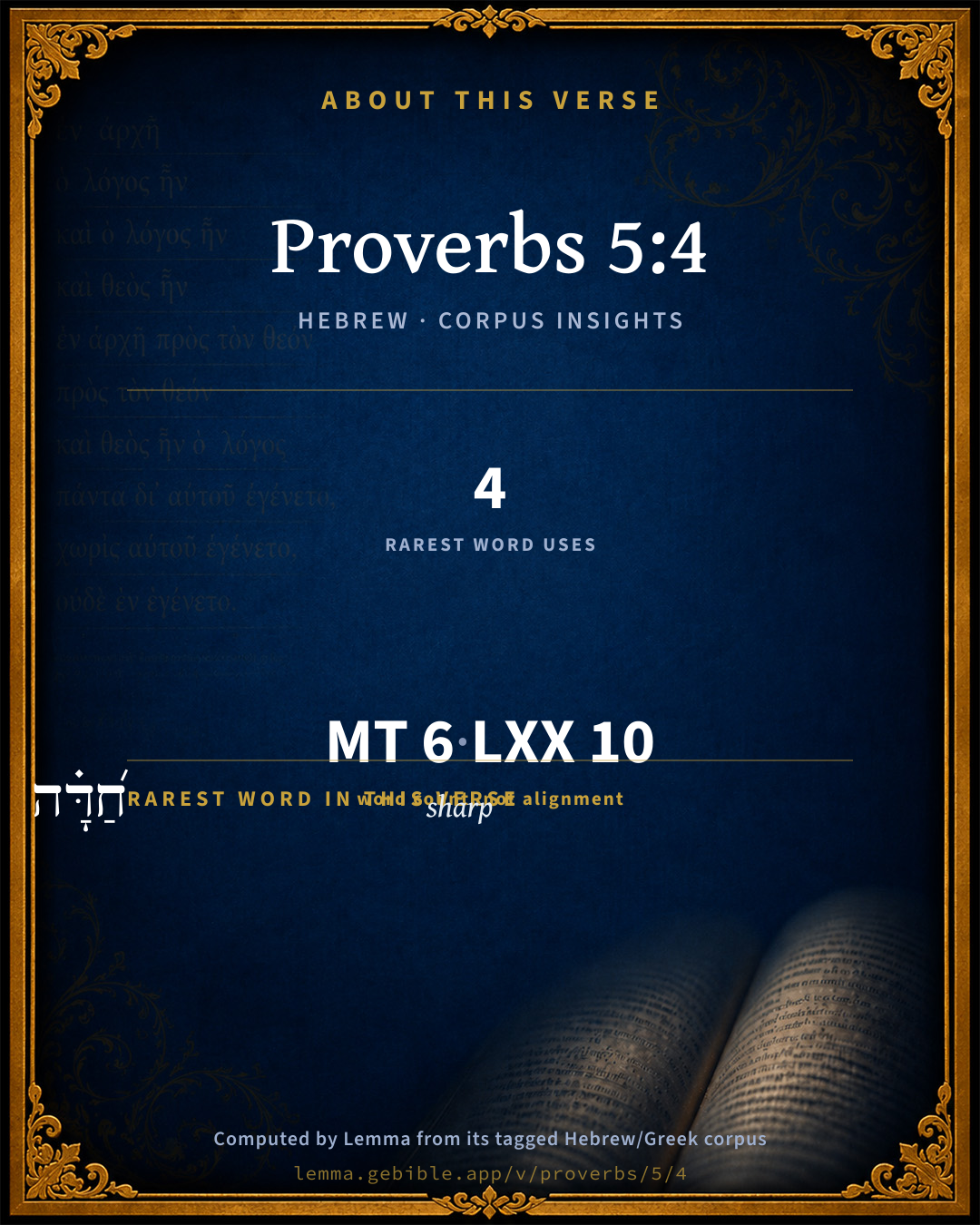
The rarest word here is חַ֝דָּ֗ה sharp H2299 — appearing just 4 times in the whole Hebrew Bible.

Shared distinctive vocabulary

חַ֝דָּ֗ה sharp H2299 occurs in 4 verses of the Hebrew Bible. Also found in:

Grammatical profile

  • 4 nouns
  • 2 adjectives

Hebrew & Septuagint length

In English translation the verse runs 17 words from the Hebrew and 16 from the Septuagint (LXX English) — closely comparable.

A rough comparison of the two English renderings, which tokenize alike — not a word-level alignment.

Word counts can differ between the Hebrew and the Greek without any difference in meaning — e.g. the Hebrew direct-object marker אֵת has no separate Greek word, and Greek often adds the article ὁ.

In the original languages it is 6 Hebrew tokens and 10 Greek tokens — but the two are counted differently (Hebrew bundles its prefixes and suffixes into one token; the Greek is in lemma form), so that isn’t a like-for-like length.

Cross-references

11

Topical passages linked to Proverbs 5:4 in the Treasury of Scripture Knowledge — connected by theme and wording, ordered by reader-vote popularity; previews shown in the World English Bible.

  • Ecclesiastes 7:26 I find more bitter than death the woman whose heart is snares and traps, whose hands are chains. Whoever pleases God shall escape from her; but the sinner will be ensnared by her.
  • Psalms 55:21 His mouth was smooth as butter, But his heart was war. His words were softer than oil, Yet they were drawn swords.
  • Psalms 57:4 My soul is among lions. I lie among those who are set on fire, Even the sons of men, whose teeth are spears and arrows, And their tongue a sharp sword.
  • Hebrews 4:12 For the word of God is living, and active, and sharper than any two-edged sword, and piercing even to the dividing of soul and spirit, of both joints and marrow, and is able to discern the thoughts and intentions of the heart.
  • Proverbs 9:18 But he doesn't know that the dead are there, That her guests are in the depths of Sheol.
  • Judges 16:4–6 It came to pass afterward, that he loved a woman in the valley of Sorek, whose name was Delilah.
  • Judges 16:15–21 She said to him, How can you say, I love you, when your heart is not with me? you have mocked me these three times, and have not told me in which your great strength lies.
  • Proverbs 6:24–35 To keep you from the immoral woman, From the flattery of the wayward wife's tongue.
  • Proverbs 7:22–23 He followed her immediately, As an ox goes to the slaughter, As a fool stepping into a noose.
  • Proverbs 23:27–28 For a prostitute is a deep pit; And a wayward wife is a narrow well.
  • Hebrews 12:15–16 looking carefully lest there be any man who falls short of the grace of God; lest any root of bitterness springing up trouble you, and thereby the many be defiled;

Cross-references courtesy of OpenBible.info (CC BY 4.0).

Hebrew and Greek witnesses Masoretic Hebrew ↔ Greek Septuagint

The same verse in the two great witnesses to the Old Testament, shown verse-for-verse.

These are two independent witnesses, not word-aligned to each other, and the Septuagint is shown in lemma (dictionary) form.

Hebrew Proverbs 5:4 Masoretic · Westminster Leningrad Codex

וְֽ֭אַחֲרִיתָהּ מָרָ֣ה כַֽלַּעֲנָ֑ה חַ֝דָּ֗ה כְּחֶ֣רֶב פִּיּֽוֹת

But in the end she is as bitter as wormwood, And as sharp as a two-edged sword.

World English Bible · Public Domain

Greek LXX Proverbs 5:4 Septuagint · lemma form

ὕστερον μέντοι πικρός χολή εὑρίσκω καί ἀκονάω μᾶλλον μάχαιρα δίστομος

but afterwards you will find her more bitter than gall, and sharper than a two-edged sword.

LXX2012 (modern English Septuagint) · Public Domain

On this verse, The Pulpit Commentary discusses the Septuagint’s reading. Read the note in Commentary ↓

Hebrew: Westminster Leningrad Codex (CC BY 4.0). Greek: Septuagint (public domain); English from LXX2012 (modern English Septuagint) (Public Domain). How the Septuagint differs from the Hebrew →

Commentary

Notes on Proverbs 5:4 from classic Christian and Jewish commentators (each source and its license shown beneath its notes). The classic Christian expositions comment on the surrounding passage and are grouped to its opening verse, so a note may address several verses; the Jewish commentaries on the Tanakh (Rashi and others) are per-verse, so they appear only where the commentator wrote on this verse.

Lemma curates 59 commentaries, every one of them public domain or Creative Commons licensed, each selected and text-cleaned for this edition rather than reprinted as found. About our sources →

Trapp's Complete Commentary

John Trapp

Pro 5:4 But her end is bitter as wormwood, sharp as a twoedged sword.

Ver. 4. But her end is bitter as wormwood.] The pleasure passeth, the sting remaineth; for in the froth of this filthy pleasure is bred that hell worm of guilt that never dieth. {a}

“ Principium dulce est, sed finis amoris amarus:

Laeta venire Venus, tristis abire solet. ”

Diana of the Ephesians was so artificially portrayed, that she seemed to smile most pleasantly upon such as came into her temple, but to frown at those that went out. So doth sensual pleasure. Heus tu scholastiae, dulce et amarum gustulum carpis, &c., said the harlot to Apuleius; hark, scholar, it is but a bitter sweet that you are so fond of. {b} Plus aloes quam mellis habet; { c} knowest thou not that there will be bitterness in the end? The chroniclers {d} have observed of our Edward III that he had always fair weather at his passage into France, and foul upon his return. Such is the way of the harlot; the sin committed with her is as the poison of asps. When an asp stings a man, it doth first tickle him so as it makes him laugh, till the poison by little and little get to the heart, and then it pains him more than ever before it delighted him. See Luk 6:25; Luk 16:25 Heb 12:15-16 Job 13:26 Ecc 7:27-28.

{a} In amore multum est amari.

{b} Dulcis acerbitas amarissima voluptas. - Tertul.

{c} Plutarch.

{d} Speed, Walsing.

John Trapp, A Commentary or Exposition upon All the Books of the Old and New Testament (1647–1656) — public domain. Text from a community e-Sword module.

Jamieson, Fausset & Brown

Robert Jamieson, A. R. Fausset & David Brown

her end--literally, "her future," in sense of reward, what follows (compare Psa 37:37; Psa 73:17). Its nature is evinced by the use of figures, opposite those of Pro 5:3. The physical and moral suffering of the deluded profligate are notoriously terrible.

Jamieson, Fausset & Brown — Commentary Critical and Explanatory on the Whole Bible (1871) — public domain (CC PDM 1.0). Text via the HelloAO Bible API.

Adam Clarke's Commentary

Verse 4. Bitter as wormwood] כלענה Kelanah, like the detestable herb wormwood, or something analogous to it: something as excessive in its bitterness, as honey is in its sweetness.

Adam Clarke's Commentary on the Bible (1810–1826) — public domain. Text from a community e-Sword/MySword module.

Ellicott's Commentary for English Readers

(4) Bitter as wormwood.—The absinthium of Rev_8:11, where, apparently, it is considered as a poison. So God’s message to St. John (Rev_10:10) was in his mouth sweet as honey (comp. Psa_19:10), but made his belly bitter: that is, he met with much sorrow and trouble in making it known to men, but through this “much tribulation” (Act_14:22) he “entered into the kingdom of heaven.”

A Bible Commentary for English Readers, edited by Charles John Ellicott (1878–1897) — public domain. Text from a community e-Sword module.

The Cambridge Bible for Schools and Colleges

gen. ed. J. J. S. Perowne

4. wormwood] The reference is perhaps not merely to the bitterness, but to the noxiousness of this herb. See Deu_29:18, and Rev_8:10-11, where “many men died of the waters” into which the star named “wormwood” had fallen.

The Cambridge Bible for Schools and Colleges (gen. ed. J. J. S. Perowne; Cambridge University Press, 1878–1918) — public domain. Text from a community e-Sword module.

John Gill's Exposition

But her end is bitter as wormwood,.... Which is opposed to the honeycomb her lips are said to drop; so that, as Juvenal says (g), "plus aloes quam mellis habet": the end which she brings persons to, or the issue of complying with her, is bitterness; such as loss of credit, substance, and health, remorse of conscience, and fear of death, corporeal and eternal; see Ecc 7:26;

sharp as a twoedged sword; which cuts every way; as committing sin with an harlot hurts both soul and body; and the reflection upon it is very cutting and distressing, and destroys all comfort and happiness. This is the reverse of her soothing and softening speech, which is as oil. Such also will be the sad case of the worshippers of the beast, or whore of Rome; who will gnaw their tongues for pain, and be killed with the twoedged sword that proceedeth out of the mouth of Christ, Rev 16:10.

(g) Satyr. 6. v. 180. "Lingua dicta dulcia dabis, corde amara facilis", Plauti Truculentus, Act. 1. Sc. 1. v. 77. Cistellaria, Act. 1. Sc. 1. v. 70, 71, 72.

John Gill's Exposition of the Whole Bible (1746–1763) — public domain (CC PDM 1.0). Text via the HelloAO Bible API.

Albert Barnes' Notes on the Bible

Wormwood - In Eastern medicine this herb, the absinthium of Greek and Latin botanists, was looked upon as poisonous rather than medicinal. Compare Rev 8:11.

Albert Barnes' Notes on the Bible (1834–1885) — public domain. Text from a community e-Sword/MySword module.

Haydock's Catholic Bible Commentary

Sword. "It is a crime even to hearken." (St. Ambrose, de Abrah. ii. 11.) She seeks thy ruin, ver. 5., and chap. ii. 16.

George Leo Haydock (1774–1849), Haydock's Catholic Family Bible and Commentary, 1859 edition — public domain. Excludes Psalms (Douay-Rheims chapter numbering differs from Protestant) and Deuterocanonical books (Catholic canon only).

Matthew Poole's English Annotations

Her design, and the effect of that lewdness to which she enticeth men, is the sinner’s destruction.

Matthew Poole's English Annotations on the Holy Bible (1683–1685) — public domain. Text from a community e-Sword/MySword module.

Whedon's Commentary on the Bible

Daniel D. Whedon

4. Bitter as wormwood — As the accursed or poisonous herb or root. The ancients regarded this herb, whatever it was, as poisonous. There are sundry passages referring to it as noxious. See Deu_29:18; Heb_12:15; Rev_8:10-11. “Wormwood,” says Zockler, “is a plant about two feet high, belonging to the genus artemesia, (artemesia absinthium,) which produces a very firm stock with many branches, grayish leaves, and small, almost round, pendent blossoms. It has a bitter and saline taste, and seems to have been regarded as a poison.” It was a fitting popular emblem of the results of illicit love. Such love is full of poison, and in the end will be as destructive as a double-edged sword. This is more plainly stated in the following verse.

Daniel D. Whedon (gen. ed.), Commentary on the Old and New Testaments (1874–1909) — public domain. Text from a community e-Sword module.

The Pulpit Commentary

The contrast is drawn with great vividness between the professions of the "strange woman" and the disastrous consequences which overtake those who listen to her enticements. She promises enjoyment, pleasure, freedom from danger, but her end is bitter as wormwood. "Her end," not merely with reference to herself, which may be and is undoubtedly true, but the last of her as experienced by those who have intercourse with her her character as it stands revealed at the last. So it is said of wine, "At the last," i.e. its final effects, if indulged in to excess, "it biteth like a serpent, and stingeth like an adder". (Pro_23:22) Bitter as wormwood. The Hebrew, laanah , "wormwood," Gesenius derives from the unused root laan, "to curse." It is the equivalent to the absinthium of the Vulgate. So Aquila, who has aqinyion . The LXX improperly renders colh , "gall." In other places the word laanah is used as the emblem of bitterness, with the superadded idea of its being poisonous, also according to the Hebrew notion, shared in also by the Greeks, that the plant combined these two qualities. Thus in Deu_29:18 it is associated with rosh, "a poisonful herb" (margin), and the Targum terms it, agreeably with this notion, "deadly wormwood." The same belief is reproduced in Rev_8:11, "And the name of the star is called Wormwood: and many men died of the waters because they were made bitter". (cf. Jer_9:15 Amo_5:7:6:12) The apostle, no doubt, has it in mind when he speaks of any "root of bitterness," in Heb_12:15. The herb is thus described by Umbreit: "It is a plant toward two feet high, belonging to the genus Artemisia (species Artemisia absinthium), which produces a very firm stalk with many branches, grayish leaves, and small, almost round, pendent blossoms. It has a bitter and saline taste, and seems to have been regarded in the East as also a poison, of which the frequent combination with rosh gives an intimation." Terence has a strikingly similar passage to the one before usIn melle sunt linguae sitae vestrae atque orations Lacteque; corda felle sunt lita atque acerbo aceto.

"Your tongues are placed in honey and your speech is milk; your hearts are besmeared with gall and sharp vinegar" ("Trucul.," 1:11. 75). Sharp as a two-edged sword; literally, as a sword of edges (kherev piphiyyoth), which may mean a sword of extreme sharpness. Her end is as sharp as the sharpest sword. But it seems better to take the term as it is understood in the Authorized Version, which has the support both of the Vulgate, gladius biceps, and the LXX, macaira distomov , i.e. "a two-edged sword." Compare "a two-edged sword" (kherev piphiyyoth) of Psa_149:6. The meaning is, the last of her is poignancy of remorse, anguish of heart, and death. In these she involves her victims.

The Pulpit Commentary (1880–1919), ed. H.D.M. Spence-Jones & Joseph S. Exell — public domain. Text from a community e-Sword module.

John Wesley's Explanatory Notes

But - The effect of that to which she entices men, is destruction.

John Wesley, Explanatory Notes Upon the Whole Bible (1754–1765) — public domain. Text via the GEBible commentary corpus.

Lesson kit

Teaching starters — assembled from the data on this page, not authored interpretation. Every prompt links to the verse data it draws on. Edit before teaching.

Proverbs, in the Wisdom, opens this verse with 6 words (6 distinct Hebrew lemmas). Its most distinctive word is chad (“sharp”). A historical commentator’s framing appears above. Read the whole chapter for the surrounding context.

Discussion questions

  1. How does “sharp” (chad) shape what this verse is saying?
  2. Psalms 57:4 shares the word «sharp» with this verse. How do the two illuminate each other?
  3. The translations on this page render this verse differently — a whole-verse word diff, not a word-by-word alignment. What might account for the different wordings?
  4. Reading how Trapp's Complete Commentary and Jamieson, Fausset & Brown read this verse, where do the two commentators agree and where do they part?

Things to notice

Reading settings

Reading text

Shown beneath each verse's original-language words.

Old Testament
Old Testament edition

Read the OT as the Masoretic Hebrew (MT) or the Greek Septuagint (LXX).

English shown for the Greek Septuagint (in the Hebrew ↔ Greek comparison).

Comparing translations? Open the Compare panel on any verse page to stack up to four side by side.