
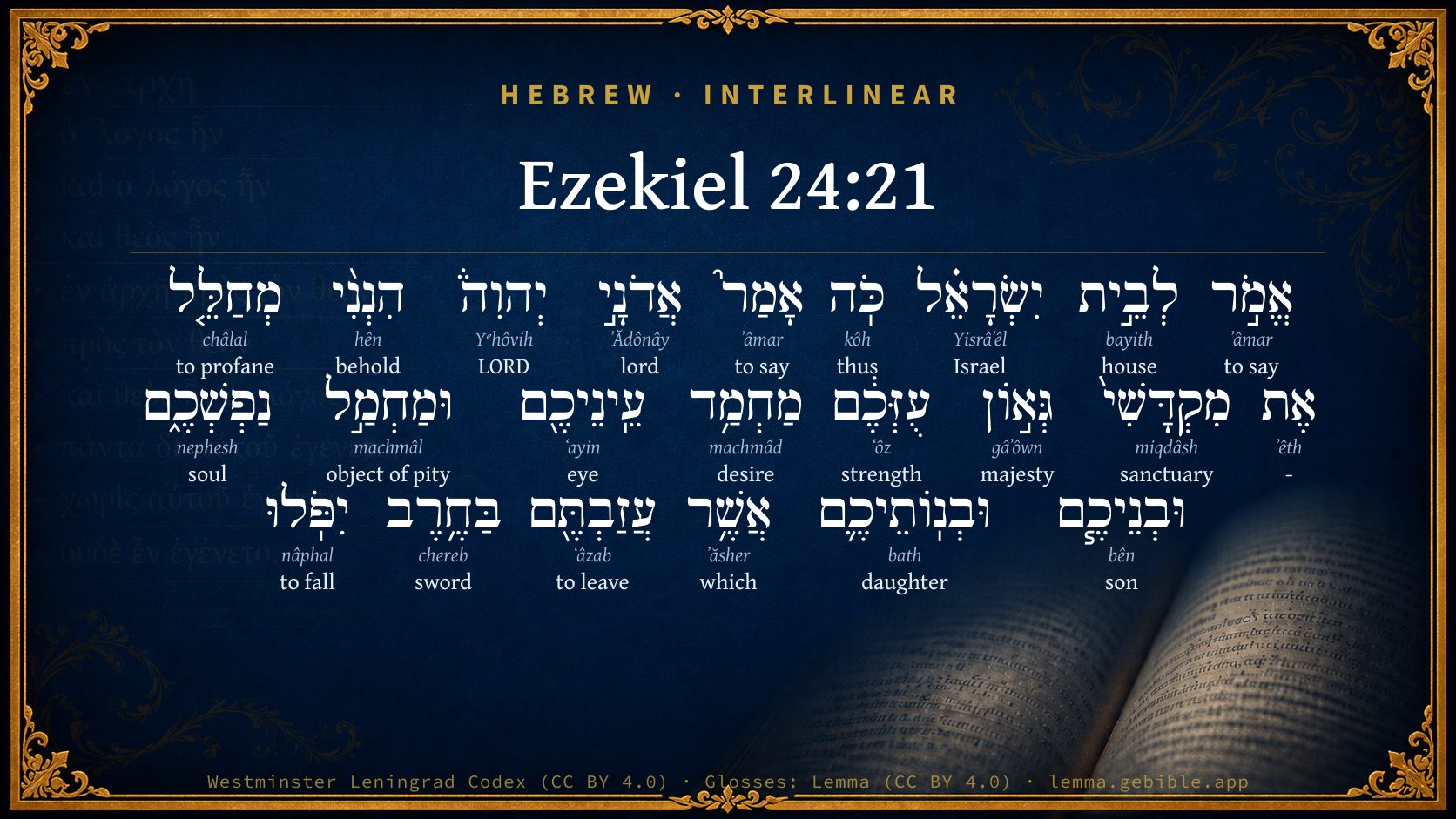
Ezekiel 24:21

Hebrew (Westminster Leningrad Codex) Ezekiel 24:21 appears in the Hebrew Old Testament. The text above is from the Westminster Leningrad Codex. Each word links to its Strong’s number, a concise gloss, and parsing drawn from the Open Scriptures Hebrew Bible morphology. Click any word for its full Brown-Driver-Briggs (BDB) entry.
Download image
Cite this verse

Ezekiel 24:21 (World English Bible). Public Domain. Lemma interlinear Bible study tool, https://lemma.gebible.app/v/ezekiel/24/21.

Show BibTeX & RIS
BibTeX
RIS
English Translation
Speak to the house of Israel, Thus says the Lord Yahweh: Behold, I will profane my sanctuary, the pride of your power, the desire of your eyes, and that which your soul pities; and your sons and your daughters whom you have left behind shall fall by the sword.
World English Bible · Public Domain
Highlights
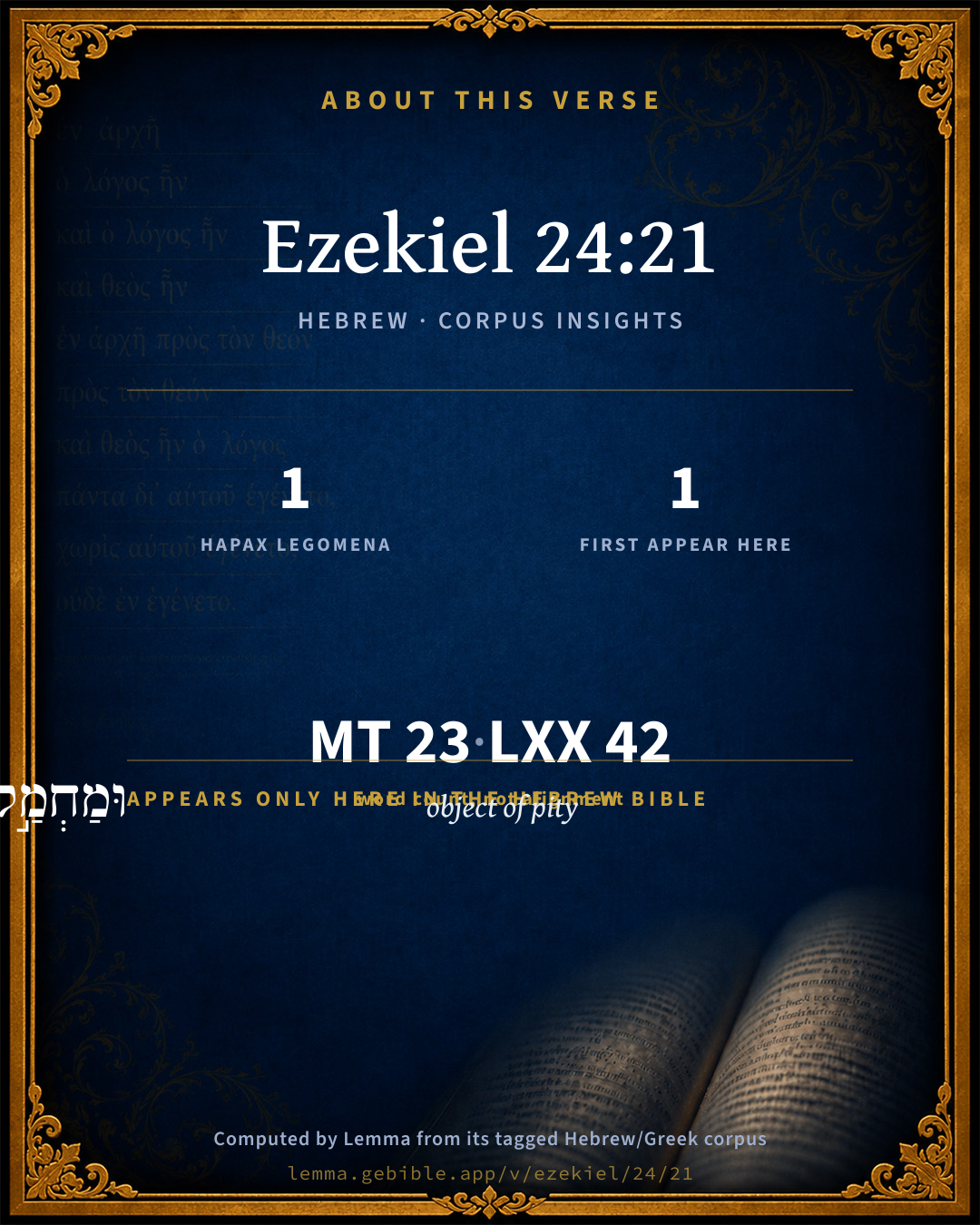
  • 1 hapax legomenon — only here in the Hebrew Bible
  • 1 first appearance in the Hebrew Bible
Full analysis ↓
Download a study sheet

One document with this verse’s original text, its word-by-word gloss line, the meaning frame, cross-references with their text, attributed commentary, and full source and license credits — printable, and it pastes into notes with its structure intact.

This verse Autodidact and up

Study sheet (.html) Plain text (.txt)

A passage Seminary Student

Up to 50 verses in one chapter. A passage sheet keeps up to 6 commentary sources and 12 cross-references per verse, in the order this page ranks them, and says so on the sheet whenever that leaves anything out. Ask for a single verse and you get the Autodidact verse sheet above.

Everything on this page stays free to read, with no account — the sheet is a download of what is already on screen, not access to it.

Want to remove ads? Support Godless Engineer
Compare translations 3

The same verse in 3 English versions, stacked beneath the original-language interlinear above. Click any original word for its lexicon entry.

Each is an independent rendering of the whole verse — the interlinear is not word-aligned to these translations.

Highlighted words mark where these versions differ — a whole-verse word diff, not a word-by-word alignment.

  • World English Bible Public Domain
    Speak to the house of Israel, Thus says the Lord Yahweh: Behold, I will profane my sanctuary, the pride of your power, the desire of your eyes, and that which your soul pities; and your sons and your daughters whom you have left behind shall fall by the sword.
  • King James Version Public Domain
    Speak unto the house of Israel, Thus saith the Lord GOD; Behold, I will profane my sanctuary, the excellency of your strength, the desire of your eyes, and that which your soul pitieth; and your sons and your daughters whom ye have left shall fall by the sword.
  • unfoldingWord Literal Text CC BY-SA 4.0
    ‘Say to the house of Israel, the Lord Yahweh says this: Behold! I will desecrate my sanctuary—the pride of your power, the delight of your eyes, and the yearning of your soul, and your sons and your daughters whom you left behind will fall by the sword.

unfoldingWord Literal Text — © unfoldingWord, licensed CC BY-SA 4.0. Word-aligned USFM3 via Door43 (git.door43.org/unfoldingWord/en_ult).

Versions to compare (up to 4)

3 of 4 selected

Show all 18 translations

Every available English version of this verse, each an independent rendering of the whole verse.

  • World English Bible Public Domain
    Speak to the house of Israel, Thus says the Lord Yahweh: Behold, I will profane my sanctuary, the pride of your power, the desire of your eyes, and that which your soul pities; and your sons and your daughters whom you have left behind shall fall by the sword.
  • Berean Standard Bible Public Domain
    Tell the house of Israel that this is what the Lord GOD says: ‘I am about to desecrate My sanctuary, the pride of your power, the desire of your eyes, and the delight of your soul. And the sons and daughters you left behind will fall by the sword.’
  • Majority Standard Bible Public Domain
    Tell the house of Israel that this is what the Lord GOD says: ‘I am about to desecrate My sanctuary, the pride of your power, the desire of your eyes, and the delight of your soul. And the sons and daughters you left behind will fall by the sword.’
  • King James Version Public Domain
    Speak unto the house of Israel, Thus saith the Lord GOD; Behold, I will profane my sanctuary, the excellency of your strength, the desire of your eyes, and that which your soul pitieth; and your sons and your daughters whom ye have left shall fall by the sword.
  • American Standard Version (1901) Public Domain
    Speak unto the house of Israel, Thus saith the Lord Jehovah: Behold, I will profane my sanctuary, the pride of your power, the desire of your eyes, and that which your soul pitieth; and your sons and your daughters whom ye have left behind shall fall by the sword.
  • Revised Version (1885) Public Domain
    Speak unto the house of Israel, Thus saith the Lord GOD: Behold, I will profane my sanctuary, the pride of your power, the desire of your eyes, and that which your soul pitieth; and your sons and your daughters whom ye have left behind shall fall by the sword.
  • Geneva Bible (1599) Public Domain
    Speake vnto the house of Israel, Thus sayth the Lord God, Behold, I will pollute my Sanctuarie, euen the pride of your power, the pleasure of your eyes, and your hearts desire, and your sonnes, and your daughters whom ye haue left, shall fall by the sworde.
  • Douay-Rheims (1899) Public Domain
    Speak to the house of Israel: Thus saith the Lord God: Behold I will profane my sanctuary, the glory of your realm, and the thing that your eyes de sire, and for which your soul feareth: your sons, and your daughters, whom you have left, shall fall by the sword.
  • Young's Literal Translation Public Domain
    Say to the house of Israel: Thus said the Lord Jehovah: Lo, I am polluting My sanctuary, The excellency of your strength, The desire of your eyes, and the pitied of your soul, And your sons and your daughters whom ye have left, by sword they do fall.
  • Literal Standard Version CC BY-SA 4.0
    Say to the house of Israel, Thus said Lord YHWH: Behold, I am defiling My sanctuary, || The excellence of your strength, || The desire of your eyes, and the pitied of your soul, || And your sons and your daughters whom you have left, fall by sword.
  • Unlocked Literal Bible CC BY-SA 4.0
    'Say to the house of Israel, the Lord Yahweh says this: Behold! I will desecrate my sanctuary—the pride of your power, the delight of your eyes, and the yearning of your soul, and your sons and your daughters whom you left behind will fall by the sword.
  • unfoldingWord Literal Text CC BY-SA 4.0
    ‘Say to the house of Israel, the Lord Yahweh says this: Behold! I will desecrate my sanctuary—the pride of your power, the delight of your eyes, and the yearning of your soul, and your sons and your daughters whom you left behind will fall by the sword.
  • Darby Bible Public Domain
    Say unto the house of Israel, Thus saith the Lord Jehovah: Behold, I will profane my sanctuary, the pride of your strength, the desire of your eyes, and your soul's longing; and your sons and your daughters whom ye have left behind shall fall by the sword.
  • World Messianic Bible Public Domain
    ‘Speak to the house of Israel, “The Lord GOD says: ‘Behold, I will profane my sanctuary, the pride of your power, the desire of your eyes, and that which your soul pities; and your sons and your daughters whom you have left behind will fall by the sword.
  • Webster's Bible Public Domain
    Speak to the house of Israel, Thus saith the Lord GOD; Behold, I will profane my sanctuary, the excellence of your strength, the desire of your eyes, and that which your soul pitieth; and your sons and your daughters whom ye have left shall fall by the sword.
  • Free Bible Version CC BY-SA 4.0
    Tell the people of Israel that this is what the Lord God says: I am about to make my sanctuary unclean, this place you're so proud of that you think gives you power, the place you love so much, the place that makes you happy. Your sons and daughters that you left behind will be killed by the sword.
  • Bible in Basic English Public Domain
    Say to the people of Israel, The Lord has said, See, I will make my holy place unclean, the pride of your strength, the pleasure of your eyes, and the desire of your soul; and your sons and daughters, who did not come with you here, will be put to the sword.
  • JPS Tanakh (1917) Public Domain
    Speak unto the house of Israel: Thus saith the Lord GOD: Behold, I will profane My sanctuary, the pride of your power, the desire of your eyes, and the longing of your soul; and your sons and your daughters whom ye have left behind shall fall by the sword.

Literal Standard Version (2020), Covenant Press — licensed CC BY-SA 4.0. Text via the HelloAO Bible API (eBible.org). Unlocked Literal Bible (unfoldingWord) — licensed CC BY-SA 4.0. Text via the HelloAO Bible API (eBible.org). unfoldingWord Literal Text — © unfoldingWord, licensed CC BY-SA 4.0. Word-aligned USFM3 via Door43 (git.door43.org/unfoldingWord/en_ult). Free Bible Version, Dr. Jonathan Gallagher — licensed CC BY-SA 4.0. Text via the HelloAO Bible API (eBible.org).

Word by word

More ways to search: Search by grammar → Find every occurrence → Compare this word →

Practice this passage: Drill this verse → Learn its vocabulary →

וּמַחְמַ֣ל
machmâl
H4263
“and · object of pity of”
Conjunction + Noun, Common, Masculine, Singular, Construct
Part of Speech
Conjunction + Noun
Type
Common
Gender
Masculine
Number
Singular
State
Construct
Full BDB Definition

Origin: from H2550

TWOT: 676b

object of compassion or pity, thing pitied - (TWOT) object of deep love
  1. אֱמֹ֣ר ʼâmar H559 “say” Verb, Qal, Imperative, 2nd Person, Masculine, Singular
  2. לְבֵ֣ית bayith H1004 “to/for · house of” Preposition + Noun, Common, Masculine, Singular, Construct
  3. יִשְׂרָאֵ֗ל Yisrâʼêl H3478 “Israel” Noun, Proper
  4. כֹּֽה kôh H3541 “thus” Adverb
  5. אָמַר֮ ʼâmar H559 “to say” Verb, Qal, Perfect, 3rd Person, Masculine, Singular
  6. אֲדֹנָ֣י ʼĂdônây H136 “Lord · my” Noun, Common, Masculine, Plural, Construct + Suffix, Personal, 1st Person, Common, Singular
  7. יְהוִה֒ Yᵉhôvih H3069 “LORD” Noun, Proper
  8. הִנְנִ֨י hên H2005 “behold · me” Particle, Demonstrative + Suffix, Personal, 1st Person, Common, Singular
  9. מְחַלֵּ֤ל châlal H2490 “profaning” Verb, Piel, Participle Active, Masculine, Singular, Absolute
  10. אֶת ʼêth H853 “-” Particle, Direct Object
  11. מִקְדָּשִׁי֙ miqdâsh H4720 “sanctuary · my” Noun, Common, Masculine, Singular, Construct + Suffix, Personal, 1st Person, Common, Singular
  12. גְּא֣וֹן gâʼôwn H1347 “majesty of” Noun, Common, Masculine, Singular, Construct
  13. עֻזְּכֶ֔ם ʻôz H5797 “strength · your” Noun, Common, Masculine, Singular, Construct + Suffix, Personal, 2nd Person, Masculine, Plural
  14. מַחְמַ֥ד machmâd H4261 “desire of” Noun, Common, Masculine, Singular, Construct
  15. עֵֽינֵיכֶ֖ם ʻayin H5869 “eyes · your” Noun, Common, Both, Dual, Construct + Suffix, Personal, 2nd Person, Masculine, Plural
  16. נַפְשְׁכֶ֑ם nephesh H5315 “soul · your” Noun, Common, Both, Singular, Construct + Suffix, Personal, 2nd Person, Masculine, Plural
  17. וּבְנֵיכֶ֧ם bên H1121 “and · sons · your” Conjunction + Noun, Common, Masculine, Plural, Construct + Suffix, Personal, 2nd Person, Masculine, Plural
  18. וּבְנֽוֹתֵיכֶ֛ם bath H1323 “and · daughters · your” Conjunction + Noun, Common, Feminine, Plural, Construct + Suffix, Personal, 2nd Person, Masculine, Plural
  19. אֲשֶׁ֥ר ʼăsher H834 “which” Particle, Relative
  20. עֲזַבְתֶּ֖ם ʻâzab H5800 “to leave” Verb, Qal, Perfect, 2nd Person, Masculine, Plural
  21. בַּחֶ֥רֶב chereb H2719 “in/at the · sword” Preposition, Determined + Noun, Common, Feminine, Singular, Absolute
  22. יִפֹּֽלוּ nâphal H5307 “to fall” Verb, Qal, Imperfect, 3rd Person, Masculine, Plural

About this verse

These counts appear in no published source. They are computed here, from the morphology-tagged text and Lemma’s own curated glosses. What Lemma adds →

23
words
22
distinct lemmas
Prophets
section

Notable vocabulary

1 hapax legomenon — a word that appears only here in the entire Hebrew Bible:

  • וּמַחְמַ֣ל object of pity H4263

First appearance in Scripture

This word makes its first canonical appearance in the Hebrew Bible here:

  • וּמַחְמַ֣ל object of pity H4263

Shared distinctive vocabulary

מַחְמַ֥ד desire H4261 occurs in 13 verses of the Hebrew Bible. Also found in:

Grammatical profile

  • 5 verbs
  • 14 nouns
  • 1 adverb
  • 3 particles

Verb forms

  • אֱמֹ֣ר Qal · Imperative
  • אָמַר֮ Qal · Perfect
  • מְחַלֵּ֤ל Piel · Participle Active
  • עֲזַבְתֶּ֖ם Qal · Perfect
  • יִפֹּֽלוּ Qal · Imperfect

Repetition

A word recurs within this verse — often emphatic in Hebrew:

  • אֱמֹ֣ר to say H559 ×2

Hebrew & Septuagint length

In English translation the verse runs 49 words from the Hebrew and 48 from the Septuagint (LXX English) — closely comparable.

A rough comparison of the two English renderings, which tokenize alike — not a word-level alignment.

Word counts can differ between the Hebrew and the Greek without any difference in meaning — e.g. the Hebrew direct-object marker אֵת has no separate Greek word, and Greek often adds the article ὁ.

In the original languages it is 23 Hebrew tokens and 42 Greek tokens — but the two are counted differently (Hebrew bundles its prefixes and suffixes into one token; the Greek is in lemma form), so that isn’t a like-for-like length.

Cross-references

21

Topical passages linked to Ezekiel 24:21 in the Treasury of Scripture Knowledge — connected by theme and wording, ordered by reader-vote popularity; previews shown in the World English Bible.

  • Ezekiel 23:47 The company shall stone them with stones, and dispatch them with their swords; they shall kill their sons and their daughters, and burn up their houses with fire.
  • Psalms 27:4 One thing I have asked of Yahweh, that I will seek after, That I may dwell in the house of Yahweh all the days of my life, To see Yahweh's beauty, And to inquire in his temple.
  • Jeremiah 7:14 therefore will I do to the house which is called by my name, in which you trust, and to the place which I gave to you and to your fathers, as I did to Shiloh.
  • Ezekiel 23:25 I will set my jealousy against you, and they shall deal with you in fury; they shall take away your nose and your ears; and your residue shall fall by the sword: they shall take your sons and your daughters; and your residue shall be devoured by the fire.
  • Psalms 84:1 How lovely are your dwellings, Yahweh of Hosts!
  • Jeremiah 6:11 Therefore I am full of the wrath of Yahweh; I am weary with holding in: pour it out on the children in the street, and on the assembly of young men together; for even the husband with the wife shall be taken, the aged with him who is full of days.
  • Jeremiah 16:3–4 For thus says Yahweh concerning the sons and concerning the daughters who are born in this place, and concerning their mothers who bore them, and concerning their fathers who became the father of them in this land:
  • Lamentations 2:6–7 He has violently taken away his tent, as if it were of a garden; he has destroyed his place of assembly: Yahweh has caused solemn assembly and Sabbath to be forgotten in Zion, Has despised in the indignation of his anger the king and the priest.
  • Ezekiel 24:16 Son of man, behold, I take away from you the desire of your eyes with a stroke: yet you shall neither mourn nor weep, neither shall your tears run down.
  • Psalms 74:7 They have burned your sanctuary to the ground. They have profaned the dwelling-place of your Name.
  • Psalms 79:1 God, the nations have come into your inheritance. They have defiled your holy temple. They have laid Jerusalem in heaps.
  • Psalms 96:6 Honor and majesty are before him. Strength and beauty are in his sanctuary.
  • Psalms 105:4 Seek Yahweh and his strength. Seek his face forever more.
  • Psalms 132:8 Arise, Yahweh, into your resting place; You, and the ark of your strength.
  • Isaiah 65:11 But you who forsake Yahweh, who forget my holy mountain, who prepare a table for Fortune, and who fill up mixed wine to Destiny;
  • Jeremiah 9:21 For death is come up into our windows, it is entered into our palaces; to cut off the children from outside, [and] the young men from the streets.
  • Lamentations 1:10 The adversary has spread out his hand on all her pleasant things: For she has seen that the nations are entered into her sanctuary, Concerning whom you did command that they should not enter into your assembly.
  • Ezekiel 7:20–22 As for the beauty of his ornament, he set it in majesty; but they made the images of their abominations [and] their detestable things therein: therefore have I made it to them as an unclean thing.
  • Ezekiel 9:7 He said to them, Defile the house, and fill the courts with the slain: go you forth. They went forth, and struck in the city.
  • Daniel 11:31 Forces shall stand on his part, and they shall profane the sanctuary, even the fortress, and shall take away the continual [burnt offering], and they shall set up the abomination that makes desolate.
  • Acts 6:13–14 and set up false witnesses who said, "This man never stops speaking blasphemous words against this holy place and the law.

Cross-references courtesy of OpenBible.info (CC BY 4.0).

Hebrew and Greek witnesses Masoretic Hebrew ↔ Greek Septuagint

The same verse in the two great witnesses to the Old Testament, shown verse-for-verse.

These are two independent witnesses, not word-aligned to each other, and the Septuagint is shown in lemma (dictionary) form.

Hebrew Ezekiel 24:21 Masoretic · Westminster Leningrad Codex

אֱמֹ֣ר לְבֵ֣ית יִשְׂרָאֵ֗ל כֹּֽה אָמַר֮ אֲדֹנָ֣י יְהוִה֒ הִנְנִ֨י מְחַלֵּ֤ל אֶת מִקְדָּשִׁי֙ גְּא֣וֹן עֻזְּכֶ֔ם מַחְמַ֥ד עֵֽינֵיכֶ֖ם וּמַחְמַ֣ל נַפְשְׁכֶ֑ם וּבְנֵיכֶ֧ם וּבְנֽוֹתֵיכֶ֛ם אֲשֶׁ֥ר עֲזַבְתֶּ֖ם בַּחֶ֥רֶב יִפֹּֽלוּ

Speak to the house of Israel, Thus says the Lord Yahweh: Behold, I will profane my sanctuary, the pride of your power, the desire of your eyes, and that which your soul pities; and your sons and your daughters whom you have left behind shall fall by the sword.

World English Bible · Public Domain

Greek LXX Ezekiel 24:21 Septuagint · lemma form

εἶπον πρός ὁ οἶκος ὁ ἰσραήλ ὅδε λέγω κύριος ἰδού ἐγώ βεβηλόω ὁ ἅγιος ἐγώ φρύαγμα ἰσχύς σύ ἐπιθύμημα ὀφθαλμός σύ καί ὑπέρ ὅς φείδομαι ὁ ψυχή σύ καί ὁ υἱός σύ καί ὁ θυγάτηρ σύ ὅς ἐν καταλείπω ἐν ῥομφαία πίπτω

Say to the house of Israel, Thus says the Lord; Behold, I will profane my sanctuary, the boast of your strength, the desire of your eyes, and for which your souls are concerned; and your sons and your daughters, whom you⌃ have left, shall fall by the sword.

LXX2012 (modern English Septuagint) · Public Domain

Hebrew: Westminster Leningrad Codex (CC BY 4.0). Greek: Septuagint (public domain); English from LXX2012 (modern English Septuagint) (Public Domain). How the Septuagint differs from the Hebrew →

Targum (Aramaic paraphrase)

1

The Targum is the ancient Jewish Aramaic paraphrase of the Hebrew Scriptures — an interpretive translation, not the Hebrew text itself. Onkelos (literal) and Pseudo-Jonathan (expansive) render the Torah, and Jonathan the Prophets. Coverage is partial: where no permissively-licensed English translation exists for a verse, only the Aramaic is shown. This is verse-level text, not a word-by-word alignment to the Hebrew.

  1. Targum Jonathan Prophets (Joshua–Malachi)
    אֲמַר לְבֵית יִשְׂרָאֵל כִּדְנַן אֲמַר יְיָ אֱלֹהִים הָא אֲנָא מַפִיס יַת בֵּית מִקְדָשִׁי יְקָר תּוּקְפְכוֹן רִגְנָא דְעֵינֵיכוֹן וְחִבּוּב נַפְשְׁכוֹן וּבְנֵיכוֹן וּבְנָתֵיכוֹן דִשְׁבַקְתּוּן בְּחַרְבָּא יִתְקַטְלוּן:

    (no public-domain English translation for this verse)

    Targum Jonathan — Aramaic: “Mikraot Gedolot” (public domain). English: “Sefaria Community Translation” (CC0 1.0 (public-domain dedication)); “London "Chaldee Paraphrase," 1871” (public domain). Text via Sefaria.

Commentary

Notes on Ezekiel 24:21 from classic Christian and Jewish commentators (each source and its license shown beneath its notes). The classic Christian expositions comment on the surrounding passage and are grouped to its opening verse, so a note may address several verses; the Jewish commentaries on the Tanakh (Rashi and others) are per-verse, so they appear only where the commentator wrote on this verse.

Lemma curates 59 commentaries, every one of them public domain or Creative Commons licensed, each selected and text-cleaned for this edition rather than reprinted as found. About our sources →

Trapp's Complete Commentary

John Trapp

Eze 24:21 Speak unto the house of Israel, Thus saith the Lord GOD; Behold, I will profane my sanctuary, the excellency of your strength, the desire of your eyes, and that which your soul pitieth; and your sons and your daughters whom ye have left shall fall by the sword.

Ver. 21. Behold, I will profane my sanctuary.] I will put it into the hands of profane persons to be spoiled and polluted, for a punishment of your manifold pollutions of it.

The excellency of your strength.] The Jews had too high a conceit of, and did put too much confidence in, their temple, which therefore they called, as here, the "excellency of their strength," the "desire of their eyes," and that which their soul pitied, animarum indulgentiam. "The temple of the Lord!" they cried; but the Lord of the temple they cared not for. {Jer 7:4}

John Trapp, A Commentary or Exposition upon All the Books of the Old and New Testament (1647–1656) — public domain. Text from a community e-Sword module.

Geneva Bible (1599)

Geneva Bible translators

Wherein you boast and delight.

By sending the Chaldeans to destroy it, as Ezek. 7:22.

Geneva Bible (1599) marginal notes — public domain. Text via Bolls.life.

Jamieson, Fausset & Brown

Robert Jamieson, A. R. Fausset & David Brown

excellency of your strength--(compare Amo 6:8). The object of your pride and confidence (Jer 7:4, Jer 7:10, Jer 7:14).

desire of . . . eyes-- (Psa 27:4). The antitype to Ezekiel's wife (Eze 24:16).

pitieth--loveth, as pity is akin to love: "yearned over."

Profane--an appropriate word. They had profaned the temple with idolatry; God, in just retribution, will profane it with the Chaldean sword, that is, lay it in the dust, as Ezekiel's wife.

sons . . . daughters . . . left--the children left behind in Judea, when the parents were carried away.

Jamieson, Fausset & Brown — Commentary Critical and Explanatory on the Whole Bible (1871) — public domain (CC PDM 1.0). Text via the HelloAO Bible API.

Ellicott's Commentary for English Readers

(21) Profane my sanctuary.—Not merely by its destruction, but by the manner of its destruction, the Gentiles being allowed to enter its most sacred precincts, and carry off in triumph its sacred vessels and treasures. It was in the confidence that God would protect this that the last hope of the Jews lay; He tells them that He will Himself profane it.

A Bible Commentary for English Readers, edited by Charles John Ellicott (1878–1897) — public domain. Text from a community e-Sword module.

The Cambridge Bible for Schools and Colleges

gen. ed. J. J. S. Perowne

21. excellency of your strength] i.e. your proud boast, or, your boasted stronghold (Eze_24:25). The temple is referred to.

that which … pitieth] Or, spareth, i.e. holds dear, Eze_36:21; Job_20:13.

The Cambridge Bible for Schools and Colleges (gen. ed. J. J. S. Perowne; Cambridge University Press, 1878–1918) — public domain. Text from a community e-Sword module.

John Gill's Exposition

And ye shall do as I have done,.... When his wife died, and as he was ordered by the Lord; the meaning of Which they were now inquiring:

ye shall not cover your lips; as a token of mourning; nor use any other of their country rites and ceremonies, for fear of provoking their enemies, in whose hands they shall be:

nor eat the bread of men; or "of mourners", as the Targum; there shall be none to comfort them, or send bread to them; they shall all be alike mourners.

John Gill's Exposition of the Whole Bible (1746–1763) — public domain (CC PDM 1.0). Text via the HelloAO Bible API.

Haydock's Catholic Bible Commentary

Profane, or esteem it no more, (Haydock) but abandon it to the Gentiles. (Calmet) --- Feareth to lose; or on which it rests, ver. 25. (Haydock)

George Leo Haydock (1774–1849), Haydock's Catholic Family Bible and Commentary, 1859 edition — public domain. Excludes Psalms (Douay-Rheims chapter numbering differs from Protestant) and Deuterocanonical books (Catholic canon only).

Matthew Poole's English Annotations

Now he is commissioned to declare the meaning of that he did.

Speak unto the house of Israel; to them at Babylon by word of mouth, but to them at Jerusalem by letter, or messenger.

Profane my sanctuary; cast off, and put into the hands of heathens, who will regard it no more than any other common building, though it is and hath been long my sanctuary; but you, O Jews, first profaned it with your sins, and now, in my just displeasure against you, I will suffer it to be profaned by the Chaldeans.

The excellency of your strength; so it was whilst God’s presence was there, and whilst the Jews kept it undefiled; it was their confidence, and they trusted in it, though they were fallen from God, Jer 7.

The desire of your eyes; as much your desire as my wife was mine, saith the prophet, most dear to you, as she to me, but this shall be burnt.

Your sons and your daughters; the children which survive to you after these grievous calamities, and in whom you hoped for comfort and posterity, shall die by the conqueror’s sword too, Eze 23:47.

Matthew Poole's English Annotations on the Holy Bible (1683–1685) — public domain. Text from a community e-Sword/MySword module.

Whedon's Commentary on the Bible

Daniel D. Whedon

21. I will profane my sanctuary — The prophet’s wife symbolizes Jehovah’s sanctuary, and what the desire of his eyes was to Ezekiel that the temple was to Jehovah and to Israel. No thought of woman in ancient or modern literature is more noble than this. All of these expressions show not only what the temple was to the Israelites, but what his wife was to Ezekiel. Among no other ancient people was the home so sacred that such comparisons could have been properly made. As to the light which this chapter throws upon the character of Ezekiel see introduction to chapter and general Introduction, “Ezekiel’s Personality.”

Daniel D. Whedon (gen. ed.), Commentary on the Old and New Testaments (1874–1909) — public domain. Text from a community e-Sword module.

The Pulpit Commentary

The desire of your eyes. There is something exquisitely pathetic in the iteration of the phrase of Ver. 17. To the priest Ezekiel himself, to the people whom he addressed, the temple was as dear as the wife to the husband. It was also "the pride of their power" (Revised Version), the "pity of their soul" (margin). The former phrase comes from Lev_26:19. When that temple should be profaned, when sons and daughters should fall by the sword, then they would do as the prophet had done. They would learn that there is a sorrow which is too deep for tears, something that passeth show. The state which the prophet describes is not one of callousness, or impenitence, or despair. The people shall mourn for their iniquities;" this will be the beginning of repentance. Lev_26:39, 40 was obviously in the prophet"s thoughts. We note that Ver. 24 is the one solitary passage since Eze_1:3 in which Ezekiel names himself. As single acts and gestures had before (Eze_4:1-12) been a sign of what was coming, so now the man himself was to be in that hour of bereavement.

The Pulpit Commentary (1880–1919), ed. H.D.M. Spence-Jones & Joseph S. Exell — public domain. Text from a community e-Sword module.

John Wesley's Explanatory Notes

Profane - Cast off, and put into the hands of Heathens. The excellency of your strength - So it was while God's presence was there. The desire - As much your desire, as my wife was mine; most dear to you.

John Wesley, Explanatory Notes Upon the Whole Bible (1754–1765) — public domain. Text via the GEBible commentary corpus.

Rashi

Rabbi Shlomo Yitzchaki (Rashi)

whom you have left over in Jerusalem, when you went out into exile.

Rashi on the Tanakh — English translations: “The Judaica Press complete Tanach with Rashi, translated by A. J. Rosenberg” (CC BY 4.0); “Pentateuch with Rashi's commentary by M. Rosenbaum and A.M. Silbermann, 1929-1934” (public domain); “The Metsudah Tanach series, Lakewood, N.J” (CC BY 4.0); and “The Book of Joshua, Metsudah Publications, 1997” (CC BY 4.0). Text via Sefaria.

Lesson kit

Teaching starters — assembled from the data on this page, not authored interpretation. Every prompt links to the verse data it draws on. Edit before teaching.

Ezekiel, in the Prophets, opens this verse with 23 words (22 distinct Hebrew lemmas). Its most distinctive word is machmâl (“object of pity”). A historical commentator’s framing appears above. Read the whole chapter for the surrounding context.

Discussion questions

  1. The word machmâl carries the sense “object of pity.” How does it shape the verse?
  2. This verse holds 1 word here found nowhere else in the Hebrew Bible. What might the rare word draw attention to?
  3. The word “object of pity” first appears here in Scripture. What is being introduced at this debut?
  4. 1 Kings 20:6 shares the word «desire» with this verse. How do the two illuminate each other?
  5. “to say” occurs 2× in this one verse. What is the effect of the repetition?
  6. These translations render this verse differently. What is at stake in choosing one wording over another?
  7. The verb «אֱמֹ֣ר» is Qal Imperative. How does its form color the action?
  8. Reading how Trapp's Complete Commentary and Geneva Bible (1599) read this verse, where do the two commentators agree and where do they part?

Things to notice

  • 1 word in this verse appears nowhere else in the Hebrew Bible.
  • 1 word makes its first canonical appearance in Scripture here.
  • This verse counts 23 Hebrew ↔ 42 Greek words.
  • These translations choose different wording for 24 words in this verse.
  • “to say” occurs 2× in this single verse.

Reading settings

Reading text

Shown beneath each verse's original-language words.

Old Testament
Old Testament edition

Read the OT as the Masoretic Hebrew (MT) or the Greek Septuagint (LXX).

English shown for the Greek Septuagint (in the Hebrew ↔ Greek comparison).

Comparing translations? Open the Compare panel on any verse page to stack up to four side by side.