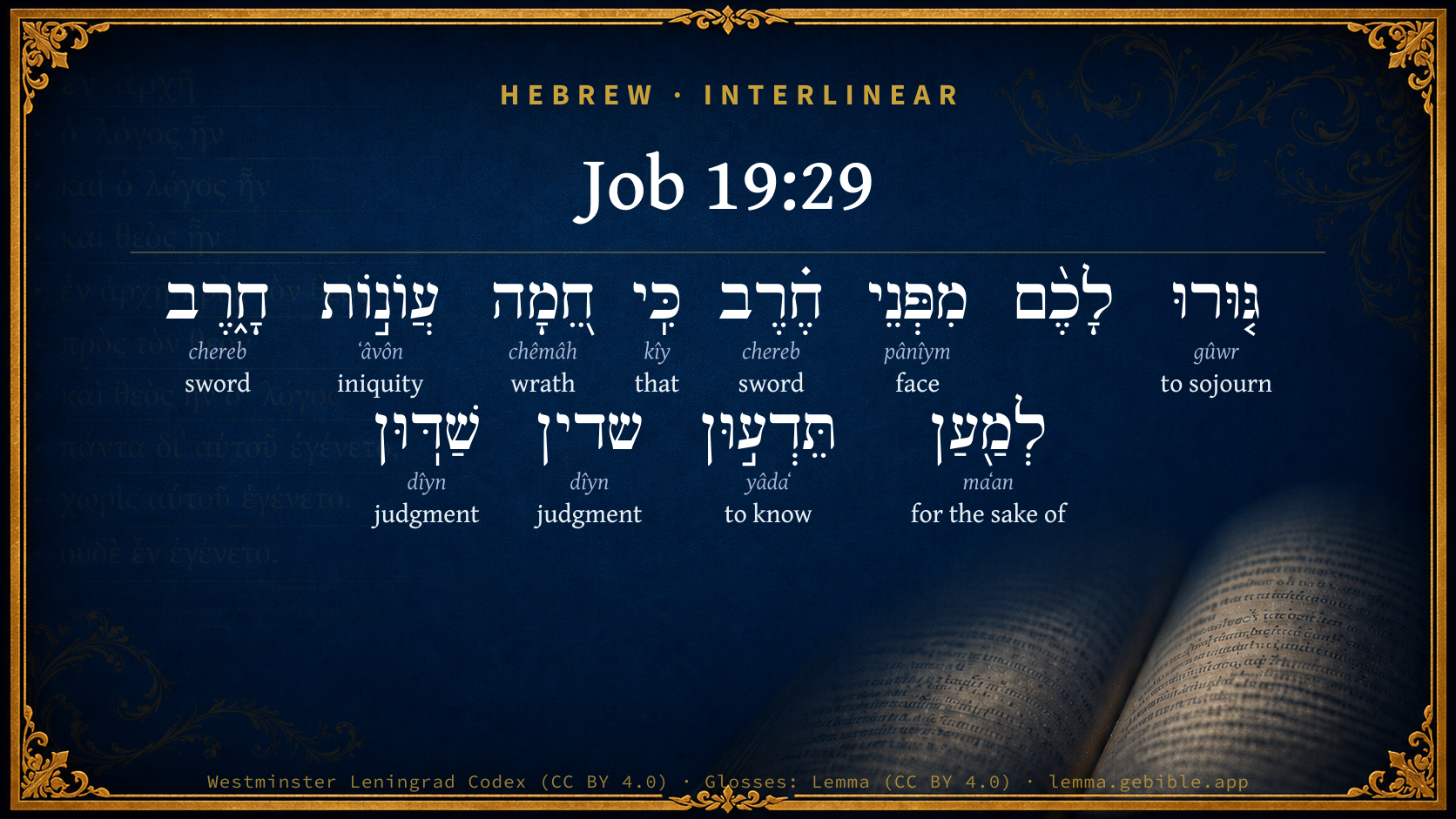
Job 19:29

Hebrew (Westminster Leningrad Codex) Job 19:29 appears in the Hebrew Old Testament. The text above is from the Westminster Leningrad Codex. Each word links to its Strong’s number, a concise gloss, and parsing drawn from the Open Scriptures Hebrew Bible morphology. Click any word for its full Brown-Driver-Briggs (BDB) entry.
Download image
Cite this verse

Job 19:29 (World English Bible). Public Domain. Lemma interlinear Bible study tool, https://lemma.gebible.app/v/job/19/29.

Show BibTeX & RIS
BibTeX
RIS
English Translation
Be afraid of the sword, For wrath brings the punishments of the sword, That you may know there is a judgment."
World English Bible · Public Domain
Download a study sheet

One document with this verse’s original text, its word-by-word gloss line, the meaning frame, cross-references with their text, attributed commentary, and full source and license credits — printable, and it pastes into notes with its structure intact.

This verse Autodidact and up

Study sheet (.html) Plain text (.txt)

A passage Seminary Student

Up to 50 verses in one chapter. A passage sheet keeps up to 6 commentary sources and 12 cross-references per verse, in the order this page ranks them, and says so on the sheet whenever that leaves anything out. Ask for a single verse and you get the Autodidact verse sheet above.

Everything on this page stays free to read, with no account — the sheet is a download of what is already on screen, not access to it.

Want to remove ads? Support Godless Engineer
Compare translations 3

The same verse in 3 English versions, stacked beneath the original-language interlinear above. Click any original word for its lexicon entry.

Each is an independent rendering of the whole verse — the interlinear is not word-aligned to these translations.

Highlighted words mark where these versions differ — a whole-verse word diff, not a word-by-word alignment.

  • World English Bible Public Domain
    Be afraid of the sword, For wrath brings the punishments of the sword, That you may know there is a judgment."
  • King James Version Public Domain
    Be ye afraid of the sword: for wrath bringeth the punishments of the sword, that ye may know there is a judgment.
  • unfoldingWord Literal Text CC BY-SA 4.0
    be afraid for yourselves of the face of the sword, for wrath the punishment of the sword, so that you will know that there is judgment.”

unfoldingWord Literal Text — © unfoldingWord, licensed CC BY-SA 4.0. Word-aligned USFM3 via Door43 (git.door43.org/unfoldingWord/en_ult).

Versions to compare (up to 4)

3 of 4 selected

Show all 18 translations

Every available English version of this verse, each an independent rendering of the whole verse.

  • World English Bible Public Domain
    Be afraid of the sword, For wrath brings the punishments of the sword, That you may know there is a judgment."
  • Berean Standard Bible Public Domain
    then you should fear the sword yourselves, because wrath brings punishment by the sword, so that you may know there is a judgment.”
  • Majority Standard Bible Public Domain
    then you should fear the sword yourselves, because wrath brings punishment by the sword, so that you may know there is a judgment.”
  • King James Version Public Domain
    Be ye afraid of the sword: for wrath bringeth the punishments of the sword, that ye may know there is a judgment.
  • American Standard Version (1901) Public Domain
    Be ye afraid of the sword: For wrath `bringeth' the punishments of the sword, That ye may know there is a judgment.
  • Revised Version (1885) Public Domain
    Be ye afraid of the sword: for wrath bringeth the punishments of the sword, that ye may know there is a judgment.
  • Geneva Bible (1599) Public Domain
    Be ye afraide of the sworde: for the sworde will be auenged of wickednesse, that yee may knowe that there is a iudgement.
  • Douay-Rheims (1899) Public Domain
    Flee then from the face of the sword, for the sword is the revenger of iniquities: and know ye that there is judgment.
  • Young's Literal Translation Public Domain
    Be ye afraid because of the sword, For furious `are' the punishments of the sword, That ye may know that `there is' a judgment.
  • Literal Standard Version CC BY-SA 4.0
    Be afraid because of the sword, || For the punishments of the sword [are] furious, || That you may know that [there is] a judgment.”
  • Unlocked Literal Bible CC BY-SA 4.0
    then be afraid of the sword, because wrath brings the punishment of the sword, so that you may know there is a judgment.”
  • unfoldingWord Literal Text CC BY-SA 4.0
    be afraid for yourselves of the face of the sword, for wrath the punishment of the sword, so that you will know that there is judgment.”
  • Darby Bible Public Domain
    Be ye yourselves afraid of the sword! for the sword is fury against misdeeds, that ye may know there is a judgment.
  • World Messianic Bible Public Domain
    be afraid of the sword, for wrath brings the punishments of the sword, that you may know there is a judgment.”
  • Webster's Bible Public Domain
    Be ye afraid of the sword: for wrath bringeth the punishments of the sword, that ye may know there is a judgment.
  • Free Bible Version CC BY-SA 4.0
    You yourselves should fear being punished by God, for you know anger brings God's punishment that accompanies judgment.”
  • Bible in Basic English Public Domain
    Be in fear of the sword, for the sword is the punishment for such things, so that you may be certain that there is a judge.
  • JPS Tanakh (1917) Public Domain
    Be ye afraid of the sword; for wrath bringeth the punishments of the sword, that ye may know there is a judgment.

Literal Standard Version (2020), Covenant Press — licensed CC BY-SA 4.0. Text via the HelloAO Bible API (eBible.org). Unlocked Literal Bible (unfoldingWord) — licensed CC BY-SA 4.0. Text via the HelloAO Bible API (eBible.org). unfoldingWord Literal Text — © unfoldingWord, licensed CC BY-SA 4.0. Word-aligned USFM3 via Door43 (git.door43.org/unfoldingWord/en_ult). Free Bible Version, Dr. Jonathan Gallagher — licensed CC BY-SA 4.0. Text via the HelloAO Bible API (eBible.org).

Word by word

More ways to search: Search by grammar → Find every occurrence → Compare this word →

Practice this passage: Drill this verse → Learn its vocabulary →

שדין
dîyn
H1779
“who/which · judgment”
Particle, Relative + Noun, Common, Masculine, Singular, Absolute
Part of Speech
Particle + Noun
Type
Common
Gender
Masculine
Number
Singular
State
Absolute
Full BDB Definition

Origin: from H1777

TWOT: 426a

judgment - judgment - cause, plea - condemnation, judgment - dispute, legal suit, strife - government
  1. גּ֤וּרוּ gûwr H1481 “sojourn” Verb, Qal, Imperative, 2nd Person, Masculine, Plural
  2. מִפְּנֵי pânîym H6440 “from · face(s) of” Preposition + Noun, Common, Both, Plural, Construct
  3. חֶ֗רֶב chereb H2719 “sword” Noun, Common, Feminine, Singular, Absolute
  4. כִּֽי kîy H3588 “that” Conjunction
  5. חֵ֭מָה chêmâh H2534 “wrath” Noun, Common, Feminine, Singular, Absolute
  6. עֲוֺנ֣וֹת ʻâvôn H5771 “iniquities of” Noun, Common, Both, Plural, Construct
  7. חָ֑רֶב chereb H2719 “sword” Noun, Common, Feminine, Singular, Absolute
  8. לְמַ֖עַן maʻan H4616 “for the sake of” Preposition
  9. תֵּדְע֣וּן yâdaʻ H3045 “to know” Verb, Qal, Imperfect, 2nd Person, Masculine, Plural + Suffix, n
  10. שַׁדּֽוּן dîyn H1779 “who/which · judgment” Particle, Relative + Noun, Common, Masculine, Singular, Absolute

About this verse

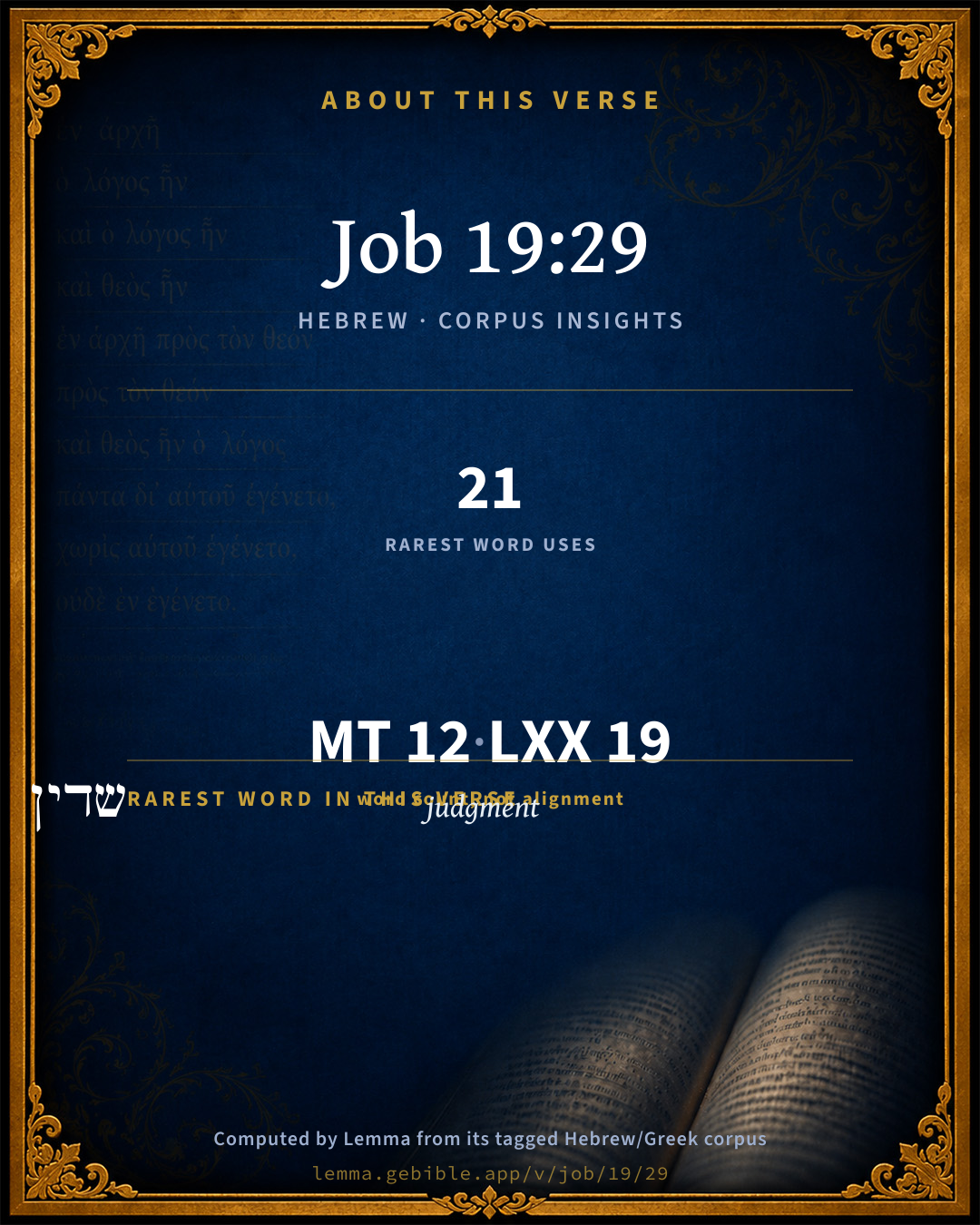
These counts appear in no published source. They are computed here, from the morphology-tagged text and Lemma’s own curated glosses. What Lemma adds →

12
words
9
distinct lemmas
Wisdom
section

Notable vocabulary

The rarest word here is שדין judgment H1779 — appearing just 21 times in the whole Hebrew Bible.

Shared distinctive vocabulary

שדין judgment H1779 occurs in 17 verses of the Hebrew Bible. Also found in:

Grammatical profile

  • 2 verbs
  • 7 nouns
  • 2 prepositions
  • 1 conjunction

Verb forms

  • גּ֤וּרוּ Qal · Imperative
  • תֵּדְע֣וּן Qal · Imperfect

Repetition

Words recur within this verse — often emphatic in Hebrew:

  • חֶ֗רֶב sword H2719 ×2
  • שדין judgment H1779 ×2

Hebrew & Septuagint length

In English translation the verse runs 21 words from the Hebrew and 21 from the Septuagint (LXX English) — the same length.

A rough comparison of the two English renderings, which tokenize alike — not a word-level alignment.

Word counts can differ between the Hebrew and the Greek without any difference in meaning — e.g. the Hebrew direct-object marker אֵת has no separate Greek word, and Greek often adds the article ὁ.

In the original languages it is 12 Hebrew tokens and 19 Greek tokens — but the two are counted differently (Hebrew bundles its prefixes and suffixes into one token; the Greek is in lemma form), so that isn’t a like-for-like length.

Cross-references

11

Topical passages linked to Job 19:29 in the Treasury of Scripture Knowledge — connected by theme and wording, ordered by reader-vote popularity; previews shown in the World English Bible.

  • Ecclesiastes 11:9 Rejoice, young man, in your youth, And let your heart cheer you in the days of your youth, And walk in the ways of your heart, And in the sight of your eyes; But know that for all these things God will bring you into judgment.
  • Ecclesiastes 12:14 For God will bring every work into judgment, with every hidden thing, whether it is good, or whether it is evil.
  • Job 13:7–11 Will you speak unrighteously for God, And talk deceitfully for him?
  • Job 15:22 He doesn't believe that he shall return out of darkness, He is waited for by the sword.
  • Job 22:4 Is it for your piety that he reproves you, That he enters with you into judgment?
  • Psalms 1:5 Therefore the wicked shall not stand in the judgment, Nor sinners in the congregation of the righteous.
  • Psalms 9:7 But Yahweh reigns forever. He has prepared his throne for judgment.
  • Psalms 58:10–11 The righteous shall rejoice when he sees the vengeance. He shall wash his feet in the blood of the wicked;
  • Matthew 7:1–2 "Don't judge, so that you won't be judged.
  • Romans 13:1–4 Let every soul be in subjection to the higher authorities, for there is no authority except from God, and those who exist are ordained by God.
  • James 4:11–12 Don't speak against one another, brothers. He who speaks against a brother and judges his brother, speaks against the law and judges the law. But if you judge the law, you are not a doer of the law, but a judge.

Cross-references courtesy of OpenBible.info (CC BY 4.0).

Hebrew and Greek witnesses Masoretic Hebrew ↔ Greek Septuagint

The same verse in the two great witnesses to the Old Testament, shown verse-for-verse.

These are two independent witnesses, not word-aligned to each other, and the Septuagint is shown in lemma (dictionary) form.

Hebrew Job 19:29 Masoretic · Westminster Leningrad Codex

גּ֤וּרוּ לָכֶ֨ם מִפְּנֵי חֶ֗רֶב כִּֽי חֵ֭מָה עֲוֺנ֣וֹת חָ֑רֶב לְמַ֖עַן תֵּדְע֣וּן שדין שַׁדּֽוּן

Be afraid of the sword, For wrath brings the punishments of the sword, That you may know there is a judgment."

World English Bible · Public Domain

Greek LXX Job 19:29 Septuagint · lemma form

εὐλαβέομαι δή καί σύ ἀπό ἐπικάλυμμα θυμός γάρ ἐπί ἄνομος ἐπιἔρχομαι καί τότε γιγνώσκω ποῦ εἰμί αὐτός ὁ ὕλη

Do you⌃ also beware of deceit: for wrath will come upon transgressors; and then shall they know where their substance is.

LXX2012 (modern English Septuagint) · Public Domain

On this verse, Haydock's Catholic Bible Commentary discusses the Septuagint’s reading. Read the note in Commentary ↓

Hebrew: Westminster Leningrad Codex (CC BY 4.0). Greek: Septuagint (public domain); English from LXX2012 (modern English Septuagint) (Public Domain). How the Septuagint differs from the Hebrew →

Commentary

Notes on Job 19:29 from classic Christian and Jewish commentators (each source and its license shown beneath its notes). The classic Christian expositions comment on the surrounding passage and are grouped to its opening verse, so a note may address several verses; the Jewish commentaries on the Tanakh (Rashi and others) are per-verse, so they appear only where the commentator wrote on this verse.

Lemma curates 59 commentaries, every one of them public domain or Creative Commons licensed, each selected and text-cleaned for this edition rather than reprinted as found. About our sources →

Trapp's Complete Commentary

John Trapp

Job 19:29 Be ye afraid of the sword: for wrath [bringeth] the punishments of the sword, that ye may know [there is] a judgment.

Ver. 29. Be ye afraid of the sword] Heb. Be ye afraid for yourselves, from the face of the sword; God’s sore, and great, and strong sword, Isa 27:1, that hangeth over your heads, as it were, by a twined thread. Oh tremble at God’s judgments, while they hang in the threatenings. He that trembleth not in hearing shall be cut to pieces in feeling, as that martyr said: God’s sword contemneth the rod, Eze 21:13. If Job be under his rod, they that persecute him, under what pretence soever, shall feel the dint of his sword, or of his deep displeasure. Now it is a fearful thing to fall into the punishing hands of the living God. And cruelty toward others, toward his own especially, he will be sure to punish, for he is gracious, Exo 22:27. Fugite ergo a facie gladii, Flee, therefore, from the face of the sword, so the Vulgate rendereth this text. The sword is an instrument of death; it hath its name in Hebrew from laying waste; and the face or faces of the sword, show that Divine vengeance is near at hand. It is a mercy to men that God whets his sword before he smites, and first takes hold on judgment before his judgments take hold on us, Deu 32:41 (Aug. in Psal. XXX.).

For wrath bringeth the punishments of the sword] It is from displeased love that God chastiseth his children; but from fierce wrath that he plagueth his enemies: some of these God punisheth here, lest his provideuce, but not all, lest his patience and promise of judgment, should be called into question.

That we may know that there is judgment] Wherein they that rashly judge others shall be judged by God, Mat 7:1. And this Job’s friends knew well enough, but well weighed not, to scare themselves from rash censurings. He reminds them, therefore, of their danger, and labours to prevent their sorrow, who had so much caused his. See the like in Jer 26:15, in our Saviour, in St Stephen, &c., and learn to be similarly charitable; though your success be no better than Job’s was, upon whom, in lieu of this love, they fell more foul than before, as will appear by their following discourses.

John Trapp, A Commentary or Exposition upon All the Books of the Old and New Testament (1647–1656) — public domain. Text from a community e-Sword module.

Joseph Benson's Commentary

Job 19:29. Be ye afraid of the sword — Of some considerable judgment to be inflicted on you, which is called the sword; as Deu 32:41, and elsewhere. That is, if ye continue to persecute me. So Houbigant understands him, interpreting these words in connection with the preceding, thus: But if ye shall say, Let us persecute him, and devise some cause of accusation against him: then be afraid for yourselves from the threatening sword. Job may be considered, however, as threatening them with punishment on account of their past uncharitable and unrighteous judgment of him, and severe treatment of him. For wrath bringeth the punishment of the sword — That wrath, or fury, which is in your hearts, and breaks forth from your lips against me, deserves and will certainly bring upon you the punishment of the sword, that is, a dreadful judgment from God. The Hebrew word here rendered punishment, עונות, gnavonoth, properly means iniquities, but is sometimes used, by a metonymy, for the punishment of iniquities, which our translators judged was its meaning here. The sense, however, is good, if the word be rendered literally, thus: Wrath (the sin of wrath, or anger against man, especially against one in affliction) bringeth, or implies, iniquities of the sword, that is, iniquities fit to be punished by the sword, or by some eminent judgment. Thus, Job 31:19, An iniquity of the judges, means an iniquity to be punished by the judges, as our translation has it. That ye may know there is a judgment — I give you this admonition, that you may know in time, and may seriously consider it for your good, that there will be a time of judgment, when God will call men to an account for all their hard speeches and miscarriages, and particularly for their rash and uncharitable censures of their brethren, Mat 7:1; Rom 14:4; Jas 4:11; either in this life, or at that last and dreadful day of the general resurrection and judgment, of which I have just spoken. God sees and observes, and will judge all your words and actions, and therefore do not flatter yourselves with vain hopes of impunity.

Joseph Benson's Commentary on the Old and New Testaments (1811–1818) — public domain. Text from a community e-Sword module.

Tyndale Open Study Notes

Tyndale Open Resources

19:29 Given the biblical principles against bearing false witness (13:7-11; see Matt 7:1-2; Jas 4:11-12), Job warned his friends that they should fear God’s judgment. They did eventually face his judgment, but they also received mercy (Job 42:7-8).

Tyndale Open Study Notes — © Tyndale Open Resources, licensed CC BY-SA 4.0. Text via the HelloAO Bible API.

Geneva Bible (1599)

Geneva Bible translators

God will be revenged of this hasty judgment, whereby you condemned me.

Geneva Bible (1599) marginal notes — public domain. Text via Bolls.life.

Jamieson, Fausset & Brown

Robert Jamieson, A. R. Fausset & David Brown

wrath--the passionate violence with which the friends persecuted Job.

bringeth, &c.--literally, "is sin of the of the sword"

that ye may know--Supply, "I say this."

judgment--inseparably connected with the coming of the Vindicator. The "wrath" of God at His appearing for the temporal vindication of Job against the friends (Job 42:7) is a pledge of the eternal wrath at the final coming to glorify the saints and judge their enemies (Th2 1:6-10; Isa 25:8).

Next: Job Chapter 20

Jamieson, Fausset & Brown — Commentary Critical and Explanatory on the Whole Bible (1871) — public domain (CC PDM 1.0). Text via the HelloAO Bible API.

Adam Clarke's Commentary

Verse 29. Be ye afraid of the sword] Of God's judgments.

For wrath bringeth] Such anger as ye have displayed against me, God will certainly resent and punish.

That ye may know there is a judgment.] That ye may know that God will judge the world; and that the unequal distribution of riches and poverty, afflictions and health, in the present life, is a proof that there must be a future judgment, where evil shall be punished and virtue rewarded.

IT would not be fair, after all the discussion of the preceding verses in reference to the two grand opinions and modes of interpretation instituted by learned men, not to inform the reader that a third method of solving all difficulties has been proposed, viz., that Job refers to a Divine conviction which he had just then received, that God would appear in the most evident manner to vindicate his innocence, and give the fullest proofs to his friends and to the world that his afflictions had not been sent as a scourge for his iniquities. Dr. Kennicott was the proposer of this third mode of solving these difficulties, and I shall give his method in his own words.

"These five verses, though they contain but twelve lines, have occasioned controversies without number, as to the general meaning of Job in this place, whether he here expressed his firm belief of a resurrection to happiness after death, or of a restoration to prosperity during the remainder of his life.

"Each of these positions has found powerful as well as numerous advocates; and the short issue of the whole seems to be, that each party has confuted the opposite opinion, yet without establishing its own. For how could Job here express his conviction of a reverse of things in this world, and of a restoration to temporal prosperity, at the very time when he strongly asserts that his miseries would soon be terminated by death? See Job 6:11; Job 7:21; Job 17:11-15; Job 19:10, and particularly in Job 7:7: O remember that my life is wind; mine eye shall no more see good.

"Still less could Job here express a hope full of immortality, which sense cannot be extorted from the words without every violence. And as the possession of such belief is not to be reconciled with Job's so bitterly cursing the day of his birth in Job 3:1-3, so the declaration of such belief would have solved at once the whole difficulty in dispute.

"But if neither of the preceding and opposite opinions can be admitted, if the words are not meant to express Job's belief either of a restoration or of a resurrection, what then are we to do? It does not appear to me that any other interpretation has yet been proposed by the learned; yet I will now venture to offer a third interpretation, different from both the former, and which, whilst it is free from the preceding difficulties, does not seem liable to equal objections.

"The conviction, then, which I suppose Job to express here, is this: That though his dissolution was hastening on amidst the unjust accusations of his pretended friends, and the cruel insults of his hostile relations; and though, whilst he was thus singularly oppressed with anguish of mind, he was also tortured with pains of body, torn by sores and ulcers from head to foot, and sitting upon dust and ashes; yet still, out of that miserable body, in his flesh thus stripped of skin, and nearly dropping into the grave, HE SHOULD SEE GOD, who would appear in his favour, and vindicate THE INTEGRITY of his character. This opinion may perhaps be fairly and fully supported by the sense of the words themselves, by the context, and by the following remarks.

"We read in Job 2:7, that Job was smitten with sore boils from the sole of his foot unto his crown; and Job 2:8, 'He sat down among the ashes.' In Job 7:5, Job says, 'My flesh is clothed with worms, and clods of dust; my skin is broken, and become loathsome.' In Job 16:19: 'Also now, behold, my witness is in heaven, and my record is on high.' Then come the words of Job, Job 19:25-29. And then, in opposition to what Job had just said, that God would soon appear to vindicate him, and that even his accusing friends would acquit him, Zophar says, Job 20:27, that 'the heaven would reveal his iniquity, and the earth would rise up against him.' Lastly, this opinion concerning Job's words, as to God's vindication of him, is confirmed strongly at the end of the book, which records the conclusion of Job's history. His firm hope is here supposed to be that, before his death, he should, with his bodily eyes, see GOD appearing and vindicating his character. And from the conclusion we learn that God did thus appear: Now, says Job, mine eye seeth thee. And then did God most effectually and for ever brighten the glory of Job's fame, by four times calling him HIS SERVANT; and, as his anger was kindled against Job's friends, by speaking to them in the following words: 'Ye have not spoken of me the thing that is right, as my servant Job hath. Go to my servant Job, - and my servant Job shall pray for you, - in that ye have not spoken of me the thing which is right, like my servant Job,' Job 40:7; Job 40:8."

Dr. K. then gives the common version, and proposes the following as a new version: -

Ver. 25. For I know that my Vindicator liveth,

And he at last shall arise over this dust.

26. And after that mine adversaries have mangled me thus,

Even in my flesh shall I see God.

27. Whom I shall see on my side;

And mine eyes shall behold, but not estranged from me:

All this have I made up in mine bosom.

28. Verily ye shall say, Why have we persecuted him;

Seeing the truth of the matter is found with him?

29. Tremble for yourselves at the face of the sword;

For the sword waxeth hot against iniquities:

Therefore be assured that judgment will take place.

KENNICOTT'S Remarks on Select Passages of Scripture, p. 165.

There is something very plausible in this plan of Dr. Kennicott; and in the conflicting opinions relative to the meaning of this celebrated and much controverted passage, no doubt some will be found who will adopt it as a middle course. The theory, however, is better than some of the arguments by which it is supported. Yet had I not been led, by the evidence mentioned before, to the conclusion there drawn, I should probably have adopted Dr. K.'s opinion with some modification: but as to his new version, it is what I am persuaded the Hebrew text can never bear. It is even too loose a paraphrase of the original, as indeed are most of the new versions of this passage. Dr. Kennicott says, that such a confidence as those cause Job to express, who make him speak concerning the future resurrection, ill comports with his cursing so bitterly the day of his birth, c. But this objection has little if any strength, when we consider that it is not at all probable that Job had this confidence any time before the moment in which he uttered it: it was then a direct revelation, nothing of which he ever had before, else he had never dropped those words of impatience and irritation which we find in several of his speeches. And this may be safely inferred from the consideration, that after this time no such words escaped his lips: he bears the rest of his sufferings with great patience and fortitude and seems to look forward with steady hope to that day in which all tears shall be wiped away from off all faces, and it be fully proved that the Judge of all the earth has done right.

Adam Clarke's Commentary on the Bible (1810–1826) — public domain. Text from a community e-Sword/MySword module.

Ellicott's Commentary for English Readers

(29) Be ye afraid . . .—Job threatens his friends with that condign punishment of which they regarded him as a conspicuous example.

A Bible Commentary for English Readers, edited by Charles John Ellicott (1878–1897) — public domain. Text from a community e-Sword module.

The Cambridge Bible for Schools and Colleges

gen. ed. J. J. S. Perowne

29. for wrath bringeth the punishments of the sword] This translation seems to assume that “wrath” here is that of men, such wrath as Job’s friends shewed towards him. But the word is too strong to be taken in this sense. The Divine “wrath” or fury is meant. The phrase “punishments of the sword” means most naturally, the punishments inflicted by the sword. The whole expression would thus mean, for wrath (i. e. in wrath, or, wrathful) are the punishments of the sword—the “sword” being as before God’s judicial sword. Others render, “transgressions of the sword,” i. e. such transgressions as bring down the Divine sword; but the phrase “transgressions of the sword are wrath,” i. e. have to bear wrath as their reward or chastisement, (Delitzsch) is exceedingly cumbrous.

that … there is a judgment] The reference is not to any final or general judgment, but to the fact that God does in truth judge and punish injustice, such as the friends were guilty of; cf. Job_13:10 seq. The translation assumes a form of the relative conjunction that which nowhere else occurs in the Book of Job, and there may be some fault in the text. Ewald and others by a slight change of spelling obtain the meaning, that ye may know the Almighty.

The Cambridge Bible for Schools and Colleges (gen. ed. J. J. S. Perowne; Cambridge University Press, 1878–1918) — public domain. Text from a community e-Sword module.

Albert Barnes' Notes on the Bible

Be ye afraid of the sword - Of the sword of justice, of the wrath of God. In taking such views, and using such language, you ought to dread the vengeance of God, for he will punish the guilty.

For wrath bringeth the punishments of the sword - The word “bringeth” is supplied by the translators, and as it seems to me improperly. The idea is, that wrath or anger such as they had manifested, was proper for punishment; that such malice as they had shown was a crime that God would not suffer to escape unpunished. They had, therefore, everything to dread. Literally, it is, “for wrath the iniquities of the sword;” that is, wrath is a crime for the sword.

That ye may know that there is a judgment - That there is justice; that God punishes injuries done to the character, and that he will come forth to vindicate his friends. Probably Job anticipated that when God should come forth to vindicate “him,” he would inflict exemplary punishment on “them;” and that this would be not only by words, but by some heavy judgment, such as he had himself experienced. The vindication of the just is commonly attended with the punishment of the unjust; the salvation of the friends of God is connected with the destruction of his foes. Job seems to have anticipated this in the case of himself and his friends; it will certainly occur in the great day when the affairs of this world shall be wound up in the decisions of the final judgment. See Matt. 25.

Albert Barnes' Notes on the Bible (1834–1885) — public domain. Text from a community e-Sword/MySword module.

Haydock's Catholic Bible Commentary

Know. Septuagint, "And then they shall know that their power is nowhere;" or, "where is their substance?" (Grabe) (Haydock) --- Job menaces his friends with God’s judgments, as they had done him. (Calmet)

George Leo Haydock (1774–1849), Haydock's Catholic Family Bible and Commentary, 1859 edition — public domain. Excludes Psalms (Douay-Rheims chapter numbering differs from Protestant) and Deuterocanonical books (Catholic canon only).

Matthew Poole's English Annotations

Of the sword, i.e. of some considerable judgment to be inflicted on you, which is called the sword; as Deu 32:41, and oft elsewhere. Do not please yourselves with such pretences and crafty evasions, as if the blame were wholly in me, not in you: God will not be mocked by you; he sees and will punish your most unrighteous and uncharitable judgment of me, and dealing with me.

Wrath bringeth the punishment of the sword: for that wrath or fury which is in your hearts, and breaks out of your lips against me, doth deserve, and will certainly bring upon you, the punishment (Heb. punishments or iniquities; but iniquity is oft put for punishment)

of the sword, i.e. a dreadful judgment from God. Or without any supplement, except that which is generally understood,

for wrath (that sin of wrath or rage against a man, especially against one in affliction) is an iniquity (Heb. iniquities, the plural number being used by way of aggravation; as Psa 73:22, and elsewhere: or, of the iniquities; the Hebrew prefix mem being here understood, as it is in many other places)

of the sword, i.e. one of those iniquities which use to be, or are fit to be, punished by the Sword, i.e. by some eminent judgment; as Job 31:11, an iniquity of the judges, is an iniquity to be punished by the judges, as our translation hath it. That ye may know: the sense is either,

1. This admonition I now give you, that you may know it in time, and for your good, that you may seriously consider and prevent it. Or,

2. This judgment will come upon you, that you may be taught by your own sad and costly experience what you would not learn without it. That there is a judgment, i.e. that there will be a time of judgment, when God will call men to an account for all their hard speeches and miscarriages, and particularly for their rash and uncharitable censures of their brethren, Mat 7:1; Rom 14:4; Jam 4:11, either in this life, or at that last and dreadful day of the general resurrection (of which he spoke Job 19:25, &c.) and judgment. God sees, and observes, and will judge all your words and actions, and therefore do not flatter yourselves with vain hopes of impunity.

Matthew Poole's English Annotations on the Holy Bible (1683–1685) — public domain. Text from a community e-Sword/MySword module.

Whedon's Commentary on the Bible

Daniel D. Whedon

29. Be ye afraid — A continuation (the apodosis) of the preceding verse.

The punishments of the sword — עונות means iniquities, which in this case deserved the punishment of the sword, succinctly called “sins of the sword.” With the Hebrew the sword was the symbol of the divine judgments, (Job_15:22, Deu_32:41; Psa_7:12, etc.) It was also the insignia of the judge, and pointed to the judgment he executed. The last two Hebrew words stand as the equivalent, as well as the outcome of the first, “wrath.” The sense, then, is not far from that of our translators, wrath is, or bringeth, death. By “wrath” Hengstenberg understands that wrath of God, which visits capital misdeeds — those which deserve the sword. See note on Job_36:18. A judgment — שׁדין, a compound word, the first letter of which is an abbreviation of אשׁר, signifying that. Ewald’s objection, that such a compounding of words would be solitary in our book is invalid, since a like use of the pronoun appears once in Deborah’s song, (Jdg_5:7,) and only once besides in the same book, (Jdg_6:17.) Dillmann’s reading, “Almighty,” would require a radical change of the word. Divine judgments await the wrong doer here, and serve as so many indices of the judgment to come. “If there were no other argument for a life to come, SIN would furnish one never to be refuted.” The incomplete punishment of sin in this life necessitates punishment in the next.

EXCURSUS V.

THE INSCRIPTION.

This memorable passage has given rise to more comment, and probably to a greater division of sentiment, than any other in the Old Testament Scriptures. The history of these opinions does not lie within our scope, except to remark in general that the olden faith, that these lines referred to the Messiah and the resurrection of the body, has, to a great extent, given place in modern times to the view that the deliverance was altogether confined to this life, and that the earnest desire of Job was answered by the disclosure of Deity at the end of the debate, a view which is shared by such commentators as Albert Barnes, Stuart, and Noyes. More recent interpreters, however, incline to the opinion that Job speaks of a vision of God after death; though these do not for the most part acknowledge the teaching of a resurrection of the body. The question of Job’s faith in such a resurrection is so closely allied to the other question, of his belief in the existence of the soul after death, that the admission of the one seems quite to involve that of the other. J.J.S. Perowne, who doubts that the passage alludes to an after life, admits, “most certainly if there be any expression here of a hope reaching beyond this world, then there can be no doubt, I think, that Job looks for a resurrection, not merely for a future life.” — HULS. Lec. on Immortality, p. 80.

I. The evidently great importance, in Job’s estimation, of the inscription. Job desires that it should be chiselled into the rock, and in such a manner as to endure forever. The temporal theory, which looks to the vindication of Job’s character and the restoration of his loss, fails to present us an inscription with a purport worthy of such high consideration.

The experience of the Church in all ages proves that the vindication of character in this life, and the restoration of temporal loss, are not of so much consequence in the divine estimate. The Scriptures assume, rather, that loss and ignominy are incidental to the life of the good man, and that restitution and vindication are to take place in the life to come. It is of more importance that the moral government of God in this world should be vindicated; a demand that can be met only in a future life, comprehending within itself redemption for the entire man.

II. The natural impression that the language, literally interpreted, makes upon the mind. Mr. Barnes concedes that the language which is used is such as would properly describe the coming Messiah and the future resurrection of the dead. “This,” he says, “is undoubted, though more so in our translation than in the original; but the original would appropriately express such an expectation.” This may account for the marked unanimity among the ancient interpreters of this passage. Although the Septuagint, in the opinion of some, is of doubtful meaning, its rendering is, “For I know that he is eternal who is about to deliver me, and to raise up upon the earth my skin (the Codex Alexandrinus has σωμα, body) that endures these” (sufferings.) The Targum, the Vulgate, Clemens Romanus, Ephraim, Epiphanius, Augustine, and many others of the fathers; of more recent Continental interpreters, Schultens, J.H. and J.D. Michaelis, Rosenmuller, Kosegarten, Pareau, Welte, and Velthusen; and of English commentators, Adam Clarke, Good, Hales, Carey, Pusey, Wordsworth, and others; have seen in this inscription either a prophecy of, or an allusion to, the resurrection of the dead. The objection that nothing is said in reply to the startling thoughts of Job may be met by the consideration that no reply is made to other startling expressions. as those of a Daysman, (Job_9:33.) hope within sheol, (Job_14:13-16,) and advocacy of God with God, (Job_16:21.) The objection would be equally good against any possible interpretation of the inscription, for there is no direct reference made to it in the replies of the friends. It confessedly stands out alone — a vein of golden ore in the adamantine rock.

In the earlier ages truth was given in fragments. It was isolated, succinct, compressed, not unlike the utterances of oracles. The reader will be reminded of the gospel given in the garden, the prediction by Enoch of a judgment to come, the promise of Shiloh, and the prophecies through the Gentile Balaam. They who thus became agents for the transmission of divine truth may have failed to comprehend it in all its bearings, but the truth is on that account none the less rich and comprehensive. In the living Goel who shall stand upon the dust, Job may not have seen Christ in the fulness of the atonement; nor in the view of God “from the flesh,” have grasped the glories of the resurrection morn; but the essential features of these two cardinal doctrines of Scripture are there, identical with those we now see in greater completeness; even as the outlines of a landscape, however incompletely sketched, are still one with those of the rich and perfected picture.

Dr. Green wisely remarks that “the resurrection of the body was probably not present to Job’s thoughts, certainly not in the form of a general and simultaneous rising from the dead. And yet it is so linked, seminally at least, with our continued spiritual existence, and it is so natural, and even necessary, for us to transfer our ideas of being, drawn from the present state, to the great hereafter, that it may perhaps be truly said that the germs of the resurrection may likewise be detected here.” — The Argument, etc., p. 216.

III. The structure of the language. The keenest dissection of the sentences shows that there is nothing in the words themselves incompatible with a rudimental hope of the resurrection. The exegesis of the present day, as we have seen, accords to them the hope of immortality. The concession, we believe, carries with it the entire bulwark. “When Job says that with his own eyes he shall behold Eloah, it is, indeed, possible by these eyes to understand the eyes of the spirit; but it is just as possible to understand him to mean the eyes of his renewed body… and when Job thinks of himself (Job_19:25) as a mouldering corpse, should he not by his eyes, which shall behold Eloah, mean those which have been dimmed in death, and are now again become capable of seeing?” — Delitzsch, 1:371. Those who reject the doctrine of a resurrection are confronted with serious difficulties in the expressions “from my flesh” and “mine eyes.” They who confine the interpretation to the idea of immortality do grammatical violence to the former of the two expressions, “from my flesh,” (see note, Job_19:26,) — and the tautology is not to be overlooked, since he has just before uttered the words “after my skin” — and at the same time they are constrained to spiritualize the latter — “mine eyes.” Job having spoken once and again of the “I” who shall see God, the expression “mine eyes” appears to be expletive, unless he means the eyes of his body after its death. Then, too, we have “upon the dust,” “after my skin,” and “not another,” each of which expressions are excrescences upon the passage if we accept either the theory of deliverance in this life, or the spiritual beholding of God in the life to come. An insignificant and jejune inscription is the rock on which, an the one side, the temporal theory must split; while on the other, the superfluities in an inscription confessedly epigrammatic, make the Charybdis in which those critics who spiritualize the passage must founder. In other words, if the proposed inscription means merely the present life, it is hardly worth inscribing; if it have no idea of a resurrection it has so much that is superfluous, that it is at war with itself; it seems pruned to the utmost degree, and compacted, and yet at the same time is weighed down with redundancies.

IV. The scope of the context. During the course of the debate, Job has frequently given utterance not only to his despair of life, but to a passionate longing for death, (Job_6:8-12; Job_7:15; Job_10:18-21; Job_17:11-16.) Continued life entails inexpressible wretchedness. Therefore he digs for death more than for hid treasures. The glowing descriptions of brighter days that adorned the discourses of his friends sound to him as words of mockery, (Job_16:20; Job_17:2.) This very chapter speaks of his utter destruction, (Job_19:10.) It is, he stays, like that of a house fallen into ruins or a tree plucked up by the roots. Life no longer enters into his estimate. He had at times caught a glimpse of another life. His eye of faith had seen that the gloom of sheol could not last forever. The voice of God should surely call the sentinel from his dreary post, Job_14:13-16.

We are prepared for any notes of triumph from the welkin of a life to come, and even to see Job “plant the flag of victory over his own grave.” — Delitzsch. But here to talk of mere temporal life, (vain and barren in its best estate,) of compensation for loss, and an avenger of blood, is as much out of place as “the bloating of sheep and the lowing of oxen “at Gilgal. 1Sa_15:14. The view into the dark grave, by contrast reminds him of the view of God on its other side; and site sight of his loathsome body naturally suggests the hope that the time of its renewal should come, and that from his body he should yet see God.

V. The ancient and wide-spread belief in a resurrection, or more properly, a re-vivifying of the body. The objection has been strongly urged against the evangelistic interpretation of this passage that the dogma of a resurrection is of more recent disclosure than the time of Job. This objection now quite disappears beneath the accumulating light of our age.

It now appears that the most ancient of the civilized nations enjoyed high religious light. Frequent discoveries are made of religious truth in what appear most barren fields, which prove to be nuggets of gold from wastes of sand. With almost every Pagan people, the nearer we approach the fountain head of history the purer seems the knowledge of divine things. The history of very ancient nations — and we can hardly except the early Hebrew — records a loss of spiritual truth.

The following hymn, addressed to the mediator, God, (see Excursus iv,) taken from the Assyrian tablets, transmits the faith of the ancient Akkadian and of the later Chaldean-Babylonian on the subject of the resurrection: — “Great lord of the land, king of countries, eldest son of Hea, who dost lead (in their periodic movements) heaven and earth — great lord of the land, king of countries, god of gods, servant of Anna and Moulge, (that is, of heaven and earth,) the merciful one among the gods — the merciful one who dost raise the dead to life: O Silik — mouloukhi, king of heaven and earth, king of Babylon…strengthen heaven and earth… strengthen death and life.… Thou art the favourable Colossus. Thou art he who quickens. Thou art he who makes to prosper — the merciful one among the gods, the merciful one who raises the dead to life.” — LENORMANT, La Magie, etc. Compare George Smith’s Assyrian Discoveries, 202, 203.

In the proximity of Idumaea was another great people with whom the immortality of the soul had ever been a cardinal doctrine of faith. Even if most of the Semitic races of Arabia, Babylonia, and Phenicia, while retaining other spiritual knowledge had lost that of the resurrection of the body, Egypt, it now appears, possessed it, though in a modified form. With the Egyptian, in contradistinction even to the Hebrew, the body was the subject of anxious consideration after death. Its preservation, as all will admit, was for some reason essential to the weal of the soul. (See note, Job_3:14; also BUNSEN, Egypt’s Place, etc., 4:651.) In the fable of Osiris it was taught “that the souls of dead persons, whose bodies had been properly embalmed, descended into hades [the invisible world, see Excursus on Sheol] in the boat of the setting sun; and that after some long period, during which they had many trials to undergo, they would rise again perfectly pure to reunite with the body in the boat of the rising sun. Abydos then took its name, which means ‘the city of the resurrection,’ because at the time it was the highest point up the river to which the valley had been explored, and therefore the place where, according to the fable, the resurgent souls would first reach Egypt. It was, moreover, the doctrine of this fable that Osiris reigned supreme (both as god and king) over the entire destinies of the bodies and souls of the dead. He especially presided over the resurrection. Therefore it was that his city was named Abydos, the city (or place) of the resurrection.” — OSBURN, Monumental History of Egypt, 1:332.

“The deceased was to be resuscitated after this subterranean pilgrimage: the soul was to re-enter the body again to give it movement and life, or, to use the language of Egyptian mythology, the deceased was to arrive finally at the boat of the sun, to be received there by Ra, the scarabaeus god, and to shine with a brightness borrowed from him.” — LENORMANT, Ancient History, 1:321. “In general, the greater part of the funereal ceremonies, the various wrappers of the mummies, the subjects painted on the interior or exterior of the coffins, have reference to the different phases of the resurrection, such as the cessation of the corpse-like rigidity, the reviving of the organs, the return of the soul.” (Ibid., 1:311.) Compare chap. clv and clxix of the Book of the Dead, in the latter of which occurs the prayer, “Make his soul in his body again,’ etc.

The Vedas now satisfy the student that the Aryan race — between whom and the Semitic there was originally intercommunication of religious light as well as perhaps a primeval oneness of language — had some knowledge of a resurrection, though probably not so full and clear as that of the Egyptian and the Assyrian. “It is incontestable,” says Burnouf, (Essai sur le Veda, p. 438,) “that all ancient India believed in the possibility of the resurrection of the dead.” For the formula of the resurrection, see ibid., 436, 437.

The ancient Persian has been supposed by the Rationalists of the day to have been the great depository from which Job gained his ideas of Satanology; and, later, Israel its knowledge of the resurrection. On this account they have been disposed to ascribe a later origin to the book of Job. But the Parsee now seems to have been less enlightened than either the Egyptian or the Assyrian. On the cardinal doctrines just referred to, Job appears to have had fewer points in common with the Persian than with his other neighbours. Those well qualified to form an opinion deny that there are any traces of the resurrection in the Avesta — the sacred books of the Parsee. (See HARDWICK, Christ and other Masters, 2:426.) If Job had not some distinct conception of the revivifying of the dead body, he, the most enlightened of the Gentile world, and evidently possessed of a wide culture, falls below his contemporaries and neighbours, both Egyptian and Assyrian. If he had such knowledge, the words before us — the marvellous inscription — can be interpreted on no other hypothesis than that of a communication of his faith, which infinitely outshone that of any ancient religion whose light still lingers among men. The faith according to which the patriarchs lived and died, (Heb_11:13,) probably embraced a belief in the future reunion of soul and body. Joseph certainly could not have been ignorant of this marked feature of Egyptian lore. This is manifested in his remarkable care for his own mummy, “his bones,” which he commanded to have buried with his brethren in the land of promise and hope. (Heb_11:22.) The sun of a primeval revelation shed its light upon the human race as a whole; and Hebrew, Idumaean, Egyptian, and Assyrian enjoyed its quickening power, though subsequently in different degrees, because of the darkening and destructive influences of idolatry, into which some of them sank. If the seventh from Adam, of a line prior to the select Abrahamic race, overlooked the centuries and beheld the Lord coming to judgment, (Jud_1:14,) it is not unreasonable to suppose that the patient sufferer of Uz may have overlooked the grave and seen the same Lord standing triumphantly upon the dust of an entire race, and summoning soul and body to renewed and united life.

Daniel D. Whedon (gen. ed.), Commentary on the Old and New Testaments (1874–1909) — public domain. Text from a community e-Sword module.

The Pulpit Commentary

Be ye afraid of the sword; i.e. "the sword of God"s justice, which will assuredly smite you if you persecute an innocent man. " For wrath bringeth the punishments of the sword; rather, for wrath is among the transgressions of the sward; i e. among the transgressions for which the sword is the fit punishment. It is "wrath" which leads Job"s "comforters" to Persecute him. That ye may know there is a judgment; or, so that ye will know there is a judgment"When the blow comes upon them they will recognize that it has come upon them on account of their ill treatment of their friend.

A final judgment.

There is a judgment always proceeding, to be finally manifested when the ultimate rewards and punishments of human conduct will be assigned. A final judgment is

I A UNIVERSAL BELIEF.

II TESTIFIED BY THE CONSCIENCE.

III NECESSARY ON ACCOUNT OF THE PRESENT INVOLVED CONDITION OF HUMAN AFFAIRS. Conditions are unequal; wickedness seems to triumph, and the wicked to prosper. The good suffer. The reward of faithful service is not attained. The Divine ways are not justified. Human conduct does not meet with due retribution.

IV To BE DREADED BY THE UNFAITHFUL. V ANTICIPATED BY THE RIGHTEOUS.

VI LIFE TO BE HELD IN THE LIGHT OF A FUTURE JUDGMENT. R.G.

The Pulpit Commentary (1880–1919), ed. H.D.M. Spence-Jones & Joseph S. Exell — public domain. Text from a community e-Sword module.

John Wesley's Explanatory Notes

Sword - Of some considerable judgment to be inflicted on you which is called the sword, as Deut. xxxii, 41, and elsewhere. That - This admonition I give you, that you may know it in time, and prevent it. A judgment - God sees and observes, and will judge all your words and actions.

John Wesley, Explanatory Notes Upon the Whole Bible (1754–1765) — public domain. Text via the GEBible commentary corpus.

Rashi

Rabbi Shlomo Yitzchaki (Rashi)

for the wrath For you are committing much iniquity that will bring about the sword.

in order that you know and understand the secret of the retribution that will come upon the wicked. Also, the mesorah is authoritative and שדין is written, as though it would say that there is justice (שיש דין) in the world, like (Jud. 5:7), “I, Deborah, arose (שַׁקַמְתִּי), [like שֶׁקַמְתִּי].” I saw this in Tanchuma (Mishpatim 3)

Rashi on the Tanakh — English translations: “The Judaica Press complete Tanach with Rashi, translated by A. J. Rosenberg” (CC BY 4.0); “Pentateuch with Rashi's commentary by M. Rosenbaum and A.M. Silbermann, 1929-1934” (public domain); “The Metsudah Tanach series, Lakewood, N.J” (CC BY 4.0); and “The Book of Joshua, Metsudah Publications, 1997” (CC BY 4.0). Text via Sefaria.

Lesson kit

Teaching starters — assembled from the data on this page, not authored interpretation. Every prompt links to the verse data it draws on. Edit before teaching.

Job, in the Wisdom, opens this verse with 12 words (9 distinct Hebrew lemmas). Its most distinctive word is dîyn (“judgment”). A historical commentator’s framing appears above. Read the whole chapter for the surrounding context.

Discussion questions

  1. How does “judgment” (dîyn) shape what this verse is saying?
  2. Deuteronomy 17:8 shares the word «judgment» with this verse. How do the two illuminate each other?
  3. “sword” occurs 2× in this one verse. What is the effect of the repetition?
  4. These translations render this verse differently. What is at stake in choosing one wording over another?
  5. The verb «גּ֤וּרוּ» is Qal Imperative. How does its form color the action?
  6. Reading how Trapp's Complete Commentary and Joseph Benson's Commentary read this verse, where do the two commentators agree and where do they part?

Things to notice

Reading settings

Reading text

Shown beneath each verse's original-language words.

Old Testament
Old Testament edition

Read the OT as the Masoretic Hebrew (MT) or the Greek Septuagint (LXX).

English shown for the Greek Septuagint (in the Hebrew ↔ Greek comparison).

Comparing translations? Open the Compare panel on any verse page to stack up to four side by side.