
Judges 20:35

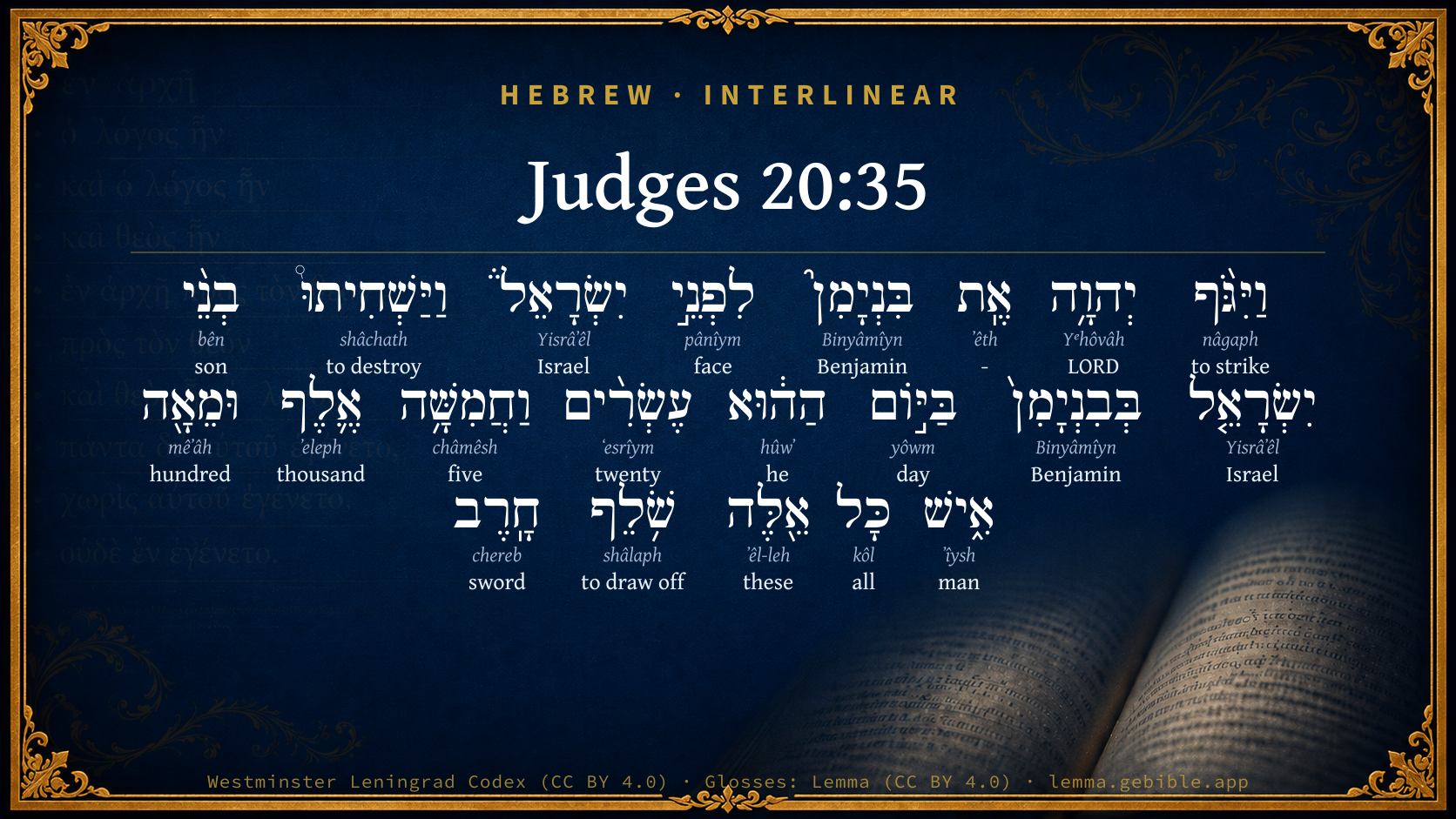
Hebrew (Westminster Leningrad Codex) Judges 20:35 appears in the Hebrew Old Testament. The text above is from the Westminster Leningrad Codex. Each word links to its Strong’s number, a concise gloss, and parsing drawn from the Open Scriptures Hebrew Bible morphology. Click any word for its full Brown-Driver-Briggs (BDB) entry.
Download image
Cite this verse

Judges 20:35 (World English Bible). Public Domain. Lemma interlinear Bible study tool, https://lemma.gebible.app/v/judges/20/35.

Show BibTeX & RIS
BibTeX
RIS
English Translation
Yahweh struck Benjamin before Israel; and the children of Israel destroyed of Benjamin that day twenty-five thousand one hundred men: all these drew the sword.
World English Bible · Public Domain
Download a study sheet

One document with this verse’s original text, its word-by-word gloss line, the meaning frame, cross-references with their text, attributed commentary, and full source and license credits — printable, and it pastes into notes with its structure intact.

This verse Autodidact and up

Study sheet (.html) Plain text (.txt)

A passage Seminary Student

Up to 50 verses in one chapter. A passage sheet keeps up to 6 commentary sources and 12 cross-references per verse, in the order this page ranks them, and says so on the sheet whenever that leaves anything out. Ask for a single verse and you get the Autodidact verse sheet above.

Everything on this page stays free to read, with no account — the sheet is a download of what is already on screen, not access to it.

Want to remove ads? Support Godless Engineer
Compare translations 3

The same verse in 3 English versions, stacked beneath the original-language interlinear above. Click any original word for its lexicon entry.

Each is an independent rendering of the whole verse — the interlinear is not word-aligned to these translations.

Highlighted words mark where these versions differ — a whole-verse word diff, not a word-by-word alignment.

  • World English Bible Public Domain
    Yahweh struck Benjamin before Israel; and the children of Israel destroyed of Benjamin that day twenty-five thousand one hundred men: all these drew the sword.
  • King James Version Public Domain
    And the LORD smote Benjamin before Israel: and the children of Israel destroyed of the Benjamites that day twenty and five thousand and an hundred men: all these drew the sword.
  • unfoldingWord Literal Text CC BY-SA 4.0
    So Yahweh defeated Benjamin to the face of Israel. And the sons of Israel destroyed Benjamin on that day, 25, 100 men, all of them drawing the sword.

unfoldingWord Literal Text — © unfoldingWord, licensed CC BY-SA 4.0. Word-aligned USFM3 via Door43 (git.door43.org/unfoldingWord/en_ult).

Versions to compare (up to 4)

3 of 4 selected

Show all 18 translations

Every available English version of this verse, each an independent rendering of the whole verse.

  • World English Bible Public Domain
    Yahweh struck Benjamin before Israel; and the children of Israel destroyed of Benjamin that day twenty-five thousand one hundred men: all these drew the sword.
  • Berean Standard Bible Public Domain
    The LORD defeated Benjamin in the presence of Israel, and on that day the Israelites slaughtered 25,100 Benjamites, all armed with swords.
  • Majority Standard Bible Public Domain
    The LORD defeated Benjamin in the presence of Israel, and on that day the Israelites slaughtered 25,100 Benjamites, all armed with swords.
  • King James Version Public Domain
    And the LORD smote Benjamin before Israel: and the children of Israel destroyed of the Benjamites that day twenty and five thousand and an hundred men: all these drew the sword.
  • American Standard Version (1901) Public Domain
    And Jehovah smote Benjamin before Israel; and the children of Israel destroyed of Benjamin that day twenty and five thousand and a hundred men: all these drew the sword.
  • Revised Version (1885) Public Domain
    And the LORD smote Benjamin before Israel: and the children of Israel destroyed of Benjamin that day twenty and five thousand and an hundred men: all these drew the sword.
  • Geneva Bible (1599) Public Domain
    And the Lord smote Beniamin before Israel, and the children of Israel destroyed of the Beniamites the same day fiue and twenty thousand and an hundreth men: all they could handle the sword.
  • Douay-Rheims (1899) Public Domain
    And the Lord defeated them before the children of Israel, and they slew of them in that day five and twenty thousand, and one hundred, all fighting men and that drew the sword.
  • Young's Literal Translation Public Domain
    And Jehovah smiteth Benjamin before Israel, and the sons of Israel destroy in Benjamin, on that day, twenty and five thousand, and a hundred men; all these `are' drawing sword.
  • Literal Standard Version CC BY-SA 4.0
    And YHWH strikes Benjamin before Israel, and the sons of Israel destroy in Benjamin, on that day, twenty-five thousand and one hundred men; all these [are] drawing sword.
  • Unlocked Literal Bible CC BY-SA 4.0
    Yahweh defeated Benjamin before Israel. On that day, the soldiers of Israel killed 25,100 men of Benjamin. All these who died were those who had been trained to fight with the sword.
  • unfoldingWord Literal Text CC BY-SA 4.0
    So Yahweh defeated Benjamin to the face of Israel. And the sons of Israel destroyed Benjamin on that day, 25, 100 men, all of them drawing the sword.
  • Darby Bible Public Domain
    And the LORD defeated Benjamin before Israel; and the men of Israel destroyed twenty-five thousand one hundred men of Benjamin that day; all these were men who drew the sword.
  • World Messianic Bible Public Domain
    The LORD struck Benjamin before Israel; and the children of Israel destroyed of Benjamin that day twenty-five thousand one hundred men. All these drew the sword.
  • Webster's Bible Public Domain
    And the LORD smote Benjamin before Israel: and the children of Israel destroyed of the Benjaminites that day twenty and five thousand and a hundred men: all these drew the sword.
  • Free Bible Version CC BY-SA 4.0
    So the Lord defeated Benjamin before Israel. That day the Israelites killed twenty-five thousand one hundred Benjamites, all armed with swords.
  • Bible in Basic English Public Domain
    Then the Lord sent sudden fear on Benjamin before Israel; and that day the children of Israel put to death twenty-five thousand, one hundred men of Benjamin, all of them swordsmen.
  • JPS Tanakh (1917) Public Domain
    And the LORD smote Benjamin before Israel; and the children of Israel destroyed of Benjamin that day twenty and five thousand and a hundred men; all these drew the sword.

Literal Standard Version (2020), Covenant Press — licensed CC BY-SA 4.0. Text via the HelloAO Bible API (eBible.org). Unlocked Literal Bible (unfoldingWord) — licensed CC BY-SA 4.0. Text via the HelloAO Bible API (eBible.org). unfoldingWord Literal Text — © unfoldingWord, licensed CC BY-SA 4.0. Word-aligned USFM3 via Door43 (git.door43.org/unfoldingWord/en_ult). Free Bible Version, Dr. Jonathan Gallagher — licensed CC BY-SA 4.0. Text via the HelloAO Bible API (eBible.org).

Word by word

More ways to search: Search by grammar → Find every occurrence → Compare this word →

Practice this passage: Drill this verse → Learn its vocabulary →

שֹׁ֥לֵף
shâlaph
H8025
“drawing off”
Verb, Qal, Participle Active, Masculine, Singular, Absolute
Part of Speech
Verb
Stem
Qal
Form
Participle Active
Gender
Masculine
Number
Singular
State
Absolute
Full BDB Definition

Origin: a primitive root

TWOT: 2402

to draw out or off, take off - (Qal) - to draw out - to draw off - to shoot up, draw out (of blade of grass on roof)
  1. וַיִּגֹּ֨ף nâgaph H5062 “and · to strike” Conjunction + Verb, Qal, Sequential Imperfect, 3rd Person, Masculine, Singular
  2. יְהוָ֥ה Yᵉhôvâh H3068 “LORD” Noun, Proper
  3. אֶֽת ʼêth H853 “-” Particle, Direct Object
  4. בִּנְיָמִן֮ Binyâmîyn H1144 “Benjamin” Noun, Proper
  5. לִפְנֵ֣י pânîym H6440 “to/for · face(s) of” Preposition + Noun, Common, Both, Plural, Construct
  6. יִשְׂרָאֵל֒ Yisrâʼêl H3478 “Israel” Noun, Proper
  7. וַיַּשְׁחִיתוּ֩ shâchath H7843 “and · to destroy” Conjunction + Verb, Hiphil, Sequential Imperfect, 3rd Person, Masculine, Plural
  8. בְנֵ֨י bên H1121 “sons of” Noun, Common, Masculine, Plural, Construct
  9. יִשְׂרָאֵ֤ל Yisrâʼêl H3478 “Israel” Noun, Proper
  10. בְּבִנְיָמִן֙ Binyâmîyn H1144 “in/at · Benjamin” Preposition + Noun, Proper
  11. בַּיּ֣וֹם yôwm H3117 “in/at the · day” Preposition, Determined + Noun, Common, Masculine, Singular, Absolute
  12. הַה֔וּא hûwʼ H1931 “the · he” Particle, Definite Article + Pronoun, Personal, 3rd Person, Masculine, Singular
  13. עֶשְׂרִ֨ים ʻesrîym H6242 “twenty” Adjective, Cardinal number, Both, Plural, Absolute
  14. וַחֲמִשָּׁ֥ה châmêsh H2568 “and · five” Conjunction + Adjective, Cardinal number, Masculine, Singular, Absolute
  15. אֶ֛לֶף ʼeleph H505 “thousand” Adjective, Cardinal number, Both, Singular, Absolute
  16. וּמֵאָ֖ה mêʼâh H3967 “and · hundred” Conjunction + Adjective, Cardinal number, Both, Singular, Absolute
  17. אִ֑ישׁ ʼîysh H376 “man” Noun, Common, Masculine, Singular, Absolute
  18. כָּל kôl H3605 “all of” Noun, Common, Masculine, Singular, Construct
  19. אֵ֖לֶּה ʼêl-leh H428 “these” Pronoun, Demonstrative, Common, Plural
  20. חָֽרֶב chereb H2719 “sword” Noun, Common, Feminine, Singular, Absolute

About this verse

These counts appear in no published source. They are computed here, from the morphology-tagged text and Lemma’s own curated glosses. What Lemma adds →

21
words
19
distinct lemmas
Historical
section

Notable vocabulary

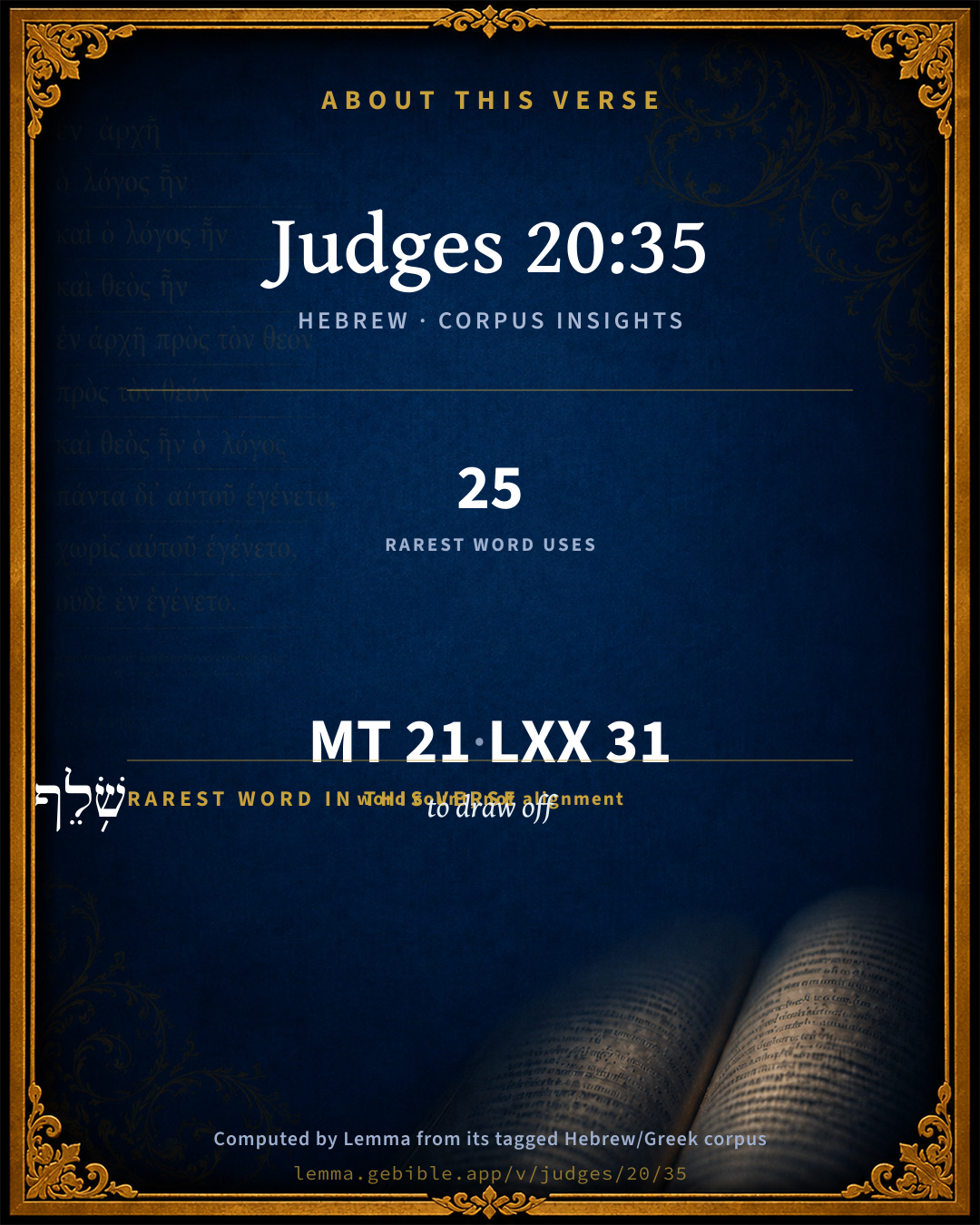
The rarest word here is שֹׁ֥לֵף to draw off H8025 — appearing just 25 times in the whole Hebrew Bible.

Shared distinctive vocabulary

שֹׁ֥לֵף to draw off H8025 occurs in 24 verses of the Hebrew Bible. Also found in:

Grammatical profile

  • 3 verbs
  • 11 nouns
  • 4 adjectives
  • 2 pronouns
  • 1 particle

Verb forms

  • וַיִּגֹּ֨ף Qal · Sequential Imperfect
  • וַיַּשְׁחִיתוּ֩ Hiphil · Sequential Imperfect
  • שֹׁ֥לֵף Qal · Participle Active

Repetition

Words recur within this verse — often emphatic in Hebrew:

  • בִּנְיָמִן֮ Benjamin H1144 ×2
  • יִשְׂרָאֵל֒ Israel H3478 ×2

Hebrew & Septuagint length

In English translation the verse runs 25 words from the Hebrew and 31 from the Septuagint (LXX English) — closely comparable.

A rough comparison of the two English renderings, which tokenize alike — not a word-level alignment.

Word counts can differ between the Hebrew and the Greek without any difference in meaning — e.g. the Hebrew direct-object marker אֵת has no separate Greek word, and Greek often adds the article ὁ.

In the original languages it is 21 Hebrew tokens and 31 Greek tokens — but the two are counted differently (Hebrew bundles its prefixes and suffixes into one token; the Greek is in lemma form), so that isn’t a like-for-like length.

Cross-references

3

Topical passages linked to Judges 20:35 in the Treasury of Scripture Knowledge — connected by theme and wording, ordered by reader-vote popularity; previews shown in the World English Bible.

  • Job 20:5 That the triumphing of the wicked is short, The joy of the godless but for a moment?
  • Judges 20:15 The children of Benjamin were numbered on that day out of the cities twenty-six thousand men who drew the sword, besides the inhabitants of Gibeah, who were numbered seven hundred chosen men.
  • Judges 20:44–46 There fell of Benjamin eighteen thousand men; all these [were] men of valor.

Cross-references courtesy of OpenBible.info (CC BY 4.0).

Hebrew and Greek witnesses Masoretic Hebrew ↔ Greek Septuagint

The same verse in the two great witnesses to the Old Testament, shown verse-for-verse.

These are two independent witnesses, not word-aligned to each other, and the Septuagint is shown in lemma (dictionary) form.

Hebrew Judges 20:35 Masoretic · Westminster Leningrad Codex

וַיִּגֹּ֨ף יְהוָ֥ה אֶֽת בִּנְיָמִן֮ לִפְנֵ֣י יִשְׂרָאֵל֒ וַיַּשְׁחִיתוּ֩ בְנֵ֨י יִשְׂרָאֵ֤ל בְּבִנְיָמִן֙ בַּיּ֣וֹם הַה֔וּא עֶשְׂרִ֨ים וַחֲמִשָּׁ֥ה אֶ֛לֶף וּמֵאָ֖ה אִ֑ישׁ כָּל אֵ֖לֶּה שֹׁ֥לֵף חָֽרֶב

Yahweh struck Benjamin before Israel; and the children of Israel destroyed of Benjamin that day twenty-five thousand one hundred men: all these drew the sword.

World English Bible · Public Domain

Greek LXX Judges 20:35 Septuagint · lemma form

καί πατάσσω κύριος ὁ βενιαμίν ἐνώπιον υἱός ἰσραήλ καί διαφθείρω ὁ υἱός ἰσραήλ ἐκ ὁ βενιαμίν ἐν ὁ ἡμέρα ἐκεῖνος εἴκοσι καί πέντε χιλιάς καί ἑκατόν ἀνήρ πᾶς οὗτος ἕλκω ῥομφαία

And the Lord struck Benjamin before the children of Israel; and the children of Israel destroyed of Benjamin in that day one hundred and twenty-five thousand men: all these drew sword.

LXX2012 (modern English Septuagint) · Public Domain

On this verse, Adam Clarke's Commentary discusses the Septuagint’s reading. Read the note in Commentary ↓

Hebrew: Westminster Leningrad Codex (CC BY 4.0). Greek: Septuagint (public domain); English from LXX2012 (modern English Septuagint) (Public Domain). How the Septuagint differs from the Hebrew →

Targum (Aramaic paraphrase)

1

The Targum is the ancient Jewish Aramaic paraphrase of the Hebrew Scriptures — an interpretive translation, not the Hebrew text itself. Onkelos (literal) and Pseudo-Jonathan (expansive) render the Torah, and Jonathan the Prophets. Coverage is partial: where no permissively-licensed English translation exists for a verse, only the Aramaic is shown. This is verse-level text, not a word-by-word alignment to the Hebrew.

  1. Targum Jonathan Prophets (Joshua–Malachi)
    וְתַבֵּר יְיָ יַת בִּנְיָמִין קֳדָם יִשְׂרָאֵל וְחַבִּילוּ בְּנֵי יִשְׂרָאֵל בִּדְבֵית בִּנְיָמִין בְּיוֹמָא הַהוּא עַסְרִין וְחַמְשָׁא אַלְפִין וּמֵאָה גַבְרָא כָּל אִלֵין שַׁלְפֵי סַיְפָא:

    (no public-domain English translation for this verse)

    Targum Jonathan — Aramaic: “Mikraot Gedolot” (public domain). English: “Sefaria Community Translation” (CC0 1.0 (public-domain dedication)); “London "Chaldee Paraphrase," 1871” (public domain). Text via Sefaria.

Commentary

Notes on Judges 20:35 from classic Christian and Jewish commentators (each source and its license shown beneath its notes). The classic Christian expositions comment on the surrounding passage and are grouped to its opening verse, so a note may address several verses; the Jewish commentaries on the Tanakh (Rashi and others) are per-verse, so they appear only where the commentator wrote on this verse.

Lemma curates 59 commentaries, every one of them public domain or Creative Commons licensed, each selected and text-cleaned for this edition rather than reprinted as found. About our sources →

Trapp's Complete Commentary

John Trapp

Jdg 20:35 And the LORD smote Benjamin before Israel: and the children of Israel destroyed of the Benjamites that day twenty and five thousand and an hundred men: all these drew the sword.

Ver. 35. And the Lord smote Benjamin.] Not the Israelites by their stratagem, but the Lord smote them. Victory is his gift.

“ Vincere quisquis aves hostilem exereitum, age, ante,

Invictum vincas per tua vota Deum. ”

John Trapp, A Commentary or Exposition upon All the Books of the Old and New Testament (1647–1656) — public domain. Text from a community e-Sword module.

Adam Clarke's Commentary

Verse 35. Twenty and five thousand and a hundred] As the Benjamites consisted only of twenty-six thousand and seven hundred slingers; or, as the Vulgate, Septuagint, and others read, twenty-five thousand, which is most probably the true reading; then the whole of the Benjamites were cut to pieces, except six hundred men, who we are informed fled to the rock Rimmon, where they fortified themselves.

Adam Clarke's Commentary on the Bible (1810–1826) — public domain. Text from a community e-Sword/MySword module.

Ellicott's Commentary for English Readers

(35) Destroyed of the Benjamites . . .—Here again we have a summary of the final result, followed by details, in a manner which proves either that the narrative was compiled from various sources (one of which seems to have been a poem), or that it was penned before the “periodic style” of history (lexis katestrammene) had been invented. If written consecutively, and not compiled, the writer must have been one whose method bore the same resemblance to that of later writers, as the style of Hellanicus did to that of Herodotus and Thucydides. It is the style to which Roman writers would have applied the epithet inconditus—the style of the oldest annals. Jdg_20:36-46 are not, as has been conjectured by some writers, necessarily a different account of the battle, but contain a loose assemblage of details, which has been added to explain the general result.

A Bible Commentary for English Readers, edited by Charles John Ellicott (1878–1897) — public domain. Text from a community e-Sword module.

The Cambridge Bible for Schools and Colleges

gen. ed. J. J. S. Perowne

35. As elsewhere the account of the battle is brought to an end with a summing up of the numbers slain, Jdg_20:21; Jdg_20:25; Jdg_20:46, Jdg_3:29, Jos_8:25. For the numbers see on Jdg_20:15. This later source B, it is to be noted, ascribes the victory to the direct interference of Jehovah; cf. 2Ch_13:15; 2Ch_14:12, where the same verb smote occurs.

The Cambridge Bible for Schools and Colleges (gen. ed. J. J. S. Perowne; Cambridge University Press, 1878–1918) — public domain. Text from a community e-Sword module.

John Gill's Exposition

So the children of Benjamin saw that they were smitten,.... Their forces broken and worsted, many being killed:

for the men of Israel gave place to the Benjaminites; at first, and made as if they were afraid of them, and so fled before them, which was only to decoy them to a greater distance from the city Gibeah:

because they trusted unto the liers in wait, which they had set beside Gibeah; that these would not only enter the city, and burn it, but meet the Benjaminites fleeing back to it, when they should turn upon them and smite them, and so cut off all that remained of them.

John Gill's Exposition of the Whole Bible (1746–1763) — public domain (CC PDM 1.0). Text via the HelloAO Bible API.

Haydock's Catholic Bible Commentary

The sword. It seems the slingers also used the sword, ver. 16.

George Leo Haydock (1774–1849), Haydock's Catholic Family Bible and Commentary, 1859 edition — public domain. Excludes Psalms (Douay-Rheims chapter numbering differs from Protestant) and Deuterocanonical books (Catholic canon only).

Matthew Poole's English Annotations

This is the total sum, whereof the particulars are related Jdg 20:11,45; and for the odd hundred not there mentioned, they were killed in other places not there expressed.

Matthew Poole's English Annotations on the Holy Bible (1683–1685) — public domain. Text from a community e-Sword/MySword module.

Whedon's Commentary on the Bible

Daniel D. Whedon

35. Twenty and five thousand and a hundred — The historian here gives the result of the battle, and then proceeds, in Jdg_20:36-46, to give more of the details. It appears that eighteen thousand fell in battle, (Jdg_20:44,) five thousand were gleaned along the highways, (Jdg_20:45,) and that two thousand more were killed as they fled to Gidom. This makes exactly twenty-five thousand; but no account is given in this latter part of the other one hundred. So also no account at all is given of the number of Benjamites who fell in the previous battles. According to Jdg_20:47 only six hundred men of Benjamin escaped; but before the first battle they numbered twenty-six thousand seven hundred. Jdg_20:15. Consequently twenty-six thousand one hundred were killed and missing in the war. The historian records twenty-five thousand one hundred killed on this last day of battle; the other one thousand, not accounted for, probably fell in the battles of the previous days, for it is not supposable that the Benjamites killed twenty-two thousand on one day (Jdg_20:21) and eighteen thousand on another without any loss to themselves.

Daniel D. Whedon (gen. ed.), Commentary on the Old and New Testaments (1874–1909) — public domain. Text from a community e-Sword module.

Lesson kit

Teaching starters — assembled from the data on this page, not authored interpretation. Every prompt links to the verse data it draws on. Edit before teaching.

Judges, in the Historical, opens this verse with 21 words (19 distinct Hebrew lemmas). Its most distinctive word is shâlaph (“to draw off”). A historical commentator’s framing appears above. Read the whole chapter for the surrounding context.

Discussion questions

  1. The word shâlaph carries the sense “to draw off.” How does it shape the verse?
  2. Numbers 22:23 shares the word «to draw off» with this verse. How do the two illuminate each other?
  3. “Benjamin” occurs 2× in this one verse. What is the effect of the repetition?
  4. These translations render this verse differently; the difference is in the English rendering, not the original. What questions does that raise?
  5. The verb «וַיִּגֹּ֨ף» is Qal Sequential Imperfect. How does its form color the action?
  6. Reading how Trapp's Complete Commentary and Adam Clarke's Commentary read this verse, where do the two commentators agree and where do they part?

Things to notice

Reading settings

Reading text

Shown beneath each verse's original-language words.

Old Testament
Old Testament edition

Read the OT as the Masoretic Hebrew (MT) or the Greek Septuagint (LXX).

English shown for the Greek Septuagint (in the Hebrew ↔ Greek comparison).

Comparing translations? Open the Compare panel on any verse page to stack up to four side by side.