
Ezekiel 21:3

Hebrew (Westminster Leningrad Codex) Ezekiel 21:3 appears in the Hebrew Old Testament. The text above is from the Westminster Leningrad Codex. Each word links to its Strong’s number, a concise gloss, and parsing drawn from the Open Scriptures Hebrew Bible morphology. Click any word for its full Brown-Driver-Briggs (BDB) entry.
Download image
Cite this verse

Ezekiel 21:3 (World English Bible). Public Domain. Lemma interlinear Bible study tool, https://lemma.gebible.app/v/ezekiel/21/3.

Show BibTeX & RIS
BibTeX
RIS
English Translation
and tell the land of Israel, Thus says Yahweh: Behold, I am against you, and will draw forth my sword out of its sheath, and will cut off from you the righteous and the wicked.
World English Bible · Public Domain
Download a study sheet

One document with this verse’s original text, its word-by-word gloss line, the meaning frame, cross-references with their text, attributed commentary, and full source and license credits — printable, and it pastes into notes with its structure intact.

This verse Autodidact and up

Study sheet (.html) Plain text (.txt)

A passage Seminary Student

Up to 50 verses in one chapter. A passage sheet keeps up to 6 commentary sources and 12 cross-references per verse, in the order this page ranks them, and says so on the sheet whenever that leaves anything out. Ask for a single verse and you get the Autodidact verse sheet above.

Everything on this page stays free to read, with no account — the sheet is a download of what is already on screen, not access to it.

Want to remove ads? Support Godless Engineer
Compare translations 3

The same verse in 3 English versions, stacked beneath the original-language interlinear above. Click any original word for its lexicon entry.

Each is an independent rendering of the whole verse — the interlinear is not word-aligned to these translations.

Highlighted words mark where these versions differ — a whole-verse word diff, not a word-by-word alignment.

  • World English Bible Public Domain
    and tell the land of Israel, Thus says Yahweh: Behold, I am against you, and will draw forth my sword out of its sheath, and will cut off from you the righteous and the wicked.
  • King James Version Public Domain
    And say to the land of Israel, Thus saith the LORD; Behold, I am against thee, and will draw forth my sword out of his sheath, and will cut off from thee the righteous and the wicked.
  • unfoldingWord Literal Text CC BY-SA 4.0
    Say to the land of Israel, ‘Yahweh says this: Behold! I am against you! I will draw my sword from its sheath and cut off both the righteous person and the wicked person from you!

unfoldingWord Literal Text — © unfoldingWord, licensed CC BY-SA 4.0. Word-aligned USFM3 via Door43 (git.door43.org/unfoldingWord/en_ult).

Versions to compare (up to 4)

3 of 4 selected

Show all 18 translations

Every available English version of this verse, each an independent rendering of the whole verse.

  • World English Bible Public Domain
    and tell the land of Israel, Thus says Yahweh: Behold, I am against you, and will draw forth my sword out of its sheath, and will cut off from you the righteous and the wicked.
  • Berean Standard Bible Public Domain
    and tell her that this is what the LORD says: ‘I am against you, and I will draw My sword from its sheath and cut off from you both the righteous and the wicked.
  • Majority Standard Bible Public Domain
    and tell her that this is what the LORD says: ‘I am against you, and I will draw My sword from its sheath and cut off from you both the righteous and the wicked.
  • King James Version Public Domain
    And say to the land of Israel, Thus saith the LORD; Behold, I am against thee, and will draw forth my sword out of his sheath, and will cut off from thee the righteous and the wicked.
  • American Standard Version (1901) Public Domain
    and say to the land of Israel, Thus saith Jehovah: Behold, I am against thee, and will draw forth my sword out of its sheath, and will cut off from thee the righteous and the wicked.
  • Revised Version (1885) Public Domain
    and say to the land of Israel, Thus saith the LORD: Behold, I am against thee, and will draw forth my sword out of its sheath, and will cut off from thee the righteous and the wicked.
  • Geneva Bible (1599) Public Domain
    And say to the land of Israel, Thus saith the Lord, Beholde, I come against thee, and will drawe my sword out of his sheath, and cut off from thee both the righteous and the wicked.
  • Douay-Rheims (1899) Public Domain
    And say to the land of Israel: Thus saith the Lord God: Behold I come against thee, and I will draw forth my sword out of its sheath, and will cut off in thee the just, and the wicked.
  • Young's Literal Translation Public Domain
    and thou hast said unto the ground of Israel: Thus said Jehovah: Lo, I `am' against thee, And have brought out My sword from its scabbard, And have cut off from thee righteous and wicked.
  • Literal Standard Version CC BY-SA 4.0
    and you have said to the ground of Israel, Thus said YHWH: Behold, I [am] against you, || And have brought out My sword from its scabbard, || And have cut off righteous and wicked from you.
  • Unlocked Literal Bible CC BY-SA 4.0
    Say to the land of Israel, 'Yahweh says this: Behold! I am against you! I will draw my sword from its sheath and cut off both the righteous person and the wicked person from you!
  • unfoldingWord Literal Text CC BY-SA 4.0
    Say to the land of Israel, ‘Yahweh says this: Behold! I am against you! I will draw my sword from its sheath and cut off both the righteous person and the wicked person from you!
  • Darby Bible Public Domain
    and say to the land of Israel, Thus saith Jehovah: Behold, I am against thee, and I will draw forth my sword out of its sheath, and will cut off from thee the righteous and the wicked.
  • World Messianic Bible Public Domain
    Tell Eretz-Israel, ‘The LORD says: “Behold, I am against you, and will draw my sword out of its sheath, and will cut off from you the righteous and the wicked.
  • Webster's Bible Public Domain
    And say to the land of Israel, Thus saith the LORD; Behold, I am against thee, and will draw forth my sword out of its sheath, and will cut off from thee the righteous and the wicked.
  • Free Bible Version CC BY-SA 4.0
    and tell them that this is what the Lord says: Watch out, because I'm going to attack you! I'm going to take out my sword and destroy you, both the good and the bad.
  • Bible in Basic English Public Domain
    And say to the land of Israel, These are the words of the Lord: See, I am against you, and I will take my sword out of its cover, cutting off from you the upright and the evil.
  • JPS Tanakh (1917) Public Domain
    (21-8) and say to the land of Israel: Thus saith the LORD: Behold, I am against thee, and will draw forth My sword out of its sheath, and will cut off from thee the righteous and the wicked.

Literal Standard Version (2020), Covenant Press — licensed CC BY-SA 4.0. Text via the HelloAO Bible API (eBible.org). Unlocked Literal Bible (unfoldingWord) — licensed CC BY-SA 4.0. Text via the HelloAO Bible API (eBible.org). unfoldingWord Literal Text — © unfoldingWord, licensed CC BY-SA 4.0. Word-aligned USFM3 via Door43 (git.door43.org/unfoldingWord/en_ult). Free Bible Version, Dr. Jonathan Gallagher — licensed CC BY-SA 4.0. Text via the HelloAO Bible API (eBible.org).

Word by word

More ways to search: Search by grammar → Find every occurrence → Compare this word →

Practice this passage: Drill this verse → Learn its vocabulary →

מִתַּעְרָ֑הּ
taʻar
H8593
“from · razor · her”
Preposition + Noun, Common, Both, Singular, Construct + Suffix, Personal, 3rd Person, Feminine, Singular
Part of Speech
Preposition + Noun
Type
Common
Gender
Both
Number
Singular
State
Construct
Full BDB Definition

Origin: from H6168

TWOT: 1692e

razor, sheath (making naked) - razor - sheath (of sword)
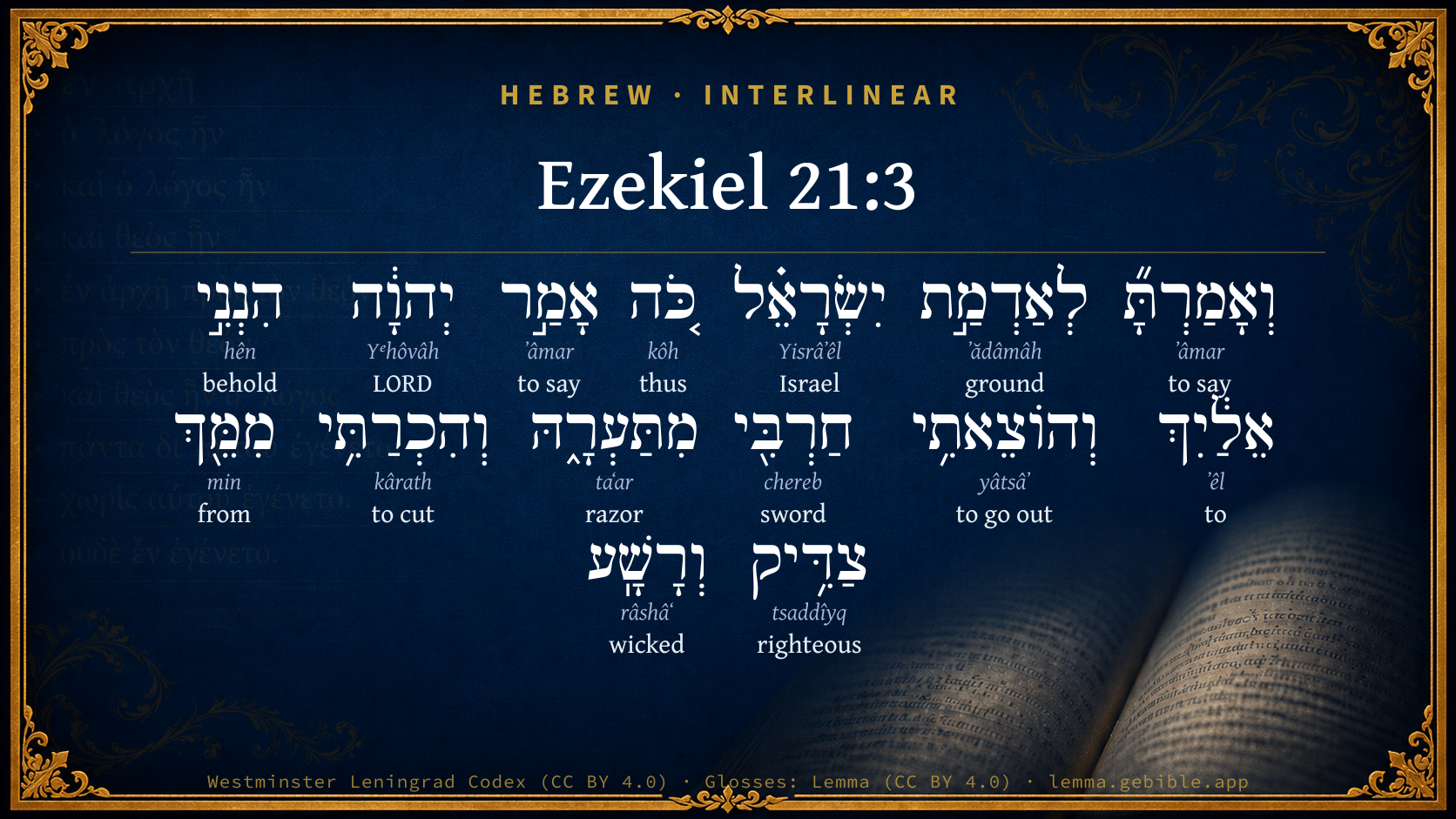
  1. וְאָמַרְתָּ֞ ʼâmar H559 “and · to say” Conjunction + Verb, Qal, Sequential Perfect, 2nd Person, Masculine, Singular
  2. לְאַדְמַ֣ת ʼădâmâh H127 “to/for · ground of” Preposition + Noun, Common, Feminine, Singular, Construct
  3. יִשְׂרָאֵ֗ל Yisrâʼêl H3478 “Israel” Noun, Proper
  4. כֹּ֚ה kôh H3541 “thus” Adverb
  5. אָמַ֣ר ʼâmar H559 “to say” Verb, Qal, Perfect, 3rd Person, Masculine, Singular
  6. יְהוָ֔ה Yᵉhôvâh H3068 “LORD” Noun, Proper
  7. הִנְנִ֣י hên H2005 “behold · me” Particle, Demonstrative + Suffix, Personal, 1st Person, Common, Singular
  8. אֵלַ֔יִךְ ʼêl H413 “to · you” Preposition + Suffix, Personal, 2nd Person, Feminine, Singular
  9. וְהוֹצֵאתִ֥י yâtsâʼ H3318 “and · to go out” Conjunction + Verb, Hiphil, Sequential Perfect, 1st Person, Common, Singular
  10. חַרְבִּ֖י chereb H2719 “sword · my” Noun, Common, Feminine, Singular, Construct + Suffix, Personal, 1st Person, Common, Singular
  11. וְהִכְרַתִּ֥י kârath H3772 “and · to cut” Conjunction + Verb, Hiphil, Sequential Perfect, 1st Person, Common, Singular
  12. מִמֵּ֖ךְ min H4480 “from · you” Preposition + Suffix, Personal, 2nd Person, Feminine, Singular
  13. צַדִּ֥יק tsaddîyq H6662 “righteous” Adjective, Adjective, Masculine, Singular, Absolute
  14. וְרָשָֽׁע râshâʻ H7563 “and · wicked” Conjunction + Adjective, Adjective, Masculine, Singular, Absolute

About this verse

These counts appear in no published source. They are computed here, from the morphology-tagged text and Lemma’s own curated glosses. What Lemma adds →

15
words
14
distinct lemmas
Prophets
section

Notable vocabulary

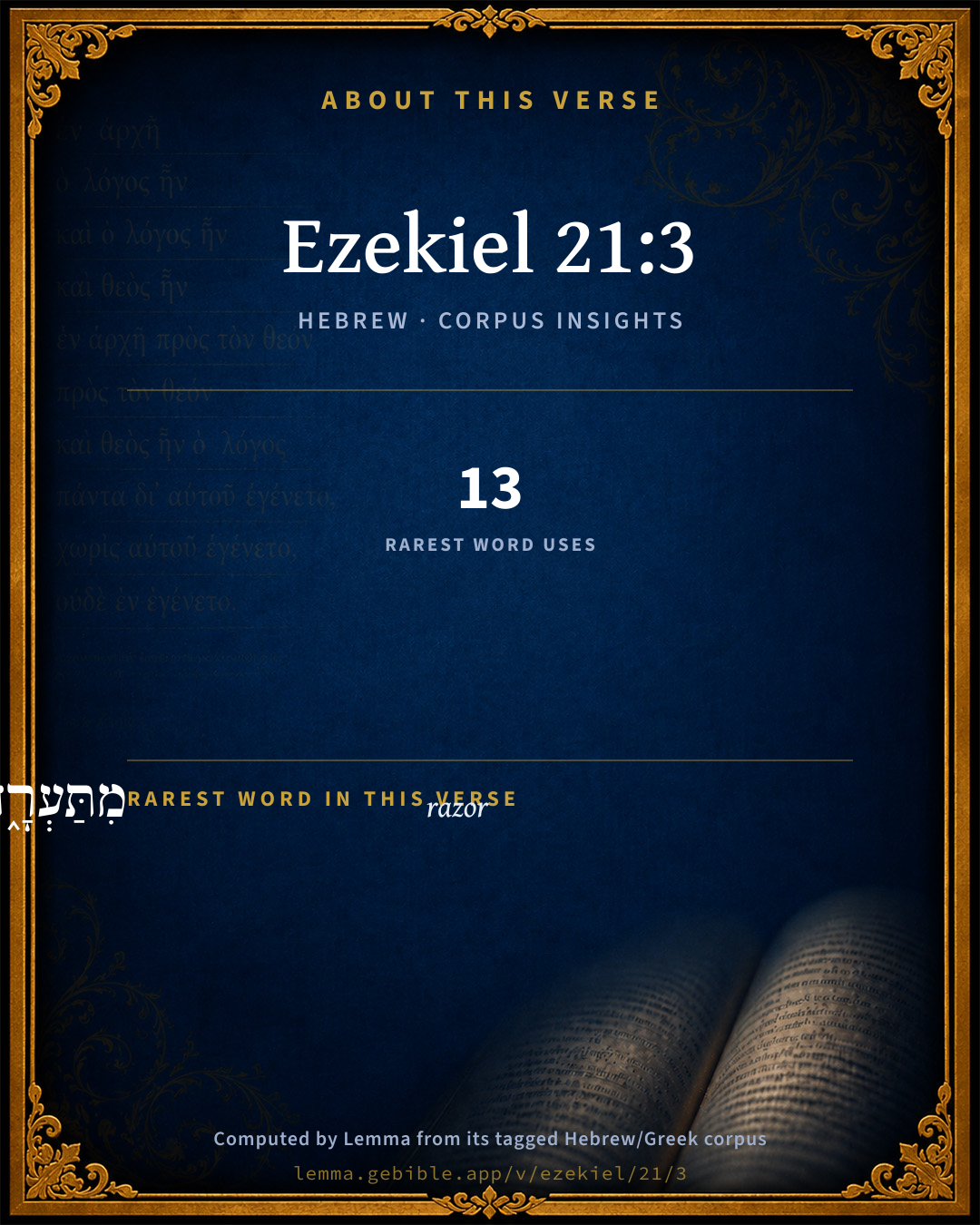
The rarest word here is מִתַּעְרָ֑הּ razor H8593 — appearing just 13 times in the whole Hebrew Bible.

Shared distinctive vocabulary

מִתַּעְרָ֑הּ razor H8593 occurs in 13 verses of the Hebrew Bible. Also found in:

Grammatical profile

  • 4 verbs
  • 5 nouns
  • 2 adjectives
  • 2 prepositions
  • 1 adverb
  • 1 particle

Verb forms

  • וְאָמַרְתָּ֞ Qal · Sequential Perfect
  • אָמַ֣ר Qal · Perfect
  • וְהוֹצֵאתִ֥י Hiphil · Sequential Perfect
  • וְהִכְרַתִּ֥י Hiphil · Sequential Perfect

Repetition

A word recurs within this verse — often emphatic in Hebrew:

  • וְאָמַרְתָּ֞ to say H559 ×2

Hebrew & Septuagint length

In English translation the verse runs 35 words from the Hebrew and 40 from the Septuagint (LXX English) — closely comparable.

A rough comparison of the two English renderings, which tokenize alike — not a word-level alignment.

Word counts can differ between the Hebrew and the Greek without any difference in meaning — e.g. the Hebrew direct-object marker אֵת has no separate Greek word, and Greek often adds the article ὁ.

Cross-references

27

Topical passages linked to Ezekiel 21:3 in the Treasury of Scripture Knowledge — connected by theme and wording, ordered by reader-vote popularity; previews shown in the World English Bible.

  • Job 9:22 "It is all the same. Therefore I say, He destroys the blameless and the wicked.
  • Jeremiah 21:13 Behold, I am against you, O inhabitant of the valley, [and] of the rock of the plain, says Yahweh; you that say, Who shall come down against us? or who shall enter into our habitations?
  • Ezekiel 5:8 therefore thus says the Lord Yahweh: Behold, I, even I, am against you; and I will execute judgments in the midst of you in the sight of the nations.
  • Ezekiel 5:12 A third part of you shall die with the pestilence, and with famine shall they be consumed in the midst of you; and a third part shall fall by the sword round about you; and a third part I will scatter to all the winds, and will draw out a sword after them.
  • Ezekiel 14:17 Or if I bring a sword on that land, and say, Sword, go through the land; so that I cut off from it man and animal;
  • Ezekiel 14:21 For thus says the Lord Yahweh: How much more when I send my four sore judgments on Jerusalem, the sword, and the famine, and the evil animals, and the pestilence, to cut off from it man and animal!
  • Ezekiel 21:9–11 Son of man, prophesy, and say, Thus says Yahweh: Say, A sword, a sword, it is sharpened, and also furbished;
  • Ezekiel 21:19 Also, you son of man, appoint two ways, that the sword of the king of Babylon may come; they both shall come forth out of one land: and mark out a place, mark it out at the head of the way to the city.
  • Nahum 2:13 "Behold, I am against you," says Yahweh of Hosts, "and I will burn her chariots in the smoke, and the sword will devour your young lions; and I will cut off your prey from the earth, and the voice of your messengers will no longer be heard."
  • Nahum 3:5 "Behold, I am against you," says Yahweh of Hosts, "and I will lift your skirts over your face. I will show the nations your nakedness, and the kingdoms your shame.
  • Exodus 15:9 The enemy said, 'I will pursue, I will overtake, I will divide the spoil. My desire shall be satisfied on them. I will draw my sword, my hand shall destroy them.'
  • Leviticus 26:25 I will bring a sword upon you, that will execute the vengeance of the covenant; and you will be gathered together within your cities: and I will send the pestilence among you; and you will be delivered into the hand of the enemy.
  • Leviticus 26:33 I will scatter you among the nations, and I will draw out the sword after you: and your land will be a desolation, and your cities shall be a waste.
  • Deuteronomy 32:41–42 If I whet my glittering sword, My hand take hold on judgment; I will render vengeance to my adversaries, Will recompense those who hate me.
  • Psalms 17:13 Arise, Yahweh, Confront him, cast him down. Deliver my soul from the wicked by your sword;
  • Ecclesiastes 9:2 All things come alike to all. There is one event to the righteous and to the wicked; to the good, to the clean, to the unclean, to him who sacrifices, and to him who doesn't sacrifice. As is the good, so is the sinner; he who takes an oath, as he who fears an oath.
  • Isaiah 10:5 Ho Assyrian, the rod of my anger, the staff in whose hand is my indignation!
  • Isaiah 34:5 For my sword has drunk its fill in the sky: behold, it shall come down on Edom, and on the people of my curse, to judgment.
  • Jeremiah 15:2–4 It shall happen, when they tell you, Where shall we go forth? then you shall tell them, Thus says Yahweh: Such as are for death, to death; and such as are for the sword, to the sword; and such as are for the famine, to the famine; and such as are for captivity, to captivity.
  • Jeremiah 47:6–7 You sword of Yahweh, how long will it be before you be quiet? put up yourself into your scabbard; rest, and be still.
  • Jeremiah 50:31 Behold, I am against you, you proud one, says the Lord, Yahweh of Hosts; for your day is come, the time that I will visit you.
  • Jeremiah 51:20 You are my battle-axe and weapons of war: and with you will I break in pieces the nations; and with you will I destroy kingdoms;
  • Jeremiah 51:25 Behold, I am against you, destroying mountain, says Yahweh, which destroy all the earth; and I will stretch out my hand on you, and roll you down from the rocks, and will make you a burnt mountain.
  • Ezekiel 26:3 therefore thus says the Lord Yahweh, Behold, I am against you, Tyre, and will cause many nations to come up against you, as the sea causes its waves to come up.
  • Zephaniah 2:12 You Cushites also, you will be killed by my sword.
  • Zechariah 13:7 "Awake, sword, against my shepherd, And against the man who is close to me," says Yahweh of Hosts. Strike the shepherd, and the sheep will be scattered; And I will turn my hand against the little ones.
  • Ezekiel 9:5–6 To the others he said in my hearing, Go you through the city after him, and strike: don't let your eye spare, neither have you pity;

Cross-references courtesy of OpenBible.info (CC BY 4.0).

Hebrew and Greek witnesses Masoretic Hebrew ↔ Greek Septuagint

The same verse in the two great witnesses to the Old Testament, shown verse-for-verse.

These are two independent witnesses, not word-aligned to each other, and the Septuagint is shown in lemma (dictionary) form.

Hebrew Ezekiel 21:3 Masoretic · Westminster Leningrad Codex

וְאָמַרְתָּ֞ לְאַדְמַ֣ת יִשְׂרָאֵ֗ל כֹּ֚ה אָמַ֣ר יְהוָ֔ה הִנְנִ֣י אֵלַ֔יִךְ וְהוֹצֵאתִ֥י חַרְבִּ֖י מִתַּעְרָ֑הּ וְהִכְרַתִּ֥י מִמֵּ֖ךְ צַדִּ֥יק וְרָשָֽׁע

and tell the land of Israel, Thus says Yahweh: Behold, I am against you, and will draw forth my sword out of its sheath, and will cut off from you the righteous and the wicked.

World English Bible · Public Domain

Greek LXX Ezekiel 21:3 Septuagint · lemma form

καί εἶπον ὁ δρυμός ναγεβ ἀκούω λόγος κύριος ὅδε λέγω κύριος κύριος ἰδού ἐγώ ἀναἅπτω ἐν σύ πῦρ καί καταἐσθίω ἐν σύ πᾶς ξύλον χλωρός καί πᾶς ξύλον ξηρός οὐ σβέννυμι ὁ φλόξ ὁ ἐκἅπτω καί κατακαίω ἐν αὐτός πᾶς πρόσωπον ἀπό ἀπηλιώτης ἕως βορέας

and you shall say to the land of Israel, Thus says the Lord; Behold, I am against you, and I will draw forth my sword out of its sheath, and I will destroy out of you the transgressor and unrighteous.

LXX2012 (modern English Septuagint) · Public Domain

Hebrew: Westminster Leningrad Codex (CC BY 4.0). Greek: Septuagint (public domain); English from LXX2012 (modern English Septuagint) (Public Domain). How the Septuagint differs from the Hebrew →

Targum (Aramaic paraphrase)

1

The Targum is the ancient Jewish Aramaic paraphrase of the Hebrew Scriptures — an interpretive translation, not the Hebrew text itself. Onkelos (literal) and Pseudo-Jonathan (expansive) render the Torah, and Jonathan the Prophets. Coverage is partial: where no permissively-licensed English translation exists for a verse, only the Aramaic is shown. This is verse-level text, not a word-by-word alignment to the Hebrew.

  1. Targum Jonathan Prophets (Joshua–Malachi)
    וְתֵימַר לְחוּרְשָׁא דְדָרוֹמָא קַבֵּיל פִּתְגָמָא דַייָ כִּדְנַן אֲמַר יְיָ אֱלֹהִים הָא אֲנָא מַדְלִיק בָּךְ אֶשְׁתָּא וְתִקְטֵיל בָּךְ כָּל אִילַן יַבִּישׁ לָא תִטְפֵי לְשַׁלְהוֹבִיתָא דִמְשֵׁיצְיָא וְיִתְרַשְׁמוּן בָּהּ כָּל אַפַּיָא מִדְרוֹם לְצִפּוּנָא:

    (no public-domain English translation for this verse)

    Targum Jonathan — Aramaic: “Mikraot Gedolot” (public domain). English: “Sefaria Community Translation” (CC0 1.0 (public-domain dedication)); “London "Chaldee Paraphrase," 1871” (public domain). Text via Sefaria.

Commentary

Notes on Ezekiel 21:3 from classic Christian and Jewish commentators (each source and its license shown beneath its notes). The classic Christian expositions comment on the surrounding passage and are grouped to its opening verse, so a note may address several verses; the Jewish commentaries on the Tanakh (Rashi and others) are per-verse, so they appear only where the commentator wrote on this verse.

Lemma curates 59 commentaries, every one of them public domain or Creative Commons licensed, each selected and text-cleaned for this edition rather than reprinted as found. About our sources →

Trapp's Complete Commentary

John Trapp

Eze 21:3 And say to the land of Israel, Thus saith the LORD; Behold, I [am] against thee, and will draw forth my sword out of his sheath, and will cut off from thee the righteous and the wicked.

Ver. 3. Behold, I am against thee.] That is misery enough, for all the creatures are soon against such; as a nobleman’s servants draw their swords when their lord once draweth.

And will cut off from thee the righteous.] Who are sometimes wrapped up with the wicked in a common calamity. The husbandman cutteth down his corn and weeds together, but for a different end and purpose. If the righteous also be judged of the Lord, it is that they may not be condemned with the world. {1Co 11:31}

John Trapp, A Commentary or Exposition upon All the Books of the Old and New Testament (1647–1656) — public domain. Text from a community e-Sword module.

Tyndale Open Study Notes

Tyndale Open Resources

21:3-5 The Lord was the fundamental enemy whom Israel had to fear, for he was about to unleash an all-encompassing judgment against it. • One would expect the righteous to avoid judgment and the wicked to receive it. This pairing parallels the green tree and the dry tree of the parable (20:47-48). The judgment of sin would be like a very hot fire burning all it touched.

Tyndale Open Study Notes — © Tyndale Open Resources, licensed CC BY-SA 4.0. Text via the HelloAO Bible API.

Geneva Bible (1599)

Geneva Bible translators

That is such which seem to have an outward show of righteousness, by observation of the ceremonies of the law.

Geneva Bible (1599) marginal notes — public domain. Text via Bolls.life.

Jamieson, Fausset & Brown

Robert Jamieson, A. R. Fausset & David Brown

righteous . . . wicked--not contradictory of Eze 18:4, Eze 18:9 and Gen 18:23. Ezekiel here views the mere outward aspect of the indiscriminate universality of the national calamity. But really the same captivity to the "righteous" would prove a blessing as a wholesome discipline, which to the "wicked" would be an unmitigated punishment. The godly were sealed with a mark (Eze 9:4), not for outward exemption from the common calamity, but as marked for the secret interpositions of Providence, overruling even evil to their good. The godly were by comparison so few, that not their salvation but the universality of the judgment is brought into view here.

Jamieson, Fausset & Brown — Commentary Critical and Explanatory on the Whole Bible (1871) — public domain (CC PDM 1.0). Text via the HelloAO Bible API.

Adam Clarke's Commentary

Verse 3. Behold, I am against thee] Dismal news! When God is against us, who can be for us?

And will draw forth my sword] War.

And will cut off from thee] The land of Judea.

The righteous and the wicked.] All shall be removed from thee. Some shall be cut off-removed by the sword; shall be slain in battle, or by the pestilence; and some shall be cut off - die by the famine; and some shall be cut off - removed from the land by captivity. Now, among the two latter classes there might be many righteous as well as wicked. And when all the provisions were consumed, so that there was no more bread in the city, during the siege by Nebuchadnezzar, the righteous must have suffered as well as the wicked; for they could not be preserved alive, but by miracle, when there was no bread; nor was their perishing for want any loss to them, because the Lord would take them straight to his glory. And however men in general are unwilling to die, yet there is no instance, nor can there be, of any man's complaint that he got to heaven too soon. Again, if God had permitted none to be carried off captive but the wicked, the case of these would be utterly hopeless, as there would be none to set a good example, to preach repentance, to reprove sin, or to show God's willingness to forgive sinners. But God, in his mercy, permitted many of the righteous to be carried off also, that the wicked might not be totally abandoned, or put beyond the reach of being saved. Hence, both Ezekiel and Daniel, and indeed several others, prophets and righteous men, were thus cut off from the land, and carried into captivity. And how much was God's glory and the good of men promoted by this! What a seed of salvation was sown, even in the heathen countries, by thus cutting off the righteous with the wicked! To this we owe, under God, many of the Psalms, the whole of the Book of Ezekiel, all the prophecies of Daniel, the bright example of Shadrach, Meshach, and Abed-nego, the decrees passed in favour of the religion of the true God by Nebuchadnezzar, Cyrus, Darius, &c. And to this dispensation of God's merciful providence we owe the Books and example of Ezra and Nehemiah. Where then is the injustice, so loudly declaimed against, of God's thus cutting off from the land of Judea the righteous with the wicked? The righteous were not cut off for the crimes of the wicked, (see Eze 18:20, &c.,) nor were these crimes visited upon them, yet several of them shared in the common calamity, but none perished. Those that were removed by a violent death, (and I believe we shall find few such,) got a speedier entrance into eternal glory.

Adam Clarke's Commentary on the Bible (1810–1826) — public domain. Text from a community e-Sword/MySword module.

Ellicott's Commentary for English Readers

(3, 4) The righteous and the wicked.—This explains the green tree and the dry of Eze_20:47; and “all flesh” of Eze_21:4-5, corresponds to “all faces” of the same. These expressions are meant to show the universality of the approaching desolation. The actual separation in God’s sight between the righteous and the wicked has already been plainly set forth in 9:4-6. But still in this, as in all national judgments, the innocent must of necessity be involved in the same temporal sufferings with the guilty. The general terms of this prophecy are to be limited by what is elsewhere said of the mercy which shall be shown to a remnant.

A Bible Commentary for English Readers, edited by Charles John Ellicott (1878–1897) — public domain. Text from a community e-Sword module.

John Gill's Exposition

Seeing then that I will cut off from thee the righteous and the wicked,.... Some by the sword, some by famine, some by pestilence, and others by captivity; and, upon the whole, none spared, but the land left desolate:

therefore shall my sword go forth out of his sheath against all flesh, from the south to the north; the Chaldean army shall go out of their own land against all the inhabitants of Judea, from Beersheba to Dan; this explains what is meant by all faces being burnt from the south to the north, Eze 20:47, namely, the general destruction of the Jews by the Chaldeans.

John Gill's Exposition of the Whole Bible (1746–1763) — public domain (CC PDM 1.0). Text via the HelloAO Bible API.

Haydock's Catholic Bible Commentary

Just. But had not God declared the contrary, chap. xviii? The time was not yet arrived; or, he rescued the just from death, though he permitted them to experience the other common miseries. (Calmet) --- He preserved them from eternal death. (Estius) --- The just often means those who are so only in appearance, chap. xvi. 51. (Calmet) --- Temporal afflictions fall upon all; but the just derive benefit from them, while the wicked fall into eternal misery. (St. Jerome) (Worthington)

George Leo Haydock (1774–1849), Haydock's Catholic Family Bible and Commentary, 1859 edition — public domain. Excludes Psalms (Douay-Rheims chapter numbering differs from Protestant) and Deuterocanonical books (Catholic canon only).

Matthew Poole's English Annotations

Publish it to all the people of the land, if any will consider it; it is not the severe and morose conjecture of a disturbed and injured man, let them know God the Lord speaks it. Weigh this, I say it is of great importance. You think yourselves more righteous than those that come against you, that they are heathen, you my peculiar people, that my temple is with you, and that I will be on your side; but be not deceived, for

I am, and I will be, against you.

Will draw forth as an enemy resolved to slay,

my sword, the Chaldean army under captains that are skilful to destroy, out of his sheath; I will bring them out of their land, where they are now quiet and at rest. This army shall not vanish, but effect what it is raised for, it shall make a general havoc.

Will cut off, or take away out of the midst of thee, partly by the sword, and partly by captivity, or by famine.

The righteous; some say here is meant such as seemed to be, but were not, just; but it is no unusual thing that in outward troubles and public calamities those who are indeed righteous should be involved with others, nor does this contradict any places which seem to promise a security to them; they may be chastised, but shall not be condemned.

And the wicked; profane, ungodly, and vicious ones, who shall be cut off with double destruction.

Matthew Poole's English Annotations on the Holy Bible (1683–1685) — public domain. Text from a community e-Sword/MySword module.

The Pulpit Commentary

HOMILIES BY J.R. THOMSON Vers. 3-5. Undiscriminating infliction.

It is a pathetic spectacle, this of the prophet, in his exile away in the northeast, turning by Divine command his gaze, sorrowful and sympathizing, towards Jerusalem, the holy places, the land of Israel. The present is sad enough, but Ezekiel has to bear the oppressive anticipation of the future. He hears the assurance of the God whom his countrymen have offended by their infidelity that worse calamity, even disaster, and death are about to befall the remnant in Palestine. The sword is about to be drawn out of its sheath, and the righteous and the wicked alike are about to feel the keenness of its edge.

I PROVIDENCE REGARDS A NATION AS HAVING A CORPORATE LIFE. Israel was a unity, and the scattered tribes were regarded by the King of nations as one people. It is the same with other communities. Every nation has its own national life, its own organic unity. Each subject or citizen is a member of the body, and his existence has meaning in this relation and all that it involves.

II RECTORAL LAW ACCORDINGLY DEALS WITH A NATION AS A WHOLE. The inhabitants of the earth are under moral government and control, are subject to law and to the Divine Lawgiver and Judge. God is the God of nations. So much is this the case that political authority is represented in Scripture as being a Divine institution: "The powers that be are ordained of God." As Providence designs that men should live in communities, so God determines the discipline, the moral education, through which nations must pass. God is in history; which is uninteresting and meaningless unless his hand is recognized, and the operation of his rule observed with admiring reverence.

III THIS PRINCIPLE INVOLVES THAT THE WICKED PARTICIPATE IN THE PROSPERITY, AND THE GOOD IN THE ADVERSITY, WHICH COME UPON A NATION. Individuals are not always in sympathy with the community of which they form a part. There are other currents in a stream beside its main flow. Broadly speaking, the nation which publicly and flagrantly violates the moral law undermines its own life and prepares the way for its own dissolution. When the catastrophe comes, those who have protested against the nation"s sins, and have endeavoured to stem the torrent of unbelief and ungodliness, are carried away in the general destruction.

IV SUCH RETRIBUTION DOES NOT, HOWEVER, AFFECT THE INDIVIDUAL MORAL PROBATION OF MEN. God deals with men upon general principles according to broad, intelligible laws. We cannot see how it could be otherwise. Yet this seems to involve many cases of individual hardship, and even injustice. How can this be avoided? The Judge of all the earth will surely do right. How, then, can we explain the fact that in the language of Ezekiel the Eternal, with his sword, cuts off the righteous and the wicked?

V THIS ARRANGEMENT IS EXPLAINED BY, AND HARMONIZES WITH, THE JUDGMENT AND RETRIBUTION OF A FUTURE STATE. What we know not now we shall know hereafter. The anomalies of the present state of being are such as to suggest that this is only a probationary state, that we do not now and here see the unfolding of the complete purposes of the Lord and Judge of all. The Scriptures reveal a state in which retribution and compensation shall be complete, as we know they are not here. The righteous and the wicked shall not always be confused in one common category, and consigned to one common doom. The discrimination which is not exercised now shall be exercised hereafter. Prosperous sinners shall not forever elude the righteous judgment of God. The suffering and patience of the virtuous and pious shall one day be rewarded, not only by the approbation of the Judge, but by an everlasting recompense. T.

The Pulpit Commentary (1880–1919), ed. H.D.M. Spence-Jones & Joseph S. Exell — public domain. Text from a community e-Sword module.

John Wesley's Explanatory Notes

The righteous - It is no unusual thing, that in publick calamities, those who are indeed righteous should be involved with others.

John Wesley, Explanatory Notes Upon the Whole Bible (1754–1765) — public domain. Text via the GEBible commentary corpus.

Rashi

Rabbi Shlomo Yitzchaki (Rashi)

shall be scorched Heb. וְנִצְרְבוּ, an expression related to (Lev. 13:23): “a scar (צָרֶבֶת) from the boil”; (Prov. 16:27), “and on his lips is a kind of searing (צָרֶבֶת) fire,” an expression of a burn.

all faces from the south to the north All the people south of Babylon, which is to the north. וְנִצְרְבוּ, shall be scorched, comes from צרב (as Lev. 13:2), retrere in Old French, to shrivel up.

Rashi on the Tanakh — English translations: “The Judaica Press complete Tanach with Rashi, translated by A. J. Rosenberg” (CC BY 4.0); “Pentateuch with Rashi's commentary by M. Rosenbaum and A.M. Silbermann, 1929-1934” (public domain); “The Metsudah Tanach series, Lakewood, N.J” (CC BY 4.0); and “The Book of Joshua, Metsudah Publications, 1997” (CC BY 4.0). Text via Sefaria.

Lesson kit

Teaching starters — assembled from the data on this page, not authored interpretation. Every prompt links to the verse data it draws on. Edit before teaching.

Ezekiel, in the Prophets, opens this verse with 15 words (14 distinct Hebrew lemmas). Its most distinctive word is taʻar (“razor”). A historical commentator’s framing appears above. Read the whole chapter for the surrounding context.

Discussion questions

  1. What does “razor” (taʻar) contribute to the verse as a whole?
  2. How does Numbers 6:5, which shares the word «razor», read alongside this verse?
  3. What does the repetition of “to say” (2× in this one verse) do in this verse?
  4. These translations render this verse differently; the difference is in the English rendering, not the original. What questions does that raise?
  5. «וְאָמַרְתָּ֞» is a Qal Sequential Perfect verb. How does that grammatical form shape the action described?
  6. Compare how Trapp's Complete Commentary and Tyndale Open Study Notes read this verse. Where do they agree or differ?

Things to notice

Reading settings

Reading text

Shown beneath each verse's original-language words.

Old Testament
Old Testament edition

Read the OT as the Masoretic Hebrew (MT) or the Greek Septuagint (LXX).

English shown for the Greek Septuagint (in the Hebrew ↔ Greek comparison).

Comparing translations? Open the Compare panel on any verse page to stack up to four side by side.