
Judges 3:22

Hebrew (Westminster Leningrad Codex) Judges 3:22 appears in the Hebrew Old Testament. The text above is from the Westminster Leningrad Codex. Each word links to its Strong’s number, a concise gloss, and parsing drawn from the Open Scriptures Hebrew Bible morphology. Click any word for its full Brown-Driver-Briggs (BDB) entry.
Download image
Cite this verse

Judges 3:22 (World English Bible). Public Domain. Lemma interlinear Bible study tool, https://lemma.gebible.app/v/judges/3/22.

Show BibTeX & RIS
BibTeX
RIS
English Translation
and the haft also went in after the blade; and the fat closed on the blade, for he didn't draw the sword out of his body; and it came out behind.
World English Bible · Public Domain
Highlights
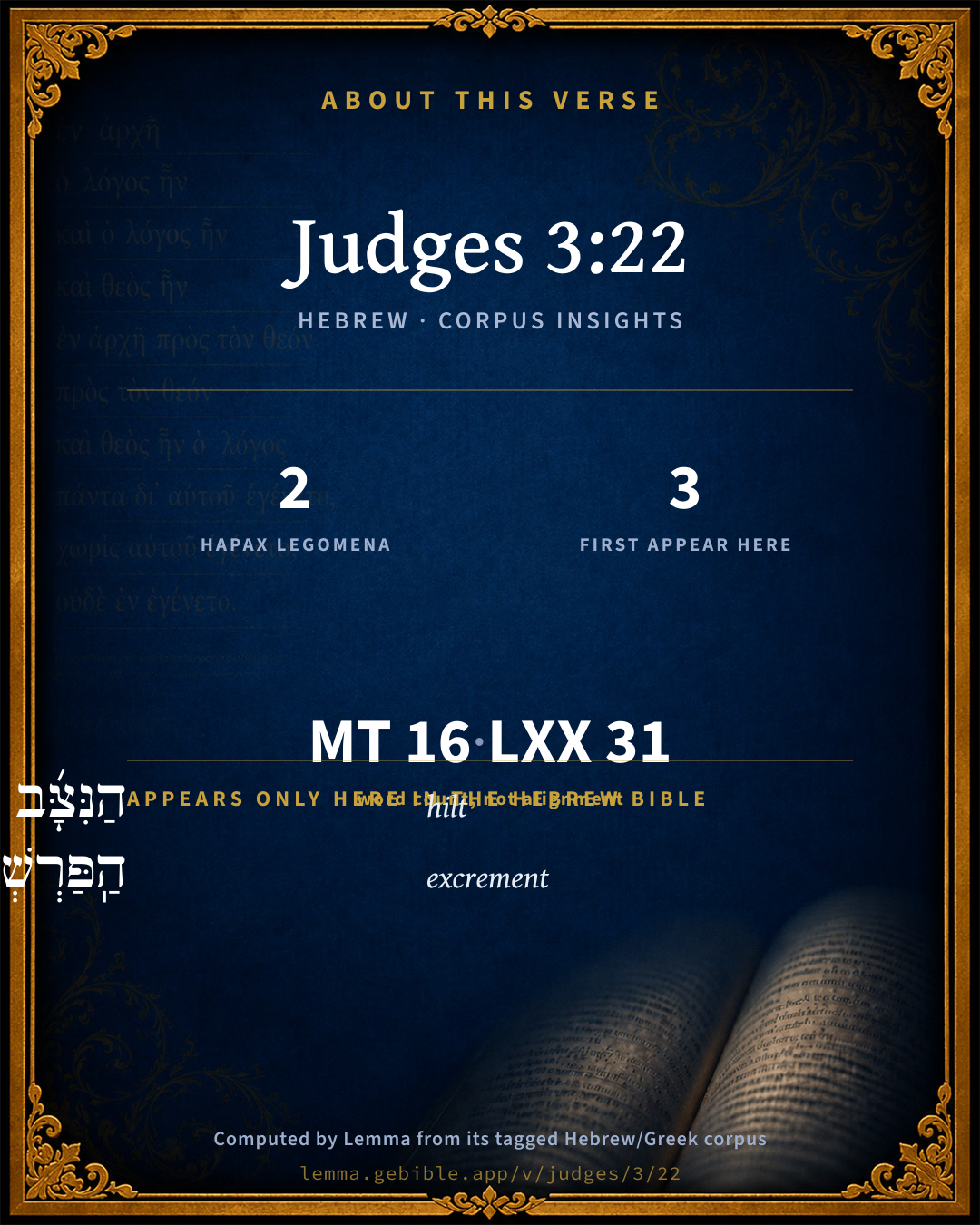
  • 2 hapax legomena — only here in the Hebrew Bible
  • 3 first appearances in the Hebrew Bible
Full analysis ↓
Download a study sheet

One document with this verse’s original text, its word-by-word gloss line, the meaning frame, cross-references with their text, attributed commentary, and full source and license credits — printable, and it pastes into notes with its structure intact.

This verse Autodidact and up

Study sheet (.html) Plain text (.txt)

A passage Seminary Student

Up to 50 verses in one chapter. A passage sheet keeps up to 6 commentary sources and 12 cross-references per verse, in the order this page ranks them, and says so on the sheet whenever that leaves anything out. Ask for a single verse and you get the Autodidact verse sheet above.

Everything on this page stays free to read, with no account — the sheet is a download of what is already on screen, not access to it.

Want to remove ads? Support Godless Engineer
Compare translations 3

The same verse in 3 English versions, stacked beneath the original-language interlinear above. Click any original word for its lexicon entry.

Each is an independent rendering of the whole verse — the interlinear is not word-aligned to these translations.

Highlighted words mark where these versions differ — a whole-verse word diff, not a word-by-word alignment.

  • World English Bible Public Domain
    and the haft also went in after the blade; and the fat closed on the blade, for he didn't draw the sword out of his body; and it came out behind.
  • King James Version Public Domain
    And the haft also went in after the blade; and the fat closed upon the blade, so that he could not draw the dagger out of his belly; and the dirt came out.
  • unfoldingWord Literal Text CC BY-SA 4.0
    And the handle also went in after the blade, and the fat closed around the handle, for he did not pull the sword from his belly, and excrement came out.

unfoldingWord Literal Text — © unfoldingWord, licensed CC BY-SA 4.0. Word-aligned USFM3 via Door43 (git.door43.org/unfoldingWord/en_ult).

Versions to compare (up to 4)

3 of 4 selected

Show all 18 translations

Every available English version of this verse, each an independent rendering of the whole verse.

  • World English Bible Public Domain
    and the haft also went in after the blade; and the fat closed on the blade, for he didn't draw the sword out of his body; and it came out behind.
  • Berean Standard Bible Public Domain
    Even the handle sank in after the blade, and Eglon’s fat closed in over it, so that Ehud did not withdraw the sword from his belly. And Eglon’s bowels emptied.
  • Majority Standard Bible Public Domain
    Even the handle sank in after the blade, and Eglon’s fat closed in over it, so that Ehud did not withdraw the sword from his belly. And Eglon’s bowels emptied.
  • King James Version Public Domain
    And the haft also went in after the blade; and the fat closed upon the blade, so that he could not draw the dagger out of his belly; and the dirt came out.
  • American Standard Version (1901) Public Domain
    and the haft also went in after the blade; and the fat closed upon the blade, for he drew not the sword out of his body; and it came out behind.
  • Revised Version (1885) Public Domain
    and the haft also went in after the blade; and the fat closed upon the blade, for he drew not the sword out of his belly; and it came out behind.
  • Geneva Bible (1599) Public Domain
    So that the hafte went in after the blade, and the fatte closed about the blade, so that he could not drawe the dagger out of his bellie, but the dirt came out.
  • Douay-Rheims (1899) Public Domain
    With such force that the haft went in after the blade into the wound, and was closed up with the abundance of fat. So that he did not draw out the dagger, but left it in his body as he had struck it in. And forthwith by the secret parts of nature the excrements of the belly came out.
  • Young's Literal Translation Public Domain
    and the haft also goeth in after the blade, and the fat shutteth on the blade, that he hath not drawn the sword out of his belly, and it goeth out at the fundament.
  • Literal Standard Version CC BY-SA 4.0
    and the hilt also goes in after the blade, and the fat shuts on the blade, that he has not drawn the sword out of his belly, and he goes out [through] the antechamber [[or and the dung came out]].
  • Unlocked Literal Bible CC BY-SA 4.0
    The hilt of the sword also went into him following the blade. The tip of the sword came out of his back and the fat closed over it, for Ehud did not pull the sword out of his belly.
  • unfoldingWord Literal Text CC BY-SA 4.0
    And the handle also went in after the blade, and the fat closed around the handle, for he did not pull the sword from his belly, and excrement came out.
  • Darby Bible Public Domain
    and the hilt also went in after the blade, and the fat closed over the blade, for he did not draw the sword out of his belly; and the dirt came out.
  • World Messianic Bible Public Domain
    The handle also went in after the blade; and the fat closed on the blade, for he didn’t draw the sword out of his body; and it came out behind.
  • Webster's Bible Public Domain
    And the haft also entered after the blade: and the fat closed upon the blade, so that he could not draw the dagger out of his belly; and the dirt came out.
  • Free Bible Version CC BY-SA 4.0
    The handle went in with the blade and the fat closed over it. So Ehud didn't pull the sword out, and the king defecated.
  • Bible in Basic English Public Domain
    And the hand-part went in after the blade, and the fat was joined up over the blade; for he did not take the sword out of his stomach. And he went out into the...
  • JPS Tanakh (1917) Public Domain
    And the haft also went in after the blade; and the fat closed upon the blade, for he drew not the sword out of his belly; and it came out behind.

Literal Standard Version (2020), Covenant Press — licensed CC BY-SA 4.0. Text via the HelloAO Bible API (eBible.org). Unlocked Literal Bible (unfoldingWord) — licensed CC BY-SA 4.0. Text via the HelloAO Bible API (eBible.org). unfoldingWord Literal Text — © unfoldingWord, licensed CC BY-SA 4.0. Word-aligned USFM3 via Door43 (git.door43.org/unfoldingWord/en_ult). Free Bible Version, Dr. Jonathan Gallagher — licensed CC BY-SA 4.0. Text via the HelloAO Bible API (eBible.org).

Word by word

More ways to search: Search by grammar → Find every occurrence → Compare this word →

Practice this passage: Drill this verse → Learn its vocabulary →

הַנִּצָּ֜ב
nitstsâb
H5325
“the · hilt”
Particle, Definite Article + Noun, Common, Masculine, Singular, Absolute
Part of Speech
Particle + Noun
Type
Common
Gender
Masculine
Number
Singular
State
Absolute
Full BDB Definition

Origin: passive participle of H5324

TWOT: 1398a

haft, hilt (of sword)
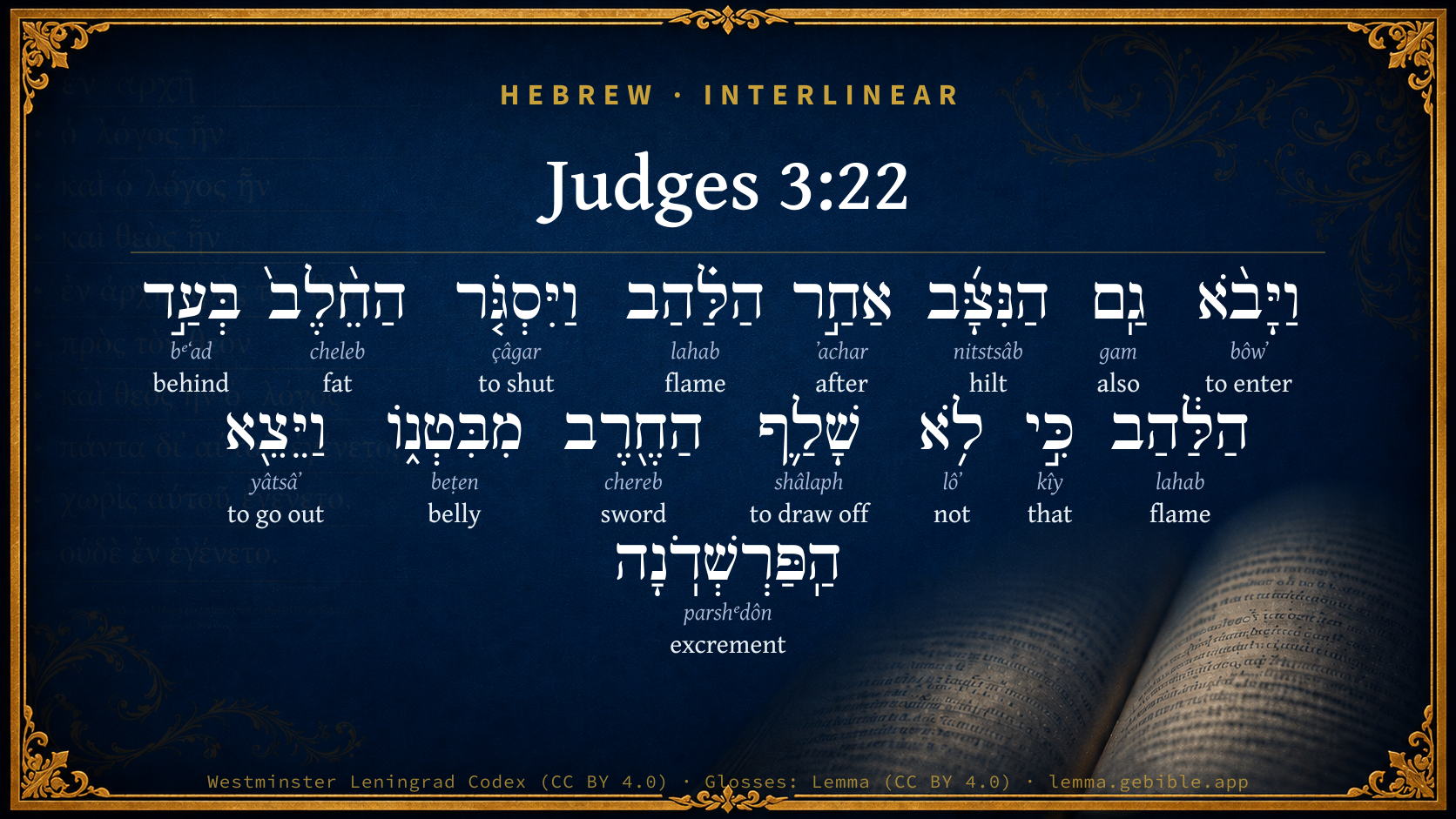
  1. וַיָּבֹ֨א bôwʼ H935 “and · to enter” Conjunction + Verb, Qal, Sequential Imperfect, 3rd Person, Masculine, Singular
  2. גַֽם gam H1571 “also” Adverb
  3. אַחַ֣ר ʼachar H310 “after” Preposition
  4. הַלַּ֗הַב lahab H3851 “the · flame” Particle, Definite Article + Noun, Common, Masculine, Singular, Absolute
  5. וַיִּסְגֹּ֤ר çâgar H5462 “and · to shut” Conjunction + Verb, Qal, Sequential Imperfect, 3rd Person, Masculine, Singular
  6. הַחֵ֨לֶב֙ cheleb H2459 “the · fat” Particle, Definite Article + Noun, Common, Masculine, Singular, Absolute
  7. בְּעַ֣ד bᵉʻad H1157 “behind” Preposition
  8. הַלַּ֔הַב lahab H3851 “the · flame” Particle, Definite Article + Noun, Common, Masculine, Singular, Absolute
  9. כִּ֣י kîy H3588 “that” Conjunction
  10. לֹ֥א lôʼ H3808 “not” Particle, Negative
  11. שָׁלַ֛ף shâlaph H8025 “to draw off” Verb, Qal, Perfect, 3rd Person, Masculine, Singular
  12. הַחֶ֖רֶב chereb H2719 “the · sword” Particle, Definite Article + Noun, Common, Feminine, Singular, Absolute
  13. מִבִּטְנ֑וֹ beṭen H990 “from · belly · his” Preposition + Noun, Common, Feminine, Singular, Construct + Suffix, Personal, 3rd Person, Masculine, Singular
  14. וַיֵּצֵ֖א yâtsâʼ H3318 “and · to go out” Conjunction + Verb, Qal, Sequential Imperfect, 3rd Person, Masculine, Singular
  15. הַֽפַּרְשְׁדֹֽנָה parshᵉdôn H6574 “the · excrement · toward” Particle, Definite Article + Noun, Common, Masculine, Singular, Absolute + Suffix, Demonstrative

About this verse

These counts appear in no published source. They are computed here, from the morphology-tagged text and Lemma’s own curated glosses. What Lemma adds →

16
words
15
distinct lemmas
Historical
section

Notable vocabulary

2 hapax legomena — words that appear only here in the entire Hebrew Bible:

  • הַנִּצָּ֜ב hilt H5325
  • הַֽפַּרְשְׁדֹֽנָה excrement H6574

First appearance in Scripture

These words make their first canonical appearance in the Hebrew Bible here:

  • הַנִּצָּ֜ב hilt H5325
  • הַלַּ֗הַב flame H3851
  • הַֽפַּרְשְׁדֹֽנָה excrement H6574

Shared distinctive vocabulary

הַלַּ֗הַב flame H3851 occurs in 10 verses of the Hebrew Bible. Also found in:

Grammatical profile

  • 4 verbs
  • 7 nouns
  • 2 prepositions
  • 1 conjunction
  • 1 adverb
  • 1 particle

Verb forms

  • וַיָּבֹ֨א Qal · Sequential Imperfect
  • וַיִּסְגֹּ֤ר Qal · Sequential Imperfect
  • שָׁלַ֛ף Qal · Perfect
  • וַיֵּצֵ֖א Qal · Sequential Imperfect

Repetition

A word recurs within this verse — often emphatic in Hebrew:

  • הַלַּ֗הַב flame H3851 ×2

Hebrew & Septuagint length

In English translation the verse runs 31 words from the Hebrew and 27 from the Septuagint (LXX English) — closely comparable.

A rough comparison of the two English renderings, which tokenize alike — not a word-level alignment.

Word counts can differ between the Hebrew and the Greek without any difference in meaning — e.g. the Hebrew direct-object marker אֵת has no separate Greek word, and Greek often adds the article ὁ.

In the original languages it is 16 Hebrew tokens and 31 Greek tokens — but the two are counted differently (Hebrew bundles its prefixes and suffixes into one token; the Greek is in lemma form), so that isn’t a like-for-like length.

Hebrew and Greek witnesses Masoretic Hebrew ↔ Greek Septuagint

The same verse in the two great witnesses to the Old Testament, shown verse-for-verse.

These are two independent witnesses, not word-aligned to each other, and the Septuagint is shown in lemma (dictionary) form.

Hebrew Judges 3:22 Masoretic · Westminster Leningrad Codex

וַיָּבֹ֨א גַֽם הַנִּצָּ֜ב אַחַ֣ר הַלַּ֗הַב וַיִּסְגֹּ֤ר הַחֵ֨לֶב֙ בְּעַ֣ד הַלַּ֔הַב כִּ֣י לֹ֥א שָׁלַ֛ף הַחֶ֖רֶב מִבִּטְנ֑וֹ וַיֵּצֵ֖א הַֽפַּרְשְׁדֹֽנָה

and the haft also went in after the blade; and the fat closed on the blade, for he didn't draw the sword out of his body; and it came out behind.

World English Bible · Public Domain

Greek LXX Judges 3:22 Septuagint · lemma form

καί ἐπι εἰςφέρω καί γέ ὁ λαβή ὀπίσω ὁ φλόξ καί ἀποκλείω ὁ στέαρ κατά ὁ φλόξ ὅτι οὐ ἐκσπάω ὁ μάχαιρα ἐκ ὁ κοιλία αὐτός καί ἐκἔρχομαι αωδ ὁ προστάς

and drove in also the haft after the blade, and the fat closed in upon the blade, for he drew not out the dagger from his belly.

LXX2012 (modern English Septuagint) · Public Domain

On this verse, Ellicott's Commentary for English Readers discusses the Septuagint’s reading. Read the note in Commentary ↓

Hebrew: Westminster Leningrad Codex (CC BY 4.0). Greek: Septuagint (public domain); English from LXX2012 (modern English Septuagint) (Public Domain). How the Septuagint differs from the Hebrew →

Targum (Aramaic paraphrase)

1

The Targum is the ancient Jewish Aramaic paraphrase of the Hebrew Scriptures — an interpretive translation, not the Hebrew text itself. Onkelos (literal) and Pseudo-Jonathan (expansive) render the Torah, and Jonathan the Prophets. Coverage is partial: where no permissively-licensed English translation exists for a verse, only the Aramaic is shown. This is verse-level text, not a word-by-word alignment to the Hebrew.

  1. Targum Jonathan Prophets (Joshua–Malachi)
    וְעַל אַף דִסְתְּקָא בָּתַר שְׁנָנָא וְטִמְטֵם שׁוּמְנָא בְּאַפֵּי שְׁנָנָא אֲרֵי לָא שְׁלַף חַרְבָּא מִמְעוֹהִי וּנְפַק אוּכְלֵיהּ שְׁפִיךְ:

    (no public-domain English translation for this verse)

    Targum Jonathan — Aramaic: “Mikraot Gedolot” (public domain). English: “Sefaria Community Translation” (CC0 1.0 (public-domain dedication)); “London "Chaldee Paraphrase," 1871” (public domain). Text via Sefaria.

Commentary

Notes on Judges 3:22 from classic Christian and Jewish commentators (each source and its license shown beneath its notes). The classic Christian expositions comment on the surrounding passage and are grouped to its opening verse, so a note may address several verses; the Jewish commentaries on the Tanakh (Rashi and others) are per-verse, so they appear only where the commentator wrote on this verse.

Lemma curates 59 commentaries, every one of them public domain or Creative Commons licensed, each selected and text-cleaned for this edition rather than reprinted as found. About our sources →

Trapp's Complete Commentary

John Trapp

Jdg 3:22 And the haft also went in after the blade; and the fat closed upon the blade, so that he could not draw the dagger out of his belly; and the dirt came out.

Ver. 22. And the dirt came out.] Which was a sign of death. And here Ehud was a type of Christ, in that he alone slew Eglon, as Christ alone doth all our enemies.

John Trapp, A Commentary or Exposition upon All the Books of the Old and New Testament (1647–1656) — public domain. Text from a community e-Sword module.

Joseph Benson's Commentary

Jdg 3:22. And the dirt came out — The Hebrew word פרשׁדנה, parschedona, here translated dirt, is found only in this place. It is from the Chaldee that it is thus rendered, and all agree that it signifies the excrements.

Joseph Benson's Commentary on the Old and New Testaments (1811–1818) — public domain. Text from a community e-Sword module.

Adam Clarke's Commentary

Verse 22. The haft also went in after the blade] As the instrument was very short, and Eglon very corpulent, this might readily take place.

And the dirt came out] This is variously understood: either the contents of the bowels issued through the wound, or he had an evacuation in the natural way through the fright and anguish.

The original, פרשדונה parshedonah, occurs only here, and is supposed to be compounded of פרש peresh, dung, and שדה shadah, to shed, and may be very well applied to the latter circumstance; so the Vulgate understood it: Statinque per secreta naturae alvi stercora proruperunt.

Adam Clarke's Commentary on the Bible (1810–1826) — public domain. Text from a community e-Sword/MySword module.

Ellicott's Commentary for English Readers

(22) The haft also went in after the blade.—The tremendous violence of the blow marks that resoluteness of character which Ehud shows throughout. The Hebrew for “blade” is “flame,” as the LXX. here render it. It is as though the vivid narrator would make us see the flash of the dagger ere it is buried, hilt and all, in the huge body. So in Nah_3:3 we have, “The horseman lifteth up the flame of the sword and the lightning of the spear.” The only other passage where the word occurs is to describe the polished head of the spear of Goliath (1Sa_17:7).

So that he could not draw the dagger out.—Thus he had disarmed himself by the force of his own blow; but the original only says, “for he did not draw the dagger out.”

And the dirt came out.—The meaning of this clause is excessively doubtful, because the Hebrew word rendered “dirt” (parsedonah) occurs here and here only. (1) Our E.V. follows the Chaldee and the Vulgate with the alternative rendering (2) “it came out at the fundament” (marg.), which is the view of Gesenius. The Jews were themselves uncertain of the meaning and even in Rabbi Tanchum’s commentary we find that some understood it to mean (3) “he (Ehud) ran out into the gallery.” (4) A fourth guess—that of the Syriac version—is, “he went out hastily.” The LXX. omit it altogether, either because they thought that they were consulting propriety—a tendency which they constantly show—or because they could not rightly explain it. The resemblance of the word parsedonah to the word misderônah (“porch”), in the next clause, is certainly in favour of its meaning some part of the house. Ewald renders it, “he rushed out into the gallery,” which runs round the roof. He refers to Eze_42:5. To understand it more exactly, we should require to know the structure of the house. Following the analogy of other Eastern houses, as described by Shaw, it seems that Eglon’s alijah was a separate building (domation, Jos.), or part of a building, with one door opening on a balcony, and another on a private staircase and closet (Jdg_3:24). It was an inner room, and its outer door communicated with the house.

A Bible Commentary for English Readers, edited by Charles John Ellicott (1878–1897) — public domain. Text from a community e-Sword module.

The Cambridge Bible for Schools and Colleges

gen. ed. J. J. S. Perowne

22. and it came out behind] i.e. the sword; but this is hardly grammatical, for sword is fem. and came out is mas. The marg. he went out into the ante-chamber is merely based upon a guess of the LXX (τὴν προστάδα). The AV. renders and the dirt came out, so Vulgate statimque per secreta naturae alvi stercora proruperunt, Targ., Jews, and many moderns, correcting the unknown and corrupt Hebr. word parshìdon to peresh = dung. “This somewhat drastic touch is altogether in the vein of the narrator” (Moore); cf. Jdg_3:16-17; Jdg_3:24 b. On the other hand the clause is so much like the words at the beginning of the next verse in Hebr., that it may be a dittograph, a miswritten form of what follows.

The Cambridge Bible for Schools and Colleges (gen. ed. J. J. S. Perowne; Cambridge University Press, 1878–1918) — public domain. Text from a community e-Sword module.

John Gill's Exposition

Then Ehud went forth through the porch,.... Which the Targum interprets by "exedra", a place, as Kimchi, where there were many seats, either for the people to sit in while waiting to have admittance into the presence of the king, or where the guards sat, and may be called the guard room; through this Ehud passed with all serenity and composure of mind imaginable, without the least show of distress and uneasiness in his countenance, being fully satisfied that what he had done was right, and according to the will of God:

and shut the doors of the parlour upon him, and locked them; joined the doors of the parlour, as the Targum, the two folds of the door, shut them close together upon Eglon within the parlour, and bolted them within, or drew the bolt on the inside, which he was able to do with a key for that purpose; of which see more on Jdg 3:25; and which it is probable he took away along with him; this must be understood as done before he went through the porch, and therefore should be rendered, "when" or "after he had shut the doors", &c. (e); wherefore in the Vulgate Latin version this clause is put first.

(e) "quum occlusisset", Junius & Tremellius, Piscator.

John Gill's Exposition of the Whole Bible (1746–1763) — public domain (CC PDM 1.0). Text via the HelloAO Bible API.

Albert Barnes' Notes on the Bible

The King James Version and margin give different explanations of the last words of this verse. Others explain it of a vestibule or chamber, through which Ehud passed into the porch where the entrance doors were. He locked the doors, took the key with him; and then retired through the midst of the attendants below (or: more probably, through the door which communicated directly with the outside).

Albert Barnes' Notes on the Bible (1834–1885) — public domain. Text from a community e-Sword/MySword module.

Haydock's Catholic Bible Commentary

CHAPTER III.

With, &c. Hebrew [and] Protestants, "And the haft also went in after the blade, and the fat closed upon the blade, so that he could not draw the dagger out of his belly, and the dirt came out." By the word belly, the Jews mean all the vital parts. (Calmet) ---- The wound was so deep, that Aod did not think proper to strive long to extract his sword; and indeed, being all bloody, it would have only tended to excite suspicion. (Haydock) --- The Chaldean agrees with the Vulgate in rendering parshedona "excrements," though it seem to be rather irregularly in construction with a masculine [], &c. If we should read peristana, "a porch," the difficulty would be avoided. (Calmet) --- Septuagint, "(23) and Aod went out into the porch, (prostada) and he shut the doors of the upper chamber....(24) and he himself went out." (Haydock)

George Leo Haydock (1774–1849), Haydock's Catholic Family Bible and Commentary, 1859 edition — public domain. Excludes Psalms (Douay-Rheims chapter numbering differs from Protestant) and Deuterocanonical books (Catholic canon only).

Matthew Poole's English Annotations

i.e. His excrements came forth, not at the wound, which closed up, but at the fundament, as is usual when persons die either a natural or violent death.

Matthew Poole's English Annotations on the Holy Bible (1683–1685) — public domain. Text from a community e-Sword/MySword module.

Whedon's Commentary on the Bible

Daniel D. Whedon

22. The dirt came out — The meaning of the word translated dirt is quite uncertain. The English version errs in making פרשׁדנה, parshedonah, rendered the dirt, the subject of the verb came out; for, as Gesenius says, “the He paragogic implies rather the place to which a thing comes out.” It seems, therefore, better to understand this obscure word as denoting either the place on Eglon’s body where the blade of Ehud’s dagger came out, or else an apartment of Eglon’s palace into which Ehud came out. This latter is, perhaps, preferable. Three apartments seem to be mentioned: the private parlour, (Jdg_3:20,) the hall, and the porch, (Jdg_3:23.) Having buried his dagger in Eglon’s body, Ehud went out through the hall and porch, and so escaped. Bachmann thinks the parshe-donah was a flat roof, upon which Ehud came out from the chamber where he assassinated Eglon, and that it is further defined by the word porch, in the next verse, which, in his view, means not an ordinary porch, but the platform of the roof, enclosed by lattice work.

Daniel D. Whedon (gen. ed.), Commentary on the Old and New Testaments (1874–1909) — public domain. Text from a community e-Sword module.

The Pulpit Commentary

The haft, etc. Ehud, feeling the necessity of killing Eglon at one blow, plunged the dagger into his body with such force that the handle went in with the blade, and he was unable to draw it out. Leaving it, therefore, buried in his fat, he went out at once into the parshedon, or antechamber, for so it is best to render the last words of the verse, and thence into the misederon, the outer porch, having first locked the door of the summer chamber. The words parshedon and misederon occur only here, and the former is very variously rendered.

The Pulpit Commentary (1880–1919), ed. H.D.M. Spence-Jones & Joseph S. Exell — public domain. Text from a community e-Sword module.

Rashi

Rabbi Shlomo Yitzchaki (Rashi)

The hilt. The iron into which the blade is inserted, called 'hulot' in old French. This balances the sword in its scabbard.

The blade. The sharpened section, called "brant" and "lama" in old French.

The fat closed. His fat. He was extremely corpulent, so that he enclosed the entire length of the dagger.

Waste matter oozed. Yonasan renders, "Spilled waste matter oozed." He reads this as a contraction of two words with the 'shin' serving both. "spilled waste matter" [oozed]. שְׁפַךְ, "spilled", is the translation of שְׁדָא according to Yonasan.

Rashi on the Tanakh — English translations: “The Judaica Press complete Tanach with Rashi, translated by A. J. Rosenberg” (CC BY 4.0); “Pentateuch with Rashi's commentary by M. Rosenbaum and A.M. Silbermann, 1929-1934” (public domain); “The Metsudah Tanach series, Lakewood, N.J” (CC BY 4.0); and “The Book of Joshua, Metsudah Publications, 1997” (CC BY 4.0). Text via Sefaria.

Lesson kit

Teaching starters — assembled from the data on this page, not authored interpretation. Every prompt links to the verse data it draws on. Edit before teaching.

Judges, in the Historical, opens this verse with 16 words (15 distinct Hebrew lemmas). Its most distinctive word is nitstsâb (“hilt”). A historical commentator’s framing appears above. Read the whole chapter for the surrounding context.

Discussion questions

  1. The word nitstsâb carries the sense “hilt.” How does it shape the verse?
  2. 2 words here appear nowhere else in the Hebrew Bible. Why might the author reach for such rare wording?
  3. 3 words make their first appearance in Scripture here. What does this debut establish?
  4. How does Judges 13:20, which shares the word «flame», read alongside this verse?
  5. What does the repetition of “flame” (2× in this one verse) do in this verse?
  6. These translations render this verse differently; the difference is in the English rendering, not the original. What questions does that raise?
  7. «וַיָּבֹ֨א» is a Qal Sequential Imperfect verb. How does that grammatical form shape the action described?
  8. Compare how Trapp's Complete Commentary and Joseph Benson's Commentary read this verse. Where do they agree or differ?

Things to notice

  • 2 words in this verse appear nowhere else in the Hebrew Bible.
  • 3 words make their first canonical appearance in Scripture here.
  • This verse counts 16 Hebrew ↔ 31 Greek words.
  • These translations choose different wording for 16 words in this verse.
  • “flame” occurs 2× in this single verse.

Reading settings

Reading text

Shown beneath each verse's original-language words.

Old Testament
Old Testament edition

Read the OT as the Masoretic Hebrew (MT) or the Greek Septuagint (LXX).

English shown for the Greek Septuagint (in the Hebrew ↔ Greek comparison).

Comparing translations? Open the Compare panel on any verse page to stack up to four side by side.