
Joshua 19:47

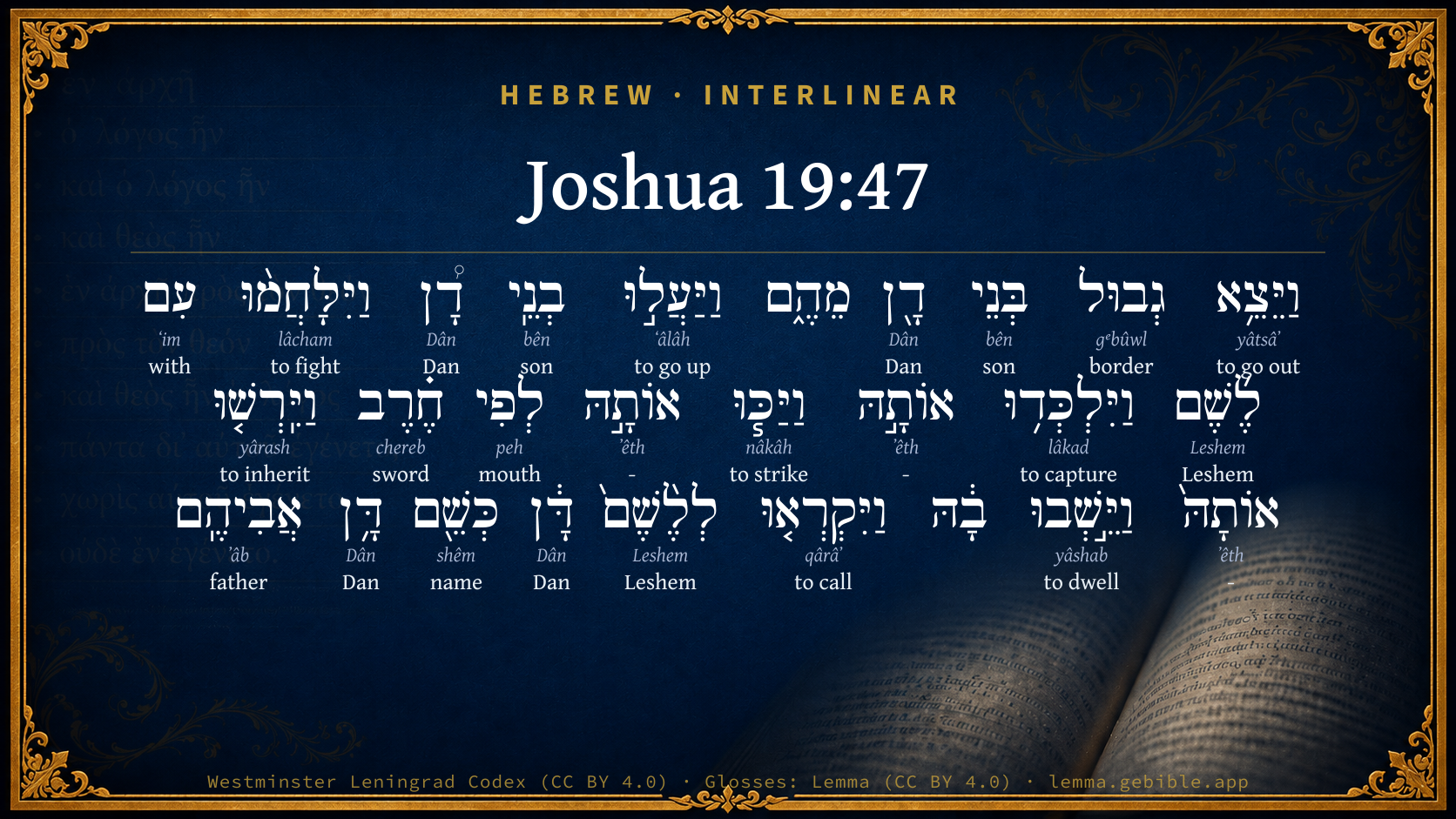
Hebrew (Westminster Leningrad Codex) Joshua 19:47 appears in the Hebrew Old Testament. The text above is from the Westminster Leningrad Codex. Each word links to its Strong’s number, a concise gloss, and parsing drawn from the Open Scriptures Hebrew Bible morphology. Click any word for its full Brown-Driver-Briggs (BDB) entry.
Download image
Cite this verse

Joshua 19:47 (World English Bible). Public Domain. Lemma interlinear Bible study tool, https://lemma.gebible.app/v/joshua/19/47.

Show BibTeX & RIS
BibTeX
RIS
English Translation
The border of the children of Dan went out beyond them; for the children of Dan went up and fought against Leshem, and took it, and struck it with the edge of the sword, and possessed it, and lived therein, and called Leshem, Dan, after the name of Dan their father.
World English Bible · Public Domain
Highlights
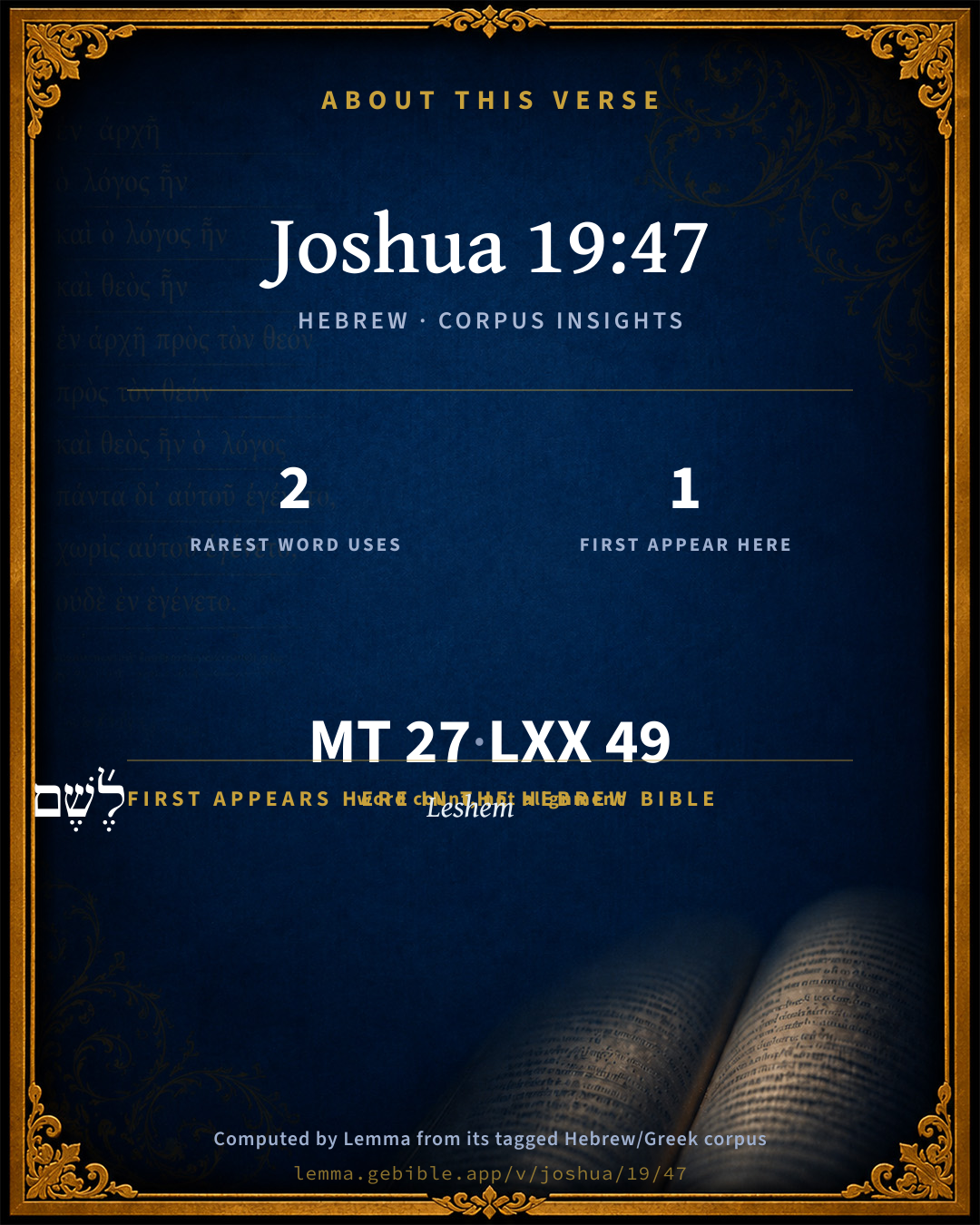
  • 1 first appearance in the Hebrew Bible
Full analysis ↓
Download a study sheet

One document with this verse’s original text, its word-by-word gloss line, the meaning frame, cross-references with their text, attributed commentary, and full source and license credits — printable, and it pastes into notes with its structure intact.

This verse Autodidact and up

Study sheet (.html) Plain text (.txt)

A passage Seminary Student

Up to 50 verses in one chapter. A passage sheet keeps up to 6 commentary sources and 12 cross-references per verse, in the order this page ranks them, and says so on the sheet whenever that leaves anything out. Ask for a single verse and you get the Autodidact verse sheet above.

Everything on this page stays free to read, with no account — the sheet is a download of what is already on screen, not access to it.

Want to remove ads? Support Godless Engineer
Compare translations 3

The same verse in 3 English versions, stacked beneath the original-language interlinear above. Click any original word for its lexicon entry.

Each is an independent rendering of the whole verse — the interlinear is not word-aligned to these translations.

Highlighted words mark where these versions differ — a whole-verse word diff, not a word-by-word alignment.

  • World English Bible Public Domain
    The border of the children of Dan went out beyond them; for the children of Dan went up and fought against Leshem, and took it, and struck it with the edge of the sword, and possessed it, and lived therein, and called Leshem, Dan, after the name of Dan their father.
  • King James Version Public Domain
    And the coast of the children of Dan went out too little for them: therefore the children of Dan went up to fight against Leshem, and took it, and smote it with the edge of the sword, and possessed it, and dwelt therein, and called Leshem, Dan, after the name of Dan their father.
  • unfoldingWord Literal Text CC BY-SA 4.0
    But the border of the sons of Dan went out from them. So the sons of Dan went up and fought with Leshem and captured it, and they struck it to the mouth of the sword. And they possessed it and settled in it and called Leshem Dan, like the name of their father Dan.

unfoldingWord Literal Text — © unfoldingWord, licensed CC BY-SA 4.0. Word-aligned USFM3 via Door43 (git.door43.org/unfoldingWord/en_ult).

Versions to compare (up to 4)

3 of 4 selected

Show all 18 translations

Every available English version of this verse, each an independent rendering of the whole verse.

  • World English Bible Public Domain
    The border of the children of Dan went out beyond them; for the children of Dan went up and fought against Leshem, and took it, and struck it with the edge of the sword, and possessed it, and lived therein, and called Leshem, Dan, after the name of Dan their father.
  • Berean Standard Bible Public Domain
    (Later, when the territory of the Danites was lost to them, they went up and fought against Leshem, captured it, and put it to the sword. So they took possession of Leshem, settled there, and renamed it after their father Dan.)
  • Majority Standard Bible Public Domain
    (Later, when the territory of the Danites was lost to them, they went up and fought against Leshem, captured it, and put it to the sword. So they took possession of Leshem, settled there, and renamed it after their father Dan.)
  • King James Version Public Domain
    And the coast of the children of Dan went out too little for them: therefore the children of Dan went up to fight against Leshem, and took it, and smote it with the edge of the sword, and possessed it, and dwelt therein, and called Leshem, Dan, after the name of Dan their father.
  • American Standard Version (1901) Public Domain
    And the border of the children of Dan went out beyond them; for the children of Dan went up and fought against Leshem, and took it, and smote it with the edge of the sword, and possessed it, and dwelt therein, and called Leshem, Dan, after the name of Dan their father.
  • Revised Version (1885) Public Domain
    And the border of the children of Dan went out beyond them: for the children of Dan went up and fought against Leshem, and took it, and smote it with the edge of the sword, and possessed it, and dwelt therein, and called Leshem, Dan, after the name of Dan their father.
  • Geneva Bible (1599) Public Domain
    But the coastes of the children of Dan fell out too litle for them: therefore the children of Dan went vp to fight against Leshem, and tooke it, and smote it with the edge of the sworde, and possessed it, and dwelt therein, and called Leshem, Dan after the name of Dan their father.
  • Douay-Rheims (1899) Public Domain
    And is terminated there. And the children of Dan went up and fought against Lesem, and took it: and they put it to the sword, and possessed it, and dwelt in it, calling the name of it Lesem Dan, by the name of Dan their father.
  • Young's Literal Translation Public Domain
    And the border of the sons of Dan goeth out from them, and the sons of Dan go up and fight with Leshem, and capture it, and smite it by the mouth of the sword, and possess it, and dwell in it, and call Leshem, Dan, according to the name of Dan their father.
  • Literal Standard Version CC BY-SA 4.0
    And the border of the sons of Dan goes out from them, and the sons of Dan go up and fight with Leshem, and capture it, and strike it by the mouth of the sword, and possess it, and dwell in it, and call Leshem, Dan, according to the name of their father Dan.
  • Unlocked Literal Bible CC BY-SA 4.0
    When the territory of the tribe of Dan was lost to them, Dan attacked Leshem, fought against it, capturing it and striking it with the sword; taking possession of it and settled in it. They renamed Leshem, calling it Dan after their ancestor.
  • unfoldingWord Literal Text CC BY-SA 4.0
    But the border of the sons of Dan went out from them. So the sons of Dan went up and fought with Leshem and captured it, and they struck it to the mouth of the sword. And they possessed it and settled in it and called Leshem Dan, like the name of their father Dan.
  • Darby Bible Public Domain
    And the border of the children of Dan ended with these; and the children of Dan went up and fought against Leshem, and took it, and smote it with the edge of the sword, and took possession of it, and dwelt in it, and called Leshem, Dan, after the name of Dan their father.
  • World Messianic Bible Public Domain
    The border of the children of Dan went out beyond them; for the children of Dan went up and fought against Leshem, and took it, and struck it with the edge of the sword, and possessed it, and lived therein, and called Leshem, Dan, after the name of Dan their forefather.
  • Webster's Bible Public Domain
    And the border of the children of Dan, went out too little for them: therefore the children of Dan went up to fight against Leshem, and took it, and smote it with the edge of the sword, and possessed it, and dwelt in it, and called Leshem, Dan, after the name of Dan their father.
  • Free Bible Version CC BY-SA 4.0
    However, the tribe of Dan was not able to hold on to their allotted land, so they went and attacked Leshem and captured it. They slaughtered its inhabitants and took possession of the town, settling there. They renamed Leshem as Dan, after their ancestor.
  • Bible in Basic English Public Domain
    (But the limit of the children of Dan was not wide enough for them; so the children of Dan went up and made war on Leshem and took it, putting it to the sword without mercy, and they took it for their heritage and made a place for themselves there, giving it the name of Leshem-dan, after the name of their father, Dan.)
  • JPS Tanakh (1917) Public Domain
    And the border of the children of Dan was too strait for them; so the children of Dan went up and fought against Leshem, and took it, and smote it with the edge of the sword, and possessed it, and dwelt therein, and called Leshem, Dan, after the name of Dan their father.

Literal Standard Version (2020), Covenant Press — licensed CC BY-SA 4.0. Text via the HelloAO Bible API (eBible.org). Unlocked Literal Bible (unfoldingWord) — licensed CC BY-SA 4.0. Text via the HelloAO Bible API (eBible.org). unfoldingWord Literal Text — © unfoldingWord, licensed CC BY-SA 4.0. Word-aligned USFM3 via Door43 (git.door43.org/unfoldingWord/en_ult). Free Bible Version, Dr. Jonathan Gallagher — licensed CC BY-SA 4.0. Text via the HelloAO Bible API (eBible.org).

Word by word

More ways to search: Search by grammar → Find every occurrence → Compare this word →

Practice this passage: Drill this verse → Learn its vocabulary →

לֶ֜שֶׁם
Leshem
H3959
“Leshem”
Noun, Proper
Part of Speech
Noun
Type
Proper
Full BDB Definition

Origin: the same as H3958

TWOT: None

Leshem = "precious stone" - a city west of Mount Hermon, also called 'Laish' and later 'Dan'
  1. וַיֵּצֵ֥א yâtsâʼ H3318 “and · to go out” Conjunction + Verb, Qal, Sequential Imperfect, 3rd Person, Masculine, Singular
  2. גְבוּל gᵉbûwl H1366 “border of” Noun, Common, Masculine, Singular, Construct
  3. בְּנֵי bên H1121 “sons of” Noun, Common, Masculine, Plural, Construct
  4. דָ֖ן Dân H1835 “Dan” Noun, Proper
  5. וַיַּעֲל֣וּ ʻâlâh H5927 “and · to go up” Conjunction + Verb, Qal, Sequential Imperfect, 3rd Person, Masculine, Plural
  6. בְנֵֽי bên H1121 “sons of” Noun, Common, Masculine, Plural, Construct
  7. דָ֠ן Dân H1835 “Dan” Noun, Proper
  8. וַיִּלָּחֲמ֨וּ lâcham H3898 “and · to fight” Conjunction + Verb, Niphal, Sequential Imperfect, 3rd Person, Masculine, Plural
  9. עִם ʻim H5973 “with” Preposition
  10. וַיִּלְכְּד֥וּ lâkad H3920 “and · to capture” Conjunction + Verb, Qal, Sequential Imperfect, 3rd Person, Masculine, Plural
  11. אוֹתָ֣הּ ʼêth H853 “- · her” Particle, Direct Object + Suffix, Personal, 3rd Person, Feminine, Singular
  12. וַיַּכּ֧וּ nâkâh H5221 “and · to strike” Conjunction + Verb, Hiphil, Sequential Imperfect, 3rd Person, Masculine, Plural
  13. אוֹתָ֣הּ ʼêth H853 “- · her” Particle, Direct Object + Suffix, Personal, 3rd Person, Feminine, Singular
  14. לְפִי peh H6310 “to/for · mouth of” Preposition + Noun, Common, Masculine, Singular, Construct
  15. חֶ֗רֶב chereb H2719 “sword” Noun, Common, Feminine, Singular, Absolute
  16. וַיִּֽרְשׁ֤וּ yârash H3423 “and · to inherit” Conjunction + Verb, Qal, Sequential Imperfect, 3rd Person, Masculine, Plural
  17. אוֹתָהּ֙ ʼêth H853 “- · her” Particle, Direct Object + Suffix, Personal, 3rd Person, Feminine, Singular
  18. וַיֵּ֣שְׁבוּ yâshab H3427 “and · to dwell” Conjunction + Verb, Qal, Sequential Imperfect, 3rd Person, Masculine, Plural
  19. וַיִּקְרְא֤וּ qârâʼ H7121 “and · to call” Conjunction + Verb, Qal, Sequential Imperfect, 3rd Person, Masculine, Plural
  20. לְלֶ֨שֶׁם֙ Leshem H3959 “to/for · Leshem” Preposition + Noun, Proper
  21. דָּ֔ן Dân H1835 “Dan” Noun, Proper
  22. כְּשֵׁ֖ם shêm H8034 “like/as · name of” Preposition + Noun, Common, Masculine, Singular, Construct
  23. דָּ֥ן Dân H1835 “Dan” Noun, Proper
  24. אֲבִיהֶֽם ʼâb H1 “father · their” Noun, Common, Masculine, Singular, Construct + Suffix, Personal, 3rd Person, Masculine, Plural

About this verse

These counts appear in no published source. They are computed here, from the morphology-tagged text and Lemma’s own curated glosses. What Lemma adds →

27
words
18
distinct lemmas
Historical
section

Notable vocabulary

The rarest word here is לֶ֜שֶׁם Leshem H3959 — appearing just 2 times in the whole Hebrew Bible.

First appearance in Scripture

This word makes its first canonical appearance in the Hebrew Bible here:

  • לֶ֜שֶׁם Leshem H3959

Grammatical profile

  • 8 verbs
  • 13 nouns
  • 3 prepositions
  • 3 particles

Verb forms

  • וַיֵּצֵ֥א Qal · Sequential Imperfect
  • וַיַּעֲל֣וּ Qal · Sequential Imperfect
  • וַיִּלָּחֲמ֨וּ Niphal · Sequential Imperfect
  • וַיִּלְכְּד֥וּ Qal · Sequential Imperfect
  • וַיַּכּ֧וּ Hiphil · Sequential Imperfect
  • וַיִּֽרְשׁ֤וּ Qal · Sequential Imperfect
  • וַיֵּ֣שְׁבוּ Qal · Sequential Imperfect
  • וַיִּקְרְא֤וּ Qal · Sequential Imperfect

Repetition

Words recur within this verse — often emphatic in Hebrew:

  • דָ֖ן Dan H1835 ×4
  • בְּנֵי son H1121 ×2
  • לֶ֜שֶׁם Leshem H3959 ×2

Hebrew & Septuagint length

In English translation the verse runs 51 words from the Hebrew and 64 from the Septuagint (LXX English) — closely comparable.

A rough comparison of the two English renderings, which tokenize alike — not a word-level alignment.

Word counts can differ between the Hebrew and the Greek without any difference in meaning — e.g. the Hebrew direct-object marker אֵת has no separate Greek word, and Greek often adds the article ὁ.

In the original languages it is 27 Hebrew tokens and 49 Greek tokens — but the two are counted differently (Hebrew bundles its prefixes and suffixes into one token; the Greek is in lemma form), so that isn’t a like-for-like length.

Cross-references

2

Topical passages linked to Joshua 19:47 in the Treasury of Scripture Knowledge — connected by theme and wording, ordered by reader-vote popularity; previews shown in the World English Bible.

  • Judges 1:34–35 The Amorites forced the children of Dan into the hill-country; for they would not allow them to come down to the valley;
  • Judges 18:1–29 In those days there was no king in Israel: and in those days the tribe of the Danites sought them an inheritance to dwell in; for to that day [their] inheritance had not fallen to them among the tribes of Israel.

Cross-references courtesy of OpenBible.info (CC BY 4.0).

Hebrew and Greek witnesses Masoretic Hebrew ↔ Greek Septuagint

The same verse in the two great witnesses to the Old Testament, shown verse-for-verse.

These are two independent witnesses, not word-aligned to each other, and the Septuagint is shown in lemma (dictionary) form.

Hebrew Joshua 19:47 Masoretic · Westminster Leningrad Codex

וַיֵּצֵ֥א גְבוּל בְּנֵי דָ֖ן מֵהֶ֑ם וַיַּעֲל֣וּ בְנֵֽי דָ֠ן וַיִּלָּחֲמ֨וּ עִם לֶ֜שֶׁם וַיִּלְכְּד֥וּ אוֹתָ֣הּ וַיַּכּ֧וּ אוֹתָ֣הּ לְפִי חֶ֗רֶב וַיִּֽרְשׁ֤וּ אוֹתָהּ֙ וַיֵּ֣שְׁבוּ בָ֔הּ וַיִּקְרְא֤וּ לְלֶ֨שֶׁם֙ דָּ֔ן כְּשֵׁ֖ם דָּ֥ן אֲבִיהֶֽם

The border of the children of Dan went out beyond them; for the children of Dan went up and fought against Leshem, and took it, and struck it with the edge of the sword, and possessed it, and lived therein, and called Leshem, Dan, after the name of Dan their father.

World English Bible · Public Domain

Greek LXX Joshua 19:47 Septuagint · lemma form

οὗτος ὁ κληρονομία φυλή υἱός δαν κατά δῆμος αὐτός ὁ πόλις αὐτός καί ὁ κώμη αὐτός καί οὐ ἐκθλίβω ὁ υἱός δαν ὁ ἀμορραῖος ὁ θλίβω αὐτός ἐν ὁ ὄρος καί οὐ ἐάω αὐτός ὁ ἀμορραῖος καταβαίνω εἰς ὁ κοιλάς καί θλίβω ἀπό αὐτός ὁ ὅριον ὁ μερίς αὐτός

This is the inheritance of the tribe of the children of Dan, according to their families, these are their cities and their villages: and the children of Dan did not drive out the Amorite who afflicted them in the mountain; and the Amorite would not suffer them to come down into the valley, but they forcibly took from them the border of their portion.

LXX2012 (modern English Septuagint) · Public Domain

On this verse, Haydock's Catholic Bible Commentary discusses the Septuagint’s reading. Read the note in Commentary ↓

Hebrew: Westminster Leningrad Codex (CC BY 4.0). Greek: Septuagint (public domain); English from LXX2012 (modern English Septuagint) (Public Domain). How the Septuagint differs from the Hebrew →

Targum (Aramaic paraphrase)

1

The Targum is the ancient Jewish Aramaic paraphrase of the Hebrew Scriptures — an interpretive translation, not the Hebrew text itself. Onkelos (literal) and Pseudo-Jonathan (expansive) render the Torah, and Jonathan the Prophets. Coverage is partial: where no permissively-licensed English translation exists for a verse, only the Aramaic is shown. This is verse-level text, not a word-by-word alignment to the Hebrew.

  1. Targum Jonathan Prophets (Joshua–Malachi)
    וּנְפַק תְּחוּם בְּנֵי דָן מִנְהוֹן וּסְלִיקוּ בְּנֵי דָן וְאַגִיחוּ קְרָבָא עִם לֶשֶׁם וּכְבַשׁוּ יָתָהּ וּמְחוֹ יָתָה לְפִתְגַם דְחֶרֶב וִירִיתוּ יָתָהּ וִיתִיבוּ בָהּ וּקְרוֹ לְלֶשֶׁם דָן כְּשׁוּם דָן אֲבוּהוֹן:

    (no public-domain English translation for this verse)

    Targum Jonathan — Aramaic: “Mikraot Gedolot” (public domain). English: “Sefaria Community Translation” (CC0 1.0 (public-domain dedication)); “London "Chaldee Paraphrase," 1871” (public domain). Text via Sefaria.

Commentary

Notes on Joshua 19:47 from classic Christian and Jewish commentators (each source and its license shown beneath its notes). The classic Christian expositions comment on the surrounding passage and are grouped to its opening verse, so a note may address several verses; the Jewish commentaries on the Tanakh (Rashi and others) are per-verse, so they appear only where the commentator wrote on this verse.

Lemma curates 59 commentaries, every one of them public domain or Creative Commons licensed, each selected and text-cleaned for this edition rather than reprinted as found. About our sources →

Trapp's Complete Commentary

John Trapp

Jos 19:47 And the coast of the children of Dan went out [too little] for them: therefore the children of Dan went up to fight against Leshem, and took it, and smote it with the edge of the sword, and possessed it, and dwelt therein, and called Leshem, Dan, after the name of Dan their father.

Ver. 47. Went up to fight against Leshem.] Called Laish in Jdg 18:7 Where they turned open idolaters, and are therefore cut out of the roll of Christ’s people. {Rev 7:1-17 1Ch 7:1-40}

John Trapp, A Commentary or Exposition upon All the Books of the Old and New Testament (1647–1656) — public domain. Text from a community e-Sword module.

Joseph Benson's Commentary

Jos 19:47. The coast of Dan went out too little — The words too little are not in the Hebrew, where there is nothing that corresponds with them. The passage runs thus: The coast of the children of Dan went out from them; that is, they were dispossessed of it in some parts, or kept out of them by the former inhabitants; and we find, by Jdg 1:34, that the Amorites forced them into the mountains, and would not suffer them to dwell in the valley. This reduced them to such straits, that they were constrained to enlarge their border some other way; which they did as follows. They went up to fight against Leshem — A city not far from Jordan, called Laish in the book of Judges, before it was taken by the Danites. And called Leshem, Dan, after the name of Dan their father — It was customary for conquerors to change the names of those places they subdued. This was done with respect to Leshem, after the death of Joshua; and is related more largely in the book of Judges, chap. 18., where the whole expedition is recorded. From whence some have argued that this book was not written by Joshua; whereas no more can fairly be inferred, than that, in after times, Ezra, or some other, thought good to insert this verse here, in order to complete the account of the Danites’ possessions.

Joseph Benson's Commentary on the Old and New Testaments (1811–1818) — public domain. Text from a community e-Sword module.

Tyndale Open Study Notes

Tyndale Open Resources

19:47 The tribe of Dan had trouble taking possession of their land because of the Philistines, so a group of Danites later moved northward to Laish (see Judg 18), which they renamed Dan, on the northern border of Israel’s territory.

Tyndale Open Study Notes — © Tyndale Open Resources, licensed CC BY-SA 4.0. Text via the HelloAO Bible API.

Geneva Bible (1599)

Geneva Bible translators

According as Jacob had prophesied, Gen. 49:17.

Geneva Bible (1599) marginal notes — public domain. Text via Bolls.life.

Jamieson, Fausset & Brown

Robert Jamieson, A. R. Fausset & David Brown

the children of Dan went up to fight against Leshem--The Danites, finding their inheritance too small, decided to enlarge its boundaries by the sword; and, having conquered Leshem (Laish), they planted a colony there, calling the new settlement by the name of Dan (see on Jdg 18:7).

Jamieson, Fausset & Brown — Commentary Critical and Explanatory on the Whole Bible (1871) — public domain (CC PDM 1.0). Text via the HelloAO Bible API.

Adam Clarke's Commentary

Verse 47. Went out too little for them] This is certainly the meaning of the passage; but our translators have been obliged to add the words too little to make this sense apparent. Houbigant contends that an ancient copyist, meeting frequently with the words ויצאהגבול vaiyetse haggebul, in the preceding history, became so familiarized to them that he wrote them here instead of ויאץ הגבול vaiyaats haggebul, and the border of the children of Dan was STRAIT for them. It was on this account that they were obliged to go and fight against Leshem, and take and possess it, their former inheritance being too strait for their increasing population.

And called Leshem, Dan] This city was situated near the origin of Jordan, at the utmost northern extremity of the promised land, as Beer-sheba was at that of the south; and as after its capture by the Danites it was called Dan, hence arose the expression from Dan even to Beer-sheba, which always signified the whole extent of the promised land. Some suppose that Leshem was the same with Caesarea Philippi, but others with reason reject this opinion. It must be granted that the whole account given in this verse refers indisputably to a fact which did not take place till after the death of Joshua. It is another of the marginal or explicative notes which were added by some later hand. The whole account of this expedition of the Danites against Leshem is circumstantially given in Jdg 18:1-29 the book of Judges, and to that chapter the reader is referred.

Adam Clarke's Commentary on the Bible (1810–1826) — public domain. Text from a community e-Sword/MySword module.

Ellicott's Commentary for English Readers

(47) And the coast of the children of Dan went out too little for them.—The words “too

little” are not in the original; and it seems better to translate literally: And the coast of the children of Dan went out from them—i.e., their territory was partly re-conquered by the Philistines. Something similar seems to have occurred in several districts of the country. The Israelites not taking advantage of the impression produced by Joshua’s great victories to occupy the territory assigned to them, the nations of Canaan re-possessed themselves of their former abodes. and held them against Israel. The Philistines are expressly said to have been left to prove Israel. Joshua was not permitted to exterminate them. And although Dan and Judah, numerically the two strongest of all the tribes (both in the census in the plains of Moab and at Sinai), were placed next to the Philistines, and had the task of conquering that nation assigned to them, still it was not effected. We read in Judges 1, “The Amorites forced the children of Dan into the mountains, for they would not suffer them to come down into the valley.”

Hence the Danites, instead of attacking the Philistines and Amorites in their inheritance, preferred to form a new settlement in the north, and put to the sword “a people quiet and secure,” who “had no deliverer,” rather than “run with patience the race set before them.” They were not minded to resist unto blood, striving against their foes. (See the narrative in Judges 18, especially Jos_19:27-28.)

A Bible Commentary for English Readers, edited by Charles John Ellicott (1878–1897) — public domain. Text from a community e-Sword module.

The Cambridge Bible for Schools and Colleges

gen. ed. J. J. S. Perowne

47. went out too little for them] The words “too little” are inserted in our Version. They are not found in the original Hebrew, which literally means, the border of the children of Dan went out from them, i.e. the border of the children of Dan was extended. “Squeezed into the narrow strip between the mountains and the sea, its energies were great beyond its numbers.” Stanley’s Sin. and Pal., p. 395; Lectures, p. 268.

went up to fight] “Stieded vp, and fouçten,” Wyclif. Hard pressed by the Amorites, whom they were unable to expel from the plain (Jdg_1:34), and by the Philistines, they longed for an addition to their territory, they sent out five spies from two towns in the low country, who tracked the Jordan to its source beyond the waters of Merom, and came to an eminence on which rose the town of

Leshem] or Laish, far up in northern Palestine, the modern Tell el-Kâdy near Bâniâs. It was a colony from Sidon, and its inhabitants, separated from their mother city by the huge mass of Lebanon and half of Anti-Lebanon, “dwelt quiet and secure” (Jdg_18:7), in the enjoyment of the warm climate and exquisite scenery, and tilling the fertile soil, irrigated by many streams. The spies marked the spot, and on their return bade their brethren arise, and take possession of a place where there is no want of any thing that is in the earth (Jdg_18:10), and the soil of which “even now produces large crops of wheat, barley, maize, sesame, rice, and other plants with very little labour … while horses, cattle, and sheep fatten on the rich pastures, and large herds of black buffaloes luxuriate in the streams and deep mire of the marshes.” See Thomson’s Land and the Book, p. 214; Robinson, Bib. Res. iii. 396.

therefore the children of Dan went up to fight] On receiving the news six hundred Danites from Zorah and Eshtaol girded on their weapons of war (Jdg_18:11), and pushed their way to the sources of the Jordan, and finding the town of Laish just as the spies had described it, far from its mother city, dwelling quiet and secure, they burst upon it, scaled its walls (Jdg_18:27), and

took it] and set it on fire, massacring the inhabitants. Then they rebuilt the town, and dwelt therein, and

called Leshem, Dan, after the name of Dan their father] The name Tell el-Kâdi = “the mound of the Judge”, still preserves the ancient Dan = “judge.” See Tristram’s Land of Israel, p. 580.

The Cambridge Bible for Schools and Colleges (gen. ed. J. J. S. Perowne; Cambridge University Press, 1878–1918) — public domain. Text from a community e-Sword module.

John Gill's Exposition

This is the inheritance of the tribe of the children of Dan,.... Before described by its cities, which were in it. This tribe was bounded by Ephraim on the north, by Judah on the east, by Simeon on the south, and by the Mediterranean sea on the west. Josephus (h) says, the Danites enjoyed the vale which lies to the setting sun, bounded by Azotus and Doris, and all Jamnia and Getta, from Accaron (or Ekron) to the mountain from whence the tribe of Judah begins:

according to their families; which inheritance was distributed according to the number of their families:

their cities with their villages; before named.

(h) Antiqu. l. 5. c. 1. sect. 22.

John Gill's Exposition of the Whole Bible (1746–1763) — public domain (CC PDM 1.0). Text via the HelloAO Bible API.

Albert Barnes' Notes on the Bible

The words “too little” are an insertion of the King James Version Render rather, “the border of the children of Dan was extended.” The Hebrew appears to mean “the children of Dan enlarged their border because they had not room enough.”

The reason of this was that the Danites, a numerous tribe (Num 26:5 note), found themselves Jdg 1:34-35 cooped up among the hills by the powerful and warlike Amorites. Hence, the Danite expedition (see the marginal reference), which surprised the Sidonion inhabitants of Leshem, an unwarlike and peaceable race, exterminated them, and annexed their city and territory to the portion of Dan.

Albert Barnes' Notes on the Bible (1834–1885) — public domain. Text from a community e-Sword/MySword module.

Haydock's Catholic Bible Commentary

There. Hebrew, "and the limits of Dan went out from them. They were not able to keep the cities in subjection; so that, finding themselves too much confined, they sought for fresh settlements at Lessem; or, their borders were known by these cities, through which they passed, (Calmet) though most of them had been already assigned to the tribe of Juda. (Menochius) --- Dan. This city was not Peneas, or Cæsarea, but the utmost boundary of Palestine on the north, as Bersabee was on the south. This history is given more at large, Judges xviii. 1. The Septuagint vary from the Hebrew in verses 46, 47, and 48, (Calmet) and add that "the children of Dan did not destroy the Amorrhites, who afflicted them in the mountains, and would not suffer them to descend into the plain....But the land of Ephraim lay heavy upon them, and they became tributary to them. (See chap. xvii. 13.) 49. And they went to take possession of their limits, and the children of Israel," &c. (Haydock)

George Leo Haydock (1774–1849), Haydock's Catholic Family Bible and Commentary, 1859 edition — public domain. Excludes Psalms (Douay-Rheims chapter numbering differs from Protestant) and Deuterocanonical books (Catholic canon only).

Matthew Poole's English Annotations

Went out too little for them, Heb. went out from them, to wit, out of their hands or possession; for so this Hebrew word is used concerning those lands, which in the year of the jubilee are said to go out, Lev 25:28,30,31,33, i.e. out of the hands of the present possessor, to the first and ancient owner. And so peradventure this may signify that many of the Danites were forced by their powerful neighbors the Philistines to relinquish their coast, and their allotted habitations; which put them upon the following course.

The children of Dan went up to fight against Leshem after Joshua’s death, as appears from Jdg 18 and seems to be here inserted, partly that all the chief places where the Danites (dwelt,) though far distant, might be mentioned together; and partly to give an account of this strange accident, why they removed from their appointed portion to so remote a place; which may be this, that being much molested and terrified by their bad neighbours, they thought fit to go to some place remote from them, which also they were in a manner constrained to do, because otherwise they must have taken some part of the portions of other tribes, whereas now going to the very utmost northern point of the land, they took that which did not belong to, or, at least, was not in the possession of any other tribe. See more Jdg 18.

Matthew Poole's English Annotations on the Holy Bible (1683–1685) — public domain. Text from a community e-Sword/MySword module.

Whedon's Commentary on the Bible

Daniel D. Whedon

47. The coast… went out too little — Here the English version is at fault by inserting too little. Masius has given the sense correctly thus: “The Danites emigrated beyond themselves, that is, beyond the inheritance in which they were first placed by the divine lot, and set out in search of other possessions.” This occurred after the death of Joshua, and is here narrated out of its chronological order, so as to complete the description of Dan’s lot.

Therefore… went up to fight — Rather, and the children of Dan went up and fought. Leshem, or Laish, is at the extreme north, near the foot of Mount Hermon. A minute account of this expedition and its results is found in Judges 18, where see notes.

Daniel D. Whedon (gen. ed.), Commentary on the Old and New Testaments (1874–1909) — public domain. Text from a community e-Sword module.

The Pulpit Commentary

Went out too little for them. The Hebrew is, went out from them; i.e. , either went out beyond their own borders, or went out too small a distance to be sufficient for them. The first is the explanation of Masius ("extra se migrasse"), the second of Jarchi. Houbigant suggests for axeYew "and it went out" xaYw "and it was narrow." But the LXX, has the same reading as ourselves, and the explanation given above is quite consistent with the fact. The border of Dan did "go out" far beyond the borders originally assigned to the tribe, in fact to the extreme northern limit of Palestine. The account of the taking of Laish, or Leshem, is given more fully in Jud_1:18. The inheritance assigned to Dan was extremely small, but it was also extremely fertile.

The Pulpit Commentary (1880–1919), ed. H.D.M. Spence-Jones & Joseph S. Exell — public domain. Text from a community e-Sword module.

John Wesley's Explanatory Notes

Went up to fight - This was done after Joshua's death, and seems to be here inserted, that all the chief places where the Danites dwelt, tho' far distant, might be mentioned together; and to give an account of this strange accident, why they removed from their appointed portion to so remote a place; which may be this, that being much molested by their bad neighbours, they thought fit to go to some place remote from them, which also they were in a manner constrained to do, because otherwise they must have taken some part of the portions of other tribes, whereas now going to the very utmost northern point of the land, they took that which did not belong to any other tribe.

John Wesley, Explanatory Notes Upon the Whole Bible (1754–1765) — public domain. Text via the GEBible commentary corpus.

unfoldingWord translationNotes

Door43 World Missions Community

Leshem

This is the name of a city. (See: How to Translate Names)

This was the inheritance of the tribe of Dan

The land and cities that the tribe of Dan received are spoken of as if they were an inheritance that they received as a permanent possession. AT: "This was the land and the cities that the tribe of Dan received as an inheritance" (See: Metaphor)

translationWords

Dan

sword

possess

unfoldingWord translationNotes — © Distant Shores Media and the Door43 World Missions Community, licensed CC BY-SA 4.0. Source: git.door43.org/Door43/en_tn.

Rashi

Rabbi Shlomo Yitzchaki (Rashi)

The boundary of Bnei Don extended from them. At this point they took only a small portion, but the lot also fell for them in another place which was a distance from their boundary, and thus the other tribes intervened between them.

They fought against Leshem. This took place later in the time of Osniel, the son of Kenaz, in the days of the graven image of Michoh, as it is said in the Book of Shoftim.

Leshem This is the city of Layish, that is mentioned in the Book of Shoftim.

Rashi on the Tanakh — English translations: “The Judaica Press complete Tanach with Rashi, translated by A. J. Rosenberg” (CC BY 4.0); “Pentateuch with Rashi's commentary by M. Rosenbaum and A.M. Silbermann, 1929-1934” (public domain); “The Metsudah Tanach series, Lakewood, N.J” (CC BY 4.0); and “The Book of Joshua, Metsudah Publications, 1997” (CC BY 4.0). Text via Sefaria.

Lesson kit

Teaching starters — assembled from the data on this page, not authored interpretation. Every prompt links to the verse data it draws on. Edit before teaching.

Joshua, in the Historical, opens this verse with 27 words (18 distinct Hebrew lemmas). Its most distinctive word is Leshem (“Leshem”). A historical commentator’s framing appears above. Read the whole chapter for the surrounding context.

Discussion questions

  1. How does “Leshem” (Leshem) shape what this verse is saying?
  2. This is the first place “Leshem” appears in Scripture (first appears here). What does its debut here establish?
  3. How does Judges 1:34–35, which shares this passage’s theme, read alongside this verse?
  4. What does the repetition of “Dan” (4× in this one verse) do in this verse?
  5. These translations render this verse differently; the difference is in the English rendering, not the original. What questions does that raise?
  6. «וַיֵּצֵ֥א» is a Qal Sequential Imperfect verb. How does that grammatical form shape the action described?
  7. Compare how Trapp's Complete Commentary and Joseph Benson's Commentary read this verse. Where do they agree or differ?

Things to notice

Reading settings

Reading text

Shown beneath each verse's original-language words.

Old Testament
Old Testament edition

Read the OT as the Masoretic Hebrew (MT) or the Greek Septuagint (LXX).

English shown for the Greek Septuagint (in the Hebrew ↔ Greek comparison).

Comparing translations? Open the Compare panel on any verse page to stack up to four side by side.