
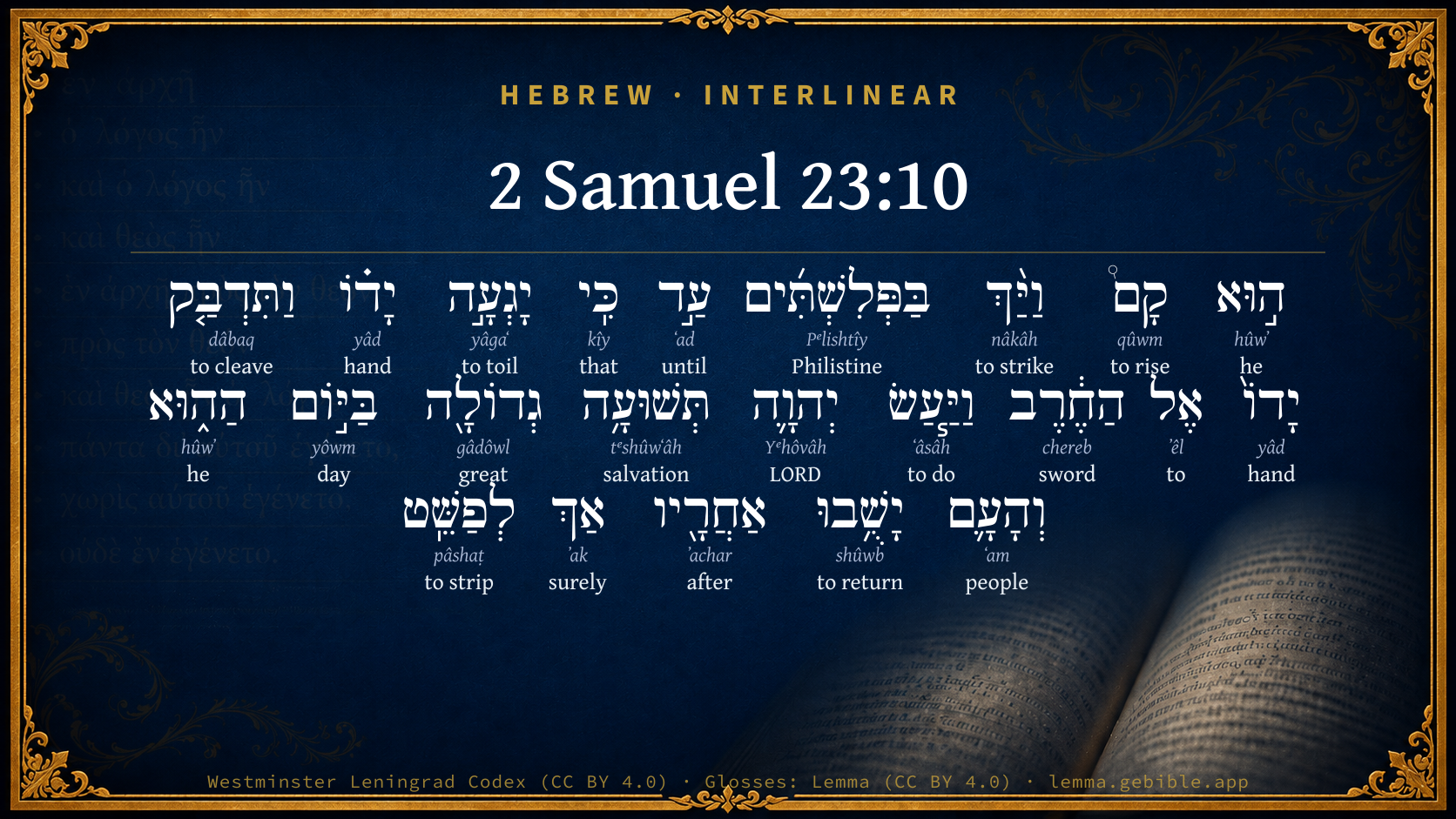
2 Samuel 23:10

Hebrew (Westminster Leningrad Codex) 2 Samuel 23:10 appears in the Hebrew Old Testament. The text above is from the Westminster Leningrad Codex. Each word links to its Strong’s number, a concise gloss, and parsing drawn from the Open Scriptures Hebrew Bible morphology. Click any word for its full Brown-Driver-Briggs (BDB) entry.
Download image
Cite this verse

2 Samuel 23:10 (World English Bible). Public Domain. Lemma interlinear Bible study tool, https://lemma.gebible.app/v/2-samuel/23/10.

Show BibTeX & RIS
BibTeX
RIS
English Translation
He arose, and struck the Philistines until his hand was weary, and his hand froze to the sword; and Yahweh worked a great victory that day; and the people returned after him only to take spoil.
World English Bible · Public Domain
Download a study sheet

One document with this verse’s original text, its word-by-word gloss line, the meaning frame, cross-references with their text, attributed commentary, and full source and license credits — printable, and it pastes into notes with its structure intact.

This verse Autodidact and up

Study sheet (.html) Plain text (.txt)

A passage Seminary Student

Up to 50 verses in one chapter. A passage sheet keeps up to 6 commentary sources and 12 cross-references per verse, in the order this page ranks them, and says so on the sheet whenever that leaves anything out. Ask for a single verse and you get the Autodidact verse sheet above.

Everything on this page stays free to read, with no account — the sheet is a download of what is already on screen, not access to it.

Want to remove ads? Support Godless Engineer
Compare translations 3

The same verse in 3 English versions, stacked beneath the original-language interlinear above. Click any original word for its lexicon entry.

Each is an independent rendering of the whole verse — the interlinear is not word-aligned to these translations.

Highlighted words mark where these versions differ — a whole-verse word diff, not a word-by-word alignment.

  • World English Bible Public Domain
    He arose, and struck the Philistines until his hand was weary, and his hand froze to the sword; and Yahweh worked a great victory that day; and the people returned after him only to take spoil.
  • King James Version Public Domain
    He arose, and smote the Philistines until his hand was weary, and his hand clave unto the sword: and the LORD wrought a great victory that day; and the people returned after him only to spoil.
  • unfoldingWord Literal Text CC BY-SA 4.0
    he, he arose and struck the Philistines until his hand tired and his hand clung to the sword. And Yahweh did great salvation on that day, and the people returned after him only to plunder.

unfoldingWord Literal Text — © unfoldingWord, licensed CC BY-SA 4.0. Word-aligned USFM3 via Door43 (git.door43.org/unfoldingWord/en_ult).

Versions to compare (up to 4)

3 of 4 selected

Show all 18 translations

Every available English version of this verse, each an independent rendering of the whole verse.

  • World English Bible Public Domain
    He arose, and struck the Philistines until his hand was weary, and his hand froze to the sword; and Yahweh worked a great victory that day; and the people returned after him only to take spoil.
  • Berean Standard Bible Public Domain
    but Eleazar stood his ground and struck the Philistines until his hand grew weary and stuck to his sword. The LORD brought about a great victory that day. Then the troops returned to him, but only to plunder the dead.
  • Majority Standard Bible Public Domain
    but Eleazar stood his ground and struck the Philistines until his hand grew weary and stuck to his sword. The LORD brought about a great victory that day. Then the troops returned to him, but only to plunder the dead.
  • King James Version Public Domain
    He arose, and smote the Philistines until his hand was weary, and his hand clave unto the sword: and the LORD wrought a great victory that day; and the people returned after him only to spoil.
  • American Standard Version (1901) Public Domain
    He arose, and smote the Philistines until his hand was weary, and his hand clave unto the sword; and Jehovah wrought a great victory that day; and the people returned after him only to take spoil.
  • Revised Version (1885) Public Domain
    He arose, and smote the Philistines until his hand was weary, and his hand clave unto the sword: and the LORD wrought a great victory that day; and the people returned after him only to spoil.
  • Geneva Bible (1599) Public Domain
    He arose and smote the Philistims vntill his hande was wearie, and his hande claue vnto the sworde: and the Lord gaue great victorie the same day, and the people returned after him onely to spoyle.
  • Douay-Rheims (1899) Public Domain
    And when the men of Israel were gone away, he stood and smote the Philistines till his hand was weary, and grew stiff with the sword: and the Lord wrought a great victory that day: and the people that were fled away, returned to take spoils of them that were slain.
  • Young's Literal Translation Public Domain
    he hath arisen, and smiteth among the Philistines till that his hand hath been weary, and his hand cleaveth unto the sword, and Jehovah worketh a great salvation on that day, and the people turn back after him only to strip off.
  • Literal Standard Version CC BY-SA 4.0
    he has arisen, and strikes among the Philistines until his hand has been weary, and his hand cleaves to the sword, and YHWH works a great salvation on that day, and the people turn back after him only to strip off.
  • Unlocked Literal Bible CC BY-SA 4.0
    Eleazar stood and fought the Philistines until his hand became weary and his hand stiffened to the grip of his sword. Yahweh brought about a great victory that day. The army returned after Eleazar, only to strip the bodies.
  • unfoldingWord Literal Text CC BY-SA 4.0
    he, he arose and struck the Philistines until his hand tired and his hand clung to the sword. And Yahweh did great salvation on that day, and the people returned after him only to plunder.
  • Darby Bible Public Domain
    He arose and smote the Philistines until his hand was weary, and his hand clave to the sword; and Jehovah wrought a great deliverance that day; and the people returned after him only to spoil.
  • World Messianic Bible Public Domain
    He arose and struck the Philistines until his hand was weary, and his hand froze to the sword; and the LORD worked a great victory that day; and the people returned after him only to take plunder.
  • Webster's Bible Public Domain
    He arose, and smote the Philistines until his hand was weary, and his hand adhered to the sword: and the LORD wrought a great victory that day; and the people returned after him only to plunder.
  • Free Bible Version CC BY-SA 4.0
    but Eleazar took his stand and went on killing Philistines until his hand stuck to his sword. The Lord saved them by granting them a great victory. The Israelite army did return, but only to strip the dead.
  • Bible in Basic English Public Domain
    He was with David and went on fighting the Philistines till his hand became tired and stiff from gripping his sword: and that day the Lord gave a great salvation, and the people came back after him only to take the goods of the Philistines.
  • JPS Tanakh (1917) Public Domain
    he stood firm, and smote the Philistines until his hand was weary, and his hand did cleave unto the sword; and the LORD wrought a great victory that day; and the people returned after him only to strip the slain.

Literal Standard Version (2020), Covenant Press — licensed CC BY-SA 4.0. Text via the HelloAO Bible API (eBible.org). Unlocked Literal Bible (unfoldingWord) — licensed CC BY-SA 4.0. Text via the HelloAO Bible API (eBible.org). unfoldingWord Literal Text — © unfoldingWord, licensed CC BY-SA 4.0. Word-aligned USFM3 via Door43 (git.door43.org/unfoldingWord/en_ult). Free Bible Version, Dr. Jonathan Gallagher — licensed CC BY-SA 4.0. Text via the HelloAO Bible API (eBible.org).

Word by word

More ways to search: Search by grammar → Find every occurrence → Compare this word →

Practice this passage: Drill this verse → Learn its vocabulary →

יָגְעָ֣ה
yâgaʻ
H3021
“to toil”
Verb, Qal, Perfect, 3rd Person, Feminine, Singular
Part of Speech
Verb
Stem
Qal
Form
Perfect
Person
3rd Person
Gender
Feminine
Number
Singular
Full BDB Definition

Origin: a primitive root

TWOT: 842

to toil, labour, grow weary, be weary - (Qal) - to toil, labour - to grow weary, be weary - (Piel) to weary, make weary, cause to go toilsomely - (Hiphil) to make to toil, make weary, cause to be weary
  1. ה֣וּא hûwʼ H1931 “he” Pronoun, Personal, 3rd Person, Masculine, Singular
  2. קָם֩ qûwm H6965 “to rise” Verb, Qal, Perfect, 3rd Person, Masculine, Singular
  3. וַיַּ֨ךְ nâkâh H5221 “and · to strike” Conjunction + Verb, Hiphil, Sequential Imperfect, 3rd Person, Masculine, Singular
  4. בַּפְּלִשְׁתִּ֜ים Pᵉlishtîy H6430 “in/at the · Philistines” Preposition, Determined + Noun, Gentilic, Masculine, Plural, Absolute
  5. עַ֣ד ʻad H5704 “until” Preposition
  6. כִּֽי kîy H3588 “that” Conjunction
  7. יָד֗וֹ yâd H3027 “hand · his” Noun, Common, Both, Singular, Construct + Suffix, Personal, 3rd Person, Masculine, Singular
  8. וַתִּדְבַּ֤ק dâbaq H1692 “and · to cleave” Conjunction + Verb, Qal, Sequential Imperfect, 3rd Person, Feminine, Singular
  9. יָדוֹ֙ yâd H3027 “hand · his” Noun, Common, Both, Singular, Construct + Suffix, Personal, 3rd Person, Masculine, Singular
  10. אֶל ʼêl H413 “to” Preposition
  11. הַחֶ֔רֶב chereb H2719 “the · sword” Particle, Definite Article + Noun, Common, Feminine, Singular, Absolute
  12. וַיַּ֧עַשׂ ʻâsâh H6213 “and · to do” Conjunction + Verb, Qal, Sequential Imperfect, 3rd Person, Masculine, Singular
  13. יְהוָ֛ה Yᵉhôvâh H3068 “LORD” Noun, Proper
  14. תְּשׁוּעָ֥ה tᵉshûwʻâh H8668 “salvation” Noun, Common, Feminine, Singular, Absolute
  15. גְדוֹלָ֖ה gâdôwl H1419 “great” Adjective, Adjective, Feminine, Singular, Absolute
  16. בַּיּ֣וֹם yôwm H3117 “in/at the · day” Preposition, Determined + Noun, Common, Masculine, Singular, Absolute
  17. הַה֑וּא hûwʼ H1931 “the · he” Particle, Definite Article + Pronoun, Personal, 3rd Person, Masculine, Singular
  18. וְהָעָ֛ם ʻam H5971 “and · the · people” Conjunction + Particle, Definite Article + Noun, Common, Masculine, Singular, Absolute
  19. יָשֻׁ֥בוּ shûwb H7725 “to return” Verb, Qal, Imperfect, 3rd Person, Masculine, Plural
  20. אַחֲרָ֖יו ʼachar H310 “after · him” Preposition + Suffix, Personal, 3rd Person, Masculine, Singular
  21. אַךְ ʼak H389 “surely” Particle, Accusative
  22. לְפַשֵּֽׁט pâshaṭ H6584 “to strip” Preposition + Verb, Piel, Infinitive Construct

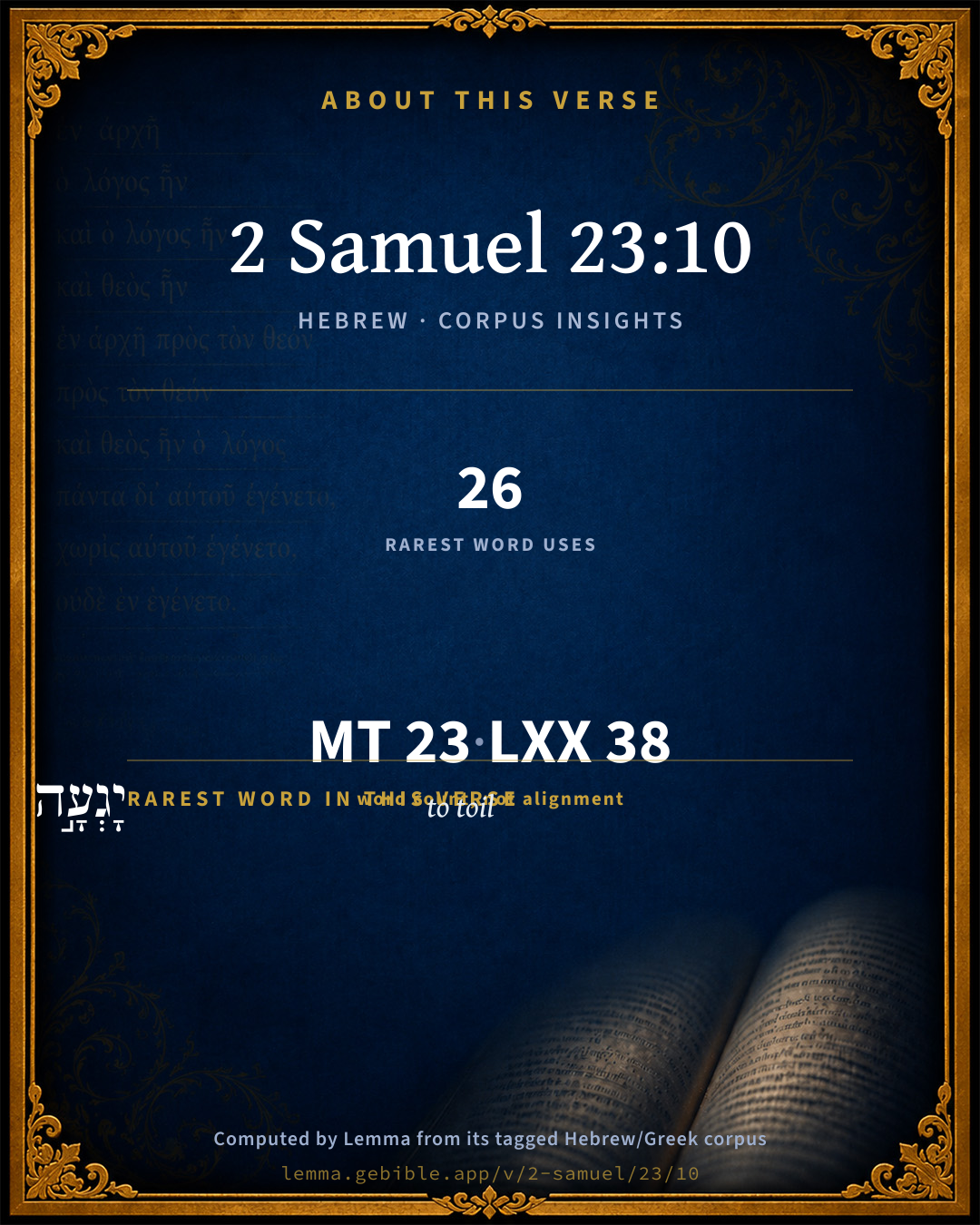
About this verse

These counts appear in no published source. They are computed here, from the morphology-tagged text and Lemma’s own curated glosses. What Lemma adds →

23
words
21
distinct lemmas
Historical
section

Shared distinctive vocabulary

יָגְעָ֣ה to toil H3021 occurs in 25 verses of the Hebrew Bible. Also found in:

Grammatical profile

  • 7 verbs
  • 8 nouns
  • 1 adjective
  • 2 pronouns
  • 3 prepositions
  • 1 conjunction
  • 1 particle

Verb forms

  • קָם֩ Qal · Perfect
  • וַיַּ֨ךְ Hiphil · Sequential Imperfect
  • יָגְעָ֣ה Qal · Perfect
  • וַתִּדְבַּ֤ק Qal · Sequential Imperfect
  • וַיַּ֧עַשׂ Qal · Sequential Imperfect
  • יָשֻׁ֥בוּ Qal · Imperfect
  • לְפַשֵּֽׁט Piel · Infinitive Construct

Repetition

Words recur within this verse — often emphatic in Hebrew:

  • יָד֗וֹ hand H3027 ×2
  • ה֣וּא he H1931 ×2

Hebrew & Septuagint length

In English translation the verse runs 36 words from the Hebrew and 39 from the Septuagint (LXX English) — closely comparable.

A rough comparison of the two English renderings, which tokenize alike — not a word-level alignment.

Word counts can differ between the Hebrew and the Greek without any difference in meaning — e.g. the Hebrew direct-object marker אֵת has no separate Greek word, and Greek often adds the article ὁ.

In the original languages it is 23 Hebrew tokens and 38 Greek tokens — but the two are counted differently (Hebrew bundles its prefixes and suffixes into one token; the Greek is in lemma form), so that isn’t a like-for-like length.

Cross-references

17

Topical passages linked to 2 Samuel 23:10 in the Treasury of Scripture Knowledge — connected by theme and wording, ordered by reader-vote popularity; previews shown in the World English Bible.

  • 1 Samuel 11:13 Saul said, There shall not a man be put to death this day; for today Yahweh has worked deliverance in Israel.
  • 1 Samuel 19:5 for he put his life in his hand, and struck the Philistine, and Yahweh worked a great victory for all Israel: you saw it, and did rejoice; why then will you sin against innocent blood, to kill David without a cause?
  • Joshua 10:10 Yahweh confused them before Israel, and he killed them with a great slaughter at Gibeon, and chased them by the way of the ascent of Beth Horon, and struck them to Azekah, and to Makkedah.
  • Joshua 10:42 All these kings and their land did Joshua take at one time, because Yahweh, the God of Israel, fought for Israel.
  • Joshua 11:8 Yahweh delivered them into the hand of Israel, and they struck them, and chased them to great Sidon, and to Misrephoth Maim, and to the valley of Mizpeh eastward; and they struck them, until they left them none remaining.
  • Judges 15:14 When he came to Lehi, the Philistines shouted as they met him: and the Spirit of Yahweh came mightily on him, and the ropes that were on his arms became as flax that was burnt with fire, and his bands dropped from off his hands.
  • Judges 15:18 He was very thirsty, and called on Yahweh, and said, You have given this great deliverance by the hand of your servant; and now shall I die for thirst, and fall into the hand of the uncircumcised.
  • 1 Samuel 14:6 Jonathan said to the young man who bore his armor, Come, and let us go over to the garrison of these uncircumcised: it may be that Yahweh will work for us; for there is no restraint to Yahweh to save by many or by few.
  • 1 Samuel 14:23 So Yahweh saved Israel that day: and the battle passed over by Beth Aven.
  • 2 Kings 5:1 Now Naaman, captain of the host of the king of Syria, was a great man with his master, and honorable, because by him Yahweh had given victory to Syria: he was also a mighty man of valor, [but he was] a leper.
  • Psalms 68:12 "Kings of armies flee! They flee!" She who waits at home divides the spoil,
  • Psalms 108:13 Through God, we will do valiantly. For it is he who will tread down our enemies.
  • Psalms 144:10 You are he who gives salvation to kings, Who rescues David, his servant, from the deadly sword.
  • Isaiah 53:12 Therefore will I divide him a portion with the great, and he shall divide the spoil with the strong; because he poured out his soul to death, and was numbered with the transgressors: yet he bore the sin of many, and made intercession for the transgressors.
  • Romans 15:18 For I will not dare to speak of any things except those which Christ worked through me, for the obedience of the Gentiles, by word and deed,
  • 2 Corinthians 4:5 For we don't preach ourselves, but Christ Jesus as Lord, and ourselves as your servants for Jesus' sake;

Cross-references courtesy of OpenBible.info (CC BY 4.0).

Hebrew and Greek witnesses Masoretic Hebrew ↔ Greek Septuagint

The same verse in the two great witnesses to the Old Testament, shown verse-for-verse.

These are two independent witnesses, not word-aligned to each other, and the Septuagint is shown in lemma (dictionary) form.

Hebrew 2 Samuel 23:10 Masoretic · Westminster Leningrad Codex

ה֣וּא קָם֩ וַיַּ֨ךְ בַּפְּלִשְׁתִּ֜ים עַ֣ד כִּֽי יָגְעָ֣ה יָד֗וֹ וַתִּדְבַּ֤ק יָדוֹ֙ אֶל הַחֶ֔רֶב וַיַּ֧עַשׂ יְהוָ֛ה תְּשׁוּעָ֥ה גְדוֹלָ֖ה בַּיּ֣וֹם הַה֑וּא וְהָעָ֛ם יָשֻׁ֥בוּ אַחֲרָ֖יו אַךְ לְפַשֵּֽׁט

He arose, and struck the Philistines until his hand was weary, and his hand froze to the sword; and Yahweh worked a great victory that day; and the people returned after him only to take spoil.

World English Bible · Public Domain

Greek LXX 2 Samuel 23:10 Septuagint · lemma form

αὐτός ἀναἵστημι καί πατάσσω ἐν ὁ ἀλλόφυλος ἕως ὅς κοπιάω ὁ χείρ αὐτός καί προςκολλάω ὁ χείρ αὐτός πρός ὁ μάχαιρα καί ποιέω κύριος σωτηρία μέγας ἐν ὁ ἡμέρα ἐκεῖνος καί ὁ λαός κάθημαι ὀπίσω αὐτός πλήν ἐκδιδύσκω

He arose an struck the Philistines, until his hand was weary, and his hand clave to the sword: and the Lord wrought a great salvation in that day, and the people rested behind him only to strip the slain.

LXX2012 (modern English Septuagint) · Public Domain

Hebrew: Westminster Leningrad Codex (CC BY 4.0). Greek: Septuagint (public domain); English from LXX2012 (modern English Septuagint) (Public Domain). How the Septuagint differs from the Hebrew →

Targum (Aramaic paraphrase)

1

The Targum is the ancient Jewish Aramaic paraphrase of the Hebrew Scriptures — an interpretive translation, not the Hebrew text itself. Onkelos (literal) and Pseudo-Jonathan (expansive) render the Torah, and Jonathan the Prophets. Coverage is partial: where no permissively-licensed English translation exists for a verse, only the Aramaic is shown. This is verse-level text, not a word-by-word alignment to the Hebrew.

  1. Targum Jonathan Prophets (Joshua–Malachi)
    הוּא קָם וּקְטַל בִּפְלִשְׁתָּאֵי עַד דְלָאִית יְדֵיהּ וְאַדְבִּיקַת יְדֵיהּ עִם חַרְבָּא וַעֲבַד יְיָ פּוּרְקָנָא רַבָּא בְּיוֹמָא הַהוּא וְעַמָא תַּב בַּתְרוֹהִי בְּרַם לַחֲלָצָא קְטִילַיָא:

    (no public-domain English translation for this verse)

    Targum Jonathan — Aramaic: “Mikraot Gedolot” (public domain). English: “Sefaria Community Translation” (CC0 1.0 (public-domain dedication)); “London "Chaldee Paraphrase," 1871” (public domain). Text via Sefaria.

Commentary

Notes on 2 Samuel 23:10 from classic Christian and Jewish commentators (each source and its license shown beneath its notes). The classic Christian expositions comment on the surrounding passage and are grouped to its opening verse, so a note may address several verses; the Jewish commentaries on the Tanakh (Rashi and others) are per-verse, so they appear only where the commentator wrote on this verse.

Lemma curates 59 commentaries, every one of them public domain or Creative Commons licensed, each selected and text-cleaned for this edition rather than reprinted as found. About our sources →

Trapp's Complete Commentary

John Trapp

2Sa 23:10 He arose, and smote the Philistines until his hand was weary, and his hand clave unto the sword: and the LORD wrought a great victory that day; and the people returned after him only to spoil.

Ver. 10. Until his hand was weary.] Scanderbeg fought against the Turks with such earnestness, that the blood burst out at his lips, as he was slaying them.

And his hand clave unto the sword.] By the contraction of his sinews, through the pains he had taken. Spasmus est tendonum contractio: quae aliquando fit, quum prae nimio sudore tendones siccescunt.

John Trapp, A Commentary or Exposition upon All the Books of the Old and New Testament (1647–1656) — public domain. Text from a community e-Sword module.

The Biblical Illustrator

Joseph S. Exell

2Sa_23:10

His hand clave unto the sword.

A heroic sword-grasp

In the roll of honour of King Davids army, there was one, Eleazor by name, who was counted worthy to stand with the first three mighty men of David, because he arose and smote the Philistines until his hand was weary, and his hand clave unto the sword, and the Lord wrought a great victory that day, and the people returned after him only to spoil. In this account we see that his heroic sword-grasp was looked upon as a proof of his valour, and was made the mark of his honour and of his reward.

I. We observe that Eleazars grasp shows his appreciation of the sword as a weapon both for defence and for aggression.

1. We cannot do much with a weapon in which we have little or no confidence.

2. The sword of the Spirit is the only weapon by which we can gain a great victory.

3. The efficiency of Gods Word does not consist in the mere letter, but in the doctrines and duties which it teaches, and in the virtues which it commends such as truthfulness, justice, purity, benevolence, holiness. Our grasp of these shows cur appreciation of them.

II. Eleazar grasped his sword firmly, and did not relax his hold.

1. The enemy, knowing the power of the sword, will seek to wrest it from ones grasp. If the grasp be weak, a sly thrust at the Mistakes of Moses, or a bold, materialistic blow at the Miracles of Jesus, may break the grasp, and then we are helpless.

2. Worldliness, or avarice, or appetite, or lust, or malice, may so loosen our grasp upon the principles of the Word that we shall be compelled to surrender.

3. It requires true heroism to hold on to principle when the men of Israel are gone away, and the Philistines are arrayed against us.

4. A true soldier will die rather than lose his sword.

III. Eleazars grasp was made firmer by the conflict.

1. Heroic conflict requires and produces an heroic sword-grasp.

2. A true hero does not stop to count the enemy nor to consider a compromise, nor to hide himself through fear of ridicule or other evil weapons; but putting his strength into his sword he rushes on to victory.

3. Christian conflict is not controversy, but an heroic Christian life which requires and produces a firm grasp on the words and the principles of the Gospel.

4. Jesus With this sword met and repulsed Satan. (Mat_4:10.)

5. When we are alone, as Jesus was and as Eleazar was, we can gain our greatest victories.

IV. Eleazars firmness of grasp, and fierceness of conflict, made his sword cleave unto his hand.

1. Whatever we cling to, shapes the grasp, and will, in proportion to the strength of the grasp, cleave unto the hand.

2. The more firmly we grasp, and the more efficiently we use, the words and the principles of the Word, the more deeply will they be impressed into our nature and cleave unto us.

3. When the sword cleaves unto the hand, and the hand grows weary, we can still fight on.

4. The sword of the Spirit has adhered so firmly to the hand of many a hero in Gods army that even death could not break the grasp.

V. Eleazars heroic sword-grasp was made the mark of his heroism and of his reward.

1. The true marks of honour are obtained through conflict and suffering.

2. The cleaving of the sword unto the hand is the mark of Gods greatest heroes: the prophets, apostles, martyrs, reformers, missionaries, and others.

3. Clinging to the true and the right until the true and the right cleave unto us, is as heroic in the peculiar temptations of our day as was Eleazars conflict.

4. The marks of our sword-grasp will be our badge of honour in eternity. Let us, then, be assured that if we rightly appreciate the sword of the Spirit, grasp it firmly, and use it efficiently until it cleave unto the hand, we also shall gain a great victory in the conflicts of life, and in the kingdom of heaven a glorious reward. (J. Saxtell.)

The warriors scars

I want you to hold the truth with undetachable grip, and I want you to strike so hard for God that it will react, and while you take the sword, the sword will take you. Soldiers coming together are very apt, to recount their experiences, and to show their scars. Here is a soldier who pulls up his sleeve and says, There I was wounded. I have had no use of that limb since the gunshot fracture. Oh, when the battle of life is over, and the resurrection has come, and our bodies rise from the dead, will we have on us any scars of bravery for God? Christ will be there all covered with scars. And all heaven will shout aloud as they look at those scars. Ignatius will be there, and he will point out the place where the tooth and the paw of the lion seized him in the Coliseum; and John Huss will be there, and he will show where the coal first scorched the foot on that day when his spirit took wing of flame from Constance. McMillan, and Campbell, and Freeman, American missionaries in India, will be there--the men who with their wives and children went down in the awful massacre at Cawnpore, and they will show where the daggers of the Sepoys struck them. The Waldenses will be there, and they will show where their hones were broken on that day the Piedmontese soldiery pitched them over the rocks. And there will be those there who took care of the sick and who looked after the poor, and they will have evidences of earthly exhaustion. And Christ, with His scarred hand waving over the scarred multitude, will say, You suffered with Me on earth; now be glorified with Me. (T. De Witt Talmage.)

The sword of the valiant

Of the old hero the minstrel sung, With his Yemen sword for aid, ornament it carried none but the notches on the blade. What nobler declaration of honour can any good man seek after than his scar of service, his losses for the cross, his reproaches for Christs sake, his being worn out in the Masters service. (C. H. Spurgeon.)

The sword for use

The glittering sword with its keen edge and jewelled hilt is an object of beauty as a work of art, yet it is harmless. But in the muscular grip of a soldiers hand and swung with a purpose and an aim, it is a dread weapon. So with truth wielded with skill and power by the consecrated preacher.

Hitting hard

It is told of Abraham Lincoln that once, when quite a young man, he saw men and women put on the block, exhibited for sale, and bought like cattle. He saw the humbling and degrading familiarities which the buyers took with file human chattels, saw the looks of dumb and piteous agony which stole across the poor black faces as wives were sold away from their husbands, and children torn from their mothers arms; and he forced his way out the ring and with flaming eyes, and voice husky with suppressed passion, said to a companion, gripping him by the arm, If ever I get a chance to hit at this thing Ill hit hard, by the Eternal God. My chance has come, he exclaimed, later in life, and I mean to hit hard.

The Biblical Illustrator, edited by Joseph S. Exell (c. 1880s–1900s) — public domain. Text from a community e-Sword module.

Tyndale Open Study Notes

Tyndale Open Resources

23:10 to collect the plunder: Cp. 1 Sam 30:9-10, 21-25.

Tyndale Open Study Notes — © Tyndale Open Resources, licensed CC BY-SA 4.0. Text via the HelloAO Bible API.

Geneva Bible (1599)

Geneva Bible translators

By a cramp which came of weariness and striving.

Geneva Bible (1599) marginal notes — public domain. Text via Bolls.life.

Ellicott's Commentary for English Readers

(10) Clave unto the sword.—Instances are rare, but well authenticated, of a sort of cramp following excessive exertion, so that the hand could only be released from the sword by external appliances.

Returned after him.—Does not imply that they had at any time deserted him, but only that they turned wherever he went to gather the spoil of the men he slew.

A Bible Commentary for English Readers, edited by Charles John Ellicott (1878–1897) — public domain. Text from a community e-Sword module.

The Cambridge Bible for Schools and Colleges

gen. ed. J. J. S. Perowne

10. his hand clave unto the sword] At the close of the massacre of the Christians of Mount Lebanon by the Druses, in 1860, Sheikh Ali Amad’s hand so clave to the handle of his sword that he could not open it until the muscles were relaxed by fomentation of hot water. Van Lennep’s Bible Lands, II. p. 679.

wrought a great victory] Lit. wrought a great deliverance or salvation. Cp. 1Sa_11:13; 1Sa_19:5.

returned after him] Were turning after him, were following him: not necessarily implying that they had fled previously.

The Cambridge Bible for Schools and Colleges (gen. ed. J. J. S. Perowne; Cambridge University Press, 1878–1918) — public domain. Text from a community e-Sword module.

John Gill's Exposition

He arose, and smote the Philistines until his hand was weary,.... He rose up when the Israelites fled, and stood his ground alone, and fought with the Philistines, and smote them with his sword, until his hand was weary with smiting:

and his hand clave unto the sword; which was contracted by holding it so long, and grasping it so hard, that it could not easily be got out of it; or through the quantity of blood which ran upon his hand, as it was shed, so Josephus (t); and which being congealed, and dried, caused his hand to stick to the hilt of his sword, so that they were, as it were, glued together by it; or the sense may be only, that though weary, he did not drop his sword, but held it fast till he had destroyed the enemy:

and the Lord wrought a great victory that day; for to him it must be ascribed, and not to the strength and valour of the man:

and the people returned after him only to spoil; they that fled, when they saw what a victory was obtained by him, returned and came after him; not to help him in smiting, but to spoil those that were slain, and strip them of what they had.

(t) Antiqu. l. 7. c. 12. sect. 4.

John Gill's Exposition of the Whole Bible (1746–1763) — public domain (CC PDM 1.0). Text via the HelloAO Bible API.

Haydock's Catholic Bible Commentary

Sword; holding it, and exerting himself so long; (Sanctius) or on account of the blood, which glued, as it were, his hand to the sword. (Josephus) (Menochius) --- This verse, and as far as troop in the following, is omitted in 1 Paralipomenon; so that Semma is not so much as mentioned, (Haydock) and of course the number thirty seven cannot be found. (Kennicott) --- Perhaps Samaoth may be the same hero, 1 Paralipomenon ii. 17., and xxvii. 8. (Calmet)

George Leo Haydock (1774–1849), Haydock's Catholic Family Bible and Commentary, 1859 edition — public domain. Excludes Psalms (Douay-Rheims chapter numbering differs from Protestant) and Deuterocanonical books (Catholic canon only).

Matthew Poole's English Annotations

He arose, i. e. he undertook the work, as that word sometimes is used. Or, he stood (as it sometimes signifies) when the rest fled.

His hand clave unto the sword; either through sweat or blood, or by a contraction of the sinews. Or thus, yet did his hand cleave to his sword, i.e. though he was weary, he did not desist, but continued fighting.

Only to spoil i.e. to pursue the enemy, whom he had discomfited, and to take their spoil.

Matthew Poole's English Annotations on the Holy Bible (1683–1685) — public domain. Text from a community e-Sword/MySword module.

Whedon's Commentary on the Bible

Daniel D. Whedon

10. He arose — Took a bold, defiant position; resolved to maintain his ground.

His hand clave unto the sword — So long and so firmly had he grasped its hilt that his hand became benumbed and cramped, yet firmly fixed in its grasp. Some think his hand was stuck fast to his sword by the blood which was on it.

Returned after him only to spoil — That is, after they had retreated from him, and he was left alone to fight with the foe, and they saw at a distance the mighty victory wrought through him, they returned again and followed after him, not now to help him, but only to gather up the spoil.

Daniel D. Whedon (gen. ed.), Commentary on the Old and New Testaments (1874–1909) — public domain. Text from a community e-Sword module.

The Pulpit Commentary

Victory; Hebrew, salvation; and so also in ver. 12 and 1Sa_11:13 1Sa_19:5. Returned after him. This does not imply that they had fled, but simply that they turned in whichever way he turned, and followed him. Battles in old time depended very much upon the prowess of the leaders.

The Pulpit Commentary (1880–1919), ed. H.D.M. Spence-Jones & Joseph S. Exell — public domain. Text from a community e-Sword module.

Rashi

Rabbi Shlomo Yitzchaki (Rashi)

But only to strip [the corpses]. Yonoson translates: "To strip the dead." There was no one to help him kill [the Pelishtim] but they were all stripping the corpses after [he had killed them].

Rashi on the Tanakh — English translations: “The Judaica Press complete Tanach with Rashi, translated by A. J. Rosenberg” (CC BY 4.0); “Pentateuch with Rashi's commentary by M. Rosenbaum and A.M. Silbermann, 1929-1934” (public domain); “The Metsudah Tanach series, Lakewood, N.J” (CC BY 4.0); and “The Book of Joshua, Metsudah Publications, 1997” (CC BY 4.0). Text via Sefaria.

Lesson kit

Teaching starters — assembled from the data on this page, not authored interpretation. Every prompt links to the verse data it draws on. Edit before teaching.

2 Samuel, in the Historical, opens this verse with 23 words (21 distinct Hebrew lemmas). Its most distinctive word is yâgaʻ (“to toil”). A historical commentator’s framing appears above. Read the whole chapter for the surrounding context.

Discussion questions

  1. How does “to toil” (yâgaʻ) shape what this verse is saying?
  2. How does Joshua 7:3, which shares the word «to toil», read alongside this verse?
  3. What does the repetition of “hand” (2× in this one verse) do in this verse?
  4. These translations render this verse differently; the difference is in the English rendering, not the original. What questions does that raise?
  5. «קָם֩» is a Qal Perfect verb. How does that grammatical form shape the action described?
  6. Compare how Trapp's Complete Commentary and The Biblical Illustrator read this verse. Where do they agree or differ?

Things to notice

Reading settings

Reading text

Shown beneath each verse's original-language words.

Old Testament
Old Testament edition

Read the OT as the Masoretic Hebrew (MT) or the Greek Septuagint (LXX).

English shown for the Greek Septuagint (in the Hebrew ↔ Greek comparison).

Comparing translations? Open the Compare panel on any verse page to stack up to four side by side.