
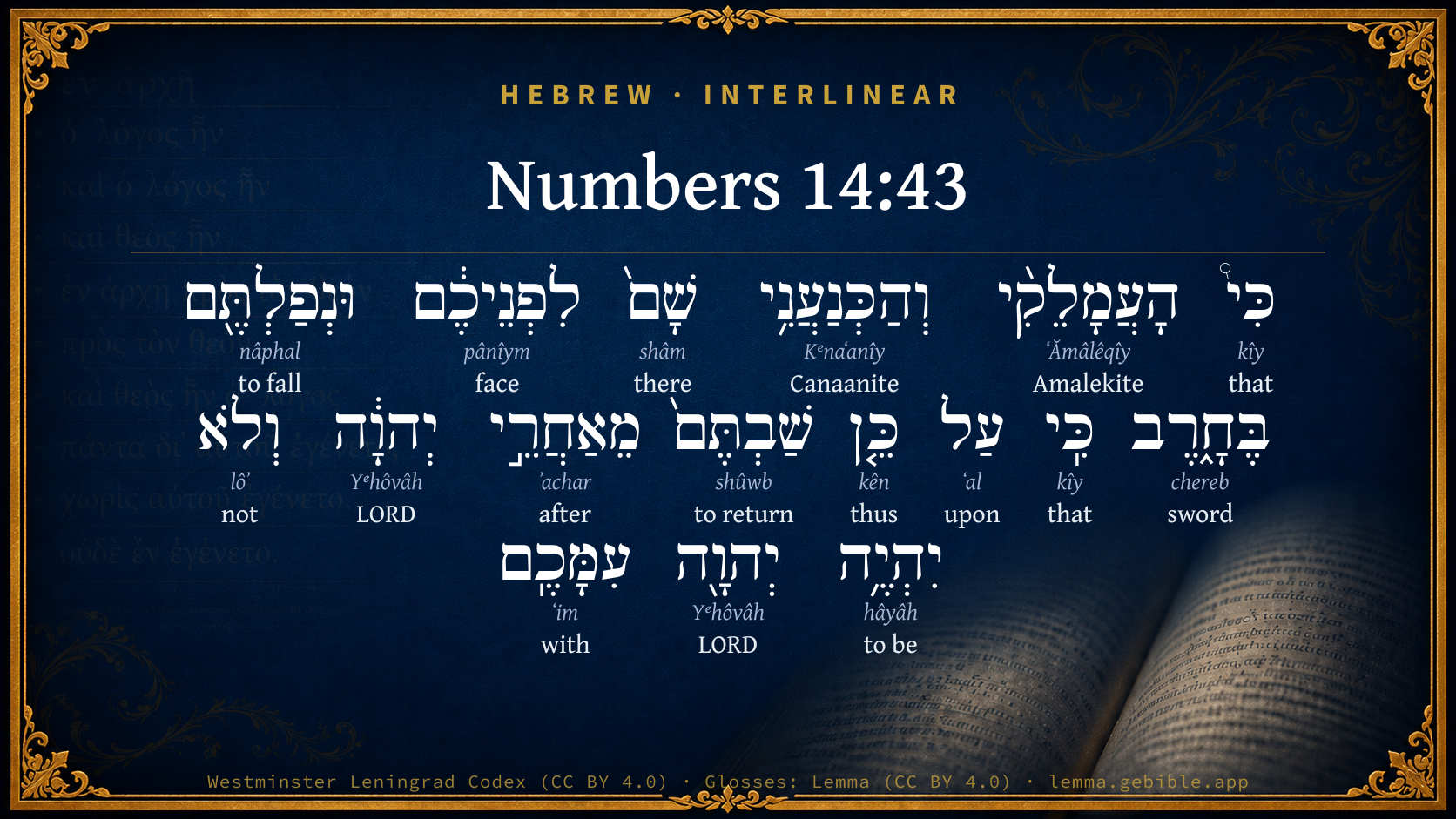
Numbers 14:43

Hebrew (Westminster Leningrad Codex) Numbers 14:43 appears in the Hebrew Old Testament. The text above is from the Westminster Leningrad Codex. Each word links to its Strong’s number, a concise gloss, and parsing drawn from the Open Scriptures Hebrew Bible morphology. Click any word for its full Brown-Driver-Briggs (BDB) entry.
Download image
Cite this verse

Numbers 14:43 (World English Bible). Public Domain. Lemma interlinear Bible study tool, https://lemma.gebible.app/v/numbers/14/43.

Show BibTeX & RIS
BibTeX
RIS
English Translation
For there the Amalekite and the Canaanite are before you, and you shall fall by the sword: because you are turned back from following Yahweh, therefore Yahweh will not be with you.
World English Bible · Public Domain
Download a study sheet

One document with this verse’s original text, its word-by-word gloss line, the meaning frame, cross-references with their text, attributed commentary, and full source and license credits — printable, and it pastes into notes with its structure intact.

This verse Autodidact and up

Study sheet (.html) Plain text (.txt)

A passage Seminary Student

Up to 50 verses in one chapter. A passage sheet keeps up to 6 commentary sources and 12 cross-references per verse, in the order this page ranks them, and says so on the sheet whenever that leaves anything out. Ask for a single verse and you get the Autodidact verse sheet above.

Everything on this page stays free to read, with no account — the sheet is a download of what is already on screen, not access to it.

Want to remove ads? Support Godless Engineer
Compare translations 3

The same verse in 3 English versions, stacked beneath the original-language interlinear above. Click any original word for its lexicon entry.

Each is an independent rendering of the whole verse — the interlinear is not word-aligned to these translations.

Highlighted words mark where these versions differ — a whole-verse word diff, not a word-by-word alignment.

  • World English Bible Public Domain
    For there the Amalekite and the Canaanite are before you, and you shall fall by the sword: because you are turned back from following Yahweh, therefore Yahweh will not be with you.
  • King James Version Public Domain
    For the Amalekites and the Canaanites are there before you, and ye shall fall by the sword: because ye are turned away from the LORD, therefore the LORD will not be with you.
  • unfoldingWord Literal Text CC BY-SA 4.0
    For the Amalekite and the Canaanite there to your face, and you will fall by the sword, for upon this, you returned from after Yahweh, and Yahweh will not be with you.”

unfoldingWord Literal Text — © unfoldingWord, licensed CC BY-SA 4.0. Word-aligned USFM3 via Door43 (git.door43.org/unfoldingWord/en_ult).

Versions to compare (up to 4)

3 of 4 selected

Show all 18 translations

Every available English version of this verse, each an independent rendering of the whole verse.

  • World English Bible Public Domain
    For there the Amalekite and the Canaanite are before you, and you shall fall by the sword: because you are turned back from following Yahweh, therefore Yahweh will not be with you.
  • Berean Standard Bible Public Domain
    For there the Amalekites and Canaanites will face you, and you will fall by the sword. Because you have turned away from the LORD, He will not be with you.”
  • Majority Standard Bible Public Domain
    For there the Amalekites and Canaanites will face you, and you will fall by the sword. Because you have turned away from the LORD, He will not be with you.”
  • King James Version Public Domain
    For the Amalekites and the Canaanites are there before you, and ye shall fall by the sword: because ye are turned away from the LORD, therefore the LORD will not be with you.
  • American Standard Version (1901) Public Domain
    For there the Amalekite and the Canaanite are before you, and ye shall fall by the sword: because ye are turned back from following Jehovah, therefore Jehovah will not be with you.
  • Revised Version (1885) Public Domain
    For there the Amalekite and the Canaanite are before you, and ye shall fall by the sword: because ye are turned back from following the LORD, therefore the LORD will not be with you.
  • Geneva Bible (1599) Public Domain
    For the Amalekites and the Canaanites are there before you, and ye shall fall by the sworde: for in as much as ye are turned away from the Lord, the Lord also will not be with you.
  • Douay-Rheims (1899) Public Domain
    The Amalecite and the Chanaanite are before you, and by their sword you shall fall, because you would not consent to the Lord, neither will the Lord be with you.
  • Young's Literal Translation Public Domain
    for the Amalekite and the Canaanite `are' there before you, and ye have fallen by the sword, because that ye have turned back from after Jehovah, and Jehovah is not with you.'
  • Literal Standard Version CC BY-SA 4.0
    for the Amalekite and the Canaanite [are] there before you, and you have fallen by the sword, because that you have turned back from after YHWH, and YHWH is not with you.”
  • Unlocked Literal Bible CC BY-SA 4.0
    The Amalekites and Canaanites are there, and you will die by the sword because you turned back from following Yahweh. So he will not be with you.”
  • unfoldingWord Literal Text CC BY-SA 4.0
    For the Amalekite and the Canaanite there to your face, and you will fall by the sword, for upon this, you returned from after Yahweh, and Yahweh will not be with you.”
  • Darby Bible Public Domain
    for the Amalekites and the Canaanites are there before you, and ye shall fall by the sword; for as ye have turned away from Jehovah, Jehovah will not be with you.
  • World Messianic Bible Public Domain
    For there the Amalekite and the Canaanite are before you, and you will fall by the sword because you turned back from following the LORD; therefore the LORD will not be with you.”
  • Webster's Bible Public Domain
    For the Amalekites and the Canaanites are there before you, and ye shall fall by the sword: because ye are turned away from the LORD, therefore the LORD will not be with you.
  • Free Bible Version CC BY-SA 4.0
    The Amalekites and Canaanites living there will attack you, and you will die by the sword. Because you rejected the Lord, he won't help you.”
  • Bible in Basic English Public Domain
    For the Amalekites and the Canaanites are there before you, and you will be put to death by their swords: because you have gone back from the way of the Lord, the Lord will not be with you.
  • JPS Tanakh (1917) Public Domain
    For there the Amalekite and the Canaanite are before you, and ye shall fall by the sword; forasmuch as ye are turned back from following the LORD, and the LORD will not be with you.'

Literal Standard Version (2020), Covenant Press — licensed CC BY-SA 4.0. Text via the HelloAO Bible API (eBible.org). Unlocked Literal Bible (unfoldingWord) — licensed CC BY-SA 4.0. Text via the HelloAO Bible API (eBible.org). unfoldingWord Literal Text — © unfoldingWord, licensed CC BY-SA 4.0. Word-aligned USFM3 via Door43 (git.door43.org/unfoldingWord/en_ult). Free Bible Version, Dr. Jonathan Gallagher — licensed CC BY-SA 4.0. Text via the HelloAO Bible API (eBible.org).

Word by word

More ways to search: Search by grammar → Find every occurrence → Compare this word →

Practice this passage: Drill this verse → Learn its vocabulary →

הָעֲמָלֵקִ֨י
ʻĂmâlêqîy
H6003
“the · Amalekite”
Particle, Definite Article + Noun, Gentilic, Masculine, Singular, Absolute
Part of Speech
Particle + Noun
Type
Gentilic
Gender
Masculine
Number
Singular
State
Absolute
Full BDB Definition

Origin: from H6002

TWOT: None

Amalekite = see Amalek " people of lapping" - descendants of Amalek, the grandson of Esau
  1. כִּי֩ kîy H3588 “that” Conjunction
  2. וְהַכְּנַעֲנִ֥י Kᵉnaʻanîy H3669 “and · the · Canaanite” Conjunction + Particle, Definite Article + Noun, Gentilic, Masculine, Singular, Absolute
  3. שָׁם֙ shâm H8033 “there” Adverb
  4. לִפְנֵיכֶ֔ם pânîym H6440 “to/for · face(s) · your” Preposition + Noun, Common, Both, Plural, Construct + Suffix, Personal, 2nd Person, Masculine, Plural
  5. וּנְפַלְתֶּ֖ם nâphal H5307 “and · to fall” Conjunction + Verb, Qal, Sequential Perfect, 2nd Person, Masculine, Plural
  6. בֶּחָ֑רֶב chereb H2719 “in/at the · sword” Preposition, Determined + Noun, Common, Feminine, Singular, Absolute
  7. כִּֽי kîy H3588 “that” Conjunction
  8. עַל ʻal H5921 “upon” Preposition
  9. כֵּ֤ן kên H3651 “thus” Particle, Demonstrative
  10. שַׁבְתֶּם֙ shûwb H7725 “to return” Verb, Qal, Perfect, 2nd Person, Masculine, Plural
  11. מֵאַחֲרֵ֣י ʼachar H310 “from · after” Preposition + Preposition
  12. יְהוָ֔ה Yᵉhôvâh H3068 “LORD” Noun, Proper
  13. וְלֹא lôʼ H3808 “and · not” Conjunction + Particle, Negative
  14. יִהְיֶ֥ה hâyâh H1961 “to be” Verb, Qal, Imperfect, 3rd Person, Masculine, Singular
  15. יְהוָ֖ה Yᵉhôvâh H3068 “LORD” Noun, Proper
  16. עִמָּכֶֽם ʻim H5973 “with · you” Preposition + Suffix, Personal, 2nd Person, Masculine, Plural

About this verse

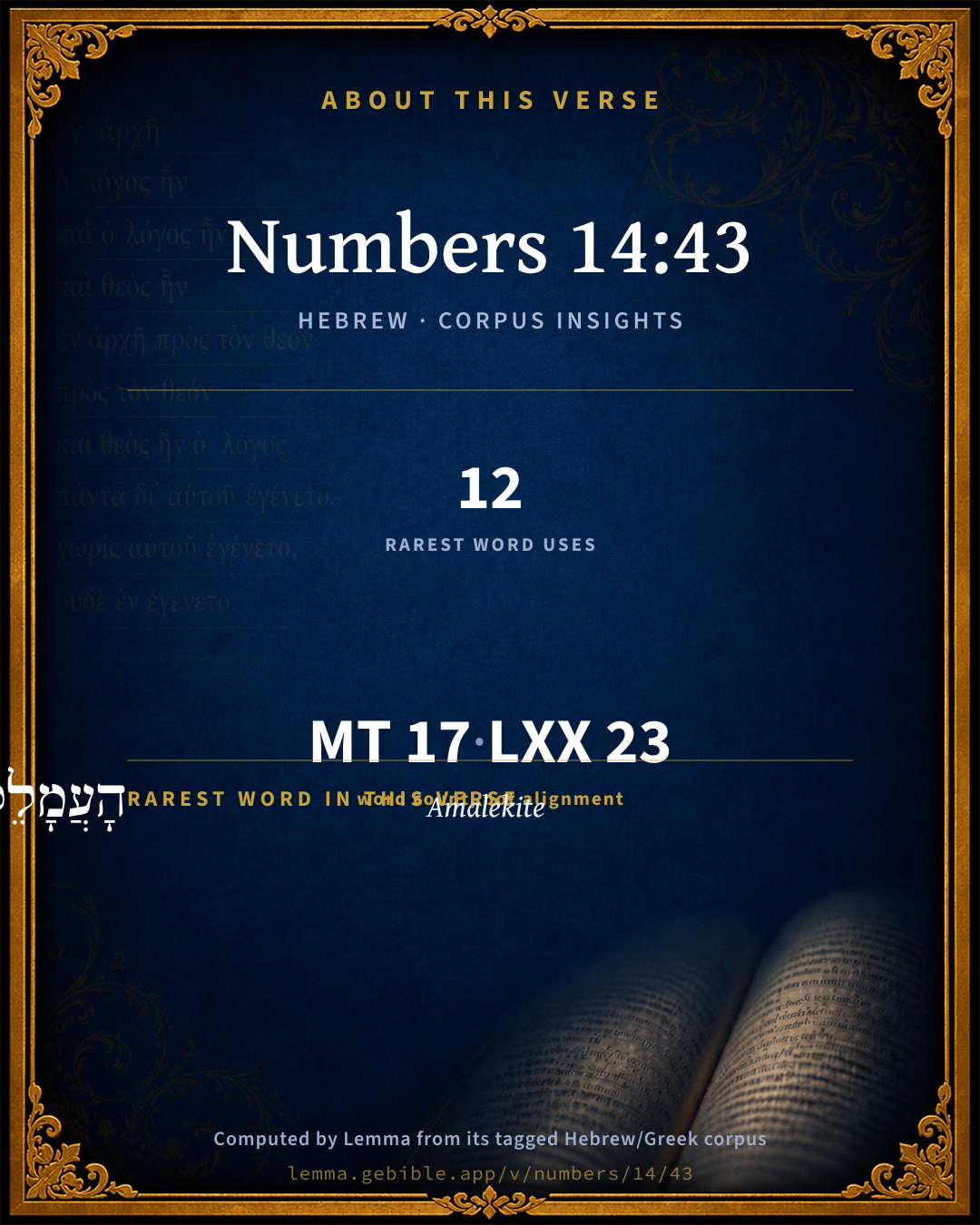
These counts appear in no published source. They are computed here, from the morphology-tagged text and Lemma’s own curated glosses. What Lemma adds →

17
words
15
distinct lemmas
Pentateuch
section

Notable vocabulary

The rarest word here is הָעֲמָלֵקִ֨י Amalekite H6003 — appearing just 12 times in the whole Hebrew Bible.

Shared distinctive vocabulary

הָעֲמָלֵקִ֨י Amalekite H6003 occurs in 12 verses of the Hebrew Bible. Also found in:

Grammatical profile

  • 3 verbs
  • 6 nouns
  • 3 prepositions
  • 2 conjunctions
  • 1 adverb
  • 2 particles

Verb forms

  • וּנְפַלְתֶּ֖ם Qal · Sequential Perfect
  • שַׁבְתֶּם֙ Qal · Perfect
  • יִהְיֶ֥ה Qal · Imperfect

Repetition

Words recur within this verse — often emphatic in Hebrew:

  • יְהוָ֔ה LORD H3068 ×2
  • כִּי֩ that H3588 ×2

Hebrew & Septuagint length

In English translation the verse runs 32 words from the Hebrew and 33 from the Septuagint (LXX English) — closely comparable.

A rough comparison of the two English renderings, which tokenize alike — not a word-level alignment.

Word counts can differ between the Hebrew and the Greek without any difference in meaning — e.g. the Hebrew direct-object marker אֵת has no separate Greek word, and Greek often adds the article ὁ.

In the original languages it is 17 Hebrew tokens and 23 Greek tokens — but the two are counted differently (Hebrew bundles its prefixes and suffixes into one token; the Greek is in lemma form), so that isn’t a like-for-like length.

Cross-references

9

Topical passages linked to Numbers 14:43 in the Treasury of Scripture Knowledge — connected by theme and wording, ordered by reader-vote popularity; previews shown in the World English Bible.

  • Numbers 13:29 Amalek dwells in the land of the South: and the Hittite, and the Jebusite, and the Amorite, dwell in the hill-country; and the Canaanite dwells by the sea, and along by the side of the Jordan.
  • Numbers 14:25 Now the Amalekite and the Canaanite dwell in the valley: tomorrow turn you, and get you into the wilderness by the way to the Red Sea.
  • 2 Chronicles 15:2 and he went out to meet Asa, and said to him, Hear you me, Asa, and all Judah and Benjamin: Yahweh is with you, while you are with him; and if you seek him, he will be found of you; but if you forsake him, he will forsake you.
  • Leviticus 26:17 I will set my face against you, and you will be struck before your enemies. Those who hate you will rule over you; and you will flee when no one pursues you.
  • Deuteronomy 28:25 Yahweh will cause you to be struck before your enemies; you shall go out one way against them, and shall flee seven ways before them: and you shall be tossed back and forth among all the kingdoms of the earth.
  • Judges 16:20 She said, The Philistines are on you, Samson. He awoke out of his sleep, and said, I will go out as at other times, and shake myself free. But he didn't know that Yahweh had departed from him.
  • 1 Chronicles 28:9 You, Solomon my son, know the God of your father, and serve him with a perfect heart and with a willing mind; for Yahweh searches all hearts, and understands all the imaginations of the thoughts: if you seek him, he will be found of you; but if you forsake him, he will cast you off forever.
  • Isaiah 63:10 But they rebelled, and grieved his holy Spirit: therefore he was turned to be their enemy, [and] himself fought against them.
  • Hosea 9:12 Though they bring up their children, Yet I will bereave them, so that not a man shall be left. Indeed, woe also to them when I depart from them!

Cross-references courtesy of OpenBible.info (CC BY 4.0).

Hebrew and Greek witnesses Masoretic Hebrew ↔ Greek Septuagint

The same verse in the two great witnesses to the Old Testament, shown verse-for-verse.

These are two independent witnesses, not word-aligned to each other, and the Septuagint is shown in lemma (dictionary) form.

Hebrew Numbers 14:43 Masoretic · Westminster Leningrad Codex

כִּי֩ הָעֲמָלֵקִ֨י וְהַכְּנַעֲנִ֥י שָׁם֙ לִפְנֵיכֶ֔ם וּנְפַלְתֶּ֖ם בֶּחָ֑רֶב כִּֽי עַל כֵּ֤ן שַׁבְתֶּם֙ מֵאַחֲרֵ֣י יְהוָ֔ה וְלֹא יִהְיֶ֥ה יְהוָ֖ה עִמָּכֶֽם

For there the Amalekite and the Canaanite are before you, and you shall fall by the sword: because you are turned back from following Yahweh, therefore Yahweh will not be with you.

World English Bible · Public Domain

Greek LXX Numbers 14:43 Septuagint · lemma form

ὅτι ὁ αμαληκ καί ὁ χαναναῖος ἐκεῖ ἔμπροσθεν σύ καί πίπτω μάχαιρα ὅς εἵνεκεν ἀποστρέφω ἀπειθέω κύριος καί οὐ εἰμί κύριος ἐν σύ

For Amalec and the Chananite are there before you, and you⌃ shall fall by the sword; because you⌃ have disobeyed the Lord and turned aside, and the Lord will not be among you.

LXX2012 (modern English Septuagint) · Public Domain

Hebrew: Westminster Leningrad Codex (CC BY 4.0). Greek: Septuagint (public domain); English from LXX2012 (modern English Septuagint) (Public Domain). How the Septuagint differs from the Hebrew →

Targum (Aramaic paraphrase)

2

The Targum is the ancient Jewish Aramaic paraphrase of the Hebrew Scriptures — an interpretive translation, not the Hebrew text itself. Onkelos (literal) and Pseudo-Jonathan (expansive) render the Torah, and Jonathan the Prophets. Coverage is partial: where no permissively-licensed English translation exists for a verse, only the Aramaic is shown. This is verse-level text, not a word-by-word alignment to the Hebrew.

  1. Targum Onkelos Torah (Genesis–Deuteronomy)
    אֲרֵי עֲמַלְקָאָה וּכְנַעֲנָאָה תַמָן קֳדָמֵיכוֹן וְתִפְּלוּן בְּחַרְבָּא אֲרֵי עַל כֵּן תַּבְתּוּן מִבָּתַר פּוּלְחָנָא דַיְיָ וְלָא יְהֵי מֵימְרָא דַיְיָ בְּסַעְדְכוֹן

    (no public-domain English translation for this verse)

    Targum Onkelos — Aramaic: “Onkelos Genesis” (public domain); “Onkelos Exodus” (public domain); “Onkelos Leviticus” (public domain); “Onkelos Numbers” (public domain); “Onkelos Deuteronomy” (public domain). English: “Sefaria Community Translation” (CC0 1.0 (public-domain dedication)); “J.W. Etheridge. The Targums of Onkelos and Jonathan Ben Uzziel on the Pentateuch. London: Longmans, Green, 1862” (public domain). Text via Sefaria.

  2. Targum Pseudo-Jonathan Torah (Genesis–Deuteronomy)
    אֲרוּם עֲמַלְקָאֵי וּכְנַעֲנָאֵי תַּמָן זְמִינִין קֳדָמֵיכוֹן וְתִתְרְמוּן קְטִילִין בְּחַרְבָּא אֲרוּם מִן בִּגְלַל דְחַבְתּוּן מִן בָּתַר פּוּלְחָנָא דַיְיָ בְּגִין כֵּן לָא יְהֵי מֵימְרָא דַיְיָ בְּסַעַדְכוֹן

    For the Amalekites and Kenaanites are there prepared for you, and you will fall slaughtered by the sword. For, because you have turned away from the service of the Lord, the Word of the Lord will not be your Helper.

    Targum Pseudo-Jonathan — Aramaic: “Targum Jonathan on Genesis” (public domain); “Targum Jonathan on Exodus” (public domain); “Targum Jonathan on Leviticus” (public domain); “Targum Jonathan on Numbers” (public domain); “Targum Jonathan on Deuteronomy” (public domain). English: “The Targum of Jonathan ben Uzziel, trans. J. W. Etheridge, London, 1862” (public domain). Text via Sefaria.

Commentary

Notes on Numbers 14:43 from classic Christian and Jewish commentators (each source and its license shown beneath its notes). The classic Christian expositions comment on the surrounding passage and are grouped to its opening verse, so a note may address several verses; the Jewish commentaries on the Tanakh (Rashi and others) are per-verse, so they appear only where the commentator wrote on this verse.

Lemma curates 59 commentaries, every one of them public domain or Creative Commons licensed, each selected and text-cleaned for this edition rather than reprinted as found. About our sources →

Tyndale Open Study Notes

Tyndale Open Resources

14:43 The Lord will abandon you because you have abandoned the Lord: Moses’ prediction summarizes the whole chapter.

Tyndale Open Study Notes — © Tyndale Open Resources, licensed CC BY-SA 4.0. Text via the HelloAO Bible API.

Ellicott's Commentary for English Readers

(43) Are there before you.—Or, will be there before you. If the same persons are here spoken of as in Num_14:25, it will follow that they had left their temporary abode, and gone up into the hill country. It is possible however, that the reference is to different portions of the same nations.

A Bible Commentary for English Readers, edited by Charles John Ellicott (1878–1897) — public domain. Text from a community e-Sword module.

John Gill's Exposition

But they presumed to go up unto the hill top,.... In a bold, audacious, and presumptuous manner; they attempted to go up to the top of the hill, notwithstanding the remonstrances of Moses against it, and the danger they would be exposed unto; but withdrawing themselves from God and his ministers, and lifted up in themselves, and confident of their own strength, ventured on this rash enterprise: the Vulgate Latin version is, "being darkened they went up": either having their understandings darkened, and being given up to a judicial blindness and hardness of heart; or else they went up in the morning while it was dark, before daylight; which latter sense is favoured by the Targum of Jonathan,"and they girded (or armed) themselves in the dark, before the morning light;''and the former by an ancient exposition, called Tanchuma, mentioned by Jarchi,"they went obscure (as it were in the dark) because without leave:"

nevertheless the ark of the covenant of the Lord, and Moses, departed not out of the camp; the cloud not being taken up, but abiding on the tabernacle, which was the signal for resting, both for the ark, and for the camp, the Kohathites did not move with the ark: the Jews (e) have a notion, that there were two arks which went with Israel in the wilderness, one in which the law was put, and another in which the broken pieces of the tables were left; that in which the law was, was placed in the tabernacle of the congregation, and of this it is written, "the ark of the covenant of the Lord, and Moses, departed not", &c. but that in which the broken pieces of the tables were, went in and out with them: but this does not clearly appear; and it is highly probable no ark went with them at this time; nor did Moses, the leader and commander of the people, stir from the camp of the Levites; wherefore it was a bold and hazardous undertaking the other camps engaged in without God going with them, and their general before them, or Joshua his minister; for if one did not go, the same may be concluded of the other.

(e) T. Hieros. Sotah, fol. 22. 2.

John Gill's Exposition of the Whole Bible (1746–1763) — public domain (CC PDM 1.0). Text via the HelloAO Bible API.

Whedon's Commentary on the Bible

Daniel D. Whedon

43. Amalekites — See Num_13:29, note.

Are there before you — Either they had withdrawn from the valley (Num_14:25) to a more defensible position in the mountains, or they had sent a strong force to seize the passes, and successfully contest the passage of Israel. This fact was communicated to Moses by his scouts or by direct revelation from Jehovah.

Ye shall fall — This divinely inspired prediction rests on the fact that Israel had turned away from the Lord. He who is most conscious of the divine presence and support, as was Moses, most feels his dependence on His favour, and most forbodes disaster when that favour is withdrawn. But the worldling neither recognizes the presence nor misses the absence of God. Such was unbelieving Israel at Kadesh.

Daniel D. Whedon (gen. ed.), Commentary on the Old and New Testaments (1874–1909) — public domain. Text from a community e-Sword module.

Rashi

Rabbi Shlomo Yitzchaki (Rashi)

כי על כן שבתם — means: for (כי) this will come upon you, because (על כן) ye have turned away etc. (cf. Rashi on Genesis 18:5 and Numbers 10:31).

Rashi on the Tanakh — English translations: “The Judaica Press complete Tanach with Rashi, translated by A. J. Rosenberg” (CC BY 4.0); “Pentateuch with Rashi's commentary by M. Rosenbaum and A.M. Silbermann, 1929-1934” (public domain); “The Metsudah Tanach series, Lakewood, N.J” (CC BY 4.0); and “The Book of Joshua, Metsudah Publications, 1997” (CC BY 4.0). Text via Sefaria.

Lesson kit

Teaching starters — assembled from the data on this page, not authored interpretation. Every prompt links to the verse data it draws on. Edit before teaching.

Numbers, in the Pentateuch, opens this verse with 17 words (15 distinct Hebrew lemmas). Its most distinctive word is ʻĂmâlêqîy (“Amalekite”). A historical commentator’s framing appears above. Read the whole chapter for the surrounding context.

Discussion questions

  1. The word ʻĂmâlêqîy carries the sense “Amalekite.” How does it shape the verse?
  2. Genesis 14:7 shares the word «Amalekite» with this verse. How do the two illuminate each other?
  3. “LORD” occurs 2× in this one verse. What is the effect of the repetition?
  4. These translations render this verse differently; the difference is in the English rendering, not the original. What questions does that raise?
  5. The verb «וּנְפַלְתֶּ֖ם» is Qal Sequential Perfect. How does its form color the action?
  6. Reading how Tyndale Open Study Notes and Ellicott's Commentary for English Readers read this verse, where do the two commentators agree and where do they part?

Things to notice

Reading settings

Reading text

Shown beneath each verse's original-language words.

Old Testament
Old Testament edition

Read the OT as the Masoretic Hebrew (MT) or the Greek Septuagint (LXX).

English shown for the Greek Septuagint (in the Hebrew ↔ Greek comparison).

Comparing translations? Open the Compare panel on any verse page to stack up to four side by side.