Nehemiah 4:18

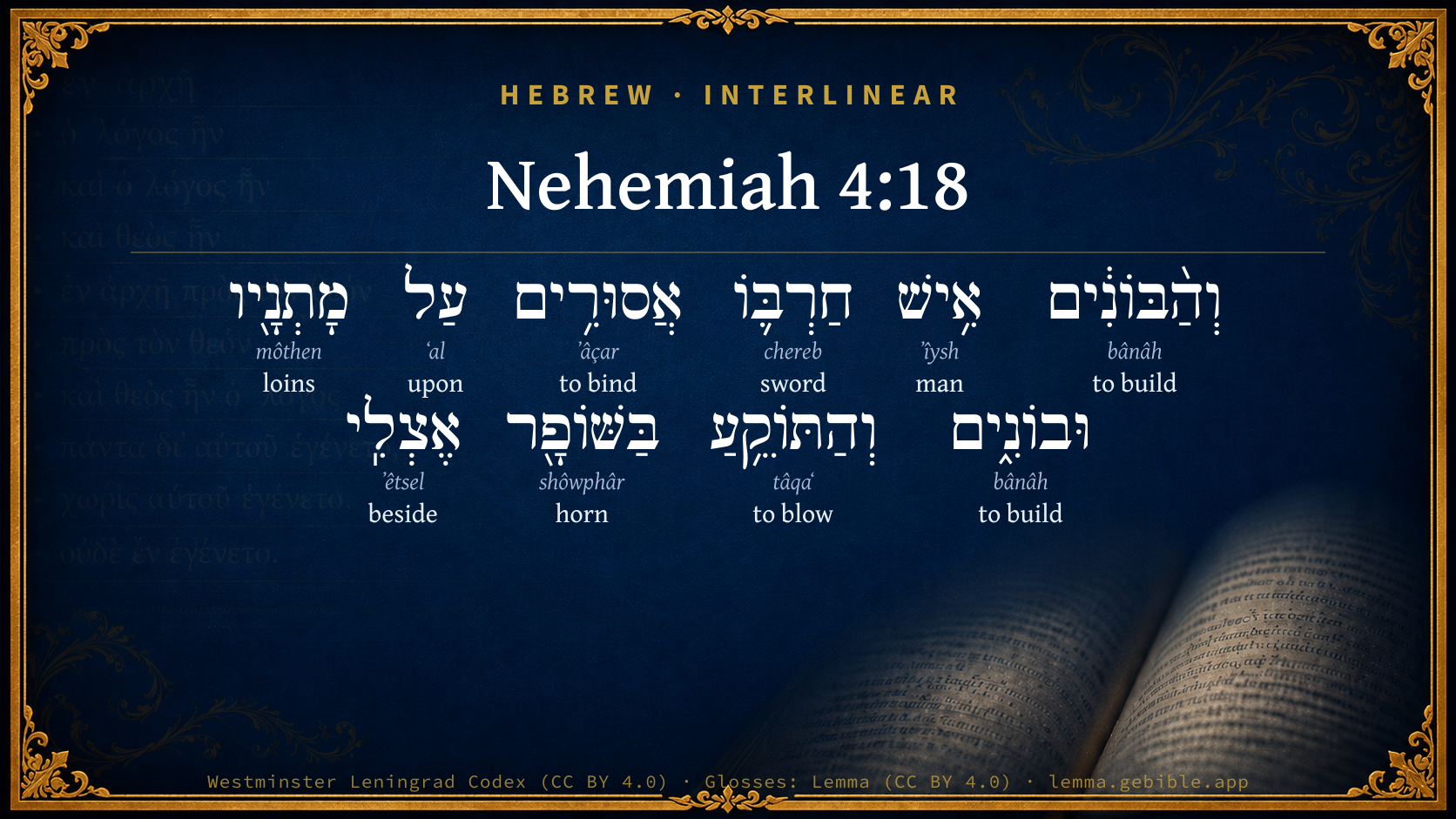
Hebrew (Westminster Leningrad Codex) Nehemiah 4:18 appears in the Hebrew Old Testament. The text above is from the Westminster Leningrad Codex. Each word links to its Strong’s number, a concise gloss, and parsing drawn from the Open Scriptures Hebrew Bible morphology. Click any word for its full Brown-Driver-Briggs (BDB) entry.
Download image
Cite this verse

Nehemiah 4:18 (World English Bible). Public Domain. Lemma interlinear Bible study tool, https://lemma.gebible.app/v/nehemiah/4/18.

Show BibTeX & RIS
BibTeX
RIS
English Translation
and the builders, everyone had his sword girded by his side, and so built. He who sounded the trumpet was by me.
World English Bible · Public Domain
Download a study sheet

One document with this verse’s original text, its word-by-word gloss line, the meaning frame, cross-references with their text, attributed commentary, and full source and license credits — printable, and it pastes into notes with its structure intact.

This verse Autodidact and up

Study sheet (.html) Plain text (.txt)

A passage Seminary Student

Up to 50 verses in one chapter. A passage sheet keeps up to 6 commentary sources and 12 cross-references per verse, in the order this page ranks them, and says so on the sheet whenever that leaves anything out. Ask for a single verse and you get the Autodidact verse sheet above.

Everything on this page stays free to read, with no account — the sheet is a download of what is already on screen, not access to it.

Want to remove ads? Support Godless Engineer
Compare translations 3

The same verse in 3 English versions, stacked beneath the original-language interlinear above. Click any original word for its lexicon entry.

Each is an independent rendering of the whole verse — the interlinear is not word-aligned to these translations.

Highlighted words mark where these versions differ — a whole-verse word diff, not a word-by-word alignment.

  • World English Bible Public Domain
    and the builders, everyone had his sword girded by his side, and so built. He who sounded the trumpet was by me.
  • King James Version Public Domain
    For the builders, every one had his sword girded by his side, and so builded. And he that sounded the trumpet was by me.
  • unfoldingWord Literal Text CC BY-SA 4.0
    And the builders: a man girded his sword to his loins and built. And the one who blew the ram’s horn was beside me.

unfoldingWord Literal Text — © unfoldingWord, licensed CC BY-SA 4.0. Word-aligned USFM3 via Door43 (git.door43.org/unfoldingWord/en_ult).

Versions to compare (up to 4)

3 of 4 selected

Show all 18 translations

Every available English version of this verse, each an independent rendering of the whole verse.

  • World English Bible Public Domain
    and the builders, everyone had his sword girded by his side, and so built. He who sounded the trumpet was by me.
  • Berean Standard Bible Public Domain
    And each of the builders worked with his sword strapped at his side. But the trumpeter stayed beside me.
  • Majority Standard Bible Public Domain
    And each of the builders worked with his sword strapped at his side. But the trumpeter stayed beside me.
  • King James Version Public Domain
    For the builders, every one had his sword girded by his side, and so builded. And he that sounded the trumpet was by me.
  • American Standard Version (1901) Public Domain
    and the builders, every one had his sword girded by his side, and so builded. And he that sounded the trumpet was by me.
  • Revised Version (1885) Public Domain
    and the builders, every one had his sword girded by his side, and so builded. And he that sounded the trumpet was by me.
  • Geneva Bible (1599) Public Domain
    For euery one of the buylders had his sworde girded on his loynes, and so buylded: and he that blewe the trumpet, was beside me.
  • Douay-Rheims (1899) Public Domain
    For every one of the builders was girded with a sword about his reins. And they built, and sounded with a trumpet by me.
  • Young's Literal Translation Public Domain
    And the builders `are' each with his sword, girded on his loins, and building, and he who is blowing with a trumpet `is' beside me.
  • Literal Standard Version CC BY-SA 4.0
    And the builders [are] each with his sword, girded on his loins, and building, and he who is blowing with a horn [is] beside me.
  • Unlocked Literal Bible CC BY-SA 4.0
    Every builder wore his sword on his side and that is how he worked. The one who sounded the trumpet stayed beside me.
  • unfoldingWord Literal Text CC BY-SA 4.0
    And the builders: a man girded his sword to his loins and built. And the one who blew the ram’s horn was beside me.
  • Darby Bible Public Domain
    And the builders had every one his sword girded by his side, and built. And he that sounded the trumpet was by me.
  • World Messianic Bible Public Domain
    Among the builders, everyone wore his sword at his side, and so built. He who sounded the shofar was by me.
  • Webster's Bible Public Domain
    For the builders, every one had his sword girded by his side, and so built. And he that sounded the trumpet was by me.
  • Free Bible Version CC BY-SA 4.0
    All the builders carried a sword strapped to their side, and the trumpeter stood beside me.
  • Bible in Basic English Public Domain
    Every builder was working with his sword at his side. And by my side was a man for sounding the horn.
  • JPS Tanakh (1917) Public Domain
    (4-12) and the builders, every one had his sword girded by his side, and so builded. And he that sounded the horn was by me.

Literal Standard Version (2020), Covenant Press — licensed CC BY-SA 4.0. Text via the HelloAO Bible API (eBible.org). Unlocked Literal Bible (unfoldingWord) — licensed CC BY-SA 4.0. Text via the HelloAO Bible API (eBible.org). unfoldingWord Literal Text — © unfoldingWord, licensed CC BY-SA 4.0. Word-aligned USFM3 via Door43 (git.door43.org/unfoldingWord/en_ult). Free Bible Version, Dr. Jonathan Gallagher — licensed CC BY-SA 4.0. Text via the HelloAO Bible API (eBible.org).

Word by word

More ways to search: Search by grammar → Find every occurrence → Compare this word →

Practice this passage: Drill this verse → Learn its vocabulary →

מָתְנָ֖יו
môthen
H4975
“loins · his”
Noun, Common, Masculine, Dual, Construct + Suffix, Personal, 3rd Person, Masculine, Singular
Part of Speech
Noun
Type
Common
Gender
Masculine
Number
Dual
State
Construct
Full BDB Definition

Origin: from an unused root meaning to be slender

TWOT: 1267a

loins, hips - used with H2223 in Pro 30:31 ; perhaps an extinct animal, exact meaning unknown
  1. וְהַ֨בּוֹנִ֔ים bânâh H1129 “and · the · building” Conjunction + Particle, Definite Article + Verb, Qal, Participle Active, Masculine, Plural, Absolute
  2. אִ֥ישׁ ʼîysh H376 “man” Noun, Common, Masculine, Singular, Absolute
  3. חַרְבּ֛וֹ chereb H2719 “sword · his” Noun, Common, Feminine, Singular, Construct + Suffix, Personal, 3rd Person, Masculine, Singular
  4. אֲסוּרִ֥ים ʼâçar H631 “bound” Verb, Qal, Participle Passive, Masculine, Plural, Absolute
  5. עַל ʻal H5921 “upon” Preposition
  6. וּבוֹנִ֑ים bânâh H1129 “and · building” Conjunction + Verb, Qal, Participle Active, Masculine, Plural, Absolute
  7. וְהַתּוֹקֵ֥עַ tâqaʻ H8628 “and · the · blowing” Conjunction + Particle, Definite Article + Verb, Qal, Participle Active, Masculine, Singular, Absolute
  8. בַּשּׁוֹפָ֖ר shôwphâr H7782 “in/at the · horn” Preposition, Determined + Noun, Common, Masculine, Singular, Absolute
  9. אֶצְלִֽי ʼêtsel H681 “beside · me” Preposition + Suffix, Personal, 1st Person, Common, Singular

About this verse

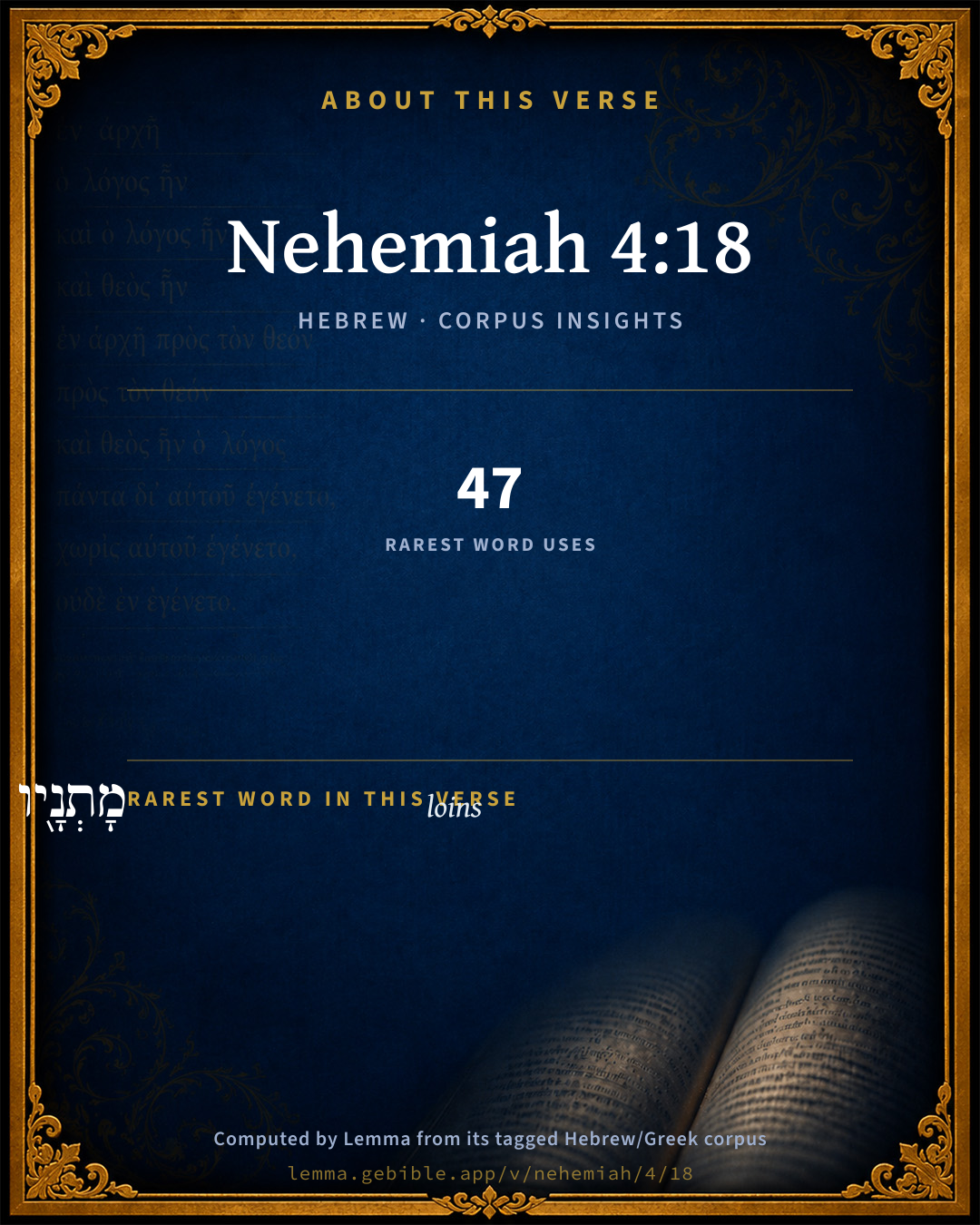
These counts appear in no published source. They are computed here, from the morphology-tagged text and Lemma’s own curated glosses. What Lemma adds →

10
words
9
distinct lemmas
Historical
section

Shared distinctive vocabulary

מָתְנָ֖יו loins H4975 occurs in 45 verses of the Hebrew Bible. Also found in:

Grammatical profile

  • 4 verbs
  • 4 nouns
  • 2 prepositions

Verb forms

  • וְהַ֨בּוֹנִ֔ים Qal · Participle Active
  • אֲסוּרִ֥ים Qal · Participle Passive
  • וּבוֹנִ֑ים Qal · Participle Active
  • וְהַתּוֹקֵ֥עַ Qal · Participle Active

Repetition

A word recurs within this verse — often emphatic in Hebrew:

  • וְהַ֨בּוֹנִ֔ים to build H1129 ×2

Cross-references

2

Topical passages linked to Nehemiah 4:18 in the Treasury of Scripture Knowledge — connected by theme and wording, ordered by reader-vote popularity; previews shown in the World English Bible.

  • Numbers 10:9 When you go to war in your land against the adversary who oppresses you, then you shall sound an alarm with the trumpets; and you shall be remembered before Yahweh your God, and you shall be saved from your enemies.
  • 2 Chronicles 13:12–17 Behold, God is with us at our head, and his priests with the trumpets of alarm to sound an alarm against you. Children of Israel, don't you fight against Yahweh, the God of your fathers; for you shall not prosper.

Cross-references courtesy of OpenBible.info (CC BY 4.0).

Hebrew and Greek witnesses Masoretic Hebrew ↔ Greek Septuagint

The same verse in the two great witnesses to the Old Testament, shown verse-for-verse.

These are two independent witnesses, not word-aligned to each other, and the Septuagint is shown in lemma (dictionary) form.

Hebrew Nehemiah 4:18 Masoretic · Westminster Leningrad Codex

וְהַ֨בּוֹנִ֔ים אִ֥ישׁ חַרְבּ֛וֹ אֲסוּרִ֥ים עַל מָתְנָ֖יו וּבוֹנִ֑ים וְהַתּוֹקֵ֥עַ בַּשּׁוֹפָ֖ר אֶצְלִֽי

and the builders, everyone had his sword girded by his side, and so built. He who sounded the trumpet was by me.

World English Bible · Public Domain

Greek LXX Structure differs

The Septuagint has no separate book of Nehemiah. Its Greek text is the second half of Esdras B (2 Esdras), chapters 11–23; Ezra is the first half (1–10).

A verse-for-verse comparison isn’t shown here because the chapters and verses don’t line up. Switch to the LXX edition with the MT / LXX toggle above to read the Greek directly.

Hebrew: Westminster Leningrad Codex (CC BY 4.0). Greek: Septuagint (public domain); English from a public-domain English Septuagint. How the Septuagint differs from the Hebrew →

Commentary

Notes on Nehemiah 4:18 from classic Christian and Jewish commentators (each source and its license shown beneath its notes). The classic Christian expositions comment on the surrounding passage and are grouped to its opening verse, so a note may address several verses; the Jewish commentaries on the Tanakh (Rashi and others) are per-verse, so they appear only where the commentator wrote on this verse.

Lemma curates 59 commentaries, every one of them public domain or Creative Commons licensed, each selected and text-cleaned for this edition rather than reprinted as found. About our sources →

Trapp's Complete Commentary

John Trapp

Neh 4:18 For the builders, every one had his sword girded by his side, and [so] builded. And he that sounded the trumpet [was] by me.

Ver. 18. For the builders every one had his sword girded by his side] Heb. on his loins; that is the place for the sword to hang on: Psa 45:3, "Gird thy sword upon thy thigh, O most mighty." And Rev 19:16, Christ’s name is written upon his vesture, that all may see it, and upon his thigh, where his sword hangs, to show that he won it by his valour. Among the Turks at this day, as the right hand is held uppermost for a scholar, so the left for a soldier; because it gives a man possession of his companion’s sword; though the Turks seldom bear weapons but in travel; and then some of them seem no less like a walking, than these builders did like a working, armoury.

John Trapp, A Commentary or Exposition upon All the Books of the Old and New Testament (1647–1656) — public domain. Text from a community e-Sword module.

Joseph Benson's Commentary

Neh 4:18. He that sounded the trumpet was by me — To give the alarm, and call the people together, when and where it was necessary. It appears by this he was continually with them while they wrought upon the wall.

Joseph Benson's Commentary on the Old and New Testaments (1811–1818) — public domain. Text from a community e-Sword module.

Tyndale Open Study Notes

Tyndale Open Resources

4:18-19 Through the trumpeter, Nehemiah could sound the alarm to direct workers to any portion of the wall that might be attacked.

Tyndale Open Study Notes — © Tyndale Open Resources, licensed CC BY-SA 4.0. Text via the HelloAO Bible API.

The Cambridge Bible for Schools and Colleges

gen. ed. J. J. S. Perowne

18. For the builders] R.V. And the builders. Not, as A.V., a fresh explanatory sentence, but a continuation of the foregoing, a description of the other class of those engaged in the work.

his sword girded by his side] Both hands were occupied in the work of laying the stones, which would be done chiefly by skilful mechanism with pulleys and rollers. The free action of both hands would be requisite. But though thus fully occupied, they were to be armed against a surprise attack. The mention of the ‘sword’ here accounts for its absence in Neh_4:16.

And he that &c.] This is a distinct parenthetical sentence introducing the personal reminiscence. The men were scattered over a large area, and the commands of the governor were to be given by sound of trumpet, so that the alarm could be given to all at the same time.

by me] i.e. at my side, cf. Neh_4:3. The words imply that Nehemiah was the life and soul of the defence, and that he was untiring in moving from point to point in the wall, superintending the work and directing the disposition for the defence.

The Cambridge Bible for Schools and Colleges (gen. ed. J. J. S. Perowne; Cambridge University Press, 1878–1918) — public domain. Text from a community e-Sword module.

John Gill's Exposition

For the builders had everyone his sword girded by his side, and so builded,.... Thus accoutred he wrought, and was prepared for either service:

and he that sounded the trumpet was by me; to give the alarm of war, that everyone might lay aside his work, and prepare for the battle: this officer stood by Nehemiah, that when he found it necessary, might give him orders to sound his trumpet, for the men to gather to him.

John Gill's Exposition of the Whole Bible (1746–1763) — public domain (CC PDM 1.0). Text via the HelloAO Bible API.

Haydock's Catholic Bible Commentary

By me, when the enemy appeared. (Menochius)

George Leo Haydock (1774–1849), Haydock's Catholic Family Bible and Commentary, 1859 edition — public domain. Excludes Psalms (Douay-Rheims chapter numbering differs from Protestant) and Deuterocanonical books (Catholic canon only).

Matthew Poole's English Annotations

To call the people together, when and where it was fit and necessary.

Matthew Poole's English Annotations on the Holy Bible (1683–1685) — public domain. Text from a community e-Sword/MySword module.

Whedon's Commentary on the Bible

Daniel D. Whedon

18. Every one had his sword girded by his side — This was probably literally the case. Swords are not mentioned in Neh_4:16 as among the arms held in readiness by the half of the people that watched while the others worked. Swords could be worn so as not greatly to hinder the workmen in their work.

Daniel D. Whedon (gen. ed.), Commentary on the Old and New Testaments (1874–1909) — public domain. Text from a community e-Sword module.

The Pulpit Commentary

For the builders. Rather, "and the (actual) builders masons, bricklayers, and the like, as distinct from the bearers of burthens, or carriers of material. He that sounded the trumpet. The signalman. Trumpeters appear both in the Egyptian and the Assyrian sculptures (see "Ancient Monarchies," vol. 1. p. 539, second ed.; Wilkinson, "Ancient Egyptians," vol. 2. p. 260).

God fighting for his people.

"Our God shall fight for us." An inspiriting assurance. Grounds of it in the case of Nehemiah and the Jews.

I WHEN WE MAY CHERISH THIS ASSURANCE. When we fight for God; which we do

1. When we contend in and for his cause. When our contest is against Satan, sin, and error; and on behalf of Christ and truth and righteousness and souls our own and others.

2. When we are actuated by sincere and supreme regard for him. Desiring his glory, and trusting him for strength and victory.

3. When we employ the weapons which he has given us. Not using Satan"s arms, but the weapons of truth and love. (see 2Co_10:4)

4. When we fight in the spirit which he prescribes and imparts. (2Ti_2:25 Jam_1:20)

5. When we battle with all our power.

II THE GROUNDS OF THIS ASSURANCE.

1. The relation of God to us. "Our God.

2. His interest in the contest. It concerns his "great name," the accomplishment of his purposes of love to mankind in Christ, the destruction of his enemies.

3. His summons to it.

4. His promises.

III THE EFFECTS OF SUCH ASSURANCE.

1. Alacrity to engage in the combat.

2. Courage.

3. Confidence of victory.

"If God be for us, who can be against us?" Finally, take heed lest any of you fight against God. "Woe unto him that striveth with his Maker."

The Pulpit Commentary (1880–1919), ed. H.D.M. Spence-Jones & Joseph S. Exell — public domain. Text from a community e-Sword module.

John Wesley's Explanatory Notes

Sounded - To call the people together, when, and where it was necessary.

John Wesley, Explanatory Notes Upon the Whole Bible (1754–1765) — public domain. Text via the GEBible commentary corpus.

Lesson kit

Teaching starters — assembled from the data on this page, not authored interpretation. Every prompt links to the verse data it draws on. Edit before teaching.

Nehemiah, in the Historical, opens this verse with 10 words (9 distinct Hebrew lemmas). Its most distinctive word is môthen (“loins”). A historical commentator’s framing appears above. Read the whole chapter for the surrounding context.

Discussion questions

  1. The word môthen carries the sense “loins.” How does it shape the verse?
  2. Genesis 37:34 shares the word «loins» with this verse. How do the two illuminate each other?
  3. “to build” occurs 2× in this one verse. What is the effect of the repetition?
  4. These translations render this verse differently; the difference is in the English rendering, not the original. What questions does that raise?
  5. The verb «וְהַ֨בּוֹנִ֔ים» is Qal Participle Active. How does its form color the action?
  6. Reading how Trapp's Complete Commentary and Joseph Benson's Commentary read this verse, where do the two commentators agree and where do they part?

Things to notice

  • These translations choose different wording for 16 words in this verse.
  • “to build” occurs 2× in this single verse.
  • 9 distinct Hebrew lemmas span 10 words in this verse.

Reading settings

Reading text

Shown beneath each verse's original-language words.

Old Testament
Old Testament edition

Read the OT as the Masoretic Hebrew (MT) or the Greek Septuagint (LXX).

English shown for the Greek Septuagint (in the Hebrew ↔ Greek comparison).

Comparing translations? Open the Compare panel on any verse page to stack up to four side by side.